.svg)



Market positioning used to be something you figured out once and moved on from. That's no longer the case. Businesses now exist in an environment where content volume has exploded and noise drowns out undifferentiated brands, market positioning is the foundation of every effective marketing strategy.
Whether you're launching a new product or service, entering a new market, or trying to reclaim relevance, your positioning strategy determines whether your target audience even notices you exist.
This guide walks through everything you need to build an effective market positioning strategy, from understanding your current market position to crafting a compelling positioning statement, developing your unique value proposition, and executing across every customer touchpoint.
Whether you're new to positioning in marketing or refining an existing approach, you'll learn why market positioning is important and how to execute it effectively.
What market positioning actually means
Market positioning is the process of establishing a unique identity for your brand, product, or service in the minds of your target audience. It's not about what you say about yourself, it's mostly about how customers think of you relative to competing brands.
Effective market positioning creates a mental map where consumers can place your company on criteria that matter to them: quality, price, innovation, service, specialization. When done well, brand positioning makes your product or brand the obvious choice for a specific market segment.
"Positioning is about perception more than practicalities," as the saying goes. But those perceptions drive real business outcomes, from purchase decisions to price sensitivity to customer loyalty.
How positioning differs from branding and differentiation
These terms often get conflated, but they serve distinct functions in your marketing strategy.
.avif)
Positioning refers to acquiring space in the mind of the consumer. It's the strategic choice of where you want to compete and what you want to be known for. Positioning defines how your brand occupies a distinct place in consumer perceptions—influencing consumer perceptions to create favorable perception of your offering relative to alternatives.
Branding is when a company creates a specific image through the combination of logos, taglines, visual identity, brand personality, and advertising strategies. It's the expression of your positioning that builds strong brand reputation over time.
Differentiation is the tactic of making your offering stand out by highlighting what makes it unique compared to other brands. Companies with high brand awareness often achieve it through consistent differentiation.
Think of positioning as the umbrella under which branding and differentiation sit. Your positioning strategy defines the territory; your brand identity brings it to life; differentiation tactics defend that territory against competitors.
Why market positioning matters now more than ever
Why is market positioning important? Understanding why market positioning is important has never been more critical—indeed, few questions are more fundamental in today's saturated markets. The bar to stand out in B2B has risen sharply. More noise, more players, more content competing for the same attention. As my co-founder Ferdi often says: The bar for standing out is much higher, and the need to stand out is bigger than it was."
This reality creates both challenge and opportunity. Without clear market positioning, you leave your brand reputation and product positioning to chance. You become another undifferentiated option in a crowded category, competing on price when you could be competing on differentiated value.
But companies that invest in strategic positioning build competitive edge that compounds over time. A well-executed brand positioning strategy creates additional competitive edge that's difficult for rivals to replicate. Companies with successful market positioning attract better-fit customers who close faster and stay longer. Successful market positioning also justifies higher price points because their unique value is crystal clear. They become the default choice for their specific market segment.
Why most marketing misses 95% of the market
Here's something most companies get wrong about positioning. At any given time, only about 5% of your potential customers are actively in-market—comparing solutions, ready to buy. The other 95% are out of market. They don't know they have a problem yet, or they're not ready to solve it.
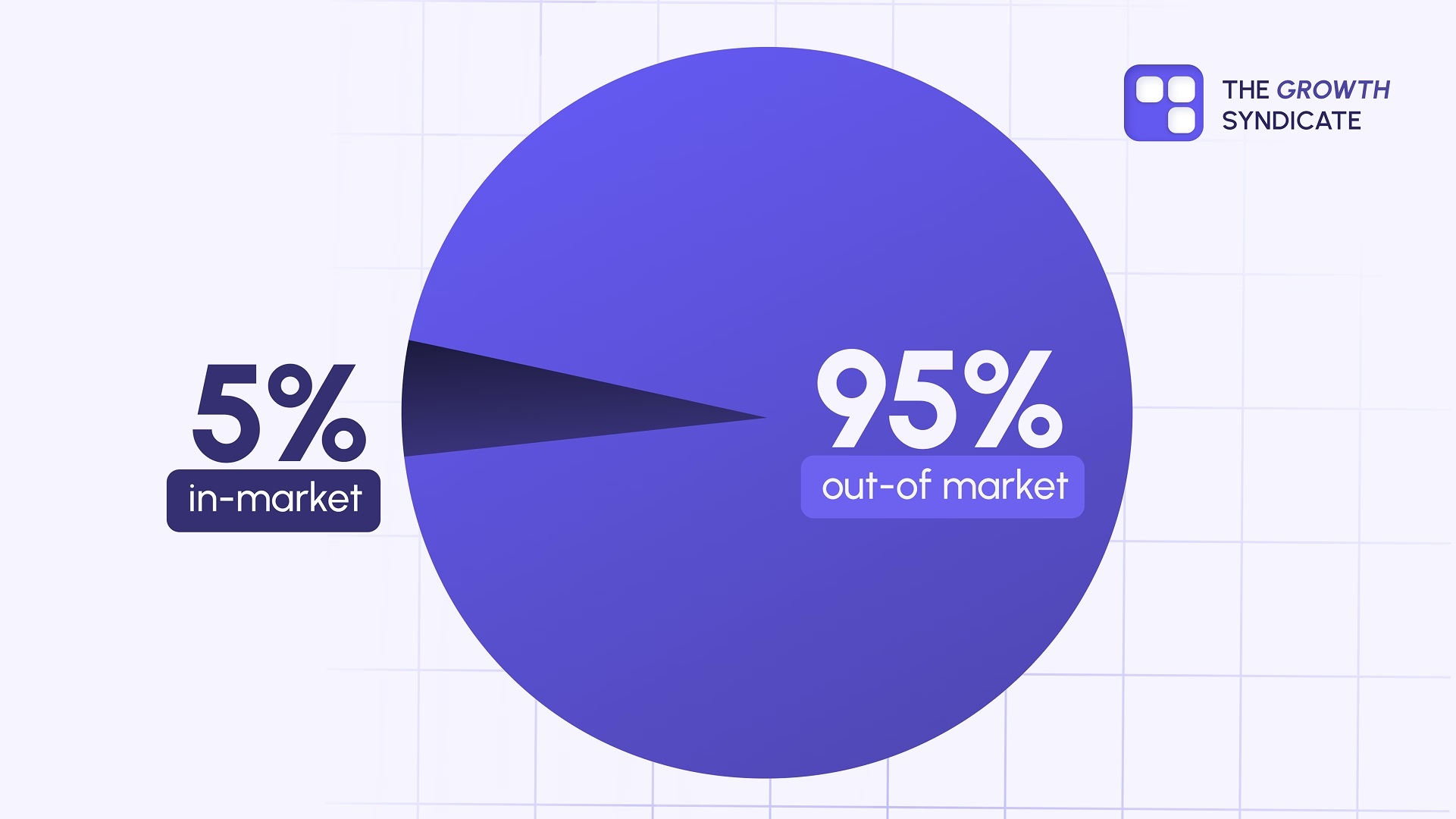
Most marketing efforts focus exclusively on that small in-market segment through demand capture tactics: Google Ads for high-intent keywords, outbound to companies showing buying signals, retargeting website visitors. These tactics matter, but they ignore the vast majority of your addressable market.
The companies that dominate buyer shortlists invest in long-term positioning and demand generation. As Clément Dumont, co-founder at The Growth Syndicate, explains: "Those companies have been doing a really good job at the branding, at the demand generation part. When someone is ready to buy, they already have three companies in mind. They're not going to check anything else."
Effective market positioning ensures you're already on that shortlist when buying intent emerges.
The five pillars of an effective positioning strategy
An effective positioning strategy rests on five essential pillars. Miss any one, and your market positioning becomes weak or unclear.
1. Target audience definition
Everything starts with knowing exactly who you're trying to reach. Your target audience isn't "everyone who might buy." It's the specific customer segment where you can deliver the most value and win consistently.
A well-defined target market includes firmographic criteria (company size, industry, geography), behavioral signals (technologies used, growth stage, recent events), and psychographic elements (decision-making style, risk tolerance, values alignment).
Creating distinct customer personas helps translate this definition into actionable understanding. What problems keep your target customer awake at night? What triggers their buying process? Where do they go for information? Who influences their decisions?
2. Market category
What business are you in? This sounds obvious but isn't. Your market category shapes how potential customers understand you before they ever visit your website.
If you're a new CRM, you're competing with Salesforce, HubSpot, and Pipedrive—established players with massive brand recognition. But if you're "the CRM for real estate teams," you've created a category where you can become the incumbent.
"Niching down is basically being the incumbent for a niche," explains Goetzen. This reframes category strategy from a defensive limitation to an offensive play for category leadership.
3. Unique value proposition
Your unique value proposition answers a simple question: why should customers choose you over the alternatives? It's the promise you make about the specific benefits your product or service delivers.
A strong positioning promise is specific (not generic claims like "best-in-class"), relevant (addresses problems your target audience actually has), and differentiated (something competitors can't easily claim).
Your unique value proposition isn't your tagline. It's the core truth that your tagline tries to capture. It should influence everything from product development to sales conversations to customer service interactions.
4. Proof points
Claims without evidence are just marketing noise. Proof points make your positioning credible—especially important when you're making bold differentiation claims.
Effective proof points include customer testimonials and case studies, performance metrics and data, industry recognition and awards, certifications and partnerships, and track record (years in business, customers served, projects completed).
The best proof points directly support your unique selling points. If you claim fastest implementation, show average deployment times. If you claim best customer support, show satisfaction scores and response times.
5. Competitive frame of reference
In complex B2B companies, different departments possess deep but disconnected knowledge. Sales knows customer pain points. Product knows technical capabilities. Customer success knows retention drivers. But no single function connects these insights into coherent positioning and messaging.
As Dumont describes it: "Marketing doesn't need to be the deepest technical expert but must facilitate strategic alignment. Different departments have their thoughts, their ideas, their technicities, but it's not linked together. Marketing has to be the shepherd that brings everything together into cohesive ICP, positioning, and messaging that aligns all departments."
This shepherd role, which includes facilitating cross-functional strategy workshops, synthesizing distributed knowledge into unified positioning, and ensuring all departments align on target audience and core messaging often delivers more business impact than any individual marketing campaign.
These pillars work together as a cascading system each layer strengthening the one below it until your positioning becomes unassailable.
.avif)
Developing your positioning statement
A positioning statement is an internal document that crystallizes your market positioning into a clear, memorable formula. It's not customer-facing copy—it's the strategic foundation that guides all customer-facing communication.
The positioning statement framework
A compelling positioning statement follows this structure:
For [target market], who [need or opportunity], [brand] is a [market category] that [key benefit/unique value proposition]. Unlike [competitor or alternative], we [key differentiator with proof point].
This framework forces clarity on every essential element: who you serve, what category you compete in, what benefit you deliver, and why you're different from alternatives.
How your brand positioning statement connects to your core promise
Your brand positioning statement defines your strategic territory. Your core promise describes what you'll do to deliver on that positioning. Messaging then translates both into specific language for different target segments and customer interactions.
These three elements should align perfectly. When they don't—when your messaging promises something your positioning doesn't support—customers experience a disconnect that erodes trust.
Types of market positioning strategies
Different types of positioning strategies suit different market conditions and competitive landscapes. Your messaging positioning should align with whichever approach you choose. Here are the main approaches.
.avif)
Quality-based positioning
Premium brand positioning focuses on superior quality, craftsmanship, or performance. Apple positions itself as a premium brand focusing on user experience and innovation, justifying higher price points through perceived quality and brand prestige.
This strategy works when your target audience values quality over price and you can deliver a noticeably superior experience.
Price-based positioning
Walmart positions itself as a budget-friendly option, helping consumers "Save Money, Live Better." Price-based positioning builds market share through accessibility but requires operational efficiency to maintain margins.
Feature or benefit positioning
Tesla is positioned as the leader in the electric vehicle industry, focusing on cutting-edge technology, innovation, and sustainability. Feature positioning and product positioning work when you have genuine differentiation that competitors can't easily replicate. This approach requires strong product marketing to communicate technical advantages to prospective customers in terms they understand and value.
Use case or application positioning
Bumble positioned itself as a dating app that empowers women by allowing only female users to initiate contact. This positioning created a unique identity through a specific use case, attracting a target audience underserved by existing alternatives.
Niche market positioning
Mission Mountain Winery has positioned itself as a niche brand selling small batches of wine with local flavors. Hyper-niche positioning trades total market size for category dominance within a specific market segment.
Values-based positioning
Patagonia differentiates itself by positioning as a climate-conscious brand that promotes sustainability. When brand values align with customer core values, the result is enhanced customer loyalty and brand recognition that transcends product features. Values-based positioning builds a loyal customer base and drives repeat purchases through emotional connection rather than just functional benefits.
.avif)
Building your market positioning strategy step by step
Step 1. Understand your current market position
Before you can improve your positioning, you need to understand where you stand today. How do customers currently perceive your brand? What position does your brand occupy in the market relative to competing brands? This requires extensive research to gain insights into current perceptions.
Methods for assessing current market position include customer interviews and surveys (how do customers describe you to others?), sales call analysis (what objections come up? what competitors get mentioned?), win/loss analysis (why do deals close or fail?), brand tracking surveys (aided and unaided awareness, perception attributes), and share of voice monitoring (how often are you mentioned versus competitors?).
Step 2. Conduct competitor positioning analysis
Map how competitors are positioning their brands across key dimensions. Identify competitor positioning strategies, their claimed territories, their proof points, and gaps they've left open. Study how successfully positioned competitors built their market share over time.
Look for positioning opportunities where customer needs are underserved, where competitor claims are weak or unsupported, and where market trends create new positioning possibilities.
Step 3. Identify your unique selling points
What genuinely sets you apart? This requires honest assessment. Many companies claim differentiation that customers don't actually experience in their brand's products.
True differentiation for effective product positioning might come from product capabilities competitors lack, specialized expertise in a specific industry or use case, superior service or support model, proprietary technology or methodology, or customer outcomes and results competitors can't match.
Step 4. Define your target market precisely
Effective market positioning requires choosing who you're not trying to reach. The discomfort of narrowing is actually the signal—if defining your target market doesn't force hard choices, you probably haven't defined it narrowly enough.
Your ideal customer profile should specify firmographic criteria, behavioral signals, and qualification requirements. It should also include disqualification criteria: knowing which prospects will never close, no matter how good your sales team is, saves everyone time.
Step 5. Develop your positioning statement
Synthesize your research into a clear positioning statement using the framework above. Companies with well-developed positioning statements test them against these criteria: Is it true? Can you deliver on the promise? Is it differentiated? Would a competitor struggle to make the same claim? Is it relevant? Does your target audience care? Is it credible? Do you have proof points to support it?
Step 6. Create your messaging architecture
Translate your positioning into messaging for different audiences, channels, and stages of the customer journey. Your messaging architecture should include core narrative (the overarching story that explains your positioning), audience-specific messaging (tailored for different target segments), feature-benefit mapping (connecting product capabilities to customer outcomes), and proof point library (organized evidence supporting your claims).
Step 7. Align organizational touchpoints
Positioning only works when every customer interaction reinforces the same message. This means aligning sales conversations and collateral, customer service interactions, product experience and onboarding, marketing campaigns and content, visual identity and brand expression, and pricing and packaging decisions.
Consistency across all marketing touchpoints can increase revenue by up to 23%. But inconsistency undermines credibility—the customer experience must match the positioning promise.
Making marketing the strategy integrator
In complex B2B companies, different departments possess deep but disconnected knowledge. Sales knows customer pain points. Product knows technical capabilities. Customer success knows retention drivers. But no single function connects these insights into coherent positioning and messaging.
This is where marketing can drive disproportionate strategic value. As Dumont describes it: "Marketing doesn't need to be the deepest technical expert but must facilitate strategic alignment. Different departments have their thoughts, their ideas, their technicities, but it's not linked together. Marketing has to be the shepherd that brings everything together into cohesive ICP, positioning, and messaging that aligns all departments."
This shepherd role—facilitating cross-functional strategy workshops, synthesizing distributed knowledge into unified positioning, and ensuring all departments align on target audience and core messaging—often delivers more business impact than any individual marketing campaign.
Monitoring and refining your positioning strategy
Market positioning isn't a one-time exercise. Markets shift. Competitors evolve. Customer preferences change. Your positioning strategy should evolve accordingly through continuous monitoring and refinement.
Tracking market positioning effectiveness
Key metrics for monitoring positioning include brand awareness (unaided and aided recall in target market), brand perception scores (tracking whether you're associated with intended attributes), share of voice (mentions relative to competitors), message recall (do customers remember your key differentiators?), sales cycle analysis (are better-fit prospects finding you?), and price sensitivity (can you maintain premium pricing?).
Use tools like Google Trends, Statista, and brand tracking platforms to monitor market trends and competitive shifts. But also maintain close feedback loops with sales and customer success, they're often first to notice when positioning needs adjustment.
When to revise your positioning
Signs that positioning revision may be needed include declining brand recognition despite marketing efforts, increasing price pressure in deals you should win, competitors successfully claiming your differentiation territory, customer feedback that doesn't match your positioning intent, market changes that make your positioning less relevant, and new capabilities that deserve greater prominence.
Real-world positioning examples
Studying how successful companies position themselves provides templates for your own positioning strategy. Here are a few examples of unique positioning executed well—real world examples that demonstrate what effective market positioning looks like in practice.
Coca-Cola is positioned as the ultimate refreshment, leveraging brand heritage and consistent product experience across global markets. The brand's products have maintained remarkably consistent positioning for decades—proof that effective positioning creates lasting competitive advantage.
Nike has successfully positioned itself as a brand that inspires athletes and promotes a healthy lifestyle. Their "Just Do It" positioning transcends product or service features to create emotional connection with their target audience.
Beautycounter positions itself as a leader in environmentally friendly beauty products, setting high standards for safety that competitors in mass-market beauty don't match. This values-based positioning creates strong brand identity and loyal customer base among health-conscious consumers.
Each of these companies demonstrates that effective market positioning is about making strategic choices, and most importantly, sticking with them consistently over time.
Common market positioning mistakes to avoid
Even companies that understand the importance of market positioning make strategic errors that undermine their efforts. Here are the most common pitfalls.
%20(1).avif)
Positioning too broadly. Trying to appeal to everyone means resonating with no one. Your positioning strategy should feel uncomfortably specific. If it applies equally well to competitors, it's not differentiated enough.
Confusing features with benefits. Your product or service might have impressive technical capabilities, but effective market positioning focuses on customer outcomes. What problem does your product or service solve? What result does it enable? Strong product marketing bridges this gap.
Ignoring competitor positioning. Your market positioning only matters relative to alternatives. If you claim the same territory as established competitors without a credible reason to believe you're better, you're fighting an uphill battle.
Inconsistent execution. A brilliant positioning strategy fails when customer experience doesn't match the promise. Every touchpoint—from marketing campaigns to customer service to the product itself—must reinforce the same positioning. Even your launch campaign must align.
Setting and forgetting. Market trends shift. Consumer preferences evolve. Competitor positioning changes. Your positioning strategy needs ongoing attention and periodic refinement based on customer feedback and market research.
From positioning to market leadership
The company that educates the market wins the market. If you're trying to sell to prospects who've been educated by competitors, that's extraordinarily hard. But if you're the one doing the educating, you're in a fundamentally stronger position.
This is why market positioning matters beyond marketing. Clear positioning guides product development priorities. It informs which markets to enter and which to avoid. It shapes hiring decisions and organizational culture. It determines which customers to pursue and which to let competitors have.
In increasingly crowded markets, strategic positioning isn't just a marketing function—it's a business survival skill. The companies that thrive are those willing to make clear positioning choices, commit to them consistently, and invest in building the brand recognition and customer trust that positioning makes possible.
Your effective market positioning strategy starts with understanding where you are today and deciding where you want to compete. The rest—the positioning statement, the messaging, the campaigns—follows from that strategic foundation. Get the foundation right, and marketing becomes dramatically more efficient. Get it wrong, and no amount of tactical execution will compensate.

.png)