.svg)


TL;DR: A fractional CMO (fractional Chief Marketing Officer) is a senior-level marketing executive who works with your business on a part-time or contract basis. This cost-effective solution gives startups and mid-sized businesses access to top-tier marketing expertise without the full-time commitment of a permanent hire, typically at 30-50% of a full-time CMO cost.
The marketing leadership gap nobody talks about
Over the years at TGS, we've come across dozens of B2B tech companies that keep running into a similar issue.
Founders know they need senior marketing leadership, but they're caught in an impossible bind. A full-time CMO costs €200,000+ annually and requires a leap of faith. A junior marketing hire lacks the strategic depth to drive real business growth. And doing nothing means watching competitors capture market share while you figure it out.
The fractional CMO model emerged precisely to solve this tension, but most content about it reads like a job description rather than a strategic framework for thinking about marketing leadership. Let's fix that.
A fractional CMO (Chief Marketing Officer) is an experienced marketing professional who provides senior-level marketing leadership on a part-time, contract basis, or interim arrangement. Unlike a full-time CMO working exclusively for one company, a fractional CMO typically serves multiple clients simultaneously. This isn't a limitation—it's actually the source of their unique value. They bring a fresh perspective and diverse industry knowledge that comes from pattern-matching across different business contexts.
The fractional CMO model has gained significant traction among B2B tech companies that need strategic marketing leadership but aren't ready for the full-time cost and commitment of a permanent hire. These experienced marketing professionals bring proven track records from leading marketing teams across various industries, allowing them to hit the ground running and implement strategies that drive measurable results.
But there's a deeper advantage that rarely gets discussed. I've had conversations with Joliene, my co-founder at The Growth Syndicate, about this extensively. Her perspective on fractional engagements comes from years of building and advising marketing teams, and she frames it as a risk mitigation play rather than a cost savings exercise.
"With a fractional it's actually easier to test because you're not really stuck to hiring. A lot of times founders don't know what they are looking for when they start hiring people, and they hire a marketing team that—even though maybe a good CMO—is not the right CMO for their business." Joliene, Co-founder at The Growth Syndicate
As a result, when you think about fractional CMO services as a testing mechanism rather than a budget compromise, the entire decision calculus changes.
What does strategic marketing leadership actually look like?
The question "what does a fractional CMO do?" typically gets answered with a list of responsibilities like strategy, branding, demand generation, team management. That's accurate to an extent, but incomplete.
The more useful question is: what does marketing leadership look like when it's working well?
A fractional CMO performs the same strategic responsibilities as a full-time CMO but with heightened focus on rapid value delivery. They must quickly understand your business objectives, identify growth opportunities, and build marketing infrastructure that supports sustainable growth. The best fractional CMOs combine visionary leadership with hands-on execution capabilities.
The integration challenge most companies miss
In complex B2B companies, knowledge is fragmented. Sales knows customer pain points intimately. Product understands technical capabilities. Customer success sees retention patterns. But rarely does anyone connect these insights into coherent go-to-market strategy.
This is where marketing leadership (fractional or not) should add unique value. Not as another siloed function, but as the connective tissue that synthesizes distributed knowledge into unified positioning and messaging.
We started calling this the "shepherd" role at The Growth Syndicate.
"Marketing doesn't need to be the deepest technical expert, but must facilitate strategic alignment. Different departments have their thoughts, their ideas, their technicalities—but it's not linked together. Marketing has to be the shepherd that brings everything together into cohesive ICP, positioning, and messaging that aligns all departments." Clement, Co-founder at The Growth Syndicate
When I work with B2B tech companies, this integration function often delivers more value than any individual marketing campaign. A fractional CMO who facilitates cross-functional strategy workshops—bringing sales, product, and customer success together to define ICP and messaging—creates alignment that persists long after the engagement ends.
Brand strategy as business strategy
A good fractional CMO quickly recognizes whether your brand positioning is helping or hindering business growth. They refine your brand identity, value proposition, and messaging architecture to ensure optimal engagement with your target audience. This includes developing content strategy frameworks that resonate with prospective clients throughout the customer journey.
But brand strategy isn't about logos and taglines. It's about making strategic choices that inform everything from pricing to sales conversations to product roadmap priorities. The best marketing leaders I know treat positioning as the foundation for business strategy, not a downstream marketing exercise.
The demand generation paradox
Effective demand generation requires balancing short-term results with long-term brand building, and this is where most B2B marketing goes wrong.
Fractional CMOs bring expertise in both demand capture (reaching the 5% actively in-market) and demand generation (building awareness with the 95% who will eventually buy). They oversee marketing campaigns across channels including content marketing, paid media, and digital marketing to drive business growth.
Most companies focus their entire marketing budget on the small percentage of buyers actively looking for solutions right now. The logic seems sound: why invest in people who aren't buying? But this creates a dangerous vulnerability.
"Most B2B marketing focuses exclusively on demand capture—ads, outbound—while ignoring that 90-95% of potential clients are not currently in market. The companies that dominate buyer shortlists invest in long-term demand generation so when intent emerges, they're already familiar." Clement, Co-founder at The Growth Syndicate
Think about your own buying behavior. When you need a CRM, you probably already have three vendors in mind before you start "researching." Those companies earned their spot on your mental shortlist through years of brand building—content you consumed, people you followed, recommendations from peers. A fractional CMO brings the strategic discipline to balance these competing priorities—capturing today's demand while building tomorrow's pipeline.
Beyond strategy: Team leadership and organizational development
Beyond strategy, fractional CMOs excel at team leadership and team development. They guide in-house marketing teams, manage relationships with external agencies, and collaborate across sales, product, and customer success departments. This cross-functional alignment ensures marketing efforts connect to measurable business outcomes rather than vanity metrics.
The organizational development aspect often gets undervalued. A good fractional CMO doesn't just set strategy, they build capability. They mentor junior team members, establish processes that scale, and create frameworks your team can execute independently. The goal should be building marketing leadership capability, not dependency.
Specialized knowledge and pattern recognition
While fractional CMOs are often marketing generalists, many bring specialized industry knowledge in areas like B2B SaaS, demand generation, digital marketing, or market expansion. This expertise allows them to challenge assumptions, introduce innovative solutions, and accelerate time-to-value based on what's worked across multiple companies.
The pattern recognition advantage is significant. Someone who's seen twenty B2B SaaS companies navigate the €1M to €10M growth stage has context that no amount of theory can replicate. They've watched certain approaches fail repeatedly and others succeed consistently. That experiential knowledge compresses your learning curve dramatically.
The CMO matching problem: Why "good" isn't good enough
Here's where most fractional CMO content falls short: it assumes you know what you need. In practice, one of the most common hiring mistakes is bringing in a "good CMO" who turns out to be the wrong type of CMO for your specific business model, audience, and stage.
Joliene and I have discussed this extensively, and she's developed a framework that I find genuinely useful for thinking through the matching problem.
Many CMO failures aren't talent problems—they're type mismatches. A brilliant brand marketer will struggle in a deeply technical B2B environment, just as a process-oriented operator will flounder in an early-stage company that needs creative experimentation. Before you hire a fractional CMO, you need to understand which archetype matches your business needs.
The three CMO archetypes
The consequences of a type mismatch can be severe—not just wasted budget, but months of lost momentum and team confusion. Joliene shared an example that illustrates this vividly:
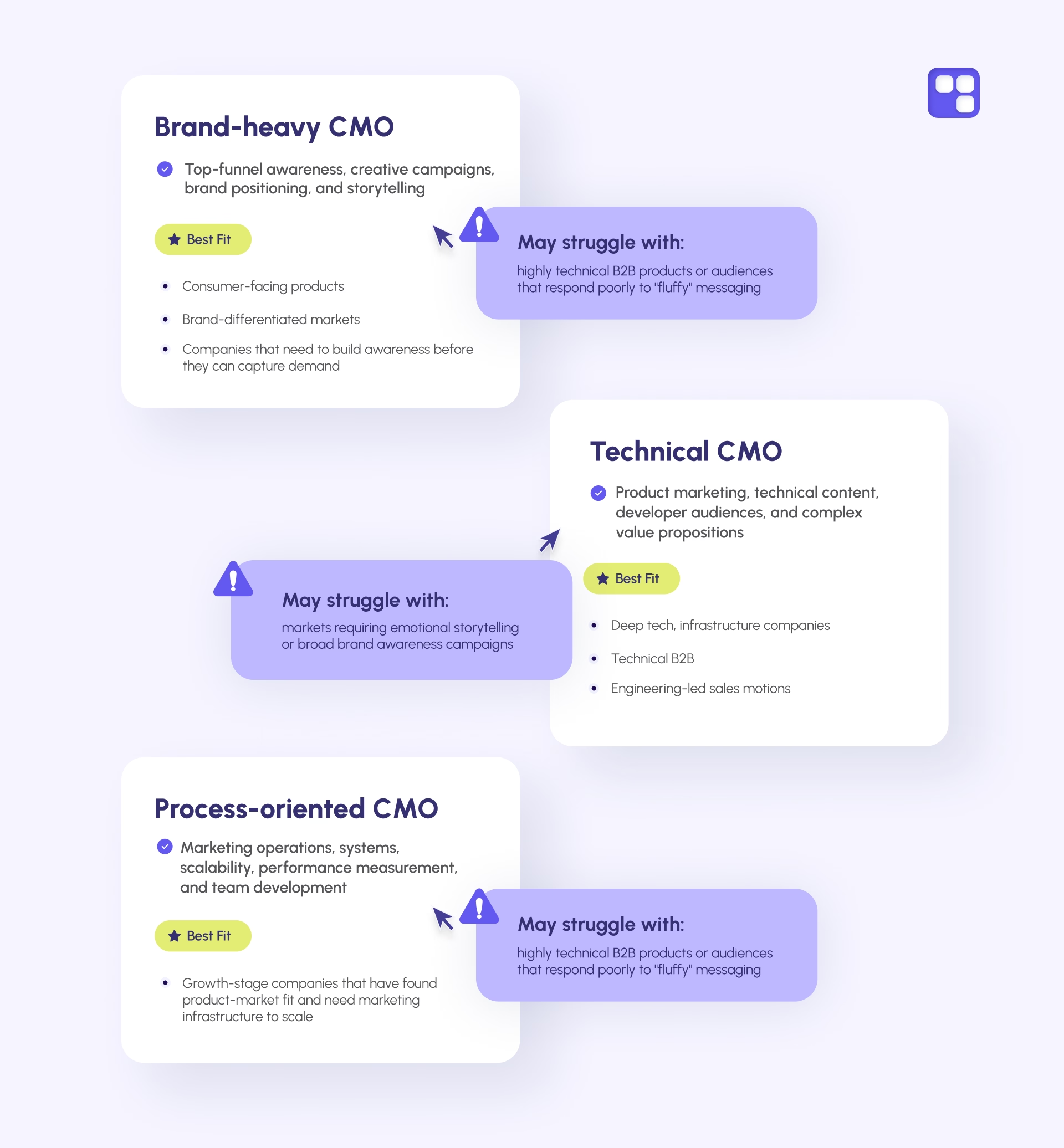
"We had a very brand-heavy marketer, but the audience was very technical and the product was very technical. There was a massive mismatch because the content was very fluffy, very top funnel, but it didn't resonate at all with the audience." Joliene, Co-founder at The Growth Syndicate
Warning sign to watch for: If your fractional CMO's content doesn't resonate with your actual buyers within 60 days, you likely have a type mismatch—not a talent problem. The fix isn't to push harder on execution; it's to reconsider whether you have the right archetype for your context.
Diagnosing your marketing leadership needs
A fractional CMO is ideal when you need senior marketing leadership but aren't ready—financially or strategically—for a permanent hire. This makes fractional CMO services especially valuable for startups, mid-sized businesses, and companies in transition who need marketing expertise to achieve specific business goals.
Scenarios where fractional leadership makes strategic sense
Growth challenges: Whether you're stagnating or struggling to scale during rapid growth, a fractional CMO identifies effective growth levers and implements proven marketing strategies. They've likely seen your specific challenge before and can compress months of experimentation into weeks of focused execution.
New market or product launch: Building a go-to-market strategy for new markets requires specialized expertise in positioning, messaging, and target audience identification. A fractional CMO brings frameworks they've refined across multiple launches.
Lack of executive expertise: If there's no in-house marketing team leadership or you're undergoing M&A, a fractional CMO provides stability during transition. They can hold the strategic function while you figure out your long-term structure.
Need for quick impact: Businesses facing time constraints with major projects need someone who can hit the ground running and implement strategies immediately. The fractional model's compressed timeline creates urgency that often produces faster results than traditional engagements.
Rebranding or repositioning: Fractional CMOs bring fresh perspectives and proven experience in appealing to new audiences while minimizing disruption. They're not attached to your historical positioning, which makes them more willing to challenge assumptions.
Marketing audit: Top-tier fractional CMOs can instantly recognize effective vs. ineffective marketing and formulate a marketing plan to support revenue goals. Pattern recognition from multiple contexts allows them to diagnose issues quickly.
The three dysfunction patterns
Based on working with hundreds of B2B companies, we've identified three recurring dysfunction patterns that signal you need marketing leadership support. These patterns emerged from countless conversations with founders, and Joliene articulated them in a way that I think captures the underlying dynamics precisely.
These patterns often compound—a wrong hire leads to isolation, which leads to poor performance in a downward spiral. A fractional CMO can break this cycle by providing clarity on what good marketing leadership actually looks like for your specific situation.
Fractional CMO vs. marketing agency: A framework for choosing
While both fractional CMOs and marketing agencies provide marketing services, they serve fundamentally different purposes. The confusion between them leads to mismatched expectations and frustrated engagements.
Fractional CMOs operate like internal executives—attending leadership meetings, collaborating with sales and product teams, and building valuable relationships across the organization. Marketing agencies, while valuable for specific execution tasks, don't provide the same strategic depth or organizational integration.
The practical implication: many companies benefit from both. A fractional CMO to set strategy and lead marketing initiatives, with specialized agencies executing specific marketing campaigns under the CMO's direction. The fractional CMO becomes the strategic layer that agencies often lack.
The economics of fractional marketing leadership
Fractional CMO cost varies based on experience level, industry expertise, scope of work, and time commitment. The flexible arrangement allows you to scale marketing leadership to match your marketing budget and business needs.
Typical pricing structures
Hourly rates: €200–€500 per hour for senior-level marketing executive expertise. This model works well for advisory-heavy engagements or companies with unpredictable needs.
Monthly retainers: €5,000–€15,000 per month depending on hours and scope. This provides more predictable budgeting and typically includes a mix of strategic and operational involvement.
Project-based: Custom pricing for specific marketing initiatives or go-to-market strategy development. Useful when you have discrete challenges rather than ongoing leadership needs.
The real cost comparison
While the hourly rate may seem significant, the cost effectiveness becomes clear when compared to a full-time CMO cost. A permanent hire at the CMO level typically exceeds €200,000 annually in total compensation, plus benefits, equity, and the risk of a poor fit.
The fractional model delivers a cost-effective solution because you're paying only for the hours you need. For many growing businesses, 10-20 hours per month of top-tier marketing expertise delivers more value than a full-time commitment from a less experienced marketing leader.
But the financial calculation shouldn't stop at compensation comparison. Consider the risk-adjusted value: with a fractional engagement, you can test fit without the severance costs, cultural disruption, and lost time of a failed full-time hire. When you factor in the probability of hiring mistakes—which industry data suggests is substantial for executive roles—the fractional model's risk profile often makes it the economically superior choice even at higher hourly rates.
A framework for hiring well
Finding the right fractional CMO requires clarity on your needs and thorough evaluation of candidates' track records. Here's a systematic approach:
1. Define your business objectives first. Before starting your search, establish the specific marketing goals and challenges you need addressed. This clarity helps identify which type of marketing expert matches your needs. Vague briefs produce vague results.
2. Evaluate industry knowledge and track record. Marketing for a B2B SaaS company differs significantly from a consumer brand. Look for demonstrated results in your industry or with similar business models. Ask for concrete examples of measurable growth they've driven—not activities completed, but outcomes achieved.
3. Assess the CEO-CMO partnership potential. Marketing success requires bidirectional responsibility—it's not enough to hire a great CMO and hope for the best. More on this below.
4. Look for communication and leadership style fit. A fractional CMO must get buy-in from management, align with sales, and rally teams. Evaluate their ability to communicate complex strategies simply and build valuable relationships quickly.
5. Clarify the working arrangement. Define expected hours, contract basis, deliverables, and how success will be measured. The best fractional CMO relationships have clear expectations around scope, timeline, and business outcomes.
6. Tap into professional networks. Referrals from trusted connections often surface the best candidates. Fractional CMO jobs attract experienced professionals who build reputations through results, not job postings.
The partnership model that actually works
Hiring the right person is only half the equation. The relationship between CEO and CMO determines whether marketing succeeds or fails—and both parties share responsibility for making it work.
This is something Joliene feels strongly about, and I've come to share her conviction after watching the pattern play out repeatedly.
"Good marketing outcomes come from both CEOs and CMOs that are proactive. The CEO is proactive in including the CMO at the table. And the CMO needs to want to be at the table. The CEO should be the champion of the CMO you're bringing in because they need to get power of attorney to do stuff. The CEO needs to really embed the CMO into the organization." Joliene, Co-founder at The Growth Syndicate
The practical implications are significant. When onboarding a fractional CMO, the CEO should introduce them in all-hands meetings, include them in strategic planning sessions, and publicly delegate marketing authority. The CMO, in turn, must actively seek involvement and demonstrate commercial value rather than waiting to be invited.
Warning sign: If marketing still operates in a silo after 90 days, either the CEO hasn't championed the CMO or the CMO hasn't pushed for integration. Both parties share responsibility for driving sustainable growth.
The CEO-CMO partnership model
Marketing success isn't just about hiring the right CMO—it's about building a partnership where both parties actively contribute. When either side fails to uphold their responsibilities, marketing remains siloed and underperforms. Use this framework to evaluate whether both you and your fractional CMO are doing your part.
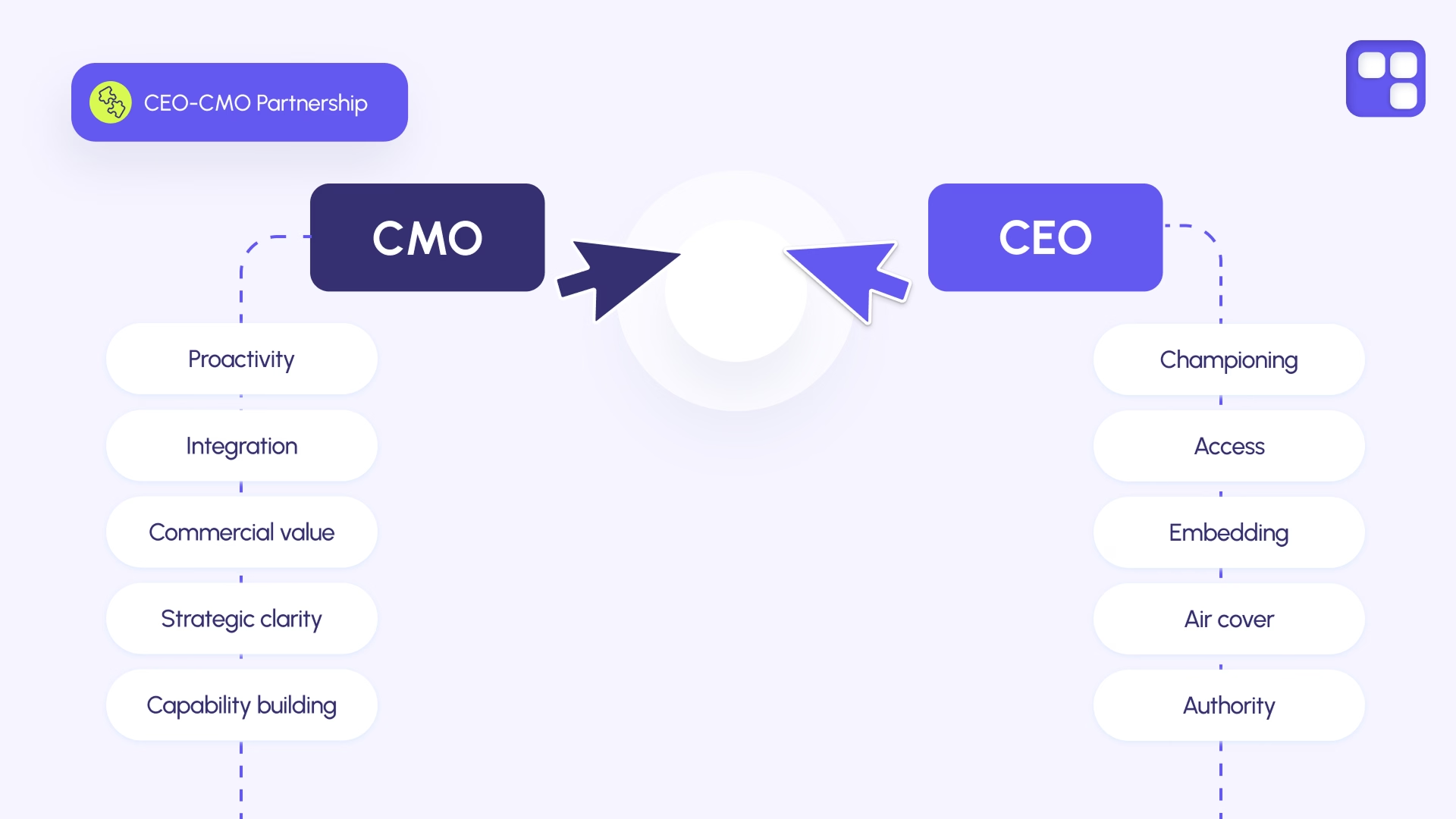
The 90-day litmus test: If marketing still operates in a silo after 90 days, one or both parties haven't fulfilled their responsibilities. Diagnose which side needs to step up before assuming the partnership isn't working.
The B2B tech context: Why this matters now
Fractional CMO services are increasingly in demand among B2B tech companies, and the reasons extend beyond cost optimization. In fast-paced, crowded markets like SaaS, an experienced marketing professional with industry expertise can build marketing strategies that differentiate your business and attract high-quality potential clients.
B2B tech companies face unique marketing challenges that require specialized knowledge:
- Complex products requiring technical content marketing that actually resonates with sophisticated buyers
- Long sales cycles demanding sophisticated demand generation across multiple touchpoints
- Multiple stakeholders involved in purchase decisions, each with different information needs
- Need to balance brand building with performance marketing under investor scrutiny
- Expansion into new markets requiring localized go-to-market strategy
A fractional CMO brings fresh perspectives from working across multiple companies, helping you challenge assumptions and implement innovative solutions that drive growth. They've seen what works—and what doesn't—across different business stages, making them uniquely positioned to accelerate your marketing maturity.
Our approach at The Growth Syndicate
At The Growth Syndicate, our team of proven marketing experts is laser-focused on helping B2B tech companies grow from €1M to €100M in revenue through tried-and-tested growth strategies, including fractional CMO services.
Our tailored approach provides quick impact while ensuring you scale sustainably. Unlike traditional fractional CMO roles that continue indefinitely, our goal is to make ourselves obsolete within 3-9 months, leaving you with a solid foundation, clear marketing plan, and the capability to drive growth independently.
We focus on building marketing leadership capability, not dependency. That means developing your in-house teams, establishing scalable processes, and creating the strategic clarity your organization needs for long-term success.
If you're a B2B tech company seeking fractional CMO services from proven B2B marketing experts, get in touch today.
Frequently asked questions about fractional CMOs
How many hours per week does a fractional CMO typically work?
Most fractional CMO engagements range from 10-20 hours per week, though this varies based on business needs. Some companies start with more intensive involvement during strategy development, then transition to lighter ongoing support. The flexible contract basis allows you to scale up or down as marketing initiatives evolve.
Can a fractional CMO work with my existing marketing team?
Absolutely—and this is often ideal. Fractional CMOs excel at leading marketing teams, providing strategic direction while your in-house marketing team handles day-to-day execution. They bring team development expertise, helping elevate your existing talent through mentorship and process improvement.
What's the difference between a fractional CMO and a marketing consultant?
A marketing consultant typically advises from the outside and delivers recommendations. A fractional CMO functions as part of your executive team—attending leadership meetings, making decisions, and driving implementation. They're accountable for business outcomes, not just deliverables. The fractional CMO model embeds marketing leadership into your organization rather than providing external advice.
How quickly can a fractional CMO make an impact?
Experienced fractional CMOs typically deliver initial strategic recommendations within the first 2-4 weeks after conducting stakeholder interviews and marketing audits. Measurable results from implemented strategies usually emerge within 60-90 days, though this depends on your starting point and the complexity of marketing initiatives required.
When should I transition from a fractional CMO to a full-time hire?
Consider a permanent hire when you have consistent, full-time marketing leadership needs—typically when your marketing budget supports a dedicated executive and your company has grown beyond the startup stage. A good fractional CMO helps you understand what type of full-time CMO you need and can even assist in hiring and onboarding your permanent marketing leadership.
.png)