.svg)
Selling into a market you can count?
TGS runs account-based programs for health tech companies with finite buyer lists. Rapid Circle closed more than ten enterprise deals on this model.
Book a free strategy session
Depending on whose definition you accept, digital health is a $199 billion market or a $946 billion one. That spread is the first thing worth knowing about this sector: nobody agrees on where it starts and ends, and most of the marketing advice written for it inherits the confusion.
This report covers which health tech you are actually in, who buys there, what counts as proof, which channels work for which buyers, and why so much marketing in this sector says nothing. It was built from six practitioner interviews and three rounds of desk research.
Almost everything written about health tech marketing comes from vendors and agencies pitching the sector. Very little comes from people who have been on the hook for revenue inside it. The advice that results tends to collapse into one suggestion: "Healthcare is slow and heavily regulated, so be patient and build trust."
True, but also close to useless. It explains nothing about why one company's LinkedIn campaign books more meetings than its sales team can handle while another's sinks without a trace, or why a product with paying users and demonstrable results cannot get a clinic to return an email.
So we went looking for people who had done the work.
What they told us kept returning to two themes, and both run through everything that follows.
The first came from Marcel Alberti, who spent a decade at Philips in medical imaging before co-founding a generative AI company for hospitals. Marcel mentioned it unprompted and then asked us to put it in the report. "Health tech is not one industry in a sense."
It's an industry label stretched across markets that share a sector and very little else. The buyers have almost nothing in common. What counts as evidence shifts from one segment to the next. And the channels diverge so completely that a tactic booking more meetings than one company can handle will produce silence for the company down the road. Sales cycles run from two weeks to five years inside the same three-word category.
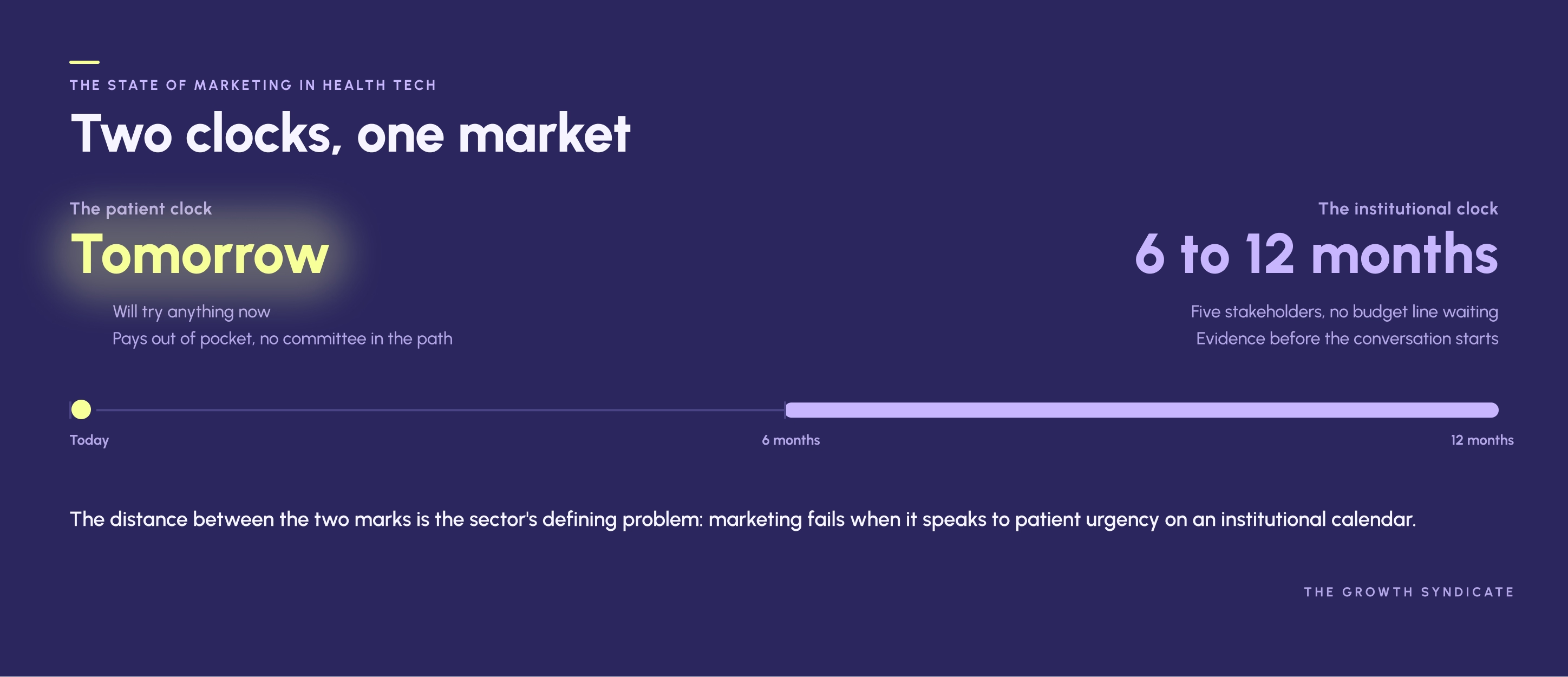
The second came from Nemanja Stamenovic, Head of AI at Empedoc Labs, whose product predicts migraine attacks a day or two ahead from Apple Watch data. People who get migraines, he says, will try anything tomorrow: "the easiest audience I've ever marketed to."
The clinics and wellness platforms serving those same people run on six-to-twelve month cycles, answer to five stakeholders, and have no budget line waiting for him. So the way we see it, health tech operates on two clocks, running at different speeds. His summary of what that does to a marketing function was the most useful sentence anyone gave us:

"Most health tech marketing fails because it speaks to the patient's urgency while selling on the institution's calendar."

This report draws on six practitioner interviews conducted between May and June 2026, checked against three rounds of desk research across the regulated and unregulated ends of the sector.
Internally, we interviewed:
Externally, we interviewed:
Between them they cover regulated devices, pharma, hospital AI, health IT, biotech, and a consumer subscription business currently crossing into institutional selling. Where they contradicted each other, we left the contradiction in. Some of the more useful passages in this report are two experienced operators disagreeing.
We cross-referenced their observations against data from the OECD, the WHO, the European Commission, the Peterson Health Technology Institute, Gartner, the NHS, Fenin, CMS, and peer-reviewed research in the Journal of Medical Internet Research. None of it is a SaaS playbook relabeled.
In brief: Health tech is a label covering several markets that share little. Two axes locate you: regulated against unregulated, cure against care. Your position on them decides your buyer, your evidence bar, your channels and your cycle length.
Every practical question in health tech marketing (what proves your case, who signs, which channel works, how long it takes) resolves differently depending on where you sit. Two axes do most of that work.
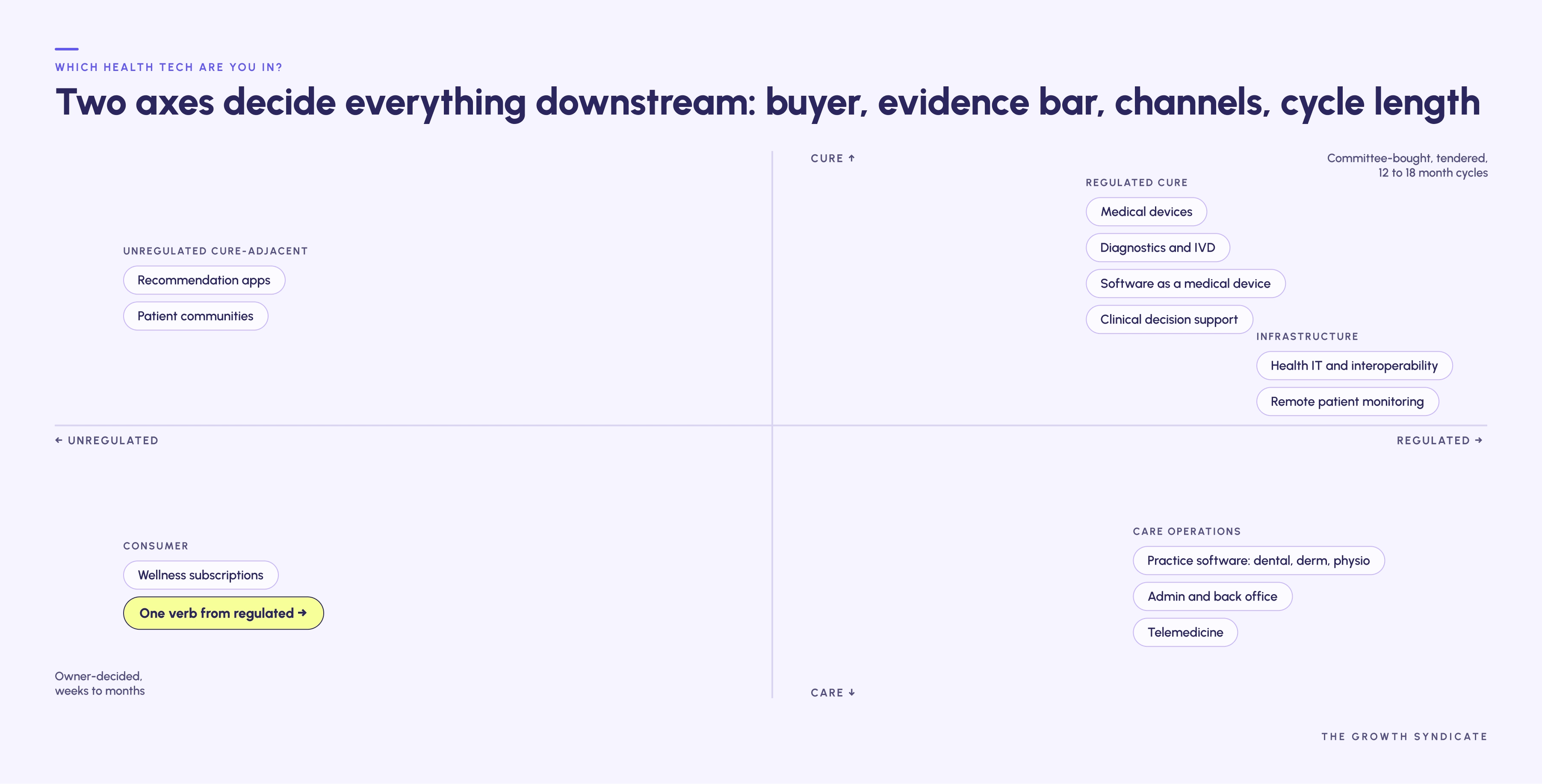
This is the distinction the sector discusses worst, usually because the discussion collapses into a judgment about who is serious. That framing gets the mechanism wrong.
Both ends are real markets, with real companies and real revenue behind them. What separates them is what you must produce before an institution will buy, and that requirement is set by the claim you make, not the technology you build.
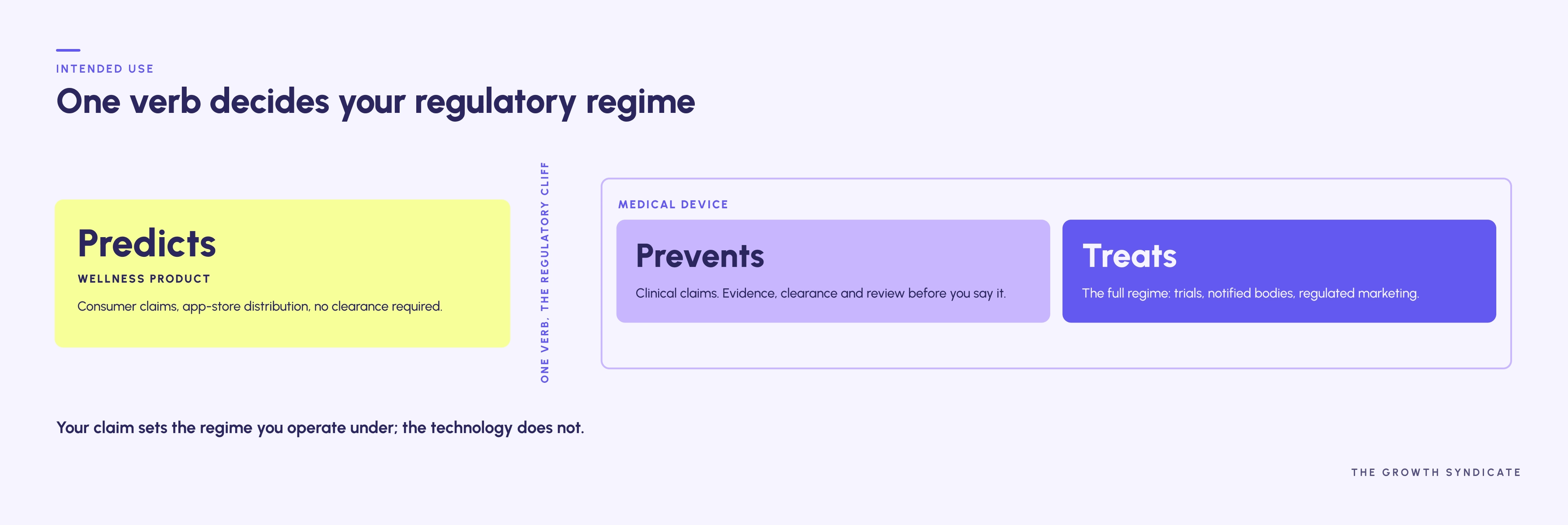
The mechanism is intended use, and it operates at the level of individual verbs. Nemanja Stamenovic, whose product sits deliberately on the wellness side of the line while he builds toward the clinical side, describes the discipline as follows: "'Predicts,' 'prevents' and 'treats' are three different regulatory universes." His company says predicts risk. It does not say prevents, and it does not say treats. "One verb separates a wellness app from a medical device."
Marcel Alberti runs the same logic one level up, at the category instead of the sentence. His company works on hospital administration, staying clear of clinical decisions, and the lighter regulatory weight of that territory is deliberate. Stay in low-risk areas, he says, and adoption is fine.
The barriers on either side of that line are wildly asymmetric. This is a fact about the market, and it carries no verdict about anyone operating in it. James Eisner, who has worked both ends (Dream on the regulated side, Syd on the consumer side), puts entry difficulty at the center of the distinction. Anyone can assemble a health recommendation product from published literature. Very few organizations get a device through the FDA.
What the unregulated end is not required to do: run clinical trials, satisfy a notified body, submit for clearance, or push every marketing asset through medical, legal and regulatory review. The dividend is speed. You can ship in months, iterate weekly, price and distribute through an app store, and reach users without ever meeting a buying committee. Those are substantial advantages, and the regulated end has no access to them.
The cost arrives the moment you sell to an institution, which is where most of the consumer end's revenue actually lives: employers, insurers, wellness platforms, clinics. At that point the freedom becomes a deficit. Here's how Nemanja describes this impasse: "A wellness platform can love the demo, but their client is an employer asking where the ROI proof is, and without outcome data the platform cannot justify the line item. App Store metrics do not count. 'AI-powered' does not count."
The collision is institutional as well as commercial. The Peterson Health Technology Institute, launched in 2023 with a $50 million commitment, publishes assessments of consumer-facing digital health categories against institutional standards. Its March 2024 review of digital diabetes tools concluded they do not deliver meaningful clinical benefits and increase healthcare spending, finding HbA1c reductions of 0.23 to 0.60 percentage points against usual care, mostly below the threshold considered clinically meaningful. Products built to consumer standards now get graded against institutional ones, after the fact, by assessors with no commercial stake. Section 3 covers what that shift means for evidence strategy.
None of which makes the two ends a caste system. They are a choice, and Nemanja Stamenovic is the evidence. He runs an App Store subscription business and has voluntarily adopted the regulated end's standards: a Professor of Neurology as medical advisor, clinical pilots sequenced before any serious B2B push, co-authorship offered to clinics instead of free access. He intends to sell institutionally and knows what that costs. The consumer end can meet the higher bar. It is simply never compelled to, and most of it does not.
Ferdinand Goetzen, co-founder of The Growth Syndicate frames the second axis as the difference between cure and care: the places you go when you are seriously ill, and the places you go for everything else.
Cure is hospitals and acute systems. Largely public in Europe, bought through tenders and value analysis committees, twelve to eighteen months, with clinical evidence and total cost of ownership as the currency.
Care is dentistry, dermatology, aesthetics, physiotherapy, ambulatory surgery. Private, owner-decided, weeks to months, and much closer to conventional B2B SaaS in how it behaves. The buyer is a practice owner or a manager, and the argument is payback per chair or per procedure.
The same product sold into both worlds needs two go-to-market motions, not one message with two logos on the case study. The care side is also growing. The US Centers for Medicare & Medicaid Services finalized the addition of 560 procedures to the ambulatory surgical center covered list for 2026. That transfers significant clinical volume, cardiac ablation and spine cases among it, out of hospitals and into settings with completely different purchasing behavior.
Sub-segments are easy to list and easy to treat as a filing exercise: devices, diagnostics, software as a medical device, health IT and interoperability, clinical decision support, population health, telemedicine, remote monitoring, administrative tooling, consumer.
The reason to bother is what Marcel Alberti said next, once he had made the point about it not being one industry. Every clinical specialty has its own association. Cardiologists have theirs, radiologists have theirs, and that is forty organizations before anyone counts nursing or the support functions. He considers the proliferation one of healthcare's structural problems. For a marketer it decides everything, because channel strategy stops being a question of preference or budget. Which sub-segment you serve determines it, and getting that wrong leaves you absent from the only rooms where your buyers gather.

It's not one industry in that sense.
A note on numbers. The global digital health market is variously sized at $199 billion, $420 billion, and $946 billion depending on which analyst's definition of "digital health" you accept. The European medtech market sits around €170 billion, with Spain fifth-largest at roughly €11.6 billion in sector turnover. Treat all of these as directional. The variance between them is itself evidence of the definitional problem this section describes.
In brief: Every institutional purchase is a committee purchase, and the committee's members answer to nobody in common. A single pharma company behaves like dozens of separate ones. Cycles run from six months to five years, and markets this small make reputation compound in both directions.
Ask a health tech marketer what makes their job hard and the answer is usually regulation. Ask what actually consumed the last eighteen months and it is the buying committee.
Hospital purchases are committee purchases, and the committee is larger than most vendors plan for. Value analysis committees, the cross-functional groups that evaluate and approve new products in US health systems, typically run to somewhere between a dozen and two dozen people, spanning clinicians, supply chain, biomedical engineering, finance, IT security, and increasingly the C-suite.
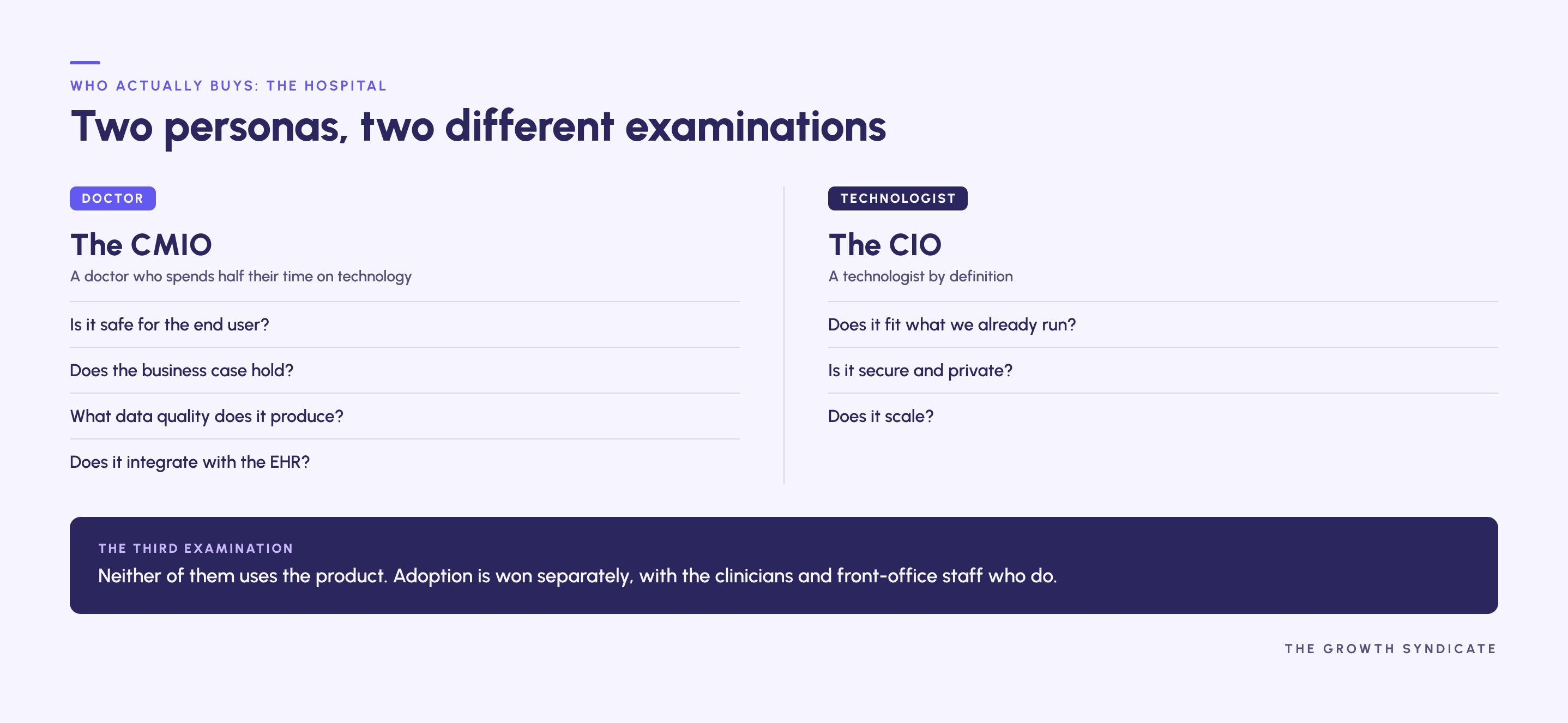
Marcel Alberti sells to two of them specifically. The Chief Medical Information Officer, a doctor who spends roughly half their time on technology, asks whether the thing is safe, what it does for the end user, whether the business case holds, what data quality it produces, and whether it integrates with the electronic health record. The Chief Information Officer asks a different set entirely: does it fit what the hospital already runs, is it secure, is it private, does it scale. Neither of them uses the product. Adoption still has to be won separately with the clinicians and front-office staff who do.
Ysabel Camus's decision-making unit at Fireleaf was comparably wide: chief executive, head of IT, head of data, chief information security officer, and a job title that barely existed a few years ago, head of data interoperability. Sales cycles ran eight to twelve months. Six, she says, was the optimistic case.
Pharma is the most structurally peculiar buyer in health tech, and James Eisner's account of it is the clearest we heard.
The first move is to stop thinking of a pharma company as a company. "It's better to look at a pharma company as a collection of companies within the company," he says, "because they're just so big."
Entry is through the digital health team, usually at global level, sometimes regional, often organized by therapeutic area. Which can mean your entire route into a company the size of Merck runs through three specific people who handle oncology. That team gatekeeps anything resembling new technology. It is also, in James Eisner's description, "taken extremely unseriously by everyone."
Treat that contradiction as an operating principle. A team fighting for internal legitimacy is a team hunting for something worth championing, which makes them reachable in a way a confident, well-resourced function would not be.
But they do not hold the money. Budget sits with the brand or commercial teams, organized by drug and by region. So the digital health team has to pitch your product internally, to people with their own targets, and you have to help them do it. "You actually have to help them pitch internally to the brand team to more or less get the contract."
Two things follow. First, the deal only makes financial sense once three or four regions are on board, so the internal pitch happens repeatedly, in sequence, across geographies. Second, this is why the numbers look the way they do. At Dream, James Eisner's cycles ran from six months to five years: the short ones were fifty to a hundred thousand dollar deals, the long ones ten million a year.
The marketing consequence is easy to miss and expensive to get wrong. Whatever your champion thinks of the product, what they are actually calculating is personal risk. "Essentially, they are putting their career on the line on your product," James Eisner says. In that context a case study functions as risk mitigation for the individual who has to stand up in a room and vouch for you.

"Essentially, they are putting their career on the line on your product."
And occasionally the whole structure bypasses itself. Brand teams sometimes select a vendor without the digital health team ever knowing the conversation happened.
Hospitals and pharma companies are not the only buyers in health tech, and the alternatives have their own physics.
Research institutes and individual academics are the fast lane, and the most underused. James Eisner found younger researchers, early-career PhDs with less to lose and more flexibility, closing in three to six months at ten to thirty thousand dollars, or collaborating free in exchange for proof points. The stakes there are personal, not institutional. Nobody dies from a study on how coffee affects sleep. Larger institutions like the Mayo Clinic revert to pharma behavior: studies, efficacy data, financial justification.
Payers move slowly and want large datasets before committing. Employers move fast and are exhausted. Half of them manage ten or more vendor relationships, benefits teams are tiny, and navigation platforms increasingly stand between vendors and the employer as curators. Chirag Shah of Define Ventures and the analyst Christina Farr have both argued that new point solutions should stay out of the employer channel altogether unless they address a major cost driver.
Government and public systems run on their own machinery: NHS procurement frameworks, CMS innovation models, and in Spain seventeen regional health services with separate tenders, where Fenin has tracked public-sector payment periods to medtech suppliers at 88 to 96 days against a thirty-day legal limit.
One structural fact does most of the work in how trust moves through this market, and it cuts both ways.
"If you think of it in the Netherlands, it's just six universities where all doctors go to," Marcel Alberti says. "So everyone knows everyone." Referral becomes one of the strongest proof mechanisms available. A doctor willing to take a call from another doctor does more than any campaign.
James Eisner's version is starker because his market is smaller still. Roughly fifty pharma companies on the planet matter. Burn a relationship at one of them, by going around the digital health team to the brand team for instance, and you do not get to replace it. "There's only 50 of them, so you don't have a lot of chances to make that back up if you burned a bridge with even one of them."
This effect has been measured. Donohue and colleagues, publishing in PLOS One in 2018, mapped peer networks across nearly 12,000 physicians using shared patients, practice settings and training history, and found that peer adoption strongly predicted individual adoption of new drugs, most strongly among physicians who shared patients. An earlier study of a mobile clinical IT rollout at a community hospital found physicians under the influence of an opinion leader three times more likely to adopt than those outside that influence.
Reputation compounds in a market this small, and mistakes do not wash out. The network carrying your referral carries everything else too.
In brief: A working product is roughly 30% of the job. The rest is proof: peer-reviewed publication, clinical evaluation, certifications, and case studies that get read like studies. App Store metrics carry no weight, and an independent assessor may write the document that decides your category.
In most software categories a working product with paying users constitutes a business. Health tech withholds that.
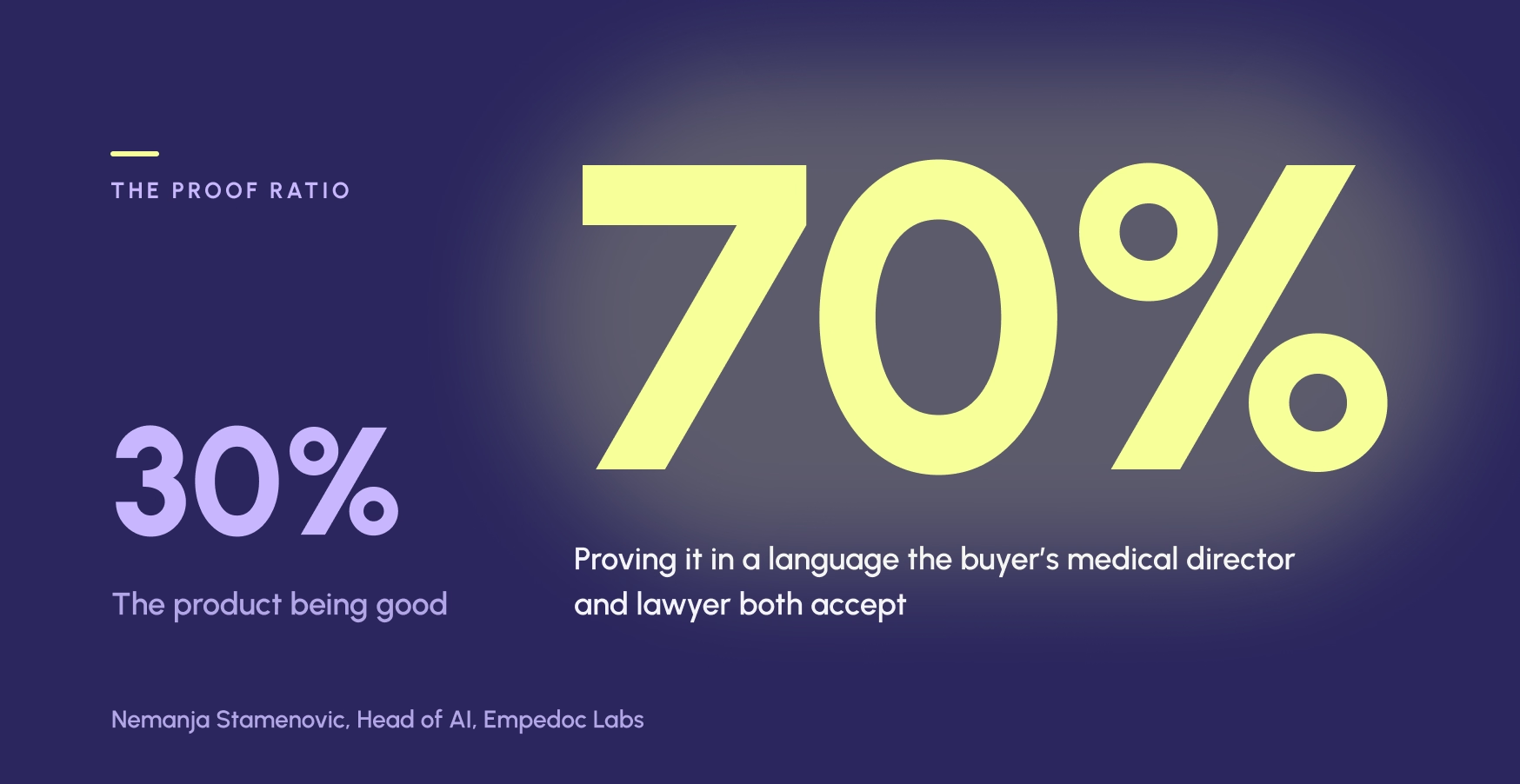
Nemanja Stamenovic has the working product. It is live, it works, and early users pay for it. None of that moves a clinic or a wellness platform. His accounting of why is the most quoted line in our notes: "The product being good is maybe 30% of the job. The other 70% is proving it in a language the buyer's medical director and lawyer both accept."
That ratio held across every segment we looked at. It is also why so many health tech marketing plans get built backwards, with the campaign designed first and the evidence treated as something to gather later.
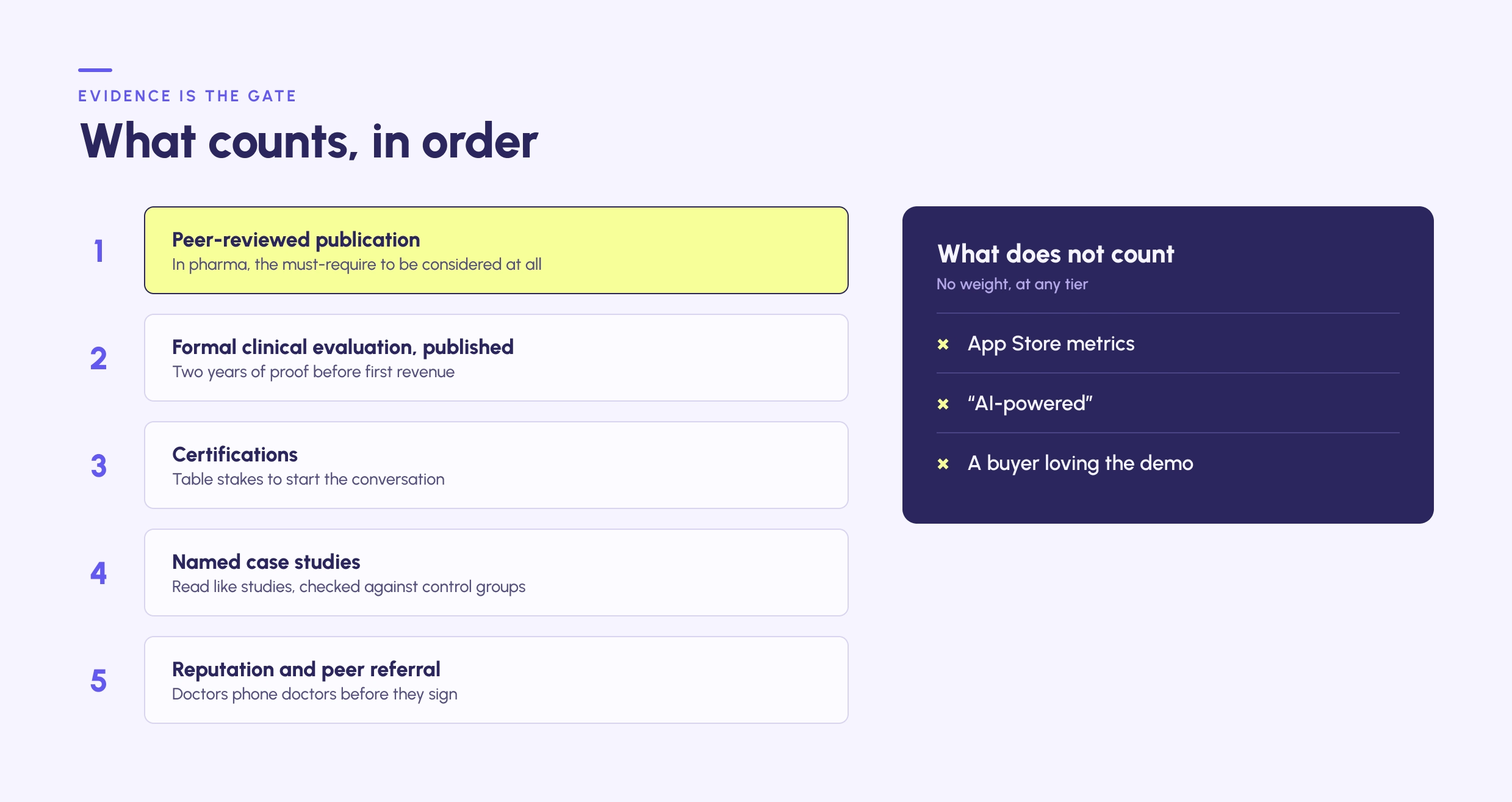
Peer-reviewed publication sits at the top, and in pharma it is a threshold instead of an advantage. James Eisner is blunt about the sequence: "Peer-reviewed, published. That's the must-require for you to even be considered." The reason is exposure. Pharma companies will not approve a claim they cannot defend academically, because the downside is a regulator asking questions. In his description they are risk-averse by construction, and the last thing any of them wants is a drug commission investigation triggered by a vendor's marketing copy.
Formal clinical evaluation is the founder-scale version of the same commitment. Marcel Alberti's company spent two years co-developing its product and running a clinical evaluation before commercializing anything, then published the evaluation. Two years of deferred revenue, spent on proof. He describes it as the reason adoption works now.
Certifications gate the conversation before it starts. Ysabel Camus lists HIPAA, ISO and a longer roster behind them, and is precise about what they buy you: "There's a whole list of certifications and regulations and compliances that your company needs to have in order to even just be credible to start a sales conversation." Not to win. To begin. For companies outside the device pathway, SOC 2 has become the fast baseline and HITRUST the version payers and health systems ask for.
Case studies get read like studies. James Eisner's customers at Dream ran control groups in a conventional sleep laboratory alongside the device in patients' homes, then compared the two before deciding. Expect any case study you publish to be treated as a data set that someone with a research background intends to interrogate.
Informal proof does more work than most vendors expect. Marcel Alberti splits it this way: the formal side is the published evidence. the informal side is who is behind the company and which of your peers already use it. In a market where doctors phone other doctors, that second half moves faster than any campaign.
A 2025 rapid review in Frontiers in Artificial Intelligence, screening 872 citations to include 40 studies, describes the chain this runs along. For a patient to trust a clinical AI system, the clinician has to trust it first, and the clinician's trust rests on their confidence in the organization that built it. Institutional credibility sits upstream of everything else, which makes it a product characteristic, not a layer of presentation applied afterward.
Nemanja Stamenovic answers this from what he calls the failing side, which makes him unusually specific about it. App Store metrics do not count. "AI-powered" does not count. A platform loving the demo does not count. Every buyer he has spoken to asks the same question, and it is always about outcome data from real patients.
Ysabel Camus frames the underlying rule in terms of what the register will bear. In other categories you can assert your way to a position: "You can say this is the number one juice brand. You can't say that in the health tech industry because people's lives depend on it." Buyers see through unsupported language quickly, and the cost of being caught is not a lost campaign but a lost reputation in a small network.

You can say this is the number one juice brand. You can't say that in the health tech industry because people's lives depend on it.
Evidence in this market is increasingly assessed by third parties with no commercial relationship to anyone involved.
The Peterson Health Technology Institute has now published verdicts across several digital health categories. Virtual musculoskeletal solutions came out well, with physiotherapy-guided products improving pain and function comparably to in-person care at a net reduction in spending. Digital hypertension tools came out mixed, where only the medication-management approaches justified broader adoption and the behavior-change products showed little effect on systolic blood pressure. Vendors disputed these findings publicly and pointed to excluded studies. Purchasing shifted regardless.
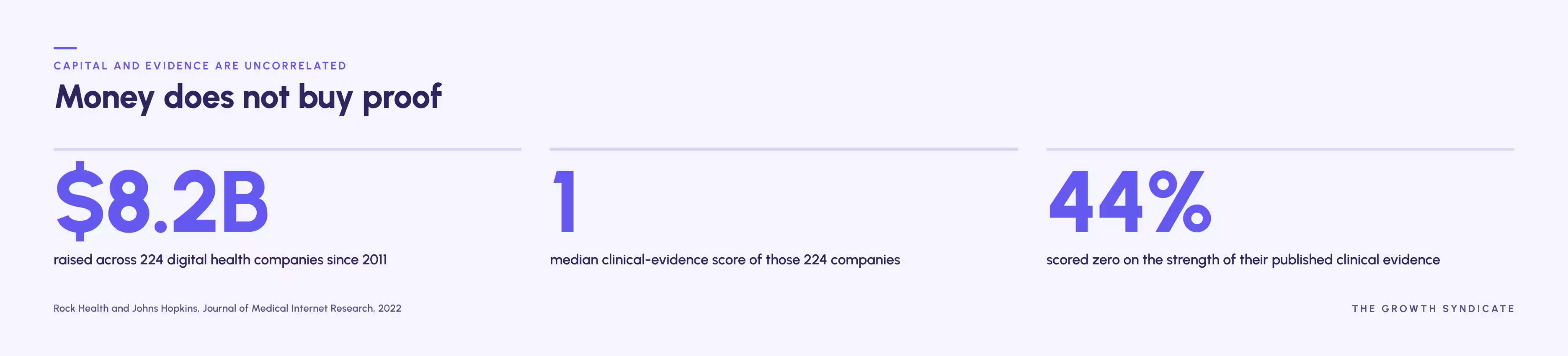
The wider picture explains why assessments like these carry weight. A 2022 analysis by Rock Health and Johns Hopkins, published in the Journal of Medical Internet Research, scored 224 digital health companies on the strength of their published clinical evidence. Those companies had raised $8.2 billion between them since 2011. The median score was one, and 44% scored zero. Capital and evidence, in other words, are close to uncorrelated in this sector. When most of a category has published nothing, a single credible independent review sets the terms for everyone in it.
Olive AI raised $902 million and reached a $4 billion valuation on the promise of roughly fivefold savings in hospital administration. Customers reported receiving a fraction of that. KLAS rated it a C. The company shut down at the end of October 2023 and sold what remained to Waystar and Humata Health.
James Eisner raised it unprompted, and it surfaced independently in our desk research, which tells you how thoroughly the story has lodged in the sector's memory. The lesson attached to it is narrower than "do not exaggerate." Health tech buyers extend trust in advance of proof, because they have to. A vendor who spends that trust and cannot cover the withdrawal removes the basis of the sale for themselves and makes the next vendor's job harder.
There is a subtler version of the same failure, and Nemanja Stamenovic flags it against his own category. Migraine prediction products advertise accuracy. Accuracy is the wrong number. The problem nobody has solved is specificity: "A model that warns you every second day and is wrong half the time gets deleted within a week, whatever its 'accuracy' claims." He notes that no one in the space has published credible real-world specificity figures, his own company included. A metric can be true and still function as an overclaim if it is not the metric that decides whether the product survives contact with a user.
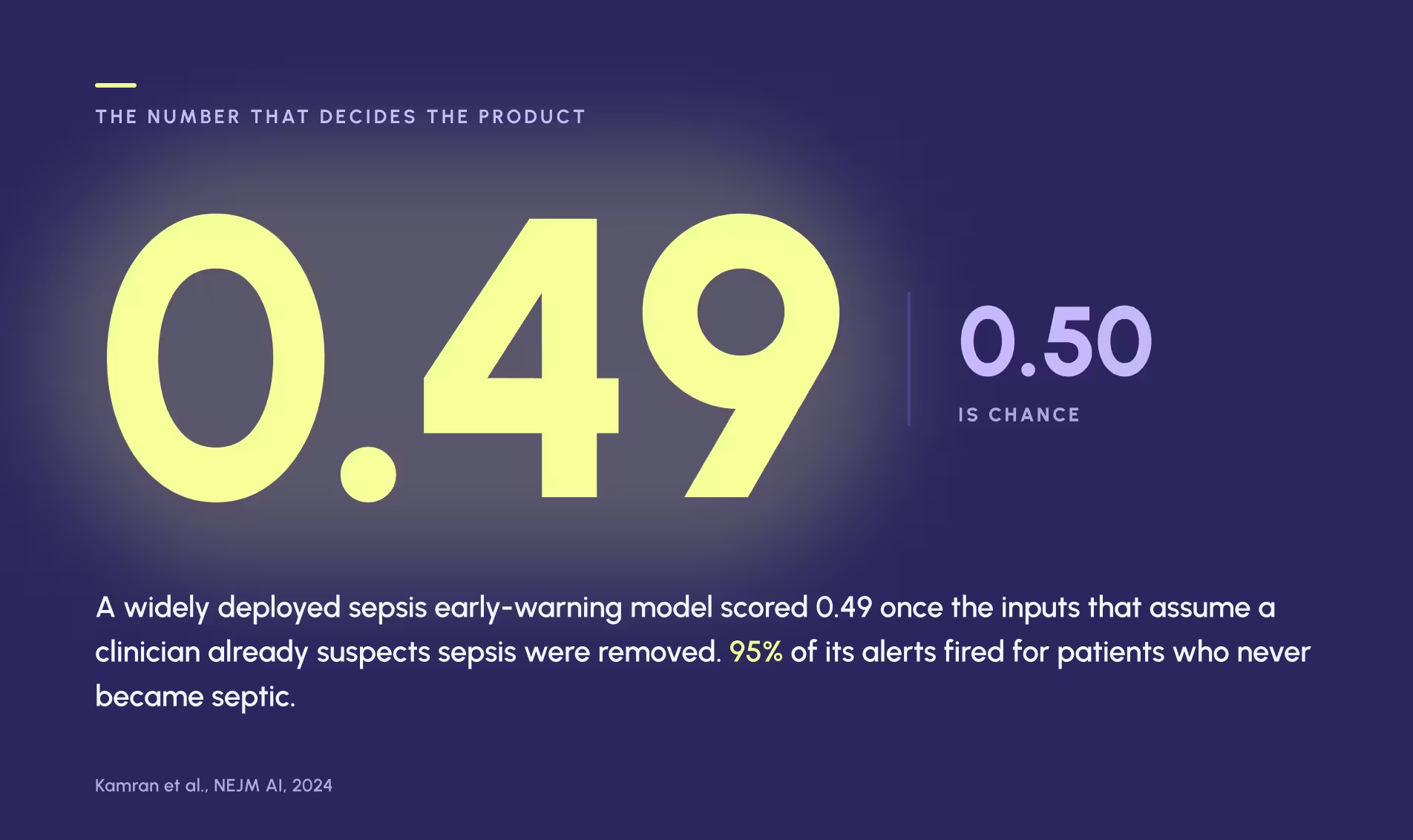
The clinical literature supports him, and with a sharper number than any vendor would volunteer. Kamran and colleagues, writing in NEJM AI in 2024, evaluated a widely deployed sepsis early-warning system after removing the model inputs that depended on a physician already suspecting sepsis. Measured that way, the system scored an ROC of 0.49. Chance is 0.50. The same evaluation found that 95% of the alerts it generated were for patients who never became septic. Every one of those alerts still cost a clinical team time: a reassessment, a conversation, labs ordered and reviewed.
For a marketer the practical lesson is a question to ask internally before it gets asked externally. What is our false positive rate in deployment, and can we publish it? Buyers who have lived through alert fatigue are already asking.
In brief: A clinical advisor changes how your first email is read, and nobody signs because of one. Their real value is designing the studies that produce your evidence. The requirement scales with how close your product sits to a clinical decision.
Every health tech company reaches for a clinician. The instinct is correct. The expectations attached to it are usually wrong.
Four of our six contributors described the same move from different positions. Clément Dumont observed it across TGS clients, where companies routinely keep former doctors on staff and surgeons on the board. James Eisner's employer had a recognized sleep specialist as Chief Medical Officer, and treating him as a visible figure was itself the marketing tactic, because researchers wanted to work with him and that interest arrived as inbound. Nemanja Stamenovic has a Professor of Neurology as medical advisor. Marcel Alberti's advice to anyone trying to reach a clinical sub-group without existing relationships is direct: "You better get some medical advisor on your board," or set up co-creation with a hospital.
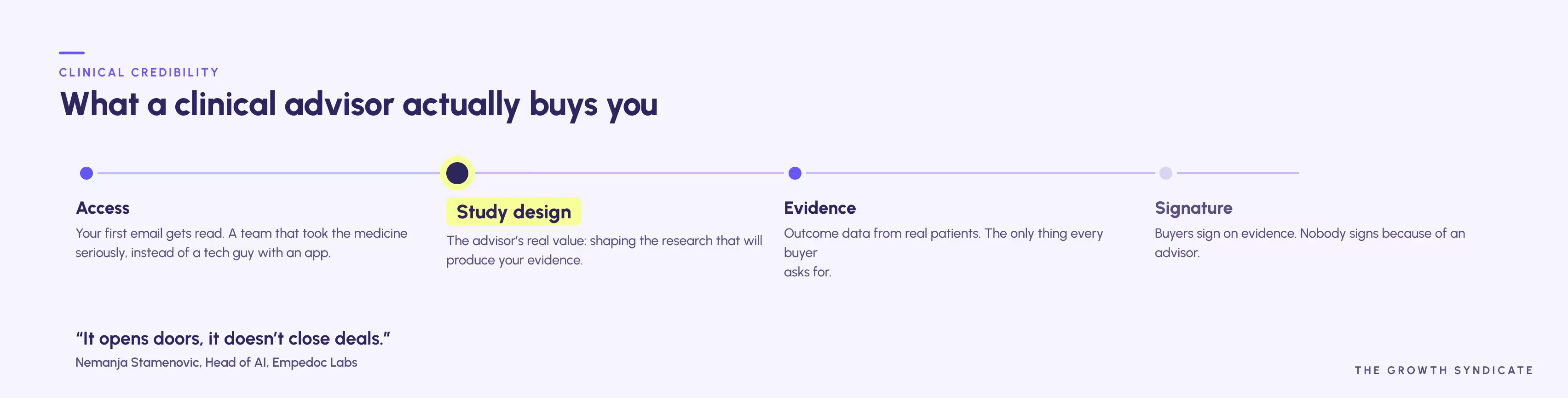
What the clinician changes is legible in Nemanja Stamenovic's description of a first email. "Without a clinician attached, you're a tech guy with an app. With one, you're a team that took the medicine seriously."
Nemanja Stamenovic then supplies the qualification that keeps this from becoming a shortcut. "But I'd temper expectations: it opens doors, it doesn't close deals. Nobody signs because of an advisor. They sign on evidence, and the advisor's real value is helping you design the studies that produce it."
Read that way, the clinical advisor is an access mechanism and a research capability. Companies that hire one expecting a conversion lift have bought the wrong thing, and will conclude the tactic failed when what failed was the assumption.
The requirement scales with how close your product sits to a clinical decision, and Marcel Alberti provides the counter-example that proves it. Most health tech startups have some healthcare connection on the team or the board. But he points to a French company attacking hospital billing with a purely technical founding team, doing well without any medical background at all, because billing does not touch clinical judgment.
So the rule is narrower than the sector's habit suggests. Products that inform, support or replace a clinical decision need clinical credibility attached before anyone will engage. Products that sit in administration, billing or infrastructure can be built and sold by people with no medical background, and paying for credibility you do not need is a real cost.
The most transferable finding in this section came from two contributors who have never met, working at opposite ends of the sector, arriving at the same conclusion.
Nemanja Stamenovic stopped offering clinics pilots and started offering co-authorship on a clinical case study. "Doctors ignore free tools. They answer to publications." Response quality changed immediately.
Doctors ignore free tools. They answer to publications.
James Eisner ran a campaign at Dream inviting researchers to apply for grant funding. The company covered two grants. Roughly two hundred applications arrived. The two winners produced studies, and the other one hundred and ninety-eight became a warm pipeline the company could approach with an offer to support their work.
Both are versions of the same insight. Free access to your product is worth very little to a clinician or a researcher, because their career does not advance on software. Publication, co-authorship and grant support are worth a great deal, because those are the units their institutions actually reward. Health tech companies that treat product value as the thing they are offering will keep losing to companies offering academic credit.
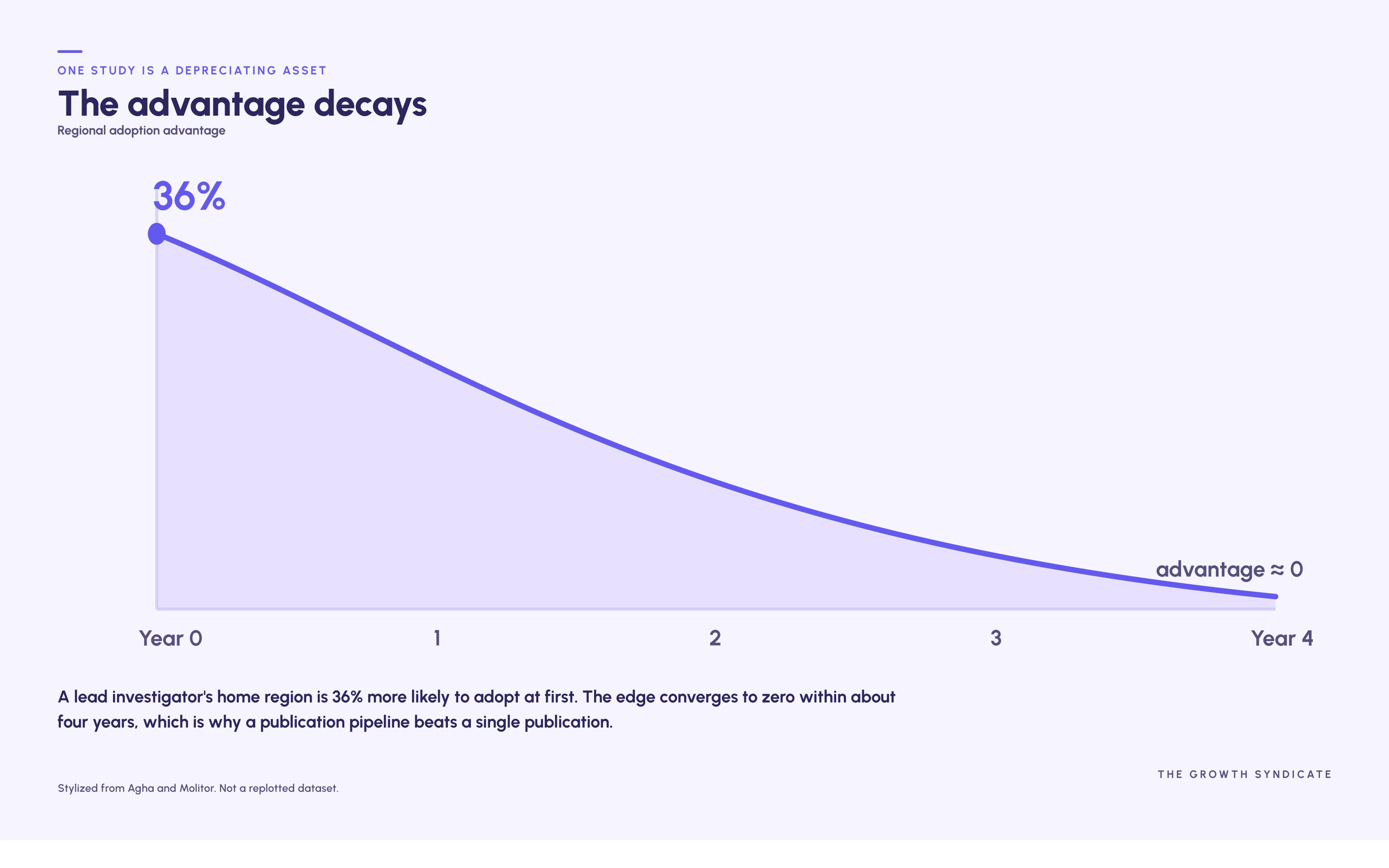
The diffusion research puts a number on what that buys. Agha and Molitor, comparing adoption patterns across 21 new cancer drugs, found that patients in the region of a drug's lead trial investigator were initially 36% more likely to receive it. Investigators with stronger citation records exerted wider influence than less prominent authors. The researcher who runs your study becomes, in effect, a regional adoption engine.
Two things follow for anyone planning an evidence program. Which clinician runs the study matters as much as whether the study happens at all, because prominence travels. And the advantage decays: in that same analysis, regional adoption converged within about four years. A single study is a depreciating asset, which argues for a publication pipeline over a single publication.
In brief: Regulation is legible; you can read it and plan around it. Go-to-market complexity is what actually kills health tech companies. Regulation still shapes the work in four specific ways: it sets the claim, gates velocity, removes products, and creates digital liability.
Ask a health tech founder what slows them down and regulation arrives first. Marcel Alberti puts it well down the list, and he has better standing to complain than most. A decade at Philips, then a company that spent two years on clinical evaluation before it could sell anything.
His argument is that regulation is legible and go-to-market is not. "We can complain about legislation and the regulatory aspect, but first of all, I think it's clear. So you can read it." The rules are published. Satisfying them is slow and expensive, and it is knowable in advance. You can staff for it, budget for it and schedule around it.
What he says people underestimate, himself included, is "the time that it takes to bring a product to market, to have it being adopted and to build a business out of it." He had come from an organization with ten thousand customers, where there was always a problem to fix and money to be made. Finding the first two or three customers turned out to be the hard part.
I think the go-to-market is the hardest thing, because there's enough problems to be solved. You find them everywhere. I think the technology is also ready.
The same conclusion turns up in the clinical literature, reached from the opposite direction. Beede and colleagues evaluated a deep learning system for detecting diabetic retinopathy after it moved from the laboratory into real clinics, where lighting and photography conditions were more variable than the model had been built for. Performance declined, and staff intervention was what prevented the cost falling on patients. The authors concluded that end users and their environment determine how a system gets implemented, and that implementation matters as much as the accuracy of the algorithm itself.
That reframing decides how a marketing function gets resourced. A team that believes regulation is the bottleneck invests in compliance and waits for clearance. A team that believes go-to-market is the bottleneck invests in reference customers, stakeholder maps and the internal pitch decks its champions will need to survive a budget meeting.
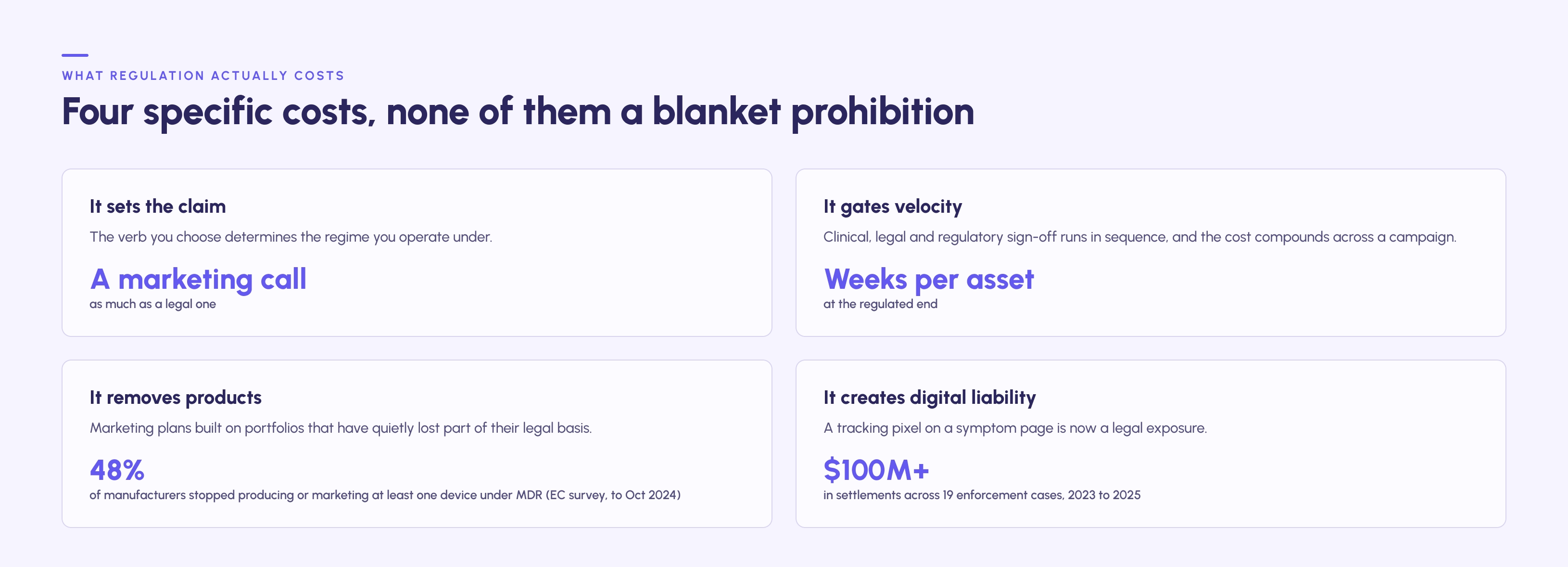
Regulation shapes the work in four specific ways, none of them the blanket prohibition founders tend to imagine.
It sets the claim. The verb you choose determines the regime you operate under, and the category you pick determines how much scrutiny arrives with it. Both decisions belong to marketing as much as to legal, which is unusual and is covered in more detail earlier in this report.
It gates velocity. Ysabel Camus's experience at Fireleaf is the version most marketers will recognize. Certification was already complete when she arrived, so it never blocked her directly. What slowed her down was review: every piece of content had to be validated by the data team and by developers before it could go live. In companies where certification is still in progress, marketing waits on a separate team with no ability to influence the timeline. At the regulated end this hardens into formal medical, legal and regulatory review, where each asset passes clinical, legal and regulatory sign-off in sequence. The cost is measured in weeks per asset, and it compounds across a campaign.
It removes products from the market. The European Commission's second economic operator survey, with data to October 2024, found that 48% of medical device manufacturers had stopped producing or marketing at least one device since the Medical Device Regulation took effect in May 2021. A marketing plan built around a portfolio that has quietly lost part of its legal basis is a common and expensive problem.
It creates live liability in digital channels. After updated guidance from the HHS Office for Civil Rights in 2024 and enforcement actions against GoodRx and BetterHelp, tracking pixels on pages carrying health-condition context have generated 19 enforcement cases and more than $100 million in penalties and settlements between 2023 and 2025. A Meta Pixel or a standard analytics tag on a symptom page is now a legal exposure. Most health tech marketing stacks were assembled before anyone treated them that way.
Nemanja Stamenovic assumed that selling to clinics and platforms meant integration. APIs, patient data moving between his company and the partner, a security questionnaire attached to every conversation. Then his team realized they could distribute through Apple's offer codes instead. They generate activation codes, the partner hands them out, Apple sits in the middle, and no personal data passes between the two companies at any point.
Zero integration, zero PII exchange. Compliance pushed us into a distribution model that's better than what we would have built without the constraint.
Look at what that removes from a sales conversation. The security review, the data processing agreement, the integration timeline, and the partner's own compliance team all leave the critical path. A constraint that most companies treat as friction turned into the shortest route to deployment.
Every contributor described healthcare as cautious. Marcel Alberti agrees, then complicates it in a way that should change how anyone plans a launch.
Generative AI, in his experience, is being taken up faster than cloud computing was, and faster than AI in diagnostics. The reason is that it addresses the problem hospital executives already rank first. "If you ask them, what's your number one concern, it's staff, both clinicians as well as nurses. Because young people are dropping out, people are burning out because of admin."
Despite being a slow industry, being adopted much faster than, for example, cloud technology or AI in diagnostics, because everybody's suffering from the admin burden.
The condition attached is staying in low-risk territory. He expects these tools to be classified as medical devices eventually, and notes that the UK and Sweden have already moved in that direction.
Adoption speed and demonstrated outcomes are separate questions, and the second one is still early. Goodson and colleagues, writing in Learning Health Systems in 2025, reviewed the 13 peer-reviewed studies of AI scribes in clinical practice available at the time. Documentation time fell by between 0.7 and 2.1 minutes per encounter across them. The authors are candid about the limits of that evidence base: most studies enrolled volunteers, few used control groups, and the two that adjusted for confounders found smaller differences than the uncontrolled ones. Sustained use varied widely too, with fewer than 30% of the 3,442 clinicians in the largest study using the tool more than 100 times over ten weeks.
None of that contradicts what Marcel Alberti describes. Hospitals are buying these tools quickly, and the reason he gives is the right one. It does mean the category is moving faster than its literature, which is the ordinary condition of a technology this new arriving in a field that measures slowly. Two practical consequences follow. Vendors publishing early outcome data are building an asset their competitors do not have. And utilization is worth reporting alongside deployment, because a buyer who has watched a rollout stall knows the difference between a tool that is enabled and a tool that is used.
.avif)
The generalizable version is worth holding onto. Healthcare's caution behaves like a default setting that acute pain overrides. A product aimed at a problem the buyer already ranks at the top of their list moves through a conservative institution faster than the institution's reputation suggests. Which is the subject of the next section.
In brief: The EU is 1.2 million healthcare workers short today and 4.1 million short by 2030. Buyers weigh whether your product returns something they lack: staff hours, beds, throughput. Denominate value in the buyer's constraint and design proposals that ask nothing of them.
The OECD counted a shortfall of 1.2 million doctors, nurses and midwives across the EU in 2022. Twenty member states reported doctor shortages. The WHO projects 4.1 million missing healthcare workers in the EU by 2030, among them 600,000 doctors and 2.3 million nurses. More than a third of EU doctors and a quarter of nurses are already over 55. Spain, the fifth-largest medtech market in Europe, has 5.9 nurses per thousand people against an EU average of 8.4.
These are the conditions your buyer works in, and they explain why clinical superiority on its own has stopped being a winning argument.
.avif)
Clément Dumont describes what it sounds like from the other side of the table. In client conversations across hospital AI and diagnostics, the clinicians he spoke to were not unconvinced. They were constrained. They knew prostate cancer was the leading cancer in men, they knew prevention was under-delivered, and they could not act on either fact because the money was not there and neither were the people or the machines.
Marcel Alberti reaches the same place from the executive floor. Staff is the first thing hospital C-suites name when asked what worries them, and the burnout driving people out is administrative before it is clinical.
A buyer in that position has moved past the question of whether your product works. What they are weighing is whether it returns something they are short of.
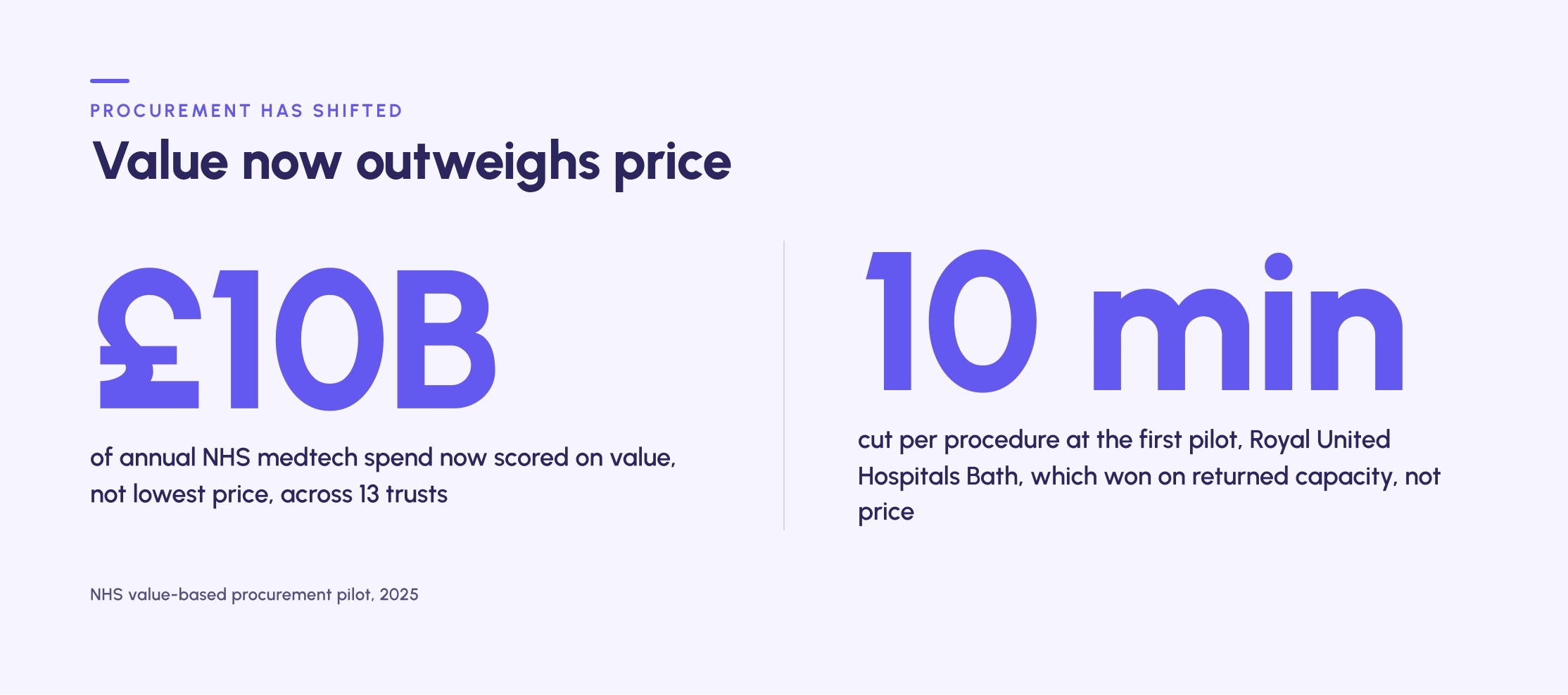
The NHS began piloting value-based procurement across 13 trusts in 2025, covering roughly £10 billion of annual medtech spend. The scoring model caps whole-life cost at 40% and gives at least 60% to value domains that include productivity, pathway simplification and social value.
The first pilot at Royal United Hospitals Bath is the template. A transnasal endoscopy product won on operational grounds, with operating time cut by an average of ten minutes per procedure and a significant reduction in complications. It won on returned capacity, at a price that was not the lowest in the room.
Value has to be denominated in the buyer's constraint. Clinician minutes returned per session. Beds freed. Length of stay. Complications avoided. Patients seen with the same headcount. Throughput per list.
The time-motion literature gives you defensible numbers to build those arguments on, and a boundary to respect while doing it. Physicians spend between 43% and 52% of the workday inside the electronic health record, and documentation accounts for only 23% to 30% of that time. The first figure is the scale of the opportunity. The second is a caution: a product that solves documentation has addressed roughly a quarter of the problem, and a CMIO can check that. Claim the quarter precisely and you are more credible than a competitor claiming the whole.
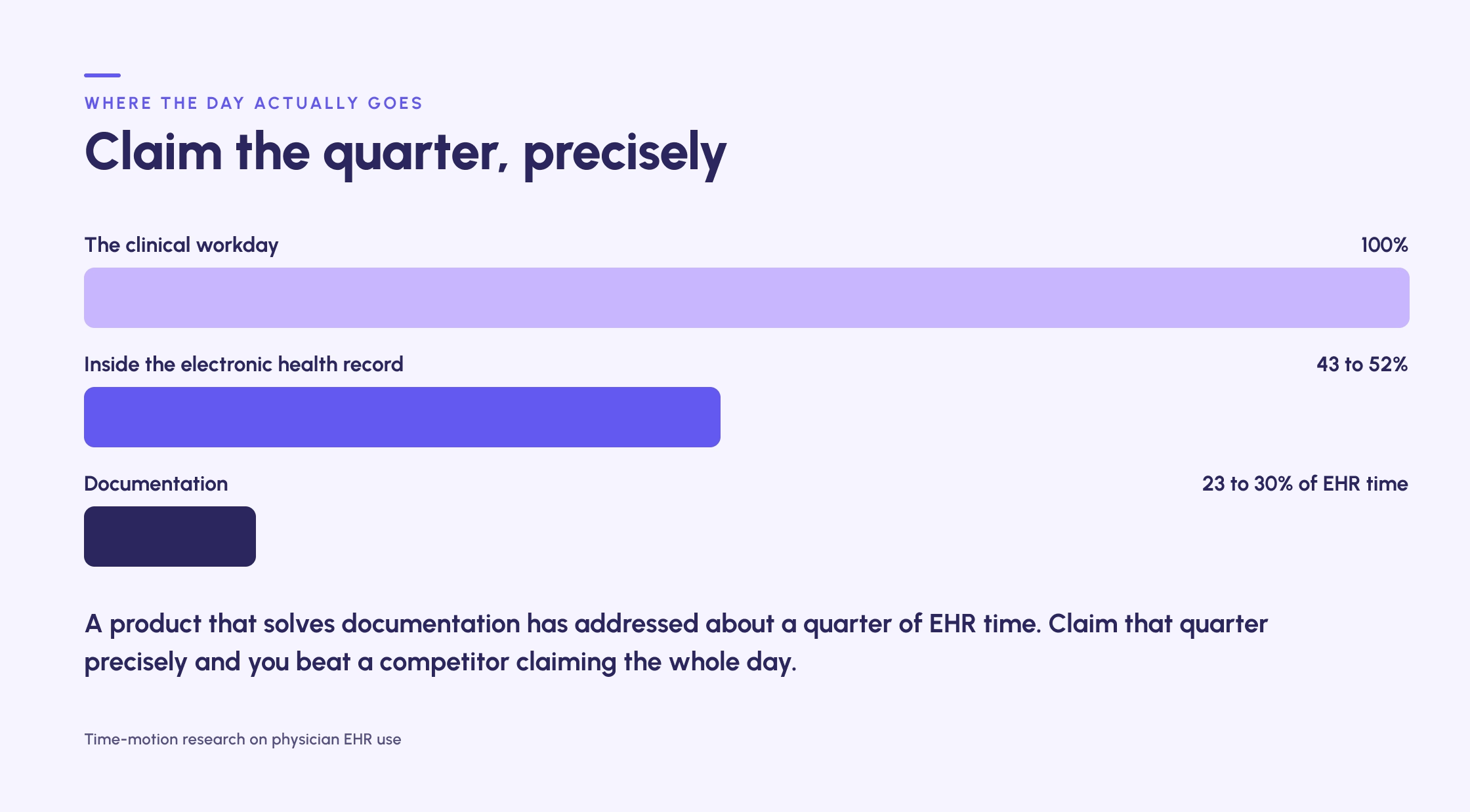
That means health-economic models and total cost of ownership calculators stop being sales-support collateral and become primary marketing assets, built early and published, not held in reserve for late-stage conversations. Value analysis committees and finance directors are reading for these numbers specifically, and a submission that leads with clinical outcomes alone is answering a question they have already moved past.
The capacity problem shapes more than the message. It limits what you are allowed to ask the buyer to do.
"A clinic director can think your product is great and still have zero staff hours to run anything," Nemanja Stamenovic says. His response was to redesign the pilot so the partner does almost nothing. The app goes to their patients free, activation is a single code, and the clinicians' only task is to mention that it exists. His company carries the recruitment materials, the data work and the final report.
"Every proposal we send is now built around one question: what's the version of this where the buyer's effort is zero?"
He is careful not to claim it works yet. "Whether that converts agreement into signatures, ask me in six months."
Every proposal we send is now built around one question: what's the version of this where the buyer's effort is zero?
The principle survives the uncertainty. Any request you make of a capacity-constrained institution competes directly with patient care for the same hours. Onboarding sessions, data pulls, internal champions asked to run training, IT time for integration: each one is a reason to defer. The vendors who win in a short-staffed system are the ones who arrive having already absorbed the work.
In brief: Events win nearly unanimously, with two caveats attached. LinkedIn works for technically oriented buyers and fails for practicing clinicians, who are reached through their associations. Search captures existing demand and cannot create a category. The consumer motion inverts all of it.
Channel advice in health tech is usually wrong because it is usually unqualified. The tactic that fills one company's calendar returns nothing for another, and the variable is rarely execution quality. It is almost always who the buyer is.
The unanimity here surprised us.
James Eisner rates in-person contact above every other channel he has used, in any sector: "The most superior one I found was the events, the in-person touch points, more so than any other industry I've seen." Hosting side events alongside the main conference amplified the return further.
Ysabel Camus reached the same conclusion at Fireleaf, where events were the primary channel. The sector runs on conferences across Europe and North America, and "you had to be there if you wanted to be known in the industry." She points to the underlying reason: these are the venues where the field shares knowledge with itself, so absence reads as absence from the field.
Marcel Alberti extends it to clinical audiences. Where the target is a specialty instead of an administrator, the specialty's association and its trade show are the route in.
Two qualifications matter.
The first is what events are now for. Lead generation has moved to digital channels that do it more cheaply. What the room delivers is acceleration of deals already in motion, plus podium time for your clinical voices. The return sits in the account work done before the event and the follow-up after it, with the stand functioning as a backdrop.
The second comes from the only contributor early enough to have been caught by it. Nemanja Stamenovic went to South Summit and came away with seven or eight contacts who expressed interest. "One was a real opportunity. The rest were consultants and agencies selling services to founders: funding advisory, dev shops, market-entry consulting."
Early-stage health tech founders are themselves a target market for service providers, and it's easy to mistake that attention for traction.
Both readings are accurate, and the difference is stage. The contributors who rate events highest were at companies with something to sell into the industry. Nemanja Stamenovic is at the point where he is the one being sold to.
LinkedIn produced the sharpest disagreement in our research, and resolving it produced the most useful channel finding in this report.
It works, decisively, for technically oriented buyers. Marcel Alberti explains why in terms of who his buyers are. Chief Medical Information Officers are doctors who spend half their working life on technology, and Chief Information Officers are technologists by definition. "They're all on LinkedIn." His conclusion is worth repeating for anyone worried about reach: "You also don't need to target everyone. Our audience is there." Clément Dumont's account-based programs for hospital-facing AI companies produced more meetings than one client's sales team could work through. James Eisner found pharma digital health teams and brand teams equally reachable.
It fails, structurally, for practicing clinicians. James Eisner is specific about the mechanism: "A lot of them try to purposely stay off of it. Because sometimes you don't want your patients being able to figure out who you are, where you came from, how to find you, in case things go wrong." Absence from LinkedIn is a professional safety decision for many doctors, and no amount of budget corrects for it.
So the variable is whether your buyer's professional identity is technological or clinical. Marcel Alberti and Clément Dumont arrived at the same split during our interview without prompting: a product aimed at cardiologists or radiologists needs the associations, not the platform.
For those audiences the channels are therapeutic-area and regional associations, their closed forums, and their annual meetings. Sponsorship of an association event frequently carries access to the membership mailing list, which is usually the asset worth paying for.
One warning applies inside pharma specifically. James Eisner segments his messaging by team: direct approaches and meeting invitations to digital health teams, awareness only to brand teams. Contacting a brand team without the digital health team's involvement is read as going around your champion, and it costs you the relationship that route depends on. Given how few companies exist at that level, a burned bridge is not replaceable.
Clément Dumont pushes the segmentation to its strategic conclusion, speaking about B2B generally rather than health tech alone: "If I look at a client we work with, which is often B2B, complex industries, long sales cycles, enterprise deals — they potentially have like a few hundred customers in Europe. Then you could argue that everything you do on the demand gen side actually is ABM." In a market of fifty pharma companies or six university hospitals, the line between demand generation and account-based marketing collapses. Every campaign is aimed at accounts you can name.
Ysabel Camus found search close to useless at Fireleaf. "SEO was an uphill battle for them because there was such low awareness about FHIR itself that there was just not a lot of search volume around it. It was really before its time."
Desk research points the other way, with search among the highest-return organic channels for established B2B health tech companies.
Both hold, because search captures demand that already exists and cannot manufacture a category nobody knows to look for. The diagnostic question is whether your buyer has a phrase for the problem you solve. If they do, invest in search. If the phrase is yours alone, search will find nobody until the category catches up, and the budget belongs somewhere else in the meantime.
Cold email to named decision-makers returned roughly 10% response rates for Nemanja Stamenovic, and James Eisner reports similar. Slow and unglamorous, and it works.
Trade press and specialist journals carry weight. Marcel Alberti names ICT&health as a channel that moves in his market. He also runs newsletters and is honest that he cannot tell whether they work.
The no-budget mix. Most health tech marketing teams run with little or no paid media. Ysabel Camus's program at Fireleaf was case studies, thought leadership, a website and messaging rebuild, and event materials.
Reddit and X are irrelevant for regulated audiences, in James Eisner's experience. The professional register in this sector keeps these buyers off open platforms.
Doctor referral models work in the United States and almost nowhere else. Referral fees make the economics function there, and tighter regulation elsewhere removes the mechanism entirely.
At the unregulated end the channel logic reverses, which is what makes running both motions so expensive.
Distribution is direct. App store, subscription, no buying committee anywhere in the path. Nemanja Stamenovic finds organic patient communities more promising than any paid channel at his current size. Product-led and freemium models become available wherever time-to-value is close to immediate, and those models are structurally impossible for anything requiring institutional deployment.
The bridge back to institutions is still B2B, through employers, benefits brokers, insurers, wellness platforms and clinics. That channel is crowded and tiring: half of employers manage ten or more vendor relationships, benefits teams number a handful of people, and navigation platforms increasingly stand between vendors and the buyer as curators.
One constraint belongs to this end alone. Nemanja Stamenovic describes the requirement as consumer marketing that respects suffering without exploiting it. Desperate audiences are easy to reach and easy to abuse, and regulation largely does not police that line at the wellness end, which leaves the company to hold it.
The two motions cannot share a playbook. Consumer rewards urgency and volume. Institutional buying rewards evidence, patience, and the ability to work a committee. The two clocks from the opening are the mechanism here: the consumer motion runs on the patient's clock, the institutional motion on the buyer's, and one funnel cannot keep both. A company that builds one funnel and discovers it needs two has found the most common structural failure in health tech marketing.
In brief: Category creation triples the marketing workload: define the category, explain the problem, and build the brand at the same time. If your product fits an existing category, use it. If it genuinely does not, plan a longer runway.
Two of our contributors disagree about this, and the disagreement is more useful than either position alone.
Ysabel Camus lived category creation at Fireleaf. One of the founders had co-authored FHIR, the standard for making patient data portable between institutions. The problem was widely experienced and barely named, which put the company in a position she describes precisely: "You need to create your own category. And the dynamics of marketing changes when you're creating a category versus when you're entering a red ocean market."
The workload that follows is the part most founders underestimate. "You need to define the category. You need to explain the problem really well and the solution. And then also stand out, build your brand at the same time." Three campaigns, one budget, and a permanent question about which of them gets the next euro. She names PCA Vision as facing the same difficulty, a company Clément Dumont has worked with directly and described in the same terms.
Marcel Alberti answers from the founder's chair, before the choice is locked in. Among the things that accelerate a health tech go-to-market, he puts category selection near the top: "It's easier, of course, if you pick an existing category versus when you're trying to create an entire new category. Which is I think one of the mistakes we also made in the beginning.
"Both are correct, and they are answering different questions. Ysabel Camus describes what marketing looks like once the choice has been made and cannot be unmade. Marcel Alberti describes the choice itself, and calls it a mistake he repeated.
The practical reading. If your product can be positioned inside a category your buyer already recognizes, do that, even at the cost of some differentiation. If it genuinely has no category, accept that you are funding three campaigns at once, budget for a longer runway before compounding begins, and expect search to stay unproductive until the market has language for what you do.
Marcel Alberti offers three moves for shortening a go-to-market that no amount of marketing craft will make short.
Get to your first referenceable customer as fast as possible, by any means available. Evidence, referral and case studies all follow from that single relationship, and nothing downstream compounds until it exists.
Target a narrowly defined, solvable problem. Breadth reads as vagueness to a buying committee that is looking for a reason to defer.
Ship something that works standalone. Deep integration with electronic health records is notorious in every country he has sold into, and a basic standalone version is usually good enough to begin.
In brief: Marketing is under-resourced and disconnected from revenue at every company size, from ten-person startups to a billion-euro Philips business line. The output compounds the problem: companies mirror pharma's caution, overshoot it, and end up saying nothing.
Two separate failures compound here. The function is under-resourced and disconnected from revenue, and the output it does produce says almost nothing. They have different causes and they reinforce each other.
Ysabel Camus's assessment of the sector she worked in is unambiguous. Marketing was not taken seriously. In her description it was understood as the department that produces flyers before an event, designs the stand, and orders branded shirts. "It was really more seen as a nice to have versus something that can really and truly drive growth for your sales teams."
The structural symptom was separation. "I hardly saw a marketing team there that worked super integrated with the sales team. Everything was completely siloed." Proposing that pipeline and revenue numbers be brought into a marketing meeting was treated as an unusual request.
The obvious explanation is company size, and Marcel Alberti's decade at Philips rules it out.
Marketing at Philips was controlled centrally. Any topic came with at least a hundred guidelines attached. Product teams could not launch their own website, run their own campaign, or announce anything outside the frame handed to them, and what remained was a small section of a corporate site subject to the same rules. "Marketing played, in my experience, for our products in Philips, a very limited role. We would look at marketing more as events." His business unit turned over a billion euros and had five or six marketers with a small budget. The commercial model was sales-driven throughout. He also confirms the same disconnect Ysabel Camus found in a company a fraction of the size: "Even for Philips, we had a disconnect between sales and marketing."
A ten-person health IT company and a billion-euro business line inside one of the largest medical technology companies in the world arrived at the same arrangement. That rules out budget as the cause and leaves belief. Health tech does not generally think marketing drives growth, so it staffs and structures accordingly, and the resulting performance confirms the belief.
Joliene van Grieken, TGS co-founder and COO, describes the mechanism that holds the belief in place, speaking about B2B at large: "9 out of 10 businesses are not CMO-led. The founder is sales-led or product-led... So they don't understand marketing. So they see it as a reactive function. And that's confirmed because then they hire the wrong people who keep it being fluff and keep it top level. It's not contributing to revenue. So you get that spiral." Health tech's version of the spiral simply has stronger tailwinds behind it: a sales-driven commercial culture, a caution reflex, and a talent pool trained to expect the flyer desk.
.avif)
They see it as a reactive function... It's not contributing to revenue. So you get that spiral.
Marcel Alberti's comparison after leaving is worth recording, because it isolates what the constraint was actually costing. As a founder he can own a website, run events, publish whatever he judges appropriate, and build campaigns without clearance. "We have complete freedom. And then you do see that it works." His summary of the difference between the two models: much more effective.
James Eisner attacks the second failure, and his diagnosis is more specific than a complaint about jargon.
Health tech companies, he argues, are afraid to say what they actually do for the buyer. The Dream proposition was that a hospital or pharma company could get sleep laboratory results at roughly half the cost, from patients' own homes. Saying that plainly felt too blunt to the companies he worked with, so the message defaulted to patient outcomes and patient engagement instead.
His objection is that this misreads what the buyer wants. A pharma brand team is measured on whether the drug hits its number. Everything else is preamble. "They care like, can I do this for cheaper or can I sell more of my drug? That's all that matters in the end."
The cause is worth understanding because it looks like prudence from the inside. Pharma is cautious by construction, since a single unsupported published figure can trigger a regulatory investigation. Health tech companies observe that caution, correctly conclude their buyer is risk-averse, and mirror it. Then they overshoot, until every company in the category is producing the same unobjectionable sentences about driving patient engagement and improving outcomes, and a reader in pharma cannot tell what any of it would do for them.
The tell is the gap between channels. One-to-one sales conversations in this sector get specific fast, while the marketing materials produced by the same companies stay abstract. James Eisner sees the pattern at his current company as well as his former one, which suggests a sector default at work and not a local failure.
His recommended position is a middle one. Keep the patient outcomes, because they are real and the audience expects them. Then say the commercial thing out loud: this helps you hit your targets, or keeps patients adhering to your drug for longer. Companies avoid that second half out of a fear that reads, from the buyer's side, as having nothing specific to offer.
TGS published a report on manufacturing marketing before this one, and the same organizational pattern appeared there: marketing treated as a cosmetic function, disconnected from sales, undervalued by leadership.
Ysabel Camus has worked in both sectors, and when we offered her the parallel she rejected half of it immediately. The cultures rhyme. The work does not. Manufacturing was, in her experience, the most successful marketing she has done. Tactics imported from B2B SaaS landed in an old-fashioned industry that had not seen them before, and they produced results disproportionate to their sophistication.
"Those things I wasn't able to get away with in the health industry."
The credibility bar is why. In manufacturing you can be interesting and specific and win attention. In health tech the same move fails, because the audience checks, the claims have to survive review, and a piece of content that a clinician can see through costs you more than the campaign was worth.
The synthesis: health tech and manufacturing share an organizational problem and face opposite craft problems. Marketing is undervalued in both. Only one of them lets you fix that with borrowed SaaS tactics.
The health SaaS end operates close to enterprise software norms, with working demand generation, account-based programs and attribution discipline. Traditional medtech marketing sits several years behind and has much to gain from importing what survives the credibility bar.
The transfer runs the other way too, and the sector has already paid to learn it. Olive AI and Pear Therapeutics failed with software-grade marketing operations and without the evidence discipline the regulated end treats as the price of entry.
In brief: Healthcare's caution is partly protective, partly performed, and occasionally a business of its own. Treat regulation as fixed. Treat institutional hesitation as movable, because evidence and reduced personal risk demonstrably move it.
Health tech's conservatism is usually discussed as a fact of nature. It is worth asking whether it earns its keep, and one of our contributors was willing to answer on the record.
Marcel Alberti's position is that it does not. "Personally, I don't think it's a good thing. I think it slows down a lot of good innovation that could either reach professionals and or benefit patients."
He goes further, and this is the part most people in the sector will not say aloud. "The reasons often cited for this are most often not true, in my opinion. So I'm not saying we should become radical or avoid legislation, but I think it's also often used as an excuse to slow things down."
I'm not saying we should become radical or avoid legislation, but I think it's also often used as an excuse to slow things down.
The critique extends past marketing into the economics. Healthcare is the largest industry in the world by financial weight, and in his view it should not be. "We should not be spending 15 to 20% of our national budget on healthcare. There's other things we need to pay for as well." What would change it, he thinks, is healthcare adopting more of a business orientation, closer to a societal shift than a sector one. He points at private clinics as where meaningful change is already visible.
He also notes, more quietly, that the slowness has become an industry of its own. ⚑ "Partially it's for good reasons that it takes time. Partially it's a business in itself. There's people making money on the fact that it's slow."
Set against that, the other contributors supply reasons the caution exists that have nothing to do with protecting incumbents.
Ysabel Camus's version is the simplest. In most categories a marketer can assert a position and defend it later. Here the assertions concern products that people's health depends on, and the audience is trained to check. Caution in that context is accuracy, not timidity.
James Eisner's is institutional. A pharma company that publishes an unsupported number invites a regulator into its business. Risk aversion is the rational response to an asymmetry where the upside of a bold claim is a marginally better campaign and the downside is a multi-government investigation.
Clément Dumont supplies the version that operates at the level of the individual clinician, and it is the most persuasive of the three. A doctor adopting a new product is exposed personally if something goes wrong. The certifications and approvals function as a defense they can stand behind. Seen that way, the paperwork that vendors experience as obstruction is, for the person on the other side of the table, the thing that makes adoption survivable.
All of it is true simultaneously. The caution is real and partly protective, partly performed, and occasionally commercial. A marketer does not get to resolve that argument and should stop waiting for the sector to resolve it either.
What follows from the disagreement is narrower and more useful. Treat regulatory requirements as fixed and plan around them, since they are legible. Treat institutional hesitation as a variable you can move, because it responds to evidence, referral and a credible reduction in the buyer's personal risk. Marcel Alberti's observation about generative AI adoption is the proof that the second half is movable. The most conservative buyers in the sector moved quickly when a product addressed the pain they already ranked first.
In brief: Health tech bleeds into pharma and biotech, healthcare IT services, and consumer territory. Each runs on different money, different evaluators and different channels. Companies that drift across a boundary usually keep running the playbook from the market they left.
Health tech's edges are indistinct, and Ferdinand Goetzen's instruction on this point was to acknowledge the blur without pretending the adjacent territories are the same business. Three of them matter commercially, because companies drift into them without noticing and then apply the wrong playbook.
Pharma and biotech. The money works differently here, and so does the arithmetic. A technology that removes years from a drug development timeline is arguing against a number the buyer already knows to the decimal place. Clément Dumont's example is Cradle, which applies machine learning to protein engineering and can compress the path to a new drug or vaccine by several years. Set that against a practice management application sold to a dental office, where the buyer is weighing your subscription against the cost of a new chair, and the difference in available ambition becomes obvious.
Convergence between these worlds is now commercial as well as scientific. Companion diagnostics is the clearest instance, with Guardant Health's multi-year agreement embedding its liquid biopsy platform as a companion diagnostic across Merck's oncology program. The category has acquired a name, TechBio, which describes companies applying machine learning and computational methods to drug discovery and biology, and 2025 figures to match: 31 AI-discovered assets in clinical phases, more than 30 pharma contracts signed with TechBio companies, and over 150 new companies founded in a single year.
Selling here means longer cycles, larger numbers and evaluators holding doctorates. The marketing motion runs on scientific publication, joint advisory boards, partnering conferences and business development outreach. Almost none of the hospital playbook transfers.
Healthcare IT services. European healthcare IT was valued at roughly $124.7 billion in 2024, with projections approaching $283 billion by 2030. The buyer is a CIO, a CMIO or an integration lead, and the questions concern certification, interoperability standards and reference architecture. Clinical opinion leaders carry little weight in this segment. Epic, Oracle Health and the national digitization frameworks carry a great deal. Rapid Circle, a Microsoft partner working across manufacturing and healthcare, operates in exactly this territory.
Consumer. Treated throughout this report, and defined by what it is not permitted to claim.
The reason to name these boundaries is practical. Companies that have drifted across one of them usually keep running the marketing motion from the market they left, and spend a year discovering that the buyer, the evidence bar and the channel have all changed underneath them.
In brief: The right moves depend on stage. Pre-evidence companies sequence proof before promotion. Early commercial companies design for zero buyer effort. Scaling companies audit their exposure and say the commercial thing plainly.
The advice below is staged, because almost none of it applies at every point in a company's life. Which stage you are in also decides which clock you are selling on, and most of the mistakes in this report come from confusing the two.
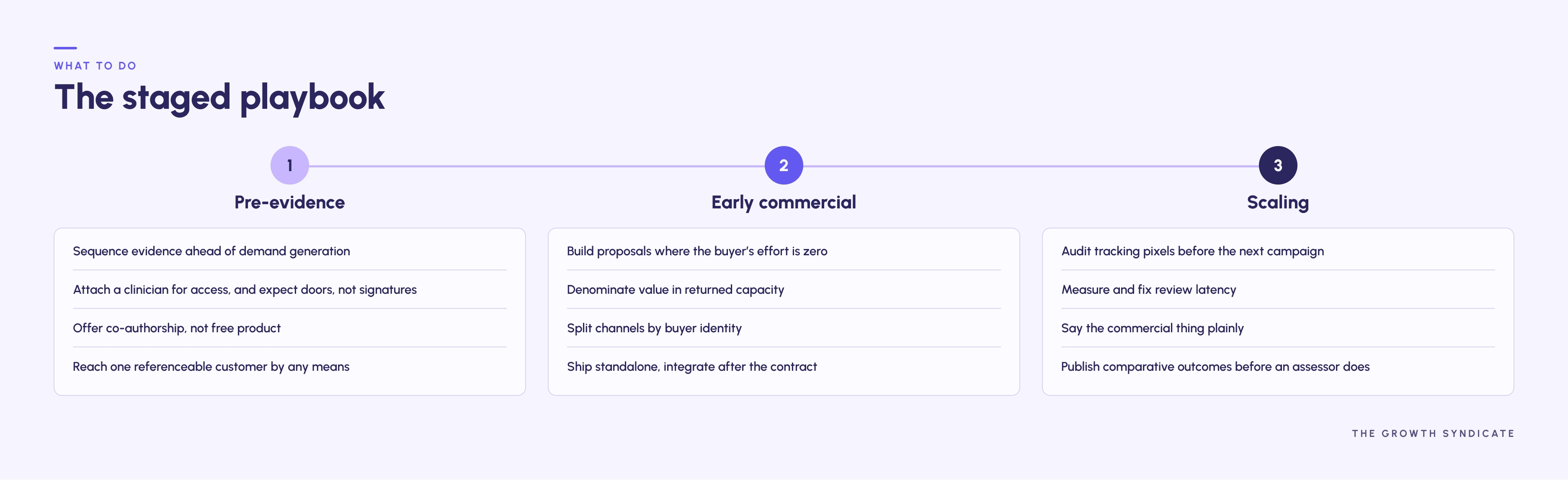
Sequence evidence ahead of demand generation. Marcel Alberti spent two years on clinical evaluation before commercializing, and describes it as the reason adoption works now. Nemanja Stamenovic is running small clinical pilots before any serious institutional push, having established that every buyer conversation hits the same wall without them.
Attach a clinician, and expect access instead of conversion. The advisor gets your first email read and helps design the studies that will eventually close deals. Budget for both, and do not expect the first to substitute for the second.
Offer publication, not product access. Free software is worth little to a clinician whose career advances on papers. Co-authorship and grant support are worth a great deal.
Pick an existing category and a narrowly defined problem wherever the product allows it. If it genuinely does not, accept that you are funding category education, problem education and brand building simultaneously, and plan a longer runway.
Get to one referenceable customer by any means available. Everything downstream depends on it.
Design every proposal so the buyer's effort approaches zero. Anything you ask a short-staffed institution to do competes with patient care for the same hours.
Denominate value in the buyer's constraint. Clinician minutes returned, beds freed, complications avoided, patients seen with the same headcount. Build the health-economic model early and publish it.
Segment channels by buyer identity. LinkedIn for technically oriented buyers, and specialty associations, closed forums and their annual meetings for practicing clinicians. Inside pharma, split messaging between digital health teams and brand teams, and never approach the second without the first.
Treat events as acceleration for deals already in motion. At early stage, count only the contacts who could actually buy, and discount the consultants and agencies who came to sell to you.
Ship something that works standalone. Integration with electronic health records can follow the contract instead of blocking it.
Audit your tracking pixels and analytics tags against health-condition context before the next campaign goes live. This is now a litigation exposure with more than $100 million of settlements behind it.
Measure and fix review latency. If a standard asset takes more than a few weeks to clear clinical, legal and regulatory sign-off, the process is the bottleneck and it can be redesigned.
Say the commercial thing. Keep the patient outcomes, then state plainly what the product does for the buyer's targets. The reticence that feels like professionalism reads as vagueness from the other side of the table.
Publish comparative outcome data before an independent assessor publishes theirs. In several categories the most consequential document about a company was written by somebody with no commercial relationship to it.
Cost per acquisition on account-based work is not falling after six months at consistent message quality. The problem is the target definition, not the channel.
Evidence from your reference sites is not being requested by later prospects within a year of clearance. The evidence was designed for the wrong question.
Marketing and sales do not share a pipeline number. You have inherited the sector default, and it will cap the function regardless of who you hire.
You sell to payers or employers and have published no comparative outcome data. You are exposed to an assessment you will not control.
Buyers agree the product is valuable and still do not sign. Examine what you are asking them to do, not what you are telling them.
The two clocks do not synchronize. Patients want a solution this week and institutions will decide next year, and no amount of marketing craft closes that gap. The practitioners in this report stopped treating the gap as an obstacle and started treating it as the design brief. Three things run through every interview and every dataset behind this report.
Locate yourself before you borrow a tactic. Health tech is several markets wearing one label. The channel that fills one company's calendar returns silence for another, and the difference is rarely execution. It is position: the buyer you serve and the clock they run on. Every recommendation in this report is conditional on where you sit.
Sequence evidence ahead of demand. Marcel Alberti spent two years on clinical evaluation before commercializing anything. Nemanja Stamenovic is running clinical pilots before any serious institutional push. The currency with clinicians is publication, and the document that decides your category may be written by an assessor you have never met. Campaigns spend evidence; they cannot substitute for it.
Treat the buyer's constraint as the design brief. Your buyer is short of staff, hours and political capital, so proposals win by asking for none of them. Denominate value in returned capacity. Build the version where the buyer's effort is zero. Then say the commercial thing plainly, because the person championing you is spending personal risk and deserves to know exactly what they are buying.
None of that is faster. It is simply the version that works, and the companies still waiting for health tech to behave like software are the ones who will keep finding it slow.
How to cite this report: The Growth Syndicate (2026). Marketing for the Health Tech Industry in 2026. thegrowthsyndicate.com/reports/marketing-for-the-health-tech-industry. Free to quote with attribution.
This report was written and produced by Adrian Stefirta, Head of Content at The Growth Syndicate. It draws on practitioner interviews conducted in May and June 2026 and three rounds of desk research across peer-reviewed literature, regulatory sources, and independent assessments.
Health tech marketing is the discipline of selling technology products into healthcare: to hospitals, pharma companies, payers, employers and clinics, and in the consumer motion to patients directly. It differs from general B2B marketing in one structural way. An institutional buyer will not purchase on product quality alone, so published evidence, certifications and peer referral gate every sale, and producing and distributing that proof is part of the marketing job. The label also covers several markets that share very little: a regulated device company (the end of the sector usually called medtech marketing), a hospital AI vendor and a wellness app operate with different buyers, different evidence bars and different channels. Locating which health tech you are in comes before any tactical choice.
Three structural differences do most of the work. First, evidence gates the sale: a working product is roughly 30% of the job, and of 224 digital health companies scored on published clinical evidence, 44% scored zero (JMIR, 2022). Second, buying committees are wide and their members answer to nobody in common, which is why cycles stretch. Third, the markets are small enough that reputation compounds: roughly fifty pharma companies matter globally, and in the Netherlands every doctor trained at one of six universities. Health tech shares its organizational dysfunction with sectors like manufacturing, where marketing is similarly undervalued, but the craft transfers poorly: tactics that win attention in manufacturing fail against health tech's credibility bar.
It depends entirely on segment. In hospitals, two personas run the evaluation: the Chief Medical Information Officer, who asks about safety, business case, data quality and EHR integration, and the Chief Information Officer, who asks about security, privacy and scale. Neither uses the product, so adoption is a separate battle with clinicians and front-office staff. In pharma, entry runs through a digital health team that holds no budget, while brand and commercial teams hold the money by drug and by region. Payers want large datasets. Employers move faster and are exhausted, with half managing ten or more vendor relationships. Research institutes are the underused fast lane: early-career researchers close in three to six months at ten to thirty thousand dollars.
From two weeks to five years, depending on where you sell. The care side (dental, dermatology, physiotherapy) is owner-decided and closes in weeks to months. Hospitals run eight to eighteen months. Pharma runs six months at the small end and five years at the large end, because deals only make financial sense once three or four regions are on board. The cause is structural. Doctors, boards, insurers and internal teams hold interests that were never aligned, and long cycles are the mechanical cost of assembling agreement among parties who do not share a scoreboard.
In descending order: peer-reviewed publication, which in pharma is the requirement to be considered at all; a formal clinical evaluation, published; certifications, which buy you the right to start a conversation, never to win one; named case studies, which get read like studies and checked against control groups; and reputation with peer referral, because doctors phone doctors before they sign. What carries no weight: App Store metrics, the phrase "AI-powered," and a buyer loving the demo. Increasingly, independent assessors such as the Peterson Health Technology Institute publish the document that decides a category, which is an argument for publishing comparative outcome data before somebody else frames it for you.
If your product informs, supports or replaces a clinical decision, yes, because access depends on it: without a clinician attached you read as a tech company with an app. Expectations need calibrating, though. An advisor opens doors and does not close deals; buyers sign on evidence, and the advisor's deepest value is designing the studies that produce it. The requirement also scales with clinical proximity. Products in billing, administration or infrastructure are built and sold by purely technical teams, and paying for credibility you do not need is a real cost.
Events rank highest across every contributor we interviewed, with two qualifications: their role has shifted from lead generation to accelerating deals already in motion, and early-stage founders should count only contacts who could actually buy, because founders are themselves a target market for service providers at conferences. Specialty associations, their closed forums and their annual meetings reach clinical audiences that no advertising platform reaches. Cold email to named decision-makers returns roughly 10% response rates. Trade press carries weight in national markets. The governing rule: channel choice is decided by who your buyer is, which is why the same tactic fills one company's calendar and returns silence for another.
For technically oriented buyers, decisively yes. CMIOs are doctors who spend half their time on technology, CIOs are technologists by definition, and pharma digital health teams are reachable there. Account-based programs against these audiences have produced more meetings than sales teams could work through. For practicing clinicians, no. Many doctors stay off the platform deliberately so patients cannot find them, and no budget corrects for a buyer who is not there; specialty associations are the route instead. Inside pharma, segment carefully: meeting requests to digital health teams, awareness only to brand teams, because approaching a brand team around your champion burns a relationship you cannot replace.
It depends on whether your category exists yet in the buyer's vocabulary. Search captures demand that already has language and cannot manufacture a category nobody knows to look for: at Fireleaf, a company built around the FHIR interoperability standard, there was simply no search volume to capture. The diagnostic question is whether your buyer has a phrase for the problem you solve. If they do, search is among the highest-return organic channels in the sector. If the phrase is yours alone, the budget belongs elsewhere until the market catches up.
In four specific ways, none of them a blanket prohibition. It sets the claim: the verb you choose (predicts, prevents, treats) determines the regulatory regime you operate under. It gates velocity, because clinical, legal and regulatory review is measured in weeks per asset. It removes products: 48% of manufacturers stopped producing or marketing at least one device under the EU Medical Device Regulation. And it creates digital liability, with tracking pixels on health-condition pages generating more than $100 million in settlements since 2023. The larger finding is that regulation is legible and plannable, while go-to-market complexity is what actually kills health tech companies. Occasionally the constraint even improves the product, as when compliance pushed one contributor into a zero-integration distribution model better than the one he had planned.
Evidence-first and metric-honest. Adoption moves fast where the pain is acute: generative AI for hospital administration is being adopted faster than cloud computing was, because staff shortage is the C-suite's first-ranked problem. The outcome literature is younger than the deployment curve, which cuts two ways: vendors who publish real outcome data early are building an asset competitors do not have, and utilization deserves reporting alongside deployment, because fewer than 30% of clinicians sustained use of an AI scribe in the largest study to date. Watch the metric that decides survival instead of the one that flatters the model: a widely deployed sepsis system scored an ROC of 0.49 once physician-suspicion inputs were removed, and 95% of its alerts were false alarms. Specificity, not accuracy, decides whether a prediction product survives contact with users.
You cannot make it short. You can stop making it longer. Get to your first referenceable customer as fast as possible, because evidence, referral and case studies all follow from that relationship. Position inside an existing category with a narrowly defined problem wherever the product allows it. Ship something that works standalone, since EHR integration is notorious in every country and can follow the contract instead of blocking it. Design pilots where the buyer's effort is zero, because any request you make of a short-staffed institution competes with patient care. And offer clinicians publication instead of product access, because academic credit is the currency their institutions actually reward.