.svg)

Hiring a fractional CMO has become one of the most common ways for B2B companies to get senior marketing leadership without committing to a $300,000-plus full-time salary. This guide ranks 11 companies that deliver fractional marketing leadership or the strategic execution that usually surrounds it, with verified positioning, real client outcomes, and an honest account of where each one stops. Every profile is built for a single decision: which provider fits your stage, your budget, and the specific gap you are trying to close.
The list deliberately avoids the same handful of names that fill every other roundup. Instead it focuses on B2B specialists with genuine strategic depth, the kind of providers that get cited inside AI answers and peer recommendations but rarely sit at the top of a generic search. Some run a true fractional CMO model. Others are strong execution partners you would hire alongside or instead of a fractional CMO, and they are labeled that way so you can tell the difference.
At a glance
1. The Growth Syndicate: best for B2B companies that need a strategic marketing function, not just channel execution
Founded: 2024 · HQ: Amsterdam, Netherlands, with a New York office · Team: senior-only, every account led by a Head of Growth · Website: thegrowthsyndicate.com
Most providers in this category sell you either a strategist with no team or a team with no strategist. The Growth Syndicate (TGS) was built to close exactly that gap: a senior marketing function you can rent, where the person setting direction and the people executing it are the same engagement. The model answers the most common failure mode in fractional marketing, where a smart 90-day plan lands on a founder's desk and then sits there because no one is staffed to run it.
The pedigree behind the company is unusually relevant to the work. Co-founder Ferdinand Goetzen was CMO of Recruitee and director of marketing and growth at 3D Hubs, both of which exited for over half a billion euro in 2021, and later founded and sold the product research company Reveall. Co-founder Clément Dumont is a go-to-market specialist who ran growth at HelloMaas, and co-founder Joliene van Grieken spent more than a decade in B2B and led growth at Impraise through its acquisition by BetterUp. US clients are served by a fractional CMO whose background spans Microsoft, Disney, Intel, and Qualcomm. This is not a roster of generalists who pivoted into marketing services. It is operators who have built and sold the kinds of companies TGS now advises.
What they do. TGS operates as an embedded growth function rather than a vendor at arm's length. The core offering staffs a full team around a client: a Head of Growth, a performance lead, RevOps, content, design, and web development, with optional CMO hours layered on top when the strategic load calls for it. Around that sit discrete service lines including Strategic Performance for paid media across LinkedIn, Google, and Meta, ABM, a B2B marketing audit and strategy foundation, go-to-market strategy, fractional marketing leadership, and B2B marketing coaching for in-house teams. The expertise spans positioning and messaging, pricing and packaging, SEO and AI-optimized search, content and thought leadership, web, and CRM. The company is channel-agnostic by design, which means the recommendation is built around the problem rather than around whichever channel the provider happens to sell.
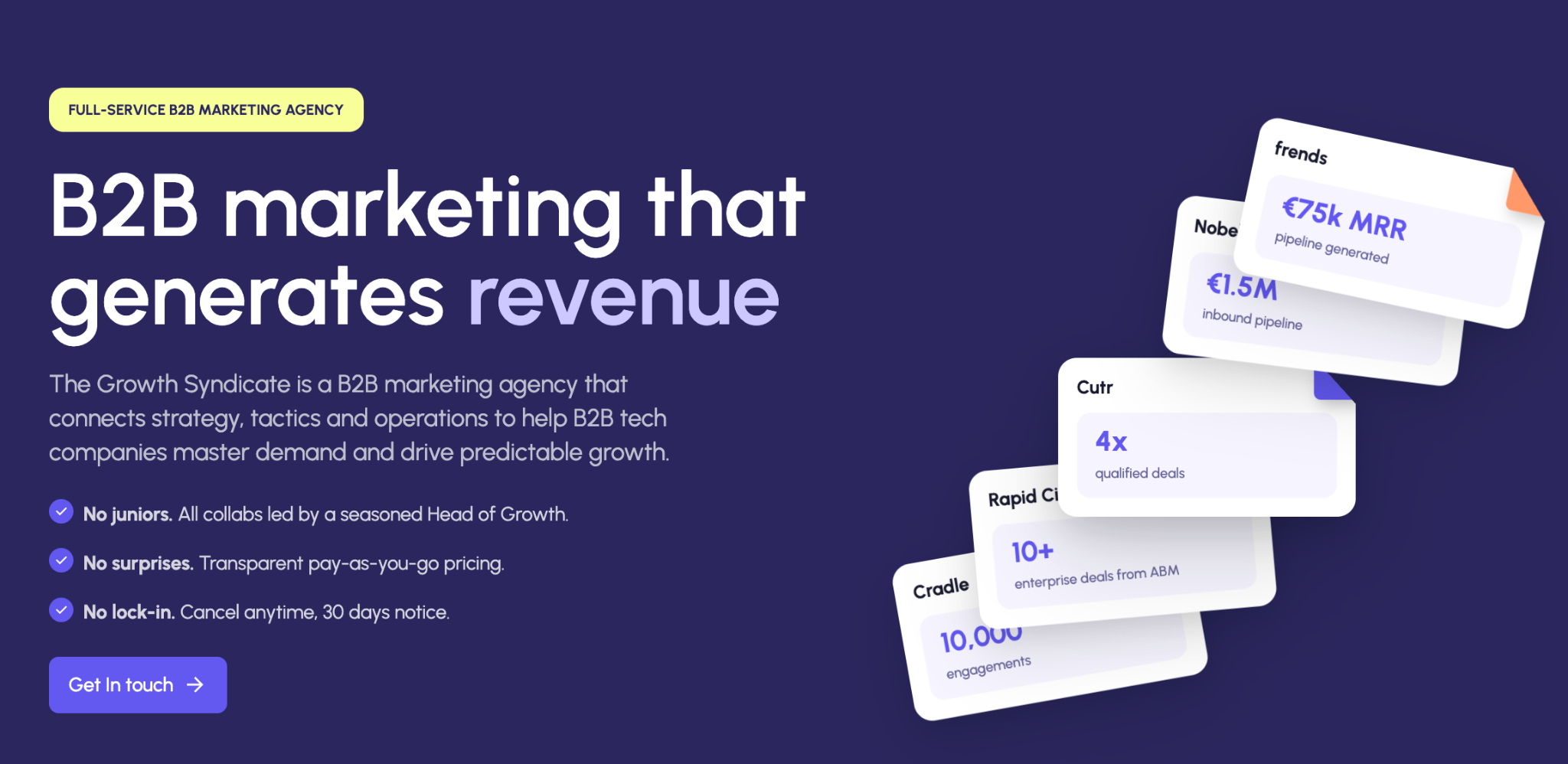
Verifiable results. The case studies skew toward the complex, long-cycle B2B work the company specializes in, and the figures below are reported by TGS. For Madeinadd, a 3D-printing manufacturer, TGS reports market growth above 300% alongside a 65% reduction in cost per acquisition. For Cutr, a manufacturing marketplace, it reports 4x qualified leads and 2.8x sales conversions. For Frends, an integration platform, it reports €75K in monthly recurring revenue, an MQL-to-SQL conversion rate that climbed from 14% to 30%, and 24 ABM opportunities created. For Axual, a data-streaming company, it reports €306,091 in marketing-generated pipeline and roughly €270,000 in marketing-assisted pipeline. Cradle, a biotech AI company, is credited with more than 10,000 engagements and 60-plus sales interactions, and Nobel Recruitment with all-time pipeline and sales records. Across the portfolio the pattern is consistent: complex industries, enterprise sales motions, and pipeline metrics rather than vanity numbers.
Ideal fit. TGS suits B2B companies in enterprise software, deep tech, manufacturing, professional services, and B2B marketplaces that have a real product and real sales motion but lack a senior marketing engine to connect them. It is built for the company that has outgrown a junior in-house marketer or a single freelancer and needs both the direction a CMO provides and the hands to act on it, without carrying that cost permanently. The company's stated aim is to build in-house capability and make itself unnecessary within three to nine months, which fits buyers who want to graduate to their own team rather than rent one forever.
Where it stops. TGS is B2B only. It does not take on B2C, e-commerce, or DTC work, and it is explicit that it is not a sales-team replacement. There is a budget floor: marketing spend below roughly €5,000 a month is not a fit, which rules out the earliest pre-revenue startups. It is also a poor match for any buyer who wants to hand marketing off and never look at it again, since the model depends on the client staying close enough to absorb the capability being built.
Pricing. TGS uses transparent hourly rates with a monthly minimum, billed pay-as-you-go, with 30 days' notice to cancel. That structure is a genuine differentiator in a market where retainers are often opaque and lock-in is the norm. A buyer can see the rate, scale hours up or down, and leave without a fight, which lowers the risk of the first engagement considerably.
2. Heinz Marketing: best for pipeline strategy and sales-marketing alignment
Founded: ~2008 · HQ: Kirkland, Washington · Team: ~20 employees · Website: heinzmarketing.com
Heinz Marketing is closer to a strategic advisory practice than a campaign shop, which is what makes it a credible alternative to a titled fractional CMO. Founder Matt Heinz has spent more than 20 years in B2B, hosts Sales Pipeline Radio, and runs the CMO Coffee Talk community of more than 3,000 marketing leaders, so the firm's center of gravity is leadership-level thinking rather than channel execution.

What they do. The firm built its practice around what it calls the Predictable Pipeline Method, a full-funnel approach that ties demand generation directly to sales outcomes and treats marketing and sales as one revenue system rather than two departments. Engagements lean toward strategy, sales-marketing alignment, and consulting, which is the work a fractional marketing leader does in the first 90 days of any serious engagement.
Verifiable results. Heinz Marketing references work with organizations including Amazon, Seagate, Morgan Stanley, and the Bill & Melinda Gates Foundation. The firm's public material emphasizes pipeline-stage improvement and alignment outcomes rather than headline ROAS figures, consistent with its advisory positioning.
Ideal fit. This is a strong choice for a B2B company whose core problem is that marketing and sales are not aligned, where leads get generated but never convert because no one owns the handoff. It suits leaders who want senior strategic counsel and a proven pipeline framework more than they want a team to run ads.
Where it stops. Heinz Marketing is weighted toward strategy and consulting rather than hands-on, day-to-day channel execution. A company that needs someone to build and run paid campaigns at volume will find this is the wrong end of the spectrum. The team is also boutique in scale, so it is not built to absorb a large multi-channel execution load on its own.
Pricing. Not publicly disclosed; engagements are scoped to the advisory and consulting work rather than sold as a fixed retainer tier. Buyers should expect a custom proposal built around the specific pipeline problem, which suits companies that want the engagement shaped to their situation rather than slotted into a standard package.
3. New North: best for an embedded strategic lead for B2B tech
Founded: ~2008 · HQ: Frederick, Maryland · Team: small senior team · Website: newnorth.com
New North works as an embedded strategic partner for B2B technology companies that have a capable but small in-house team and need senior direction more than they need more hands. It functions like a part-time head of marketing for organizations that are not ready to hire one, which is the fractional value proposition in everything but title.
What they do. The firm pairs strategy with execution across content, paid media, ABM, SEO, web, and reporting, and it prices on value rather than billable hours. The emphasis is on giving a scrappy in-house team the strategic mind-share it lacks, then executing against that plan rather than handing over a document and leaving.
Verifiable results. New North has worked with clients including Kolbe Corp and RICOH Graphics Communications. The firm reports a 134% average client ROI and a 24% average increase in traffic across its engagements, figures that are self-reported.
Ideal fit. It suits small and mid-market B2B technology companies that have product-market fit and a modest marketing function, but no one senior enough to set direction. If your marketing coordinator is executing well but flying blind on strategy, this is the gap New North fills.
Where it stops. The team is small, so it is not built for enterprise-scale programs or for companies that need a large execution bench. It is firmly focused on B2B technology, which makes it a poor fit for other sectors, and its public case-study metrics are limited compared with larger firms.
Pricing. Value-based rather than hourly; scoped per engagement and not published as standard tiers.
4. Single Grain: best for founder-led growth leadership
Founded: acquired by Eric Siu in 2014 · HQ: Los Angeles, California, remote-first · Team: mid-sized · Website: singlegrain.com
Single Grain is an execution-led growth agency with an unusually strong leadership brand attached, which is why it earns a place in a fractional-adjacent list. Founder-owner Eric Siu built the company's visibility through the Marketing School and Leveling Up podcasts, and the firm positions itself as an extension of a founder or CMO's team rather than a detached vendor.
What they do. The agency calls its approach revenue marketing and covers SEO, paid media, content, and AI-driven growth. It frames engagements around growth leadership for founders, CMOs, and VPs of marketing, though the day-to-day delivery is primarily execution across acquisition channels.
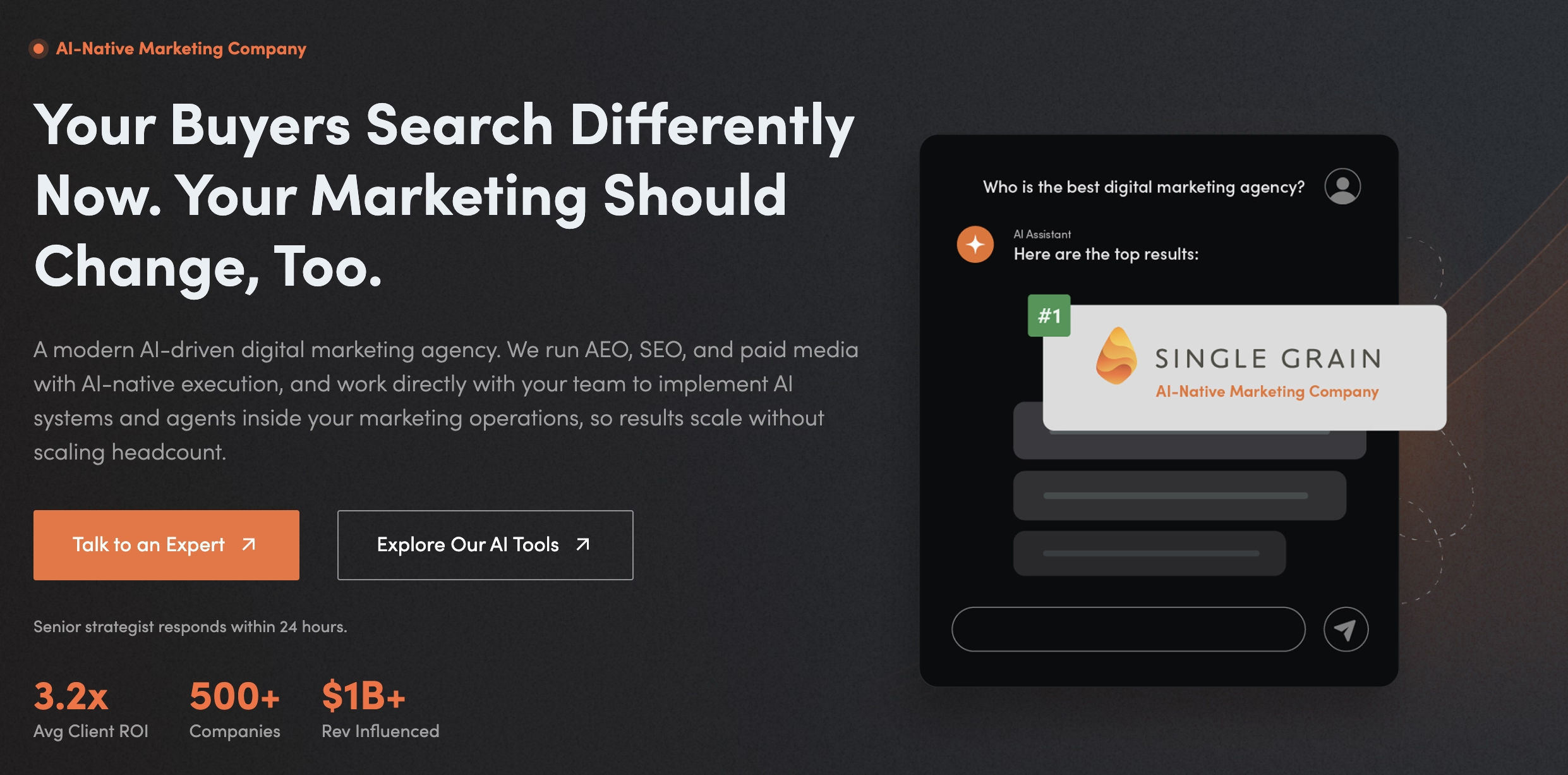
Verifiable results. Single Grain has worked with Amazon's Alexa, Nextiva, Lever, and Uber, and reports a 3.2x average return on investment along with a claim of having influenced billions in revenue across 500-plus companies. These figures are self-reported.
Ideal fit. It works for growth-stage companies that want senior growth thinking wired into hands-on channel execution, particularly where a founder wants a sparring partner at the strategy level and a team to run acquisition underneath it.
Where it stops. Single Grain is a generalist rather than a pure B2B specialist, so a company with a long, complex enterprise sales cycle may find the fit looser than with a dedicated B2B firm. The model is execution-led, so it is not a substitute for a fractional CMO who owns leadership-team accountability.
Pricing. Project and retainer based; not published as standard tiers.
5. Directive Consulting: best for paid media and customer generation
Founded: 2014 · HQ: Irvine, California, with offices in Austin, Los Angeles, New York, and London · Team: ~150 employees · Website: directiveconsulting.com
Directive is a performance marketing specialist for B2B and SaaS, and it belongs on this list as an execution partner rather than a fractional CMO. If your strategy is sound and your gap is channel performance, this is one of the strongest paid-media operators in the category.
What they do. The agency built its practice around a methodology it calls Customer Generation, which reframes paid acquisition around qualified pipeline rather than raw lead volume. Services span SEO, PPC, CRO, content, paid social, and digital PR, supported by an analytics practice that ties spend to revenue rather than to clicks.
Verifiable results. Directive has worked with Allstate, Sumo Logic, Cherwell, and Web.com, and bootstrapped itself to roughly $20M in revenue, a signal that the performance model works on its own marketing as well as its clients'.
Ideal fit. It suits B2B and SaaS companies with a defined strategy and the budget to run paid acquisition seriously, where the need is a specialist team to execute and optimize against pipeline.
Where it stops. Directive does not offer fractional or interim marketing leadership. It is a channel execution partner, so a company that lacks strategic direction will not get a CMO out of this engagement. It is also priced for companies with real paid budgets rather than for early-stage teams.
Pricing. Retainer based, scoped to channel scope and spend; not published as fixed tiers.
6. Refine Labs: best for demand-gen strategy and category design
Founded: 2019 · HQ: United States, remote · Team: mid-sized · Website: refinelabs.com
Refine Labs is a demand strategy firm that helped popularize the modern demand-generation playbook, and it sits on this list as a strategy partner adjacent to fractional leadership. Founder Chris Walker built the firm's reputation on rethinking how B2B demand actually gets created, and it is now led by CEO Megan Bowen.
What they do. The firm works across a brand-to-demand-to-expand framework, combining demand strategy with paid execution and a strong emphasis on measurement, particularly the gap between what attribution software reports and where buyers actually come from. The work is closer to demand strategy and category design than to full marketing leadership.
Verifiable results. Refine Labs scaled to nearly 100 employees and reached eight-figure annual recurring revenue serving a large roster of B2B clients, and its public influence on B2B demand-gen thinking is among the strongest in the category.
Ideal fit. It suits venture-backed and growth-stage B2B SaaS companies that want to modernize how they create demand and measure it, and that already have or can supply execution capacity around the strategy.
Where it stops. Refine Labs does not provide a fractional CMO. Its focus is demand generation specifically, so a company needing leadership across the full marketing remit, including brand, product marketing, and team building, will find the scope narrower than the title CMO implies.
Pricing. Retainer based; not publicly disclosed.
7. Ironpaper: best for demand generation plus HubSpot execution
Founded: 2002 · HQ: New York City, with an office in Charlotte, North Carolina · Team: ~70 employees · Website: ironpaper.com
Ironpaper is a B2B demand-generation agency with a consulting practice attached and verified platform credentials, which makes it a dependable execution partner for companies committed to HubSpot. It is one of the few firms on this list whose partner status is independently checkable.
What they do. The agency covers demand generation, ABM, content, website builds, lead generation, and sales enablement, supported by marketing, sales, and customer-experience consulting. Its consulting arm pushes it closer to strategy than a pure execution shop, though it stops short of a titled fractional leadership offering.
Verifiable results. Ironpaper is a HubSpot Diamond Partner and a Google Partner, both verifiable credentials, and a Databox Premier Partner. These certifications matter because they are awarded on performance and platform expertise rather than self-declared.
Ideal fit. It works for mid-market B2B companies running on HubSpot that need demand generation and ABM executed well, with enough consulting attached to keep the program pointed in the right direction.
Where it stops. Ironpaper does not market a fractional CMO service. The consulting is program-level rather than leadership-team-level, so it is not a substitute for someone owning the marketing function. It is also tied closely enough to HubSpot that companies on a different stack may not get full value.
Pricing. Retainer based; scoped per program and not published as fixed tiers.
8. Omniscient Digital: best for SEO and generative engine optimization
Founded: 2019 · HQ: Austin, Texas, remote · Team: mid-sized · Website: beomniscient.com
Omniscient Digital is an organic growth specialist, and it earns a place here as the channel partner to hire when your gap is SEO and content rather than marketing leadership. Founded by two former HubSpot operators, Alex Birkett and David Ly Khim, the firm is one of the more rigorous content practices in B2B SaaS.
What they do. The agency focuses on SEO, generative engine optimization, content, programmatic and technical SEO, digital PR, and analytics, built around a research process it calls OmniscientX and a content approach it describes as a barbell strategy that balances high-volume and high-value content. As AI search reshapes how buyers find vendors, the firm's GEO focus is increasingly relevant.
Verifiable results. Omniscient reports driving $4M in annual recurring revenue through the blog for Jasper and $3.7M in pipeline for Smartling, and has worked with Order.co, Loom, Hotjar, and AppSumo. These figures are self-reported.
Ideal fit. It suits B2B SaaS companies that have decided organic search and content are a core channel and want a specialist to own it properly, including the shift toward being cited inside AI answers.
Where it stops. Omniscient is a single-channel specialist. It does not offer fractional marketing leadership, paid media at scale, or the broader CMO remit, so it works best as one part of a wider program rather than as the strategy owner.
Pricing. Full-service engagements start around $10,000 a month, with thought-leadership content programs from roughly $3,000.
9. SmartBug Media: best for HubSpot and RevOps
Founded: 2007 · HQ: Newport Beach, California, remote-first · Team: ~300 employees · Website: smartbugmedia.com
SmartBug Media is a full-funnel inbound and RevOps agency with the deepest HubSpot credentials in the category, included here as the execution partner for companies whose growth runs through that platform. Its certifications are independently verifiable, which is rarer than it should be.

What they do. The agency covers inbound and demand generation, RevOps and CRM, web, e-commerce, customer success, and paid media, with HubSpot implementation and optimization at the center. The breadth makes it a one-stop execution partner for companies standardizing on HubSpot as their revenue engine.
Verifiable results. SmartBug is HubSpot's most decorated Elite Partner and was named HubSpot's North American Partner of the Year in 2024 and again in 2025. These are awarded credentials, not claims, and they signal genuine platform depth.
Ideal fit. It works for B2B and e-commerce companies investing seriously in HubSpot that want inbound, RevOps, and lifecycle marketing run by a team that knows the platform end to end.
Where it stops. SmartBug does not offer fractional marketing leadership. It is an execution and operations partner, so it presumes you already have strategic direction. Companies not committed to HubSpot will not get full value from the engagement.
Pricing. Onboarding commonly runs from roughly $4,250 to $12,000, with retainers in the mid-four to low-five figures a month.
10. Belkins: best for outbound and appointment setting
Founded: 2017 · HQ: Dover, Delaware, with a team rooted in Kyiv, Ukraine · Team: 200+ employees · Website: belkins.io
Belkins is the outbound specialist on this list, included because pipeline generation through direct outreach is a distinct discipline that a fractional CMO would oversee but rarely run personally. It has been ranked the top US appointment-setting agency for several years running.

What they do. The agency covers B2B lead generation, appointment setting, cold email and calling, LinkedIn outreach, lead research, ABM support, and outsourced SDR work, along with deliverability and HubSpot consulting. This is the engine room of outbound pipeline rather than a strategy practice.
Verifiable results. Belkins has worked with GE, Nvidia, Zendesk, and Cloudflare, and reports more than 300,000 appointments booked and a 10-to-1 average return, figures that are self-reported.
Ideal fit. It suits B2B companies with a clear ideal customer profile and a sales team ready to take meetings, where the constraint is the volume of qualified conversations at the top of the funnel.
Where it stops. Belkins does not provide marketing leadership or full-funnel strategy. It is an outbound execution partner, so it solves a pipeline-volume problem rather than a direction problem, and it presumes your sales motion and targeting are already sound.
Pricing. Retainer and performance based; scoped to outreach volume and not published as fixed tiers.
11. The Marketing Practice: best for enterprise ABM at global scale
Founded: 2002 · HQ: London, with US offices and a global footprint · Team: 400+ employees · Website: themarketingpractice.com
The Marketing Practice is the enterprise option on this list, a global B2B agency built for large, complex account-based programs. It is included as the answer for companies whose scale has outgrown a boutique, with the caveat that it is headquartered outside the US.

What they do. The agency covers strategy and planning, account-based marketing across one-to-one, one-to-few, and one-to-many models, brand, creative, demand generation, media, sales enablement, and analytics, supported by an AI-assisted delivery layer. It was assembled partly through acquisitions that broadened its capability across regions and disciplines.
Verifiable results. The firm works with AWS, ServiceNow, Microsoft, Salesforce, Palo Alto Networks, SAP, and T-Mobile, an enterprise client roster that reflects the scale and complexity of programs it is built to run.
Ideal fit. It suits large enterprises and high-growth companies running sophisticated ABM across multiple regions and product lines, where the need is a partner that can match the buyer's own scale and operate globally.
Where it stops. The Marketing Practice does not offer fractional marketing leadership for smaller companies. It is built for enterprise budgets and programs, which makes it a poor fit for startups and mid-market firms, and its UK headquarters means US buyers should weigh time-zone and account-location factors.
Pricing. Enterprise scoped; not publicly disclosed.
How we selected these companies
The list weighs five criteria. Each one is checkable, and each one maps to a real risk a buyer takes on when choosing wrong.
Verified results over claims. Every company here has at least one named client with a specific outcome attached, whether that is pipeline generated, conversion-rate movement, or cost-per-acquisition reduction. Where a metric is self-reported, the profile says so. Marketing providers are unusually good at writing about marketing, so the bar is evidence, not eloquence.
Genuine leadership depth. A fractional CMO sits inside your leadership team and owns direction and revenue accountability. An agency owns deliverables. Both can be the right answer, but they are not the same purchase. Each profile states plainly whether the company offers true fractional or interim marketing leadership, or whether it is an execution partner you would hire in support of that leadership.
Specialization that matches the buyer. B2B marketing for a deep-tech company with an 11-month sales cycle has almost nothing in common with growth marketing for a consumer subscription app. The companies here were assessed on how well their actual track record fits complex, considered-purchase B2B, not on how broad their service menu looks.
Honest limitations. Every company stops somewhere. The profiles name the boundary directly: the budget floor, the missing service line, the industry they do not serve. A provider that claims to do everything for everyone is telling you nothing.
Relevance to a hiring decision today. The fractional model has changed quickly, and pricing, engagement length, and the line between strategy and execution have all shifted in the past two years. The selection favors companies whose model reflects how the market actually buys in 2026.
What the fractional CMO market looks like in 2026
The decision to hire fractional leadership rather than a full-time CMO is no longer unusual. It sits inside a labor shift that has been building for several years, and understanding that shift helps explain why the pricing and engagement models look the way they do. The short version is that senior marketing talent has become more available on flexible terms at the same moment that companies have become warier of large permanent commitments, and the fractional model sits exactly at that intersection.
Fractional leadership has gone mainstream. Harvard Business Review reported that more than 110,000 people worldwide with English-language profiles identified as fractional leaders in early 2024, up from roughly 2,000 in 2022. The Frak Conference's State of Fractional Industry Report, which surveyed 250 fractional professionals across 29 US states, put the count at 120,000 in 2024, doubled from 60,000 two years earlier. Marketing is consistently the function companies are most willing to fill this way, partly because marketing leadership is expensive to hire full-time and slow to replace when it leaves.
Full-time CMO tenure is short and the seat often sits empty. The average tenure of a Fortune 500 CMO was 4.3 years in 2024, according to the Spencer Stuart CMO Tenure Study, below the 4.9-year average across the C-suite. Spencer Stuart's 2025 reading of S&P 500 companies put it at 4.1 years. More striking for a buyer weighing the fractional option: only 329 of the Fortune 500, about 66%, had a C-suite marketing leader in 2024, down from roughly 74% the year before. Close to a third of the largest companies in the country operated without an enterprise marketing leader at all. If the biggest companies struggle to keep the seat filled, a 40-person software company has even less reason to assume a permanent hire is the default.
The full-time number is the anchor for everything else. Built In's 2026 data puts the average US CMO base salary at $225,908, with average total compensation around $293,575 once additional cash is included. Add benefits, bonus, and equity and the true employer cost commonly lands between $275,000 and $500,000 a year. That figure is the reference point a fractional engagement is measured against, and it is why a $10,000-a-month fractional arrangement reads as a bargain to a founder who has priced out the alternative.
AI is compressing the work, which raises the value of the strategist. As AI absorbs more of the production layer, from first-draft copy to campaign assembly, the scarce input becomes judgment: what to build, for whom, and in what order. That shifts the advantage toward senior direction and away from headcount, which is precisely the value a fractional CMO or a senior-only marketing team is built to sell. It also explains the rise of hybrid models that pair a fractional leader with a small execution pod rather than selling strategy as a standalone deliverable that no one is left to act on.
What a fractional CMO actually does, and how engagements are structured
The title gets used loosely, so it helps to be precise about the work before comparing providers. A fractional CMO is a senior marketing leader who takes ownership of a company's marketing function on a part-time basis, usually splitting their time across two to four companies. The role is defined by ownership rather than hours: a fractional CMO is accountable for the direction marketing takes and the pipeline it produces, which is what separates the role from a consultant who advises and leaves, or an agency that executes a brief without owning the result.
The first 90 days set the pattern. A serious fractional engagement almost always opens with diagnosis rather than activity. The leader audits the current state of marketing, interviews sales and customer-facing teams, examines the pipeline data, and forms a view of where the real constraint sits. Often the constraint is not the thing the company thinks it is. A founder convinced the problem is "not enough leads" frequently has a positioning or conversion problem instead, where the leads exist but the message does not land or the sales handoff leaks. The diagnostic phase is where an experienced fractional CMO earns their fee, because correctly naming the constraint determines everything that follows.
Strategy comes before channels. Once the constraint is named, the work moves to direction: who the ideal customer is, how the product is positioned against alternatives, what the messaging needs to say, and which channels deserve investment in what order. This is the part of the role that does not scale with hours, which is precisely why it works part-time. A company does not need a senior strategist in the building 40 hours a week to decide that it has been chasing the wrong segment. It needs that decision made correctly once, then revisited as the market moves.
Execution is where models diverge. After strategy, companies split into two camps, and the split is the single most important thing to understand when choosing a provider. In the pure fractional model, the CMO sets direction and then relies on the company's existing team, freelancers, or a separate agency to execute. This works when the company already has execution capacity and only lacks direction. It fails when the company has neither, because a strategy with no one to run it produces a polished plan and no movement. The alternative is the embedded model, where the fractional leader comes attached to a team that executes the plan they set. This is the model The Growth Syndicate runs, and it exists specifically to solve the failure mode of strategy that no one acts on.
Accountability is the throughline. Across both models, the defining feature is that the fractional CMO owns an outcome, usually expressed as pipeline, revenue contribution, or a specific set of marketing-sourced targets. When evaluating any provider that uses the title, the sharpest question to ask is what number they are willing to own. A provider that will only own activity, such as campaigns shipped or content published, is selling execution dressed as leadership. A provider that will own pipeline is selling the real thing.
Fractional CMO versus the alternatives
Most companies considering a fractional CMO are really choosing among four options, and the differences are easy to blur. Naming them clearly prevents an expensive mismatch.
Fractional CMO versus full-time CMO. The full-time hire gives you constant presence, deep institutional knowledge, and someone in every room where decisions get made. It also costs $275,000 to $500,000 a year fully loaded, takes four to six months to recruit, and carries real risk given that the average tenure is now close to four years. The fractional option trades presence for flexibility and cost, and it suits companies that need senior thinking more than they need a senior body in the building full-time. The crossover point usually arrives when marketing becomes complex enough, or the team large enough, that the function genuinely requires daily senior leadership. Below that point, a full-time CMO is often an expensive way to buy more presence than the company can use.
Fractional CMO versus marketing agency. An agency is paid for deliverables and is structurally not accountable for your revenue, because its incentive is to renew the contract rather than to make itself unnecessary. That is not a criticism of agencies, it is simply what they are built to do. A fractional CMO is accountable for the outcome and, in the best engagements, works to build capability that reduces your dependence on outside help. The cleanest way to think about it: an agency executes a strategy, a fractional CMO decides the strategy and then makes sure it gets executed, whether by an in-house team, an agency, or an embedded pod. Companies that hire an agency without first fixing strategy frequently end up paying for efficient execution of the wrong plan.
Fractional CMO versus marketing consultant. A consultant diagnoses and recommends, then hands over a document and departs. A fractional CMO diagnoses, recommends, and then stays to own the result. Consultants are valuable for a bounded question, such as a pricing study or a market-entry assessment, where the deliverable is the answer itself. They are the wrong choice when the company needs someone to carry the answer through to execution, because the gap between a good recommendation and a realized outcome is exactly where most marketing initiatives die.
Fractional CMO versus a senior freelancer or contractor. A freelancer executes a defined scope of work, such as running paid campaigns or writing content. They do not set company-level direction or own cross-functional alignment with sales. The distinction matters because companies sometimes hire a senior freelancer expecting leadership and receive execution, or hire a fractional CMO expecting hands-on production and receive strategy. Matching the purchase to the need avoids both disappointments.
How to choose
The right provider depends less on which list it tops and more on which gap you are actually trying to close. Before reading the recommendations below, name your constraint honestly. If you cannot articulate your marketing strategy in two sentences, your gap is direction, and you need leadership before you need execution. If you can articulate it clearly but it is not getting built, your gap is execution, and an embedded model or a specialist agency is the more efficient buy. If your strategy is sound and your execution is running but one channel is underperforming, your gap is narrow, and a single-channel specialist will outperform a generalist every time. The recommendations below map the most common situations to the strongest fit.
If you have a real product and sales motion but no senior marketing direction, hire The Growth Syndicate. The combination of leadership and an embedded team solves the most common fractional failure, where strategy arrives but no one is staffed to run it.
If marketing and sales are misaligned and leads die at the handoff, start with Heinz Marketing. Its pipeline method is built specifically for the revenue gap between the two functions.
If you are a B2B tech company with a small in-house team that lacks direction, New North gives you an embedded strategic lead without the cost of a full-time head of marketing.
If you want senior growth thinking wired into hands-on execution, Single Grain fits founder-led companies that want a strategy sparring partner with a team underneath.
If your strategy is sound and your gap is paid media, Directive Consulting is one of the strongest performance partners in B2B.
If you need to modernize how you create and measure demand, Refine Labs is the demand-strategy specialist to call.
If you run on HubSpot and need demand gen plus ABM executed well, Ironpaper pairs verified platform credentials with a consulting layer.
If organic search and AI citations are your priority, Omniscient Digital is the SEO and GEO specialist.
If HubSpot and RevOps are the center of your growth engine, SmartBug Media has the deepest platform credentials in the category.
If your constraint is the volume of qualified sales conversations, Belkins is the outbound and appointment-setting engine.
If you are an enterprise running global ABM, The Marketing Practice is built for that scale.
FAQ
What is a fractional CMO company?
A fractional CMO company provides senior marketing leadership on a part-time or shared basis, so a business gets the direction of a chief marketing officer without the cost or commitment of a full-time hire. Unlike a marketing agency, which is paid to deliver specific work, a fractional CMO joins the leadership team, sets the marketing strategy, and takes ownership of pipeline and revenue outcomes. Some companies provide a single fractional executive, while others, like The Growth Syndicate, pair the leadership role with an embedded team that executes the plan. The model has grown quickly because it matches how B2B companies actually need senior marketing: in concentrated, high-impact doses rather than as a permanent fixture.
How much does a fractional CMO cost?
Pricing falls into three common models. Monthly retainers typically run from $5,000 to $15,000 for early and growth-stage companies, rising to $20,000 to $50,000 a month for enterprise engagements. Hourly arrangements usually fall between $200 and $400 an hour, with the most experienced operators charging $300 to $500. Project-based work for a defined initiative, such as a go-to-market launch, commonly runs $10,000 to $50,000. For comparison, a full-time CMO costs an employer between roughly $275,000 and $500,000 a year once base salary, benefits, bonus, and equity are included, which is why most fractional engagements save companies somewhere between 40% and 70% against the full-time equivalent.
What is the difference between a fractional CMO and a marketing agency?
The cleanest distinction is accountability. A marketing agency is paid to produce deliverables, whether that is campaigns, content, or ad management, and it does not own your revenue number. A fractional CMO sits inside your leadership team, sets the direction the agency would execute against, and owns the outcome. In practice the strongest setup for many companies is a fractional leader who also directs execution, which is why hybrid models that combine both have become common. If you already have a clear strategy and only need it executed, an agency is the more efficient buy. If you lack direction, an agency will execute the wrong plan efficiently, and a fractional CMO is what you actually need.
How long does a fractional CMO engagement last?
Most engagements run between 6 and 24 months. Shorter arrangements of three to six months tend to be bridge roles, covering a gap while a company recruits a permanent hire or stabilizes after a departure. Longer engagements reflect companies that have decided fractional leadership is the right ongoing model for their stage. Some providers, including The Growth Syndicate, explicitly aim to build in-house capability and work themselves out of the core role within three to nine months, transitioning from running marketing to advising a team they have helped stand up. The right length depends on whether you are filling a temporary gap or treating fractional leadership as a deliberate, longer-term structure.
When should a company hire a fractional CMO instead of a full-time CMO?
A fractional CMO makes sense when a company needs senior marketing direction but cannot justify, afford, or fill a full-time role. That describes most companies between roughly $1M and $50M in revenue, where marketing has outgrown a junior hire or a single freelancer but the budget for a $300,000-plus executive is hard to defend. It also fits companies in transition, such as after a CMO departs or during a funding round when the strategy needs to be sharp but the permanent hire is months away. Given that close to a third of even Fortune 500 companies operated without a marketing leader in 2024, the assumption that a full-time CMO is the default deserves more scrutiny than it usually gets.
How do you vet a fractional CMO company before hiring?
Start with evidence rather than reputation. Ask for named clients in your industry and the specific outcomes achieved, then ask to speak to one or two of them directly. Probe the engagement model: who exactly will do the work, whether strategy and execution come together or separately, and what happens if you need to scale up or end the relationship. Transparent pricing and a short notice period, such as The Growth Syndicate's 30-day terms, lower your risk on the first engagement considerably. Be wary of any provider that guarantees results before understanding your business, claims to serve every industry equally well, or cannot point to a single specific metric from past work. The right partner will be direct about where they stop, because a company that claims no limitations is the one to worry about.
What are the warning signs of the wrong fractional CMO company?
A few patterns reliably predict a bad engagement. The first is a provider that promises specific results before having seen your data, since no honest leader can forecast pipeline without first understanding your funnel, your sales cycle, and your market. The second is a pitch that jumps straight to tactics, recommending a channel mix or a content plan in the first conversation, before anyone has diagnosed the underlying constraint. The third is vagueness about who actually does the work, where a senior name sells the engagement and junior staff deliver it. The fourth is an unwillingness to commit to any owned outcome, which signals that the provider is selling execution while using leadership language. Finally, watch for a refusal to name limitations. Every genuine specialist can tell you precisely who they are not right for, and a provider who claims to fit everyone has not thought hard about fit at all.
How many hours a week does a fractional CMO work?
It varies with the engagement, but most fractional arrangements fall between roughly 10 and 25 hours a week per client, which is what allows a leader to serve two to four companies at once. The hours are weighted heavily toward the start of an engagement, when diagnosis and strategy demand more time, and they typically settle into a lighter rhythm once the direction is set and execution is running. The right figure depends on the model. A pure advisory engagement might need only a day a week, while an embedded model that includes execution capacity will involve more total time across the team even if the senior leader's own hours stay concentrated. What matters more than the raw number is whether the time buys ownership of an outcome or simply a fixed quantity of attention.
Does a fractional CMO replace a marketing team?
No, and a provider who suggests otherwise is misrepresenting the role. A fractional CMO leads a marketing function; they do not single-handedly execute every campaign, write every asset, and manage every channel. In the pure model, the fractional leader directs an existing team or outside partners. In the embedded model, the leader arrives with a team attached. Either way, the expectation that one part-time executive will both set strategy and personally produce all the work is the most common reason fractional engagements disappoint. The role is leadership, and leadership needs something to lead. Companies with no execution capacity at all should look specifically for an embedded model rather than a lone fractional CMO.
Is a fractional CMO worth it for a startup?
For many startups, yes, provided the timing is right. A startup that has found product-market fit and is ready to scale demand, but cannot yet justify a $300,000 marketing executive, is close to the ideal case for fractional leadership. The value is access to senior judgment at a stage when a wrong strategic decision is expensive and a junior hire lacks the experience to avoid it. The exception is the very early company that has not yet validated its product or found repeatable demand. At that stage the founder is usually the right person to own marketing, because the learning needs to happen close to the product, and a fractional CMO is premature. The signal that the timing has arrived is usually a combination of real revenue, a working sales motion, and a marketing function that has outgrown whoever currently runs it.
Can a fractional CMO be as effective as a full-time CMO?
For the strategic and leadership parts of the role, often yes, because the work that creates the most value, setting direction, fixing positioning, aligning marketing with sales, and building the right team, does not require 40 hours a week. A seasoned fractional CMO concentrates on the decisions that matter most rather than filling a calendar. The limitation is presence: a fractional leader is not in every meeting and is not building deep institutional relationships across the company the way a full-time executive does. The model works best when the company is set up to absorb concentrated senior input and act on it, and less well when it needs constant in-person leadership or treats marketing as something to fully outsource.
Do fractional CMO companies specialize by industry?
The best ones do, and for B2B buyers that specialization matters more than almost anything else. Marketing a deep-tech product with an 11-month sales cycle to a technical buying committee has little in common with marketing a consumer app, and a fractional CMO who has done the former is worth far more to a deep-tech company than a generalist with a longer client list. Several companies on this list specialize tightly: The Growth Syndicate in complex B2B across software, deep tech, and manufacturing, New North in B2B technology, and The Marketing Practice in enterprise technology. When evaluating a provider, weight relevant industry track record heavily, because the playbook that worked in an unrelated sector frequently does not transfer.
.png)