.svg)


Most B2B content gets indexed, then forgotten. The teams behind it did the keyword research and filled the content calendar.
They skipped the harder question: why would a buyer spend ten minutes with this?
B2B buyers now complete most of their evaluation before speaking to anyone. AI answers intercept searches that once brought website traffic, and generative tools flood every channel with lookalike articles.
B2B content marketing still works, just no longer by default.
This guide covers what B2B content marketing is, how to build a B2B content marketing strategy, B2B content marketing examples worth copying, and the practices that separate compounding programs from noise.
What is B2B content marketing?
B2B content marketing is the practice of creating and distributing valuable, relevant content to attract, engage, and convert other businesses rather than individual consumers. Per the Content Marketing Institute's classic framing, the end goal is profitable customer action: pipeline, revenue, retention.
In business to business markets, trust comes from educational content: blog posts, white papers, industry reports, and customer success stories that help a target audience solve business problems. B2B content marketing is designed to attract and convert other businesses, competing on usefulness and credibility rather than entertainment.
B2B buying is slow and collective; by widely cited estimates, nearly 50% of B2B leads are not ready to buy at first engagement.
B2B content marketing builds relationships through valuable information sharing, staying useful to potential customers until they are ready. The bar: valuable content a buyer would want even without your product.
How B2B content marketing differs from B2C
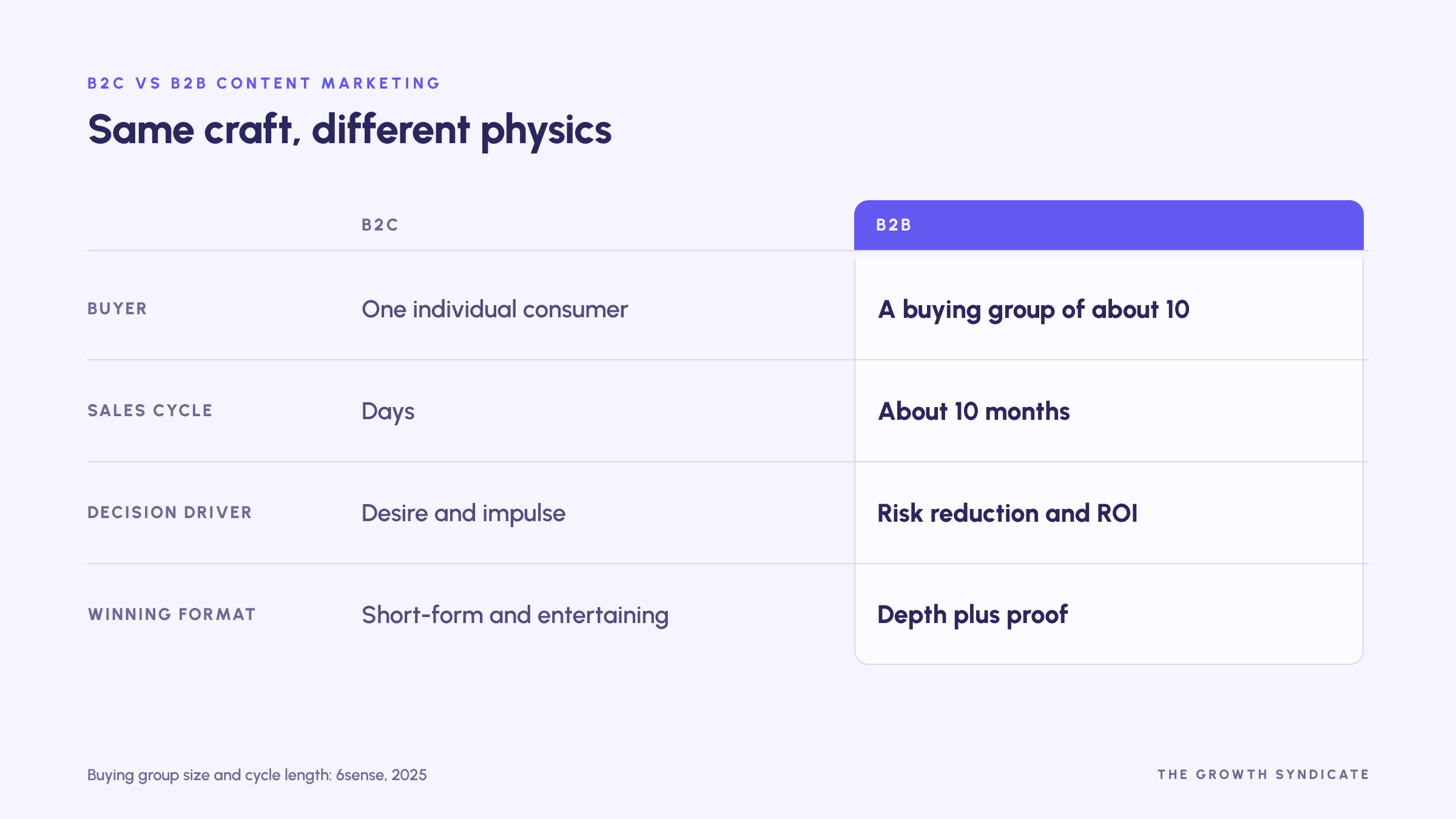
B2C content marketing targets individual consumers making fast, emotional decisions. B2B content marketing targets a business audience making slow, high-stakes ones.
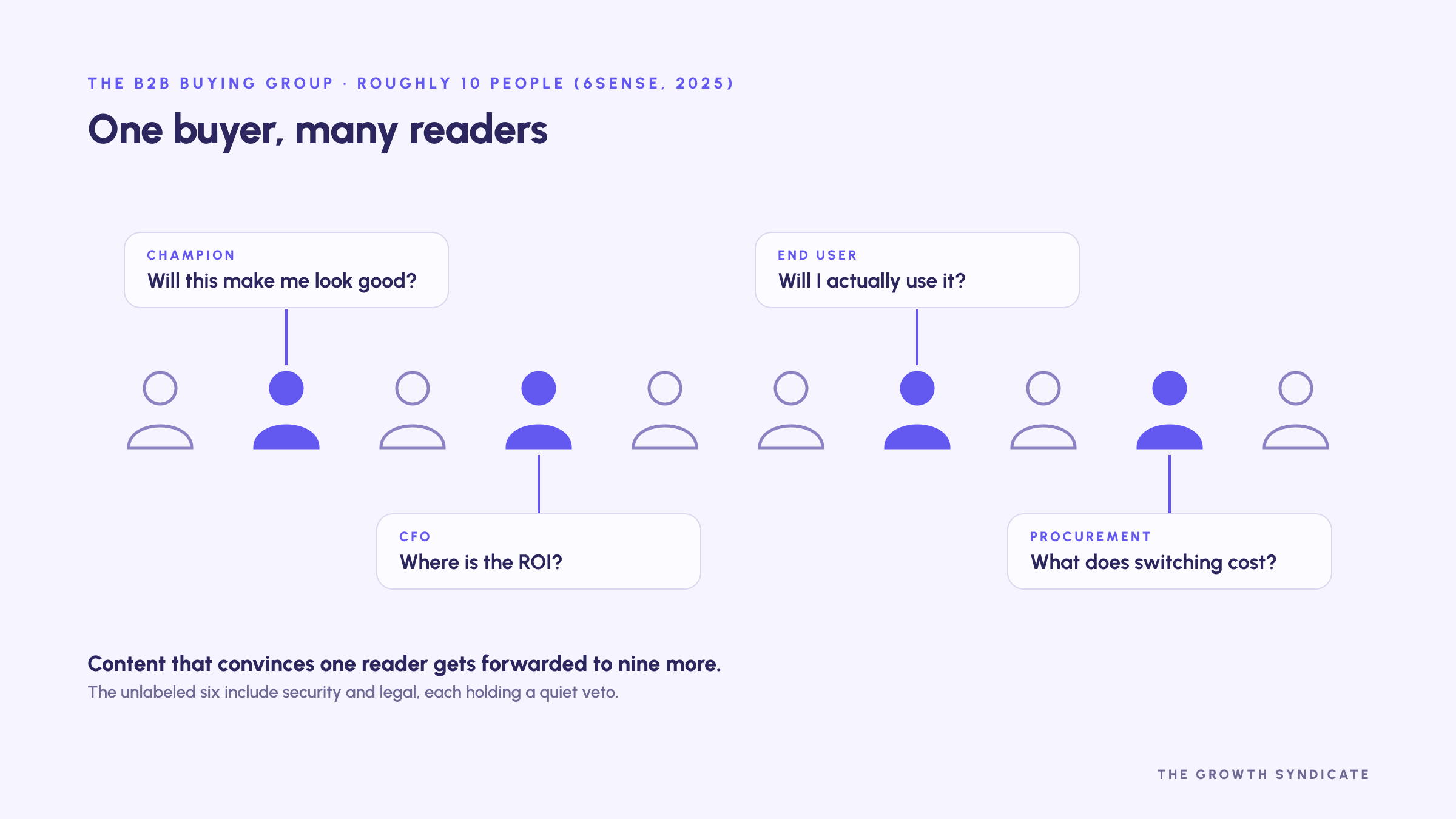
B2B purchases rarely involve a single decision-maker. 6sense's 2025 Buyer Experience Report puts the average buying group at roughly 10 people, spread across departments, over a customer journey averaging 10 months (6sense, November 2025).
Purchases carry high costs and risks, so content must translate complex concepts for multiple stakeholders.
Where B2C can win on impulse, effective B2B content marketing addresses specific pain points throughout a complex buyer's journey, focusing on logic, ROI, and solving operational problems. It has to survive forwarding: white papers that convince one manager must hold up when the CFO reads them cold.
Content marketing, demand generation, and thought leadership
Conflating these produces muddled programs. Content marketing is the engine: ongoing production and content distribution. Demand generation is the commercial motion it powers. The third is the sharpest gear: perspective-led work that shapes how a market thinks.
We draw the line at TGS like this: content marketing asks "what keywords can we rank for?" while thought leadership asks "what does our market need to understand that only we can teach them?"
A serious B2B content marketing strategy needs both, because search-led work captures existing demand while perspective-led work creates it. We cover the second in our [thought leadership strategy guide](internal: /thought-leadership-strategy) and the commercial motion in our [demand generation guide](internal: what-is-demand-generation article).
Why B2B content marketing matters more in 2026
Two structural shifts define the moment, and both raise the stakes for your content strategy.
Buyers decide before they talk to you
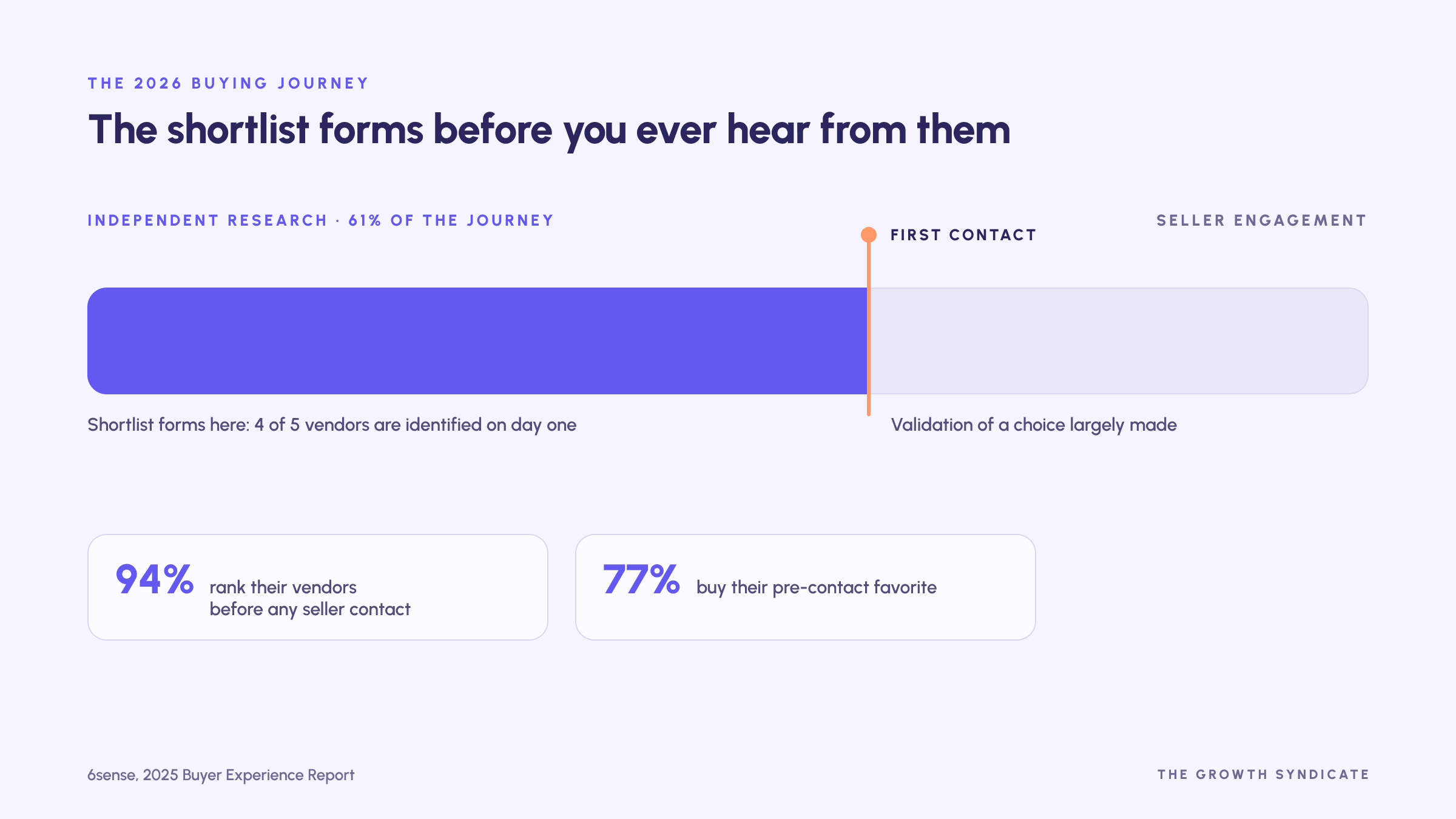
The self-serve buying journey is now measured. 6sense's 2025 research across 4,000+ buyers found that 94% of buying groups rank their preferred vendors before contacting a single seller, then buy from that favorite 77% of the time.
First contact comes about 61% of the way through the customer journey, after requirements are set and the shortlist is locked.

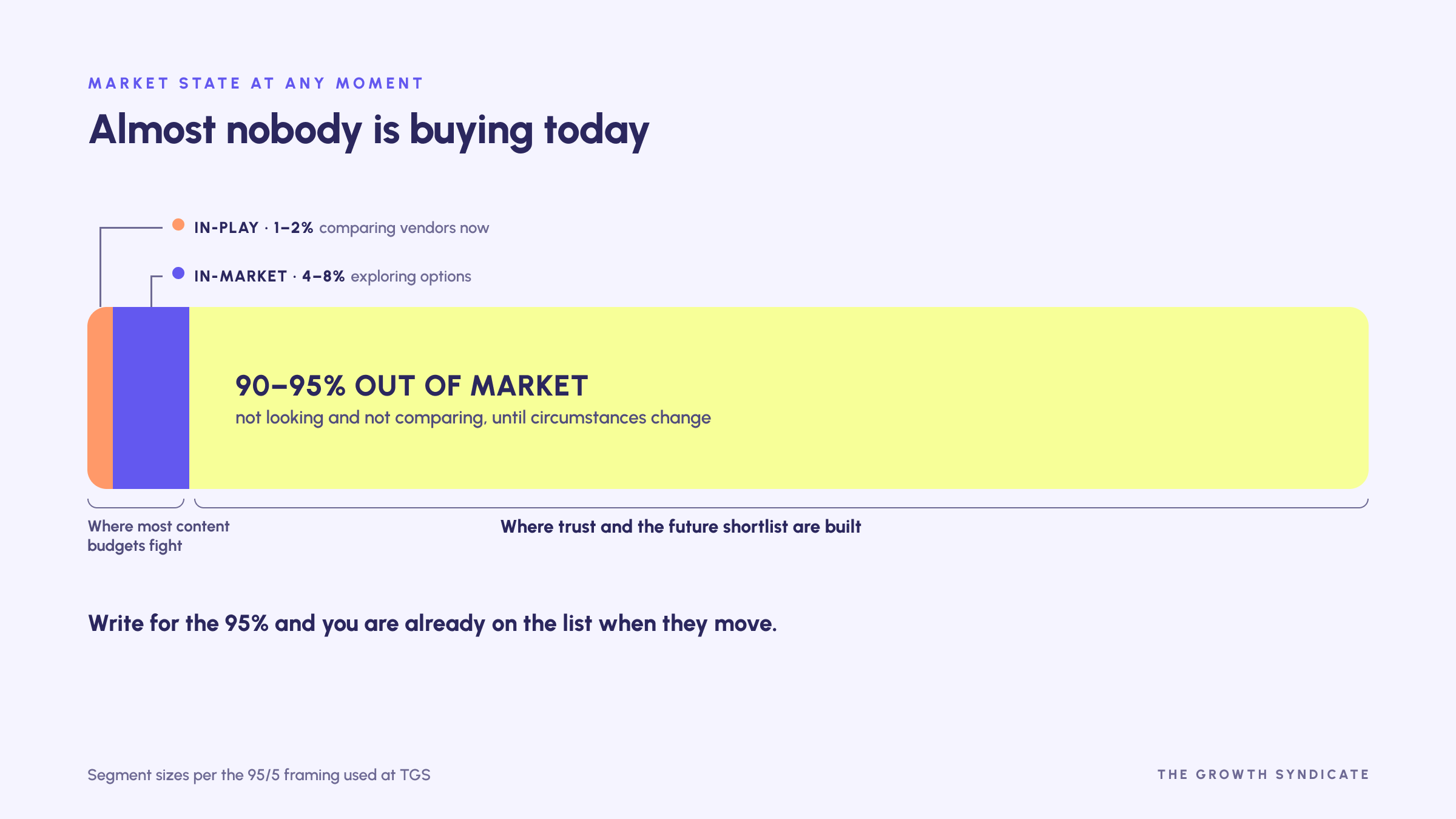
"Most companies focus on the 4-5% who are in-market while ignoring the 90-95% they need to educate. But here's what happens. When someone moves from out-of-market to in-market, they already have two or three companies in mind. They're not going to check anything else."
That is the core economic argument for a B2B content marketing strategy: only a small slice of your target audience is buying right now. Valuable content is the only scalable way to reach the rest of your potential buyers, so you are already on the list when they move.
Much of that influence happens in the dark funnel: Slack threads, forwarded newsletters, and white papers passed around internally. Google Analytics will never show most of it.
AI intercepts the clicks
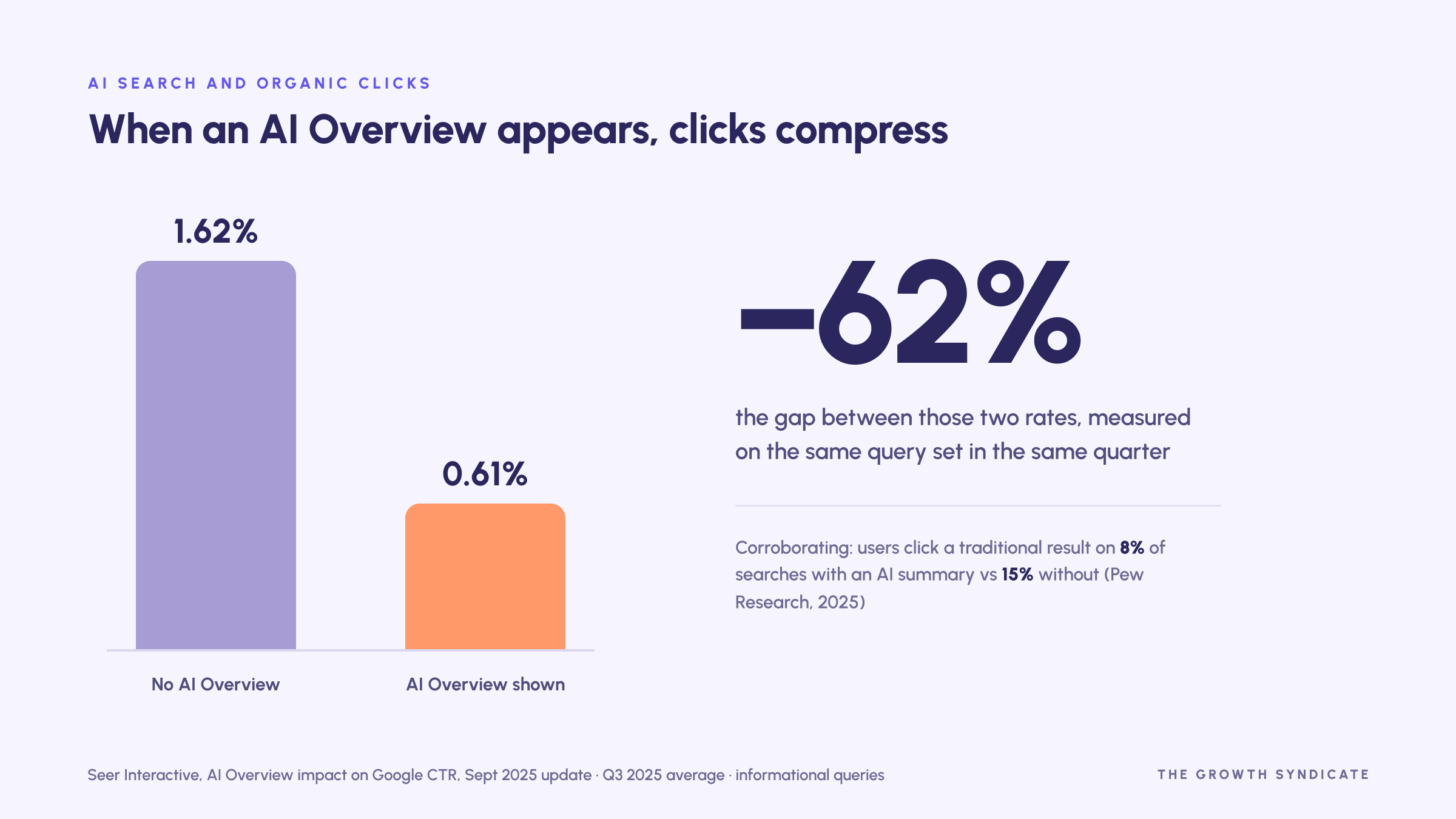
The second shift hits content distribution: AI Overviews now answer many informational queries on the results page.
Ahrefs' analysis of 300,000 keywords, comparing December 2023 against December 2025, found an AI Overview correlates with a 58% lower clickthrough rate for the top-ranking page. Seer Interactive measured organic CTR on affected queries falling from 1.76% to 0.61% between mid-2024 and September 2025, with a partial rebound through early 2026. Treat it as a reset, not a straight line down.
Buyers have adopted the tools too: 94% of B2B buyers now use LLMs like ChatGPT during evaluation (6sense, 2025). Website traffic from search engines is partly being replaced by citations inside AI answers.
For content marketing efforts built on rankings alone, search visibility now includes being the source AI systems quote, rewarding original data and named expertise over interchangeable blog posts.
The shifts above raise the bar for B2B content marketing. B2B content marketing strategy is how you clear it.
How to build a B2B content marketing strategy
A B2B content marketing strategy is a documented plan connecting business goals to audiences, topics, formats, distribution channels, and measurement. A documented content marketing strategy keeps the marketing team aligned and its trade-offs explicit; CMI's research has long tied documentation to results, yet most teams run an undocumented content strategy.
Here is the sequence we use to build a B2B content marketing strategy.
1. Anchor the strategy to a business case
Decide what your B2B content marketing strategy must do commercially before deciding what to make. Typical goals: generate leads for sales, build awareness with future buyers, or shorten cycles by pre-answering objections. Attach a number to each.
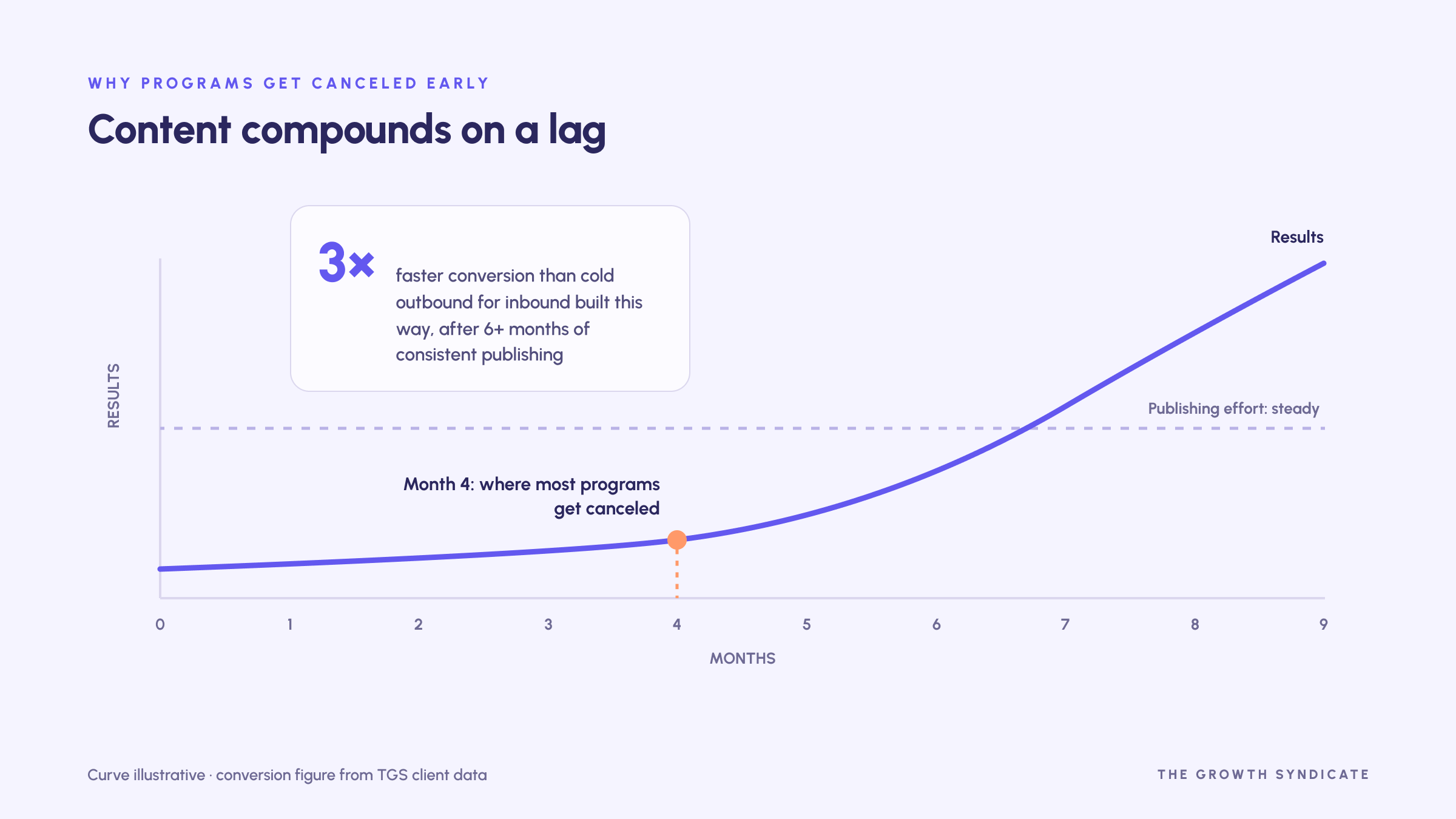
Content marketing compounds slowly; pretending otherwise is how programs get cancelled at month four. Our own TGS data shows this kind of inbound converts 3x faster than cold outbound, but only after 6+ months of consistent publishing.
2. Research the target audience and the buying committee
Audience research in B2B means mapping a committee, starting with conversations rather than dashboards. Interview customers, mine sales calls, and capture the language potential buyers use for their pain points.
Build buyer personas for each committee role, then map those buyer personas to what each role asks. Treat buyer personas as hypotheses to test against interviews, turning what you hear into relevant insights competitors lack.
The output: expensive, recurring business problems you are unusually qualified to speak on for your target audience. That is the backbone of a B2B content marketing strategy.
3. Map content to the customer journey
The classic marketing funnel still works as a planning grid, though real journeys loop and stall. Unaware buyers need perspective on industry trends, problem-aware buyers need frameworks and educational content, decision-stage buyers need comparisons and proof.
The sales funnel view keeps you honest about coverage, the buyer's journey view about sequence. Build follow-ups that nurture leads between stages instead of pushing everyone toward a demo.
Most B2B libraries over-index on decision-stage content for the 5% in-market and starve the 95% who are not. Rebalance your B2B content marketing strategy accordingly.
4. Choose content formats you can win with
Content formats should follow your strengths and your target audience's habits, not fashion. The core menu: blog posts for search and depth, white papers and industry reports for authority, thought leadership content for perspective, webinars for real-time engagement, podcasts for reach, educational videos and infographics for complex concepts, and customer success stories plus customer testimonials for proof.
CMI/MarketingProfs found video (61%) and thought leadership content (52%) topped the list of planned spending increases; its 2026 report puts AI tools first at 45%, then events (33%) and owned media (32%).
Pick two or three formats your content marketing strategy can sustain with high quality content. A thin presence everywhere loses to a strong presence somewhere.
5. Plan distribution before production
Distribution is where a B2B content marketing strategy quietly dies. Decide how you will distribute content before you create content, budgeting as much for spreading each asset as making it.
The realistic channel set: LinkedIn (85% of B2B marketers call it their best-value social platform), email newsletters (71% use them), organic search, and communities. A newsletter is a relationship channel; email marketing in the promotional sense is a different discipline.
A content distribution plan for one flagship asset: publish on a dedicated content hub, extract ten social media posts, brief the founders' LinkedIn accounts, cut two clips, pitch three podcasts. Owned social media channels give control; borrowed audiences give reach.

6. Build the production system
Consistency beats intensity. Set a content calendar your marketing team can sustain, keep a backlog of content ideas from interviews, and put subject-matter experts inside the process, not at the review stage.
Use AI where it helps (research, repurposing, briefs); keep humans on judgment and voice. CMI's 2026 research puts AI use at 95% of B2B organizations, up from 81% a year earlier, so a modern B2B content marketing strategy treats AI as an accelerant, never the author.
Two rules protect it. Every piece needs one specific reader and one job. And perform a content audit at least once a year: kill or update stale pieces, reinvest in winners. Evergreen content continues to attract organic traffic and generate leads long after publication, if someone maintains it.
7. Measure like an operator, not an optimist
Pick a few KPIs per goal and resist vanity dashboards. Track engagement and conversions on content, demo requests and self-reported attribution ("how did you hear about us?") for pipeline, and Google Analytics plus CRM for website traffic and trend lines.
Tracking a few KPIs well refines your content strategy faster than tracking twenty badly. Judge content marketing efforts against their stage; every B2B content marketing strategy runs on a lag, so plan for it.
Directional evidence fills the dark-funnel gap: branded search growth, inbound quality, win rates.
B2B content marketing examples worth studying
The best B2B content marketing programs share a pattern: one sharp choice, executed for years. Each of these B2B content marketing examples reduces a B2B content marketing strategy to one bet.
Cognism: ungating everything
The sales intelligence company ripped forms off its content and rebuilt its B2B content marketing strategy around demand creation instead of MQL harvesting. Under CMO Alice de Courcy, Cognism scaled from $3M to $50M+ ARR over four years while rebuilding around ungated content, eventually removing MQLs from its SMB segment entirely and reporting more demo requests, better lead quality, and shorter cycles (Cognism, "Diary of a First-Time CMO").
Forms suppress the trust content builds. Giving away valuable information beat the old lead generation model at feeding the sales funnel with hand-raisers.
Gong: original data as the engine
Gong turned its product telemetry into Gong Labs, publishing research drawn from millions of analyzed sales calls. The industry insights existed nowhere else, so every post was quotable, fueling one of the most-followed company presences on LinkedIn.
Publishing unique industry data enhances credibility and quotability; in an AI-search era, it is what gets thought leadership content cited.
Ahrefs: product-led education
Ahrefs writes and films almost exclusively about problems its product solves, ranking blog posts by business potential over raw search volume. That focus, plus a YouTube library teaching SEO from zero, carried one of SaaS's most efficient software companies to nine-figure revenue with a tiny marketing team.
High value content that demonstrates the product beats high volume that merely mentions it.
Zapier: programmatic scale with intent
Zapier built thousands of landing pages for specific app-to-app integrations, matching long-tail searches precisely. The programmatic engine drove millions of monthly visits and made content its primary way to generate leads past $100M ARR. Scale worked because every page served a real intent.
Clay: distribution through practitioners
Clay grew explosively (6x ARR growth in 2024, past $100M ARR by the end of 2025, a $5B valuation by early 2026) on a community and creator ecosystem that pays practitioner experts to teach workflows on the product. Instead of one brand blog, Clay cultivated credible voices who engage business buyers in their own audiences. In crowded markets, distribution through trusted people beats publishing.
B2B content marketing best practices for 2026
Publish original data, not opinions about opinions
Data-driven storytelling now dominates the B2B content that earns press, backlinks, and AI citations. Run surveys, analyze usage data, or aggregate what only you can see, then turn findings into relevant insights nobody else can publish.
Original research is the hardest thing to commoditize and the easiest to distribute. Every stat becomes a social post, every chart earns links from reputable websites, and your commentary on industry trends gains a foundation nobody can copy.
Put named experts on the page
Generic bylines are dead weight. Attach real practitioners: quotes, positions, and authorship from people with skin in the game.
This is partly for E-E-A-T and AI retrieval, which favor attributable expertise, and mostly for readers, who smell committee-written prose. Thought leadership content earns its name only when a person is on the page; high quality content starts with a human visibly thinking and providing valuable insights a model could not generate.
Optimize for citations as well as rankings
Treat AI answers as a distribution channel in your B2B content marketing strategy. Answer the question in the first two sentences under each heading, make claims with numbers and sources, and structure blog posts so each section stands alone.
This is the craft of GEO (generative engine optimization), and the payoff is measurable: Seer found brands cited inside AI Overviews earn 35% more organic clicks. Keyword research still maps demand; it no longer finishes the job.
Distribute in the dark
Dark social (private Slack channels, forwarded emails, WhatsApp groups) is where B2B decisions spread. You cannot track it, but you can feed it.
Make blog posts easy to excerpt, screenshot, and forward. Zero-click posts on social media platforms that deliver the insight in-feed build more goodwill than teaser links; the most engaging content is what your target audience shares unprompted.
Ungate strategically
Nearly half of leads are not ready to buy, and a form will not change that. Default to open access, because valuable content works harder when potential customers self-educate freely; reserve gates for high-commitment assets like tools or benchmark datasets.
Then nurture leads over months instead of pushing for a meeting in week one. Content marketing remains up to 62% more cost-effective for lead generation than traditional outbound, though that benchmark is over a decade old. It holds only when the content is worth returning for.
Repurpose deliberately
One flagship asset per quarter, atomized into twenty derivatives, beats twenty disposable posts. Tailoring content by channel matters: an insight becomes a LinkedIn carousel, a newsletter section, a webinar segment, blog posts, and a clip, each native to its surface.
This is how small teams distribute content across distribution channels without burning out.
Why B2B content marketing programs fail
A B2B content marketing strategy fails in predictable ways.
Nothing to say. Most failed programs never had a point of view. If your work could sit on a competitor's blog unchanged, you are adding to the noise. Extract real positions from your experts before you create content.
No distribution muscle. Publishing blog posts to an audience of zero and calling it a content marketing strategy. If the plan is "post it and share it once," the plan is hope.
Wrong metrics, measured too early. Judging month-three work by MQL volume kills programs that would have printed pipeline in month nine. Set expectations early: content marketing success shows up first in engagement and quality signals, then in pipeline.
Volume worship. Generative AI made producing engaging content cheap and made differentiated work more valuable. Quality content at a sustainable cadence compounds; slop at any cadence does not.
A 90-day starting sequence
Weeks 1-4: run the business case, target audience interviews, and a content audit. Weeks 5-8: define your point of view, pick two formats, and create high quality content for one flagship asset with your experts. Weeks 9-12: ship it with a real distribution push, set the measurement baseline, then run a monthly cadence reviewed quarterly against your B2B content marketing strategy.
Expect engagement signals within a quarter, compounding organic traffic by month six, and defensible pipeline attribution by month nine. Teams that quit early never learn whether the strategy worked.
Frequently asked questions
What is the 3-3-3 rule in marketing?
The 3-3-3 rule structures attention: earn the first 3 seconds with the hook, deliver the core message within 30 seconds, and reward 3 minutes of attention with depth. Variants exist, but the attention version matters most, especially for video marketing where the first line decides everything.
What are the 4 types of B2B?
The four commonly cited B2B customer types: producers (buying inputs to make products), resellers (buying to sell on), governments, and institutions (hospitals, universities, nonprofits). Each buys differently, which is why a one-size marketing strategy underperforms.
Does B2B pay well?
Generally, yes. Because business to business deals are large and cycles complex, B2B marketing roles pay above B2C equivalents: US B2B content marketing managers typically earn $70K-$110K, with senior and director roles at $120K-$180K+. Ranges vary widely by market and stage.
What is B2B marketing with examples?
B2B marketing is promoting products or services to other businesses rather than consumers. Examples: Cognism selling sales intelligence to revenue teams, software companies like Salesforce selling CRM, or an accounting firm running webinars for CFOs to win potential clients. Informative content does much of the lead generation, because business buyers research heavily before engaging vendors.
Where TGS fits
The Growth Syndicate builds B2B content marketing engines end to end: a documented B2B content marketing strategy, a defined point of view, production with your experts, and distribution wherever buyers research, structured for search engines and AI citation from day one. Our marketing strategy work pairs search-led content with the perspective layer that creates demand among the 95% not buying yet.