

B2B PPC is paid advertising bought per click to reach people who buy on behalf of a business, mostly on search engines and LinkedIn. It rarely fails at the auction. It fails after the click, when a lead waits two days for a reply or never reaches the bidding algorithm as a qualified outcome, and this guide gives a fit test, the 2026 channel mix, a seven-step build and a cost-per-opportunity model to prevent that.
Key takeaways
- Paid search fits a B2B company when buyers already search for the category and sales replies to new leads within one working day. The deal also has to cover the cost of an opportunity, not just a lead.
- In research published in Harvard Business Review, firms that tried to contact a web lead within an hour were nearly seven times as likely to qualify it as firms that tried an hour later, and in a separate audit of 2,241 US companies, 23% never replied at all.
- The right B2B PPC budget is the lower of two ceilings: what search demand can absorb, and how many new leads your sales team can work each month.
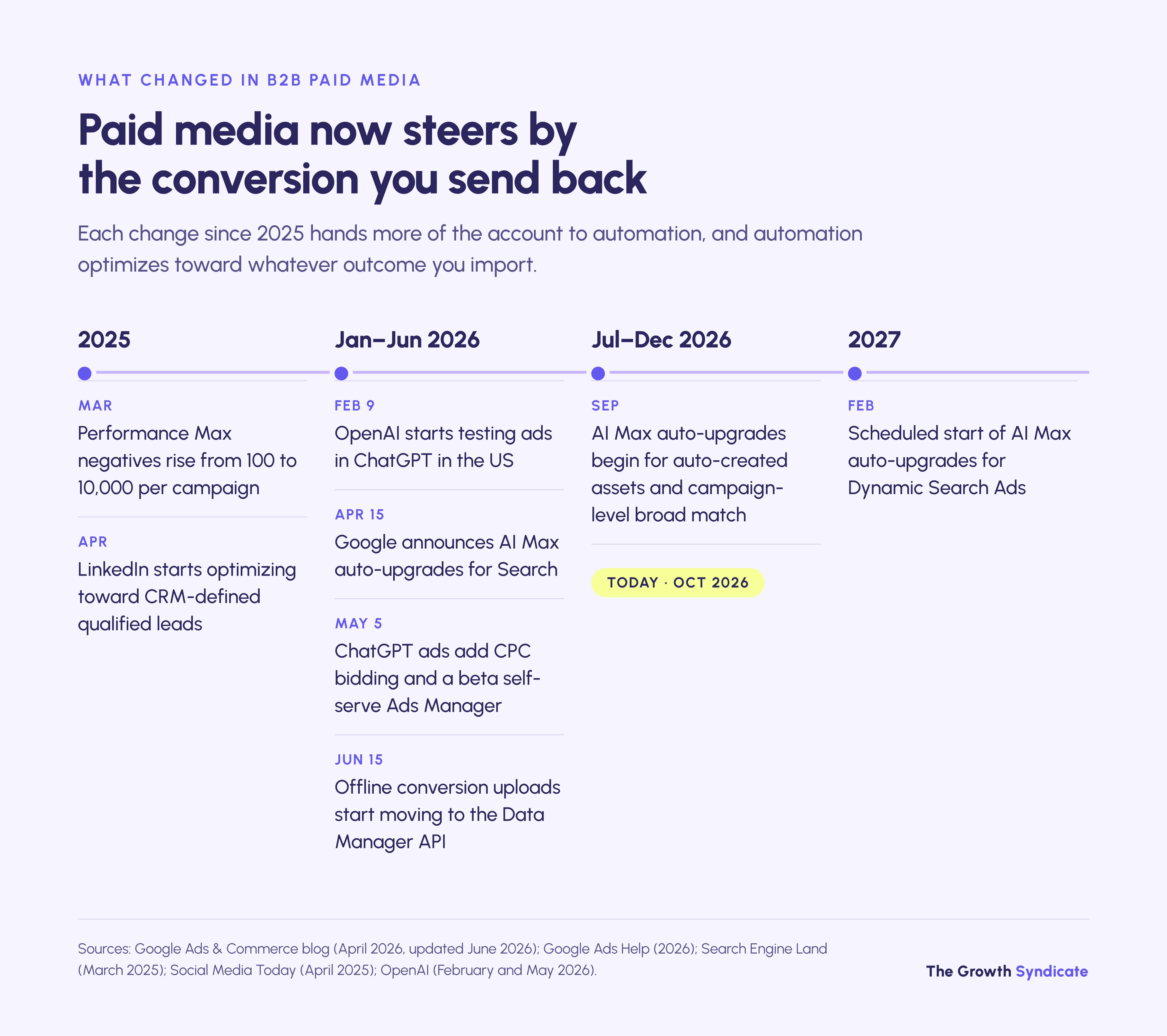
- Since June 15, 2026, Google has been moving offline conversion uploads to its Data Manager API, and it scheduled AI Max auto-upgrades to start in September 2026, so the conversion you import now steers most of the account.
- Judge B2B PPC on cost per sales-accepted opportunity after one full sales cycle, with cost per lead as an early warning only.
This guide draws on TGS's work running paid search and LinkedIn programs for B2B clients, founder practice recorded in TGS's internal knowledge base, and primary sources from Gartner, Harvard Business Review, the Ehrenberg-Bass Institute, Google and OpenAI, plus industry press. Figures that come from the ad platforms themselves are labeled as platform-reported.
What is B2B PPC, and how is it different from B2C?
B2B PPC is pay-per-click advertising aimed at people buying for a business, run mainly through search engines and LinkedIn. It differs from B2C because one click almost never becomes one purchase. A group of people decides over months, so the value of a click only becomes visible later, in the CRM, where the ad platform cannot see it by default.
In B2C, a click on a product ad can turn into revenue in the same session, and the ad platform sees the sale with its value attached. In B2B, the same click produces a form fill or a demo request. Revenue arrives after a sales process the platform never sees unless someone sends the outcome back.
The people behind that process are numerous and rarely agree. Gartner's 2025 survey of 632 B2B buyers found buying groups ranging from five to 16 people across as many as four functions, and 74% of buyer teams showing unhealthy conflict during the decision. A click from one of those people tells you very little about whether the group will buy.
The comparison holds for considered purchases. A B2B product with a credit-card checkout and a free trial behaves much more like B2C, and the B2C playbook works better there. Everywhere else, PPC for B2B needs the adjustments in the rest of this guide.
Does PPC work for B2B companies with long sales cycles?
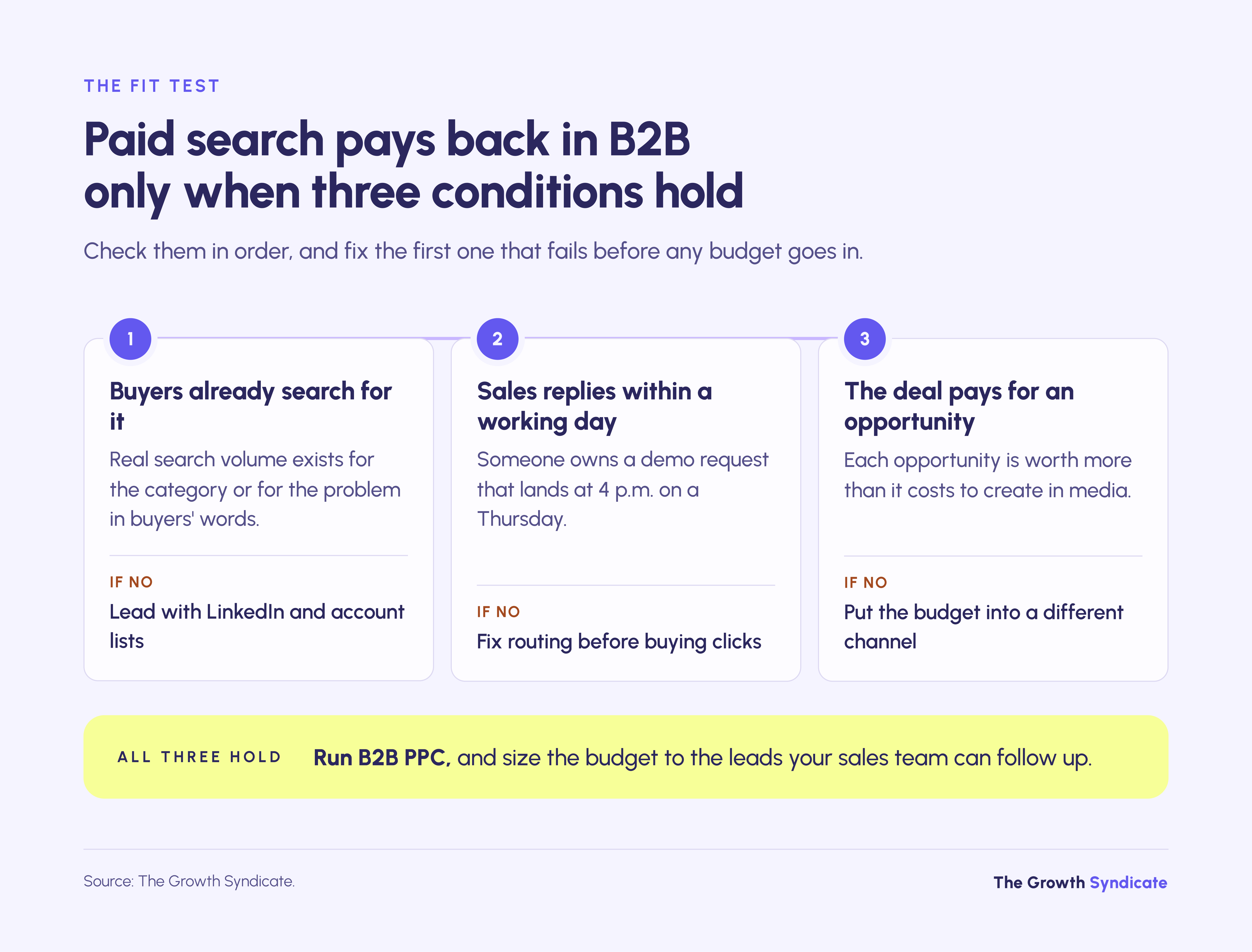
Paid search works for a B2B company when buyers already search for the category and sales can reply to a new lead within one working day. The deal also has to be large enough to pay for an opportunity rather than a lead. If any one of those conditions fails, extra budget buys more form fills and no more pipeline.
Condition 1: buyers already search for what you sell
Paid search for B2B can only capture demand that already exists. If your category is new, the people who need you search for the problem in their own words, or they don't search at all. Check volume for both the category term and the problem phrasing before you set a budget.
When the honest numbers are a few dozen searches a month, lead with LinkedIn and account lists. Keep search to brand terms and the handful of high-intent problem queries.
Condition 2: sales can follow up within one working day
A B2B lead loses value by the hour, which the next section quantifies. The test is practical. Who picks up a demo request that arrives at 4 p.m. on a Thursday, and when do they call?
If the answer is "Monday, probably," fix routing before you spend on clicks. A faster reply costs nothing per lead, while a slower one wastes every lead you bought.
Condition 3: the deal pays for an opportunity, not just a lead
Work the threshold backward from your own numbers. Divide average contract value by the number of opportunities it takes to win one deal, and you have what each opportunity is worth to you before margin. Then compare it with what an opportunity costs, which is cost per lead divided by the share of leads that become opportunities.
With illustrative numbers, the same funnel passes the test at a $30,000 contract and fails it at $8,000.
Put together, the three conditions make a short test to run before any budget is set.
Deal size also changes which paid channel leads. Smaller deals with shorter cycles suit high-volume search, while enterprise deals with large buying groups usually need account-based work, with search as one input among several.

Why are B2B PPC results decided after the click?
The auction sets the price of a click, and what happens afterward sets its value. In B2B, four post-click steps decide whether a click becomes revenue: how fast sales responds, how the lead is qualified, which CRM stage it lands in, and whether that outcome goes back to the ad platform to steer bidding.
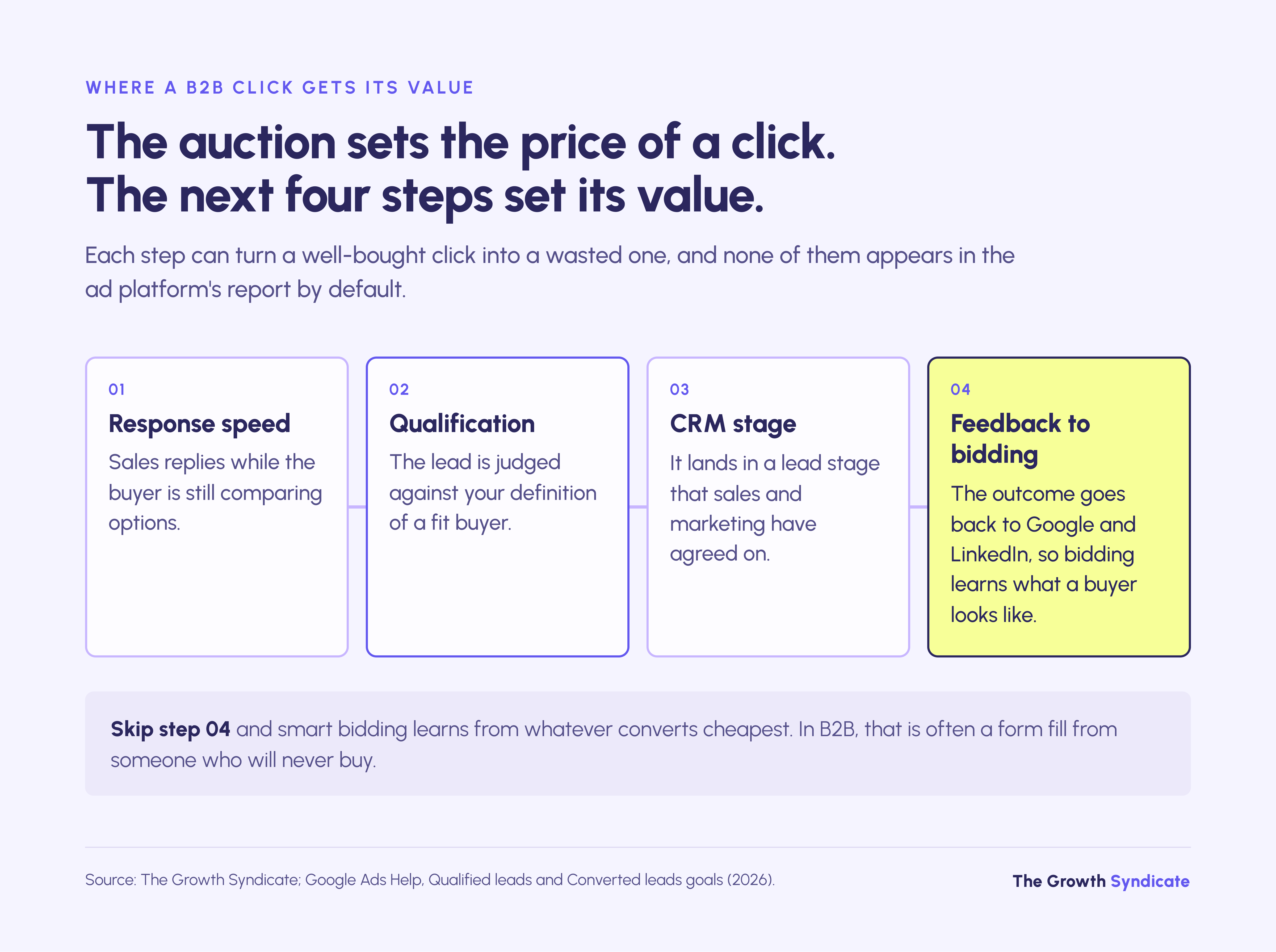
Response speed is the first leak, and it is well documented. When researchers sent test web leads to 2,241 US companies for Harvard Business Review, 37% replied within an hour, the companies that answered within 30 days took 42 hours on average, and 23% never replied at all. A separate study by the same authors, of 1.25 million leads at 42 US companies, found that firms that tried to contact a lead within an hour were nearly seven times as likely to qualify it as those that tried even an hour later, and more than 60 times as likely as those that waited 24 hours or more.
Both studies date from 2011, so read the multipliers as direction rather than a current benchmark. The direction hasn't changed, and a paid lead that waits until next week was bought at full price and used at a fraction of it.
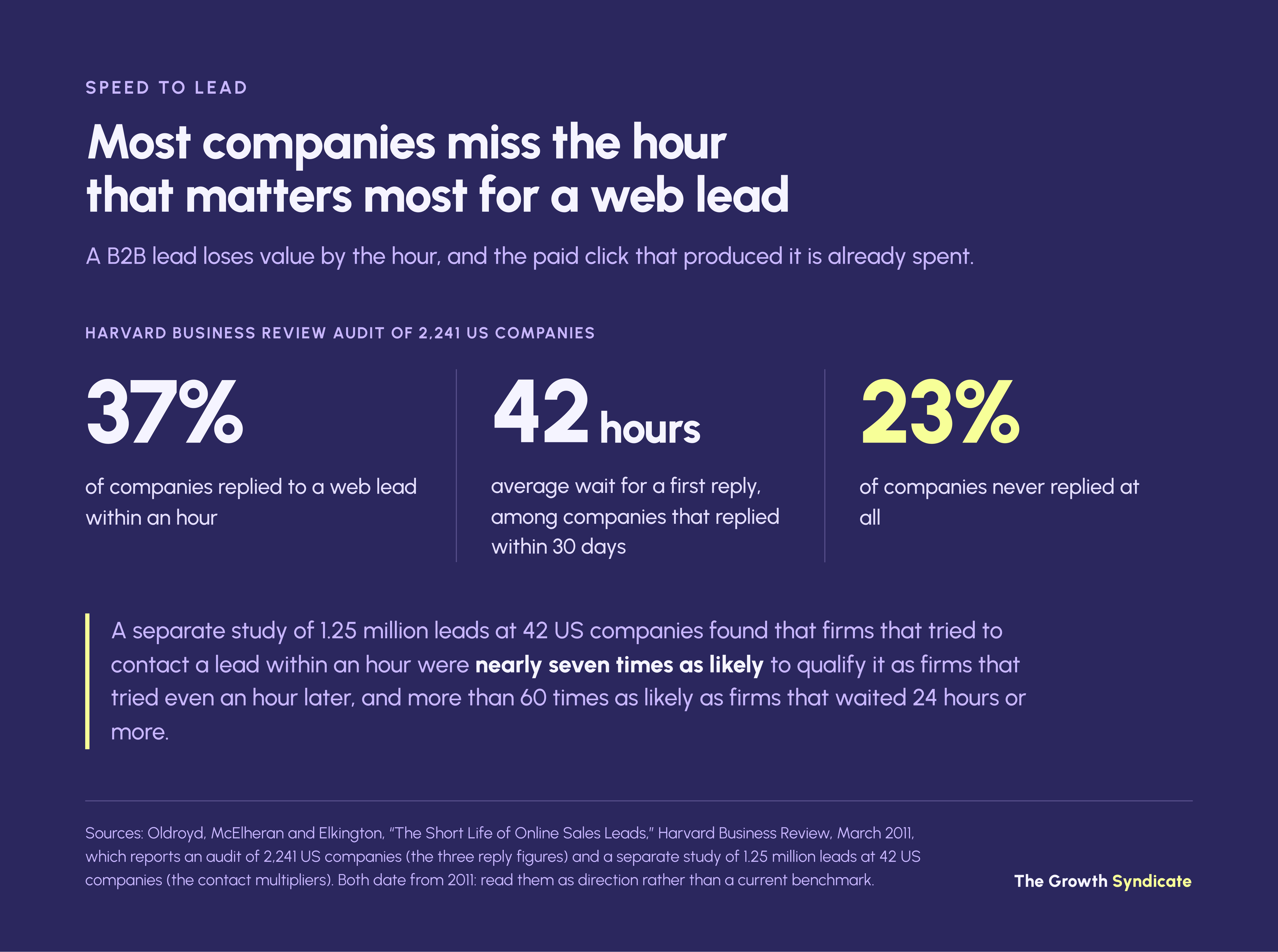
Classification is the second leak. When every form fill counts as a marketing-qualified lead, the ad platform is told that a student downloading a template and a VP requesting a demo are the same success, and smart bidding goes looking for more of the cheaper one. The fix starts with how your team defines a qualified B2B lead, because that definition becomes the instruction the ad platforms follow.
The platforms now build the feedback loop in. Google replaced its imported-leads goal with Qualified leads and Converted leads goals, so automated bidding can chase "high-value business outcomes rather than just maximizing lead volume," in Google's words. LinkedIn's Qualified Leads Optimization does the same with CRM-defined leads sent through its Conversions API, and LinkedIn said early results showed upwards of a 39% decrease in cost per qualified lead, without publishing a method.
The handoff to sales matters as much as the data. In TGS's paid work, accounts that look broken are often doing their part, and the conversion happens in a sales conversation the ad report never shows.

"Very often in B2B it doesn't work like that. Often the final conversion takes place in person, through sales outreach, at some event. And this should not reduce the perception of performance as a function that represents these initial touchpoints."
This argument has a limit. Faster follow-up and better feedback cannot rescue a category with no search demand or a contract too small to pay for an opportunity. Those are fit failures, and one full sales cycle of opportunity data usually shows which kind of failure an account has.
Which channels belong in a B2B paid media mix in 2026?
Most B2B companies should start paid media with Google and Microsoft search, because search reaches buyers who are already looking. LinkedIn comes next when the buying group is narrow and nameable. Meta and YouTube add lower-cost reach and retargeting, and ChatGPT ads belong in a small, time-boxed test budget for now.
Google and Microsoft come first in a B2B paid search strategy because intent is visible in the query. LinkedIn earns second place because it targets job title, seniority and company list directly, which matters when your market is a few thousand named people.
On LinkedIn, the most common leak is targeting by industry. An "IT industry" audience includes the HR, finance and operations staff of IT companies, so filter by job title and seniority, and measure success by which target companies engaged rather than by clicks alone.
ChatGPT ads are new enough to treat as a test. OpenAI began testing ads in ChatGPT in the US on February 9, 2026, for logged-in adult users on its Free and Go tiers. On May 5, 2026, it added CPC bidding and began rolling out a beta self-serve Ads Manager, alongside a recently launched pixel and Conversions API.
When TGS ran ChatGPT ads for B2B clients, click-through rates landed between 0.62% and 1.63% across manufacturing, healthcare and SaaS accounts, with zero clicks in fintech. The traffic produced no qualified pipeline, which is why ChatGPT ads sit in the test column of this mix after one early round.
A B2B paid media strategy flips that order when search demand is thin. A company selling into 300 named accounts gets more from LinkedIn company lists and account retargeting than from a keyword list that produces 40 searches a month.
How much should you budget for B2B PPC?
Set a B2B PPC budget from two ceilings and spend to the lower one. The first is what search demand can absorb at a cost per opportunity your deals can carry. The second is how many new leads your sales team can work properly each month, multiplied by your cost per lead.
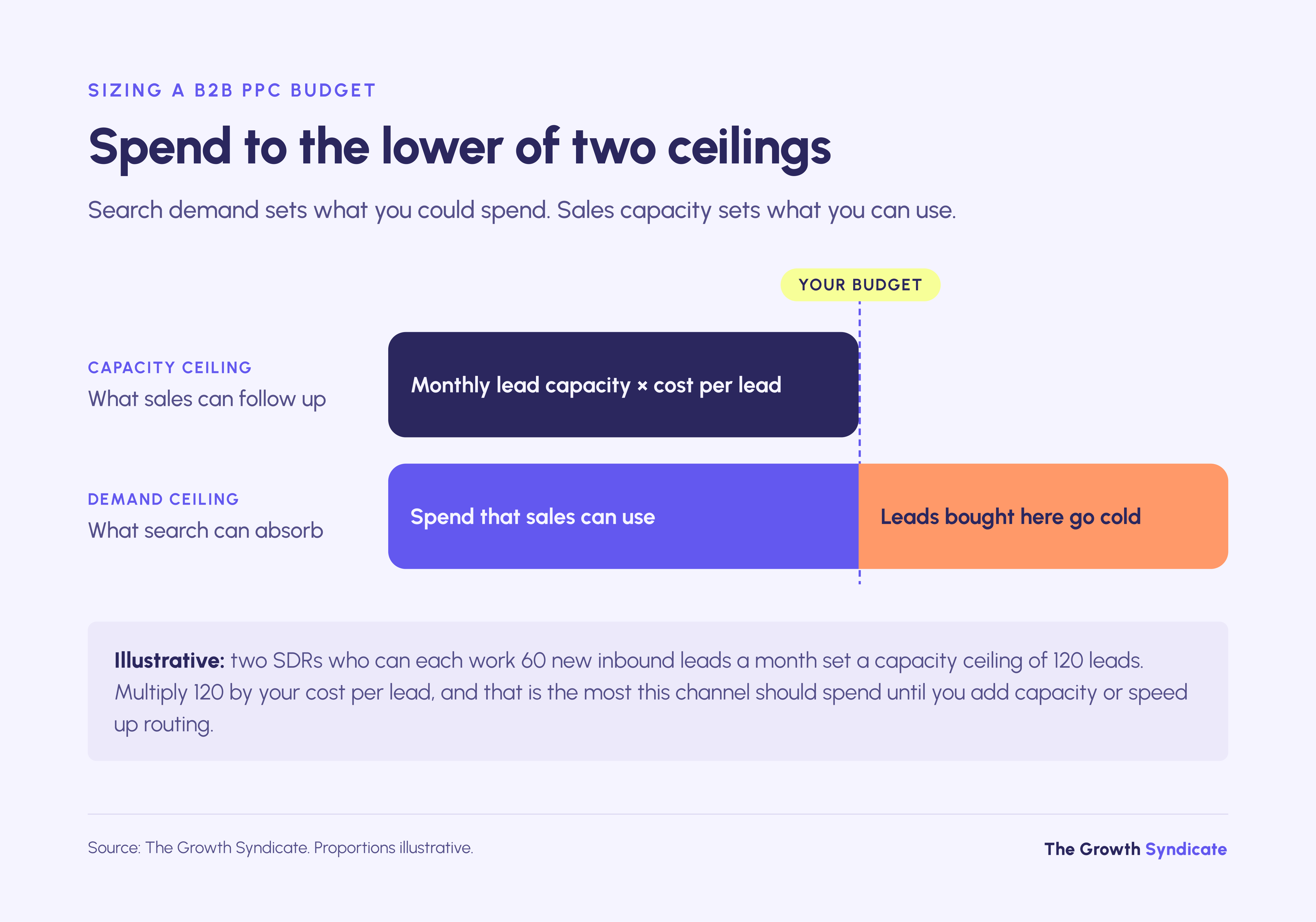
Above the capacity ceiling, extra spend buys leads that go cold. The demand ceiling comes from the standard reverse funnel, and five steps get you there:
- Start from the new bookings target for the period.
- Divide by your win rate to get the pipeline you need.
- Divide by average contract value to get the number of opportunities.
- Divide by the share of paid leads that become opportunities to get the leads you need.
- Multiply by your cost per lead to get the spend.
Then apply the cap that rarely makes it into the spreadsheet, which is sales capacity. If two SDRs can each give real attention to 60 new inbound leads a month, the ceiling is 120 leads, whatever your category's search volume suggests. Multiply 120 by your cost per lead, and that is the most this channel should spend until you add capacity or speed up routing.
Use your own cost per lead once the account has data, and treat published averages as a starting guess. Many published averages count form fills, and the gap between a form fill and a sales-accepted lead varies by industry, offer and form length.
How do you build a B2B PPC campaign?
Build a B2B PPC campaign in seven steps, and finish the measurement work before any ad goes live. The order matters because 2026 bidding systems learn from whatever conversion you give them on day one. If that conversion is a raw form fill, the account spends its first months learning to find the wrong people.
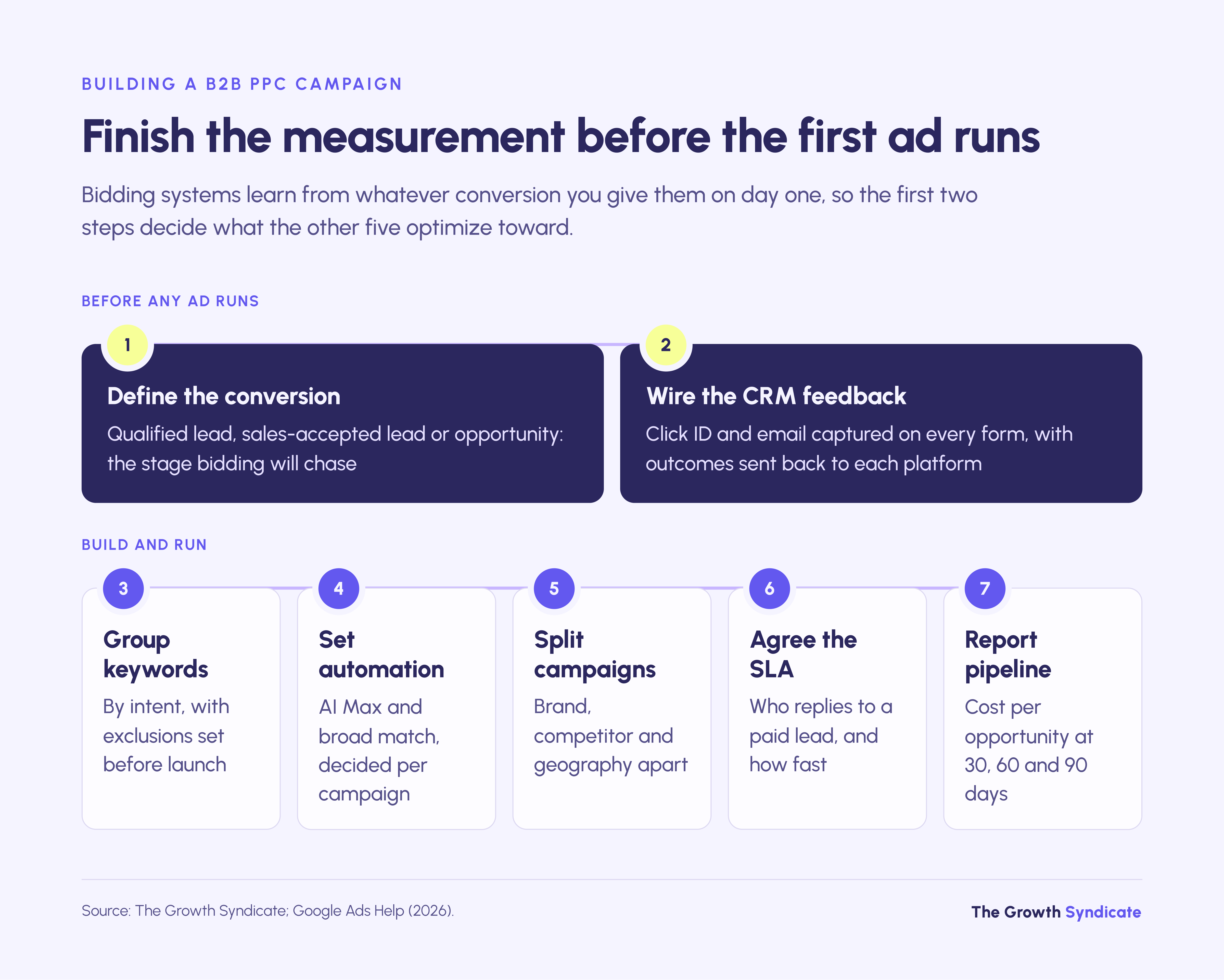
1. Define the conversion the account will optimize toward
This step produces a written definition of the lead stage you will import. Pick the deepest stage you can send in reasonable volume, whether that is a qualified lead, a sales-accepted lead or an opportunity.
If you create only a handful of opportunities a month, start with qualified leads and move the goal deeper as volume grows. Bidding needs enough conversions to learn from, and a goal that fires twice a month gives it almost nothing.
2. Wire the CRM feedback loop before launch
This step produces a working path from CRM stage back to each ad platform. Capture the click ID and the work email on every form, then set up enhanced conversions for leads, which Google describes as an upgraded version of offline conversion import that uses data your leads provide, such as their email address.
Since June 15, 2026, Google has been moving offline conversion uploads to its Data Manager API. An integration still built on the older Google Ads API upload route needs migrating, or qualified outcomes can stop reaching bidding. On LinkedIn, the Conversions API does the same job for CRM stages.
3. Build keyword themes by intent, then exclude
This step produces campaigns grouped by the buyer's situation. Separate category terms, problem terms, competitor terms and integration terms, because each signals a different stage and needs different copy.
Build the exclusion list before launch. Queries containing job, career, salary, free, template, course or "what is" attract people who will never buy, and in a small B2B keyword set they can take a large share of spend. Keep exact and phrase match on expensive terms until the account has qualified-conversion data to justify broader matching. Our negative keyword strategy for B2B Google Ads sorts a starter list by where each exclusion belongs in the account.
4. Decide how much automation to accept
This step produces a deliberate setting for each campaign rather than an inherited default. Google is moving Search toward AI Max, and it scheduled campaigns using automatically created assets or campaign-level broad match to auto-upgrade from September 2026. Dynamic Search Ads follow from February 2027.
Google reports an average of 7% more conversions or conversion value at a similar CPA or ROAS when the full AI Max feature set is on, based on its own data for non-retail advertisers. That gain helps a B2B account only if the conversion being optimized is a qualified one. If a campaign used campaign-level broad match or automatically created assets, check which AI Max features the September upgrade switched on, and set up any Dynamic Search Ads campaign deliberately before its upgrade begins in February 2027.
5. Separate brand, competitor and geography
This step produces an account structure you can read and bid on. Split brand, product category and competitor terms into separate campaigns, and split geographies with different cost levels, such as the US and Europe.
Mixed campaigns put markets with very different click costs under one budget and bid strategy, and their blended reporting can't tell you which intent produced pipeline. If you run Performance Max, add campaign-level negatives before scaling it. Google raised the cap from 100 to 10,000 negative keywords per campaign in March 2025.
6. Agree the follow-up SLA with sales
This step produces a written agreement on who receives a paid lead, within how many working hours, and what happens when the deadline passes. Set the monthly lead ceiling from that agreement, and let it cap the budget.
Ask sales to record why a lead was rejected. Those reasons are the fastest source of new exclusions and the clearest evidence of whether the problem is targeting or follow-up.
7. Report on cost per opportunity at 30, 60 and 90 days
This step produces a reporting rhythm that matches the sales cycle. In the first month, watch leading indicators such as search term quality, cost per qualified lead, speed to first contact and the share of leads sales accepts.
By day 60 and 90, report cost per sales-accepted opportunity. Judge the channel on opportunities only after one full sales cycle has passed, and on revenue after two.
How does PPC fit with ABM and demand generation?
Paid search captures demand that already exists, while ABM and demand generation build it. In a B2B program, PPC runs underneath both. Target-account lists feed search and LinkedIn audiences, retargeting keeps engaged accounts warm, and results are judged on account-level pipeline rather than on which channel got the last click.
The reason is arithmetic. In 2021, the Ehrenberg-Bass Institute's John Dawes estimated that up to 95% of business buyers are not in the market for many products and services at any one time, with roughly 5% in market in a given quarter. Search ads mostly reach that 5%.
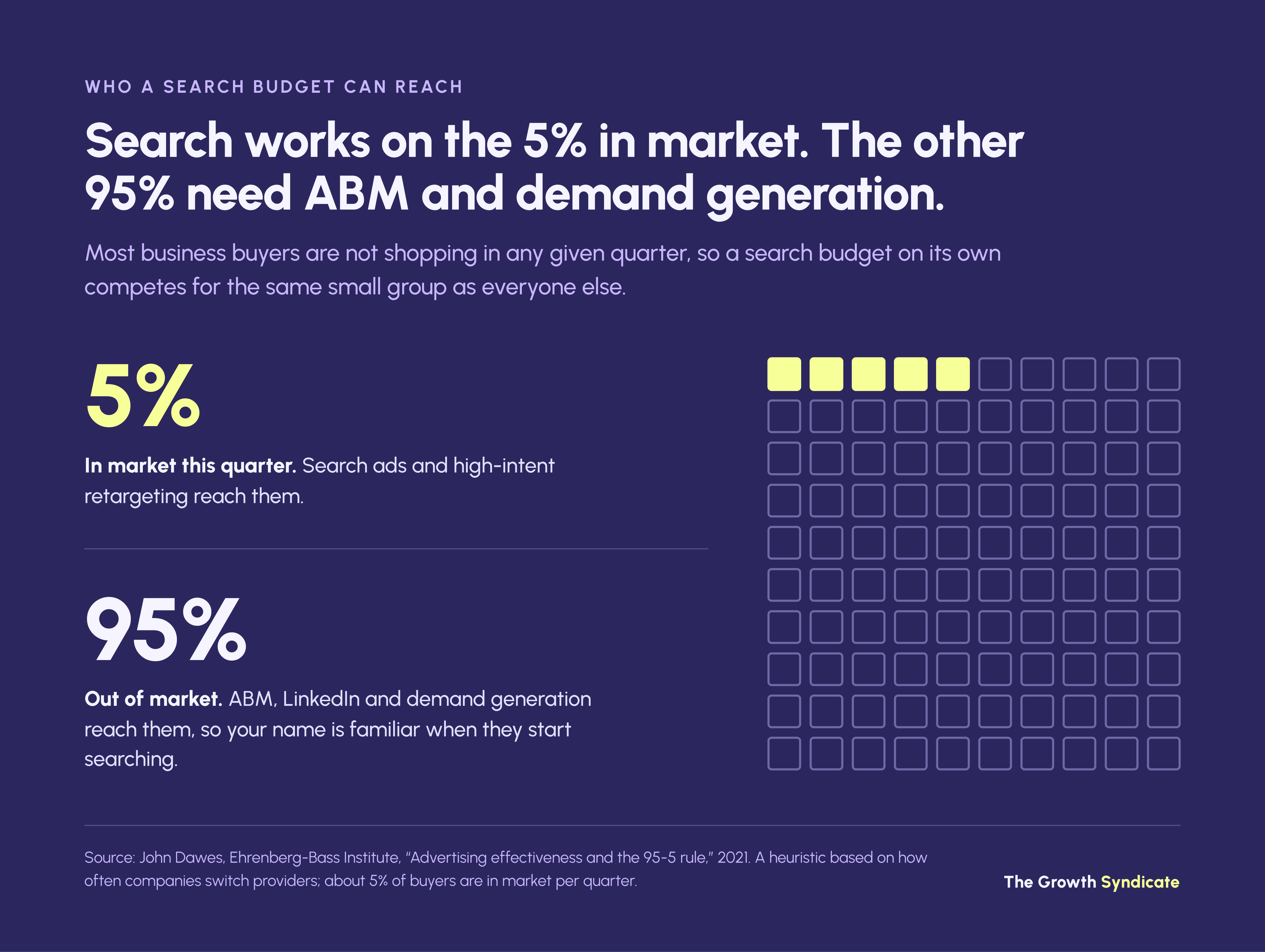
Demand generation and ABM work on the other 95%, so that when one of those buyers starts searching, your name is already familiar. That changes what a branded search or a high-intent click is worth.
In an account-based marketing program, paid media is the delivery layer for the account list. Four connections do most of the work:
- Upload target-account lists to LinkedIn matched audiences, and contact lists from those accounts to Google Customer Match, so both platforms recognize the people you already want to reach.
- Retarget people at target accounts who engaged with LinkedIn content, including those who never visited your site.
- Exclude existing customers from acquisition campaigns, and give them expansion messages of their own.
- Report pipeline by account, so a search click from an account sales has worked for three months is credited to the program rather than to the keyword.
Whether to build demand before capturing it is the sequencing question behind demand generation vs lead generation. For paid media the answer is short. Search captures what the rest of the program creates, and a search budget without that program competes for the same 5% as everyone else.
What should a B2B PPC landing page do?
A B2B PPC landing page has two jobs. It converts the right visitor, and it gives sales what it needs to qualify them. That means matching the ad's promise exactly and capturing the company, role and click ID that lead routing and offline conversion import depend on, so the lead arrives in the CRM with its context attached.
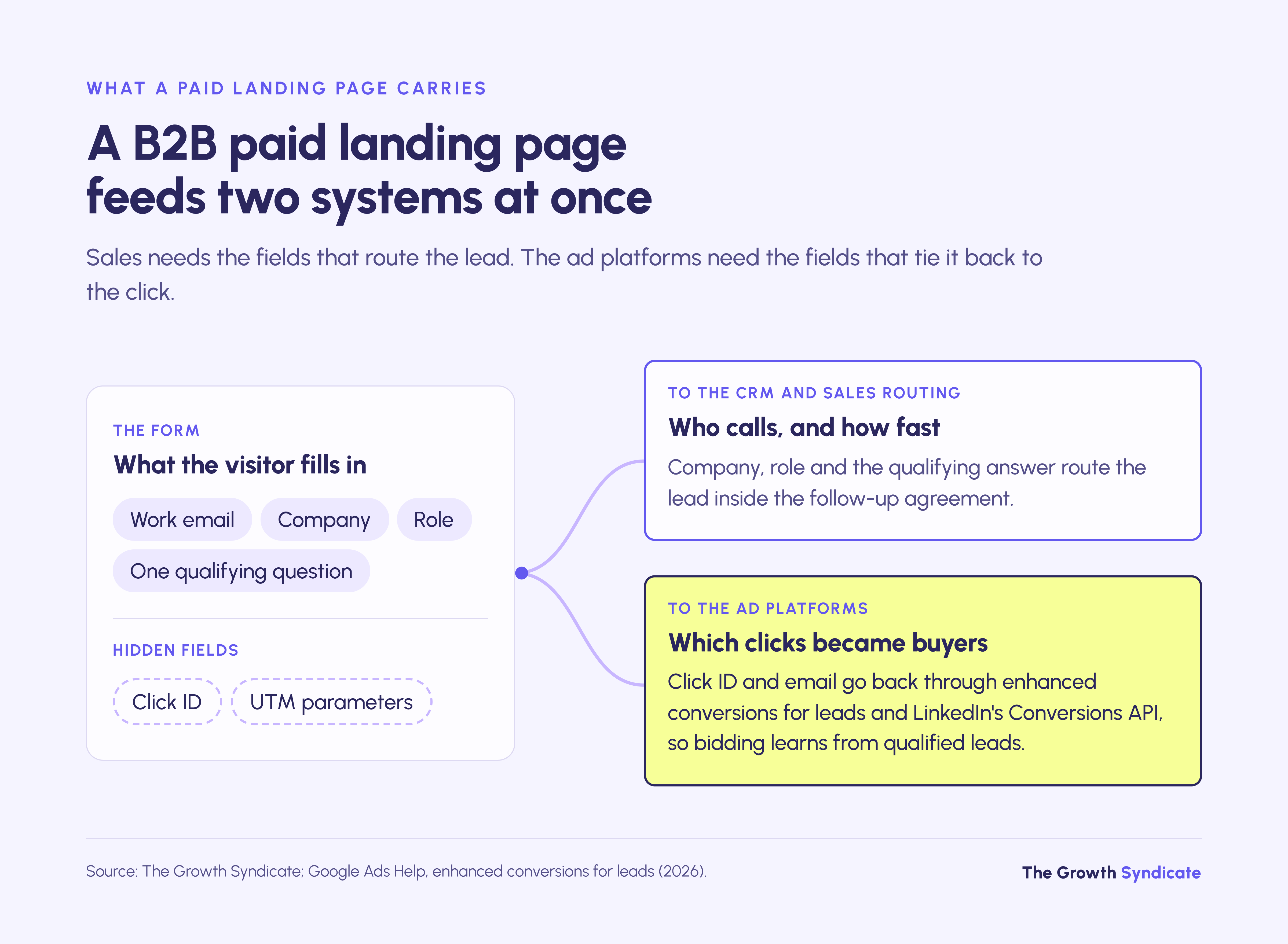
Most of what makes B2B landing pages convert applies here, with one difference. A paid landing page also carries the data the ad platforms need back. Six elements matter most:
- One page per intent cluster, with a headline that names the problem in the search term.
- Proof from the same segment, such as a named customer, a logo from the same industry or a result with a number.
- A price signal where you can give one, such as a "starting from" figure, which filters out buyers outside your range.
- A form that asks only what routing needs: work email, company, role and one qualifying question.
- Hidden fields for the click ID and UTM parameters, so the CRM record can be matched back to the ad.
- A next step after submission, such as a calendar booking, so the follow-up clock starts immediately.
Sending paid traffic to the homepage or a generic contact form breaks most of this list at once. The visitor has to find their own way to relevance, and the CRM receives a lead with no context about the search that produced it.
How do you measure B2B PPC beyond cost per lead?
Measure B2B PPC on cost per sales-accepted opportunity, and use cost per lead as an early warning only. Cost per lead tells you how cheaply the account fills forms. Cost per opportunity tells you whether those forms turn into deals worth pursuing, which is the number a CFO eventually asks about.
When TGS takes over a paid account, the first audit is tracking. We check whether conversions fire and reach the paid channels, then where they land once they enter the CRM. Lead stages come next, because a funnel with undefined stages cannot produce a trustworthy cost per opportunity.

Once the stages are defined, six numbers cover the funnel from click to payback.
Platform-reported conversions over-credit the last click, and B2B buying runs longer than most lookback windows: Google Ads counts click-through conversions for 30 days by default and 90 at most. Buying groups also research where ads can't see. Gartner's 2026 survey of 646 B2B buyers found 45% used AI during a recent purchase, and 67% prefer a rep-free experience.
Pair the CRM's opportunity source with a self-reported "How did you hear about us?" field, and read the two together. Self-reported attribution picks up the peer recommendations and AI-assisted research that click tracking misses, which is often where a paid click's opportunity actually started.
Is performance marketing the same as PPC?
No. PPC is a pricing model and a set of channels where you pay per click, while performance marketing is a management discipline that holds every paid channel, including PPC, programmatic, affiliates and paid social, to a measurable business outcome. In B2B that outcome should be pipeline, which makes performance marketing the wider frame and PPC one of its instruments.
The difference shows up in accountability. A PPC manager can hit a cost-per-lead target while pipeline falls, and under performance marketing as TGS defines it, that quarter counts as a miss.
B2B performance marketing also widens the channel view. LinkedIn and Reddit rarely show the final conversion in their own reporting, yet they create touchpoints that later surface as branded searches or event registrations.
Should you run B2B PPC in-house or with an agency?
Run B2B PPC in-house when you have, or can hire, a senior specialist and spend is steady enough to keep them busy. An agency fits when you need senior judgment without a full-time hire, or several channels at once. Either way, the engagement should own the CRM feedback loop as well as the ad accounts.
Whoever runs it, a B2B PPC engagement should cover six things:
- Conversion architecture, meaning lead stages, offline conversion import and the CRM integration behind it.
- Account structure, search term reviews and exclusion lists, maintained weekly.
- Governance of AI Max, broad match and Performance Max settings.
- Landing page tests tied to qualified-lead rate rather than form fills.
- A monthly review with sales on lead quality and rejection reasons.
- Reporting on cost per opportunity and pipeline, with spend shown against it.
Agency pricing usually follows one of two logics, a percentage of ad spend or a fee tied to scope. Percentage-of-spend pricing rewards spending more, while a scope-based fee keeps the agency neutral on budget, which matters when the honest advice is to spend less. TGS prices its B2B PPC work on transparent hourly rates with a monthly minimum rather than a share of media spend.
What are the most common B2B PPC mistakes?
The costliest B2B PPC mistakes happen in setup, before a single bid is placed. The account optimizes toward raw form fills and buys searches nobody chose, and both make it look busy while pipeline stays flat. Neither shows up in a report that leads with clicks and cost per lead, which is why they last so long.
The first two mistakes below are usually the largest leak. In TGS account audits, broad matching and loose audience settings show up before any creative or bidding problem does.
Seven mistakes recur in B2B paid accounts. Each leaves a symptom you can spot in the account before it shows up in the pipeline report.
The last one is new in 2026: Google began moving offline conversion uploads to the Data Manager API on June 15, 2026, and an unmigrated integration can stop sending qualified outcomes to bidding.
Where this approach breaks down
This approach assumes a B2B company passes the fit test described in this guide. Where search demand is missing, or deals are too small to pay for an opportunity, a better-run PPC account still loses money. The honest move then is a different channel or a smaller, time-boxed test with a fixed end date and a pipeline target.
- Category creation. If nobody searches for your category yet, search can only catch the few who describe the problem. Budget belongs in LinkedIn, content and events until demand forms.
- Very small markets. With 200 target accounts, keyword lists run dry quickly. Account lists, LinkedIn and direct outreach do more.
- Low contract values. If an opportunity costs more in media than the deal can carry, no amount of optimization fixes the arithmetic.
- No CRM discipline. Without defined lead stages, the feedback loop has nothing reliable to send, and bidding learns from noise.
- Up-front cost. Tracking, CRM integration and landing pages take weeks of work before the first ad runs, and that cost lands before any pipeline does.
The hardest limit is patience. Paid search on a six-month cycle shows opportunities in weeks and revenue in quarters, and leadership that expects closed deals from a six-week test will cut the channel just before it starts working.

What to do next
Start with the fit test, then fix the first condition that fails before adding budget. Most B2B teams sit in one of five situations, and each calls for a different first move, from tracking and routing to channel choice or a smaller test. Find the one that matches your account today and start there this quarter.
- If you have never run paid search, check category search volume and your sales team's response time before building anything, then launch on exact and phrase match with a qualified-lead goal.
- If your account produces leads but no pipeline, audit conversion tracking and lead stages first, then import qualified leads as the optimization goal.
- If your market is a few hundred named accounts, lead with LinkedIn and Customer Match lists, and keep search to brand and high-intent problem terms.
- If sales can't keep up, cap spend at follow-up capacity and put the difference into routing or an extra SDR.
- If the account works and you want to scale, widen match types and accept AI Max only once qualified conversions arrive steadily every week.
Frequently asked questions
How do B2B companies automate paid media?
They automate bidding against CRM outcomes rather than form fills. That means importing qualified leads, sales-accepted leads or opportunities into Google through enhanced conversions for leads, and into LinkedIn through its Conversions API, while ChatGPT ads can receive lead events through OpenAI's Conversions API. Automation is only as good as the conversion it learns from, so define stages first.
How do you scale B2B paid media?
Scale only when cost per opportunity holds steady and sales has capacity for more leads. Then widen in order: add keyword themes, loosen match types once qualified conversions arrive every week, add LinkedIn audiences for the same accounts, and test new channels with capped budgets. Scaling spend faster than follow-up capacity lowers lead value.
How do you build a keyword list for B2B PPC?
Start from the buyer's situation rather than a seed list. Group terms into category, problem, competitor and integration themes, check volume for each, and drop terms whose searchers cannot buy. Build the negative list at the same time, covering job, education, free and definition queries, and keep exact and phrase match on expensive terms.
Should B2B lead generation use Performance Max?
Only with fences in place. Performance Max works for B2B lead generation when it optimizes toward a qualified-lead goal, carries campaign negatives and brand exclusions, and has enough qualified conversions to learn from. Without those, it tends to find the cheapest form fills across Google's inventory, which in B2B usually means the least relevant ones.
Is Google Ads or LinkedIn better for B2B?
It depends on whether your buyers search. Google Ads is better when there is real search demand for the category, because it reaches people already looking. LinkedIn suits a market made of a defined set of companies and job titles with little search volume, and most B2B programs end up running both, with search first.
Do ChatGPT ads work for B2B?
Not yet, on the evidence available. By May 2026, ChatGPT ads offered CPC bidding and a Conversions API, but reporting is aggregated and early B2B tests, including TGS's own, produced clicks without qualified pipeline. Treat ChatGPT ads as a capped test with a fixed end date, judged on qualified leads.
How long does B2B PPC take to show results?
Leading indicators such as search term quality and cost per qualified lead show within the first month. Sales-accepted opportunities appear once leads have moved through first sales conversations. Revenue takes a full sales cycle, which on a six-month cycle means two quarters or more, so judge pipeline before you judge revenue.
What should a B2B PPC proposal include?
A useful proposal states the conversion the account will optimize toward and how CRM outcomes will reach the ad platforms. It should also cover account structure, exclusion strategy, landing pages and the follow-up agreement with sales, with reporting on cost per opportunity. A proposal that only promises clicks or leads skips the part that decides value.
What is a good cost per lead for B2B PPC?
A good cost per lead is one your deals can afford once it becomes an opportunity. Work it backward: divide contract value by the opportunities needed to win one deal, then multiply by the share of leads that become opportunities. That gives a maximum cost per lead for your business, which beats any industry average.