.svg)


B2B marketing attribution is sold as a solved problem, and it is not one. This article covers what attribution can genuinely tell you, where the attribution models break, and how measuring marketing ROI can survive contact with a nine-month sales cycle and a buying committee of eight people.
The credibility gap that attribution was supposed to close
Gartner surveyed 378 senior marketing leaders in September 2024 and found that just over half said they could prove marketing's value and receive credit for it. The two audiences named as most skeptical were CFOs and CEOs, at around 40% and 39% respectively. That is the gap attribution software was built to close, and after fifteen years of increasingly sophisticated tracking, it has not closed.

The reason is not that marketing teams bought the wrong tool or failed to calculate marketing ROI correctly. It is that measuring marketing ROI in B2B is structurally different from the problem the tools were designed for, and most of the content written about it comes from companies with a commercial interest in you believing otherwise. That gap costs real money, because marketing investment gets allocated on the strength of numbers nobody fully trusts.
Who writes the content you have been reading
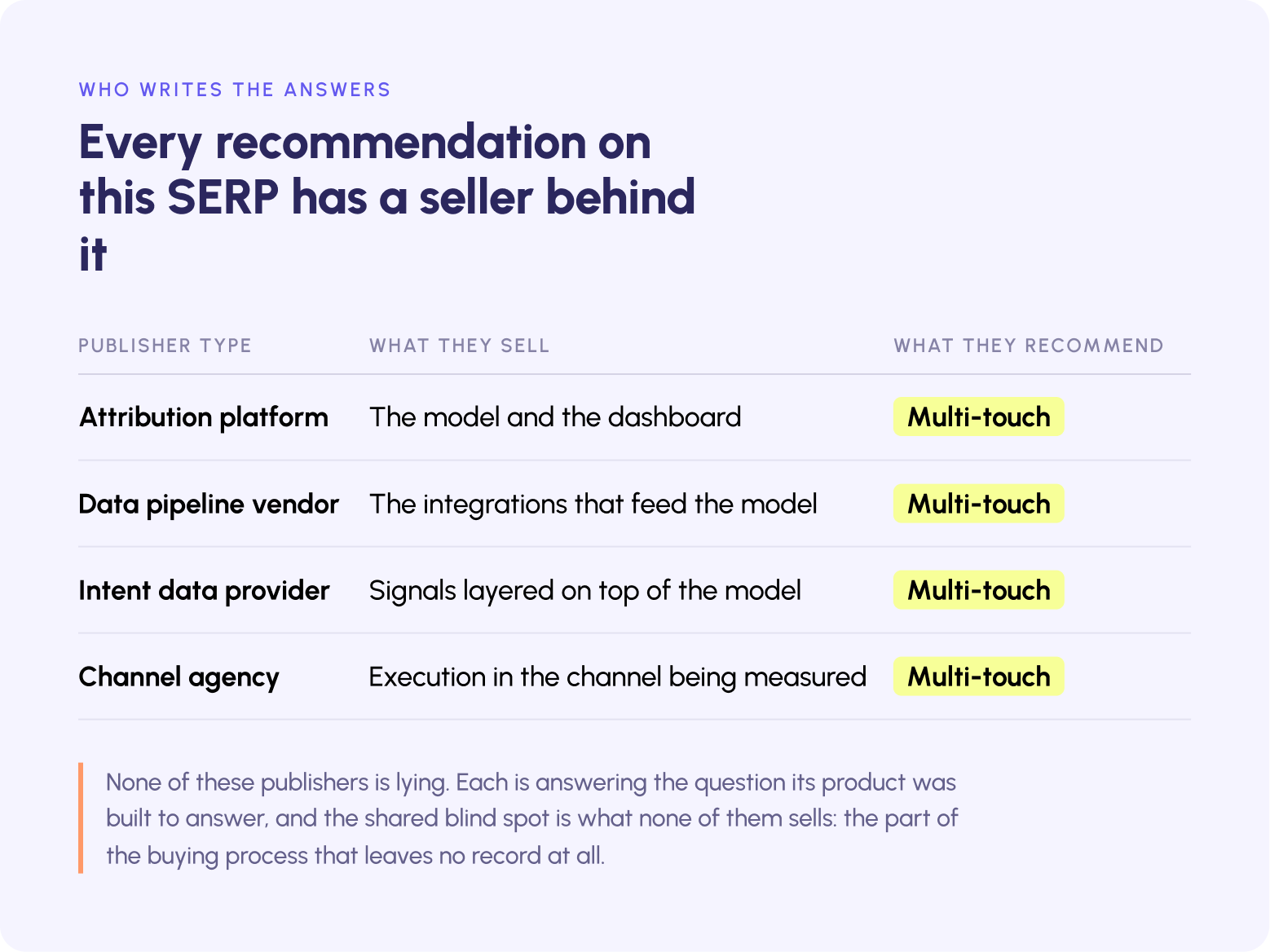
Search for anything in this category and the first page is almost entirely vendor-published. Attribution platforms, data pipeline companies, and intent data providers all produce long guides that follow the same shape: define attribution, list six or seven attribution models, then recommend a data-driven multi-touch approach that their product happens to provide.
Most of these guides contain a single honest sentence, usually buried around the halfway mark, acknowledging that any attribution model can only credit interactions that were recorded in your CRM or web analytics. They then move on without addressing what that sentence actually means, which is that in B2B, most of the buying process is never recorded at all. The result is an entire category of content about measuring marketing ROI that quietly assumes the hard part has been solved.
What this article does instead
Two things. First, it takes seriously the evidence that multi-touch attribution models systematically misstate what specific marketing efforts contributed. That evidence is stronger than the vendor content admits and comes largely from controlled experiments, not from opinion.
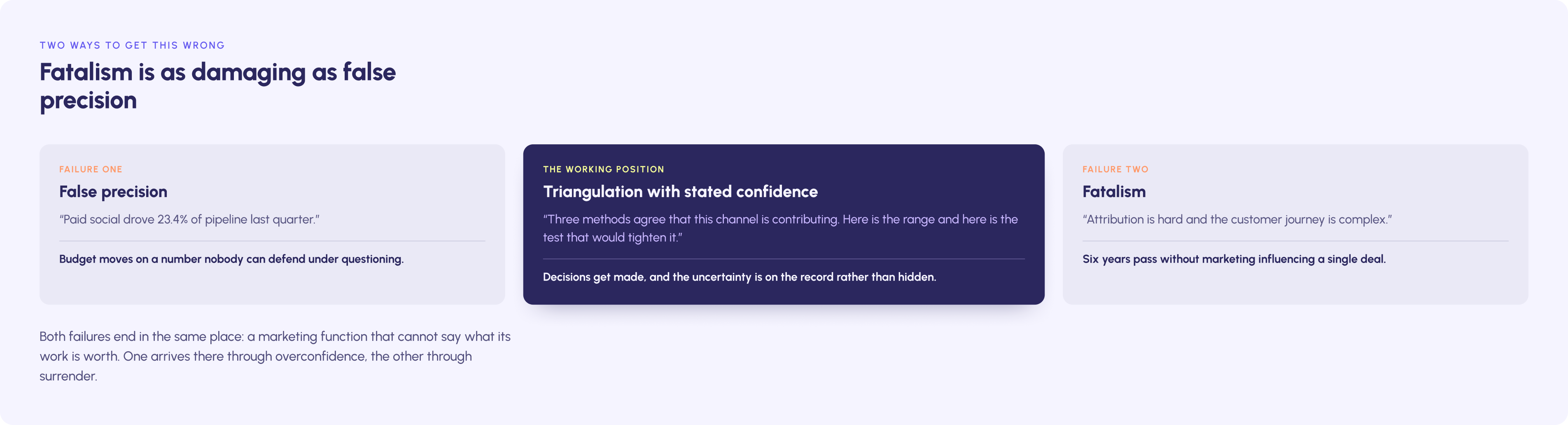
Second, and this matters more, it refuses to let that conclusion become an excuse. There is a version of the honest-attribution argument that curdles into fatalism, where the customer journey is declared unknowable and marketing quietly stops being accountable for anything. That position is as damaging as the false precision it replaced.
Why B2B attribution breaks before you configure anything
The failures below are structural. They do not go away with a better attribution tool, a cleaner data infrastructure, or more disciplined UTM tagging, though all three help. They are also the reason so many marketing teams distrust their own marketing ROI reporting while continuing to present it.
Buying committees do not behave like users
Attribution systems track contacts. B2B purchases are made by groups. A single deal might involve a champion who found you through a podcast, a technical evaluator who read three comparison pages, a security reviewer who never visited your website at all, and a CFO who asked two peers for a recommendation.
Contact-level tracking sees four disconnected people, or more commonly sees one of them and misses the rest. Complex customer journeys of this shape are the norm in considered B2B purchases, not the exception. Any model that assigns credit across a linear path has already lost the plot, because there was no path. There were multiple stakeholders moving at different speeds toward a decision that got made in a meeting you were not in. The customer journey diagram on your wall shows one line because a line is easy to draw.

Long sales cycles outrun the measurement window
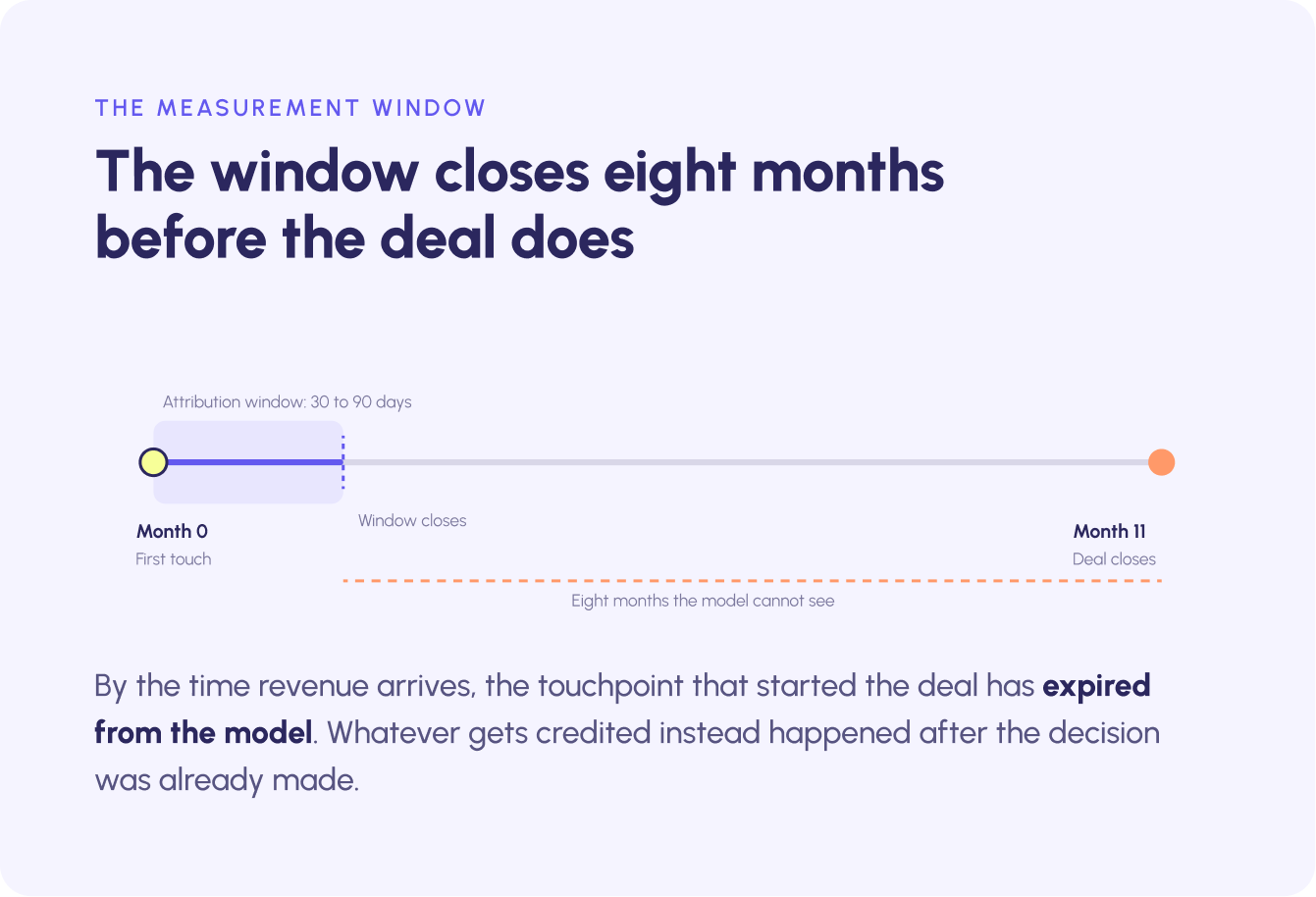
Standard attribution windows of 30 to 90 days were inherited from ecommerce. In B2B, a deal that closes in month eleven has a first touch that sits well outside any window you are likely to have configured. Complex sales cycles do not just make the data harder to collect. They mean the touchpoint that actually mattered has usually expired from the model by the time revenue arrives.
Ferdinand Goetzen puts the problem with the underlying mental model bluntly. Funnels and bow ties, he argues, are modestly useful as internal planning tools, and dangerously misleading the moment anyone treats them as a literal description of how B2B buying works.
Offline interactions leave no trace
Conferences, dinners, referrals from a former colleague, a conversation in a private Slack community. None of these produce a click, and none appear in your web analytics. Combining online and offline measurements is possible in principle and rarely happens in practice, because the offline half depends on someone remembering to log it.
Dark social swallows the referral data
SparkToro ran a controlled study in 2023 across more than 1,100 visits and eleven networks. Every visit originating from TikTok, Slack, Discord, Mastodon and WhatsApp arrived with no referral information and was recorded as direct traffic. Three quarters of Facebook Messenger visits were the same. Public LinkedIn passed accurate referral data only around 14% of the time.
Your direct traffic number is not a measure of brand strength. It is a landfill.
This matters for budget decisions, because the marketing channels most likely to be invisible are the ones doing demand creation. Community, podcasts and social media posts get systematically underpriced by any attribution system that only counts what it can see.
The tracking substrate keeps eroding
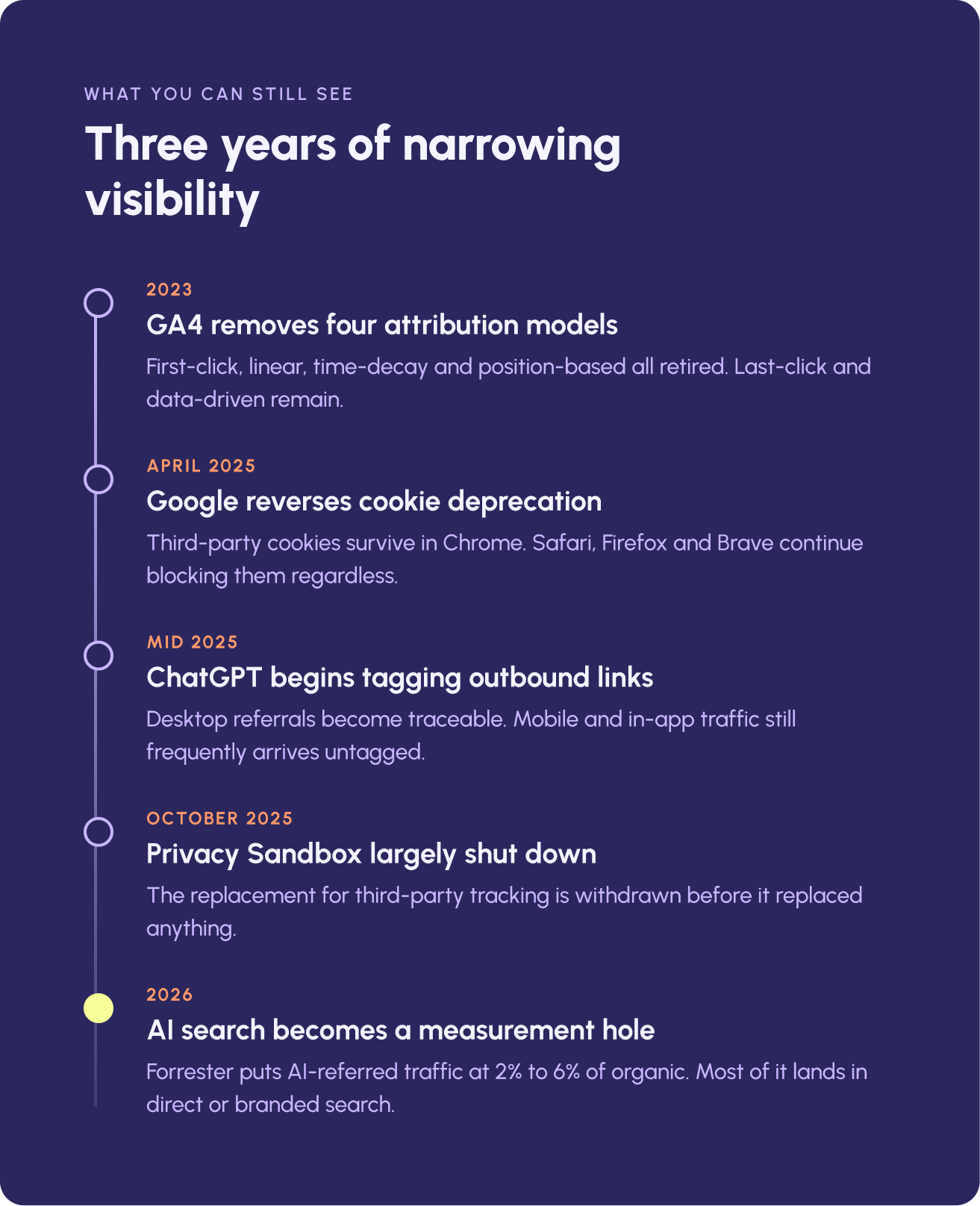
Google reversed its third-party cookie deprecation plan in April 2025 and then shut down most of Privacy Sandbox in October of that year, but Safari, Firefox and Brave have blocked third-party cookies for years regardless. GA4 removed first-click, linear, time-decay and position-based models in 2023, leaving last-click and a data-driven option. Consent banners remove a further slice of measurable traffic in every European market.
AI search adds a new hole. ChatGPT only began appending source parameters to outbound links in mid-2025, and mobile and in-app traffic still frequently arrives untagged. Forrester's estimate puts AI-referred traffic at somewhere between 2% and 6% of organic, growing fast. Almost all of it currently lands in direct or branded search.
The CRM breaks it last
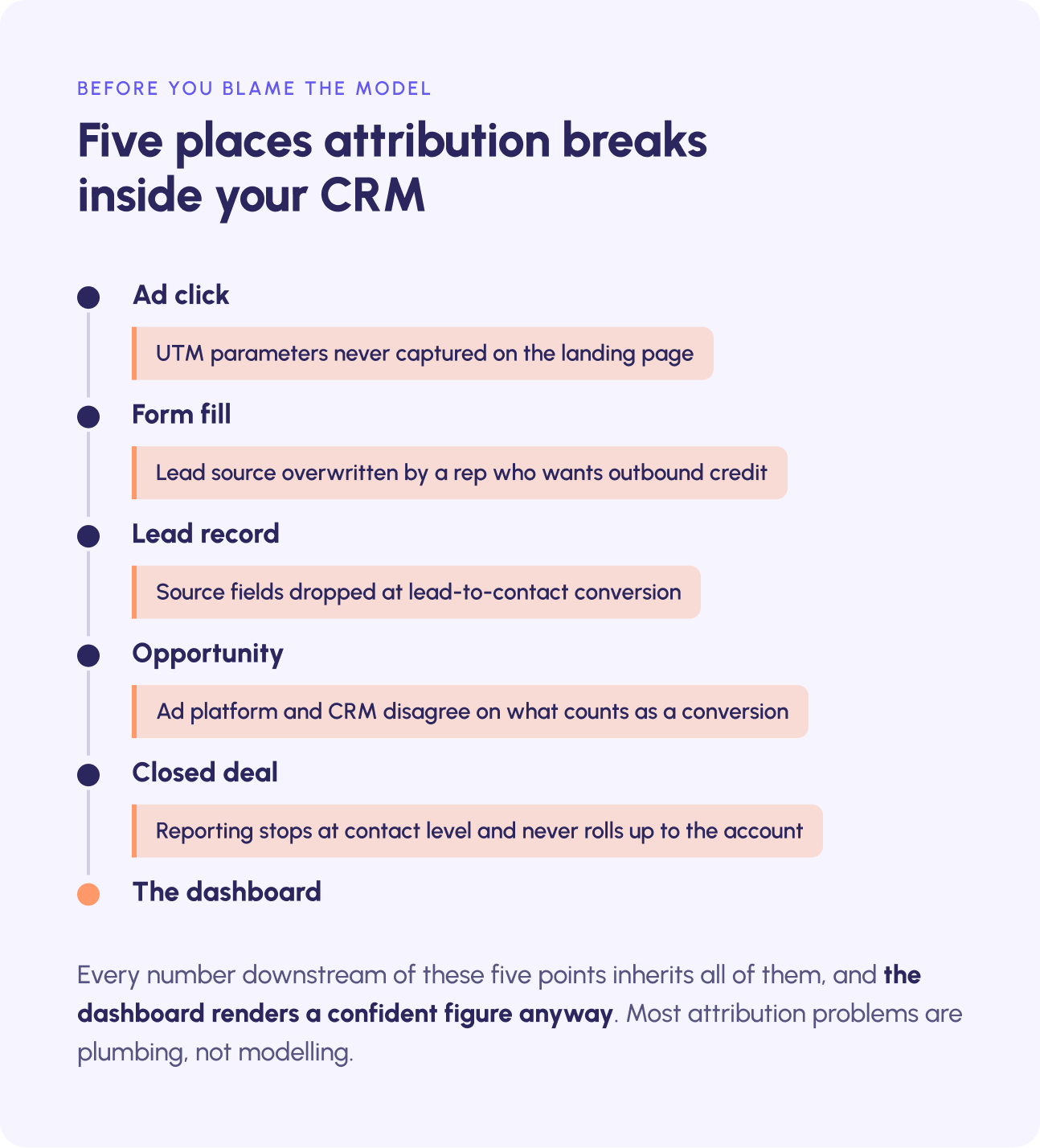
Most attribution failures are not modelling failures. Salesforce lead source holds one value, gets overwritten on conversion, and gets edited by reps who want the deal credited to outbound. UTM parameters vanish at the lead-to-contact handoff. Marketing automation platforms and ad platforms disagree about what a conversion is. Then a dashboard renders a confident number on top of all of it, and someone presents it as evidence that marketing campaigns worked.
The attribution models, assessed honestly
Every guide lists these. Few say what each one is actually good for, so here is that version. Each attribution model below is a way of allocating credit, not a way of discovering truth, and choosing between them changes your reported marketing ROI without changing a single thing about the business.
First-touch attribution
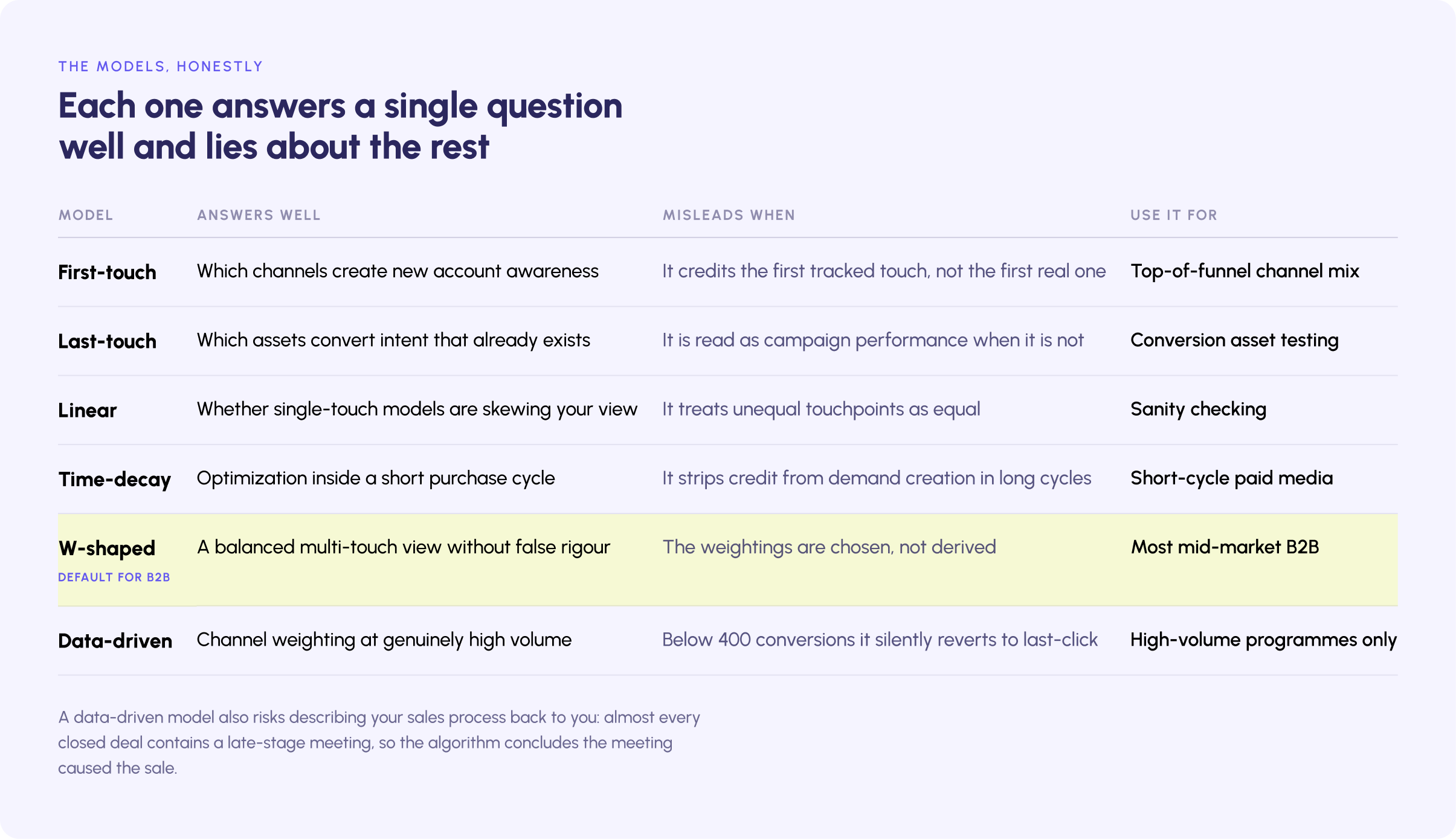
Assigns all credit to the first recorded interaction. Useful for one narrow question: which marketing channels bring new accounts into your world for the first time. This attribution model will systematically overvalue whatever sits earliest in your recorded data, which is usually branded search, and it will credit the first tracked touch, not the first real one.
Last-touch attribution
Assigns all credit to the final interaction before conversion. It reliably rewards the demo request form, which is the thing that happens after the decision has already been made. As a measure of campaign success it is close to worthless. As a measure of which asset converts intent that already exists, it is fine.
The linear attribution model
Splits credit evenly across every recorded touchpoint. Its honesty is also its weakness: it makes no claim that touchpoints are equal, but it behaves as though they are. The linear attribution model is useful mainly as a sanity check against single-touch alternatives. If linear and last-touch tell radically different stories about a channel, that gap is informative.
Time-decay attribution
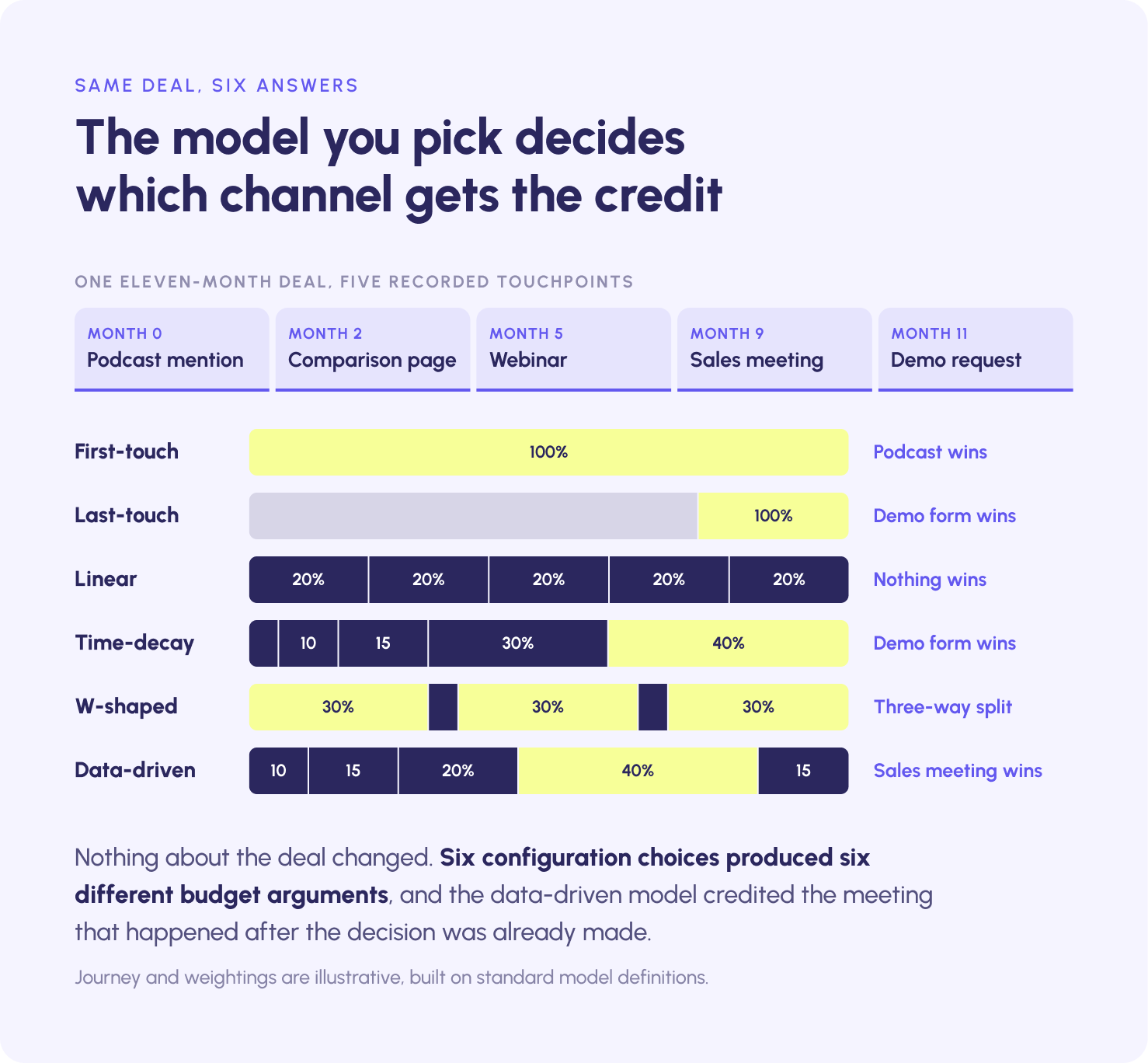
Weights recent interactions more heavily. For a short purchase cycle driven by digital advertising, this is defensible. In an eleven-month enterprise deal it systematically strips credit from the content that created the demand in the first place and hands it to the sales-stage material that closed it.
W-shaped and position-based models
Concentrate credit at first touch, lead creation and opportunity creation. These at least acknowledge that some moments matter more, and W-shaped is the most sensible default for B2B teams that want a multi-touch view without pretending to statistical rigour. The weightings are still arbitrary. Somebody chose 30/30/30 because it looked reasonable.
Data-driven models
Use algorithmic weighting based on your own data. The catch is volume. Google's data-driven attribution requires roughly 400 conversions per conversion type across paths of two or more interactions, plus around 10,000 paths, and quietly falls back to last-click below that threshold. Most B2B companies closing forty deals a quarter do not have the sample size, and running machine learning on that volume produces authoritative-looking noise.
There is a subtler problem that Dreamdata, an attribution vendor, states plainly in its own documentation: a Markov-based model risks simply describing your sales process back to you. Almost every closed deal includes a late-stage meeting, so the algorithm concludes the meeting caused the sale.
A comparison worth keeping
ModelBest question it answersWhere it misleadsFirst-touchWhich channels create new account awarenessCredits first tracked touch, not first real oneLast-touchWhich assets convert existing intentReads as campaign performance when it is notLinearSanity check against single-touch skewTreats unequal touchpoints as equalTime-decayShort-cycle optimizationStrips credit from demand creationW-shapedBalanced multi-touch view for B2BWeightings are chosen, not derivedData-drivenChannel weighting at high volumeNeeds volume most B2B lacks; can describe sales process
The evidence that models get it wrong
This is the part vendor content leaves out, and it is the strongest material available.
The eBay experiment
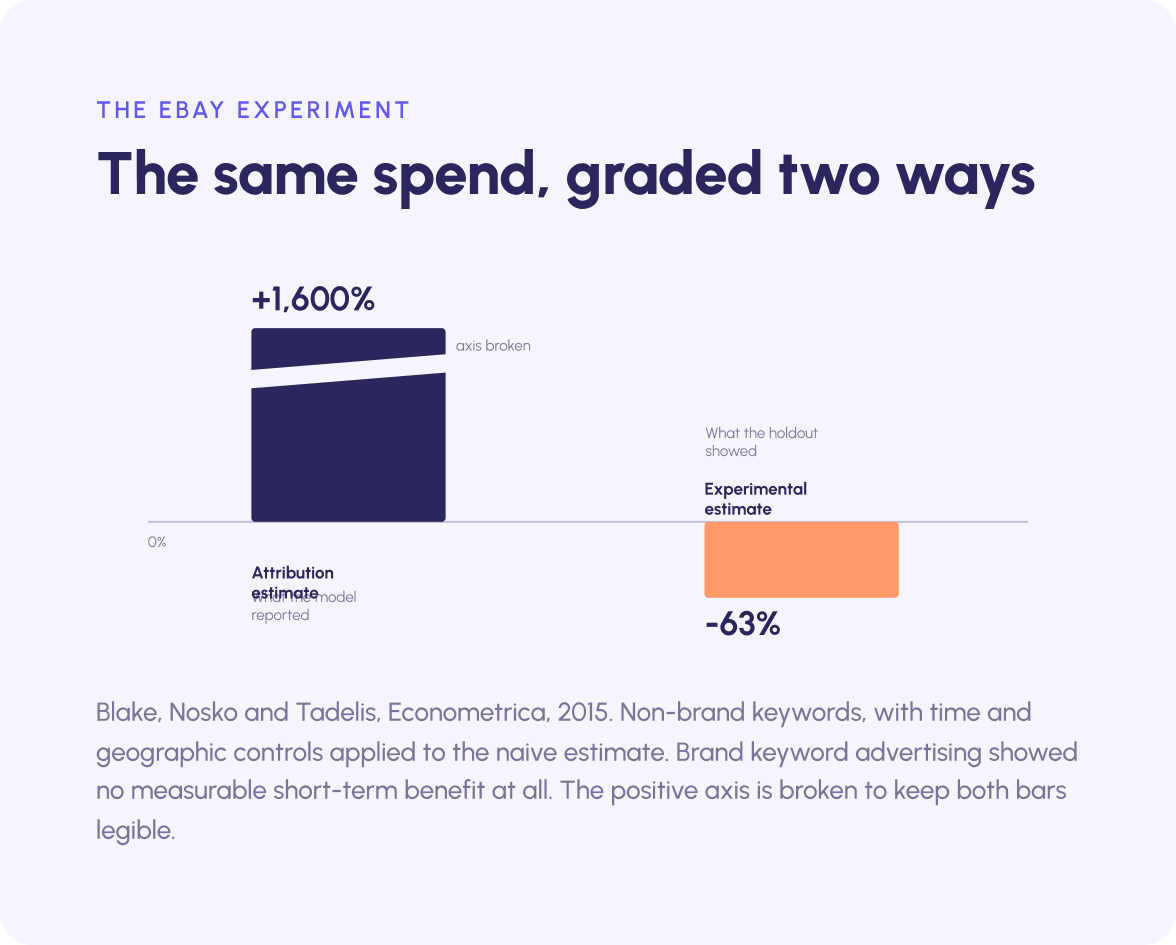
Blake, Nosko and Tadelis published a field experiment in Econometrica in 2015 in which eBay switched off paid search in randomized geographies. Brand keyword advertising showed no measurable short-term benefit, because organic search absorbed nearly all of the traffic. For non-brand keywords, the naïve attribution-style estimate implied a return above 1,600% once time and geographic controls were applied. The experimental estimate was negative 63%.
The same marketing spend looked wildly profitable under attribution and lost money under experiment. The reason is simple: an attribution model credits ads for purchases that would have happened anyway, which inflates reported marketing ROI in exactly the channels where existing demand is strongest.
The Facebook randomized trials
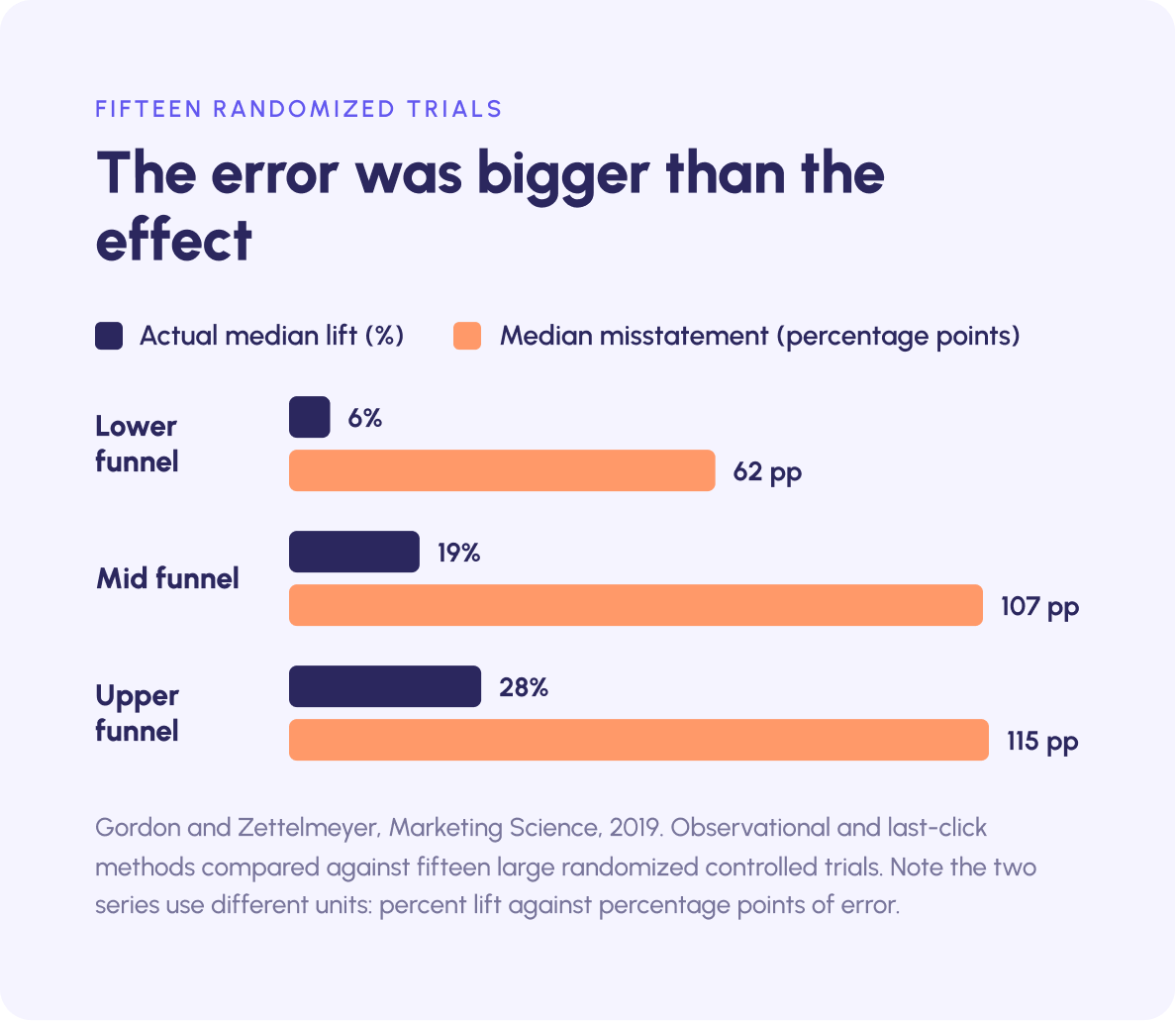
Gordon and Zettelmeyer, publishing in Marketing Science in 2019, compared observational attribution methods against fifteen large randomized controlled trials on Facebook. The observational methods misstated true lift by a median of 62, 107 and 115 percentage points at lower, mid and upper funnel respectively. The actual median lifts were 6%, 19% and 28%.
The measurement error was consistently larger than the effect being measured.
What happened when large advertisers cut the marketing budget
These are corporate disclosures rather than controlled experiments, so treat them accordingly, but the pattern is hard to ignore. In each case a very large marketing budget was cut and the revenue growth the spend was supposedly driving did not move. Uber's former performance marketing head reported turning off roughly $100 million of around $150 million in annual digital advertising spend with no meaningful change in app installs. P&G cut more than $200 million in digital spend in 2017 and reported no impact on the business. JPMorgan Chase reduced display placements from roughly 400,000 sites to about 5,000 and saw the same results.
The honest counter-argument
The serious defence of multi-touch attribution models is not that they measure causation. It is that they are useful for in-funnel optimization decisions that broader methods cannot resolve, provided they are calibrated against experiments. Steffen Hedebrandt of Dreamdata makes the modest version of the claim: the goal is not mapping 100% of customer journeys, it is moving a company from understanding 5% or 10% of them to understanding 50% or 60%.
That is a defensible position, and a follow-up paper by Gordon, Moakler and Zettelmeyer in 2023 supports a version of it, showing that last-click metrics retain predictive value once calibrated against a subset of randomized tests. Attribution as a directional optimization layer, anchored to experiments, is reasonable. Attribution as the number you report to the board is not.
The dark funnel is real, and it is not an excuse
Here is where a lot of honest-attribution content goes wrong.
The evidence above supports a specific claim: models that assign precise revenue credit to individual marketing touchpoints are unreliable in B2B. It does not support the broader claim that marketing impact is unmeasurable, and the drift from the first position to the second has been convenient for a lot of marketing teams.
Ferdinand Goetzen describes the pattern as accountability avoidance. The demand generation movement began as a reasonable correction to short-term lead obsession, and then, in his account, the line "attribution is hard and the customer journey is complex" became the reason a marketing function could go six years without influencing a single deal.
.avif)
"The dark funnel has become permission to measure nothing. You cannot track every touchpoint, and you can still measure engagement over time, which accounts keep coming back, and who else from that company shows up. Enough signals tell you something. Reading them is the job."
That is the trap. You cannot track every interaction. You can still measure engagement over time, multi-stakeholder website visits from a single target account, content interactions, and shifts in branded search. Those signals are enough to steer future marketing efforts even when no attribution model can tell you which touch closed the deal. Enough signals in aggregate indicate intent, and reading them well is the job. The alternative is hiding in a victim bubble where nothing is anyone's fault because the buyer journey is complicated.
What you can measure when you cannot measure everything
The working answer is triangulation. No single method is trustworthy alone, and the disagreements between methods are themselves informative. Measuring marketing ROI well means running several imperfect instruments and reading them together.

Self-reported attribution
Ask buyers directly. A required open-text field asking how someone first heard about you, plus the same question asked on the first sales call and logged in your CRM, produces a signal that no tracking system can generate.
Refine Labs published an internal study in October 2024 covering 620 conversions across roughly $21.5 million in ARR, and found a large gap between what software reported and what buyers said. Web search accounted for 78% of software-reported first touches and 12% of self-reported ones. Podcast appearances registered near zero in software and 53% in self-reported answers. This is a single-vendor study by a company that sells demand creation services, so weight it accordingly. It is still directionally consistent with the SparkToro dark social findings and with the experimental evidence above.
Self-reported attribution has real weaknesses. People remember the most recent or most memorable interaction rather than the first. Picklists bias responses toward whatever options you listed. Optional fields get skipped by roughly a third of respondents. Treat the output as a qualitative signal about demand creation, not as a precise share.
Where self-reported attribution and your attribution system disagree, neither is wrong. They are answering different questions. One tells you what created demand and the other tells you what captured it.
Account-based attribution
For anything resembling ABM, contact-level tracking is the wrong unit of analysis entirely. Account-based attribution rolls every known interaction from every contact at a company into a single account-level view, which at least matches how the purchase is actually made.
What you measure is engagement depth: how many people at a target account have interacted, whether new roles have appeared in the last quarter, whether engagement is accelerating. Joliene van Grieken's rule for LinkedIn holds more broadly. The useful question is not how many people clicked but which companies engaged. A thousand impressions against the right accounts beats a hundred thousand against the wrong ones.
Intent data supplements this by flagging accounts researching your category elsewhere. Intent data is noisy and oversold, but as a prioritization input rather than a truth claim it earns its place, and it makes attribution analysis at the account level considerably more useful.
Incrementality testing
Turn something off in a set of matched geographies, or hold out a portion of your addressable accounts, and compare outcomes. This is the only method on this list that measures causation rather than correlation, and it does not depend on tracking individuals at all, which makes it durable as privacy restrictions tighten.
Limitations worth stating: geo tests rely on a synthetic control model whose construction can itself introduce bias, adjacent markets leak into each other, and each test answers one narrow question. In long-cycle B2B you also need patience, because a holdout that runs for six weeks tells you nothing about a nine-month sales cycle. Incrementality results are the closest thing available to accurate ROI measurement, and they are the right calibration point for everything else.
Marketing mix modelling
Marketing mix modelling uses aggregate historical data to estimate each channel's contribution, including offline and brand channels that no attribution model can see. It has become far more accessible: Meta's Robyn, Google's Meridian released in early 2025, and PyMC-Marketing are all free and open source.
Realistic expectations matter here. These tools solve the modelling step, not the input gathering step, and they need consistent historical data with genuine variation in spend. Forrester's assessment of Meridian is that it is not a universal replacement for commercial solutions. The right pairing is a marketing mix model calibrated against incrementality results, which is what serious teams are converging on.
Leading indicators
In a business where revenue lags the work by six to eighteen months, managing exclusively to lagging revenue metrics means steering with your eyes closed. Branded search volume, share of search against competitors, review site presence, and the number of engaged accounts in your ICP all move earlier than pipeline and correlate with it. These are the numbers that should shape future marketing efforts, because by the time revenue confirms a decision, the decision is a year old.
How to calculate marketing ROI without inventing the number
Attribution answers which activities to credit. When you calculate marketing ROI, you are answering a different question: whether the whole marketing investment paid off. They are separate questions and conflating them is the source of a lot of bad reporting.
The formula, and the term everyone drops
The basic marketing ROI calculation is straightforward:
Marketing ROI = (Sales growth minus organic sales growth minus marketing costs) / marketing costs
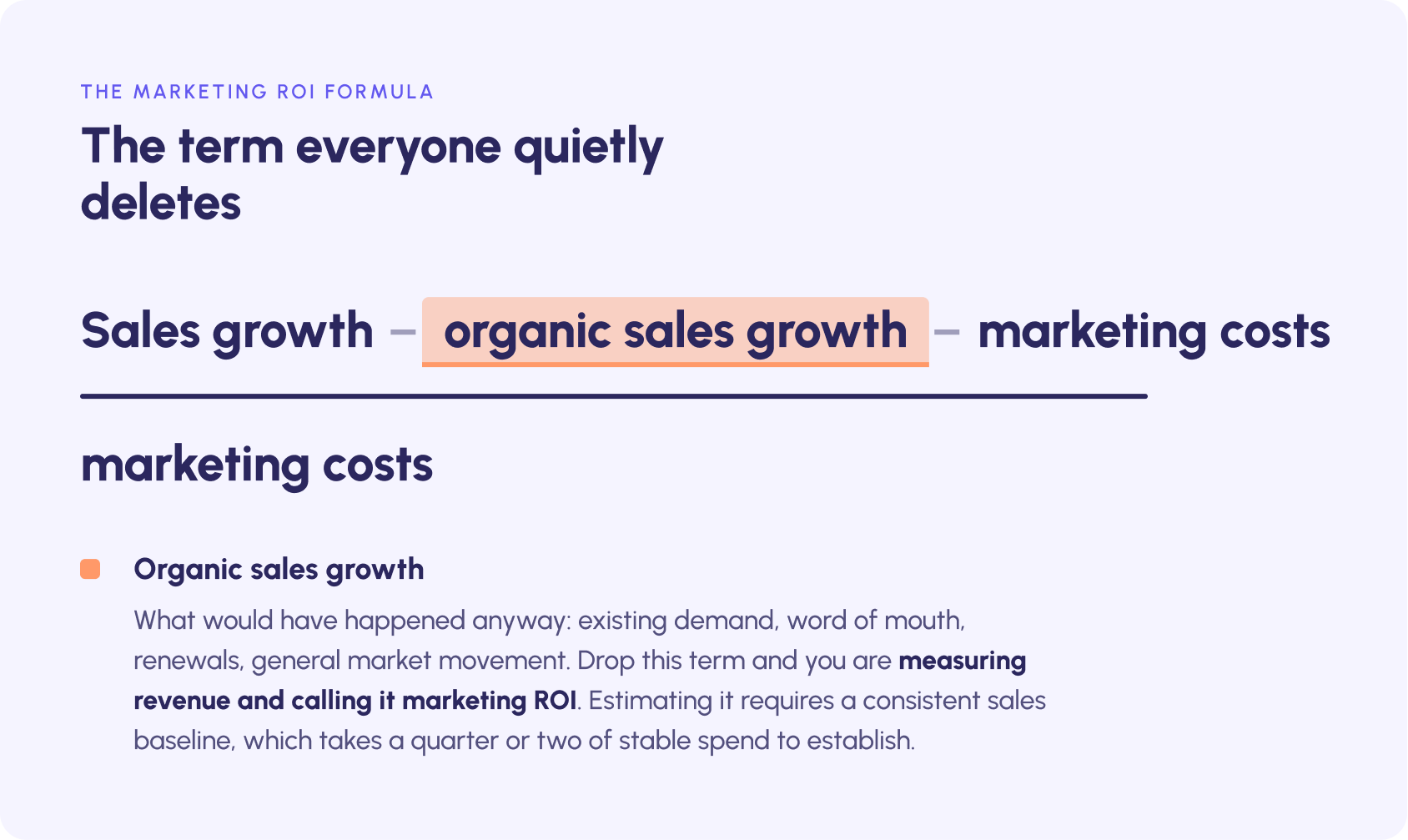
The middle term is the one that gets quietly deleted, and deleting it is how a mediocre programme reports triple-digit returns. Organic sales growth is what would have happened anyway: existing demand, word of mouth, renewals, general market movement. If you do not subtract organic sales growth, you are not measuring marketing ROI. You are measuring revenue and calling it marketing ROI.
Estimating that baseline growth requires a consistent sales baseline, which means a period of stable spend you can measure against. Establishing a consistent sales baseline is unglamorous and takes a quarter or two. It is also the single thing that most improves accurate ROI measurement.
The marketing costs you are probably not counting
Marketing costs are not just media. A defensible calculation includes agency and freelance fees, marketing technology subscriptions, content production, events, and a loaded share of salaries for the people running the marketing programs. Marketing expenses that sit in other cost centres still consumed marketing dollars.
Understating marketing expenses inflates the return, which feels good for one quarter and destroys credibility when someone from finance rebuilds the number.
The metrics that survive a CFO conversation
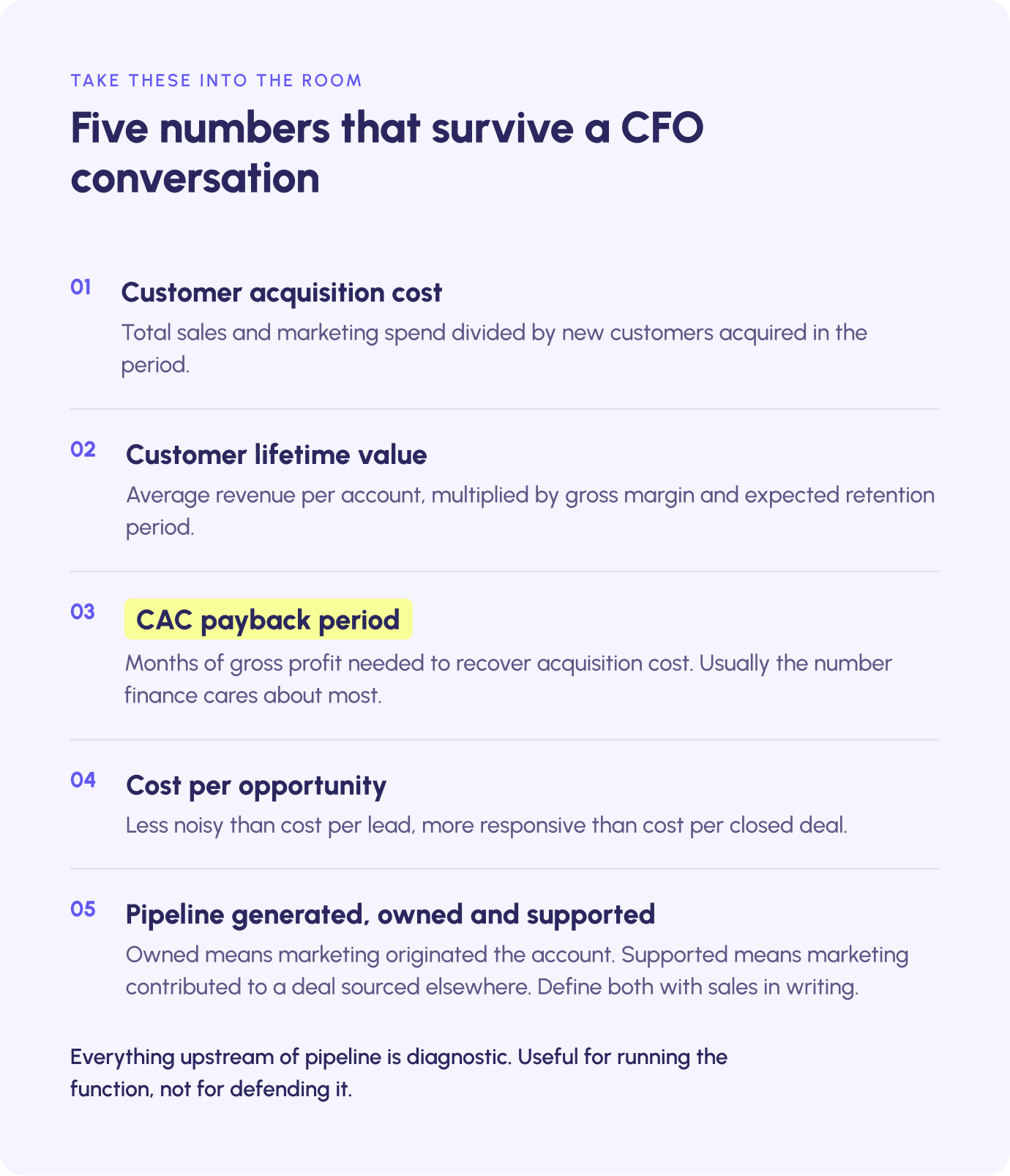
Marketing ROI as a single figure is fragile. These hold up better under scrutiny:
- Customer acquisition cost. Total sales and marketing spend divided by new customers acquired in the period.
- Customer lifetime value. Average revenue per account multiplied by gross margin and expected retention period. The customer lifetime value to acquisition cost ratio is a more stable measure of marketing effectiveness than any single-period return.
- CAC payback period. Months of gross profit required to recover acquisition cost. This is usually the number finance cares about most.
- Cost per opportunity. Less noisy than cost per lead and more responsive than cost per closed deal.
- Pipeline generated, split by owned and supported. Owned means marketing originated the account. Supported means marketing contributed to a deal sourced elsewhere. Report both, define them jointly with sales in writing, and never change the definitions mid-year.
What counts as a good marketing ROI
The figure that circulates as the benchmark for a good marketing ROI is 5:1, with 10:1 described as exceptional and 2:1 as break-even for many businesses. It is worth knowing that this benchmark has no identifiable primary source. It is a rule of thumb that got repeated until it looked like research.
A more useful test of good marketing ROI: is your CAC payback period shortening, is your customer lifetime value to CAC ratio holding above three, and is the marketing-sourced share of pipeline growing faster than marketing costs. Those questions have answers grounded in your own numbers rather than in a figure someone invented.
Measuring marketing ROI across online and offline touchpoints
Measuring marketing ROI across online and offline touchpoints is where most attribution systems quietly give up. A field event, a partner referral and a conversation at a user group can all influence the same deal that your web analytics files as a branded search visit.
Reconciling online and offline measurements takes three things: a consistent event taxonomy so offline interactions get logged in the same shape as digital ones, discipline from sales in recording them, and acceptance that the resulting attribution data will be incomplete. Incomplete and directionally right beats precise and wrong.
The compromise most teams land on is to keep online and offline measurements separate for optimization purposes and combine them only at the account level, where the question is whether an account is engaging rather than which interaction deserves the credit.
Measuring marketing ROI channel by channel
Aggregate marketing ROI tells you whether the function is working. Marketing ROI at the level of individual marketing channels tells you what to do next week, and it is far less reliable, because the attribution model doing the allocating carries every problem described earlier. If you want to calculate ROI per channel, do it knowing the error bars are wide.
- Paid search and paid social. These are the digital advertising channels where platform-reported returns are least trustworthy, since ad platforms grade their own homework. Compare platform figures against revenue generated in the CRM, then validate periodically with a holdout. Reported campaign success in an ad account and revenue generated in a CRM are different claims.
- Content and organic search. Long lag, weak last-touch performance, heavy influence on demand creation. Measure through self-reported attribution and branded search movement rather than direct conversion.
- Events and field marketing. The clearest case for account-level measurement. Track engagement from attending accounts over the following two quarters instead of counting badge scans.
- Organic social and social media posts. Social media posts rarely convert directly and frequently create the branded search that converts later. Which companies engaged is a better measure of campaign success than reach.
- Outbound and ABM. Judge on account penetration and opportunity creation inside the target list, not on reply rates.
Two rules make channel-level marketing ROI calculation less misleading. Never compare a demand capture channel against a demand creation channel on the same last-touch basis, because that comparison is rigged before you start. And when platform data and CRM data disagree about which marketing campaigns generate revenue, treat the disagreement as the finding rather than picking whichever number flatters the campaign.

Attribution windows and when revenue lands
Set your attribution windows explicitly and document them. Ninety days for sourced pipeline and 180 to 365 days for influenced pipeline are common in B2B, and any figure is defensible as long as it is consistent. Changing the window mid-year makes every trend line meaningless.
Improving marketing ROI without increasing the marketing budget
Most marketing ROI improvement comes from three unglamorous places rather than from better marketing campaigns.
Fix the conversion between stages. A marketing budget producing plenty of opportunities that stall at proposal has a qualification problem, not a spend problem. Improving marketing ROI in the middle of the funnel almost always beats buying more volume at the top.
Reallocate before expanding. Most companies run several marketing campaigns that produce activity and no pipeline, and one or two that carry the entire number. Moving existing marketing dollars produces faster revenue growth than a larger marketing investment does.
Shorten the sales cycle. Revenue growth arrives sooner when deals close faster, and content that answers procurement and security questions early does more for measurable return than another awareness campaign. This is also the fastest route to a defensible marketing ROI figure, because you cannot calculate ROI on a deal that has not closed.
Fixing the plumbing before fixing the model
Most companies with an attribution problem have a customer relationship management problem. The following sequence fixes more measurement issues than any tool purchase.
Capture and preserve source data
Write UTM parameters and click identifiers into dedicated first-touch and last-touch fields on the contact record, separate from the editable lead source field. Make sure those fields survive the lead-to-contact-to-opportunity conversion. Data collection that breaks at the handoff produces attribution data that looks complete and is not.
Govern your tagging
One naming convention, documented, enforced, with a single owner. Most attribution failures trace back to three teams tagging the same marketing campaigns three different ways over two years.
Report at the deal level
For account-based motions, opportunity-level reporting with account rollups reflects reality better than contact-level reporting. Contact counts measure form fills. Deals measure business.
Reconcile your platforms
Ad platforms, web analytics, marketing automation platforms and the CRM will never agree, because they count different things over different windows. Pick one as the system of record for revenue, usually the CRM, and treat the rest as diagnostic. Unified marketing reporting is a governance decision before it is a technology decision.
This is the work that RevOps exists to do, and it is the least visible part of improving marketing ROI. It is also the part that determines whether anything downstream is trustworthy.
Reporting to a board that wants one number
The hardest conversation in B2B measurement is not technical. It is explaining to a CEO that the single precise ROI figure they want does not exist, without sounding like you are dodging.
The activities, deliverables, results hierarchy
Ferdinand Goetzen describes a useful hierarchy for this. If results are landing, nobody asks how you got them. When results have not arrived yet, stakeholders start looking at deliverables, meaning the things you shipped that could plausibly produce results. When deliverables look thin, attention drops to activities, and people start questioning effort.

The practical implication for a nine-month sales cycle is that you cannot report results in month two, and pretending otherwise sets you up to fail. You report deliverables and leading indicators in the early months, with an explicit statement of when results should become visible. That is not a hedge. It is an accurate description of how the business works, and it buys the runway that marketing efforts need.

"If there are results, nobody cares how you got them. If there are no results, you show deliverables. If the deliverables are thin, you end up showing activities. Knowing where you sit on that hierarchy tells you what your stakeholders are about to ask for."
Justifying marketing spend when the number carries uncertainty
Marketing leaders are routinely asked to justify marketing spend with a precision no other function is held to. Sales forecasts carry error bars and nobody demands they be exact.
The way to justify marketing spend credibly is to show the method rather than a single figure: here is the directional read from the attribution model, here is what the holdout test showed, here is what buyers reported, and here is where those three agree. Where they agree, act with confidence. Where they disagree, that is the next experiment rather than the next argument. Attribution analysis produces actionable insights at the point where independent methods converge, not at the point where one dashboard produces a decimal place.
Set the contract early
Agree what success means before tactics are chosen. That means defining the KPIs, establishing where the baseline sits today, and setting targets at three, six and twelve months with every stakeholder explicitly signed on. Marketing and sales teams that align on definitions before a campaign launches spend far less time arguing about lead quality afterwards.
Be honest about what brand cannot prove
Some marketing investment cannot be justified through an upfront return calculation, and brand is the clearest case. Ferdinand's view is that treating brand investment as an ROI commitment creates a false contract with the CEO, one that marketing will eventually be held to and lose. Brand is a strategic decision that compounds, closer in character to Apple's early commitment to design than to a paid campaign with a payback period.
The honest framing to leadership: here is what we can measure directly, here is what we can measure through experiment, here is what we are choosing to invest in on strategic grounds, and here is the leading indicator we will watch instead of a return figure.
What to stop measuring
Some metrics actively make marketing performance harder to see.
Brad Schlachter, TGS founding US partner, is direct about the damage. Marketers who report on activity metrics while ignoring revenue are, in his words, bullshit artists, and they are the reason the profession struggles for credibility. He watched a successor at a large consumer brand report free trial numbers for an entire year while never mentioning paying subscribers. The business did not grow and went millions over budget, and nobody connected the two.

The metrics to demote:
- Impressions and raw traffic, which create false confidence faster than any other number
- Click-through rate in isolation, which measures whether the ad was interesting, not whether the business grew
- MQL volume without a qualification standard that reflects genuine intent and fit
- Social media posts published, content pieces shipped, and every other output count
- Email opens, now largely fictional after privacy protections
Building marketing strategies around what you can actually measure
Measurement should shape marketing strategies rather than merely grade them. Three practical consequences follow from everything above.
Marketing strategies built entirely around demand capture will always report better marketing ROI than strategies that include demand creation, because capture is the part attribution can see. Reading that as evidence to defund demand creation is the most common expensive mistake in B2B, because most of the customer journey happens where attribution cannot follow it.
Marketing efforts that generate no trackable event still belong in the plan, provided you have agreed in advance how their contribution will be judged. Marketing activities without a measurement plan are the ones cut first in a difficult quarter, regardless of merit, and that is how good marketing efforts die.
And marketing effectiveness improves fastest when marketing and sales share one definition of a qualified opportunity. Most disagreements about marketing performance turn out to be definitional rather than empirical.
A measurement stack that matches your stage
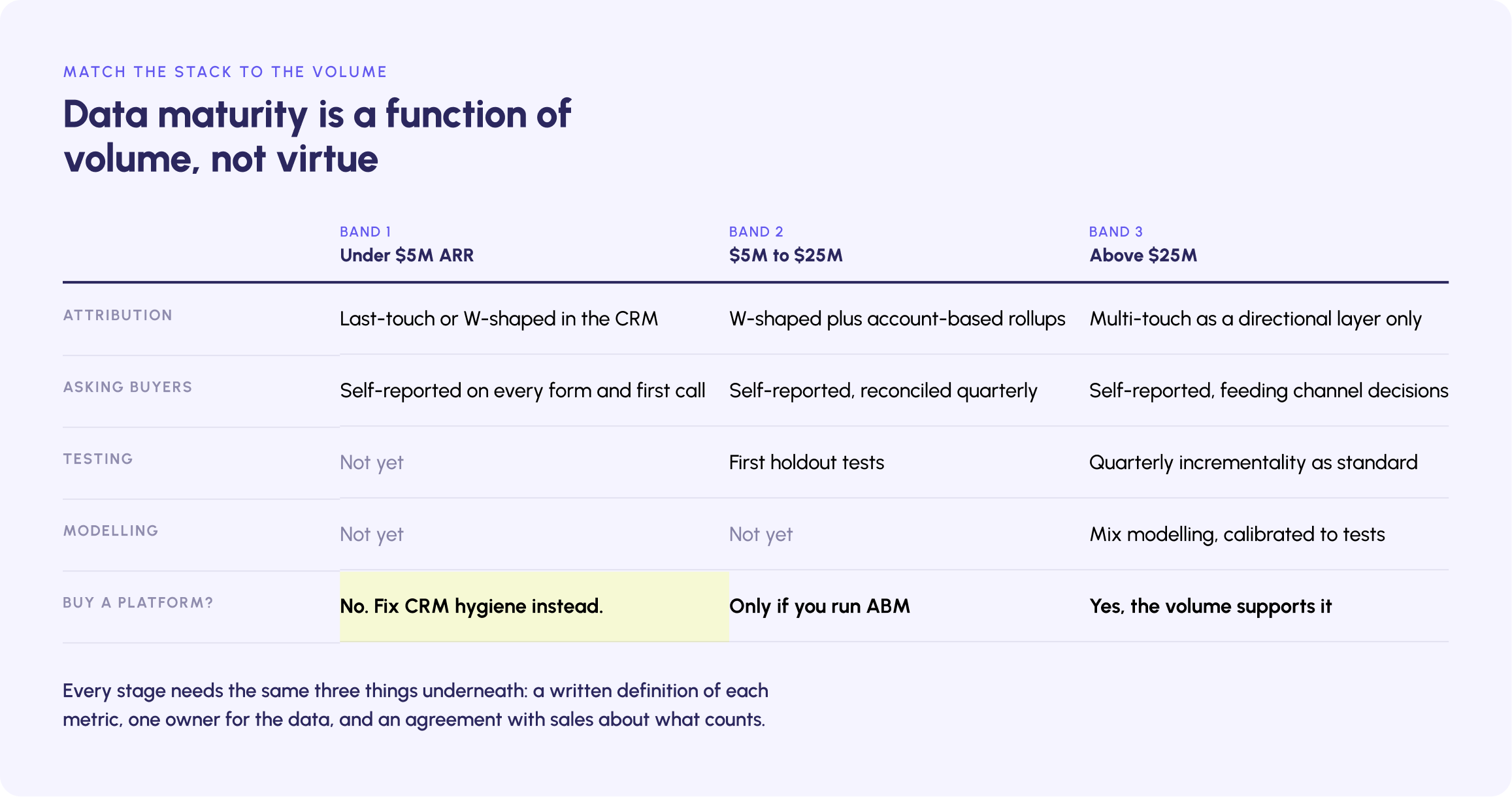
Attribution advice fails when it ignores company size. Data maturity is not a virtue, it is a function of volume.
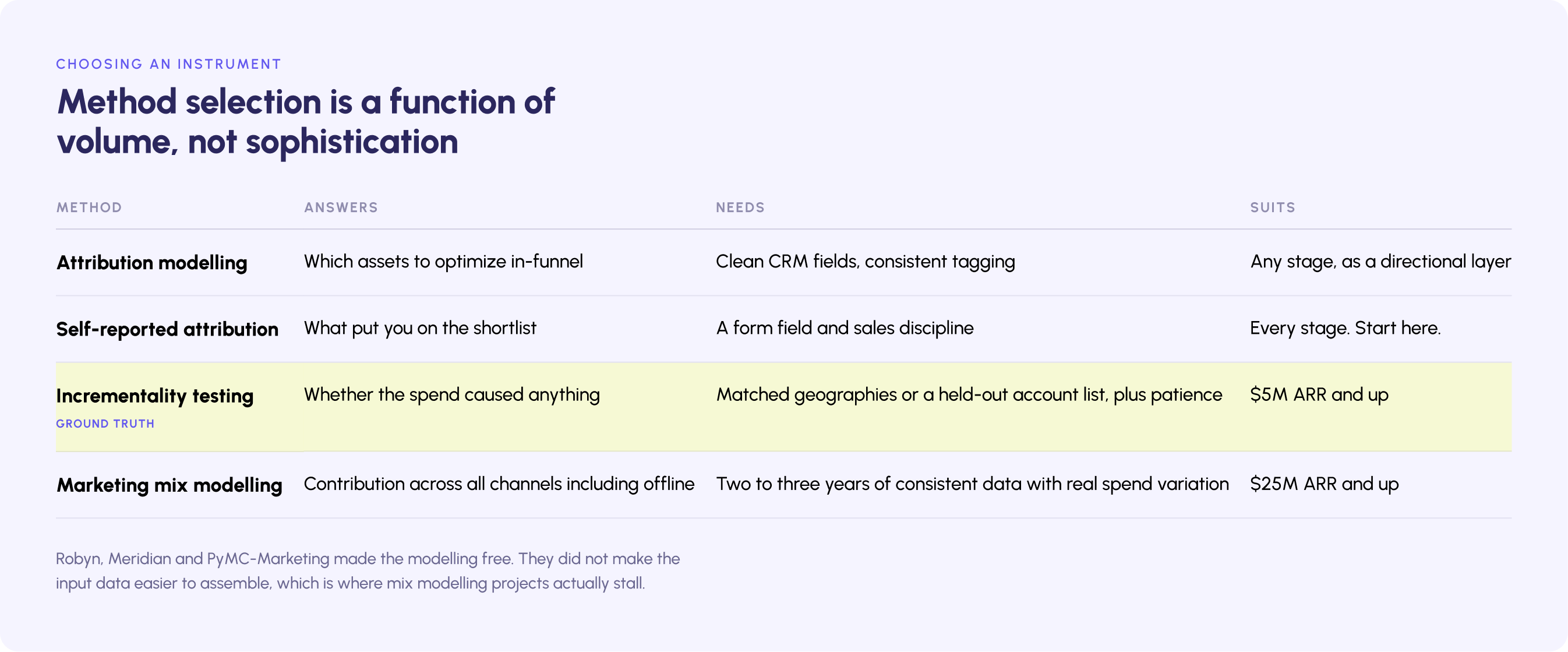
Under roughly $5M ARR
Self-reported attribution on every form and every sales call. Last-touch or W-shaped in the CRM for directional reading. Pipeline reporting split by owned and supported. Clean UTM governance. Do not buy an attribution platform yet, because you do not have the data volume to make it say anything true.
Roughly $5M to $25M ARR
Add account-based attribution and account engagement scoring if you run ABM. Introduce your first holdout tests. Formalize CAC payback and customer lifetime value reporting. This is the stage where the marketing mix starts having enough moving parts that channel-level questions become genuinely hard.
Above roughly $25M ARR
Quarterly incrementality testing as standard practice. Marketing mix modelling using one of the open source tools, calibrated against those tests. Multi-touch attribution retained as an in-funnel optimization layer with explicit acknowledgement that it is directional. This is the point where an attribution system pays for itself, because the volume finally supports the maths.
What every stage needs
A written definition of every metric, one owner for the data infrastructure, and a standing agreement between marketing and sales about what counts. The marketing landscape changes constantly. Definitions should not.
What this looks like in practice
Frends, an integration platform company, came to us with the standard version of this problem: activity across several marketing channels, no clear line from marketing activities to revenue, and disagreement between marketing and sales about lead quality.
The work was not a better attribution model, and it was not a larger marketing investment. It was an account-based programme with qualification criteria agreed jointly with sales, account-level engagement measurement instead of contact counting, and pipeline reporting both teams accepted. MQL-to-SQL conversion moved from 14% to 30%, the programme produced 24 ABM-sourced opportunities, and roughly $75K in MRR was generated.
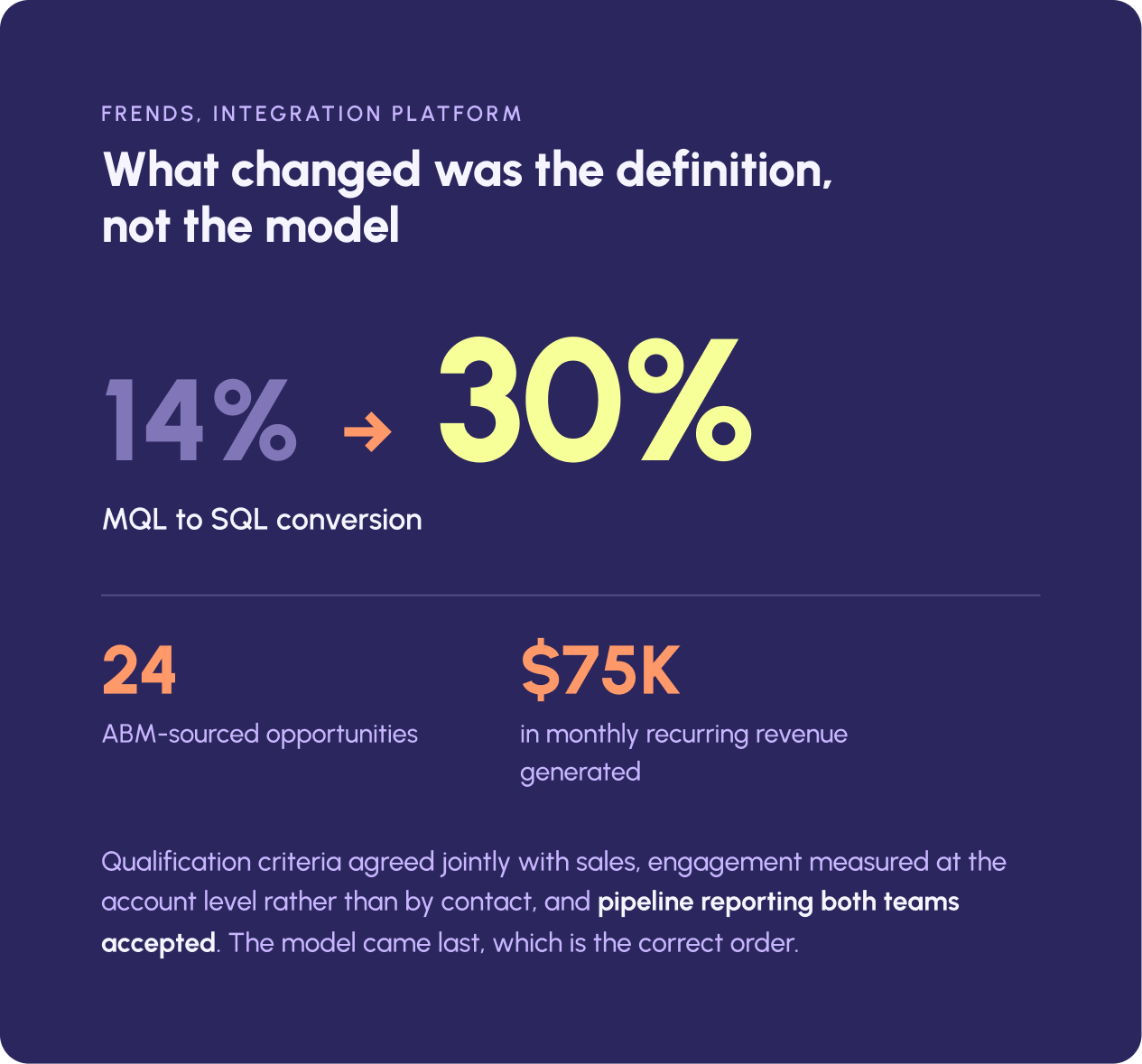
The measurable improvement came from fixing definitions and measuring marketing efforts at the account level. The model came last, which is the correct order.
Where this leaves you
Multi-touch attribution models are a directional optimization tool that should be calibrated against experiments and never presented as causal truth. Self-reported attribution captures the demand creation that tracking cannot see. Incrementality testing is the only thing on the list that measures causation. Account-level measurement matches how B2B purchases actually happen. Pipeline, CAC payback and customer lifetime value are what survive a conversation with finance.
And the constraint that makes all of this necessary is worth stating plainly. Research from 6sense covering around 4,000 B2B buyers found that buyers are roughly two thirds of the way through their process before they engage a seller, that four of the five vendors they evaluate were on the shortlist from day one, and that they buy from that original shortlist 95% of the time. The Ehrenberg-Bass and LinkedIn B2B Institute work on the 95-5 rule points the same way: at any moment, only around 5% of your market is in a position to buy.
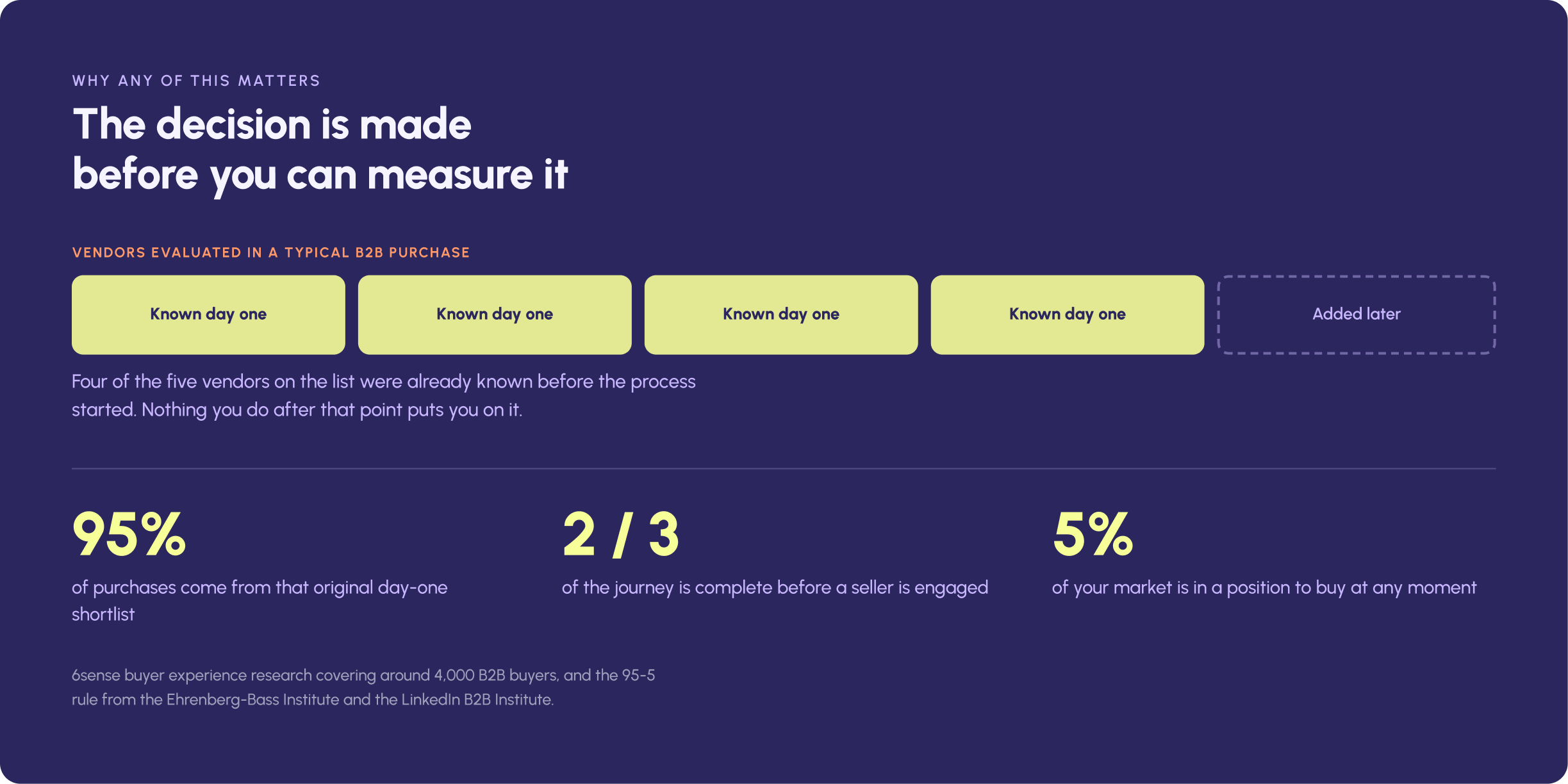
What follows from that is a strategic point rather than a measurement one. Most buyers are out of market at any given time, so the job is investing in demand creation such that when intent finally appears, you are already on the list. Attribution will never see most of those marketing efforts. That is an argument for measuring differently, not for measuring less.
FAQ
What is B2B marketing attribution?
B2B marketing attribution is the practice of connecting marketing touchpoints to business outcomes like pipeline and revenue, usually by assigning credit across the interactions recorded before a deal closes. B2B attribution differs from consumer attribution in three ways that matter: purchases are made by committees rather than individuals, sales cycles run for months rather than minutes, and a large share of the buyer journey happens in places that generate no trackable event. Because of this, B2B attribution works better at the account level than the contact level, and it works better as a directional input than as a precise revenue allocation.
How do you calculate marketing ROI?
The standard marketing ROI calculation subtracts organic sales growth and marketing costs from total sales growth, then divides by marketing costs. The result is expressed as a ratio or percentage. Two things determine whether the number means anything: whether you have a consistent sales baseline to estimate what growth would have happened without marketing, and whether your marketing costs include everything, meaning salaries, marketing technology, agency fees and production, not just media. Most published marketing ROI figures fail on one or both counts. For ongoing measurement, CAC payback and the ratio of customer lifetime value to customer acquisition cost are more reliable than a period return figure.
What is a good marketing ROI in B2B?
The commonly cited benchmark for a good marketing ROI is 5:1, with 10:1 treated as exceptional. This figure circulates widely but has no traceable primary source, and it ignores the fact that a business with 85% gross margins and one with 30% margins face completely different maths. A better internal test is whether CAC payback is shortening, whether the customer lifetime value to CAC ratio sits comfortably above 3:1, and whether marketing-sourced pipeline is growing faster than marketing spend. Those benchmarks come from your own business rather than from a number that got repeated until it seemed authoritative.
Which attribution model should B2B companies use?
For most B2B companies, a W-shaped or position-based model gives the most useful multi-touch view, because it credits the first interaction, lead creation and opportunity creation without pretending to statistical precision. A data-driven attribution model needs roughly 400 conversions per conversion type and around 10,000 distinct paths before they produce meaningful weightings, which rules them out for most mid-market companies. Whatever you choose, run self-reported attribution alongside it. The disagreement between the two is more informative than either number alone, because software sees demand capture and buyers report demand creation.
How do you measure marketing ROI when the sales cycle is nine months?
You separate reporting into leading and lagging indicators, and you agree in advance when each becomes meaningful. In the first quarter of a new programme, report deliverables and leading signals: engaged accounts in your ICP, branded search movement, multi-stakeholder engagement from target accounts, cost per opportunity. Revenue attribution becomes meaningful only after a full sales cycle has elapsed. The mistake that damages credibility is reporting early-stage proxy metrics as though they were results, which trains stakeholders to distrust everything you present later.
Can you measure dark social and word of mouth?
Not directly, and any vendor claiming otherwise is selling something. You can measure them indirectly through self-reported attribution, branded search volume over time, direct traffic patterns, and the ratio of shortlist appearances to outbound effort. SparkToro's research shows that traffic from private messaging and closed communities arrives with no referral data attached and lands in direct, so a rising direct traffic number alongside rising branded search is one of the more reliable signals that off-platform demand creation is working. The honest position is that you can detect the shape of dark social activity even though you cannot itemize it, and that detecting the shape is enough to make budget decisions.
What is the difference between marketing-sourced and marketing-influenced pipeline?
Marketing-sourced pipeline covers deals where marketing originated the account. Marketing-influenced pipeline covers deals where marketing contributed touchpoints to an opportunity sourced elsewhere, usually by sales. Both are worth reporting and each distorts in a predictable direction. Sourced undercounts marketing's role in accelerating deals sales found. Influenced inflates over time, since almost every contact eventually receives a marketing email, which makes it a poor basis for budget decisions. The critical step is defining both jointly with sales, writing the definitions down, and keeping the attribution windows fixed across the year.
Do you need an attribution platform?
Below roughly $5M in ARR, generally no. You do not have the conversion volume for a data-driven model to say anything reliable, and the money is better spent fixing CRM data hygiene and running self-reported attribution. Between $5M and $25M, a platform starts to earn its place if you run ABM and need account-level rollups your CRM cannot produce natively. Above that, an attribution tool becomes reasonable as an in-funnel optimization layer, on the condition that its output is calibrated against incrementality tests rather than treated as ground truth. The sequence matters: clean inputs first, definitions second, tooling last.
.png)