.svg)

What is the difference between SEO, GEO and AEO?
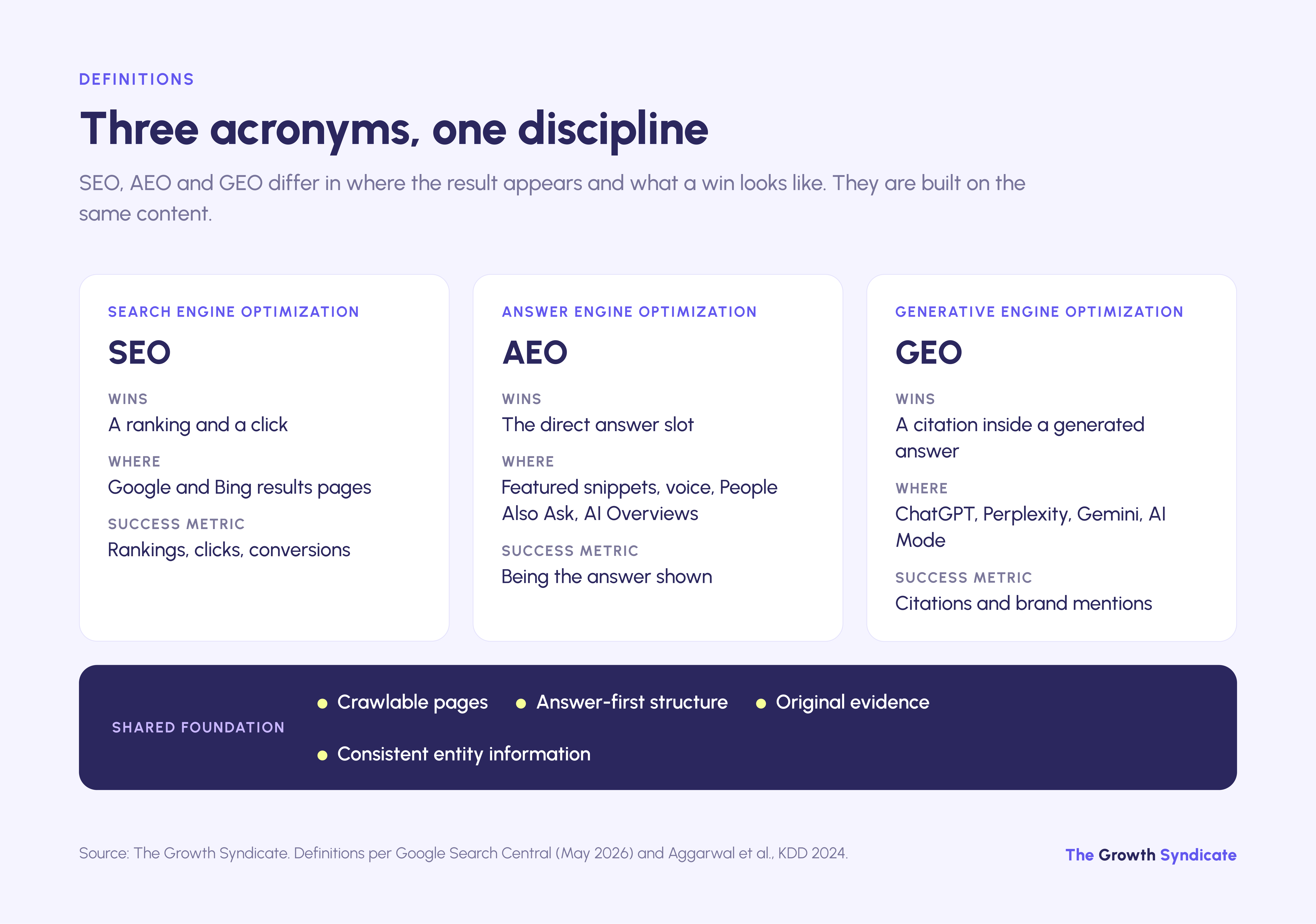
SEO earns a ranking and a click from traditional search engines. Generative engine optimization (GEO) earns a citation inside the AI-generated answers of ChatGPT, Perplexity, Gemini and Google AI Overviews. Answer engine optimization (AEO) earns the direct answer slot: featured snippets, voice results and, now, AI summaries. All three reward the same underlying content. They differ in which queries they serve and in what a win looks like.
Is SEO dead? What the click data actually shows
No. Search engines are handling more queries than ever: searches per Google user grew 21.6% between 2023 and 2024 in Datos' US clickstream panel (SparkToro, March 2025), and AI assistants send about 1% of website traffic on average (Conductor, November 2025). What is dying is thin informational content that only ever earned a click because nothing better existed. Those clicks now go to an AI summary, and the way back in is being cited inside it.
The debate that resurfaces every quarter
The "is SEO dead" thread returns to r/SEO roughly every three months, and it got a mainstream boost when New York Magazine ran "SEO Is Dead. Say Hello to GEO" in August 2025. The catastrophists point at falling clicks and declare the discipline finished. The practitioners who have watched search behavior change for a decade say something narrower: low-effort, volume-driven traditional SEO is what is dying. Both camps read the same data and reach different conclusions, so it is worth looking at the data itself.
What the numbers say about clicks
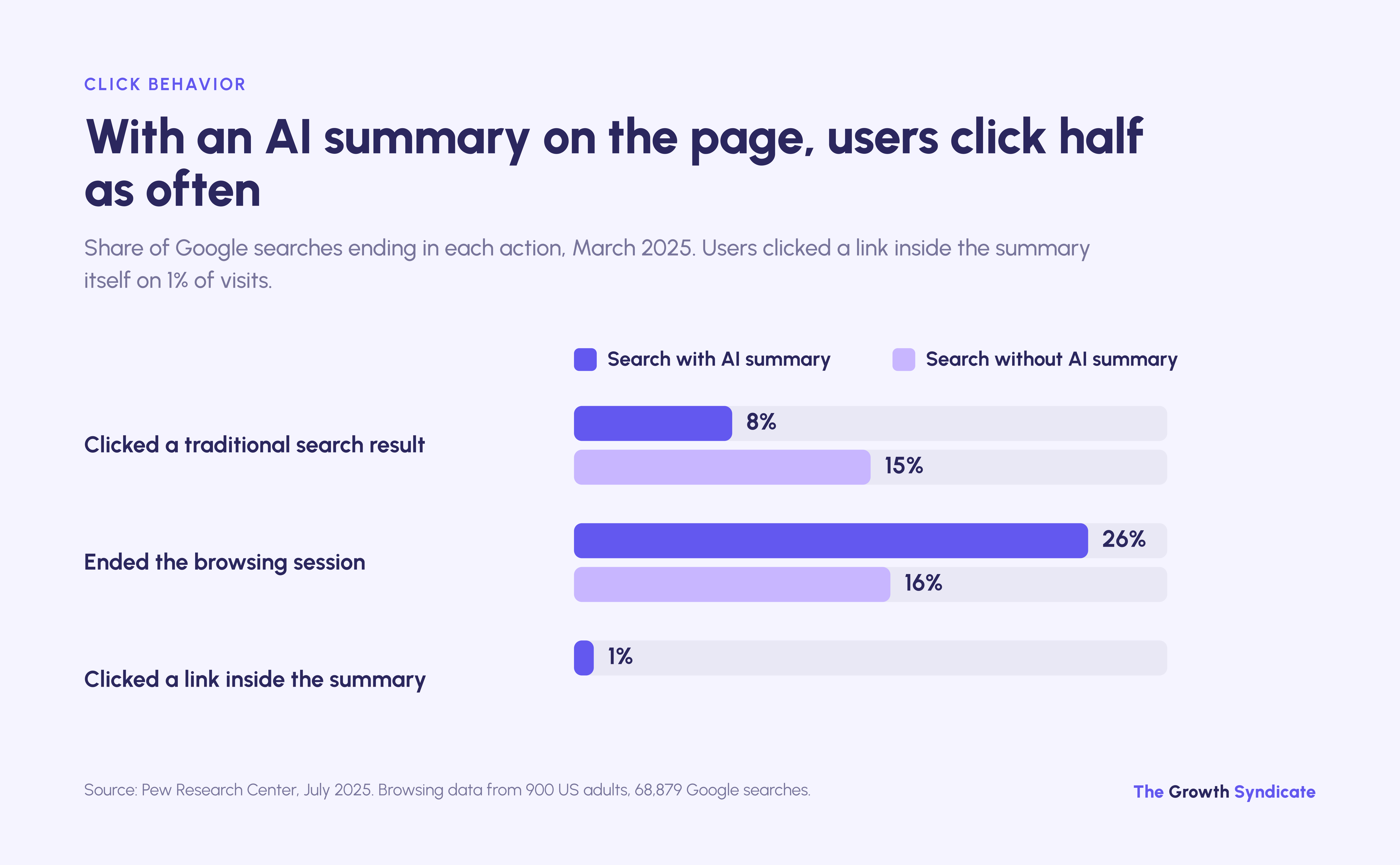
Pew Research analyzed 68,879 Google searches made by 900 US adults in March 2025 and found an AI summary on 18% of them. When a summary appeared, users clicked a traditional result 8% of the time, against 15% without one. Only 1% of visits clicked a link inside the summary itself, and sessions ended after the search 26% of the time versus 16% (Pew Research Center, July 2025). Google has disputed Pew's method, and the AI Overview labels came from search results fetched in April, a few weeks after the March browsing data, so treat the 18% as a floor rather than a fixed share.
Newer data points higher. Conductor's benchmark of 3.3 billion sessions across 13,770 enterprise domains put AI Overviews on 25% of US searches in late 2025, and SparkToro's analysis of Similarweb clickstream data found that 68% of US Google searches in the first four months of 2026 ended without a click to any website, up from 60% in 2024 and the fastest jump in a decade (SparkToro, 2026).
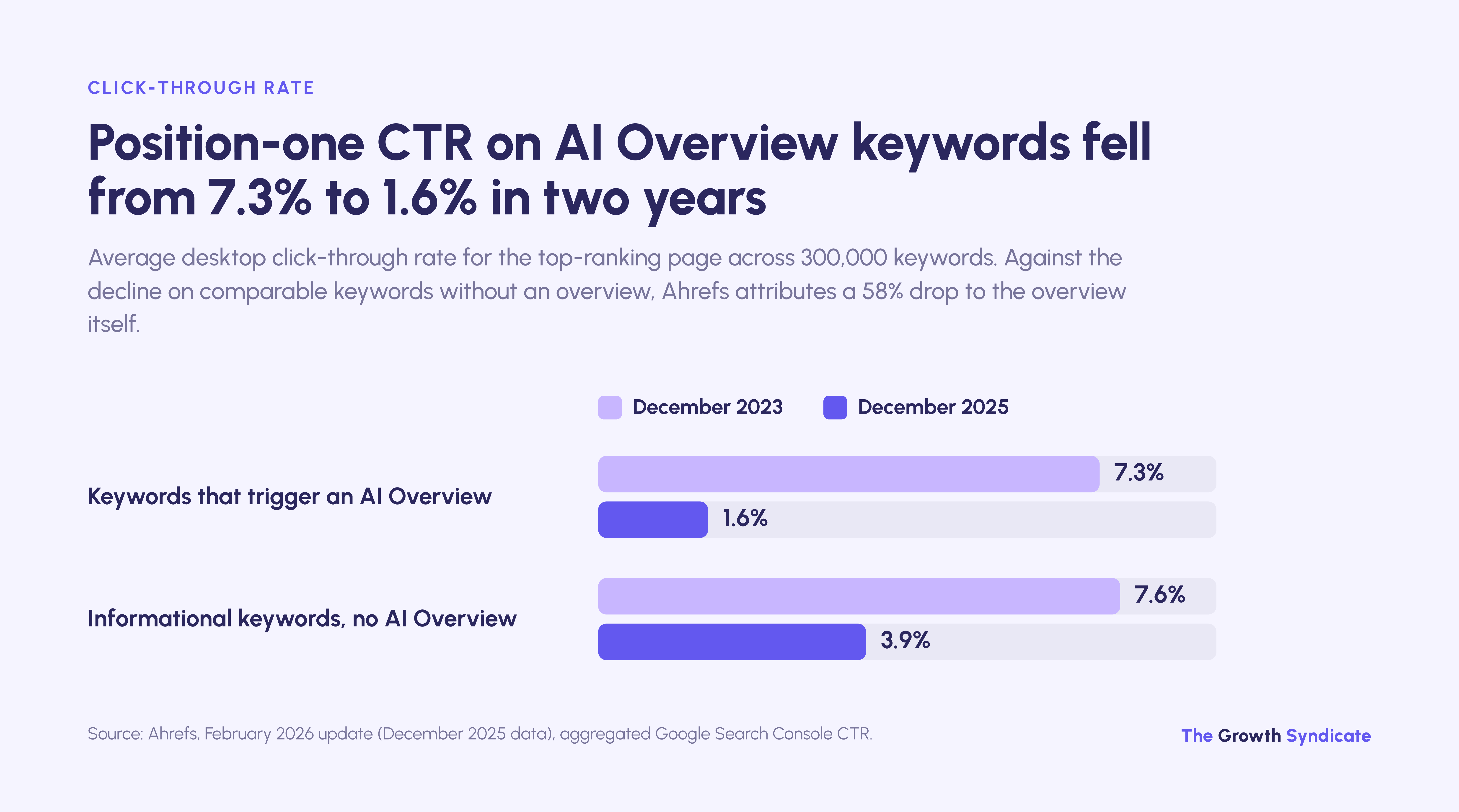
The cost lands on whoever ranks first. Ahrefs compared 300,000 keywords with and without AI Overviews and found the top-ranking page's average click-through rate 58% lower when an overview is present. In its April 2025 study the gap was 34.5% (Ahrefs, February 2026, using December 2025 data). Seer Interactive saw organic CTR on informational queries with an overview fall from 1.76% to 0.61% between June 2024 and September 2025, across 3,119 queries and 25 million impressions (Seer Interactive, November 2025). Seer also found that pages cited inside the overview received 35% more organic clicks than pages that ranked but were not cited. That correlation does not prove causation, and Seer says so, but it is the clearest signal available that being the source beats being the listing. Seer's expanded 2026 study, covering 5.47 million queries across 53 brands, adds two nuances: CTR on overview queries stopped falling and recovered from 1.3% in December 2025 to 2.4% in February 2026, and cited pages earned roughly 120% more clicks per impression than uncited ones (Seer Interactive, April 2026). The click did not vanish; Google redirected it toward the sources it names.
What actually died
Position-one clicks on informational user queries died. Organic traffic from content that answered a question adequately and no better died with them. The queries did not die, the buyers did not disappear, and the AI-generated answers that replaced those clicks are assembled by generative engines from pages that still have to be crawled, indexed and trusted. Search engines are still doing the underlying work; they are presenting the result differently. That is why the "SEO is dead" framing is wrong and the "nothing changed" framing is also wrong.
GEO vs SEO: what changes and what doesn't
Generative engine optimization (GEO) aims to get your content cited inside AI-generated responses rather than ranked in a list of links. The tactics that earn a citation (clear answer-first passages, verifiable statistics, named sources, consistent entity information, crawlable HTML) are the same tactics that have earned search rankings for years. What changes is where the result appears, how success is measured, and how quickly the link between ranking and citation is weakening.
What generative engine optimization asks you to do
The term comes from a 2023 paper by a group of artificial intelligence and natural language processing researchers at Princeton, Georgia Tech, IIT Delhi and the Allen Institute for AI, led by Pranjal Aggarwal and published at KDD 2024 (Aggarwal et al., "GEO: Generative Engine Optimization"). The authors built a benchmark of 10,000 queries and tested which content changes made a source more visible in the responses generative engines produce. Adding citations to authoritative sources, adding quotations and adding statistics produced the largest gains, up to 40% on their visibility measure. Keyword stuffing, the one classic SEO tactic they tested, made things worse.
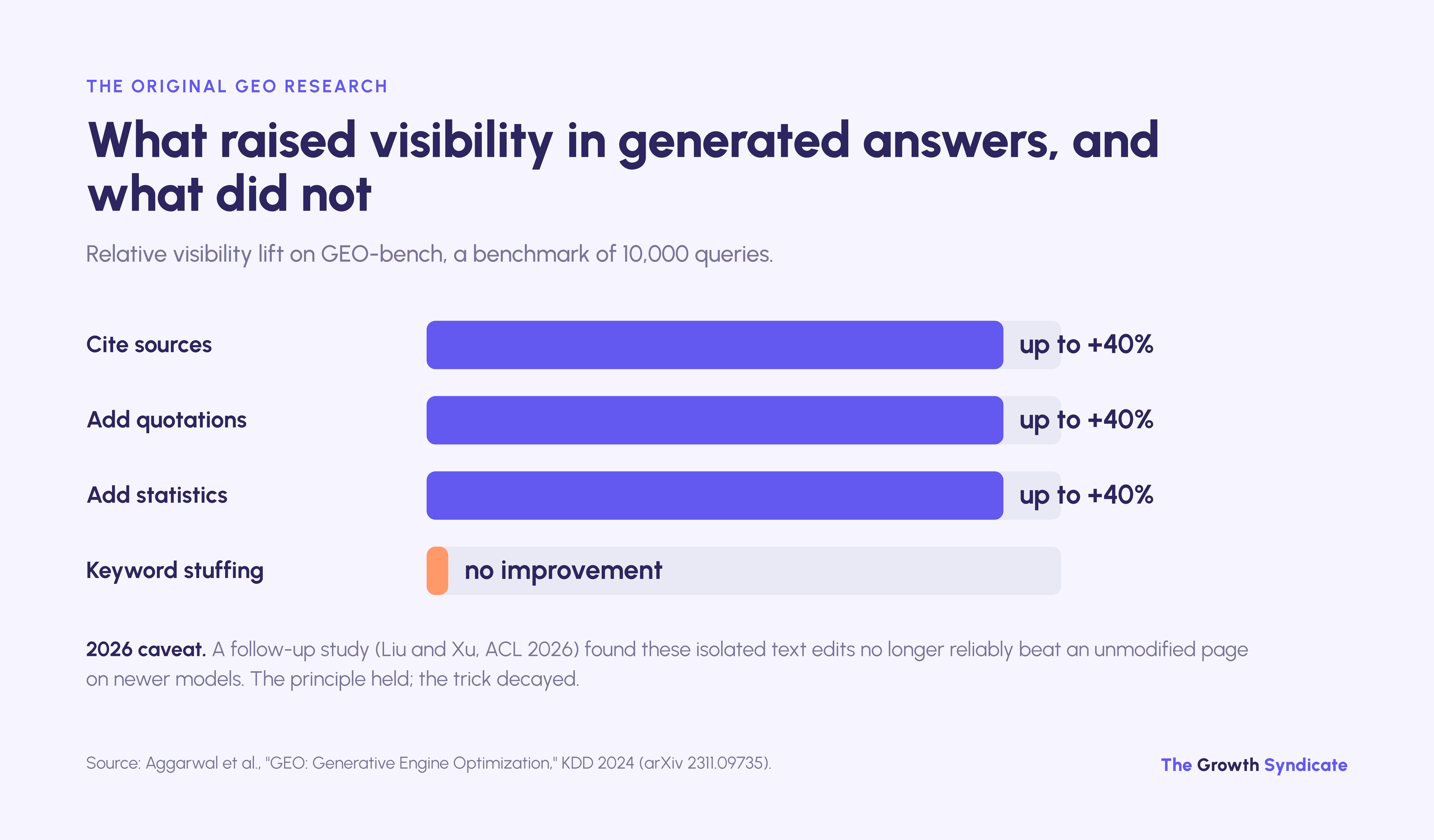
Read that list again. Cite your sources and put numbers on your claims, with a quotation where someone said it better. That is a description of good editorial practice, and it is what search engines have rewarded under E-E-A-T guidance for years. Generative engines reward it for a related reason: a model choosing between multiple sources that say roughly the same thing favors the one that hands it a number and a name to attribute. A 2026 follow-up study found the paper's specific text tweaks no longer reliably beat an unmodified baseline on newer models, and that citation behavior depends more on document-level qualities than on isolated edits (Liu and Xu, ACL 2026), which suggests the mechanism (concrete, attributable, well-structured content) holds while any single trick decays.
So "GEO focuses on AI answers" is true, and "GEO requires a separate playbook" is not. Danny Sullivan, a director on Google's Search team, said as much at WordCamp US in August 2025: "Good SEO is good GEO or AEO or AI SEO or LLM SEO or even LMNOPEO" (Search Engine Land, August 2025). He and John Mueller then spent two episodes of Google's Search Off the Record podcast in December 2025 and January 2026 saying the same thing at length, and in May 2026 Google published its first official guide to appearing in its AI features, which states that optimizing for those features is "still SEO" (Google, May 2026). Google has an interest in discouraging people from gaming its AI systems, so its word is not the last one, but the independent research points the same way.
What stays the same, and what is quietly shifting
Generative engines are machine learning systems sitting on top of a retrieval index, and for the most part it is the same index the traditional search engines built. Unlike traditional search engines, though, most AI crawlers do not execute JavaScript. A Vercel and MERJ analysis of crawler traffic on Vercel's network, including 569 million GPTBot fetches in a single month, found that GPTBot, ClaudeBot and PerplexityBot download JavaScript files but never run them; Google's Gemini is the exception because it uses Googlebot's renderer (Vercel, December 2024). If your product pages render client-side, the AI systems your buyers ask are reading an empty shell, and so are the AI agents that increasingly browse on a buyer's behalf. Server-side rendering has gone from a performance preference to a prerequisite.
The link between ranking and citation in AI responses is real, but page one is not the gate it used to be. BrightEdge tracked AI Overview citations across nine industries for 16 months and found that the share of citations coming from pages that rank somewhere in the organic top 100 rose from 32% to 54.5% between May 2024 and September 2025, while the share coming from the top ten stayed flat at about 17%; most of the growth came from pages ranking between positions 21 and 100 (BrightEdge, September 2025). In B2B technology, 71% of citations came from ranking pages, but only about one in four or five from page one (BrightEdge, February 2026). Across AI search engines the divergence is sharper: when Profound ran 100,000 prompts through both ChatGPT and Perplexity, only 11% of cited domains appeared in both (Profound, 2025). ChatGPT leans on Wikipedia, Perplexity on Reddit and recent sources, Google AI Overviews on Reddit, YouTube, Quora and LinkedIn, and for B2B software queries G2 shows up heavily. A page that ranks somewhere on Google is more likely to be cited, ranking first no longer guarantees it, and off-site presence carries independent weight.
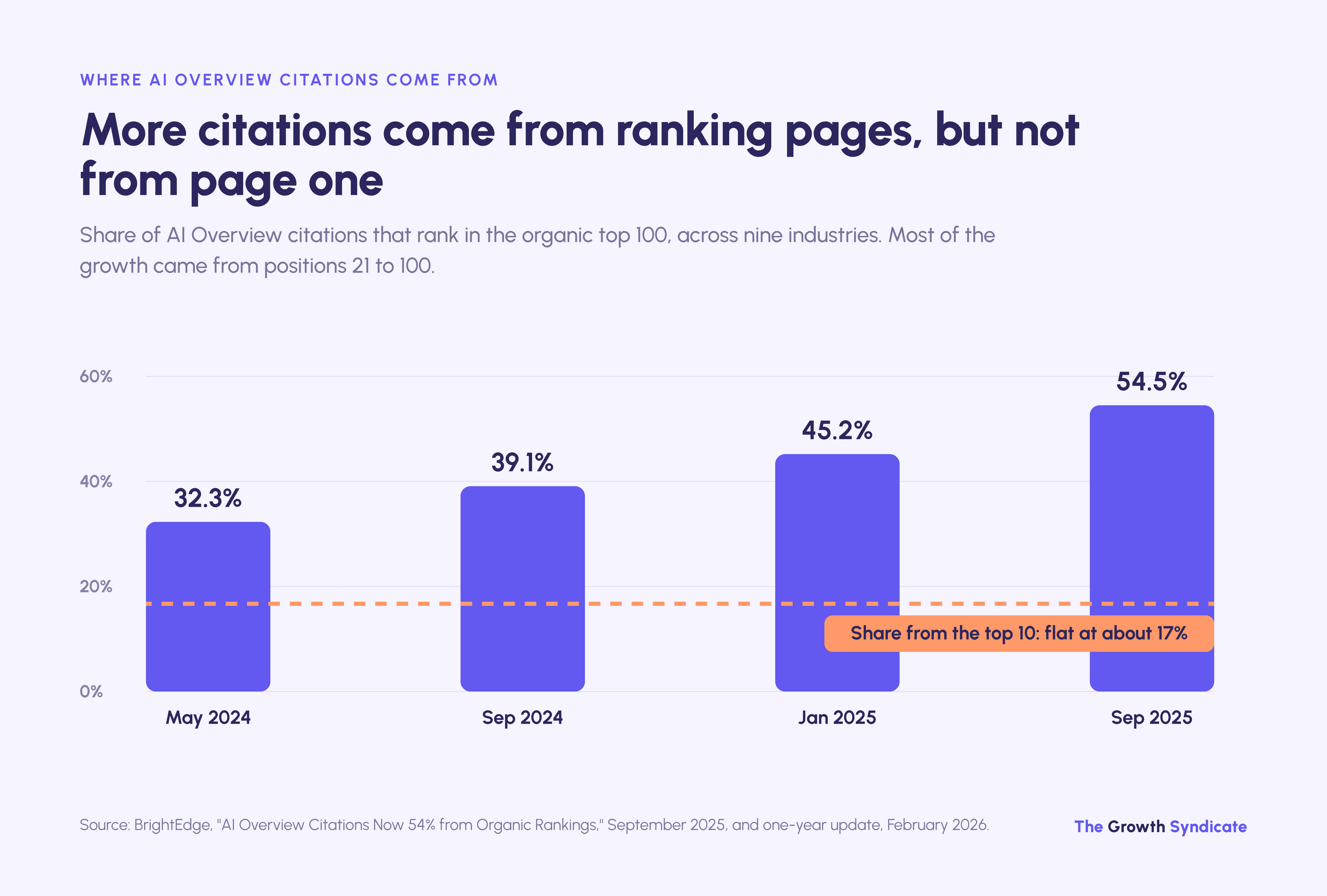
That is the honest version of what generative engine optimization changes: the same content fundamentals, applied across more surfaces, with a ranking-to-citation relationship that no longer does the work on its own. Our B2B SEO strategy guide covers the fundamentals in depth, and none of them has been replaced.
AEO vs SEO: the answer engine was here before the acronym
Answer engine optimization (AEO) is the practice of getting a page selected as the direct answer to a query rather than one of several results. The term dates to the featured snippet and voice search era of 2017 and 2018 (Jason Barnard is generally credited with coining it), and the same principle now applies to People Also Ask boxes and Google AI Overviews. In practice, AEO is snippet optimization with a broader set of surfaces attached.
Search engines built the first answer engines: the featured snippet was Google using natural language processing to match a question to a passage and presenting it as the answer. The tactic is simple to describe and tedious to do well: put a 40-to-60-word answer at the top of a section whose heading matches the way people phrase the question, then earn the right to be trusted with the rest of the page. Structured data helps machines confirm what the page is about and improves semantic relevance for the query. Meta tags and meta descriptions still shape how the listing reads when a click is on offer. None of that is new, and none of it is separate from SEO.
Where AEO does differ is in the trade it asks you to make. Direct answers reduce clicks; that is their purpose. Pew's data shows sessions ending without a click far more often when a summary is present. What you get in exchange is visibility, and sometimes brand recall, at the moment the question is asked, whether a featured snippet or one of the generative engines delivers it. For a B2B company the trade is usually worth making on informational queries and rarely worth making on the comparison and pricing queries where the click is the point.
One more definitional note, because vendors blur it: AEO and GEO overlap but are not the same. AEO is the older umbrella for single-answer surfaces, including voice and answer snippets. Generative engine optimization specifically targets the generated responses of large language models. Both sit inside the AI search optimization conversation, and both are done with SEO tools, SEO skills and SEO content. The naming disagreement among practitioners is itself evidence that these are labels for one discipline rather than three crafts.
Which queries matter to your pipeline: a decision framework by query type
The useful question is not "do we need generative engine optimization" but "which of our pipeline queries now get answered by AI systems, and where do we need to be when that happens." AI Overview presence varies enormously by user intent: near-saturated on question and comparison queries, rising on commercial queries, and low on transactional ones. Map your queries by type, then decide surface by surface.
Informational queries: assume the answer will be generated
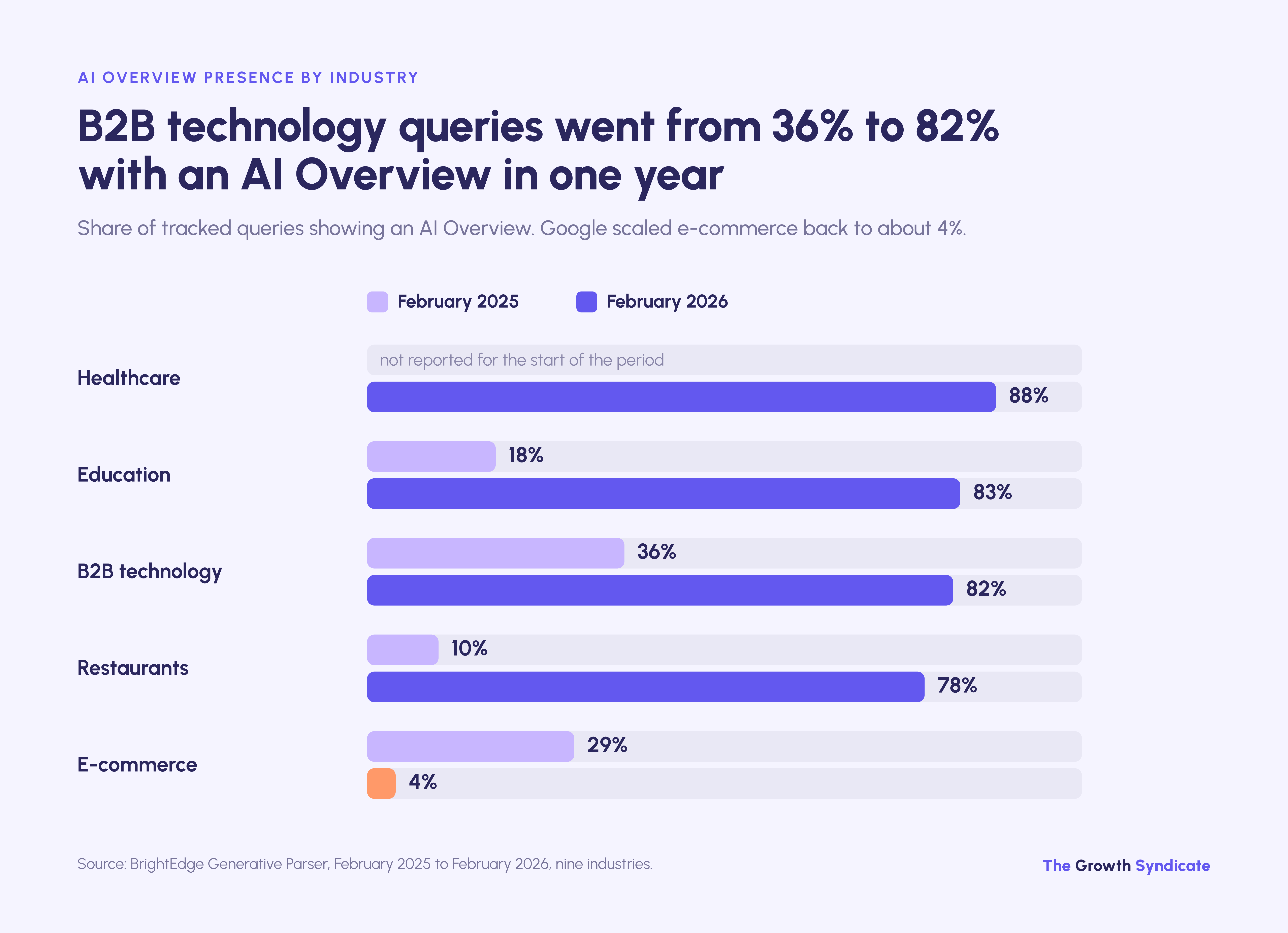
Question-format user queries trigger an AI Overview 85.9% of the time and comparison queries 95.4% of the time in Seer Interactive's 2026 data across 49,353 classified queries. Pew found the same pattern from the user side: 8% of one-or-two-word searches produced a summary against 53% of searches of ten words or more. For B2B technology specifically, BrightEdge tracked AI Overview presence rising from 36% to 82% between February 2025 and February 2026 (BrightEdge). If your category is informational-heavy, and most B2B categories are, the generative engines have already moved in and the AI-generated results are already there. The decision is whether you are cited in them.
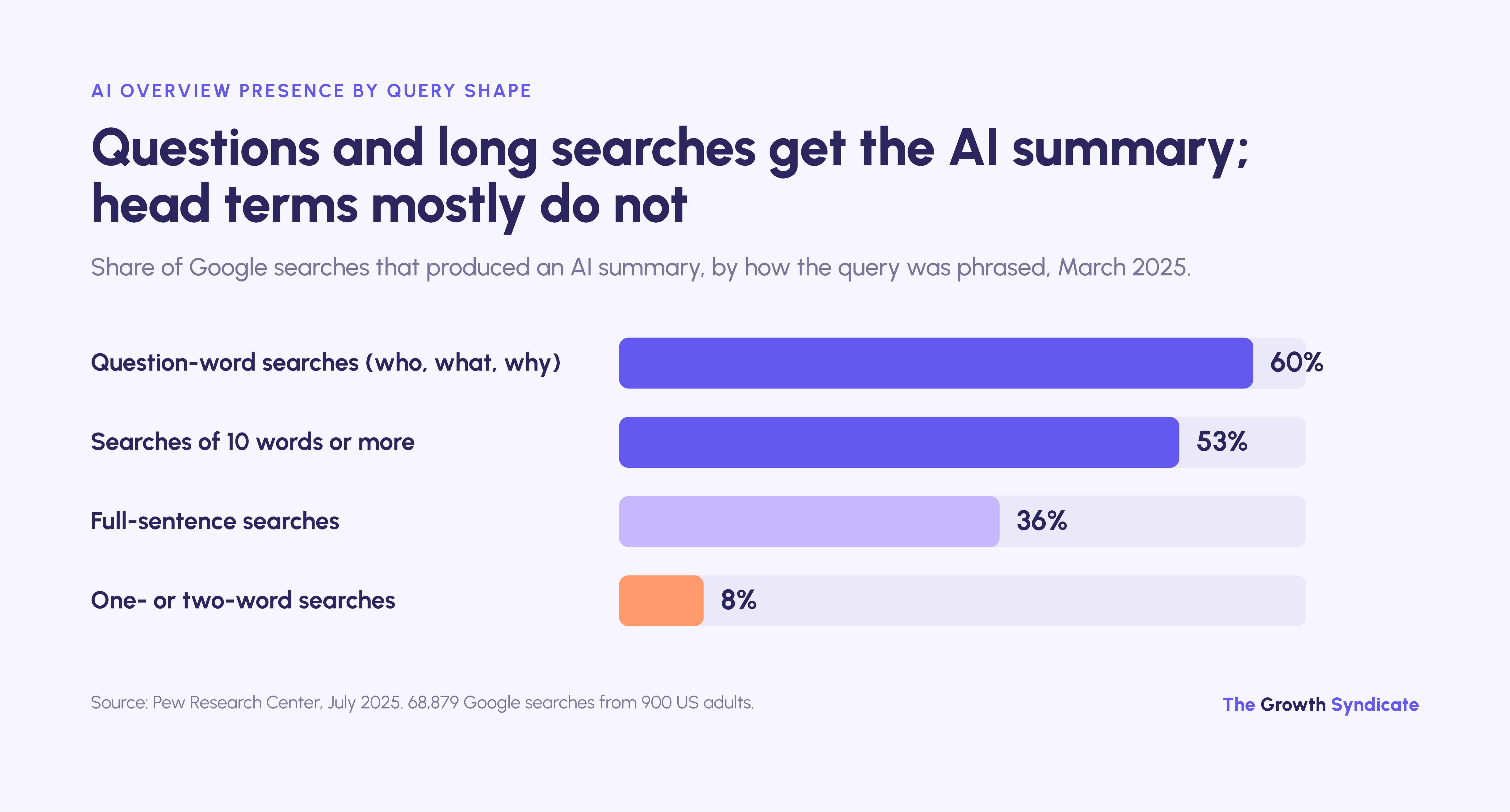
What to do: structure content as answer-first blocks under query-matching headings, use original data where you have it and named external sources where you do not. Optimize content for the citation rather than the click: accept fewer clicks and measure brand mentions and cited pages instead.
Commercial and comparison queries: the contested middle
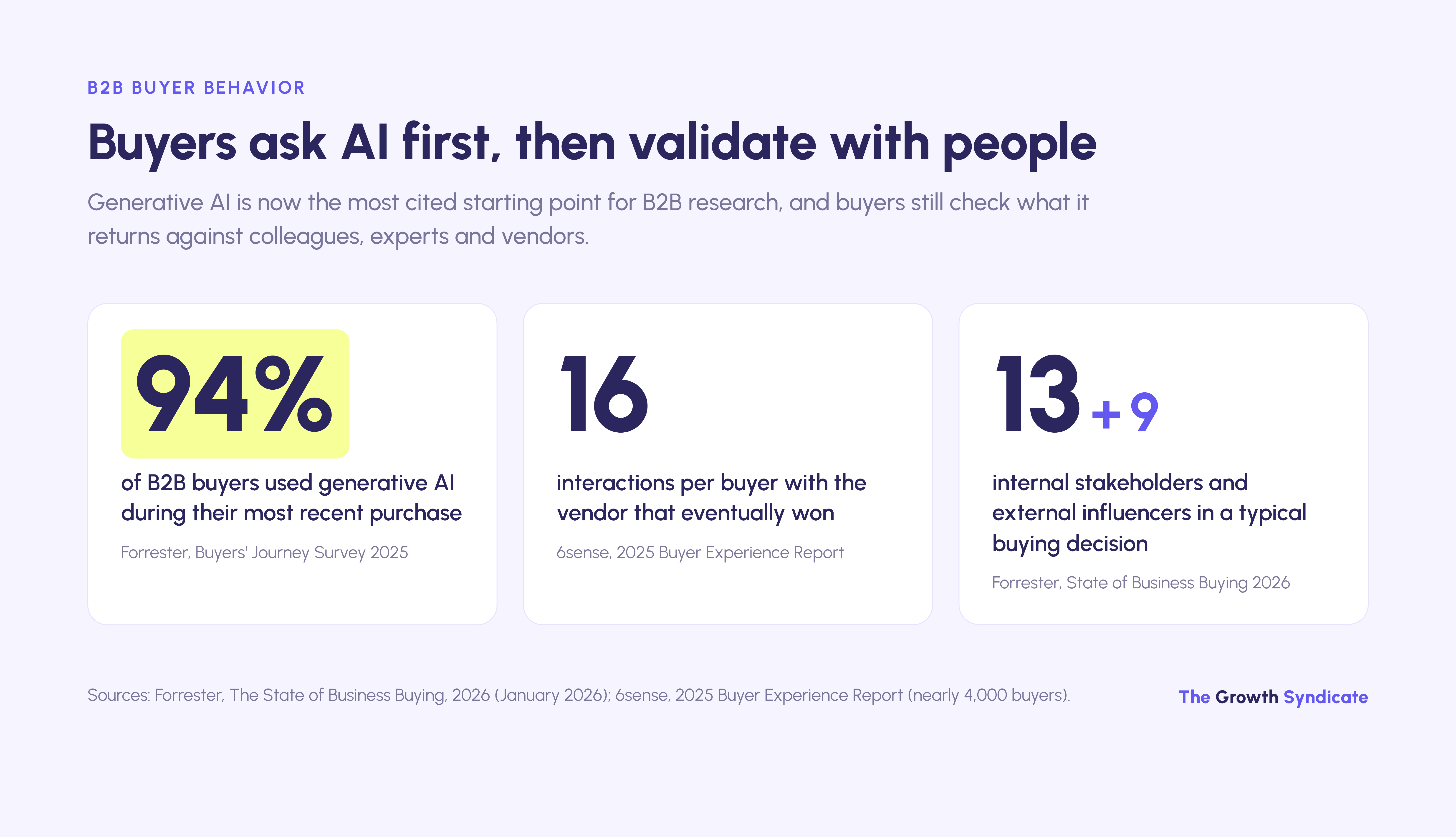
"Best X for Y" and "X vs Y" queries used to be the safest organic real estate in B2B. They are now the fastest-moving. Semrush's six-month study of 600,000 keywords found overviews on commercial-intent results up 71% by April 2026, with finance up 231%, and comparison queries are already the most saturated format. This is also where B2B buyers do their AI research: Forrester's Buyers' Journey Survey, 2025, reported in The State of Business Buying, 2026, found 94% of B2B buyers used generative AI during their most recent purchase, and twice as many named generative AI or conversational search as a more meaningful source than any other, ahead of vendor websites and sales (Forrester, January 2026). The same report found buyers distrust what those tools return and validate it through colleagues, outside experts and vendors, which is why being the source the tool cites matters more than the tool itself.
What to do: keep the ranking work, because these pages still earn clicks, and add the citation work, because the comparison your buyer reads may be assembled by AI assistants and AI agents from G2 reviews, Reddit threads and whichever vendor page explained the trade-offs most clearly. SE Ranking's analysis of ChatGPT citation factors found domains listed on multiple review platforms such as G2, Capterra and Trustpilot averaged 4.6 to 6.3 citations against 1.8 for domains absent from them, and domains with heavy Reddit or Quora presence averaged 7 (Search Engine Journal, November 2025). Those are correlations, and authority confounds them, but user generated content on those platforms is now part of your page's job.
Transactional queries: still a click business
Google is still cautious on money queries. BrightEdge measured AI Overviews on only about 4% of e-commerce queries in February 2026, down from 29% a year earlier, and Semrush found the share of transactional results carrying an overview fell 5% between November 2025 and April 2026 while commercial results rose 71% (Semrush, 2026). User intent on these queries is to buy, and Google is protecting the queries that pay for it. For B2B, "pricing," "demo," "quote" and "agency" queries remain work for the traditional search engines, and the winning page is the one that converts, which is a website design problem as much as a search one.
What to do: classic SEO, conversion work, and no separate AI budget.
Navigational and branded queries: the entity check
When someone types your company name plus "reviews," or asks an AI assistant what your company does, the AI responses are generated from whatever the model has read about you. Inconsistent descriptions across your site, LinkedIn, G2, Crunchbase and press coverage produce inconsistent answers. This is the one query type where a specific new task exists: audit how AI platforms describe you, then fix the sources they are reading.
The framework above is the one we apply to every channel: most of any B2B market is out of market at any given moment, so the queries that matter are the ones the in-market minority uses. Kerry Cunningham, who leads research at 6sense, made a related point in the 2025 Buyer Experience Report, a survey of nearly 4,000 B2B buyers: the visitors who stopped clicking are largely the professionally curious and future buyers, and their absence is unlikely to dent current pipeline (6sense, 2025). That reframes the panic. Losing informational clicks hurts brand reach over time; it does not empty the funnel this quarter.
What B2B teams should change this quarter
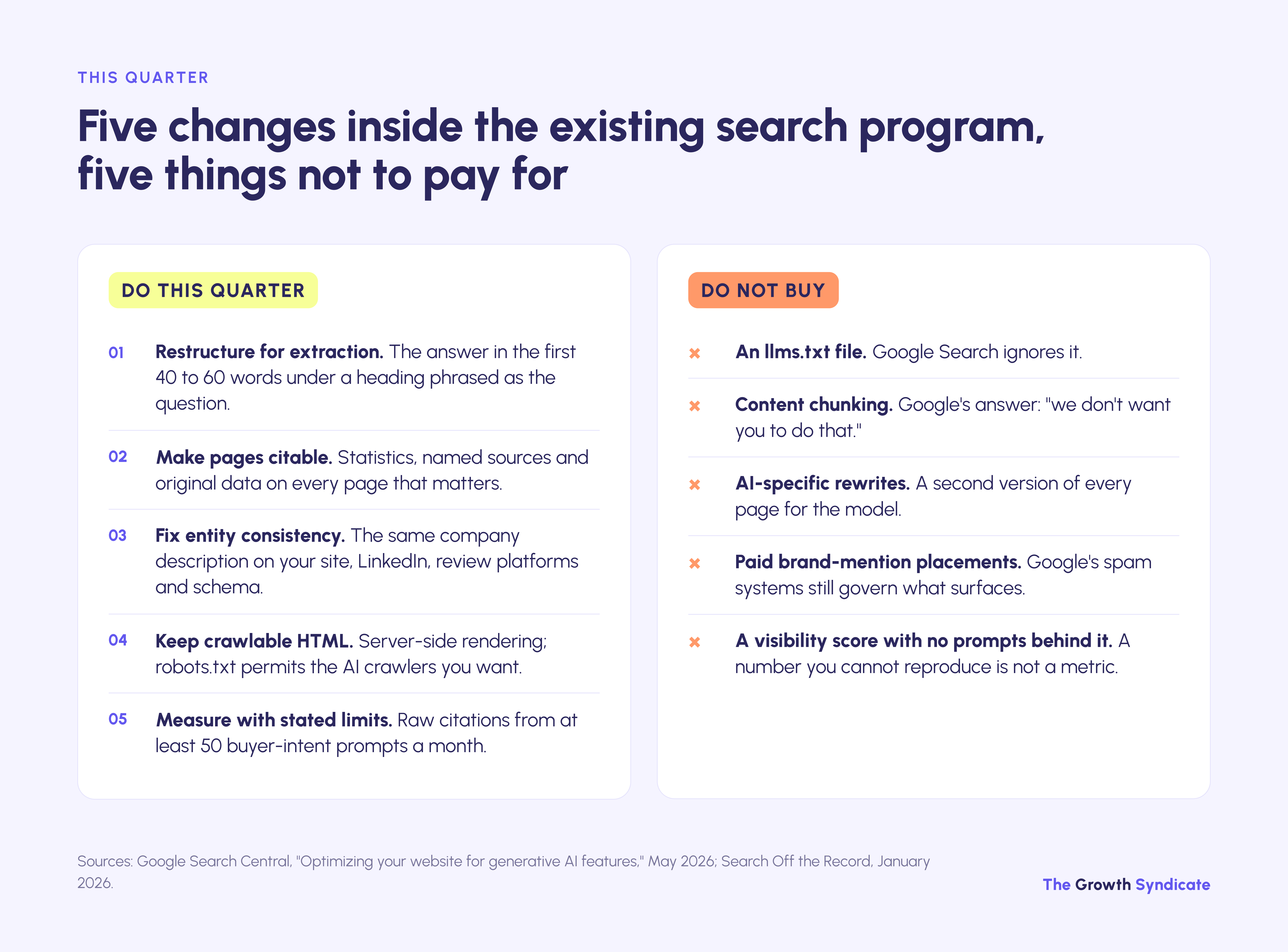
AI search optimization, written out as a to-do list, comes to five changes, all of them inside the existing search program and none requiring a new department. Digital teams that already run SEO have the skills for every one of these optimization strategies.
Restructure for extraction. Every page that targets a question gets the answer in the first 40 to 60 words under a heading phrased the way the question is asked, followed by the depth that earns trust. This is how you structure content for answer engines and for the people skimming on a phone; the two audiences want the same thing. Modern SEO and AI optimization converge on this one habit.
Make pages citable. Generative engines favor sources with statistics, quotations and named references, which is what the original GEO research measured and what E-E-A-T guidance has asked for. Original data is the strongest version of this, because when you create content from a survey or a dataset nobody else has, there is no competing source to cite. Our State of AI in B2B Marketing report found 63% of 110 B2B marketing leaders naming more noise and less differentiation as AI's biggest risk, and the same dynamic applies to AI answers: when many sources say the same bland thing, the one with a number and a name gets cited. High quality content with factual accuracy is the whole game; the content creation that wins here is research-led rather than volume-led. Content creation that starts from your own data points is the one thing nobody else can be cited for.
Fix entity consistency. Make sure the company is described the same way on your site, on LinkedIn, on review platforms and in your schema markup. AI models synthesize from multiple sources and penalize contradictions by hedging or omitting you. Your website's visibility in an AI answer depends on the rest of your digital presence agreeing with it.
Keep crawlable HTML. Check that your key pages render server-side, that robots.txt permits the AI crawlers you want (GPTBot, OAI-SearchBot, PerplexityBot, Google-Extended) and blocks only the ones you do not, and that nothing important lives behind a JavaScript call that search engines can render but AI crawlers cannot. This is a ten-minute check with a large downside if it fails.
Do not buy the trick. A short list of things with no evidence behind them: an llms.txt file (Google has said it will not use one), "chunking" content into LLM-sized fragments (Sullivan's response was "we don't want you to do that"), paid brand-mention placements, and any single AI visibility score sold without the underlying prompts and answers. Optimization strategies that promise to game AI engines age the way link schemes aged.
Everything on this list is what generative engine optimization vendors sell, and it is work your SEO team, or your B2B SEO agency, should already be doing. Keyword research still tells you which queries carry pipeline; the difference is that you now optimize content for the answer as well as the ranking. If a vendor presents that as a new service line, the service is repackaging.
How to measure AI search visibility today, and where it stops
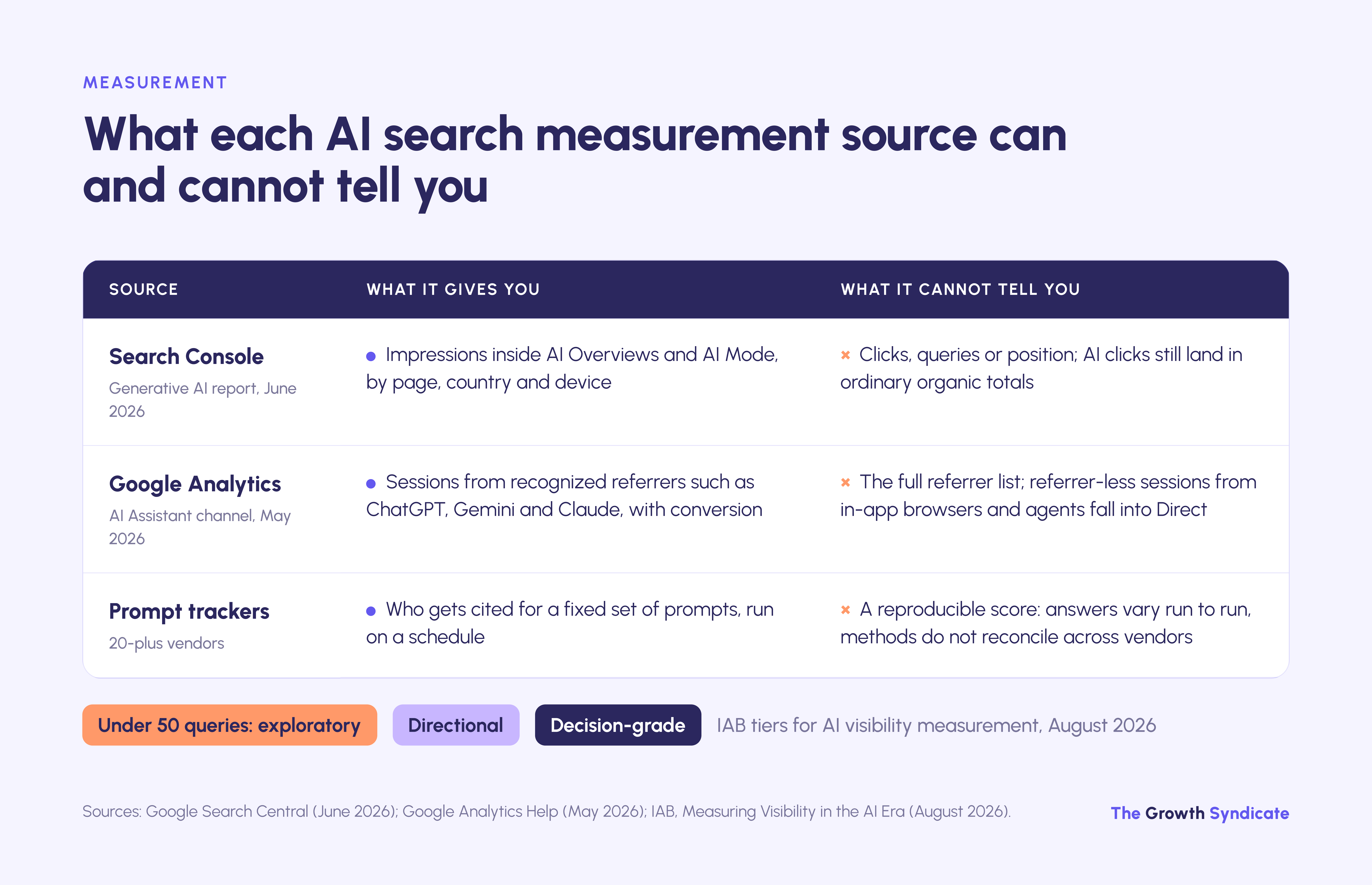
Measurement is the one genuinely new problem, and it is immature. Google Search Console added a report in June 2026 that shows impressions inside AI Overviews and AI Mode, but it reports no clicks, no queries and no position, and it is rolling out in phases, so AI clicks still land in ordinary organic totals with no way to separate them (Google, June 2026). Google Analytics added an "AI Assistant" channel group on May 13, 2026, that tags recognized referrers such as ChatGPT, Gemini and Claude, but the full referrer list is unpublished, in-app browsers often send no referrer at all, and AI agents fetching on a user's behalf rarely identify themselves, so AI traffic is undercounted in Direct.
Prompt-tracking tools try to fill the gap by asking the generative engines a fixed set of questions and recording who gets cited. The problems are structural: the same prompt returns different answers on different runs, because the machine learning models behind these AI platforms are probabilistic; personalization changes what a real buyer sees; and most programs sample too few queries. The IAB's August 2026 measurement guidance classifies programs under 50 queries as "exploratory," a tier below even "directional," and notes that the 20-plus vendors selling these tools use methods that do not reconcile with each other (IAB, Measuring Visibility in the AI Era, August 2026). Two providers grading the same brand on the same day can disagree enough to be useless.
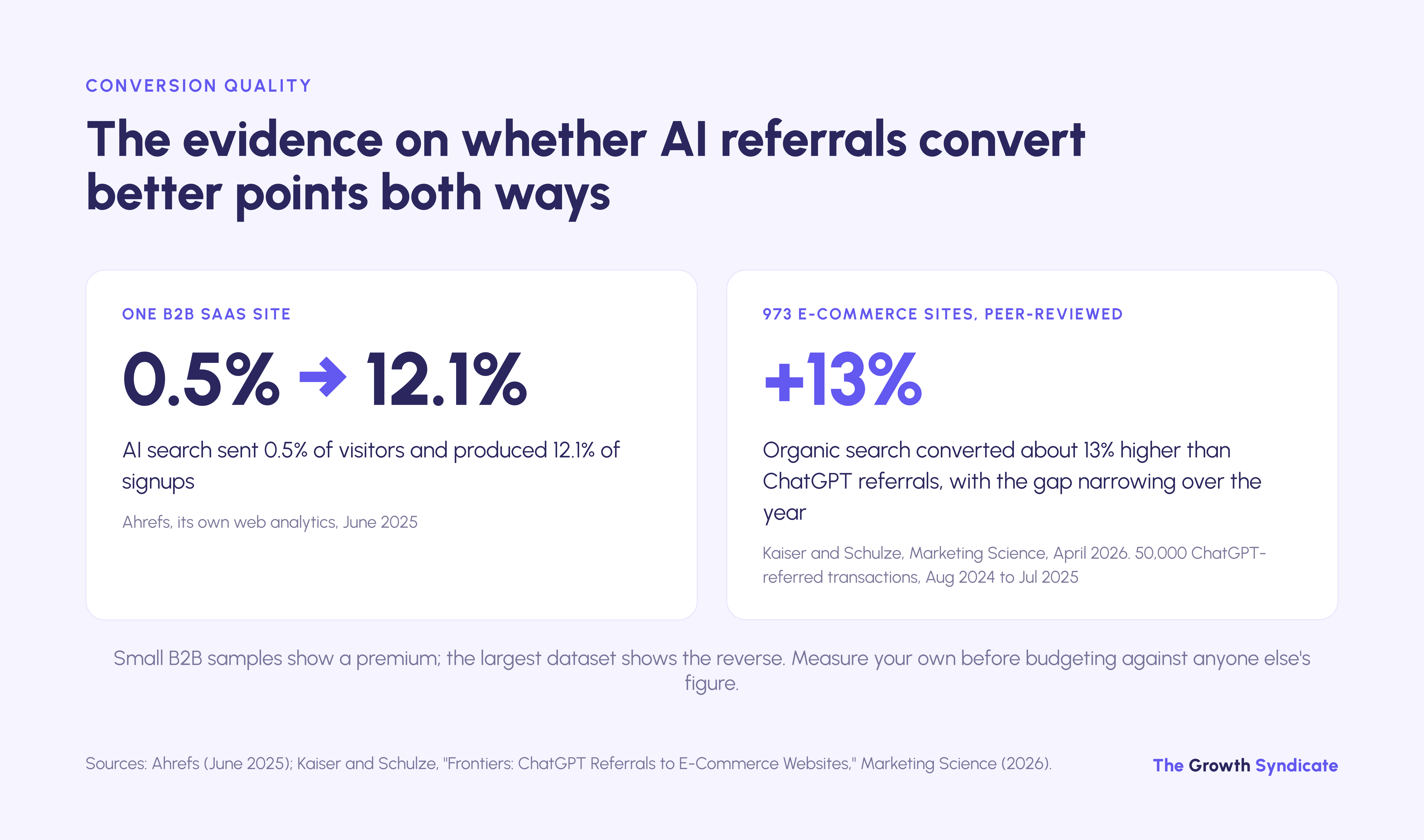
What works today: segment AI referrals in GA4 and watch conversion rather than volume; track branded search and direct traffic to deep pages as a proxy for AI-driven discovery; run a fixed panel of at least 50 buyer-intent prompts monthly across ChatGPT, Perplexity, Gemini and Google, and record the raw citations rather than a score. Whether AI referrals convert better is contested. Ahrefs found 0.5% of its visitors from AI search producing 12.1% of signups (Ahrefs, June 2025), while a peer-reviewed study of 973 e-commerce sites and 50,000 ChatGPT-referred transactions found organic search converting about 13% higher than ChatGPT referrals, with the gap narrowing over the study year (Kaiser and Schulze, Marketing Science, April 2026). The B2B SaaS evidence leans positive and the large-sample evidence does not, so measure your own. How to instrument that, and which tracking tools hold up, is the subject of our AI visibility tracking article. For the broader question of what any search channel is worth to pipeline, our attribution guide covers the limits of the models most marketing efforts are judged by.
Frequently asked questions
Is GEO replacing SEO?
No. Generative engine optimization extends where SEO applies. Generative engines retrieve from the same crawled, indexed and ranked web that traditional search engines use, so a page that is invisible to Google is invisible to ChatGPT and Perplexity too. Google's own position is that GEO is a subset of SEO, and the independent research on what earns AI citations (clear answers, statistics, named sources, crawlable pages) describes SEO done properly.
Is AEO the same as GEO?
They overlap heavily but started in different places. AEO, coined in 2018, targets any surface that returns direct answers rather than a list: featured snippets, voice assistants, People Also Ask and now AI Overviews. GEO, from a 2023 research paper, targets AI-generated answers from large language models such as ChatGPT and Gemini. In practice one team optimizes for answer engines and generative engines with the same content, and the vocabulary matters less than the query types you choose to compete on.
Is AI SEO called AEO? What is AIO vs SEO?
AI SEO, AIO (artificial intelligence optimization), LLMO and AEO are used interchangeably by different vendors, with no agreed standard. Google treats AI optimization, under any of these names, as part of SEO. When a proposal uses one of these labels, ask what specific work it covers. If the answer is answer-first structure, citable content and technical health, that is traditional SEO with a new invoice line. If the answer is a visibility score with no prompts behind it, that is a dashboard.
Do I need a GEO agency?
Not a separate one. You need a search partner that already knows how to structure content for extraction, builds them around original data and named sources, keeps your site crawlable for AI crawlers, and measures AI visibility with stated limits. If your current SEO provider cannot do those things, the problem is the provider rather than the acronym. The one specific new task worth buying is an audit of how AI systems currently describe your company and which sources they draw on.
Does AI-generated content rank or get cited?
It can, if it is accurate, specific and better than what exists. Search engines judge content by quality rather than by how it was produced, and Google's guidance says so explicitly. In practice, AI-generated pages that restate what every other page says are exactly what generative engines skip, because the model already holds that information and favors sources that add data, quotations or a distinctive position. Using generative AI tools to create content is fine; using them to produce interchangeable pages is the fastest way to earn zero citations, and it is the direct opposite of what SEO success looks like now.
Does ranking first on Google get me into AI Overviews?
Less than you would expect. BrightEdge found only about 17% of AI Overview citations come from the top ten organic results, a figure that held flat through 2025, while 54.5% come from pages ranking somewhere in the top 100. Ranking still raises your odds, and answer-first structure raises them further, but Google pulls most citations from further down the search results and from sources such as Reddit, YouTube and review sites.
Does traffic from ChatGPT and Perplexity convert better than Google traffic?
The evidence conflicts. Single-company B2B SaaS data, with Ahrefs' own site the best-documented case, shows AI referrals converting many times better than organic, at tiny volumes. The largest dataset, a peer-reviewed 2026 study of 973 e-commerce sites, shows organic search converting about 13% better than ChatGPT referrals. The likely truth is that the premium exists in high-consideration B2B categories and is time-dependent, and that AI referrals remain around 1% of traffic, so AI search will not drive organic traffic at the scale Google does for years yet. Measure your own before you budget against anyone else's figure.
What are the key differences between AEO, GEO and SEO in 2026?
The goal and the surface differ; the work largely does not. SEO wins rankings and clicks in organic search results. AEO wins the direct answer slot. GEO wins a citation inside the responses of generative engines. The key components are shared: crawlable pages, answer-first structure, original evidence and consistent entity information. The real 2026 differences are where buyers decide (increasingly inside the answer for informational and comparison queries) and how you measure it (still immature for anything outside Google).
Is generative engine optimization (GEO) a real discipline or a marketing term?
Both. It is a real, peer-reviewed research area with measurable tactics, and it is a real behavior to optimize for, because 94% of B2B buyers now use AI tools during purchasing. It is also the label a crowded vendor market adopted in 2025 to sell what is mostly SEO. Take the mechanism seriously and the packaging skeptically, and judge any partner by the data-driven insights they can show you rather than the acronym on the proposal.
How do I get cited by ChatGPT, Perplexity or Google AI Overviews?
Optimize content so the answer sits in the first paragraph, back it with statistics and named sources, keep the page in plain server-rendered HTML that AI crawlers and AI agents can read, and make sure the same claims about your company appear on the third-party sites each of the AI search engines draws from: review platforms and Reddit for Perplexity and ChatGPT, YouTube for Google AI Overviews, LinkedIn and G2 for B2B queries. Then track raw citations across at least 50 buyer-intent prompts a month and change what is not working. The goal is a customer who gets a correct answer about you and a click when it matters; customer satisfaction with the answer is what every one of these AI systems is tuned to, and it is the one target that has not moved.
.png)