.svg)

.png)

Sales enablement has grown from a shared drive of pitch decks into a discipline with dedicated sales enablement teams, job titles, a conference circuit, and a platform market that Grand View Research valued at $5.23 billion in 2024. Adoption tells the same story. CSO Insights tracked the share of companies with a dedicated sales enablement function climbing from roughly 32% in 2016 to over 60% by 2019, and some vendor surveys now put it close to 90%.
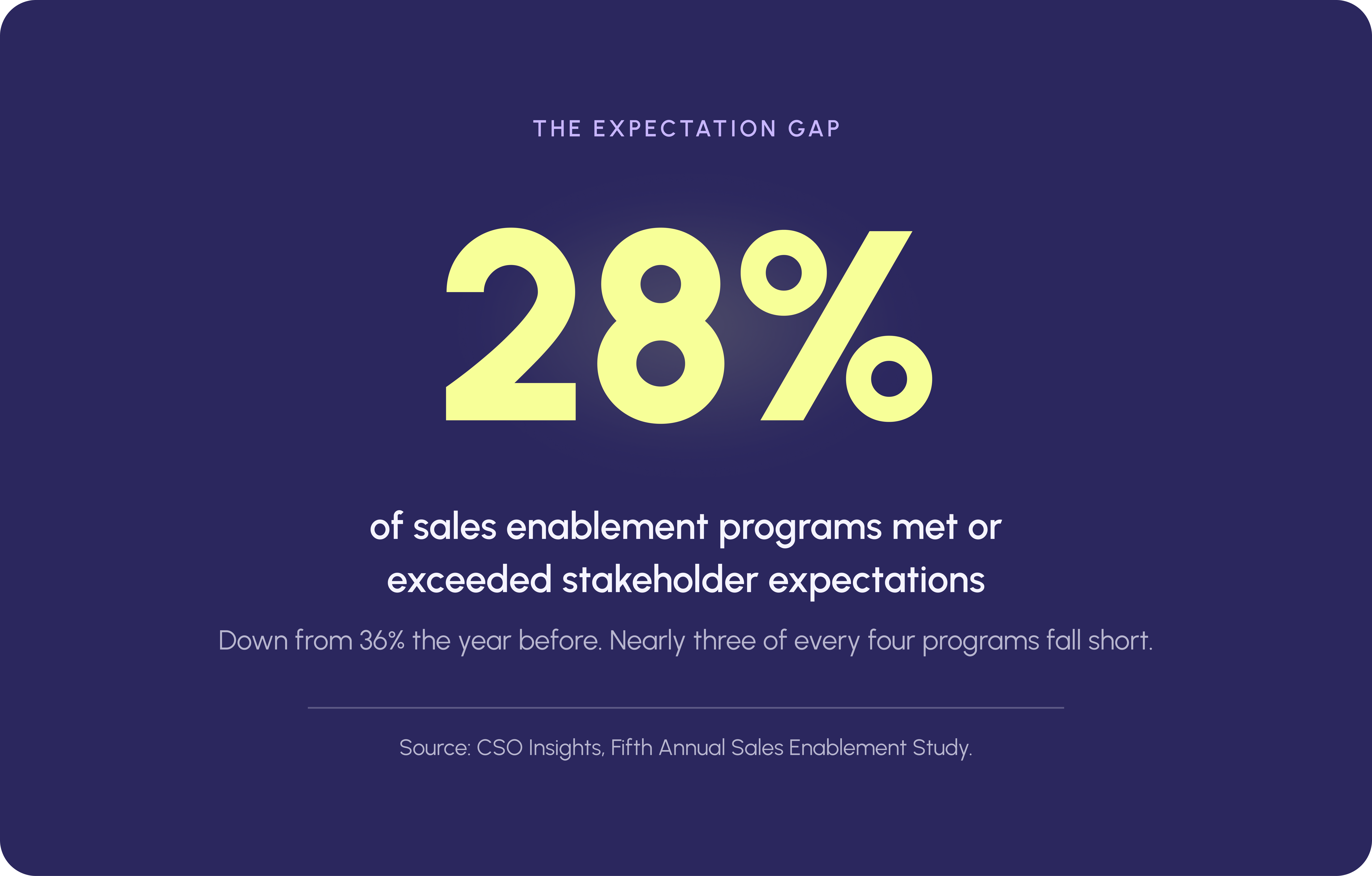
Then comes the uncomfortable number. CSO Insights also found that only 28% of sales enablement programs met or exceeded expectations. Nearly three out of four fall short.
This guide covers what sales enablement actually is, what the evidence says works, and why so many sales enablement initiatives end up as expensive content libraries nobody opens. It draws on analyst research, peer-reviewed studies, and what we see inside B2B companies every week.
What exactly is sales enablement?
Sales enablement is the ongoing process that equips sales teams with the content, training, coaching, and tools they need to sell effectively. It aligns marketing and sales teams around one goal: helping sales reps hold more valuable conversations with buyers and close more deals. A working sales enablement strategy covers strategy, content, training, and measurement, with sales enablement technology supporting the system rather than substituting for it.
How analysts and academics define sales enablement
Ask five people to define sales enablement and you get five overlapping answers. The serious definitions share a common core.
Gartner defines sales enablement as the process of providing the sales organization with the information, content, and tools that help sellers sell more effectively. Forrester's original definition, written by analyst Scott Santucci, goes broader: a strategic, ongoing process that equips all client-facing employees to have consistently valuable conversations with the right customer stakeholders at each stage of the customer's problem-solving life cycle.
The academic literature arrived late but adds a useful frame. A study in the Journal of the Academy of Marketing Science (Peterson, Malshe, Friend, and Dover, 2021) conceptualized sales enablement as a dynamic capability of the firm: a cross-functional ability to keep reconfiguring content, processes, and technology around how customers actually buy. Around the same time, Rangarajan and colleagues in the Journal of Personal Selling & Sales Management proposed a "3 Ps" agenda (people, process, performance) and noted that around 61% of firms employing B2B salespeople already ran sales enablement initiatives before researchers had seriously studied any of them.
Three things stand out across every credible attempt to define sales enablement:
- It is a process, not a project. One-off sales training or a content refresh does not qualify.
- It is cross-functional by nature. Sales enablement exists at the seam between sales and marketing, which is exactly why it breaks when that seam is broken.
- It serves the buyer's journey, not the org chart. The point is to help sellers show up usefully at each stage of a purchase decision.
A short history of the discipline
Sales enablement has a traceable origin story, at least as industry lore tells it: in 1999, John Aiello and Drew Larsen started building a structured approach to fixing inconsistent messaging and poor sales execution, and the phrase spread through software and pharma companies over the following decade, mostly describing shared folders of collateral. Forrester analyst Scott Santucci gave the field its first formal definition around 2010, and SiriusDecisions published the early frameworks that still shape the discipline.
The institutions followed the practice. The Sales Enablement Society formed in 2016, around the time Gartner began treating sales enablement as a distinct technology category. Forrester acquired SiriusDecisions for $245 million in 2019, consolidating the major analyst frameworks. Academic journals only caught up in 2020, which means practitioners ran a decade ahead of the research describing them. Business leaders should read the discipline's youth as context: best practices here are younger, and less settled, than the confidence of the people selling them suggests.
What sales enablement is not
The term absorbs everything near it, so the boundaries matter.
Sales enablement is not sales operations. Sales ops owns the system: CRM administration, territories, quotas, compensation, forecasting. Sales enablement owns seller behavior: whether sales reps have the right resources, skills, and messages to run the sales process well. The two meet in the data, and increasingly both report into revenue operations, but they answer different questions. Ops asks whether the machine runs. Enablement asks whether the people in it can sell. Both serve the same sales strategy.
Sales enablement is not sales training. Training is one component. A sales enablement team that only schedules workshops is running an events calendar, and sales teams treat it accordingly. The discipline includes onboarding, coaching, content management, and measurement, tied together by a strategy.
Sales enablement is not content management. Organizing marketing assets into a searchable library helps, and sales enablement platforms sell exactly that promise, but a tidy repository of unused sales content is still unused. The evidence on this is brutal, and we cover it below.
If your company already has someone doing all three of these jobs at once under a different title, congratulations: you have a sales enablement function. Around 39% of enablement functions now report into revenue operations, with another quarter reporting directly into sales, according to the 2025 Sales Enablement Landscape Report.
Why sales enablement exists: buyers changed first
The discipline did not appear because someone invented a new department. It appeared because B2B buying stopped cooperating with the traditional sales process.
Gartner's research on B2B buying found that buyers spend only about 17% of their total purchase journey meeting with potential suppliers. When they compare several vendors, any single sales rep may get 5% to 6% of the buyer's total time. The rest of the buyer's journey goes to independent research, internal alignment, and meetings you will never attend. The typical buying group now involves 6 to 10 stakeholders; Forrester's 2024 buying study puts the average at 13. And in Gartner's most recent buyer survey (646 buyers, late 2025), 67% of B2B buyers said they prefer a rep-free buying experience altogether.
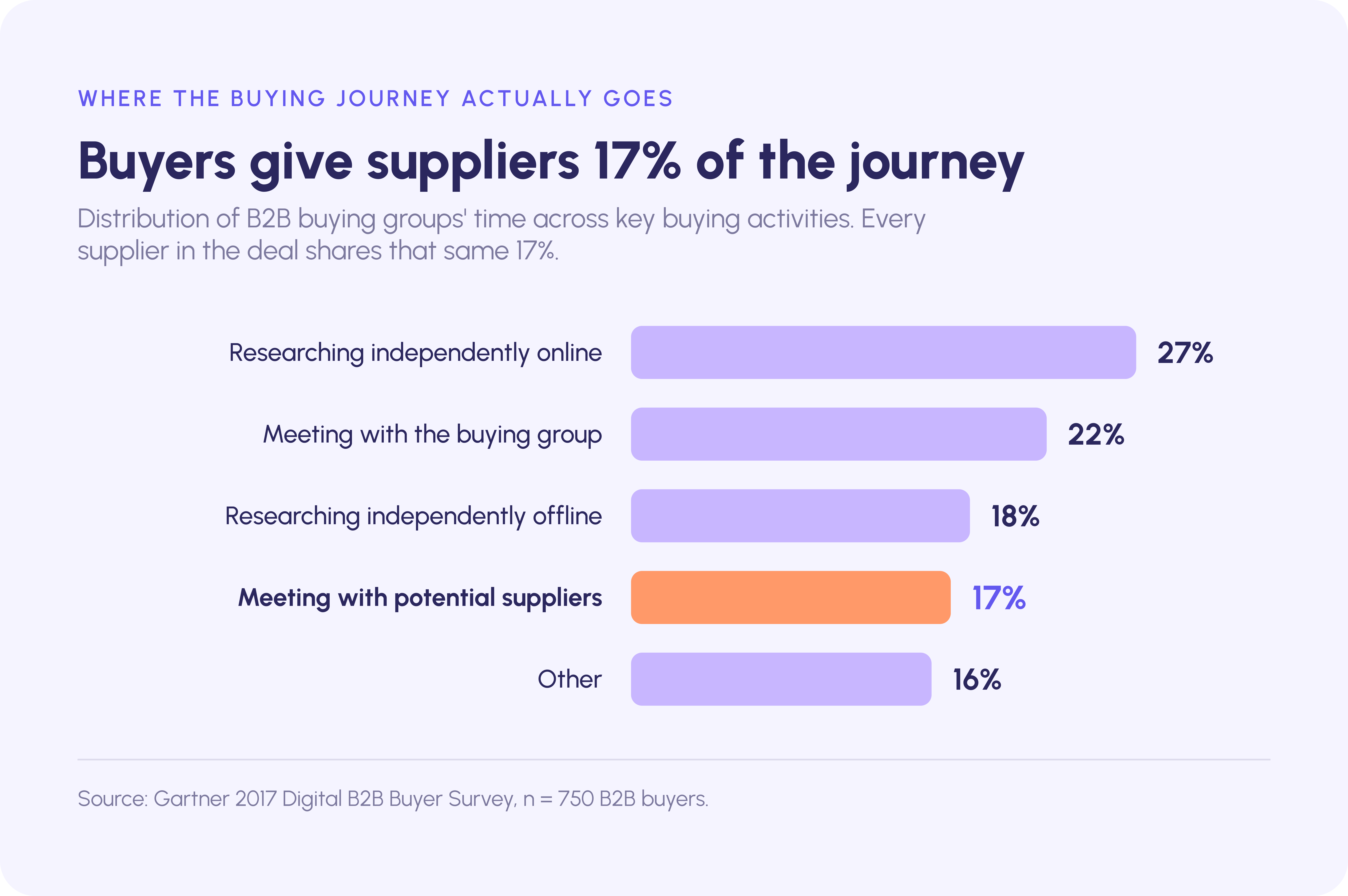
McKinsey's B2B Pulse research adds the channel picture: buyers now use around ten channels across a purchase, roughly double the number from 2016, and expect an even split of in-person, remote, and self-service digital selling.
There is one more layer that most sales enablement content skips: at any given moment, the overwhelming majority of your market is not buying anything. Only a small fraction of target accounts are in-market in a given quarter. That changes what enablement is for. Winning the deals on the table is half the job; the other half is being remembered when a buyer finally enters the market.

Put those numbers together and the case for sales enablement writes itself. Sales reps get a sliver of the buyer's attention, in front of a large committee, most of which they never meet. Whatever happens in that sliver has to count, and everything around it (the content buyers find on their own, the questions sales reps anticipate, the internal champions they equip) has to do the selling when no rep is in the room. Sales enablement is how you make that sliver count, and how sales teams close deals they would otherwise lose. That is what makes sales enablement important now in a way it simply was not twenty years ago.
What are the three pillars of sales enablement?
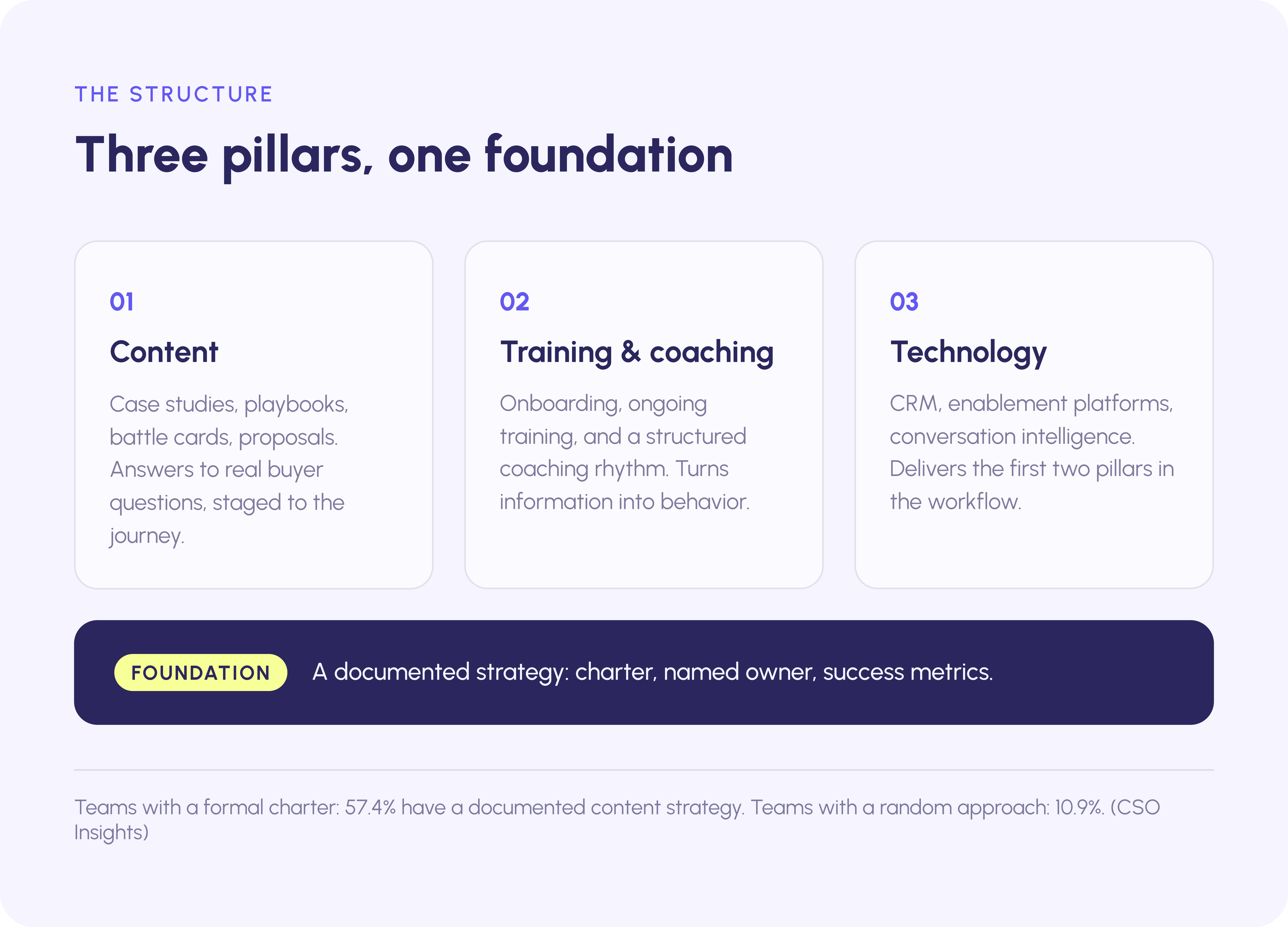
Most practitioner frameworks converge on three pillars of sales enablement, resting on a strategic foundation.
- Content. Case studies, sales playbooks, battle cards, one-pagers, proposal templates, and the marketing assets buyers see. The job of sales content is to answer real buyer questions at the right stage of the sales funnel, so sales reps engage buyers effectively instead of improvising.
- Training and coaching. Sales onboarding for new hires, ongoing training on products and sales techniques, and structured coaching from managers. This pillar turns information into behavior.
- Technology. The sales enablement tools that deliver the first two pillars inside the seller's workflow: CRM software, sales enablement platforms, conversation intelligence, learning systems.
Under all three sits the foundation: a documented sales enablement strategy with clear objectives, owners, and metrics. CSO Insights found that teams with a formal enablement charter were far more likely to have a documented content strategy (57.4% versus 10.9% for teams with a random, ad hoc approach). The pillars only stand on something deliberate, and effective sales enablement ensures all three pull in the same direction across the customer journey.
Building a sales enablement strategy
A strong sales enablement strategy answers five questions before it produces a single asset. We list them in order because teams that skip the early ones pay for it later.
- Who does enablement serve, and against which goal? Pick the revenue outcome first, and anchor it in your go-to-market strategy: win rate, deal size, ramp time, sales cycle length. An effective sales enablement strategy is scoped to a business problem, not to "support sellers" in the abstract.
- What does the buyer's journey actually look like? Map how your customers research, evaluate, and decide, then map your sales process and sales strategy against the customer journey you find. Every stage should name the buyer's question and the resource that answers it.
- Who owns what? Sales enablement sits between marketing and sales teams, which means without explicit ownership it belongs to no one. Assign a named owner, whether that is a sales enablement manager, a marketing lead, or a founder in an early-stage sales organization.
- What is the charter? Write down scope, services, and success metrics, and get sales leadership and marketing to sign the same page. The charter is what separates a function from a favor.
- How will you know it works? Define the leading and lagging indicators up front. We cover measurement in its own section below.
One practice we run with clients belongs in any sales enablement strategy: a weekly review where marketing and sales sit together and go through every new customer and every lost opportunity. Most companies treat customer feedback as anecdotal sales input. Reviewed systematically, it becomes market intelligence: the real ICP, the objections that keep recurring, the messaging that closed the deal, the disqualification criteria nobody wrote down. It costs an hour a week and gives sales enablement teams more usable material than most content calendars produce in a quarter.
The same logic applies when sales and marketing teams are at odds. Fixing the whole relationship at once rarely works. What works is finding one willing sales rep, narrowing to one or two segments, building the account list together, and sharing customer data and engagement signals while they run outreach. Prove the motion with one rep, then extend it. Cross-functional collaboration spreads through results, not mandates.
Alignment is the substrate all of this runs on. Where marketing is measured on lead volume and sales is measured on revenue, sales and marketing teams optimize against each other, and enablement inherits the fight. Joint accountability for pipeline changes that dynamic, which is why we treat sales and marketing alignment as the precondition for any sales enablement strategy working at all.
Sales content: the most expensive shelf in B2B
Content is where sales enablement budgets go to die. SiriusDecisions put the canonical number on it back in 2013: 60% to 70% of content produced by B2B marketing teams goes unused, sitting on portals and shared drives. Some organizations reported more than 80%. A decade of sales enablement platforms later, nobody serious claims the problem is solved.
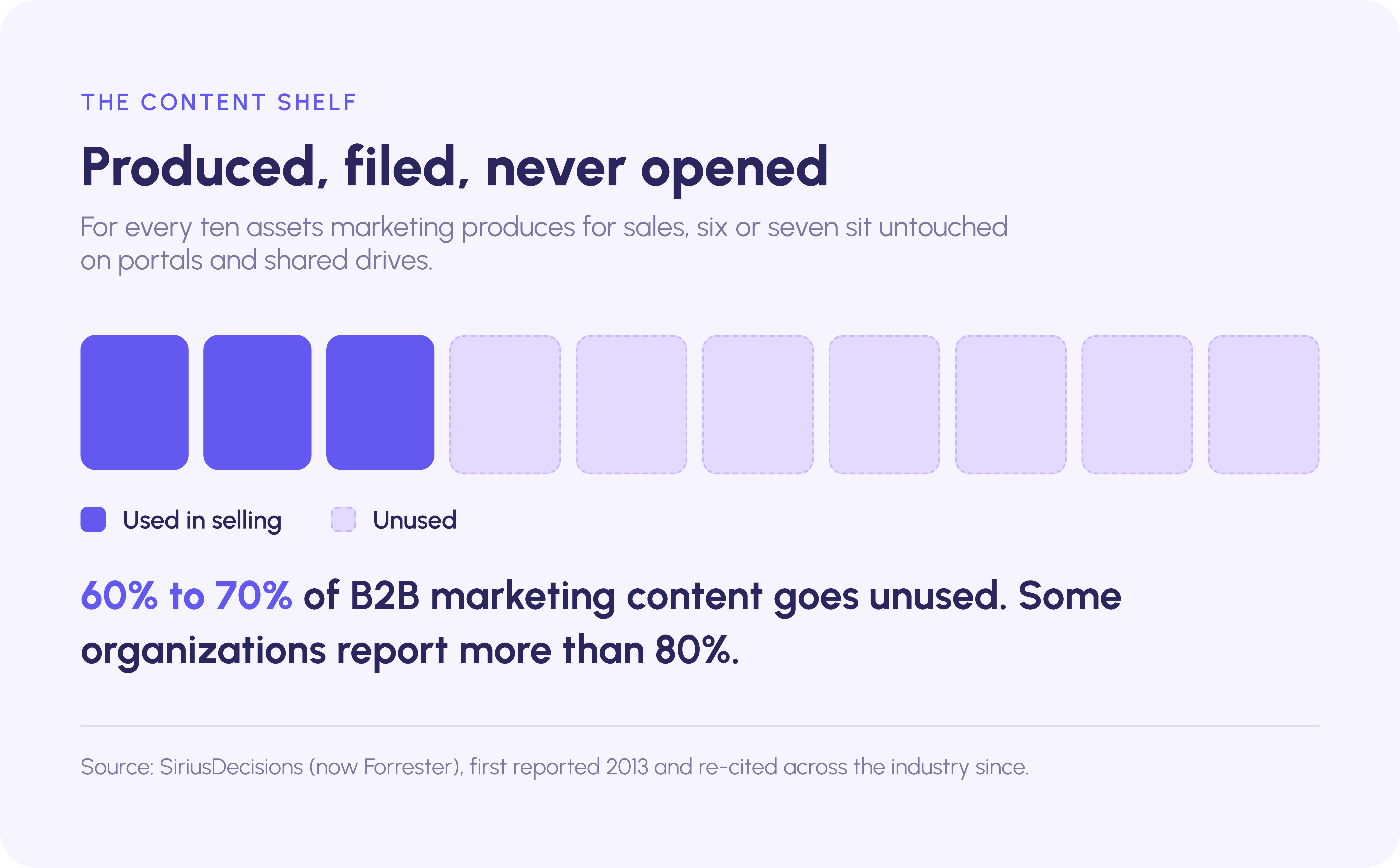
The waste has two causes. First, content gets produced from the inside out: what the company wants to say rather than what buyers ask at each stage of the customer lifecycle. Second, marketing efforts and sales efforts run on separate calendars, so relevant content exists but reaches sellers late, at the wrong stage of the sales funnel, or not at all.
The fix starts with subtraction. Audit the marketing assets you already have, measure usage, buyer engagement, and what actually moves deals, and retire the rest. Then rebuild around the questions buyers ask at each stage of the customer journey, in the words they use, with proof attached. In our client work, two content types earn their keep more reliably than the rest:
- Vertical proof. Generic case studies carry less weight every year. What convinces a buying committee is industry-specific evidence: naming what will and will not work in their vertical before they have said anything. Customer testimonials and case studies drawn from your existing customer base do more than any capability deck.
- Answers to the unspoken question. Buyers evaluating a vendor privately ask: what happens tomorrow if I say yes? Content that shows the first ninety days concretely (team, plan, pricing, cancellation terms) converts anxiety into confidence, and confident buyers close deals faster than persuaded ones.
There is a strategic layer above the individual asset. Content is also how you educate a market before it buys: the slow half of demand generation, and how incumbents build a competitive advantage that outlasts any single deal.

Measured against that standard, most sales content is aimed too late in the buyer's journey: at the roughly 5% of buyers in-market at any given time rather than the 95% who are not, a split the Ehrenberg-Bass Institute popularized as the 95-5 rule. The larger group remembers whoever taught them something useful.
Training and coaching: from events to habits
The second pillar suffers from a delivery problem. Traditional sales training runs as events: a kickoff, a two-day workshop, a certification push. Research on knowledge retention has been unkind to that model for a century, and seller behavior confirms it. What sticks is short, specific, and close to the moment of use: just-in-time learning tied to the deal in front of the rep.
Coaching is the highest-leverage activity in this pillar and the most neglected. In Salesforce's State of Sales research, only 26% of sales professionals said they receive one-on-one coaching at least weekly. CSO Insights found that organizations reaching a "dynamic" coaching stage, where sales managers coach in a structured way aligned with enablement services, posted win rates around 28% higher than the study average, one of the largest sales performance gaps in the study.
Three habits separate sales teams that train from sales teams that improve:
- Coach to the process, not the number. Reviewing pipeline is inspection. Coaching means working on one skill per sales rep per period, observed in real calls.
- Use real customer interactions as the curriculum. Call recordings, win-loss interviews, and the weekly customer review give you training material no vendor can sell you.
- Reinforce in the workflow. A playbook nobody opens mid-deal is shelf decoration. The best sales enablement teams push relevant content into the CRM record where the sales rep already works, which is how sales reps close deals without leaving their workflow.
Onboarding and the 30-60-90 rule
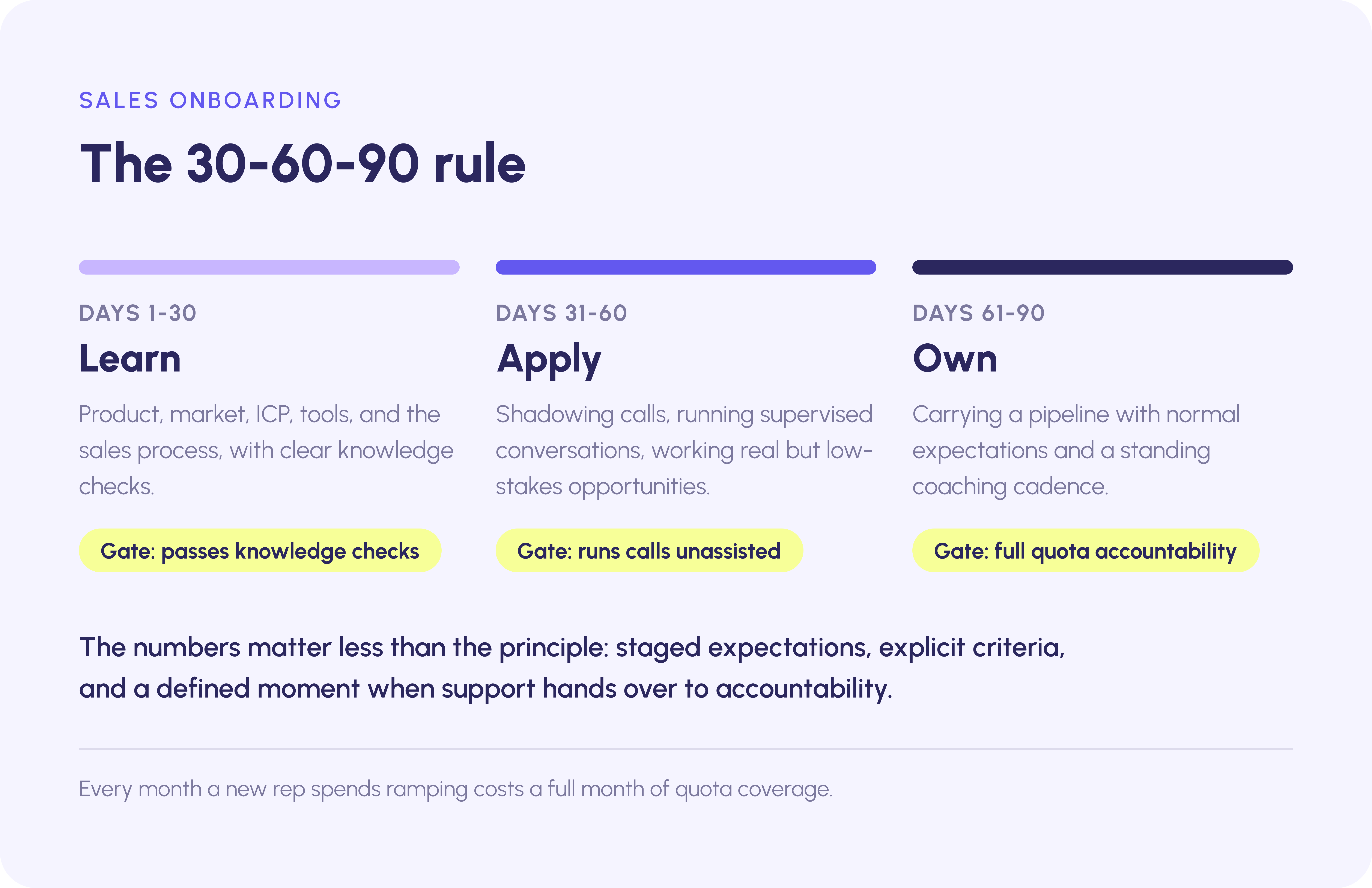
Onboarding is enablement's most measurable win. Every month new sales reps spend ramping costs a full month of quota coverage, so reducing ramp time shows up in revenue faster than almost any other sales enablement initiative.
The 30-60-90 rule is the standard structure for sales onboarding. In the first 30 days, the sales rep learns: product, market, ICP, tools, and the sales process, with clear knowledge checks. By day 60, the rep applies: shadowing calls, running supervised conversations, working real but low-stakes opportunities. By day 90, the rep owns: carrying a pipeline with normal expectations and a coaching cadence. The numbers are less important than the principle: staged expectations, explicit criteria, and a defined moment when support hands over to accountability.
Two details make the difference in practice. Treat onboarding like a product launch, with the same planning you would give a release, because a new seller is your message entering the market. And keep the material alive: onboarding content that no one updates trains new reps on last year's company.
Measuring sales enablement: leading indicators, lagging proof
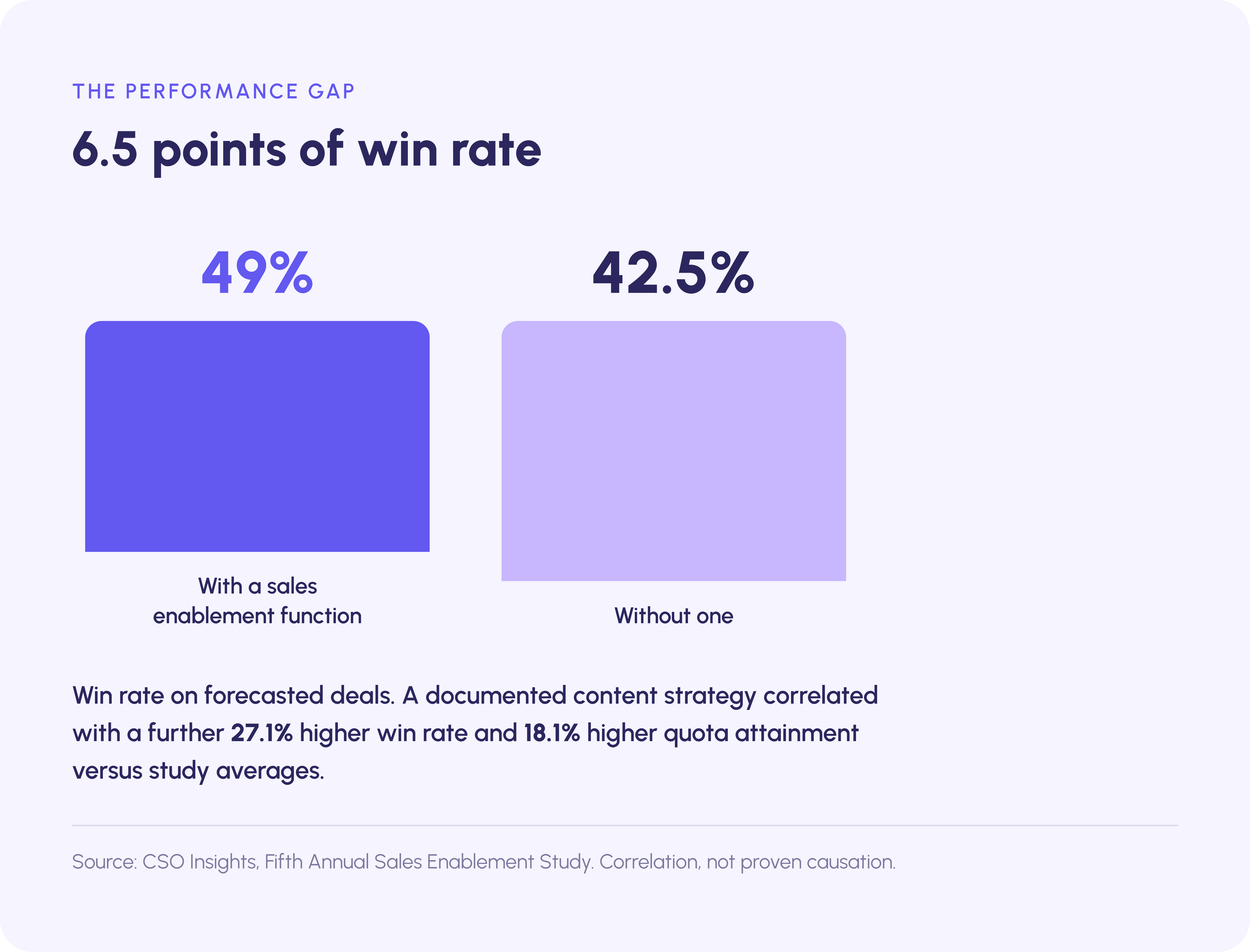
Measurement is where sales enablement programs earn or lose their budget, and where most of them get vague. The discipline's own research shows why clarity pays. CSO Insights found organizations with a sales enablement function reported a 49% win rate on forecasted deals, against 42.5% for those without one. Teams with a documented content strategy posted win rates 27.1% higher and quota attainment 18.1% higher than average.
Treat those numbers as correlation, not proven causation, and note that the research arm publishing them sat inside a sales training company. The pattern still repeats across too many studies to dismiss.
A workable measurement model has two layers:
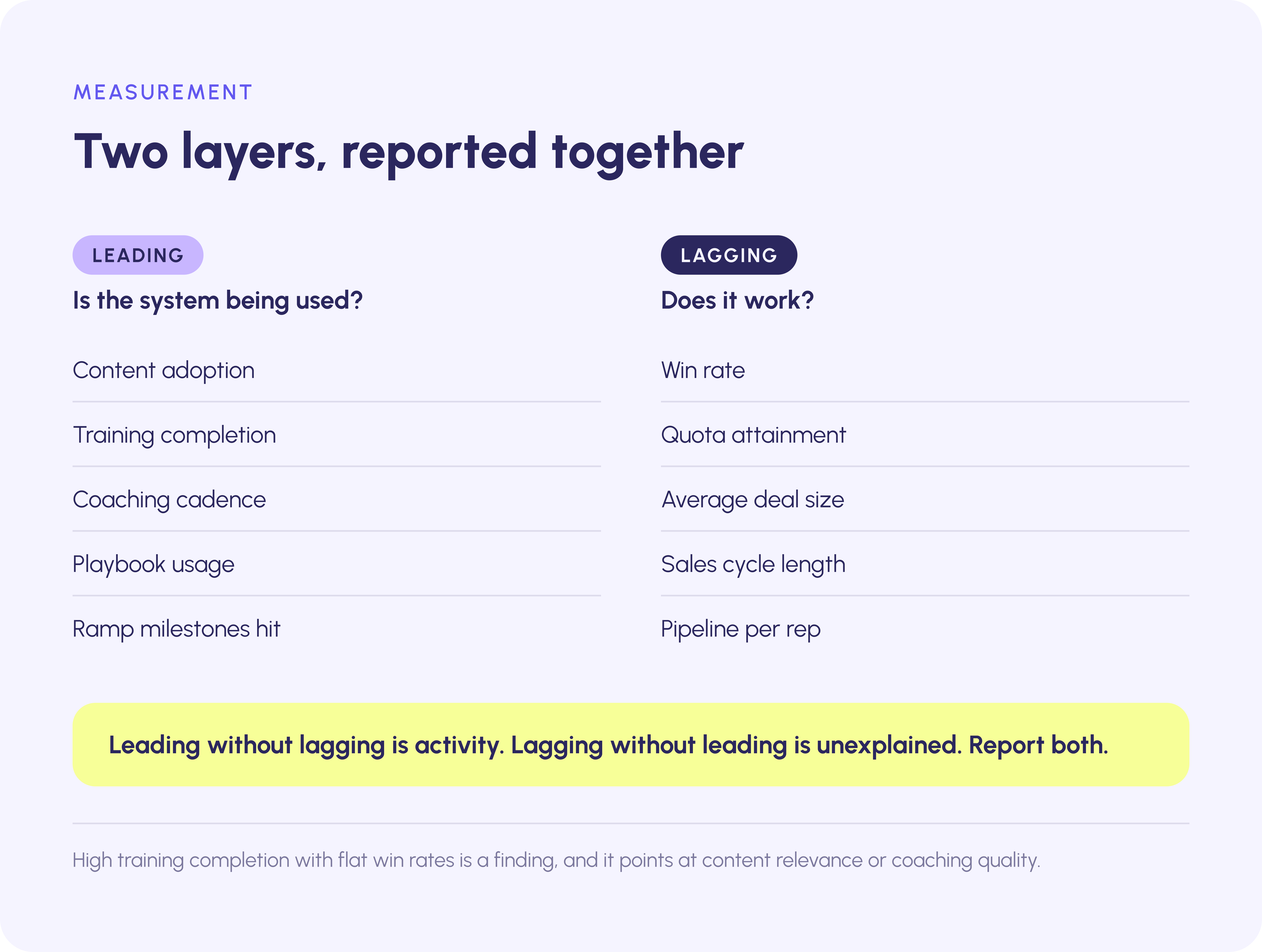
- Leading indicators tell you the system is being used: content adoption, training completion, coaching cadence, playbook usage, time-to-first-deal for new hires.
- Lagging indicators tell you it works: win rate, quota attainment, average deal size, sales cycle length, and pipeline created per sales rep at each stage of the sales funnel.
The trap sits between the layers. Enablement teams that report only leading indicators end up describing activity, and activity is what stakeholders stop funding. High training completion with flat win rates is a finding, and it usually points at content relevance or coaching quality rather than effort: sales reps complete the course and still cannot close deals any faster. Report both layers together, tie sales enablement success to the revenue metrics the business already tracks, and resist inventing new vanity numbers. If the reporting conversation keeps collapsing into arguments about credit, that is an attribution problem, and it deserves the same honest treatment we give it in our piece on B2B marketing attribution.
One number worth stealing from this research even if you steal nothing else: sales reps spend less than 30% of their time actually selling, according to Salesforce's State of Sales. Administrative tasks, internal meetings, and hunting for information eat the rest. Any sales enablement program that gives sellers hours back (through better content findability, automation of repetitive tasks, cleaner customer data in the CRM software) improves sales productivity before it improves anything else. Give sales teams more hours in front of buyers and better odds to close deals in the hours they get. Enablement multiplies selling time; it cannot conjure it.
Sales enablement tools: buy last, not first
The sales enablement software market is the loudest voice in this category, which is why most articles on this topic read like product tours. The platforms are real and some are good. Sales enablement platforms such as Highspot, Seismic, Showpad, Mindtickle, and Allego bundle content management systems, learning delivery, and analytics in one place, and the sales enablement software category keeps absorbing adjacent tools. Conversation intelligence tools like Gong record and analyze sales calls. Underneath everything sits CRM software as the system of record.
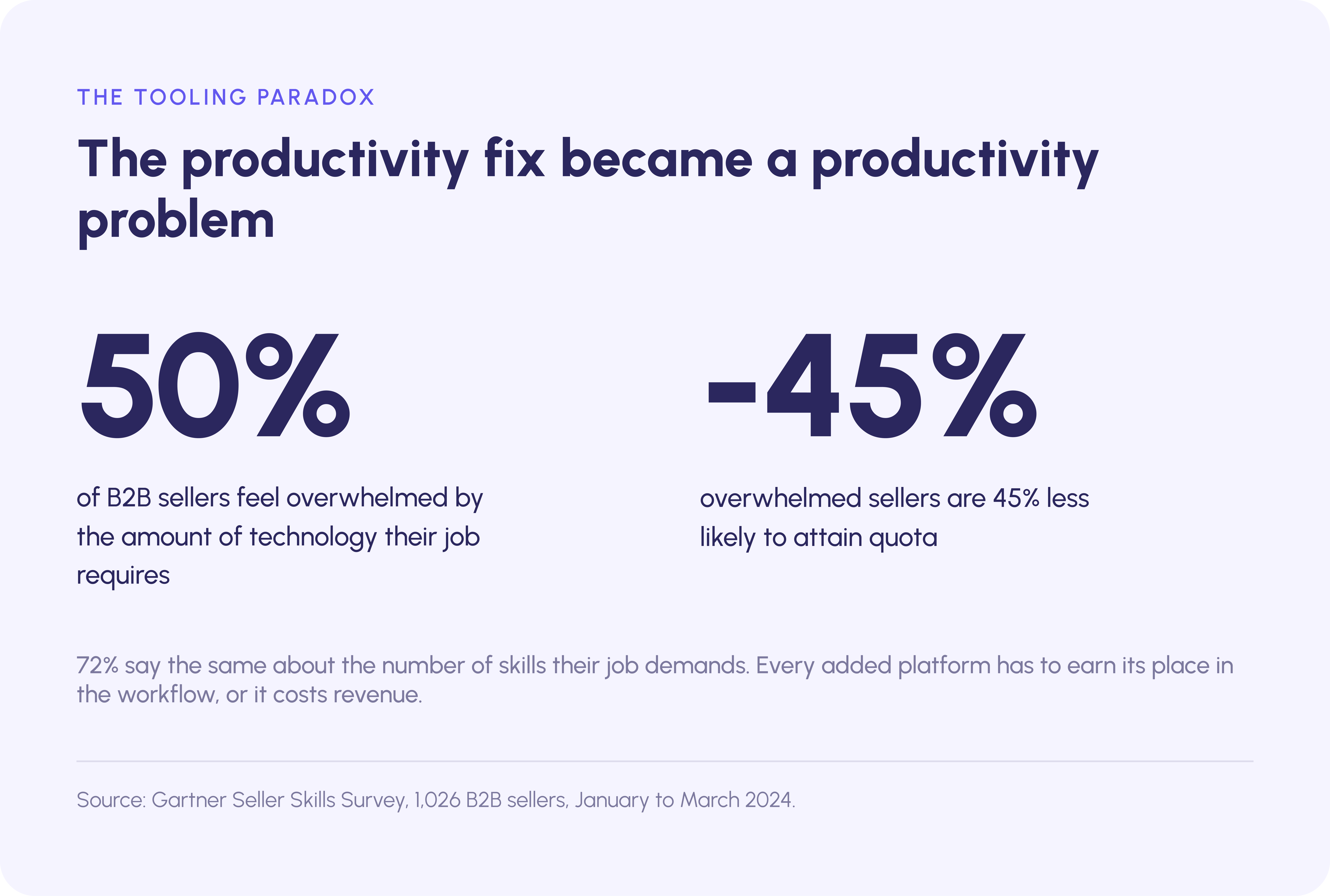
The evidence, however, argues for restraint. Gartner's 2024 survey of 1,026 B2B sellers found 72% overwhelmed by the number of skills their job now demands and half overwhelmed by the amount of technology, and overwhelmed sellers were 45% less likely to attain quota. Salesforce's research puts the average rep on eight tools per deal. The industry's answer to a productivity problem has itself become a productivity problem.
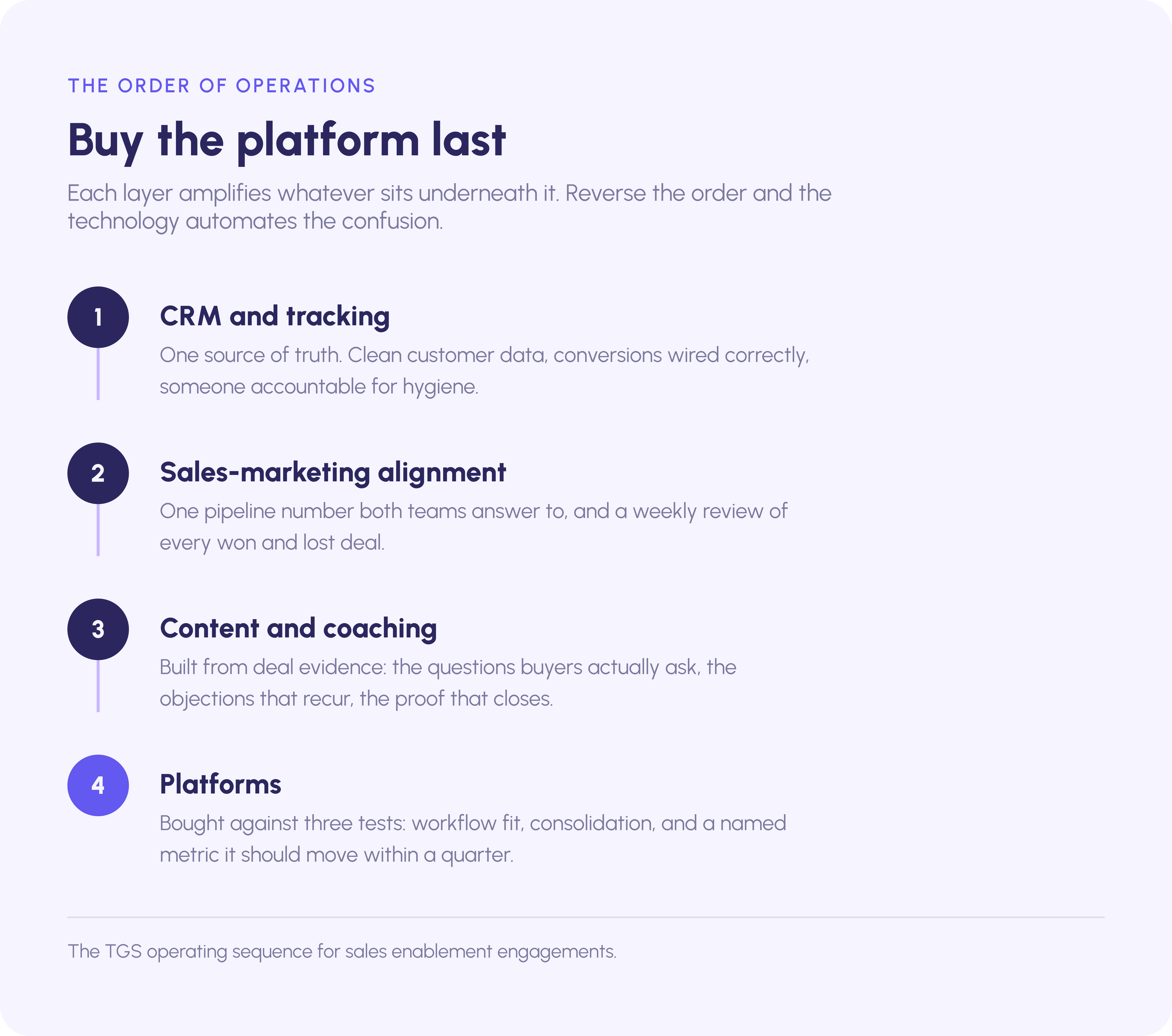
Our position, formed across our client engagements: the order of operations matters more than the vendor shortlist.
.avif)
In practice, more than nine in ten companies we audit have tracking or CRM hygiene problems that silently corrupt the customer data every dashboard runs on. Fix that first; sales enablement software amplifies whatever operation it lands on. Then choose the right sales enablement tools against three tests, in order:
- Workflow fit. Does it surface the right resources where sales reps already work, or does it add another tab? The right sales enablement tools streamline processes sellers already run; the wrong ones add new habits to police.
- Consolidation. Does it replace two existing sales enablement tools, or become the eighth? Given the tool-overload data, subtraction is a feature.
- Measurable behavior change. Can you name the leading indicator this purchase should move within a quarter? If not, you are buying shelfware with a dashboard.
A successful implementation follows that order, and sales enablement technology bought this way compounds the strategy. Bought first, sales enablement platforms automate the confusion you already had. This is also why we treat revenue operations and enablement as one conversation: the same CRM, the same pipeline definitions, the same source of truth, whether the work is done in-house or through our RevOps & CRM practice.
How mature is your program? The four stages
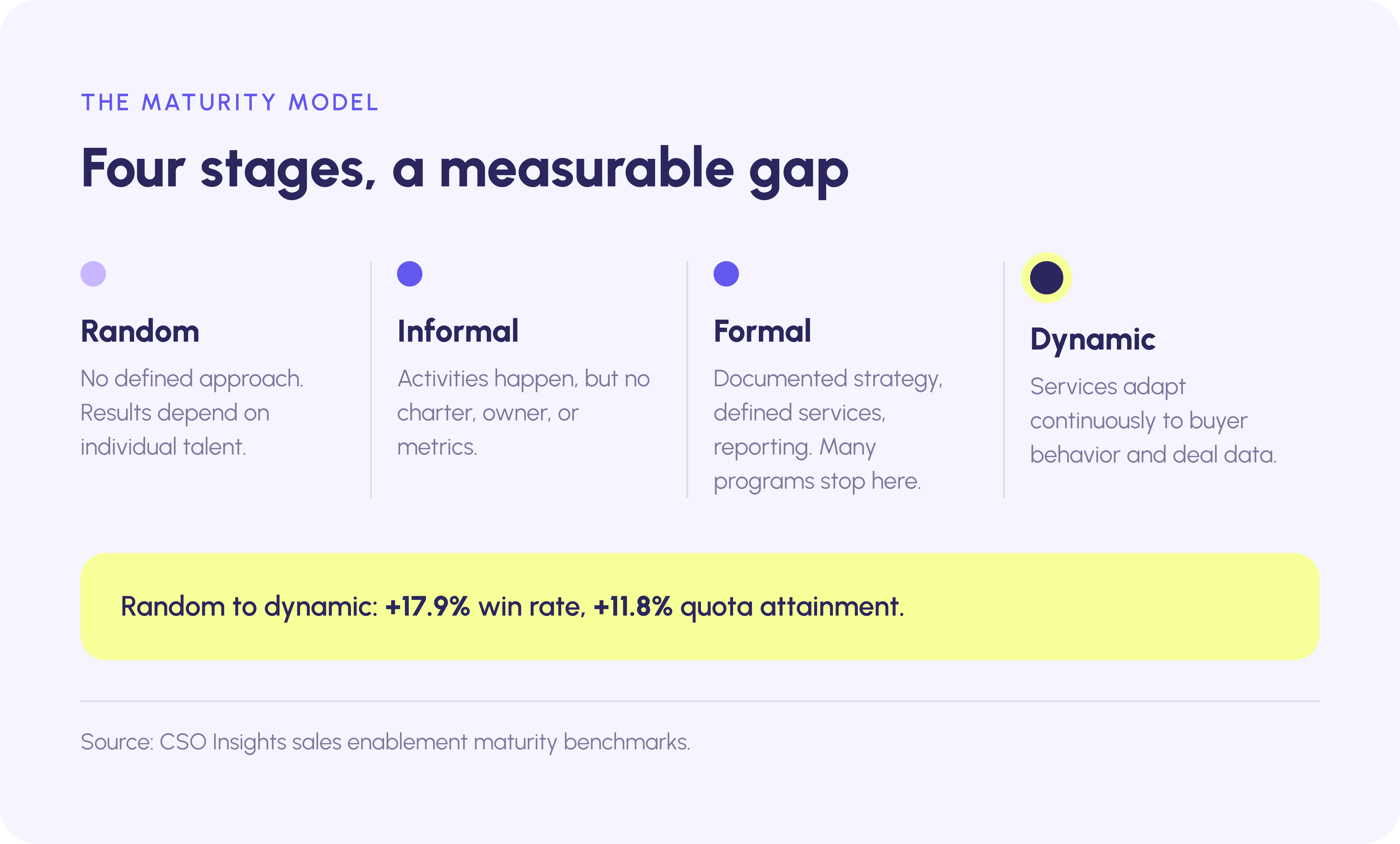
CSO Insights' maturity model remains the most useful self-diagnostic in the field, and it takes one paragraph to apply. Programs move through four stages:
- Random. No defined approach. Reps improvise, marketing produces what it produces, and results depend on individual talent.
- Informal. Enablement activities happen (some training, some content coordination) but without a charter, owner, or metrics.
- Formal. A documented sales enablement strategy exists, with defined services, an owner, and reporting. Programs that get this far often stop here.
- Dynamic. Enablement services adapt continuously to buyer behavior and seller data. Coaching, content, and training adjust based on what deals show, not on an annual plan.
The distance between the stages is measurable. Moving from a random approach to dynamic alignment correlated with 17.9% higher win rates and 11.8% higher quota attainment in CSO Insights' benchmarks. The honest question for most teams reading this is whether they have genuinely left stage two, because a strategy document nobody operates from is stage two with better formatting.
Why sales enablement programs fail
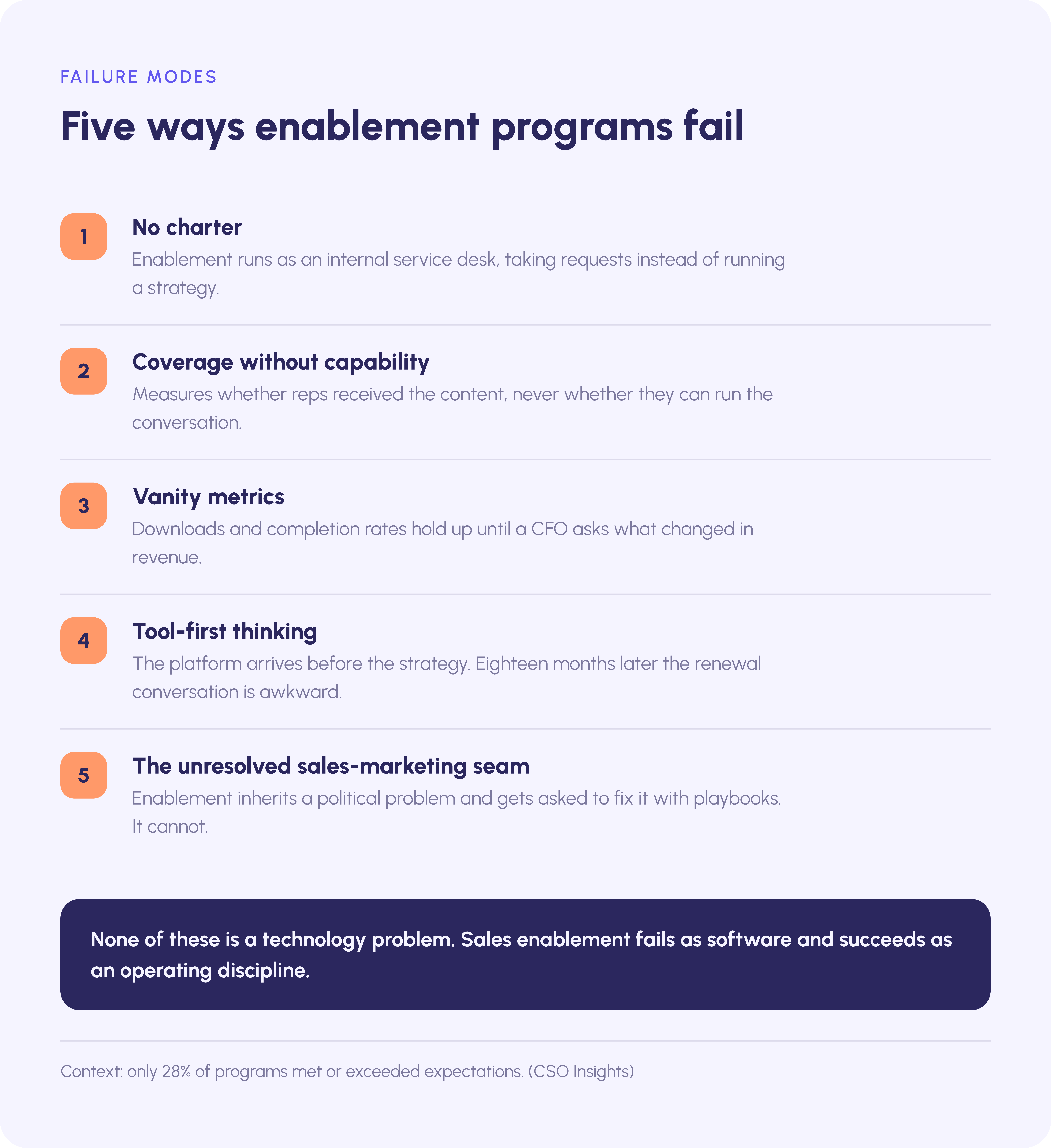
Back to the number this article opened with: 28% of programs meeting expectations means the median sales enablement function disappoints the people funding it. The failure modes are consistent enough to list. We see five, and most struggling sales enablement teams run several at once:
- No charter. Enablement operates as an internal service desk, taking requests instead of running a strategy. CSO Insights' data on formal charters (57.4% versus 10.9% with a documented content strategy) is really data about this.
- Coverage without capability. The program measures whether sales reps received the content and completed the course, never whether they can run the sales process in a live conversation. Delivery is easy to count; competence is what wins deals.
- Vanity metrics. Downloads, views, and completion rates keep the lights on until a CFO asks what changed in revenue. Programs measured on activity get cut in the first hard quarter.
- Tool-first thinking. The sales enablement platforms arrive before the strategy, the content gets migrated as-is, and adoption is declared the goal. Eighteen months later the renewal conversation is awkward.
- The unresolved sales-marketing seam. Where marketing teams throw leads over a wall and sales complains about lead quality, sales and marketing teams stop trusting each other, and enablement inherits a political problem it gets asked to fix with sales playbooks. It cannot. The MQL handoff itself is often the defect: how leads get qualified is frequently just a form-fill threshold, and the fight over definitions burns the trust enablement needs. Shared pipeline accountability upstream fixes more than any asset downstream.
None of these is a technology problem, which is the point. Sales enablement fails as software and succeeds as an operating discipline.
From sales enablement to revenue enablement, and where AI fits
Two shifts define where the discipline is heading.
The first is scope. Gartner and Forrester both now push "revenue enablement": extending enablement beyond the sales team to every revenue-facing role, including customer success, presales, partners, and marketing teams. The professional association followed, with the Sales Enablement Society renaming itself the Revenue Enablement Society in 2023.
The logic is sound. Buyers experience one company across the whole customer lifecycle, and customer engagement does not end at the signature, so it is odd to script the first conversation carefully and leave renewal and expansion to improvisation. The caution is equally sound: companies that never built effective sales enablement do not fix that by widening the mandate. An enablement strategy that never worked for one sales team will not work for five more, and broader scope on a weak foundation just spreads the weakness.
The second is AI, and here the vendor enthusiasm needs a discount rate, because sales enablement software vendors lead the charge. Highspot's 2025 State of Sales Enablement survey (a vendor study, read accordingly) found 90% of organizations had implemented AI or planned to within the year. The genuinely useful applications are already visible: conversation intelligence that turns every call into coaching material, role-play practice that gives sales reps repetitions no manager has time for, drafting support for personalized outreach, and search that actually finds the right asset. Used this way, AI gives sellers time back and gives managers actionable insights they never had.
The failure mode is equally visible, and it is the same one as always: automation layered on top of broken operations amplifies the mess. AI trained on a dirty CRM confidently scales the dirt. Buyers are adopting AI on their side of the table too (the same Gartner survey found 45% of B2B buyers used AI during a recent purchase), which raises the bar for what a human conversation must add. Market trends will keep shifting the tooling; the underlying test stays fixed: does this help a seller add value in the few moments of the customer journey buyers still share?
Sales enablement FAQ
Does sales enablement pay well?
Yes, by the standards of go-to-market roles. In the US, sales enablement manager positions are typically advertised in the low six figures, with director and head-of-enablement roles above that. A 2024 study in the Journal of Selling analyzed 131 director-level enablement job postings, and the breadth of responsibilities and qualifications employers list explains the premium: the role spans several jobs, from sales experience to training design, content, and analytics.
Who should own sales enablement?
Whoever is accountable for the seam between sales and marketing. In practice, ownership lands in revenue operations (about 39% of functions), directly in sales (about 25%), or in marketing. The reporting line matters less than the mandate: a named owner, a written charter, a seat in sales strategy conversations, and shared revenue accountability with both teams. Ownership by committee is the same as no ownership.
Does a small company need a sales enablement team?
Small companies need the function, not the headcount. A five-person sales team does not need a sales enablement manager; it needs someone who owns the charter part-time, a maintained set of relevant content, a real sales onboarding plan, and a weekly customer review. Small sales teams get more deals out of one living playbook than out of sales enablement platforms nobody administers. Most companies with more than 500 sellers run dedicated teams (77% in CSO Insights' data), but the discipline scales down further than the org chart does.
How long until sales enablement shows results?
Leading indicators move within a quarter: content adoption, coaching cadence, ramp milestones. Lagging indicators follow the length of your sales cycle, because a better-run deal still takes a deal's length to close. Expect one to two full sales cycles before sales teams demonstrably win more deals, and be suspicious of anything that claims faster.
What does a sales enablement manager do?
A sales enablement manager builds and runs the system this article describes: keeping sales reps stocked with the right resources, maintaining the content library, running onboarding and ongoing training, setting the coaching rhythm with sales managers, administering the sales enablement platforms, and reporting the metrics. The best ones spend their time in win-loss calls and customer interviews, because the buyer's journey is where enablement material comes from. Industry insights age; your own deal evidence does not.