.svg)


Customer journey is the term for the complete sequence of interactions a person or an account has with your company: every ad seen, article read, demo attended, invoice paid, and renewal signed. The journey starts before your CRM knows the buyer exists and continues long after the deal closes.
The concept sounds simple. In practice, most companies describe a customer journey their customers never take.
This guide covers the definition, the five stages, the frameworks built on top of them, how the B2B customer journey actually behaves, and how to approach customer journey mapping so it changes decisions instead of decorating a conference room wall.

Customer journey, customer experience, and buyer's journey
Three terms get used interchangeably. They shouldn't be.
The customer journey is what customers do. It's the observable path a customer takes across customer touchpoints: website visits, emails opened, calls booked, tickets raised. You can see it in customer data.
The customer experience is how customers feel while doing it. Journeys are sequences of events. Customer experience is perception, and it shows up in customer feedback, online reviews, and survey scores. A fast journey can still produce a poor customer experience, and a slow one can delight.
The buyer's journey ends at the purchase stage. The customer journey contains the buyer's journey and then keeps going: onboarding, adoption, renewal, expansion, advocacy. In subscription businesses this distinction is commercial rather than academic. Most of the revenue arrives across the rest of the customer lifecycle, after the buyer's journey is over, which is why customer success owns as much of the journey as marketing does. Customer journey mapping, covered below, has to span both, so a good journey map doesn't stop at the signature.

The five stages of a customer journey
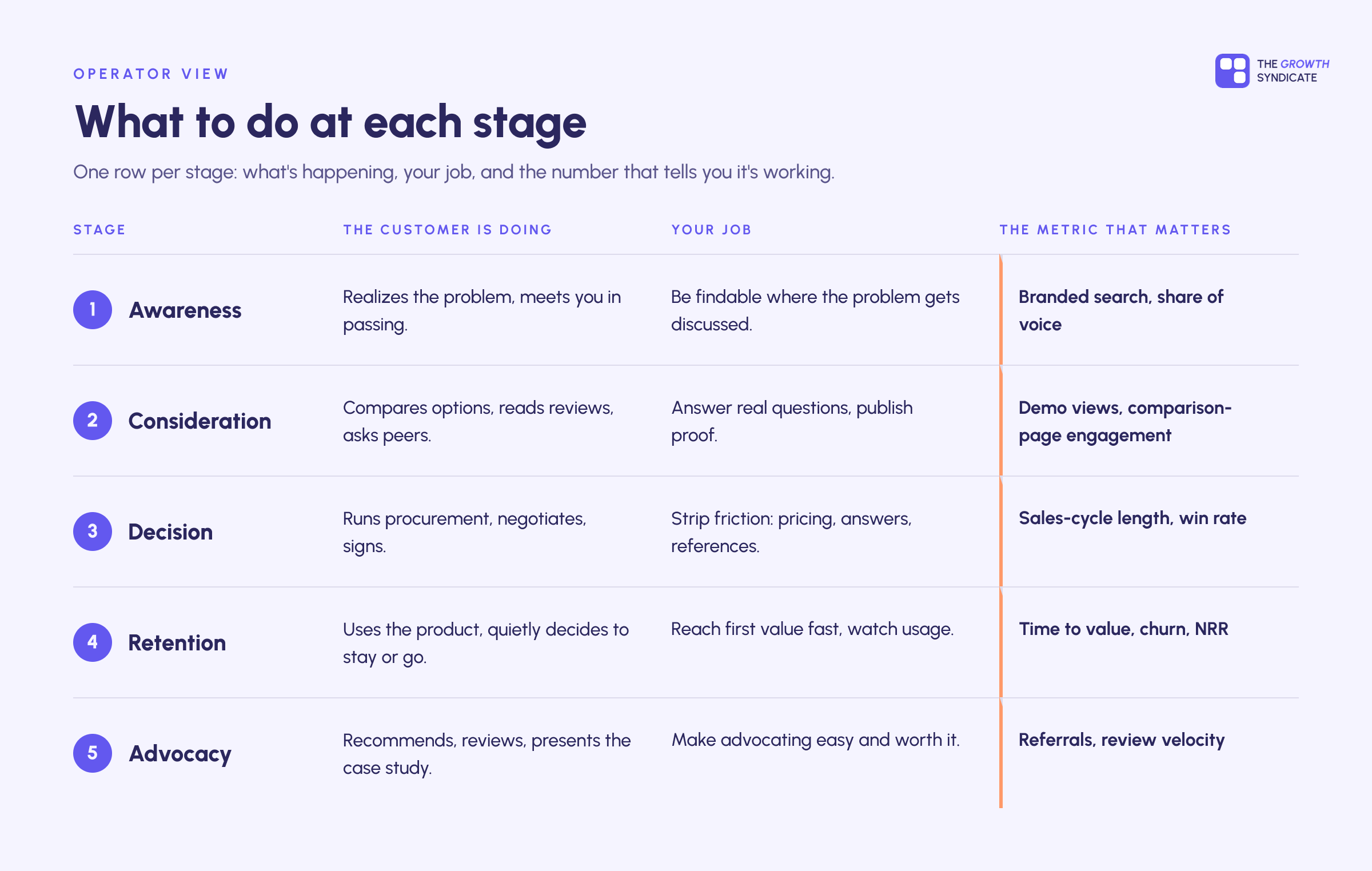
Most models describe five stages, and most customer journey mapping work organizes itself around some version of them. Treat the stages as shared vocabulary for internal teams, a way for marketing teams, sales, and support teams to talk about the same customer and the same customer experience, rather than a script the customer follows. Real buyers skip, stall, and loop.

1. Awareness
The customer realizes they have a problem, and somewhere in that window they encounter your brand for the first time: a search result, a colleague's recommendation, a post, an ad. Initial awareness is rarely trackable and rarely polite enough to happen on your company website. The work here is being findable and memorable where problems get discussed.
2. Consideration
The customer starts comparing ways to solve the problem. This is the heart of the research process: reading comparison pages, watching demos, scanning review sites, asking peers. Customer expectations form here, often before you know the account exists. Content that answers real questions and speaks to real pain points beats content that congratulates itself.
3. Decision
The shortlist shrinks to one. Pricing calls, procurement, security review, negotiation. The job at the purchase stage is stripping friction out of the purchasing process: clear pricing, fast answers, references on request. Every extra form field and every "let me check with the team" email adds days to the buying process.
4. Retention
The customer starts using the product or service, and the journey quietly resets. The onboarding process determines whether the value promised in stage two ever materializes. Customer success and support teams own this stretch and the post-sale customer experience with it: adoption, escalations, customer service inquiries, renewal conversations. The teams that retain customers do it here. Customer churn is usually decided months before the cancellation email.
5. Advocacy
Satisfied customers become a channel. Reviews, referrals, case studies, conference mentions. An existing customer who advocates for you shortens someone else's consideration stage, which is why advocacy compounds and why brand loyalty is a growth input rather than a vanity outcome.
Two more ways to slice it: the 5 A's and the 5 E's
Different teams cut the same customer journey with different frameworks. Two come up constantly, and both feed directly into customer journey mapping templates, so here they are.
Kotler's 5 A's
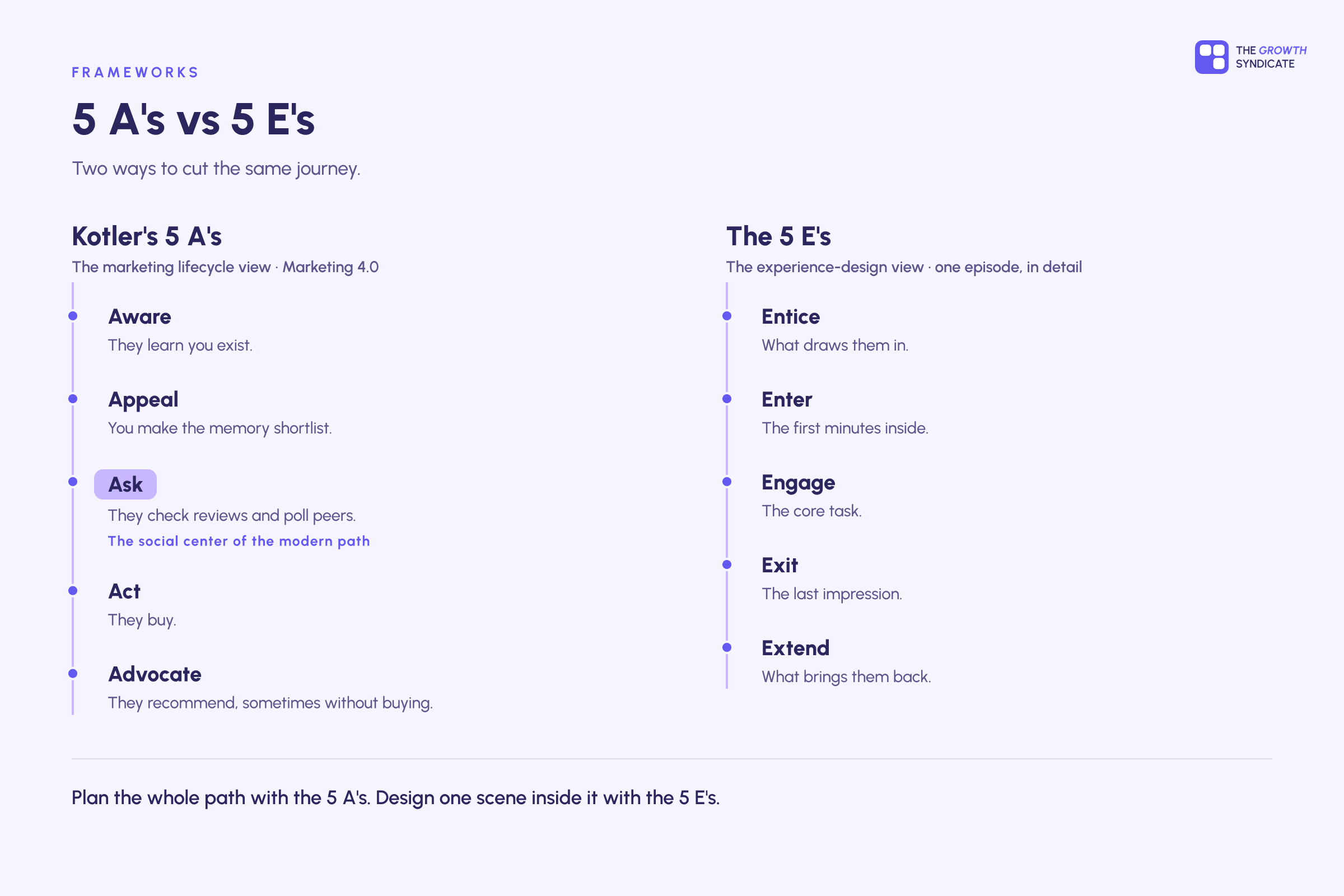
Philip Kotler's model from Marketing 4.0 maps the path as aware, appeal, ask, act, and advocate. Its useful contribution is honesty about non-linearity: customers skip stages, and some people advocate for brands they never bought. Kotler built the model for a connected market where customers interact with each other as much as with the brand, so "ask" (checking reviews, polling peers) sits at the center of the path.
The 5 E's
The experience-design version: entice, enter, engage, exit, extend. It comes out of the UX and service design world, and it works best for mapping a single episode with a product or service rather than a whole lifecycle: one store visit, one onboarding flow, one event. If the 5 A's describe the marketing view of the journey, the 5 E's describe the user experience view of one scene inside it.
Pick one model and make it shared language before any customer journey mapping starts. The framework matters far less than the evidence you attach to it.
The B2B customer journey plays by different rules
The five-stage arc describes a person buying shoes. The B2B customer journey describes a committee buying infrastructure. Same vocabulary, different physics, and the difference is what makes B2B customer journey mapping worth doing carefully.
A buying group makes the decision
There is no single B2B customer. Gartner puts the typical buying group at six to ten people, multiple stakeholders with different priorities and veto powers, and LinkedIn benchmark data analyzed by Dreamdata shows the average deal is influenced by 76 touchpoints across 3.7 channels, usually over a year or more.
Worse, the person who signs is often not the person who uses the product. Clem calls this the buyer-user disconnect:

One journey map of one persona cannot describe this. You either build several customer journey maps, one per buying role, or one journey map with swimlanes for the economic buyer, the daily user, and the internal champion who has to sell the decision upward. B2B customer journey mapping starts with the committee roster.

The journey loops instead of flowing
Gartner's research replaced the linear funnel with six buying jobs: problem identification, solution exploration, requirements building, supplier selection, validation, and consensus creation. Buyers revisit each job at least once, in no fixed order. Gartner's own researchers describe the resulting path as looking like a bowl of spaghetti.
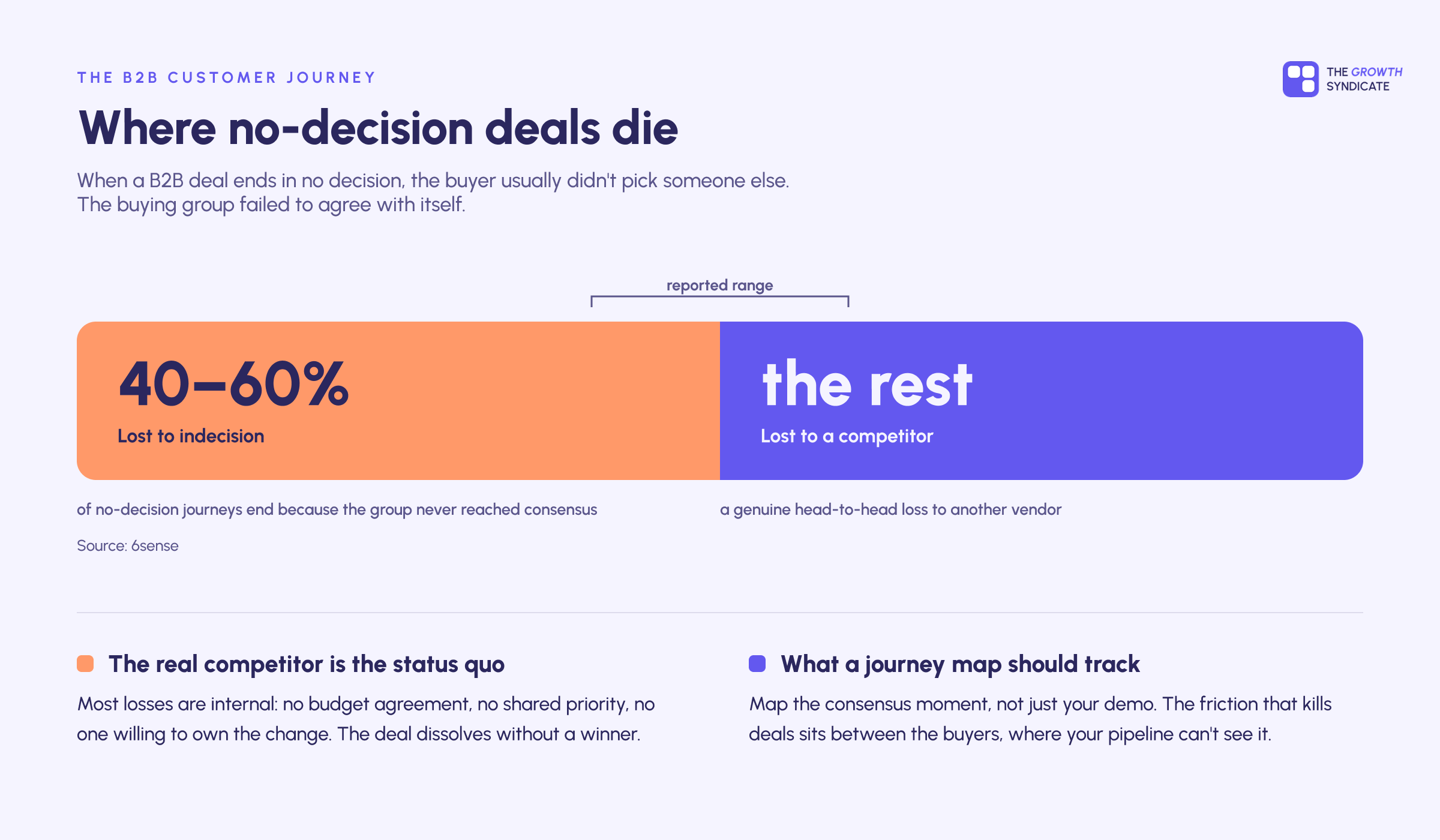
The friction is mostly internal to the buyer. In Gartner surveys, 77% of B2B buyers describe their latest purchase as very complex or difficult, and the hardest job, consensus creation, happens in meetings no vendor attends. 6sense research suggests 40% to 60% of journeys that end in "no decision" fail because the committee never agreed with itself.
The implication for customer journey mapping: draw the loops. A B2B journey map with a straight arrow through different stages is a fiction with good typography.
Most of the journey is invisible
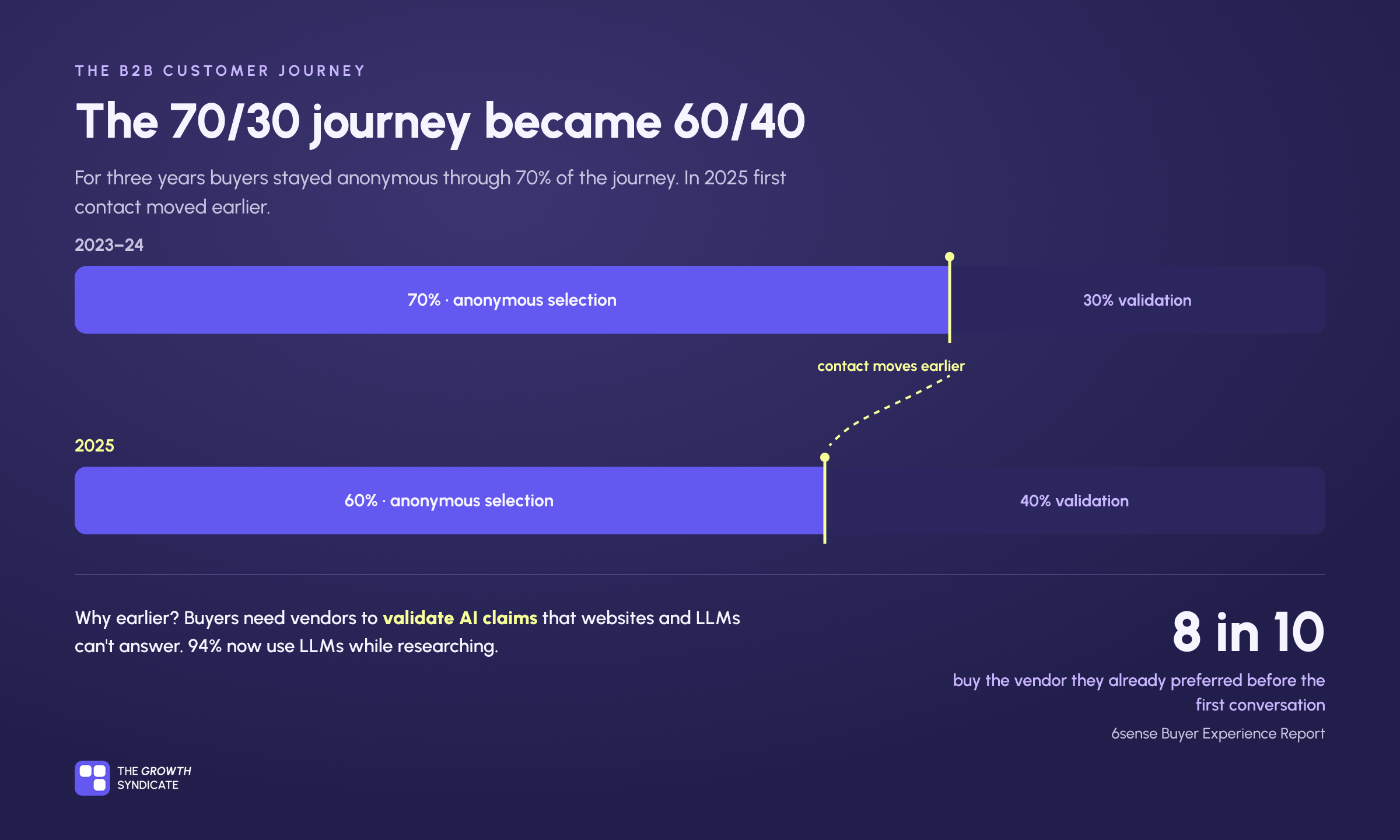
For three years, 6sense's buyer research found that buying groups complete roughly 70% of the buying journey before first contact with any vendor, that buyers initiate that contact 83% of the time, and that around eight in ten ultimately purchase from the vendor they already preferred before the first conversation.
Their 2025 report shows the split shifting to roughly 60/40, with buyers reaching out earlier for one reason: they need vendors to validate AI claims that websites and LLMs can't answer. In the same research, 94% of buyers said they now use LLMs during their research.
So the part of the whole journey you can see in your pipeline is the epilogue. Requirements are largely set, the favorite is chosen, and your CRM timestamps the moment the story was already 60% told. Customer journey mapping built only from CRM data is a journey map of the epilogue.
Most of your market isn't on the journey at all
Ehrenberg-Bass Institute research popularized as the 95:5 rule estimates that only about 5% of your category's buyers are in-market in a given quarter. The math is purchase frequency: companies change providers roughly every five years, so about 20% buy in a year and about 5% in a quarter.

That means the awareness stage for most future customers is happening now, years before their buying journey starts. Ferdi's framing of the marketer's actual job follows directly:

The battle is won or lost before the buyer enters anything resembling a funnel. Forrester data points the same direction: 92% of buyers have a shortlist before they speak to sales, and 41% walk in with a single vendor already in mind. If your journey map starts at "lead created," it starts too late. This is the same logic that drives demand generation rather than pure demand capture.
What is customer journey mapping?
Customer journey mapping is the practice of turning the journey into a visual representation your teams can argue with: stages across the top and, underneath each one, what the customer is doing, thinking, and feeling, which customer touchpoints they use, and which of your internal teams and internal processes sit behind each moment. The output is a customer journey map; the value is in the mapping.
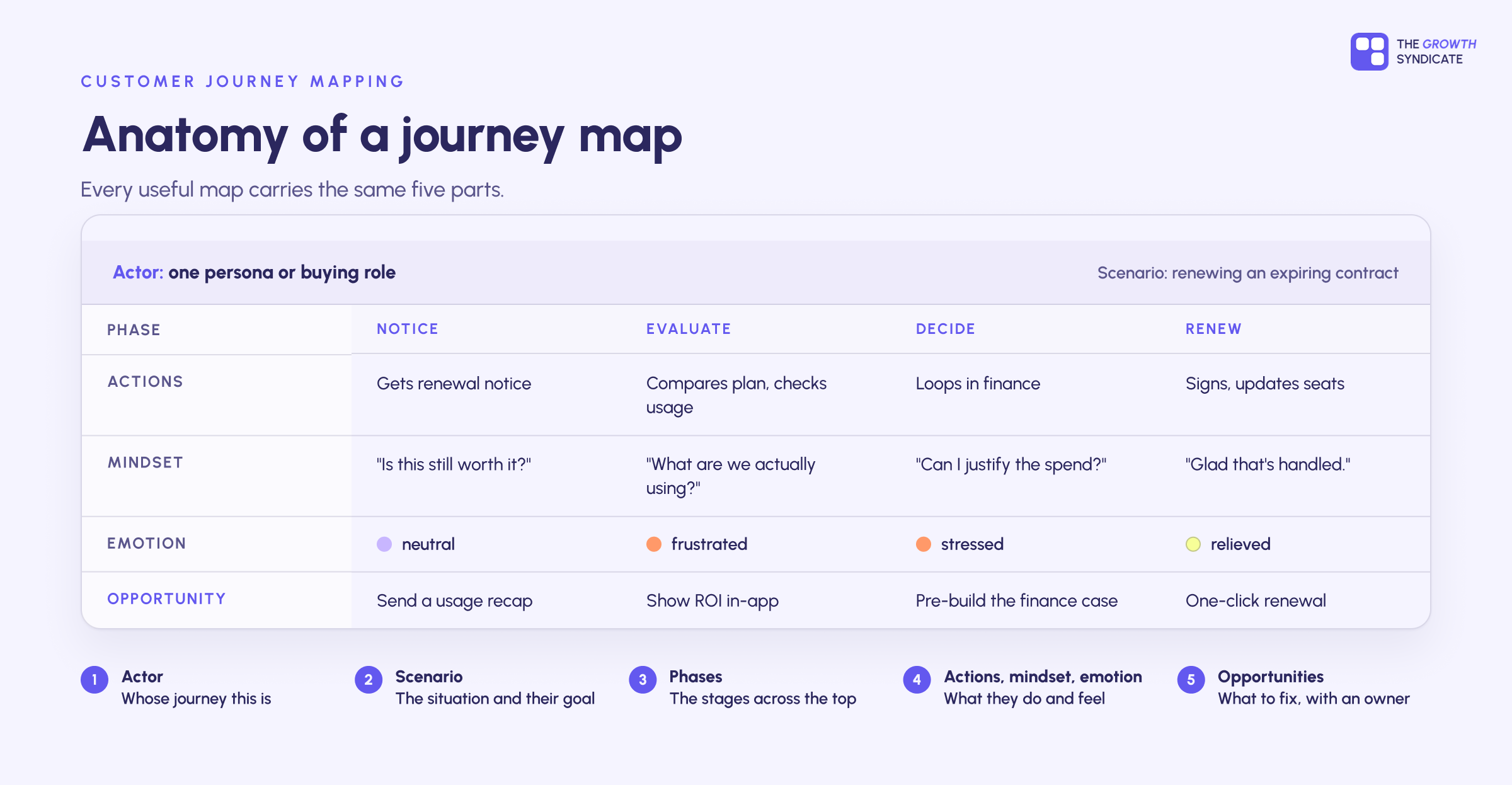
Good customer journey mapping produces journey maps with five key components, a structure the Nielsen Norman Group formalized: an actor (one persona or buying role per map), a scenario with customer expectations attached, the journey phases, the customer's actions, mindsets, and emotions inside each phase, and the opportunities the map surfaces, with owners attached.
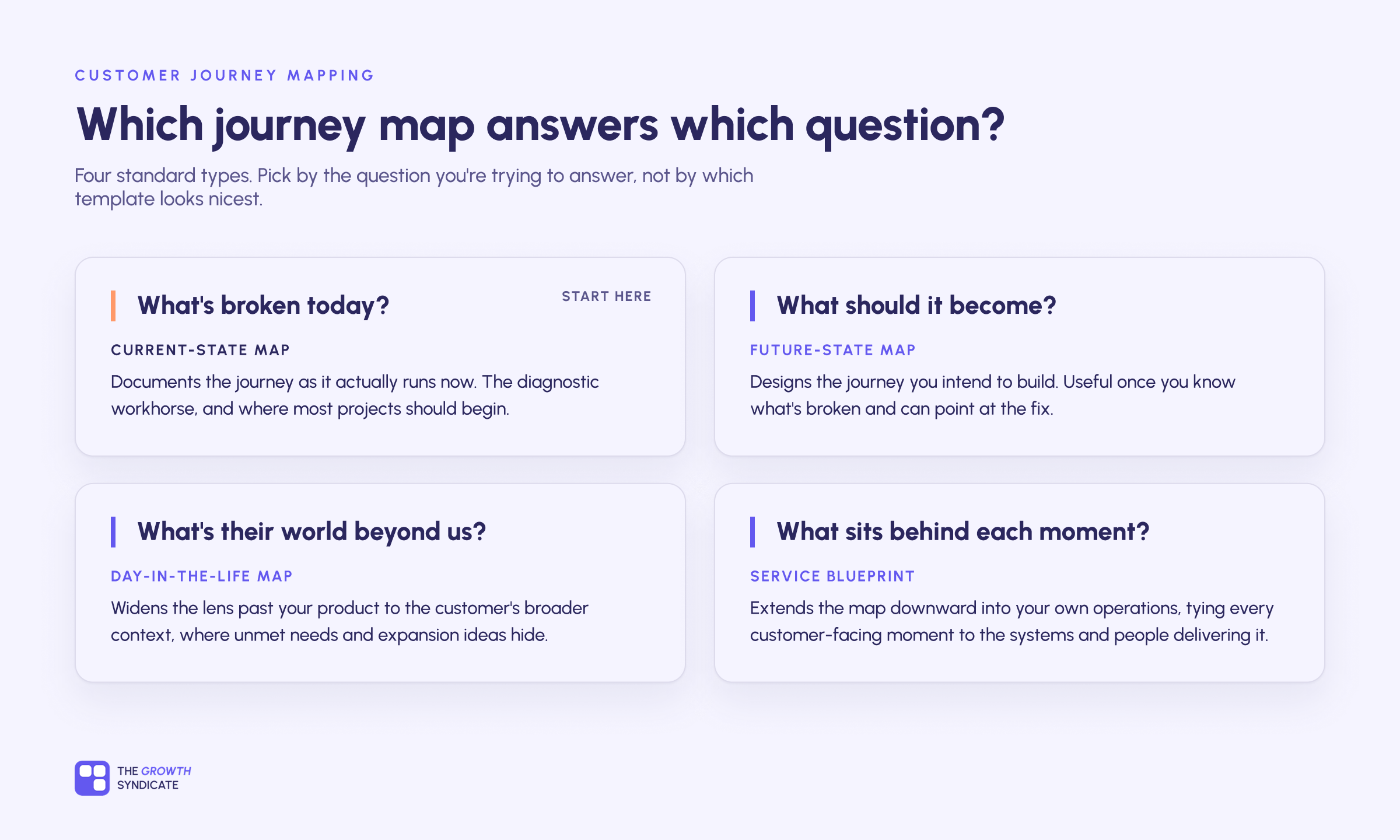
Customer journey mapping also comes in a few standard flavors. A current-state journey map documents customer behavior as it exists today and is the diagnostic workhorse of most customer journey mapping projects. A future-state journey map designs the journey you intend to build. A day-in-the-life journey map widens the lens to the customer's broader context beyond your product. A service blueprint extends the journey map downward into your own operations, connecting each customer-facing moment to the systems and people that deliver it.
The purpose across every flavor of customer journey mapping is the same: build a customer's point of view your teams can act on, identify areas where customers encounter friction, surface the pain points behind it, and decide what to fix first in the customer experience. A journey map that doesn't change a decision is a poster.
Why most customer journey mapping fails
Gartner research found that 83% of customer experience professionals say their organizations struggle to use customer journey maps to actually improve the customer experience. The consultancy Watermark describes the typical journey map as corporate art: beautifully drawn, hung in a conference room, ignored.
The failure modes of customer journey mapping repeat across companies:
The journey map is built from assumptions. A workshop full of employees guessing what customers think produces an internal opinion poll formatted as customer research. Journey maps built without customer interviews and behavioral evidence describe the company's imagination.
The journey map is linear while the buying journey loops. Straight arrows flatter the process and hide where deals actually stall.
The journey map follows one persona while a buying group decides. In B2B customer journey mapping, charting "Marketing Manager Maria" alone means the CFO, the IT reviewer, and the end users, the people who kill deals, are missing.
The journey map mirrors the org chart. Stages named after your sales process ("MQL," "SQL," "handoff") describe your internal processes wearing customer language. That's a process map that borrowed the journey map's format, and the customer isn't in it.
The journey map is a project instead of a program. It gets built once, presented once, and never updated, while customer behavior keeps moving. Customer journey mapping only compounds when someone owns it past the workshop.
The fix for all five is the same discipline: attach the journey map to one business problem and one KPI before anyone opens a whiteboard, and give customer journey mapping an owner whose job continues after the sticky notes come down.

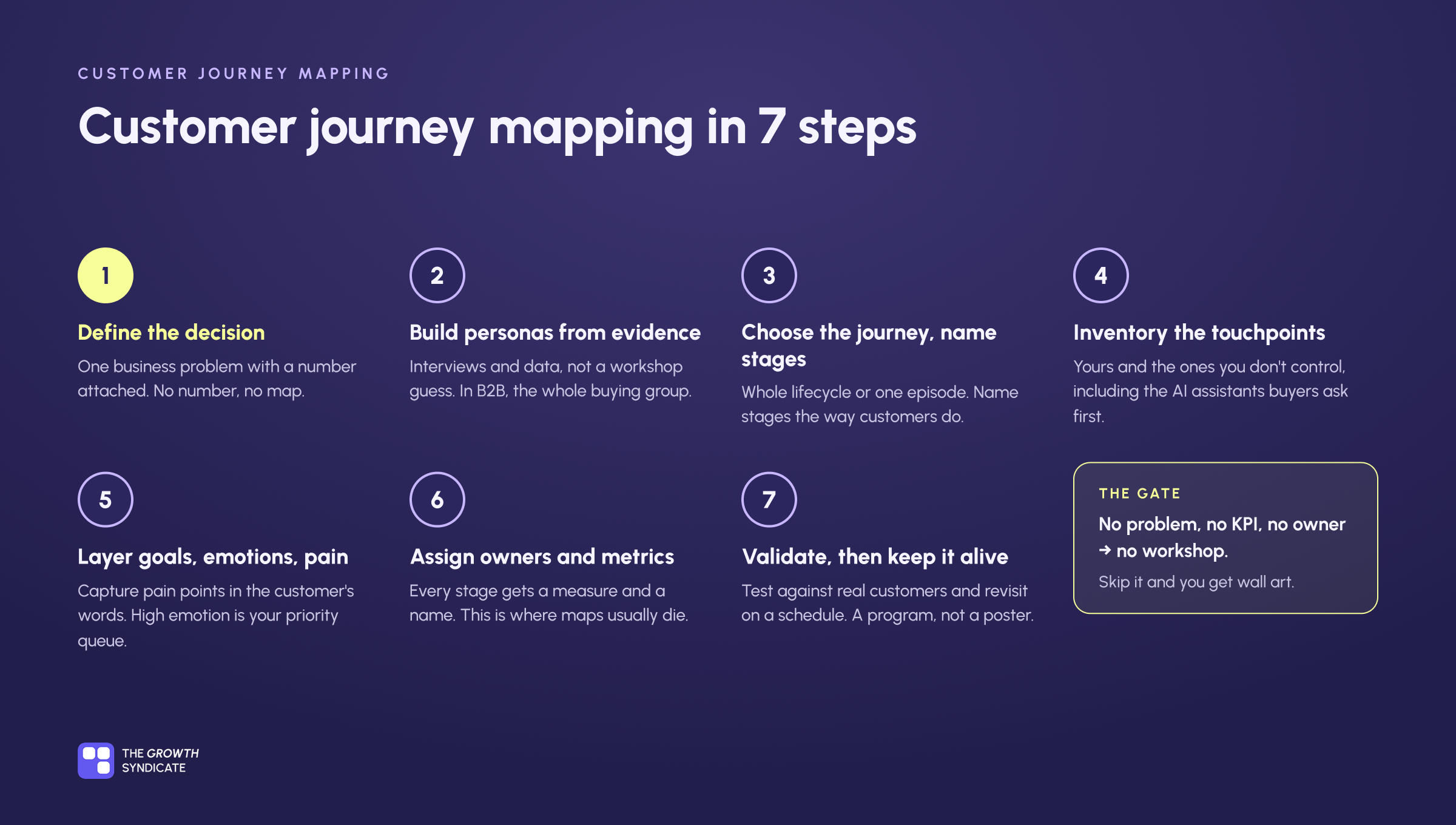
How to create a customer journey map in 7 steps
The customer journey mapping process, condensed to what actually matters:
1. Define the decision the journey map should change. Pick one business problem with a number attached: cut onboarding churn, lift trial conversion, shorten the sales cycle. If nobody can say what the customer journey mapping effort is for, stop before the workshop starts.
2. Build buyer personas from evidence. Interviews, win-loss notes, support transcripts, analytics, focus groups if you have them. For B2B customer journey mapping, model the full buying group: economic buyer, users, influencers, and the internal champion. Customer needs differ by seat, and so do the journey maps.
3. Choose the journey and name its stages. Whole customer lifecycle or one episode, such as onboarding or renewal. Fewer, clearly named stages beat many vague ones. Borrow the five stages, the 5 A's, or Gartner's buying jobs, then adjust to how customers describe the buying process in their own words, so the journey map speaks their language.
4. Inventory the customer touchpoints at each stage of the journey map. Your website, ads, email, sales calls, the product itself, billing, support, events. Include the individual touchpoints you don't control: review platforms, peer communities, social media interactions, and increasingly the AI assistants buyers ask first. Note where a customer speaks to a human versus a system.
5. Layer goals, emotions, and pain points. For every stage: what is the customer trying to accomplish, how do customers feel, and where's the friction. Capture customer pain points on the journey map in the customer's own words. The moments with the highest emotional load are your priority queue, and the pain points that recur across customer segments are the ones worth budget.
6. Assign owners and metrics. Critical touchpoints get named owners, and every stage of the journey map gets a measure: conversion, time-to-value, customer satisfaction, customer retention. This step is what separates detailed customer journey maps from decoration, and it's where customer journey mapping most often dies.
7. Validate with real customers and keep it alive. Test the journey map against interviews and behavioral data, then revisit the journey map on a schedule. Clem's habit from his operator years does this by default: a weekly session where marketing and sales "go through all the new customers and opportunities one by one," asking why each closed or didn't. The key insights from that cadence keep the journey map honest and feed messaging back to marketing. A living review beats an annual remap, because customer journey mapping is a program, and programs need a pulse.
Customer journey map examples
Journey map templates teach format. Examples teach consequences. Each of these is a customer journey mapping example where the mapping changed a real decision.
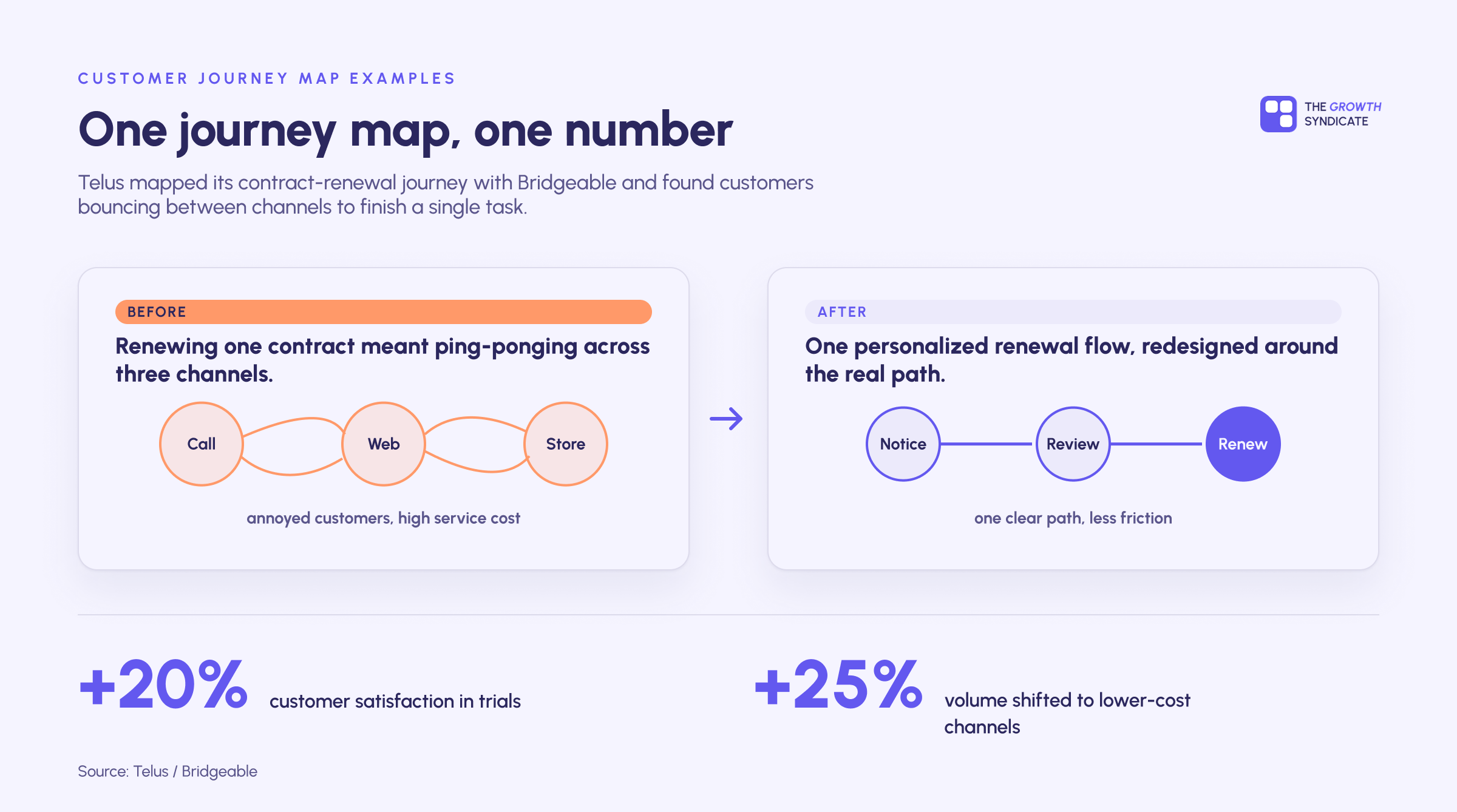
Telus: the renewal loop. The Canadian telecom ran a customer journey mapping engagement with the design firm Bridgeable on contract renewals and found customers bouncing between call center, website, and store to complete a single renewal, which soured the customer experience and inflated service costs. The journey map made those pain points impossible to argue with. The redesigned, personalized renewal journey lifted customer satisfaction scores 20% in trials and shifted 25% more volume to lower-cost channels. One journey map, one journey, measurable money.
Spotify: one feature, one user journey. Spotify mapped the narrow user journey of sharing music between listeners and found that people share dramatically more when the sharing option is visible in the flow. A tightly scoped exercise in customer journey mapping, one persona and one scenario, drove a product change. A journey map doesn't need to boil the entire customer experience down to one canvas.
An elder-care referral service: the journey map that changed the customer. A retirement-home referral business ran a customer journey mapping project and discovered the real decision makers were adult children, who were weighing in-home care and renovations against facilities. The company expanded from home referrals into broader elder-care guidance. Sometimes customer journey mapping redefines who the customer even is.
A composite B2B SaaS journey map. The version we build for clients looks different from the templates: swimlanes per buying role, loops drawn explicitly between evaluation and consensus, the pre-contact research phase shaded dark with intent signals noted, and post-sale stages given equal width to pre-sale ones, because that's where the revenue is. The finished journey map is messier than a funnel diagram. So is reality.
Digital customer journey mapping
Digital customer journey mapping replaces workshop recall with behavioral evidence. Instead of asking a room what customers probably do, you assemble the journey map from the digital exhaust of customer interactions: website visits, product analytics, email engagement, ad clicks, chat logs, mobile apps. It is customer journey mapping with receipts.
The mechanics have shifted in the last few years. Third-party cookies are gone or going, so digital customer journey mapping now runs on first-party data, often stitched into unified profiles with a customer data platform, with journey analytics tools showing how customers interact across various stages and channels in reality rather than in theory. Customer segments get compared side by side rather than guessed at. Done well, this is how you find the drop-off nobody predicted and collect data on the paths customers actually take, including the ones that embarrass the official journey map. The customer experience you measure this way is the one customers actually have.
The newer shift is harder to instrument. With most B2B buyers now using LLMs during research, the earliest touchpoints of a typical customer journey increasingly happen inside AI answers your analytics will never record. You can't track that stage of the customer experience. You can only influence it, by being the source the machines cite, which is the discipline of GEO.
None of this excuses giving up on measurement. Joliene's standing rule:
.avif)
"Marketers use the dark funnel as an excuse to measure nothing. Yes, you can't track every touchpoint. But you can still measure parts of the funnel: engagement over time, multi-stakeholder website visits, content interactions. Enough signals can indicate intent. Don't hide in the victim bubble. The funnel isn't perfect, but you can still figure it out."
The practical posture: measure the visible 30 to 40% rigorously, model the rest with intent data, and add a "how did you hear about us" field, because self-reported attribution routinely surfaces the touchpoints software can't see. That mix turns digital customer journey mapping into actionable insights without pretending to omniscience.

Frequently asked questions
What are the 5 main stages of a customer journey?
Awareness, consideration, decision, retention, and advocacy. These five stages (sometimes called the five main points or five steps of the customer journey) run from the customer's first exposure to your brand through purchase, ongoing engagement, and referral. Most businesses adapt the names to their own sales process.
What are the 5 A's of the customer journey?
Aware, appeal, ask, act, and advocate: Philip Kotler's model from Marketing 4.0. It stresses that modern customers move socially, asking peers and reading reviews before acting, and that they skip stages and sometimes advocate for a product or service without buying it.
What are the 5 E's of the customer journey?
Entice, enter, engage, exit, and extend. It's the experience-design cut of the journey, best suited to mapping one episode, like a store visit or an onboarding flow, in fine detail from the customer experience side.
What is a customer journey mapping example?
Telus mapped its contract renewal journey and found customers forced to hop between phone, web, and store to finish one task. The redesigned journey raised customer satisfaction 20% in trials and moved 25% more renewals to cheaper channels. Good customer journey mapping ties directly to a fix and a number like that.
How do you write a customer journey map?
Define the business problem, build buyer personas from real customer research, choose the journey and its stages, list the key components and touchpoints at each stage of the journey map, add goals, emotions, and pain points, assign owners and metrics, and validate the journey map with customers on a recurring schedule. The full seven-step customer journey mapping process is above.
Make the map earn its keep
The customer journey is real. The tidy diagram of it usually isn't. B2B buyers move in committees, loop through decisions, complete most of the whole journey where you can't see them, and start forming preferences years before they're in-market.
Customer journey mapping that admits all of that becomes a genuinely useful instrument: it tells you where to build salience, which pain points to fix first, which moments make the journey smoother for the people in it, and where customer success quietly wins or loses the account. The journey map stops being wall art and starts driving revenue growth.
If you want a second pair of eyes on your customer journey, from mapping the buying group to fixing the stages your marketing efforts currently skip, that is most of what we do before we build anything else. And if you're benchmarking where your funnel leaks against peers, start with our B2B marketing benchmarks.