.svg)



A B2B company spent most of a year convinced it had a marketing problem. Sales said the pipeline was drying up. The board heard that marketing was not generating enough demand. The obvious fix was more budget and more campaigns.
The analysis said something different. Marketing had generated roughly half a million in pipeline that year, which was more than the company had ever attributed to marketing before. Twenty-one deals came out of it. One closed. The rest were lost, and nobody could say why, because the CRM captured lost reasons in a free-text comment box that most reps left empty.
Marketing had done its job. The operational layer underneath it had not, and because the failure surfaced in the pipeline report, it got diagnosed as a demand problem. That is close to the default state of B2B commercial teams: the reporting is wrong, so the diagnosis is wrong, so the money goes to the wrong place.
"It's easy to pin everything on marketing. You need to look deeper into the funnel."— Joliene van Grieken, co-founder, The Growth Syndicate
This article covers what marketing operations is, what a marketing operations team owns, how the function gets staffed, where it should sit in the organization, and what specifically breaks when nobody owns it. It does not re-teach the sales and marketing handoff, which our sales and marketing alignment pillar covers in depth, or attribution modeling, which sits in our guide to B2B marketing attribution.
What is marketing operations?
Marketing operations is the function that owns the systems, data, processes, and measurement infrastructure a marketing department runs on. Marketing operations professionals administer the martech stack, govern customer data, define lifecycle stages, build the reporting layer, and standardize how marketing campaigns get planned, executed, and reviewed.
That definition is uncontroversial and almost useless on its own, because it describes a job rather than a condition. The more useful framing is diagnostic: marketing operations is where every unresolved decision in the commercial function eventually lands. Nobody agreed on what qualifies as a lead, so the marketing automation platform routes everything to sales. Nobody owns data hygiene, so the CRM fills with contacts from markets the business exited years ago. Nobody defined lost reasons, so the funnel has no failure signal. Each of those is a decision that was never made, and marketing operations is the place where the cost shows up.
The academic literature has no dedicated construct for this. Marketing scholarship studies adjacent things well: marketing capabilities and their link to firm performance (Vorhies and Morgan, Journal of Marketing, 2005), measurement ability and its effect on profitability (O'Sullivan and Abela, Journal of Marketing, 2007), and the marketing–sales interface (Kotler, Rackham and Krishnaswamy, Harvard Business Review, 2006). None of them name marketing operations as a function. The practitioner consensus that this is a distinct discipline runs ahead of the research, which matters when a CFO asks for evidence that the headcount is justified.

What does a marketing operations team do?
A marketing operations team owns five domains: marketing technology administration, data management and governance, process design, lead and lifecycle management, and performance measurement. In practice, the marketing operations function absorbs a sixth: it becomes the internal help desk for anyone in the marketing department who needs a number, a list, or a workflow fixed.
Here is what each domain covers in a working marketing operations group.
Marketing technology management
Selecting and integrating the marketing tools the marketing department runs on, then administering them once they are live. A typical B2B stack includes a CRM, a marketing automation platform, analytics tools, a project management tool, and a growing set of point solutions. Someone has to own the connections between them, because the value of a stack lives in the integrations rather than the licenses. Seamless integration between platforms is the difference between a stack and a pile.
Data management and governance
Field structures, deduplication, enrichment, consent records, and the governance rules that keep the database usable. Collecting data is easy. Making collected data comparable across systems is the actual job, and it determines whether every marketing data point downstream means anything.
Process optimization
Standardized workflows for campaign execution, briefing templates, approval paths, and the operating procedures that let marketing teams run the same play twice without rebuilding it. Standardized marketing processes reduce approval loops and meetings, which is the mechanism behind claims that marketing operations improves speed to market. Stripping redundant tasks out of a campaign build is often worth more hours per quarter than any new tool. Continuous improvement lives here too: broken processes get surfaced, documented, and fixed on a cadence rather than during a crisis.
Lead and lifecycle management
Definitions of lead, MQL, SQL, and opportunity, the scoring logic behind them, routing rules, and the SLAs governing handoff to the sales team. This domain decides what counts as qualified leads, which makes it the most consequential part of the job and the most commonly broken one.
Measurement and analytics
Campaign performance reporting, attribution models, funnel conversion tracking, and the performance metrics leadership uses to allocate budget. Marketing operations builds the centralized measurement framework and connects marketing goals to business objectives. It does not usually own the strategic interpretation of what the numbers mean.
The list leaves out as much as it includes. Marketing operations does not own creative, messaging, demand generation strategy, product marketing, or content marketing, and it does not run digital marketing execution. The marketing operations role is infrastructural. A marketing operations manager who starts making campaign strategy decisions has usually been handed a gap somewhere else in the marketing organization.
Marketing operations vs sales operations, RevOps, and project management
The boundaries between these functions are drawn differently in almost every company, which is why job titles in this space are unreliable signals of scope. The distinctions that hold:
Marketing operations owns the marketing side of the revenue system: the marketing automation platform, marketing data governance, campaign infrastructure, and everything that happens before a person becomes a record a sales rep can work.
Sales operations owns CRM administration on the sales side, territory design, quota and compensation modeling, and forecasting. Where marketing ops focuses on demand capture and measurement, sales ops focuses on capacity and coverage.
Revenue operations consolidates both, plus customer success operations, under shared data and process. In many organizations the marketing operations function now reports into RevOps rather than into marketing, which changes the reporting line without changing the work.
Project management coordinates execution through an agreed process. Project management software is one component of the stack a marketing operations team uses, not a substitute for the function. A marketing operations group designs the process that project management then runs.
The reason these keep getting conflated is that all four are invisible when working and blamed when not. The useful test is what each one is accountable for: marketing operations is accountable for whether the numbers describing marketing are true.
Why is marketing operations important?
Marketing operations matters because it determines whether marketing performance can be measured at all, and unmeasurable marketing loses budget arguments. The strongest academic evidence here is O'Sullivan and Abela's 2007 study in the Journal of Marketing, which surveyed senior marketers at high-technology firms and matched their responses to secondary data on profitability and stock returns. Marketing performance measurement ability was positively associated with firm performance, and with marketing's standing inside the company, which the study measured as CEO satisfaction with marketing.
The second finding matters as much as the first. Firms that could measure marketing performance also had marketing functions their chief executives rated more highly. Marketing departments that cannot produce trustworthy numbers do not lose arguments because their marketing strategy is wrong. They lose because they have nothing credible to argue with.
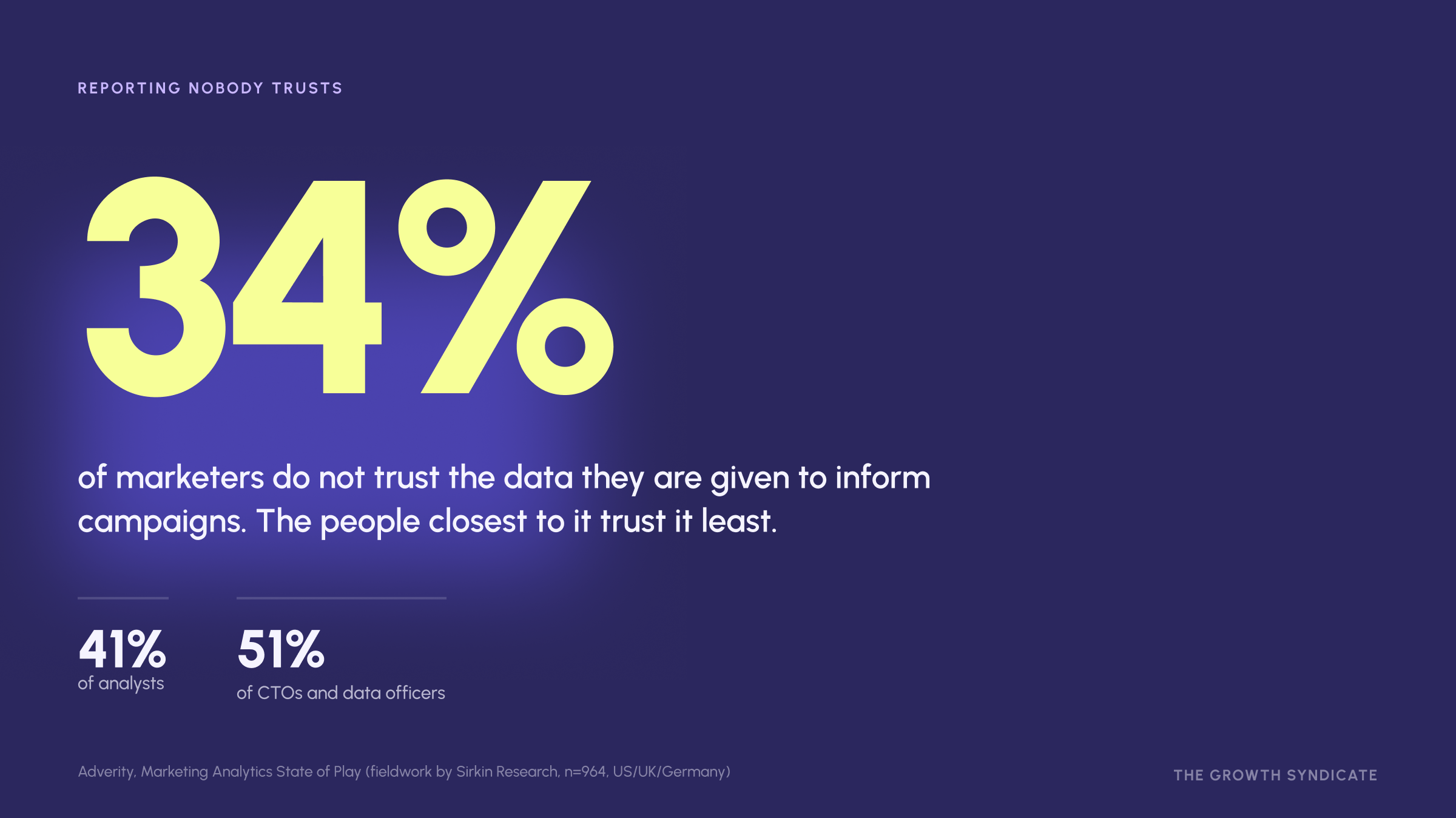
The counterweight is that most marketing leaders do not trust what their own systems tell them. Adverity's Marketing Analytics State of Play 2022 report, fielded by Sirkin Research in late 2021 across 964 marketers and analysts in the US, UK, and Germany, found that 34% of marketers did not trust the data they were given to inform campaigns. Among analysts the figure rose to 41%, and among CTOs and data officers to 51%. The people closest to the data trusted it least.
This is why marketing operations is a strategic function rather than an administrative one. It decides whether the entire organization can tell which marketing efforts worked. The picture has not improved with time. GrowthLoop's 2026 AI and Marketing Performance Index, a February 2026 survey of 318 marketing and data leaders at US and Canadian companies above $100M in revenue, found that only 23% could reliably link marketing actions to business outcomes, and only 46% had a fully centralized single source of truth for customer data.
A marketing department in that position is running on instinct while producing dashboards that suggest otherwise. Every budget decision and every channel cut rests on data insights that the person presenting them privately doubts.
What breaks first: the four failures in almost every CRM audit
When a new client engagement starts, the diagnostic sequence is consistent. Check whether the website is tracked properly and whether conversions fire and route correctly. Then open the CRM. Four failures recur so reliably that their absence is more surprising than their presence.
.avif)
"The first thing I look at is the website. Is it tracked properly? Are the conversions set up correctly? Once something converts, where does it go? Then I open the CRM, and the CRM is always a mess, because nobody really owns it and it sits in the middle."
Tracking that fires on the wrong things
Broken tracking produces two failure modes, and they look nothing alike. Things arrive in the CRM that should not, which inflates volume and depresses every conversion rate downstream. Or things do not arrive that should, which is expensive in a way that never shows up in a report.
The second failure is the one that costs real money. One B2B company ran an account-based campaign that generated a substantial inbound response from named ICP accounts. The list was built by one person in marketing, the tracking did not connect it to the automation, and the follow-up sequence never fired. High-intent accounts raised their hands and nobody in the business knew.
That miss leaves no trace. The pipeline report shows a campaign that underperformed. There is no line item for demand that arrived and was never answered, which means the marketing team draws exactly the wrong conclusion and cuts the channel that worked.
Speed compounds the problem. The most-cited primary audit of lead response remains the 2011 Harvard Business Review study by Oldroyd, McElheran, and Elkington, which sent test web leads to 2,241 US companies: the average response time among firms that responded within 30 days was 42 hours, only 37% responded within an hour, and 23% never responded at all. These numbers circulate constantly in mangled form. The widely quoted "100x more likely to connect" and "21x more likely to qualify" multipliers are not from that study. They come from a separate 2007 Lead Response Management study by James Oldroyd with InsideSales.com, covering six companies and about 15,000 leads, and they are routinely miscredited to Harvard.
Contact bloat that you pay for by the record
Most marketing automation platforms and CRMs price on contact volume. Most B2B databases contain a large share of contacts that will never convert, never engage, and in many cases are no longer employed where the record says they are.
Contact bloat is a compounding cost. B2B contact data decays continuously as people change roles and companies. The most-cited benchmark, MarketingSherpa's 2.1% per month, which HubSpot annualizes to about 22.5%, is old enough that it should be treated as an order of magnitude rather than a precise rate. The direction is not in dispute even if the decimal is.
The operational fix is a scheduled suppression and deletion policy rather than a one-off cleanup. At that decay rate, roughly a fifth of a database goes stale within a year and around 40% within two, so a single cleanup buys less time than it feels like it should.
Consent and governance debt
In European markets, opt-in and opt-out states are frequently incomplete or unrecorded, which converts a data quality issue into a regulatory exposure. Compliance and governance belong to the same workstream as data management, with a legal deadline attached.
The practical question for marketing leaders is how much of that risk the organization has explicitly decided to carry, because an undocumented consent posture is a decision made by default.
Lifecycle stages that mean nothing
This is the biggest one, and it is the root cause of most reporting that marketing leaders distrust.
Lifecycle stages need real criteria. A lead can be almost anything. MQL criteria should primarily focus on fit: does this contact match the ICP on firmographics and demographics? An SQL adds qualification on budget, authority, and timeline. An opportunity is a deal a rep has agreed to work. Most B2B organizations either never define these criteria or define them and then fail to enforce them in the marketing automation platform.
"Companies come to us asking why their MQL to SQL conversion rate is so bad. Everybody who signs up becomes an MQL. Of course the conversion is bad. The lifecycle stages were never set up correctly, which means intent is never measured correctly, which means you can never build accurate reporting."
The failure chain runs in one direction. Undefined stages produce meaningless MQLs. Meaningless MQLs produce conversion rates that measure nothing. Conversion rates that measure nothing produce budget decisions made on noise. In our own audits, roughly nine times out of ten the lifecycle qualifications turn out to be unset or set incorrectly, which means a company that says its funnel is underperforming usually has not yet established that its funnel is measured.
For benchmarking context: First Page Sage's funnel benchmarks, drawn from the agency's own client data between 2019 and 2025, put the cross-industry MQL-to-SQL average at about 13%, while their B2B SaaS channel-level figures run from 26% for paid search to 51% for organic search. The dataset skews toward SEO-led clients, but the spread inside a single dataset is the point. It exists mostly because the definitions differ, not because the businesses do. Two companies in the same category can honestly report figures three times apart while running identical processes. We cover the mechanics of the definitions themselves in our guide to B2B lead qualification, and how to read conversion figures in context in our B2B marketing benchmarks breakdown.
Reporting nobody trusts
Ask a marketing operations team what percentage of their week goes to reporting and data hygiene and the honest answer is usually the largest single block. That work produces dashboards that leadership then treats as directionally interesting rather than decision-grade, which is a strange outcome for the most expensive recurring activity in the marketing function.
Two specific mechanics account for most of it.
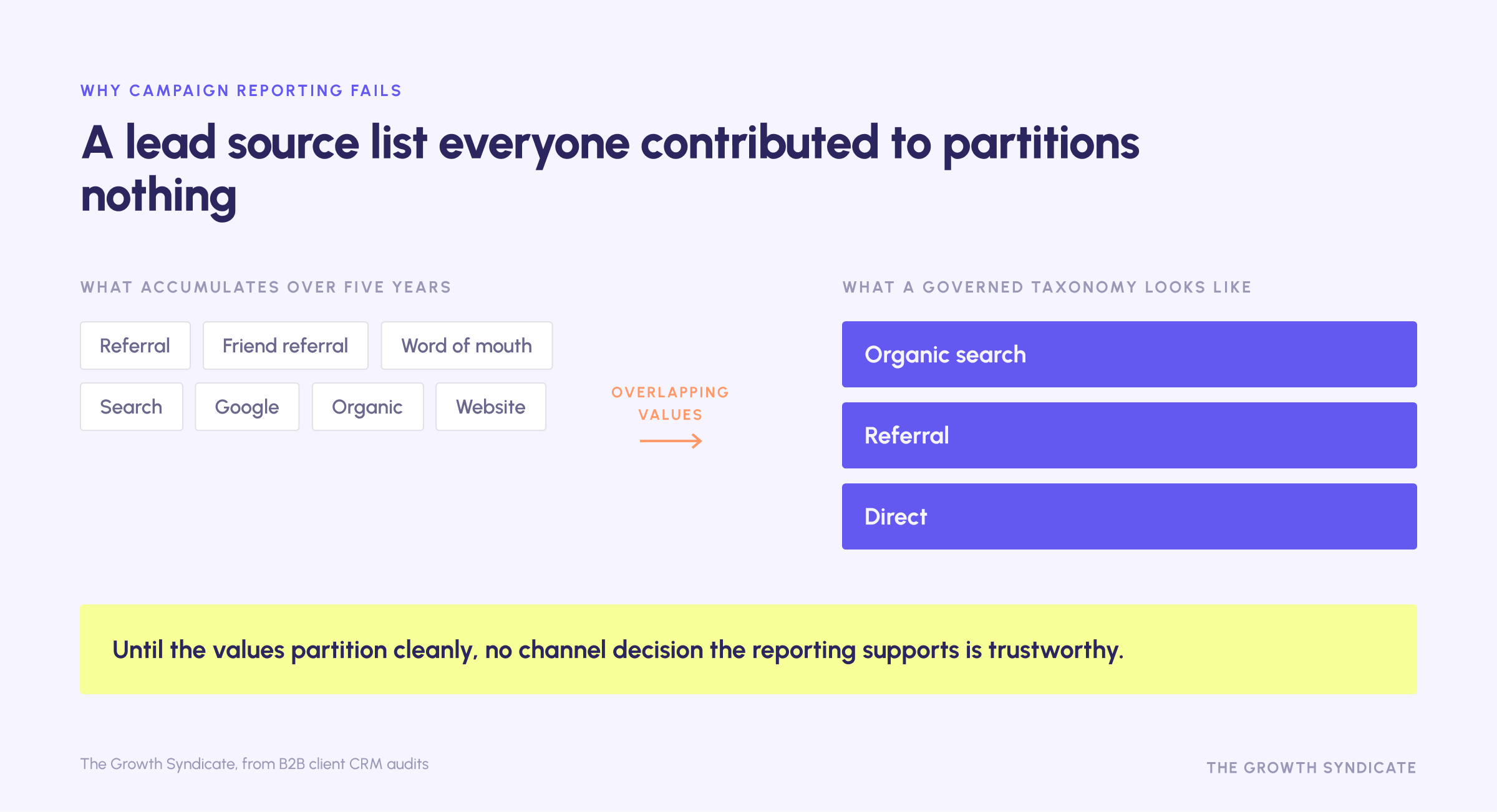
Lead source taxonomies that everyone contributed to. A typical CRM accumulates lead source values over years, added by whoever needed one that day. Referral, friend referral, word of mouth, search, Google, organic, and website can all coexist as separate values describing overlapping realities. Once that happens, campaign performance cannot be measured, because the categories do not partition anything. Rebuilding the taxonomy and mapping historical values to it is unglamorous work that restores the ability to attribute marketing efforts to outcomes.
Lost reasons captured as free text. A comment field is not a lost reason. Structured lost reasons need a fixed picklist with an optional comment attached, because a picklist aggregates and a paragraph does not. Without structured loss data, the marketing department cannot tell the difference between leads that were wrong and leads that were mishandled, which are opposite problems with opposite fixes.
This is where the diagnosis in the opening example came from. Twenty-one deals, one closed, no structural explanation. The next questions were not about marketing at all: are sales conversations recorded, is anyone reviewing what happens in those meetings, and does the CRM capture why deals die. Marketing was carrying the blame for a qualification and execution problem further down the funnel.
The martech stack problem
The marketing technology industry grew faster than the capacity to operate it for fifteen years, and has now stopped growing. The 2026 Marketing Technology Landscape counted 15,505 solutions, up less than 1% on the prior year after a 9% rise in 2025 and a 28% rise in 2024. Its authors call it a possible peak. Underneath the flat headline, 1,488 products were added and 1,367 removed, so the churn is still fierce even if the total is not.
Utilization never kept pace with the growth. Gartner's marketing technology survey tracked the share of licensed martech capability actually in use falling from 58% in 2020 to 42% in 2022 and 33% in 2023. When Gartner asked in 2022 why it had dropped, respondents named overlap between tools (30%), difficulty recruiting talent to drive adoption (28%), and complexity and sprawl of the stack (27%). Gartner's 2025 survey, which asks about tools actively used rather than capability utilized, put the figure at 49%, and only 15% of organizations qualified as high performers.
Meanwhile martech's share of marketing budget has fallen every year since 2021, from 26.6% to 25.4% in 2023, 23.8% in 2024, 22.4% in 2025, and 19.4% in Gartner's 2026 CMO Spend Survey. Buying is slowing. The gap between purchased capability and operated capability is not closing nearly as fast.
The practical consequence for a marketing operations manager is that stack audits produce more value than stack additions. Most marketing teams have marketing processes that were never designed for the tools already bought, which is a cheaper problem to fix than a tooling shortage. Regular audits of marketing technology surface redundant tools, broken integrations, and licenses nobody has opened in a year. Eliminating waste in the stack is one of the few marketing initiatives with an immediate return, because the savings are contractual rather than projected.

One failure has become the most common expensive mistake in B2B marketing operations: adding automation or AI on top of data that was never governed. If the lifecycle stages are wrong, an AI layer will make wrong decisions faster and at greater volume. The tooling amplifies whatever is underneath it.
"You can't build a machine without your CRM set up correctly. You don't know what you're doing wrong and you don't know what you're doing right, so you can't scale it and you can't automate it. You need a source of truth, because that's the only way you make decisions. It's the last thing people focus on and it's the thing you need most."
Where should marketing operations sit?
Marketing operations sits best in a neutral commercial operations function reporting outside both marketing and sales. Where that is not viable, it belongs in marketing, because marketing teams generally understand the tracking layer that exists before a contact becomes a record and sales teams generally do not.
The argument for neutrality is about incentives. Operations inside a sales team tends to sit near commission, and commission distorts how people treat data. A neutral owner can look at the whole process, including the parts that make each side look bad, without a compensation plan pulling in one direction. That owner has to understand commercial mechanics, though. A process person with no feel for revenue produces tidy systems that answer no useful question.
The argument for marketing as the fallback is asymmetric knowledge. Everything that happens before a contact exists as a record, which is most of what marketing does, is invisible from inside a sales-owned system. Marketing operations professionals understand that layer natively.
The reporting question is also being answered by market drift. The RevOps model, which consolidates marketing operations, sales operations, and customer success operations under shared data and process, has been absorbing marketing operations teams for several years. The evidence that consolidation improves performance is weaker than the enthusiasm for it. The widely repeated claim that RevOps adopters generate meaningfully more revenue traces to analyst commentary rather than a disclosed sample, and Gartner's own adoption forecast has drifted: a May 2021 press release predicted 75% of the highest-growth companies would run a RevOps model by 2025, and Gartner's current revenue operations page makes the same prediction for 2026. Treat the structural trend as real and the performance claims as unproven.
Our RevOps and CRM service page covers how we approach this in client engagements.
How marketing operations teams are staffed
Most B2B companies now have someone dedicated to marketing operations, and most of them are stretched thin. MarketingOps.com's State of the Marketing Ops Professional research found that over 80% of companies had a dedicated marketing operations person or team in 2022, up from 65% the year before, based on a survey of about 600 practitioners. The ratio question is harder to answer well: the most useful public data point is an informal 2023 poll run by Darrell Alfonso, then leading marketing strategy and operations at Indeed, in which one operations person per ten marketers was the most common answer and 44% of respondents reported one per 25 or more. LXA's State of Martech and Marketing Operations survey from the same period found 63% of CMOs expecting to grow the function within twelve months.
Treat all of that as directional rather than benchmark-grade. No disclosed-methodology study of marketing operations headcount ratios exists, which is itself a signal about how recently the function was recognized as one.
Below the point where a company can justify a dedicated role, marketing operations is a fraction of somebody's job, and that somebody is often the person least equipped to do it. This is the structural problem behind most early-stage operational debt.
"Up to about eighty people, the individual contributor becomes the leader of the team. Your best marketing specialist becomes head of marketing. Your best sales person becomes head of sales. They're good at their specialism, but they're not process people, and that's a different role type. If the commercial function doesn't define who owns it, it doesn't get owned."
That observation explains why operational debt accumulates in a specific shape. Early-stage companies are rarely careless about this. The promotion path in a growing commercial organization selects for specialists and then hands them a process job nobody described as part of the role. The result is a marketing department where every individual is competent and the machine still does not work.
Three structural questions determine how a marketing operations group gets built:
Centralized or embedded. A centralized marketing operations team serves the entire marketing organization from one place, which produces consistency and a queue. Embedded operations professionals sit inside squads or business units, which produces responsiveness and divergence. Most organizations above a few hundred employees end up with a hybrid: centralized governance of data and platforms, embedded support for campaign execution.
In-house or outsourced. MOps teams are difficult to hire into, and marketing operations jobs are difficult to fill, because the skill set combines technical platform depth with commercial judgment and neither half is common in the other's talent pool. Agency or fractional support is common for platform migrations, audits, and rebuilds. Ongoing lifecycle governance is usually better held in-house, because it requires continuous context.
Seniority mix. MOps teams built entirely from specialists with no senior owner will optimize the parts of the system each team member can see. No single team member has the standing to make a decision that makes another team's numbers look worse in service of accurate reporting, so someone senior has to hold that authority explicitly.
The other reason MOps teams stall is intake. Marketing operations professionals who spend their week on ad hoc requests from across the marketing department never get to the structural work, and the structural work is the only thing that reduces the volume of ad hoc requests. Breaking that loop requires a protected allocation for system improvement, defended by whoever runs the group, because efficient collaboration with the rest of the marketing organization is not the same as saying yes to all of it.

The marketing operations manager role
A marketing operations manager owns the systems, data, and processes behind marketing execution: administering the marketing automation platform and CRM, defining lifecycle stages and lead routing, building campaign performance reporting, and running the process improvements that let marketing teams execute consistently. The marketing operations role sits between marketing strategy and technical implementation, and marketing operations job descriptions reflect that split.
What marketing operations job descriptions ask for
Scanning marketing operations jobs across US B2B companies, the responsibilities in job descriptions cluster into a consistent pattern:
- Own and administer the marketing automation platform and its CRM integration
- Define and maintain lifecycle stages, lead scoring, and routing rules
- Build and maintain campaign performance dashboards and funnel reporting
- Govern data quality, including deduplication, enrichment, and consent management
- Partner with the sales team on handoff processes and shared SLAs
- Manage the marketing technology stack, vendor relationships, and renewals
- Run process improvements across campaign planning and execution workflows
- Support strategic planning with data driven insights on resource allocation
The skills that separate good operations managers from adequate ones
The skills that distinguish strong marketing operations managers are less technical than job descriptions imply. Platform certifications are table stakes. Data management skills matter, and so does fluency in the reporting layer. What separates operations managers who change outcomes from operations managers who maintain systems is commercial literacy: understanding why a definition matters to a revenue forecast, and being willing to tell a marketing leader that a number reported for two years running is wrong.
That last part is a temperament question rather than a training one. Operations managers sit on evidence that makes colleagues look bad. Marketing managers who present inflated MQL volume, sales managers whose reps skip stages, and executives attached to a channel narrative all have reasons to prefer the existing reporting. A marketing operations manager who cannot hold that line becomes an administrator of other people's assumptions.
Marketing operations manager salary in the US
Marketing operations managers in the US earn a competitive salary relative to other marketing managers at similar seniority. Aggregated market data puts average base pay for the role between roughly $98,000 (Built In) and $113,000 (Glassdoor), with Built In's average total compensation including bonus and equity at about $116,000. Senior marketing operations managers sit higher, averaging around $139,000 on Glassdoor with a typical range of $114,000 to $173,000. Those figures come from job-board aggregators rather than surveys, and the reported ranges run wide: Built In's full range spans roughly $48,000 to $220,000. That spread reflects title inflation across the category as much as real variance in the work: the same job title covers a campaign builder at a twelve-person startup and a systems owner running a nine-figure funnel.
Careers in marketing operations
The marketing operations role also functions as a training ground. Operations managers who spend two years fixing lifecycle models and learning to improve processes under real revenue pressure tend to make unusually good commercial leaders, because they have seen how the machine fails from the inside.
Career paths in marketing operations typically run in one of three directions: deeper into marketing technology and systems architecture, laterally into RevOps leadership, or upward into a VP of marketing operations or a commercial COO role. For job seekers, the function has an unusual property among marketing careers. The skills transfer cleanly between industries, because a broken lifecycle model looks the same in fintech as it does in manufacturing, and the demand for people who can fix one is not sector-specific.
Marketing operations frameworks
Marketing operations teams typically borrow process frameworks from software development rather than inventing their own. The common four:
Lean focuses on eliminating waste and maximizing customer value, which in a marketing context usually means killing work that produces no decision. Lean is the right frame for stack audits and process rationalization.
Scrum breaks work into fixed sprints, usually one to four weeks, with defined commitments per sprint. Scrum works for marketing teams with predictable campaign cycles and struggles with reactive demand.
Kanban uses visual boards to manage continuous workflow, limiting work in progress rather than time-boxing it. Kanban suits marketing operations teams specifically, because the intake is unpredictable and the work items vary in size.
Scrumban combines sprint planning with continuous flow, which is where most marketing operations groups land once they stop pretending their intake is predictable.
The framework matters less than the fact of having one. A marketing operations team without a documented intake process becomes a queue managed by whoever asks most persistently, and that is a resource allocation model that optimizes for internal politics.
How to build a marketing operations strategy
A marketing operations strategy sequences the fixes so that each one makes the next one possible. Tracking and data hygiene come before lifecycle definitions, lifecycle definitions come before reporting, and reporting comes before automation. Building in the wrong order produces sophisticated systems on top of unreliable foundations.
Start with the people who depend on the output. Ask the marketing managers, sales leaders, and finance partners who use marketing reporting what decisions they are trying to make and what they currently cannot answer. That conversation sets the priorities better than an audit checklist does, because it tells you which marketing activities are contested and which are simply unmeasured.
The working sequence:
Establish what is true. Audit tracking, conversion capture, and data flows before touching anything else. This produces the baseline that later claims of improvement will be measured against, and it usually produces at least one uncomfortable finding about a number leadership has been quoting.
Fix the database before the process. Suppress or delete contacts that will never convert, resolve consent states, and rebuild the lead source taxonomy. Contact hygiene has an immediate financial return on platforms priced per record.
Define lifecycle stages with the sales team in the room. The definitions have to be agreed, not announced, because a definition sales did not consent to is a definition sales will not follow. Set the criteria for each stage, agree what triggers movement between them, and document what happens when a stage is skipped. Sales and marketing teams that build these definitions together enforce them; definitions handed down by one side get ignored by the other within a quarter.
Instrument the funnel, including failure. Structured lost reasons, disqualification reasons, and stage-regression tracking. Most funnels only measure success, which makes diagnosis impossible.
Build reporting on the fixed foundation, not before it. Dashboards constructed on ungoverned data teach an organization to distrust dashboards, and that distrust outlives the fix.
Automate last. Once definitions are stable and data is governed, automation and AI compound the value. Before that point, they compound the error.
Each stage should have an owner named in the marketing department or the operations group, a date, and a defined output. Set goals that are specific enough to fail: a target for duplicate rate, a date for lifecycle enforcement, a defined reporting standard. Vague strategic planning around "better data" produces nothing measurable.
The most common failure in marketing operations strategy is running the whole program as a project with no continuous owner, so that eighteen months later the same audit produces the same findings. Many organizations rebuild the same broken system twice before recognizing that the problem was never the build. Reviewing the system on a fixed cadence, and using those reviews to improve processes incrementally, is what turns a cleanup into an operating capability, and it is how operations work starts to maximize ROI on the marketing budget rather than simply describing it.

How long before fixing operations shows up in the numbers
Fixing marketing processes produces insight quickly and revenue slowly. Within weeks of a tracking and lifecycle rebuild, a marketing team can usually see which channels and campaigns are working, which is often the first time that question has had a reliable answer. Revenue impact follows the length of the sales cycle, which in B2B means one to three quarters.
Operations work is a prerequisite rather than a growth lever. Fixing the data shows where demand already exists and where budget is being wasted, and in most engagements the second finding is larger than the first.
Sometimes the work produces no insight at all: if the historical data is bad enough, the correct answer is to accept that the past is unrecoverable and start the clean measurement from a fixed date. Trying to reconstruct two years of ungoverned lifecycle data is usually a worse investment than instrumenting the next two quarters properly.

Where operations, targeting, and sales collaboration are fixed together, the compounding is visible. In our work with Frends, an integration platform company, restructuring the account-based program alongside the qualification model moved MQL-to-SQL conversion from 14% to 30%. The operational change did not create that result on its own. It made the result measurable and repeatable, which is the actual contribution of marketing operations to marketing operations success.
What AI actually changes in marketing operations
AI changes the tooling in marketing operations without changing the thinking. The GTM engineer role emerging across B2B is a marketing operations role with a more technical skill set: the same work of ensuring the right data moves through the right systems and reaches the right decision, executed with different instruments.
The adoption data supports a narrower reading of AI's impact than most vendor material suggests. MarketingOps.com's 2026 AI Advantage Assessment, a validated sample of 111 marketing operations professionals that the publisher describes as directional, found roughly 80% using AI all the time or increasingly for solo tasks like research, drafting, and idea generation, but only around 29% for connected system work: CRM data entry, campaign setup, multi-step agentic workflows. Lead routing, probably the highest-value automation target in the entire marketing operations function, sat at 20%. Respondents identified context quality rather than model capability as the limiting factor.
Independent survey data cuts further against the acceleration narrative. GrowthLoop's 2026 index found 41% of teams at $100M-plus companies taking more than 30 days from idea to execution, up from 37% a year earlier. Typeface's 2026 survey of more than 200 VP-level marketing leaders found the share needing one to two months to launch a campaign rising from 5% to 34% in eight months. Gartner has forecast that over 40% of agentic AI projects will be canceled by the end of 2027 on cost, unclear business value, or inadequate risk controls.
Read together, the evidence says AI is currently very good at the parts of marketing operations that involve one person and a document, and not yet reliable at the parts that involve several systems and a data model. The second category is where the work is. That gap closes when the data underneath is governed, which returns the problem to where it started.

Marketing operations FAQs
What does a marketing operation do?A marketing operation manages the technology, data, processes, and measurement that marketing runs on. Day to day, a marketing operations team administers the marketing automation platform and CRM, maintains data quality, defines lifecycle stages and lead routing, builds campaign performance reporting, and standardizes how the marketing department plans and executes campaigns.
What are the 7 marketing functions?The seven marketing functions are promotion, selling, product and service management, marketing information management, pricing, financing, and distribution. Marketing operations maps most directly onto marketing information management, though in B2B practice it also carries much of the process infrastructure behind promotion and selling.
What is the average salary for a marketing operations manager in the US?Aggregated job-board data places average base salary for a marketing operations manager in the US between roughly $98,000 and $113,000, with average total compensation around $116,000. Senior marketing operations managers average about $139,000. Reported ranges run from about $48,000 to $220,000, reflecting wide variation in scope behind the same job title.
What are 5 careers in marketing?Five common marketing careers are marketing operations manager, demand generation manager, product marketing manager, content marketing manager, and marketing analytics manager. Marketing operations jobs are among the most transferable across industries, since the systems and lifecycle problems recur regardless of sector. Digital marketing roles tend to specialize by channel; marketing teams hiring for operations are usually hiring for a way of thinking instead.
Is marketing operations the same as revenue operations?No. Marketing operations focuses on the marketing function's systems, data, and processes. Revenue operations covers marketing, sales, and customer success operations under one structure with shared data and governance. Many marketing operations teams now report into a RevOps leader rather than the CMO.
What is a marketing operations specialist?A marketing operations specialist is typically an individual contributor executing within the systems a marketing operations manager designs: building campaigns in the marketing automation platform, maintaining data hygiene, running reports, and supporting the marketing teams that request them.
How big should a marketing operations team be?There is no benchmark-grade answer. The most common ratio reported by practitioners is about one operations professional per ten marketers, and a large minority of organizations run one per 25 or more. Below the point where a dedicated role is affordable, fractional or agency support is common.
What is the difference between marketing operations and project management?Project management coordinates work through a defined process. Marketing operations designs the process and owns the systems it runs on. A project management tool is one component of a marketing operations stack, not a substitute for the function.
.png)