.svg)
.png)

What is B2B market segmentation?
B2B market segmentation is the process of dividing your total addressable market into distinct groups of companies that share similar characteristics, needs, and buying behavior. Instead of treating the whole target market as one audience, you identify which segments your product serves best and concentrate your marketing strategy, sales resources, and product decisions on them. Common bases include firmographics, technographics, behavior, needs, and customer value, and the resulting segments anchor your entire marketing strategy.
That definition sounds simple. The practice rarely is. Academic research on industrial markets has repeatedly found that companies understand market segmentation in theory and still struggle to make it work in their sales and marketing campaigns. A systematic review of 88 peer-reviewed studies published in the Journal of Business Research (Mora Cortez, Clarke, and Freytag, 2021) concluded that more than 30 years of research has not produced comprehensive guidelines for building reliable B2B market segments, and that the financial impact of segmentation "remains empirically unclear."
That finding should sharpen your attention rather than discourage you. Segmentation fails in predictable ways, and most of them are execution problems rather than framework problems. This guide covers what the research actually supports about B2B market segmentation: the frameworks that survived five decades of scrutiny, the six types that matter, how market segmentation differs from customer segmentation, how segments relate to your ICP and buyer personas, and where the whole exercise usually breaks down.
Why segmentation carries more weight in B2B
Marketers who move from consumer brands into B2B often assume the same market segmentation playbook transfers. It doesn't, for reasons the academic literature identified long before modern martech existed. Shapiro and Bonoma argued in Harvard Business Review back in 1984 that segmenting industrial markets is considerably harder than segmenting consumer markets, because the same product serves multiple applications and several products can serve the same application.
Three structural differences separate the B2B market from consumer markets:
- Committees of decision makers. Gartner's buyer research puts the median B2B buying group at 6 to 10 decision makers, each arriving with 4 or 5 pieces of information they gathered independently. Forrester's State of Business Buying research for 2026 counts 13 internal stakeholders plus 9 external influencers on a typical purchase. A B2C purchase often involves just one person; a B2B segment describes an organization full of people who disagree with each other. That is why demographic segmentation alone tells you very little, and why your messaging has to effectively communicate with several roles, each with different pain points, at once.
- Longer, less visible buying cycles. Gartner's data shows buyers spend only 17% of their buying cycle meeting with potential suppliers. Split across every vendor under consideration, a single company gets roughly 5 to 6% of a buyer's attention. Most of the buyer's journey happens where you can't see it.
- Complexity beyond deal size. The person who signs the contract, the person who uses the product, and the person who evaluates it are often three different people with different pain points. That buyer-user disconnect demands messaging built for multiple stakeholders rather than one composite customer.
B2B sales has also historically run on personal relationships, and B2B market segmentation doesn't replace that. It tells you where personal relationships are worth building, and which personal relationships will compound into segment expertise. When your sales teams know exactly who they're pursuing and why, relationship-building stops being networking and starts being strategy.

The frameworks that still hold up
Most articles on B2B market segmentation skip the origins and jump straight to a list of types. That's a mistake, because the two canonical frameworks answer a question the lists don't: in what order should you segment, and how deep should you go?
Wind and Cardozo: macro and micro segmentation
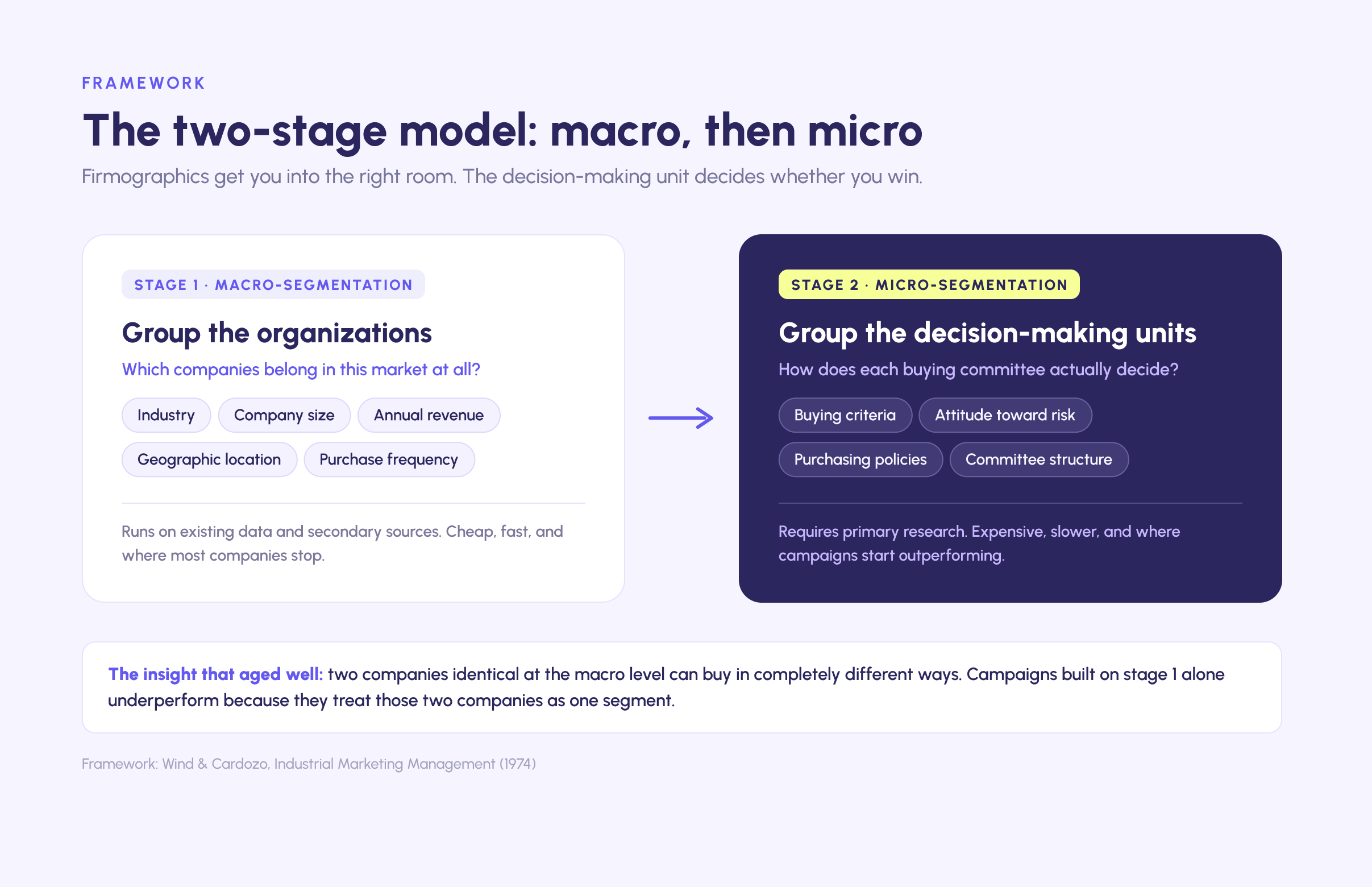
Yoram Wind and Richard Cardozo published the two-stage model in Industrial Marketing Management in 1974, and it remains the most widely applied approach to target market segmentation in industrial markets, as well as the ancestor of most modern market segmentation strategies.
Stage one is macro-segmentation: dividing the B2B market into distinct groups based on observable organizational characteristics. Industry, company size, annual revenue, geographic location, and purchase frequency all qualify. Macro-segmentation runs almost entirely on existing data and secondary sources, which makes it cheap and fast.
Stage two is micro-segmentation: dividing those macro-segments by the characteristics of the decision-making unit itself. Buyig criteria, attitude toward risk, purchasing policies, and the structure of the buying committee. Micro-segmentation requires primary market research, which is why most companies stop at stage one and then wonder why their campaigns underperform.
The model's core insight has aged well: firmographics get you into the right room, but the decision-making unit decides whether you win.
Bonoma and Shapiro: the nested approach
Thomas Bonoma and Benson Shapiro proposed the nested approach in their 1983 book Segmenting the Industrial Market, moving from outer layers (easy to observe, cheap to collect) toward inner layers (subtle, expensive, more predictive):
- Demographics/firmographics: industry, company size, location.
- Operating variables: technology in use, product and brand usage status, customer capabilities.
- Purchasing approaches: how the purchasing function is organized, power structures, existing vendor relationships, purchasing policies and criteria.
- Situational factors: urgency, specific application, order size.
- Personal characteristics: the traits of individual decision makers, their risk tolerance, their loyalty.
The nesting is the point. You work from the outside in, going only as deep as the economics of your market justify. The framework also quietly introduced the term that dominates B2B targeting today: firmographics.

The six types of B2B market segmentation
Modern practice layers several bases rather than choosing one. Here are the six main types of B2B market segmentation, ordered roughly by how often they anchor a segmentation strategy.

Firmographic segmentation
Firmographic segmentation sorts target customers into groups based on structural attributes: industry, company size, annual revenue, geographic location, growth stage, and ownership structure. Firmographics are the B2B equivalent of demographic data in consumer marketing, and they anchor nearly every segmentation process because the data is accessible and objective.
Their limitation is equally structural: firmographics describe who a company is and stay silent on whether it needs you. Two SaaS companies with identical headcount and revenue can have opposite buying priorities. Treat firmographic segmentation as your foundation, never your finished model.
Technographic segmentation
Technographic segmentation groups accounts by the technology they use: their stack, their adoption patterns, and their maturity. For most B2B software companies this is the highest-signal firmographic-adjacent data available. A company running a competitor's product is a displacement opportunity. A company running complementary tools signals integration fit. A company running nothing in your category may need education before it needs a demo.
Behavioral segmentation
Behavioral segmentation sorts existing customers and potential customers into groups based on what they do: purchasing history, product usage, engagement with your content, repeat purchases, and past interactions with sales. In B2B, behavioral segmentation reads organizational behavior, meaning multiple people from one account researching you, rather than one individual's clicks. Behavior is the strongest predictor of future action you have, and it's first party data, which means nobody else has it.
The catch in B2B is volume. You'll have fewer behavioral signals per account than a consumer brand has per user, especially if you don't sell online through a self-serve motion, so behavioral segments work best layered on top of firmographic ones rather than standing alone.
Needs-based segmentation
Needs based segmentation groups companies by the problems they're trying to solve, regardless of their size or industry. Two very different companies can share the same basic needs, and companies that look identical on paper can need entirely different things from you.
Most strategists consider needs-based segments the most accurate reflection of how customers buy. They're also the hardest to operationalize, because needs don't sit in a database column. You uncover them through qualitative and quantitative research: win-loss interviews, customer surveys, social media listening, and structured conversations with existing customers. The jobs-to-be-done school of thought, popularized by Clayton Christensen, takes this furthest by defining segments around the job a customer is hiring your product to do.
Tier-based (value) segmentation
Tier based segmentation groups accounts by their economic value to you: potential deal size, lifetime value, expansion potential, and acquisition costs. This is the segmentation model underneath every account-based marketing program, and it's the one your CFO instinctively understands. High-value target accounts justify personalized campaigns and dedicated sales attention. Lower tiers get scaled, automated programs.
Intent and journey-stage segmentation
The newest layer segments accounts by timing rather than traits. Intent segmentation reads research activity and buying signals to estimate which target accounts are actively evaluating solutions. Journey stage segmentation maps where a buyer sits in the sales funnel, from problem-aware to vendor comparison, and adjusts messaging for each stage of the buyer's journey.
Timing data is powerful precisely because every other segmentation base ignores it. A perfect-fit account that isn't in a buying cycle and a mediocre-fit account that is require completely different plays. The honest caveat: third-party intent data is noisier than vendors claim, so treat it as a prioritization signal rather than gospel.
Market segmentation vs customer segmentation
The two terms blur together in practice, and the blur costs money. They answer different questions.
Market segmentation looks outward at your entire target market, existing customers and potential customers alike, and asks which parts of it you should pursue. It shapes your marketing strategy, the market positioning you can credibly hold, and where your marketing budget goes. In B2B, market segmentation is the layer of marketing strategy that everything downstream inherits.
Customer segmentation looks inward at your existing customers and asks how to serve them differently. Where B2B market segmentation decides who enters your funnel, customer segmentation decides what happens after they convert. Customer segmentation drives onboarding paths, expansion plays, and customer success programs, and it's the fastest lever to improve customer retention. Done well, it shows up directly in customer satisfaction scores, customer retention, and eventually brand loyalty, because customer segments that receive relevant attention renew and expand at higher rates than accounts handled generically.
The two feed each other. Customer segmentation gives you a deeper understanding of who actually succeeds with your product and a deeper understanding of why, and that evidence should reshape your market segmentation, which in turn changes who becomes a customer. Companies that run customer segmentation without ever updating their market segmentation keep acquiring the customers they already know how to lose. Companies that segment the market but never their customer base acquire well, then treat every account identically and leave retention revenue on the table.
One practical rule follows for B2B: build both on the same data spine. If your market segments and your customer segments use incompatible definitions, no one can trace whether the target segments you pursue become the customer segments that retain.
Segments, ICPs, and buyer personas: how they fit together
These three terms get used interchangeably, which creates real strategic confusion. They operate at different altitudes:
- Market segments are groups of companies with shared characteristics. Market segmentation is the analytical work of mapping the whole B2B market and deciding which parts of it you can serve better than anyone else.
- The ideal customer profile (ICP) is the sharpened output of that work: a description of the accounts where you win most often, close fastest, and retain longest. Your ICP should be derived from closed-won revenue data rather than a workshop whiteboard.
- Buyer personas describe the individual decision makers inside those accounts: their roles, their pain points, their objections, and what they need to say internally to champion you. Personas exist so your content speaks to each role in the buying committee, rather than to a generic target audience.
The sequence matters. Segmentation first, ICP second, buyer personas third. Companies that write buyer personas before doing target market segmentation end up with fictional characters marketing to nobody in particular, and no way to market effectively to anyone specific.

There's a subtler trap here that shows up in almost every scaling B2B company: confusing the customers you could win with the customers you should pursue.
"ICP comes down to ideal versus interesting. Ideal is the use case you can replicate over and over. Interesting is bycatch: deals that might close but can't scale. The danger is that interesting profiles create a false sense of product-market fit, when your enterprise customers are all using you for different reasons."— Ferdinand Goetzen, co-founder, The Growth Syndicate

"ICP comes down to ideal versus interesting. Ideal is the use case you can replicate over and over. Interesting is bycatch: deals that might close but can't scale. The danger is that interesting profiles create a false sense of product-market fit, when your enterprise customers are all using you for different reasons."
That distinction is the practical payoff of segmentation done well. A segment full of "interesting" accounts inflates your pipeline and fragments your product roadmap. A segment full of "ideal" accounts compounds: every deal teaches you how to win the next one.
The 95% problem: segmenting a market that is not ready to buy
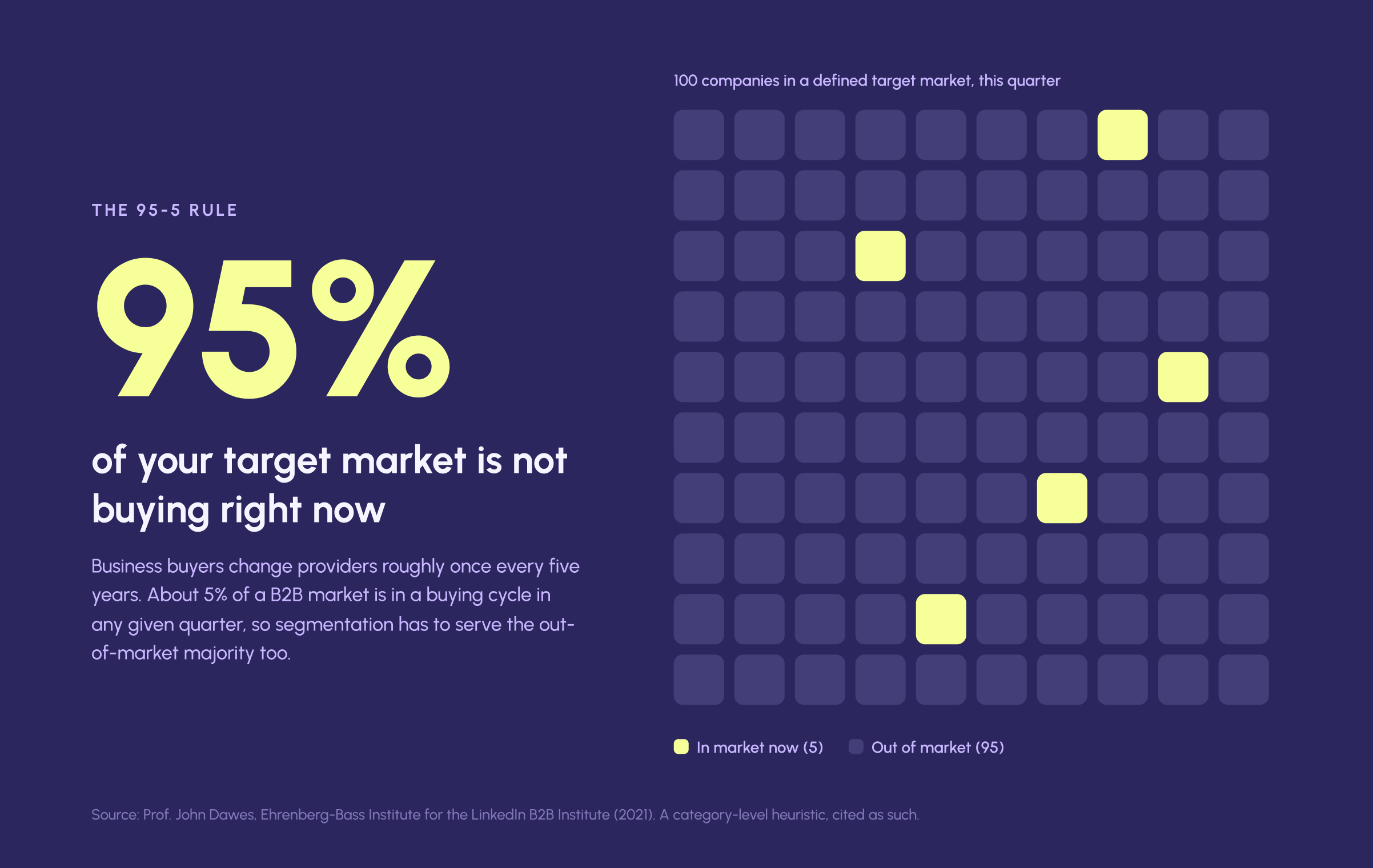
Here is the strategic reality that most market segmentation strategies, and most marketing and sales campaigns built on them, ignore entirely. Professor John Dawes of the Ehrenberg-Bass Institute, writing for the LinkedIn B2B Institute, put a number on it in 2021: businesses change service providers roughly once every five years, which means only about 20% of business buyers are in the market over an entire year, and something like 5% in a given quarter. Put another way, up to 95% of your target market is not buying right now.
The 95-5 split is a heuristic derived from category purchase cycles rather than a universal constant, and Dawes says as much. But the implication holds across nearly every B2B market with a long buying cycle: even a perfectly defined target market is mostly out of market at any given moment.
This changes what segmentation is for. If you build segments purely to feed short-term demand capture, you're competing over the small percentage of in-market buyers along with every competitor you have. Acquisition costs climb, win rates stall, and marketing efforts feel busier every quarter while producing the same pipeline. That squeeze lands hardest on the marketing budget, because paid demand capture gets more expensive as more vendors chase the same in-market accounts.
"Most buyers are out of market at any given time. Winning brands invest in long-term demand generation so that when intent emerges, they're already on the shortlist. The work is balancing demand capture with demand generation."— Clément Dumont, co-founder, The Growth Syndicate
Segmentation earns its keep on both sides of that balance. For the in-market minority, it tells you which accounts deserve immediate, personalized sales attention. For the out-of-market majority, it tells you exactly who should be seeing your brand and reading your content, and which searches your organic presence needs to own during the 12 to 24 months before they enter a buying cycle. The buyer's journey starts long before the first form fill, and segmentation decides whose journey you invest in.
How to run the B2B market segmentation process in six steps
Research treats the segmentation process as a continuous cycle rather than a one-off project. The Journal of Business Research review referenced earlier proposes four ongoing phases: pre-segmentation, segmentation, implementation, and evaluation. The six steps below put that cycle into operational terms.
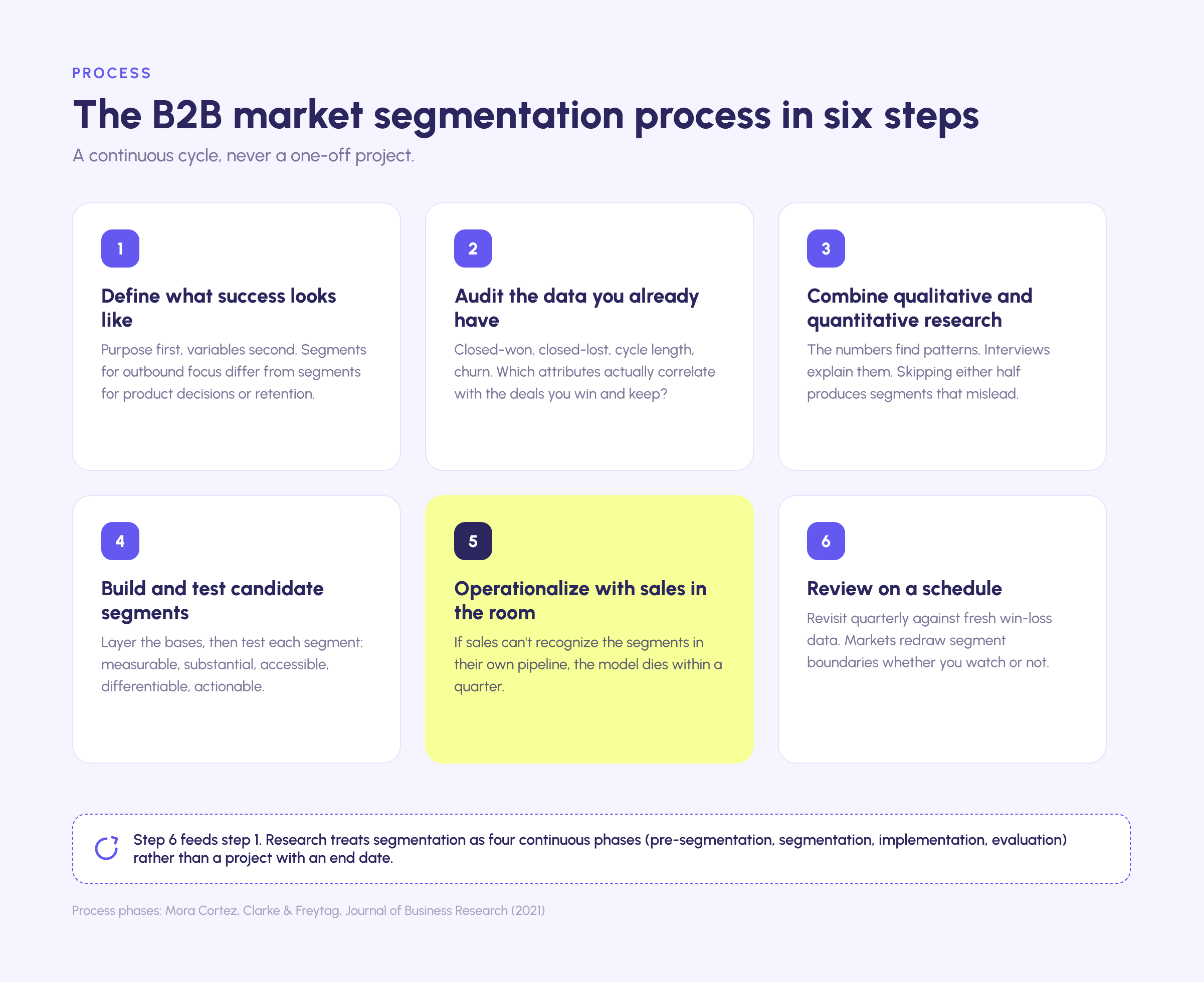
Step 1: Define what success looks like
Decide what the segments are for before you build them. Segments built to focus outbound sales campaigns look different from segments built to guide product development or improve customer retention, and different segments demand different data. Recent research in the Journal of Business Research (Mora Cortez, Clarke, and Freytag, 2025), based on data from 259 managers across four countries, found that the purpose behind segmentation directly shapes which variables companies choose, and through them, the results they get. Purpose first, variables second.
Step 2: Audit the customer data you already have
Your CRM holds the raw material: closed-won deals, closed-lost deals, sales cycle lengths, deal sizes, churn records. Start with existing data before buying any external dataset, then layer in industry reports and third-party firmographic sources until you have a complete picture of each account. The question to answer is uncomfortable and specific: which attributes actually correlate with the deals you win and keep, as opposed to the deals you think you win?
Step 3: Combine qualitative and quantitative research
Quantitative research finds the patterns; qualitative research explains them. Run the numbers on your customer data, then interview the customers behind the patterns. Market research at this stage separates real needs from assumed ones. Win-loss interviews, onboarding conversations, churn interviews, and social media listening reveal the needs and buying triggers that no spreadsheet contains, and give you a deeper understanding of why customers buy in the first place. Skipping the qualitative half is how companies end up with statistically neat segments that make no strategic sense.
Step 4: Build and test candidate segments
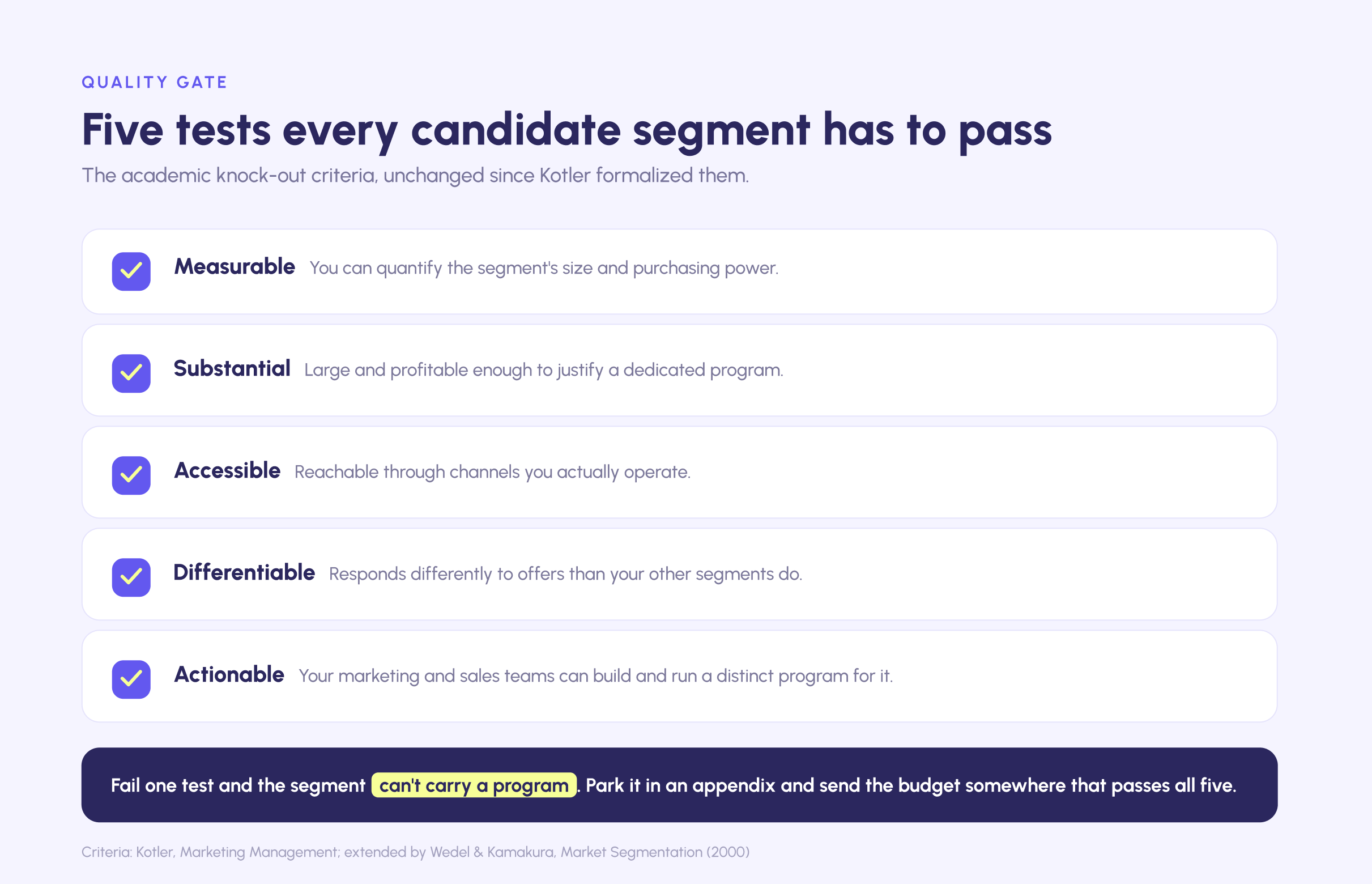
Draft your segments using the bases from earlier in this guide, layered rather than isolated: firmographics for structure, technographics for relevance, behavior and needs for depth. Then test every candidate segment against the criteria the academic literature has used since Kotler formalized them:
- Measurable: you can quantify the segment's size and potential.
- Substantial: it's large and profitable enough to justify a dedicated program.
- Accessible: you can actually reach it through channels you operate.
- Differentiable: it responds differently to different offers than your other segments do.
- Actionable: your marketing and sales teams can build and run distinct programs for it.
A segment that fails any one of these tests belongs in an appendix, and no budget should follow it.
Step 5: Operationalize with sales in the room
Segmentation dies in the handoff. If your sales teams don't recognize the segments in the accounts they work every day, they'll ignore the model within a quarter. Involve sales in defining segments, validate the output against their pipeline, and give sales and marketing teams a shared definition of exactly who a target account is and who it isn't.
"Weekly structured reviews where marketing and sales analyze every new customer and every lost opportunity build the pattern recognition that reveals your true ICP, your effective messaging, and your disqualification criteria. It turns marketing from guesswork into data-driven strategy."— Clément Dumont, co-founder, The Growth Syndicate

"Weekly structured reviews where marketing and sales analyze every new customer and every lost opportunity build the pattern recognition that reveals your true ICP, your effective messaging, and your disqualification criteria. It turns marketing from guesswork into data-driven strategy."
Step 6: Review segments on a schedule
Markets shift and products evolve. New segments emerge as markets mature, and niche segments that were too small to serve last year can become substantial. Companies that treat their segmentation strategy as finished are usually working from a picture of their target market that's two years stale. Revisit the model quarterly against fresh win-loss data, and stay up to date on the forces that redraw segment boundaries: funding cycles, regulation, and technology shifts among them.
Why most segmentation projects fail
The research on why B2B market segmentation fails is more useful than the research on why it succeeds, and it's remarkably consistent. Sally Dibb and Lyndon Simkin's study in Industrial Marketing Management (2001) found that businesses hit predictable implementation barriers, and that many managers overestimate the statistical validity of their segments because their grasp of the underlying method is weak. Substantial investment gets wasted as a result. Five failure patterns account for most of it.

Segments built from assumptions instead of evidence. Teams draft buyer personas in a workshop, nod at them, and never validate anything against revenue data. Sales ignores the output because it doesn't match the accounts in their territory, and they're right to.
Over-segmentation. More segments feel like more precision. In practice, every segment you add divides your marketing budget, your content production, and your team's attention across more marketing and sales campaigns than you can sustain.
"Enterprise marketing fails when it's busy but not cohesive. Teams spread thin across seven ICPs with isolated tactics: a webinar here, a campaign there, an event for another. Nothing compounds, because the activities don't stack on each other."— Joliene van Grieken, co-founder, The Growth Syndicate
.avif)
The fix is subtraction. Serve fewer customers, or rather fewer customer segments, exceptionally well before adding more. Focused pressure on one or two segments beats scattered coverage of seven, because repeated touchpoints across the same buying committees are what move deals.
Analysis without implementation. The segmentation deck gets presented, admired, and archived. Nothing about targeting, messaging, or budget allocation changes. The academic literature calls this the theory-practice gap; in agency work we mostly see it as a slide problem: the model was built to be presented, never to be operated.
Data coverage that can't support the model. A needs-based model is worthless if you can't identify which segment a new account belongs to without interviewing them. Your segmentation can only be as granular as the customer data you can reliably collect at scale.
No connection to how customers buy. Segments organized around your product lines or your org chart, rather than around buyer needs and buying behavior, accurately identify nothing except your own internal politics. Two segments that share the same basic needs and buy the same way should usually be one segment.
From segments to account-based marketing
Account-based marketing is what happens when tier based segmentation gets an execution engine. You segment the target market, identify high-value target accounts, and run coordinated, personalized campaigns against them, with sales and marketing teams working the same list. Done well, the results are real: in Momentum ITSMA's 2024 Global ABM Benchmark, 81% of the 300+ B2B marketers surveyed reported higher ROI from ABM than from other marketing initiatives, and Forrester's 2024 data puts the most common advantage at 21 to 50% over other marketing. Self-reported and vendor-sponsored research, so hold it loosely, but the direction matches what we see in client work.
"True one-to-one ABM only makes economic sense when you're targeting deals of at least 300K a year. Most B2B companies work with 10 to 15K deals and can't justify concentrating everything on a single account. ABM at scale, meaning 300 to 500 accounts, is really just focused marketing."
The part most ABM content skips is the economics of tiering. Personalization has a cost floor, and it decides which accounts justify which treatment.
"True one-to-one ABM only makes economic sense when you're targeting deals of at least 300K a year. Most B2B companies work with 10 to 15K deals and can't justify concentrating everything on a single account. ABM at scale, meaning 300 to 500 accounts, is really just focused marketing."— Clément Dumont, co-founder, The Growth Syndicate

One pattern from our own engagements shows what the segmentation-to-ABM handoff looks like in practice. On one Nordic engagement where marketing had been written off as a support function, the turnaround started with radical narrowing: one or two industries, one or two geographies, a single account list built together with one willing sales rep. Marketing shared engagement data as it arrived; he ran the outreach. He later described it as the easiest selling he'd ever done, and the model expanded from there.
The lesson generalizes. Narrow first, prove the motion in one segment, then expand. Segmentation gives ABM its account list, and sales and marketing alignment gives that list teeth, because a segmented campaign with no sales follow-through is just a well-organized brand awareness program.
AI, predictive analytics, and dynamic segmentation
The tooling around segmentation has changed more in five years than in the previous thirty. Machine learning clustering surfaces niche segments that manual rules miss. Predictive analytics scores target accounts on fit and likelihood to convert. Customer data platforms recalculate segment membership as behavior changes, which turns segmentation from an annual project into a living system: dynamic segmentation.
Three honest caveats before you budget for any of it:
- Data quality is the binding constraint. Clustering algorithms applied to an incomplete or dirty CRM produce statistically confident nonsense. Fix coverage first.
- AI finds patterns; it doesn't set strategy. A model can tell you that a cluster of accounts behaves similarly. It can't tell you whether serving that cluster fits your positioning, your pricing, or your roadmap. The judgment layer stays human.
- Effectiveness data is thin. Adoption statistics for AI-driven segmentation circulate widely and trace back to vendor surveys with undisclosed methods. Run your own before-and-after numbers instead of borrowing someone else's.
Where the machinery genuinely pays off is personalization at scale. McKinsey's personalization research puts the revenue lift from effective personalization most often at 10 to 15%, with customer acquisition cost reductions of as much as 50%, and finds faster-growing companies drive 40% more of their revenue from personalization than slower-growing peers. Consumer-weighted research, but the mechanism transfers: personalization requires market segmentation, because you cannot deliver highly relevant campaigns to a target audience you haven't defined. That extends to retention as well. Segmented onboarding and customer success programs improve customer retention because expansion and brand loyalty follow from customers feeling understood, and existing customers respond to relevance just as strongly as potential customers do. Personalized campaigns for the accounts you already serve are usually the cheapest revenue available.
Frequently asked questions about B2B market segmentation
What are the 6 main types of market segmentation for B2B?
The six types of B2B market segmentation are firmographic (industry, company size, location), technographic (technology stack), behavioral (engagement and purchase history), needs-based (problems to solve), tier-based (customer value), and intent or journey-stage segmentation (buying signals and timing). Most effective market segmentation strategies layer several types rather than relying on one.
What are the four types of B2B?
The four commonly cited types of B2B markets are producers (companies that buy inputs to make products), resellers (distributors and retailers who sell your product onward), governments (public sector buyers at every level), and institutions (hospitals, universities, nonprofits). Each behaves differently as a market segment, with distinct procurement rules, buying cycles, and decision makers, so each demands its own segmentation strategy.
What is the rule of 7 in B2B?
The rule of 7 is an old advertising heuristic claiming a prospect needs about seven exposures to a brand before acting. There's no rigorous study behind the specific number, so treat it as folklore with a valid core: B2B buyers genuinely need many touchpoints across multiple stakeholders before intent forms, which modern buying-committee research from Gartner and Forrester confirms in principle, if never with a magic number.
What is a good example of B2B?
A good example of B2B market segmentation in software: a cybersecurity vendor segments its market into mid-market financial services firms (compliance-driven, fast cycles), enterprise healthcare (long cycles, multiple stakeholders, integration-heavy), and MSPs who resell to their own clients. Each segment gets its own messaging, proof points, and channel mix, because each buys for different reasons.
How is B2B segmentation different from B2C segmentation?
B2C segmentation groups individual consumers, typically by demographics, psychographics, and behavior. B2B market segmentation groups organizations, which means firmographic and technographic data replace demographic data, buying committees replace individual buyers, and sales cycles run months instead of minutes. B2B also involves far fewer customers per segment, so each segment decision carries more revenue weight, and customer segmentation of the existing base matters proportionally more.
How many segments should a B2B company have?
Fewer than you think. Most B2B companies can market effectively to two or four target segments at once; beyond that, budgets and attention fragment and nothing compounds. Start with the one or two target segments where your win rate, deal size, and retention are strongest, prove the motion, and expand deliberately. New segments should be earned by capacity rather than added by ambition.
.png)