.svg)


What is B2B lead qualification?
B2B lead qualification is the process of deciding which potential customers deserve sales time, based on how closely they match your ideal customer profile (ICP), whether they show real buying intent, and whether a purchase is plausible within a workable timeframe. It sits between lead generation and the sales process, and it fails most often for one reason: marketing and sales never agreed on what a qualified lead is.
Most guides to B2B lead qualification are a menu. BANT, CHAMP, MEDDIC. Pick one, apply it, watch conversion improve. The menu is not wrong. It answers the easy question.
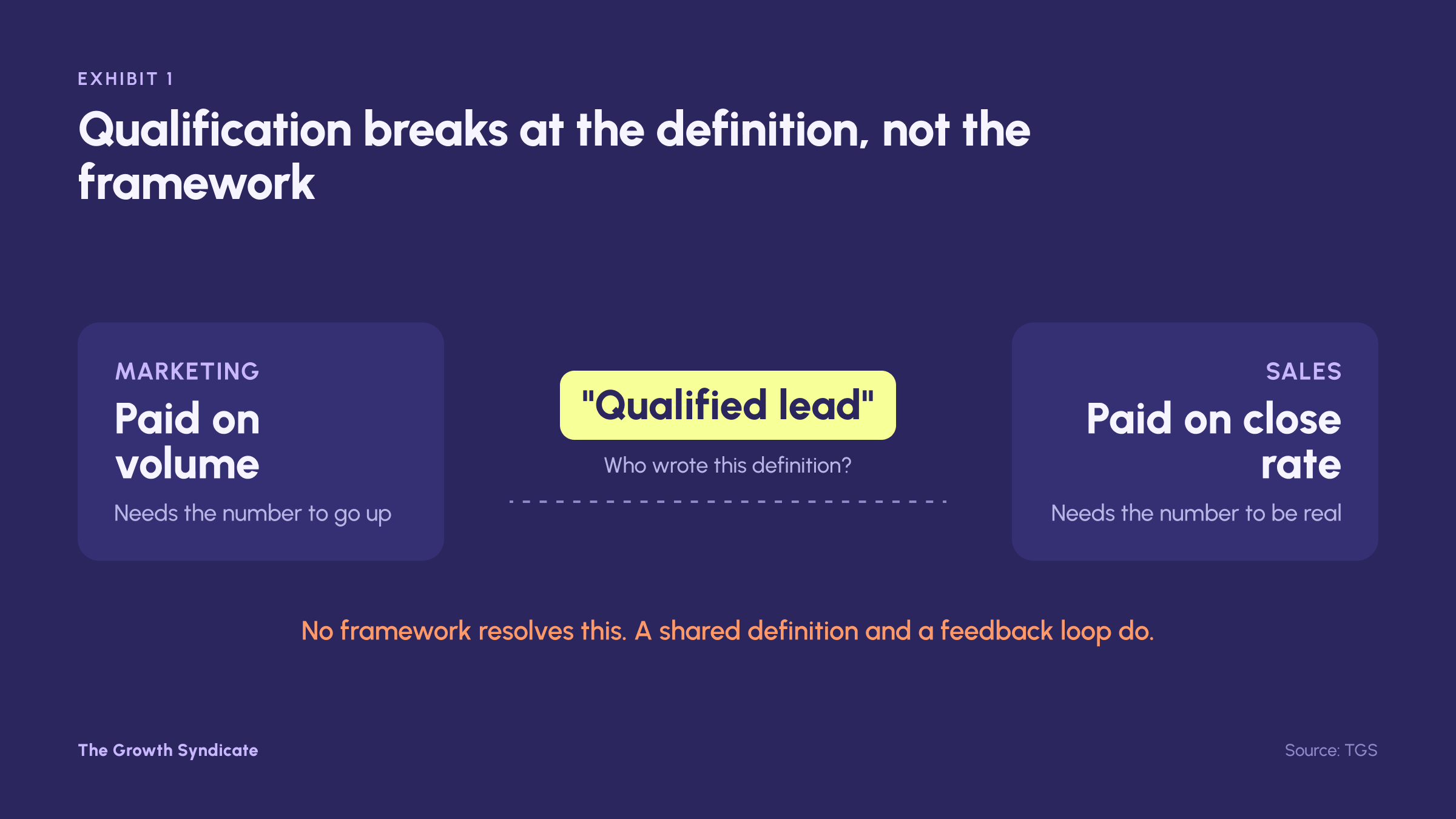
The hard question is structural. Lead qualification is usually performed by the marketing team, which is paid on volume, on leads that will be judged by the sales team, which is paid on close rate. Marketing needs the number to go up. Sales needs the number to be real. No framework resolves that tension, because frameworks operate on individual leads while the problem lives in the definition of a lead itself.
This article covers the mechanics. It walks through the four types of qualified leads and where their definitions drift, the major lead qualification frameworks and when each one earns its keep, the evidence on whether lead scoring works, the long argument over whether the MQL is dead, and the benchmarks worth trusting. It also covers what changed at Frends, a Finnish integration platform company, where MQL-to-SQL conversion went from 14% to 30% without anyone introducing a new framework.
The organizational half of that story, how marketing and sales stop blaming each other, belongs to our guide to sales and marketing alignment. This piece owns what happens to the lead.
Why lead qualification breaks before any framework is applied
Forrester's waterfall benchmarks put inquiry-to-closed-won conversion in a typical lead-centric process below 1%. In Forrester's own framing, the cross-functional process that turns early interest into revenue fails more than 99% of the time. Some of that is the nature of B2B buying. A large share of it is a definitional problem wearing a performance problem's clothes.
Three things go wrong, in sequence.
The definition is written by the team that is measured on it. When marketing owns the MQL count, the MQL definition widens until the count looks healthy. Every form fill becomes a lead: newsletter signups, gated PDF downloads, webinar registrations, the Gmail addresses, the students, the competitors doing research. The dashboard glows. The pipeline does not move. Unqualified leads flow to the CRM, and sales reps spend a quarter working them before learning to ignore anything marketing sends.
Sales rejects without explaining. A lead marked "not a fit" or "no response" is not feedback. It is noise with a timestamp. Without a structured rejection reason, marketing cannot see whether the problem is company size, seniority, geography, timing, or a lead that was simply routed to the wrong rep on a Friday afternoon. So marketing hears complaints, sales teams keep rejecting, and the loop never closes.
Both teams are reading from different dictionaries. Two companies in the same vertical can report 13% and 40% MQL-to-SQL conversion and both be telling the truth. One counts every form submission; the other counts only ICP-matched contacts with a demo request. Comparing the two numbers tells you nothing, and comparing your own number against either tells you less.
.avif)
The framework you choose sits downstream of all three problems. A rigorous MEDDIC discovery call run on a lead that should never have reached sales is expensive theater. Fix the definition first, then argue about frameworks.
The four types of qualified leads, and where each definition drifts
There are four types of qualified leads in most B2B pipelines: the marketing qualified lead (MQL), the sales accepted lead (SAL), the sales qualified lead (SQL), and the product qualified lead (PQL). Each one marks a handoff, and each handoff is where definitions quietly loosen.
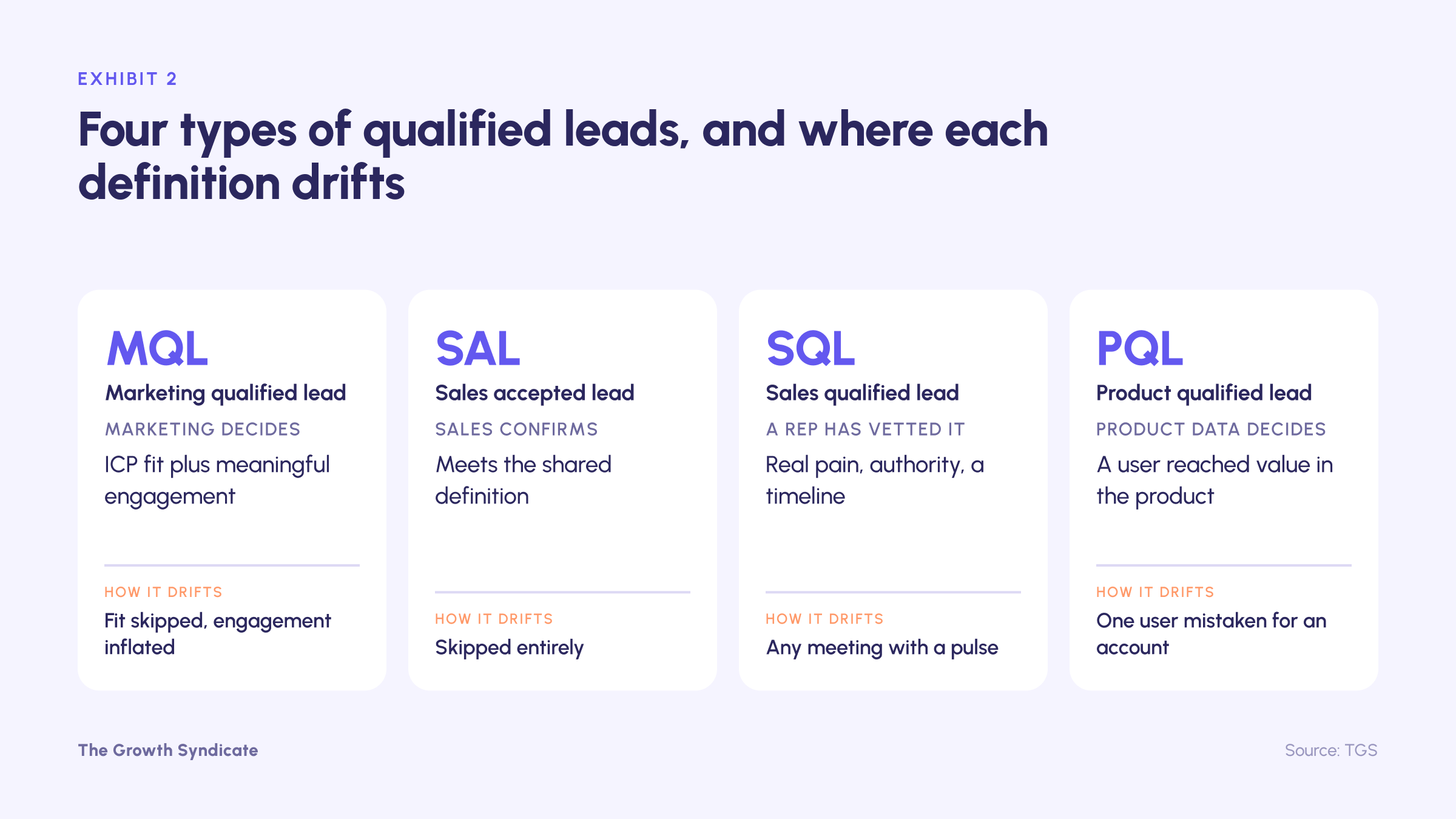
The marketing qualified lead is a contact marketing believes is likelier to buy, based on demographic and firmographic data that match the ICP, plus engagement that suggests initial interest. The trouble starts when the two halves get uncoupled. A demo request from a target account and a checklist download from a student are not the same lead, and a definition that treats them the same has already failed.
The sales accepted lead is the checkpoint most teams skip. It is the moment sales confirms that what marketing sent meets the agreed criteria before anyone works it. Skipping it removes the only structured place where a rejection reason can be captured, which is the raw material for improving the definition.
The sales qualified lead has been vetted by a rep. There is a real problem, someone with authority or influence over the purchase, and a timeframe that is not "someday." In most organizations an SQL also has a meeting on the calendar. These are the sales ready leads a rep should be working. The failure mode is the meeting-with-a-pulse: sales reps booking anything that will accept an invite because the quota counts meetings, not outcomes. The result is a calendar full of unqualified leads with SQL labels on them.
Product qualified leads belong to product-led companies. A user has hit an activation milestone, connected an integration, invited teammates, or crossed a usage threshold. The stronger B2B signal is the product qualified account (PQA), where several users at the same company cross those thresholds together. Elena Verna, who ran growth at Miro, has said it took the company 12 to 18 months to settle on a PQA definition it was happy with, which says something about how hard the definition is even when the data is clean.
Everything else in a modern lead qualification process is a question of how leads move between these four stages, and what has to be true before they do.
B2B lead qualification frameworks compared
Lead qualification frameworks give sales reps a structure for the sales conversation. They tell a rep what to find out and in what order. The right one depends on deal size, sales cycle length, and how many people sit on the buying side. Here is the field.
BANT: still the most used, and the most criticized
BANT is the oldest framework on the list and still the most common. A 2023 Gartner Digital Markets survey, as reported by Outreach (the original page has since been retired along with the Digital Markets brand), found that more than half of salespeople consider BANT reliable for qualifying prospects, with 41% valuing its flexibility. It is fast, it is teachable, and it fits a five-minute first call.
Its weaknesses are the weaknesses of the era it came from. BANT assumes one decision-maker with a defined budget, which is rarely how a purchase with multiple stakeholders works. Forrester's State of Business Buying, 2026 reports that a typical purchase now involves 13 internal stakeholders and nine external influencers, and that 73% of purchases span three or more departments. A budget gate applied on the first call disqualifies good-fit opportunities before anyone has built the business case that would create the budget. Trish Bertuzzi's line about BANT, that it is like going on a first date and asking for a credit report, has aged well.
CHAMP: challenges first, money later
CHAMP reorders BANT so the conversation opens with the prospect's pain points and the money question arrives once a problem worth paying for has been established. It suits consultative sales where budget is discovered rather than declared. It shares BANT's blind spot on multiple stakeholders.
MEDDIC and MEDDPICC: rigor for enterprise deals
MEDDIC is a discovery discipline more than a checklist. Metrics ask what measurable outcome the buyer wants. The economic buyer is the person who can release funds. Decision criteria and decision process describe how the account will evaluate and approve. Identify pain forces the rep to name the pain points in the buyer's own terms. The champion is the internal advocate who will sell when the rep is not in the room.
MEDDPICC adds paper process (legal, security, procurement) and competition, both of which routinely kill enterprise deals that were "qualified" on every other dimension. The cost is time. A proper MEDDIC discovery runs 30 to 90 minutes and needs a rep who can hold the whole picture. Applied by an SDR on a first touch, it produces guesses formatted as data.
SPICED: built for recurring revenue
Winning by Design's SPICED is a diagnostic framework. Situation and pain establish where the buyer is; impact quantifies what the pain costs; critical event identifies the date that makes inaction expensive; decision maps how the buyer will choose. It was designed to travel across marketing, sales, and customer success, which makes it a natural fit for SaaS businesses where qualification does not end at the signature.
Which lead qualification framework to use
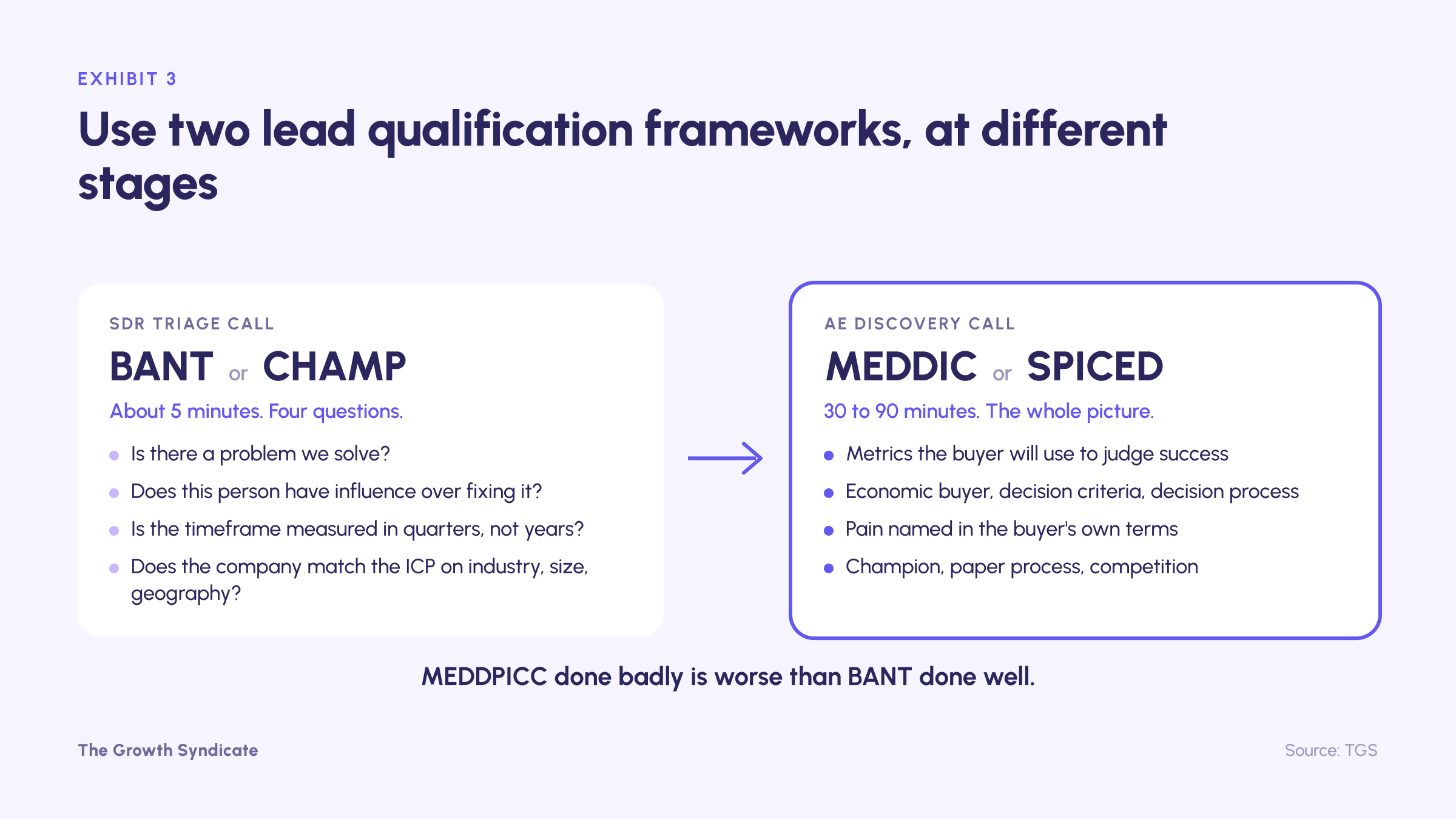
The practical answer is two lead qualification frameworks, used at different stages. Run something light at the top of the funnel and something rigorous once a deal is real. An SDR triage call needs four questions: is there a problem we solve, does this person have influence over fixing it, is the timeframe measurable in quarters rather than years, and does the company match our ICP on the basic criteria of industry, company size, and geography. That is BANT or CHAMP territory. The qualification criteria are deliberately loose, and the call takes five minutes.
The AE discovery call is where MEDDIC or SPICED earns its cost. Asking an SDR to qualify the decision process or identify the economic buyer on a cold first conversation produces nothing useful, because the prospect does not know yet either.
The framework matters less than most articles suggest. What determines sales success is the volume of qualifying conversations a team can hold per week, how quickly those conversations happen after a lead raises a hand, and whether the leads reaching sales reps deserved to be there. MEDDPICC done badly is worse than BANT done well.
Does lead scoring work?
Lead scoring quantifies lead qualification. It assigns points to a lead's fit and behavioral signals so that the CRM, rather than a human, does the work of prioritizing leads. In theory it produces qualified leads at scale, and it is in nearly every marketing automation platform. The evidence that scoring leads improves conversion is thin.
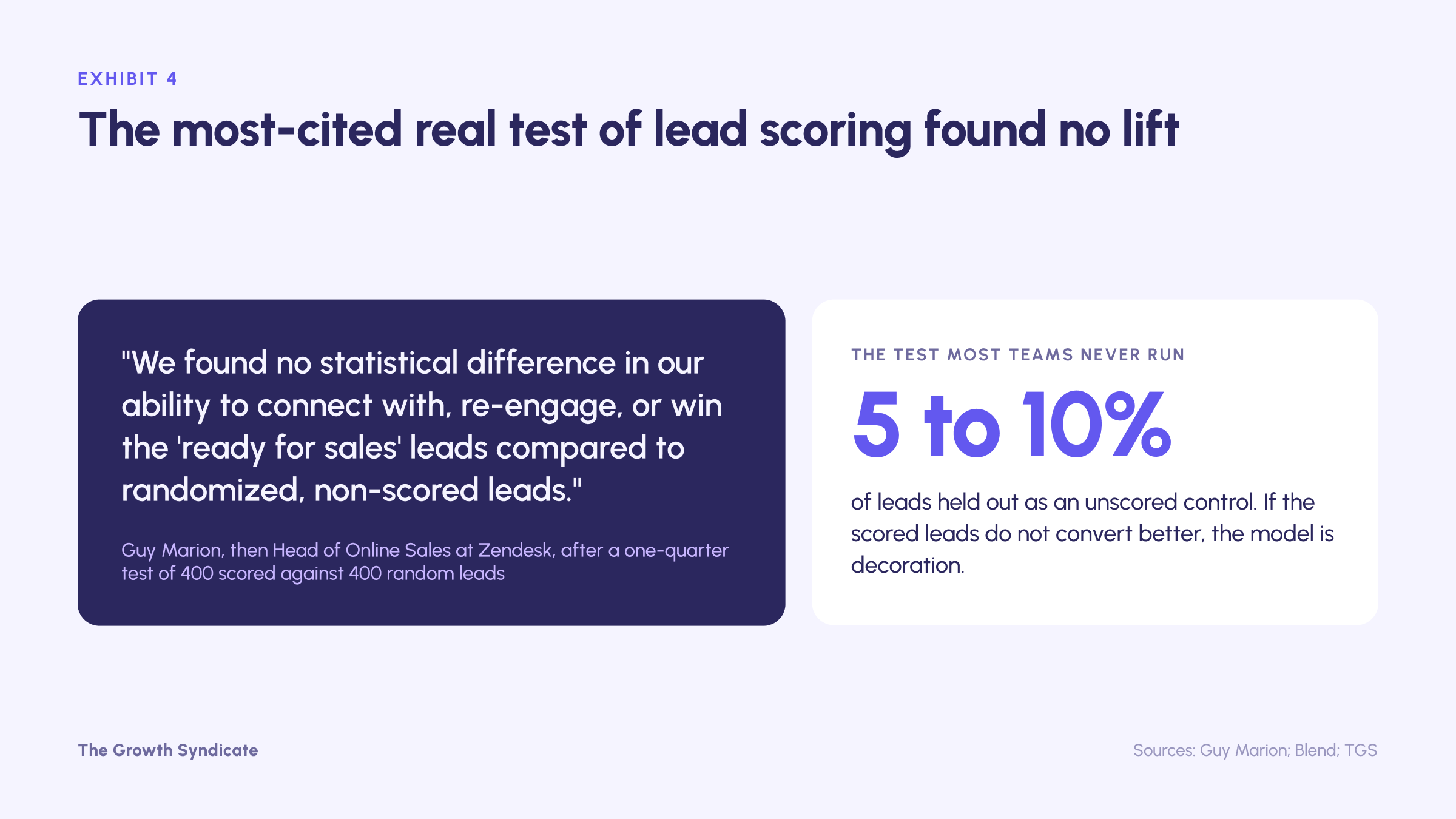
The most-cited real experiment comes from Guy Marion's time running online sales at Zendesk. Over one quarter, his team worked 400 scored "sales-ready" leads against 400 random unscored ones. His conclusion, in his own words: "we found no statistical difference in our ability to connect with, re-engage, or win the 'ready for sales' leads compared to randomized, non-scored leads." Mark Roberge, HubSpot's former CRO, wrote in The Sales Acceleration Formula that HubSpot tried lead scoring, ran into problems, and replaced it with a matrix of buyer persona and journey stage.
The reason is structural. Phil Vallender of Blend puts it plainly: the behaviors that get scored often do not correlate with intent to purchase, and buyers avoid doing the things that would score them. Serious buyers read the pricing page and the documentation. They do not download three ebooks and attend a webinar. The behaviors that rack up points belong to researchers, students, and competitors, and the best leads often score lowest.
That does not make scoring useless. It makes most lead scoring models useless. A lead scoring process that works has a few properties most do not:
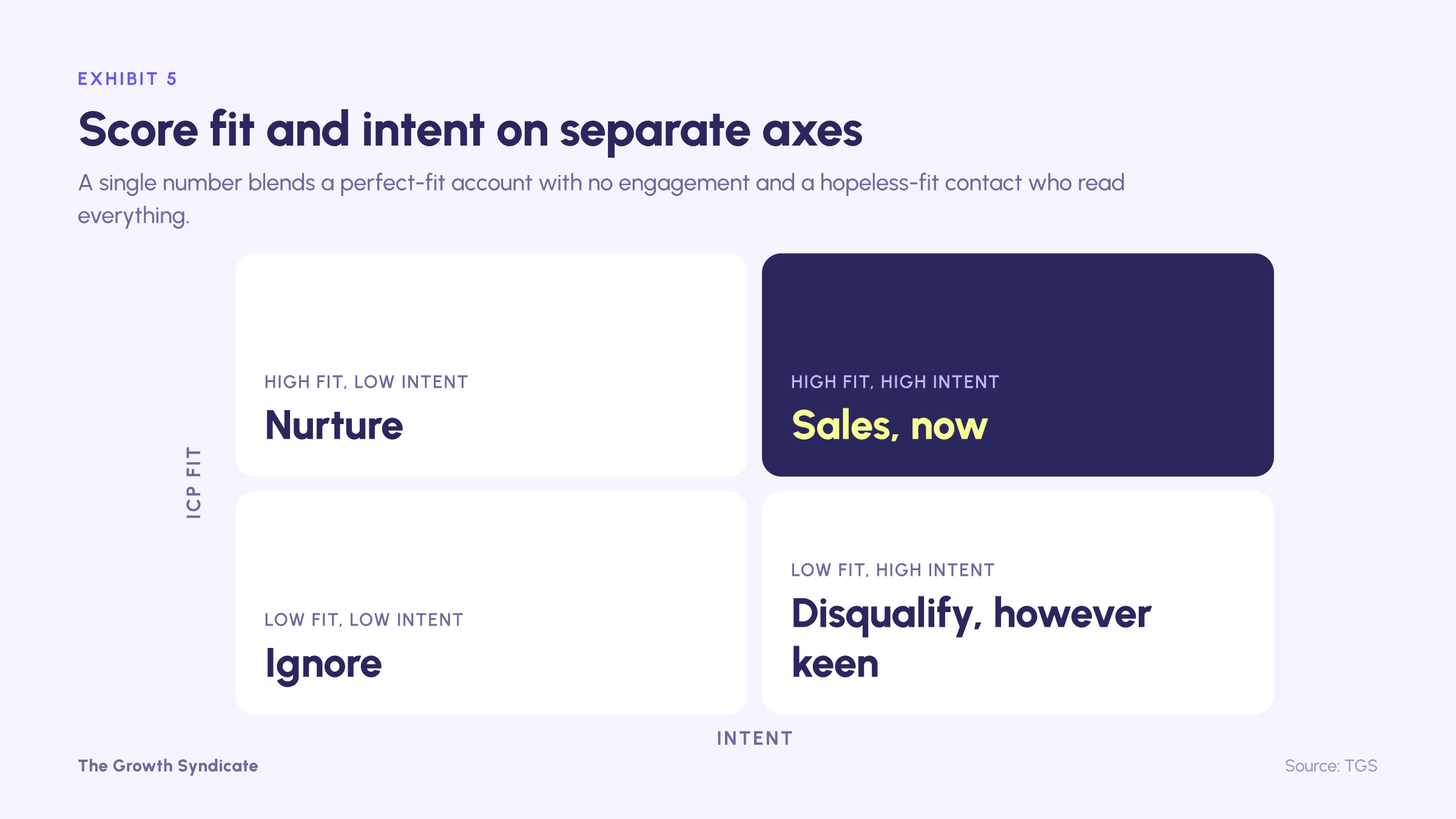
- Fit and intent scored on separate axes. A single number blends a perfect-fit account with no engagement and a hopeless-fit contact who read everything. Keep them apart. High fit and high intent goes to sales now. High fit and low intent goes to nurture. Low fit and high intent gets disqualified, however enthusiastic.
- Negative scoring as standard. Free email domains, student roles, competitor domains, and geographies you do not serve should subtract points, not merely fail to add them.
- Thresholds derived from your own data. The MQL threshold should be the score at which sales acceptance actually rises in your CRM history, not 70 because 70 sounds right. If 80% of the database sits above the threshold, the threshold is doing no work.
- A score the rep can see. A number buried in a CRM field nobody surfaces changes nobody's behavior.
- A holdout. Reserve 5% to 10% of leads as an unscored control and track whether the scored leads convert better. Few teams do this, which is why few teams can prove their model adds anything.
- A recalibration cadence. Every 90 days at minimum, and sooner if a new segment, product, or channel changes who is arriving.
Automated lead scoring, including the predictive models built into HubSpot and Salesforce, inherits every one of these problems plus one more: it learns from historical data, so a company with a few hundred closed deals is training a model on noise. Predictive scoring rewards companies with volume. Below that, a well-built manual model with a holdout beats it.
Is the MQL dead?
The marketing qualified lead has been declared dead every year since roughly 2018. The argument deserves a fair hearing on both sides, because the loudest version of it is used to excuse teams from fixing their definitions.
The case against the MQL
The most credible critique comes from Forrester and from Kerry Cunningham, who spent years at SiriusDecisions, the firm that invented the demand waterfall in 2006, co-created its 2017 successor, and now argues against the model he helped ship. He is head of research at 6sense, which sells the alternative, and that interest is worth holding in mind while reading him. His position is that the MQL was an accident of software design. Early marketing automation platforms modeled the individual contact because the contact was the easy object to build around, and the industry then spent 15 years pretending that B2B purchases are made by individuals. They are not. Forrester's numbers on buying groups, 13 internal stakeholders and nine external influencers, make the point. A model that qualifies one person at a time will keep discarding the other twelve.
Forrester's successor model qualifies the buying group: a set of people at one account who share a need, where the qualification question becomes whether the group as a whole is showing intent. Reltio, a data management company, moved from MQLs to buying-group qualification in a 60-day implementation in early 2023, after roughly six months of internal groundwork, according to Forrester's account of the project. Account-based marketing runs on the same logic, which is why the marketing qualified account (MQA) has become the operating unit for teams that sell to committees.
The case for the MQL
The counterargument is quieter and better supported by survey data than its critics admit. 6sense, itself a vendor with an interest in retiring the MQL, surveyed 634 B2B marketers in 2025 and found that nearly half of ABM adopters still measure success by MQLs. Kamil Rextin of 42 Agency argues the MQL is a leading indicator, valuable precisely in longer sales cycles where pipeline and revenue arrive too late to tell you whether marketing is working. Tom Keefe makes a sharper point: if you have a demo form on your site, you are still using MQLs. That behavior needs a name and a process, whatever you call it. And without a defined MQL, SLAs lose their anchor. It becomes harder to hold sales teams to a response time when there is no agreed object to respond to.
Where we land
Both sides are right about different deals. For committee-driven B2B sales, the individual lead is the wrong unit, and buying-group or account-level qualification is the honest way to model what is happening. For shorter cycles and smaller deals, an individual with a demo request is a perfectly good unit, and pretending otherwise adds ceremony without insight.
What neither side should be allowed to do is drop the definition. Whatever the unit, qualified leads are defined by fit and intent together. The MQL is a useful leading indicator and a necessary scaffold for SLAs, provided the definition includes ICP fit and a real intent signal, and provided it never becomes the number reported to the board. That number is pipeline, split into marketing-owned and marketing-supported, and it is where our guide to B2B marketing attribution picks up.

"If you create joint KPIs between departments, they have to work hand in hand. The goal should always be more revenue. So marketing can say: which are the best customers we can get, and how can marketing support getting those clients, and not just MQLs? The people we bring should be people that turn into customers."
How to qualify B2B leads: the shared definition and the feedback loop
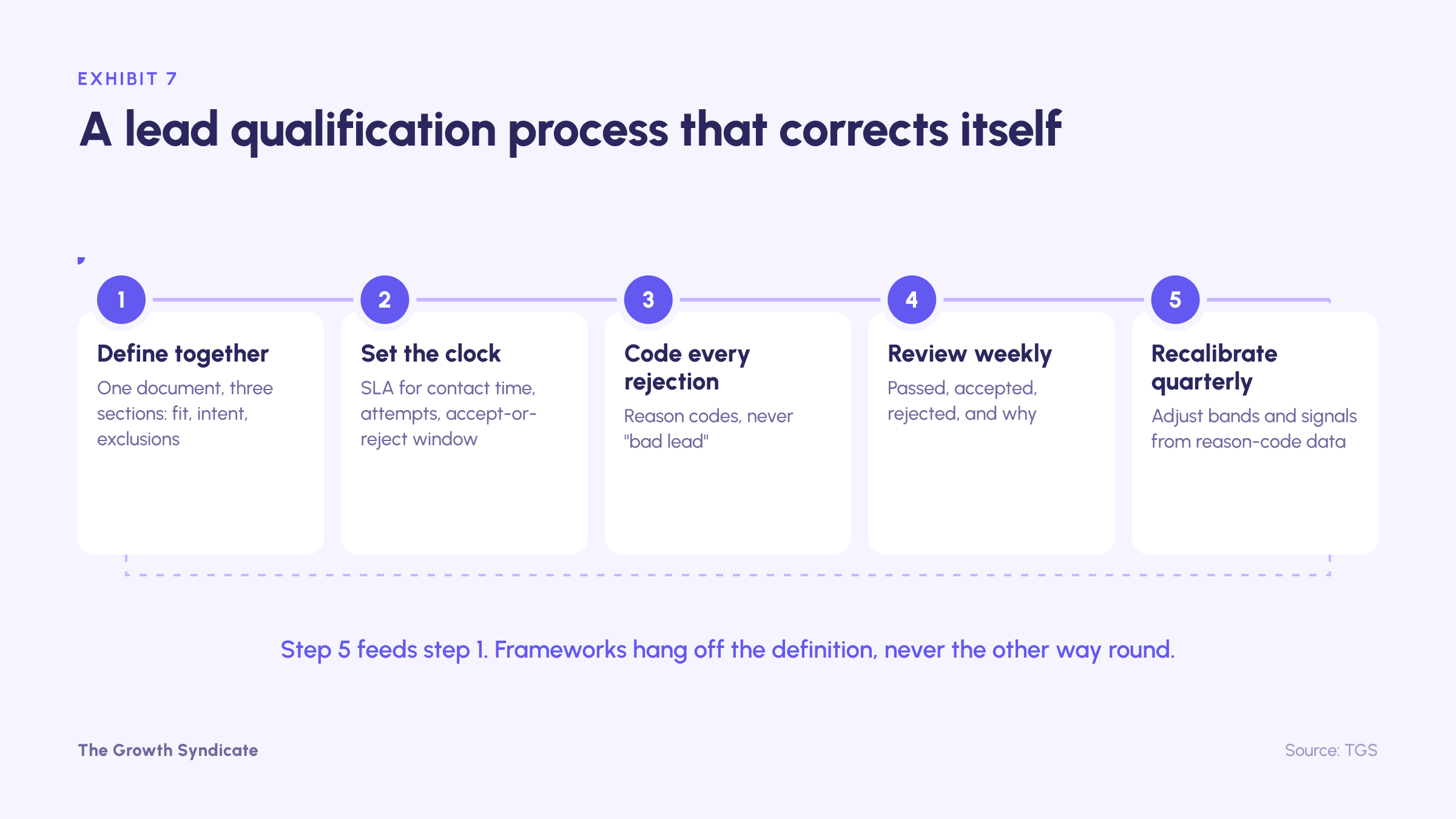
A lead qualification process that survives contact with a real sales team has two parts. A definition both teams signed, and a loop that corrects the definition when it proves wrong. Everything else, frameworks included, hangs off those two.
Step one: write the definition in one room
Marketing and sales teams draft the definition of qualified leads together, in a single document, with three sections.
Fit criteria describe the company, not the person: target industry, company size (revenue or headcount, pick one and define the band), geography, and any technographic requirement such as a CRM or platform the product depends on. This is your ideal customer profile (ICP) made operational, and if the ICP itself is fuzzy, our guide to building an ideal customer profile covers the research behind it.
Intent criteria describe what the person did. Be specific about which buying signals count and which do not. A demo request counts. A pricing page visit from an ICP-matched account counts. A gated ebook download does not, on its own. Website visits from a known account should raise attention without triggering a handoff.
Exclusions describe who never qualifies regardless of behavior: competitors, students, agencies researching on behalf of unnamed clients, free email domains for enterprise products, and whatever else your closed-lost data tells you. Closed-lost data is the jumping off point for this list, and the list should grow every quarter.
Step two: agree the handoff and the clock
Speed-to-lead is the one lever in lead qualification with consistent evidence behind it. The original study is James Oldroyd's Lead Response Management research from 2007, run at MIT Sloan with InsideSales.com, which found that firms contacting a web lead within five minutes were roughly 100 times likelier to make contact and 21 times likelier to qualify the lead than those waiting 30 minutes. A separate 2011 Harvard Business Review article by Oldroyd and colleagues audited 2,241 companies and found an average first response of 42 hours, which is where the "Harvard" attribution comes from. Both studies are old, both rest on vendor or audit data rather than a controlled trial, and the two are routinely blended into one. The directional finding has been reproduced often enough to trust.
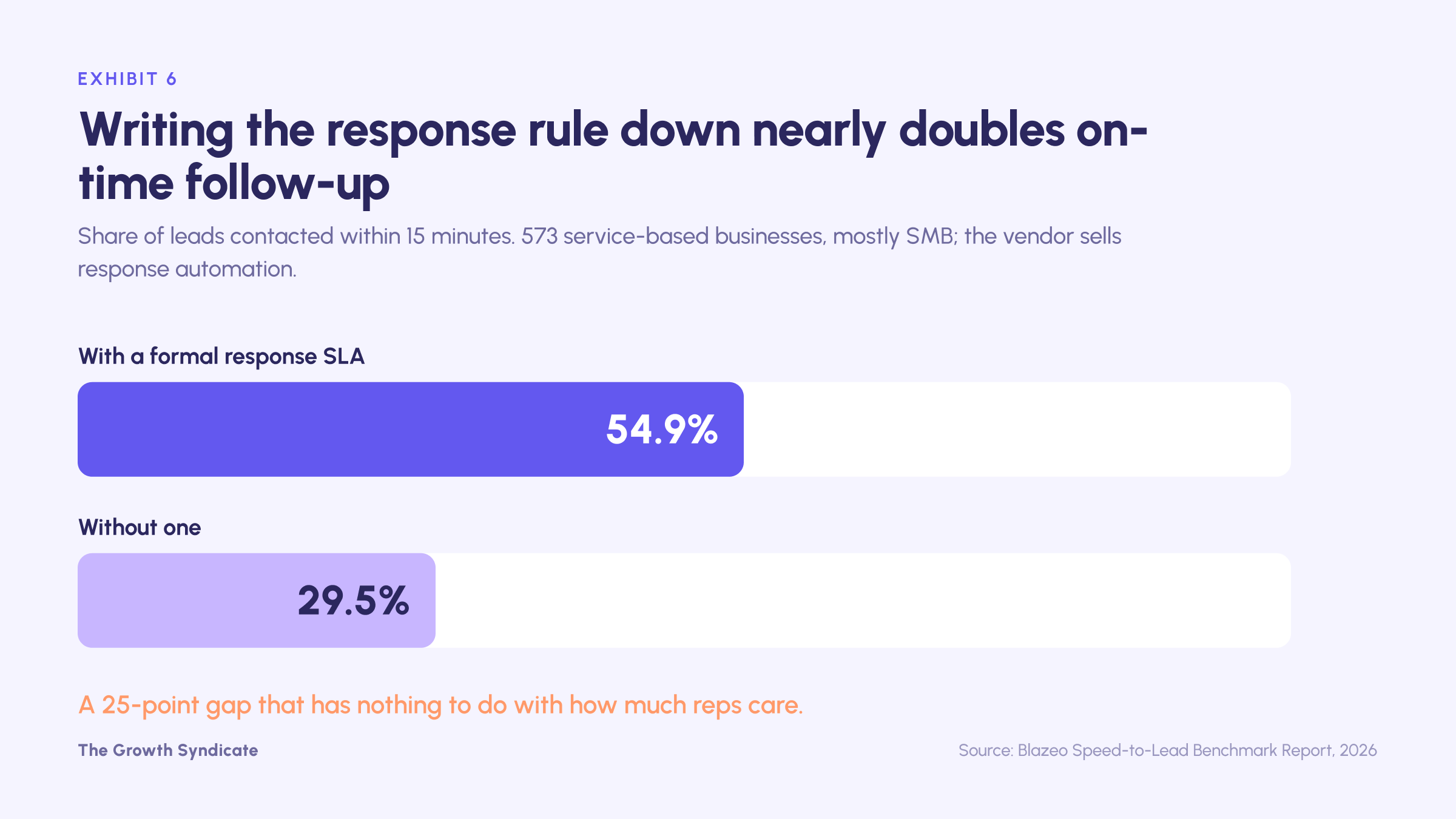
The more useful modern number concerns process rather than heroics. Blazeo's 2026 report across 573 service-based businesses found that companies with a formal response SLA hit a 15-minute standard 54.9% of the time, against 29.5% for those without one. The sample is small-business services rather than B2B software, and Blazeo sells response automation, so the number is a signal rather than a benchmark. The signal is still useful: a 25-point gap that has nothing to do with how much reps care and everything to do with whether someone wrote the rule down.
The SLA should specify how fast qualified leads are contacted, how many attempts are made before it is returned, and how long sales has to accept or reject before the lead is escalated.
Step three: make rejection structured
Every rejected lead carries a reason code chosen from a short list: wrong company size, wrong industry, wrong role, no timeline, competitor, duplicate, could not reach. "Bad lead" is not on the list. Neither is "no response," which describes what sales did, not what was wrong with the lead.
Reason codes turn rejection from an argument into a dataset. When 30% of rejections in a quarter cite company size, the definition's size band is wrong, and that is a fixable problem with a name.
Step four: review weekly, recalibrate quarterly
A short weekly session where sales and marketing look at what was passed, what was accepted, what was rejected and why. Not a status meeting, a review of the definition against reality. Then a quarterly recalibration where the fit bands, intent signals, and exclusions are adjusted using the reason-code data, the closed-won profile, and whatever the sales team learned in discovery. RevOps, or sales operations where no RevOps function exists, owns the model itself: the scoring logic, the SLA, the reason codes, and the recalibration calendar.
Step five: treat disqualification as an outcome
Sales reps should disqualify readily and early. A prospect who fails on fit or timing is not a failure; they are a data point and possibly a future customer. Unqualified leads that fail on fit leave the pipeline entirely. Those that fail only on timing go to a nurture loop with a defined exit, not a permanent "working" status. Closed-lost accounts are re-approached on a schedule tied to the reason they were lost, because a budget that did not exist in Q1 may exist in Q4.
A lead qualification checklist
For teams that want the short version, the lead qualification checklist below is it. Qualified leads should clear every line before they reach a rep:
- Company matches the ICP on industry, company size, and geography
- Contact holds a role with influence over the purchase, or a plausible path to someone who does
- At least one high-intent action from the agreed list, not a passive engagement signal
- No exclusion criteria triggered
- Contacted within the SLA window
- Reason code captured if rejected, and the lead routed to nurture or disqualified rather than left open
What changed at Frends: 14% to 30% without a new framework
Frends is a Finnish integration platform (iPaaS) selling into enterprise IT, where deals involve multiple stakeholders and sales cycles run for months. When TGS began working with them in late 2024, MQL-to-SQL conversion sat at 14%. By the time the work was documented it had reached 30%. No new qualification framework was introduced. The qualification process changed in three ways.
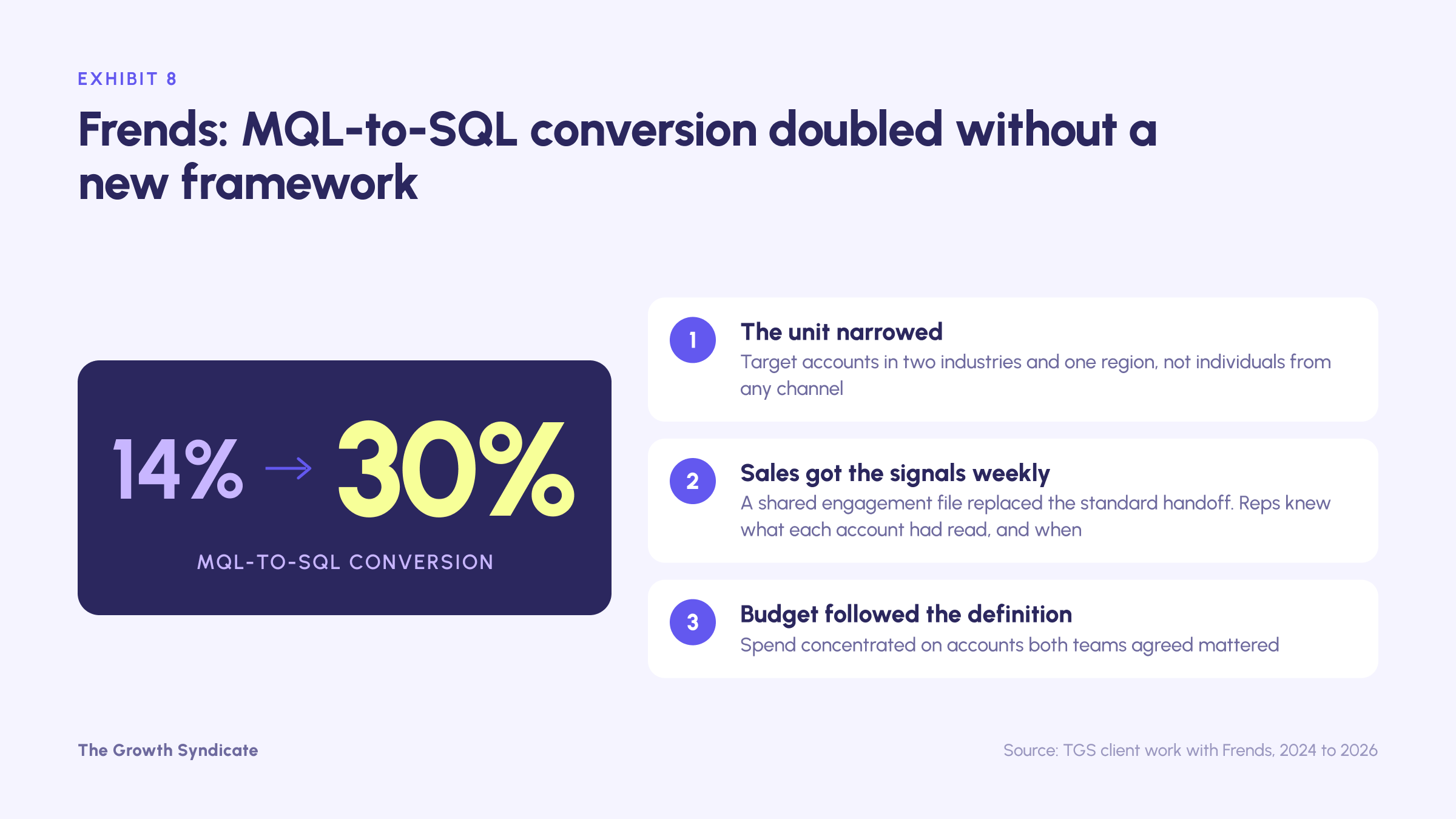
The unit of qualification narrowed. Rather than scoring leads arriving from any channel, the program focused on a defined set of target accounts in two industries and one region, Sweden, before expanding to the UK and DACH. Qualification became a question of whether a target account was showing buying signals, rather than whether an unknown contact had filled in a form.
Sales reps got the signals, with context, every week. A weekly engagement file review with the sales team replaced the standard handoff. When an account showed intent, the rep knew which content it had engaged with and when. Sales outreach became a continuation of something the buyer had already started, which is a different conversation from a cold introduction, and it is the conversation that converts to an SQL.
Budget followed the definition. Because sales and marketing were looking at the same engagement file, spend concentrated on accounts that both teams agreed mattered. Accounts that were never going to convert stopped absorbing budget. The definition was shared, the feedback loop was weekly, and the conversion rate moved.
The program also produced 24 direct opportunities from ABM and paid campaigns and engaged more than 300 high-value accounts. The full account is in the Frends case study. The point for this article is narrower: the conversion gain came from agreeing what qualified leads were and reviewing that agreement against real accounts every week, not from a framework.
Lead qualification by sales motion
A single global lead qualification model is an anti-pattern. The criteria that separate qualified leads from noise depend on how the company sells, and most companies sell in more than one way.
Optifai's 2026 pipeline study, built on stage-level CRM data from 939 B2B SaaS companies, puts the median sales cycle at 84 days, with SMB deals under $15K closing in 14 to 30 days, mid-market in 30 to 90, and enterprise above $100K in 90 to 180 or more. The longer the sales cycle, the more the individual lead misleads. An enterprise deal that looks dead because one contact went quiet is often alive in a department nobody was tracking.
Product-led motions invert the usual order. The product does the early qualification through usage, and sales enters when an account, not a user, crosses a threshold. Elena Verna's framing is the useful one: the PQA tells you when an account is ready, and the PQL is the person inside it with buying power. Confusing an engaged user for a buyer is the most common product-led qualification mistake.
For high performing teams running several motions, the qualification definitions should differ by segment and be maintained separately. What they should share is the feedback loop.
What good lead qualification numbers look like, and which ones to distrust
Benchmarks in this area are weak, inconsistently defined, and heavily recycled. Use them as guardrails, not targets, and attach definitions before comparing anything.
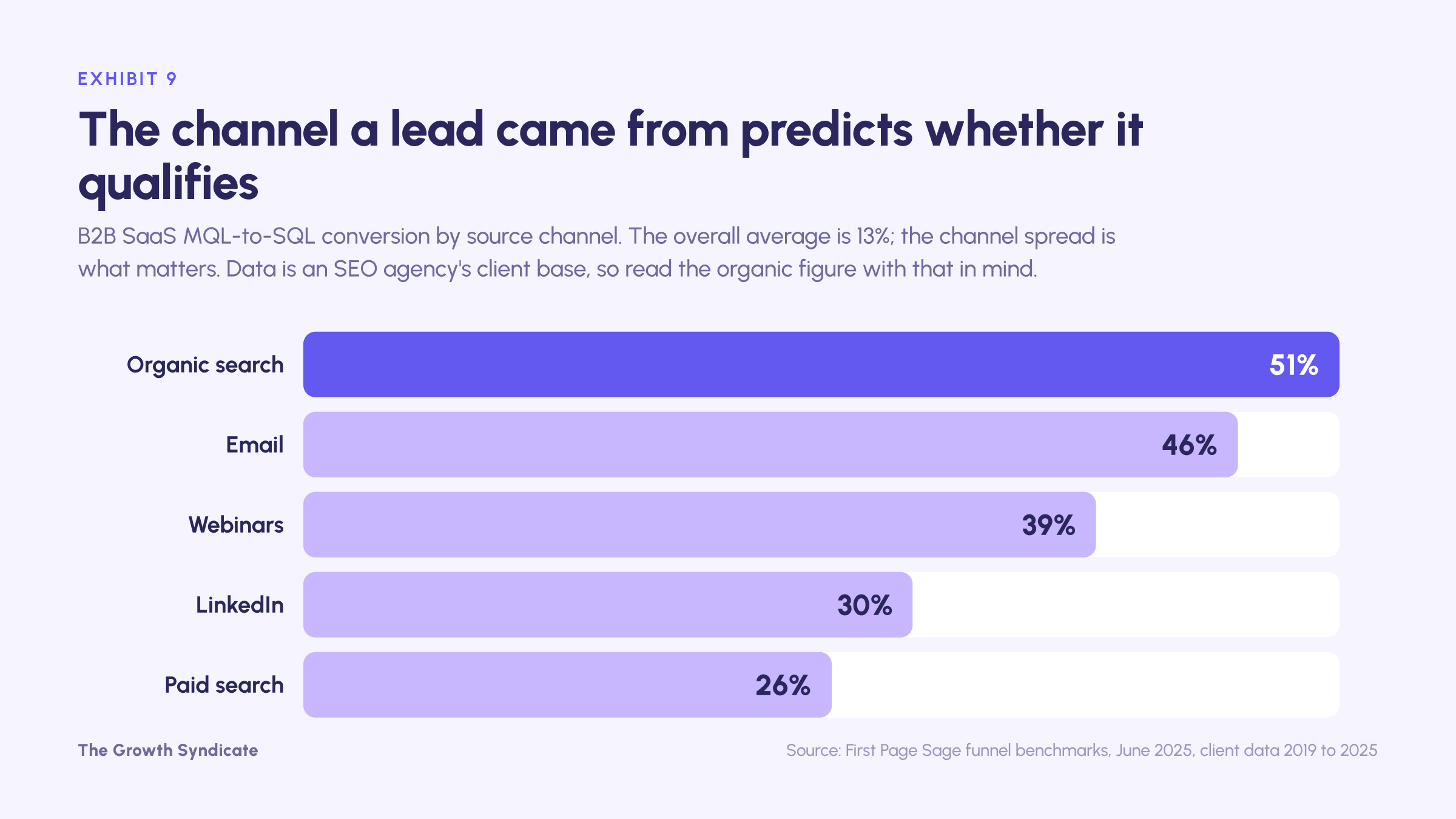
MQL-to-SQL conversion. First Page Sage's benchmark, drawn from its own client data across 2019 to 2025, puts B2B SaaS MQL-to-SQL conversion at 13% overall but 26% to 51% by channel, with the best leads coming from organic search and the weakest from paid search. The channel spread matters more than the average. A lead from an organic search for your category converts at roughly double the rate of a paid click, which is a lead quality insight disguised as a channel statistic. Two caveats: First Page Sage is an SEO agency, so its dataset leans toward SEO clients and should temper the organic figure; and its SQL definition requires that the product is within budget and the lead is talking to a salesperson, which is stricter than most.
SQL to opportunity and close. The same dataset puts SQL-to-opportunity at 38% to 49% by channel and SQL-to-closed-won near 12%.
Win rates. The 2025 Ebsta and Pavilion GTM benchmarks, built on 655,000 opportunities worth $48 billion, put the average B2B win rate near 19%, down from 29% the year before. The same report found that bringing the economic buyer in early lifts win rates by around 55%. Both findings argue for more effective lead qualification, since single-threaded deals are usually deals that were never properly qualified.
Cost. First Page Sage's cost-per-lead report, drawn from its client data between January 2022 and June 2025, puts blended B2B SaaS cost per lead at $237: $310 for paid channels and $164 for organic. The spread across 30 industries runs from $91 in e-commerce to $982 in higher education, so a cross-industry average is close to meaningless. The number that matters is cost per qualified lead or per opportunity, which almost nobody publishes with a definition attached. Cost per lead rewards volume; cost per SQL rewards qualified leads. A cheap lead that never converts is expensive.
Three numbers to stop repeating
Because the space is full of statistics with no traceable source, three of the most common deserve a warning label.
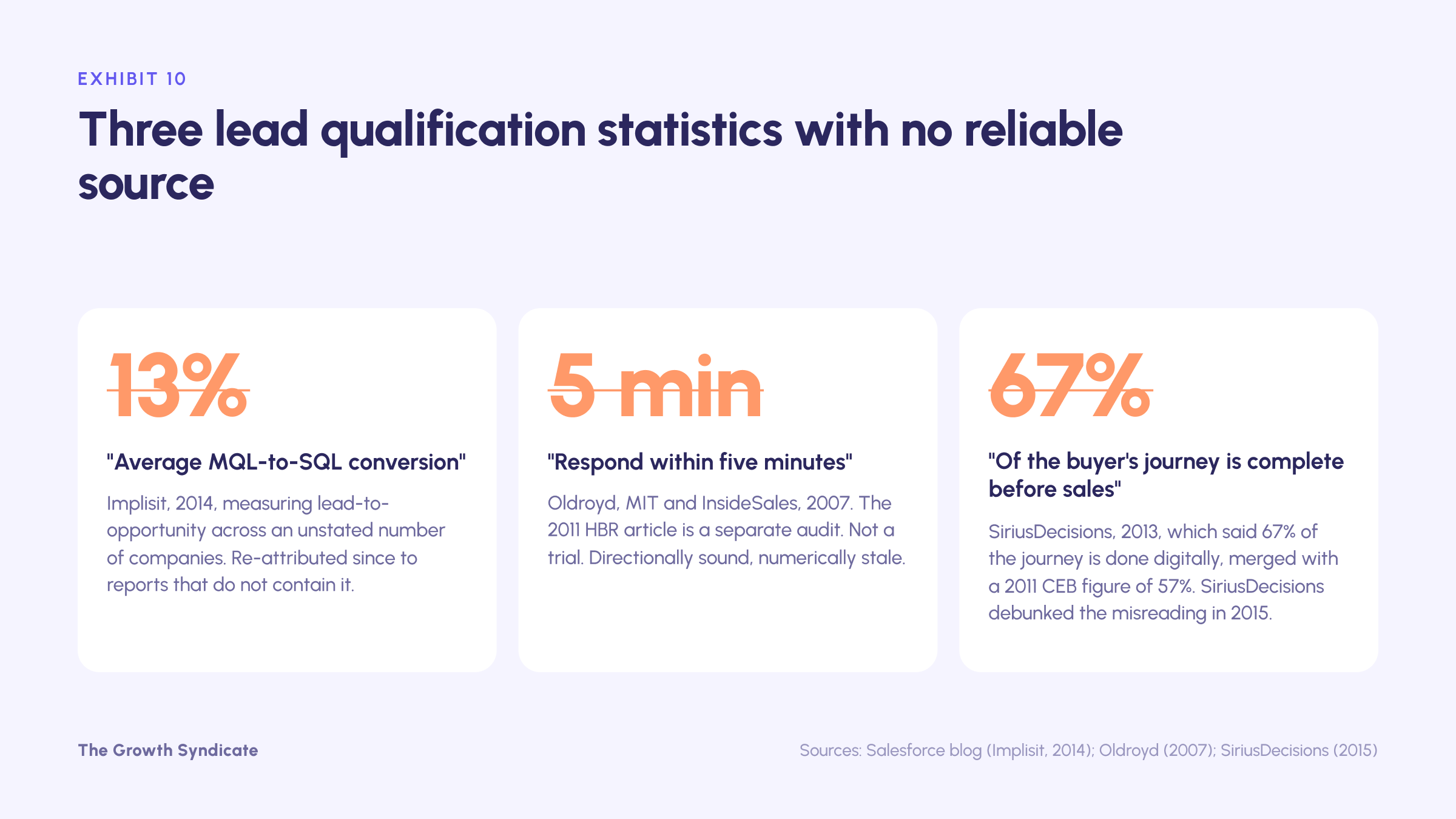
"The average MQL-to-SQL conversion rate is 13%." This traces to a 2014 Implisit study published on the Salesforce blog, which measured lead-to-opportunity conversion (a broader step than MQL-to-SQL) across an unspecified number of companies, and has since been re-attributed to reports that do not appear to contain it. Jenn Deering Davis of Gradient Works has described the provenance as dodgy, with references to Salesforce and HubSpot reports that do not seem to exist. Independent datasets do cluster around 12% to 18%, so the range is plausible. The precision is not.
"Respond within five minutes." Oldroyd, 2007, InsideSales platform data, not Harvard, not a trial. Directionally sound, numerically stale.
"67% of the buyer's journey is complete before contacting sales." The 67% comes from a 2013 SiriusDecisions study that said 67% of the journey is conducted digitally, which is a different claim, and it merged in the retelling with a 2011 CEB study that put the figure at 57% (revised to 65% in 2013). SiriusDecisions itself debunked the misreading at its 2015 Summit, showing buyers engage sellers from the earliest stage. Gartner's more careful finding, from a 2017 survey of 750 buyers, is that B2B buyers spend about 17% of their total purchasing time meeting suppliers at all. The underlying idea, that buyers arrive informed, is right. The number is folklore.
For a fuller treatment of what the credible numbers are and where they come from, see our B2B marketing benchmarks guide.
Signs your lead qualification model is broken
- MQLs above the threshold are converting no better than those below it
- Sales is rejecting a rising share of what marketing delivers, and nobody can say why
- Most of the database sits above the MQL threshold
- Reps rarely look at the score before choosing whom to call
- Nobody can produce a holdout comparison for the lead scoring model
Intent data, AI qualification, and the zero-click problem
Three developments are changing what a lead qualification model has to handle, and vendors describe all three with more confidence than the evidence supports.
Intent data. First-party intent, meaning your own site visits, product usage, and conversations, is the most reliable set of buying signals available, and most sales teams underuse it. Third-party intent from data providers that track content consumption across publisher networks is directionally useful and noisy. An account "surging" on your category might be writing about it, hiring for it, or sending a junior analyst to research it. Intent data providers' accuracy claims are marketing. Treat the signal as a reason to look, not a reason to route.
AI qualification. The autonomous AI SDR arrived in 2024 with claims it could not keep. Jason Lemkin of SaaStr, who runs several of them himself and is a supporter, wrote in mid-2025 that of more than 20 B2B SaaS companies he had watched deploy one, 90% got no pipeline and no meetings, and that the difference came down to whether leadership treated the tool like a $100K hire or a $29 subscription. The lesson from the successes and the failures is the same: the tool is a small share of the outcome, and the training, ownership, and feedback loop are the rest. Where AI earns its place in qualification is enrichment, research, drafting, routing, and 24-hour speed-to-lead. The qualification decision itself still needs a human who knows the product.
Zero-click search. Bain's September 2025 analysis of AI search's effect on B2B marketers found click-through rates on B2B software down as much as 30% since AI Overviews arrived, and that 85% of B2B buyers purchase from the shortlist they had in mind before they searched. Buyer behavior has shifted: fewer buyers fill in forms, and the ones who do are further along the buyer's journey. Forrester expects AI-referred visitors to be higher quality than keyword traffic, with lower bounce rates and higher conversion, even as the volume of clicks falls. For lead qualification this cuts one way: the volume-based lead generation model that fed loose MQL definitions is drying up, and a larger share of the leads that do arrive are high quality leads. They deserve a definition that recognizes them. Demand generation now has to do more of its work before the search happens, which is a topic for our demand generation practice rather than this article.
FAQ
What does "B2B lead" mean?
A B2B lead is a prospective customer: a company, or a person at a company, that has shown some sign of interest in a product sold to businesses rather than consumers. The sign can be as weak as a newsletter signup or as strong as a demo request. Lead qualification exists to tell those two apart.
What is the difference between a marketing qualified lead and a sales qualified lead?
A marketing qualified lead has met marketing's definition of fit and engagement. A sales qualified lead has been vetted by a rep in conversation and has a real problem, some authority, and a timeline. The gap between them is where most B2B pipelines leak, and the sales accepted lead stage exists to make that leak visible.
How do you get leads for B2B?
B2B lead generation runs on demand generation and demand capture: content and search presence that put you on the buyer's shortlist before they are ready, paid and account-based programs that reach defined target accounts, referrals, partnerships, and outbound to the ICP. The generation channel affects lead quality more than most teams expect. Organic search leads convert to SQL at roughly double the rate of paid search leads in First Page Sage's data.
What is a good cost per lead in B2B?
It depends on deal size, and the more useful metric is cost per qualified lead or cost per opportunity. First Page Sage's client data from 2022 to 2025 puts blended B2B SaaS cost per lead at $237, with organic leads at $164 and paid leads at $310, and the spread across industries runs from under $100 to nearly $1,000. A low cost per lead paired with a low conversion rate is the most expensive combination there is.
What is the rule of 7 in B2B?
The rule of 7 is the old marketing adage that a buyer needs to encounter a brand about seven times before acting. It is usually traced to film promotion in the 1930s, though the origin itself is poorly documented, and it has no modern B2B evidence behind it. The underlying point, that a buyer's journey in B2B involves many touches across a long sales cycle, is well supported. The number seven is not.
How often should lead qualification criteria be reviewed?
At least quarterly, using rejection reason codes and the closed-won profile as inputs, and sooner whenever a new product, segment, or channel changes who is arriving. A weekly review of individual handoffs keeps the quarterly recalibration honest and keeps the lead qualification process tied to real deals.
Which lead qualification framework is best?
None of them, alone. Use a light framework such as BANT or CHAMP at SDR triage and a rigorous one such as MEDDIC or SPICED at AE discovery. The framework matters far less than whether both teams agreed on the definition of a qualified lead and review it against real deals.
.png)