.svg)


Manufacturing lead generation is the work of turning the accounts your plant is built to serve into qualified RFQs, at a volume your capacity can absorb. Most of that work happens before any leads exist. By the time an RFQ arrives, the buyer has usually decided who is in the running, so the real goal of a lead generation program is to be on that list.
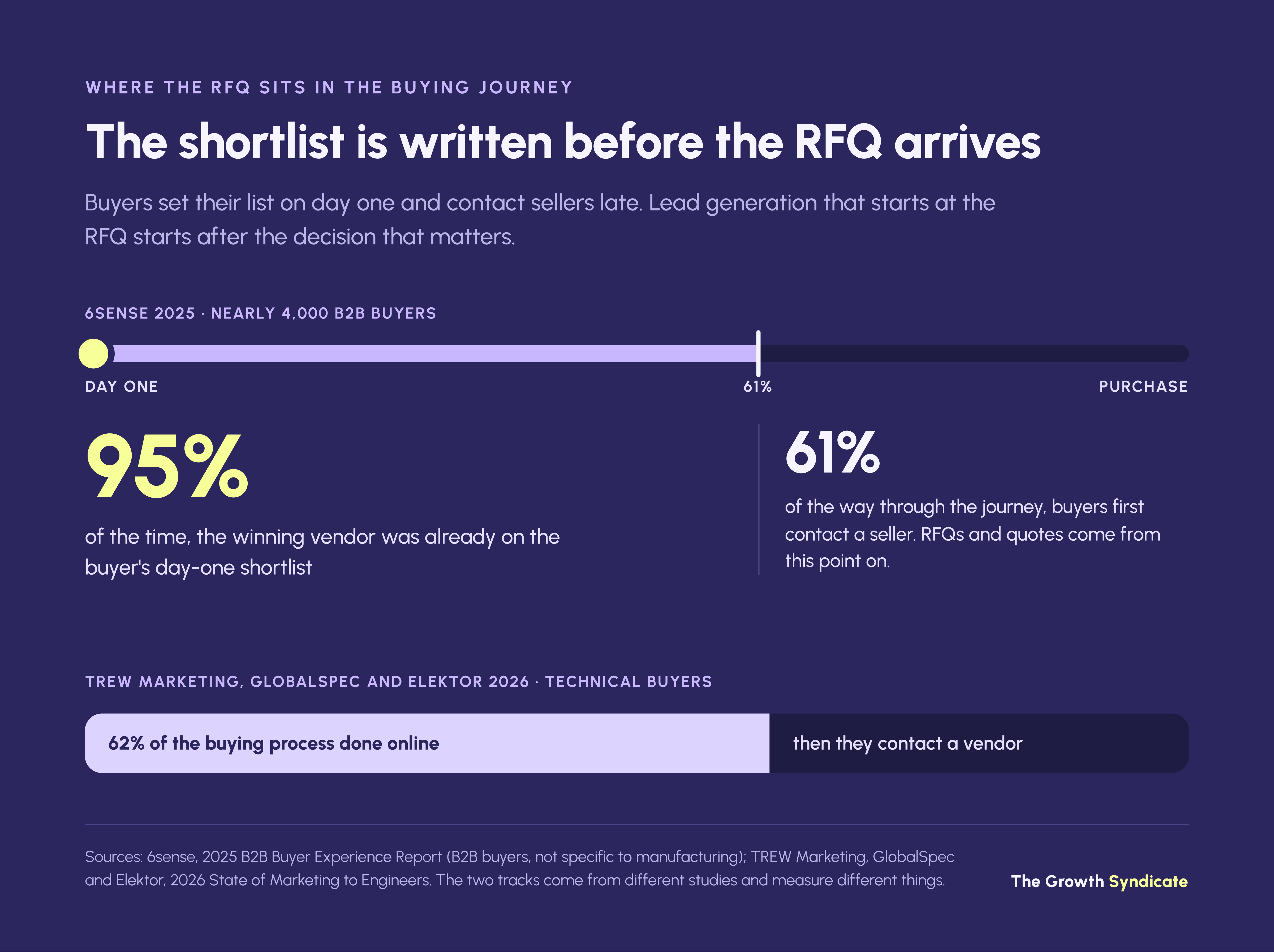
The buying data is consistent on this point. In 6sense's 2025 Buyer Experience Report, a survey of nearly 4,000 B2B buyers, the winning vendor was already on the buyer's day-one shortlist 95% of the time, and buyers made first contact with sellers 61% of the way through their journey.
Those figures cover B2B buying in general rather than manufacturing, but engineers show the same pattern. In the 2026 State of Marketing to Engineers research from TREW Marketing, GlobalSpec and Elektor, technical buyers completed 62% of the buying process online before contacting a vendor.
That changes what manufacturing lead generation has to do, and it changes the sales and marketing strategy around it. For many plants, the constraint isn't the number of leads. It is fit, meaning the right accounts sending the right work when there are hours free to make it.
This guide builds a program from that constraint outward. It sizes the effort from open capacity, tiers the accounts worth winning, reads the signals that show when one of them might switch suppliers, and treats the RFQ as the point where the work pays off rather than the point where it starts.
It is written for commercial directors, heads of sales and marketing leads at contract manufacturers, component suppliers and equipment makers who rely on referrals, reps and a few trade shows a year, and who are being pitched lead lists and appointment setting.
What is manufacturing lead generation?
In manufacturing, lead generation is the process of creating qualified RFQs and supplier conversations from companies that fit what a manufacturer makes well: its processes, materials, tolerances, volumes and certifications. The unit that matters is a qualified RFQ from a fit account, not a form fill, and success is measured in won work that fits your capacity.
Throughout this guide, "qualified leads" means RFQs and supplier conversations from fit accounts; the rest is inquiry volume. Manufacturing lead generation differs from lead generation in software or services in two ways that shape everything below. The first is what a lead looks like.
In manufacturing it often arrives as a drawing with a material, a quantity and a date attached, sent by one member of a buying committee that also includes procurement, production and quality. That means fit can be judged, in many cases, before the sales process starts.
The second is that supply is finite. A software company can add a customer at almost no marginal cost; a plant can only take work its machines, people and schedule can absorb.
Lead generation for manufacturing companies therefore has to be planned against the production schedule, which is why this guide starts from capacity rather than from channels. It is one part of a wider manufacturing marketing strategy that also covers positioning, brand and the website.
Many manufacturing companies already generate leads through pieces of this without calling it lead generation. A rep network, a distributor relationship, a stand at two or three trade shows, a contact form and an owner who knows the buyers personally all count. For most, the job is to make those pieces work as one strategy aimed at the accounts that fit, with a consistent flow of qualified RFQs as the result.
Framework: The Growth Syndicate.
Why more leads is the wrong goal for most manufacturers
More leads help a manufacturer only when they bring work that fits its processes and arrives when there is capacity to make it. Demand that doesn't fit costs estimating time, and work accepted beyond capacity turns into late deliveries that buyers remember. For many plants the scarce thing is the right order at the right time, so the goal is fit, with volume second.
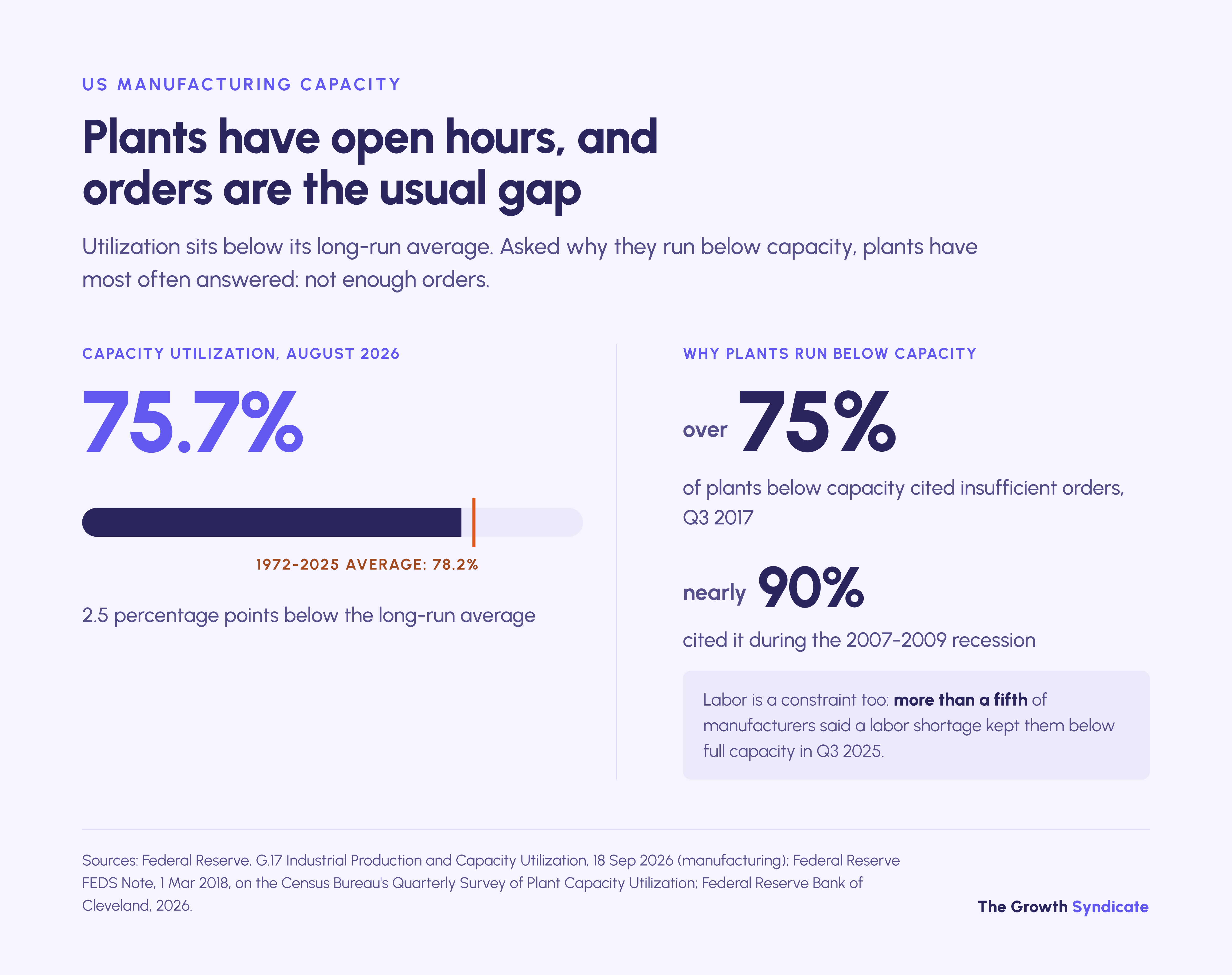
Data from across the manufacturing industry describes plants with open hours. The Federal Reserve's G.17 release put US manufacturing capacity utilization at 75.7% in August 2026, 2.5 percentage points below its 1972-2025 average of 78.2%.
When the Census Bureau's quarterly survey of plant capacity asks plants running below full capacity why, "insufficient orders" has historically been the most common answer. A Federal Reserve analysis of the survey found it was cited by over 75% of respondents in the third quarter of 2017, and by nearly 90% during the 2007-2009 recession.
Read quickly, that sounds like a case for more leads. Read closely, it is a case for more of the right orders, because open hours sit on particular machines, in particular materials and in particular weeks.
Labor narrows it further: more than a fifth of US manufacturers said in the third quarter of 2025 that a shortage of labor kept them from working at full capacity, according to the Cleveland Fed. Leads for work that needs a crew you can't hire aren't worth much.
Nor are manufacturers describing a weak market. In the National Association of Manufacturers' third-quarter 2026 outlook survey, 78.9% of respondents had a positive outlook, and rising raw material costs topped the list of business challenges for a second quarter running. Taken together, the data describes plants with open hours and scarce labor facing rising costs, a setting where the wrong work costs more than it used to.
What the wrong demand costs
Every RFQ takes estimating time, often from the same engineers who keep production running and the same small sales team that manages existing accounts. Quoting work you don't want, or can't schedule, takes that time away from the RFQs you do want, and a late or declined quote can cost you the next request from that account.
Accepting work beyond capacity costs more still. In our experience, a missed delivery date stays with a buyer far longer than a polite "not this time."
Demand is also lumpy. Many plants see seasonal swings and program-driven peaks, so the same leads are worth a lot in a slow quarter and little in a full one.
And the account universe is finite. A contract manufacturer with a specific process mix, certification set and volume band may have a few hundred realistic prospects in its region, not tens of thousands, so a lead-volume model borrowed from software, which assumes an audience that refills indefinitely, doesn't fit.
Decision rule. Add leads only where you have idle hours on the processes the market is asking for, and only through channels that let you screen for fit before an RFQ reaches an estimator. Everywhere else, work on the mix of accounts, jobs and timing.
Failure mode. Buying appointment setting or lead lists to fill a quote desk that is already the bottleneck, then losing the good RFQs in the queue.
Start from open capacity: the reverse funnel
A reverse funnel sizes a lead generation plan backward from the capacity you want to fill. Convert open machine hours into revenue and jobs, divide by your quote win rate to get the qualified RFQs you need, then divide by the RFQs a fit account sends in a year. The result is the number of accounts the program has to reach.
The model below is illustrative. The inputs are round numbers chosen to make the arithmetic easy to follow, and the last column is there for your own.
Illustrative model. Replace the example column with your own numbers. The Growth Syndicate.
Read from the bottom, the model says that 160 well-chosen accounts, a quarter of which engage in a given year, can fill 6,000 hours. That is a list a small sales team can research by name, and a pipeline it can manage. A model built on lead volume starts at the other end, with how many leads the website and the trade shows produced, and often never connects the answer to a machine schedule.
Which lever moves the number
Each input is a lever, and they don't all belong to marketing. The chart changes one input at a time from the example above.
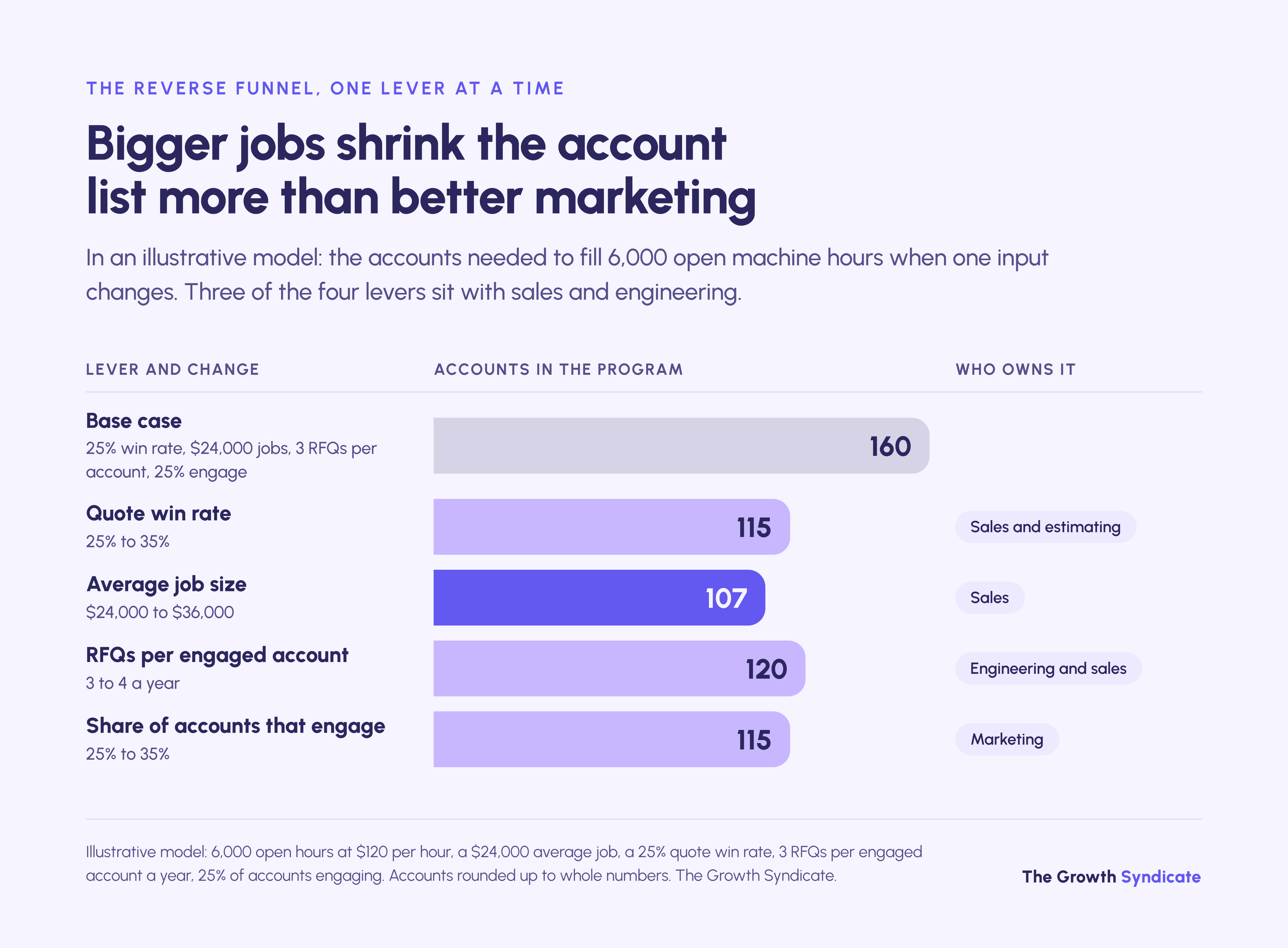
Win rate depends on how good and how fast your quotes are. Job size depends on which work sales chooses to chase.
RFQs per account depend on how many of an account's part families you're qualified to make. Only the engagement rate is mainly a marketing number, which is why a manufacturing lead generation plan belongs to the sales team, engineering and marketing together.
Decision rule. When the qualified RFQs you need exceed what your account universe can realistically send, change the mix before chasing volume: go after larger jobs, raise the win rate, quote faster, or qualify for more part families per account. Add accounts once those levers are exhausted.
The 25% win rate in the example is deliberately conservative, so check it against your own numbers by source. Modern Machine Shop's 2016 Top Shops benchmarking survey reported quote-to-book ratios of 61% for the top 20% of machine shops and 50% for the rest, though the gap moves from year to year (both groups reported 60% in the 2015 survey). Those rates likely include repeat work from existing customers, and that is the point: the same shop can win RFQs from its installed base at a very different rate from RFQs sent by a buyer it has never worked with.
What qualified leads are worth
The same arithmetic tells you what you can afford to spend to get a qualified RFQ. Suppose the contribution margin on an average $24,000 job is 30%, or $7,200 (an illustrative figure; use your own). At a 25% win rate, each qualified RFQ is worth about $1,800 in contribution from the first order alone.
Repeat orders raise that figure, which is why an RFQ from an account that could become a long-term customer is worth more than one from a buyer shopping a single part. A channel that costs more than $1,800 per qualified RFQ in this example has to earn its place through repeat business, or it doesn't earn it. The same test applies to qualified leads bought from any source.
Define and tier the account universe
Your account universe is every company in your market that regularly buys what you make well. Define it by fit first, using process, material, tolerance, certification, volume band and buying situation, then tier it by value and cross each tier with switching state: whether an account is locked in with an incumbent, open to alternatives or actively re-sourcing. That grid decides where effort goes.
Fit is specific in manufacturing, and it can be written down. A useful fit profile covers six things:
Examples are illustrative. Framework: The Growth Syndicate.
Start the list of ideal customers from your own history. Three years of RFQs and orders show which accounts sent work that fit, which of those you won, and what they have in common.
Then add the companies in the same industries and applications from industry directories, association member lists, trade show exhibitor lists and public filings. Firmographic data tells you who could buy; it can't tell you who is about to come into the market, which is what switching state is for.
Three tiers
The tiers separate accounts by what winning them is worth and how much effort each can justify:
- Tier 1: named accounts. A short list, often a few dozen at most, where one program or part family would change your year. Researched individually and worked one to one.
- Tier 2: fit accounts. The prospects that match your fit profile, often numbering in the hundreds. Worked in segments by industry or application.
- Tier 3: the long tail. Everyone else who might send a good RFQ. Served through inbound, distributors and marketplaces with little account-specific effort.
Three switching states
Switching state borrows from one of the oldest models of industrial buying. Robinson, Faris and Wind's 1967 buygrid framework classified purchases as straight rebuys, modified rebuys and new tasks. A straight rebuy goes to the incumbent almost by default.
A modified rebuy reopens the question, usually because something changed, and a new task, such as a new product program, starts the search from scratch. In lead generation terms, those become three states:
- Locked in. The account buys this work from an incumbent and has no reason to look. Most of your universe is out of the market like this at any given time.
- Open. Something has changed, such as a quality problem, a price increase, a new plant or a new sourcing policy. The account will consider an alternative, and the alternatives it considers are the ones it already knows.
- Actively switching. The account is requesting quotes from new suppliers now. It is the smallest group, and the one most lead generation spending is aimed at, because in-market prospects are the easiest to see.
How small is the active group? John Dawes of the Ehrenberg-Bass Institute, writing for LinkedIn's B2B Institute in 2021, estimated that up to 95% of business buyers are out of the market for many goods and services at any one time, using the example of companies that change their bank or law firm about once every five years.
His 95-5 rule is a heuristic, and the ratio depends on how often a category is bought: a shop quoting prototypes weekly sees far more in-market buyers than a supplier of production parts on multi-year agreements. The direction holds either way.

In our experience, relationships in traditional manufacturing run long, and buyers often work with the same people and suppliers for years. That keeps switching rare, and it makes familiarity valuable when a switch does happen.
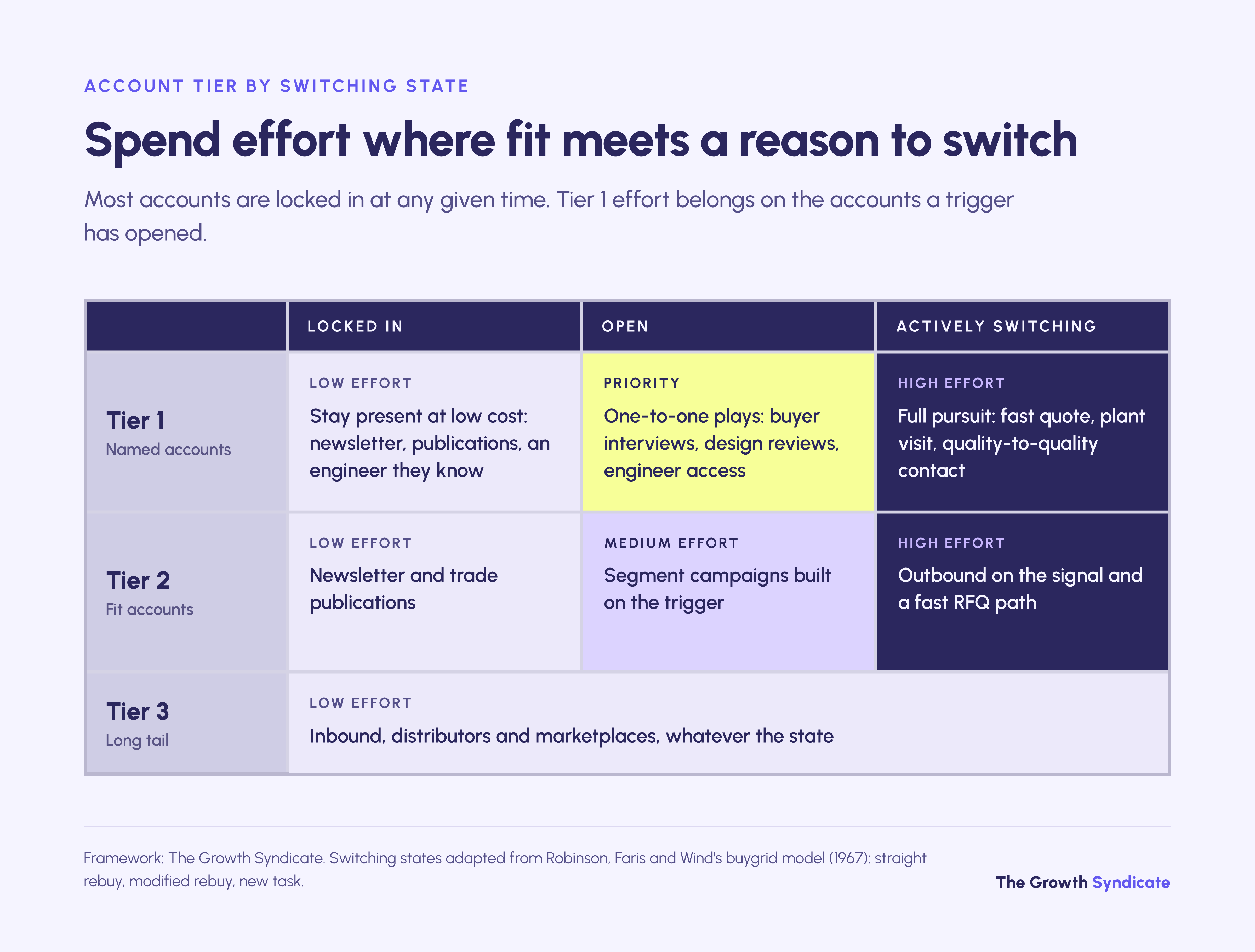
The common mistake is to spend Tier 1 effort on locked-in accounts because they are the biggest names, and to leave actively switching Tier 2 accounts to chance because nobody is watching for the signal.
Switching moments and the signals that reveal them
Manufacturers usually win new accounts when something disrupts an incumbent relationship. A supplier fails, a program launches, a sourcing policy changes, a plant expands, a quality problem escapes or prices jump. Each of these switching moments leaves traces in public or first-party data, and watching for them tells you which prospects have moved from locked in to open, and when.
Switching is expensive for the buyer, which is why it is rare. A new supplier of a production part may have to pass a formal approval, such as the Production Part Approval Process (PPAP) in automotive or first article inspection under AS9102 in aerospace, and tooling may have to move with the work. Those costs keep an account with its incumbent until something outweighs them.
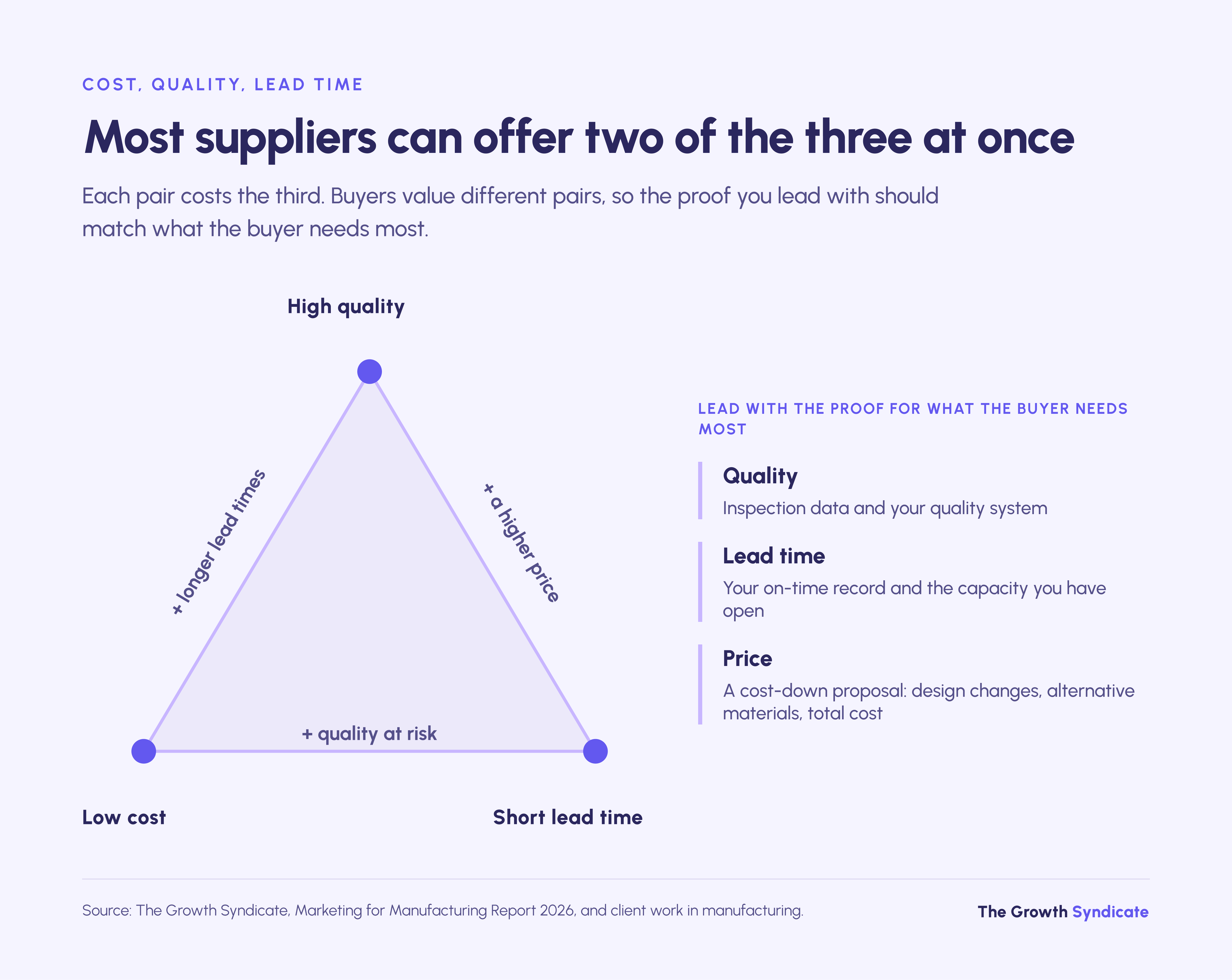
When something does, it tends to act on one of three levers, which are price, technical capability and supply reliability. The lever a trigger pulls decides which proof you lead with. A buyer leaving over a quality escape wants inspection data and a quality system before a lower price; a buyer leaving over late deliveries wants evidence of on-time performance and spare capacity.
Those levers map onto a trade-off buyers already make on every job. In our experience, most suppliers can offer two of low cost, high quality and short lead time at once, and different buyers value different pairs, which is another reason to match the proof to the trigger rather than lead with the same pitch everywhere.
Where the signals show up
The table maps six common triggers to the places they tend to show up and the play for Tier 1 and Tier 2 accounts. Some signals are public; others only surface in conversations with engineers and buyers you already know.
Framework: The Growth Syndicate.
Two of the public sources are underused. WARN notices, the advance notices of plant closings and mass layoffs that larger US employers must give to workers and state agencies, are published by many states and can reveal a struggling supplier before its customers start calling around. Federal contract awards, searchable on USAspending.gov, show which companies won federal contracts, including defense work, and for how much.
Some triggers arrive in waves across the market. The Reshoring Initiative counted about 244,000 US manufacturing jobs announced through reshoring and foreign direct investment in 2024, and in early 2025 companies cited tariffs as a reason 454% more often than in 2024.
Announcements aren't moved production, though. Kearney's 2026 Reshoring Index found US imports of manufactured goods still rose 4.6% in 2025, so treat reshoring as a reason to check specific accounts rather than a tide that lifts every shop.
What intent data can and can't tell you
Buyer intent data comes in two kinds. Third-party intent data infers interest from what people at an account read across a network of publisher sites, and flags accounts researching a topic. First-party signals come from your own channels: repeat visits to a capability page, a spec sheet download, a new contact from a known account, or an RFQ from a plant you haven't served.
In our work with manufacturers, first-party signals have proved far more reliable than third-party intent data. Niche industrial topics tend to produce thin third-party data, and a lot of engineering research happens in trade publications and distributor sites that intent networks may not see.
Intent data flags accounts to look at; it rarely hands you leads on its own. Treat a spike as a reason to look, connect it to one of the switching triggers, and only then treat the account as open.
Failure mode. Treating every intent spike or website visit from a big-name account as a switching moment, and sending sales after accounts that were only reading.
Account-based marketing for manufacturers
Account-based marketing for manufacturers means choosing the accounts first and building the program around the decision makers who approve a supplier switch: design engineers who specify parts, procurement teams that qualify suppliers, and production and quality leads who can block a change. It works best on a short list of Tier 1 accounts that are open to switching.
The buying committee is an equally old idea. Webster and Wind's 1972 model of the buying center described the users, influencers, buyers, deciders and gatekeepers involved in an organizational purchase. In a manufacturing account, those roles map onto real people with different questions, and a supplier known only to engineering can still be stopped by other decision makers in procurement or quality.
Roles after Webster and Wind's buying-center model (1972). Framework: The Growth Syndicate.
Most of the account-based marketing playbook carries over from other B2B markets. What changes for manufacturing companies is who sits on the committee, how rarely accounts switch, and how much of the proof has to be technical. An ABM strategy that ignores those differences produces meetings with the wrong people.
Plays by tier
Tier 1 starts with research. Before designing a campaign, interview 10 to 15 buyers in the segment you want to win: engineers, buyers and quality leads at accounts like your Tier 1 list. The method comes from ideal customer profile work that Steve Patti, a seven-time VP and CMO who advises manufacturing companies, describes in our 2026 report on marketing for manufacturing, and it has a side effect worth planning for: the interviews are also the first touch with the people you most want to reach.

From the interviews, create an account plan for each Tier 1 account that records who sits on the committee, what their current supplier situation is, which trigger would open them, and what you could offer that costs the buyer little to accept. A design-for-manufacturing review of a part they already buy, a capacity reservation for a program they're planning, or a plant visit for their quality team are all offers an engineer can say yes to without committing to a switch.
Tier 2 works by segment. Group fit accounts by industry or application and give each segment its own proof, such as case studies from the same industry, content on the problems that segment's engineers search for, and targeted placements in the trade publications they read.
In our experience, case studies need range. A big-name logo shows you can meet a regulated buyer's requirements, while a smaller company wants to see that you can turn a prototype around quickly.
Industry publications belong inside the ABM motion rather than beside it. In our experience, the niche journals and trade publications an account's engineers already read are places to be mentioned, through contributed articles and application stories, as well as places to advertise. Treat the right publication as a partner in reaching the account.
Tier 3 isn't ABM. Tier 3 leads come through inbound, distributors and marketplaces, plus a fast RFQ path for the ones that turn out to fit.
What the evidence says, and doesn't
In Momentum ITSMA's 2024 ABM benchmark study of more than 300 B2B marketers, 81% reported higher ROI from ABM than from other marketing initiatives, and growing existing accounts was among the top benefits they named. Those are self-reported views from companies already running ABM, across B2B rather than manufacturing alone, so read them as a signal of where ABM tends to pay rather than a measured lift. Widely repeated figures claiming that most manufacturers have adopted ABM, or that ABM delivers deals a set percentage larger, don't trace back to a primary study we could find.
Several other widely repeated lead generation statistics don't hold up once you look for the source. The table lists the ones this guide leaves out, and why.
Research by The Growth Syndicate, September 2026.
Failure mode. Running Tier 1 plays on locked-in accounts because they are the biggest names on the list, then treating the silence as proof that ABM doesn't work in manufacturing. A locked-in account needs presence, not pursuit, until a trigger opens it.
The RFQ is the lead
In manufacturing, the RFQ is the lead that matters: a buyer with a part, a quantity and a date, asking whether you can make it. It usually arrives late in the buyer's process, after the shortlist is set, so the RFQ path has to convert quickly. Make drawings easy to send and an engineer easy to reach, answer fast, and track every RFQ to an outcome.
Many manufacturers treat the contact form as the main source of leads, and the RFQ as the start of lead generation. That gets the sequence backward. By the time a buyer sends one, much of the evaluation is done.
In 6sense's 2025 buyer research, buyers initiated 79% of first contacts with sellers, and in 77% of cases they bought from the vendor they had already favored before that contact, according to 6sense's summary. The RFQ form is where manufacturing lead generation pays off; the work that decides whether an RFQ arrives happens earlier.
Design the path around why engineers get in touch. TREW's 2026 research found that pricing and inventory questions were the most common trigger for a technical buyer's first contact with a vendor, and 59% preferred to make that contact by email, against 22% who preferred a phone call. Only 10% said they would rather not deal with a salesperson at all.
Bill Carlson of BDC Laboratories, quoted in the research, described the pattern from the supplier side: "we typically don't hear from them until they need pricing and timelines."
What a good RFQ path contains
A good RFQ path removes every reason an engineer might hesitate between finding you and sending a drawing:
- Drawing upload that accepts the formats engineers actually use, such as STEP and IGES for 3D models and DXF and PDF for drawings.
- A short form. Contact details, quantity, material and target date are enough to start; everything else can be optional.
- An IP and confidentiality statement next to the upload, with an NDA available on request.
- A stated response time that you meet, shown before the buyer submits.
- A route to an engineer for buyers who don't have a finished file yet, so they can connect with someone before they commit to a quote.
- A confirmation that says what happens next and who will reply, by name.
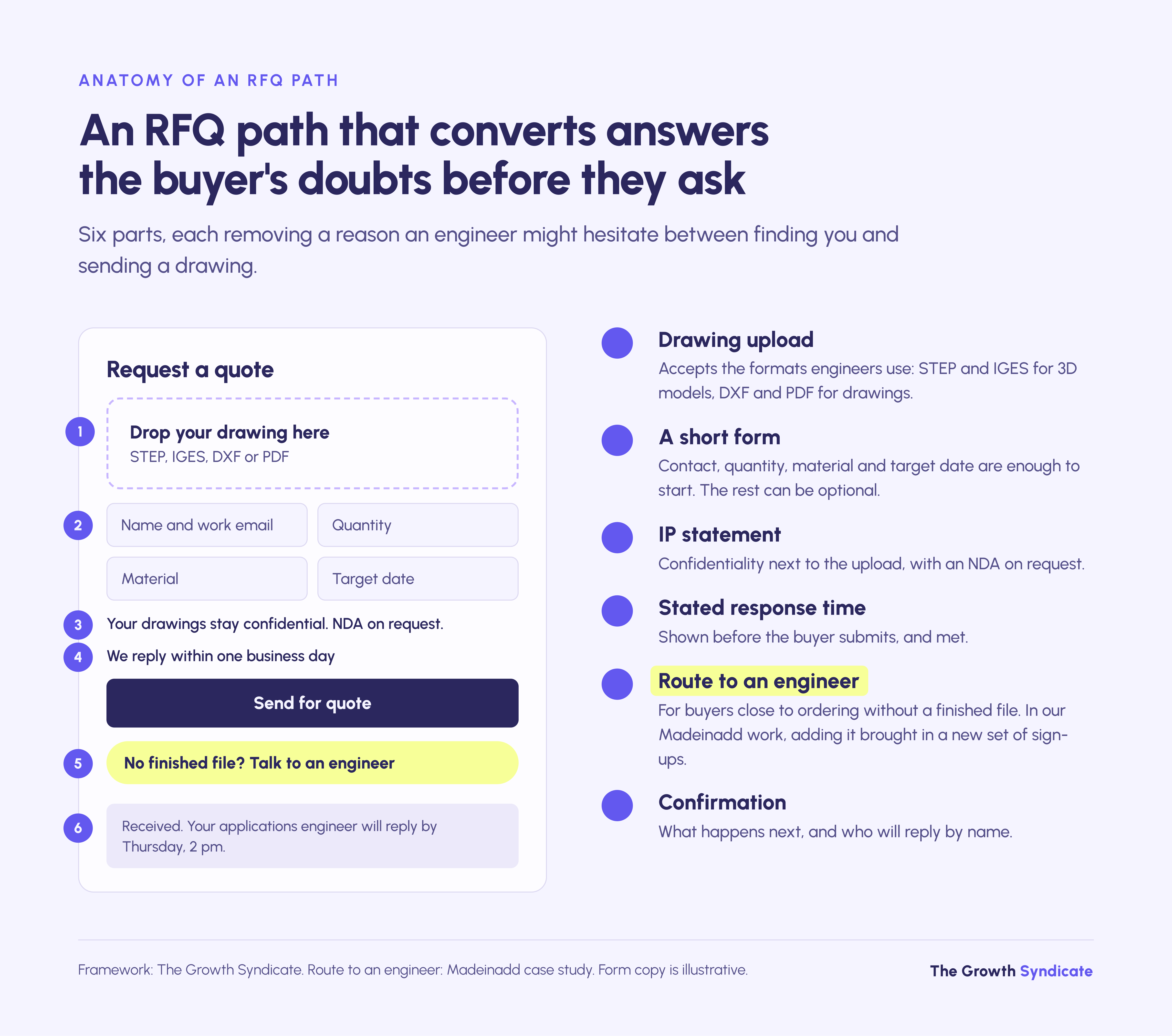
The route to an engineer matters more than it looks. In our work with Madeinadd, an Italian digital manufacturing platform for 3D printing, buyers who were close to ordering but didn't yet have a finished file had nowhere to go from an upload-only form; adding a "talk to an expert" route brought in a new set of sign-ups. The same work shifted paid budgets toward desktop, because engineers weren't signing up or uploading designs on mobile.
RFQ, instant quote or e-commerce?
Manufacturing buyers place orders through different routes for different work, and each route puts the lead generation effort in a different place. Design-in work, where a part is specified into the customer's own product, reaches one of these routes once production starts.
Framework: The Growth Syndicate.
The label "e-commerce" hides a detail. The Census Bureau counts orders placed through electronic data interchange (EDI) and other online systems as e-commerce, including orders between plants of the same company, and on that definition e-commerce accounted for about two-thirds of US manufacturing shipments in 2018, $4.0 trillion out of $5.95 trillion. Much of that likely flows through established relationships rather than new buyers, which is one more reason the installed base deserves more attention than the contact form.
Time to quote
In our experience, response time is a conversion lever many manufacturers never measure, and we haven't found a public benchmark for RFQ turnaround in contract manufacturing. The closest evidence is older and comes from web leads. In a 2011 Harvard Business Review study of 1.25 million leads at 42 US companies, firms that tried to contact a lead within an hour were nearly seven times as likely to qualify it, meaning a real conversation with a key decision maker, as firms that waited even an hour longer.
That study covered mostly consumer businesses (29 of the 42) and shows association, not cause. The direction still fits what engineers tell TREW. They get in touch when they need a price and a date, and a quote that arrives after they've moved on isn't worth much.
Track two times, the time to a first human reply and the time to a firm quote, by tier and by RFQ source, next to the win rate. They are among the few manufacturing sales metrics that marketing, estimating and the sales team can all change.
Framework: The Growth Syndicate.
Speed has a limit, and it is honesty. A quote with a lead time the plant can't meet wins the order and loses the account.
Channel economics: where manufacturing pipeline comes from
Manufacturing pipeline comes from channels with very different economics. Reps and distributors earn a commission or margin and largely own the relationship; marketplaces fill capacity but keep the buyer; shows, inbound and outbound cost money up front. Match each channel to the account tier and to how close it sits to the buyer's trusted circle.
Buyers don't search the market evenly. In the ideal customer profile research Steve Patti describes in our manufacturing report, buyers start from their own lived experience, then consult a tight inner circle of three to five trusted peers, and only then turn to broader networks and search. Splitting that outer ring into networks a supplier can join and cold channels it can buy gives manufacturing lead generation four rings to work, from the inside out, and a way to build lead generation strategies around how buyers actually decide:
- Lived experience. Your installed base, former customers, and the engineers who have used your parts. Reached through account management, email and a technical newsletter.
- The inner circle. Peers, former colleagues, systems integrators, and the reps and distributors a buyer already uses. Reached through referrals, rep and distributor relationships, and contacts who move to new employers.
- Broader networks. Trade publications, associations, trade shows and engineering communities.
- Search and cold channels. Search engines, AI assistants, paid search, directories, marketplaces, outbound and lead lists.
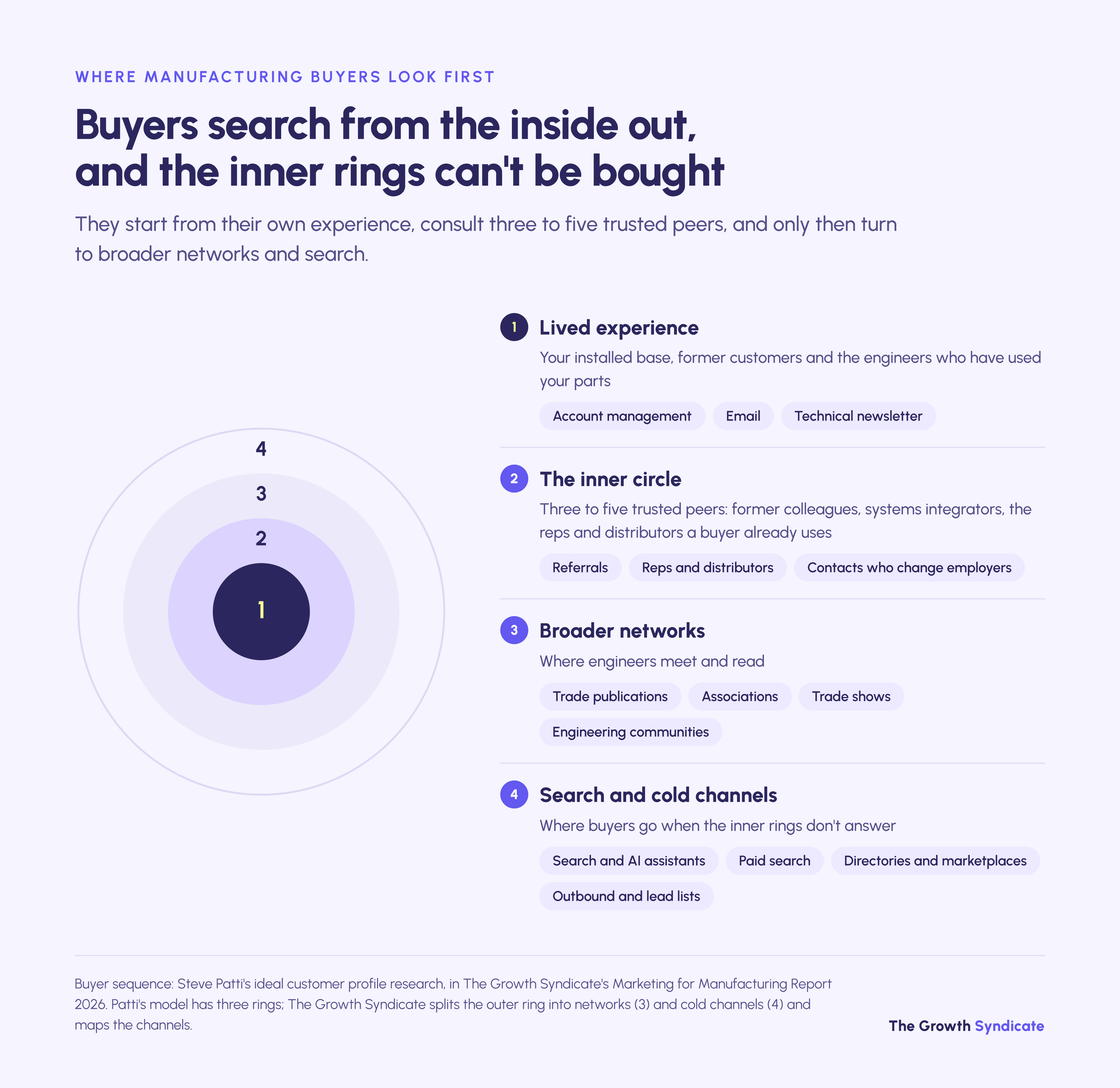
In our experience, the inner rings produce the best-fit leads for the least money, but they can't be bought, which is why budgets drift outward to the channels that can. The comparison below puts the main channels side by side.
Rings after Steve Patti's buyer research, split and mapped by The Growth Syndicate.
Reps and distributors deserve a fair hearing. An independent rep who already calls on the engineers you want is a sales partner with a head start, and can be the most efficient route into a region or an industry. The risk appears when the manufacturer has no direct line to those engineers, because the relationship, and the knowledge of which accounts are about to switch, sits with the rep.
Marketplaces: capacity in, relationship out
Marketplaces sit at the top of many manufacturers' searches for leads, and their economics are visible in public filings. Xometry's 2024 annual report describes using AI to help its supplier network select jobs to fill their capacity. The buyer orders through Xometry, which shows a price and a lead time on screen, and Xometry describes its AI as setting pricing for buyers and suppliers alike.
In 2025, Xometry's marketplace revenue was $629.6 million at a gross margin of 34.7%, which gives a sense of the spread between what buyers pay and what the work costs to fulfill. Xometry also owns Thomasnet, the industrial sourcing platform.
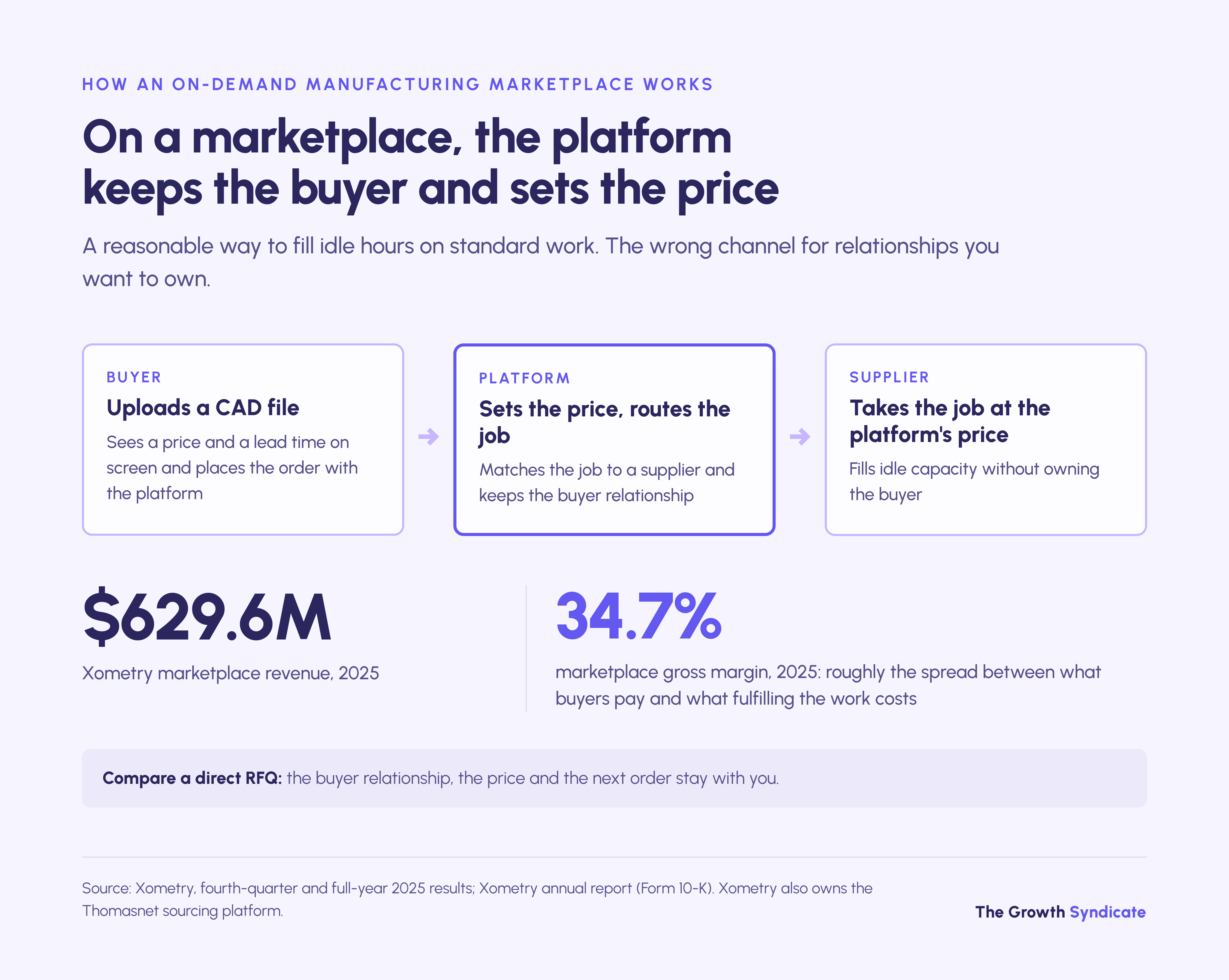
For a shop with idle hours on standard processes, that is a reasonable trade, and marketplaces can connect it with manufacturing buyers it would never have reached. For Tier 1 relationships it is the wrong channel by design, because the buyer's relationship is with the platform and the supplier accepts a price rather than setting one.
Platforms are built to own that relationship, and they invest in the buyer's path to a quote accordingly. Our Madeinadd work, described in the RFQ section above, sat on that side of the market: helping a platform convert engineers who arrive with a part to make. For a manufacturer, that means choosing on purpose: sell standard capacity through a platform where the relationship doesn't matter, and where it does, build an RFQ path of your own that is as quick to use as a platform's.
The underused channel: engineering communities
Engineering conversation increasingly happens in communities. TREW's 2026 research found that Stack Overflow and Reddit had grown in popularity with technical buyers, yet in the Content Marketing Institute's manufacturing research for 2025, based on a mid-2024 survey, only 7% of manufacturing marketers said they had increased their use of Reddit.
These channels scale through presence rather than spend. An applications engineer who answers questions on Practical Machinist or Eng-Tips under their own name, a sales engineer who stays in touch with former colleagues at target accounts, and a partner relationship with the systems integrators who specify equipment for plants all put you inside the second and third rings. None of it works as advertising.

"Engineers have a cynicism, a way of asking, ‘yeah, but what actually works?’. They like stuff that works. They have a low tolerance for empty claims. But offsetting that, they've got this huge collaborative instinct. They want to fix stuff. Here's a problem, can we solve it? That's what they care about."
Evaluating lead generation services, RFQ platforms and lead lists
Many manufacturers are pitched lead generation services at some point, from appointment setting to lead lists to RFQ platforms, often with promises of qualified leads within weeks. Before you partner with one, six questions separate the useful services from the rest:
Sources: FTC CAN-SPAM compliance guide; Google email sender guidelines. Framework: The Growth Syndicate.
Trade show marketing for manufacturers
Trade show marketing for manufacturers works best as an account play. Decide which Tier 1 and Tier 2 accounts will attend, book meetings and small dinners with them in the weeks before the show, staff the stand with people who can answer engineering questions, and follow up according to each account's switching state. The booth is often the least valuable part of the spend.
Manufacturing marketers still rate events highly: in the Content Marketing Institute's 2025 outlook research, 51% named in-person events as their most effective distribution channel. Shows also absorb a large share of budgets. In a late-2025 survey of 362 B2B exhibitors by the Center for Exhibition Industry Research (CEIR), as reported by PCMA, exhibitions took 41% of exhibitors' marketing budgets, the largest single share.
What exhibitors do with that money is another matter. In an older CEIR study of 885 exhibitors and 9,215 attendees, now more than a decade old, reported by TSNN, 82% of exhibitors valued face-to-face contact for building awareness but only 59% for helping buyers narrow their choices.
Two-thirds or more of attendees, by contrast, rated face-to-face contact as important while investigating, evaluating and narrowing options. The data suggests that buyers at a show are often shortlisting while many exhibitors are still selling awareness.
Before, during and after
The value sits largely outside the booth. Steve Patti's work with manufacturers, described in our manufacturing report, points to small-group dinners and targeted conversations arranged in the weeks before the event, with the accounts that matter most.

Before the show. Match the exhibitor and registered attendee lists against your tiers, and create a short list of the manufacturing companies you most want to meet. Book meetings with the decision makers at Tier 1 accounts at least two weeks out, and host a small dinner around a technical topic those engineers care about.
Give each meeting a reason to happen: a design-for-manufacturing review of a part they buy, or capacity you can commit for a program they're planning.
At the show. Put at least one engineer on the stand who can answer tolerance and material questions on the spot. Qualify each conversation with prospects on fit and switching state, and record the part, the volume and the timing rather than just the badge.
After the show. Follow up according to switching state:
- Actively switching: a quote or a drawing review within days.
- Open: the case study or application content that matches their trigger, and an invitation to visit the plant.
- Locked in: a place on the newsletter list, and a check-in when a trigger appears.
Judge a show on the qualified conversations and sales meetings it produced with target accounts and the pipeline from those accounts over the following year, not on the number of leads scanned. In our experience, much of a show's value is familiarity that pays off later, which a report on badge scans can't capture.
Failure mode. Measuring a show by badge scans, then sending the same email sequence to every scan, whether it came from a buyer re-sourcing a part next month or a visitor collecting pens.
Industrial inbound and outbound that engineers don't hate
Industrial inbound marketing captures accounts that are already searching, so it serves the actively switching best. Outbound reaches prospects that are open but not yet searching, and it works with engineers only when a real signal triggers it and it carries technical substance. Most manufacturers need both, aimed at different switching states rather than run as rival budgets.
Inbound: be the page an engineer checks
Engineers do their homework before they call. In TREW's research, technical buyers completed 62% of the buying process online, and in the 2026 edition online technical publications moved slightly ahead of vendor websites as engineers' top research destination.
Winning inbound leads depends on search engine optimization built around capability pages that answer specification queries, more than on blog volume or raw traffic, and on being present in the publications engineers already trust. The industrial manufacturers we've seen do SEO well treat content creation as engineering work, reviewed by the people who make the parts.
Paid search behaves differently with engineers than with many B2B audiences. In GlobalSpec's summary of the 2026 research, 42% of technical buyers said they actively avoid sponsored results, while 33% would click one that looked helpful and 22% one from a familiar site.
Manufacturing marketers still rate the channel: 68% told the Content Marketing Institute that search and pay-per-click produced their best paid results. Use paid search to test which capability terms produce leads before committing SEO effort to them, and to catch buyers who are ready to order.
AI assistants now sit in the inbound path as well. In TREW's 2026 research, 69% of technical buyers used generative AI during purchasing, but only 10% rated AI tools very or extremely trustworthy as authors of technical content, against 66% for engineering experts at vendor companies. An AI answer can put a supplier on a shortlist; the specific, verifiable page behind it and the engineer on the other end of the RFQ are what keep it there.
Outbound that earns a reply
Outbound has a poor reputation with engineers, largely because so much of it is generic. In 6sense's 2025 research, buyers initiated 79% of first contacts, and the firm's earlier studies found that sales development outreach did little to change when that contact happened.
That doesn't make outbound useless. It makes timing and substance decisive, because engineers aren't hostile to sales as such: most prefer email for first contact, and only one in ten wants no salesperson involved at all.
Generic outbound is also easy to copy. Any supplier can put up a contact form and have a salesperson message engineers on LinkedIn with some version of "we have CNC capacity, can we talk?", so the approach no longer sets anyone apart.
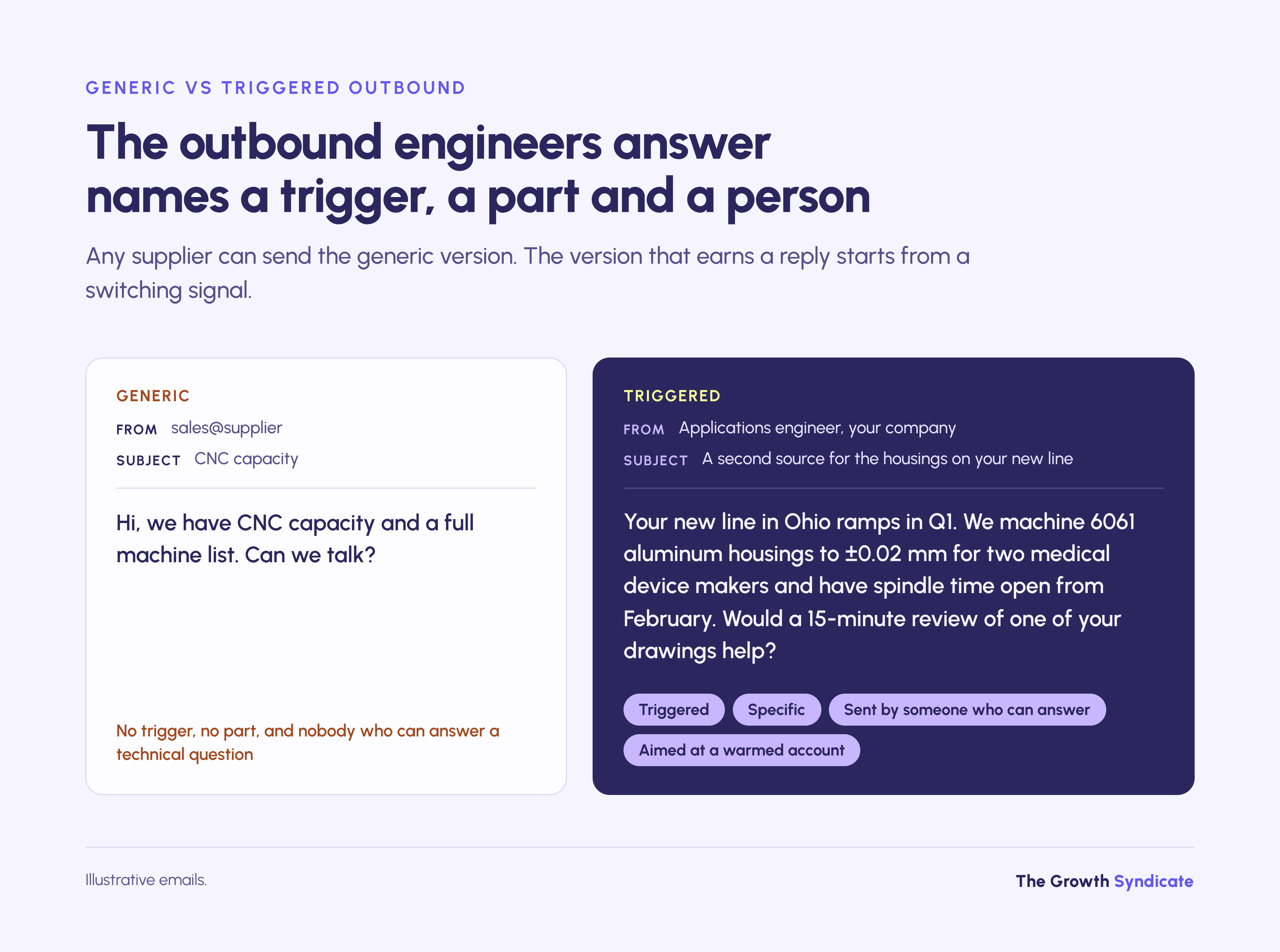
Outbound methods that engineers answer, and that turn into new sales conversations, tend to share four traits:
- Triggered. They start from a switching signal, such as a program launch or a supplier in trouble, not from a list.
- Specific. They name the part family, process or problem in the engineer's terms and in plain language.
- Sent by someone who can answer. An applications or sales engineer with a name, a title and a direct line.
- Aimed at warmed accounts. Decision makers at Tier 2 accounts who already know your name from content, a publication or a show.
Framework: The Growth Syndicate.
In our experience, a program that combines inbound and outbound strategies around the same account list works better than either run alone. Inbound shows which Tier 2 accounts are reading, outbound follows up when a trigger confirms the interest, and the RFQ path gives both a clear path to a quote.
Email and automation for the installed base
Email marketing for manufacturers does its best work inside the installed base: current accounts that could send more work, dormant accounts that stopped ordering, and champions who moved to another company. Marketing automation should route those signals to the account owner, while a technical newsletter keeps the wider universe of prospects familiar with your name until they're in market.
The installed base is the first ring of the bullseye, and its leads convert differently. An account that already knows your quality and delivery record doesn't need to be persuaded you exist; it needs a reason to send the next part family. In 6sense's 2025 research, buyers of physical goods stood out as substantially more likely to have evaluated and bought from the winning vendor before.
Engineers also use email heavily. In TREW's 2026 research, 94% of technical buyers subscribed to work-related newsletters, and the top engagement actions were reading articles (63%), downloading spec sheets (60%) and visiting vendor websites (56%).
Four installed-base plays
- Expansion. Other plants, part families and processes at accounts you already serve. Your RFQ and order history shows where you're qualified; a conversation with the account's engineers shows what they buy elsewhere.
- Reactivation. Accounts that haven't sent an RFQ in twelve months. Find out why before you send a campaign, because a quality or delivery problem needs a conversation, not a discount.
- Champions who move. Engineers and buyers who change employers can take their supplier preferences with them. Track job changes among your contacts and reach out at the new company.
- A technical newsletter. One useful piece of engineering content per issue, written or checked by an engineer, sent to Tier 1 and Tier 2 contacts and anyone who has requested a quote.
Expansion depends on delivery before it depends on marketing. An account sends more work to the partner that has earned it, and no email sequence can make up for a late shipment.

What marketing automation for manufacturing should automate
Marketing automation tools earn their keep in manufacturing when they connect the order history in the ERP to the contact data in the CRM, so that signals reach the person who owns the account. Most of the useful automations are alerts to people rather than emails to buyers.
Framework: The Growth Syndicate.
Failure mode. One drip sequence for every contact in the CRM, measured on opens, while the ERP holds the order history that would show which accounts are drifting away.
Qualifying and measuring by tier
Qualify manufacturing leads on fit before intent: process, material, tolerance, volume, timing, certification, and whether you'll have capacity when the work is due. Then measure the program by tier, using RFQs from fit accounts, time to quote, win rate, pipeline coverage against open capacity, and the share of won and lost deals where you were on the buyer's day-one shortlist.
Most of the B2B lead qualification toolkit applies to manufacturers and their sales teams. The difference is that fit can be judged from the drawing, in most cases before anyone speaks to the buyer, so a short fit checklist at the quote desk saves more estimating time than a lead score in the CRM. Qualified leads in manufacturing are RFQs that pass that checklist, from accounts in your universe, with delivery dates you can meet.
Framework: The Growth Syndicate.
The metric most programs skip
The day-one shortlist share is the measure this whole approach rests on, and in our experience few manufacturers track it. Forrester's 2024 Buyers' Journey Survey found that 41% of B2B buyers had a single vendor in mind when they began a purchase and 92% started with a shortlist, and 6sense, drawing the same conclusion from its 2025 data, recommends measuring success by shortlist placement and win rate rather than raw lead counts. You can measure your own version in win/loss conversations with decision makers: ask buyers which suppliers were on their list when they started looking, and whether you were among them.
Track the answer for won and lost deals alike, across the complete pipeline rather than a handful of big wins. If you mostly win where you were on the list and mostly lose where you weren't, the program's job is to get on more lists, which is a different job from generating more leads, and it calls for a different sales and marketing strategy.
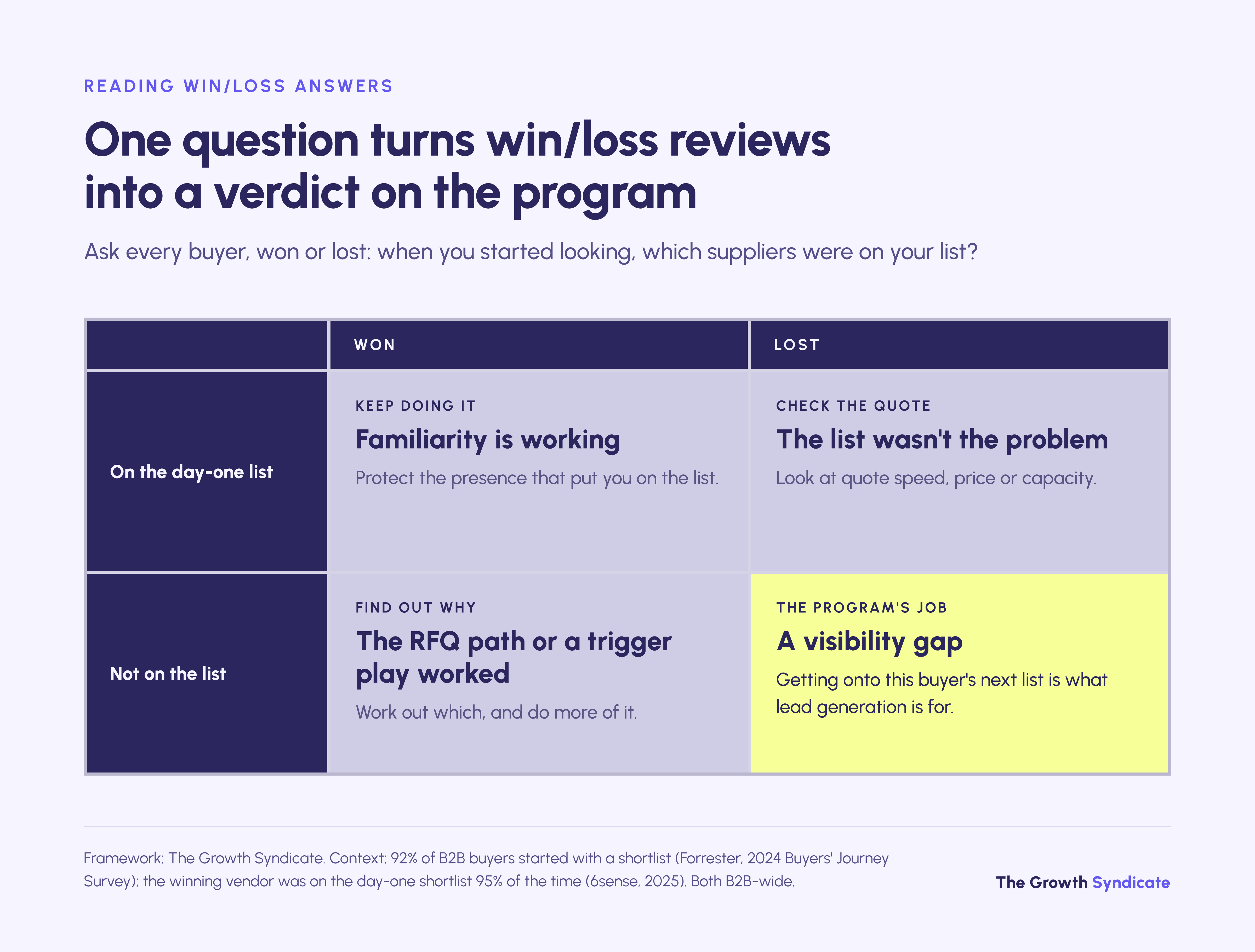
Add a "How did you first hear about us?" field to the RFQ form as well. Self-reported answers catch the colleague's recommendation, the trade publication article and the show conversation that click-based attribution tends to miss.
The review needs a regular slot with the sales team, because it is how marketing learns to connect its work to won business. Engineers who sell tend to remember why a buyer chose them in far more detail than any CRM field records.

"For the French market, I had a weekly meeting with the sales team, who were also mechanical engineers. We went through the MQLs generated, the opportunities, the meetings they'd had and the customers that closed, because I wanted to understand what questions buyers asked, what their pain point was, and why they chose us over others."
Failure mode. Reporting the number of leads to leadership, alongside website traffic, while the quote desk works from a different list, so nobody can say which marketing activity produced the work the plant is running.
Where this approach breaks down
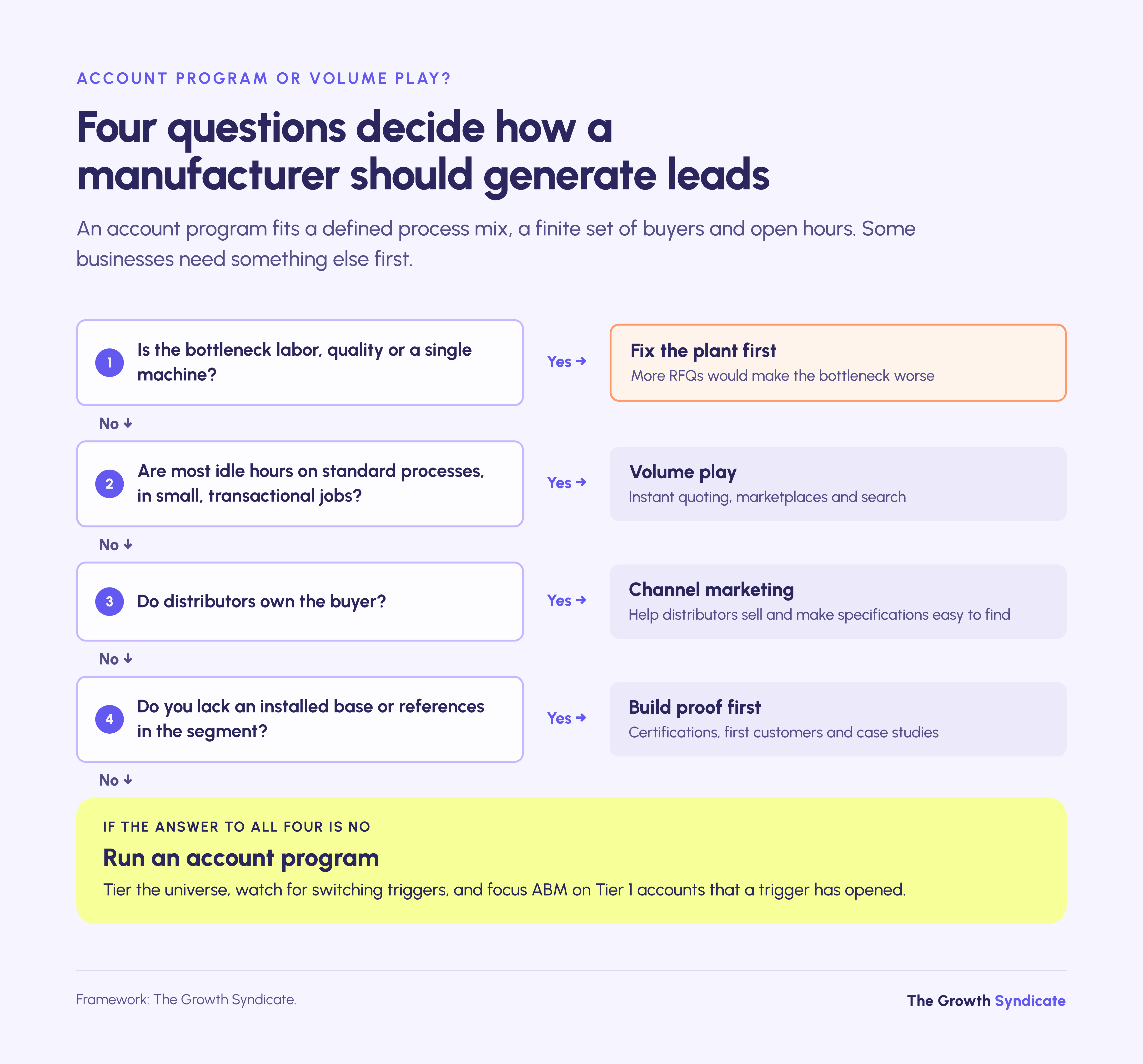
An account-and-capacity approach suits companies with a defined process mix, a finite set of realistic buyers and open hours to fill. It fits less well in the situations below, and in some of them a volume approach to manufacturing lead generation is the honest answer.
- High-mix shops with idle capacity and short, transactional jobs. When you can take almost any job in your process range and jobs are small, more leads really are the answer, and volume matters more than account selection. Instant quoting, marketplaces and SEO can fill hours faster than an account program, and many of the leads will come from manufacturing buyers you'll never speak to.
- Companies with no installed base yet. A new plant, a new capability or a company new to a market starts with an empty inner ring. Proof comes first, in the form of certifications, first customers and case studies, even if some of that work comes at thin margins through a marketplace.
- Catalog and distributor-led manufacturers. When distributors own the buyer, lead generation is mostly channel marketing, which means helping distributors sell and making specifications easy to find.
- Constraints marketing can't fix. If the bottleneck is labor, quality or a single machine, more RFQs make it worse. Fix the plant, then market it.
- Thin data and limited resources. Tiering depends on sales and engineering judgment, because third-party data on small industrial buyers is patchy, and small teams with limited resources may need to start with Tier 1 alone. Expect the first version of the account list to be wrong in places.
- The limits of the evidence. Much of the buyer research cited here covers B2B or engineering buyers in general rather than contract manufacturing, and the day-one shortlist measure relies on what buyers remember and are willing to tell you.
Where to start this quarter
Start with the numbers you already have, and let them decide where manufacturing lead generation goes first. For most plants that means capacity and the installed base before new channels, and response time before more RFQs. The situations below each map to a first move for the quarter.
- If you don't know your open capacity by process, build the reverse funnel before spending anything on leads. Most of the other decisions depend on it.
- If most of your work comes from a few long-standing accounts, start with the installed base, meaning expansion by plant and part family and a list of champions who have changed companies.
- If your quote desk is already the bottleneck, fix response time and fit screening before adding leads.
- If there are Tier 1 accounts you've never won, interview 10 to 15 buyers in that segment before designing a campaign. The research is also your first touch, and it tends to create better sales conversations than a cold sequence.
- If you exhibit at two or three shows a year, move part of the booth budget into pre-booked meetings and small dinners with named accounts.
- If you're being pitched lead generation services, lead lists or appointment setting, price a qualified RFQ from the service against what one is worth to you, and ask who owns the relationship, whether the RFQ is exclusive and how the outreach stays compliant.
Manufacturing lead generation rewards what buyers reward: being known before you're needed, and answering fast when the RFQ arrives. That is where durable revenue growth comes from in a finite market.
Frequently asked questions
How do manufacturers generate leads?
Most manufacturers generate leads from their installed base and referrals, independent reps and distributors, trade shows, and inbound search and SEO. Outbound on switching signals and RFQ platforms add volume at the edges. Effective lead generation matches these multiple channels to account tiers: relationship channels for named accounts, targeted campaigns for fit accounts, and inbound for the long tail.
Does account-based marketing work for manufacturers?
It works when it targets a short list of high-value accounts that are open to switching, and when it reaches all the decision makers on the buying committee, from engineers to procurement, production and quality. It struggles when aimed at accounts locked in with an incumbent. Published ABM benefits are self-reported and not specific to manufacturing, so measure your own results account by account.
Are trade shows still worth it for manufacturers?
For many, yes. In the Content Marketing Institute's 2025 outlook research, 51% of manufacturing marketers called in-person events their most effective distribution channel. The return depends on treating the show as an account play: pre-booked meetings and small dinners with target accounts, engineers on the stand, and follow-up by switching state rather than one sequence for all the leads a badge scanner collects.
Should manufacturers buy lead lists?
Buying contact data for accounts you have already chosen can help; buying generic lists of manufacturing leads rarely does. Contact data ages as people change jobs, cold email to stale lists damages sending reputation, and US commercial email rules apply to business-to-business messages. Price the qualified leads from any list against what one is worth to you.
What is a good RFQ-to-order rate?
There is no reliable public benchmark for RFQs from new accounts. Modern Machine Shop's 2016 Top Shops survey reported quote-to-book ratios of 61% for top-performing shops and 50% for others, a gap that varies by year and that likely includes repeat customers. Measure your own rate by source and account type, because installed-base RFQs and new-buyer RFQs convert very differently.
How can manufacturers get leads without cold calling?
Work the inner rings first when generating manufacturing leads, starting with expansion within current accounts, referrals from engineers who know your work, and former customers. Then add technical content that answers specification questions, a newsletter, trade publications and engineering communities. When outbound is needed, email tends to suit engineers better than calls: 59% of technical buyers prefer email for first contact with a vendor.
How long is the manufacturing sales cycle?
It varies with switching state and qualification requirements. A replacement part from an approved supplier can be ordered within days, while a new production part that needs formal approval can take many months. 6sense's 2025 survey of B2B buyers, not specific to manufacturing, put the average cycle at about 10 months, and 4.8 months shorter for physical goods than for services.
How much should a manufacturer pay for lead generation?
Work it out from what qualified leads are worth to your pipeline. Multiply the contribution margin on an average job by your quote win rate. In an illustrative case, a $7,200 contribution at a 25% win rate makes each qualified RFQ worth about $1,800 before repeat orders. Anything that costs more per qualified RFQ has to justify itself another way.
What is the five-minute rule for leads?
It's the idea that inbound leads should be contacted within five minutes, usually traced to lead-response research led by James Oldroyd in the late 2000s. A 2011 Harvard Business Review study found firms contacting web leads within an hour were nearly seven times as likely to qualify those leads, though most of the companies studied sold to consumers.
Can ChatGPT do lead generation?
It can help with parts of it: researching accounts, summarizing RFQs, drafting outreach and spotting trigger events in public news. It can't build trust with engineers the way a knowledgeable person can. In TREW's 2026 research, 66% of technical buyers rated engineering experts at vendor companies very or extremely trustworthy as content authors, against 10% for AI tools.
.png)