.svg)

.png)

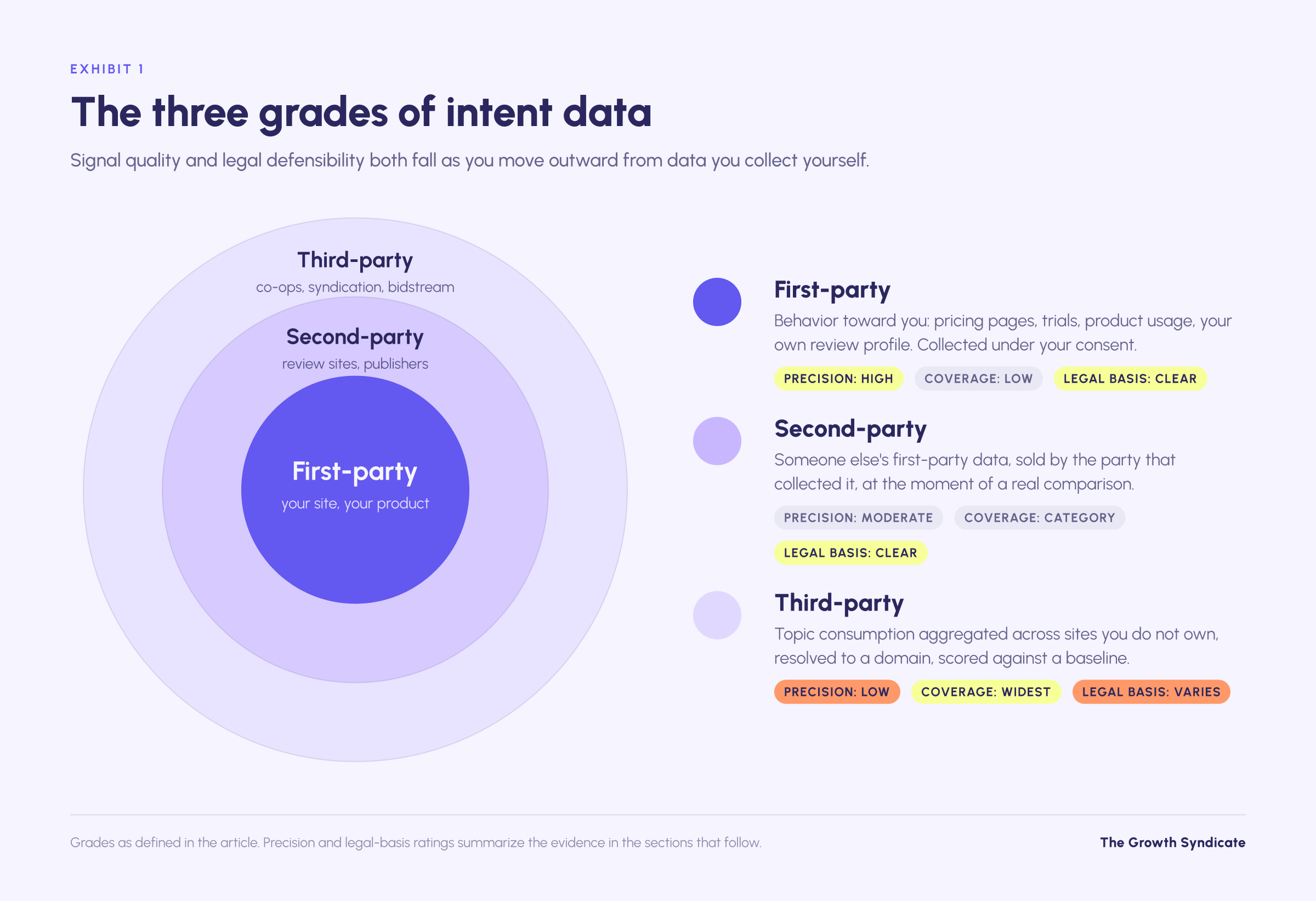
B2B intent data, also called buyer intent data, is behavioral evidence that a company is actively researching a problem, category, or product. It comes in three grades: first-party (activity on your own site and product), second-party (activity on a review site or publisher that sells you its data), and third-party (activity aggregated across publisher networks). B2B intent data tells you which accounts might be in market. It does not tell you whether they will buy from you.
Almost everything written about B2B intent data is written by someone who sells it. Nobody is conspiring; that is what the search results for a $14 keyword look like. It does mean that the questions a buyer would ask before spending $60K a year on a data feed rarely get answered in public: how often the account match is wrong, what a "surge" score measures, whether the reported lift would have happened anyway, and what the feed costs once someone has to operate it.
This article answers those questions with the evidence that exists and says plainly where the evidence stops. The position is specific rather than cynical. Most third-party intent data is weaker than the category admits. First-party intent is more valuable than most sales and marketing teams realize, and most marketing teams are under-collecting it. The distinction between the two is the whole subject, and the conditions under which each one pays off can be named.
This piece owns the data layer. It sits underneath two other guides: the one on account-based marketing owns the targeting motion that intent data usually feeds, and the one on demand generation owns the argument about creating demand versus capturing it. What follows is about the intent signals themselves: where they come from, what they can tell you, and where signal quality breaks down.
What intent data is, mechanically
The term B2B intent data covers several different things that get sold under one label. Understanding the mechanics is the only way to evaluate a vendor's claims, so this section stays close to how the data is collected.
First-party intent data
First-party intent data is behavior on properties you control: website visits and the pages viewed (pricing and comparison pages matter more than blog posts), product usage in a free tier or trial, email and content engagement, webinar attendance, and activity on your own profile on a review site. It is the highest-quality signal available because it records behavior toward you, where topic data records behavior toward a category. It is also the cleanest on privacy, since you collect it under your own consent mechanism.
The catch is coverage. First-party data only sees accounts that have already found you, which is the standard objection to it. The objection is mostly wrong, and the section on what works returns to it.
Second-party intent data
Second-party intent data is someone else's first-party data, sold to you directly by the party that collected it. The canonical examples are software review platforms, which sell the activity happening on your category page and your competitors' profiles, and B2B technology publishers that sell research activity from their registered readers. Because the behavior is captured at the point of a real research action (reading a comparison, checking pricing on a review site), it sits closer to real buyer intent than aggregated topic data does.
Third-party intent data
Third-party intent data is behavioral data aggregated across websites you do not own and were never visited by anyone thinking about you. It is collected in three main ways.
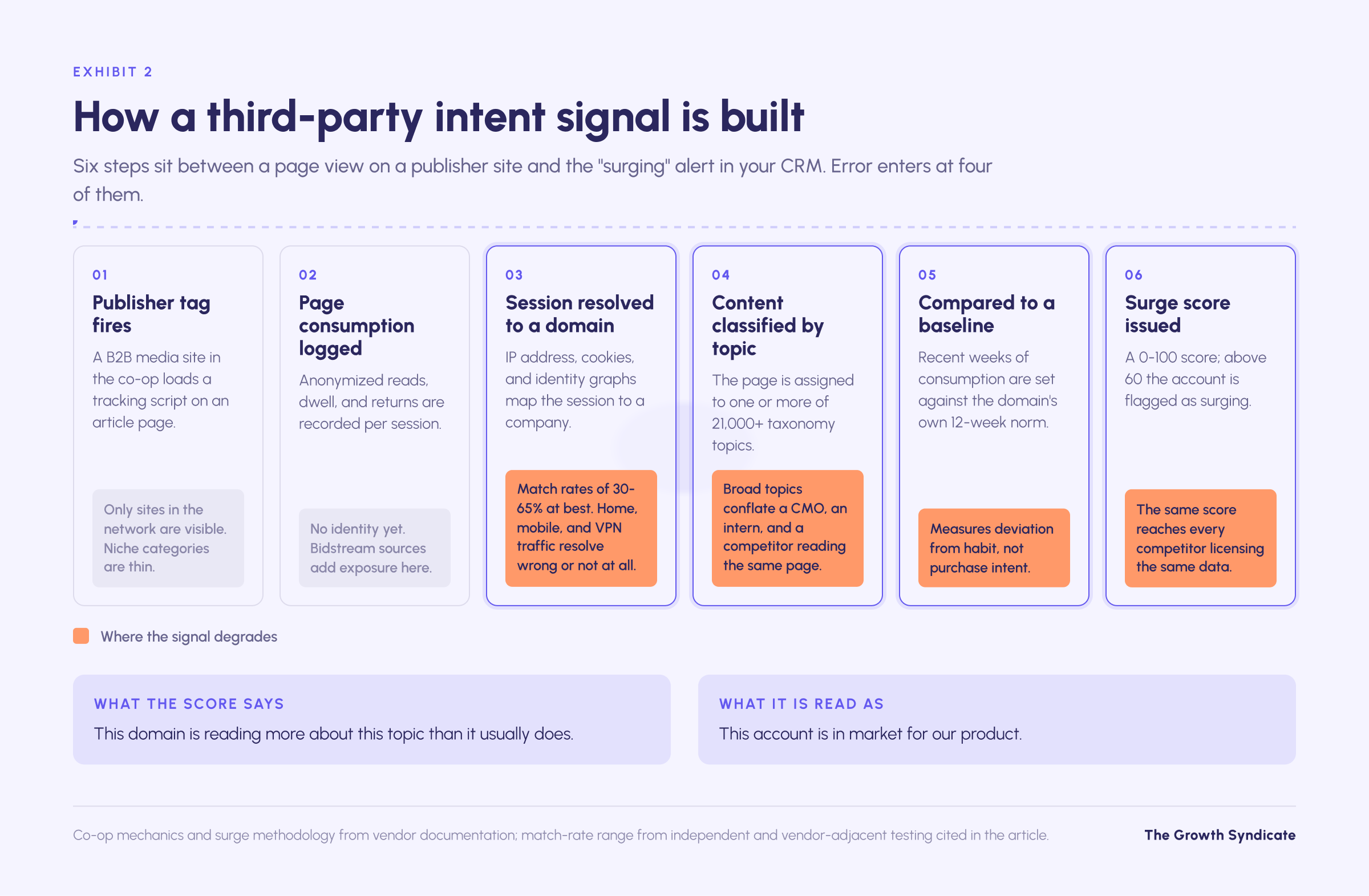
Publisher co-ops. The dominant model. A network of B2B media sites agrees to place a tracking tag on their pages and share anonymized content-consumption data with a single aggregator, which then resolves that consumption to company domains and scores it by topic. The largest co-op reports around 200 publishers across roughly 5,000 sites, nearly 4.7 million unique domains, and about 15.8 billion interactions a month, mapped against a taxonomy of more than 21,000 topics. It also reports that most of its data is exclusive to it, which matters for the commoditization problem discussed below.
Content syndication. Publishers and syndication networks that gate content behind registration forms and sell the resulting engagement, often at contact level. The signal here is that a named person downloaded a named asset, which is precise about the action and vague about the intent.
Bidstream data. The behavioral data broadcast to demand-side platforms during real-time ad auctions. Every time a page with programmatic ad inventory loads, information about the page, the device, and often the user is sent to dozens or hundreds of bidders. Some intent data providers historically captured and resold that stream of behavioral signals. It is the cheapest and widest source available, and it carries the most legal exposure. The better third-party vendors now state explicitly that they do not use it.
Contextual and account-level intent data
Two further terms appear in vendor material. Contextual intent data classifies the content being consumed in real time to build an audience for advertising, without needing to identify the reader. Account-level intent data means signals attributed to a company or domain instead of a person, which describes most third-party data: the co-op knows that "someone at a company resolving to this domain" read about a topic, not who.
What a surge score actually measures
Most intent data platforms present their output as a score, usually 0 to 100, with a threshold above which an account is said to be "surging"; the most widely used version sets it at 60. The methodology behind that version compares an account's most recent few weeks of consumption on a topic against a rolling 12-week baseline for the same account.
That definition is worth reading twice. A surge score is an anomaly-detection measure. It says that a domain is consuming more content on a topic than it usually does. It does not say that the domain is in market, that the reader is a decision-maker, or that the topic corresponds to a buying process and not to a student project or a competitor's product team reading your documentation. Vendors know this, and the honest ones describe surge as a prioritization and timing signal rather than proof that an account is actively researching a purchase. The problem is how the output gets used downstream, where "surging on CRM software" becomes "in market for our CRM" in the space of one Slack message.
Where intent data breaks
Four failure modes account for most of the gap between what B2B intent data promises and what it delivers. None of them are secrets, but they rarely appear in the same place.
The account resolution problem
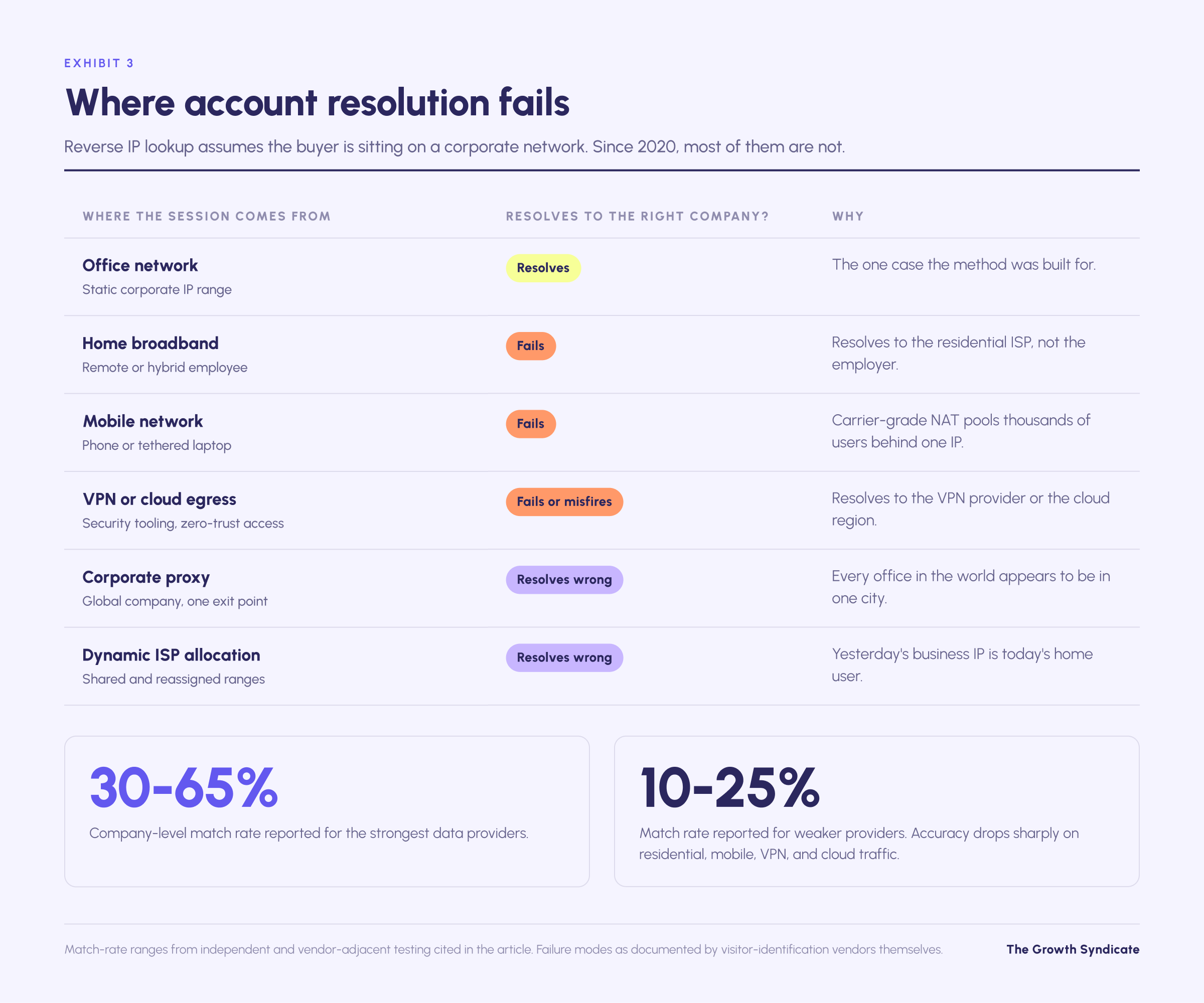
Third-party intent data depends on resolving an anonymous web session to a company. The foundation layer is reverse IP lookup: matching the visitor's IP address to a known corporate network. Independent and vendor-adjacent testing converges on company-level match rates of roughly 30-65% for the strongest data providers, and 10-25% for weaker ones. Accuracy drops sharply for residential, mobile, VPN, and cloud-routed traffic.
Remote and hybrid work broke the assumption underneath the whole method. An employee working from home resolves to their residential internet provider, not their employer. A large share of B2B research now happens on networks that cannot be resolved to a company at all, and a meaningful share of what does resolve is wrong: shared IP ranges, carrier-grade NAT, corporate proxies that route a global company through one location, and dynamic allocation that hands yesterday's business IP to tomorrow's home user.
Person-level identification tools layer cookie matching and identity graphs on top of IP resolution and claim match rates in the 30-40% range. That is where the accuracy improves and where the legal risk concentrates, which the privacy section covers.
The false positive problem
Even when the account match is right, the signal may not mean what it appears to mean. A rare quasi-independent precision test run in the DACH market found that the leading co-op's data correctly identified purchase interest in about 81% of cases, with a review-site data source at 87% and a regional provider at 92%. The test has a commercial interest behind it and a limited geography, so the numbers are directional. Even taken at face value, they mean that roughly 1 in 5 "surging" accounts from the best-known intent data providers has no purchase interest at all. Sales teams that treat every surge as a trigger will spend a fifth of their signal-driven sales outreach on accounts that were never buying.
The shared signal problem
Most third-party intent data platforms, including several that present themselves as competitors, license their topic data from the same co-op. That is worth knowing before you compare intent data providers on data quality. When an account surges, it surges for everyone. Competing sales teams receive the same alert on the same day and act on it with the same playbook. Whatever edge the data provides is competed away at the moment it is delivered. This is a structural property of aggregated data, not a vendor flaw, and no improvement in accuracy fixes it. The only intent data your competitors cannot see is the intent data you collect yourself.
The topic mismatch problem
Third-party taxonomies are large and generic by necessity. "Marketing automation" as a topic covers a CMO evaluating enterprise platforms, an intern researching a blog post, and a competitor's product team reading your documentation. The narrower and more technical your category, the worse the fit: niche industrial, scientific, and public-sector buyers produce thin topic data because the publisher network that feeds the co-op does not cover their reading. Intent data works best in the categories already crowded with B2B media, which are also the categories where the shared signal problem is worst.
The measurement problem: why the lift is rarely separable
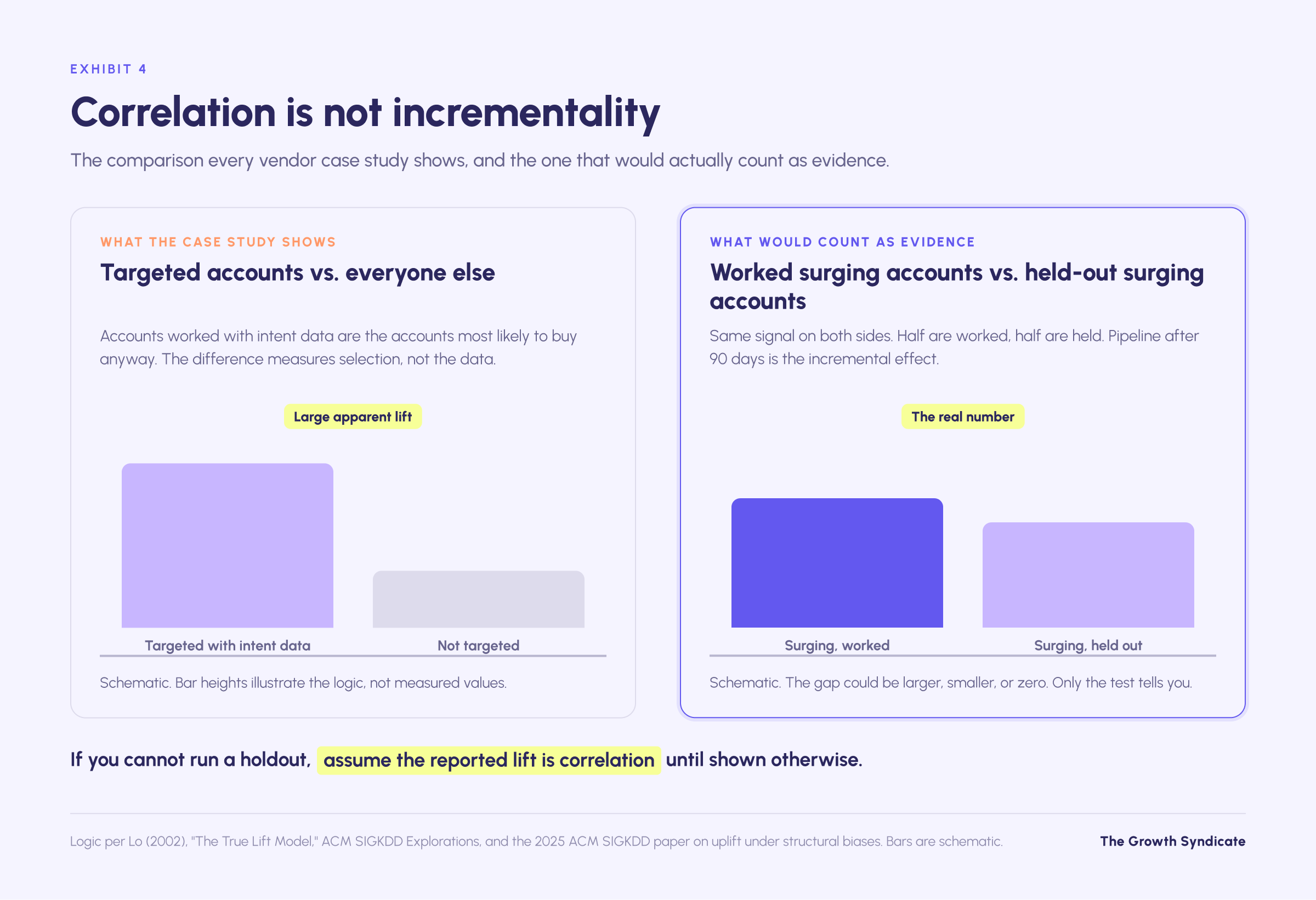
Every vendor case study follows the same shape: target accounts worked with intent data converted at a higher rate than accounts that were not. That is true and it is not evidence of much. Marketing teams that buy intent data are also the teams with a defined ICP, a working ABM motion, sales capacity, and CRM data that someone maintains. The accounts they choose to target with intent data are the accounts most likely to buy. Comparing those accounts to everyone else measures selection, not causation.
This is not a novel critique. The uplift-modeling literature in marketing science has been explicit about it for over 20 years. Victor Lo's 2002 paper "The True Lift Model" established the requirement to isolate the incremental effect of an intervention from what would have happened anyway, and a 2026 paper presented at ACM SIGKDD on evaluating uplift under structural biases lists the specific ways observational marketing data misleads: selection bias, spillover effects, measurement error, and unobserved confounding. The wider attribution literature reaches the same conclusion for a related reason. Models built on observed conversions systematically over-credit whatever channel or signal sits closest to a buyer who was already going to convert. Intent data, by design, sits exactly there.
Intent data may well produce lift. Almost nobody buying it has run a test capable of showing it. A holdout design is not exotic: split the surging accounts, work half of them and hold the other half, and compare pipeline after 90 days. The attribution and marketing ROI guide covers the general problem of self-reported and multi-touch attribution; the specific version for intent data is that if you cannot run a holdout, you should assume the reported lift is correlation until shown otherwise.
The 95-5 problem
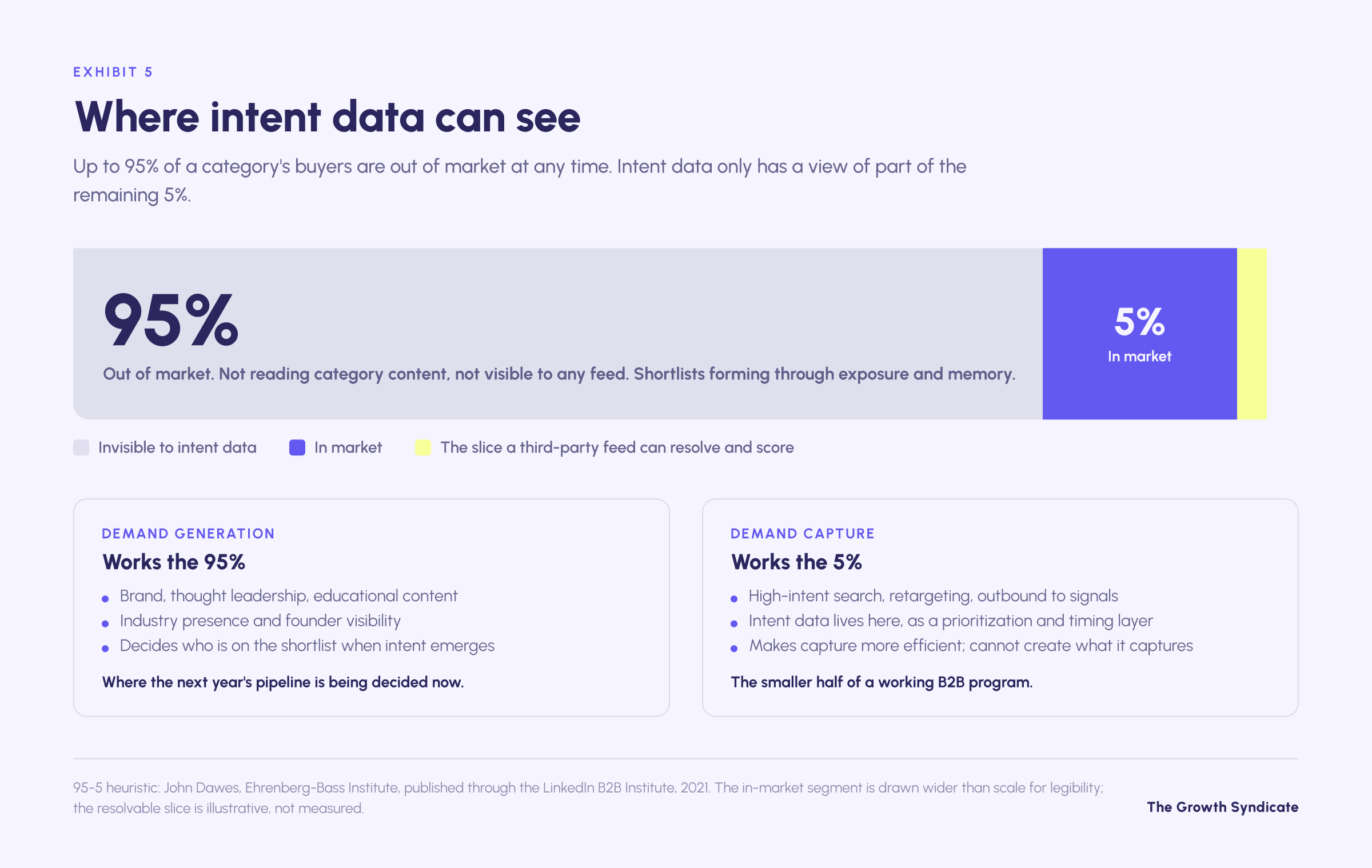
There is a strategic objection to intent data that sits above all the technical ones. Ehrenberg-Bass Institute research published through the LinkedIn B2B Institute in 2021 popularized the observation that up to 95% of potential buyers in a category are out of market at any given time. The author, John Dawes, was careful to say the figure is a heuristic and not a law. The direction is not in dispute.
If that is right, then detecting in-market accounts is a tool for the 5%. It has nothing to say to the 95% of potential customers who are not consuming category content, because they are not thinking about the category. The buyers who will come in market next year are invisible to any intent signals today, and the brands they will shortlist are being decided now, by exposure and memory that no co-op can measure.
"In every company, any market you are, 90 to 95 percent of your potential clients are not currently in market. A lot of marketing is focused on this 4 or 5 percent while you have a huge 90 to 95 percent that you have to educate."Clément Dumont, co-founder, The Growth Syndicate
The practical consequence is that intent data belongs inside a demand capture budget, and demand capture is the smaller half of a working B2B program. Teams that fund intent data by cutting the brand and content work that creates future shortlist positions are trading the 95% for a better view of the 5%. Intent data can make demand capture more efficient. It cannot manufacture the demand it captures.
"The moment I want a CRM, I am going to be looking at three companies I already have in mind. I moved from the 90 percent to the 5 percent, and I am not going to check anything else."Clément Dumont, co-founder, The Growth Syndicate
The privacy and legal layer
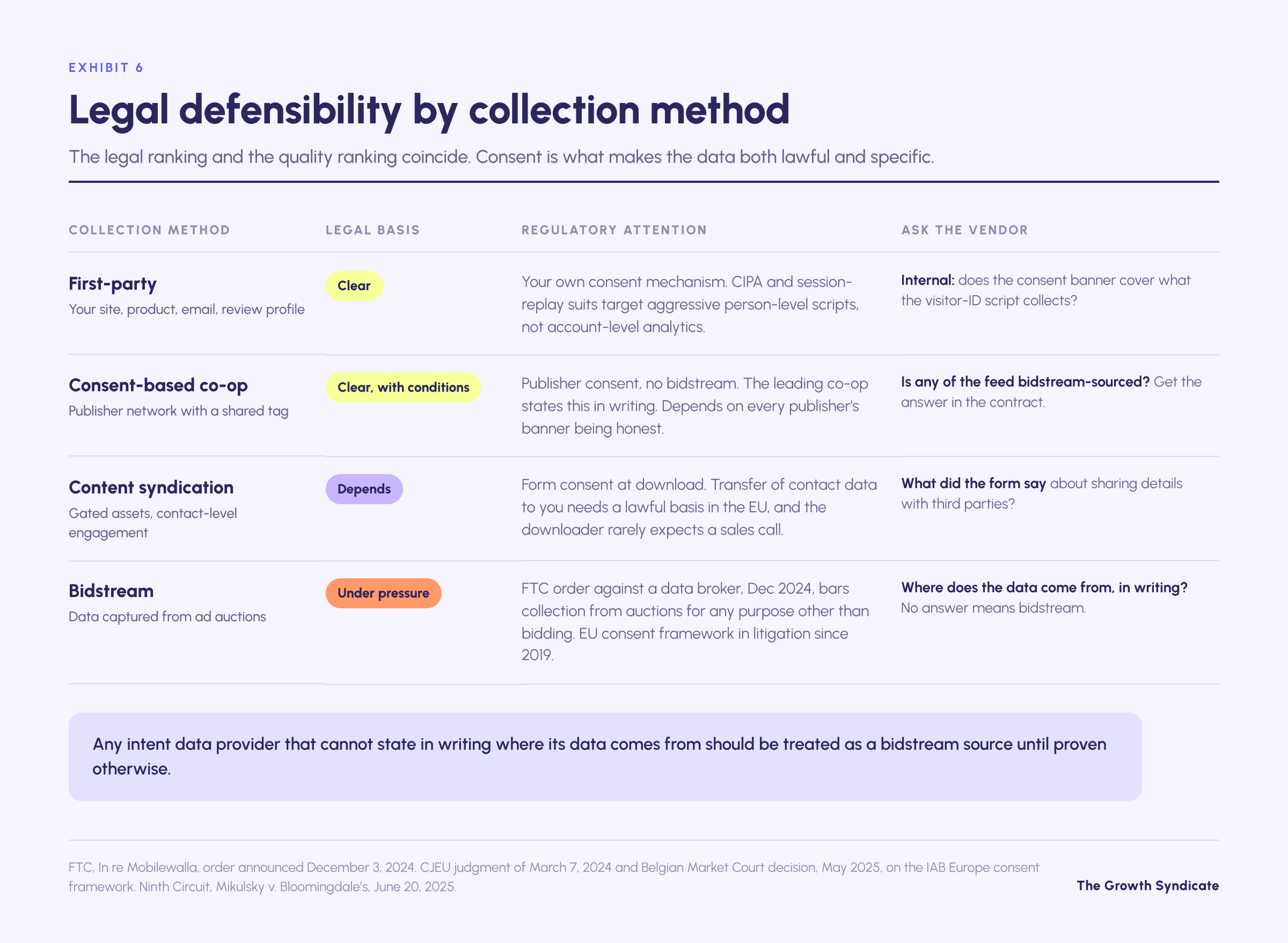
The legal footing of B2B intent data varies enormously by collection method, and buyers rarely ask about it until procurement does.
Bidstream data is under active regulatory pressure. In December 2024 the US Federal Trade Commission announced a proposed consent order against a data broker over its collection of consumer data from real-time bidding exchanges, including data from auctions it lost. The order bars the company from collecting data from ad auctions for any purpose other than participating in them. The Electronic Frontier Foundation described it as the first time the FTC had targeted the abuse of bidstream data specifically. Any intent data provider that cannot state in writing where its data comes from should be treated as a bidstream source until proven otherwise.
In the EU, the framework underneath real-time bidding has been in litigation since 2019. The Belgian data protection authority fined IAB Europe in 2022 over its consent framework; the Court of Justice of the European Union ruled in March 2024 that the consent string transmitted in ad auctions can constitute personal data and that IAB Europe can be a joint controller; the Belgian Market Court held in May 2025 that IAB Europe is a joint controller for the consent string itself but not for how individual participants process data downstream; and in January 2026 the same court annulled the regulator's validation of IAB Europe's corrective action plan and sent it back for reassessment. The direction of travel over the last two years has favored IAB Europe, and the annulment turned on scope and procedure rather than on the lawfulness of real-time bidding. What has not been overturned is the finding that the consent string is personal data. The lawful basis for behavioral data derived from ad auctions remains unsettled in Europe, and a vendor's assurance that its data is "GDPR compliant" is a claim to verify, not a fact.
Cookies did not go away, but they did not need to. Google reversed its plan to remove third-party cookies from Chrome in 2024 and confirmed the reversal in 2025. Safari and Firefox block them by default regardless, which covers roughly a third of web traffic, so the supply of cookie-based signal has been eroding for years and will continue to.
Visitor de-anonymization carries litigation risk in the US. A wave of class actions under the California Invasion of Privacy Act targets session-replay and visitor-identification scripts. The outcomes are mixed. The Ninth Circuit revived a claim against a retailer in June 2025, lowering the pleading threshold, though in an unpublished disposition that sets no binding precedent. A district court granted summary judgment for the defense in a separate case that April, holding that session-replay data is not read "in transit" as the statute requires. State privacy laws in California, Washington, and elsewhere add exposure. The tools that promise to name the person behind an anonymous visit are the tools most exposed to this, and the promise is precisely what makes them appealing.
First-party and consent-based co-op data are defensible. Data you collect on your own properties under your own consent mechanism, and co-op data collected under publisher consent without bidstream, are the two categories with a clear legal basis. The legal ranking and the quality ranking coincide for a reason: consent is what makes the data both lawful and specific.
Which intent signals to trust, in order
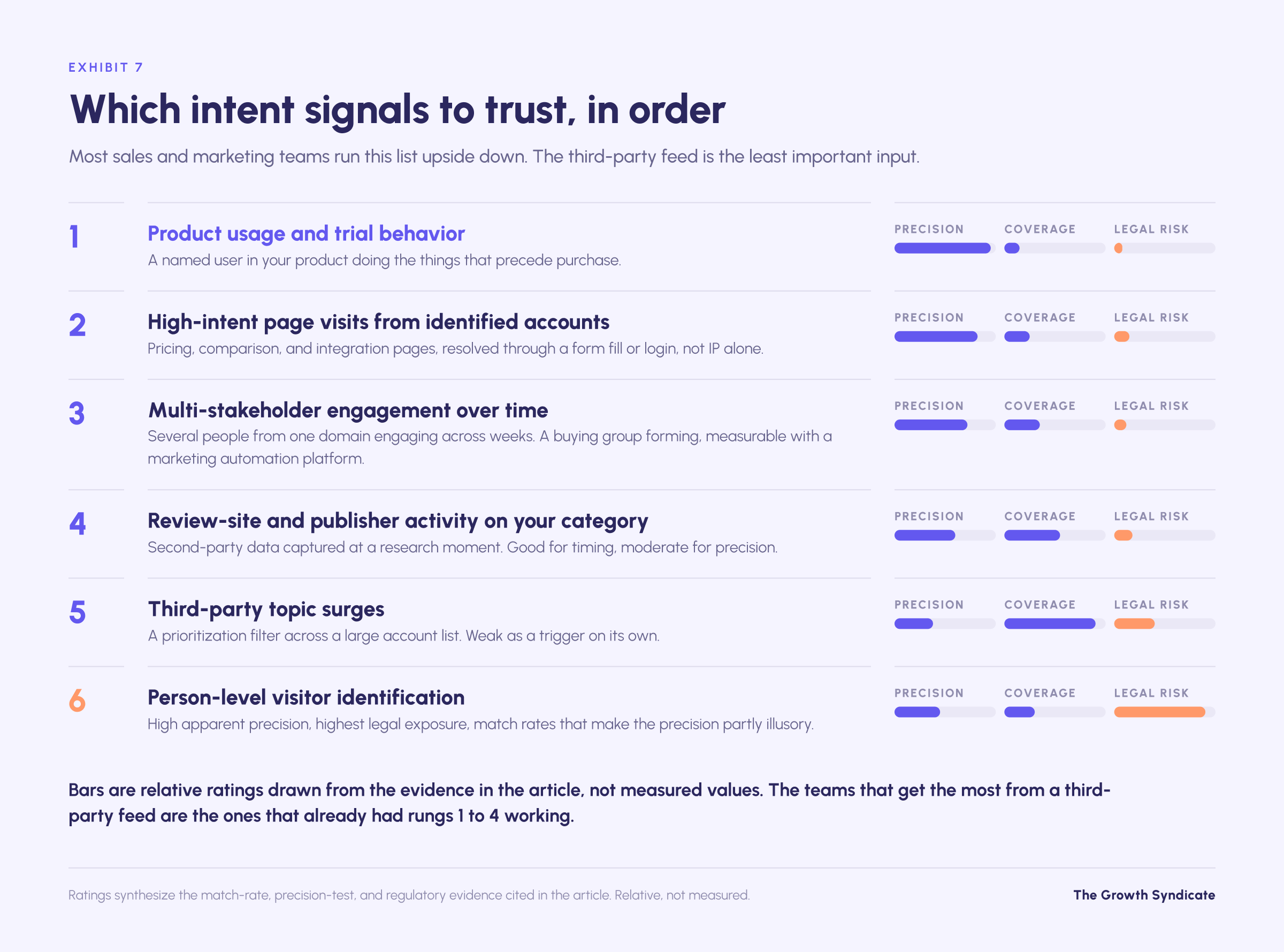
Pulling the mechanics, the accuracy evidence, and the legal position together produces a ranking of intent signals that most sales and marketing teams have backwards.
- Product usage and trial behavior. A named user in your product doing the things that precede purchase. Highest precision, lowest coverage.
- Pricing, comparison, and integration page visits from identified accounts. First-party website visits from accounts you can resolve with confidence, ideally through a form fill or a login and not through IP alone.
- Multi-stakeholder engagement over time. Several people from one domain engaging with your content across weeks. These behavioral signals are among the most reliable you have. This is the pattern that indicates a buying group has formed, and it is measurable with nothing more than a marketing automation platform and some discipline.
- Review-site and publisher activity on your category. Second-party buyer intent data, captured at a research moment. Good for timing, moderate for precision.
- Third-party topic surges. Useful for ranking high intent accounts across a large target list. Weak as a trigger for outreach on its own.
- Person-level visitor identification. Precise on outreach timing in appearance, highest legal exposure, and match rates that make the precision partly illusory.
The ranking explains a pattern that shows up repeatedly among sales and marketing teams that use intent data well: the third-party feed is the least important input, and the teams that get the most from it are the ones that already had the first four signals working.
"You can't fake intent the way you can fake an MQL. You cannot force a pain point onto a buyer. The only moves are to be top of three when demand appears, and to build the signals that let you act first when it does."Joliene van Grieken, co-founder, The Growth Syndicate
Find out whether intent data would actually change your pipeline
We start every engagement with a diagnostic of your ICP, your first-party signals, and your sales capacity to act on them. If a data feed would help, we will tell you which grade and why. If it would not, we will tell you that too.
The conditions under which intent data works
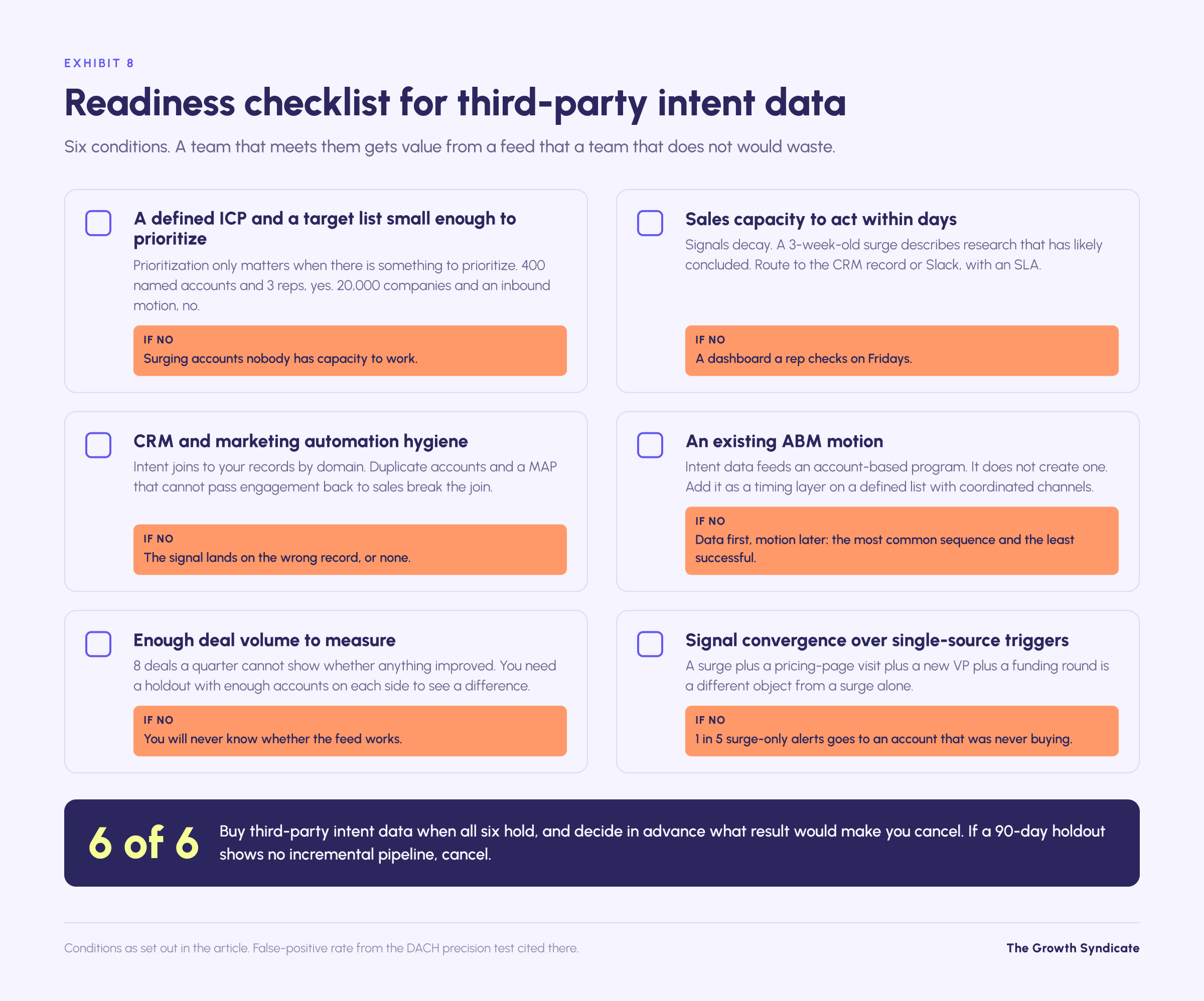
B2B intent data is not useless. It is conditional. The conditions are specific enough to write down, and a team that meets them will get value from a third-party feed that a team that does not would waste.
A defined ICP and a target account list small enough to prioritize
Intent data is a prioritization tool, and prioritization only matters when there is something to prioritize. A company with 400 named target accounts and 3 sales reps needs a way to decide who to work this week. A company with an addressable market of 20,000 companies and an inbound-led motion does not, and intent data will produce a list of surging accounts that nobody has capacity to work. The guide to ICP-led marketing covers how to draw that boundary; intent data assumes it has been drawn.
Sales capacity to act within days
Intent signals decay quickly. A topic surge that is 3 weeks old describes research that has likely concluded. Sales teams that route intent signals into a dashboard a rep checks on Fridays get nothing from them. Revenue teams that route them into the CRM record or a Slack alert, with a sales-marketing agreement on follow-up within a defined window, get whatever value exists. This is a sales and marketing alignment problem before it is a data problem: for marketing and sales teams alike, the signal is only as good as the SLA behind it.
CRM and marketing automation hygiene
Intent data is joined to your existing customer records by domain, so the state of your customer data decides whether any of it lands. If the CRM has 3 records for the same company under different names, the account signal lands on the wrong record or on none. If the CRM data cannot be matched to a domain, or the marketing automation platform cannot pass engagement history back to sales, first-party intent stays invisible. Most implementations that fail do so here, months before anyone questions the data.
An existing ABM motion
Intent data feeds an account-based program; it does not create one. The teams that report the clearest results are running one-to-few or one-to-many ABM with a defined account list, coordinated channels, and account-level measurement, and they add intent data as a timing layer on top. Buying the data first and hoping a motion forms around it is the most common sequence and the least successful.
Enough deal volume to measure
A team closing 8 deals a quarter, with long sales cycles, cannot tell whether intent data improved anything. The noise swamps the signal. If you cannot run a holdout with enough accounts on each side to see a difference, you cannot know whether the feed is working, and the vendor's dashboard will not tell you.
Signal convergence over single-source triggers
The practice that separates marketing and sales teams getting value from those getting alerts is combining signals. A third-party topic surge on its own has a false-positive rate of 1 in 5 at best. A topic surge on an account that is also visiting your pricing page, where a new VP of Marketing started last quarter and the company raised a round in the spring, is a different object. Composite account signals are how high intent accounts actually get identified. Outbound teams that publish their reply-rate data from layered outreach (trigger events such as leadership changes, hiring patterns, funding, and technology changes, combined with first-party engagement and third-party topic data) consistently show higher rates than single-source intent produces. The data is self-reported, but the pattern holds across every published set. The composite is more reliable than intent alone because each signal has different failure modes, and they rarely fail together.
"Marketers use the dark funnel as an excuse to measure nothing. You cannot track every touchpoint, but you can measure engagement over time, multi-stakeholder website visits, and content interactions. Enough signals can indicate intent."Joliene van Grieken, co-founder, The Growth Syndicate
How to collect B2B intent data
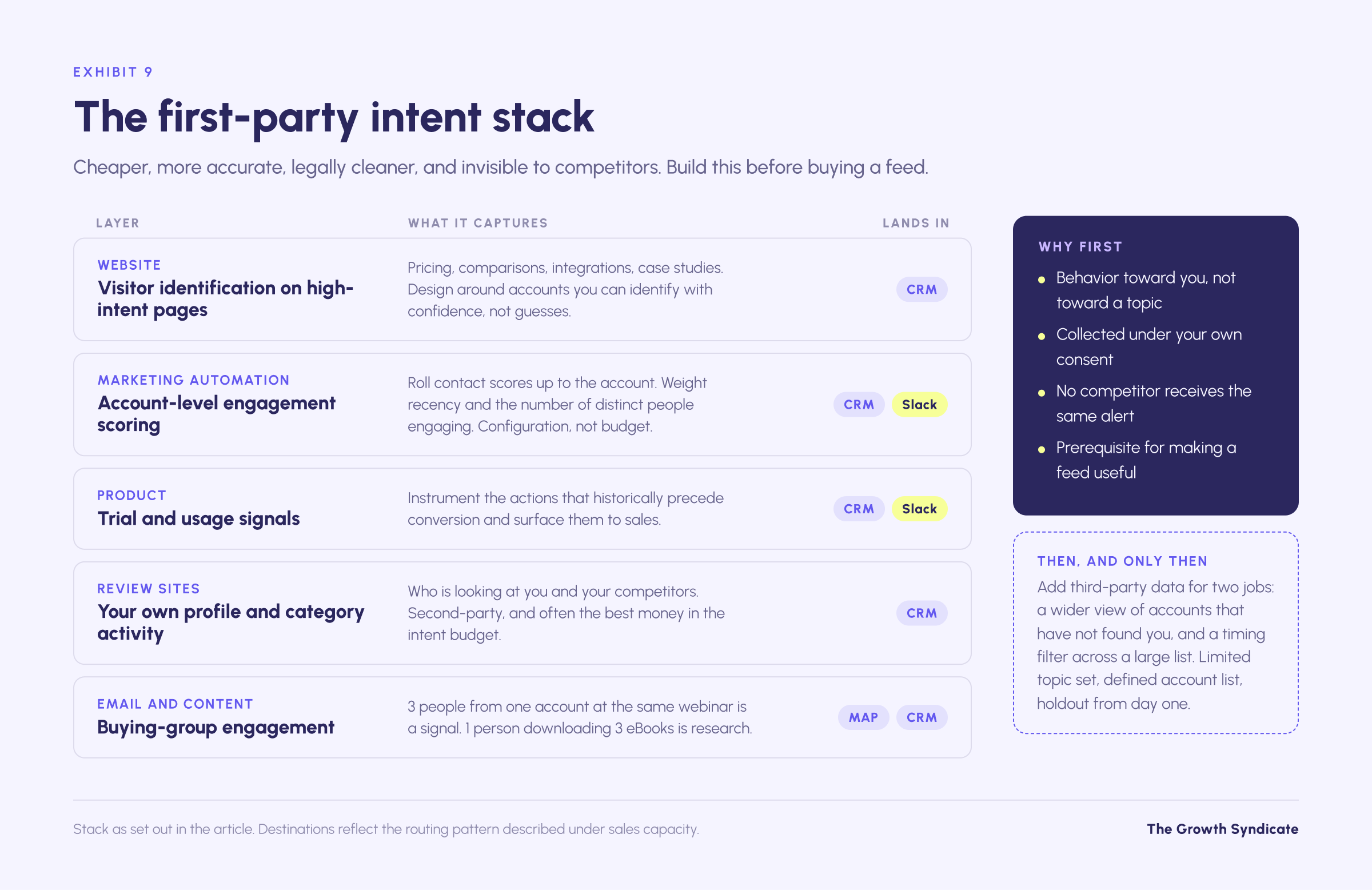
The question "how do I collect B2B intent data" is usually asked by someone about to buy a feed. The better answer is to build the first-party layer first. It is cheaper, more accurate, legally cleaner, and invisible to competitors, and it is the prerequisite for making a third-party feed useful at all.
The first-party stack
Website behavior with account resolution. A visitor-identification script that resolves visits to companies, filtered to the pages that matter (pricing, comparisons, integrations, case studies), and pushed into the CRM. Accept that resolution will fail for most home and mobile traffic and design around the accounts you can identify with confidence, not the ones you can guess.
Marketing automation engagement scoring at account level. Most platforms score contacts. Rolling scores up to the account, and weighting recency and the number of distinct people engaging, is the source of buying intent most marketing teams leave on the table. It requires configuration, not budget.
Product signals. For any company with a trial, freemium tier, or self-serve entry point, product usage is the most definitive of all intent signals. Instrument the actions that historically precede conversion and surface them to sales teams.
Your own review-site activity. Most review platforms will show you, for a fee, which potential customers are looking at your profile and your competitors'. This is second-party intent data, and for companies in a category the platform covers well, it can be the best money in the intent budget.
Email and content engagement with a buying-group lens. Three people from one account attending the same webinar is a signal. One person downloading 3 eBooks is a content marketer doing research. The difference is only visible if engagement is tracked by account.
Adding third-party intent data
Once the first-party stack works, third-party intent data adds two things: a wider view of research behavior across the category from accounts that have not found you yet and a timing filter across a large target account list. Buy it for those two purposes, evaluate it against them, and keep it downstream of the sales prospecting your team already does well. Start with a limited topic set and a defined account list instead of the full taxonomy, and run a holdout from day one.
Choosing intent data providers
The evaluation checklists circulating online run to 10 or 12 criteria and are mostly written by the intent data providers being evaluated. Five questions do most of the work.
Where does the data come from, in writing? Intent data providers should name their sources: co-op, syndication, bidstream, or first-party publisher data, and in what proportion. A provider that cannot answer this specifically is a bidstream reseller or does not know, and neither is acceptable.
What is the account match rate on your own traffic? Data accuracy claims are testable. Ask the intent data providers on your shortlist to resolve a sample of your recent site traffic and check the results against known accounts. This takes an afternoon and tells you more than any case study.
How is the score built, and what is the baseline? A surge score is a relative measure. Know what it is relative to, over what window, and what the threshold means, so the sales team can be told what a 70 actually signifies.
Which topics does the taxonomy cover for your category, and how thin is the publisher network there? Ask for topic-level volume in your category before you sign. Niche categories produce thin data, and thin data produces noise.
How does the data land in the systems sales teams already use? Native CRM and marketing automation integration, at the account record, with the ability to trigger alerts. A separate dashboard is a separate thing to ignore.
Two further points on the market itself. Independent analyst evaluations of the category do exist and are worth reading, with the caveat that every vendor named in them republishes the result as marketing. And most of the intent data platforms on the market are reselling the same co-op data with a different interface, so comparing data providers on data quality is often comparing the interface. The exception is the growing set of first-party intent data platforms that combine website identification, product usage, and trigger events; these are a different product with a different value proposition and should be evaluated as such.
Editorial note for review: naming specific vendors makes this section more useful and more citable, and invites argument. The research supports naming the major co-op, the two leading ABM platforms, the largest review-site intent product, and the publisher-owned option, each described factually. Decision pending.
What intent data costs
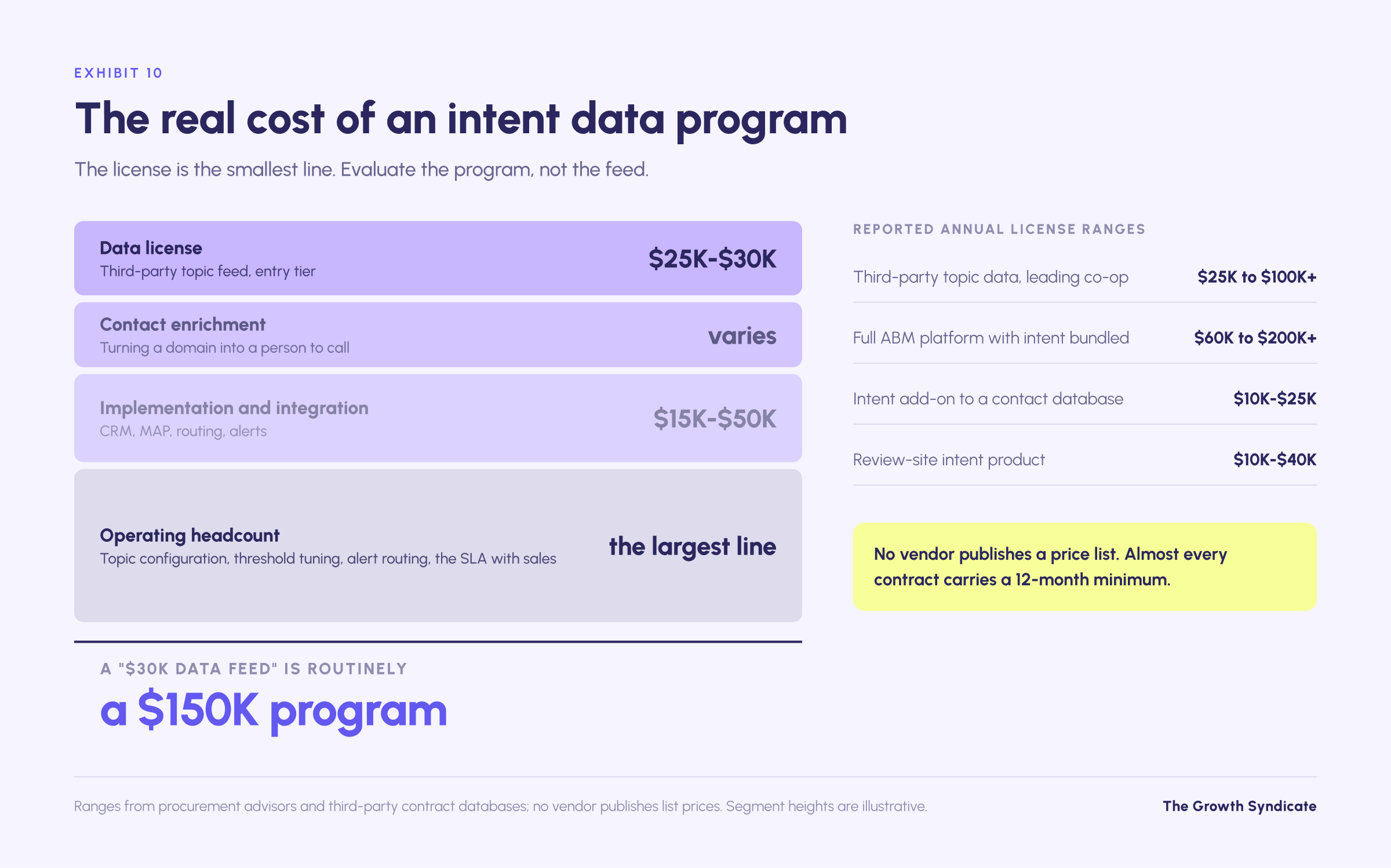
B2B intent data carries no public price list. Everything is quote-based and almost everything carries a 12-month minimum. The ranges below come from procurement advisors and third-party contract databases, not from the vendors.
Third-party topic data from the leading co-op starts around $25K a year and runs past $100K for broad topic sets; contract databases put the average deal in the high five figures. The full ABM and intent data platforms that bundle intent with account identification, advertising, and orchestration start around $60K, run $80K-$150K for most deployments, and exceed $200K for enterprise. Intent add-ons sold by contact-data providers sit at $10K-$25K on top of the base subscription. Review-site intent products run $10K-$40K depending on category coverage.
Those figures are the data. The program costs more. Turning an account-level signal into a person to contact requires contact enrichment. Procurement advisors quote implementation and integration work at $15K-$50K. And someone has to operate it: configure topics, tune thresholds, route alerts, and maintain the SLA with sales. A "$30K data feed" is routinely a $150K program once that is counted, and the evaluation should be made at the program level.
Statistics to stop repeating
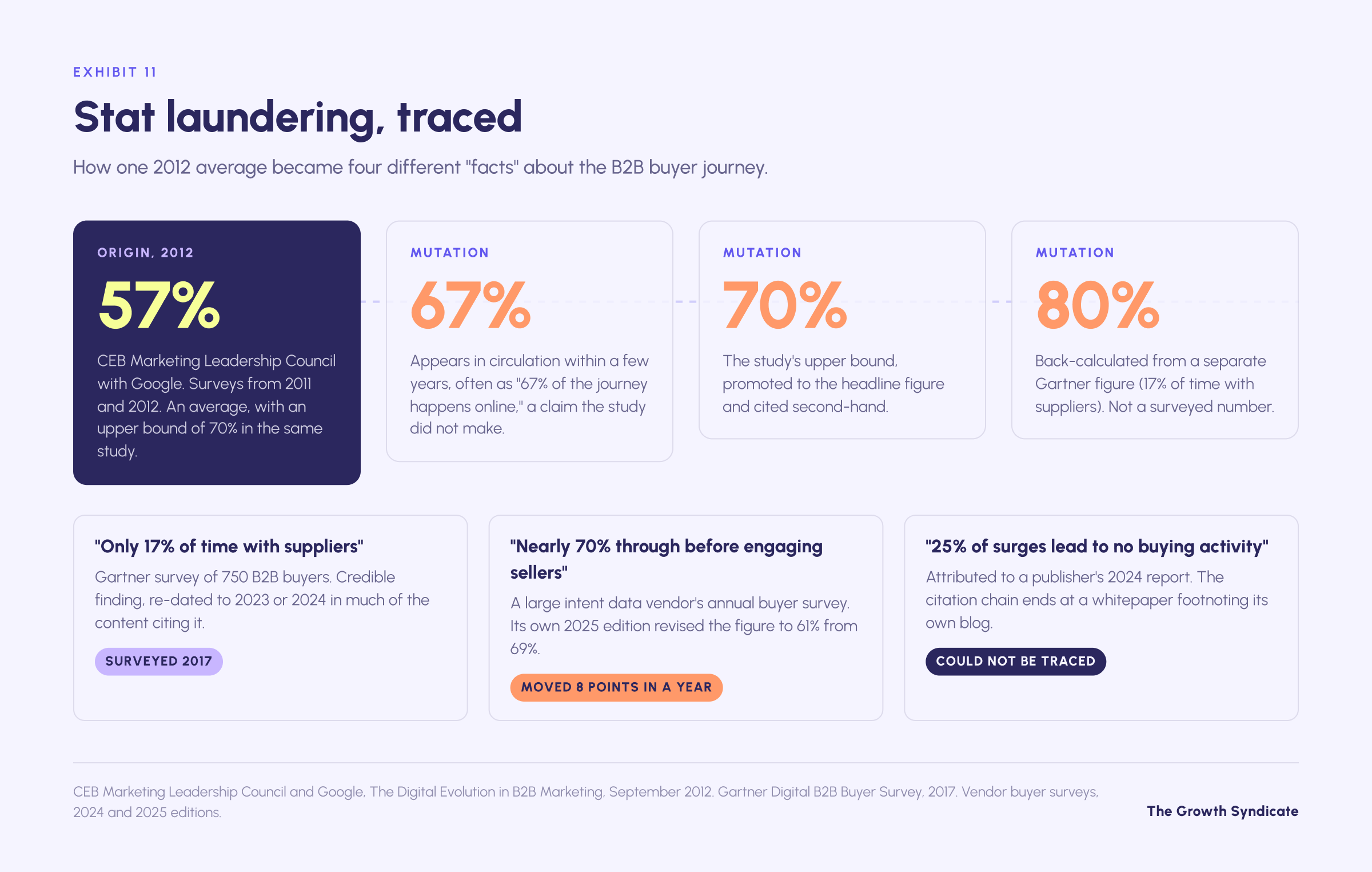
Writing about B2B intent data is unusually dependent on a small set of recycled statistics, several of which do not survive contact with their source. Repeating them undermines the credibility of everything around them.
"57% of the buying journey is complete before the buyer contacts sales." Origin: a 2012 study by CEB's Marketing Leadership Council with Google, based on surveys from 2011 and 2012. The 57% was an average, with an upper bound of 70% in the same study. It has since circulated as 67%, 70%, and 80%, none of which appear in the original, and the underlying survey is now 14 years old. It is also frequently cited as "67% of the buyer's journey occurs online," which is a different claim that the study did not make.
"Buyers spend only 17% of their time meeting with potential suppliers." Origin: a Gartner survey of 750 B2B buyers conducted in 2017. Re-dated to 2023 or 2024 in much of the current content citing it. The finding is credible; the date is not, and the "80% of the journey happens without you" figure derived from it is a back-calculation that Gartner did not publish.
"Buyers are nearly 70% through the purchase before engaging sellers." Origin: a large intent data vendor's annual buyer survey, which is competently run and self-interested. The vendor's own 2025 edition revised the figure down to 61% from 69% the year before, a shift of roughly 6-7 weeks in a typical cycle. A number that moves 8 points in a year is a snapshot, not a rule.
"25% of intent surges lead to no buying activity," attributed to a publisher's 2024 report. This one could not be traced to any such report. The citation chain leads to a whitepaper whose footnote links to its own blog. Treat it as unverified.
"Using intent data reduces cost per lead by 37%." No credible origin was found for the cost-per-lead version. A 37% figure does circulate in a different form, as an increase in lead conversion rates, attributed to a 2024 Gartner study that could not be located. The number appears to have migrated across metrics, which is reason enough not to repeat it.
Some of these claims may be true. An article about the reliability of signals should still not rest on them.
Intent data and the shift to AI search
The supply side of third-party intent data depends on buyers reading B2B media on the open web, where the co-op's tags can see them. Buyer behavior is changing. A growing share of early-stage research now happens inside AI assistants and AI-generated search results, which produce no page view on a publisher site and therefore no co-op signal. The buyer who asks a language model to compare 5 vendors has moved a long way through the buyer journey without leaving a trace that any topic taxonomy will register.
Two things follow. The first is that third-party intent data's coverage of the early journey is shrinking, at the point where it was already weakest. The second is that visibility in AI-generated answers is becoming a proxy for shortlist position, which is the 95% problem in a new form: the brands that appear when a buyer asks "what are the best options for X" are being decided by content, citations, and reputation accumulated before the question was asked. The B2B SEO strategy guide covers how that visibility is earned; the relevant point here is that it is a demand generation outcome, and no intent feed can detect it after the fact.
The category is also consolidating. Review-site intent data platforms have been acquired by technographics vendors, contact-data providers have absorbed enrichment tools, and the largest co-op's surge scores are now available natively inside a mainstream CRM record. That last development is the most telling: intent data is becoming a feature of systems buyers already own instead of a standalone purchase, which is roughly where its value sits.
The case for intent data, stated fairly
An article this skeptical about B2B intent data owes the other side its strongest argument.
Buyers do conduct most of their research without talking to a vendor, and a team that cannot see any of that research is operating blind during the phase where shortlists form. Consent-based co-op data is legally defensible in a way that bidstream is not, and it provides a real, if directional, view of category research across a large market that no first-party stack can match for breadth. The available precision testing puts the best-known intent data providers above 80%, which is a usable filter for in-market accounts even if it is not a trigger. Second-party data from review sites and publishers is captured at the moment of a real comparison action and is close to real buying intent. And the outbound teams reporting the strongest results from signal-based selling are the ones combining several sources, which points at implementation as the usual failure, with the data a distant second.
All of that is true, and none of it contradicts the position above. Intent data is a conditional tool with a real use. The category's problem is that it is sold as an unconditional one.
A decision rule
Buy third-party intent data when all of the following are true: your ICP is defined and your target account list is small enough that prioritization changes what sales does this week; your first-party signals (website, product, marketing automation, review-site) are instrumented and reaching sales; your CRM is clean enough to join a domain-level signal to the right record; you have a sales-marketing agreement on acting within days; you have enough deal volume to run a holdout; and you have decided, in advance, what result would make you cancel.
If a 90-day holdout shows no incremental pipeline against the control group, cancel. If the false-positive rate on surging accounts in your own data exceeds 1 in 5, downgrade the feed from a trigger to a filter. If your category is niche enough that topic volumes are thin, spend the budget on the second-party and first-party layers instead.
If those conditions are not met, the money is better spent on ICP definition and on the account-based marketing motion the data would feed. The demand generation work that puts you on the shortlist before any signal fires comes before both.
Build the signal stack before you buy the signal
TGS runs ABM and demand generation programs for revenue teams that need to know which accounts to work and when. We instrument the first-party layer, connect it to sales, and add third-party data only where it changes a decision.
Frequently asked questions about intent data in B2B
What does B2B data mean in the context of intent?
B2B data is any information about companies and the people who work in them: firmographic data (industry, size, location), technographic data (the tools a company uses), contact data, and behavioral data. Buyer intent data is the behavioral subset. It records what accounts are actively researching, while the other three describe what the accounts are. Intent data is most useful joined to the other categories, so that a research signal from an account that fits the ICP outranks one that does not.
Can you give me an example of intent data?
A first-party example: 3 people from the same company open your pricing page and an integrations page within a week, and one of them registers for a webinar. A second-party example: a review site reports buyer intent from an account on your target list that compared your product against two competitors. A third-party example: a co-op reports that a domain's research behavior on the topic "marketing automation" rose sharply against its 12-week baseline. The three examples describe very different levels of confidence, which is the reason the grades matter.
How do I collect B2B intent data?
Start with the intent signals you own: website visitor identification filtered to high-intent pages, account-level engagement scoring in your marketing automation platform, product usage signals if you have a trial or freemium tier, and your own review-site activity. Route all of it into the CRM at the account level. Add third-party B2B intent data from a co-op or publisher network only once that layer works, and use it as a filter on outreach timing across a defined list of target accounts, never as a standalone trigger.
What is the rule of 7 in B2B?
The "rule of 7" is a marketing folk rule holding that a buyer needs around 7 exposures to a brand before acting. It predates B2B marketing and has no rigorous research behind the specific number. The credible version of the idea comes from marketing science on mental availability: buyers shortlist the brands they can recall when a need arises, and recall is built through repeated, varied exposure over time. In the context of intent data, the rule is a reminder that by the time an account surges, the brands it will consider were largely decided by exposure that happened earlier.
Is intent data worth it for a small B2B company?
Usually not as a third-party purchase. A company with small sales teams and an addressable market it can list by name gets more from first-party signals and a disciplined account-based motion than from a $60K feed that produces alerts nobody has capacity to work. Second-party data from a review site covering the category is often the better entry point.
How accurate is intent data?
It depends on the grade. Product usage and identified first-party website behavior are close to definitive. Third-party topic surges resolve to the correct account somewhere between 30% and 65% of the time with the best intent data providers, and roughly 1 in 5 correctly matched surges shows no purchase interest in the limited independent testing available. Treat vendor accuracy claims as claims and test them against your own traffic before signing.
Does intent data replace demand generation?
No. Intent data detects research activity among the small share of buyers who are in market. It has no view of the majority who are not, and no amount of intent signals will influence which brands they consider when they arrive. Demand generation creates that shortlist position; intent data helps marketing and sales teams capture the demand once it appears. Programs that cut demand generation to fund intent data reliably see the pipeline of surging accounts thin out over time.
Can intent data be used for existing customers?
Yes, and it is one of the higher-value uses. Monitoring existing customer records for research activity on competitor categories can flag churn risk, and research on adjacent categories can flag expansion opportunities. First-party product and support signals are stronger for both than third-party topic data, but the third-party view can catch an account researching alternatives before it stops using the product.
How long does it take to see results from intent data?
Signals appear within days of setup. Whether they shorten sales cycles or produce pipeline is a different question. Sales teams that have written up their implementations put the first visible effect on pipeline at 60-90 days, assuming the operational conditions above are in place. Whether that effect is incremental requires a holdout, which most teams never run. Plan the test before the contract starts, not after.
Sources
- Ehrenberg-Bass Institute / LinkedIn B2B Institute, John Dawes, "Advertising Effectiveness and the 95-5 Rule," 2021.
- CEB Marketing Leadership Council and Google, "The Digital Evolution in B2B Marketing," September 13, 2012 (n=1,399 for the 57% figure; 1,500+ contacts across 22 B2B organizations).
- Gartner, Digital B2B Buyer Survey, 2017 (n=750).
- US Federal Trade Commission, In re Mobilewalla, Inc., FTC File No. 2023196, proposed consent order announced December 3, 2024; Electronic Frontier Foundation analysis, January 2025.
- Court of Justice of the European Union, IAB Europe v. Gegevensbeschermingsautoriteit, judgment of March 7, 2024; Belgian Market Court judgments of May 14, 2025 and January 7, 2026 (IAB Europe statement, January 9, 2026).
- Lo, V. S. Y., "The True Lift Model," ACM SIGKDD Explorations, 2002.
- Yang, Y., Liu, D., and Huang, Y., "Evaluating Uplift Modeling under Structural Biases: Insights into Metric Stability and Model Robustness," Proceedings of the 32nd ACM SIGKDD Conference (KDD 2026), August 2026. doi:10.1145/3770855.3817465.
- Ninth Circuit, Mikulsky v. Bloomingdale's, LLC, June 20, 2025 (unpublished); Torres v. Prudential Financial, Inc., 2025 WL 1135088 (N.D. Cal. Apr. 17, 2025).
- Forrester, "The Forrester Wave: Intent Data Providers For B2B, Q1 2025," February 27, 2025.
- Bombora, "Our Data" and Company Surge methodology documentation (vendor-published).
- 6sense, Buyer Experience Report 2024 (October 2024) and 2025 (November 2025) (vendor-published).
- Brixon Group, intent data precision test (commercial source, DACH market).
- Pricing ranges from procurement advisory and reseller reporting; no vendor publishes list prices.
.png)