.svg)

.png)

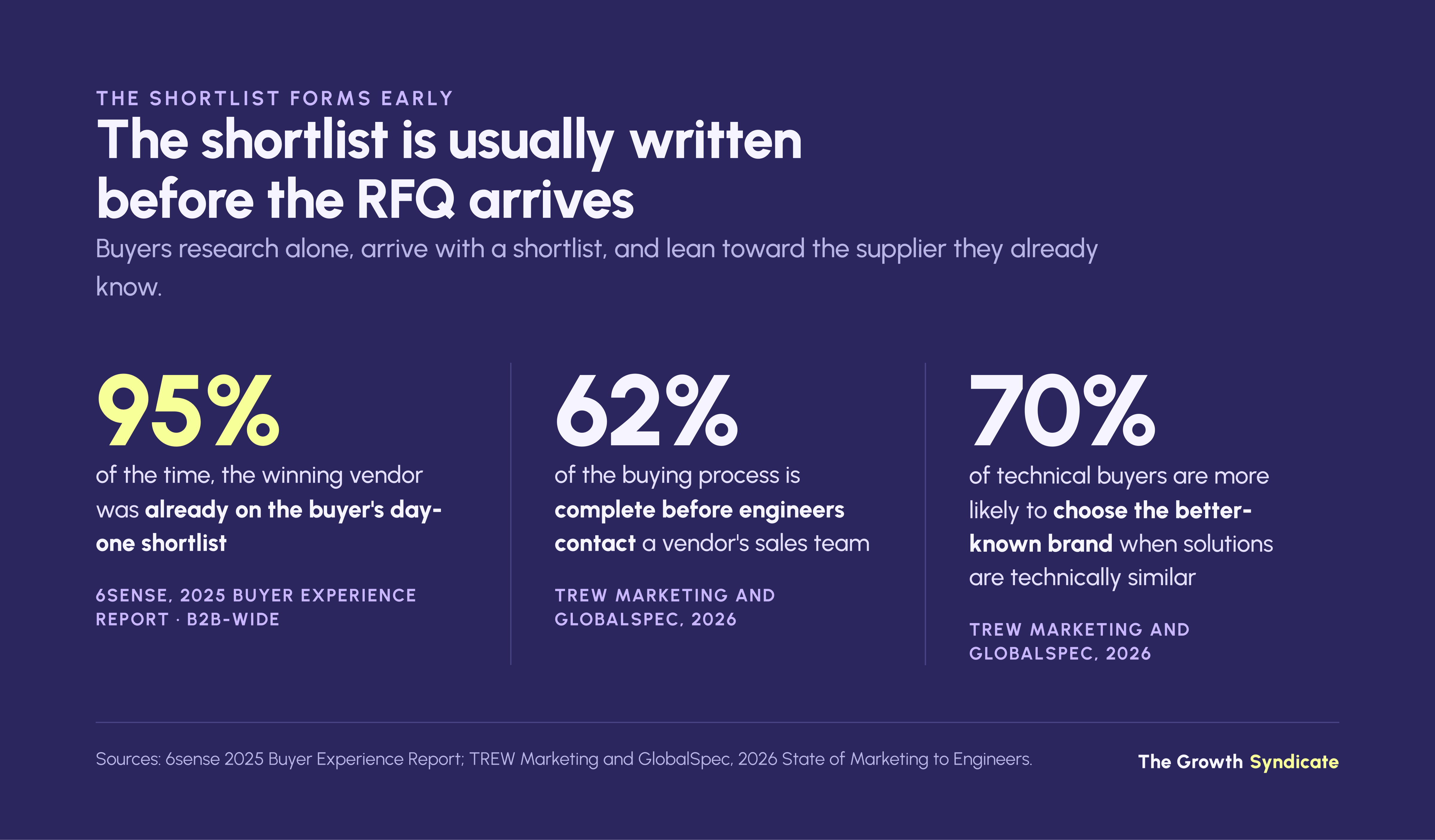
Many of the deals a manufacturer loses are lost before it knows they exist. By the time a buyer sends an RFQ, the list of suppliers they will seriously consider is usually written. Across B2B purchases, 6sense’s 2025 Buyer Experience Report found that 95% of the time, the winning vendor was already on the buyer’s day-one shortlist. Engineers, according to the 2026 State of Marketing to Engineers research from TREW Marketing and GlobalSpec, complete 62% of the buying process before they contact a vendor’s sales team.
That changes what manufacturing marketing is for. The job is less about generating demand and more about being remembered, credible and easy to verify at the moment a buyer’s need appears, while promising only what the factory can deliver.
This guide covers how to build that kind of manufacturing marketing strategy: positioning, segmentation, the buying committee, the plan, the channel mix, content, the relationship with sales and distributors, budget and measurement. Each section shows how the advice changes across four types of manufacturer, because a contract job shop and a capital equipment maker should not run the same playbook. The evidence comes from our 2026 report on marketing for the manufacturing industry, built on five practitioner interviews, from primary research on how engineers and manufacturing marketers behave, and from our work with manufacturers.
What is manufacturing marketing?
Manufacturing marketing is the work of making a manufacturer known, credible and easy to choose for the engineers, procurement teams and executives who buy industrial products and production capacity. Its purpose is to put the company on buyers’ shortlists before they enter the market, and to create demand the factory can actually fulfill.
What role does marketing play in a manufacturing company?
In many manufacturing companies, the business was built on product quality, a sales team with long relationships, and word of mouth. Marketing produced brochures, booth graphics and the occasional press release. That model assumed buyers would come to the sales team for information. Increasingly, they don’t: they arrive with a shortlist, a spec and a set of questions they could not answer on their own.
Marketing for manufacturers now carries six responsibilities:
- Positioning. Deciding what the company stands for, in one sentence, and which trade-offs it accepts.
- Memory. Keeping the company in the minds of potential customers who are not buying yet, so it makes the shortlist when they are.
- Verification. Giving engineers the datasheets, CAD files, application notes and proof they need to check a claim without calling anyone.
- Demand the factory can absorb. Generating qualified leads for the work the company wants, at a volume its capacity can handle.
- Enablement. Equipping the sales team, reps and distributors with material that answers the questions buyers actually ask.
- Measurement. Showing leadership what marketing contributes to the sales pipeline, in terms a plant manager or CFO respects.
This is where manufacturing marketing departs from consumer marketing. A consumer brand can win on emotion and reach. A manufacturer is judged by people who will check the tolerances, and every claim has to survive that check.
Why manufacturing marketing works differently from other B2B marketing
Manufacturing shares a vocabulary with the rest of B2B (funnels, leads, pipeline) but runs under five constraints most marketing playbooks ignore. Each one changes what a sensible plan looks like.
The shortlist forms before anyone contacts you
Buyers in manufacturing rarely start from zero. In Forrester’s 2024 Buyers’ Journey Survey, 41% of B2B buyers had a single vendor in mind when they began a purchase, and 92% started with a shortlist. Among engineers and technical buyers, 70% say they are more likely to choose the better-known brand when two solutions are technically similar, and 53% say brand familiarity influenced their most recent purchase (TREW Marketing and GlobalSpec, 2026).
In our experience, most of the demand a manufacturer will ever capture already exists. A part is being bought from someone today; a line will need replacing when it wears out. The marketing question is whether your company is the one buyers remember and trust when that moment arrives. Campaigns that only switch on when someone raises a hand miss most of the decision.

Growth is a capital expenditure problem first
A software company that doubles its customer base buys more server capacity. A manufacturer that doubles its customer base may need a second production line, new tooling, more skilled operators and months of lead time before the first extra unit ships. Marketing that generates demand beyond production capacity does not create revenue. It creates late deliveries, declined quotes and buyers who remember the failure.
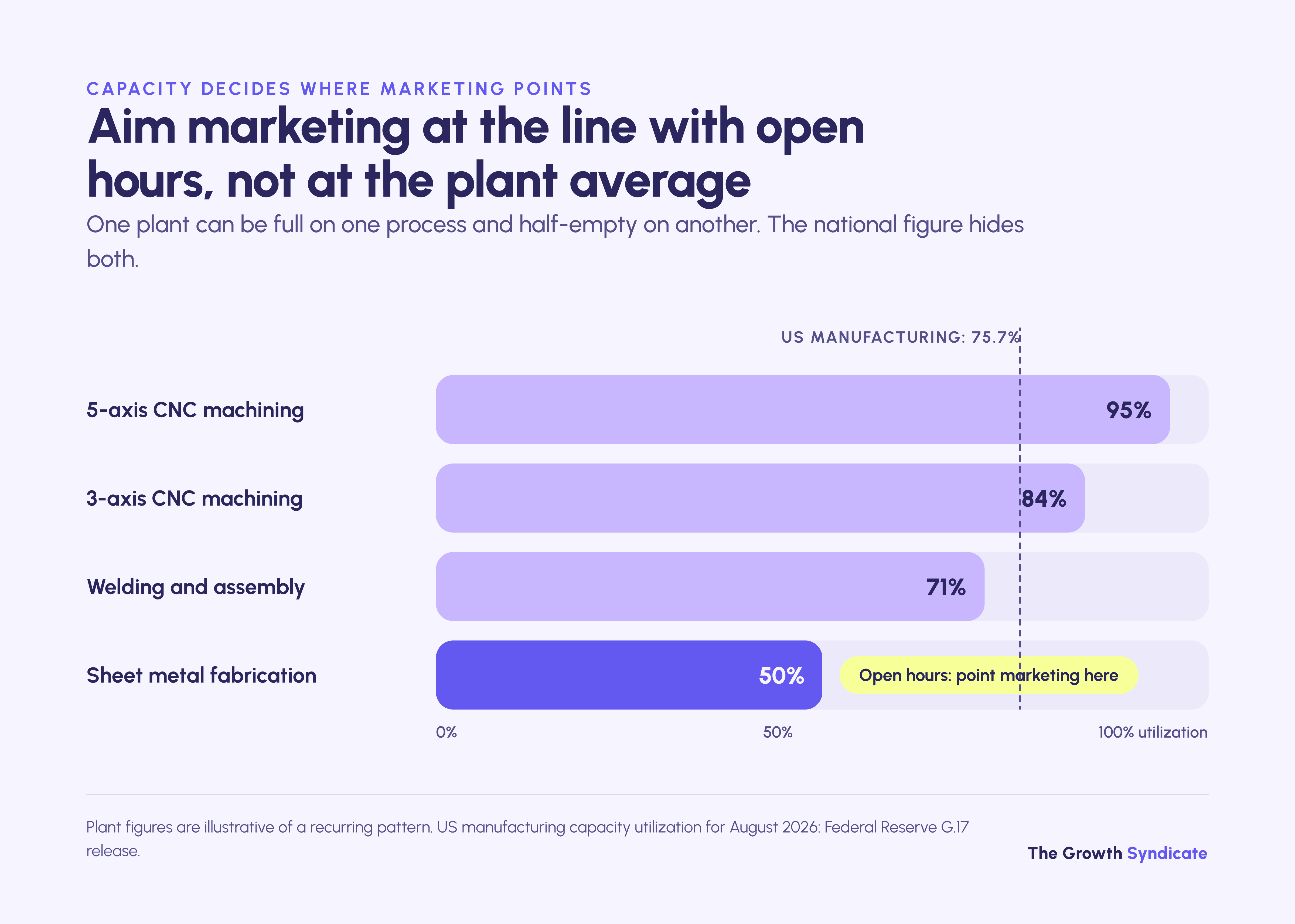
The national figures hide how different individual plants are. US manufacturing capacity utilization stood at 75.7% in August 2026, 2.5 points below its long-run average, according to the Federal Reserve’s G.17 release. A shop running at 95% on its five-axis machines and 50% on its sheet metal line needs a marketing plan aimed at the sheet metal line, not at “more leads.”
Your buyer knows more than you do
In most B2B categories a capable marketer can learn the product well within a year or two. In manufacturing, the target audience has engineering degrees and years of shop-floor experience that desk research will not replicate. The gap rarely closes, so the marketer’s value lies in translation: extracting what the company’s engineers know and making it usable for the engineers, buyers and executives outside it. That makes content slower and more dependent on internal experts than in most B2B categories, a point the content section returns to.
Long sales cycles and multiple stakeholders
Industrial purchases involve multiple stakeholders with different standards of proof, and supplier qualification in regulated sectors such as aerospace or medical devices can take months before a first production order. Long sales cycles mean the marketing that wins a deal can happen months or years before the deal is visible. They also mean results from a new marketing plan take longer to show than leadership often expects, which is one reason measurement needs leading indicators.
Marketing has to earn its standing inside the company
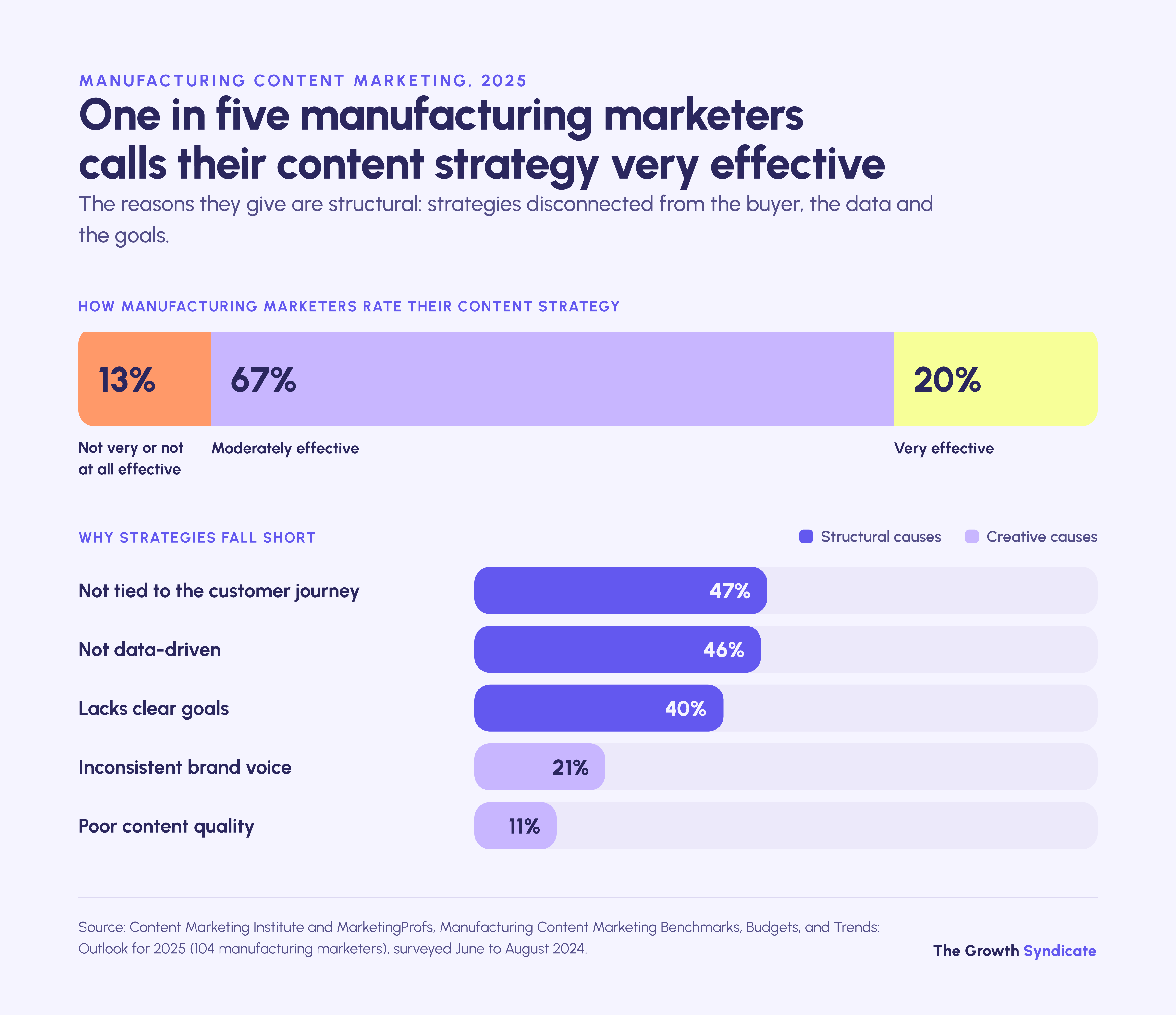
Many manufacturers are run by operators and engineers who built the business on product quality and relationships. Marketing is often seen as a cost center that makes collateral. The numbers suggest the function has work to do: in the Content Marketing Institute’s 2025 manufacturing research, only 20% of manufacturing marketers called their content strategy very effective, and 67% called it moderately effective. The most-cited reasons were structural rather than creative: strategies not tied to the customer journey (47%), not data-driven (46%) and lacking clear goals (40%). Sixty-four percent said they struggle to attribute ROI to their content and to track customer journeys.
In our experience, the manufacturing marketing challenges that matter most are rarely about talent or tools. They come from plans that start with channels instead of buyers and capacity, a pattern the rest of this guide is built to avoid.
The lens this guide uses: four archetypes, three buying modes
“Manufacturer” covers companies that sell in very different ways. The advice in each section changes depending on which of four archetypes you are, and on how your customers buy: by sending an RFQ, by designing your part into their product, or by ordering from a catalog or online quoting tool.
Framework: The Growth Syndicate. Many companies are hybrids; plan each business line for its dominant mode.
Many companies are hybrids, with a job-shop division and a proprietary product line, for example. Treat each business line separately and plan for its dominant mode.
Industrial marketing vs manufacturing marketing
Industrial marketing is the marketing of goods and services to organizations that use them to make other products or run their operations: raw materials, components, capital equipment and maintenance supplies. Manufacturing marketing is the marketing a manufacturer does to win customers for its products or its production capacity. The two overlap almost completely in practice, and most manufacturers can treat them as one discipline.
The terms come from different places, which explains why both exist. “Industrial marketing” is the older academic label, close to what textbooks now call B2B marketing; one of the field’s leading research journals is still called Industrial Marketing Management. “Manufacturing marketing” is the practitioner’s label, used by the companies doing the work and the agencies serving them.
Definitions: The Growth Syndicate.
One distinction is worth keeping. Some manufacturers sell to consumers through retailers, and their marketing looks more like consumer marketing. This guide covers manufacturers whose buyers are other businesses, which is where an industrial marketing strategy and a manufacturing marketing strategy are the same thing.
Positioning and branding: pick two of cost, quality and speed
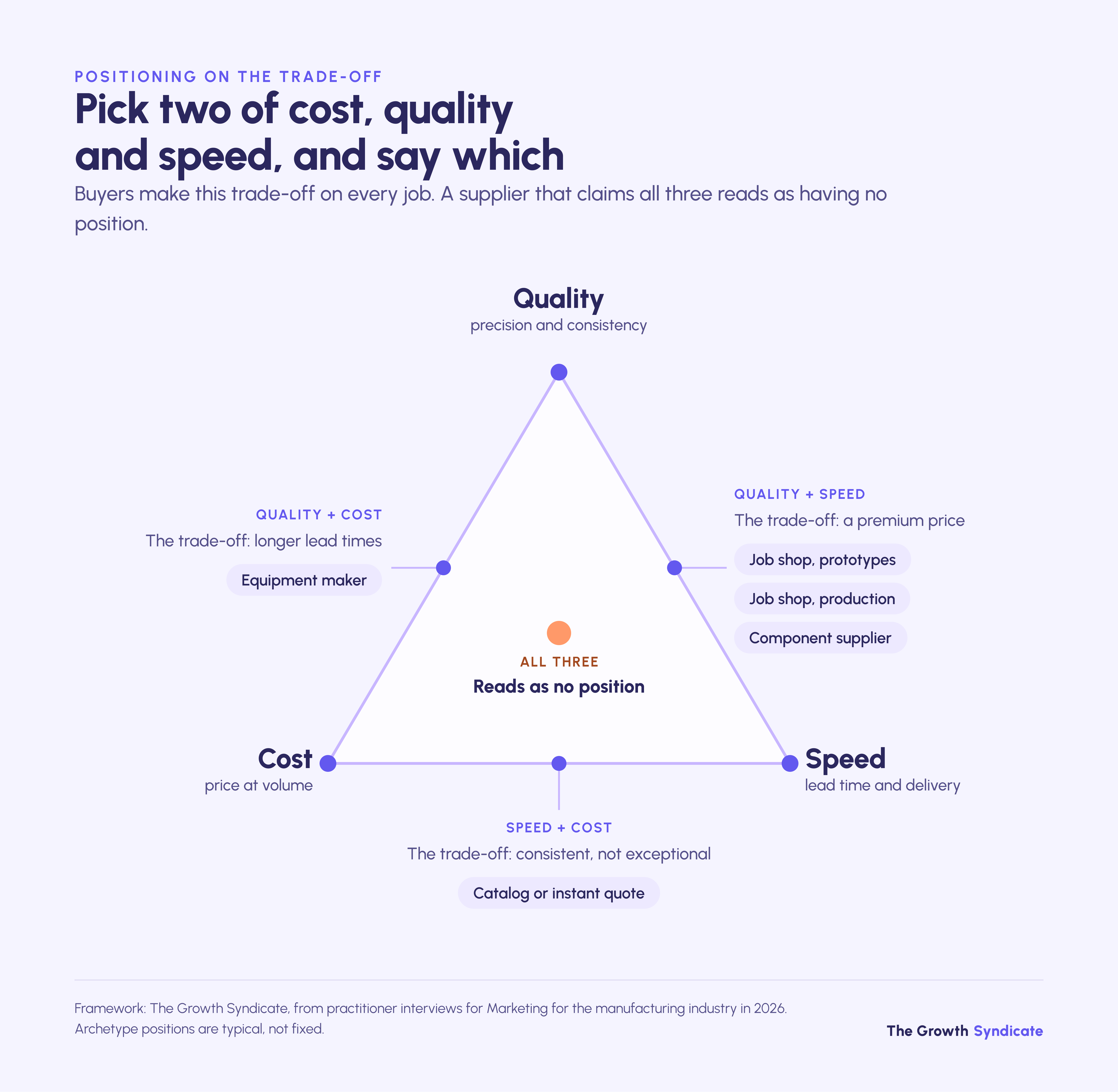
Manufacturing positioning starts with a trade-off every buyer already understands: a supplier can be fast, cheap or exceptionally precise, and can credibly offer two of the three. Manufacturers that say which two they offer, and which trade-off they accept, earn trust faster than those implying all three.
Why the triangle works as a positioning tool
Buyers make the cost, quality and speed trade-off on every job. Cheap and high quality means long lead times; fast and high quality means expensive; fast and cheap means compromise somewhere. An engineer reading a website that promises all three is likely to conclude one of two things: the company doesn’t understand its own economics, or it isn’t being straight. Neither gets it shortlisted.
A prototyping service that leads with turnaround speed makes a different promise from a production partner that leads with tolerance control and supply resilience. Both are valid positions. “Reliable second source for aerospace machining” is a valid position too, if it’s true, and a very sellable one to buyers whose single-source supplier just missed a delivery.
The one-sentence test
Many manufacturers can explain what each of their products does. Far fewer can say, in one sentence, what the company stands for. Every external practitioner interviewed for our manufacturing report raised this gap independently, and it cuts across company size and sub-sector.
A quick test: ask your head of sales, your plant manager and whoever runs marketing to write down what the company stands for in one sentence. If the three sentences differ, the market is receiving three messages. The fix is a positioning spine, a central idea every product page, sales conversation and trade show stand can extend from without contradiction. A company that serves medical, aerospace and industrial customers with thousands of SKUs cannot write a separate story for each; it needs one story that holds across all of them.

Clear positioning also turns market noise into material. Tariffs, reshoring, a new emissions rule or a supply shock becomes one more occasion to restate what the company believes, instead of a fresh communications problem. This is usually where our positioning and messaging work with manufacturers begins, because every later channel decision depends on it.
Manufacturing branding in two layers
Many manufacturing brands end up in one of two places: a polished corporate shell that could belong to any industry, or a website last updated a decade ago. Neither helps the buyer. The alternative is to build the brand in two layers.

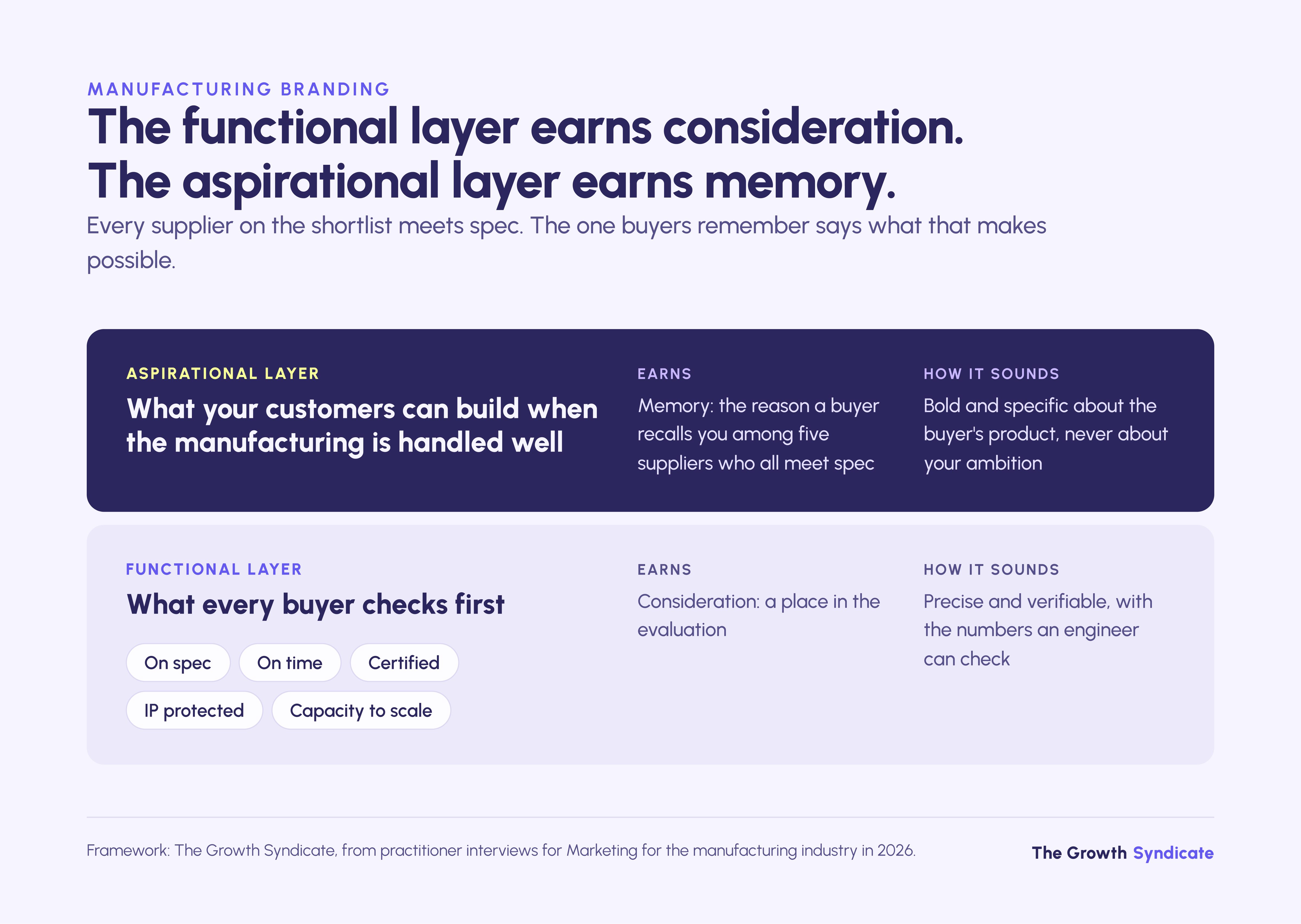
The functional layer covers what buyers check first: on spec, on time, certified, IP protected, with the capacity to scale. Being reliable, on time and to spec is most of the battle, and it has to be communicated with engineering precision. The aspirational layer covers what becomes possible when manufacturing is handled well: the products your capabilities let customers build. The first layer earns consideration; the second is what makes a buyer remember you among five suppliers who all meet spec.
One more honesty requirement applies. Many buyers run plants with older equipment and partial integrations, far from the showroom setup in your brochure. Manufacturers that say so (here is what the technology can do, here is where you probably are today, here is a sensible next step) earn more trust than those selling the vision as if the gap didn’t exist.
How the corner changes by archetype
- Contract manufacturers and job shops often split by segment: speed for prototypes, quality and delivery reliability for production. Saying which segment you serve is part of the position.
- Component suppliers compete on quality plus continuity of supply, because a designed-in part has to stay available for the life of the customer’s product.
- Equipment makers compete on quality and total cost of ownership, with service response as the speed dimension.
- Catalog and instant-quote manufacturers compete on speed and cost, and need quality to be consistent rather than exceptional.
Decision rule. Pull your last 20 won quotes and your last 20 lost ones, and note why each went the way it did. The corner you win on is your position. The corner you keep losing on is the one to stop claiming.
Example rows are illustrative. The corner you win on most is your position; the corner you keep losing on is the one to stop claiming.
Failure mode. A homepage headline promising “the highest quality, the fastest turnaround and competitive prices.” To an engineer, that reads as no position at all.
Segmenting manufacturing markets by buying situation
Industry segments such as aerospace, medical or automotive tell you who your target audience is. The buying situation tells you what they need from you this quarter. Segment by both, because two buyers in the same industry can want opposite things from the same supplier.
Prototype vs production
Prototype and production buyers want nearly opposite things from the same supplier, so the messaging, the proof points and even the RFQ form should differ. Many shops serve both and market as if they served one, which leaves each audience half convinced.
Framework: The Growth Syndicate. Many shops serve both; market to each with its own message and RFQ path.
New program, switch or expansion
The second cut is where the buyer is in relation to their current suppliers.
Framework: The Growth Syndicate.
Switching is harder than marketers assume: a supplier change costs the buyer requalification time and risk, so the incumbent usually keeps the work until something goes wrong. That is why the switch row depends on memory built long before the failure. In our experience, expansion is the most underused of the three. Existing customers already trust you, yet many have no idea you machine titanium as well as aluminum, or added a finishing line last year. Customer loyalty in manufacturing is less about programs and more about customers knowing everything you can do for them.
Direct vs through distribution
Some buyers order direct; others buy through distributors, catalogs or reps. When distribution sits between you and the buyer, the distributor’s salespeople become an audience in their own right, and they need training, pricing clarity and material they can forward without editing.
How the segmentation variable changes by archetype
- Job shops: volume band and certification requirements (ISO 13485, AS9100, IATF 16949) usually matter more than industry name.
- Component suppliers: design-in stage. Being present while a product is on the drawing board is worth more than any campaign after it launches.
- Equipment makers: installed-base age. Machines approaching end of life, or plants announcing expansions, mark the buyers entering the market.
- Catalog manufacturers: search intent by product category, because the buyer segments themselves by what they type.
Decision rule. Rank segments on four questions: does the work fill capacity you want to fill, does it carry the margin you need, are buyers there already aware of you, and can you reach them? For segments small enough to name every account, move from segmentation to account based marketing, which treats each company as a market of one.
Scores 1 to 5. Example rows are illustrative.
Failure mode. Listing “aerospace, medical, automotive” on the homepage and writing the same message for all three.
Engineers, management and leadership: three levels of the buying committee
A manufacturing purchase is judged at three levels with different standards of proof. Engineers need technical credibility, management and procurement need the business case, and executive leadership needs the strategic case. Marketing has to hold one coherent story across all three, because the same buyer committee reads all of it.
Level one: engineers and operators
Engineers want specifications, compatibility data, integration details and proof that the product works in conditions like theirs. They are the ones who quietly kill a vendor in a technical review meeting, and a business case rarely recovers from that. They are also skeptical by training: a claim without data behind it counts against you.
Level two: management, procurement and finance
This level turns an engineering recommendation into a budget request. Management wants return on investment, risk reduction and efficiency. Procurement adds its own checklist: supply reliability, certifications, IP protection, payment terms, second-source risk and total cost. A supplier that satisfies the engineer but leaves procurement guessing about capacity or delivery performance stalls here.
Level three: executive leadership
Leadership asks whether the supplier is a safe choice and fits where the company is going. They rarely read datasheets. They form views from peers, industry publications, events and a company’s general reputation, which is why brand work that seems remote from any deal still matters in manufacturing.
Framework: The Growth Syndicate, after Tom Spencer's three levels (credibility, business case, strategic case) in Marketing for the manufacturing industry in 2026.
The weight shifts by archetype. Capital equipment purchases pull leadership in early because of the capex approval; catalog purchases may involve one engineer and a purchasing card.
Creating buyer personas that are actually useful
Many personas are fictional sketches built from job titles, with invented hobbies and a stock photo. They rarely change a decision. TREW Marketing’s advice after its 2026 engineer research is to start with use cases, not job titles, because engineers with the same title face very different problems.
A useful persona for a manufacturing buyer records five things, ideally from interviews with real buyers:
- The trigger that puts them in the market.
- Where they look first, and whom they ask.
- What they need to see before they will talk to a supplier.
- What disqualifies a vendor.
- What tips the final decision.
The plan section below explains how to collect those answers without a large research budget.
How to market a manufacturing company: building the marketing plan
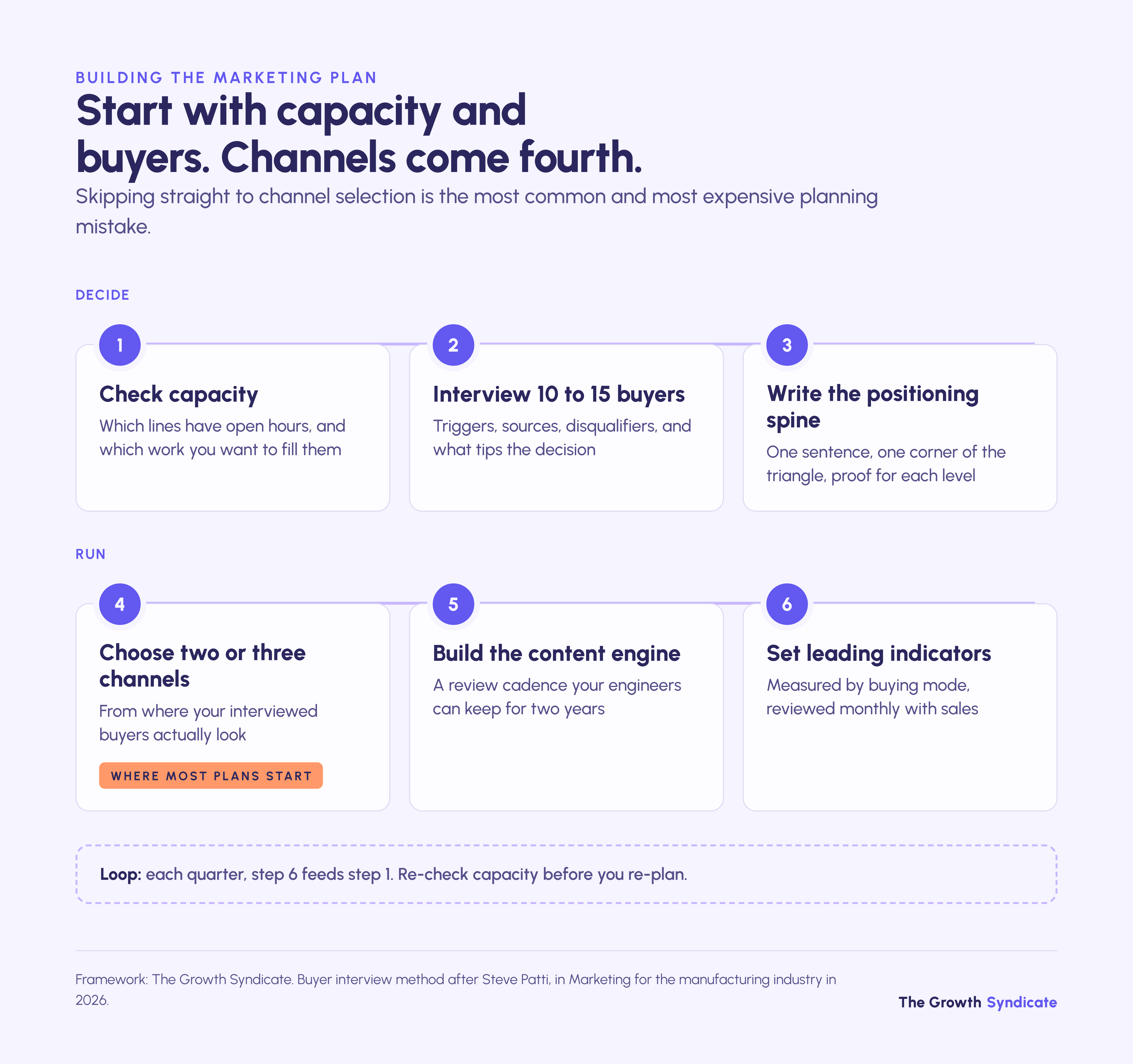
A manufacturing marketing plan should start with capacity and buyers, not channels. The sequence that works is six steps: check capacity, interview buyers, write the positioning spine, choose two or three channels, build a content engine your engineers can sustain, and set leading indicators with a review rhythm. Skipping to channel selection is the most common and most expensive mistake.
Step 1: Check capacity before setting goals
List which processes and machines have open hours over the next six to twelve months, which work you want more of (by margin, repeatability and fit with your certifications), and where seasonality bites. The output is a business objective marketing can act on, such as “fill 30% open capacity on the sheet metal line with repeat production work,” rather than “grow revenue.”
Step 2: Interview 10 to 15 buyers
Steve Patti, a seven-time VP and CMO who advises manufacturing companies, starts with primary research: interviews with 10 to 15 decision-makers at target accounts. He asks what triggers them to enter the market, where they go for information, what they look for, and what puts a winning vendor over the top. In his experience the study costs a fraction of a single month’s campaign spend, and it replaces guesswork with a map that sales and marketing can share.
Method: 10 to 15 interviews with decision-makers at target accounts, after Steve Patti in Marketing for the manufacturing industry in 2026. Questions: The Growth Syndicate.
The interviews also fill in the persona fields from the previous section with real answers instead of assumptions.
Step 3: Write the positioning spine
Combine the interview findings with your win/loss analysis: one sentence on what the company stands for, the corner of the triangle you compete on, and the proof points each level of the buying committee needs to see.
Step 4: Choose two or three channels, not ten
Pick channels from where your interviewed buyers actually look, then check them against your archetype (the channel section below has a matrix). A manufacturer doing three channels well beats one doing ten at a level engineers will ignore.
Step 5: Build a content engine your experts can sustain
Agree on who reviews technical content, how fast, and how often. A cadence your engineers can keep up for two years beats a burst they abandon after two months.
Step 6: Set leading indicators and a review rhythm
Long sales cycles make revenue a lagging signal. Choose leading indicators that fit your buying mode (covered in the measurement section), review them monthly with the sales team, and revisit the plan each quarter against capacity.
A worked example: one-page plan for a contract manufacturer
The example below is illustrative, not a client. It shows how the six steps compress into one page for a job shop.
Illustrative example, not a client.
The last row matters as much as the others. A plan earns credibility with leadership when it says what the company will not spend on, and why.
Digital marketing for manufacturers: choosing the channel mix
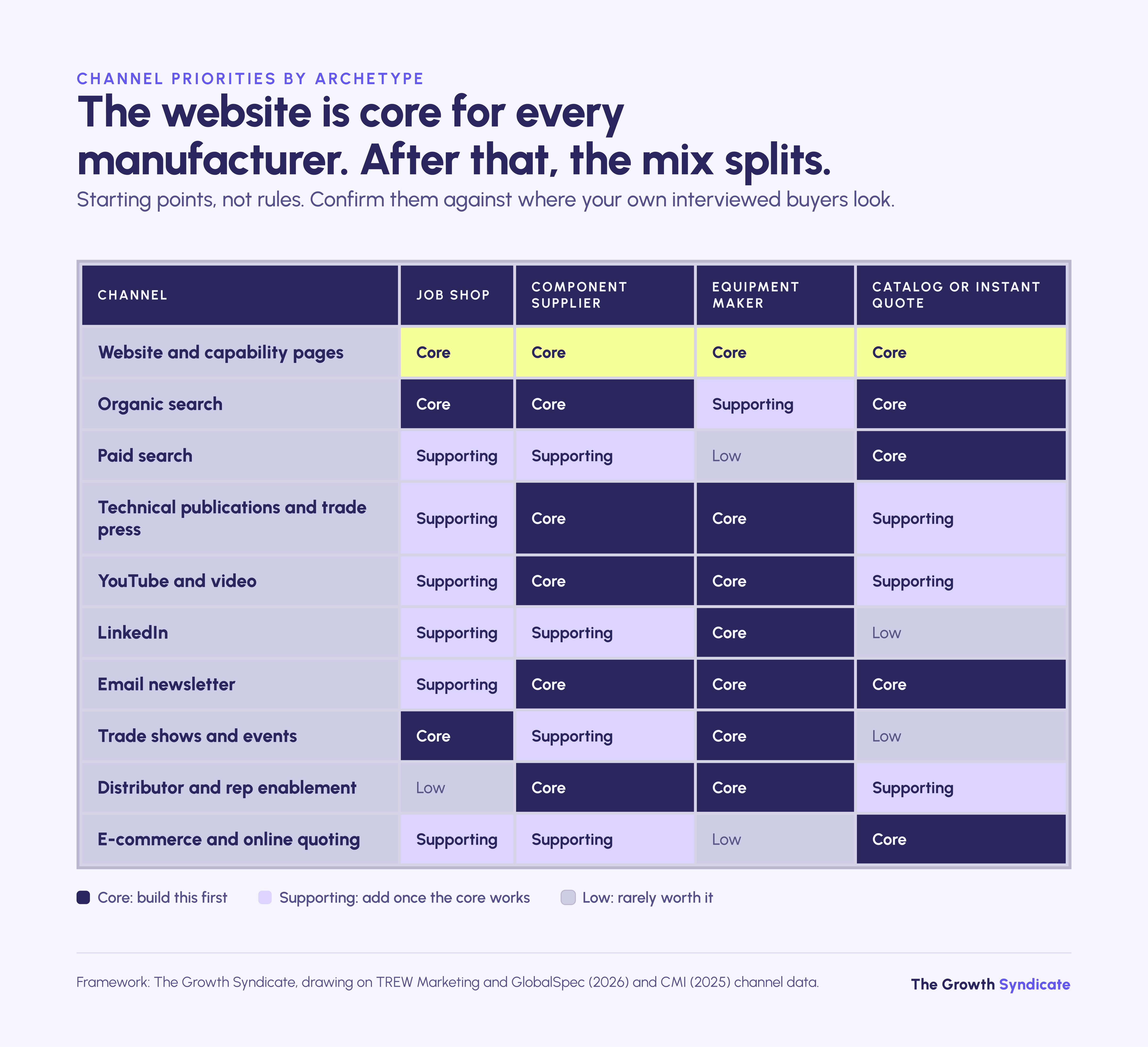
The research on where engineers look points to owned and earned channels: technical publications, vendor websites, YouTube and email newsletters. Paid search and social media have real roles, smaller than many manufacturing budgets assume. The right mix depends on your archetype, and the best digital marketing strategies for manufacturing companies concentrate on three or four channels rather than spreading thin across ten.
There is a revealing gap between what engineers say they use and what marketers say works. The two datasets ask different questions of different people, so they can’t be compared line by line, but the direction is clear.
Engineers: TREW Marketing and GlobalSpec, 2026 State of Marketing to Engineers (via Napier's and GlobalSpec's summaries). Marketers: Content Marketing Institute and MarketingProfs, 2025. Different samples and questions; not directly comparable.
The engineer findings on YouTube and LinkedIn come from Napier’s summary of the 2026 TREW research. The pattern: marketers favor the channels they can control and measure, while engineers favor the ones where they learn something. How much weight each channel deserves depends on your archetype.
The website as a factory audit, not a factory tour
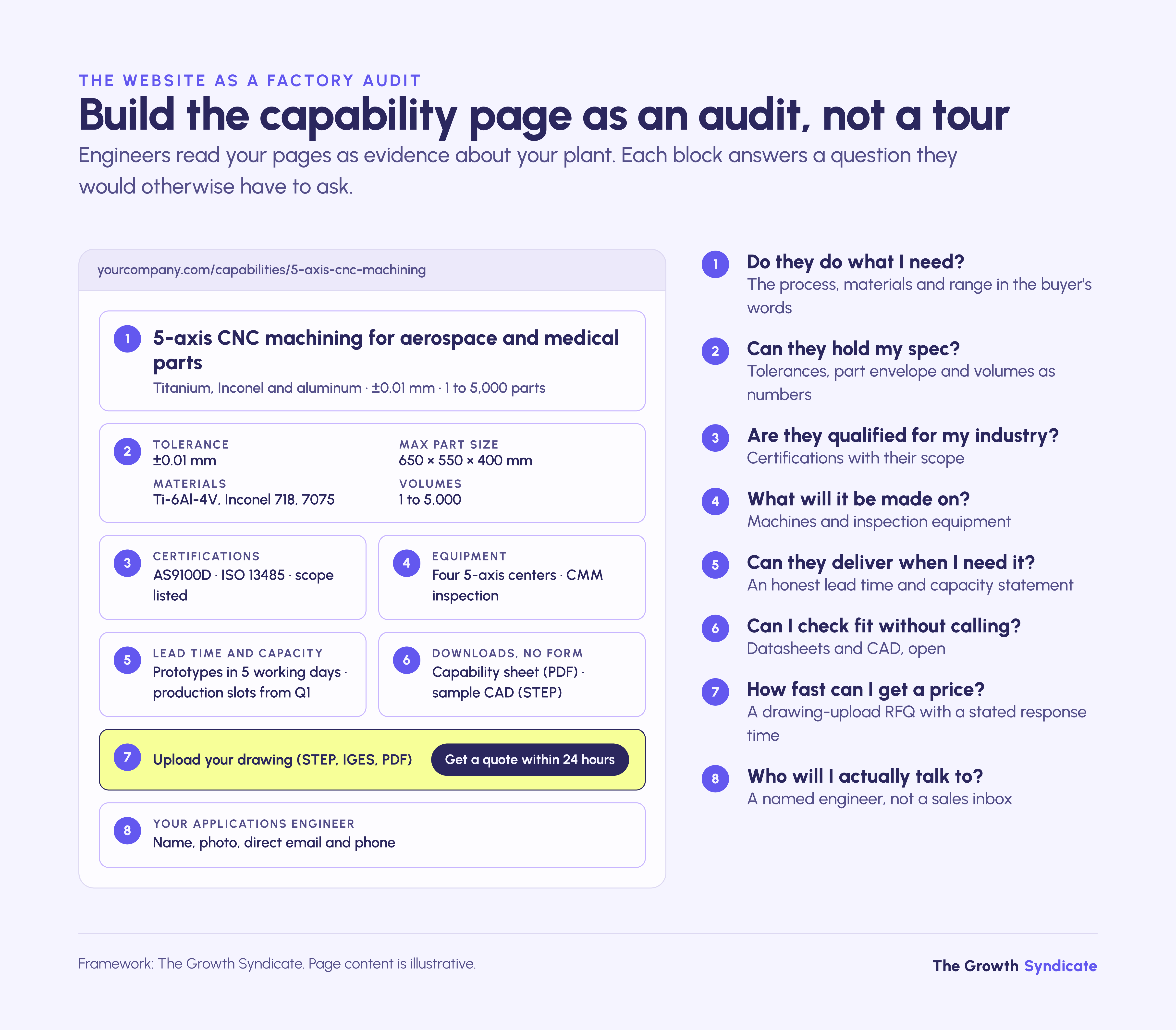
For a technical buyer, your website is evidence about how you run your plant. Engineers who can’t verify a capability online have little reason to shortlist you, and some read the quality of your pages as a proxy for the quality of your parts.
If they don’t have attention to detail in how they present themselves in marketing and sales materials, what do we think the tolerance is on parts at 1/1000 of an inch? (VP of Engineering, interviewed in Steve Patti’s buyer research)
The common instinct is to build the site as a factory tour: drone footage, a hero video, photos of clean machines. What engineers need is closer to an audit: a page per process with tolerances, materials, part size envelopes and volumes; certifications with their scope; an equipment list; the quality process; an honest statement of lead times and capacity; downloadable datasheets and CAD; and an RFQ path that accepts drawings and gets answered. Those pages should read cleanly on mobile devices as well as desktops, and they follow the same logic as any B2B website built to convert: answer the buyer’s next question before they have to ask it.
Search engines: engineers scroll further than you think
Search engine optimization is one of the most dependable channels for manufacturers because engineers search in specifications and keep going until they find an answer. In a TREW Marketing and GlobalSpec survey reported in early 2023, 43% of engineers said they would filter through at least five pages of search results to find relevant information. A capability page ranking on page three for “5-axis machining titanium medical” can still produce RFQs, which is much less likely for broad B2B terms.
That changes how to judge SEO. Organic search traffic from specific capability and application pages matters more than rankings on broad head terms, and a page targeting a query with near-zero reported volume can be worth building if it matches work you quote every month. Don’t ignore Bing either: many corporate IT setups default to Microsoft Edge, and Edge defaults to Bing. The principles in our B2B SEO strategy guide apply, with more weight on capability architecture than on content volume.
Paid search: useful, and often overweighted
Manufacturing marketers like paid search: 68% say search and pay-per-click produce their best paid-channel results (CMI, 2025). Engineers are more selective. In the 2026 research summarized by GlobalSpec, 42% of technical buyers actively avoided sponsored results (down from 51%), while 33% would click one if it looked helpful and 22% would click when it came from a familiar website. One set of interviews with a manufacturer’s target accounts found even less appetite for ads.

"I performed 12 interviews with a manufacturer’s top dream accounts. Only one out of twelve said they had ever clicked on a paid or sponsored ad when doing a Google search. Meanwhile, the company was spending well over a million dollars a year on paid media."
Both findings can be true. Google Ads captures buyers who already know what they want and are ready to order, which suits catalog and instant-quote manufacturers well. It does less to build the preference that decides design-in and capital purchases. Decision rule: use PPC advertising for high-intent capability and product queries, and as a fast test of which terms convert. Don’t make it the budget center for engineered products. Where paid search does fit, running it against capability terms rather than broad industry keywords is what keeps the cost per qualified lead sane.
Technical publications, trade press and PR
For the first time in the TREW study’s nine-year history, technical publications overtook vendor websites as engineers’ top source for researching purchases. Trade media carries trust your brand hasn’t earned yet. Contributed technical articles, sponsored newsletter features and joint webinars with specialist publishers put your expertise inside a source engineers already rely on. Print hasn’t disappeared either: 36% of manufacturing marketers still distributed content through print magazines in CMI’s research. These placements work best as a sustained presence in the few titles your buyers read, not as one-off insertions.
YouTube and video
Video is the rare channel both sides rate highly. YouTube remains engineers’ dominant social platform in the 2026 TREW research, and manufacturing marketers rate video their most effective content type (74%, CMI). The rule: make the video an engineer would bookmark, such as a how-to, an installation walkthrough or a technical deep dive, not the one your leadership team would enjoy.
LinkedIn, social media and professional communities
LinkedIn is manufacturing marketers’ favorite platform: 85% say it delivers the best value of any social platform, and 67% increased their use of it over the previous year (CMI). For engineers, YouTube remains the dominant platform, and LinkedIn’s importance varies by age, discipline and region. Both can be right, because the two platforms reach different levels of the buying committee: LinkedIn reaches management, leadership and the sales team’s own network, while YouTube reaches the engineers doing the research.
Social media marketing for manufacturers should follow that split: founder and leadership content on LinkedIn, technical explainers on YouTube. The platforms manufacturers most often neglect are the ones where engineers talk to each other, such as Reddit, Practical Machinist and Eng-Tips; in CMI’s research, only 7% of manufacturing marketers increased their use of Reddit. These communities don’t respond to ad spend. They reward people from your company who answer questions well and consistently.
Email and newsletters
Engineers use newsletters as a research tool. In the 2026 TREW research, 94% subscribe to at least one work-related newsletter, and after reading one, the most common actions were reading the full article (63%), downloading a spec sheet (60%) and visiting a vendor website (56%). A technical newsletter with real editorial value can reach all three levels of the buying committee. Email marketing to existing customers about capabilities they don’t know you have is often one of the cheapest sources of new work, because the trust already exists, and basic marketing automation is enough to send the right application note to the right segment.
Trade shows and industry events
Trade shows remain the channel manufacturing marketers rate most effective for distribution (51% named in-person events, CMI). The highest-value activity, though, happens outside the booth. Steve Patti recommends small-group dinners and targeted conversations arranged in the weeks before an event, using the show as a reason to convene the right people rather than as the marketing activity itself. Pre-booked meetings, a clear follow-up sequence, and a record of which accounts you actually spoke to turn industry events from a line item into a pipeline source.
E-commerce and self-serve quoting
Most US manufacturing shipments were already ordered electronically years ago. Census Bureau data shows e-commerce accounted for 67.3% of US manufacturing shipments in 2018, nearly $4 trillion. That figure includes EDI and orders between plants of the same company, so it measures digital ordering, not digital marketing, and it is sometimes cited as if it proved that buyers shop online. What it does show is that the transaction itself is already largely digital.
For catalog and instant-quote manufacturers, e-commerce and online configurators are the core channel. For job shops, the equivalent is an RFQ path that accepts CAD uploads and returns a quote quickly. For component suppliers, it’s downloadable CAD and a way to request samples. Equipment makers usually keep the transaction offline but can put configurators and spec comparisons online.
Content that technical buyers trust
Content marketing in manufacturing works when it survives being read by the most technical person in the buyer’s organization. That means reference material first (datasheets, spec sheets, CAD files), explanatory content second (technical articles, application notes, how-to video) and proof third (case studies with verifiable detail). Volume matters far less than accuracy.
What engineers actually use
Reference material comes first. Datasheets have ranked as engineers’ most helpful content type for years in the TREW Marketing and GlobalSpec research, as coverage of the survey has long noted, and CAD models sit alongside them as the files engineers use to check whether a part fits.
The implication for lead generation is uncomfortable for many marketing teams. Gating a datasheet costs you visibility at the exact moment an engineer is validating you, and a datasheet download on its own says little about whether that engineer is ready to buy. Keep reference material open, and gate only substantial guides where an email address is a fair exchange.
The marketer as translator
Because the buyer knows more than the marketer, the work is extraction and translation: getting what the company’s engineers know out of their heads and into a form the buyer’s engineers can use. Manufacturing marketers name the difficulty themselves. In CMI’s 2025 research, 38% cited access to subject matter experts as a challenge, and 54% said they lack a scalable model for content creation.
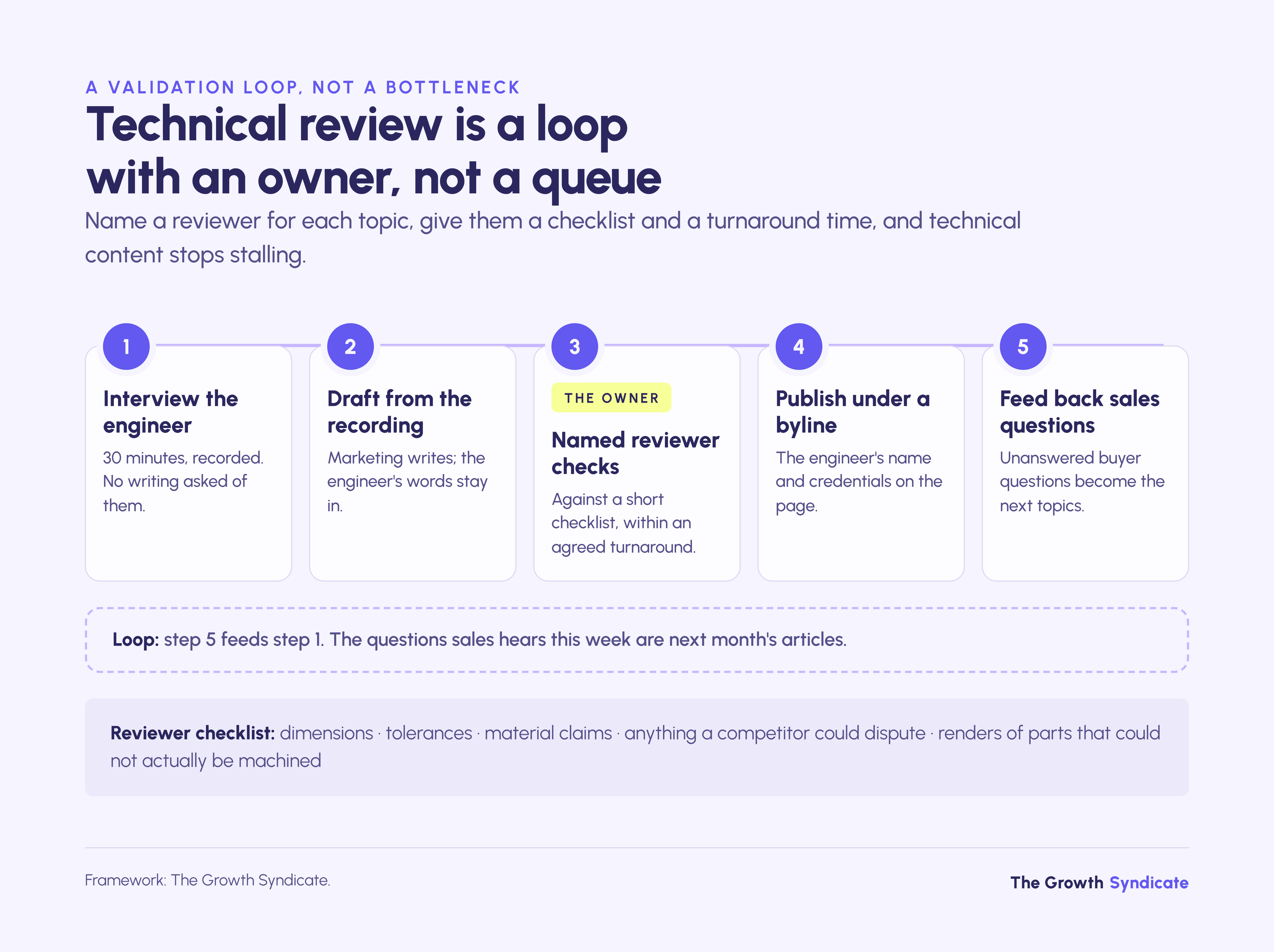
The practical route is to stop asking engineers to write. Interview them for 30 minutes, record sales calls and quote reviews, write the draft, and send it back for technical review.
A validation loop, not a bottleneck
In manufacturing, a single technical article can take two weeks to produce, with several engineers reviewing it. That cadence is the cost of content that holds up in front of an expert audience. It becomes a bottleneck only when nobody owns it. Name a reviewer for each topic, give them a short checklist (dimensions, tolerances, material claims, anything a competitor could dispute), and agree on a turnaround time. A reviewer who knows exactly what to check can turn a piece around in a day rather than a fortnight.
Named experts beat anonymous content, and AI
Engineers weigh the source, not just the information. TREW Marketing’s reading of its 2026 research is that content from credible experts carries significantly more weight than content that feels anonymous or overly branded. In the same research, 66% rated engineering experts at vendor companies very or extremely trustworthy, against 10% for AI tools. Engineers are using AI more in their research, but they rate AI answers only 4.7 out of 10 for trustworthiness and continue to verify through sources they trust.
Two decisions follow. Put a named engineer’s byline and credentials on technical content wherever possible. And use AI for research, structure and first drafts, never as the final word on anything an engineer will check. A render of a part that couldn’t actually be machined, or a tolerance that is off by a decimal place, can undo trust that took years of content to build.
Case studies across sizes and use cases
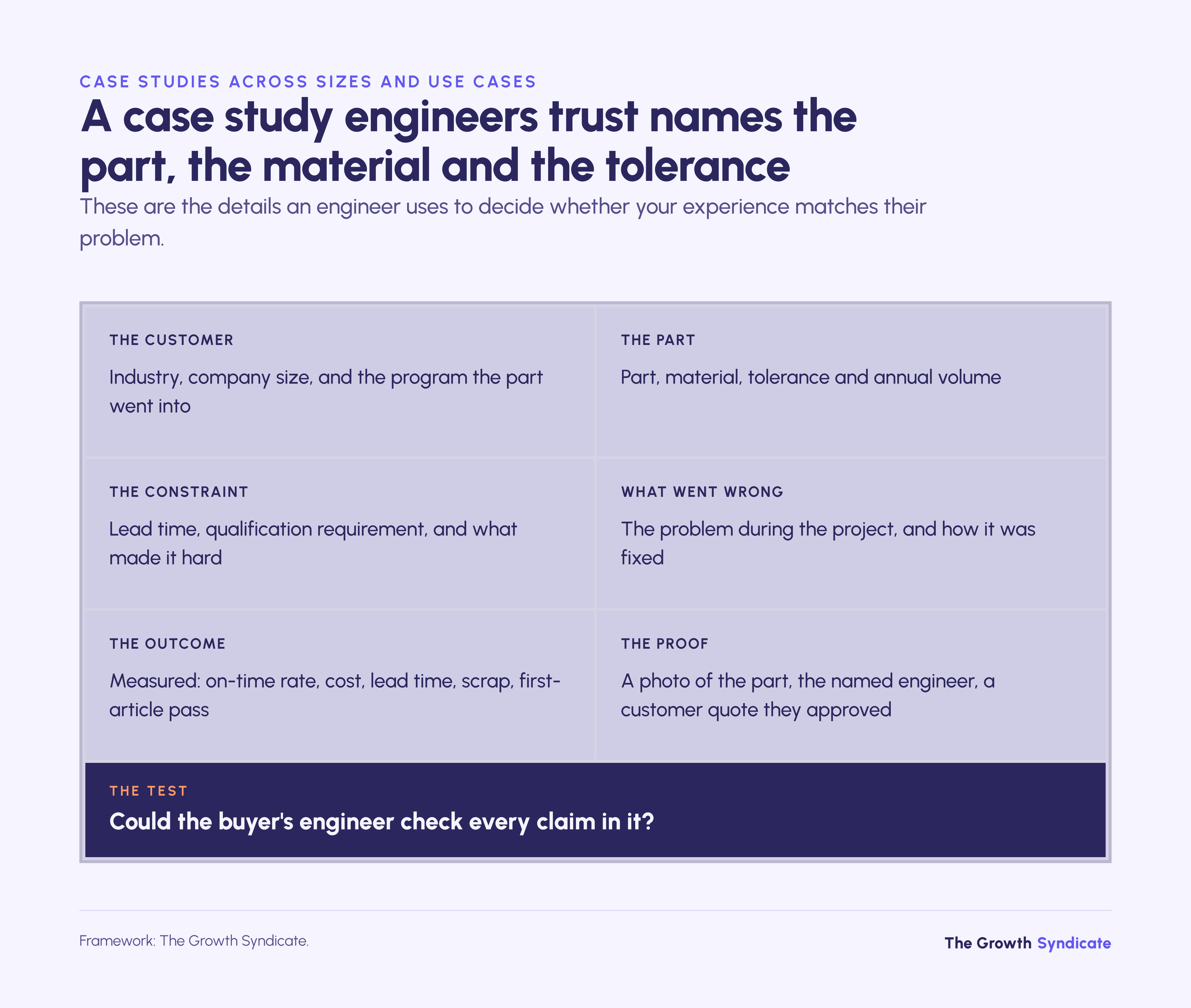
Case studies do their best work when they reach two levels of the buying committee at once: technical detail for engineers, business outcome for management. Build a set rather than a showcase. Large, recognizable customers give credibility; smaller customers give relatability to the mid-sized buyer wondering whether you’ll pay attention to them. Cover prototype and production work, different industries, and at least one project where something went wrong and you fixed it. Each should name the part, material, tolerance, volume and lead time, which is the detail an engineer uses to decide whether your experience matches their problem.
How the content mix changes by archetype
- Job shops: capability pages, design-for-manufacturing guides, case studies by process.
- Component suppliers: complete datasheets, CAD in common formats, application notes, reliability data.
- Equipment makers: demos, installation and maintenance video, total-cost-of-ownership tools, service content that reaches existing customers.
- Catalog manufacturers: complete and consistent product data, because missing specs can send buyers to the competitor whose listing has them.
The broader principles of B2B content marketing still apply; manufacturing raises the accuracy bar and lowers the tolerance for filler.
Failure mode. A blog of “five trends shaping manufacturing” posts written by a generalist, with no engineer’s name, no numbers and no answer to a question anyone asked.
Sales, reps, distributors and marketing
In manufacturing, marketing rarely closes the deal. Sales engineers, independent reps and distributors do. Marketing’s job is to give them a shared understanding of how buyers buy, material that answers the questions buyers actually ask, and a steady flow of qualified leads they trust enough to follow up.
Who owns the customer relationship
The answer changes by archetype, and it decides who marketing is really serving.
- Job shops: the owner or a sales engineer, often with a handful of long-standing accounts.
- Component suppliers: distributors and field application engineers for most customers, with direct relationships for key OEMs.
- Equipment makers: dealers, reps and the service team, who see the installed base every week.
- Catalog and instant-quote manufacturers: the website itself, backed by inside sales.
When reps or distributors own the relationship, they are marketing’s first audience. They carry many product lines, and your material competes for their attention with every other principal’s.
Align on the buyer, not on the funnel
Sales and marketing in manufacturing often run on different pictures of the customer. Marketing produces content based on product features; sales runs a process built on relationships and RFQ responses. In CMI’s 2025 research, 47% of manufacturing marketers named aligning content across sales and marketing as a challenge. The fix is less about process diagrams than about agreeing on how the buyer actually decides, which is what the buyer interviews in the plan section produce.
The organizational side of this problem, including shared targets and handoff rules, is where most sales and marketing alignment efforts succeed or stall.
A weekly win/loss rhythm
Thirty minutes a week is enough: what was quoted, won and lost, and why; which objections came up; which questions buyers asked that the website couldn’t answer. That last list is the best content backlog a manufacturer can have, because it comes straight from sales conversations. It also keeps marketing honest about which campaigns produce work the plant wants.
Enabling reps and distributors
Reps and distributors tend to respond to four things: a one-page capability summary they can forward without editing, clear pricing guidance, leads routed to them within a day, and a short briefing whenever you add a capability. Agree on what a qualified lead means before you route anything, using the same lead qualification criteria sales applies, and record routed leads in your customer relationship management system so nothing disappears between companies.
Failure mode. Marketing sends every form fill to reps as a lead. After the third one that turns out to be a student or a competitor, the reps stop following up, including on the one that mattered.
Budget, measurement and what’s changing
How much do manufacturers spend on marketing?
In Gartner’s 2025 CMO Spend Survey, manufacturing marketing budgets rebounded to 9.5% of revenue, up from 6.7% a year earlier, against a cross-industry average of 7.7%. Read that figure carefully: Gartner surveys mostly companies with more than $1 billion in revenue. Budgets at smaller manufacturers vary widely, and a benchmark drawn from billion-dollar companies tells you little about what your plan needs.
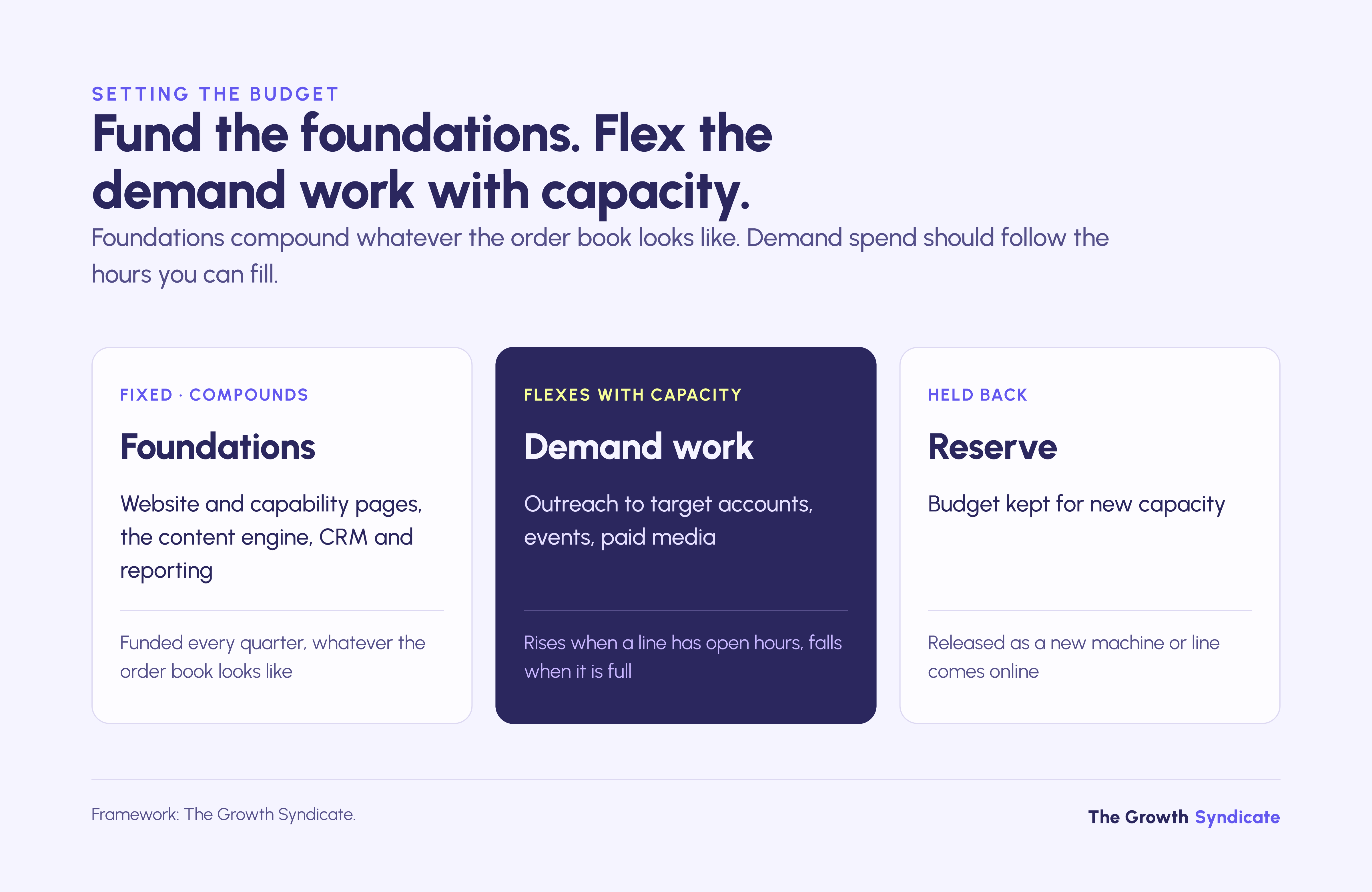
A better way to set the budget is to split it in two. Foundations (the website, capability pages, the content engine, CRM and reporting) are a fixed cost that compounds. Demand work (outreach, events, paid media) should flex with the capacity target, with a reserve held for the moment a new machine or line comes online. Published B2B benchmarks can help sanity-check the split, but they shouldn’t set it.
There is also a question of balance. Les Binet and Peter Field’s effectiveness research for the IPA argues that sustained brand building, which creates memories buyers draw on later, does more for long-term growth than short-term activation alone. In our experience, many manufacturers put most of their budget into capturing demand that already exists and little into the memory that decides the next shortlist.
Leading indicators by buying mode
Long sales cycles mean revenue arrives too late to steer by. Choose indicators that move within weeks and fit how your customers buy.
Framework: The Growth Syndicate.
Website traffic and form fills belong on the list only when they are segmented by the pages and accounts that matter. Five qualified leads from target accounts are worth more than 500 visits from students and competitors.
The shortlist metric
The most useful single measure of manufacturing marketing is also the simplest to collect. Add two questions to every win/loss review and every new-customer onboarding call: “Before you contacted us, were we already on your list?” and “Where had you come across us?” Track the share over time. It measures memory, which is what earns the shortlist, and it catches the word-of-mouth and trade-press influence that click-based attribution models routinely miss.
AI search and the industrial buyer
Engineers are adding generative AI to their research, but they don’t trust it much: they rate AI answers 4.7 out of 10 for trustworthiness, up slightly from 4.4 in 2025 but down from 6.5 in 2024, and they continue to validate what AI tells them through trusted sources (TREW Marketing and GlobalSpec, 2026). In practice, AI works as a research layer rather than a decision layer: engineers appear to use it to orient themselves, then verify elsewhere.
Manufacturing marketing today therefore has to be legible to two readers at once: the engineer and the AI tool the engineer consults first. The same work serves both: clear capability pages with specific numbers, consistent company information across your site and directories, and mentions in the technical publications AI tools are likely to draw on. Measurement of AI visibility is still immature, and most of what works is established search practice under a new name.
Where to start this quarter
A strong manufacturing marketing strategy is built from a few decisions made well, not from a long list of marketing tactics. If you do nothing else in the next 90 days, do these five things:
- Write down your open capacity and the work you want to fill it with.
- Run the one-sentence test with your heads of sales, operations and marketing, and keep going until the three sentences match.
- Interview ten buyers at accounts you want, and let their answers choose your channels.
- Rebuild the capability pages for your target work, with real tolerances, materials, certifications and lead times, and take the gates off your datasheets.
- Add the shortlist questions to every win/loss review, so you can see whether marketing is building the memory that wins work.
Manufacturing buyers judge suppliers by precision, reliability and honesty about trade-offs. Marketing held to the same standard is rare enough in this sector to stand out on its own.
Frequently asked questions
What is manufacturing marketing in simple terms?
Manufacturing marketing is how a manufacturer gets chosen by other businesses. It covers positioning, content, channels and sales support aimed at engineers, procurement teams and executives, with the goal of being on buyers' shortlists before they start looking and generating only the demand the factory can fulfill.
What are the best marketing strategies for manufacturing companies?
The best marketing strategies share one trait: they start from how buyers research and from what the plant can deliver. In practice that means a clear position on cost, quality and speed; a plan built from buyer interviews and open capacity; capability pages and search optimization for specification queries; technical content under named engineers' bylines; YouTube and a technical newsletter; account based marketing for named target accounts; and trade shows used as a reason to meet the right people.
How much should a manufacturing company spend on marketing?
Large manufacturers in Gartner's 2025 CMO Spend Survey reported marketing budgets of 9.5% of revenue, but that sample is dominated by companies above $1 billion in revenue, and spending at smaller manufacturers varies widely. Set the budget from the plan: fixed spending on foundations such as the website and content, plus demand work that flexes with open capacity.
How is marketing for manufacturers different from consumer marketing?
Consumer marketing can win on emotion, reach and repetition. Marketing for manufacturers is judged by technical buyers who check claims, by buying committees with several levels of approval, and by long sales cycles where the decision is often made before the supplier knows it exists. Accuracy and proof carry more weight than creativity, although a bold brand still helps a manufacturer stand out among suppliers who all meet spec.
Do trade shows still work for manufacturers?
Yes, and manufacturing marketers still rate in-person events as their most effective distribution channel (51% in CMI's 2025 research). The value has moved outside the booth: pre-booked meetings, small-group dinners arranged weeks ahead, and disciplined follow-up with the accounts you actually spoke to.
Should manufacturers use LinkedIn?
Yes, for the right audience. LinkedIn reaches management, leadership and your sales team's network, and 85% of manufacturing marketers rate it their best-value social platform. For engineers, YouTube remains the dominant social platform, so the two platforms should carry different content.
Does inbound marketing work for manufacturers?
Inbound marketing works well for manufacturers when it is built on capability pages, technical content and search optimization for specification queries, because engineers do most of their research alone. It captures buyers who are already looking. For a small number of high-value accounts, pair it with account based marketing, which reaches the buying committee before a need is visible.
What are the 5 C's of marketing?
The 5 C's are a situation-analysis framework: company, customers, competitors, collaborators and context (sometimes called climate). For a manufacturer, collaborators are the distributors, reps and systems integrators who influence the sale, and context includes capacity, tariffs, regulation and supply chain conditions, which constrain the plan as much as demand does.
What is the 40-40-20 rule in marketing?
The 40-40-20 rule comes from direct marketing and is usually attributed to Ed Mayer: 40% of a campaign's result depends on the audience, 40% on the offer and 20% on the creative. It holds up well in manufacturing. Choosing the right accounts and making a useful offer (a design review, samples, a fast quote) matters far more than the design of the email.
When does it make sense to hire a manufacturing marketing agency?
A marketing agency makes sense when you lack the in-house capacity to run a content engine, need an outside view on positioning, or want specialist skills in channels such as search or account based marketing. Before hiring an industrial marketing agency, ask whether it measures success in qualified RFQs and pipeline rather than form fills, how it works with your engineers on technical accuracy, and whether it will recommend against a channel it sells.
How long does manufacturing marketing take to show results?
Leading indicators such as qualified RFQs, datasheet downloads and time to quote can start to move within a quarter of changes to the website and content. Revenue lags by the length of your sales cycle; across B2B, buying cycles averaged about 10 months in 6sense's 2025 research. A marketing system built on memory and trust compounds; campaigns that stop when the budget stops do not.