.svg)



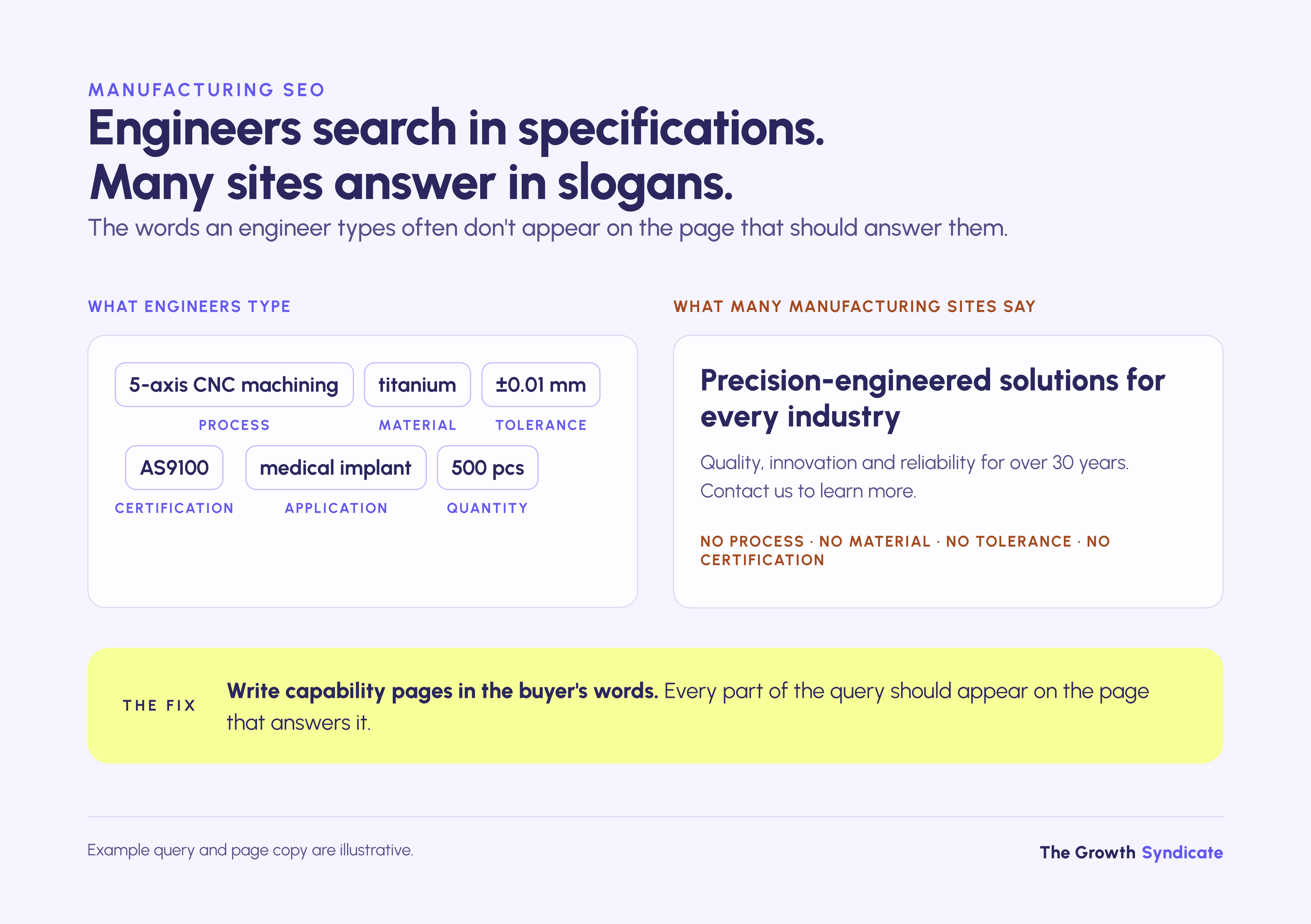
An engineer who needs a part machined rarely searches for “precision-engineered solutions.” They search for “5-axis CNC machining titanium AS9100” or “sheet metal enclosure 500 pcs ±0.1 mm,” and they keep going until something matches. Many manufacturing websites are written the other way around: brochure language on the homepage, every process on one services page, and the specifications that would match those searches locked inside PDFs.
That mismatch is where manufacturing SEO starts. Engineers do most of their evaluation before they speak to a supplier. In the 2026 State of Marketing to Engineers research from TREW Marketing, GlobalSpec and Elektor, technical buyers completed 62% of the buying process online before engaging with sales. They also look deeper than many marketers assume. In the 2020 edition of the same research, 73% of engineers viewed three or more pages of search results before choosing a result or starting a new search.
The argument of this guide follows from those two facts: rank for depth, not for position one. For most manufacturers, SEO is a capability architecture problem first and a content volume problem second, and the right measure is qualified RFQs from specification searches rather than rankings on broad head terms. The sections below follow the path an engineer takes from a first question to a quote request, and show what each step asks of your website.
What is manufacturing SEO?
Manufacturing SEO is search engine optimization for manufacturers: making a company’s processes, materials, tolerances, certifications and applications easy to find and easy to verify for the specification-level queries engineers and buyers type into Google, Bing and the AI assistants that draw on them. Its goal is qualified RFQs, not traffic.
It differs from general B2B SEO in three ways. The queries tend to be longer and more technical. The audience checks claims, often against a drawing. And the pages that win are often capability pages rather than blog posts. The fundamentals in our B2B SEO strategy guide still apply; manufacturing changes where the effort goes.
Why search carries more manufacturing pipeline than most teams think
Many manufacturing companies treat SEO as a website task and trade shows as the pipeline. The buying data points the other way. In the 2026 TREW research, technical buyers spent 62% of the buying process online before contacting sales, and younger buyers spent more: 66% for those 35 and under. Pricing and inventory questions were the most common trigger for first contact, and 59% preferred to make that contact by email.
Two things follow. First, the pages that decide whether an engineer contacts you are the ones that answer specification, pricing and lead-time questions, which puts capability pages and the RFQ path at the center of manufacturing SEO. Second, search visibility can build familiarity, and familiarity often decides close calls: 70% of technical buyers say they are likely to choose the better-known brand when two solutions are technically similar, and 53% say brand familiarity influenced their most recent purchase.
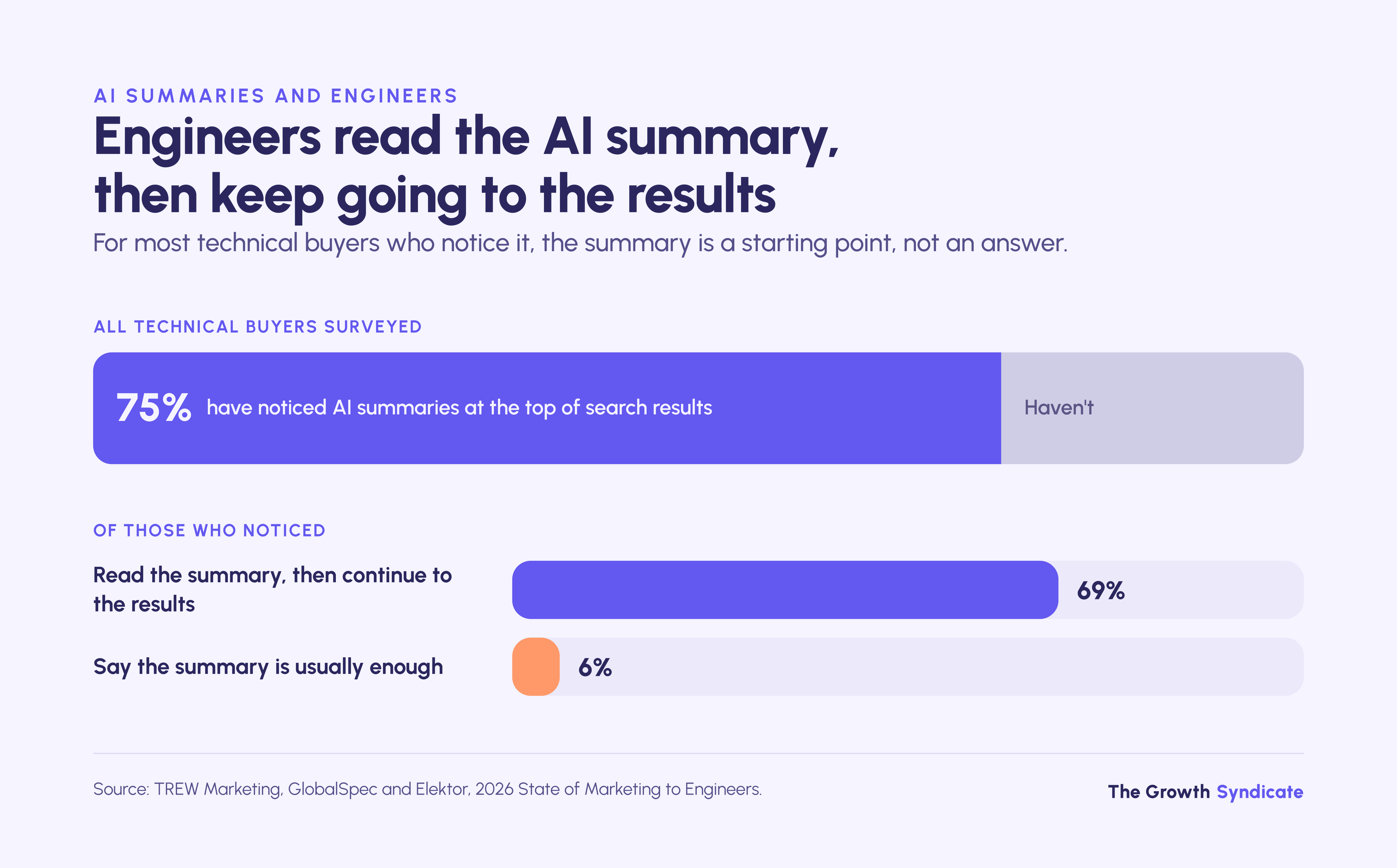
Generative AI has changed less here than the headlines suggest. In the same research, 75% of technical buyers had noticed AI summaries at the top of search results. Of those, 69% read the summary and then continued to the results, and only 6% said a summary was usually enough.
The gap shows on the marketing side too. In the Content Marketing Institute’s 2025 manufacturing research, 34% named optimizing for search as a content-creation challenge, and 64% said they struggle to attribute ROI to their content. Our 2026 report on marketing for the manufacturing industry reached the same conclusion from the practitioner side: search remains one of the most effective lead generation channels in manufacturing.
The search ladder: five rungs from question to quote
Engineers rarely find a supplier in one search. They move through a sequence, and each step produces a different kind of query:
- Learn. Understanding a design constraint, a process or a material property.
- Choose a process. Comparing processes or materials for a specific part.
- Find suppliers. Building a shortlist of companies that can do the work.
- Validate. Checking certifications, tolerances, capacity and track record.
- Request a quote. Asking for price and lead time.
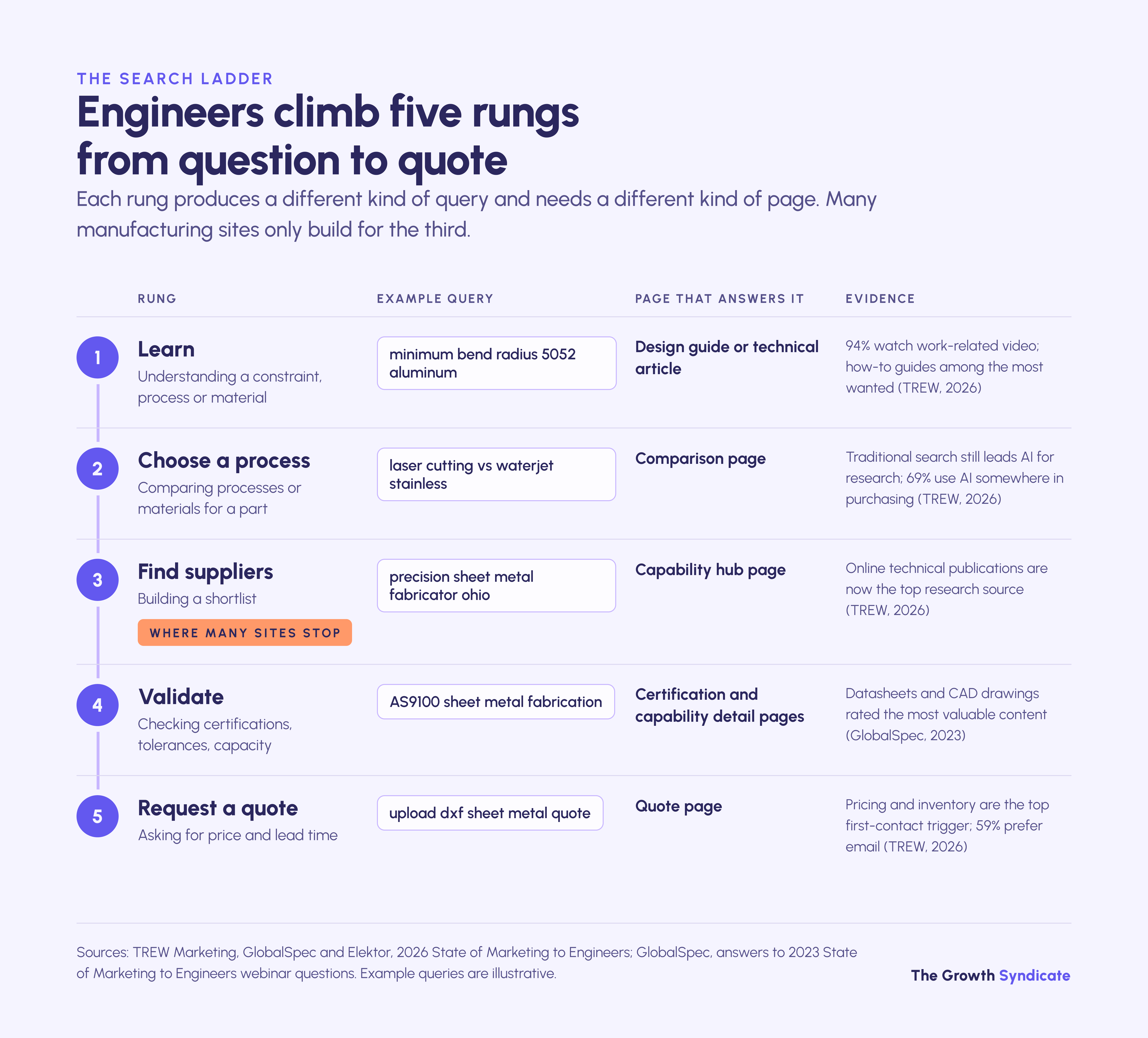
Many manufacturing websites compete only on the third rung, with a homepage and a services page. The rungs above and below it are where specification queries live, and, in our experience, where competitors running generic SEO programs rarely show up. The rest of this guide is organized around that ladder.
How engineers search at each rung
Engineers search the way jobs arrive on their desks: as a drawing with a material, a tolerance, a finish, a quantity and a deadline. Their queries often carry the same components, which is why specification searches run long and why they rarely match brochure language.
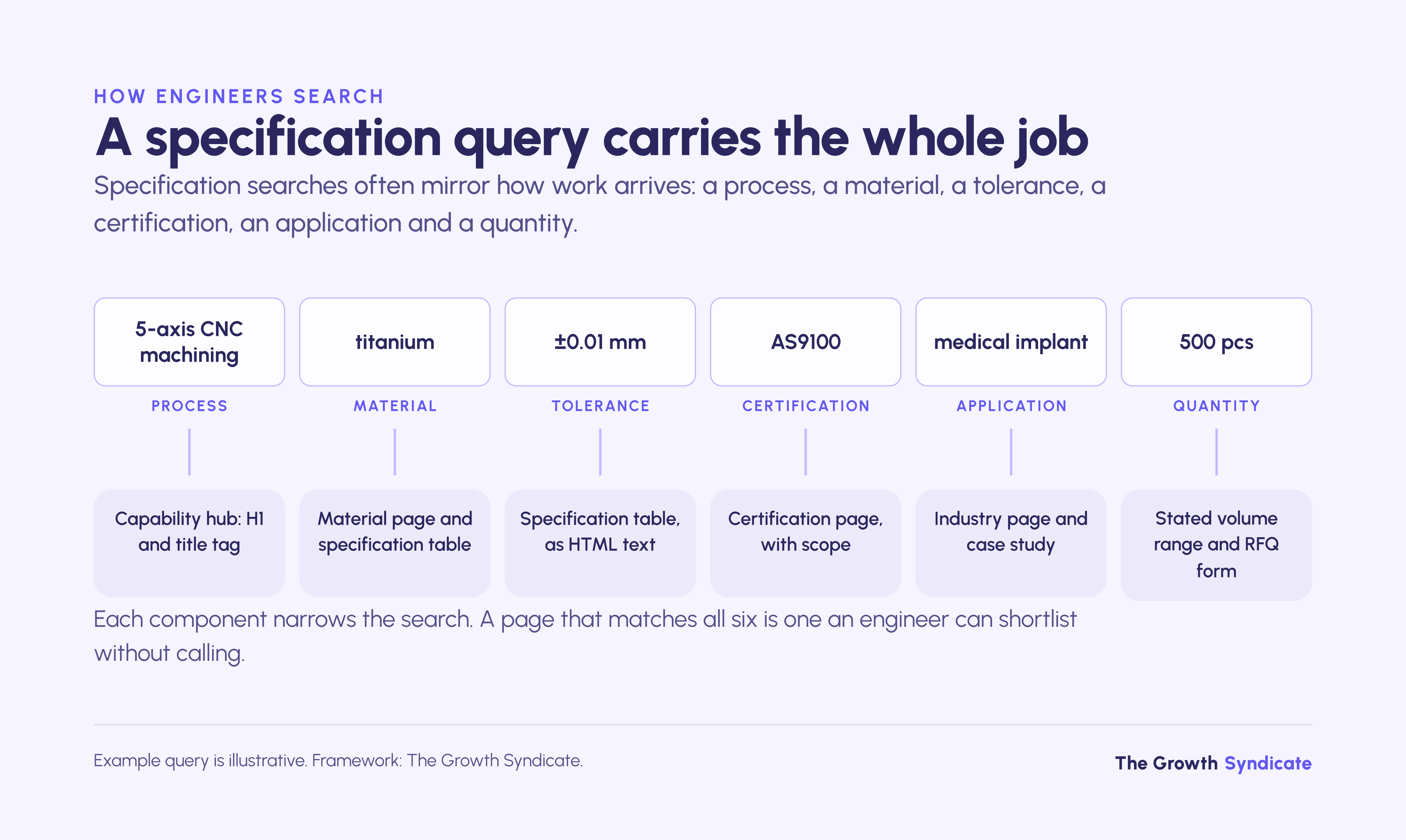
Each rung produces its own kind of query and needs its own kind of page. The examples below are illustrative.
Example queries are illustrative. Framework: The Growth Syndicate.
How far past page one engineers go
The finding that engineers look well past the first page of results has held up across several editions of the TREW and GlobalSpec research, though the figures come from different years. In the 2020 edition, 73% of engineers viewed three or more pages of results before choosing one or searching again, up from 54% the year before. Coverage of the 2023 edition reported 43% of engineers filtering through at least five pages to find relevant information. Google’s results layout has changed since those surveys, so read “pages” as a measure of persistence rather than an exact position.
The practical point holds: a capability page ranking on page two or three for “5-axis machining titanium medical” can still produce RFQs. The same position for a broad term like “cnc machining services” is usually worth less, because the searcher is less committed and the competition for attention is fiercer.
What engineers trust once they arrive
Engineers weigh the source, not just the information. In the 2026 TREW research, 66% rated engineering experts at vendor companies very or extremely trustworthy, against 10% for AI tools.

Engineers’ average trust in AI answers was 4.7 out of 10 in 2026, after 4.4 in 2025 and 6.5 in 2024. TREW’s public summary doesn’t explain the size of the 2024 to 2025 drop, so treat the trend with some caution; the level is the point.

Keyword research when the volume says zero
Many specification queries show little or no search volume in keyword tools. That often says more about the tools than about the demand. Keyword tools estimate volume from samples and models, and Google’s Keyword Planner can show broad ranges such as 100 to 1,000 rather than exact figures. When Ahrefs compared its own estimates for “zero-volume” keywords with impression data from Google Search Console, most of those keywords turned out to get some searches, although few got many on their own.
Ahrefs’ conclusion is that zero-volume keywords are usually not worth chasing, with an exception that fits manufacturing closely: lucrative topics with the potential to convert. A query that describes a job you quote every month belongs in that exception. The value comes from dozens of such queries together, and from the intent behind each one, rather than from any single term.
Where the real keywords are
Thorough keyword research for a manufacturer starts inside the company, not in a tool:
Regex example is illustrative; adapt it to your materials and standards. Method: The Growth Syndicate.
Then run a competitor analysis on the queries that matter: who ranks for your specification searches today, and what their pages contain that yours don’t. In our experience, the answer for many specification queries is a directory listing or a thin page, which is an opening.
Decision rule. Build a page for a zero-volume query when it matches work you have quoted in the last twelve months and a capability you want more of. Skip it when it describes work you don’t want, however specific the phrasing.
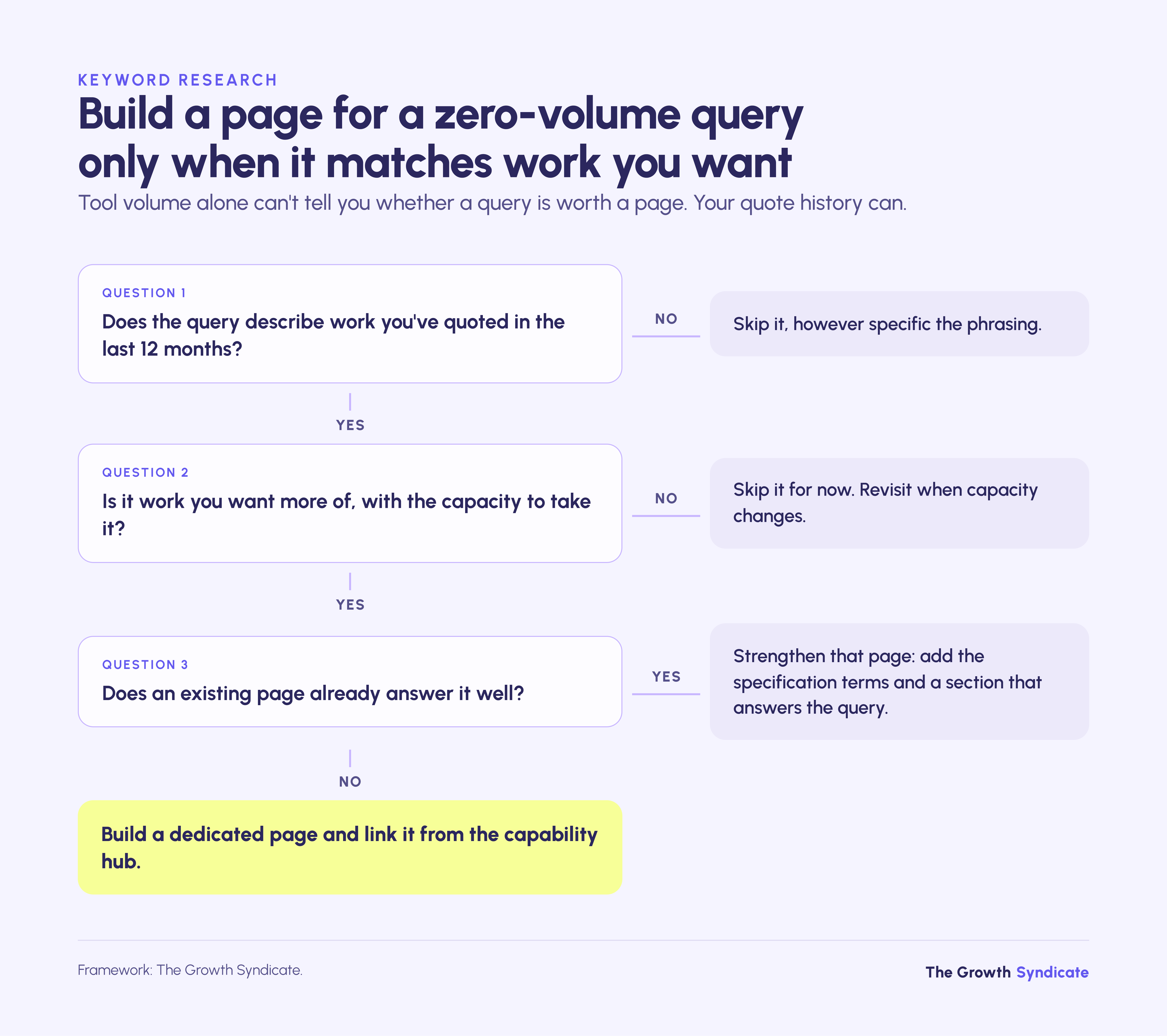
Failure mode. A keyword strategy built on head terms like “metal fabrication” because the volume looks impressive, followed by months of traffic that never sends an RFQ.
Industrial SEO vs manufacturing SEO
The two terms are used almost interchangeably, and neither has a formal definition. In practice, “industrial SEO” tends to describe equipment, MRO, component and distribution businesses with large catalogs, while “manufacturing SEO” tends to describe companies selling production capability: job shops, contract manufacturers, fabricators and finishers. A more useful distinction is between the two kinds of SEO problem those businesses have.
Framework: The Growth Syndicate.
Many manufacturers run both: a catalog of standard parts alongside a custom capability. Treat them as two SEO programs sharing one domain, with different page types, different metrics and different owners.
Site architecture: capability, material, industry and certification pages
For capability sellers, architecture is where much of manufacturing SEO is won or lost. A single services page listing twelve processes is unlikely to rank for all twelve, and it rarely has room to answer the validation questions for each of them. The alternative is a hub-and-spoke structure built around how engineers search:
- Capability hubs. One page per process: sheet metal fabrication, 5-axis machining, injection molding.
- Material pages. The materials you process well, with grades, typical tolerances and applications.
- Industry pages. What changes for medical, aerospace or industrial equipment customers: certifications, documentation, traceability.
- Certification pages. Each certification with its scope, the standard behind it and what it means for the buyer.
- Learn and choose content. Guides and comparisons, each tied to the capability page it supports.
- The quote page. The destination every capability page leads to.
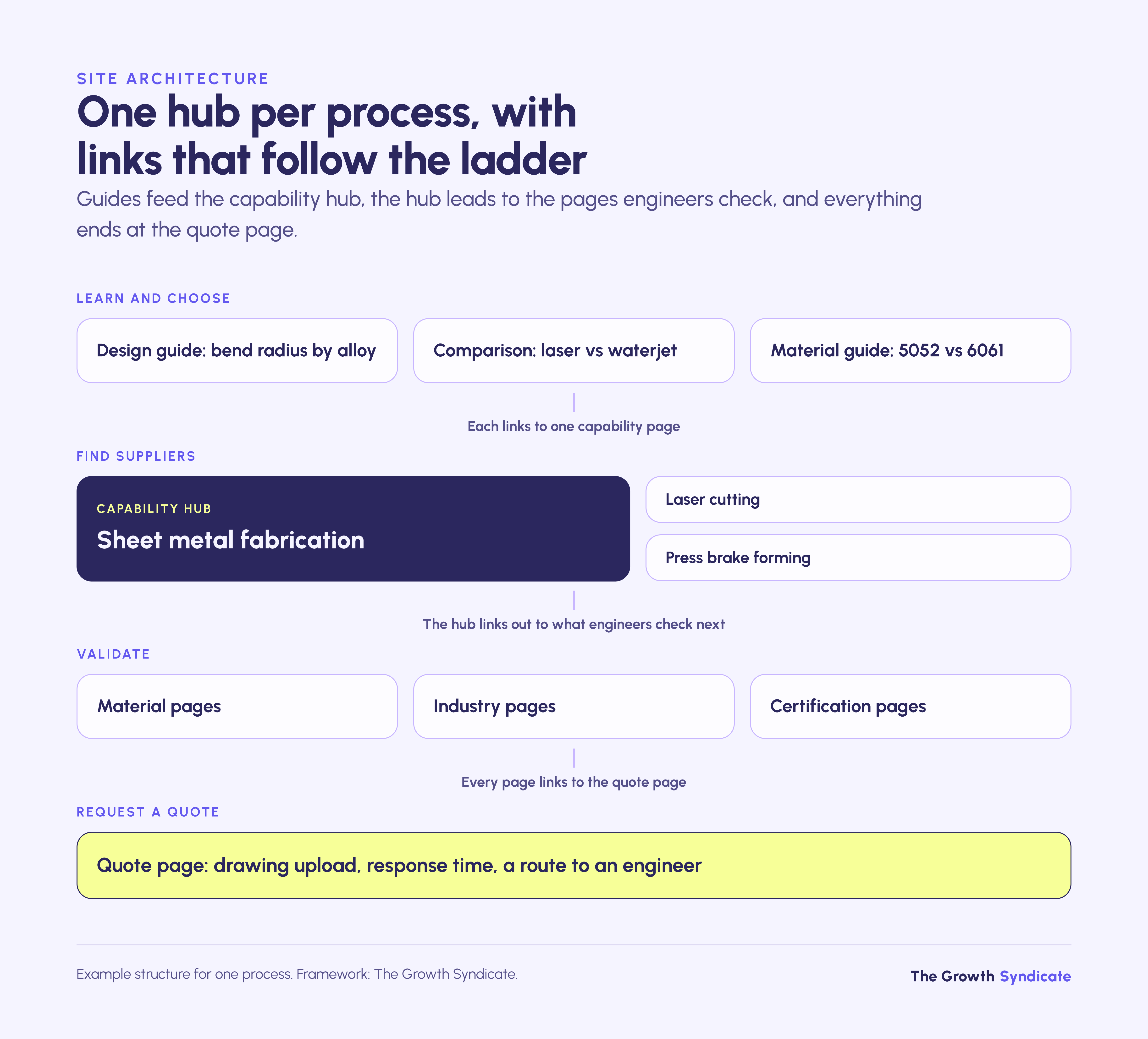
Internal linking holds the structure together. Every learn and choose page links to one capability page; every capability page links to its material, industry and certification pages and to the quote page. When we built dedicated pages for each service and capability for Madeinadd, an Italian digital manufacturing platform for 3D printing, those pages produced its first high-intent rankings for top keywords.
A worked example: sheet metal fabrication
The map below shows how one process breaks down by rung. The queries are illustrative; pull real volumes for your own market, and expect most queries on rungs three to five to show little or none.
Queries and URLs are illustrative. Pull real volumes for your market; expect many rung 3 to 5 queries to show little or none.
What a capability page needs
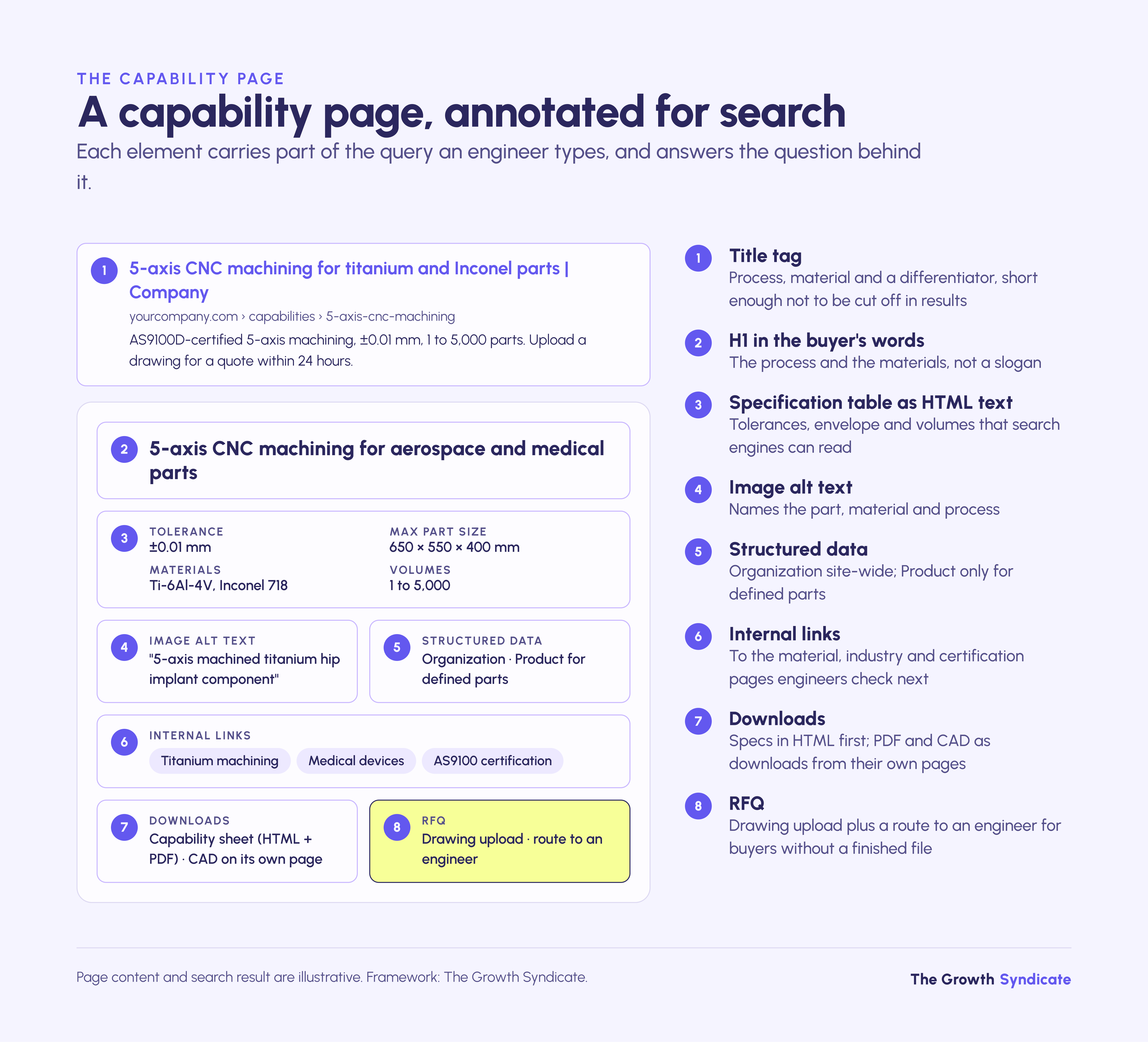
A capability page does the heaviest work in manufacturing SEO: it has to rank on rung three and answer rung four. Each block below answers a question an engineer would otherwise have to ask by email.
Framework: The Growth Syndicate.
The “talk to an engineer” option matters more than it looks. In the Madeinadd work, buyers who were close to ordering but didn’t yet have a finished file had nowhere to go from an upload-only form; adding a route to an expert opened up sign-ups from that group.
Failure mode. One services page listing every process in a paragraph each, with specifications in a PDF linked at the bottom.
Technical SEO for manufacturing sites
Technical SEO on manufacturing websites tends to run into four problems: catalogs that generate endless filter URLs, specifications trapped in files search engines can’t read as pages, content hidden behind forms, and pages designed for desktop in an index built on mobile. A technical SEO audit for a manufacturer should start with those four before anything else, and it works best when SEO and web development plan fixes together rather than trading tickets.
Faceted navigation on large catalogs
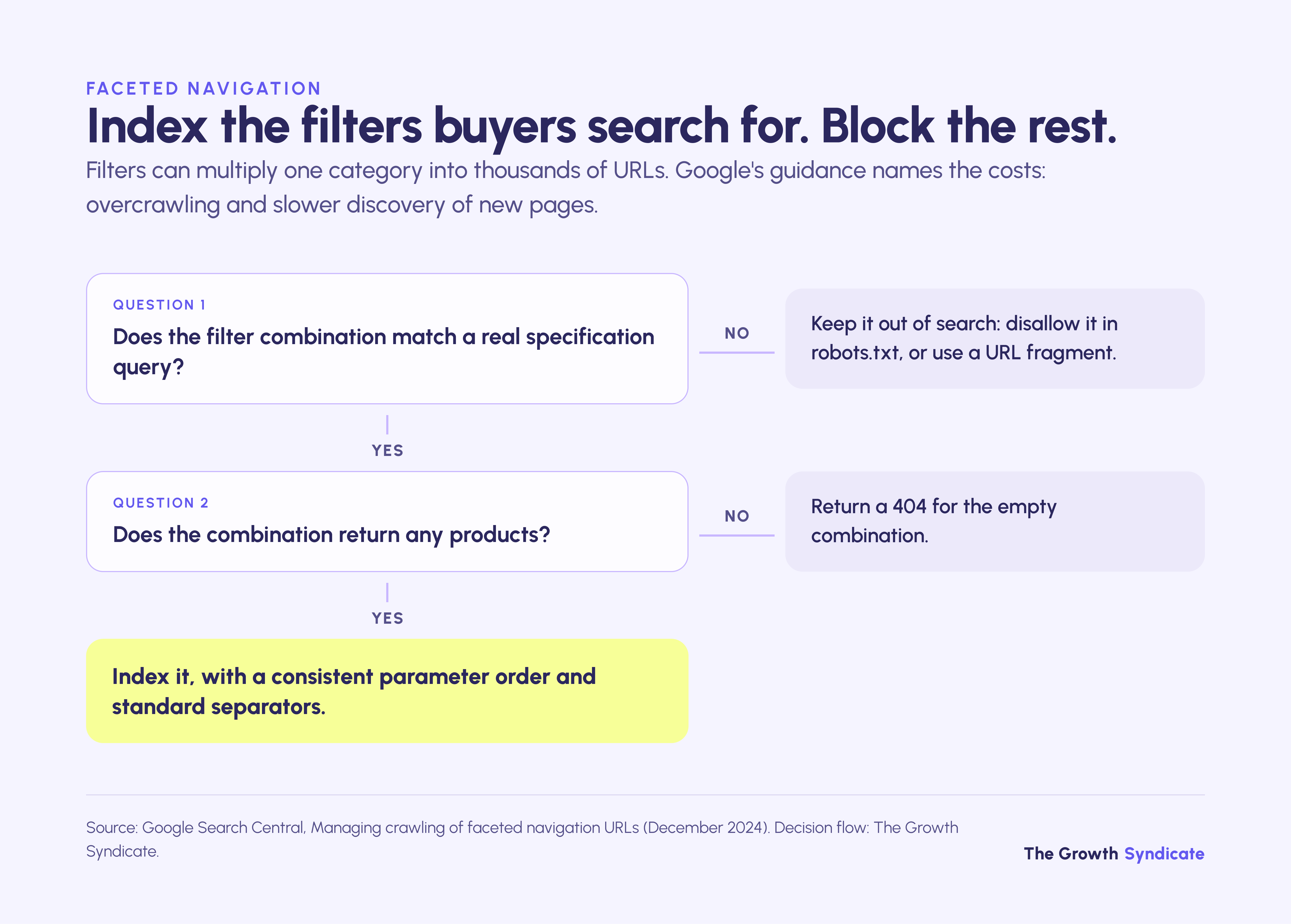
Filters for material, size, thread type or finish can multiply one category into thousands of URLs. Google’s guidance on faceted navigation, published in December 2024, names the costs as overcrawling and slower discovery of new pages. For filter URLs you don’t need in search, it recommends disallowing them in robots.txt or using URL fragments, which Google generally doesn’t crawl. For filtered pages you do want indexed, it recommends a consistent parameter order and standard separators, and returning a 404 when a filter combination has no results.
Decision rule. Index filter combinations that match real specification queries, such as a material and size pairing buyers actually search. Block the rest.
PDFs, datasheets and CAD files
Google can index PDFs; they appear on its list of indexable file types. Native CAD formats such as STEP and IGES do not, so a CAD file on its own is invisible as content. Every CAD download needs an HTML page that states the part’s dimensions, materials, tolerances and standards as text.
Datasheets should exist as HTML first and PDF second. An HTML page carries your navigation, internal links, structured data and a quote button; a standalone PDF opened from a search result usually carries none of them. When you do publish PDFs, give them descriptive titles and file names, and use text-based files so the specifications can be read.
Gated or ungated datasheets
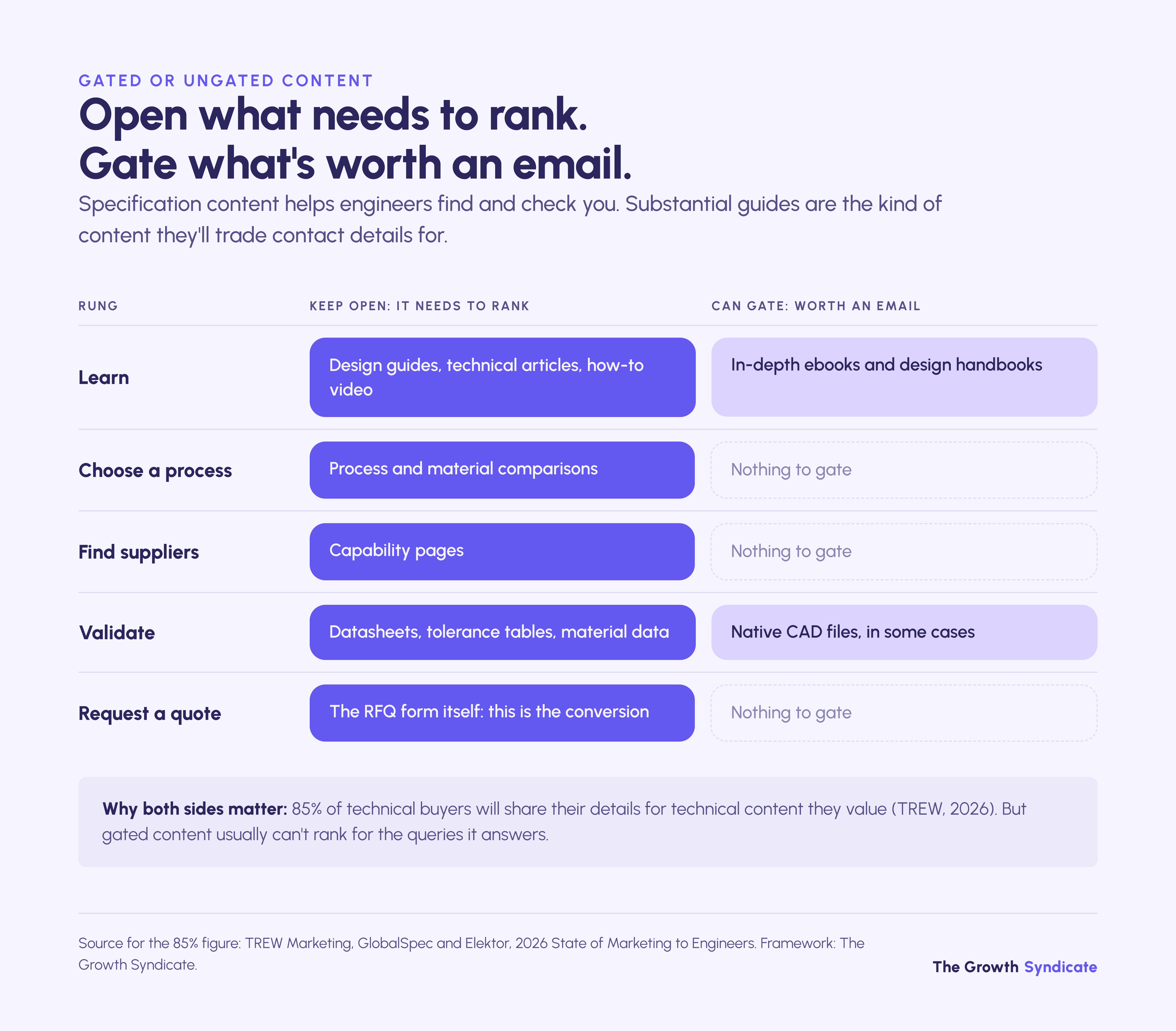
Gating has a real benefit and a real cost. Engineers will share contact details for content they value: in the 2026 TREW research, 85% of technical buyers said they would, up from 83% in the 2022 report. But content behind a form can’t be crawled as page text, so a gated datasheet usually can’t rank for the specification queries it answers.
The trade-off resolves by rung. Specification content engineers use to validate you, such as datasheets, tolerance tables and material data, should be open, because it is what makes you findable on rungs three and four. Substantial guides, and in some cases native CAD files, can be gated, because they are worth an email address and don’t need to rank. Measure both: form fills from gated assets and RFQs from the open pages.
Structured data
Structured data doesn’t rank a page by itself, but it helps search engines understand what a page describes. Organization markup establishes who you are. Product markup, with ProductGroup for variants, describes catalog items and their specifications and can make them eligible for product-related search features. Capability sellers usually need less: Organization markup everywhere, and Product markup only where you sell defined parts.
Speed and mobile
Google indexes the mobile version of pages, so a capability page that hides its specification table on phones is hiding it from Google too, even if your engineers do most of their research at a desk. Core Web Vitals, Google’s measures of loading, responsiveness and visual stability, also feed its assessment of page experience. On manufacturing sites, common culprits are heavy image galleries, embedded video players and third-party configurators.
Checklist: The Growth Syndicate.
Content for the learn and choose rungs
Engineers often search for the practical knowledge their training didn’t cover: how tight a bend radius can go in a given alloy, when laser cutting beats waterjet, what a surface finish callout does to cost. In our work with manufacturers, this educational content is where specialist companies have the best chance of standing out in search, because it rewards depth of knowledge rather than size of brand.
The formats that work on the first two rungs:
- Design guides. Bend radii, wall thicknesses, tolerances by process, with diagrams.
- Process comparisons. Laser vs waterjet, machining vs casting, with cost and tolerance trade-offs.
- Material pages. Grades, properties and what each means for manufacturability.
- Design-for-manufacturing content. The changes that make a part cheaper or faster to produce.
- How-to video. In the 2026 TREW research, 94% of technical buyers watched work-related video, and how-to guides, whiteboard sessions and product demos were the formats they wanted most.
- Application stories. Case studies that name the part, material, tolerance and volume.
Newsletters carry this content a long way. In the same research, 94% of technical buyers subscribed to newsletters, and after reading one, the most common actions were reading the full article (63%), downloading a spec sheet (60%) and visiting a vendor website (56%). A practitioner quoted in the 2026 report, Peter Matthews of Knowles Precision Devices, observed that case study videos, walkthroughs and demonstrations “build trust far more effectively than promotional claims.”
Named engineers, and a validation loop behind them
Google’s guidance on helpful, reliable content asks whether it is self-evident who wrote a page, and “strongly encourage[s] adding accurate authorship information, such as bylines.” Google presents bylines as a way to help readers assess content; it doesn’t describe them as a ranking factor. For engineers the byline carries weight of its own: in the TREW data, engineering experts at vendor companies rank far above AI tools on trust (66% vs 10%).
Named authorship needs technical review behind it, and in manufacturing that review is slow for good reason: it is the cost of content that survives an expert reading it. Name a reviewer for each topic, give them a short checklist (dimensions, tolerances, material claims, anything a competitor could dispute) and agree on a turnaround time.
Using AI on technical content
Google’s guidance on AI-generated content focuses on quality and usefulness rather than how content is produced. The risk for manufacturers is accuracy. A tolerance off by a decimal place, or a render of a part that couldn’t be machined, is the kind of error an engineer is likely to spot quickly, and it can cost more credibility than the article earns. Use AI for research, structure and first drafts; keep the final word with someone who could make the part.
The broader content strategy for manufacturers, from positioning to distribution, belongs in a wider plan. For SEO, the rule is narrower: every piece of content should answer a real question from the first two rungs and link to the capability page that answers the next one.
Authority from the industrial web
In the 2026 TREW research, online technical publications overtook vendor websites as engineers’ top research destination for the first time in the study’s history. That makes the trade press an SEO asset twice over: contributed articles and application stories put your expertise in front of engineers directly, and the links they generate help search engines find and assess your pages.
The sources that build authority for a manufacturer are specific to the industry:
- Trade publications. Contributed technical articles, application stories and expert commentary in the titles your buyers read.
- Associations and standards bodies. Member directories, committee participation and conference papers.
- Distributors and partners. Product and partner pages that link to your capability and product pages.
- Customers. Supplier and case study pages, where customers are willing to name you.
- Industrial directories. Useful as places buyers search and as citations of who you are and what you do, rather than as a source of link value.
Link building for a manufacturer is mostly this: showing up where engineers already read, with material worth citing. Bought links and generic guest posts do nothing for an engineer and carry risk with search engines.
Authority and AI answers
Which of these sources AI assistants draw on for supplier queries is not yet well measured, so treat claims of precise answers with skepticism. SparkToro’s research, cited in the 2026 TREW report, found that AI tools’ brand recommendations vary so much from one run to the next that the same list rarely repeats, which makes checking a single prompt unreliable. The practical approach is to build authority for engineers first. AI tools that cite the web may well draw on the same trade publications, directories and manufacturer pages engineers already trust.
Beyond Google: Bing, AI assistants and supplier shortlisting
Google is still where most manufacturing search happens, but two other surfaces now shape which suppliers make the shortlist: Bing, and the AI assistants that search the web on an engineer’s behalf.
Bing
Bing held 12.82% of US desktop search in August 2026, according to StatCounter, against Google’s 81.99%. Desktop is the more relevant figure for engineers researching at work, and Microsoft Edge, the default browser on Windows, uses Bing as its default search engine.
The work is small. Set up Bing Webmaster Tools, which can import your sites from Google Search Console, submit your sitemaps, and use IndexNow, the protocol Bing supports for notifying it of new and updated pages.
ChatGPT and other AI assistants
OpenAI’s own documentation connects ChatGPT’s search to Bing. For Enterprise and Edu workspaces, ChatGPT search may share disassociated search queries with Bing to return web results, and for other users it works with search partners. To be eligible for ChatGPT’s search answers, rather than only appearing as a plain navigational link, a site has to allow OAI-SearchBot to crawl it; OpenAI’s search crawler and its training crawler are controlled separately in robots.txt. So Bing is one of the indexes ChatGPT can draw on, and your robots.txt decides whether OpenAI’s own crawler sees your pages.
Sources: OpenAI crawler and ChatGPT search documentation; Google's crawler documentation. Crawler names and uses change, so check both before publishing.
For manufacturers, much of what’s now called GEO is search fundamentals applied to AI tools: clear capability pages with specific numbers, consistent company information across your site and directories, and mentions in the publications engineers read.
AI Overviews and the click
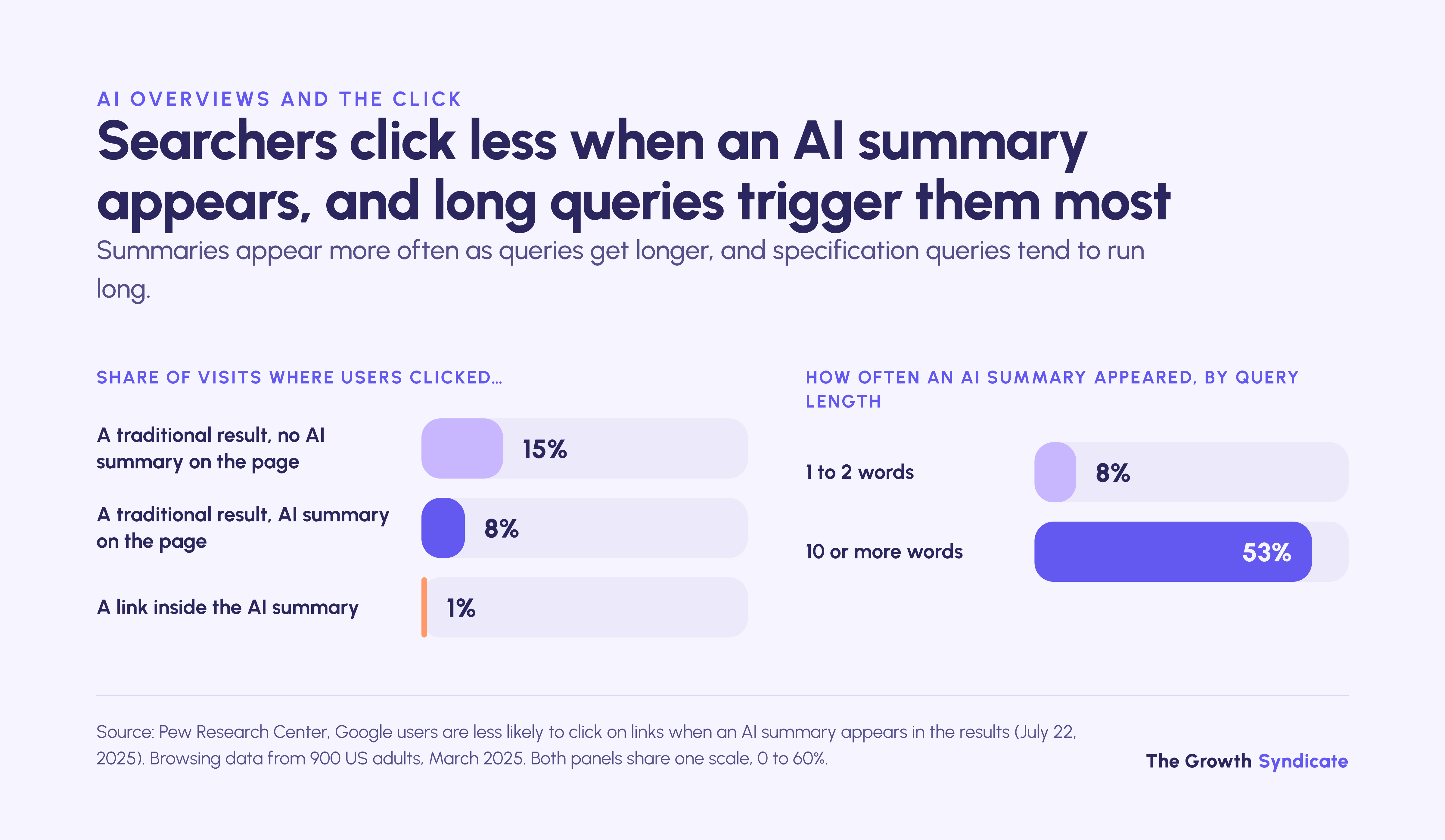
Searchers click less when an AI summary appears. In Pew Research Center’s analysis of browsing data from March 2025, users clicked a traditional result in 8% of visits to pages with an AI summary, against 15% without one, and clicked a link inside the summary in 1%. Ahrefs, comparing December 2025 with December 2023, found a 58% lower average click-through rate for the top-ranking page when an AI Overview appeared. Being cited softens the effect: in Seer Interactive’s data, brands cited in an AI Overview earned 35% more organic clicks than brands that weren’t, though Seer notes it can’t prove the citation caused the difference.
Pew’s data carries a specific warning for manufacturers. Long queries triggered summaries far more often: 53% of searches with ten or more words, against 8% of one- or two-word searches. Specification queries tend to run long, so more of them are likely to meet a summary.
By their own account, engineers behave differently. The 69% who read an AI summary and then continue to the results are still looking for a source. That is the case for the approach in this guide: be the page an engineer clicks through to check, with specific numbers, a named expert and a clear route to a quote.
Where you sell: local, national and export SEO
How much geography matters in manufacturing SEO depends on how far your parts travel. A regional job shop whose customers sit within a day’s trucking needs local visibility. A component maker shipping nationally needs little. An exporter needs a site that works in each market it sells into.
Local SEO
Local SEO matters for regional job shops, fabricators and service businesses whose buyers value short lead times, low freight costs or the option to visit. Before investing in it, check eligibility: Google’s Business Profile guidelines state that a business must make in-person contact with customers during its stated hours to qualify. A plant that receives customer visits, collections or on-site audits may qualify; a facility that never meets customers may not.
If you qualify, the basics are accurate categories and hours, real photos of the facility and work, and reviews from actual customers. Create location pages only for facilities that exist. City-name pages for places you don’t operate are the kind of doorway pages Google’s spam policies explicitly target.
National SEO
For manufacturers selling nationally, the capability architecture above is the national strategy. Many specification queries carry no location at all, and when one does (“sheet metal fabricator ohio”), it often signals a buyer who wants a supplier close by, which is a local SEO question for the plants you actually have.
International SEO for exporters
For exporters, international SEO has a technical part and a harder, editorial part. The technical part is standard: separate language or regional versions of your pages, connected with hreflang annotations so search engines show buyers the right version.
The editorial part is localization rather than translation. Engineers in different markets use different units (metric or imperial), different standards (EN and DIN or ASTM and ANSI), different material designations and different certifications. A translated page that still says “6061-T6” and “±0.005 in” to a German buyer is readable, but it isn’t written for them. In CSA Research’s 2020 survey of business users of high-tech products, 66% said they would pay up to 30% more for a localized product. That sample isn’t manufacturing-specific, but the direction is consistent with what we see.
Examples are illustrative. Check designations, standards and certifications with an engineer for each market.
Buying behavior differs by market as well. In our experience across European markets, German buyers are often more willing to start with a small test order, while French buyers tend to want more proof first and then place a larger first order. Positioning and proof points on localized pages should reflect what each market weighs most.
Measuring manufacturing SEO by rung
SEO for manufacturers is slow to show revenue, which is one reason it gets judged on the wrong things. Ahrefs’ study of how long pages take to rank found that only 1.74% of newly published pages reached the top ten within a year, and that the average page ranking first was about five years old. Low-competition specification queries on an established domain can move faster than that, but a new site chasing head terms can wait years. Plan to judge an SEO program over six to twelve months, and judge it first on leading indicators that move within weeks.
Framework: The Growth Syndicate.
The last row is the one leadership cares about, and it is the hardest to get right. Record the organic landing page with each RFQ, and add a “How did you find us?” field to the RFQ form. Self-reported answers catch the trade-press article, the colleague’s recommendation and the trade show conversation that click-based attribution routinely misses. Keyword rankings and organic traffic still belong on the report, as context for the RFQ numbers rather than as the result.
Paid search as a test bed
Paid search campaigns can answer in weeks what SEO takes months to learn: which capability terms produce RFQs. Manufacturing marketers rate the channel well. In the Content Marketing Institute’s 2025 manufacturing research, 68% said search and pay-per-click produced their best paid-channel results. Engineers are more selective. In the 2026 research summarized by GlobalSpec, 42% of technical buyers actively avoided sponsored results, while 33% would click one if it looked helpful and 22% would click when it came from a familiar website.
Use paid search to test terms before committing SEO effort to them, and as a primary channel for catalog and instant-quote businesses whose buyers are ready to order. Device settings matter too: in the Madeinadd work, paid budgets shifted toward desktop, because engineers weren’t signing up or uploading designs on mobile.
Common manufacturing SEO mistakes
Most of the common SEO mistakes on manufacturing websites come from building for a generic buyer rather than for an engineer working through the ladder. Each one breaks a specific rung.
Technical mistakes (filters, PDFs, gated specs) are covered in the audit checklist. Framework: The Growth Syndicate.
Manufacturing SEO statistics worth retiring
The last mistake deserves its own section, because the same handful of numbers appears across many articles on this topic. We couldn’t trace any of the following to a current primary source that supports the way they are usually quoted, so we don’t use them.
Research: The Growth Syndicate, September 2026.
Where this guide uses numbers, it names the source and year, and it says so when a figure comes from secondary coverage.
Choosing a manufacturing SEO agency
Many manufacturing companies bring in an SEO agency at some point, often because nobody in-house has the time to build capability pages and run a technical review loop at the same time. Manufacturing SEO agencies vary more than their websites suggest, and general SEO services built for software or ecommerce often miss what makes this work different. Six questions separate the ones worth hiring:
Framework: The Growth Syndicate.
The same questions apply to our own SEO work, and we would expect to be asked them.
Where to start this quarter
A strong SEO strategy for a manufacturer starts with a few structural decisions, not a content calendar. If you do nothing else in the next 90 days:
- Pull 20 recent RFQs and list the process, material, tolerance and certification language in each.
- Split your services page into one capability page per process you want more work in, starting with the line that has open capacity.
- Publish your specifications as HTML, with PDFs and CAD files as downloads from those pages.
- Open Search Console and Bing Webmaster Tools, check robots.txt for Bingbot and OAI-SearchBot, and fix what’s blocked.
- Add “How did you find us?” to the RFQ form, so you can see whether search is producing the work you want.
Manufacturing SEO rewards the same things engineers do: specific numbers, honest limits and a clear answer to the next question.
Frequently asked questions
How long does manufacturing SEO take to work?
Leading indicators such as impressions for specification queries, datasheet downloads and capability page visits can move within weeks of publishing. Rankings take longer: in Ahrefs’ research, only 1.74% of new pages reached the top ten within a year. Plan to judge a manufacturing SEO program over six to twelve months, and measure it by RFQs from specification queries.
Is SEO dead now with AI?
No, but it is changing. In the 2026 TREW research, technical buyers still relied on traditional search engines far more than on generative AI, and 69% of those who noticed AI summaries went on to the search results anyway. Searchers click less when AI summaries appear, so the aim shifts toward being the specific, verifiable page that engineers and AI tools both turn to.
What are the four types of SEO?
The four types usually listed are on-page SEO (the content and structure of your pages), off-page SEO (links and mentions elsewhere), technical SEO (crawling, indexing, speed and structured data) and local SEO (visibility for location-based searches). For manufacturers, the on-page work that matters most is capability architecture: one detailed page per process, material and certification.
What are the top five SEO tools for manufacturers?
A practical set is Google Search Console for queries and indexing, Google Analytics 4 for conversions, Bing Webmaster Tools for Bing’s index, a keyword and backlink tool such as Ahrefs or Semrush, and a site crawler such as Screaming Frog for technical audits. The first three are free, and Search Console is often where specification keywords turn up first.
Should manufacturers gate their datasheets?
Usually not. A gated datasheet usually can’t rank for the specification queries it answers, and those queries are one of the ways engineers find suppliers. Engineers will trade contact details for substantial content (85% said so in the 2026 TREW research), so gate in-depth guides instead and keep specification content open.
Does Bing matter for B2B manufacturers?
Yes. Bing held 12.82% of US desktop search in August 2026, Microsoft Edge uses it by default, and OpenAI’s documentation names Bing as a source for some ChatGPT web searches. Bing Webmaster Tools is quick to set up and can import your sites from Google Search Console.
Do manufacturers need local SEO?
It depends on how far your parts travel. Regional job shops and fabricators benefit from local SEO and a Google Business Profile, if they meet Google’s requirement for in-person contact with customers during stated hours. Manufacturers selling nationally or internationally usually get more from capability pages than from local listings.
What should a manufacturing capability page include?
The process and materials in the buyer’s words, a specification table with tolerances and part sizes, certifications with their scope, the equipment used, typical lead times, downloadable datasheets and CAD files, case studies with part details, an RFQ form that accepts drawings, and a named engineer to contact.
Should manufacturers use AI to write technical content?
Use it for research, structure and first drafts, and keep the final version with someone who understands the process. Google’s guidance judges content on quality and usefulness rather than how it was produced, but engineers tend to catch technical errors quickly, and a wrong tolerance can cost more trust than a well-reviewed article earns.
.png)