.svg)

.png)

Account based marketing is one of the few B2B disciplines where almost everyone agrees on the definition and almost nobody agrees on what it looks like in practice. Ask five marketing leaders what their account based marketing programs involve and you will get five different answers: one runs a genuine one-to-one program against eleven strategic accounts, one runs LinkedIn ads against a list of 400 companies, one has bought a platform and is still working out what to do with it.
That gap matters, because the economics of account based marketing are unforgiving. Concentrating marketing efforts on a small number of high value accounts is a bet. When the bet is sized correctly, it produces larger deals, higher win rates and shorter internal arguments about lead quality. When it isn't, it produces an expensive version of demand generation with a better name.
This guide covers what account based marketing is, when the numbers justify it, how to build an ABM strategy step by step, how to select the right channels for each tier of target accounts, and how to measure the program without pretending the sales cycle is shorter than it is. It is written for marketing leaders at B2B companies selling to specific accounts through considered purchases, multiple decision makers and sales cycles measured in quarters rather than days.
What account based marketing actually is
The definition
Account based marketing (ABM) is a go-to-market approach in which marketing and sales teams agree on a defined set of target accounts and treat each account, or each cluster of similar accounts, as a market in its own right. The target account list becomes the shared organizing object for both teams. Rather than generating a high volume of leads and filtering them, ABM starts with the accounts worth winning and works backwards to the people inside them.
The practical consequence is a change of unit. Traditional demand generation optimizes for leads: cost per lead, lead volume, lead-to-MQL rate. Account based marketing optimizes for accounts: how many of your target accounts are engaged, how much of the buying committee you have reached, how many of them have entered pipeline. Marketing qualified accounts replace marketing qualified leads as the object of attention.
That shift sounds administrative. It isn't. It changes which campaigns look successful to marketing teams, and which accounts look worth working to sales teams. A campaign generating 300 leads from companies you cannot sell to is a failure in an account based model, however good the cost per lead looks.
Where the term came from
The term was coined in 2003 by Bev Burgess at ITSMA, formalising practices that had existed in key account management and industrial marketing for decades. ITSMA published the first substantial paper on the discipline, Account-Based Marketing: The New Frontier, in 2004.
ITSMA also gave the discipline its most durable shorthand: the three R's.
The 3 R's of ABM are Reputation, Relationships and Revenue: the sequence in which account based marketing is supposed to create value. You build reputation inside the account, which enables relationships with key stakeholders, which eventually produces revenue. The order matters, and it is the part most programs skip. Teams that jump straight to revenue tend to produce outbound campaigns wearing an ABM costume.
How ABM differs from traditional marketing
The most common question, what is the difference between marketing and account-based marketing, has a simple answer and a more useful one.
The simple answer: traditional marketing casts a net, ABM uses a spear. Gartner's Ray Pun has used exactly that framing.
The more useful answer is that ABM applies ordinary marketing to a list you chose in advance, with sales in the room while you choose it. Everything else (the content, the ads, the events, the emails) is recognizably marketing. What changes is who decides the audience, and who carries the outcome.
How ABM and inbound marketing fit together
Account based marketing is frequently presented as the opposite of inbound marketing: the "flipped funnel" that starts narrow instead of wide. That framing is memorable and slightly misleading.
Inbound marketing builds assets that attract buyers who are already looking: search-optimized content, comparison pages, tools, resources. Account based marketing selects the companies you want and goes to them. The two are complementary, and in practice most successful abm programs depend on inbound infrastructure. When a CFO at one of your high value accounts finally searches for the category, the content that meets them was built by inbound marketing. When a target account's technical evaluator wants to understand your architecture without talking to a rep, inbound marketing is what they read.
The distinction worth holding on to is this: inbound marketing decides what to publish, account based marketing decides who you are trying to reach. Companies that treat them as competing budgets usually end up defunding the thing that makes the other work. An abm strategy should be planned alongside inbound marketing, not against it.
Why account based marketing exists: the economics
Buying committees, not buyers
The structural case for ABM is that B2B purchases are made by groups, and groups are not reachable through lead capture.
Forrester's State of Business Buying research, which surveys tens of thousands of business buyers globally, puts the typical buying group at around 13 people, with a further set of external influencers involved in complex purchases, which makes a buying network of roughly twenty people on strategic deals. Forrester also found that the large majority of B2B purchases stall at some point, and that most buyers end up dissatisfied with the provider they select.
Gartner's buyer research supplies the other half of the picture: across the whole buying journey, buyers spend only about 17% of their time meeting potential suppliers. Split that across the vendors on a shortlist, and any individual sales rep is working with a very thin slice of the customer's attention.
Put those together and the logic of ABM becomes clear. If a purchase involves thirteen people, and your sales rep gets a fraction of one seventeenth of their time, reaching one of those people through a form fill is not a strategy. You need coverage across the buying committee, sustained over the length of the sales cycle, delivered by marketing and sales in coordination.
The concentration argument
The second argument is about where revenue actually comes from. In most B2B companies, a small number of key accounts represent a disproportionate share of contract value. Key accounts here are not simply the largest logos. They are the high value accounts where win rate, deal size and retention are all above average. If your top 50 accounts are worth more than the next 2,000, spreading marketing efforts evenly across the market is a deliberate misallocation.
Account based marketing is the operational answer: spend in proportion to account value, not in proportion to account count. Business growth follows the accounts that carry the revenue.
What the ABM statistics actually say
A small set of numbers appears in almost every article on this subject: 38% higher sales win rates, 91% larger deal sizes, 24% faster revenue growth, and somewhere between 72% and 97% of marketers reporting higher ROI from ABM than from other strategies. They are worth examining rather than repeating, because the claims that survive scrutiny make a better case than the ones that do not.
The version of the ROI claim that carries a date and a sample: the sixth annual benchmark from Momentum ITSMA and the ABM Leadership Alliance, published in December 2022 and based on 279 ABM practitioners, found that 72% said ABM delivers higher ROI than other types of marketing. The same study reported 90% seeing improved engagement with selected accounts, 84% reporting pipeline growth and 77% reporting revenue growth. It is practitioner self-report, and the alliance behind it is vendor-backed, so read it as what experienced teams believe about their own programs rather than as a controlled measurement.
Taken together, the evidence supports a modest and defensible claim about abm success: teams that run account based marketing seriously tend to report better returns than they get from broad demand generation, and the effect shows up most clearly in pipeline and engagement. The precise percentages are considerably softer than their repetition across the internet suggests. If you are building a business case, the Frends numbers later in this article, or your own pilot against a matched control cohort, will hold up better under a CFO's questioning than any of the figures above.
When ABM does not make sense
This is the part most guides skip, and it is the most important qualifying question a marketing leader can ask.
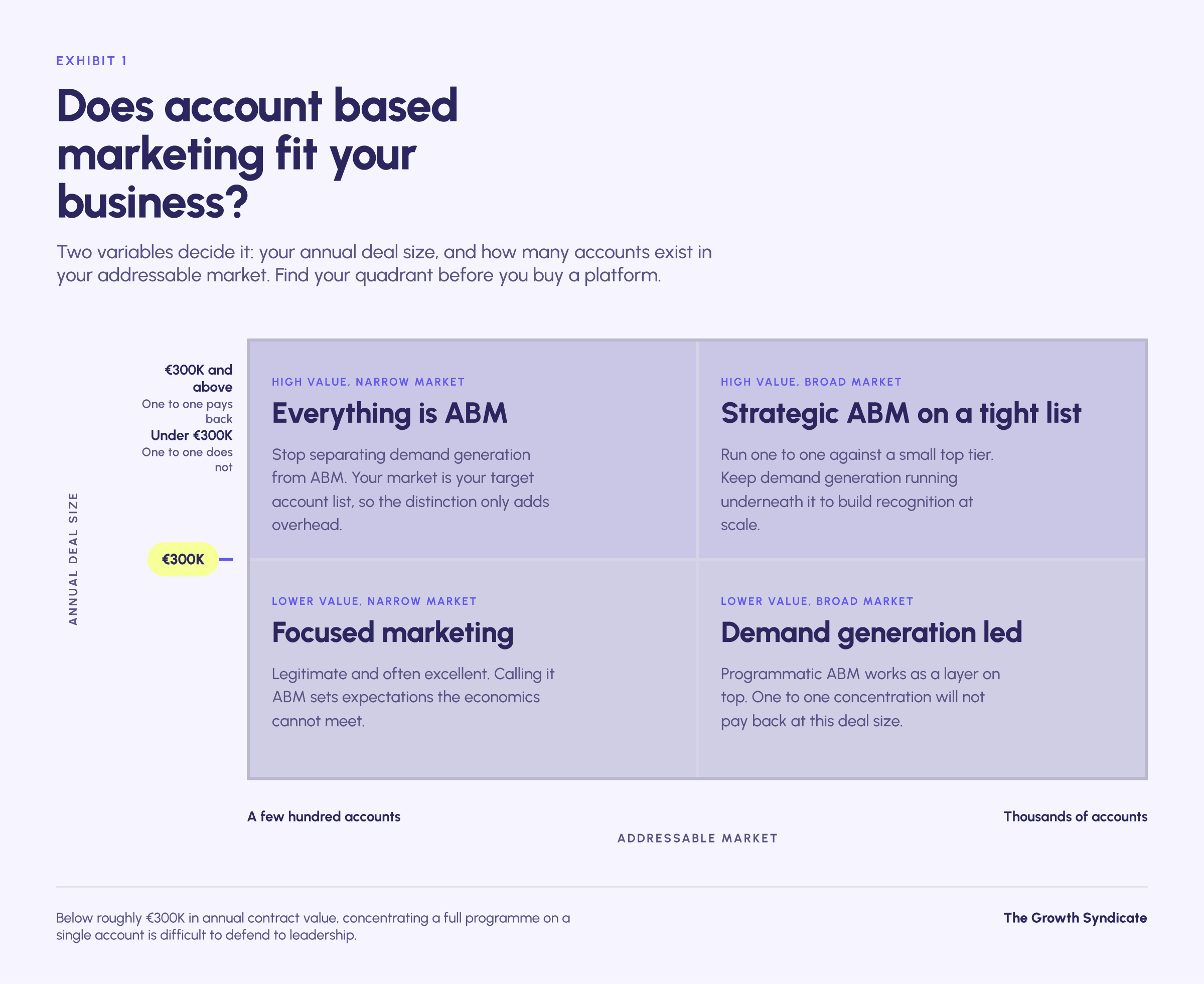
True one-to-one account based marketing (a dedicated account team, bespoke personalized content, custom experiences for a single organization) carries real cost. Our co-founder Clément Dumont puts a number on where that cost becomes rational:
The reasoning is a straightforward risk-reward calculation. If a marketer tells leadership they are going to concentrate resources on a single account and the potential return is €10K, leadership will correctly ask them to diversify. Below roughly €300K in annual contract value, single-account concentration is difficult to defend.
Most companies are not in that bracket. What they are doing, running personalized campaigns against 300 to 500 similar companies, is a legitimate and often excellent strategy. It just isn't one-to-one ABM, and calling it that creates expectations the program cannot meet.
The convergence question: ABM or demand generation?
There is a live argument in B2B about whether account based marketing is being absorbed into broader signal-based go-to-market motions. The honest answer is that the distinction was always a function of market size.
Clément's framing is the cereal box test. Demand generation is the box: market-level awareness. ABM is the individual cereals inside: account-level selection. If your box only contains a handful of cereals, there is no meaningful distinction to draw:

"If I look at a client we work with, which is often B2B, complex industries, long sales cycles, enterprise deals, they potentially have like a few hundred customers in Europe. Then you could argue that everything you do on the demand gen side actually is ABM."
That gives you a decision rule rather than a doctrine:
- Total addressable market of a few hundred accounts: treat everything as ABM-flavored. Separating demand generation from ABM creates organizational overhead with no strategic benefit. The market is the list of target accounts.
- Large TAM with diverse ICPs: keep the separation. Demand generation operates at market level; account based marketing operates as a focused motion inside it.
The three types of account based marketing
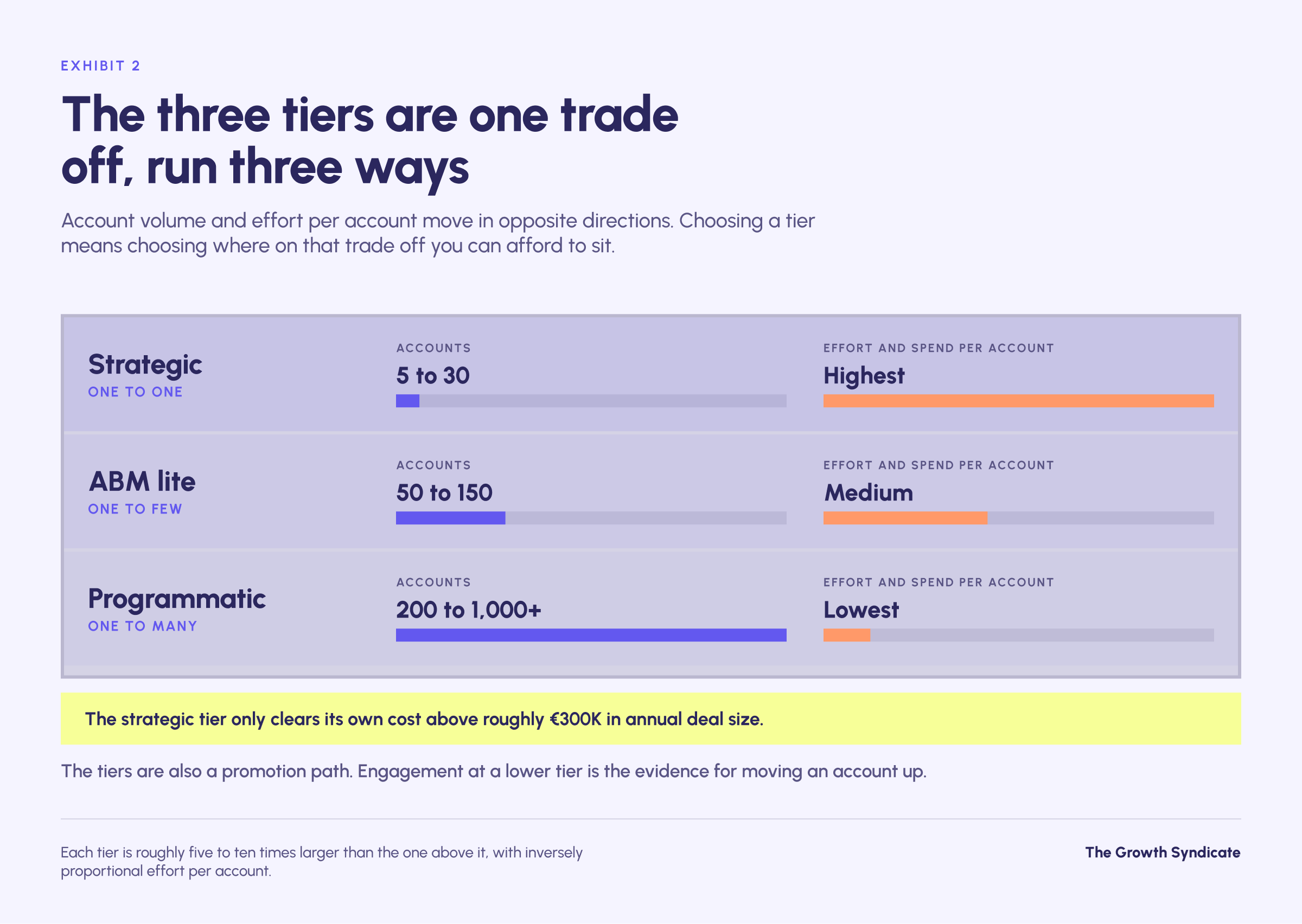
There are three types of ABM, and mature programs run all three simultaneously rather than choosing between them.
Strategic ABM (one-to-one)
Strategic ABM builds a bespoke program for a single account. Research is deep and specific: the account's stated strategy, its competitive position, its recent leadership changes, the initiatives its executives are publicly committed to. Personalized content is created for that account alone.
- Typical volume: 5 to 30 accounts
- Best suited to: strategic accounts and enterprise accounts with long sales cycles and large buying committees
- Resourcing: a named account team spanning marketing and sales
- What it produces: access to executives you could not otherwise reach
Strategic ABM is where the 300K threshold applies. It is also where expansion revenue often justifies the investment when the initial deal doesn't. Existing customers with real land-and-expand potential can warrant one-to-one treatment on the basis of lifetime value rather than first contract. For many companies the fastest payback from abm programs comes from existing customers rather than from new logos.
ABM lite (one-to-few)
ABM lite groups similar accounts into clusters (by industry, by business model, by the specific problem they share) and builds personalized campaigns for the cluster rather than for individual accounts.
- Typical volume: 50 to 150 accounts across several clusters
- Best suited to: mid-market and lower enterprise deals where accounts share a recognizable situation
- Resourcing: a marketing owner plus an SDR pod
- What it produces: most of the relevance of one-to-one at a fraction of the cost
For most B2B companies, this tier does the heavy lifting. It is also where personalization is most often overdone: a cluster of twelve manufacturers with the same compliance problem does not need twelve versions of a landing page. It needs one page that speaks precisely to that problem.
Programmatic ABM (one-to-many)
Programmatic ABM uses technology (account based advertising platforms, matched audiences, website personalization, automated nurture) to run personalized campaigns at scale across a large set of target accounts.
- Typical volume: 200 to 1,000+ target accounts
- Best suited to: velocity segments and pipeline coverage across the broader ICP
- Resourcing: the demand generation team, with ABM tooling
- What it produces: reach, and the early engagement signals that feed the tiers above
How the tiers fit together
A useful rule of thumb: each tier down is roughly five to ten times larger than the one above, with inversely proportional effort per account. The tiers are also a promotion path. Programmatic engagement identifies which accounts deserve one-to-few treatment, and one-to-few engagement identifies which deserve a strategic program.
The ABM strategy framework: building a program step by step
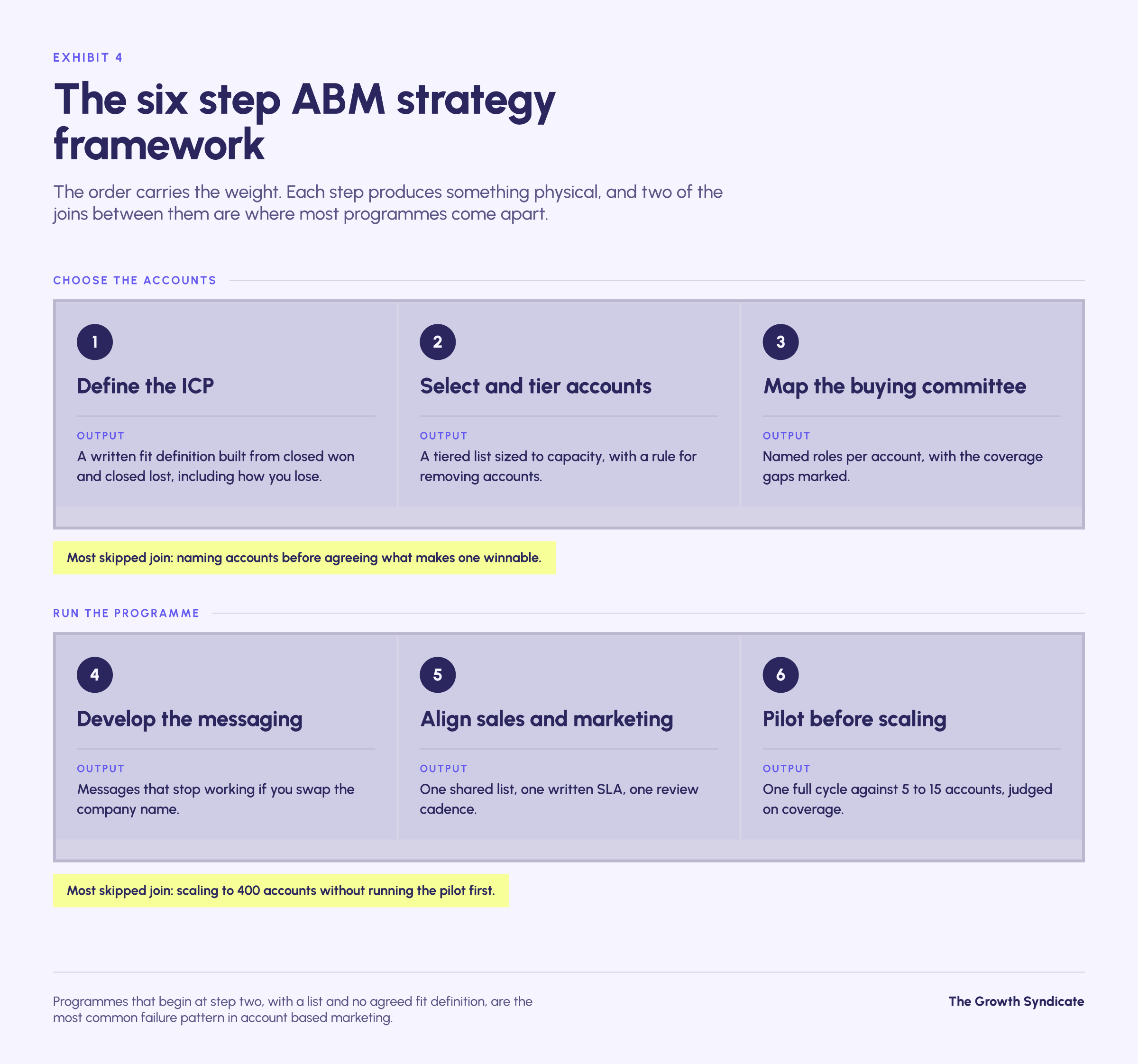
An account based marketing strategy is not a campaign plan. It is an operating model that changes how marketing and sales teams decide where to spend effort. Six steps, in order.
Step 1: Define the ICP before you build the list
Most target account problems are ICP problems wearing a disguise. Before naming a single company, marketing and sales teams need to agree on what makes an account winnable: company size, sector, technology environment, business model, buying trigger, and the one most teams leave out: the conditions under which you lose.
Build the definition from closed-won and closed-lost data rather than aspiration. The accounts you have actually won tell you more than the accounts you wish you had won. Our guide to building an ideal customer profile covers the method in detail.
Step 2: Select and tier your target accounts
Now name them. Two rules keep this honest.
First, every account needs a reason to be there that isn't the logo. Vanity accounts, impressive names with no observable fit or buying signal, quietly consume program budget for years. Fit scoring (firmographic and technographic match to the ICP) combined with signal scoring (hiring patterns, funding, leadership changes, technology adoption, research behavior) gives you a defensible tiering. Key accounts should earn their tier rather than be assigned it.
Second, you need a removal process. A list of target accounts that only grows is a list nobody is managing. Review your target accounts quarterly, demote the ones that show no engagement after a full program cycle, promote the ones that do.
Size the list to your capacity, not your ambition. A common failure is selecting 400 target accounts with resourcing sufficient for 80.
Step 3: Map the buying committee
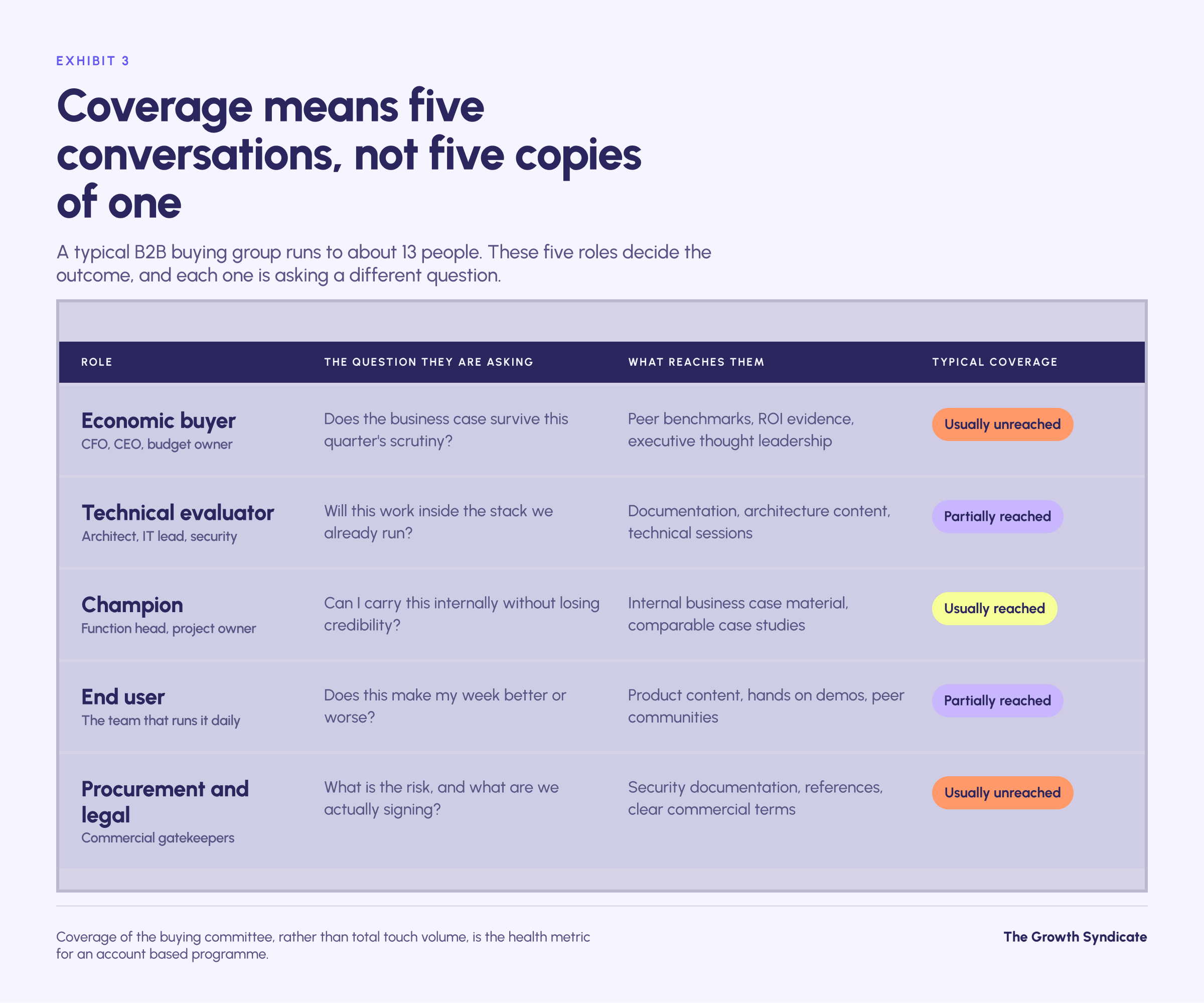
For each tier, define who you need to reach. In enterprise deals this is rarely fewer than five roles, and the people who evaluate the product are frequently not the people who will use it. Each of those decision makers travels a different customer journey through the same purchase.
Clément describes the practical implication:
That is the real work of account based marketing, and it is where most programs are thin. Buying committee coverage, meaning how many of the relevant roles inside an account you have actually engaged, is a better health metric than total touches, because ten touches concentrated on one champion is worse than five spread across the economic buyer, the technical evaluator and the champion. Coverage of buying committee members, not touch volume, is the number to watch, and each role needs relevant content of its own.
Step 4: Develop messaging that earns the relevance
Personalization and relevance are not the same thing, and confusing them produces the most recognizable ABM failure mode: personalized messaging that inserts a company name into a commercially empty sentence.
The test is simple. If you swapped in a different company name and the message still worked, it was never account specific messaging. Real relevance comes from the account's situation: a regulatory deadline, a merger, a platform migration, a public commitment their CEO made on an earnings call. A merge field will not produce it.
For the one-to-few and one-to-many tiers, relevance operates at the level of the shared situation rather than the individual company. That is legitimate, and it scales.
Step 5: Align sales and marketing on a single plan
Account based marketing does not survive misalignment, because the account list is jointly owned by definition. If marketing selects the accounts and hands them over, sales will ignore them, and the program will quietly revert to lead generation.
Practical sales and marketing alignment looks like: a shared target account list that neither team can change unilaterally, a documented SLA covering what happens when an account engages, a recurring review where marketing and sales teams look at the same accounts on the same screen, and shared metrics that both functions are measured on. The best abm programs are run by revenue teams rather than by marketing alone, with one owner accountable for the account rather than for a stage of the sales process. We cover the operating detail in our guide to sales and marketing alignment.
Our co-founder Ferdinand Goetzen describes the alternative bluntly:

Sequencing matters here. If sales and marketing alignment is weak today, fix that before scaling your abm strategy. An account based program layered on top of a broken handoff fails more loudly and more expensively than the demand generation it replaced.
Step 6: Pilot before you scale
Run the first program against a small set of five to fifteen accounts for one full cycle. The pilot exists mainly to earn the sales team's participation in the larger program, which is the actual prerequisite for scale. Testing the tactics is secondary.
Define success before you start, in terms observable within the pilot window: buying committee coverage, meetings booked with roles you previously could not reach, sales validation of account fit. Not closed revenue.
Channel strategy: how to identify the right channels
This is where most ABM guides turn into a list of tactics. Channel selection deserves better, because it determines whether the program is affordable.
The three questions that determine channel choice
1. What tier is the account in? Cost per account has to scale with expected contract value. A €200 direct mail package is rational for a €400K opportunity and absurd for a €12K one. Establish your acceptable cost per account per tier first, then select channels that fit inside it.
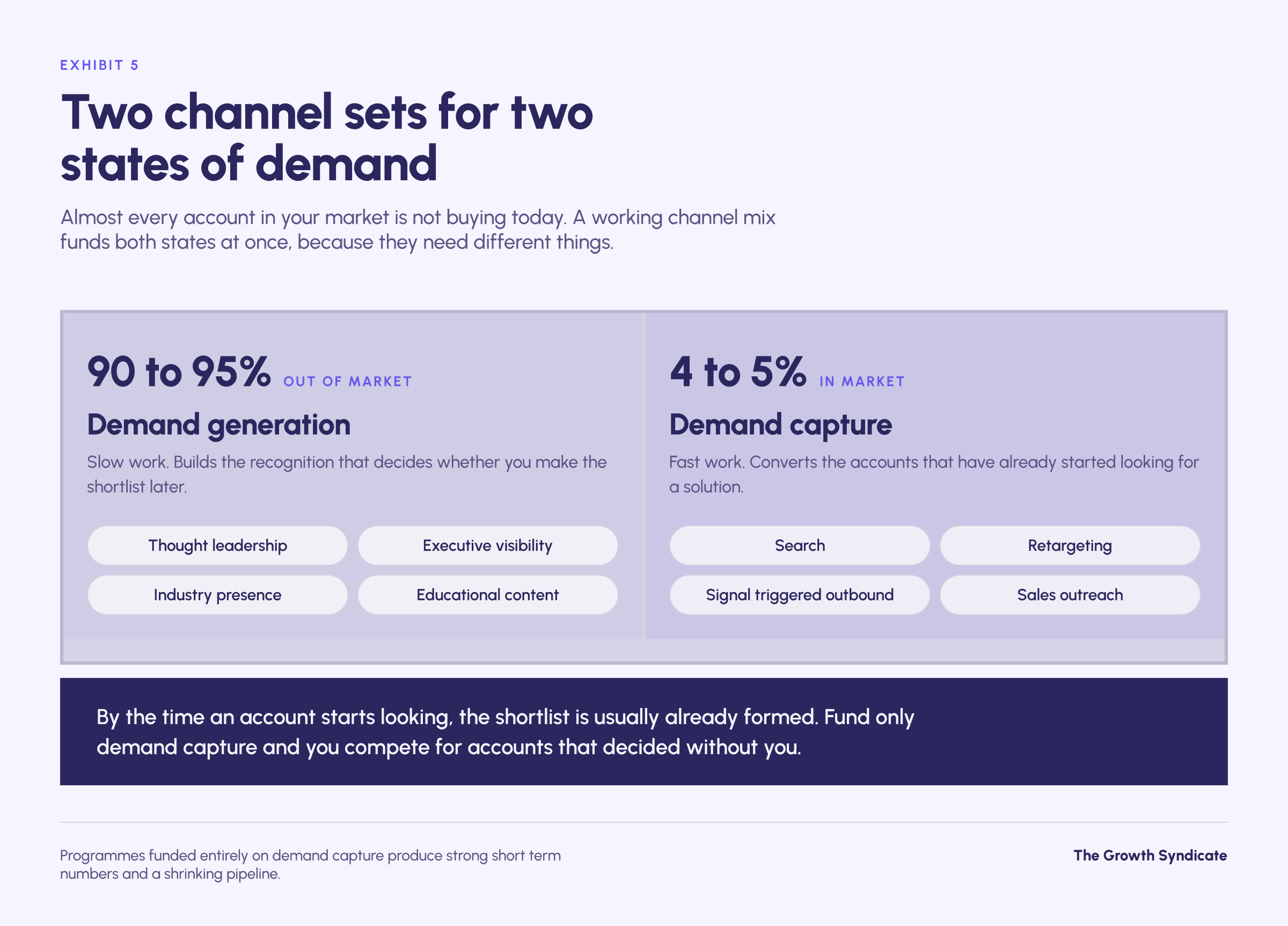
2. Where is the account in its buying cycle? Not every target account is in market. This is the most consequential idea in ABM channel planning, and it rests on a simple observation: at any given moment, 90 to 95% of your potential customers are not looking for a solution at all.
The consequence is that you need two channel sets running simultaneously. Demand capture channels (search, retargeting, signal-triggered outbound) convert the small in-market slice. Demand generation channels (thought leadership, executive visibility, industry presence, educational content) do the slower work of ensuring that when an account moves from out-of-market to in-market, you are already on the shortlist. Programs that fund only the first set produce good short-term numbers and a shrinking pipeline.
3. Which decision makers are you trying to reach? A CFO and a head of engineering are not reachable through the same channel with the same message, and they enter the customer journey at different points. Channel selection follows role coverage, not the other way round.
Air cover and direct touch
Most mature ABM programs converge on a two-layer model.
Air cover is always-on, account-targeted, low-intensity presence: account based advertising against your target accounts, thought leadership from executives, industry content, visibility at the events your accounts attend. It costs relatively little per account and its job is recognition, making sure that when a sales rep reaches out the name is already familiar.
Direct touch is high-intensity, sales-led, and reserved for accounts showing both fit and signal: personalized outreach, executive-to-executive introductions, tailored assets, meetings, dinners.
Direct touch without air cover is cold outbound. Air cover without direct touch is advertising. Sequencing abm campaigns so that recognition precedes outreach is most of the craft. The combination is what people mean by account based marketing when it works.
Mapping channels to tiers
LinkedIn and account based advertising
For most B2B companies LinkedIn is the anchor channel for account based advertising, because it is the only major platform where you can target named accounts by company and then filter by job function inside them. In Wpromote's State of B2B Marketing research, 40% of B2B marketers named LinkedIn their most effective channel for driving high-quality leads.
Three things worth knowing before you budget for it.
Executive and employee posts consistently outperform brand-account content: LinkedIn Thought Leader Ads and founder-led posting typically achieve several times the engagement of equivalent brand posts, which is why we treat ABM and thought leadership as one motion rather than two. Direct-response creative rarely works as a cold entry point into a target account; it performs in retargeting, after recognition exists. And account based advertising needs a runway: a meaningful read on LinkedIn abm campaigns takes at least a quarter, often longer.
Outbound, and where marketing meets it
Outbound sits inside account based marketing as the direct touch layer, and it performs very differently depending on whether marketing has done the air cover work first.
The model we use with clients is marketing-assisted outbound: sales owns targeting, outreach and qualification from the top down; marketing owns the advertising, collateral and automation that warms the account from the bottom up. Typical cold outbound response rates sit in the low single digits. Outbound into accounts that have had sustained exposure to your content and your executives performs several times better, because the name is no longer unfamiliar.
Physical channels, events and field marketing
Physical channels remain disproportionately effective in the strategic tier for the same reason they are impractical elsewhere: they cost enough to be scarce. Direct mail campaigns aimed at named executives inside high value accounts consistently outperform digital equivalents on response rate, at a cost per account that only makes sense above a certain deal size. Executive dinners and small roundtables do similar work, and they remain the most reliable way to get several buying committee members from the same account into one room.
Website personalization and content
If a target account arrives on your site after seeing your advertising, the experience should reflect the campaign that brought them, with relevant content for their industry rather than a generic homepage. Industry-specific landing pages and personalized content serve the one-to-few tier well without the overhead of account-specific microsites. Reserve genuinely custom experiences for the strategic tier.
What changes in Europe
For EU-facing abm programs, GDPR shapes both data and outreach. Business contact data belonging to an identifiable person is personal data, and cold outbound generally relies on legitimate interest as its lawful basis, which requires a documented assessment covering purpose, necessity and the balance against the individual's rights. Where data is sourced from a third party, notice obligations apply. Third-party intent data built on cookie-derived signals is harder to defend in Europe than in the US.
None of this makes account based marketing in Europe impractical. It does mean a US-designed playbook needs legal review before it runs in the EU, and that first-party and second-party data are structurally more valuable in European programs than in American ones.
Data, signals and account based marketing tools
What buying signals can and cannot tell you
Intent data comes in three forms: first-party (behavior on your own properties: accurate, late-stage, limited in reach), second-party (activity on review sites and partner properties), and third-party (aggregated research behavior across the web: broad reach, lower precision).
The limitation that catches teams out is granularity. Most third-party data is account-level, not contact-level. It tells you that someone at Acme is researching your category. It does not tell you it was the CISO. Treat buying signals as a prioritization input for where to spend attention, not as evidence that a specific person is in market.
Do you need an ABM platform?
Account based marketing tools genuinely help at scale: matching anonymous traffic to high value accounts, scoring engagement across the buying committee, orchestrating multi-channel programs, and reporting at account level rather than lead level. Gartner's most recent evaluation of the category places 6sense, Demandbase and ZoomInfo at the top of the market.
They also cost, commonly, well into six figures annually at enterprise tier. The honest sequencing is that a platform amplifies an operating model; it does not create one. Teams that buy tooling before they have agreed target accounts, a working relationship between marketing and sales, and clean CRM data reliably end up with an expensive dashboard.
If you are running fewer than 100 accounts, your CRM, your marketing automation platform and LinkedIn will take you a long way.
Where AI actually helps
The genuine gains today are in account research and enrichment, which compresses hours of manual investigation into minutes, and in generating cluster-level message variants at a volume that would previously have been uneconomic. Adoption is near-universal; satisfaction is not. Recent industry surveys show most B2B marketing teams using AI somewhere in their ABM efforts, but only around half reporting satisfaction with the results, and a small minority working to any formal plan.
The constraint is data quality. Agents operating on a bad list of target accounts produce bad outreach faster.
Measuring account based marketing
Account-level metrics
The metrics that matter to marketing teams running ABM describe accounts, not leads:
- Account coverage. What proportion of your target accounts have engaged at all.
- Buying committee coverage. How many relevant roles per account you have reached.
- Account engagement score. Depth and recency of engagement across the account.
- Pipeline created and influenced within your target accounts.
- Deal size and win rate for target accounts versus everything else.
- Sales cycle length for engaged accounts versus cold ones.
The last two carry the business case, because they isolate the effect ABM is supposed to have. If your target accounts are not closing larger or faster than the rest of the pipeline, the program is not working, whatever the engagement dashboard says.
The attribution problem
Multi-touch attribution breaks in account based marketing. A single deal involves dozens of touches across a dozen people over several quarters, and much of the research happens anonymously. Account-level measurement exists precisely because only a small fraction of any buying group ever fills in a form. Revenue teams that keep scoring individuals rather than accounts end up measuring the wrong thing.
Mature marketing teams stop assigning fractional credit and use two things instead: pipeline influence within a defined lookback window, and a control cohort of matched accounts receiving no ABM treatment. The control cohort is what turns "our ABM accounts closed at a higher rate" into evidence.
Be suspicious of very high influence numbers. Programs claiming ABM influenced the overwhelming majority of pipeline are usually describing a lookback window that is too generous.
The 90-day problem
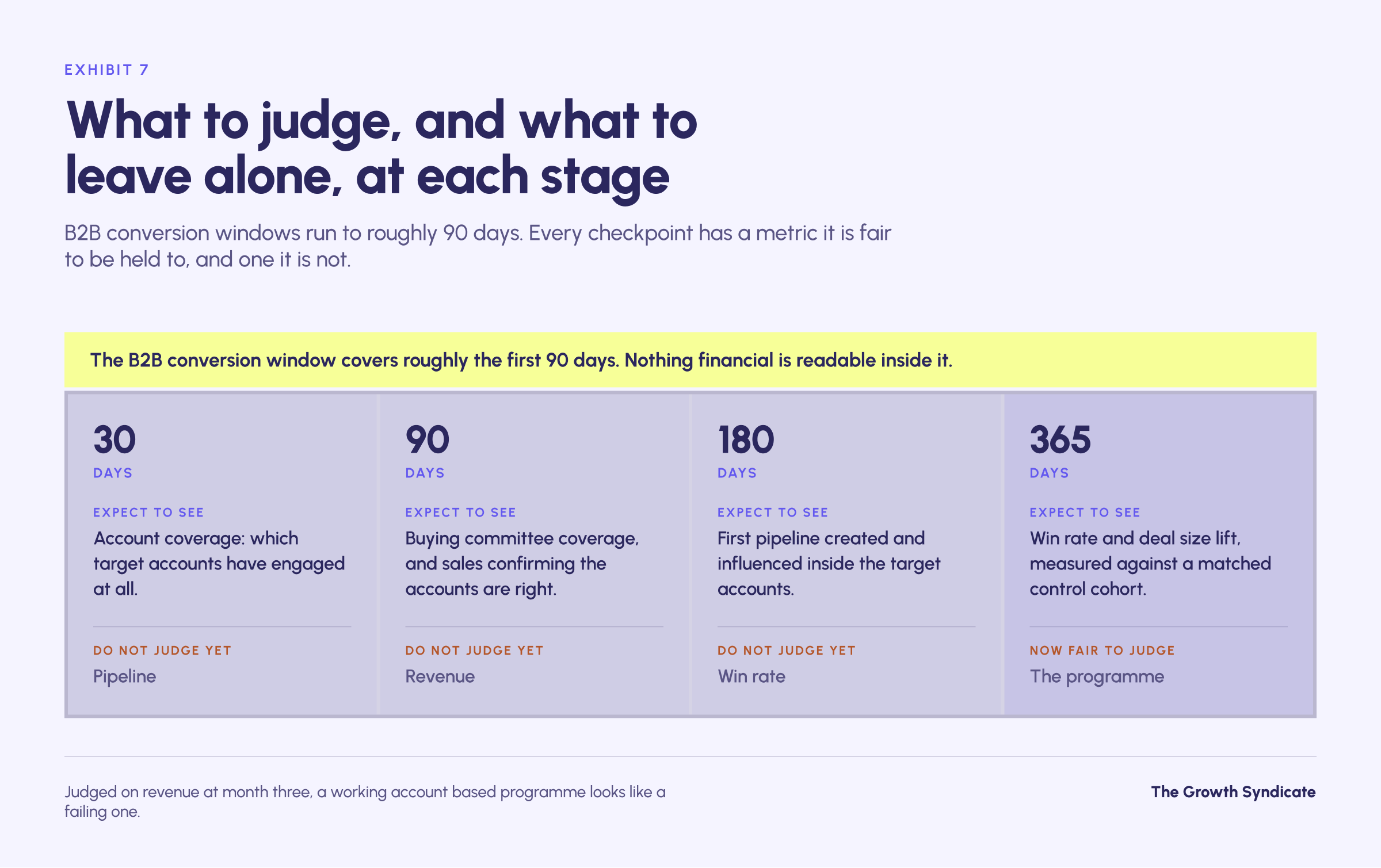
The most common way to kill a working program is to judge it on this month's numbers. Daria Kalinina, formerly our head of performance, put it directly:

"What I emotionally distrust the most is operating based on the recent metrics because the conversion window in B2B is quite big, it's about 90 days and basically relying purely on leads, revenue, and pipeline that have happened directly this month sometimes is a mistake a lot of companies would make."
Early accountability still applies. It simply has to attach to the indicators that can move inside the window: engagement from target accounts, coverage of the buying committee, and sales confirming the accounts are the right ones. Lagging financial outcomes structurally cannot have appeared yet.
Set the expectation with leadership at the start: programmatic tiers show engagement signals within a quarter and pipeline within two; strategic ABM is measured across a year.
Why ABM programs fail
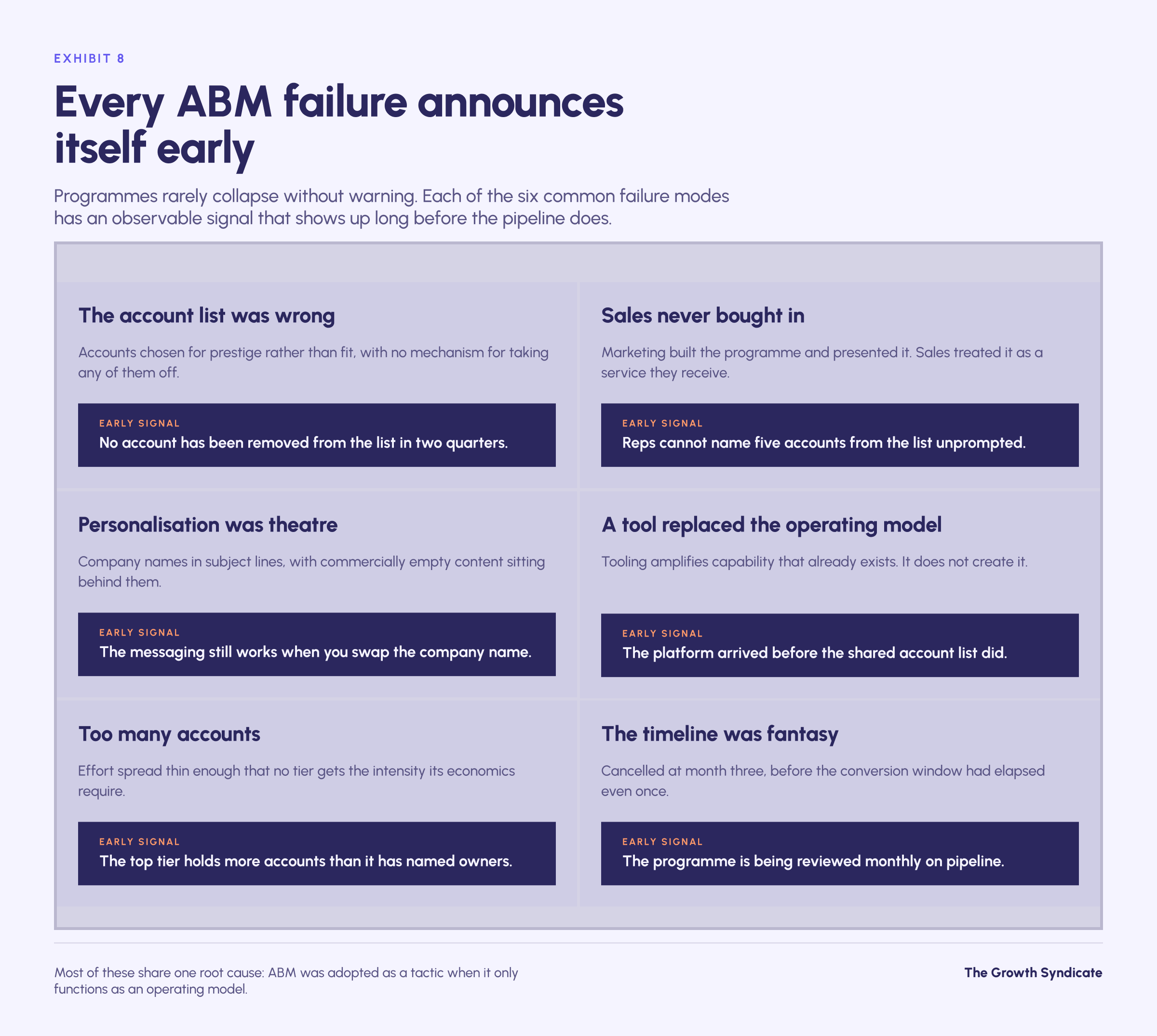
The failure modes are consistent enough to be predictable.
The account list was wrong. Accounts selected for prestige rather than fit, lists inflated by internal politics, no mechanism for removing accounts that never engage.
Sales never bought in. Marketing teams built the program and presented it. Sales treated it as a service they receive rather than a motion they own, and the target accounts on the slide quietly diverged from the accounts reps actually work.
Personalization was theatre. Company names in subject lines, generic content behind them, and no sales and marketing review of what was actually sent. Buyers notice: Gartner's research suggests a large majority actively avoid suppliers who send irrelevant outreach.
A tool was purchased instead of an operating model. The platform arrived before the alignment, the data hygiene and the account selection.
Too many accounts. Effort spread thin enough that no tier receives the intensity its economics require, and the sales process absorbs accounts it was never resourced to work.
The timeline was fantasy. Programs cancelled at month three, before the conversion window had even elapsed.
Most of these share a root cause: ABM was adopted as a tactic by marketing teams when it only functions as an operating model shared by marketing and sales.
An example of account based marketing in practice
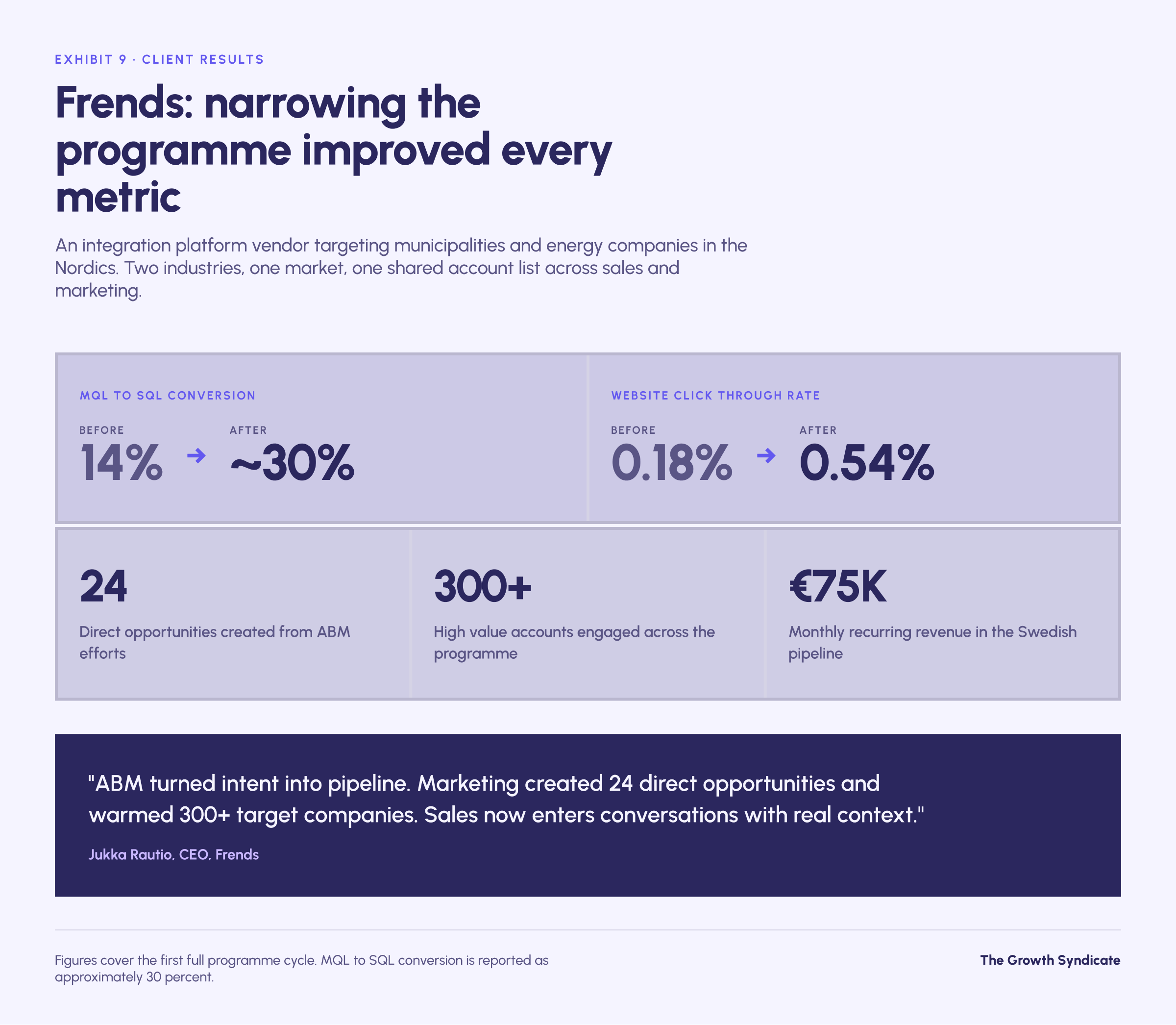
Frends, a Finnish integration platform, came to us with a target account problem rather than a lead volume problem. Marketing was generating activity, but the accounts that mattered, municipalities and energy companies in the Nordics, were not converting into qualified conversations.
The program narrowed rather than broadened. Two industries in one market first, with a defined set of target accounts and role-specific journeys instead of a single campaign aimed at everyone. Thought leadership carried the air cover; direct-response advertising was moved out of cold entry and into retargeting, where it worked. Sales and marketing teams worked from one list with a shared definition of engagement, with marketing and sales reviewing the same accounts on the same cadence.
Results after the first full cycle:
- MQL-to-SQL conversion improved from 14% to roughly 30%
- 24 direct opportunities created from ABM efforts
- 300+ high value accounts engaged
- Website click-through rate improved from 0.18% to 0.54%
- Approximately €75K in monthly recurring revenue in the Swedish pipeline

The last sentence carries the point. The program produced better meetings rather than more of them, with sales entering conversations at accounts that already knew who they were.
The pattern repeats across programs. For Axual, a data streaming platform, account based work produced €306K in marketing-generated pipeline alongside €270K in marketing-assisted pipeline. For Nobel Recruitment, a signal-based approach to account selection drove all-time pipeline and sales records. In each case the mechanism was the same: fewer accounts, better chosen, worked harder by marketing and sales together.
Frequently asked questions
What does ABM stand for?ABM stands for account-based marketing: a go-to-market approach where marketing and sales teams concentrate effort on a defined set of high value target accounts, treating each account or cluster of accounts as a market in its own right.
What are the 3 R's of ABM?
Reputation, Relationships and Revenue: the ITSMA framework describing the sequence in which account based marketing creates value. Reputation inside the account enables relationships with key stakeholders, which eventually produce revenue.
What are the three types of account based marketing?
Strategic ABM (one-to-one, for a small number of high value accounts), ABM lite (one-to-few, for clusters of similar accounts) and programmatic ABM (one-to-many, technology-enabled personalization across a large set of target accounts). Mature programs run all three at once.
What is the ABM strategy framework?
Define the ICP by company size, sector and buying trigger, select and tier your target accounts, map the buying committee for each tier, develop account specific messaging, align sales and marketing on a shared plan and shared metrics, then pilot before scaling.
What is an example of account based marketing?
A software vendor selecting 200 target accounts across two industries, running always-on account based advertising and executive thought leadership against all of them, adding personalized campaigns and executive events for the 30 high value accounts showing the strongest fit and buying signals, and measuring success by buying committee coverage and pipeline from those accounts rather than by total lead volume.
What is the difference between marketing and account-based marketing?
Traditional marketing selects an audience segment and generates leads from it. Account based marketing selects named accounts in advance, with sales and marketing choosing together, and measures success at account level. The tactics overlap almost entirely; the targeting logic and the accountability do not.
Does account based marketing deliver higher ROI than other marketing?
Practitioners consistently report that it does. The clearest dated evidence comes from the sixth annual Momentum ITSMA and ABM Leadership Alliance benchmark (December 2022, 279 ABM practitioners), where 72% said ABM delivers higher ROI than other types of marketing, 84% reported pipeline growth and 77% reported revenue growth. Higher figures circulate widely, but they are self-reported and the number shifts with the source.
Are the 91% larger deal sizes and 38% higher win rate claims reliable?
Treat both cautiously. The 38% win rate figure appears to originate in 2016 MarketingProfs research on sales and marketing alignment rather than on ABM, and the 91% deal size figure is attributed to SiriusDecisions without a dated report behind it. Both are repeated so often that they read as established. Neither should carry a business case on its own.
How much of the marketing budget should go to ABM?
Benchmark studies have put ABM at roughly a quarter to a third of B2B marketing budgets among companies running established programs, with most planning to increase it. The more useful question is cost per account per tier, since that is what determines whether the channels you have chosen are affordable at the deal sizes you actually close.
Does ABM work for smaller deal sizes?
One-to-one ABM rarely justifies itself below roughly €300K in annual contract value. One-to-few and programmatic approaches work well at considerably lower deal sizes, provided the buying process still involves multiple decision makers and a sales cycle long enough for marketing to influence.
How long does ABM take to show results?
Engagement signals within a quarter, initial pipeline within two, and a defensible read on win rate and deal size effects across a year. B2B conversion windows of around 90 days mean anything judged inside the first two months is being judged prematurely.
Where to start
If you are building an abm strategy from scratch, the sequence that fails least often is: agree the ICP across sales and marketing, name fifteen accounts, run one full cycle against them with real intensity, measure buying committee coverage and sales-validated account fit, then decide what to scale and what to buy.
The temptation is always to start with the platform and the 400-account list. That order has a poor track record.
If you would rather pressure-test the foundations first (ICP, positioning, messaging, and whether ABM is the right motion for your deal sizes at all), our marketing audit and GTM strategy engagement is built for exactly that question. If you already know ABM is the right motion and need it built and run, that is what our account based marketing team does.