.svg)


What are the best SaaS marketing strategies in 2026?
The SaaS marketing strategies that work in 2026 are the ones matched to your deal size, your stage, and the way potential customers now research software: through AI answers, peer communities, and founders on LinkedIn rather than blue links. Positioning, bottom-funnel SEO, product-led growth, founder-led content, and expansion marketing are the marketing strategies with the strongest evidence. Most SaaS marketing strategies that rank for this query still describe the 2019 playbook.
Key takeaways
- Median B2B SaaS companies spend 8% of ARR on marketing, and equity-backed companies spend twice what bootstrapped peers do (SaaS Capital, 2026). The number matters less than what the marketing budget buys at your stage.
- Roughly 68% of US Google searches now end without a click (SparkToro, 2026). Top-of-funnel blog posts are a shrinking traffic asset; citations, comparison pages, and brand search volume are the new SEO outputs for SaaS marketing.
- Only about 5% of potential customers are in-market at any given moment (Ehrenberg-Bass Institute). SaaS marketing built entirely around capturing that 5% starves next year's pipeline.
- Free trial and proof-of-concept conversion reached 50% in H2 2025, the highest-converting motion in B2B (ICONIQ, 2026). Activation, not signup volume, is the lever.
- Expansion from existing customers drives up to 40% of growth at SaaS companies past $15M ARR (ChartMogul). Expansion is a marketing job now, not just a customer success one.
- We grade each of the SaaS marketing strategies below as Strong, Emerging, or Hype based on 2025–2026 evidence, and tell you which ARR stage each one fits.
What makes SaaS marketing different
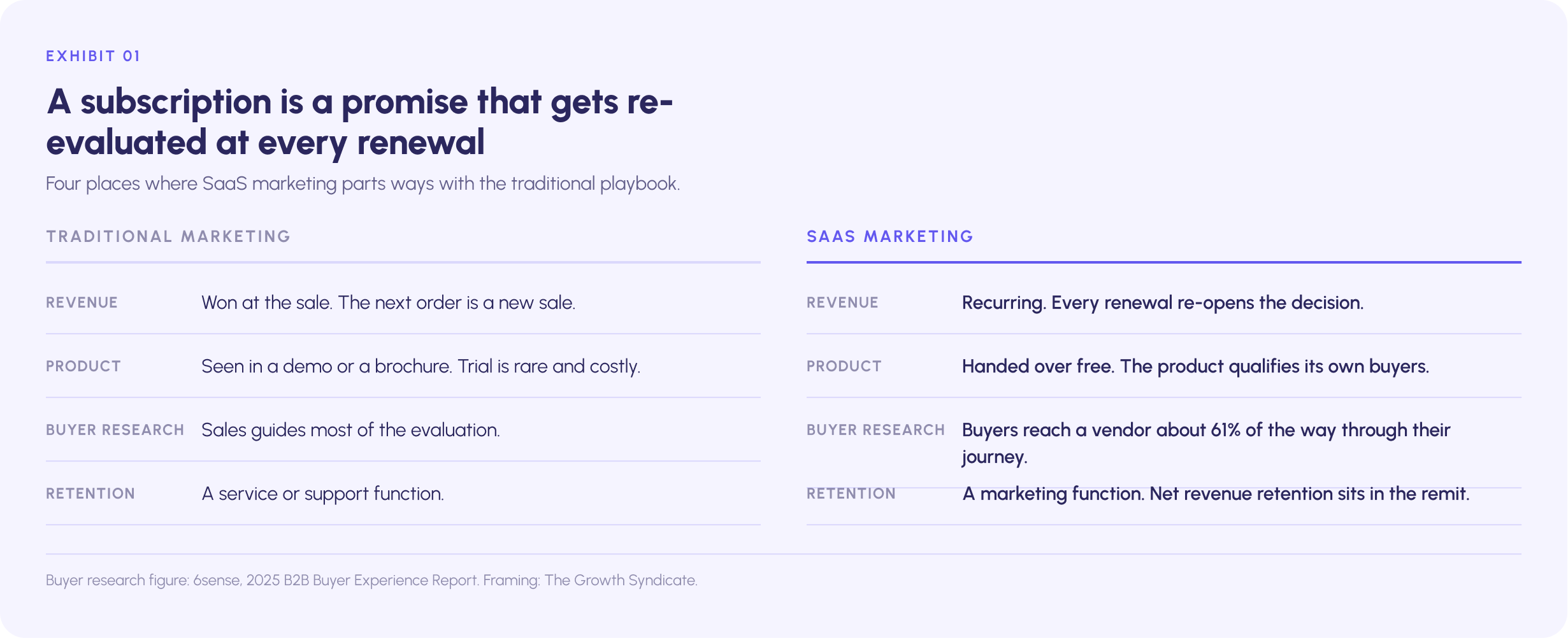
Software-as-a-service marketing sells a subscription, and a subscription is a promise that gets re-evaluated every renewal. That single fact changes everything downstream. Traditional marketing can declare victory at the sale. SaaS marketing has to keep proving value for as long as the customer pays, which is why retention, expansion, and net revenue retention sit inside the marketing remit at well-run SaaS companies rather than in a separate department.
Three other characteristics shape every SaaS growth strategy, and they explain why B2B SaaS marketing borrows so little from traditional marketing playbooks:
Recurring revenue rewards patience. Monthly recurring revenue compounds, which means a customer acquired at a high customer acquisition cost can still be a good customer if they stay for four years. It also means churn quietly destroys the math. A 3% monthly churn rate on a $100 plan erases most of the value of the acquisition spend within 18 months, whatever the customer lifetime value looked like on the spreadsheet.
The product can do the selling. No manufacturing business can hand a prospect the product for free and let them decide. SaaS products can, and that possibility (product-led growth) reshapes the marketing funnel around activation instead of lead generation. Generating leads still matters for sales-led SaaS products, but the product itself does much of the work to engage potential customers.
Buyers do most of the work before you meet them. 6sense's 2025 buyer research puts the point at which potential customers first contact a vendor at roughly 61% of the way through their customer journey. By then a shortlist exists, and the shortlist was assembled from peer opinions, community threads, AI answers, and whoever the buyer already remembered.
What changed in 2026, and what didn't
Every article on SaaS marketing strategies claims that this year is different. Some of it actually is. Separating the structural shifts from the recycled ones is the first job of any SaaS marketing plan.
The structural shifts
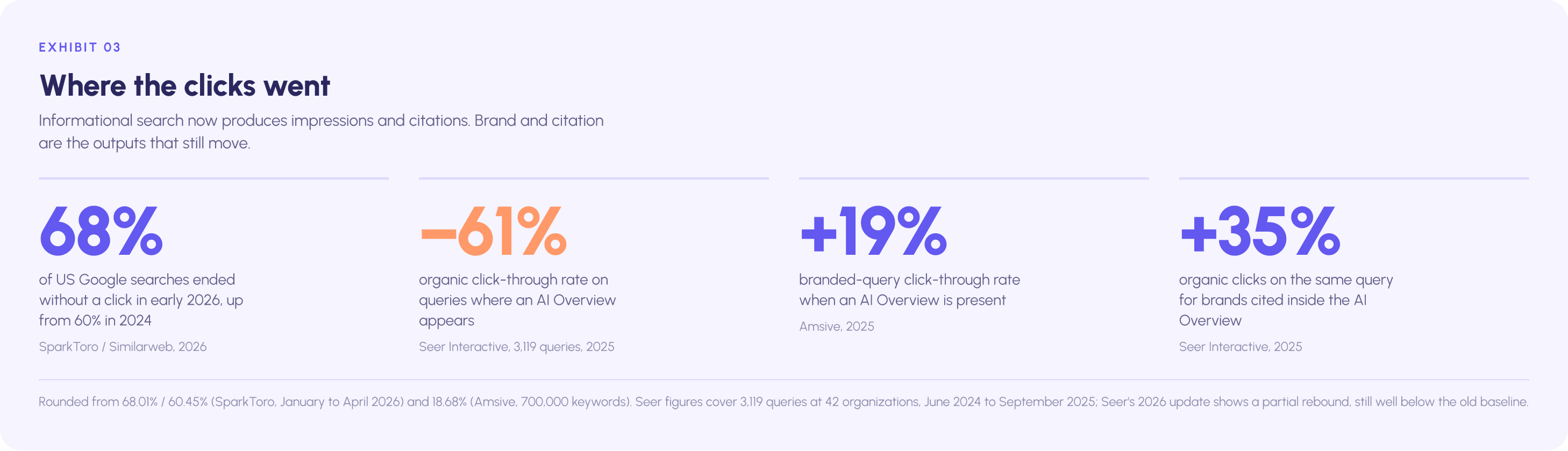
Search moved from clicks to citations. SparkToro's analysis of Similarweb clickstream data found that 68.01% of US Google searches in the first four months of 2026 ended without a click, up from 60.45% in 2024. Where an AI Overview appears on the results page, Seer Interactive measured organic click-through rates falling 61% across 3,119 informational queries at 42 organizations between June 2024 and September 2025 (its early-2026 update shows a partial rebound, still well below the old baseline), and Pew Research found users click an organic result only 8% of the time with an AI Overview present versus 15% without. Search engines still send organic traffic, but blog posts as a traffic engine are structurally impaired, and SaaS marketers who plan around them are planning around 2022.
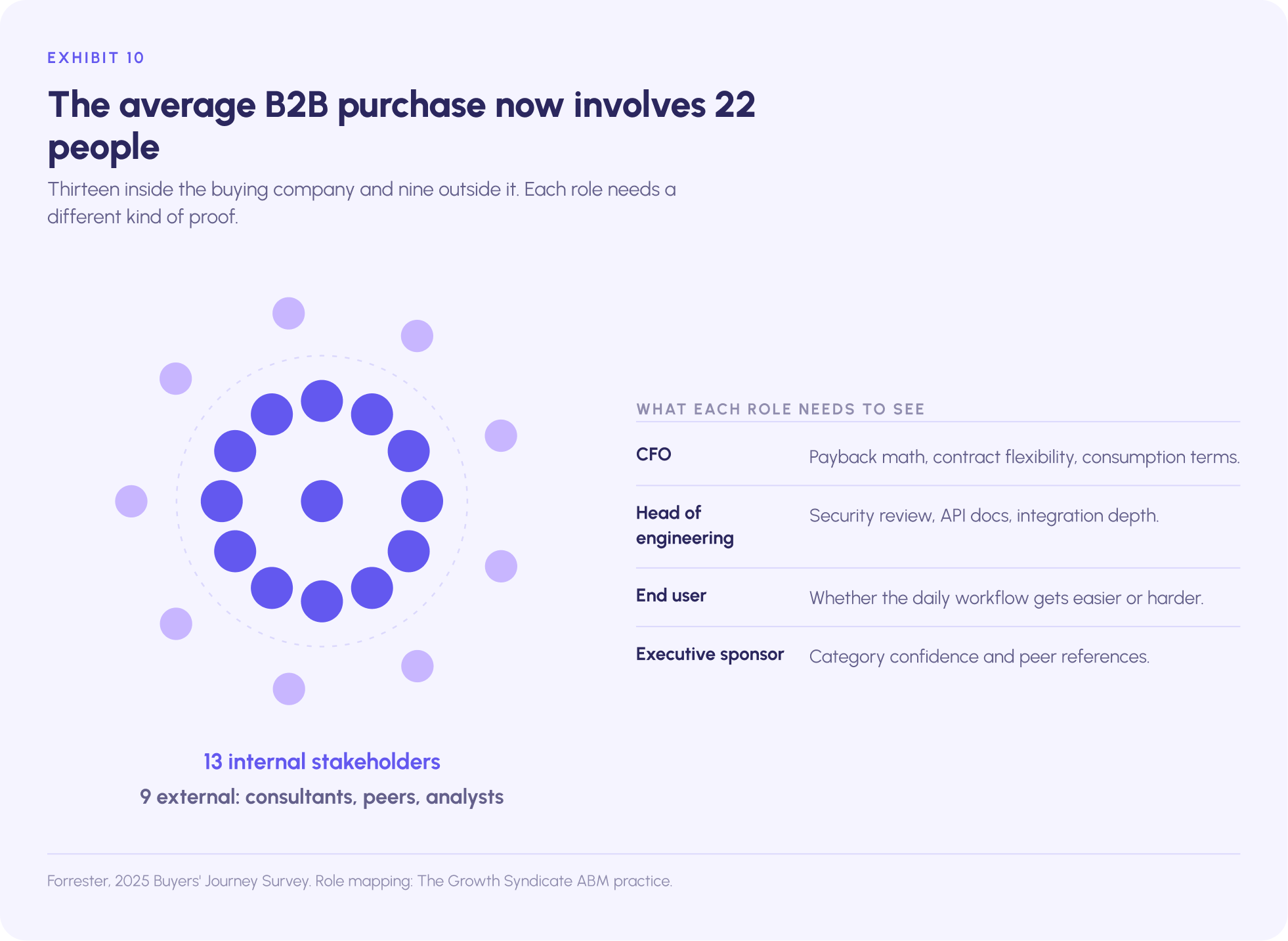
Buying groups got larger and more self-directed. Forrester's 2025 Buyers' Journey Survey found the average B2B purchase now involves around 13 internal stakeholders and 9 external participants, and more than 60% of business buyers now use a trial to reduce risk before buying. Gartner's 2025 buyer surveys found 67% prefer a rep-free experience, while 69% still turn to a rep to validate what they learned from AI tools. Both are true at once, and both make the "MQL, hand to SDR" model creak.
Contracts got shorter and conversion got faster. ICONIQ's State of Go-to-Market 2026 survey found 13% of new logos now sign sub-one-year deals, up from 4% in 2023, while sales cycles shortened by roughly six weeks between the first and second half of 2025. Long sales cycles are still the norm in enterprise, but buyers hedge against a fast-moving AI market by committing for less time. Marketing has to earn the renewal sooner.
AI compressed the cost of content marketing and raised the cost of being generic. 66% of marketers now use AI in their role (HubSpot, 2025), which means competitors can create content for your entire calendar in an afternoon. Many SaaS companies responded by publishing more. Google's scaled-content-abuse enforcement, sharpened in the March 2026 spam and core updates, penalizes exactly that output. Originality became a moat and volume became a liability.
The evergreen fundamentals
Positioning still decides whether any of the marketing channels below work, whatever content strategies or paid ads sit on top of it. Word-of-mouth still drives more SaaS growth than any paid channel. Retention still beats acquisition on unit economics. And buyers still shortlist the brands they remember, which is why the SaaS marketing strategies that build memory outperform the ones that harvest intent, even if the harvest is easier to report on.
How much should SaaS companies spend on marketing?
SaaS marketing budget benchmarks get quoted without context, so here is the context. SaaS Capital's 2026 spending survey of more than 1,000 private B2B SaaS companies puts the median marketing spend at 8% of annual recurring revenue, unchanged from the previous year. Selling costs add a separate 15%, and equity-backed companies spend 100% more on marketing than bootstrapped peers. Combined sales and marketing runs higher at venture-backed scale-ups than the survey-wide median suggests; Benchmarkit's data puts it near a third of revenue for private companies above $100M ARR, in line with public SaaS.
What the median hides is dispersion by stage. A seed-stage SaaS business might spend 25% of a small ARR figure, most of it on people. A $60M company at 5% is spending three million dollars. Same percentage logic, completely different SaaS marketing plan.
The unit economics that gate the budget matter more than the percentage. Median customer acquisition cost payback was 16 months on full-year 2025 data, with the top quartile at 6 months or less and the bottom quartile at 24 or more (Aleph and Benchmarkit, 2026 SaaS & AI Performance Benchmarks, 342 companies). The SaaS magic number crossed 1.0 for the first time in years (median 1.37), and median net revenue retention sits at 102%, barely above break-even. Two things follow. First, efficient customer acquisition is now table stakes, not a differentiator. Second, with net revenue retention this tight, expansion marketing is where the upside moved.
The 95:5 rule, and why most SaaS marketing plans ignore it
The Ehrenberg-Bass Institute's research, popularized by the LinkedIn B2B Institute, found that only about 5% of B2B buyers are in-market for a given category at any moment. The other 95% will buy eventually, but not this quarter. Most B2B SaaS marketing budgets are built as if the 5% were the whole market: paid search, retargeting, MQL forms, SDR sequences. Everything measurable, everything aimed at potential customers already searching.
That works right up until the in-market pool is exhausted, and then cost per lead climbs while pipeline flattens. The alternative is to invest in being remembered by the 95% before their buying trigger fires. Forrester's data makes the stakes concrete: 68% of buyers begin their process with a front-runner already in mind, and that front-runner wins around 80% of the time. Marketing that makes you the front-runner is worth more than marketing that makes you the fourth vendor on a shortlist.
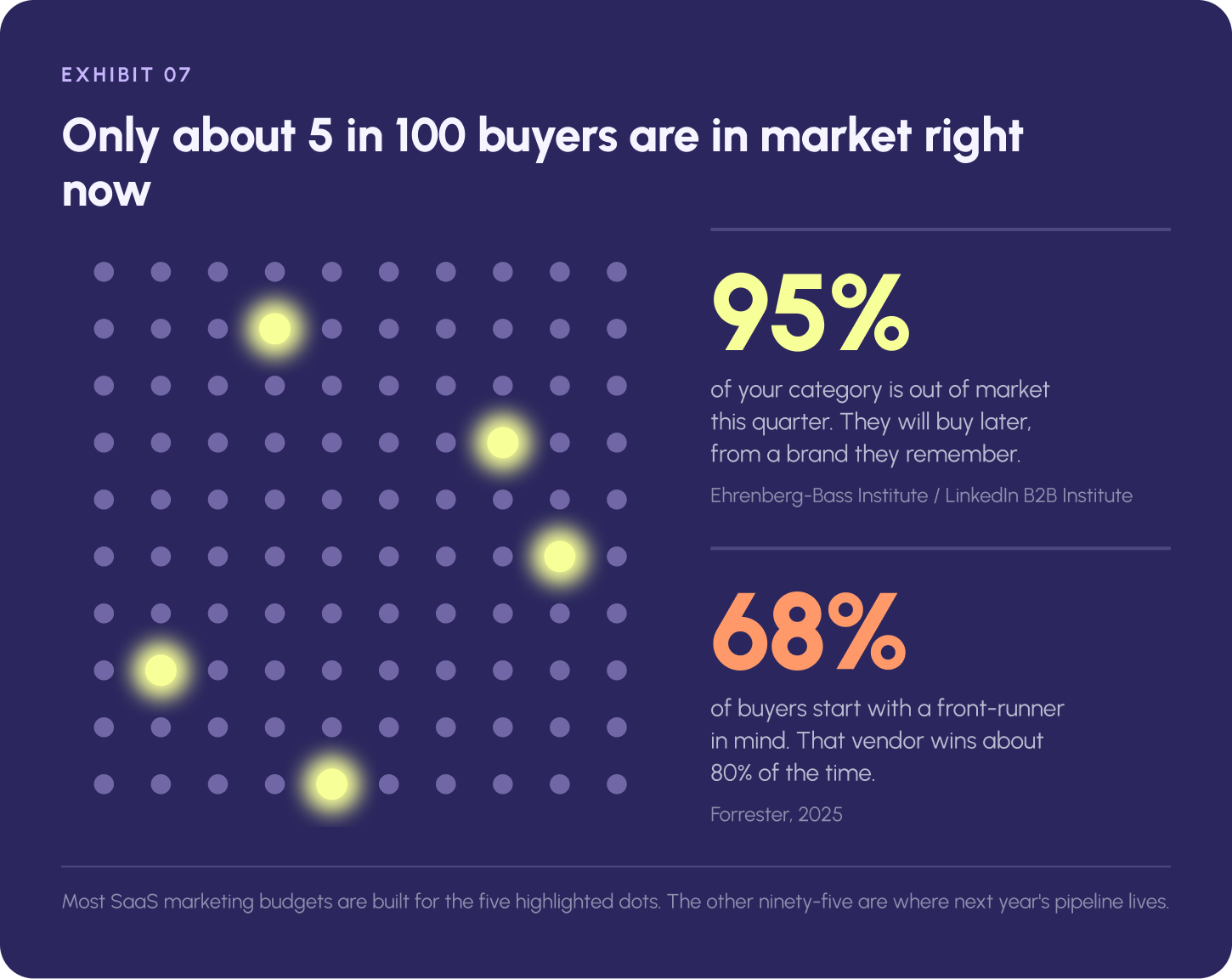
This is the organizing principle behind the fifteen SaaS marketing strategies that follow. Some capture existing demand. Some build the memory that turns into demand later. A working SaaS marketing plan needs both, in a ratio that shifts with stage.

"The demand is there and you reach for it. Your job is to be top of mind for the moment that they say, oh yeah, I have a problem. Then they know that you're one of the solutions. Sometimes I think companies like to believe that they create more than they do"
The 15 SaaS marketing strategies
Each strategy carries an evidence grade based on 2025–2026 data: Strong (multiple independent sources agree), Emerging (early evidence, directionally positive, immature measurement), or Hype (widely recommended, thinly supported). Each one also names the stage where it fits best, because the SaaS marketing tactics that work at $500K ARR and the ones that work at $50M have very little in common.
1. Positioning before channels
Evidence: Strong · Best fit: every stage, non-negotiable before $1M ARR
Positioning is the decision about which market you compete in, which alternatives you are compared against, and why a specific segment should care. Every one of the SaaS marketing strategies downstream inherits it. Many SaaS companies skip it and end up with SEO content that ranks for the wrong queries, ads that convert the wrong buyers, and a sales team that reinvents the value proposition on every call.
April Dunford's sequence remains the most practical: identify the competitive alternatives buyers actually consider (often "do nothing" or a spreadsheet), list what you have that they don't, translate those attributes into a value proposition, find the target audience that cares most, and only then pick a market category. Our own guide to building a market positioning strategy walks through the same sequence with B2B examples.
How to do it right
Run the positioning exercise with the marketing team, sales, product, and customer success in the room, and test the result against ten recent won and lost deals. If the reasons customers give for buying don't match the positioning, the positioning is wrong, not the customers. Customer feedback from churned accounts is worth more here than any workshop output.
The common mistake
Positioning against the category leader when your potential customers are actually comparing you to doing nothing.
2. Bottom-funnel SEO in the zero-click era
Evidence: Strong (for bottom-funnel) · Best fit: Series A onward
Search engine optimization still works as one of the core SaaS marketing strategies. What stopped working is the version most SaaS marketing teams run: hundreds of informational blog posts that target relevant keywords in the hope that organic traffic ends up generating leads eventually. With 68% of searches ending without a click and AI Overviews absorbing the informational intent, that model now produces impressions and citations, not visitors.
Bottom-funnel search is different. Potential customers comparing tools still click. Comparison pages ("X vs Y"), alternative pages ("Y alternatives"), integration pages, and pricing pages carry the highest intent and the lowest blended customer acquisition cost of any of the marketing channels we run for clients. They also feed AI answers, which pull heavily from comparison content when users ask "what should I use for…".
Two further shifts. Brand search became more valuable, not less: Amsive's 2025 analysis found branded-query click-through rates rise around 18.7% when an AI Overview is present, because the Overview confirms rather than replaces the brand. And being cited inside the AI Overview earns roughly 35% more organic clicks on the same query (Seer Interactive, 2025), which makes citation a measurable SEO outcome.
How to do it right
Audit your existing content by intent, not by traffic. Keep and upgrade the bottom-funnel pages, consolidate the informational sprawl into fewer, deeper pieces built for extraction (a direct answer under each query-matching heading, statistics with sources, a visible author). Target relevant keywords a buyer with a budget types, not the ones with the biggest volume. Search engine optimization for SaaS products in 2026 is a bottom-funnel discipline first. Our B2B SEO strategy guide covers the structure, and if you want the whole engine run for you, that is what our B2B SEO service does.
The common mistake
Measuring content by sessions in Google Analytics. A page that gets cited by ChatGPT and Google's AI Mode for a category query can generate pipeline while its traffic chart declines.
3. Generative engine optimization (GEO)
Evidence: Emerging · Best fit: growth stage and up, earlier for AI-native products
GEO means earning citations in ChatGPT, Perplexity, Google AI Mode, and Copilot answers. AI Overviews now appear on more than 20% of Google searches (SparkToro, 2026), and the referral traffic that AI answers send is small but unusually high-intent: several published B2B case studies report conversion rates at multiples of organic search, though none is large enough to treat as a benchmark yet.
The peer-reviewed evidence is thinner than the vendor pitches SaaS marketers receive would suggest. The original GEO study (Aggarwal et al., KDD 2024) tested around 10,000 queries and found that adding statistics, quotations, and source citations to a page lifts its visibility in generative answers by up to roughly 40%. Later benchmarks (C-SEO Bench, 2025) found that many of the tactics sold as "conversational SEO" do nothing, and that plain source relevance keeps working. Beyond that, the reliable signals are unglamorous: brand mentions across third-party sources the models trust (Reddit, YouTube, G2, industry publications), clear declarative answers under question-shaped headings, visible dates and authorship, and presence in Bing's index, since the search engines behind ChatGPT and Copilot retrieval pull from it.
How to do it right
Treat GEO as an extension of SEO and PR rather than a separate SaaS marketing discipline. Structure your best pages for extraction, run a measurement baseline before spending on tooling (the tracking category is still immature; we use Ahrefs Brand Radar for a baseline and treat vendor "share of model" figures with caution), and invest in off-site mentions.
The common mistake
Buying a GEO platform before you have a single page structured to be cited.
4. Product-led growth done with activation in mind
Evidence: Strong · Best fit: SMB and mid-market SaaS products with a self-serve motion
Product led growth uses the software itself as the primary SaaS marketing channel. Prospective customers sign up, experience value, and convert without a sales call. ICONIQ's 2026 data shows why it matters: free-trial and proof-of-concept conversion reached 50% in the second half of 2025, up from 36% the year before, the highest-converting motion in B2B and well ahead of demo-to-closed-won (38%).
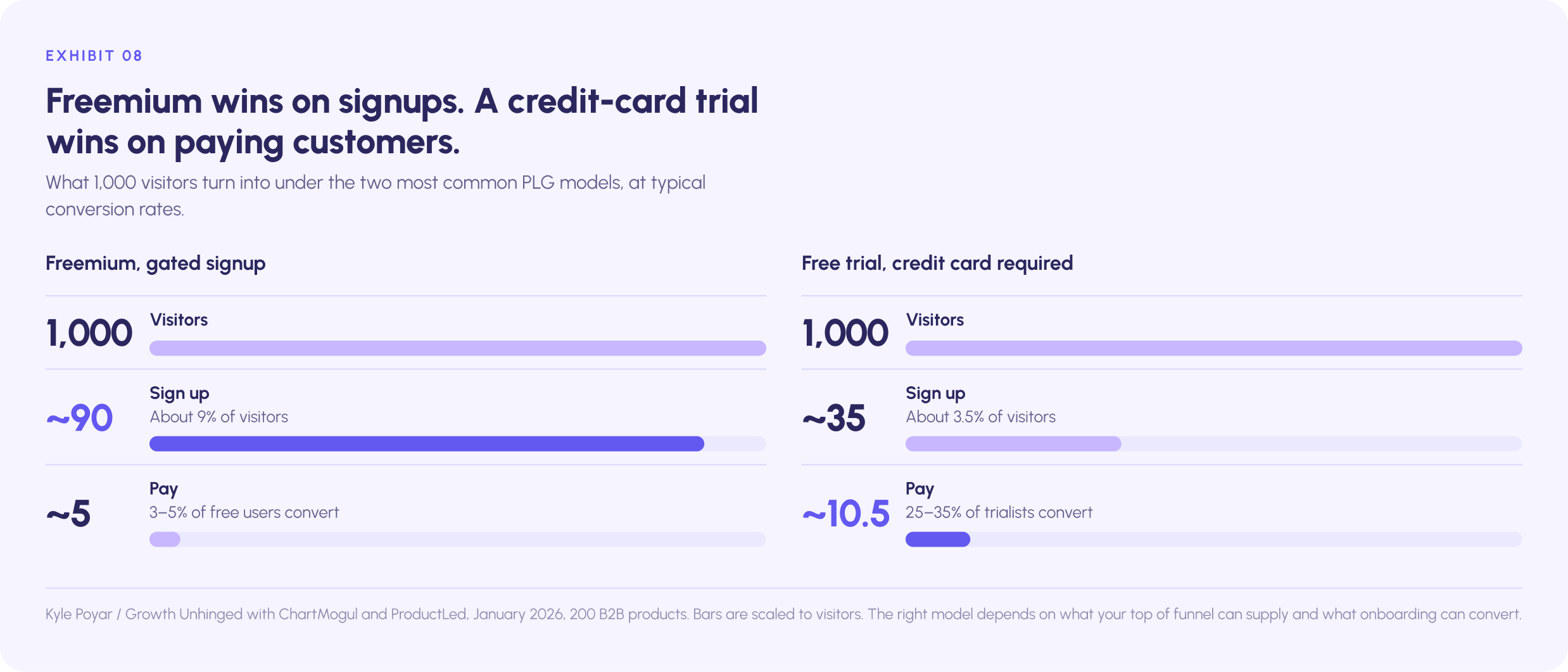
The benchmarks that matter come from Kyle Poyar's January 2026 analysis of 200 B2B products with ChartMogul and ProductLed. A "good" freemium product converts 3–5% of free users to paying customers, a great one 8–12%. Free trials without a credit card convert 4–6% (great: 10–15%); with a credit card required, 25–35% (great: 50–60%). Reverse trials sit at 4–6% (great: 8–12%). The median across all models is around 8%, but the distribution is bimodal: roughly one in five self-serve products converts under 2.5% and a similar share above 25%, a tenfold gap between the top and bottom quintiles. Almost nobody actually sits at the median.
Read the two right-hand columns together. Freemium wins on signups; a credit-card trial wins on paying customers per visitor. The right model depends on what your top of funnel can supply and what your onboarding can convert.
How to do it right
Define one activation milestone (the first moment a user gets real value), instrument it, and get users there within 14 days. Well-defined product-qualified leads convert to sales-qualified at 30–50%; undefined ones ("every active user") convert at almost nothing. Watch your margins if the product is AI-heavy: Poyar's 2026 State of B2B Monetization survey of 230 companies puts AI margins near 50% versus 70–80% or more for traditional SaaS products, and free users burn tokens.
The common mistake
Treating PLG as a substitute for a sales team at deal sizes where it can't work. High-growth companies still source 62% of new-logo pipeline from sales and 19% from marketing (ICONIQ, 2026). PLG is a wedge, not the whole SaaS growth strategy.

"I actually think the B2C to B2B divide is not that important. I think it's the deal size divide that matters. I would argue selling heat pumps and luxury cars and mortgages is almost B2B-ish in dynamics. Whereas if you're selling Typeform or Calendly, it's much closer to B2C"
5. Founder-led marketing on LinkedIn
Evidence: Strong · Best fit: pre-seed through Series B; still valuable later
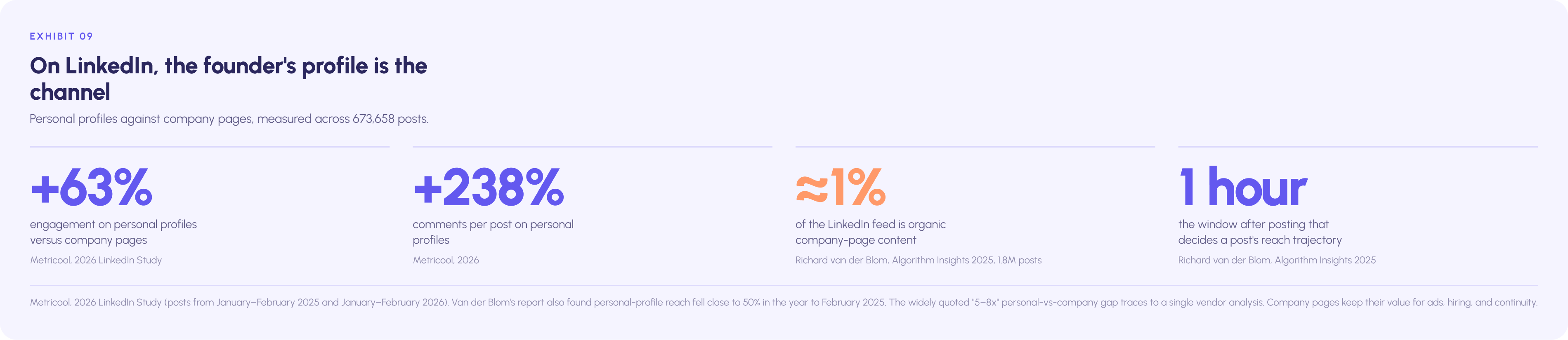
Potential customers evaluate people before they evaluate companies, and on LinkedIn the algorithm agrees. Metricool's 2026 study of 673,658 posts across 63,108 accounts found personal profiles outperform company pages on engagement by 63% and generate 238% more comments per post. Richard van der Blom's Algorithm Insights Report 2025 (1.8 million posts) found organic company-page content had shrunk to about 1% of what appears in the feed. The widely quoted "5–8x" personal-versus-company gap traces to a single vendor analysis and should be treated as an upper bound, but the direction is not in dispute.
For an early-stage SaaS business, the founder's account is the most productive of all the social media platforms and marketing channels available: zero media cost, direct access to the 95% who aren't buying yet, and a compounding audience that follows the founder into the next product, the next fundraise, and the next hire. It is the closest thing to free SaaS growth marketing that exists. Influencer marketing in B2B SaaS works the same way, with practitioners and operators standing in for the founder; the audience trusts a person with a track record, not a logo.
How to do it right
Post from a point of view, not a content calendar. Real opinions about the category, specific numbers from the business, honest accounts of what didn't work. Van der Blom's data shows the first 30 to 60 minutes after posting decide a post's reach trajectory, and personal-profile reach fell by close to half in the year to February 2025, so the founder has to be in the comments, not just the composer, and consistency matters more than it did. Keep the company page for ads, hiring, and continuity; run roughly 80% of organic effort through people.
The common mistake
Ghostwritten thought leadership that sounds like every other SaaS founder. The algorithm rewards comments, and generic posts don't get any.
6. Content marketing built for citation, not volume
Evidence: Strong · Best fit: every stage, with the format shifting by stage
SaaS content marketing has to answer a harder question in 2026: why would a model, a peer, or a buyer cite this page rather than the fifty others that say the same thing? Content that earns citations tends to share four traits. It contains original data (a survey, a benchmark from your own product, a teardown of real accounts). It takes a position that could be wrong. It names its author and shows a date. And it is structured so that the answer to the question in the heading appears in the first sentences beneath it.
This is what separates a content marketing strategy from a publishing schedule. One well-researched benchmark report gets cited for two years. Forty AI-assisted blog posts on "what is customer onboarding" get indexed, ignored, and eventually flagged as scaled content. SaaS companies that produce original research also find it pulls the rest of the marketing engine along: the report becomes the webinar, the LinkedIn series, the sales deck slide, and the reason a journalist returns your email.
How to do it right
Replace a portion of your blog budget with one original research project a year. Structure every piece to be extracted. Use AI to create content faster, and keep the judgment, the data, and the argument human. Our guide to B2B content marketing goes deeper on the format decisions and the content strategies that still compound.
The common mistake
Measuring content marketing on blog posts published per month. The diagnosis below applies to more SaaS marketing teams than would admit it.
.avif)
7. Community and Reddit presence
Evidence: Emerging · Best fit: developer, technical, and SMB-facing SaaS products first
In SaaS marketing, community used to mean a Slack group nobody posted in. In 2026 it means the places where potential customers ask each other what to use, which are also the places language models learned what to recommend. Google has publicly favored user-generated content from social media platforms and forums in results, Reddit dominates high-intent software queries, and brands discussed on Reddit and Quora show up in LLM answers several times more often than brands that aren't.
How to do it right
Participate where your buyers already are before building anything of your own. Answer questions in the relevant subreddits with actual expertise and no pitch. Let customers, not marketers, mention the product. If you do build an owned community, tie it to something concrete (a certification, a practitioner network, a shared benchmark) rather than "a space to connect."
The common mistake
Astroturfing. Reddit's moderators and users detect vendor accounts within a comment or two, and the reputational damage persists in the very threads models retrieve.
8. Account-based marketing for mid-market and enterprise
Evidence: Strong (for high-ACV) · Best fit: growth stage and up, or any stage selling $50K+ deals
Account based marketing inverts the funnel: pick the accounts, then build the marketing campaigns. For SaaS companies selling into buying groups of 13 internal stakeholders (Forrester, 2025) across long sales cycles, it is the only one of these marketing strategies that maps to how the purchase actually happens. Each role in the group needs different proof. The CFO wants payback math, the head of engineering wants the security review and the API docs, the end user wants to know whether the workflow will get easier or harder.
Intent data helps decide which accounts are warming, though most third-party intent signals are weaker than their vendors claim. 6sense's 2026 State of the BDR report found 72% of BDRs say AI makes them more productive, but the most common use, generating outreach content, shows no reliable link to quota attainment; reviewing and analyzing conversations does, and how supported the BDR feels remains the strongest predictor for the fifth year running. The signals that matter most are first-party: who visited the pricing page, who attended the webinar, whose team just started a free trial.
How to do it right
Start with 100–300 named accounts and a role map for each. Build one customer journey per role, sequence personalized outreach across LinkedIn, email, direct mail, and sales calls, and measure account engagement rather than lead generation counts. Our account-based marketing guide covers program design in depth, and our ABM service runs it for B2B SaaS companies selling into complex buying groups.
The common mistake
Applying ABM resource intensity and personalized outreach to $5K deals, or applying volume tactics to $200K deals.
"In the SMB deals you can focus more on the volume game. Google Ads usually perform a bit better, you have a bit more of the SEO play. While on the enterprise deals, I think ABM is really key. You have to nail down your ICP, your positioning, your messaging, and then you go after 100, 200, 300 companies and create a special kind of journey for the CFO, another one for the CMO, another one for the head of engineering."
9. Paid acquisition with a demand-creation split
Evidence: Strong (as capture), Hype (as growth engine) · Best fit: Series A and up, once organic proof exists
In SaaS marketing, paid ads capture demand efficiently and create it expensively. B2B non-branded search CPCs on Google Ads rose from $4.13 to $5.34 between August 2024 and July 2025, up 29%, while click-through rates fell 26% (Dreamdata, aggregated across its B2B customer accounts). LinkedIn is expensive per click and often cheaper per opportunity: Dreamdata's 2025 data puts LinkedIn's B2B return on ad spend at 121% against 67% for Google Search, and LinkedIn now takes 41% of B2B ad budgets in its dataset. Seer's data adds a twist: on queries where an AI Overview appears, paid CTRs fell 68%, more than organic.
The headline cost-per-click is a trap SaaS marketers fall into every quarter. In one client account, LinkedIn CPCs ran 2.5 times Google's, but LinkedIn leads converted at three times the rate, producing a lower final customer acquisition cost. Judge paid ads on pipeline per dollar and CAC payback, never on CPC or a point-in-time return on ad spend, which understates subscription economics by design.
How to do it right
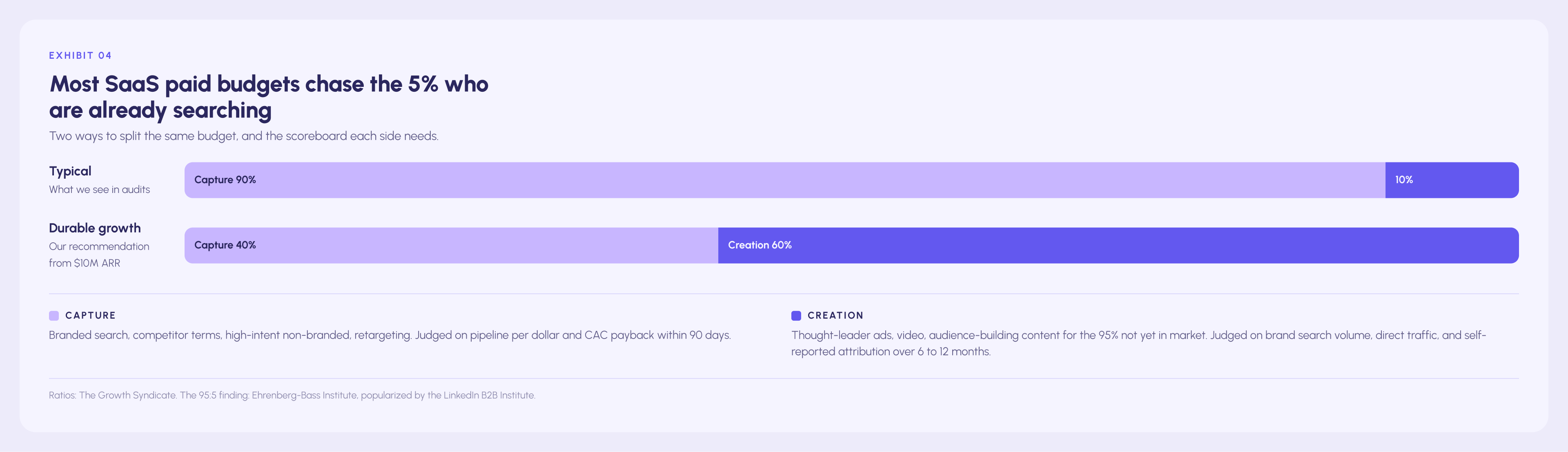
Split the budget explicitly between capture (branded search, competitor terms, high-intent non-branded, retargeting) and creation (LinkedIn thought-leader ads, video, audience-building content aimed at the 95% of potential customers who aren't searching yet). Most SaaS marketing budgets run 90% capture; the companies with durable business growth run closer to 60:40 or 70:30 toward creation. Give creation campaigns a six-to-twelve-month horizon and measure them on brand search volume, direct traffic, and self-reported attribution rather than form fills.
The common mistake
Scaling paid before organic and word-of-mouth prove the positioning. Paid amplifies what already works. It rarely fixes what doesn't.
10. Partnerships, integrations, and marketplaces
Evidence: Strong · Best fit: growth stage and up; integrations earlier for platform-adjacent products
Distribution through other people's customers is the most underrated SaaS growth strategy in the list. For SaaS products, integration pages rank for high-intent queries ("[tool] + [your category]"), app marketplace listings put you in front of potential customers already paying for the platform, and cloud marketplaces (AWS, Azure, Google Cloud) let enterprise buyers burn down committed spend on your product, which shortens procurement dramatically. Forrester expected more than half of $1M+ B2B transactions to run through digital self-serve and marketplace channels in 2025.
Ecosystem-led growth, where partners share account overlap data through tools like Crossbeam, is replacing cold outbound as response rates fall. A warm introduction from a partner who already sells to the account outperforms any sequence, and it is the kind of business growth that never shows up in a channel report.
How to do it right
Build the three integrations your current customers ask for most, publish a dedicated page for each, get listed in the partner's marketplace, and co-market with the partner team. For enterprise deals, list on the cloud marketplace your buyers already use and train the sales team to sell through it.
The common mistake
Treating partnerships as a business-development side project with no marketing owner.
11. Customer marketing and expansion revenue
Evidence: Strong · Best fit: every stage past the first 50 customers; central at growth and scale
With median net revenue retention at 102% and expansion driving up to 40% of growth for companies at $15–30M ARR and beyond (ChartMogul, 2,500+ SaaS businesses), the highest-return SaaS marketing tactics in 2026 often target existing customers rather than new logos. Top-quartile net dollar retention still runs 110–123% (ICONIQ, 2026) despite shorter contracts, which means the best companies grow even if they never sign another logo.
Customer marketing, the half of software-as-a-service marketing most teams under-resource, covers onboarding, adoption campaigns for underused features, upsell and cross-sell messaging tied to usage signals, case study production, referral marketing, and the community programs that keep customers talking to each other. Referral marketing in particular converts better and cheaper than any acquisition channel because the trust was built before the first click, and they turn existing customers into a lead generation engine that costs almost nothing to run.
How to do it right
Give marketing a number for expansion pipeline, not just new-logo pipeline. Build usage-triggered campaigns (a team hitting a seat limit, a workspace adopting a second module). Produce case studies as a system, with a quarterly cadence and a named owner, rather than as a favor customers grant occasionally. Reward loyal customers with something they value: early access, roadmap influence, a seat at the advisory board, not just a discount. And collect customer feedback systematically, then route the marketing insights back into acquisition, because the reasons current customers stay are the value proposition your acquisition marketing should be using.
The common mistake
Handing expansion entirely to customer success while marketing reports on MQLs.
12. Reviews and social proof in the LLM era
Evidence: Strong (for inclusion), Emerging (for traffic) · Best fit: Series A and up
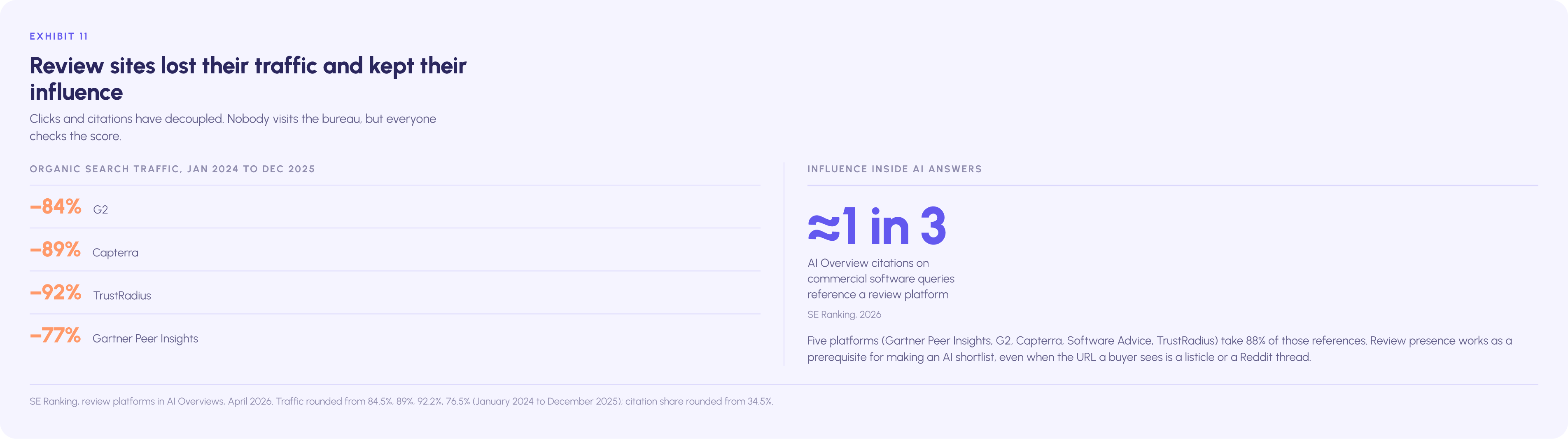
Review platforms lost most of their organic traffic from search engines between January 2024 and December 2025: G2 down roughly 84%, Capterra down 89%, TrustRadius down 92%, Gartner Peer Insights down 77% (SE Ranking). That sounds like the end of the category, and in one sense it is. Nobody is finding you through a G2 category page anymore. Many SaaS companies still budget as if they were.
What survived is influence. SE Ranking's analysis of AI Overviews found that about a third of citations on commercial software queries reference at least one review platform, with five platforms (Gartner Peer Insights, G2, Capterra, Software Advice, TrustRadius) taking 88% of those references, and G2's own analysis places it among the most-cited sources in ChatGPT for software questions. Review presence works as a prerequisite for being included in an AI shortlist even when the URL a buyer sees is a listicle or a Reddit thread. Clicks and citations have decoupled. Reviews now work like credit history: nobody visits the bureau, but everyone checks the score.
How to do it right
Run a steady review-generation program tied to customer milestones (a successful onboarding, a renewal, a support win). Respond to every negative review publicly and specifically. Push customer proof into your own pages, since prospective customers read case studies and testimonials on a comparison page and ignore the same quotes on a testimonials page nobody visits.
The common mistake
Paying for review-site premium placement expecting traffic that no longer exists.
13. Video, webinars, podcasts, and newsletters
Evidence: Emerging (as direct response), Strong (as memory-building) · Best fit: Series B and up, earlier if a founder is naturally good on camera
YouTube now appears as a cited source in roughly 16% of LLM answers, ahead of Reddit at 10% (Bluefish data reported by Adweek, January 2026; the ordering is engine-specific and Reddit still leads inside ChatGPT), and B2B SaaS marketing remains badly underinvested in it. Webinars still engage potential customers and produce pipeline in complex sales when they teach something specific rather than demo the product. Podcasts are contested: they build deep relationships with a small audience and rarely show up in attribution, which is why practitioners like Chris Walker argue they underperform for generating leads and others argue that's the wrong measurement.
In SaaS growth marketing terms, owned newsletters sit at the other end of the risk curve. An email list is the only audience no algorithm can take away, and a newsletter people actually read is the cheapest way to stay in front of the 95%, and a better long-term tool for generating leads than any gated ebook.
How to do it right
Pick one format and be consistently good at it for a year before adding another. Repurpose deliberately, because content marketing compounds only when one asset feeds the next: the webinar becomes the YouTube video becomes the six LinkedIn posts becomes the newsletter issue. Judge these channels on audience growth, brand search, and self-reported attribution, not on form fills.
The common mistake
Launching a podcast because a competitor has one, then abandoning it at episode nine.
14. Email and lifecycle marketing
Evidence: Strong · Best fit: every stage; essential for any PLG motion
Email marketing remains the highest-ROI channel most SaaS marketers own, and lifecycle email is the connective tissue of product-led growth. The onboarding sequence decides whether a signup reaches activation. The nurture sequence turns lead generation into pipeline by keeping out-of-market leads warm until they aren't. The expansion sequence tells a team hitting a limit what the next tier does for them.
Marketing automation makes this side of SaaS marketing possible at scale, but the platform matters far less than the logic. A five-email onboarding sequence triggered by what the user did (or didn't do) in the product outperforms a twenty-email sequence triggered by the calendar.
How to do it right
Map every sequence to a stage of the customer journey and a goal: signup to activation, activation to habit, habit to expansion, silence to re-engagement. Keep the sales team in the loop with clear handoff rules so that sales calls follow real product signals, since the MQL-to-SQL boundary is where most lifecycle programs leak pipeline. If the CRM behind the marketing automation is a mess, fix that first; our RevOps and CRM team spends much of its time on exactly that.
The common mistake
Sending "we noticed you haven't logged in" emails without changing anything about why.
15. AI in marketing operations, with the guardrail
Evidence: Strong (for productivity), Hype (for strategy) · Best fit: every stage
66% of marketers use AI in their role and 91% of marketing leaders say their teams do (HubSpot, 2025). ICONIQ found that go-to-market teams with high AI adoption run 20–30% leaner across every revenue band with higher quota attainment. The productivity gain is real and it is already priced into your competitors' plans; SaaS marketing success in 2026 assumes it.
The guardrail is Google's scaled-content-abuse policy, which targets mass-produced low-value pages "no matter how they're created." Enforcement ramped through 2025, and Google's March 2026 spam update, followed within days by a core update, targeted it directly; agency analyses of the fallout report losses of 50% or more at sites built on hundreds of thin, templated AI pages. The distinction the policy draws is the one SaaS marketing professionals should draw: AI as an accelerator for research, analysis, drafting, and operations is fine. AI as a substitute for having something to say is not.
How to do it right
Use AI where it removes drudgery: transcript analysis, data cleaning, first drafts, ad variant generation, CRM hygiene, reporting, and turning call notes into marketing insights the team would otherwise never extract. Keep a human owner on the marketing team for every published asset and every strategic decision. Build a small set of house rules for tone and originality and audit output against them.
SaaS marketing strategies by stage
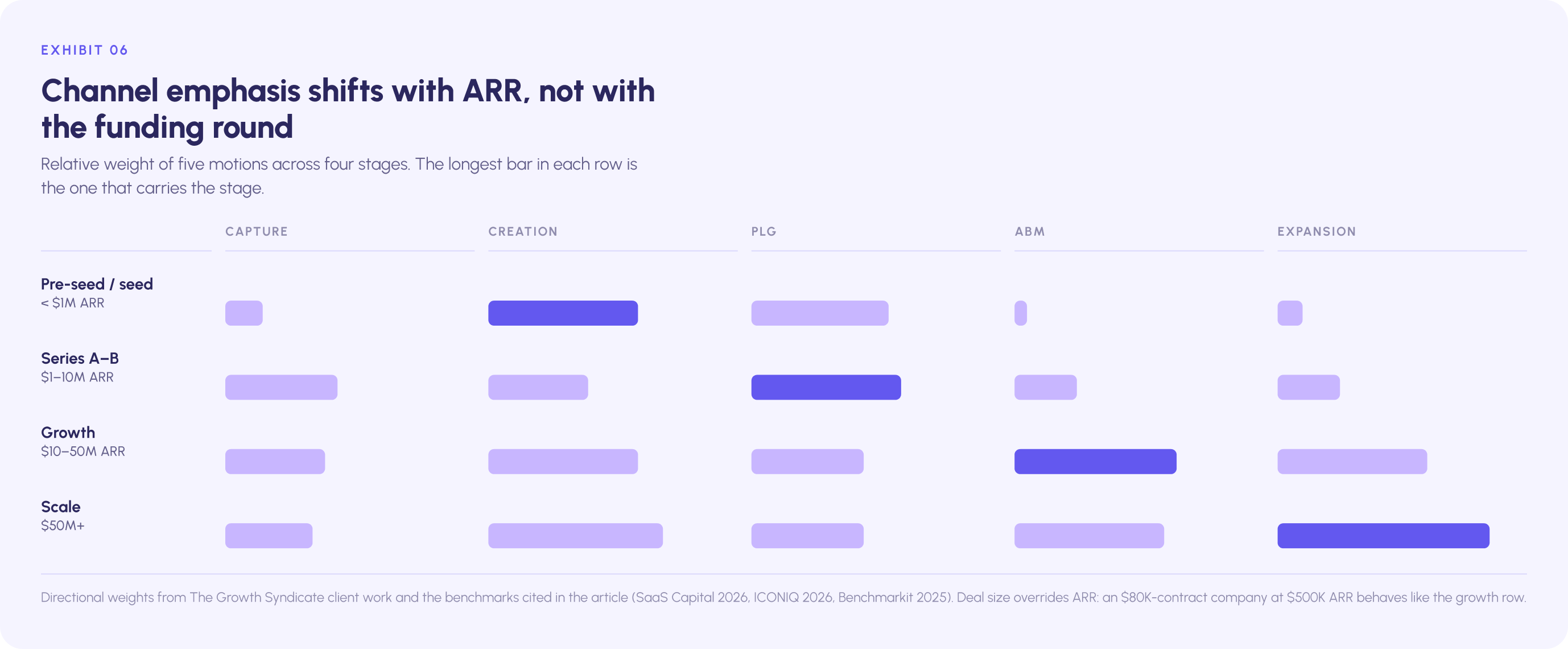
The fifteen SaaS marketing strategies above are not a checklist. Running all of them at once is how a marketing team becomes scattered. The right mix of marketing strategies depends on stage, and the stage is defined less by the funding round than by ARR, average contract value, and how many people are involved in the purchase.
Under $1M ARR: earn the right to spend
At this stage there is no SaaS marketing budget in any meaningful sense, and the constraint is founder attention. The job is to find the value proposition that makes buyers nod, prove it with ten customers, and build an audience while doing so. Founder-led content, community participation, and a self-serve or design-partner motion cover it; the more expensive marketing strategies can wait. The first SEO pages should be the ones a buyer with a credit card would read: pricing, a comparison page against the obvious alternative, an integration page for the platform your buyers already use. Most SaaS marketing success at this stage comes from one channel run well, not five run adequately.
$1–10M ARR: build the engine
At Series A and B, B2B SaaS companies have enough customers to know who buys and why, and enough budget to build repeatable marketing channels. Bottom-funnel SEO, PLG activation, lifecycle email marketing, and a review program form the core set of SaaS marketing strategies. Paid enters as an experiment with strict CAC payback limits. If average contract value is climbing past $50K, a first ABM program on 100 named accounts starts here, because the enterprise buying group won't wait for the funding round that officially makes you "enterprise-ready."
$10–50M ARR: split capture from creation
Growth-stage SaaS companies have exhausted the easy in-market demand and feel it as rising cost per lead. This is where the 95:5 rule stops being theory and starts reshaping the SaaS marketing strategies in the plan. The marketing budget splits explicitly between capturing the 5% and building memory among the 95%. Customer marketing gets an expansion target. Original research replaces volume content strategies. GEO becomes worth instrumenting. Sales and marketing alignment becomes the operational constraint, since the customer journey now runs through handoffs at a scale where any leak is expensive. Our guide to sales and marketing alignment addresses the structure that makes this work.
$50M+ ARR: brand, ecosystem, expansion
At scale the questions become category leadership, new markets, and net revenue retention. Marketing spend as a percentage of ARR often rises again at this point to fund geographic and segment expansion. Marketplaces and partner ecosystems carry a growing share of new revenue. Multi-motion go-to-market (PLG for the long tail, sales-led for enterprise) is the norm, and both the SaaS marketing strategies and the marketing team's structure have to reflect it.
Measuring SaaS marketing when most of the customer journey is invisible
Most SaaS marketing strategies get judged by attribution software, and attribution software sees clicks. Buyers don't buy through clicks. They hear about you in a Slack community, see the founder's post twice, ask a peer, read a comparison page, ask ChatGPT, and then type your URL. Every one of those touches except the last is invisible to the tracking pixel. SparkToro's controlled test of referral tracking found that 100% of visits from Slack, Discord, WhatsApp, TikTok, and Mastodon arrive labeled "direct," with no referral data at all, and 6sense found 94% of buying groups had ranked their preferred vendors before first contact. The customer journey that decides the deal is mostly the part your dashboard can't see.
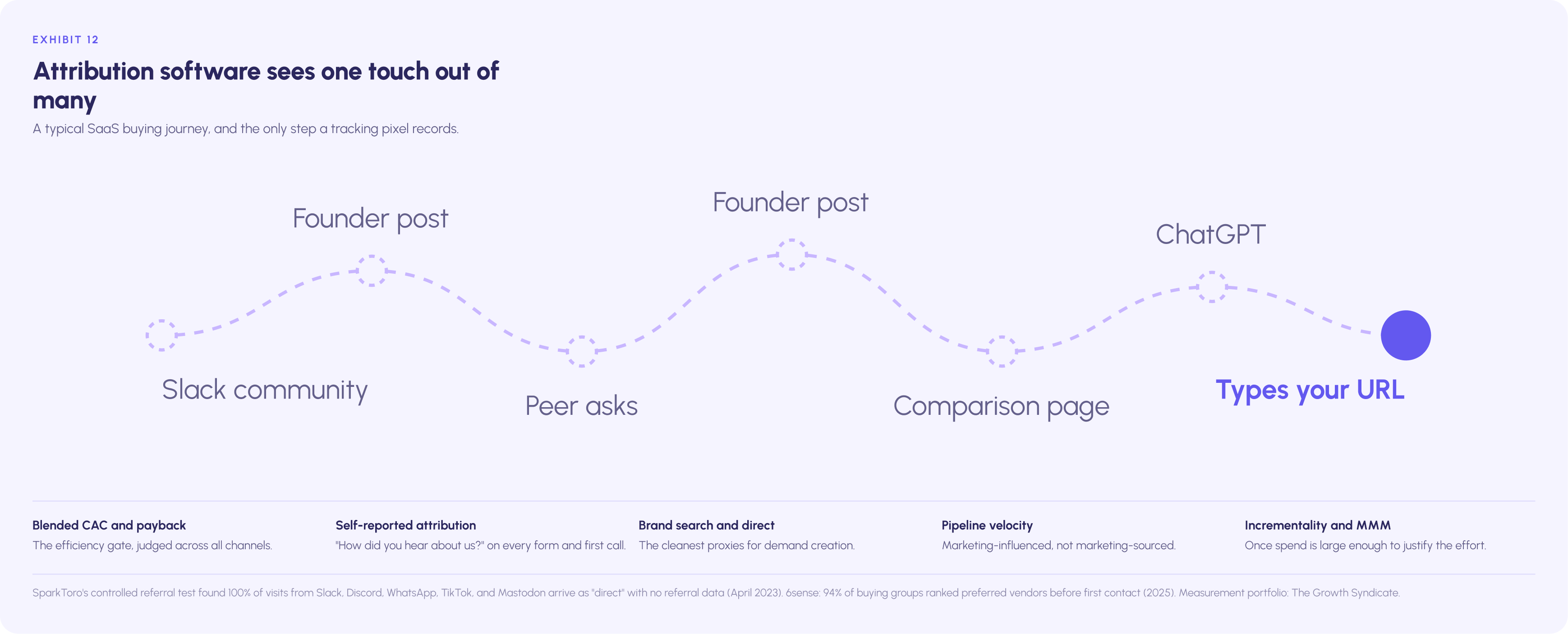
The practical answer is a portfolio of imperfect measures rather than a single model:
- Blended CAC and CAC payback as the top-line efficiency gate, judged across all marketing channels rather than per channel, using CRM revenue data rather than Google Analytics conversions.
- Self-reported attribution (a free-text "how did you hear about us?" on every form and every first call) as the primary source-of-demand signal. In our B2B SaaS marketing client work it consistently surfaces 30–50% of pipeline that digital attribution files under "direct."
- Brand search volume and direct traffic as the cleanest available proxies for demand creation.
- Pipeline velocity and marketing-influenced pipeline rather than marketing-sourced leads, which reward capture and punish creation.
- Incrementality tests and marketing mix modeling once spend is large enough to make the answer worth the effort.
Then a monthly readout that moves 10–20% of budget toward whatever is producing assisted pipeline and short payback. Google Analytics still has a role in that readout, mainly for landing-page behavior and conversion paths, but it is not the source of truth for where demand came from. Our guide to B2B marketing attribution works through the models and their limits.
Common SaaS marketing mistakes we still see in 2026
These come up in most B2B SaaS marketing audits we run, regardless of stage.
- Chasing the in-market 5% exclusively. Cost per lead rises, pipeline flattens, and the fix (more capture spend) makes it worse.
- Trusting last-touch attribution. It credits branded search and direct traffic for demand that founder content, community, and word-of-mouth created.
- Treating benchmark medians as targets. The 8% free-to-paid median is a number almost nobody lands on. Your ACV, motion, and stage set your target.
- Mass-producing AI blog posts. Google's scaled-content-abuse enforcement, sharpened in March 2026, makes this a traffic liability, not a shortcut.
- Investing in the company page over the founders. The engagement gap is large and widening.
- Measuring top-of-funnel content by sessions. It is a citation and memory asset now.
- Running PLG without an activation definition. "Every active user is a PQL" produces a conversion rate near zero.
- Set-and-forget pricing and packaging. Expansion is the durable growth lever, and packaging is how you get at it.
- Applying the same SaaS marketing strategies to SMB and enterprise segments. Deal size decides the motion, and mixing them wastes both budgets.
- Scaling paid before the positioning is proven. Paid ads amplify the message. They can't repair it.
SaaS marketing examples from 2024–2026
Three B2B SaaS marketing examples that illustrate different marketing strategies, with the caveat that revenue figures for private companies are company-reported.
Cursor (Anysphere): word-of-mouth as the entire channel. The AI code editor reached $100M ARR in January 2025, about 21 months after launch, then $1B by November 2025 and a reported $2B by February 2026, before SpaceX acquired it in an all-stock deal valued around $60B that closed in August 2026. The first $100M was widely reported as reached with no marketing spend at all. Growth came from developers talking about the product on X, Reddit, Hacker News, and YouTube, reinforced by public endorsements (influencer marketing without a budget) and a product good enough to demo itself. Enterprise's share of revenue rose from about a quarter in late 2024 to well over half by 2026, and pricing added usage-based charges for premium requests in 2025. The SaaS growth lesson is the value of a product that generates its own conversation, and the limit is that almost no product does.
Lovable: ungated PLG and a viral category. The vibe-coding platform launched in November 2024, passed $100M ARR eight months later (TechCrunch, July 2025, with 2.3 million active users at the time), doubled to $200M by Slush in November 2025, and reported a $500M run rate by June 2026 alongside a $400M Series C at a $13.3B valuation. Site traffic fell roughly 40% from its 2025 peak over the same period the revenue quadrupled, a reminder that top-of-funnel visits and revenue have decoupled here too. Ungated signup, an output users wanted to share, and a category ("build software by describing it") that generated its own demand did the work, and the target audience (people who wanted software without writing code) had never been served before. Elena Verna's growth team treats the business as a system of self-reinforcing loops rather than a marketing funnel.
HubSpot: the content flywheel, and its exposure. HubSpot passed 258,000 paying customers in early 2025 and reported $3.1B in 2025 revenue on the back of the most-cited content marketing engine in the SaaS industry. It is also the most-discussed casualty of the zero-click shift: third-party analyses put its blog's organic traffic loss at 70–80% between late 2024 and mid-2025, its CEO acknowledged on the Q1 2025 earnings call that AI Overviews were reducing click-through, and in April 2026 the company launched its own answer-engine-optimization product. Both halves are true, and together they describe the transition every SaaS content marketing program is living through.
How to build a SaaS marketing plan from this
- Fix the positioning. Write it down, test it against recent deals, and make the sales team say it back to you.
- Locate your stage and deal size. Pick the row in the stage table and the three or four SaaS marketing strategies it points to.
- Set the capture-to-creation ratio. Under $10M ARR, lean capture with founder-led creation. Above it, move toward 60:40.
- Define the metrics before the marketing campaigns. CAC payback, activation, NRR, brand search, self-reported source. Ship the "how did you hear about us" field before you ship anything else.
- Give each strategy an owner and a horizon. Marketing efforts on the two sides of the split need different clocks: capture strategies get 90 days to show pipeline. Creation strategies get twelve months and a different scoreboard.
- Review monthly and reallocate. Move 10–20% of budget toward what's producing assisted pipeline and short payback.
- Kill what isn't working. The activity-versus-outcome trap closes fastest on teams that can't stop adding marketing activities.
SaaS marketing FAQs
The SaaS marketing FAQs we hear most often from founders and marketing leads.
What is the 3-3-2-2-2 rule of SaaS?
It is the SaaS growth pattern of "triple, triple, double, double, double" (also written T2D3) that describes how venture-backed SaaS companies historically reached $100M ARR: triple annual recurring revenue for two years after hitting roughly $2M, then double it for three more. It describes an outcome investors like, not a marketing method, and in 2026 the top quartile of sub-$50M companies is growing faster than the pattern implies while the median grows slower.
What is the 3-3-3 rule in marketing?
There is no single agreed definition. It usually refers to a focus discipline: three audiences, three messages, three channels, or three priorities per quarter, rather than spreading a small team across everything. The useful part is the constraint. A SaaS marketing team that commits to three SaaS marketing strategies executed well outperforms one running ten badly.
What are the 7 strategies of marketing?
The phrase usually refers to the marketing mix rather than to seven specific marketing strategies. The 7 Ps are product, price, place, promotion, people, process, and physical evidence. For SaaS products, price and packaging carry unusual weight because they determine the growth motion (freemium, trial, sales-led) and the expansion path.
Is SaaS being replaced by AI?
The "SaaS-pocalypse" narrative is not showing up in the data. ICONIQ's 2026 survey found top-quartile ARR growth for sub-$50M companies re-accelerated to 111% year over year in the second half of 2025, sales cycles shortened, and trial conversion hit 50%. What AI is changing is the shape of the SaaS industry: shorter contracts, more consumption pricing, thinner margins for AI-heavy products (near 50% versus 70–80% or more for traditional SaaS, per Kyle Poyar's 2026 monetization survey), and leaner go-to-market teams, which changes the SaaS marketing plan more than it changes the business model. Software that wraps a thin layer around a model is at risk. Software that owns a workflow and its data is not.
What are SaaS marketing examples?
Cursor grew to $100M ARR on developer word-of-mouth with no reported marketing spend, and to $1B within the following ten months. Lovable reached $200M ARR within a year of launch through ungated product led growth. HubSpot built the category's most-cited content engine and is now rebuilding it for a zero-click search environment. Each is an example of one of these marketing strategies pushed far, which is more instructive than any company running all fifteen.
How long does SaaS marketing take to show results?
Capture-side SaaS marketing strategies (paid search, retargeting, bottom-funnel SEO on existing authority) can show pipeline within 60–90 days. Creation channels (founder-led content, original research, brand, community) take six to twelve months before brand search volume and self-reported attribution move. Boards that judge both on the same 90-day clock end up cutting the marketing activities that would have mattered most.
Freemium or free trial?
Freemium wins on signup volume; a credit-card-required trial wins on paying customers per visitor (roughly 10.5 per 1,000 visitors versus 5). Choose based on what your top of funnel can supply and what your onboarding can convert. Reverse trials (full access that downgrades to free) are a reasonable middle path for SaaS products where value takes time to appear.
Which SaaS marketing channel has the lowest customer acquisition cost?
Referrals and word-of-mouth, followed by bottom-funnel organic search, followed by lifecycle email to existing customers and signups. Paid search sits well above organic on blended CAC, and LinkedIn Ads above that on CPC, though LinkedIn can win on final CAC when lead quality is higher. Channel-level CAC only means something after self-reported attribution corrects for what the pixels missed, and only next to the lifetime value of the customers each channel produces.
How do you optimize SaaS content for AI search?
A content marketing strategy built for AI search answers the question in the heading in the first two sentences beneath it. Include statistics with named sources, direct quotations from credible people, and a visible author and date. Earn mentions on the third-party sites models trust (Reddit, YouTube, review platforms, industry publications). Make sure Bing has indexed the page. Then measure citations with a baseline (Google Analytics shows AI referrers under their own source names) before buying tooling.
Should marketing own expansion revenue?
Marketing should own an expansion pipeline number alongside customer success, because the campaigns that drive adoption, upsell, and referral, and the programs that reward loyal customers, are marketing campaigns. With median net revenue retention at 102%, expansion is the growth lever with the most headroom at many SaaS companies.
What do SaaS marketing professionals get wrong most often?
They confuse marketing efforts with marketing outcomes. A full calendar of webinars, blog posts, and campaigns feels like progress and reports well, but if none of it can be traced to pipeline, the team is busy rather than effective. The fix is structural: every activity gets a hypothesis about which stage of the customer journey it moves and which metric will show it.
.png)