.svg)


SaaS inbound marketing has a reputation problem, and it earned it. For a decade the playbook was fixed: publish informative blog posts, gate an ebook, score the download as a lead, hand it to a sales team, and call the whole thing a growth engine. Most of what ranks for this topic still describes that machine. Meanwhile the ground under it moved. AI Overviews now sit on top of the search results those blog posts were built for, buyers finish most of their evaluation before they talk to anyone, and the gated-ebook lead is the reason sales and marketing teams stopped trusting each other.
Inbound still works for SaaS companies. It just works as something narrower and more honest than the growth-engine pitch: as a marketing strategy, inbound is demand capture. It converts attention a company has already earned, and it does that job extremely well when the rest of the system is in place. This guide covers what SaaS inbound marketing is, why it suits software companies in particular, where it breaks, which inbound marketing strategies still pay, and how to measure the thing without lying to yourself.
What is SaaS inbound marketing?
SaaS inbound marketing is the practice of attracting potential customers through content, search, and community rather than interrupting them with ads or outreach. Buyers find you while researching a problem, evaluate on their own terms, and convert through free trials, demos, or email nurturing. It works for SaaS companies because the buyer's journey is self-directed and the product can sell itself once someone arrives.
What is SaaS in marketing?
SaaS stands for software as a service: software delivered through a subscription and accessed online rather than installed and bought once. In marketing, the term carries two meanings that get mixed up. The first is marketing for SaaS companies, which is what this article is about. Subscription economics change everything about how marketing gets judged: revenue arrives monthly, customer acquisition cost has to be paid back over time, and a customer who churns after four months can cost more than they ever paid.
The second meaning is SaaS used by marketers: the CRM, marketing automation, and analytics tools that make up a marketing stack. Both meanings matter here, because most inbound marketing for software companies is executed through the second kind in service of the first.
Inbound marketing for SaaS: what it is and what it isn't
Inbound marketing focuses on being found rather than finding. Outbound marketing pushes a message at people who did not ask for it: cold email, cold calls, display ads, trade show booths. Inbound marketing efforts pull people in who are already looking: search engine optimization, educational content, webinars, podcasts, communities, review sites, and the email sequences that nurture leads once they have raised a hand. The mechanism is different, and so is the timing. Outbound reaches buyers on your schedule; inbound reaches them on theirs, and the most successful strategies for SaaS companies use both in proportion to the market.
The distinctions that matter for SaaS companies are the ones the definition leaves out:
- Inbound is not the same as product-led growth. PLG is a go-to-market model in which the product does the selling through a free trial or freemium tier. Inbound is how people arrive at that trial. The two compound, and PLG companies are often among the heaviest inbound investors, but a free trial with no one arriving is a product, not a strategy.
- Inbound is not the same as content marketing. Valuable content is the raw material. Inbound marketing is the system that turns content into traffic, traffic into leads, and leads into revenue. Content marketing is the cornerstone of most inbound marketing strategies, which is exactly why the two get confused, and plenty of SaaS companies produce excellent content with no inbound system around it.
- Inbound is not demand creation. This is the one that matters most, and it deserves its own section.
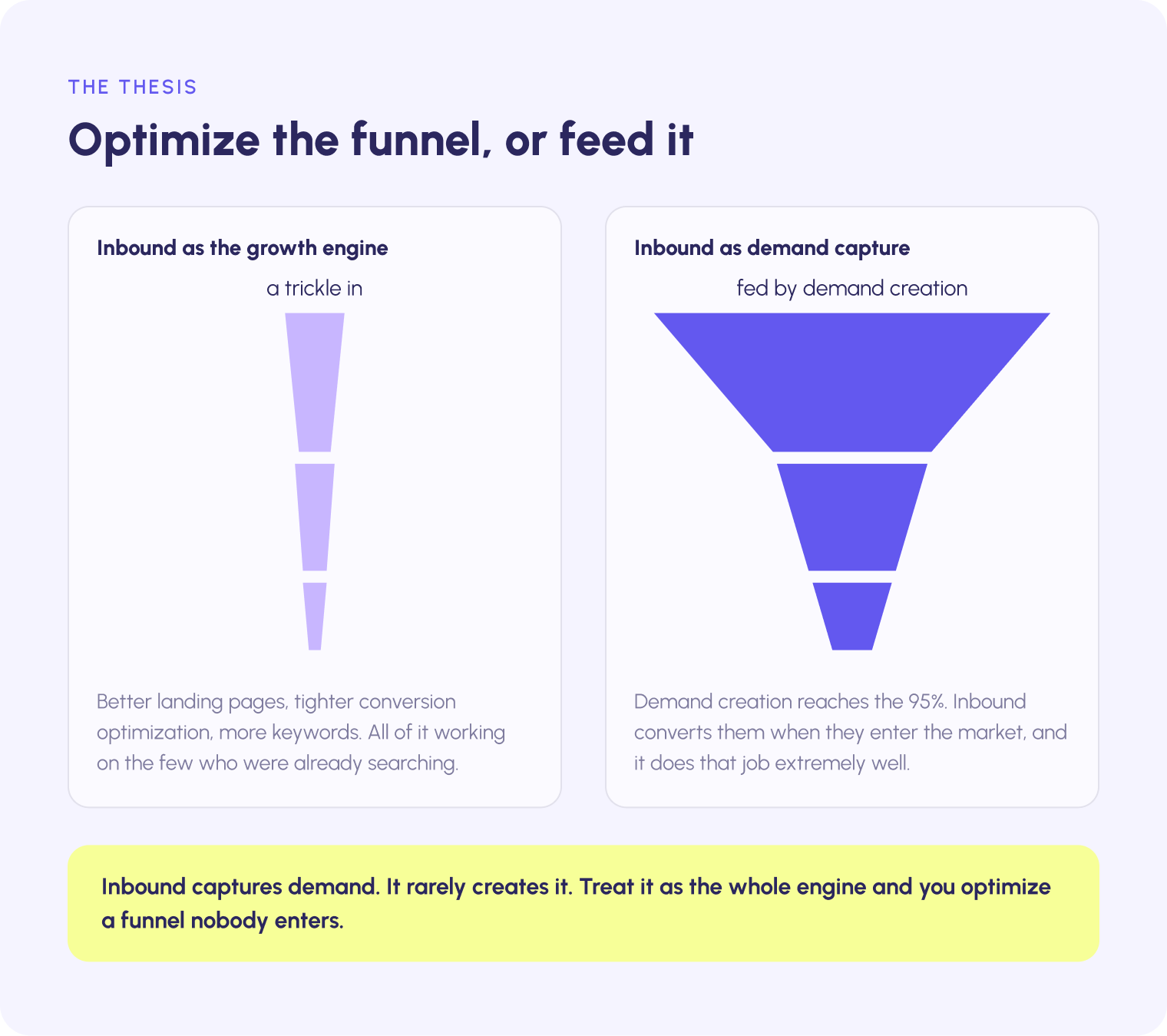
Inbound captures demand. It rarely creates it.
Every ranking article on this topic treats inbound marketing as the growth engine. Look at what it actually does. A search query is a buyer who already has a problem and already has words for it. A visit to your comparison page is a buyer who already knows the category and, usually, already knows your name. Inbound marketing is exceptionally good at converting that existing intent. It does almost nothing to make a company with no problem awareness want your product.
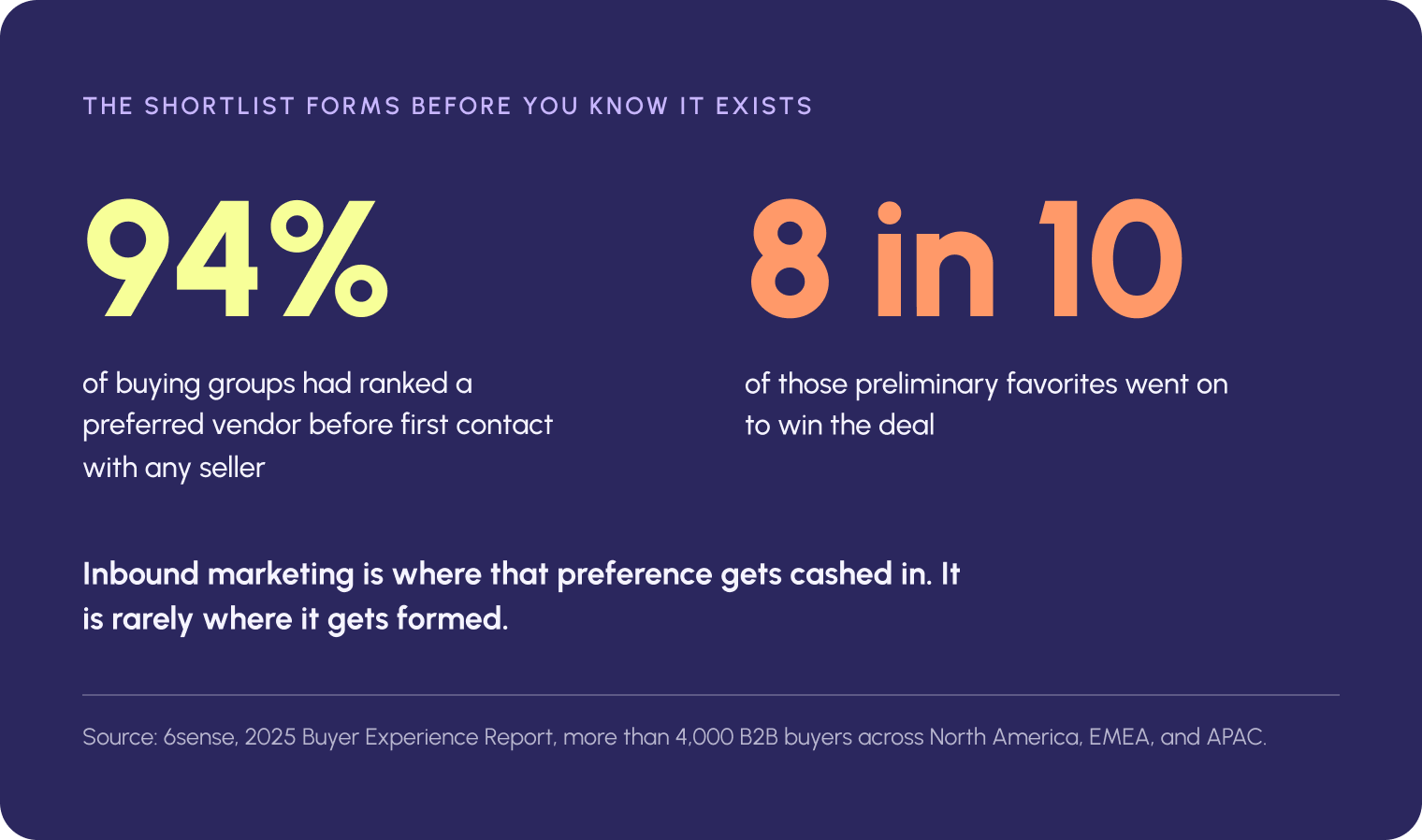
The research on buyer behavior is unambiguous about how much happens before inbound gets its chance. 6sense's 2025 Buyer Experience Report, drawn from more than 4,000 buyers, found that 94% of buying groups had ranked a preferred vendor before first contact with any seller, and that preliminary favorite won roughly eight times in ten. And 85% of buyers reported direct prior experience with the vendors they evaluated. In other words, the shortlist was formed by familiarity accumulated over months or years, and inbound marketing is where that familiarity gets cashed in.
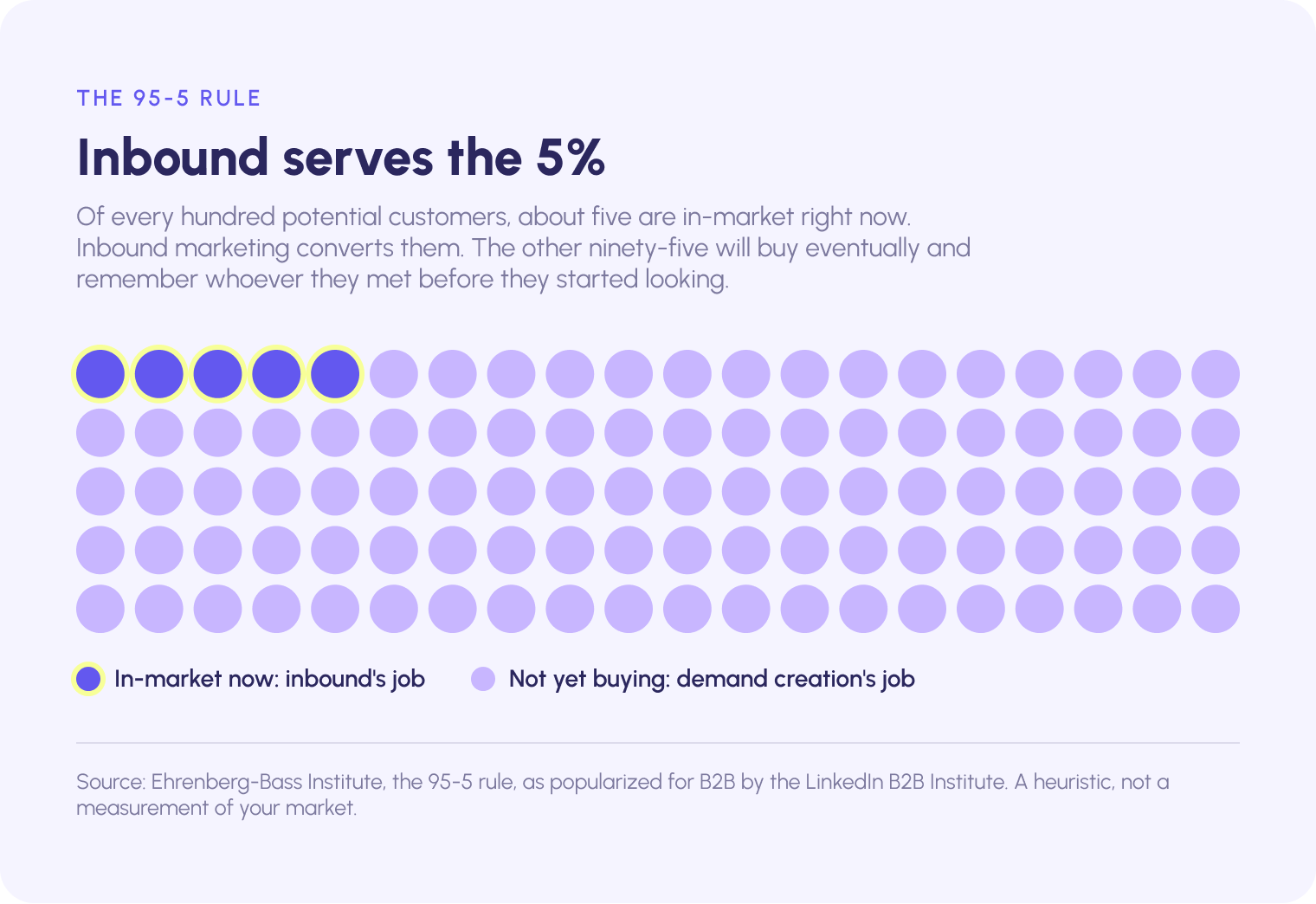
That is why the Ehrenberg-Bass Institute's 95-5 rule matters for SaaS inbound marketing more than for almost any other category. At any given time, roughly 5% of your potential customers are in-market; the other 95% will buy eventually and remember whoever they encountered before they started looking. Inbound marketing serves the 5%. Something else has to reach the 95%, and that something is demand generation in its original sense: making a market aware that a problem is solvable and that you solve it.

"Marketers cannot create demand. Demand is someone actually in the market to buy, with budget, authority, need, and timing, and it occurs whether you show up or not. The real job is salience: being the name that surfaces when a problem triggers a buying journey."
Treat inbound as the whole engine and you end up optimizing a funnel nobody enters: better landing pages, tighter conversion optimization, more relevant keywords, all working on a trickle. Treat it as demand capture and the question becomes what feeds it, which is where the rest of your marketing efforts come in. The rest of this article assumes something does.
Why inbound marketing suits SaaS companies, and when it doesn't
Inbound marketing for SaaS companies works for three structural reasons:
- Buyers research software the way inbound expects them to. Software is evaluated online, compared online, and increasingly bought online. Gartner's most recent buyer survey found 67% of B2B buyers prefer a rep-free buying experience. Content that answers their questions is the rep they wanted instead.
- The product can close. A free trial, an interactive demo, or a transparent pricing page finishes the job that content started. Few other categories can hand a prospect the actual product at the bottom of the sales funnel.
- The economics reward compounding. Subscription revenue and lifetime value make it rational to spend now on valuable content that keeps producing organic traffic for years. A paid campaign stops when the budget does; a page that ranks does not, which is what sustainable growth looks like for a subscription business.
The conditions under which it does not work are just as structural. Inbound is a volume play. It depends on enough potential customers searching for enough things to make a content operation pay for itself.

A SaaS company selling into 300 hospital networks or 150 tier-one banks should run account-based marketing and treat inbound as a supporting layer for the handful of searches those accounts run. A company selling project management software to any business with more than ten employees should build its marketing strategy around inbound as a primary channel. The mistake in both directions is common: narrow-market SaaS companies burning budget on blog content nobody in their 300 accounts will read, and broad-market SaaS companies trying to outbound their way to a market that would have found them.
![Decision diagram: if a few hundred companies could buy from you, run ABM with inbound as a supporting layer; if thousands or more could, inbound can be the primary channel.]]](https://cdn.prod.website-files.com/66b4b90abb54e3af8e25e2b8/6aabe40235e9271008cf6a9d_1.png)
The SaaS buyer's journey, and where inbound fits
The buyer's journey for software runs through three stages, and inbound marketing has a job at each one.
Awareness. The buyer has a problem and is putting words to it. They search for pain points, not products: "why does our churn spike after month three," "how to forecast pipeline without a data team." Educational content that names the problem accurately and helps before it sells earns the first touch and, more importantly, a place in memory.
Consideration. The buyer has named the category and is building a shortlist. Now they search comparisons, alternatives, pricing, integrations, and reviews. This is where most SaaS inbound marketing budgets should sit, because the content is closest to revenue and the competition for it is usually thinner than for awareness terms.
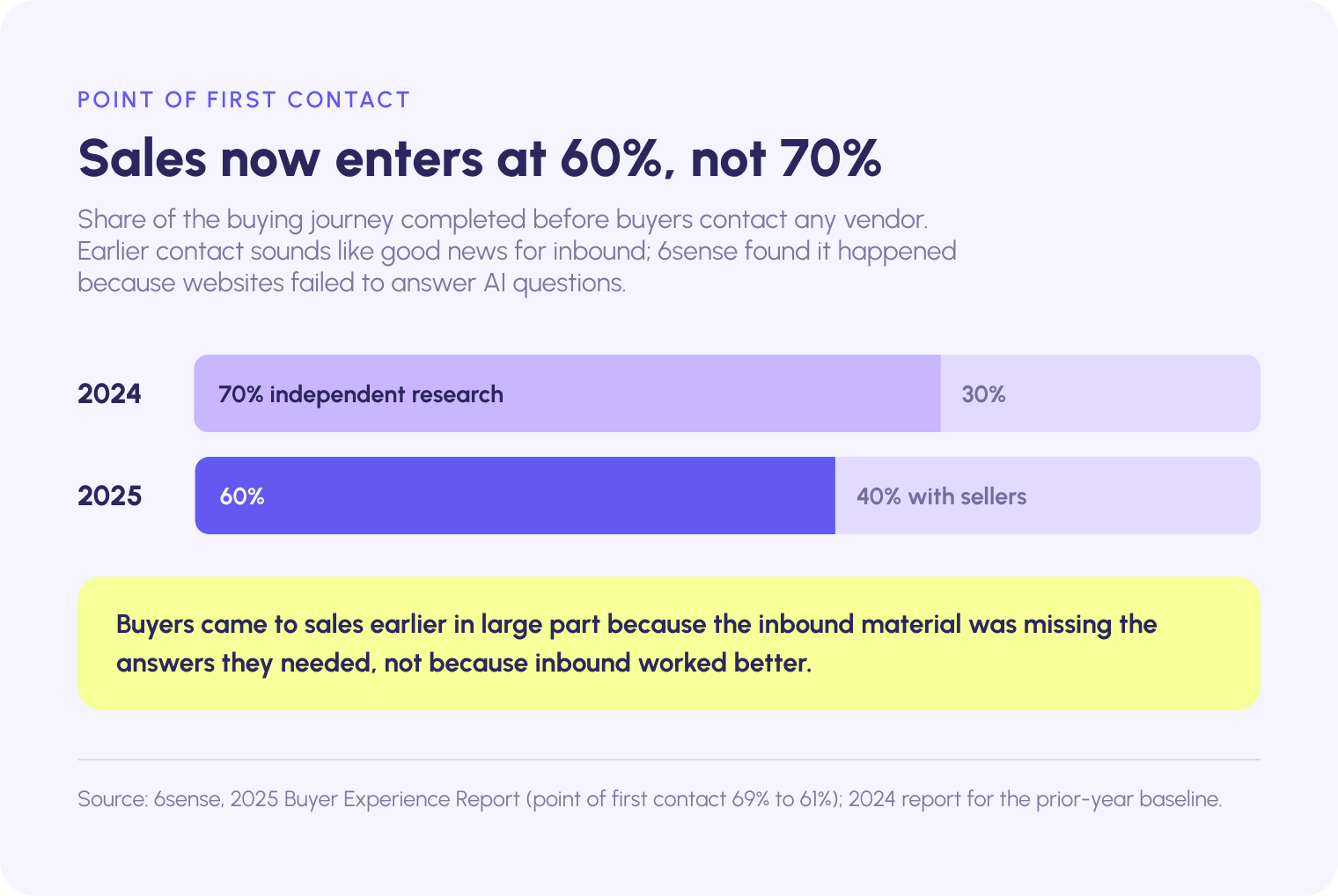
Decision. The buyer validates a preference they have mostly formed. 6sense's data puts the point of first contact at about 60% of the way through the journey in 2025, earlier than the 70% it measured in prior years, largely because buyers wanted clarity on AI capabilities that vendor websites failed to provide, with economic pressure pushing in the same direction. The lesson is uncomfortable for marketing teams: buyers came to sales earlier in large part because the inbound material was missing the answers they needed, not because inbound worked better.
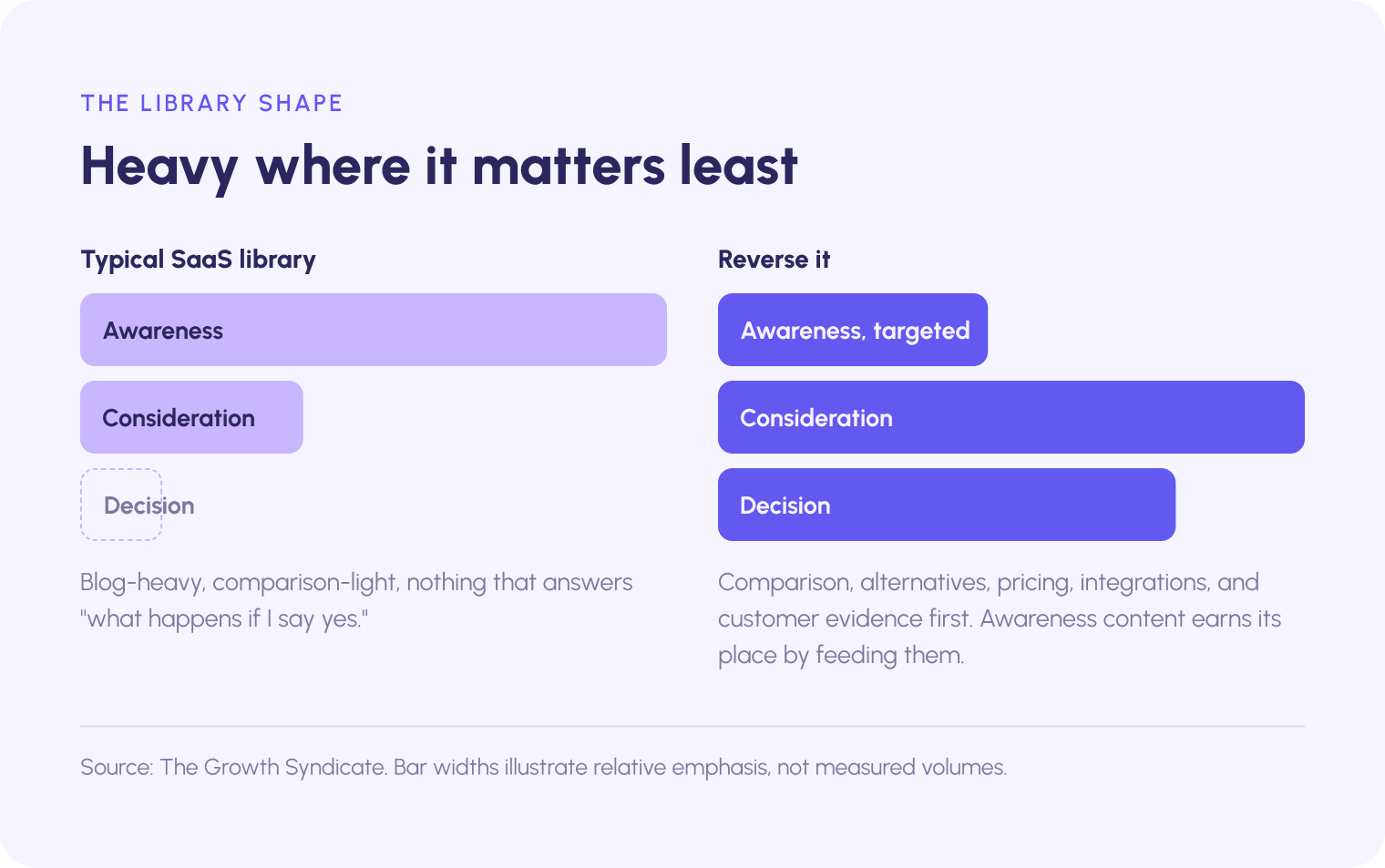
The practical move is to map every piece of content to a stage and a buyer question, then check the map against what the customer journey actually looks like in your call recordings and win-loss interviews. Most SaaS content libraries are heavy on awareness, thin on consideration, and empty on decision, which means the most relevant content for potential software buyers is usually the content that does not exist yet. Reverse that.
What are examples of inbound marketing?
Here are eight inbound marketing tactics SaaS companies use, roughly ordered from top of the sales funnel to bottom:
- Educational content and SEO: informative blog posts and guides that rank for the problems your target audience searches, plus the programmatic pages that scale organic reach across long-tail queries.
- Comparison and alternatives pages: "X vs. Y" and "alternatives to X" content that meets buyers mid-shortlist.
- Free tools, templates, and calculators: a ROI calculator or a template library that provides valuable insights before anyone has paid for anything.
- Webinars and podcasts: targeted educational webinars on the industry challenges your target audience faces capture engaged leads; podcasts build familiarity with the 95% who are not yet in-market.
- Community: a Slack group, a forum, or a customer community where practitioners answer each other's questions and your product is the shared context.
- Review sites and marketplaces: G2, Capterra, and app marketplaces are inbound channels you do not own but can influence, mostly by asking loyal customers to review you.
- Free trials, freemium, and interactive demos: the PLG layer, where the product converts the visit.
- Email marketing and nurturing: the sequences that turn a signup into a customer over the months a software decision actually takes.
Notice that only two of those eight are gated. Inbound strategies built on gated assets defined the first inbound era; they have mostly given way to ungated content that earns trust and a product that earns the signup.
The channels: where SaaS inbound marketing actually happens
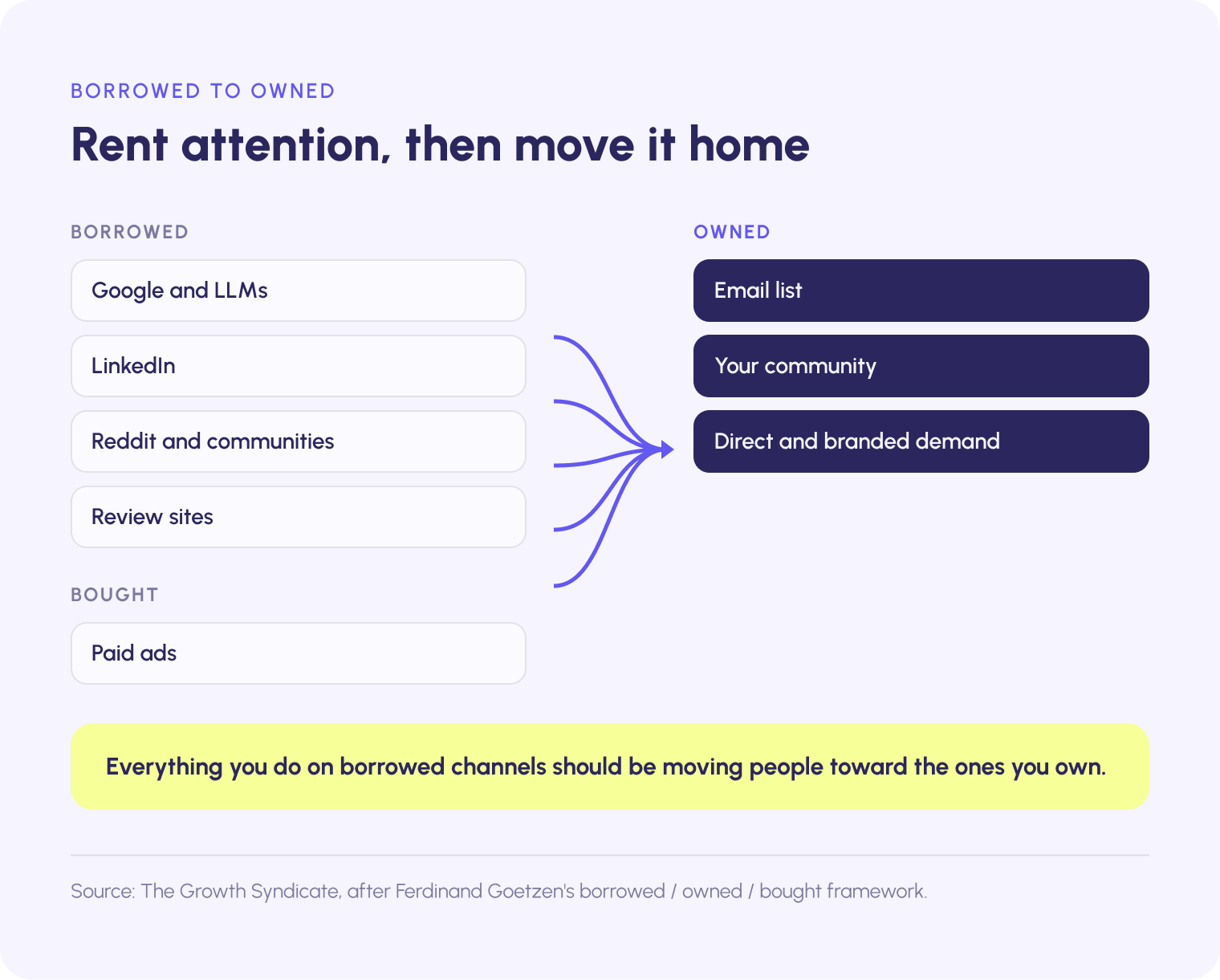
Effective inbound marketing strategies for SaaS companies concentrate on four channels, and the split between borrowed and owned channels is the most useful lens for prioritizing them.
"LinkedIn, Google, and now the LLMs are borrowed audiences: you rent access from a platform whose algorithm you don't control. Email and your own community are owned. Everything you do on borrowed channels should be moving people toward the ones you own."
Search engine optimization and content
SEO and content marketing remain the core of inbound marketing for SaaS, and they are also where inbound marketing efforts have changed the most. Search engine visibility used to translate into website traffic in a predictable ratio. It no longer does. Ahrefs' analysis of 300,000 keywords found that when an AI Overview appears, the top-ranking page's click-through rate is 58% lower than it would otherwise be, up from a 34.5% drop measured eight months earlier. Pew Research's tracking of real user sessions found people click an organic result about half as often when an AI summary is present.
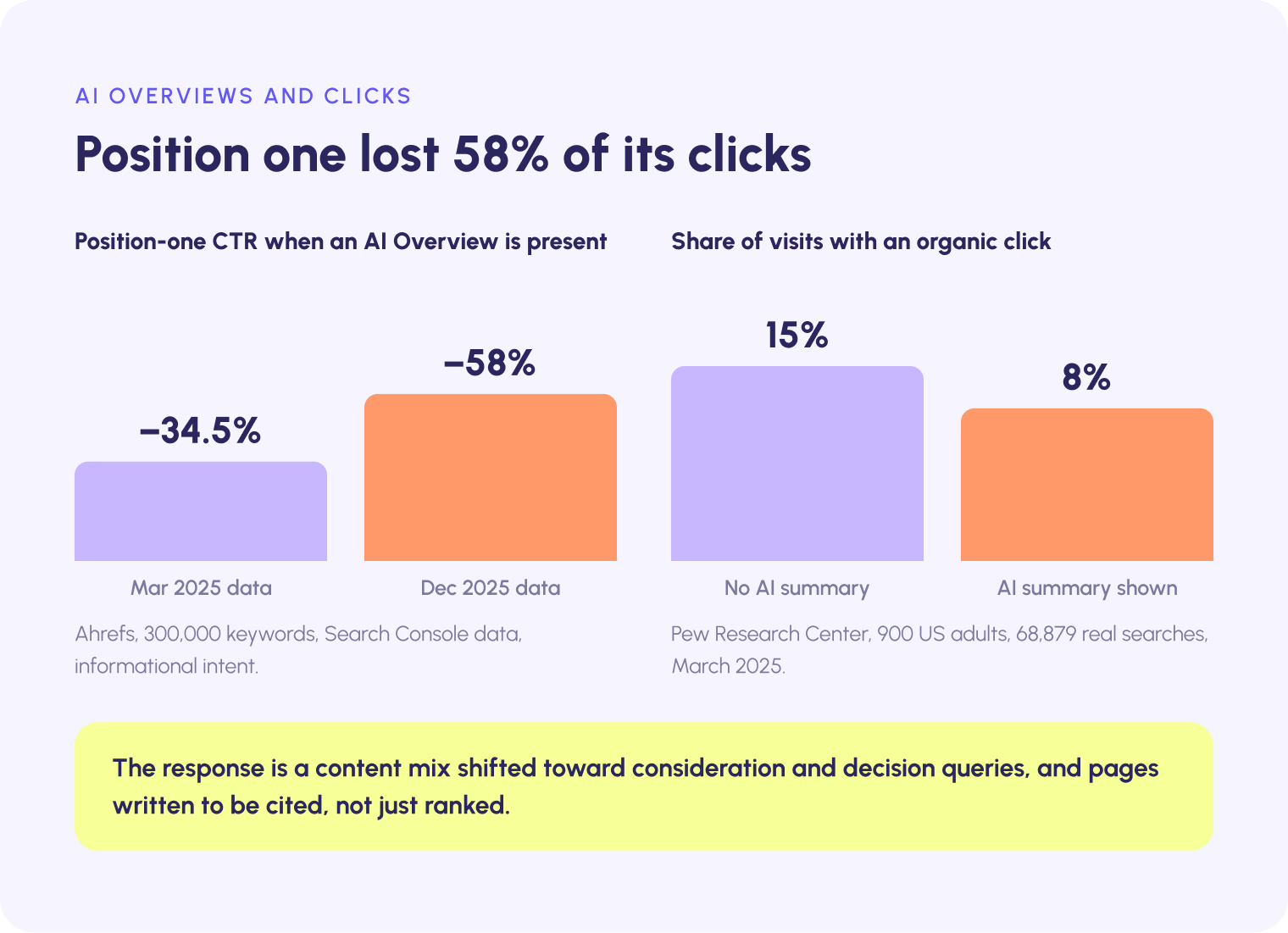
The response is not to abandon search. Three adjustments follow from the data:
- Shift the content mix toward consideration and decision terms. AI Overviews trigger almost entirely on informational queries. Comparison, pricing, integration, and "best X for Y" queries still send clicks, and they sit closer to revenue anyway.
- Write to be cited, not just ranked. Seer Interactive found pages cited inside an AI Overview earn meaningfully more clicks than pages that rank below one without a citation. Clear definitions, direct answers under question-shaped headings, original data, and named authors all raise the odds of citation.
- Do keyword research for questions, not just volume. Long-tail queries that address specific pain points are where search engine ranking is still winnable and where buyers reveal what they actually need.
A B2B SEO strategy built for this environment looks different from one built in 2019, and the difference is mostly about what you choose not to write.
There is an honest caveat that belongs in any SaaS SEO conversation. Algorithm-driven channels reward gaming, and gaming degrades quality.
The practical resolution is sequencing: write the genuinely useful thing first, then make it findable. Creating valuable content and creating content that ranks are the same job only if you do them in that order.
Email marketing: the owned layer
Email marketing is where inbound stops being borrowed. Every other channel in this article depends on a platform whose incentives are not yours. A subscriber list is the one asset that survives an algorithm update, and for SaaS companies email marketing doubles as the nurture engine for trials and the retention engine for customers.
Three practices separate email marketing programs that generate qualified leads from ones that generate unsubscribes:
- Segment by role and behavior, not just company. Hyper-segmentation by user role and engagement trigger (trial started, feature used, pricing page visited) is what makes automated email campaigns feel personal rather than automated, and it is why segmented lists post higher conversion rates than blasts.
- Nurture for the real decision length. Software purchases take months, and nurturing leads over a ten-month decision is a different discipline from nurturing leads over a two-week one. Drip campaigns built for the shorter cycle burn out subscribers before the buying committee has even formed.
- Give before you ask. Newsletters that provide valuable insights get opened; newsletters that announce features get filtered.
Marketing automation plays a crucial role here, and it is also where the tooling becomes a liability. Marketing automation multiplies whatever it is pointed at. Point it at a clean CRM and a thoughtful segmentation model and it saves marketing teams weeks a quarter. Point it at bad data and it scales the mistakes.
Social media and community
Social media marketing is a familiarity channel, not a conversion channel, for most SaaS companies. Creating valuable content for LinkedIn and showing up in the communities where your target audience already gathers reach the 95% of potential customers who are out of market. Expect these marketing efforts to show up as branded search and direct traffic months later rather than as attributable conversions. Social media platforms are also borrowed, which argues for using them to route people toward the newsletter and the community you own.
Paid amplification
Paid ads are outbound by mechanism, but paid advertising earns a place in SaaS inbound marketing campaigns as an amplifier: retargeting readers, promoting the best-performing content to lookalike audiences built from your target audience, and protecting branded search terms. The rule is that paid should multiply a working inbound asset, not substitute for one. Buying traffic to a page with poor organic conversion rates is buying the same disappointment faster.
Building a SaaS inbound marketing strategy
A SaaS inbound marketing strategy is a set of decisions before it is a content calendar. Five of them determine whether the rest works, and the order matters.
- Decide whether inbound is your primary channel. Run the market-size test above honestly, and tie the answer to business objectives rather than to what competitors publish. Inbound as a primary channel needs a large pool of potential customers and a product that can be evaluated online. If either is missing, inbound is a supporting layer and should be budgeted like one.
- Define the target audience, not the persona deck. Detailed buyer personas help only when they come from customer interviews and call recordings rather than a workshop. The useful output is a list of the specific pain points buyers describe in their own words, the questions they ask before and after the demo, and the objections that recur. That list is your content strategy.
- Pick the stage you will win first. Most SaaS companies should start at consideration: comparison pages, alternatives pages, integration pages, transparent pricing. It converts sooner, it costs less to rank, and it tells you what the awareness content should be about.
- Set the conversion path before the content. Decide what a visitor should do on each page type. Trial, demo, newsletter, template download, nothing at all. Landing pages with one clear ask and customer testimonials that match the visitor's segment outperform pages that hedge across four asks. Conversion optimization is cheap once the path is defined and impossible before, and conversion rates are the first metric to move once it is.
- Agree on the metrics and the handoff with sales. The number inbound gets judged on (pipeline, not lead generation volume), the definition of qualified leads, and what happens when a lead meets it. Get the sales team to sign the same page, because inbound programs die in the handoff between marketing and sales teams far more often than in the content.
![The five decisions that come before content in a SaaS inbound strategy: primary or supporting channel, who the buyer is, which stage to win first, the conversion path, and the metrics and sales handoff.]]](https://cdn.prod.website-files.com/66b4b90abb54e3af8e25e2b8/6aabe521f90ae5b44194e731_1.png)
Only then does content creation start. An inbound marketing strategy that skips to step six spends a year on content creation aimed at nobody in particular, much of it genuinely valuable content that never meets a buyer, and then concludes that inbound marketing does not work for the category.
Lead generation and nurturing without the MQL trap
Inbound marketing for SaaS companies fails at the seam between marketing and sales more often than anywhere else, and the failure has a name: the marketing qualified lead. In the original inbound model, generating leads meant capturing an email address behind an ebook and scoring it. Sales received a list of people who wanted a PDF. The tools got good at helping teams capture leads and terrible at helping them convert leads. Marketing reported lead generation numbers. Nobody closed anything, and the two teams learned to distrust each other's definitions.
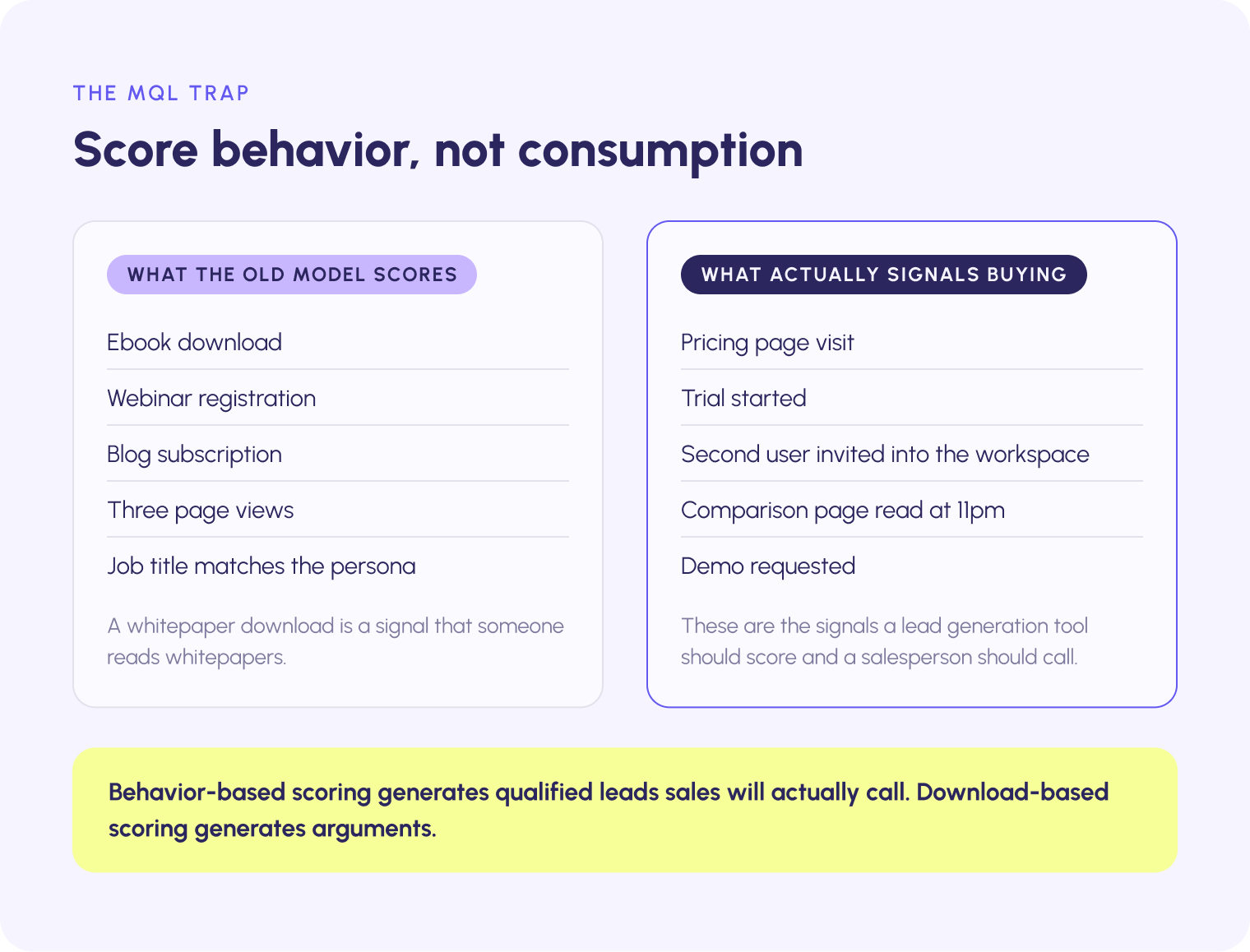
The fix has two parts. First, qualify on behavior that signals buying, not on content consumption. A pricing page visit, a trial signup, a second user invited into the workspace, a comparison page read at 11pm: these are the signals a lead generation tool should score. A whitepaper download is a signal that someone reads whitepapers. Behavior-based scoring generates qualified leads sales will actually call; download-based scoring generates arguments. How B2B lead qualification is defined decides whether the sales process starts with a conversation or an apology.
Second, treat nurturing leads as a timeline problem. Lead nurturing for SaaS means staying useful across a decision that 6sense measures at roughly ten months on average. That is a sequence of genuinely helpful emails, product education timed to trial behavior, and a human reaching out when the signals say a buying group has formed, not a five-email drip that ends in a discount. Converting high quality leads is mostly a matter of not annoying them between the moment they raise a hand and the moment they are ready.
None of this works if marketing and sales teams are measured against each other. Marketing on lead volume and sales on revenue guarantees a fight over definitions; shared pipeline accountability ends it, which is why sales and marketing alignment sits underneath every inbound program that survives its second year.
Measuring SaaS inbound marketing
The metrics for SaaS inbound marketing are the metrics for the business, translated one layer up. Three of them do most of the work:
- Customer acquisition cost (CAC) is total sales and marketing spend divided by new customers acquired, ideally split by channel so inbound's share of customer acquisition is visible. Benchmarkit's 2025 report found the median SaaS company spent $2.00 in sales and marketing for every $1.00 of new annual recurring revenue in 2024, up 14% on the year before. Content marketing lowers customer acquisition cost over time by producing assets that keep converting after the spend stops, which is the whole economic argument for inbound.
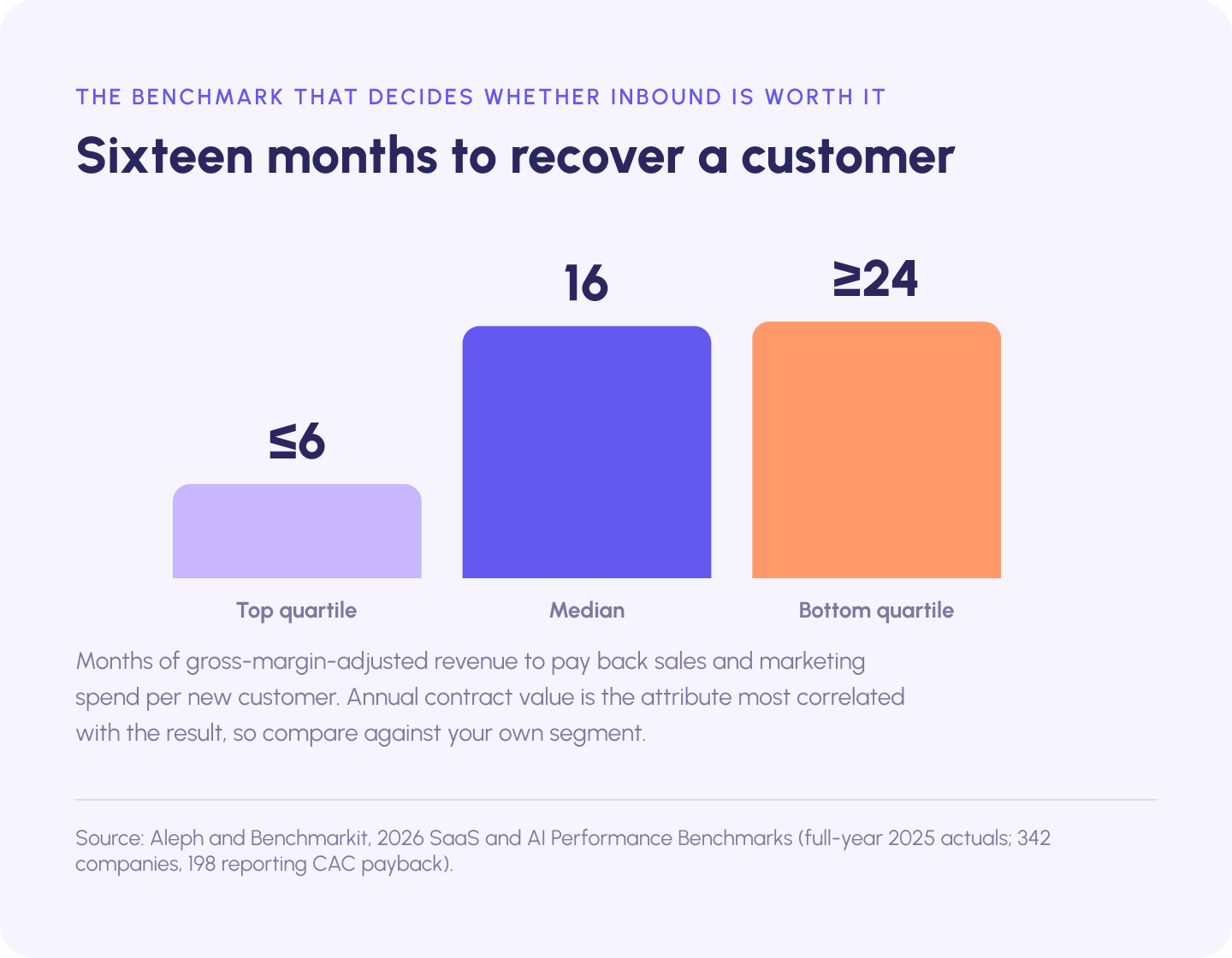
- CAC payback is how many months of gross-margin-adjusted revenue it takes to recover that cost. The 2026 Aleph and Benchmarkit benchmarks, built on full-year 2025 data from 342 software companies, put the median at 16 months, with the top quartile recovering CAC in six months or fewer and the bottom quartile taking two years or more. Annual contract value is the single attribute most correlated with the result, so compare against your own segment.
- Customer lifetime value to CAC closes the loop. Inbound customers often show better customer retention, because they chose you rather than being sold, but that is a hypothesis to test in your own cohorts rather than an assumption to plan on.
Below those three sit the operational metrics that explain them: organic traffic by stage of the sales funnel, conversion rates from visit to trial and trial to paid, pipeline sourced and pipeline influenced, and win rates on inbound-sourced deals versus outbound ones; most marketing automation platforms can track these from first visit to closed deal if the CRM underneath is clean. Website traffic on its own belongs at the bottom of the dashboard. It is the beginning of a chain that ends in business growth, and it gets reported as the end far too often.
That reporting failure has a pattern. A marketing leader reports free-trial signups for a year, the business does not grow, the budget is blown, and nobody confronts the disconnect between the metric and the revenue. We have watched a version of this happen. Free trials, click-through rates, and content downloads are activity. Revenue, retention, and payback are outcomes. Inbound strategies reported on activity get funded until the first hard quarter, and then it gets cut, usually by someone who is right to cut it.
![A three-layer metrics pyramid: activity metrics (traffic, downloads, signups) at the base, operational metrics (conversion rates, pipeline, win rate) in the middle, outcome metrics (CAC, payback, LTV to CAC) at the top. Activity reported as outcome is how programs lose funding.]]](https://cdn.prod.website-files.com/66b4b90abb54e3af8e25e2b8/6aabe6097a30fb640f7ae87a_1.png)
Attribution is the last complication, and an honest one. Most of the buyer's journey happens where analytics cannot see it: peer conversations, communities, podcasts heard on a commute, a LinkedIn post remembered three months later. Inbound gets credit for the last click on a journey that other channels shaped. Self-reported attribution (a simple "how did you hear about us?" field) recovers some of the picture, and the rest is a measurement problem the whole discipline shares; we cover it properly in our piece on B2B marketing attribution.
What AI changes about inbound marketing for SaaS
Two shifts, one on each side of the search box.
On the buyer's side, the research phase is moving into tools that do not send traffic. Gartner's late-2025 survey found 45% of B2B buyers used AI during a recent purchase; 6sense found buyers use LLMs mainly in the middle of the journey, for summarizing reviews and comparing options, rather than at the start. The consequence for SaaS inbound marketing strategies is that being cited matters as much as being ranked. A comparison page that an AI assistant paraphrases without a click still shapes the shortlist, and a company absent from those answers is absent from the consideration set.
On the marketer's side, generative tools have collapsed the cost of content marketing, which has collapsed the value of content that exists only because it was cheap to make. The search results for most SaaS categories are now crowded with competent, interchangeable articles. What still earns citations and clicks is high quality content of a kind AI cannot generate: original data, real customer evidence, opinions with a name attached, and answers specific enough to be wrong. Industry trends favor the companies that publish less and know more; the teams that create compelling content now are the ones with something original to say.
The operational point holds across both shifts. AI in marketing automation improves lead scoring, lead nurturing, personalization, and content recommendations when the data underneath is clean. When it is not, it scales the mess faster.
In-house or agency: who should run SaaS inbound marketing?
The search results for this topic are written almost entirely by agencies, ours included, so read this section with that in mind.
In-house works when a company has a marketer who understands the product deeply, the patience to fund content for the two to three quarters it takes to compound, and enough demand to justify a full-time program. An agency partnership makes sense in three situations: the team has no experience with inbound marketing strategies and wants a working system faster than it can hire one; the company needs specialized expertise in SEO and content strategy that a generalist marketer lacks; or the founders want the consideration layer built quickly while an in-house hire is being made. The honest limits are that no agency knows your product as well as your team does, and that agencies reduce customer acquisition cost only when the market-size test above already says inbound should work.
What to look for is simple to state. Ask an agency to show you an inbound marketing strategy measured against pipeline rather than traffic, to explain which content it would refuse to write for your category, and to name the point at which the work should move in-house. A good B2B SEO agency will have ready answers to all three. A content mill will have a case study about traffic.
SaaS inbound marketing FAQ
What is the 3-3-3 rule for marketing?
The 3-3-3 rule is a folk heuristic rather than a formal framework, and it circulates in several versions. The most useful one is about attention: a page or email has three seconds to earn a glance, thirty seconds to make its case, and three minutes to convince. Other versions prescribe three core messages across three channels for three months, or three touches before a follow-up is escalated. Treat it as a reminder that buyers decide fast on borrowed channels, not as a rule with evidence behind it.
What is the rule of 40 in SaaS?
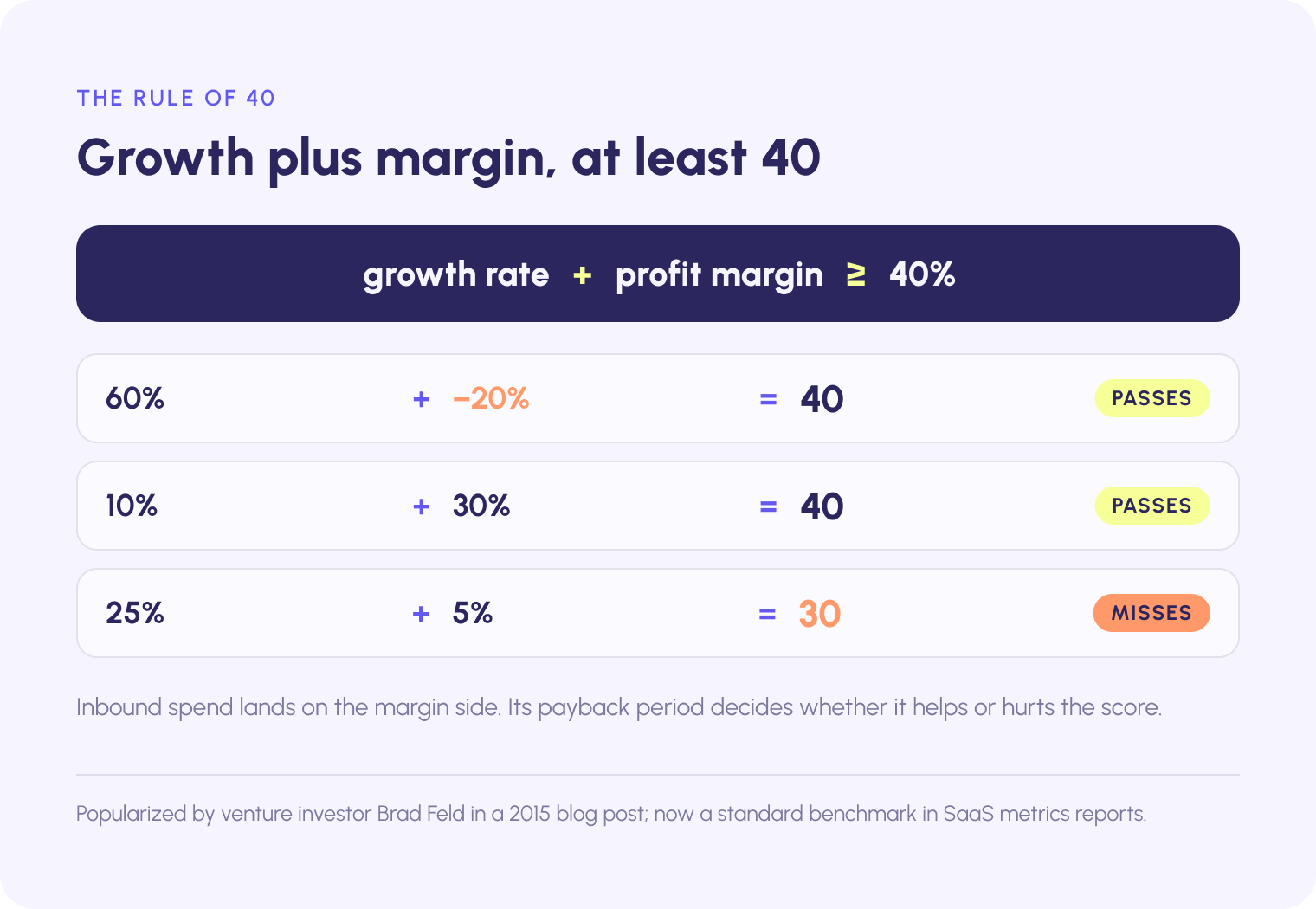
The rule of 40 says a healthy SaaS company's revenue growth rate plus its profit margin should add up to at least 40%. A company growing 60% a year can run a 20% loss; a company growing 10% needs a 30% margin. Venture investor Brad Feld popularized it in a 2015 blog post, and it has since become a standard benchmark in SaaS metrics reports. It matters for inbound because inbound spend shows up on the margin side of that equation, and its payback period plays a crucial role in whether it helps or hurts the score.
Is SaaS being replaced by AI?
No, but the model is changing underneath it. 6sense found that 89% of the B2B purchases it studied in 2025 included AI features, which means AI is being absorbed into software far faster than it is replacing it. What is arguably under real pressure is seat-based pricing, since AI features often reduce the number of people a company needs in the product. For inbound marketing, the practical effect is that buyers now arrive with questions about AI capabilities that most SaaS companies still fail to answer on their websites, and that gap is currently the cheapest consideration content a SaaS company can write.
How long does SaaS inbound marketing take to work?
Consideration-stage content can produce qualified leads and pipeline within a quarter if the keywords are winnable and the conversion path exists. Awareness content and organic authority compound over two to four quarters. Anyone promising inbound results in weeks is describing paid traffic with an inbound label on it.
What does SaaS inbound marketing cost?
The honest answer is a function of your market and your stage rather than a rate card. The useful frame is CAC payback: inbound is worth whatever it costs if the customers it produces pay back their customer acquisition cost faster than customers from your other channels, and the median SaaS company currently sits at sixteen months. Below that, keep spending; above it, fix the funnel before you feed it.
.png)
