.svg)


Demand generation is the work of building awareness, trust, and preference among future buyers so your company is the one they think of first when they are finally ready to purchase. It runs from the educational article someone reads two years before a deal to the branded search they type the week they sign a contract.
That is the clean version. The messier truth is that demand generation means different things to different people, and some of those meanings contradict each other. This guide gives you a working demand generation definition, the process, the tactics, and the metrics that matter. It is also honest about the places where the term promises more than marketing can actually deliver, because pretending otherwise is how teams end up spending budget they cannot account for.
What is the meaning of demand generation?
Demand generation is a marketing strategy focused on creating awareness and interest in a product or service across an entire market, then converting that interest into revenue over time. It spans the entire buyer journey, from the first moment someone learns your category exists to the moment they become a customer and beyond.
A useful demand generation definition has two halves. The first is demand creation: educating potential customers who are not yet looking for a product or service, so your brand becomes familiar before they ever start shopping. The second is demand capture: meeting the smaller group of people who are actively in-market and ready to evaluate vendors. Most strong demand gen does both, which is why the discipline feels broad. It is supposed to.
Several things distinguish demand gen from a one-off campaign. It creates awareness and builds trust over time rather than chasing a single conversion. It uses educational content to position a brand as a resource people return to. And it treats the whole funnel as one connected system, where the brand work at the top and the conversion work at the bottom are part of the same demand generation strategy rather than separate jobs handed to separate teams.
Why the definition gets blurry
Ask ten B2B marketers what demand generation means and you will get ten answers. HubSpot says as much in its own writing on the topic. Some people use the term as a synonym for lead generation. Others use it to mean brand awareness with a more impressive name. Others use it for the technical machinery of marketing automation and lead scoring, and a few file it next to growth marketing and online marketing as loosely interchangeable labels.
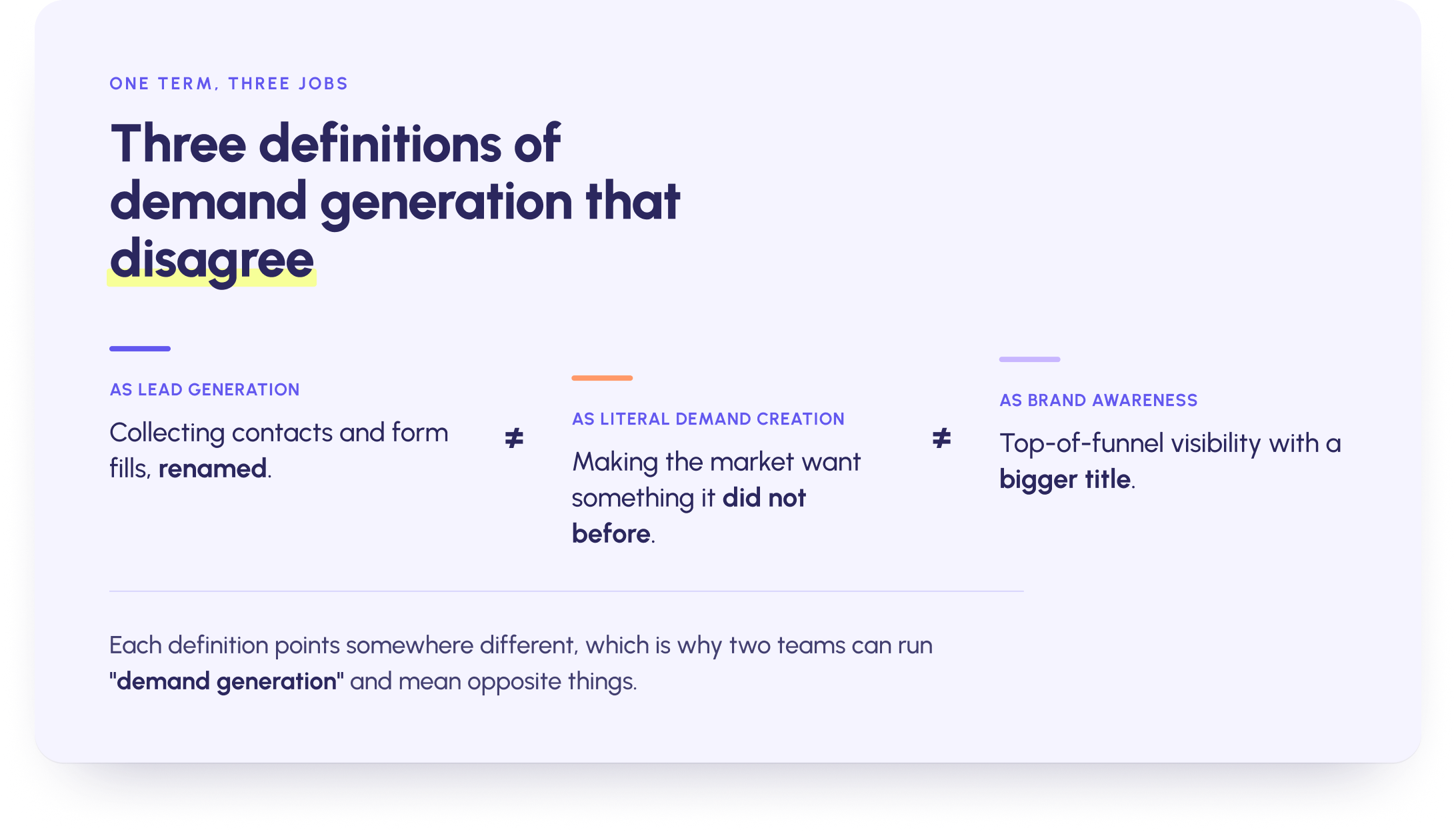
This matters because the approach you choose follows from the definition you hold. If you think it means collecting form fills, you will build a lead capture operation and call it demand gen. If you think it means making organizations want things they do not need, you will be disappointed, because that is not a capability marketing has. We will come back to this honestly later in the guide. For now, the definition worth holding is the broad one: it creates awareness and interest in products or services and carries that interest through to revenue.
Demand creation vs demand capture
The single most useful mental model in B2B marketing is the split between creating demand and capturing it.
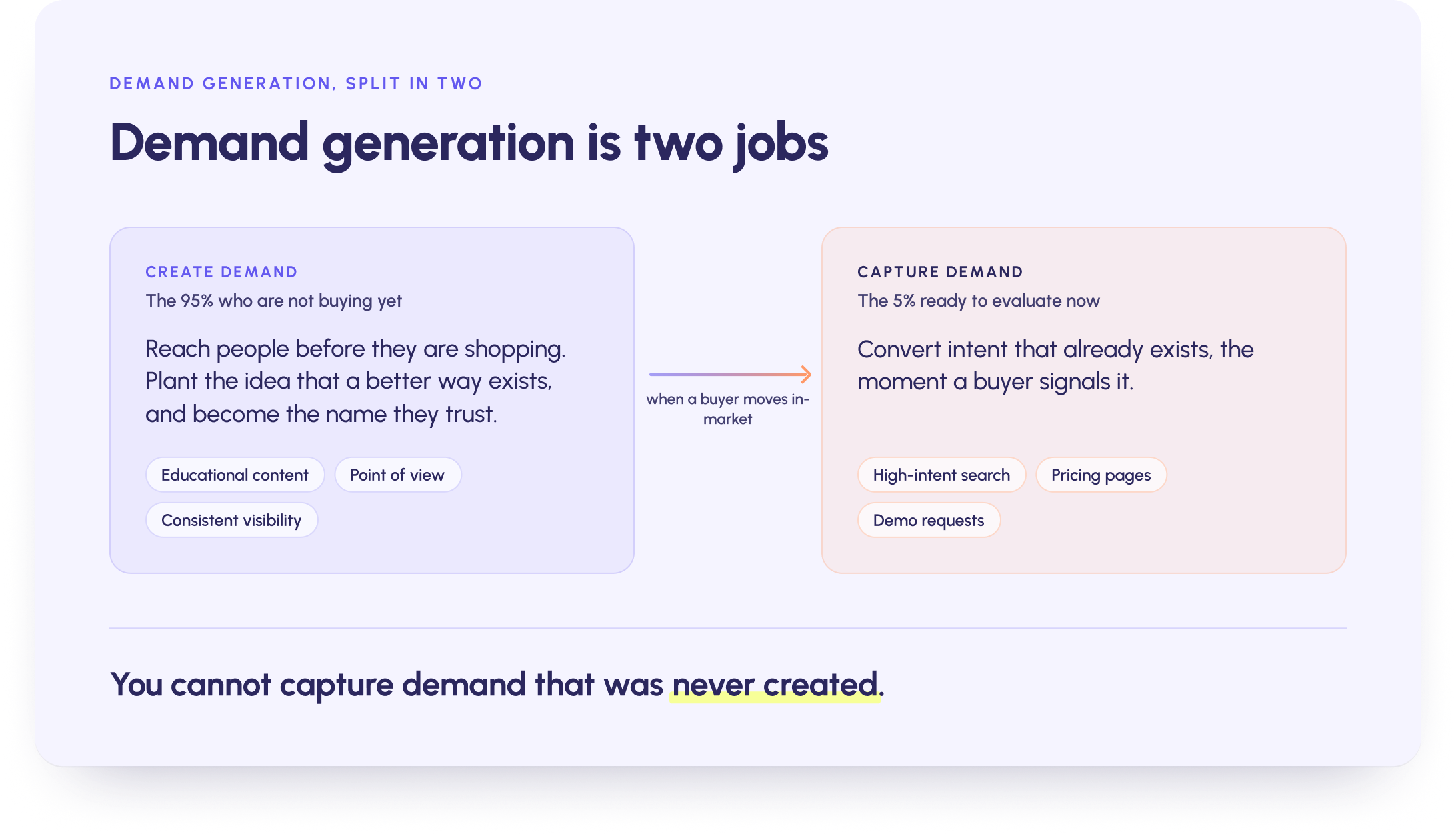
Creating demand means reaching people before they are shopping. They have a problem they have not yet named, or they have named it but assume it is just how the job works. Educational content, point of view, and visibility in the places your audience already spends time are what plant the idea that a better way exists. This is patient work, and it rarely produces a same-week lead.
Capturing demand means being present and persuasive when someone is actively evaluating options. Branded search, review sites, comparison pages, and retargeting all sit here. Demand capture is easier to measure and faster to show results, which is exactly why so many teams overinvest in it and neglect the creation work that feeds it. You cannot capture demand that was never created.
Demand generation vs lead generation
The demand generation vs lead generation question causes more confusion than any other in B2B, so it is worth being precise.
Lead generation focuses on converting an already-engaged audience into quality leads by collecting contact details, usually through a gated asset, a demo request, or a form. The output of lead generation is a list of names that sales can contact. Demand generation is the wider effort that creates the interest those leads come from in the first place. Put simply, lead generation is a subcategory of demand generation marketing, not a competing approach.
What lead generation does
Lead generation efforts capture intent that already exists. A prospect downloads a checklist, requests pricing, or books a call, and becomes a known contact. Lead magnets like templates, calculators, and benchmark reports are the usual way teams generate leads at this stage. Done well, lead gen is the moment a warm buyer raises a hand. Done badly, it is a machine that pushes uninterested people into sales workflows because they grabbed one of those lead magnets, which is how you end up with marketing qualified leads that no salesperson wants to call.
What demand generation does differently
It involves multiple marketing tactics to generate interest across the whole market, well beyond the slice that is ready today. It aims to educate potential customers rather than only drive an immediate sale. The payoff is lead quality: when buyers already understand the value of your product before they talk to sales, the conversations are shorter and the close rates are higher.
Effective demand generation attracts higher-quality leads with genuine interest, which is a different outcome from simply generating leads in volume. Good educational content tends to produce high-quality leads precisely because it filters for people who care about the problem. The result is high-quality leads who arrive already convinced, not random form fills.
Why lead generation is a subset of demand generation
Here is the relationship in plain terms.
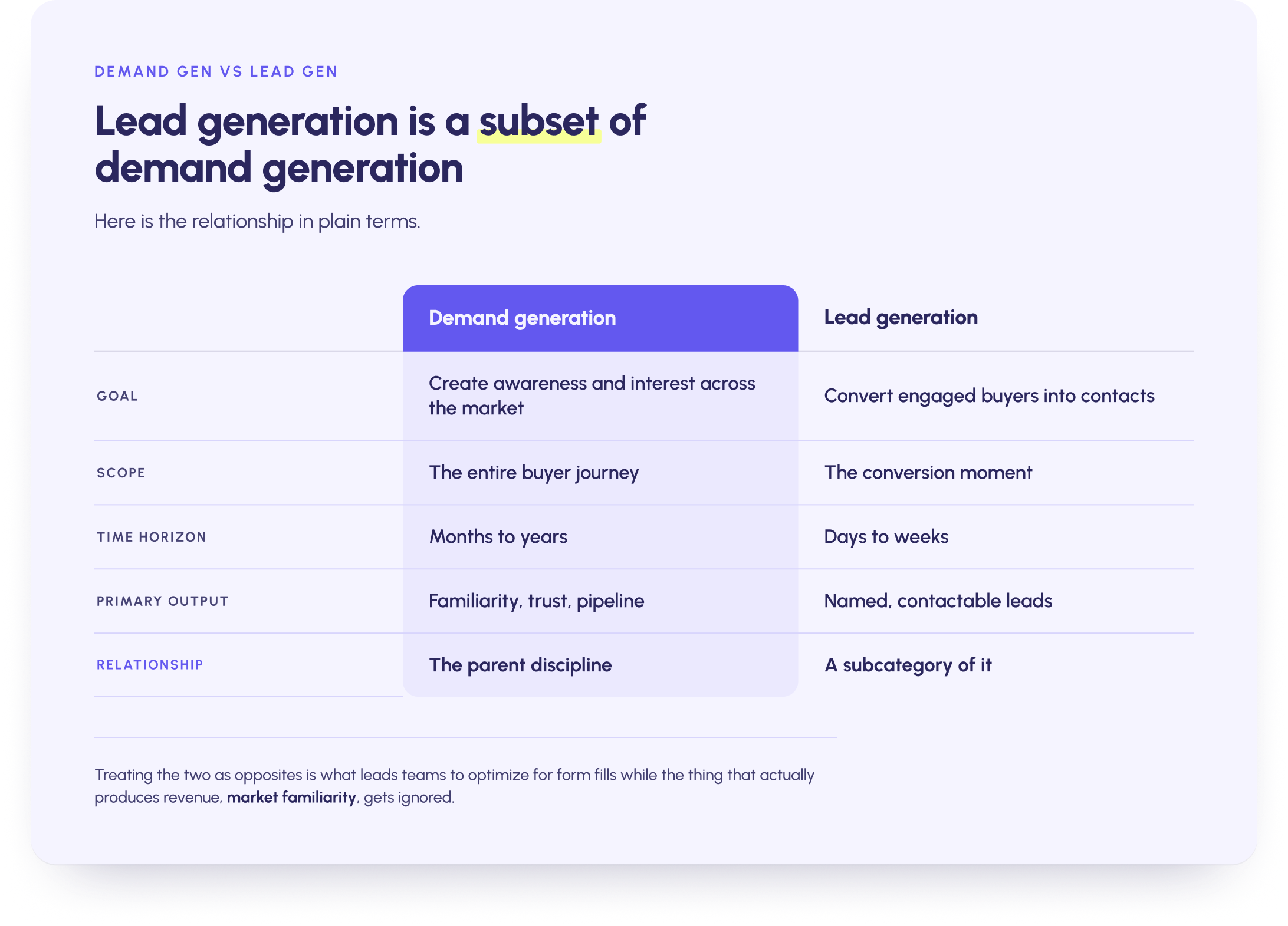
The table lists the differences. The relationship behind them is one of scope: demand generation runs the length of the buyer journey, and lead generation is the narrow step near the end where interest becomes a contactable name.
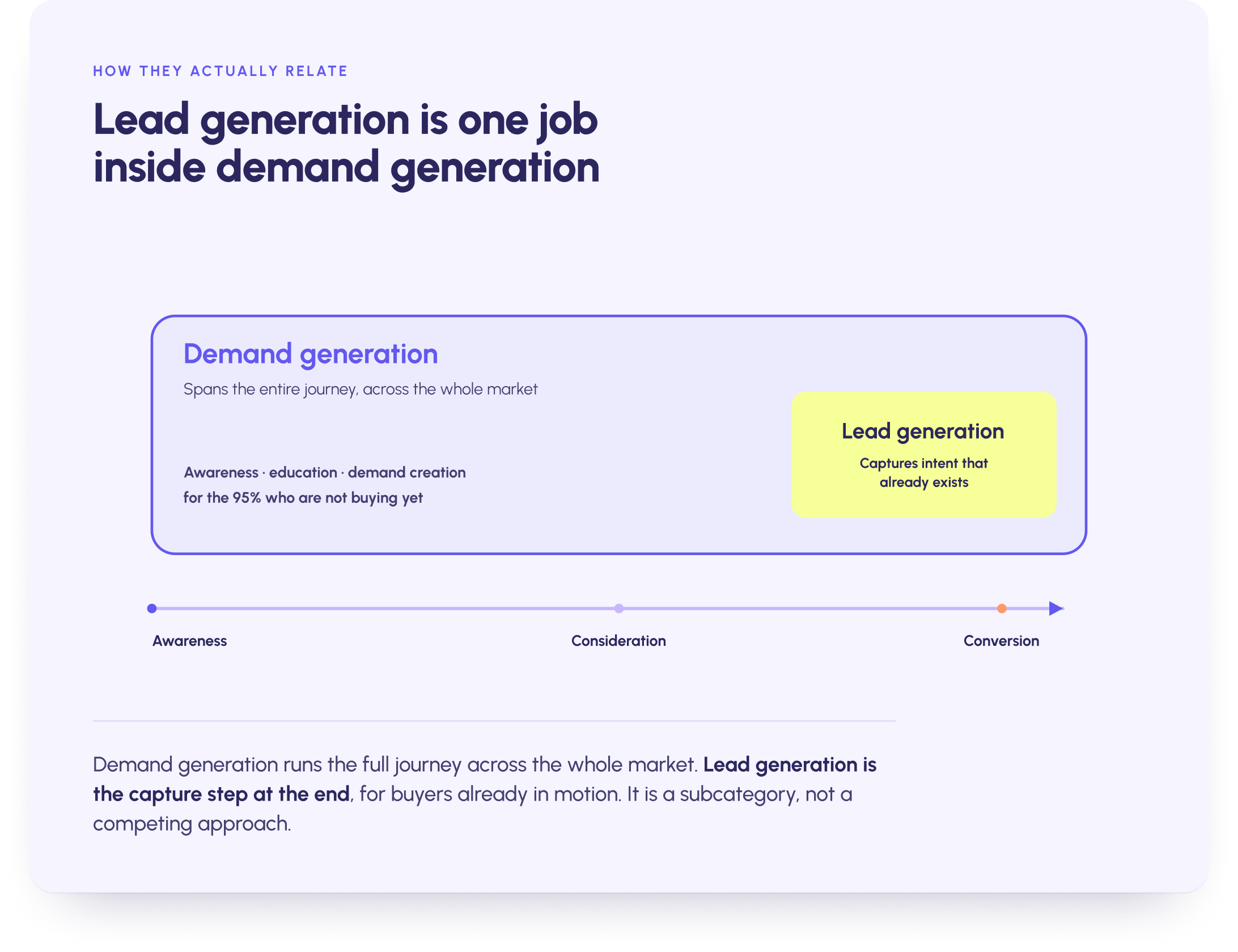
Lead generation is one job inside a demand gen program. Treating the two as opposites is what leads teams to optimize for form fills while the thing that actually produces revenue, market familiarity, gets ignored.
How demand gen actually works
Demand gen works by influencing buyers long before they enter a sales process, then being easy to find and choose once they do. The evidence for why this sequencing matters is unusually strong.
The 95% rule: most of your market is not buying yet
At any given moment, only about 5% of B2B buyers are actively in-market. The other 95% are out of market and will not buy for months or even years. This figure comes from Professor John Dawes of the Ehrenberg-Bass Institute, working with the LinkedIn B2B Institute, and it reframes the entire purpose of the discipline.
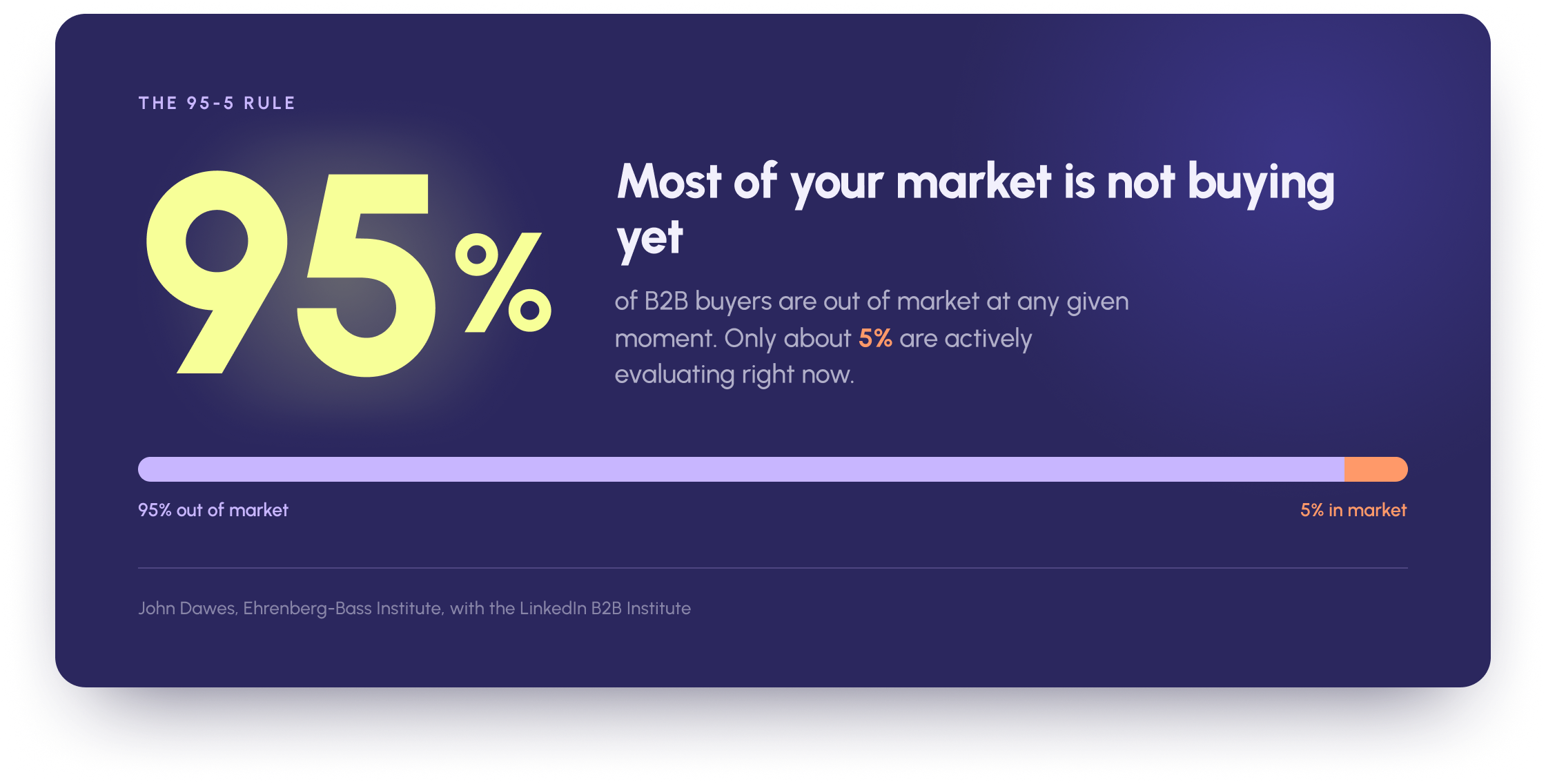
If 95% of your potential buyers are not shopping today, then most demand generation activities cannot produce an immediate sale, by definition. What they can do is make your brand familiar so that when a buyer does move into market, you are already a name they trust. Demand generation targets the 95% of the market not currently in an active buying cycle, which is precisely the part of the market that pure lead generation ignores. These are the potential customers who will not buy today but will remember you when they do.
Mental availability and category entry points
The marketing science underneath this is Byron Sharp's work at Ehrenberg-Bass on how brands grow. Brands grow mainly by being remembered in buying situations, a property Sharp calls mental availability. Advertising, in this view, is a relatively weak force: it rarely persuades anyone to want something, but it does make a brand easier to recall at the moment of need.
Jenni Romaniuk's related concept, category entry points, describes the cues that trigger someone to think of a category in the first place. A finance leader thinks "we keep missing our forecast" before they ever think "we need planning software." Demand generation creates interest by linking your brand to those cues, so that when the trigger fires, your name surfaces. The job is not to manufacture the trigger. The job is to be the answer the buyer reaches for when it arrives.
Getting on the Day-One list
Buyer research makes the stakes concrete. Bain and Google surveyed more than 1,200 B2B buyers and published the findings in Harvard Business Review in 2022. Around 90% of buyers chose a vendor that was already on their shortlist at the very start of the buying process. 6sense reports that roughly 97% of website visitors stay anonymous, which means most of your demand generation marketing efforts are influencing people you cannot see in your CRM. Its 2025 buyer research reached the same conclusion as Bain and Google: the large majority of deals go to a vendor the buyer already had in mind, and the favorite going in wins most of the time.

That move, from out of market to a shortlist of three before research even begins, is the whole game. Demand gen is, in large part, the work of getting onto that shortlist before they start looking. If you are on it, the marketing is working. If you are not, no amount of bottom-funnel optimization will save the deal. Most of those potential buyers will not raise their hand for months, which is exactly why patience is part of the job.

The six steps in the demand generation process
This process turns the theory above into a repeatable program. There is no single official version, but the six steps below cover what a working B2B demand generation strategy needs.
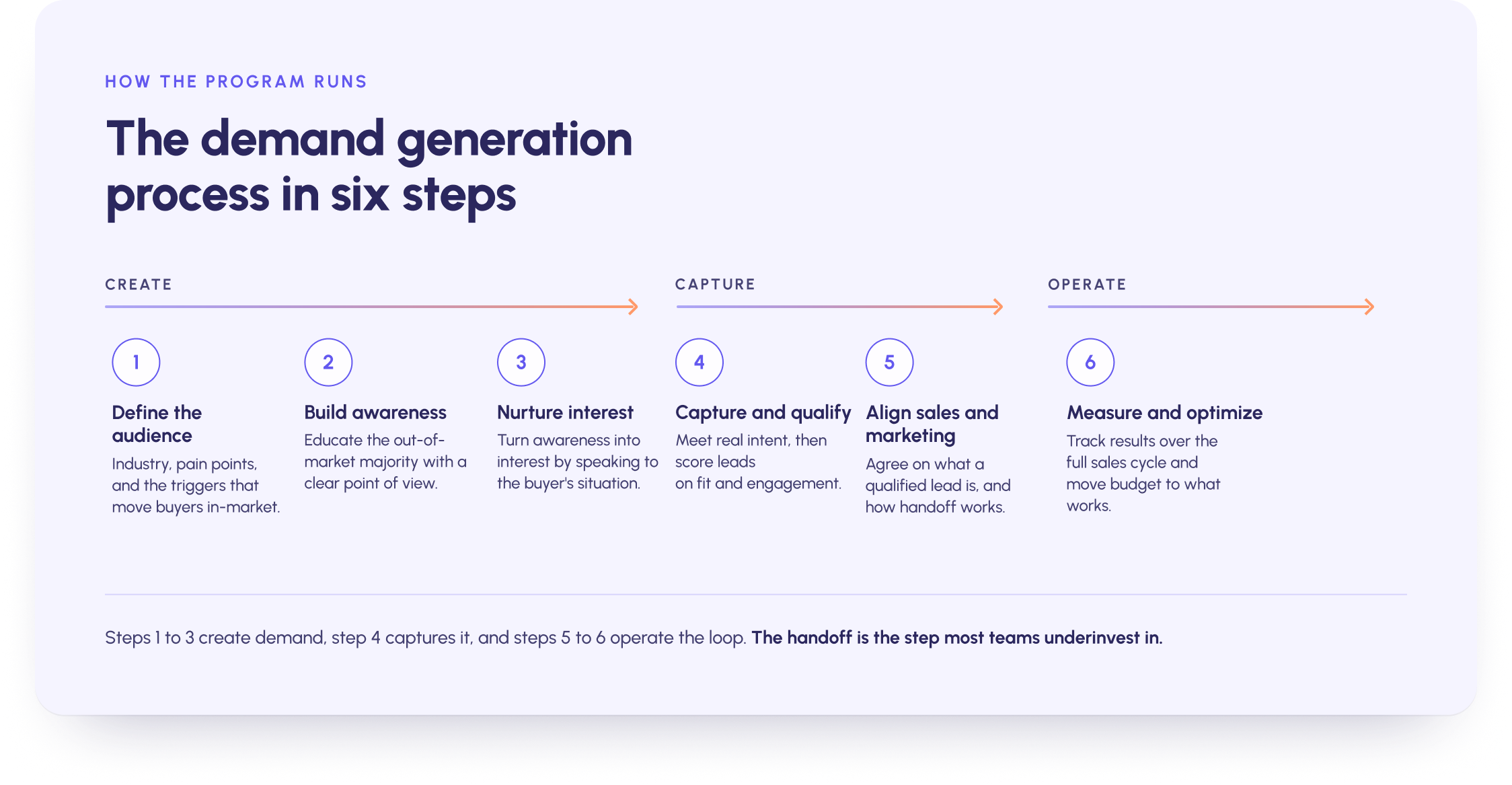
Define your audience and ideal customers
Everything starts with knowing who you are trying to reach. Build a clear target audience: the industry, the role, the pain points that push your ideal customers toward your category, and the triggers that move them into market. Sharpening the target audience is what keeps the rest of the demand generation program from spraying budget at people who will never buy. The clearer your picture of your ideal customers, the more efficient every later step becomes. A demand generation strategy that skips this work wastes everything that comes after it.
Build awareness and educate the market
With the target audience defined, the next step is creating awareness among the out-of-market majority. This is where educational content, point of view, and consistent visibility do their work. Educational content positions a brand as a trusted resource, and trusted resources are the ones buyers remember. The aim is to generate interest and increase awareness of the problem you solve, so buyers connect their pain to your product or service long before they shop, not to ask for a meeting on day one.
Create and nurture interest
Awareness becomes interest when content speaks directly to a buyer's situation. Demand gen involves content creation and brand positioning that build interest by addressing real problems rather than listing what your company's products can do. Nurture sequences, follow-up content, and retargeting keep your brand present as buyers move from "this is interesting" toward "we should look into this." Done consistently, this is what creates a predictable revenue pipeline by keeping interested buyers engaged over long cycles.
Capture and qualify demand
Once a buyer signals real intent, the demand generation strategy shifts from creating demand to capturing it. This is the lead capture moment: a demo request, a pricing inquiry, a high-intent search. A lead scoring system helps here by ranking leads on engagement and fit, so sales spends time on the buyers most likely to close. Lead scoring helps prioritize leads based on engagement and intent, which protects your sales teams from the volume problem that sinks pure lead gen. Tightening this stage is where a demand generation strategy stops leaking pipeline.
Align marketing and sales teams
Demand generation requires collaboration between marketing and sales teams, and this is the step most programs underinvest in. Marketing and sales need a shared definition of a qualified lead, a clear handoff, and agreement on what happens to leads that are not yet ready. When the handoff is clean, the quality of leads improves and fewer good buyers fall through the cracks. When it is not, marketing and sales blame each other while pipeline leaks.
Measure, attribute, and optimize
The final step closes the loop. Track your demand generation metrics, learn what is working, and move budget toward it. The hard part in B2B is attribution, because the buyer journey is long and mostly invisible.
We will cover the metrics that matter and the honest limits of measurement below. The principle for now: measure over the full length of your sales cycle, beyond the current quarter, or you will systematically undervalue the demand creation work that takes longest to pay off. This feedback loop is what keeps a demand generation strategy honest over time.
Demand generation strategies and tactics
A demand generation strategy is only as good as its execution. The tactics below are the marketing channels and methods that carry demand generation campaigns, split roughly between creating demand and capturing it. No team should run all of them at once. Pick the few that fit your target audience and your stage, then add more as you scale.
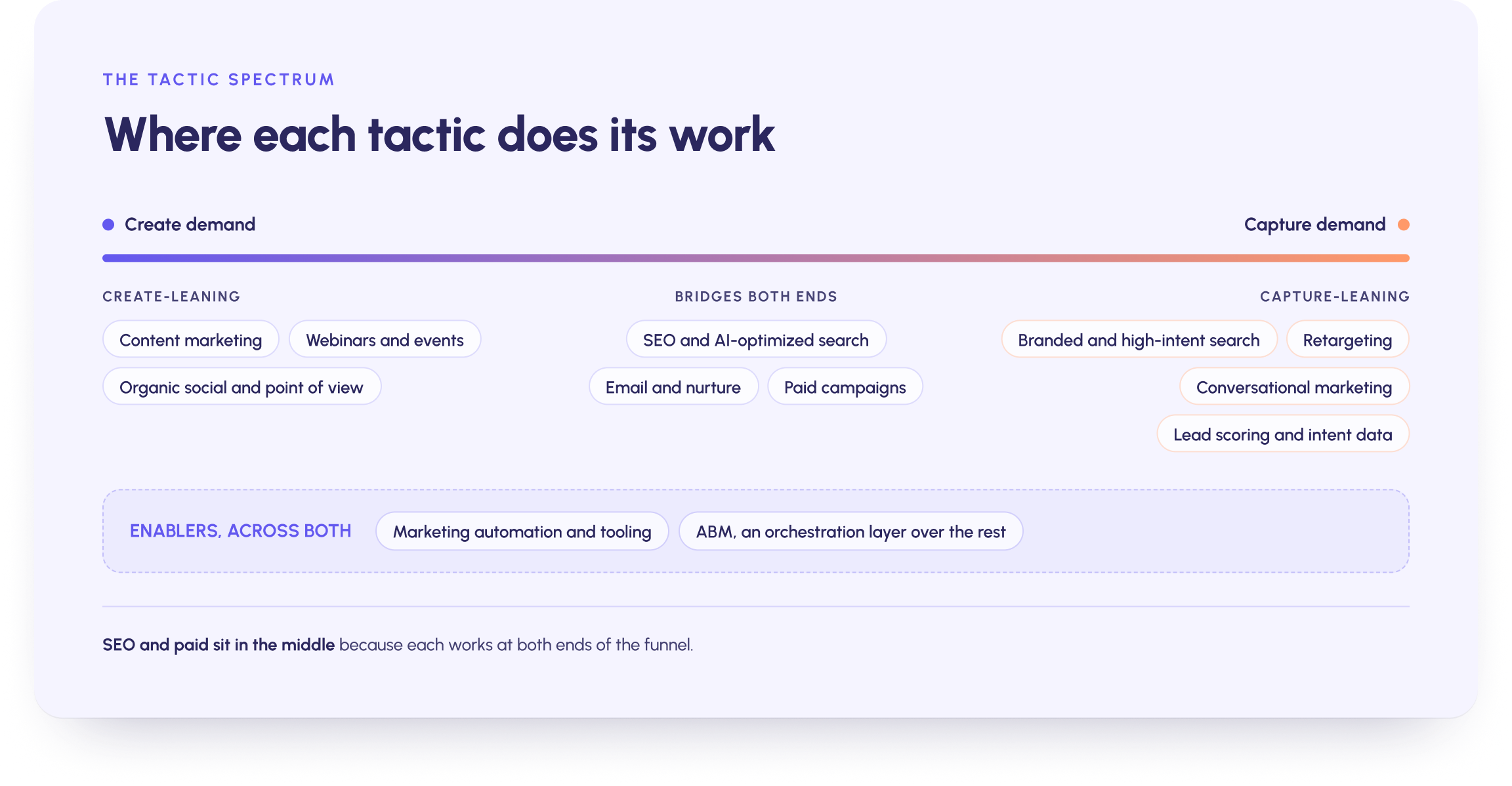
Content marketing
Content marketing is the backbone of most demand gen campaigns. It attracts customers through valuable, informative content rather than interruption, and high-quality content can generate higher quality leads because it teaches buyers to value what you do. Content marketing also establishes brand authority and trust, and it should always address specific buyer pain points rather than talk about your company's products in a vacuum. Strong educational content and industry insights can even shorten sales cycles by doing the buyer's homework for them before the first call. This is how you generate high-quality leads instead of curious tire-kickers.
The ungated versus gated debate sits here. Gating content behind a form maximizes lead capture but limits reach, which works against demand creation. The modern demand generation approach ungates most educational content to build awareness widely, and reserves forms for the genuinely high-value lead magnets a buyer will happily trade their details for.
SEO and AI-optimized search
Search engine optimization helps ensure your content is found by potential customers at the exact moment they are looking. SEO works at both ends of the funnel: problem-stage articles capture early curiosity, while bottom-funnel pages capture buyers comparing options. As AI-generated answers reshape search, being the source those systems cite is becoming its own form of visibility, and the brands with deep, credible content are the ones that get surfaced.
Paid advertising and demand generation campaigns
Paid advertising accelerates demand generation through targeted campaigns that reach the right audience faster than organic alone. For B2B, LinkedIn is the dominant channel because of its targeting by role, company, and industry. Match the ask to the buyer's readiness: brand and educational ads for the out-of-market majority, high-intent search and retargeting for buyers ready to evaluate. Watch campaign performance closely, because demand gen campaigns that push a demo request on cold audiences tend to waste budget. You are asking for commitment before you have earned attention.
Account-based marketing (ABM)
Account-based marketing concentrates demand generation on a defined set of high value accounts rather than the whole market. Account-based marketing targets high value accounts with personalized strategies, coordinating content, ads, and sales outreach around named companies. ABM is best understood as an orchestration layer over your other tactics, not a separate discipline. Account based marketing ABM works when sales and marketing run it together against a shared account list, and it is especially effective when paired with broad demand creation so the accounts already recognize your brand before outreach begins. Done well, account-based marketing ABM concentrates budget on the high value accounts most likely to close.
Webinars and events
Webinars, roundtables, and field events give buyers a reason to engage directly with your team and your point of view. They work across the funnel: a thought-provoking webinar reaches the curious, while an executive dinner deepens relationships with target accounts. Events are also one of the more reliable ways to generate buzz and create interest in a launch or a new category narrative.
Email marketing and nurture
Email marketing nurtures leads through personalized outreach and content over the long cycles B2B demands. Its value is in keeping your brand present with people who have shown interest but are not yet ready to buy, rather than chasing cold contacts. A good nurture program meets buyers where they are in the entire customer journey and moves them forward without pressure. It is also a low-cost way to deepen customer relationships with existing customers, which supports retention and expansion.
Lead scoring and intent data
Intent data tells you which accounts are showing buying signals, often before they ever contact you. Leveraging intent data, teams can prioritize outreach toward accounts that are actively researching the category and hold back on accounts that are not. Combined with a lead scoring system, intent data turns a flood of activity into a ranked list, so sales reps spend their time where it counts. This is also where the 95% rule pays off operationally: intent data helps you spot the moment an out-of-market account finally moves in-market.
Conversational marketing
Conversational marketing, through live chat and chatbots, lets buyers get answers in the moment rather than waiting on a form response. It captures intent while it is hot and routes genuinely interested buyers to sales quickly. Used well, it shortens the path from question to conversation without forcing every visitor through a gate.
Demand generation tools and marketing automation
The right tools hold the program together. Marketing automation handles nurture sequences, lead scoring, and the routing between marketing and sales, so the process runs without manual effort at every step. A CRM keeps your data and sales activity in one place. Demand generation tools matter, but they serve the strategy, not the other way around. Buying more software will not fix a program that has no point of view, and it will not generate demand on its own.
What is an example of demand generation?
A concrete example makes the abstraction land.
Picture a B2B SaaS company selling planning software to finance teams. A pure lead generation play would gate an ebook, capture emails, and have SDRs cold-call everyone who downloaded it, most of whom were just browsing. A demand generation approach looks different. The company publishes ungated articles and frameworks about the forecasting pain points finance leaders actually face.
It shows up consistently on LinkedIn with a clear point of view. Its founder guests on finance podcasts. None of this asks for a meeting. It is all creating awareness and building trust with the 95% who are not buying yet, and it positions the product or service as the obvious answer once they are.
At the same time, the company captures the 5% who are ready: it ranks for high-intent searches, maintains a strong presence on review sites, and retargets people who visited its pricing page. Intent data flags when a target account starts researching, and only then does sales reach out, to a buyer who already recognizes the brand. When that buyer builds a shortlist, this company is on it from day one. That combination, patient demand creation plus sharp demand capture, is demand gen working as intended.
The famous version of this is HubSpot, which built an audience around the idea of inbound marketing years before most of that audience was ready to buy software. By the time buyers went looking, HubSpot owned the category in their minds. That is demand creation at the highest level, and it is also rare, which is a point worth being honest about.
Demand generation metrics that matter
These metrics tell you whether the program is producing business results or just activity. These are the numbers worth tracking.
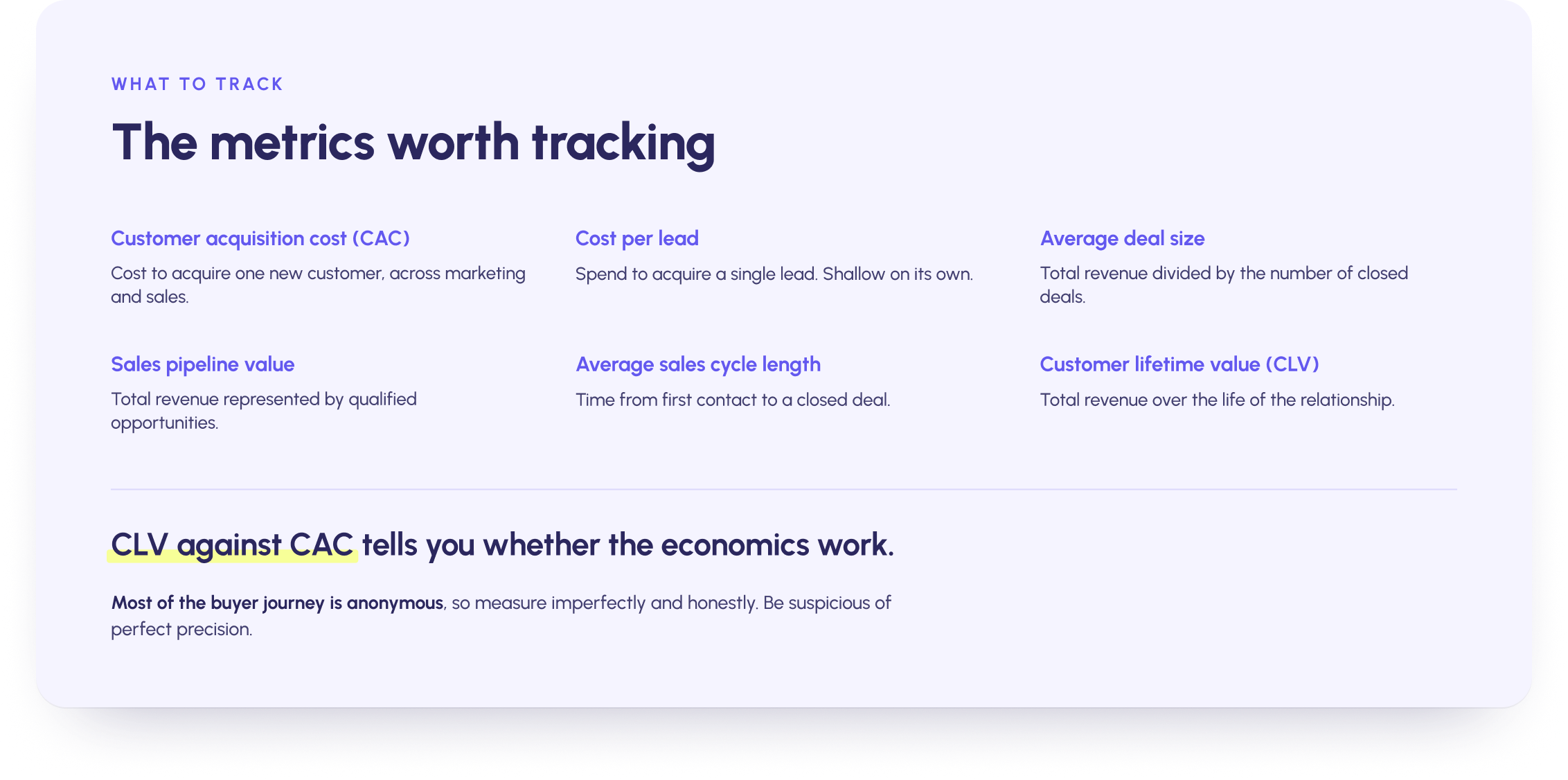
Customer acquisition cost (CAC)
Customer acquisition cost measures how much you spend to acquire a new customer, across marketing and sales. It is the headline efficiency metric for any demand gen program, and it is most useful when you compare it against the value a customer brings over time.
Cost per lead
Cost per lead indicates how much you spend to acquire a single lead. It is useful for comparing the efficiency of different marketing channels, but it is a shallow metric on its own. A low cost per lead means nothing if those leads never convert, which is exactly the trap that volume-focused lead gen falls into.
TGS sees this in audit after audit. At one company, the marketing team's MQL numbers looked spectacular, right up until you saw what was being counted as an MQL.
"They were counting MQLs as everybody who filled in a form... gave content, newsletter, but all the Gmails, the Outlooks, everything. So there was no qualification, no nothing. And of course, marketing was killing it with their MQLs. Great. If you look at MQL to SQL conversion, it was 8%."
Joliene van Grieken, co-founder, The Growth Syndicate
A cost per lead that looks cheap is only cheap on paper. Divide the spend by the 8% of those leads that were real, and the true cost is more than ten times what the dashboard reported.
Average deal size
Average deal size is calculated by dividing total revenue by the number of closed deals. Tracking it over time shows whether your demand generation strategy is attracting better-fit, higher-value buyers or simply more of them.
Sales pipeline value
Sales pipeline value is the total revenue represented by qualified opportunities in your pipeline. It is one of the more honest indicators of demand generation health, because it ties marketing activity to real revenue potential rather than to lead counts. It also keeps the conversation between sales and marketing focused on revenue rather than raw lead volume.
Average sales cycle length
Average sales cycle length measures the time from first contact to a closed deal. A strong demand generation strategy can shorten sales cycles significantly, because buyers who already understand and trust your brand move through evaluation faster. Watching this number tells you whether your demand creation work is actually making sales initiatives easier to close.
Customer lifetime value
Customer lifetime value estimates the total revenue a customer generates over the life of the relationship. Pairing lifetime value against CAC is how you know whether your demand generation marketing is economically sound. Demand gen also tends to lift retention by attracting better-fit buyers in the first place, which raises lifetime value over the long run.
A note on measurement. Marketing data in B2B is incomplete by nature, because most of the buyer journey is anonymous and long. Figuring out how much revenue your marketing actually influenced is genuinely hard, and any honest measurement approach mixes self-reported attribution ("how did you hear about us?") with the trackable digital signals your tools can see. Connecting marketing efforts to closed revenue is the hardest part of all. Be suspicious of any system that claims perfect precision.
Sales and marketing alignment
Demand gen lives or dies on the relationship between marketing and sales. When the two functions share goals, definitions, and data, the whole program performs better.
The figures usually quoted to prove this come mostly from vendor research, much of it a decade old, and they are worth a degree of caution. Forrester, through its SiriusDecisions arm, is the usual source for the headline figure: aligned organizations grow around 19% faster than misaligned ones. Marketo is behind several of the others, including close rates roughly 67% higher and customer retention about 36% higher. The same roundups add larger deals, around 20%, and a sales cycle often near 15% shorter, with the lead-quality lift repeated too, though its attributions are the haziest of the set. Read them as directional. The mechanism is the part to trust: better alignment between marketing and sales teams supports stronger business growth than the two functions working in parallel.
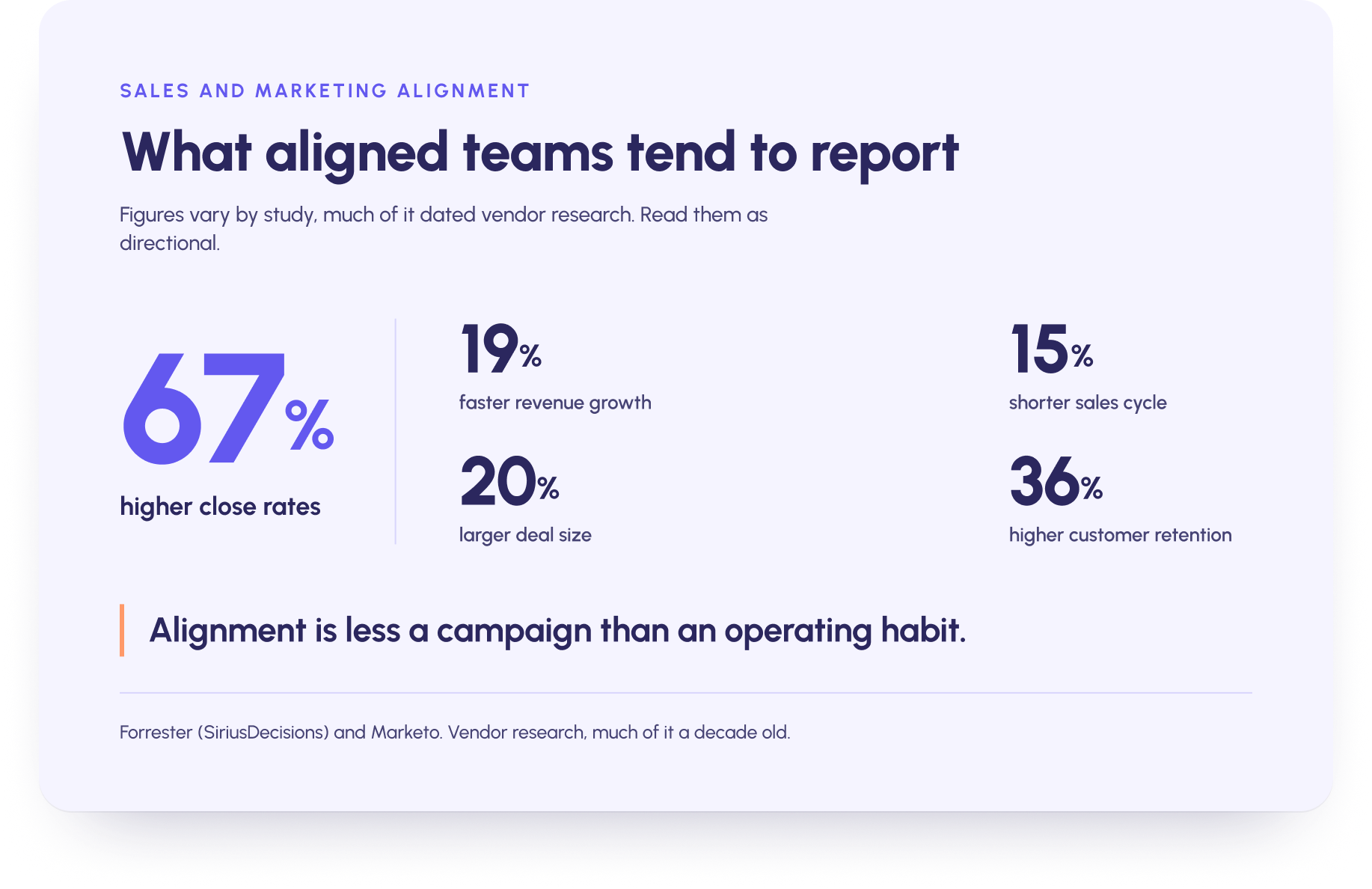
In practice, alignment means revenue teams agreeing on what a qualified lead is, how leads are handed off, and what happens to the ones that are not ready yet. It is less a campaign than an operating habit, and for most programs it is the single fix with the most upside.
Shared targets are what turn alignment from a slogan into something both teams answer for.
The honest version: where demand generation oversells itself
Everything above is the working version of demand generation, and it is genuinely useful. But TGS has run these programs long enough to be straight about where the term overpromises, and you are better served knowing this than not.
Marketing does not manufacture demand
The word "generation" suggests marketing can make organizations want things they do not need. It cannot. Demand in B2B emerges when an organization hits a problem its current setup cannot solve. Gartner found that 99% of B2B purchases are driven by organizational change: a new system, a leadership change, a regulation, a growth target. Marketing does not create that trigger.
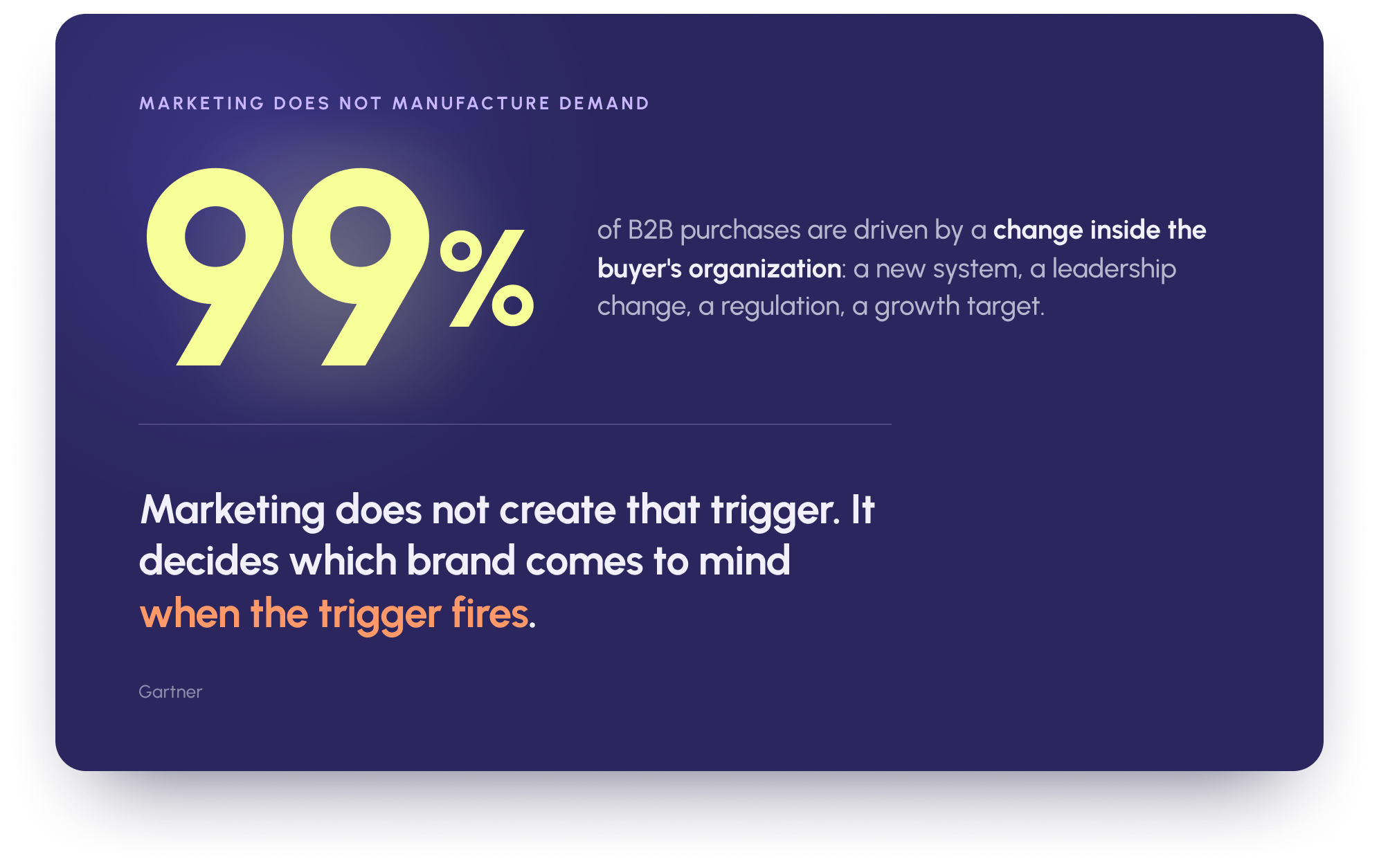
What marketing can do is make sure your brand is the one that comes to mind when the trigger fires. That is salience, and it is a real and valuable job. It is just not the same as the idea that you can generate demand from nothing. No campaign conjures the entire demand for a category into being; the underlying need has to already be forming.

That is the honest ceiling of what marketing controls, and it is plenty. The harder question is proving you did it, which is where the next problem starts.
"Attribution is hard" is true, and it has become an excuse
The honest observation that B2B attribution is difficult, because the customer journey is long and mostly invisible, is correct. The problem is what teams do with it. Some use it as license to stop measuring altogether, producing demand generation campaigns that look impressive but cannot be tied to pipeline or revenue, and waving away every question with "that's not how demand gen works."
Two things are true at once. Attribution is genuinely harder than most dashboards admit.
And "attribution is hard" has become the most popular reason for marketing teams that have quietly stopped trying to prove their impact. Measure imperfectly and honestly. Do not use the difficulty as cover.
Category creation is the rare exception
Salesforce created cloud CRM. HubSpot defined inbound marketing. These companies genuinely created demand by reframing how buyers understood their problem. It is real, and it is also rare.
Category creation requires a genuinely new market thesis, and almost no team running a content program is actually doing it. If you sell into an existing category with known competitors, you are competing for salience, not creating a category. Mistaking the second for the first is how ordinary programs overestimate what they can achieve.
Name the work, not the buzzword
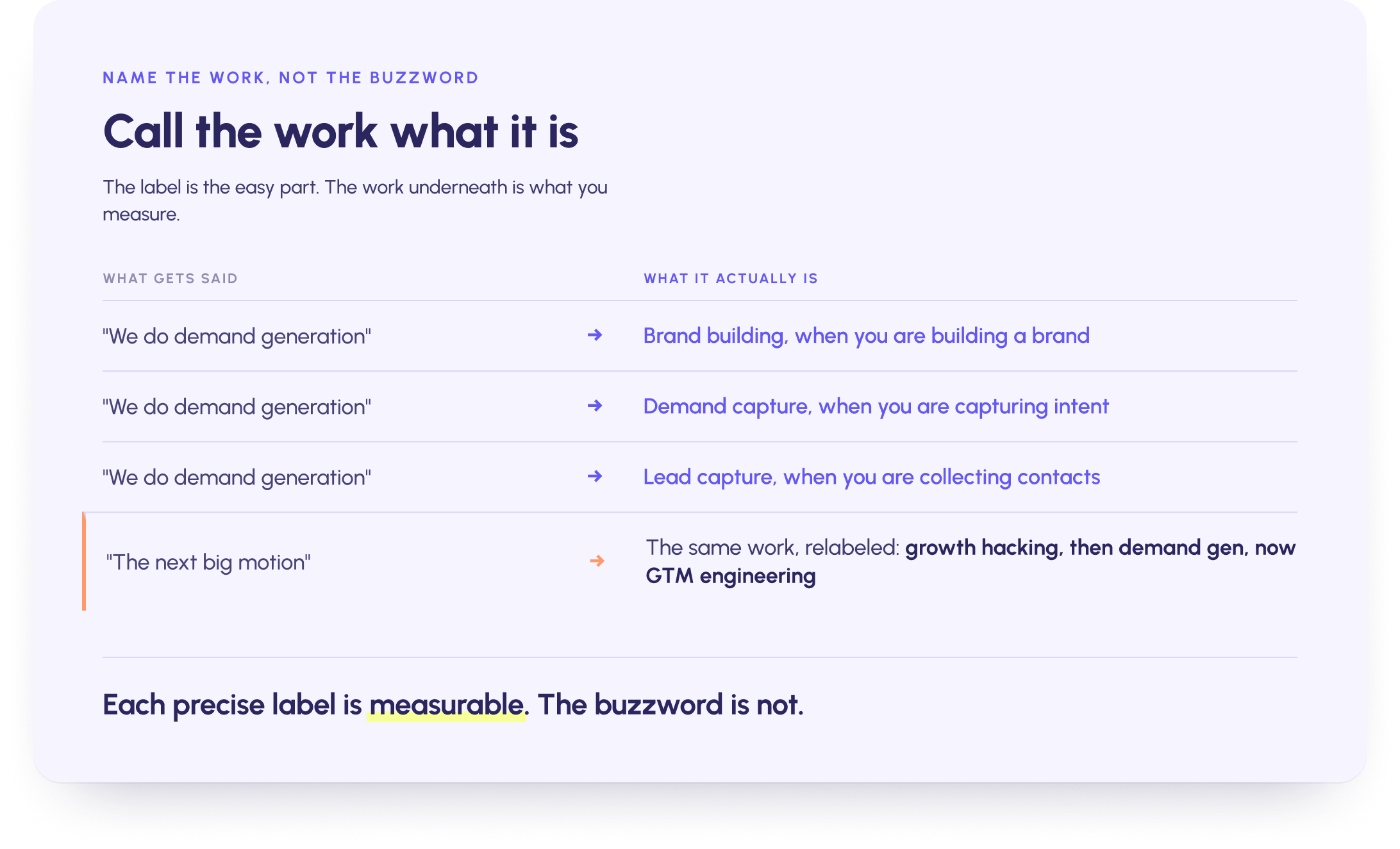
Marketing buzzwords follow a pattern. Growth hacking arrived promising to change everything. It got attached to ordinary work dressed up as clever tricks, then faded. Demand generation shows signs of the same arc, and "GTM engineering" is already lining up as the next term to chase. The underlying work does not change when the label does. Our advice is simple: use the term if it is useful shorthand, but know what you are actually doing underneath it.
"Marketing is marketing, you have to go back to the basics. Nothing has changed in like 100 years."
Clément Dumont, co-founder, The Growth Syndicate
His point is not that marketing never advances. The tools and channels change constantly. The fundamentals do not. Take the label off demand generation, growth hacking, or GTM engineering and the same handful of jobs sits underneath: understand the buyer, earn attention before they are shopping, build preference, and be the easy choice once they are ready. The name on the box changes every few years. The work inside it does not.
Call it brand building when you are building a brand. Call it demand capture when you are capturing intent. Call it lead capture when you are collecting contacts. Each of those is precise and measurable, and none of them pretends to be magic.
How to build a demand generation program that works
If you take one thing from this guide, take the sequencing. Build familiarity with the 95% who are not buying yet, capture the 5% who are, and measure both over the real length of your sales cycle. A good demand gen strategy is mostly the discipline to keep doing the patient work when the fast work is louder.
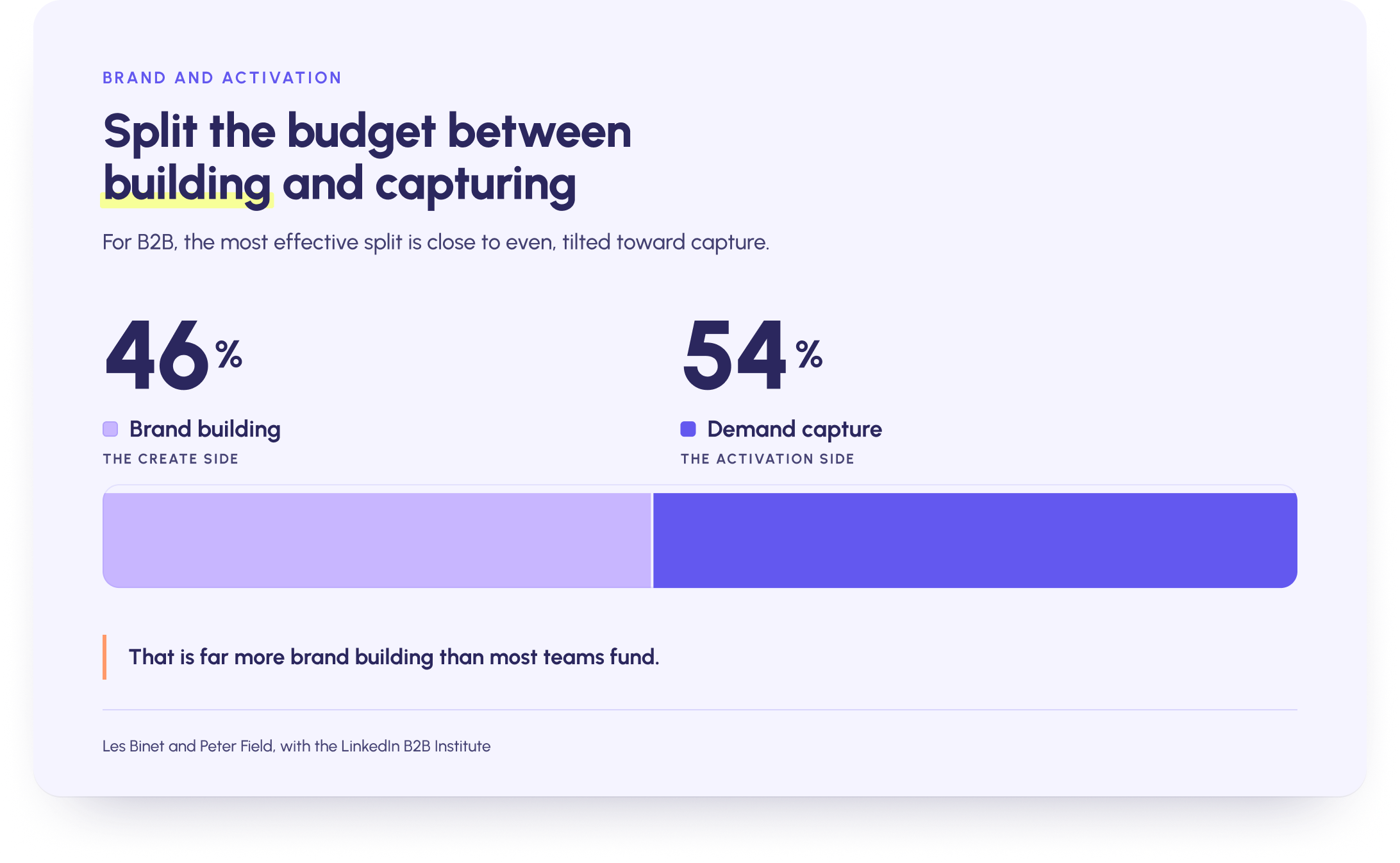
A few practical guardrails. Split your investment between creating demand and capturing it rather than pouring everything into the bottom of the funnel; research from Les Binet and Peter Field with the LinkedIn B2B Institute suggests B2B works best at roughly a 46/54 split between brand building and activation, which is far more brand-building than most teams fund. Do not gate everything. Do not measure for a shorter window than your sales cycle.
Do not treat MQL volume as the goal, because the majority of marketing qualified leads never become opportunities. And do not buy more software to paper over the absence of a point of view. The strongest demand generation marketing strategy is a clear position in the market, executed consistently, and held to account against revenue.
The honest framing TGS uses with its own clients is this: the question was never really "how do we generate demand?" The question is whether you are on the buyer's shortlist before they start looking. If you are, your demand gen is working. If you are not, that is the problem to solve first, and every tactic in this guide is in service of solving it.
.png)