.svg)


A note before we begin. This article was shaped by Daria Kalinina, our dear friend and former colleague. She led performance at The Growth Syndicate before recently moving on to a role in acquisition at TikTok, and before she left she helped us structure this piece and shared some of the most valuable thinking in it. Our thanks go with her
We often open a new client's ad account and find that 50-70% of the budget is flowing to irrelevant search terms, the wrong job titles, or channels that were never configured to produce revenue. This happens with unsettling regularity, all while the tools have never been more capable. The problem is that the execution is frequently terrible.
Performance marketing is a marketing strategy where advertisers pay only when a specific action occurs: a click, a lead, a completed sale. The gap between what that model promises on paper and how marketing companies actually run it accounts for millions in wasted spend every quarter.
This guide covers the full picture. If you run a company, the misconceptions and measurement sections will probably save you money. If you manage campaigns, the channel benchmarks and optimization frameworks give you something to pressure-test your own setup against. Both of you should read how to measure performance marketing success. That is where most of the budget disappears.
What is performance marketing, exactly?
What is performance marketing once you strip the jargon? It is any data-driven marketing activity where a brand pays a publisher, affiliate, or partner only when a buyer takes a predetermined action. The pay-for-performance model reduces financial risk, because advertisers pay based on measurable results rather than impressions alone.
Unlike a brand campaign that buys exposure and hopes for lift, performance advertising ties every dollar to a tangible outcome. Businesses can monitor performance in real time and adjust within hours. That accountability is the appeal. It is also where overconfidence creeps in, because "measurable" and "measured correctly" are not the same thing.
Performance marketing is not a silo
The misconception we meet more than any other: "We set up the ads, we spent the budget, now it should work."
It does not function that way. Performance marketing work does not happen in a vacuum. It creates touchpoints, builds recognition among your target audience, and produces signals that the rest of your go-to-market motion converts into pipeline. Sales, content marketing, events, founder outreach. None of these sit outside performance. They are the reason performance marketing drives revenue.
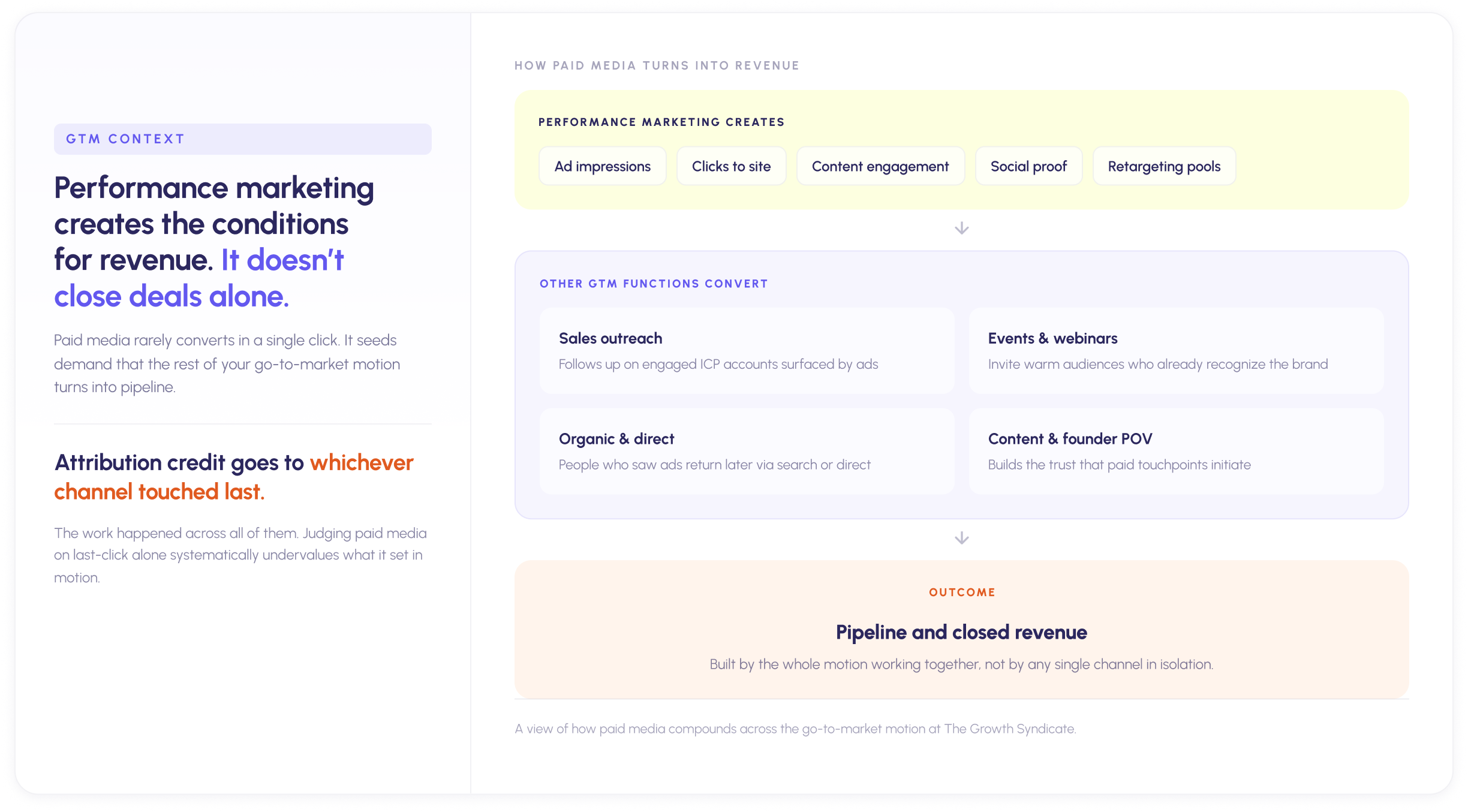
"This is the most common misconception I encounter," says Daria. "Founders expect ads alone to produce results, without creative, content, sales, or their own involvement. Performance marketing operates inside a multi-channel approach. You never switch on one channel and announce that you have performance."
In B2B this is sharper. The final conversion rarely arrives through an ad click. It arrives through a sales call, an event, or an outreach email triggered by intent signals that paid campaigns surfaced. That outcome does not diminish the performance marketing campaigns that created it. It confirms they worked.
Trouble starts when teams grade each channel as if it should close deals on its own. LinkedIn and Reddit almost never show a last-click conversion. What they do is shift opinion and build the familiarity that gets a cold email opened. Kill those channels and you remove the quiet work that made the obvious conversions possible.
"A lot of teams get disappointed in these channels," Daria mentions. "They say they stopped running LinkedIn because they never saw conversions. The value was not missing. It was measured in the wrong place: in the touchpoints that bring people back later, organically, through Google, or to a meeting."
What this means for founders
Performance advertising creates the conditions for revenue. It does not close deals by itself. If your sales team is not looped into what paid channels surface, which companies engage, which job titles click, which content lands, then the most valuable output of your ad spend sits unused.
What this means for performance marketers
Build reporting that shows the whole journey, not last-click conversions alone. Track which ICP companies see your ads and which ones engage. On LinkedIn, the companies that interact with your social media ads but never visit your site are still a qualified, relevant audience. Retarget them. Tell sales who they are.
Three forces reshaping performance marketing in 2026
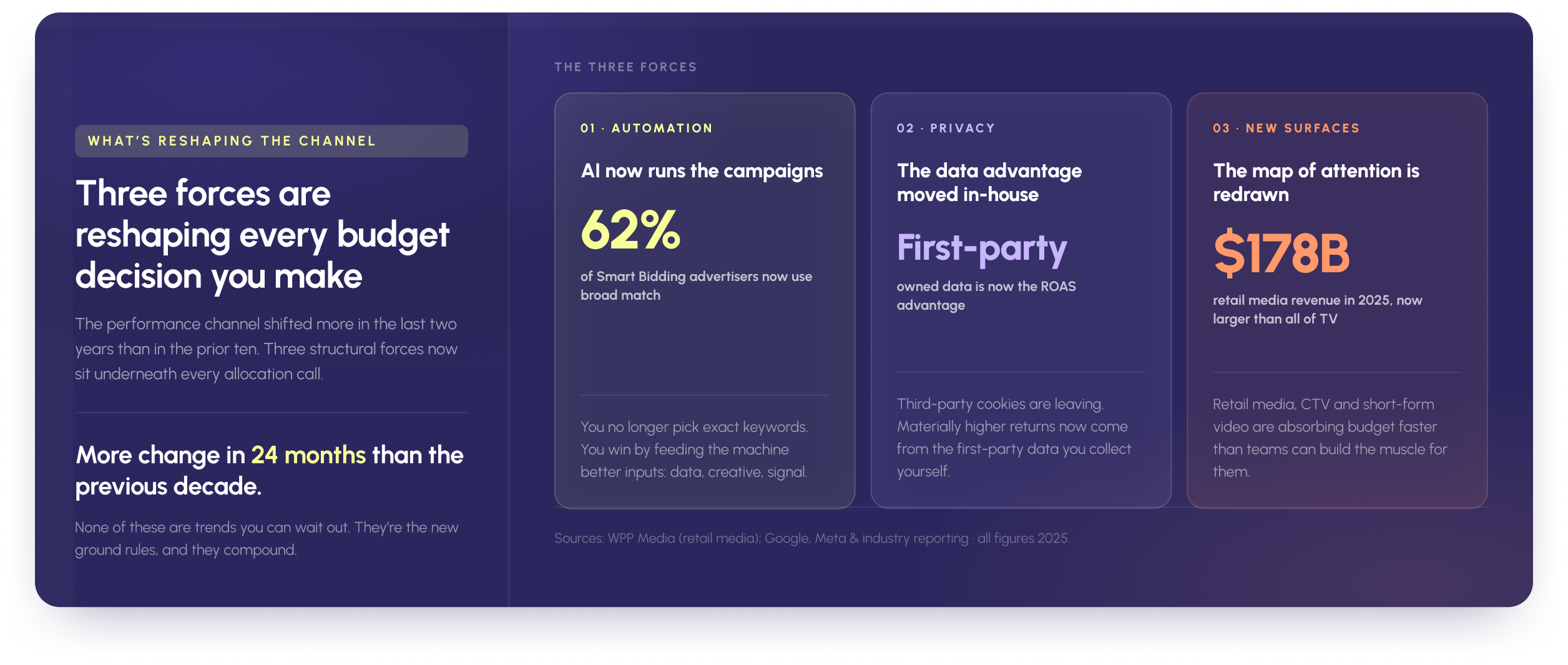
Before the channel tactics, the macro picture. Global advertising spend reached roughly $1.14 trillion in 2025 (WPP Media year-end forecast), with digital channels at about 69% of total investment (both WPP Media and Dentsu). The digital marketing playbook that worked in 2022 is mostly obsolete, for three reasons.
Artificial intelligence runs the campaigns now
Artificial intelligence has moved from experiment to default. Google's broad match plus Smart Bidding setup is now the primary keyword strategy for 62% of Smart Bidding advertisers. Meta reports its Advantage+ campaigns return $4.52 for every $1 spent, about 22% more than manually managed campaigns, though independent research from Haus across 640 incrementality tests suggests Advantage+ can underperform manual setups over longer horizons. Microsoft says its Copilot-enhanced ads drive 73% higher click-through rates and 16% stronger conversion rates in conversational search (Microsoft research, November 2024 to May 2025). Advertisers used Google's Gemini to generate nearly 70 million creative assets in Q4 2025 alone (Alphabet Q4 earnings call).
The implication for performance marketers is direct. If you still set tight keyword match types and hand-pick audiences by hand, you are competing against systems that weigh more signals per second than a team can review in a month. The job has shifted. Campaign performance now depends on the quality of the inputs you feed: creative, conversion data, first-party audience signals.
Privacy regulation reshapes audience targeting
Google reversed its cookie deprecation plan in July 2024 and formally ended the Privacy Sandbox initiative in October 2025. Third-party cookies still work in Chrome with no removal date. The industry is migrating to first-party data anyway, because Safari and Firefox already block third-party cookies, Apple's App Tracking Transparency suppresses mobile attribution, and several countries expanded privacy laws in 2025.
The data driven performance marketing teams pulling ahead are the ones building first-party data through CRM integration, server-side tracking (Meta's Conversions API, Google's Enhanced Conversions), and consent-based collection. Practitioners widely report that first-party data targeting delivers meaningfully higher ROAS than third-party approaches, and that server-side tracking captures conversion events client-side pixels miss.
Platform concentration versus emerging marketing channels
Meta, Google, and Amazon together take over 55.8% of global ad spend outside China, about $524 billion (WARC, Q3 2025). But the smaller marketing channels are where the marginal return now sits. Retail media networks reached roughly $178 billion globally in 2025 and passed traditional TV revenue for the first time (WPP Media). Connected TV ad spend grows 14%+ a year. TikTok's ad revenue, around $23.6 billion in 2024, is forecast to grow substantially through 2026, with estimates from $34.8 billion to $44 billion depending on the source.
The core advertising platforms still deserve most of the budget. The point is that expanding into retail media, connected TV, or TikTok pays back better than it used to, depending on your market and your target audience.
Types of performance marketing: channels, benchmarks, and what we find in accounts
The types of performance marketing share one logic, pay for a measurable action, but behave very differently in practice. Across all performance marketing channels the question is the same: is this reaching the right people, and can you prove it. Here is what the benchmarks say, and what we actually see when we audit accounts.
Search engine marketing (SEM): the backbone gets pricier and more automated
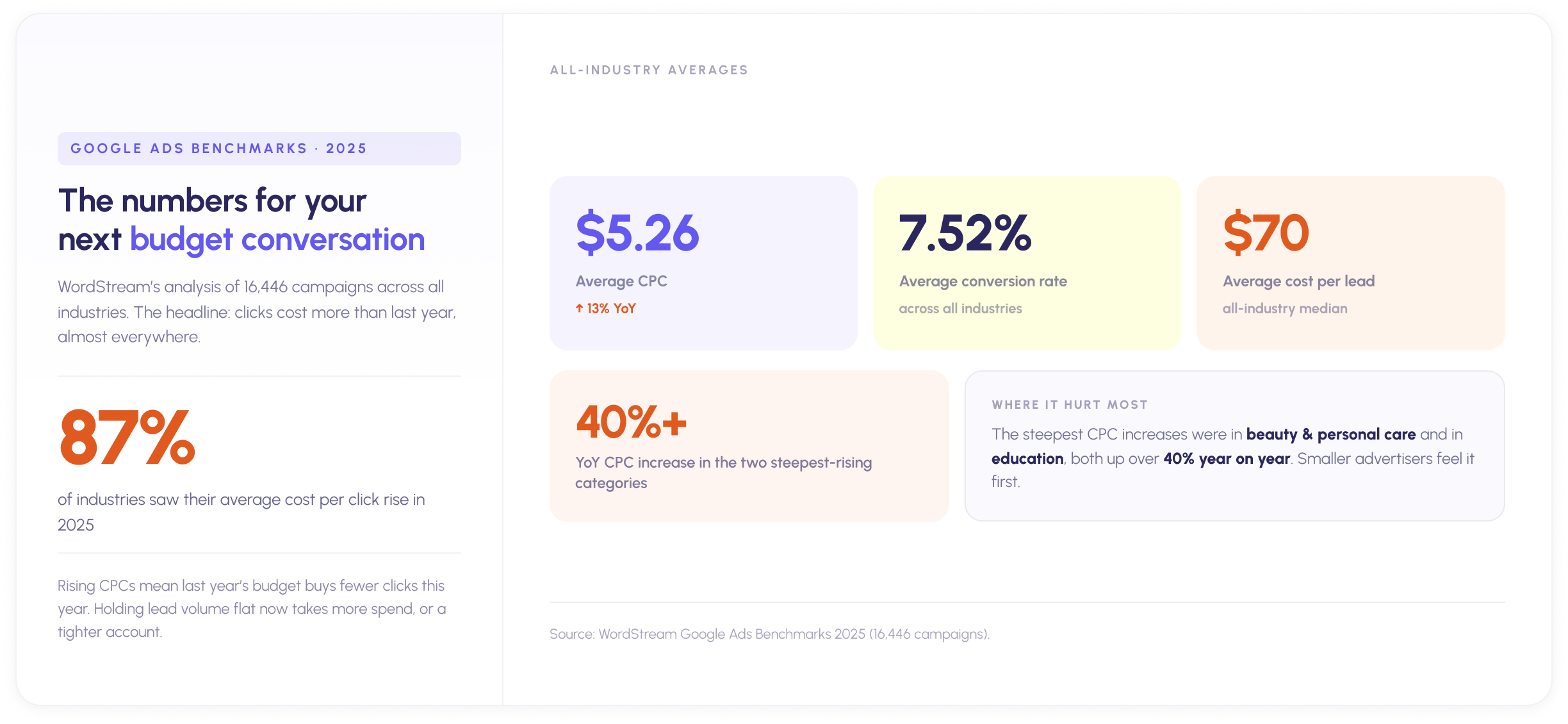
Paid search is still the largest performance marketing channel. Search engine marketing (SEM) puts your ad in the search engine results pages when someone searches a keyword, and you pay per click. Unlike search engine optimization, which earns rankings over months, paid search buys position instantly. WordStream's analysis of 16,446 US campaigns puts 2025's average Google cost per click at $5.26 (up 12.88% year over year), average conversion rate at 7.52%, and average cost per lead at $70.11. Cost per click rose for 87% of industries, steepest in beauty and personal care and in education, both over 40%.
AI Overviews changed the SERP. Google's AI Overviews peaked near 25% of queries in July 2025 before settling around 15.7% by November (Semrush). Only Performance Max, AI Max, and broad match campaigns can show ads inside them; exact match is excluded. Zero-click searches climbed from 56% to nearly 69% between May 2024 and May 2025 (Similarweb), and Ahrefs' December 2025 analysis found a 58% drop in organic click-through rate for pages under an AI Overview, up from a 34.5% estimate in April.
Google's recommended default is now broad match plus Smart Bidding plus responsive search ads, which test ad copy combinations automatically. Google's own data says advertisers switching from phrase to broad match see about 25% more conversions on target CPA and 12% more conversion value on target ROAS. Its Smart Bidding Exploration feature reports an 18% lift in unique converting query categories and a 19% lift in conversions when advertisers set target ROAS with 10-30% flexibility, and AI Max itself claims a 14% conversion lift excluding retail. All of these are Google self-reported and should be read that way.
What good search engine marketing looks like

"The most common mistake I see is budget flowing to very broad, generic terms on broad match. With technical products, I have seen companies advertise a complex system and show up for something completely unrelated. These keywords carry very high cost per click. There is no room for error, because lost money and lost opportunity add up fast."
The waste is startling. Our audits regularly find 50-70% of search engine marketing spend going to terms with no intent at all, where the searcher wanted something else and got matched through sloppy keywords. That single problem halves a company's effective performance before anyone optimizes anything.
Good practice is unglamorous. Run a search term report weekly or every two weeks. Add the high-intent long-tail keywords, which convert better because the searcher knows exactly what they want, and exclude the irrelevant ones. Split multinational accounts by geography: Europe usually costs less than the UK, the UK less than the US, and a single bidding strategy across all three means overpaying in the cheap markets and losing the expensive ones.
Performance Max improved in 2025 with campaign-level negative keywords (up to 10,000), channel reporting, and device-level controls. The recommended minimum is $100-150 a day for four to six weeks, with custom video, because auto-generated video underperforms in most accounts.
Microsoft Ads: the underpriced search engine
Bing holds about 17.2% of US desktop search, with an estimated 44 million desktop users you cannot reach through Google Ads. Average cost per click is $1.54 (33% lower than Google), click-through rate is 2.83% (50% higher), and cost per acquisition (CPA) is $41.44 (30% lower). Microsoft's LinkedIn Profile Targeting lets search campaigns target by company, industry, job function, and seniority; Microsoft reports that pairing LinkedIn with in-market targeting produces 68% higher conversion rates and 22% lower CPA. For marketing companies spending on Google and ignoring Microsoft, cheaper high-intent traffic is sitting uncollected.
Social media advertising: Meta leads, measurement separates the rest
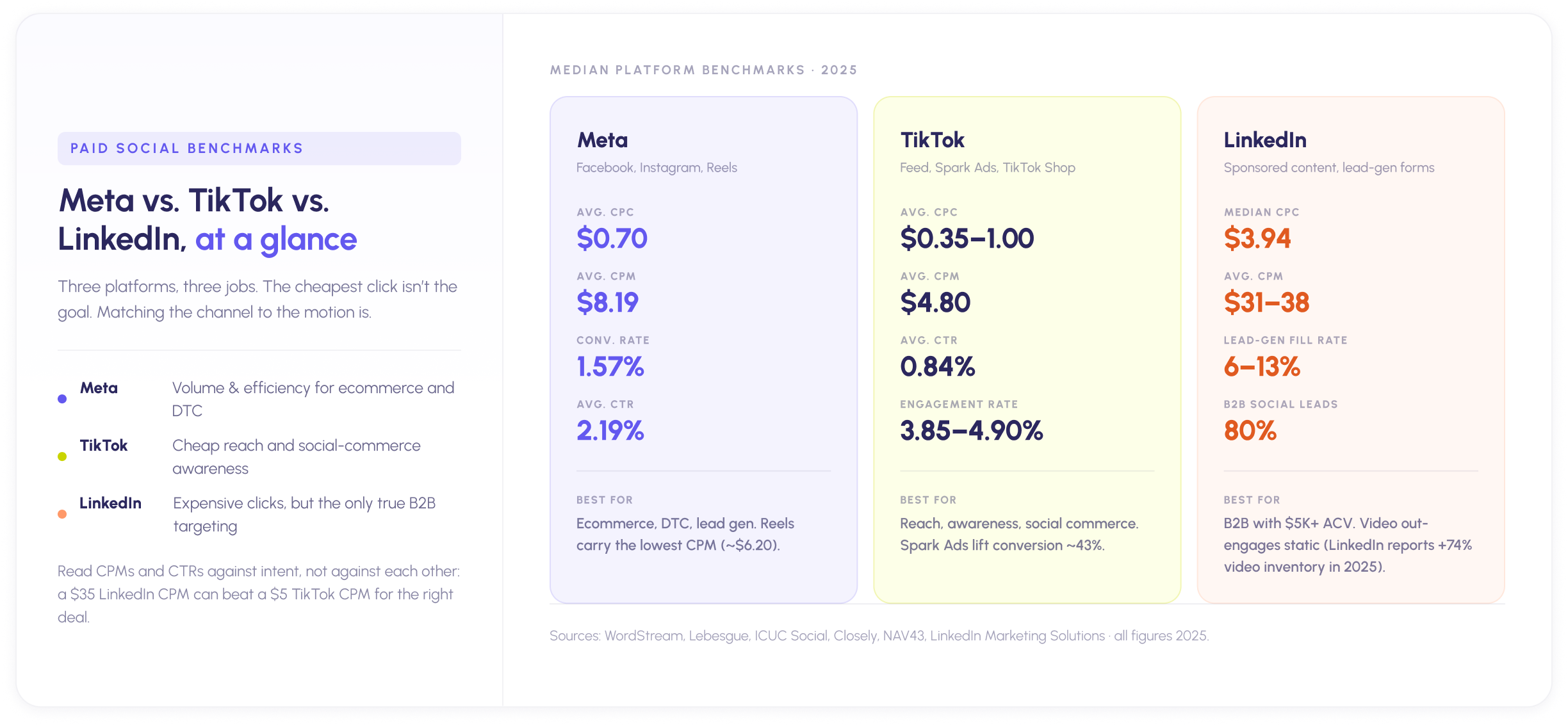
Among social media channels, Meta leads: it took 68% of ad budgets among Triple Whale's ecommerce brands in 2025. WordStream's benchmarks put the average cost per click at $0.70 on traffic campaigns and the average click-through rate at 2.19%. Triple Whale reports a median conversion rate of 1.57% and median ROAS of 1.93. Social media advertising on Meta now generates roughly $94 billion a year, and social media marketing on the platform rewards volume and variety in creative more than clever audience setup.
The shift on the ad platform is decisive. Meta retired several detailed targeting exclusions in 2025 and pushed toward creative-signal optimization. Your target audience is now set mostly by the creative itself: the algorithm reads the ad and decides who should see it. Manual audience micro-targeting is secondary.

"Performance is never a set-and-forget function. At some point your audience penetration hits 100%, your frequency climbs, and people start hiding your ads because you have worn them out. You refresh the lists, the targeting, and the creative constantly, or the results start to slide."
UGC-style content consistently beats polished brand creative on cost per acquisition across practitioner reports, though the margin varies by vertical. At meaningful spend, refresh creative every 7-14 days. The most valuable hire on most performance marketing teams now is the creative strategist, someone who reads data and visual composition with equal fluency.
TikTok: cheapest reach, growing commerce, regulatory reset
TikTok's CPM swings by campaign type, from about $4.80 on ecommerce conversion campaigns (Lebesgue) to $8-$9 blended. Cost per click runs $0.35-$1.00, with engagement between 3.85% and 4.90% in 2025 (WebFX). Facebook, by comparison, sits near 0.8%. Spark Ads, which amplify existing organic posts, beat standard social media ads on completion and conversion, with sources citing roughly 2.4x click-through rate and 40%+ better conversion.
TikTok Shop reached real scale in the US in 2025, around $15 billion in GMV. The regulatory cloud cleared in January 2026 when the USDS joint venture closed on January 22, moving US operations to majority American ownership, with Oracle, Silver Lake, and MGX among the investors and ByteDance keeping 19.9%. The algorithm is retraining on US-only data, so plan for 30-60 days of distribution turbulence.
LinkedIn: expensive, until you reframe the measurement
LinkedIn costs 5-10x what Meta does. Median cost per click is $3.94 and average CPM runs $31-$38 (Closely, 2025). For consumer brands or low-ticket products, the math does not work.
For B2B with high contract values, the question changes from "does LinkedIn produce last-click conversions" to "does LinkedIn reach the right companies and build the familiarity the rest of our go-to-market needs."
"LinkedIn shows you which companies see your ads and which ones engage," Daria explains. "That is the real measurement. When ICP companies show interest, engagement, page visits, the sales team can run outreach or host an event. These people already know you and the product. They respond far more than a cold prospect."
The precision demands discipline. "I keep seeing accounts that target everyone in the IT industry," she says. "Nobody remembers that IT companies also contain HR, office managers, and the company doctor. They all sit under 'IT companies.' Without granular audience targeting by job title and function, your budget feeds impressions to people who will never buy."
The performance marketing tactics that earn the LinkedIn premium are specific. Retarget the people who engaged with your social media ads but never reached the site. Run Thought Leader Ads, the founder-led posts that do not read as advertising. Use video, which LinkedIn says grew 74% in inventory in 2025 and out-engages static. Treat lead gen forms, with fill rates in the 6-13% range, as a top-of-funnel capture rather than a closing tool. LinkedIn claims 80% of B2B social media leads start on the platform, with 65 million decision-makers active. None of it pays off without the measurement reframe above.
Programmatic and display advertising: automated buying at scale
Display advertising uses visual ad formats across a vast inventory of sites and apps, bought programmatically in real time through ad networks and exchanges. Programmatic now accounts for the majority of digital advertising display buying. Standard display click-through rates are low, but the format earns its place in retargeting and in keeping a brand present against a defined target audience between higher-intent touchpoints.
For most B2B advertisers, programmatic display is a supporting channel, not a primary one. Contextual targeting has returned as a privacy-safe way to place ads against relevant content rather than tracked individuals, which makes it a sensible companion to search and social rather than a standalone bet.
Affiliate marketing: the highest-return channel most companies underuse
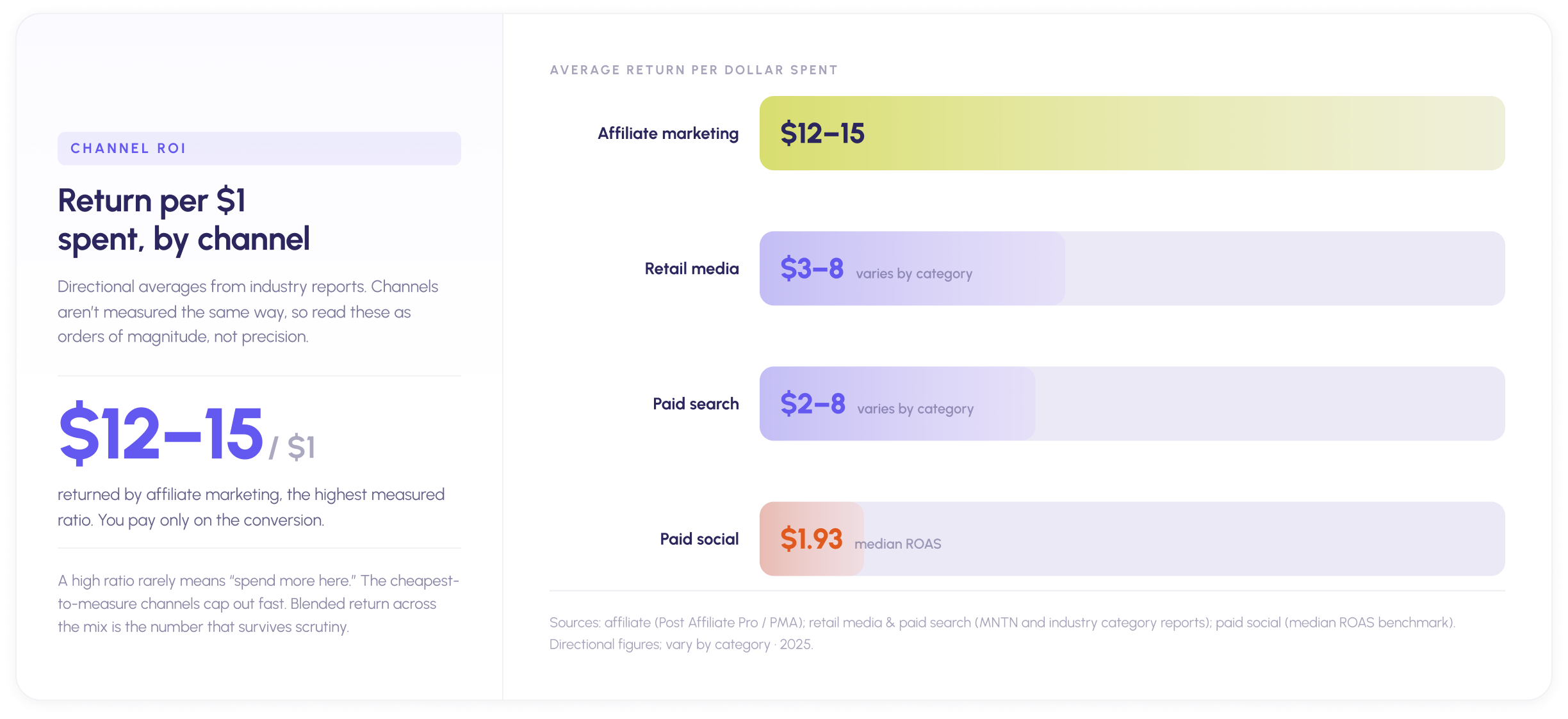
Affiliate marketing reached roughly $17-$18.5 billion globally in 2025, growing about 14.4% a year, double the pace of broader ecommerce. The Performance Marketing Association's 2025 study found US affiliate spending of $13.6 billion generated $113 billion in ecommerce sales, 9.4% of all US ecommerce. Average return sits at $12-$15 per dollar spent, among the highest of any channel. For many ecommerce and SaaS brands, affiliate marketing is the single best-returning line in the budget.
Affiliate marketing is a subset of performance marketing in its purest form: advertisers pay affiliates only when a specific action occurs, usually a sale. Commission structures vary widely, from 20-70% for SaaS, often recurring, to $50-$200 flat per lead in finance, 8-18% in fashion and beauty, and 5-20% for general ecommerce. Affiliate marketing rewards picking partners by audience fit over raw reach: a small newsletter with the right readers can beat a large site with the wrong ones.
Amazon Associates is still the largest affiliate network, with an estimated 46-48% market share, though Impact, CJ Affiliate, and PartnerStack serve more specialized affiliate marketing programs. The fastest-growing slice is the influencer-affiliate hybrid, where creator audiences meet pay-per-action economics, and affiliate marketing increasingly overlaps with creator partnerships rather than sitting apart from them.
Influencer marketing: where affiliate and social overlap
Influencer marketing borrows the reach and credibility of people with engaged audiences, and it increasingly runs on affiliate marketing mechanics: trackable links, promo codes, and commission on results rather than a flat fee for a post. Micro and nano-influencer partnerships are expanding around 25% a year, because smaller creators tend to convert better per follower than celebrities do. This is where affiliate marketing and creator content fully merge. Folded into a performance marketing strategy, influencer marketing stops being a brand expense and becomes another measurable channel.
Native advertising: promotion that reads as content
Native advertising places paid content inside a platform's organic experience, so the ad matches the form and feel of what surrounds it. The sponsored content in a publisher's feed, the promoted article that looks editorial, the in-feed unit between organic posts: these are native ads. The format has grown as publishers and social media platforms expanded native inventory, and it tends to out-engage standard display because it interrupts less.
Native advertising works hardest when the sponsored content actually informs rather than sells. A native ad that teaches potential customers something useful earns attention a banner never will, which is why native advertising sits so naturally inside a content marketing program. Well-built native ads disclose the sponsorship clearly, because the risk runs the other way too: native ads that disguise a hard pitch erode trust faster than honest display. Used well, native advertising builds familiarity with a relevant audience before you ask for the click.
Connected TV: premium reach as CPMs fall
US connected TV ad spend hit $33.35 billion in 2025 (eMarketer) and is projected near $38 billion in 2026. CPMs are falling as inventory grows: $20-$40 for standard programmatic, $15-$25 on free ad-supported streaming. Completion rates top 95% in most studies, far above mobile and desktop, and Nielsen put streaming at a record 47.5% of US TV viewing time by December 2025.
Podcast advertising: small scale, high trust
Podcast advertising, about $2.4 billion in US revenue in 2024 (IAB) and projected past $3 billion for 2025, trades scale for trust. Edison Research and Ad Results Media report that 81% of listeners trust host recommendations and that host-read ads hit 71% brand recall. Host-read mid-rolls run $25-$50 CPM and convert better than pre-roll. Neither channel closes deals on click, which puts them in the same measurement category as LinkedIn: valuable, and easy to misjudge.
Email marketing: the channel you actually own
Email marketing is one of the few performance marketing channels where you own the relationship outright. Your list is not subject to an algorithm change or a CPM spike. It works across the funnel: newsletters that build an audience at the top, nurture sequences that qualify leads in the middle, and conversion sequences tied to a specific action at the bottom.
Paired with paid channels, email marketing becomes the connective tissue between performance advertising and longer-term content marketing. Retarget the subscriber who clicked a Google landing page; email the lead a sales call did not reach. The campaign data from your paid channels makes the email smarter, and the email keeps the relationship alive between ad impressions.
Campaign structure mistakes that quietly drain budget
Beyond broad targeting and keyword waste, the same structural problems show up in almost every account we audit.
No segmentation between brand, product, and competitor campaigns
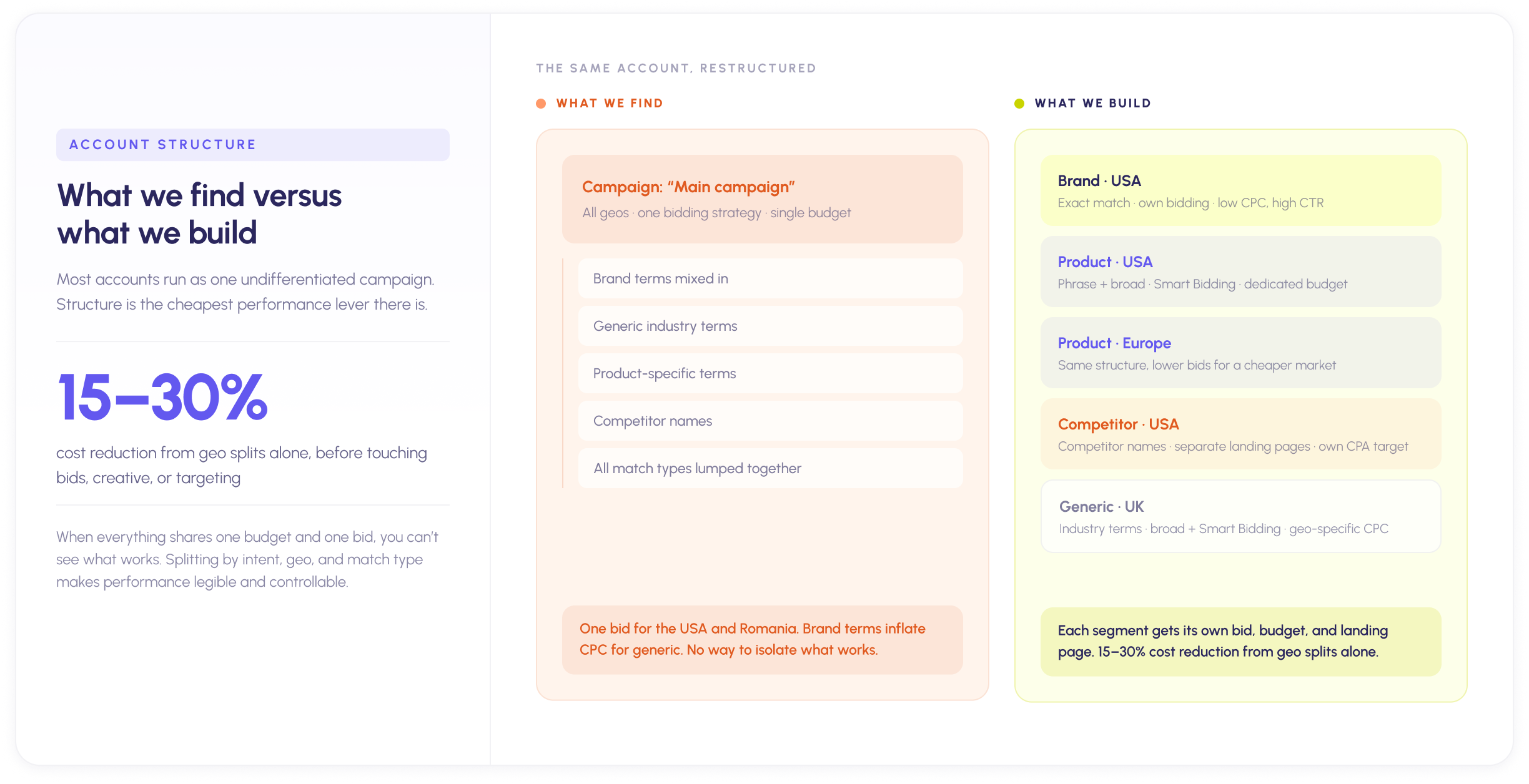
"Brand terms get grouped with generic terms and product terms in the same campaigns, which is wrong," Daria observes. "Each one draws a different audience and a different level of competition. On brand terms you face less competition, though rivals may bid on your name. Generic and product terms are fiercely contested and need their own bidding strategies."
Brand, product, and competitor campaigns need separate structures. Merge them and you force one bidding strategy across audiences with completely different intent, which inflates cost per acquisition (CPA) and strips out the granularity a performance marketing strategy needs to put budget where it converts.
One bidding strategy across every geography
A multinational account running one bidding strategy across Europe, the UK, and the US overpays by default. A climbing cost per lead in the cheaper markets is usually the first symptom. Splitting campaigns by geography can cut costs 15-30%. It is one of the simplest structural changes available and one of the highest-returning.
Ignoring engaged audiences that never reach your site
The classic retargeting move, pixel your site visitors and show them ads again, misses a real opportunity. On LinkedIn, people who watch your video or interact with a post but never click through to your landing page are still showing intent. These engagement-based segments are usually small, often around 500 people, but they already know your brand.
"This level of measurement gets missed constantly," Daria notes. "Reporting fixates on traffic and site metrics, the obvious stuff. That is the tip of the iceberg. What sits underneath is larger."
How to measure performance marketing success
The toxic metrics problem
Performance marketing lives or dies on measurement. Ask founders what they track and impressions and traffic volume come up first. Those are the two numbers most likely to mislead.
"Measure quality, not quantity, always," says Daria. "I would not say never look at impressions or traffic. But ask how relevant they are. Is the traffic coming from the right companies? Are the right job titles engaging? Or are your impressions feeding Amazon and Deloitte, companies with 10,000-plus employees that will never become customers?"
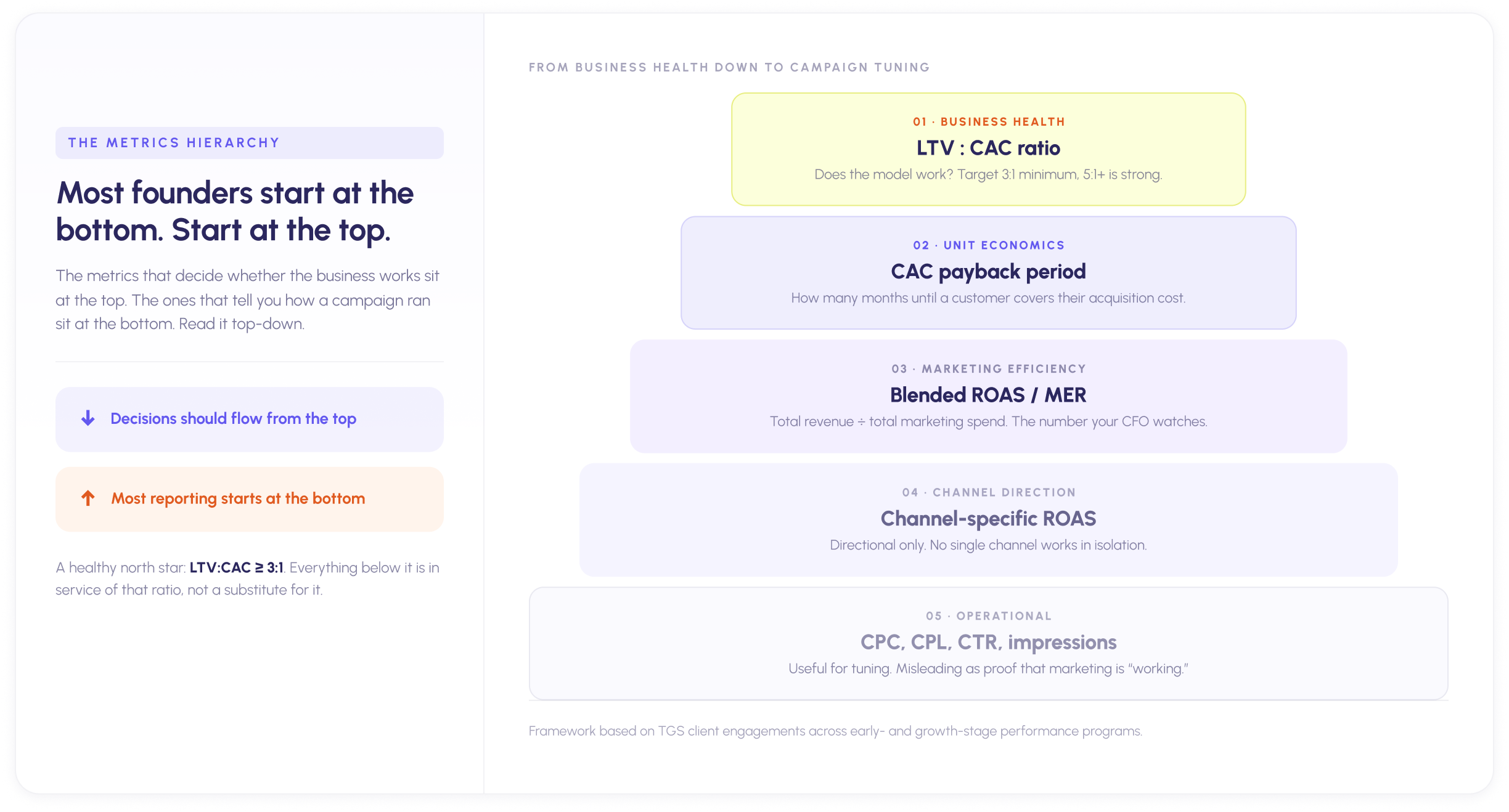
Performance marketing lets you trace every dollar to a specific result, but only if you track the right result. Key performance indicators are essential here, though only the right ones. The hierarchy that matters:
- LTV:CAC ratio (target 3:1 minimum, 5:1+ is strong). Customer lifetime value divided by cost per acquisition. This one number tells you whether your growth is a business or a subsidy.
- CAC payback period. How fast a customer becomes profitable.
- Blended ROAS, or marketing efficiency ratio. Total revenue over total marketing spend, the number your CFO actually watches.
- Channel-specific ROAS. Directional, not definitive, because no channel works alone.
- ICP engagement quality. Are the right companies and job titles engaging with your performance marketing campaigns?
Key performance indicators like cost per click and cost per lead matter for campaign-level tuning, but they are operational metrics, not business metrics. Confusing the two is how budget ends up optimized for cheap clicks instead of revenue. The upside of performance marketing only shows up when the measurement points at the outcome you actually sell.
The measurement model that survives privacy rules
No single attribution method sees the whole picture. The current consensus combines three, and together they turn raw numbers into data driven insights you can allocate against.
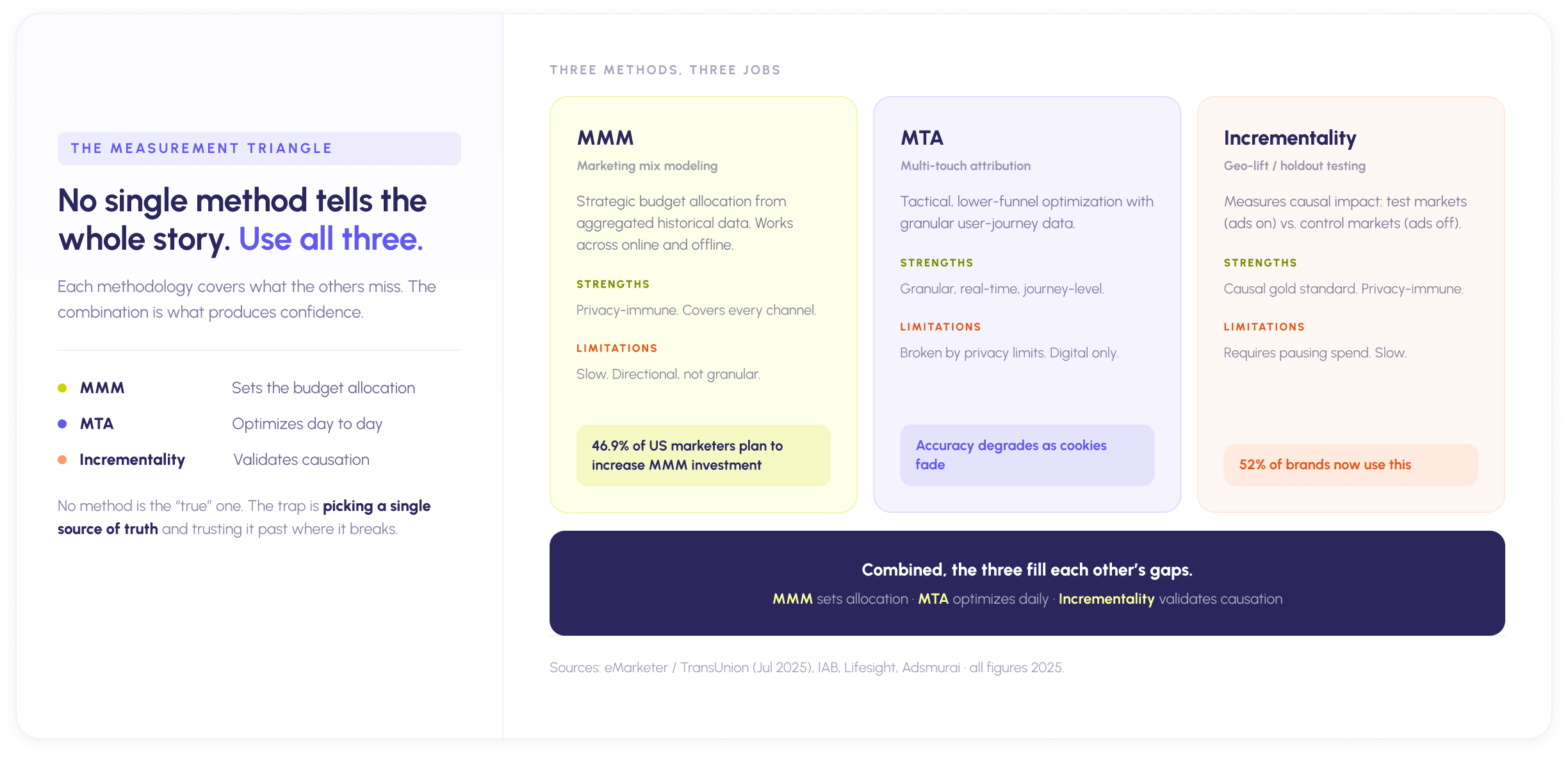
Marketing Mix Modeling handles strategic budget allocation from aggregated historical data. It is privacy-safe and spans online and offline, but it needs two to three years of history. An eMarketer and TransUnion survey (July 2025) found 46.9% of US marketers planning to increase MMM investment.
Multi-touch attribution is good for tactical, lower-funnel tuning with journey-level data, but privacy rules keep eroding its accuracy and it only sees digital touchpoints.
Incrementality testing, usually a geo-lift experiment, gives the strongest read on causation. The same survey found 52% of US marketers already running incrementality tests. The textbook example: a grocery chain paused non-branded paid search in 12 markets, saw zero sales lift, and moved the money immediately. For most companies under $200K a month, one clean holdout test teaches more than six months of attribution reports.
Real-time analytics in tracking platforms like Google Analytics keep you honest at the campaign level day to day. But the strategic calls about your performance strategy should come from all three methods together, not from any single dashboard.
The operational playbook: from early stage to growth
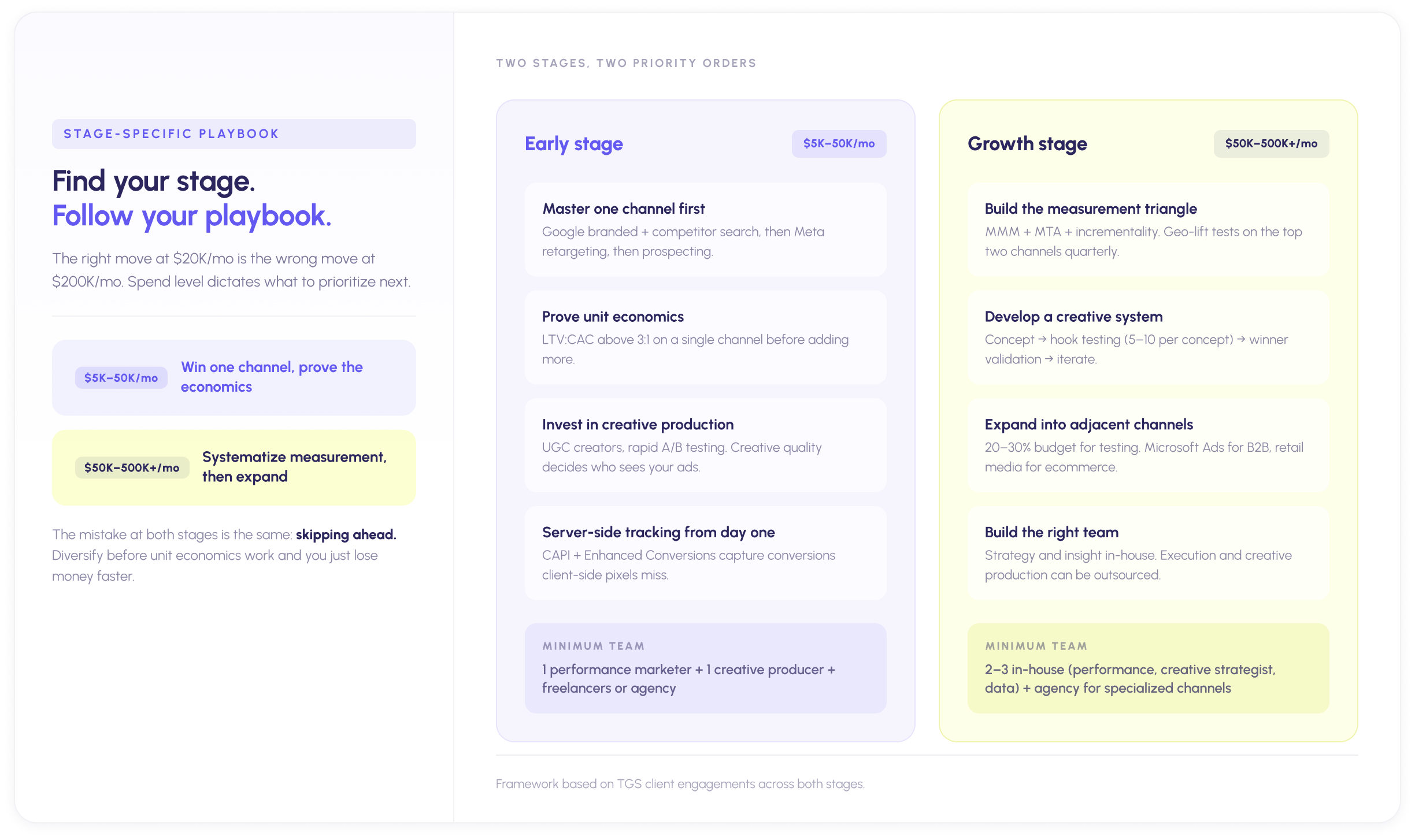
A performance marketing strategy looks different at $20K a month than at $200K. The principles hold; the priorities change.
For early-stage companies ($5K-$50K per month)
Master one channel before you add another. The common mistake is spreading a small budget across five social media platforms and starving every one of data. Start with search engine marketing (SEM): Google branded search and competitor terms, then Meta retargeting, then Meta prospecting. Meta's algorithm needs roughly $10K a month to learn properly.
Prove unit economics before scaling. If your lifetime value to cost per acquisition ratio is not above 3:1 on one channel, adding channels just multiplies the problem.
Invest in creative early. As platforms move to AI-driven broad targeting, the ad itself decides who sees it, so budget for UGC creators and fast iteration. Put server-side tracking in from day one: Meta's Conversions API and Google's Enhanced Conversions catch conversions the pixel misses. That is infrastructure, not a nice-to-have.
For context, marketing budgets flatlined at 7.7% of company revenue in 2025 (Gartner's CMO Spend Survey of 402 CMOs), level with the prior year. Early-stage spend usually runs higher as a share, but the benchmark helps frame the conversation with your board.
For growth-stage companies ($50K-$500K+ per month)
Build the measurement triangle. At this spend you need to know which of your performance marketing channels are genuinely incremental, not which ones claim credit. Run geo-lift tests on your top two channels every quarter.
Build a creative system, not just creative. The process is concept, then hook testing with 5-10 hooks per concept, then winner validation, then iteration. Creative fatigue sets in at 7-14 days at real spend. NCSolutions and Nielsen, analyzing nearly 500 campaigns, found creative quality drives 47-49% of advertising's sales contribution, more than reach (22%), brand (15%), or targeting (9%). With targeting largely automated, creative is the biggest variable left.
Expand deliberately. Put 20-30% of budget into testing. Microsoft Ads is the highest-conviction expansion for B2B, with lower cost per click and LinkedIn profile targeting baked in. Retail media is the highest-conviction expansion for ecommerce, with first-party data and closed-loop attribution. Connected TV gets more viable as CPMs fall.
Build the right team. The minimum viable growth-stage team is two to three people in-house (a performance marketer, a creative strategist, a data analyst) plus an agency for specialized work. Keep brand marketing strategy and customer insight in-house. Outsource technical execution and creative production.
Performance marketing vs brand marketing: the line is disappearing
Performance marketing chases measurable outcomes: clicks, qualified leads, sales. Brand marketing builds emotional connection and long-term awareness. Companies used to run them as separate functions with separate budgets and separate teams.
That separation is collapsing. Google's 2026 marketing predictions report has industry leaders calling to retire the distinction entirely. Brand investment feeds sales; sales data sharpens brand messaging. The companies that still wall the two off organizationally spend more to achieve less.
The benefits of performance marketing (measurable results, real-time optimization, a data driven approach to budget) increasingly apply to work that used to be purely brand. And the best brand marketing, the kind that builds emotional resonance and consistent presence, turns out to increase brand awareness in ways that make performance marketing campaigns convert at higher rates. For founders, the practical move is structural: your performance marketing strategy and your brand marketing should share data, creative insight, and business objectives.
The benefits of performance marketing, and what they require
The benefits of performance marketing are real, but each one comes with a condition.
Lower financial risk
The pay-for-performance model means you pay only for results, not impressions. Traditional ads demand payment upfront with an uncertain outcome; performance advertising ties spend to a click, a lead, or a completed sale. The model keeps funds pointed at tangible outcomes rather than reach for its own sake.
Real-time control
Campaigns adjust in real time. A landing page converting at 1% instead of 3% can be swapped today. A search engine marketing campaign pulling irrelevant traffic gets negative keywords this afternoon. A channel costing 3x more per qualified lead than another gets reallocated by Friday. That speed is a genuine edge over offline marketing efforts.
Fast, evidence-based scaling
Winners scale fast. When a campaign works you raise the budget; when it does not you stop. A data driven approach means every move has evidence behind it. But the benefits only materialize when the setup is right. Poor keyword management, the wrong target audience, missing conversion tracking, and a disconnected sales process turn all of it into expensive theater. Performance marketing offers measurable results. Whether those results are good comes down entirely to execution.
Performance marketing vs guesswork: why it matters more than ever
The future of digital marketing is measurable, accountable, and performance-driven. Dentsu forecasts global ad spend passing $1 trillion for the first time in 2026, up 5.1% year over year. The tools can target precisely, optimize bids in real time, and generate creative at scale through artificial intelligence. ChatGPT alone reached 900 million weekly active users by February 2026 (up from 800 million in October 2025), processing an estimated 2.5 billion prompts a day, and AI search is taking a growing share of queries that used to run through a traditional search engine.
Capability without strategy still produces waste. The performance marketers and marketing companies that win pair algorithmic execution with honest measurement, with granular attention to where every dollar goes, and with real integration into sales and the wider go-to-market motion.
Treat performance marketing as a standalone function, cut off from content marketing, sales, and brand, and disappointment is the likely result. Treat it as one part of a revenue system that needs coordination with sales and creative discipline, and the returns are substantial.
The habit that separates the best agencies
The marketing companies that drive revenue, rather than just reporting metrics, tend to share one habit: they are honest about what is not working. TGS builds performance marketing into full-funnel strategy rather than running it as an isolated channel, and every engagement starts the same way, with an audit. If any of this sounds like your accounts, that audit is the place to start. It is usually where the fastest wins are hiding.
This article was written by The Growth Syndicate, with insights from Daria Kalinina, Head of Performance. Market data draws on named sources including WordStream, eMarketer, Triple Whale, Gartner, WARC, WPP Media (GroupM), Dentsu, IAB, NCSolutions/Nielsen, Semrush, Similarweb, Ahrefs, the Performance Marketing Association, and platform-reported figures from Google, Meta, Microsoft, and TikTok. Platform self-reported numbers are attributed as such. Benchmarks reflect 2025 data unless noted.
.png)
