.svg)
.png)

A B2B brand strategy is a long-term plan to make your company easy to remember and easy to trust, so that when a buyer finally enters the market, your name is already on their shortlist. It is not a logo, a color palette, or a tagline. Those are outputs. The strategy is the set of decisions about who you want to be remembered by, what you want to be remembered for, and which buying situations you want to own in their memory.
Most guides to brand strategy treat this as a creative exercise borrowed from consumer marketing. They tell you to find your "why," write some values, and stay consistent. That advice is not wrong, but it skips the part that actually decides whether a B2B brand grows: the fact that almost none of your buyers are ready to buy right now, and the ones who eventually are will choose from a mental shortlist they built long before they ever spoke to a salesperson.
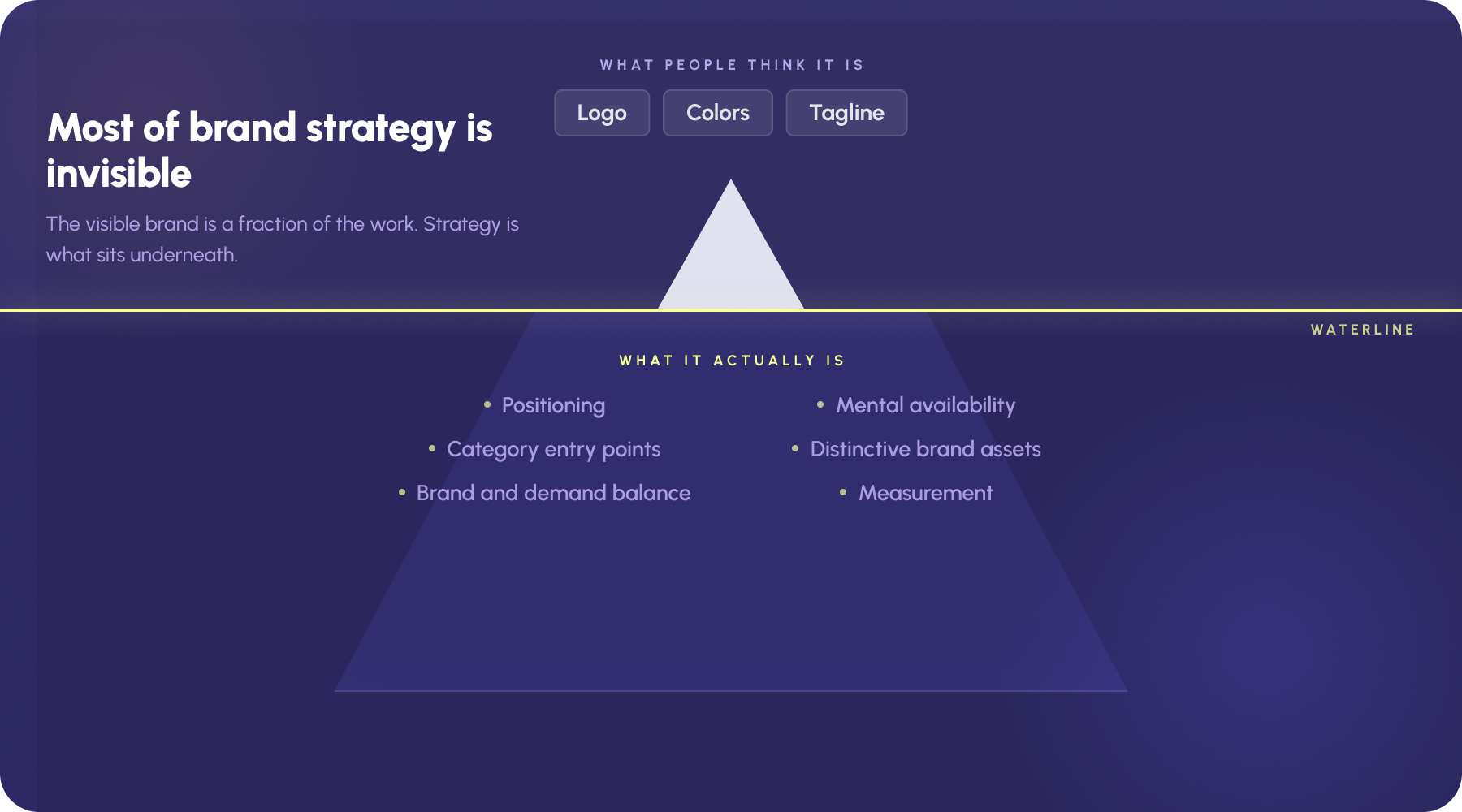
This guide covers the full process, grounded in the marketing science that the generic guides leave out. You will get the standard building blocks every brand needs, plus the B2B-specific logic, frameworks, and measurement approach that separate a brand strategy that compounds from one that just sits in a slide deck.
What is a B2B brand strategy?
A B2B brand strategy is the documented, long-term plan for how a business-to-business company builds mental availability, trust, and differentiation among the people and organizations who buy from it. Its purpose is to make the brand the default, low-risk choice when a buying group eventually forms, by linking the brand to the situations and needs that trigger a purchase.
That definition has three working parts worth pulling apart.
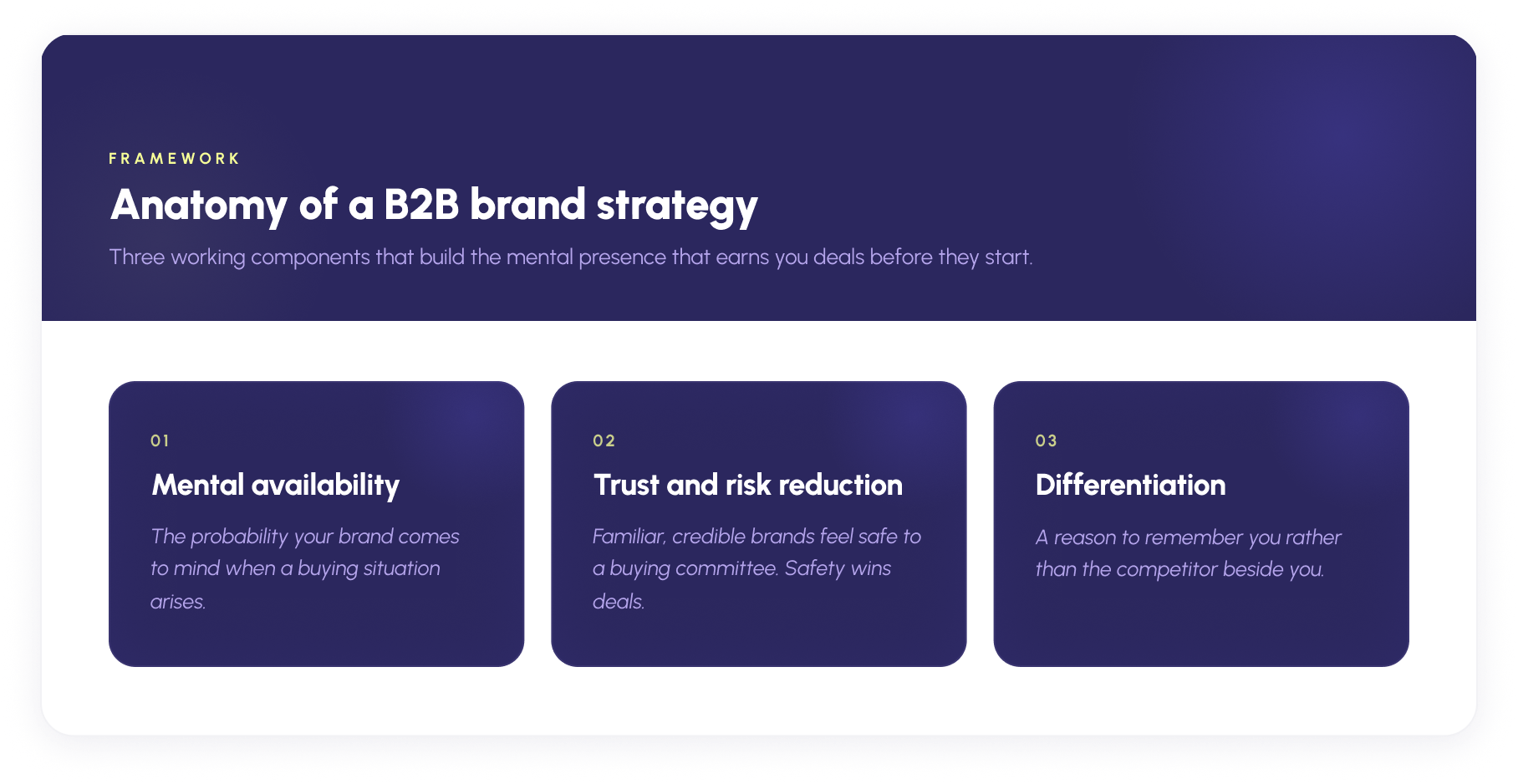
Mental availability is the probability that your brand comes to mind in a buying situation. The term comes from the Ehrenberg-Bass Institute, the marketing science body at the University of South Australia behind Byron Sharp's How Brands Grow. It is different from plain awareness. Awareness means someone recognizes your name. Mental availability means your name surfaces at the exact moment a problem appears and a purchase starts to take shape. A brand can be widely known and still fail to come to mind when it matters.
Trust and risk reduction sit at the center of B2B in a way they rarely do in consumer markets. A wrong choice in B2B can cost a buyer their budget, their credibility, and sometimes their job. The old line "nobody ever got fired for buying IBM" captures the dynamic precisely. Familiar, credible brands feel safe to a committee, and safety wins deals that features alone do not.
Differentiation is the answer to why a buyer should remember you rather than the competitor next to you. In B2B this is less about a unique product claim, which competitors copy quickly, and more about owning a distinct position and a consistent set of brand cues that make you recognizable across years of buying cycles.
Why brand strategy matters more in B2B than most teams admit
The case for B2B brand building rests on a single uncomfortable fact about how businesses buy.
Most of your buyers are not in the market
In 2021, Professor John Dawes of the Ehrenberg-Bass Institute published a piece for the LinkedIn B2B Institute that has reshaped how serious B2B marketers think. His argument, now known as the 95-5 rule, is straightforward. Companies change most of their major service providers roughly once every five years. A business switches its bank or its law firm about once every five years. Computers get replaced about once every four years. If a buying decision happens once every five years, then in any given quarter only about 5% of potential buyers are actively looking, and roughly 95% are not.
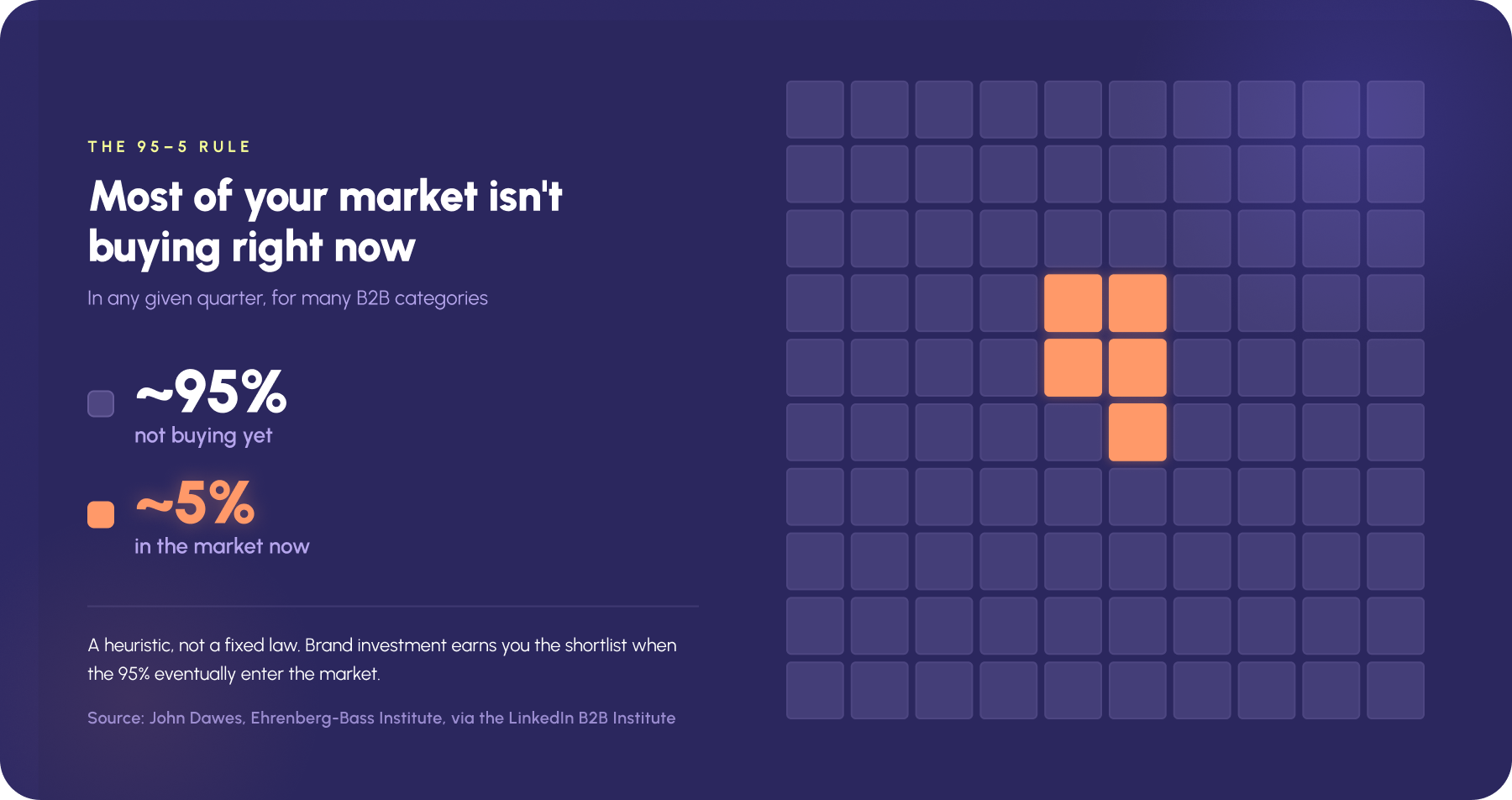
Dawes was careful about this. In his own words, the 95% figure "is not meant to be a precise rule. We're using it as a heuristic to get the idea across that the vast majority of businesses, for a large proportion of products, are not in the market in particular time periods." The exact ratio depends on your category. A product replaced every two years implies closer to half the market being reachable across a year. The point is directional, and the direction is what matters: the buyers you can reach today mostly cannot buy today.
This reframes what advertising and content are even for. If you spend everything chasing the 5% who are in-market, you are fighting every competitor for the same small pool, and you build nothing for the much larger group who will buy later. Brand building works by planting and refreshing memories now, so that when one of the 95% crosses into the 5%, your brand is already there.
Buyers arrive with a shortlist, and they buy from it
The reason mental availability pays off is that B2B buyers do not start their search with an open mind. Research by Bain & Company with Google, surveying 1,208 US business buyers, found that 80 to 90% of buyers have a set of vendors in mind before they do any research at all. More striking: about 90% of them ultimately choose a vendor from that initial "Day One" list.
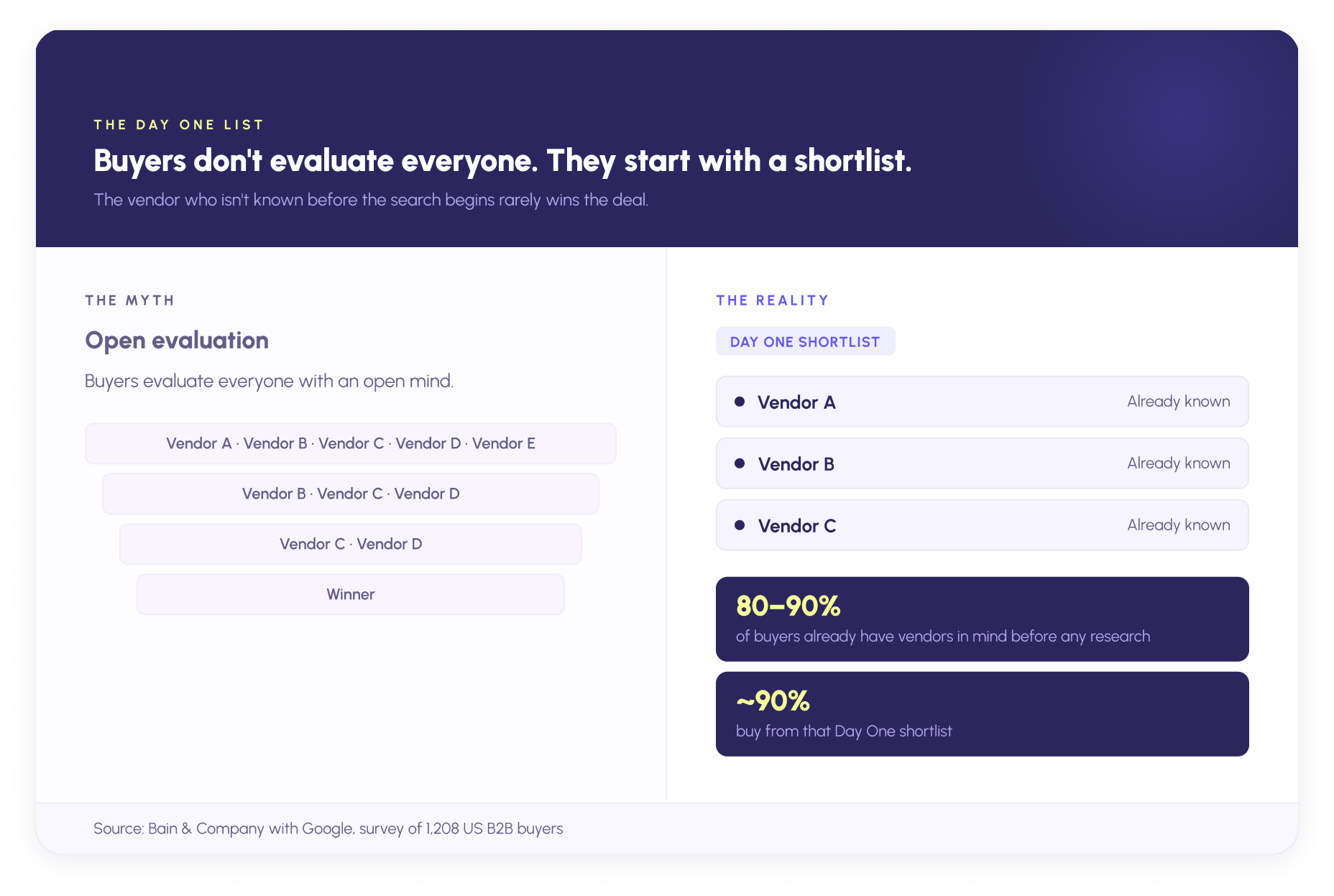
Sit with that for a moment. If the buying group writes down its candidates before research begins, and almost always buys from that initial list, then the entire competition for a deal can be decided before a single demo is booked. Being discovered late, after the buyer starts researching, leaves you fighting for a sliver of consideration that rarely converts. Brand strategy is how you earn a place on the Day One list.
Strong brands earn higher margins
Brand building is sometimes dismissed as unmeasurable fluff against the hard numbers of lead generation. The financial evidence says otherwise. McKinsey's work on business branding found that strong B2B brands outperform weak ones by 20% on EBIT margin. Their explanation matches the risk logic above: decision-makers will pay a premium for strong brands because those brands make their lives easier by aggregating information and reducing the felt risk of a complex purchase.
B2B buying is emotional, even when it looks rational
A persistent myth holds that business buyers are coldly rational, weighing specs and prices like spreadsheets with legs. The data dismantles this.
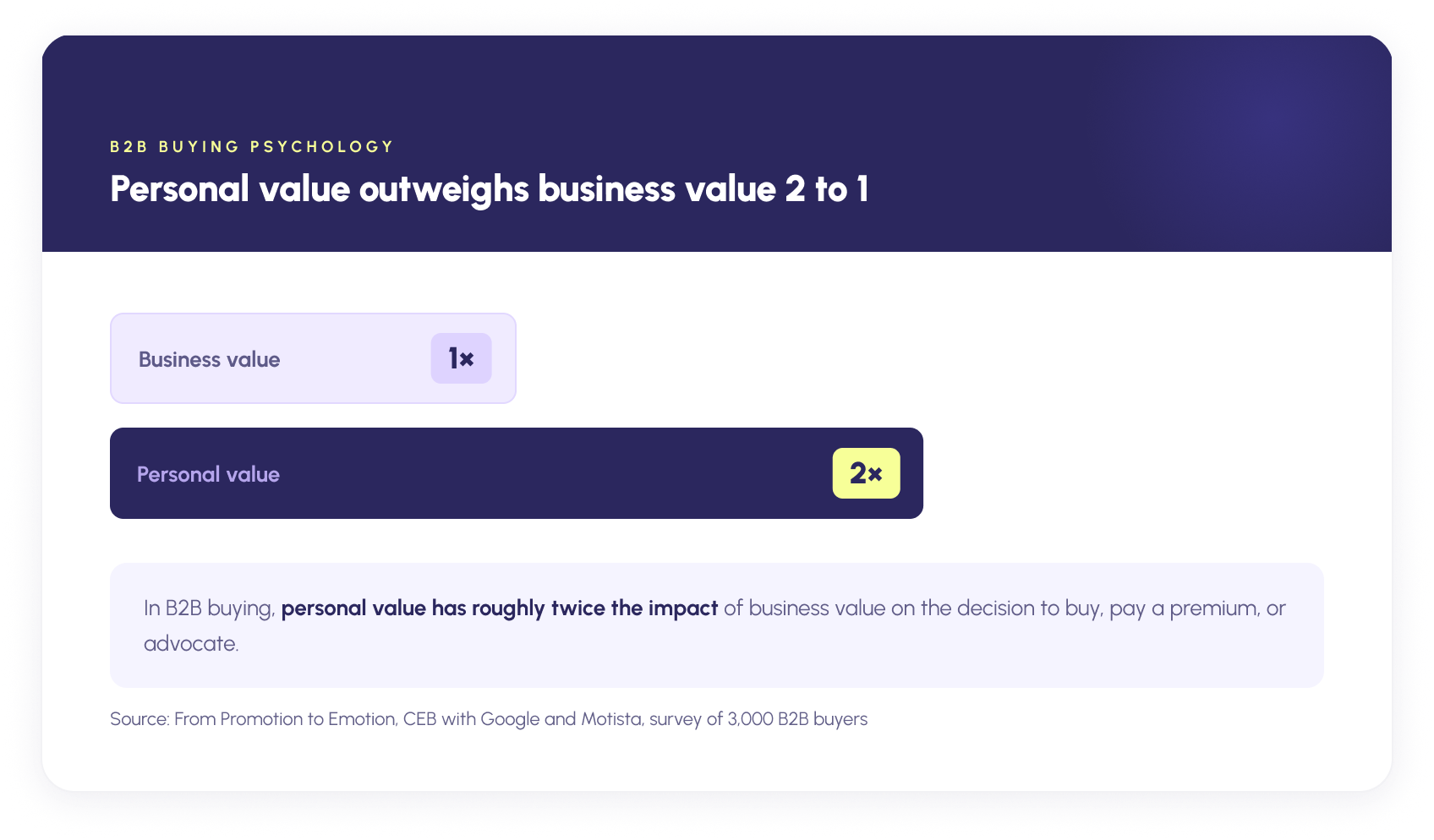
The most cited study here is "From Promotion to Emotion," conducted by CEB (now part of Gartner) with Google and Motista, surveying 3,000 buyers across 36 B2B brands. It found that personal value has roughly twice the impact of business value on a buyer's decision to purchase, pay a premium, or advocate. Personal value covers things like career advancement, confidence in the choice, and avoiding the personal fallout of a bad decision. Business value covers the functional and economic benefits you would expect to dominate.
The same research found B2B buyers are often more emotionally connected to the brands they buy than consumers are. Of the nine brands analyzed in depth, seven had emotional connections with more than half of their customers, and none fell below 40%, a level most consumer brands never reach. The reason is intuitive once you say it out loud: a consumer buying toothpaste risks a few dollars, while a B2B buyer signing a six-figure contract risks their reputation and their next promotion. Higher stakes mean more emotion, not less.
There is a practical lesson buried here. The study also found that business value barely differentiates competing brands. Only about 14% of B2B buyers saw enough of a meaningful difference in business value to pay a premium for it. If everyone in your category makes the same functional claims, those claims cannot be what makes you memorable. The emotional and personal dimensions, handled credibly, are where differentiation actually lives.
The step-by-step process for building a B2B brand strategy
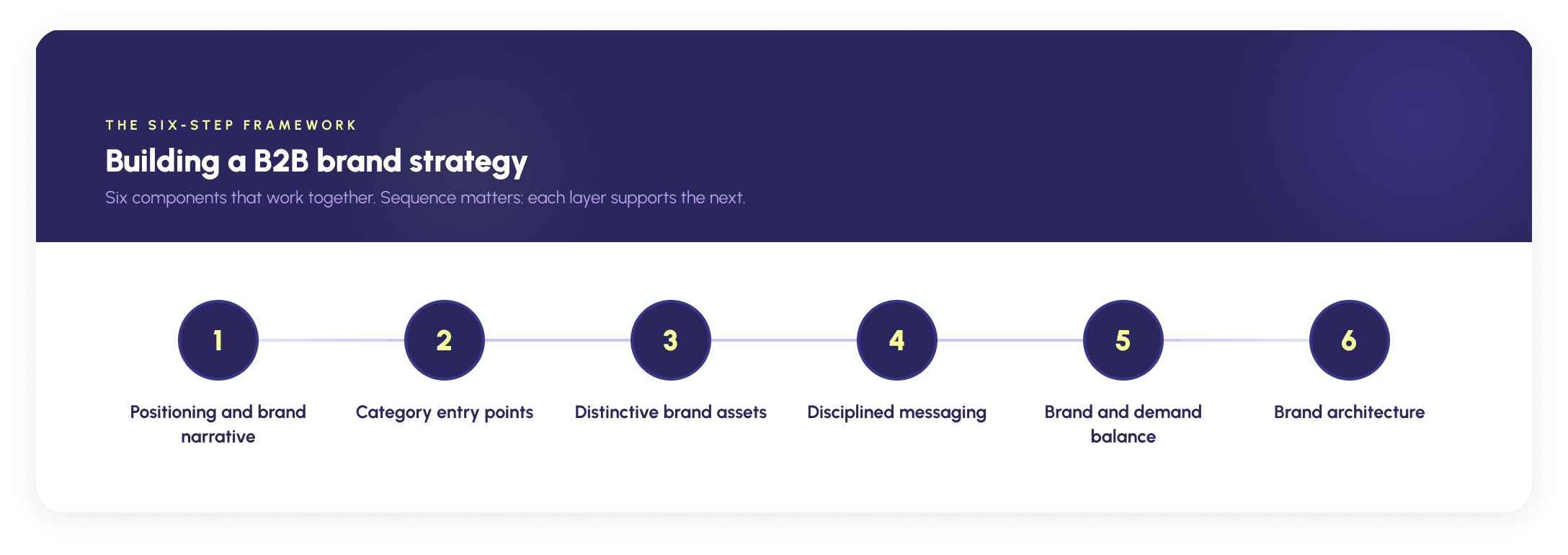
The process below moves from diagnosis to memory-building to balance and measurement. Each step produces a concrete decision or artifact rather than just a discussion.
Define your positioning and brand narrative
Positioning is the foundation, and in B2B it works best as a market stance rather than a product description. Instead of leading with what your product does, name the change in the buyer's world that makes the old way of working insufficient, explain why existing approaches fall short, and lay out the principles a buyer needs to succeed in the new reality. Your differentiators should map onto those success principles. This is the structure behind the strongest B2B positioning, and it is closely related to the work of April Dunford and to category design.
The brand narrative is the human version of that positioning: the story of why the company exists and what it stands for, told in a way that survives being passed up the org chart. A good narrative gives a champion inside the buying group the language to sell you internally when you are not in the room.
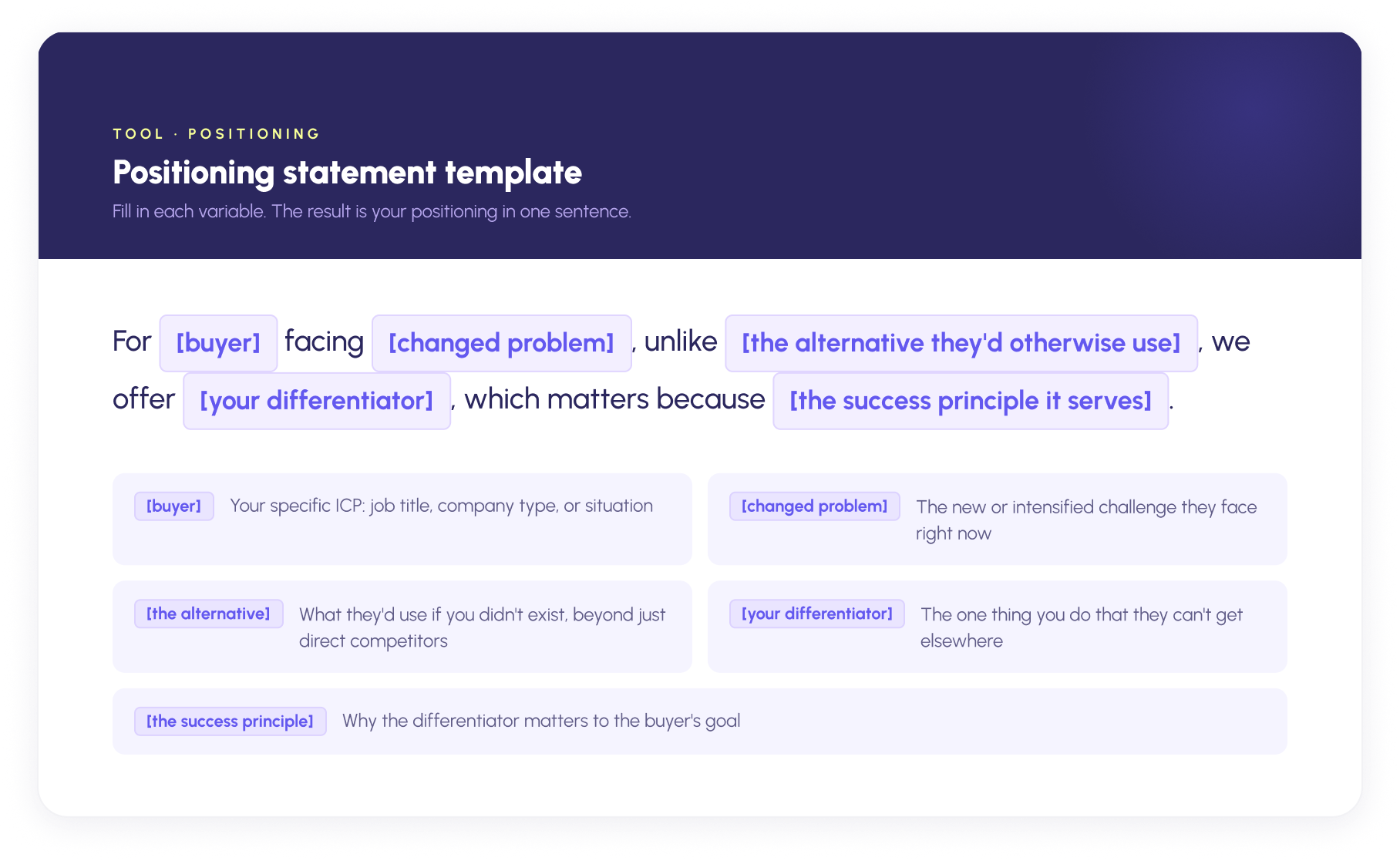
Write the positioning down as a short, defensible statement. It should name the buyer you serve, the problem you solve, the alternative you replace, and the reason you are a credible choice. If your positioning could be lifted wholesale by a competitor without anyone noticing, it is not yet a position.
Identify your Category Entry Points
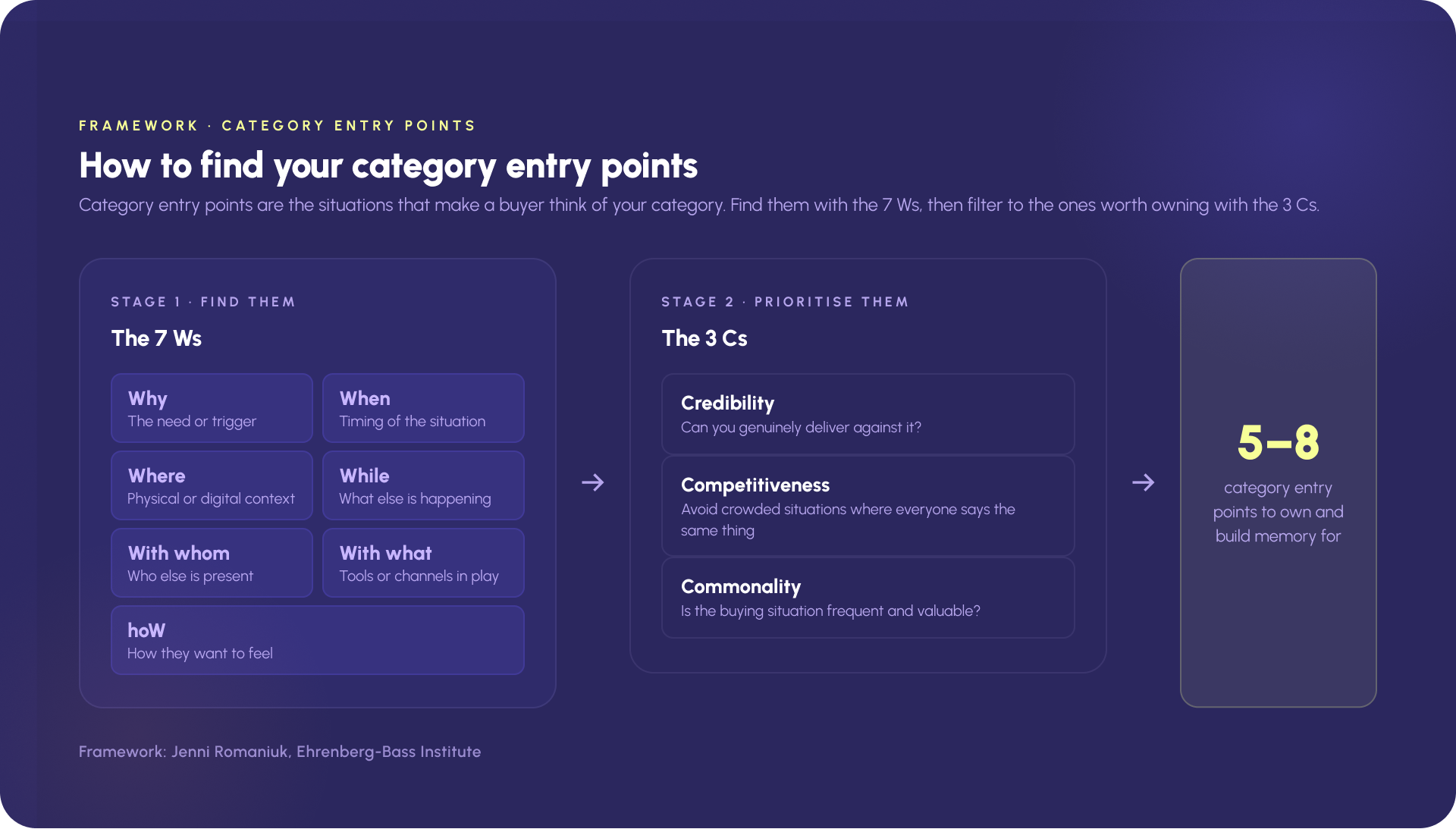
Category Entry Points, or CEPs, are the cues buyers use to access their memory when a buying situation arises. The concept comes from Jenni Romaniuk and Byron Sharp at Ehrenberg-Bass. CEPs are the needs, situations, occasions, and feelings that send someone looking for a product like yours. Romaniuk's framing is useful: CEPs are not about your brand, they are about the buyer, and they would exist even if your brand did not.
To find them, Romaniuk suggests working through the "7 Ws": why the buyer needs the category, when and where the need arises, what else is happening while it does, who is involved, what they use it with, and how they want to feel. The output is a list of realistic buying triggers, phrased the way a buyer would think about them, such as "when our current vendor's contract is up for renewal" or "when we lose a deal to a competitor with better data."
Then prioritize using Romaniuk's "3 Cs." Check each CEP for credibility, meaning your product can genuinely deliver against it. Check for competitiveness, avoiding crowded situations where every brand says the same thing. Check for commonality, favoring buying situations that are frequent and valuable. Settle on a short, trackable set of roughly five to eight CEPs. These become the situations you want your brand linked to in memory, and the backbone of your messaging.
Build and own distinctive brand assets
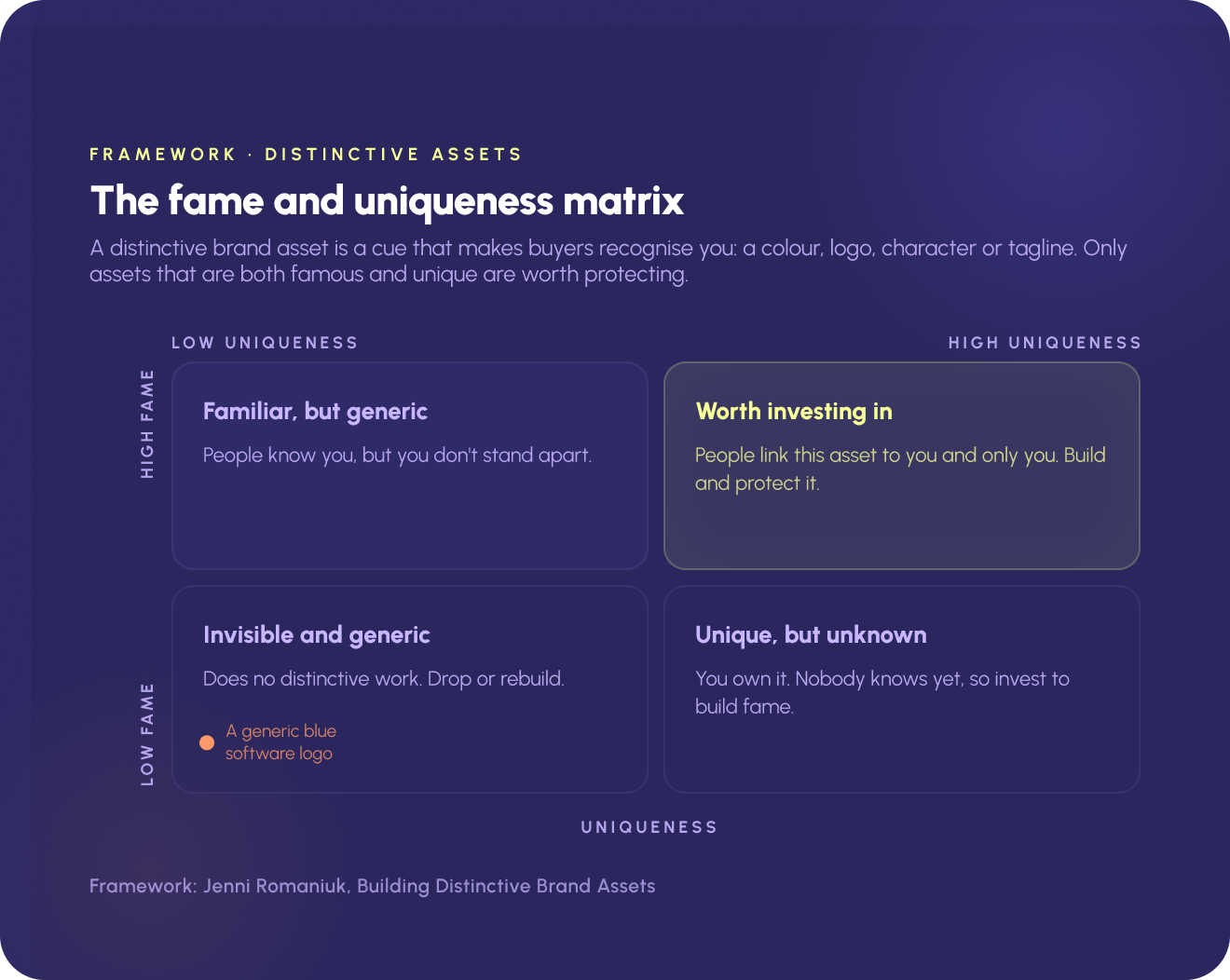
Distinctive brand assets, or DBAs, are the verbal and visual cues that let buyers recognize you fast: colors, logos, characters, taglines, a recurring spokesperson, a sonic signature. Romaniuk codified these in Building Distinctive Brand Assets. Their job is recognition and retrieval, not decoration. When a buyer encounters a CEP, your distinctive assets are what make your brand the one that surfaces.
Two measures matter for any asset. Fame is the share of your audience who correctly link the asset to your brand. Uniqueness is the share who link it to you and only you. An asset that scores high on both is worth investing in. An asset that everyone in the category uses, like a blue logo for a software company, does no distinctive work no matter how polished it is.
The discipline here is consistency over years, and resisting the urge to refresh assets the moment your own team gets bored with them. Internal fatigue with a brand asset almost always sets in long before the market has even registered it.
Develop disciplined messaging
Messaging is where positioning, CEPs, and distinctive assets come together in things buyers actually see and hear. The rule that separates effective B2B messaging from forgettable noise is discipline: one clear message per execution, each tied to a specific CEP, repeated far longer than feels comfortable internally.
The temptation is always to cram every benefit into every asset, and to change the message as soon as the marketing team tires of it. Both instincts are wrong. A buyer who sees a consistent message linked to a consistent buying situation builds a durable memory. A buyer who sees a different message every quarter builds nothing. Pick the message that ties each priority CEP to your brand, say it clearly, and keep saying it.
Lean into emotion and fame for the long-term brand work, and reserve sharper, more rational proof points for the moments when a buyer is close to a decision. Both have a place. They do different jobs.
Balance brand building and demand generation
This is the budget question, and it is where B2B brand strategy meets the reality of a marketing plan. The most rigorous answer comes from Les Binet and Peter Field, who analyzed the IPA effectiveness databank. In consumer markets, they found effectiveness is maximized at roughly 60% of budget on long-term brand building and 40% on short-term sales activation.
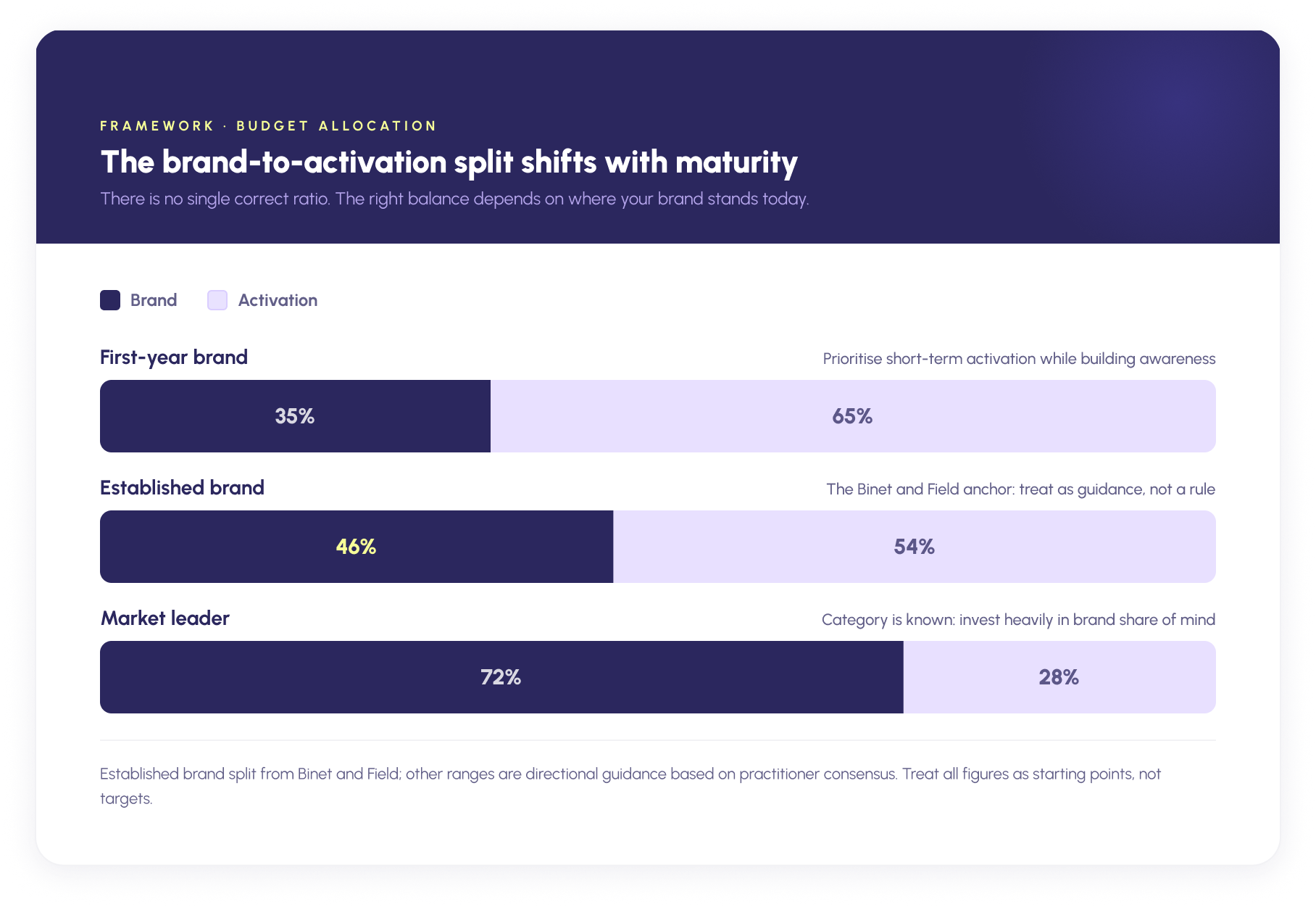
For B2B specifically, in their work with the LinkedIn B2B Institute titled "The 5 Principles of Growth in B2B Marketing," they found the optimum shifts. In their words, "efficiency appears to be maximised when around 46% of the budget is allocated to brand, with around 54% allocated to activation." B2B leans slightly more toward activation than consumer markets because, as Binet put it, B2B is a bit more rational and a bit more activation-heavy. Note that the often-repeated "50:50" split is a loose rounding of this; the data points to roughly 46:54.
That split is a starting point, not a law. It shifts with company maturity. A first-year brand fighting to establish basic awareness may sit closer to 35% brand and 65% activation. A market leader defending its position may run closer to 70% brand. Calibrate to where you are, not to a formula.
Binet and Field's broader B2B findings reinforce why the brand half of that budget pays off. They found that B2B brands respond to share of voice in almost exactly the same way consumer brands do, with about 10 points of excess share of voice associated with 0.7 points of market share growth per year, slightly higher than the 0.6 seen in consumer markets.

"Content, thought leadership, community, brand creativity. All of those things are part of the pie. The mistake is treating short-term pipeline and long-term brand as a choice. They are different strategies with synced goals, and you run them at the same time."
They also found that fame-building campaigns produced far larger business effects than narrow activation goals, and that emotional campaigns drove bigger long-term results than rational ones. One honest caveat: the B2B portion of their dataset is small, under 50 cases, which the authors themselves flag. Treat the splits as well-evidenced guidance rather than precise constants.
Decide your brand architecture
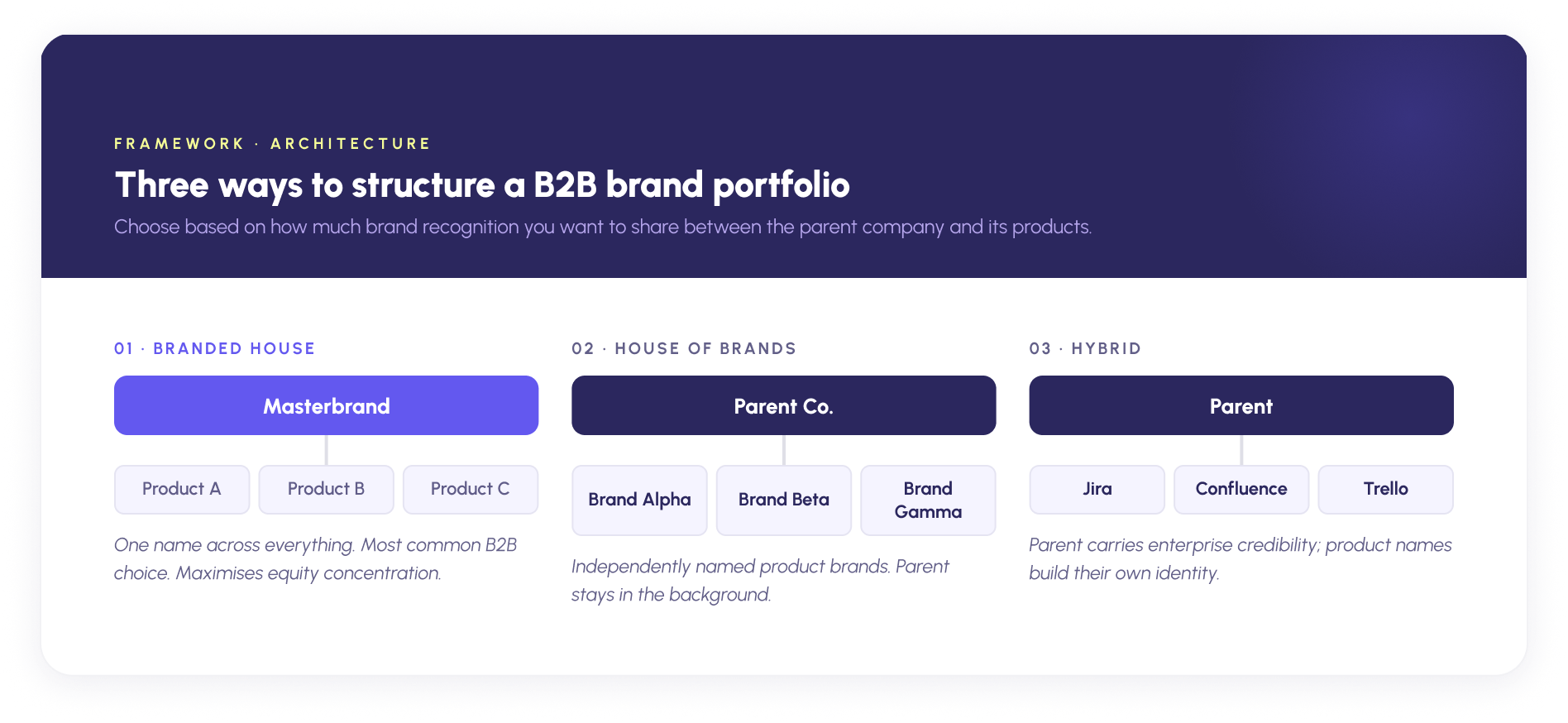
Brand architecture is the question of how many brands you run and how they relate. A branded house, or masterbrand, concentrates everything under one name, the way Salesforce, Adobe, and IBM do. A house of brands runs distinct brands for distinct products. Most B2B companies are better served by a branded house, because brand building is expensive and a single masterbrand concentrates the memory work rather than splitting it across names that each need their own investment.
Some companies run a sensible hybrid. Atlassian carries enterprise credibility at the parent level while maintaining distinct product identities like Jira, Confluence, and Trello. The right answer depends on whether your products serve the same buyers and whether a shared brand adds or dilutes credibility. Decide deliberately, because architecture is expensive to change later.
You have the six steps. How does your brand actually score against them? Most teams find the gaps are in Category Entry Points and distinctive assets, the two that drive mental availability. The Growth Syndicate runs a structured B2B brand audit that maps your current position against this framework and shows you where the leverage is. [Request a brand audit →]
How to measure B2B brand strategy
The most common objection to brand building is that you cannot measure it. You can. You just cannot measure it with the same week-to-week lead counts you use for activation, and trying to forces brand work into a frame designed to make it look like it failed.
Here is a measurement stack that reflects how brand actually works.
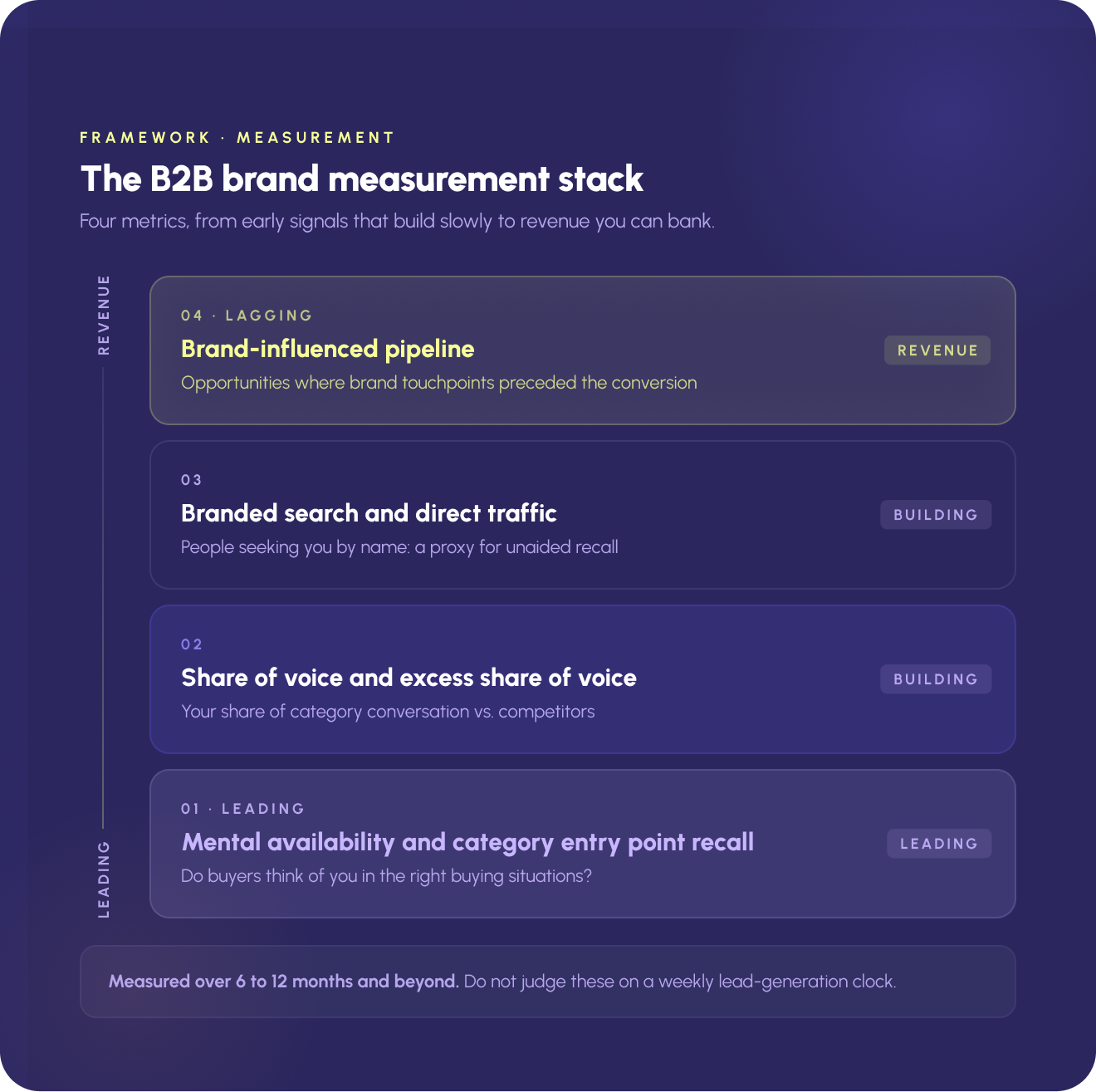
Mental availability and CEP-level recall. This is the progressive metric. Track which brands come to mind for each of your priority CEPs, and watch your linkage grow over time. Even category leaders often reach only around 50% linkage on a given CEP, and many established brands sit at 20 to 30%. This is a multi-year measure, not a monthly one.
Share of voice and excess share of voice. Share of voice is your brand's visibility in the category as a proportion of total category visibility. Excess share of voice is that figure minus your market share. A positive excess share of voice tends to predict future growth, and it is one of the cleaner leading indicators of whether your brand investment is sized correctly.
Branded search and direct traffic. When more people search for your brand by name or come directly to your site, your mental availability is rising. These are imperfect proxies, but they move in the right direction and they are easy to track.
Brand-influenced pipeline. Rather than attributing a deal to a single touch, look at whether deals involving brand-aware buyers close at higher rates, larger sizes, or shorter cycles. This connects brand work to revenue without pretending the relationship is linear.
A word of caution on metrics. The LinkedIn B2B Institute's effectiveness work found that marketers track around 32 metrics on average, but only a couple of the most popular ones actually correlate with effectiveness. More dashboards do not mean more insight. Pick the few measures that reflect mental availability and revenue quality, and watch them over six to twelve months and beyond.
What strong B2B brands actually do
A few examples show the principles in action.
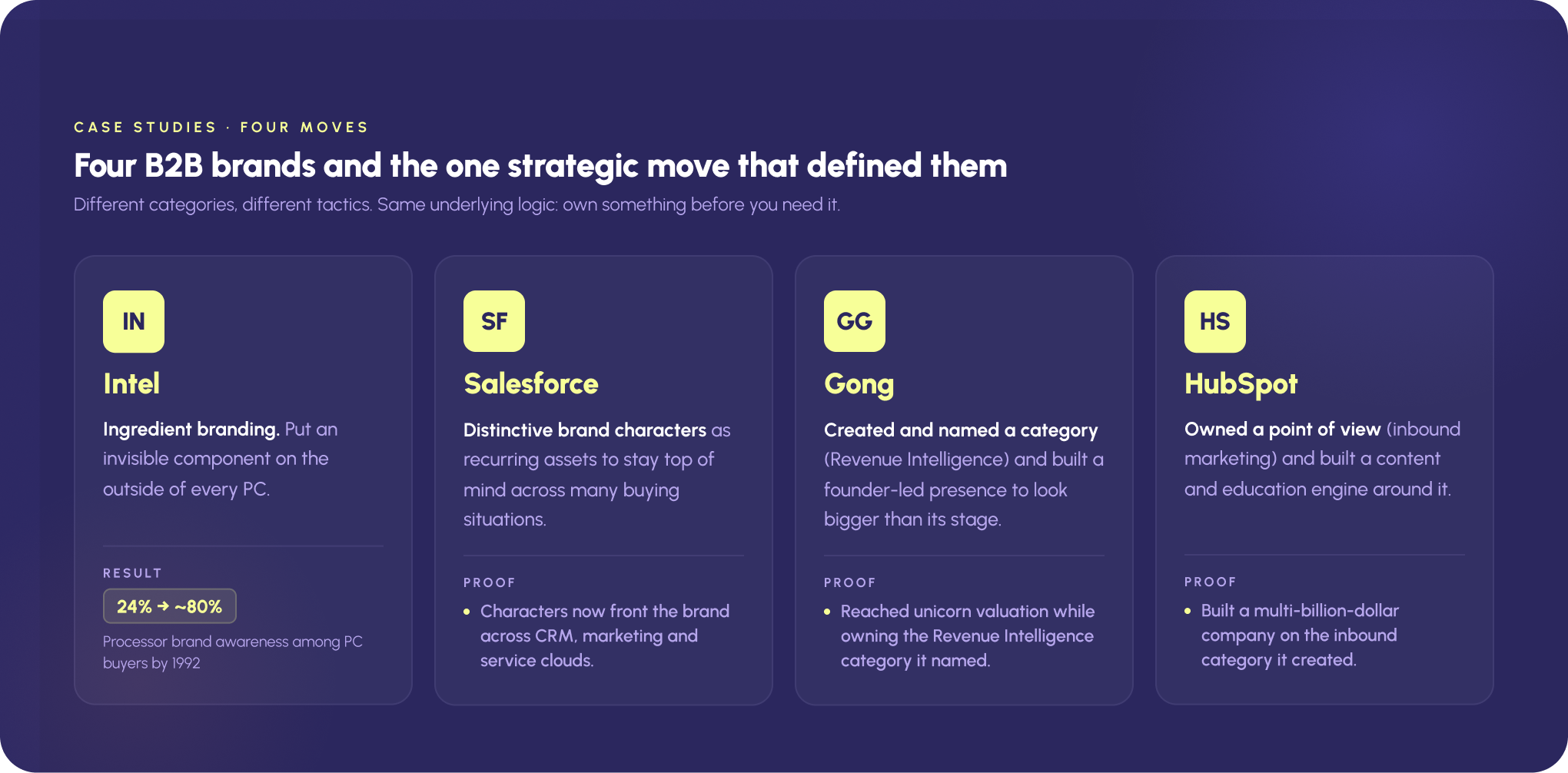
Intel turned an invisible component into a trust signal with "Intel Inside," launched in 1991. By building a distinctive asset, the logo and the sonic chime, and linking it to the buying situation of choosing a reliable PC, Intel moved processor-brand awareness among PC buyers from around 24% before the campaign to roughly 80% within about a year. It remains one of the most effective brand programs in B2B history.
Salesforce built distinctive brand assets in its Astro character and the wider Trailblazer cast, using them to link the brand to a range of CRM and software buying situations in a format that lands with both in-market and out-of-market buyers. It is a textbook example of using DBAs to build mental availability in a crowded category.
Gong created and named a category, "Revenue Intelligence," and paired it with a sharp, recognizable brand voice and a heavy founder-led presence on LinkedIn. The effect was a brand that looked and felt larger and further ahead than its stage, which made it a natural shortlist candidate as the category it defined grew.
HubSpot did something similar a decade earlier by owning "inbound marketing" as a point of view, then building a content and education engine around it. By teaching the market a way of thinking, HubSpot made itself the default brand associated with that approach.
The common thread is not budget. It is the decision to own a distinct position, express it through consistent and recognizable assets, and link it to the situations buyers care about, then to keep doing that for years.
"Clay is a sales tool, but Clay's real success is marketing. They took one of the least respected roles in B2B tech and made it something people are proud to put big on their LinkedIn and promote far and wide. That is good marketing. The catch is that it only works once. Everyone copying them now isn't differentiating, because it's already been done."
Where the conventional wisdom needs nuance
Good brand strategy means knowing where the rules bend. A few honest caveats.
The 95-5 rule is a heuristic, not a measurement of your specific category. Forrester's research found that in some B2B technology categories the in-market share runs closer to 15 to 30%, well above 5%, with the exact figure varying by category. The lesson is not to discard the rule but to compute your own ratio from your real repurchase cycle rather than assuming 5%.
The brand-versus-demand balance is contingent. The 46:54 split is sound guidance for an established company, but a startup that needs activation to survive its first year, a company selling into a tiny market of named accounts, or a product-led business where the product itself is the acquisition channel will all reasonably deviate. Deal size, category maturity, and sales motion should all flex the strategy.
Where deal size is large, the balance tips further still, and the work looks less like broad reach and more like presence.

And several widely-quoted figures circulate in looser forms than their sources support. The B2B budget split is 46:54, not a clean 50:50. The emotional-connection findings are well-supported; some of the more dramatic premium multipliers attached to them come from secondhand summaries rather than the primary research. Building a brand strategy on the primary numbers, stated honestly, is more durable than building it on inflated ones.
Turning the strategy into a working system
A brand strategy is only as good as the consistency with which it is executed across years and channels, which is where most of them quietly die. The document gets written, presented, admired, and then the next quarter's lead targets pull everyone back to activation. Six months later the brand work has stalled and someone concludes that brand building does not work, when what actually happened is that it was never sustained long enough to compound.
Sustaining it is an operational problem as much as a strategic one. It means protecting the brand portion of the budget when activation results tempt you to raid it, holding messaging consistent when the team craves novelty, and measuring on the right time horizon so that slow-building brand metrics are not judged against the fast clock of demand generation. Many companies find this easier with an outside partner who builds the system and holds the line on consistency; at The Growth Syndicate, this is the kind of long-term brand and demand work we structure for B2B clients, precisely because the discipline is hard to maintain from inside the weekly pipeline pressure. Whether you build it in-house or with help, the principle is the same. The strategy has to become a standing system, not a one-time project.
Frequently asked questions
What is the difference between a B2B brand strategy and B2B brand identity?
Brand strategy is the set of decisions about who you want to be remembered by, what position you want to own, and which buying situations you want to be linked to. Brand identity is the visual and verbal expression of that strategy: the logo, colors, typography, voice, and other distinctive assets. Strategy comes first and drives identity. Identity without strategy is decoration.
Which comes first, brand strategy or brand identity?
Brand strategy comes first. The positioning, target buyers, and Category Entry Points you define in the strategy determine what your identity needs to express and which distinctive assets are worth building. Designing an identity before settling the strategy means redoing the design once the strategy clarifies.
How is B2B brand strategy different from B2C?
B2B involves long buying cycles, buying groups of six to ten or more stakeholders, and high-risk considered purchases where trust and risk reduction dominate. Most B2B buyers are out of the market at any given time, which puts a premium on long-term memory building. B2C purchases are usually faster, lower-risk, and made by individuals. The underlying marketing science is similar, but the emphasis on trust, the length of the memory you need to build, and the slightly more activation-heavy budget split are distinctly B2B.
How long does it take to see results from a B2B brand strategy?
Brand building compounds over time rather than spiking. Some signals, like branded search and share of voice, can move within a few months. The deeper measures, like Category Entry Point recall and brand-influenced pipeline, typically show meaningful movement over six to twelve months and continue building for years. This is why brand work should not be judged on the same timeline as a lead-generation campaign.
How much of my budget should go to brand versus demand generation?
The research from Binet and Field points to roughly 46% brand and 54% activation as an efficient B2B starting point. Adjust for your situation: earlier-stage companies often weight more toward activation, while established market leaders weight more toward brand. The split is a guide, not a fixed rule, and it should reflect your company's maturity and category.
Can you measure brand strategy in B2B?
Yes. Track mental availability through Category Entry Point recall, share of voice and excess share of voice, branded search and direct traffic, and brand-influenced pipeline. The key is using the right time horizon. Brand metrics build over months and years, so measuring them on a weekly lead-generation clock will always make them look weaker than they are.
.png)