.svg)

Every agency engagement has the same moment. The proposal is agreed, the scope makes sense, everyone is enthusiastic, and then a contract appears with a twelve-month minimum term attached. The enthusiasm doesn't vanish. It just picks up a quiet undertone: why does this need locking?
An agency retainer is a contract in which a client pays a marketing agency a recurring fee, usually monthly, for an agreed level of ongoing work over a fixed term of 3, 6, or 12 months. That's the definition. This article is about the question underneath it, which is what the length of that term tells you about the agency proposing it.
We should be upfront: we're a marketing agency arguing against a practice most of our industry depends on, and we run rolling 30-day contracts ourselves. Read this with that in mind. We've tried to make the case honestly, including the parts of the retainer model that are genuinely defensible, and there are more of those than our position might suggest.
What is an agency retainer?
Being hired on a retainer means a client pays a fixed amount on a monthly or quarterly basis to reserve an agency's time and expertise, rather than paying per project or per deliverable. The retainer fee guarantees the agency a minimum income for the contract term, and it guarantees the client a defined scope of work and priority access to the team.
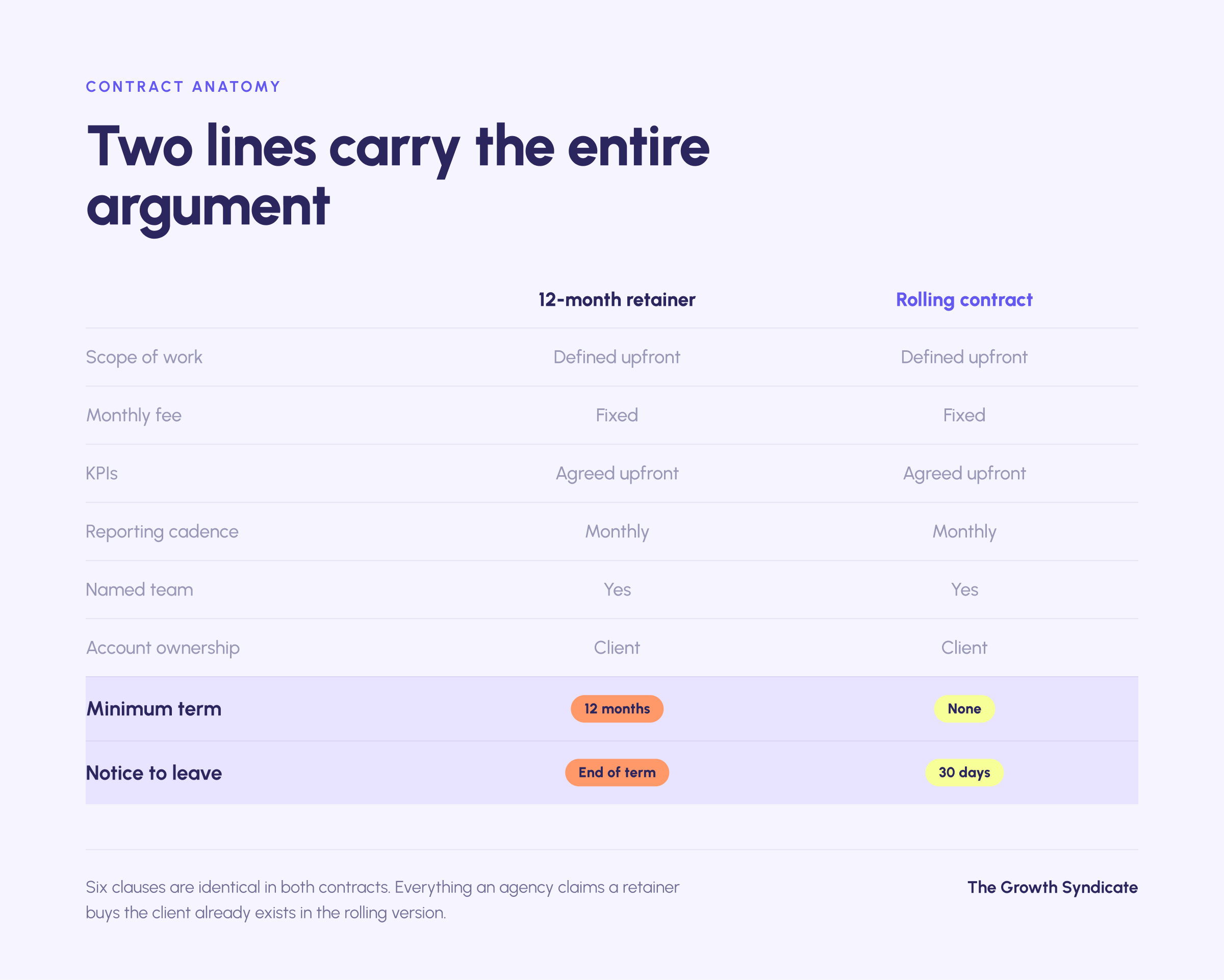
A typical agency retainer agreement specifies four things: the fee structure, the scope of work, the contract length, and the terms for ending the relationship. That last clause is the one this article is mostly about, because it's the one that shapes everyone's behavior for the duration.
Retainers are the dominant commercial model across the industry. Most digital agencies run a mix: retainer based clients providing the stable base, with one off projects and ad hoc requests layered on top. Industry research consistently finds that the overwhelming majority of agencies offer both retainer and project based work, and that very few rely on a single model (Promethean Research, 2025 Digital Agency Industry Report).
How marketing agency retainers work
The fee structure
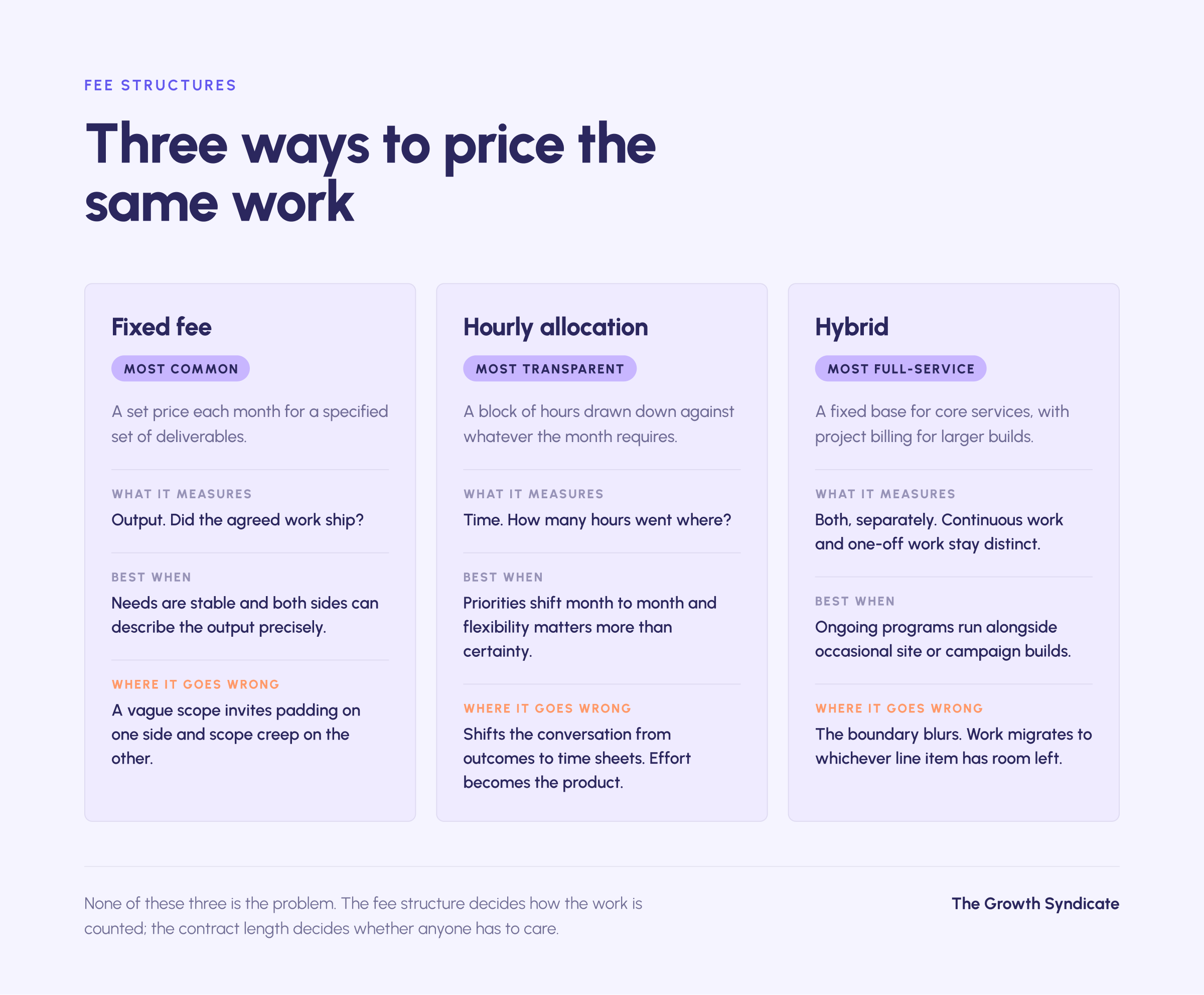
Retainer fee structures come in three broad shapes.
Fixed fee for a defined scope. The client pays a fixed price each month for a specified set of marketing services. Predictable for both sides, and the most common structure for ongoing work. A fixed fee works well when the marketing needs are stable and both parties can describe the output precisely.
Hourly allocation. The client pays for a block of hours, and the agency draws them down across whatever the month requires. Hourly work answers the "how many hours are we actually getting" question directly, but it quietly shifts the conversation from outcomes to time sheets.
Hybrid. A fixed base covering core services, with project based billing for larger pieces like web design or a rebrand. Most full service agency relationships end up here.
What's typically inside the scope of work
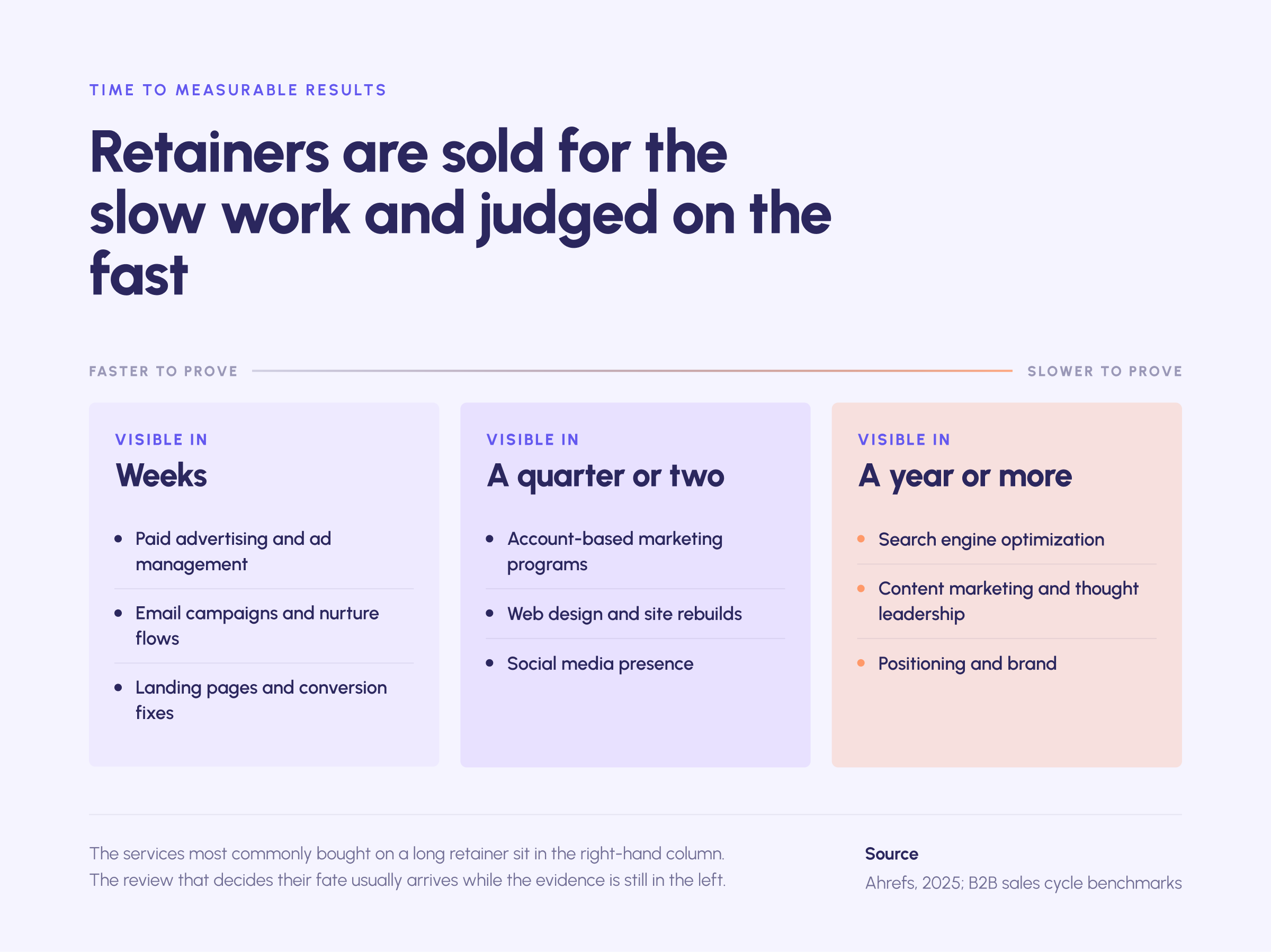
What sits inside a marketing retainer varies enormously by agency type, but most digital marketing retainers draw from the same menu of specific services:
- Search engine optimization. Technical fixes, blog content production, and organic visibility work, now increasingly extended to AI search.
- Paid advertising and ad management. Campaign builds and ongoing optimization across Google, LinkedIn, Meta, and other platforms.
- Content creation. Articles, case studies, whitepapers, and sales material. Content marketing is one of the most commonly retained services because output is continuous by nature.
- Social media management. Building a social media presence through scheduled social media posts, community management, and reporting. Social media marketing sits at the center of most consumer retainers and a smaller share of B2B ones.
- Email marketing. Nurture flows and email campaigns tied to the CRM.
- Web design and website development. Landing pages, conversion work, and site builds, often billed separately from the monthly retainer.
- Market research and marketing strategies. ICP definition, competitor analysis, positioning, and planning against target markets.
Creative agencies structure retainers around design capacity instead. Public relations firms retain for media relations and ongoing coverage. Influencer marketing shops retain for creator management. Smaller agencies and specialist digital agencies scope narrowly around one or two of the services above.
Scope matters more than fee structure, because scope is where retainers quietly go wrong. A vague scope invites scope creep in both directions: clients pile on ad hoc requests, and agencies pad months with low-value activity that technically fulfills the agreement.
What marketing agencies actually do under a retainer
Under a well-run retainer, the agency operates as an extension of the client's team, working to a continuous plan rather than a project brief. The client relationship is managed through a regular cadence of planning and review calls. The pitch for this model is continuity: the agency's expertise compounds as it learns the business, and the client gets faster turnaround than one off projects allow because the team is already in place.
That pitch is real. It's also exactly why the contract length deserves scrutiny, because everything good about a retainer comes from the working relationship, and nothing about the working relationship requires a 12-month lock-in to exist.
What agency retainers cost
Retainer pricing varies by agency size, seniority, and scope, and published ranges should be treated as rough guides rather than quotes. Across the market, a monthly retainer for digital marketing services commonly runs from a few thousand dollars for a narrow, single-channel scope with smaller agencies to tens of thousands for senior, multi-channel teams serving mid-market and enterprise clients. Management fees for paid advertising often add 10-20% of ad spend on top.
The more useful cost question isn't the monthly figure. It's the total exposure: the monthly fee multiplied by the months you cannot leave. A $10K arrangement with a 12-month term is a $120K decision made on day one, before you've seen the agency work. That framing, rather than the sticker price, is what the rest of this article is about.
Why agencies prefer retainers: the economics
Understanding the model requires understanding how agency works from the inside, and we can speak to this one directly.
An agency's costs are almost entirely team salaries, and those costs are fixed monthly whether clients pay monthly or not. Profit margins in the sector are thin enough that a single unexpected departure can turn a profitable quarter into a loss. Recurring revenue is what makes the business planable, and every practice in the industry, including the ones we criticize later in this article, traces back to that pressure.
Three arguments follow from it, and they deserve a fair hearing.
Capacity planning. An agency's product is its people. If client count swings from 12 to 8 overnight, the agency can't plan hiring, freelance commitments, or start dates. Guaranteed terms make it possible to staff properly, and staffing properly is part of what clients are paying for.
Cash flow. Recurring revenue smooths the feast-and-famine cycle that kills small agencies. This is the selfish reason, but a financially stable agency is also a better partner than one improvising payroll.
Time to results. This is the strongest argument, and it's backed by data. In organic search, only 1.74% of newly published pages reach Google's top 10 within a year, and the average page ranking first is 5 years old (Ahrefs, study of 1 million pages, 2025). B2B sales cycles routinely run the better part of a year. Almost nothing a marketing agency starts in January is legible as a result by March, so agencies reasonably fear being judged on a quarter's evidence for a year's work. A retainer buys runway.
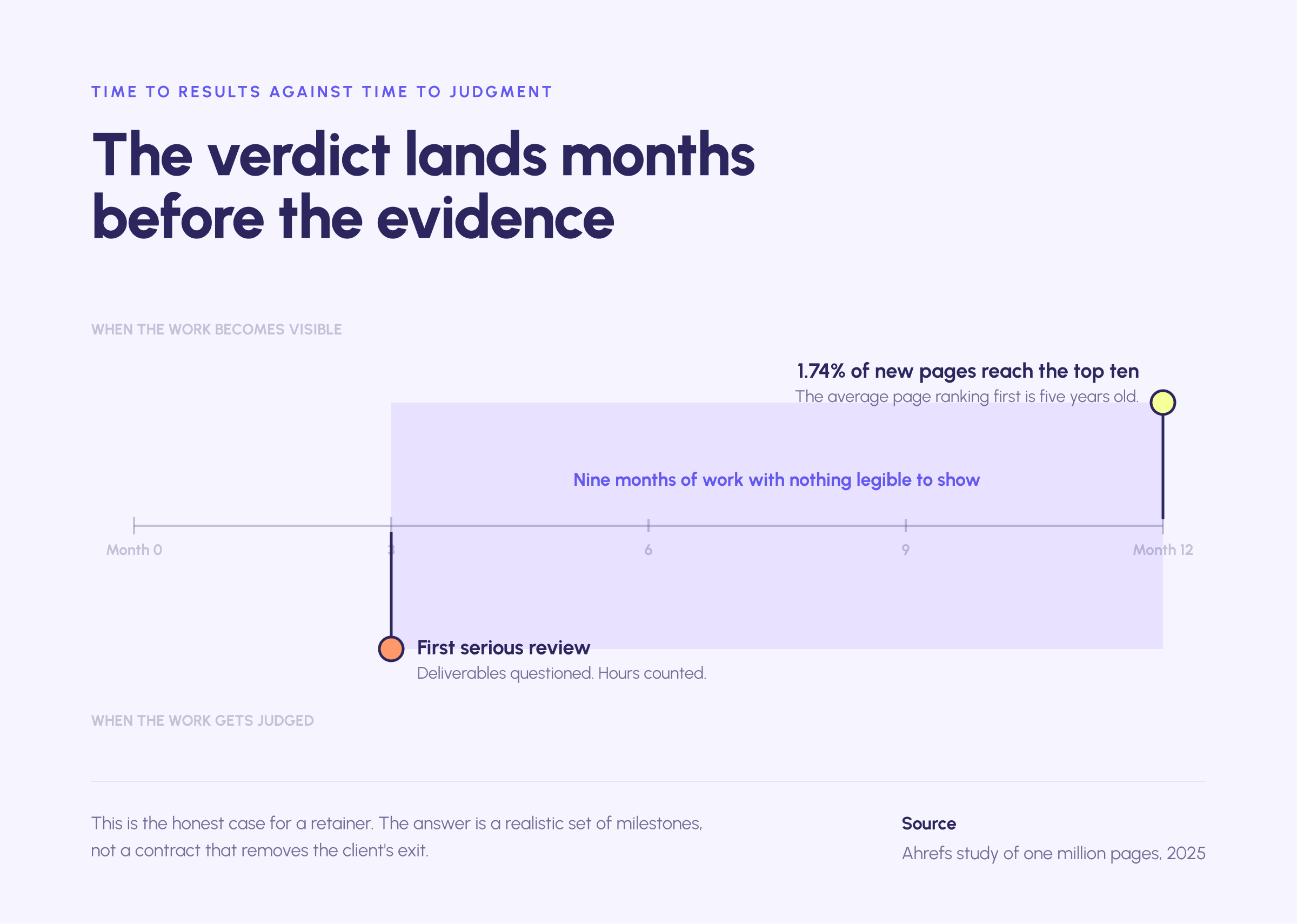
Each of these is true. And each of them, examined closely, is an argument for a stable long term relationship and honest expectation-setting rather than for a contract the client cannot exit. Capacity planning needs notice, not a year. Cash flow needs retention, which is earned. Runway is bought by explaining upfront which plays pay off in 6 weeks and which take 2 quarters, not by removing the client's ability to act on disappointment.
.avif)
Where the retainer model breaks
Guaranteed revenue changes behavior
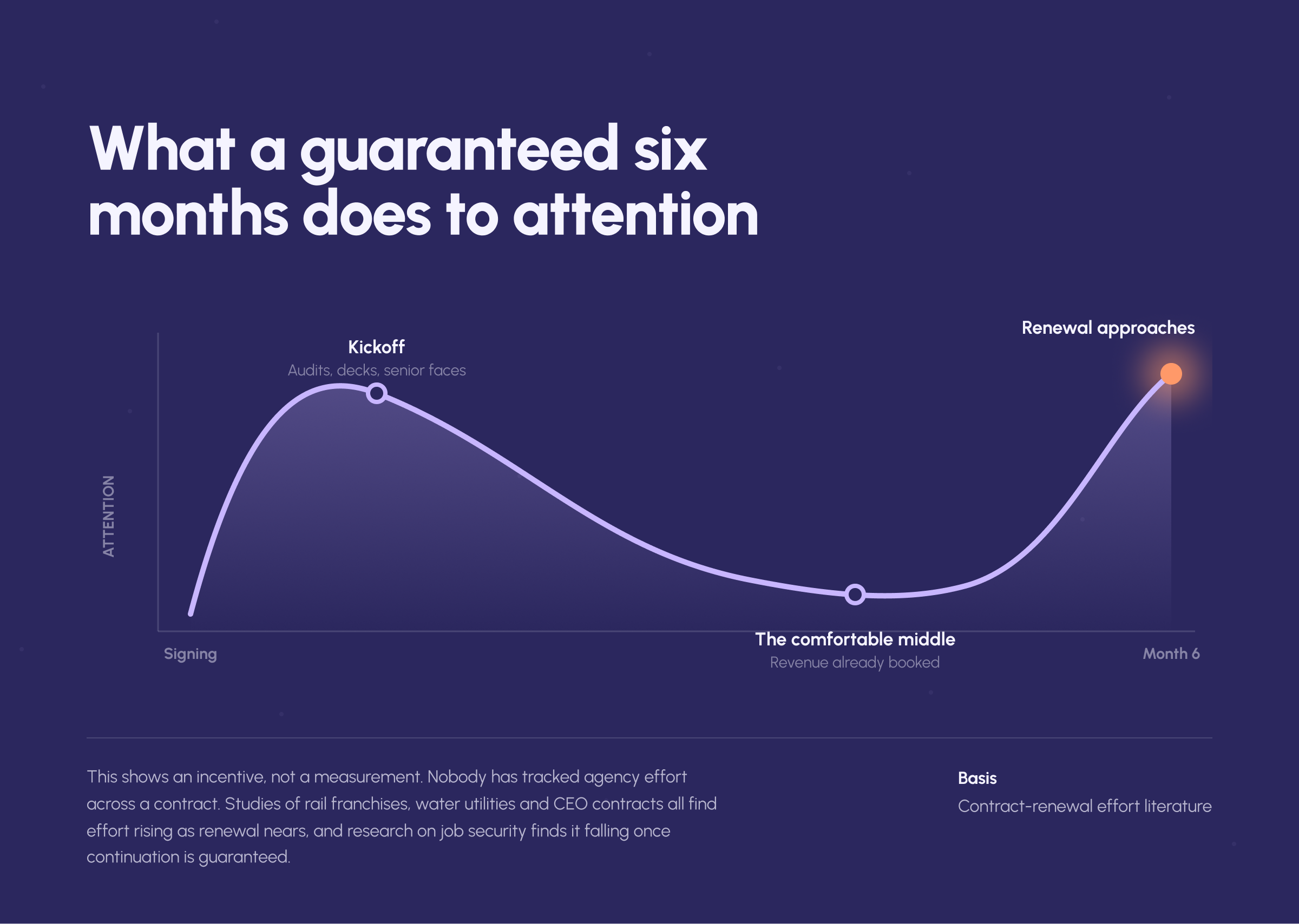
Every company that has hired an agency knows the curve. Month 1 is fireworks: audits, strategy documents, senior people on every call. By month 4 the standing meeting has moved twice and the deliverables have thinned. Then, weeks before renewal, the energy returns.
Economists have documented this pattern wherever contracts guarantee continuation: service providers demonstrably lift effort as renewal approaches and relax once continuation is secured. Nobody has measured the mid-contract trough in marketing agencies specifically, but the incentive structure is identical, and anyone who has sat on the client side of a long engagement will recognize the shape.
There's a related practice, widely discussed among agency buyers, of senior people selling the deal and junior people executing it once the contract is signed. We won't pretend to have data on how often it happens, but it's a commonly held view for a reason: a locked contract removes the main consequence of doing it.
The delivery gap
The most striking recent data on why agency relationships end comes from Setup's Marketing Relationship Survey (2024). Dissatisfaction with delivery was the number 1 reason clients ended agency partnerships, cited by 48%, up 14 points in a single year. Asked the same question, agencies ranked delivery 7th, behind leadership changes and budget cuts.
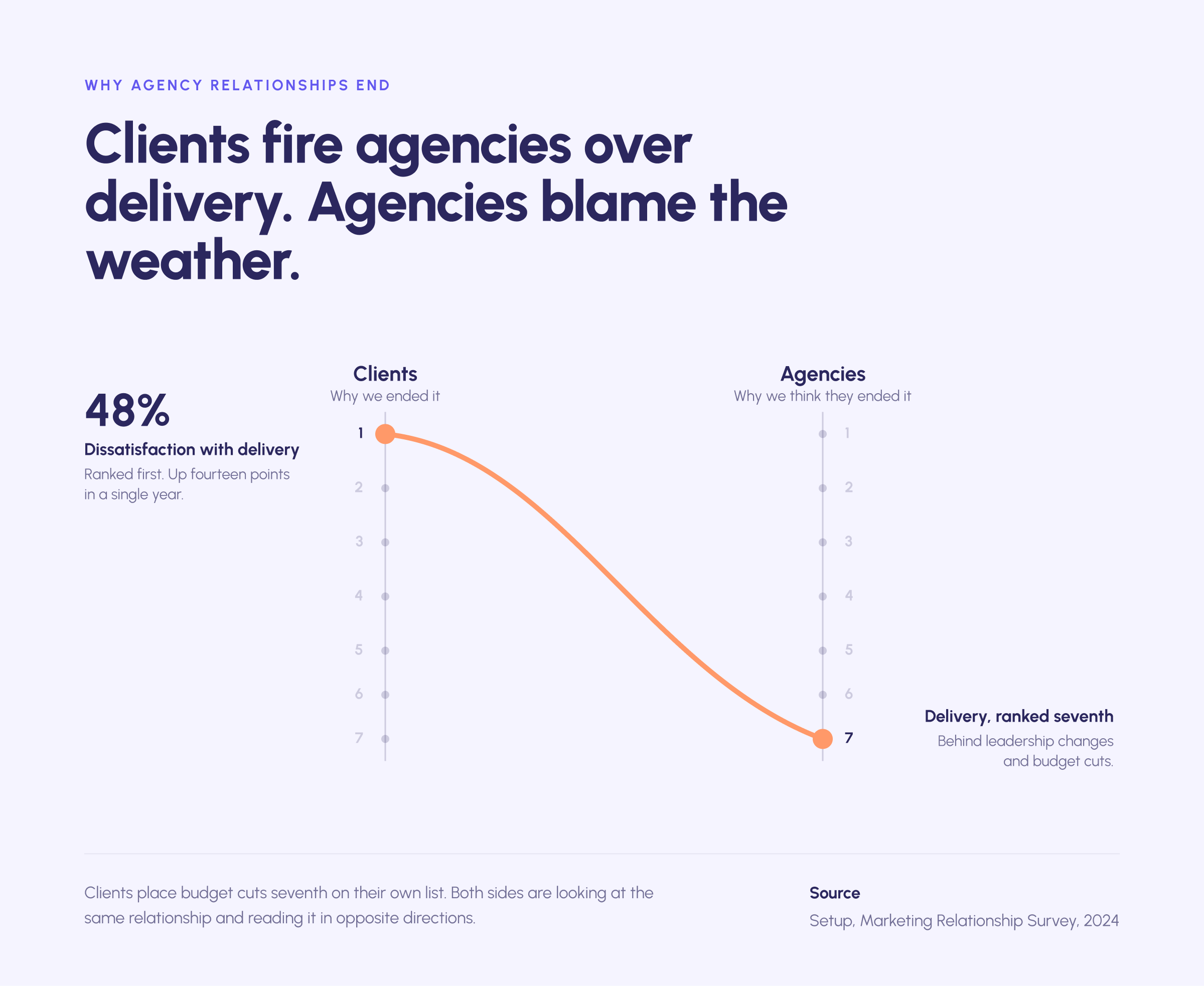
Sit with that mismatch. Clients fire agencies over the work. Agencies believe they lose clients to the weather. An industry that misreads why it gets fired will keep reaching for contractual protection instead of continuous improvement in delivery, and the retainer is that protection, formalized.
It's also why we start every engagement with an audit rather than a campaign. The most valuable thing a marketing partner offers isn't execution, it's honest diagnosis:
"To be open about the wrong, to be critical, this is the best thing you can expect from your agency. A critical approach is very important, it is very needed, and it is good, not bad."
Specialist agencies and the channel problem
There's a structural version of this problem that has nothing to do with effort. A single-channel agency can never tell a client that its channel is the wrong one. An SEO shop will not conclude that organic search is a poor fit for your market. A paid-media agency will not recommend turning off the ads. Saying so would negate its reason for existing.
Wrap a 12-month agency retainer agreement around that incentive and the client is committed to a channel that may not suit their business, advised exclusively by the one party with every reason not to mention it. This happens with competent, well-intentioned teams. The contract simply removes the exit both sides should want available.
Lock-in doesn't prevent churn. It schedules it.
The strangest thing about long retainers is that they don't even deliver the retention they're designed for.
The ANA and 4As studied client-agency tenure in 2025 and found relationships are actually getting longer: average tenure now sits around 7 years, roughly double the 2016 figure. But the internal split is the revealing part. Advertisers who run mandatory review cycles hold their agencies for as little as 3.8 years. Advertisers with no mandatory review, 60% of those surveyed, average 8.1 years.
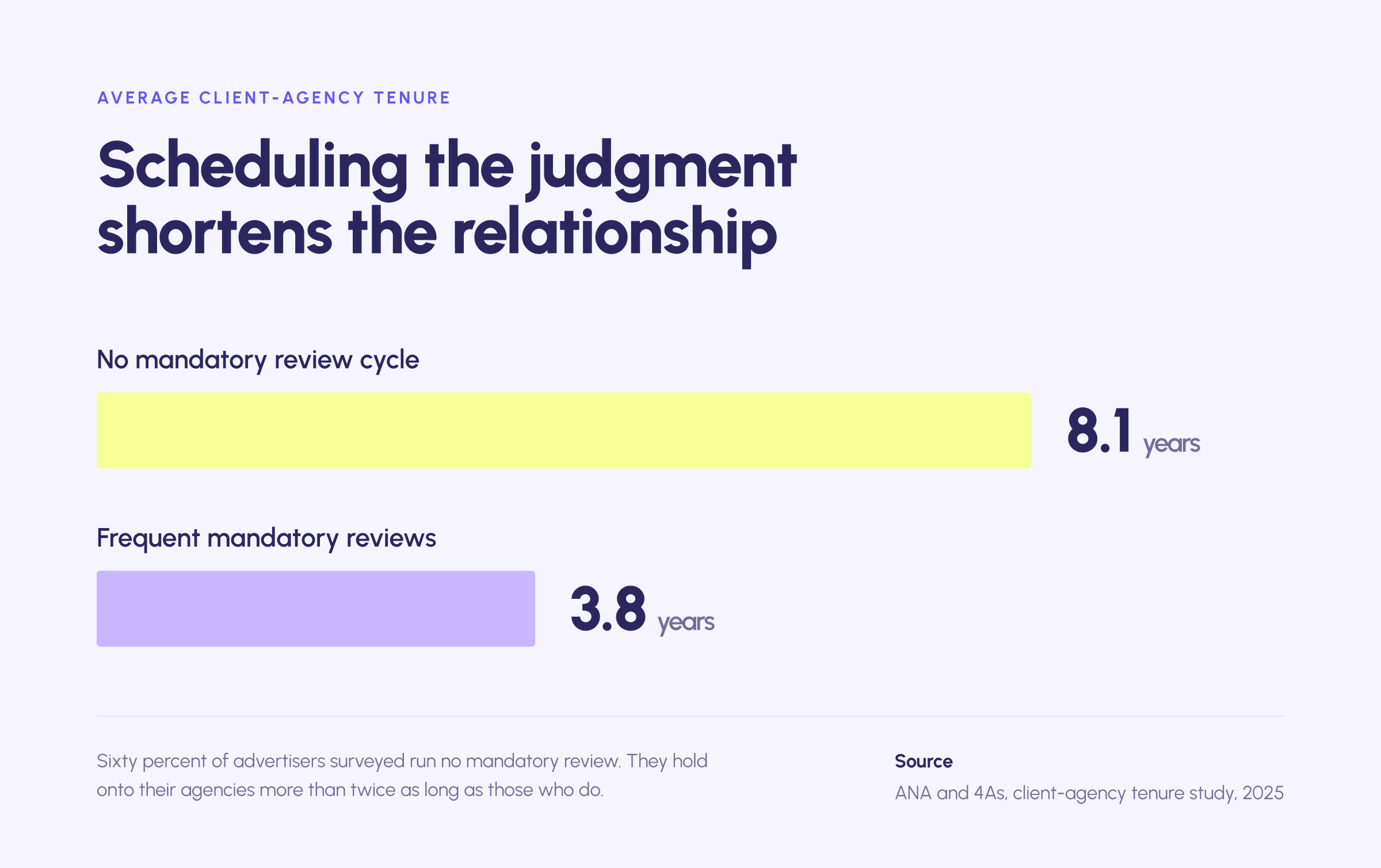
A fixed term functions as a mandatory review. It creates a date. Both sides spend the preceding weeks building a case, and the decision gets made once, formally, under pressure. Rolling contracts mostly don't get re-litigated at all; clients look at what's happening and carry on. The relationships that last a decade are the ones nobody scheduled a verdict for.
Worth adding for balance: the same research put the average cost of running an agency pitch at over $400K for the client. Leaving an agency is genuinely expensive, which is exactly why the decision should belong to the client rather than to a clause.
What a retainer agreement should include
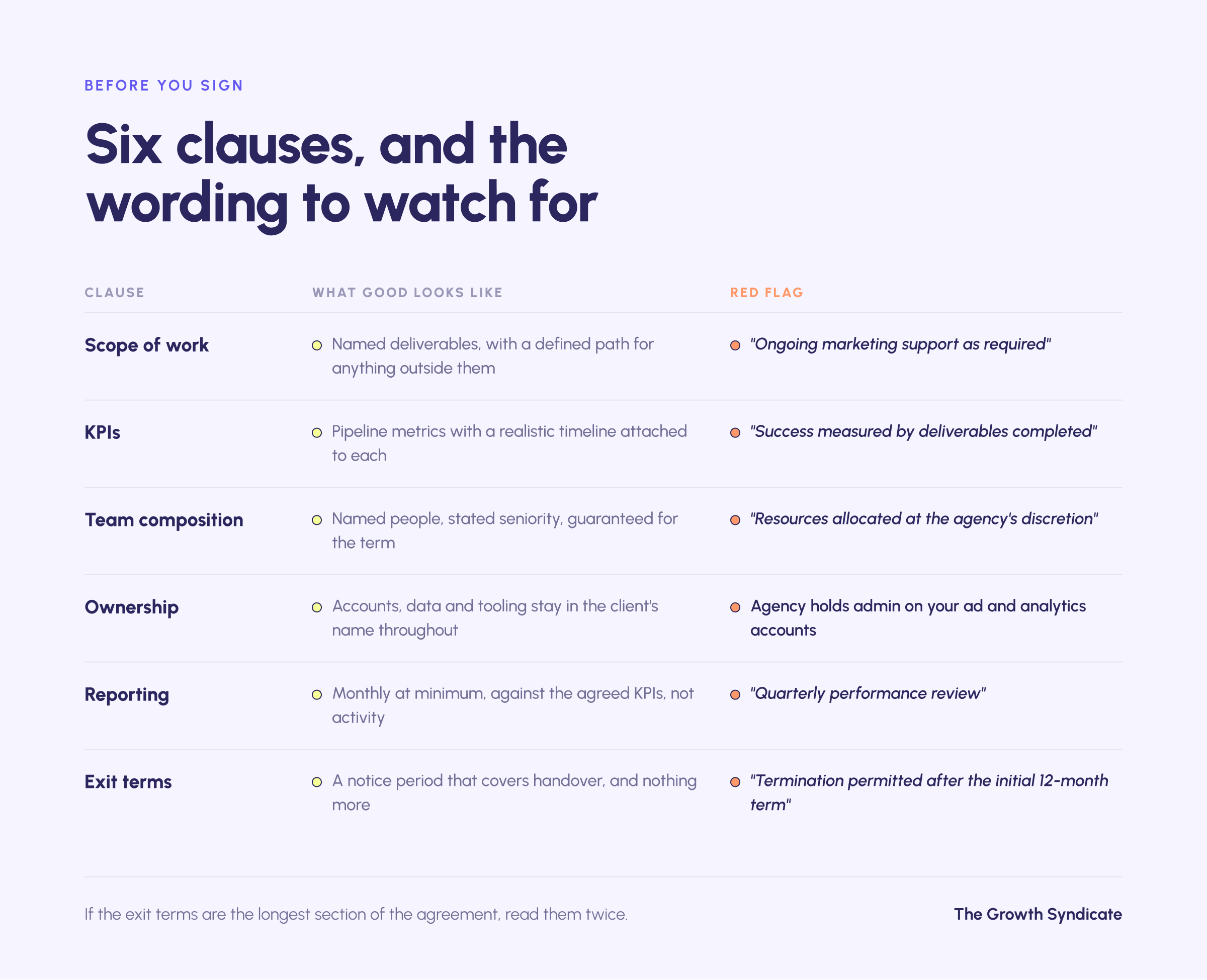
If you are signing one, the agreement itself is where most of the risk can be removed. A retainer agreement worth signing sets clear expectations on all of the following:
- Scope of work. The specific services included, and explicitly what isn't, so ad hoc requests have a defined path rather than becoming a quiet source of resentment.
- Key performance indicators. Tied to your strategic goals and to pipeline, with realistic timelines attached to each. An agency that won't commit to metrics upfront is telling you something.
- Team composition. Who works on the account and at what seniority. This is the clause that addresses the sell-senior-deliver-junior problem directly, and few clients think to ask for it.
- Ownership. Accounts, assets, data, and access to the right tools stay with the client. Dependency should never be a switching cost.
- Reporting cadence. How performance is shared and how often, so the review is continuous rather than annual.
- Exit terms. Notice period, handover obligations, and what happens to work in progress. If the exit terms are the longest section of the agreement, read them twice.
The environment stopped rewarding long commitments
Retainers are partly a legacy of a slower commercial world: long procurement cycles, expensive deal-making, and a market where an agency's methods stayed relevant for the life of a 12-month contract.
That world is gone. Buying decisions that once took 2 quarters now take weeks. And the pace of change in marketing itself, driven above all by AI, means the playbook an agency sells you in January may be outdated by June. New tools change what good execution looks like month to month. Online channels rise and decay faster than they used to. In that environment, a year-long commitment isn't a safety net for the buyer; it's a bet that nothing important will change, placed at the moment when more is changing than at any point in the industry's history.
An agency confident in its ability to adapt doesn't need to lock clients into last year's plan. The companies that deliver on their promises, in marketing services or anywhere else, don't need long-term contracts to keep their clients. That's increasingly the standard buyers should hold every vendor to, and agencies are simply the vendor category where the gap between the standard and the practice is widest.
How The Growth Syndicate structures engagements
We're a full service B2B marketing agency, and we don't use long-term retainers. Our co-founder Ferdinand Goetzen describes the principle without much decoration:
"You pay per month, it's cancel anytime. You pay per hour, it's cancel anytime. Simple and transparent."
Every engagement runs on a rolling basis with 30 days' notice, in four shapes:
Full Marketing Team. An embedded marketing function: Head of Growth, performance, content, design, RevOps. For companies that need a marketing department without building one.
Pay-As-You-Go. Flexible access to the same team, anchored by Head of Growth hours for strategic continuity. For companies starting smaller or with specific needs.
Performance Marketing. Strategy-led paid media across LinkedIn, Google, and Meta, connected to pipeline rather than click metrics.
Account-Based Marketing (ABM). Targeted programs for defined account lists and longer sales cycles, built with sales rather than alongside it.
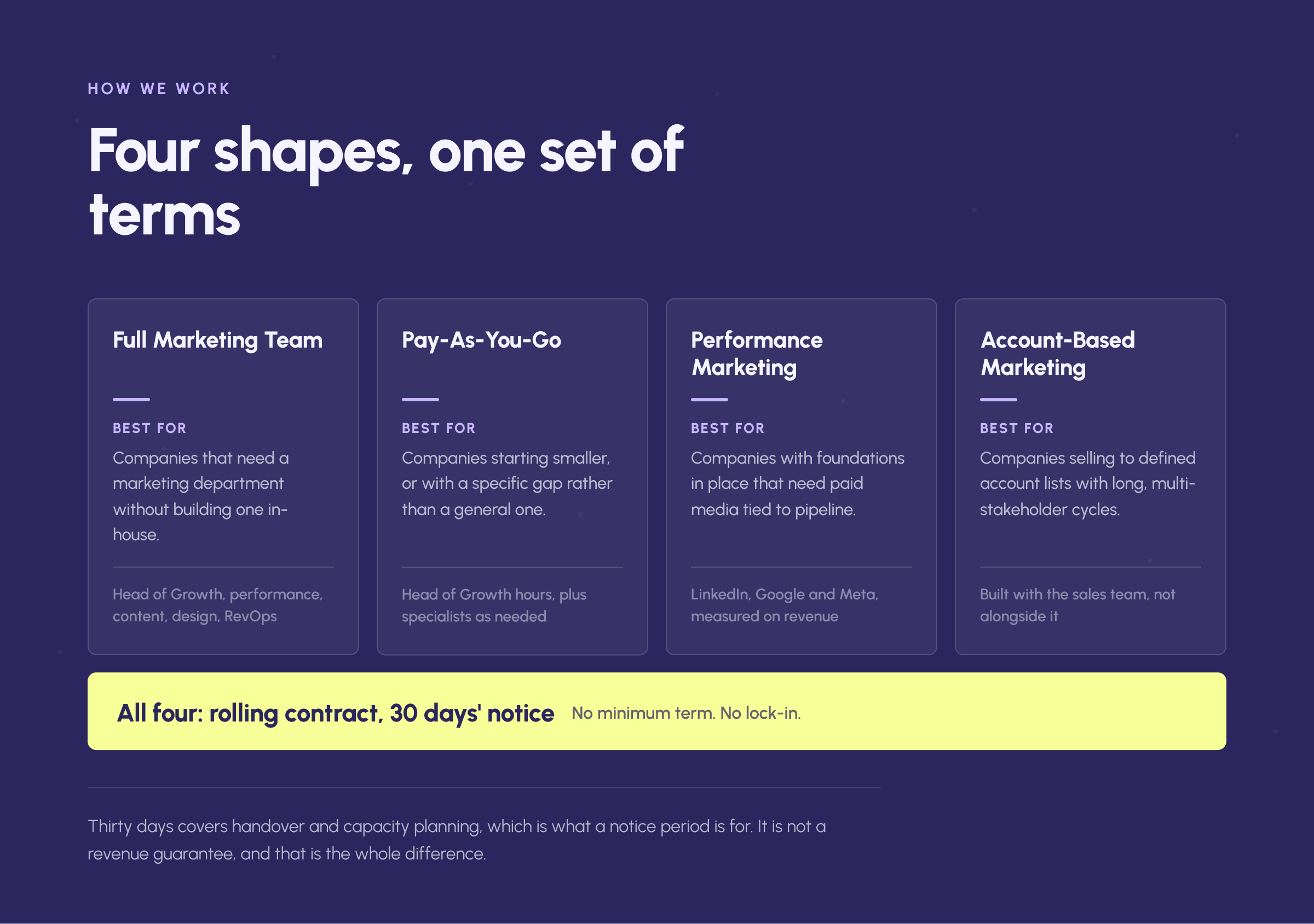
Why 30 days rather than same-day cancellation? Capacity planning, plainly. Client count affects our hiring, freelance commitments, and start dates, and no client has ever left well with zero handover. Thirty days is the operational minimum for winding down responsibly. It is not a revenue guarantee, and that's the entire difference: notice periods serve the transition; lock-ins serve the agency.
The cancellation clause is not why clients hire us, and we'd be suspicious of any agency for which it was the headline. What wins the work is senior people with extensive experience in complex B2B industries, and marketing judged on pipeline rather than vanity metrics. What the rolling contract does is lower the cost of being wrong about us, which matters most to companies that have been burned before. The obligation it creates runs in the right direction: we have to create value every month, because every month the client is free to decide we didn't.
Is a marketing agency worth it?
Often, yes, and the honest answer depends less on the agency category than on the engagement structure. The right agency brings senior expertise a company couldn't hire quickly, across strategic planning, execution, and analytics, without the fixed cost of a full in-house team. That's a genuinely cost effective way to buy capability. The wrong one bills confidently for a year and delivers activity.
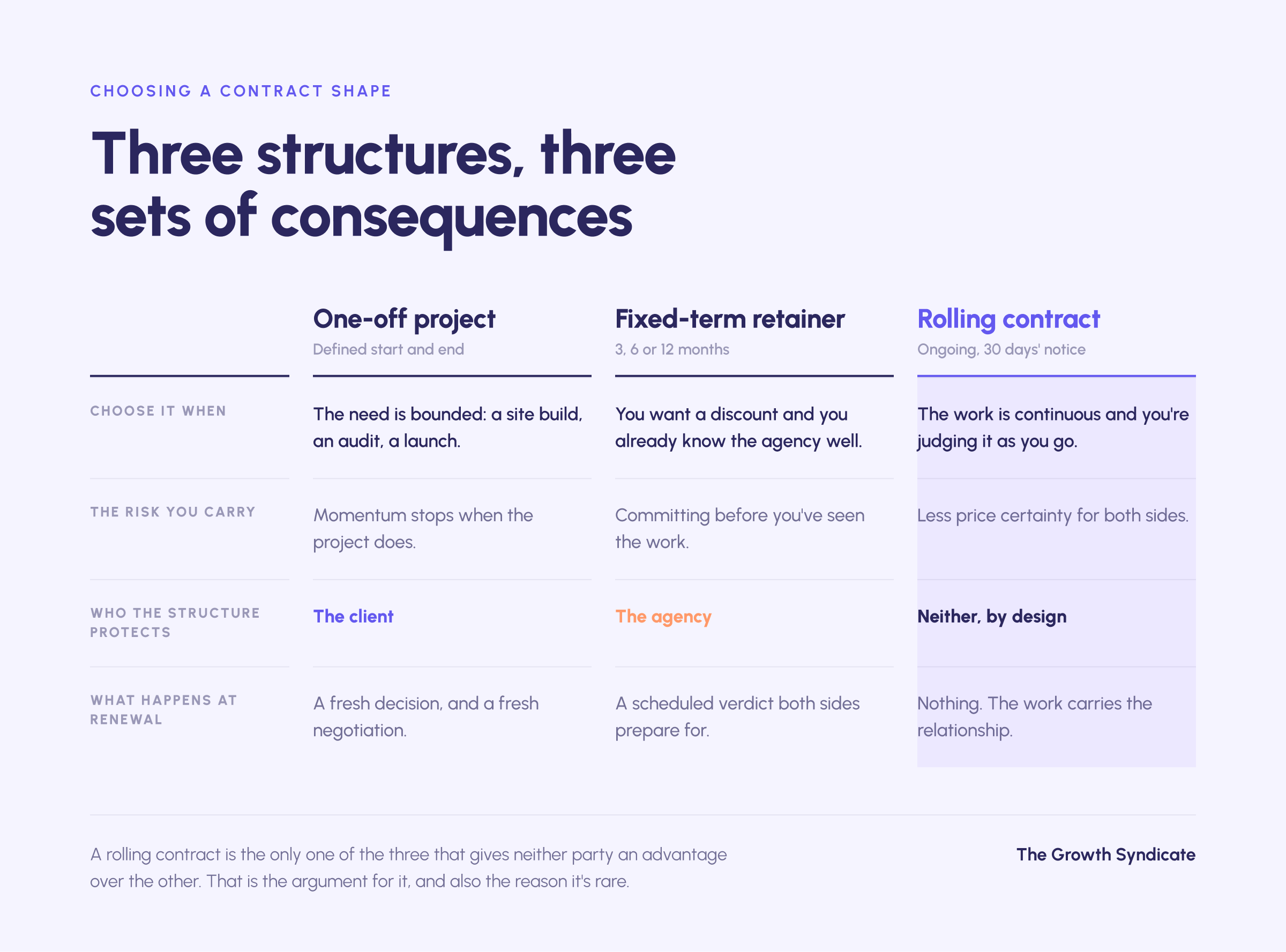
The diligence question that separates them isn't in the pitch deck, the case studies, or the client list, because every agency has prepared answers for those. Ask instead what happens if you want to leave in month 2. The answer tells you what the agency believes about its own work, and it's the fastest read on whether the next 12 months will be earned or merely billed.
Frequently asked questions
What is an agency retainer?
An agency retainer is an agreement in which a client pays a recurring fee, usually monthly, to reserve an agency's services over a fixed term. It differs from project based billing, where the client pays for a defined piece of work with a start and an end.
What does a retainer fee in an agency agreement mean?
The retainer fee is the fixed amount the client pays each period. It typically corresponds to either a defined scope of work or an allocation of hours, and it's payable regardless of how much of the scope the client actually uses in a given month.
What does it mean to be hired on a retainer?
For an agency, being on retainer means committed, ongoing work for a client rather than one off projects. In practice it means the agency reserves team capacity for that client and plans its own hiring around the commitment.
How much does a marketing retainer cost?
Anywhere from a few thousand dollars a month for a narrow scope with a smaller agency to tens of thousands for senior, multi-channel teams. Paid media management often adds a percentage of ad spend. The figure to scrutinize is the total commitment: monthly fee times the months you can't leave.
What exactly do marketing agencies do?
Marketing agencies plan and execute the work a company either can't staff internally or doesn't want to. Depending on the agency, that spans search engine optimization, paid advertising, content marketing, social media, email marketing, web design, and market research, along with the strategy and analytics that connect those activities to revenue. A full service agency covers most of that range; specialist digital agencies go deeper on one or two.
Are longer retainer contracts cheaper?
Agencies often discount longer terms, and the discount is real. What it buys the agency is your inability to act if the work disappoints. Whether that trade is worth 10-15% depends entirely on how confident you are in a partner you haven't worked with yet, which is the problem with paying for the discount on day one.
Do rolling contracts mean less committed agencies?
The incentive runs the other way. An agency on a rolling contract has to justify the relationship with every month's work. An agency holding a 12-month agreement doesn't. Commitment shows up in delivery, and delivery is best measured where it can still change the outcome.
How do I know if a marketing agency is worth the cost?
Judge it on pipeline and revenue influenced, not activity delivered. A competent agency will propose those metrics itself, tell you honestly which results take 2 quarters to appear, and structure the engagement so you're never paying for the privilege of waiting.
About the publisher and authors
The Growth Syndicate is a full service B2B marketing agency working with companies in complex industries: enterprise software, deep tech, manufacturing, fintech, healthtech, and professional services. Founded in 2024, with offices in Amsterdam and New York, we staff every account with senior practitioners and measure our work in pipeline and revenue rather than deliverables shipped. All engagements run on rolling contracts with 30 days' notice.
Ferdinand Goetzen is a co-founder of The Growth Syndicate. He has spent over a decade scaling B2B companies, as one of the first hires at Growth Tribe, then as CMO of Recruitee and Director of Marketing and Growth at 3D Hubs, both of which exited for over half a billion euro in 2021. He later founded and sold the customer insights platform Reveall. He writes and speaks regularly on ICPs, positioning, and the commercial models agencies use.
Joliene van Grieken is a co-founder of The Growth Syndicate and reviewed this article. She has supported B2B tech companies for more than 12 years, leading growth at Impraise through its acquisition by BetterUp in 2021 and building marketing from the ground up at Bud Financial. She specializes in demand generation and in building marketing processes that hold up over the long term.

.png)