.svg)


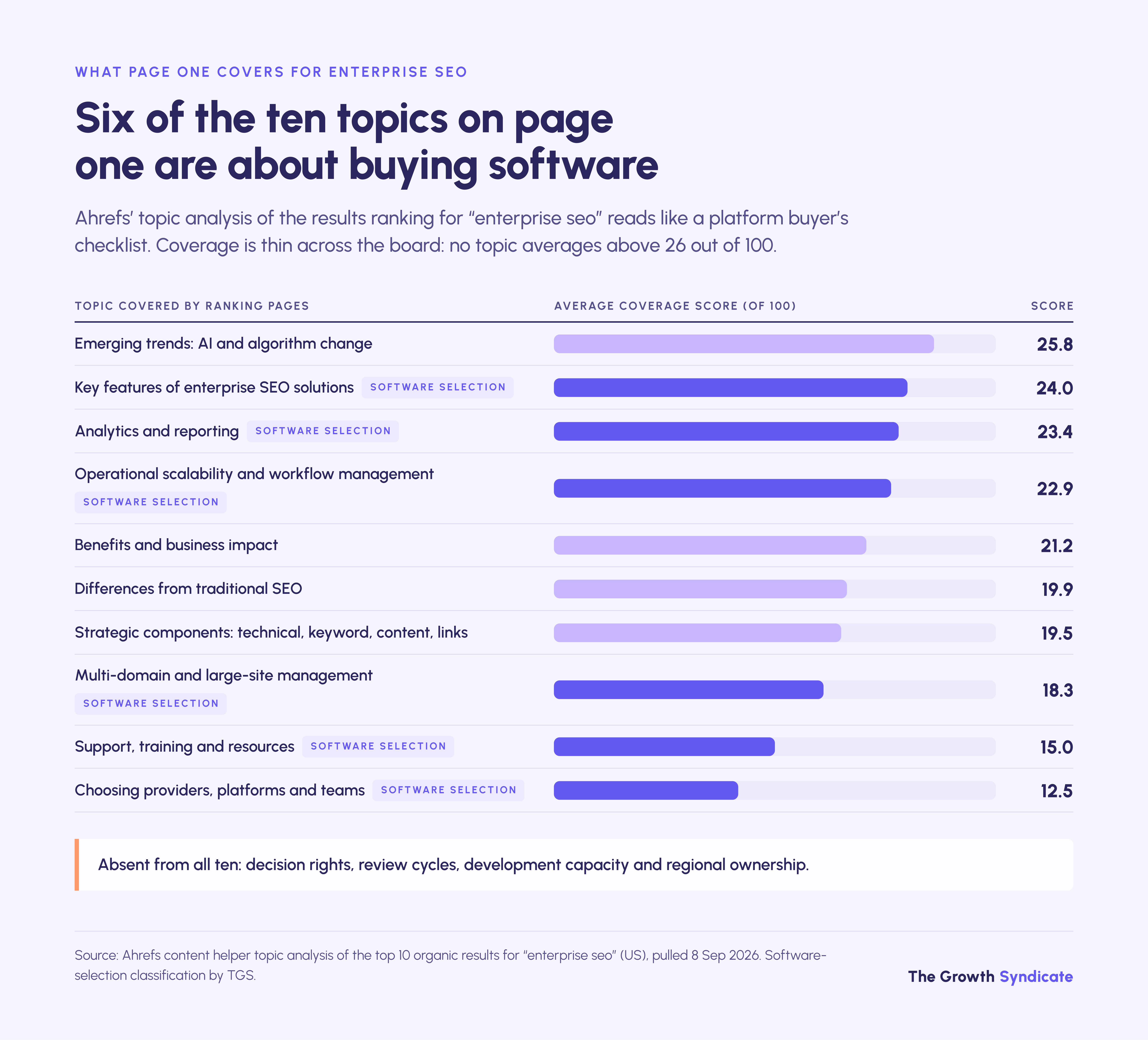
Every page currently ranking for "enterprise SEO" describes the same company: a retailer or publisher with millions of URLs, a crawl budget problem, and a need for software that can manage it all. That company exists. It is almost never a B2B enterprise.
A €500M ARR B2B software company runs somewhere between 800 and 5,000 pages. An industrial manufacturer with eleven regional sites might run 3,000. These are large enterprise companies by any commercial measure. Neither has a scale problem in any sense a search engine would recognize. Both have a program that moves at a crawl, and the reason has nothing to do with crawling.
This article covers what enterprise B2B SEO means in practice: what actually constrains these programs, how to build a strategy that survives contact with a real org chart, when an enterprise SEO platform earns its cost, and how to measure organic search when your sales cycle outlasts your attribution window. The fundamentals are the same as in any B2B SEO strategy; this piece covers what changes at enterprise scale.
What is enterprise SEO?
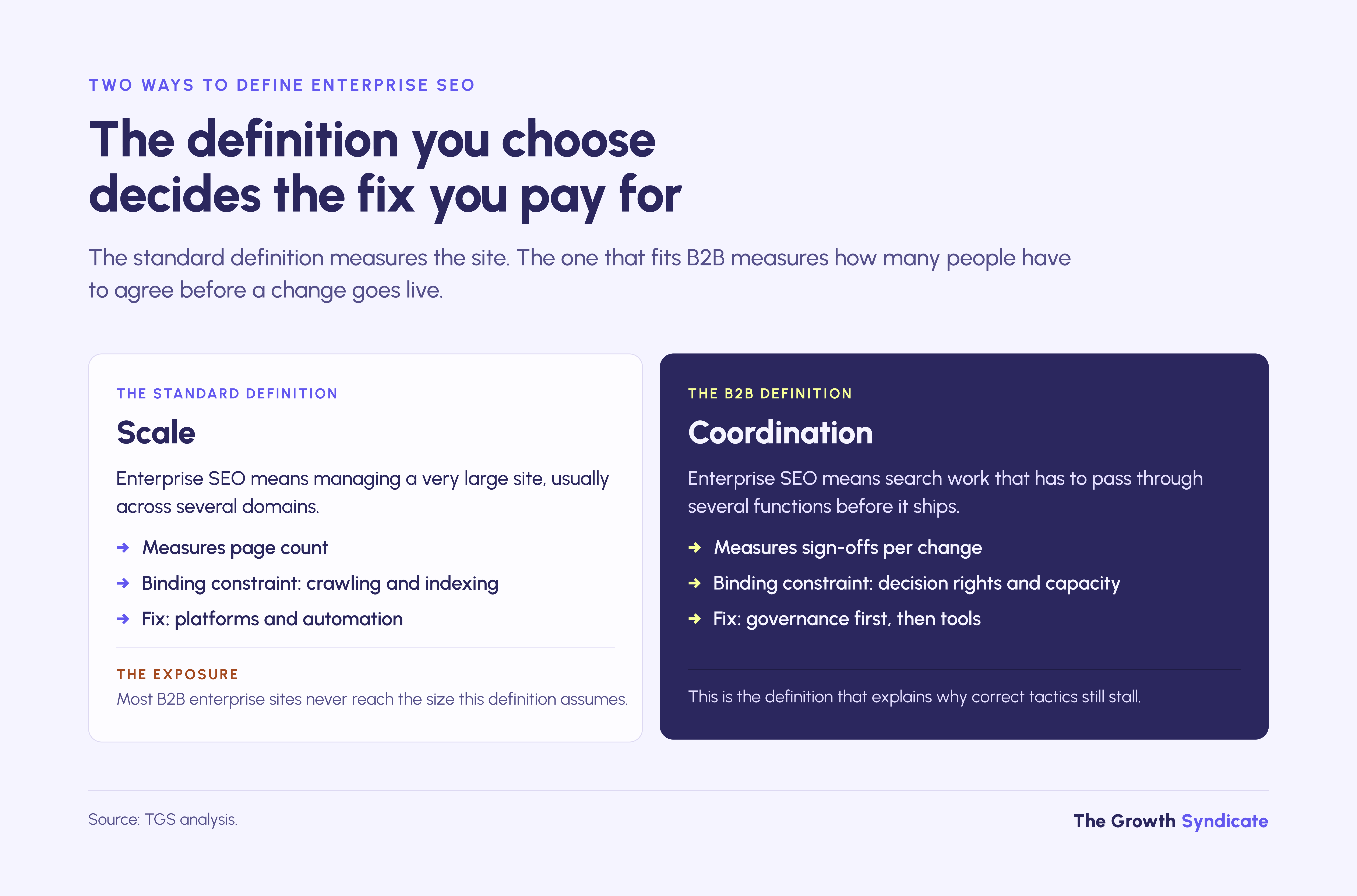
Enterprise SEO is search optimization inside an organization where the work has to pass through multiple functions before it ships. The standard definition anchors on site size, usually a large page count across multiple domains. The more useful definition for B2B anchors on decision complexity: how many people have to agree before a change goes live.
That distinction matters because the two definitions point at completely different problems. If enterprise SEO is a scale discipline, the answer is tooling and automation. If it is a coordination discipline, the answer is governance, and no amount of software substitutes for it.
The scale definition has a threshold, and most B2B sites are nowhere near it
The scale definition is testable, and it is worth knowing where the line sits. Google's own guidance on crawl budget states that the topic is relevant to sites with more than one million unique pages whose content changes roughly weekly, or more than 10,000 unique pages whose content changes daily. Google opens the document by telling most site owners not to read it. A B2B enterprise site running 3,000 pages sits two orders of magnitude below that threshold.
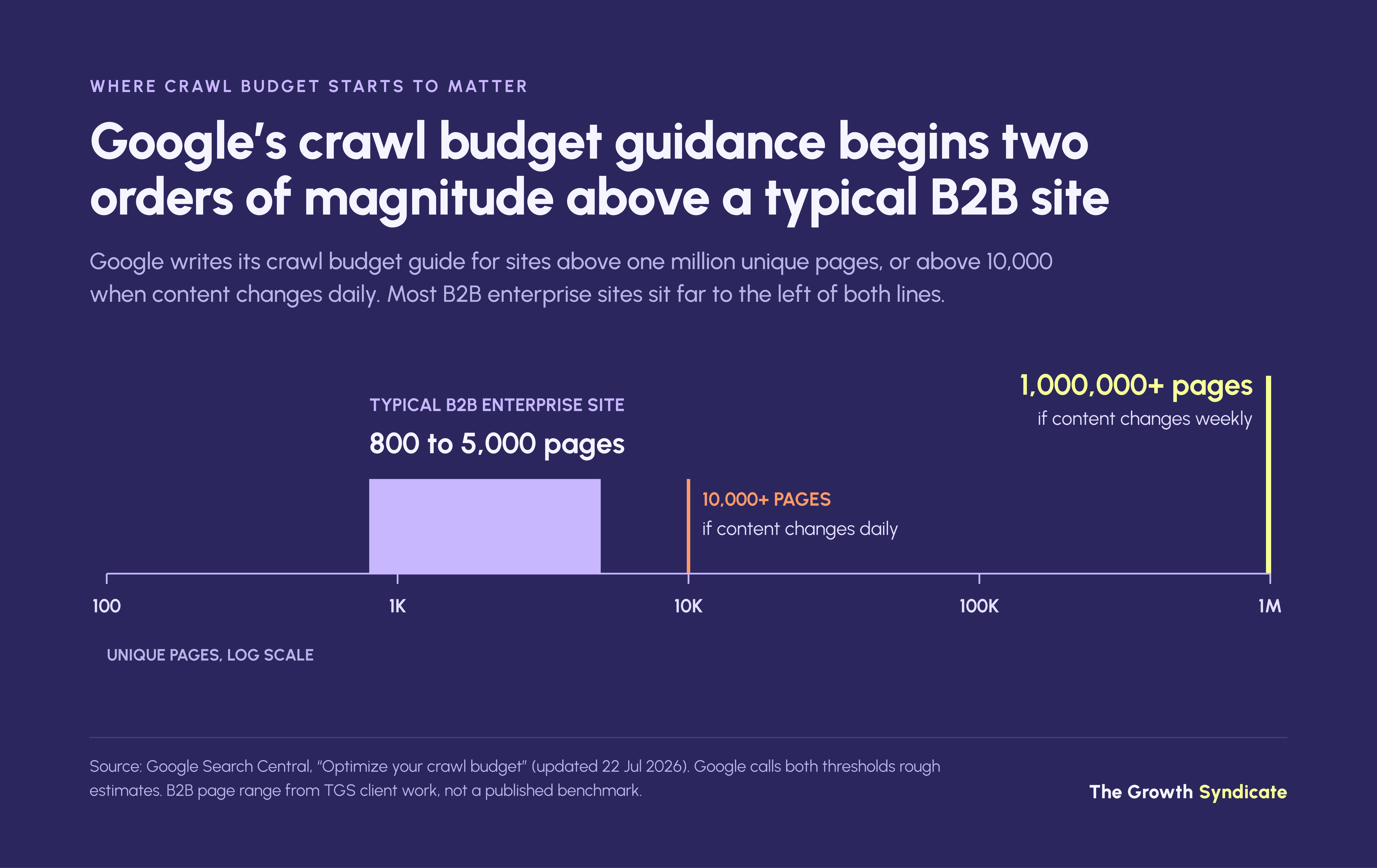
So the technical constraint that defines enterprise SEO in the retail world does not bind for most enterprise companies in B2B, which is why SEO strategies borrowed from retail tend to solve a problem these organizations do not have. Search engines are not struggling to crawl your 2,800 pages. What binds instead is the six weeks it takes to get a title tag changed.
This is not an argument that technical SEO stops mattering at this size. Site structure, indexation hygiene, and page performance all still determine whether your best content can rank. It is an argument that these are solvable problems with known solutions, and that solving them is rarely what is holding the program back.
Where technical SEO still matters at this scale
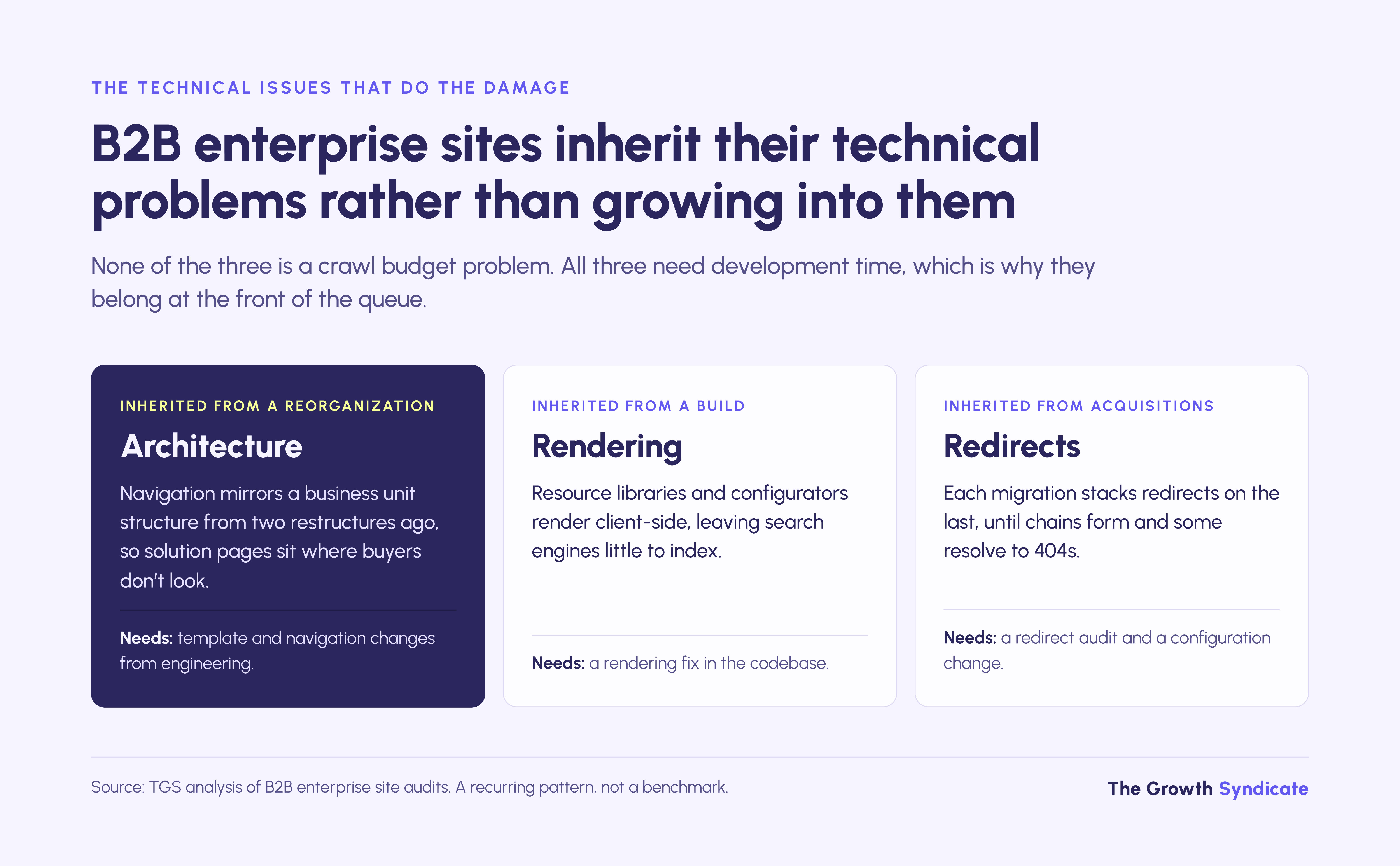
Three technical areas do real damage on B2B enterprise sites, and none of them is crawl budget.
Site architecture inherited from a reorganization. Most enterprise site architecture reflects an org chart from two restructures ago. Products sit under the business unit that used to own them, solution pages live three clicks below where buyers look for them, and the navigation encodes internal structure rather than buyer logic. Search engines infer importance partly from structure, so a page buried under a defunct division gets treated as a minor page.
JavaScript rendering on gated or dynamic sections. Resource libraries, product configurators, and personalized sections frequently render client-side in ways that leave little for search engines to index. The content exists. The search presence does not.
Redirect debt from acquisitions. Each acquisition brings a domain, and each migration leaves a layer of redirects on top of the previous layer. Chains form, some resolve to 404s, and authority stops passing where it should.
All three are fixable. All three require development time, which is why they belong at the front of the queue rather than in the third section of an audit nobody finishes reading.
How enterprise SEO differs from standard B2B SEO
Enterprise SEO differs from standard B2B SEO in decision rights rather than tactics. The keyword research is the same. The on-page work is the same. What changes is that every recommendation acquires a review cycle, a stakeholder with veto power, and a deployment risk attached to a site that other departments depend on.
A 40-person B2B software company can ship an SEO recommendation the afternoon it is written. Someone owns the CMS, someone owns the copy, and both are in the same Slack channel. At enterprise scale, the same recommendation touches web operations, brand, legal, the regional marketing lead whose page it is, and a development team prioritizing against a product roadmap you do not control.
The five differences that actually change the work
Decision rights. In a smaller organization, the SEO owner usually also controls publishing. In an enterprise, publishing rights, template rights, and technical deployment rights typically sit with three different teams, none of which report to marketing.
Review cycles. Every claim on a page in a regulated industry passes through compliance. Every product statement passes through product marketing. Every brand-adjacent phrase passes through brand.
Deployment risk. A template change on a 50-page site is reversible in minutes. The same change across 3,000 pages that also serve as the sales team's primary reference material carries organizational risk that has nothing to do with search engines.
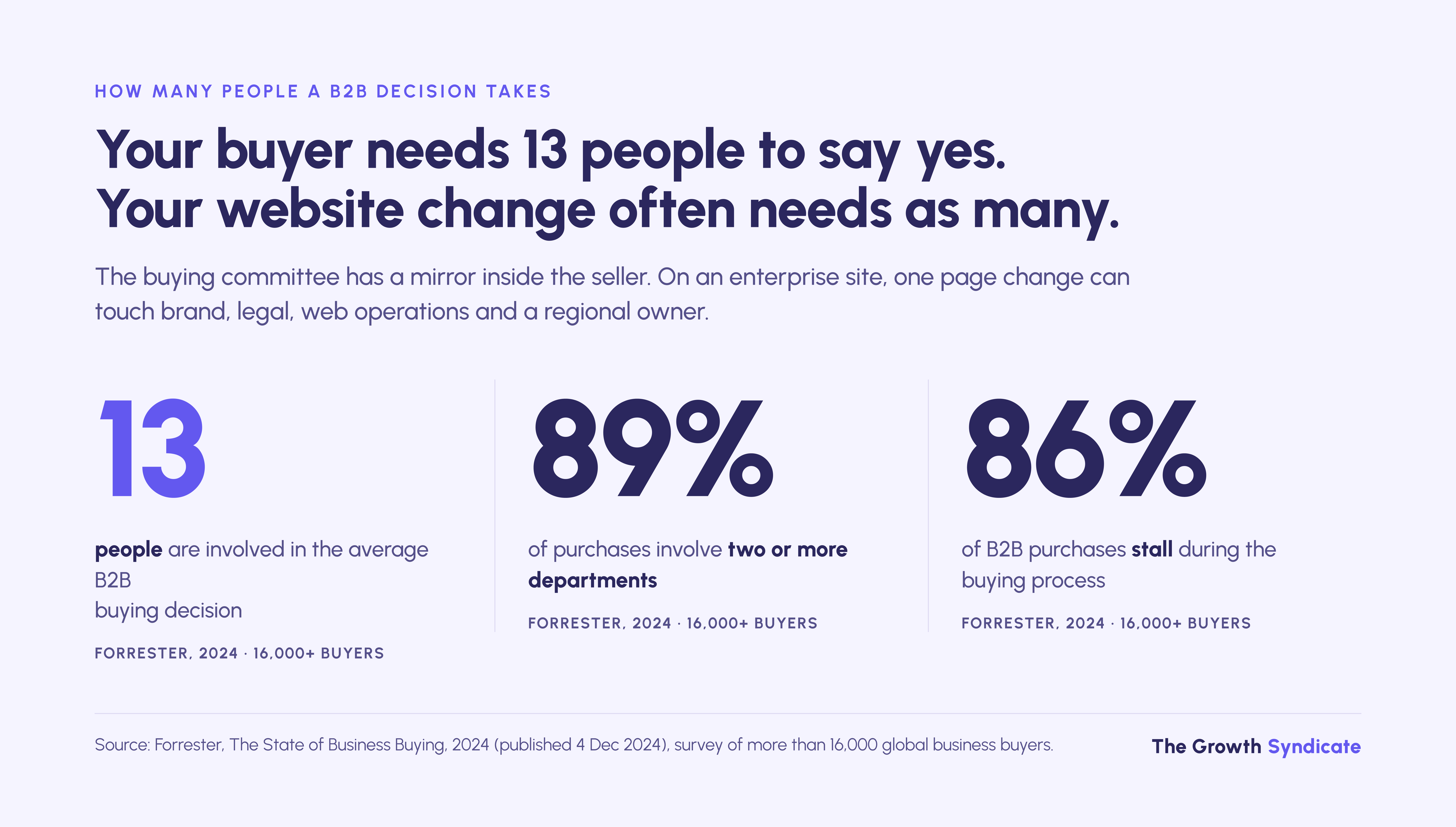
Stakeholder count. Forrester's December 2024 study of more than 16,000 business buyers found that an average of 13 people are involved in a B2B buying decision, and that 89% of purchases involve two or more departments. The internal picture usually mirrors the external one. If your buyer's organization needs 13 people to say yes, so does yours.
Measurement window. Standard B2B SEO can show a ranking movement in six weeks and a lead in three months. Enterprise programs are measured against complex sales cycles that outlast most CMOs' tenure.
This is why enterprise SEO strategies that are simply scaled-up versions of mid-market SEO strategies fail. The tactics transfer. The operating model does not.

"Most marketing teams don't fail because of poor execution. The teams that struggle are the ones that don't get buy-in from stakeholders and end up compromising heavily on campaigns, projects and tools. They can't communicate value in a way that matches how leadership sees the business, so they never get the budget or the resources. Maybe one in twenty companies I've worked with actually has an execution problem."
Why enterprise SEO programs stall: the five real constraints
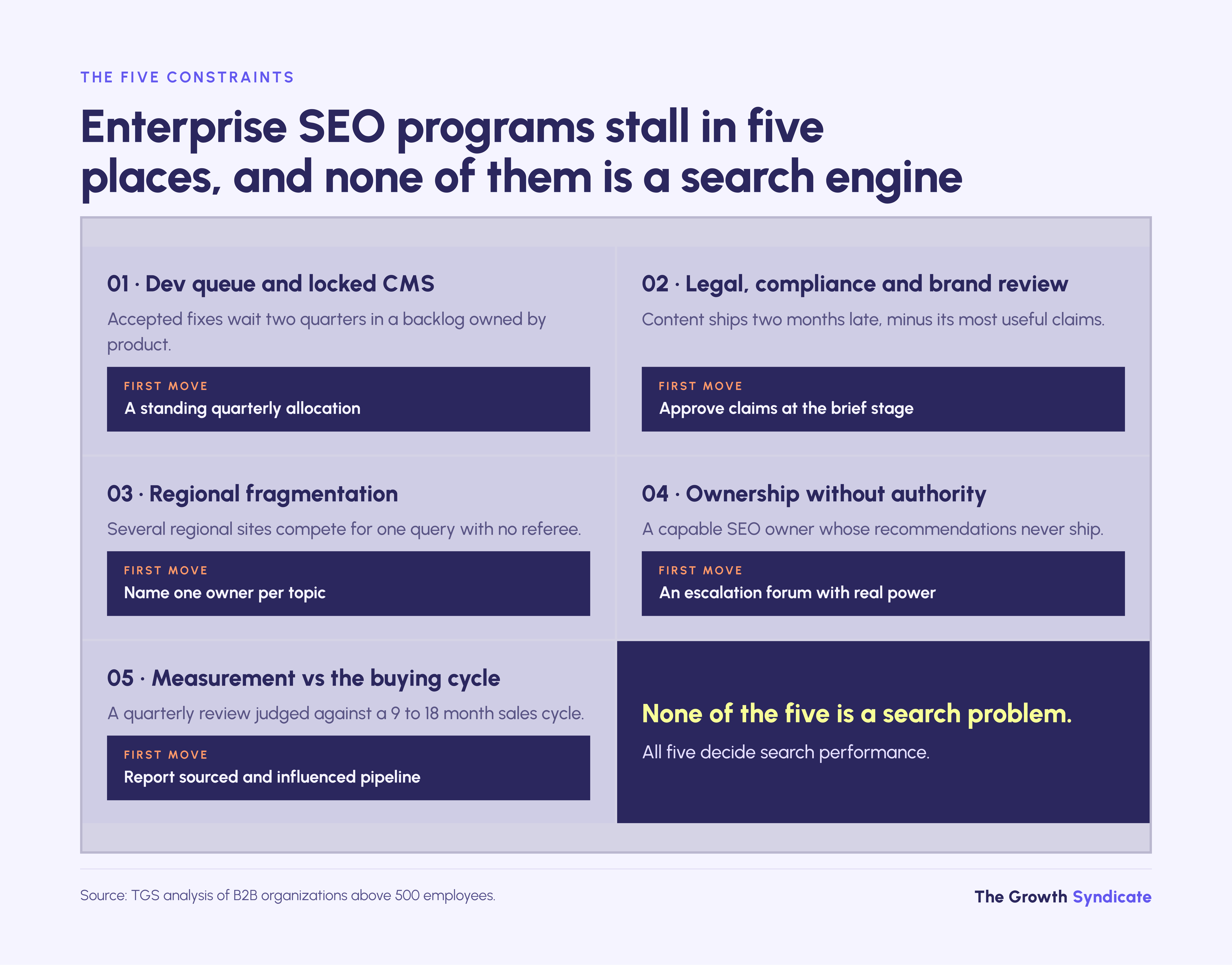
Enterprise SEO programs stall for organizational reasons, not technical ones, and the pattern holds whether the SEO program is two years old or two months. Across B2B organizations above 500 employees, the same five constraints appear regardless of industry: development capacity, review cycles, regional fragmentation, ownership without authority, and measurement that cannot survive the sales cycle.
None of these is a search problem. All of them determine search performance. The framing is old and well established in organizational research: Coase described the costs of internal coordination as the economic equivalent of friction in a physical system, and Lawrence and Lorsch's 1967 study of complex organizations showed that as firms differentiate into specialized units, performance depends on whether the people responsible for integrating those units have enough influence to actually do it. That is a precise description of what happens to an SEO lead inside a large B2B company.
Constraint one: the development queue and the locked CMS
Symptom: technical recommendations are accepted, agreed, and then sit in a backlog for two quarters.
Most enterprise sites in B2B run on a CMS that marketing does not fully control. Templates are locked. Schema markup requires a deployment. Redirect rules live in a config file owned by engineering. The SEO team can write the ticket but cannot merge it, and the development team prioritizes against a roadmap where marketing requests compete with customer-facing features.
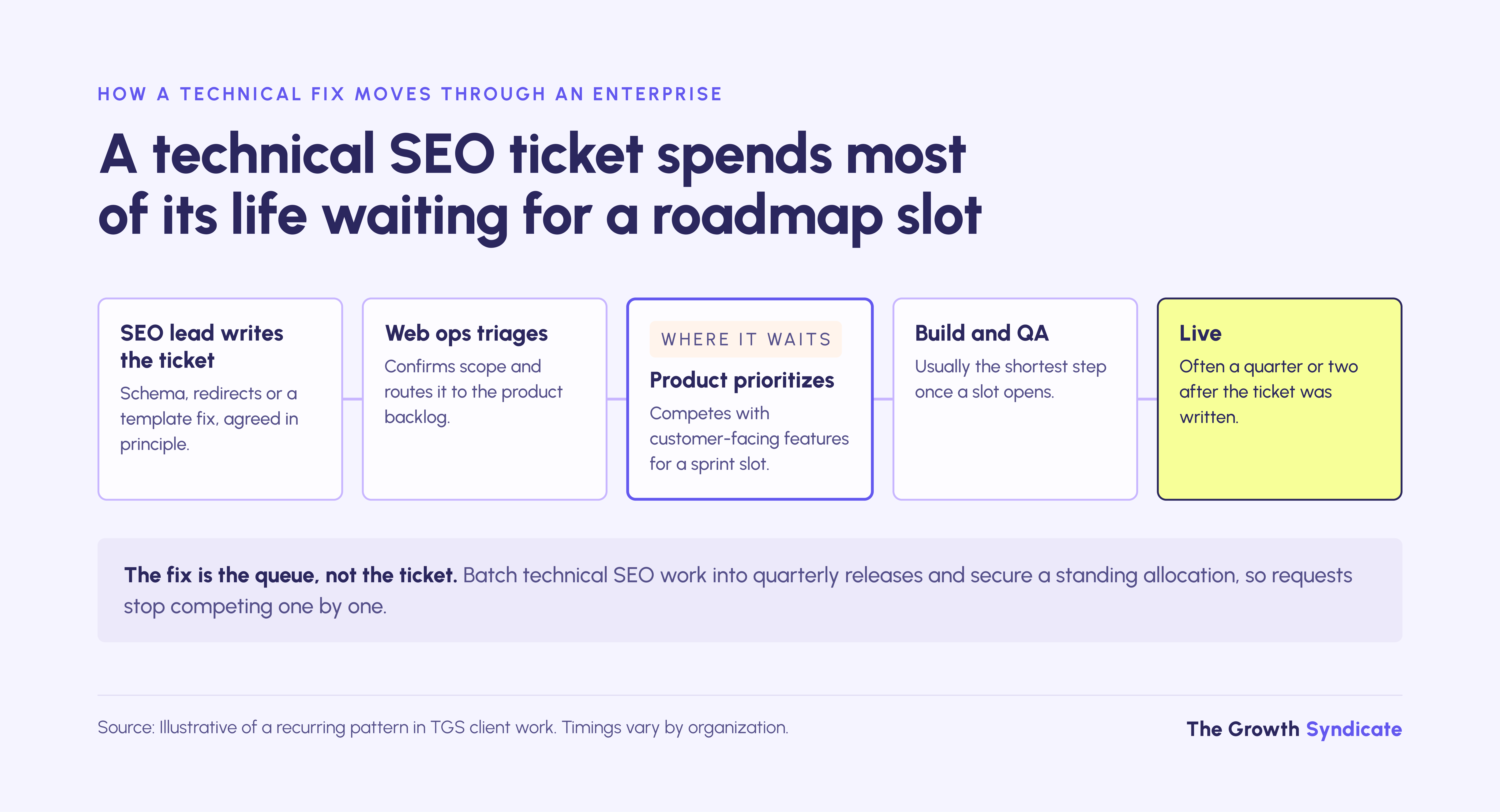
The information systems literature documents what happens next. When central technical capacity cannot meet business-unit demand, business units route around it. This is the well-studied shadow IT pattern, and in marketing it shows up as landing pages built on an unconnected subdomain, microsites launched for a campaign and never retired, and a tag manager doing work that belongs in the codebase. Each workaround is locally rational and collectively expensive, and together they degrade the technical foundation the whole program rests on.
What works: stop treating the dev queue as an obstacle and start treating it as a fixed input. Batch technical SEO work into quarterly releases rather than submitting tickets continuously, and write each ticket in the language engineering already uses. Secure a standing allocation, even a small one, rather than negotiating each request individually. Separate the changes that genuinely need engineering from the ones that only need CMS access, then fight the smaller, winnable fight for that access.
Constraint two: legal, compliance, and brand review
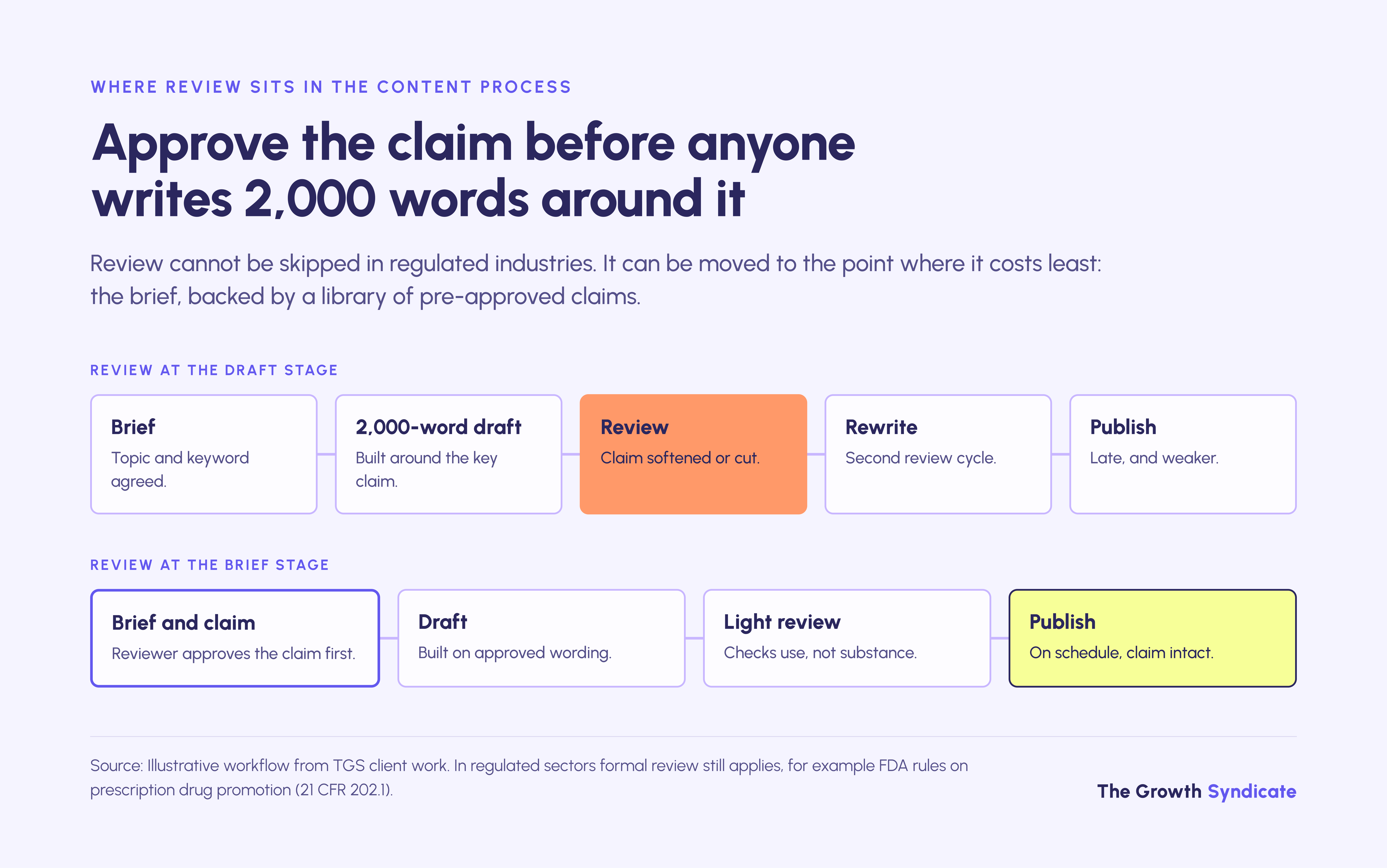
Symptom: content is written on schedule and published two months late, having lost its most useful sentences.
In pharma, medical devices, and financial services, review is not optional. Prescription drug promotion in the United States is governed by 21 CFR 202.1 and enforced by the FDA's Office of Prescription Drug Promotion, which is why medical, legal, and regulatory review exists as a formal stage rather than a courtesy. Financial services carry equivalent regimes. Anyone promising a two-week content cycle in these industries has not worked in them.
Even outside regulated sectors, enterprise brand review functions similarly. The claim your content strategy depends on is frequently the exact claim that gets softened into meaninglessness during review.
What works: move review upstream. Get the claim approved at the brief stage rather than the draft stage, which means the reviewer sees "we will state that our platform reduces reconciliation time" before anyone writes 2,000 words around it. Build a pre-approved claims library that content teams can draw from without triggering a fresh cycle. Where review timelines genuinely cannot compress, plan the editorial calendar around them rather than pretending they will not happen.
Constraint three: regional and business-unit fragmentation
Symptom: three of your regional sites compete for the same keyword, and nobody has the authority to decide which one should win.
This is the constraint most specific to global enterprises and the one with the clearest technical consequences. A manufacturer with a .com, a .de, a .co.uk, and a legacy acquisition site is running four search presences with four owners and four budgets. Google's guidance on multi-regional and multilingual sites requires distinct URLs per language and region plus consistent hreflang annotations, which assumes a single party can enforce consistency across all of them. Frequently no such party exists.
The result is duplicated content across multiple domains, conflicting entity signals, internal linking that stops at national borders, and domain authority split four ways instead of compounding in one place. Organizations running multiple business units on separate properties hit the same problem without the excuse of geography.
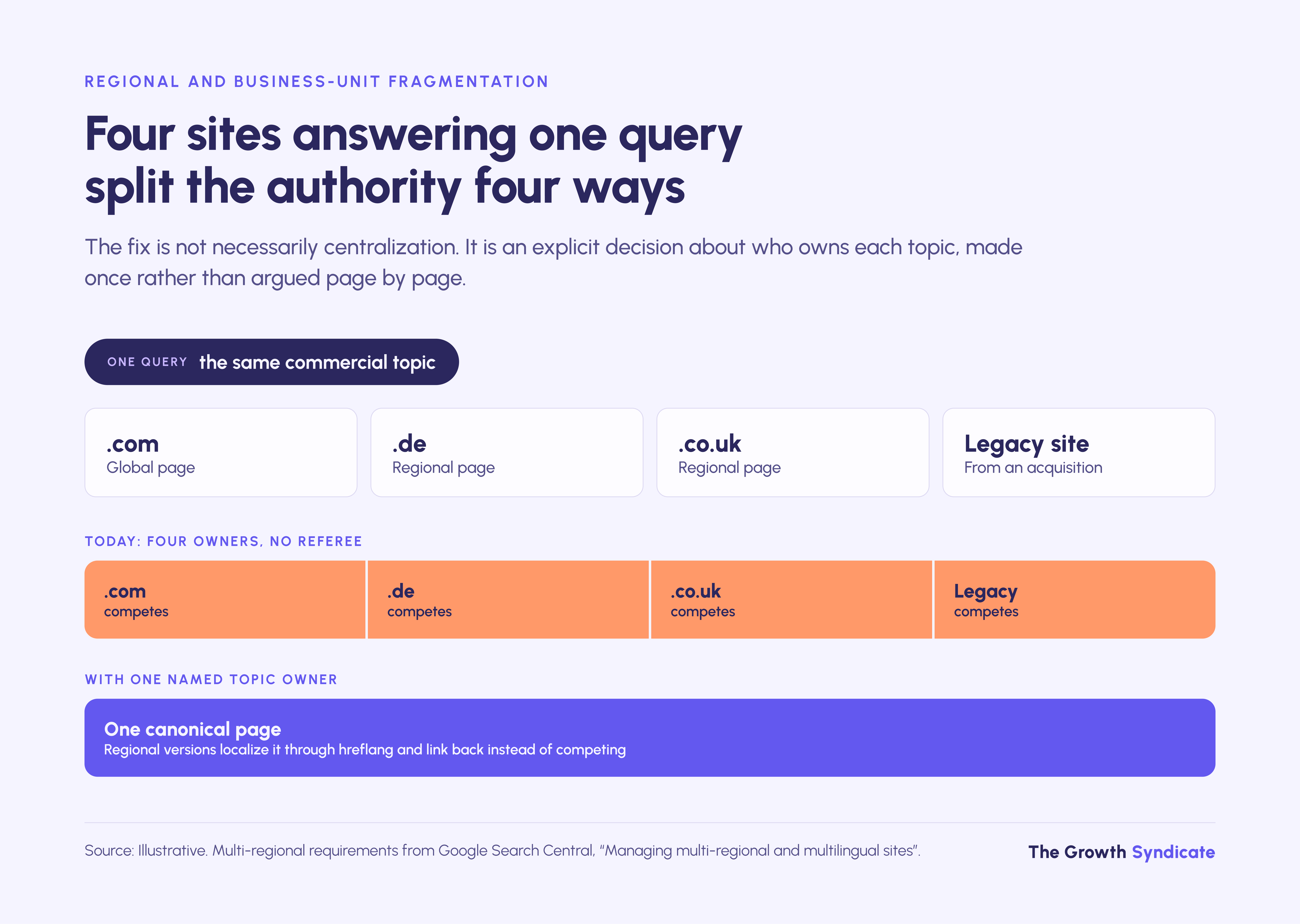
What works: the decision does not have to be centralization. It has to be explicit. Somebody needs to own the canonical version of each topic, and regional teams need to know which topics they own and which they inherit. That is a governance decision made once, not a technical fix applied repeatedly.
.avif)
"Stakeholder management is about zooming out. Who does this affect? Who needs to know? Who needs to sign off? Who do I need on board? Marketing can never achieve results in a silo. Senior marketers have to see themselves as responsible for a commercial function, not just a marketing function."
Constraint four: ownership without authority
Symptom: there is an SEO owner, they are competent, and nothing they recommend gets implemented.
This is the most common structural failure in B2B enterprise SEO and the least discussed. Someone holds the target, the reporting line, and the quarterly review, but controls none of the resources required to hit it. They cannot deploy, cannot publish without approval, cannot direct regional teams, and cannot reprioritize the dev backlog.
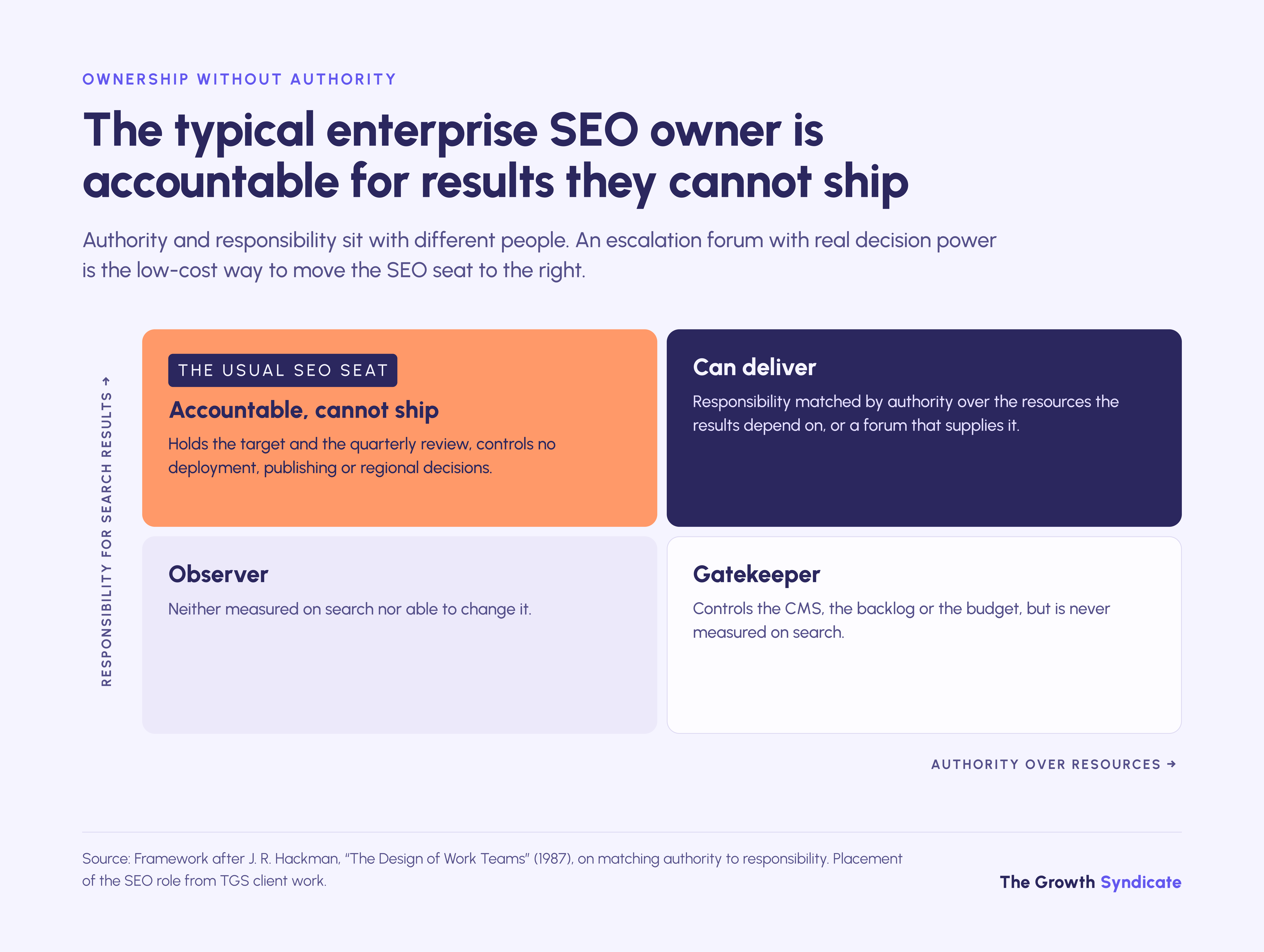
Organizational research has covered this ground for decades. Team effectiveness requires authority commensurate with responsibility, and teams held accountable for outcomes they cannot control do not simply underperform. They behave differently, shifting toward activities they can demonstrate rather than outcomes they can influence. That is precisely the failure mode where a program produces immaculate audits and no shipped changes.
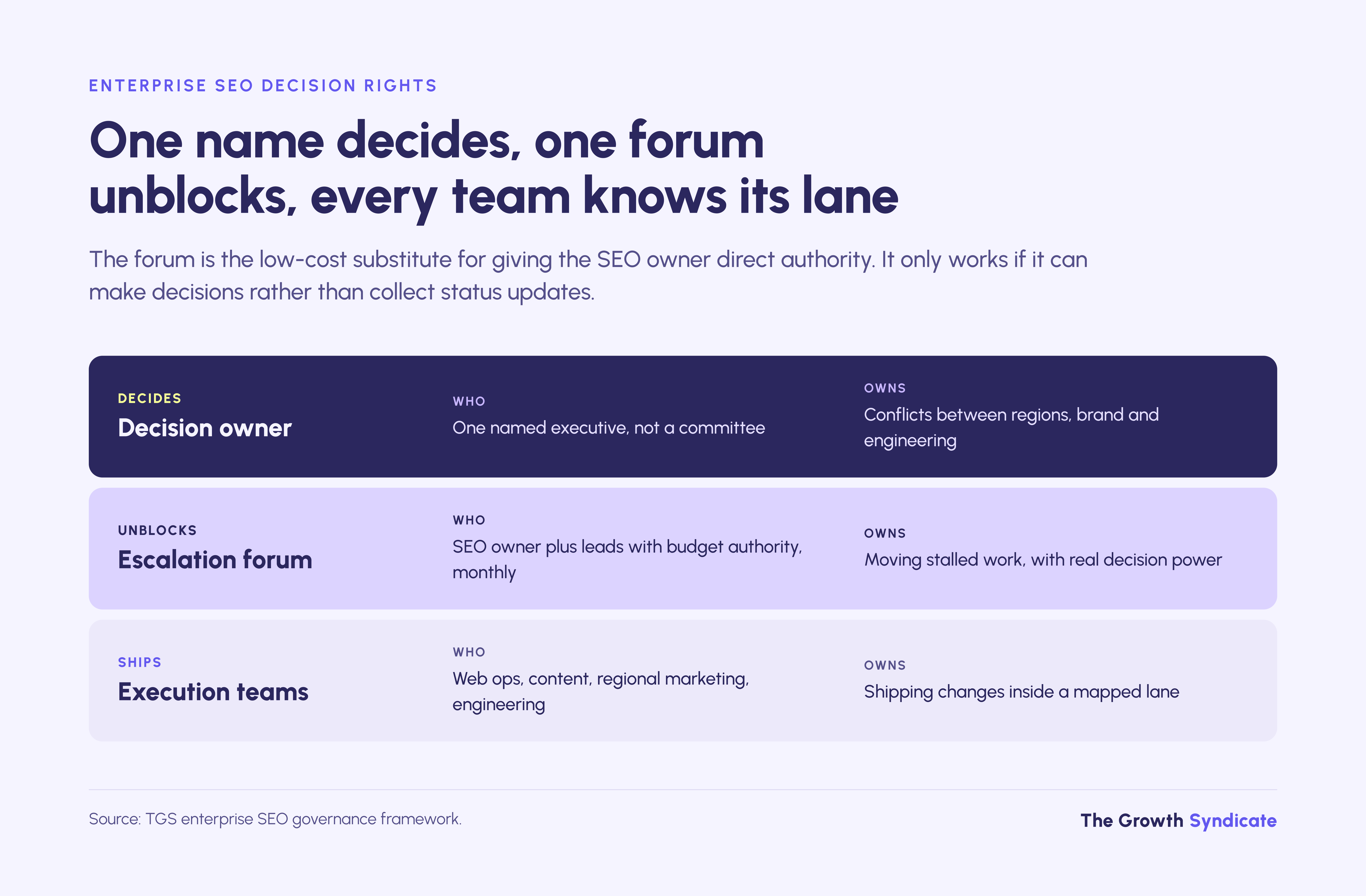
What works: give the role either the authority or a functioning escalation path. A monthly forum where the SEO owner can escalate blocked work to someone who can unblock it is a low-cost substitute for direct authority, and it works if the forum has real decision-making power rather than serving as a status update.
Constraint five: measurement that cannot survive the buying cycle
Symptom: the program is asked to justify itself quarterly against a sales cycle that runs nine to eighteen months.
An article published in March influences a buyer in June who enters a process in November and closes the following March. Every standard attribution model breaks somewhere in that chain. Multi-touch attribution measures correlation and assigns credit within a window the actual buying process outlasts. Marketing mix modeling, the causal alternative, needs high outcome volume and stable spend to produce reliable estimates, and a B2B firm closing a few hundred deals a year on a twelve-month cycle would need several years of clean history before the model says anything trustworthy.
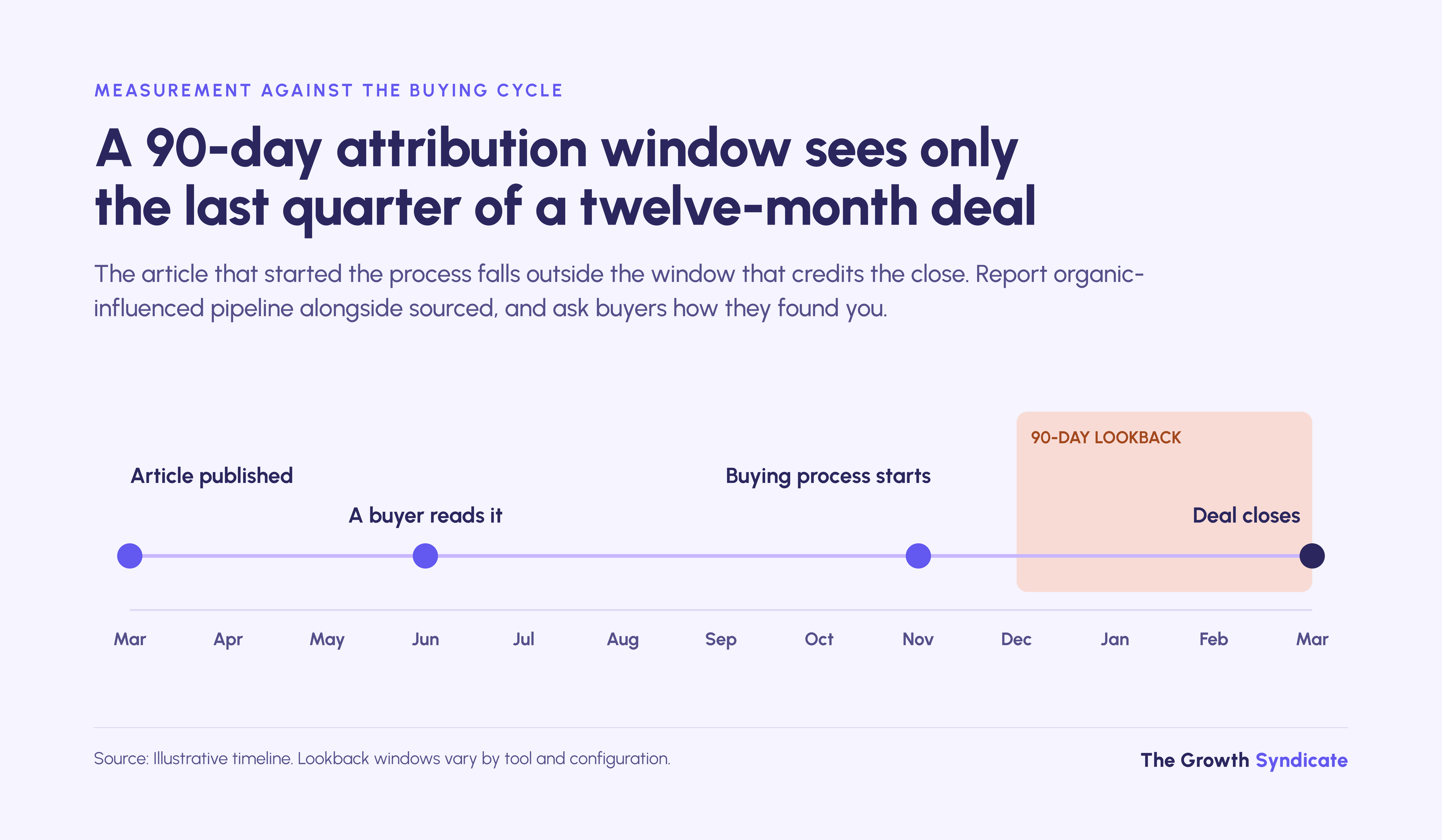
The consequence is not that measurement is impossible. It is that honest measurement looks different from the dashboard leadership expects.
What works: measure leading indicators tied to pipeline rather than conversions tied to sessions. Which target accounts visit solution pages. Whether multiple people from the same account visited in the same month. What proportion of closed-won deals had organic touchpoints at any stage, regardless of which touch gets credit. Our work on B2B marketing attribution covers why self-reported attribution frequently outperforms modeled attribution in exactly these conditions.
What enterprise SEO actually looks like for B2B
Enterprise B2B diverges from the retail and publisher model in four ways: far fewer pages carry far more value, keyword volumes are lower and buyer intent is higher, the buying committee needs different material for different roles, and most of the target market is not buying at any given moment.
That last point reorganizes everything above it. Research by John Dawes at the Ehrenberg-Bass Institute, published through the LinkedIn B2B Institute, put the figure at up to 95% of business buyers being out of market for a given category at any one time. Firms replace major suppliers roughly every five years, leaving only a fraction in market in any given quarter.
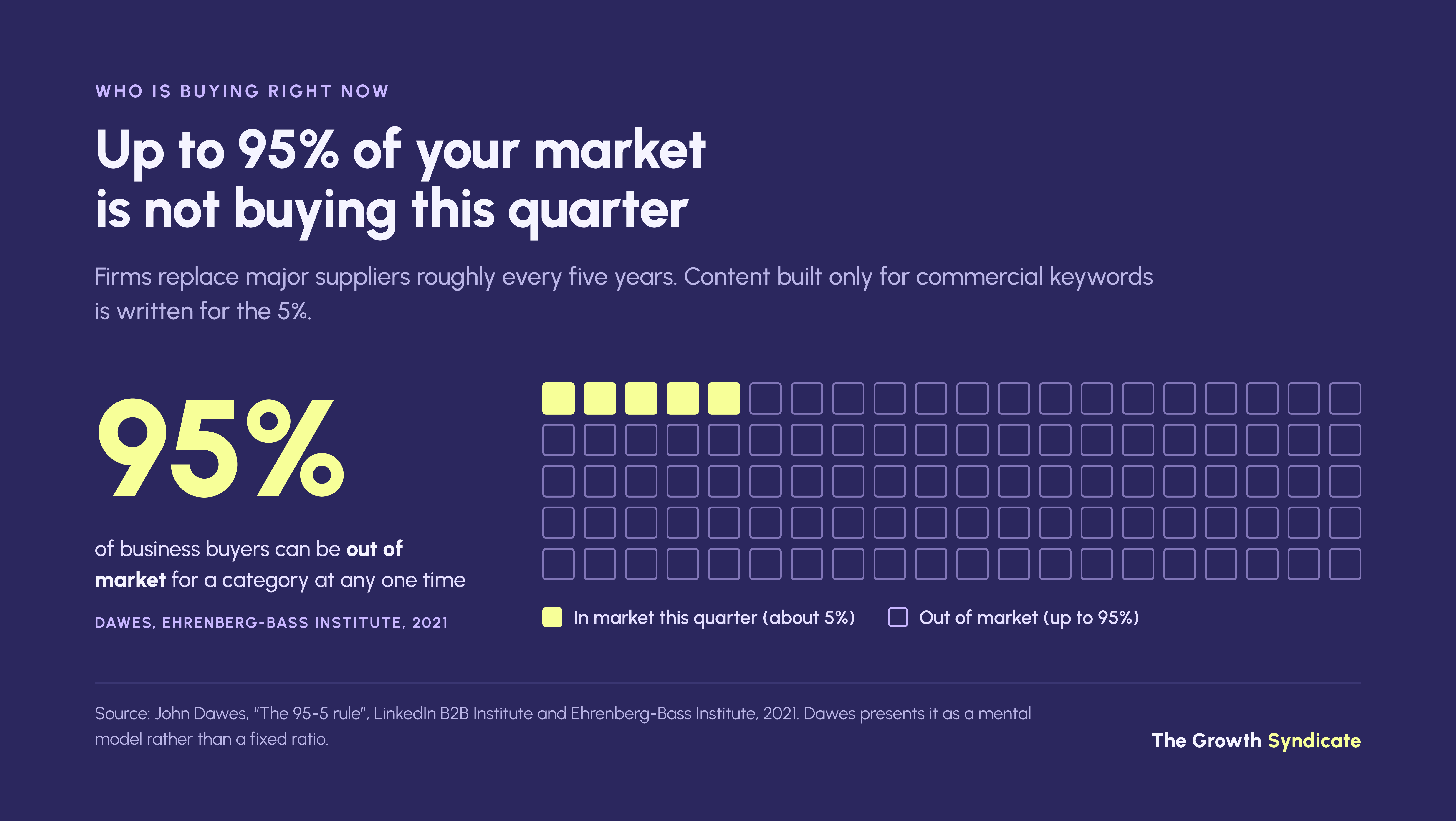
If 95% of the people reading your content cannot buy today, then a content strategy built exclusively around commercial keyword targets is fishing in 5% of the pond. Enterprise B2B has to serve both: capture the small in-market segment through high-intent pages, and stay present with the much larger out-of-market segment through material worth reading when nobody is buying. That second half is what builds topical authority, and topical authority is what makes the first half work.

"Most of your buyers are out of market at any given moment. The brands that win invest in long-term demand generation so that when intent finally shows up, they are already on the shortlist. Balancing demand capture against demand generation is the whole game."
The buying committee reads independently
Gartner's Digital B2B Buyer Survey found the typical buying group contains six to ten decision makers, each independently gathering four or five pieces of information, and that buyers spend only about 17% of their total buying time meeting with potential suppliers. McKinsey's 2026 Global B2B Pulse, drawing on nearly 4,000 decision-makers across 13 countries, found buyers now use an average of 10.2 channels across a purchase, roughly double the figure from a decade earlier.
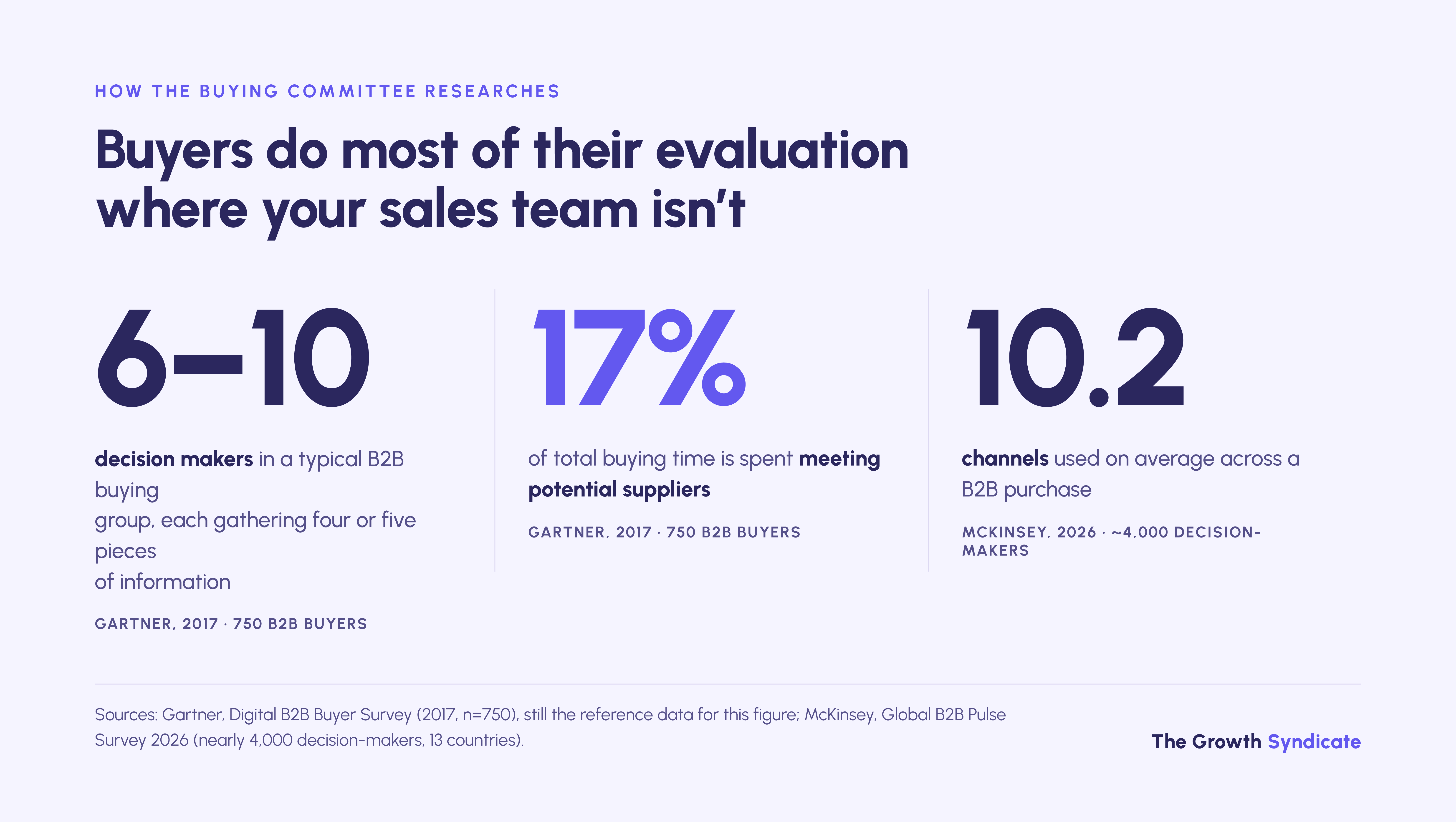
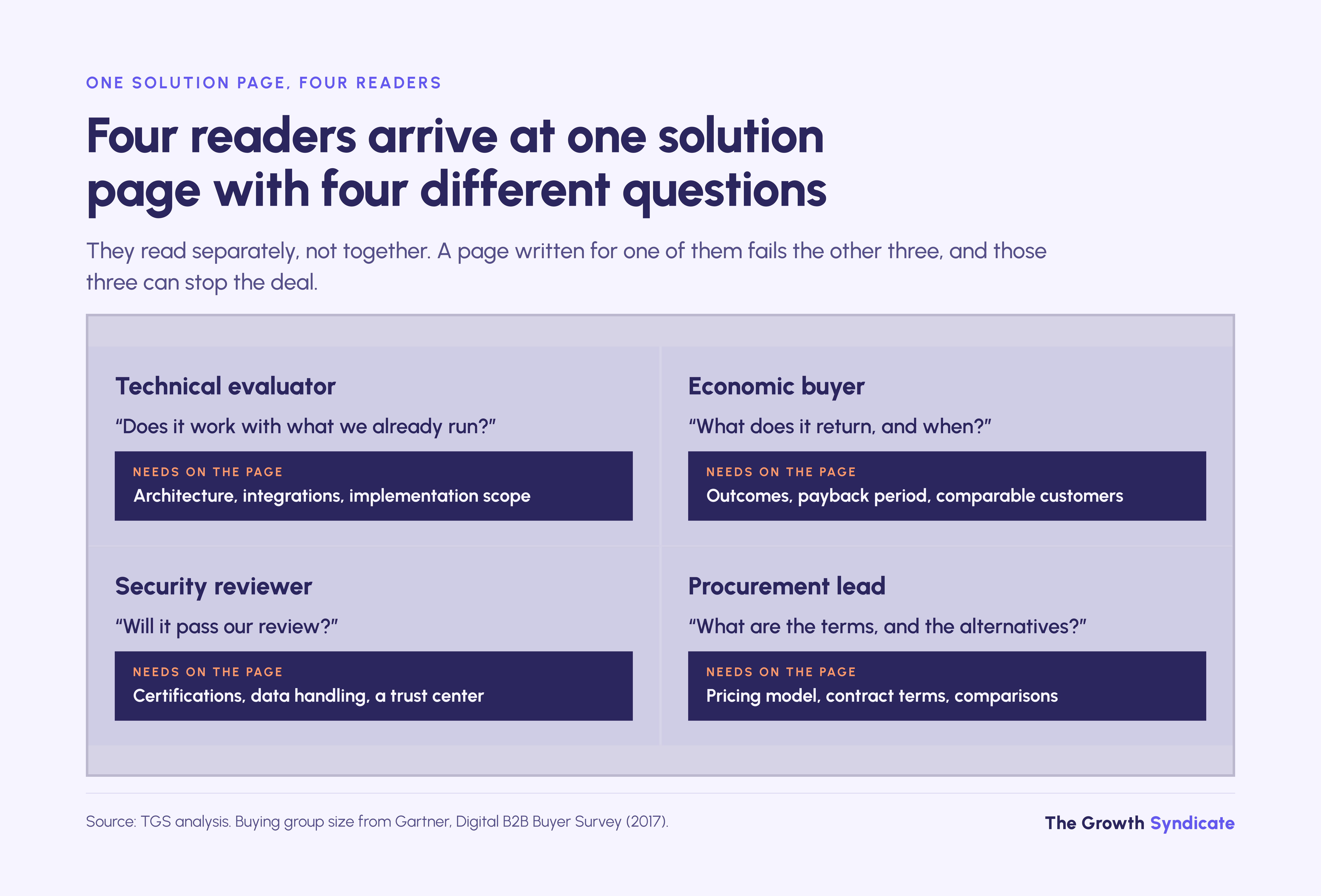
The practical implication is that your solution pages are being read by a technical evaluator, an economic buyer, a security reviewer, and a procurement lead, and they are reading separately rather than together. Content built for one persona fails the other three, and those three are the ones who kill deals. Understanding these search behaviors is more useful than any keyword volume figure, because it tells you what has to exist on the page rather than what to title it.
Volume is the wrong prioritization signal
This is where enterprise B2B and enterprise SEO in the retail sense stop resembling each other. A retailer optimizes millions of product pages toward transactional queries with immediate conversion. A B2B enterprise optimizes perhaps 200 pages that matter toward queries with fifty searches a month and a $400,000 contract value attached.
Search volume is a bad prioritization signal in that context. Revenue relevance is the right one, which also means organic search and paid search should be planned against the same account list rather than in separate silos. The same logic applies to paid media generally: enterprise buyers do not experience your channels separately, so planning them separately produces contradictions the buyer notices.
Building an enterprise SEO strategy: governance before tactics
An enterprise SEO strategy has two layers, and most organizations build only the second. The governance layer defines who decides, who ships, how work enters the queue, and how it is prioritized. The tactical layer defines what gets optimized. Building tactics without governance produces recommendations nobody can act on.
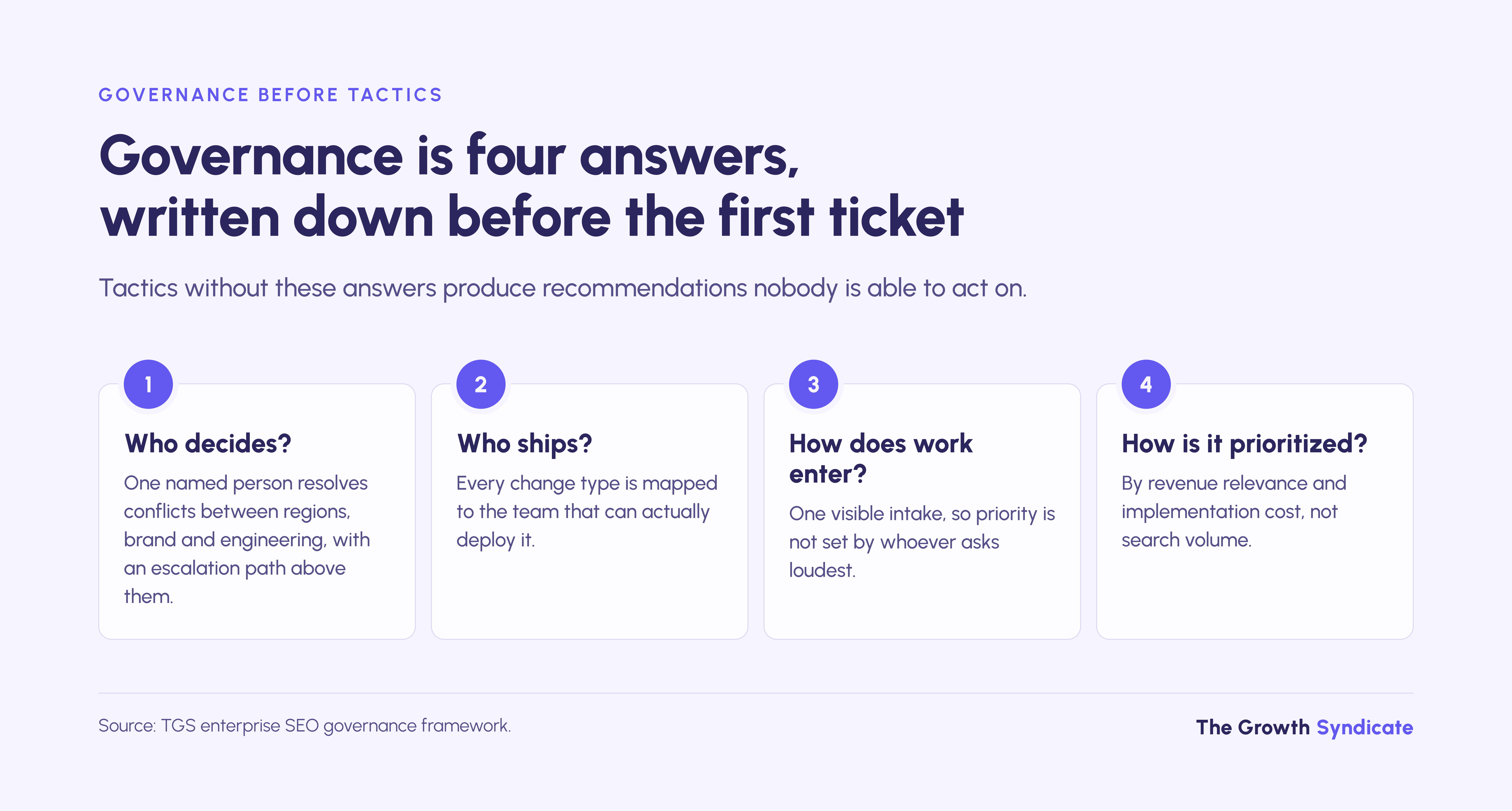
Four questions to answer in writing
Who decides? Name the person who resolves conflicts between regional teams, between brand and search, and between marketing and engineering priorities. Not a committee. One name, with an escalation path above them.
Who ships? Map every type of change against the team that can actually deploy it: copy edits, metadata, template changes, schema, redirects, new page types, site architecture changes. Most organizations discover during this exercise that four different teams can each block half the work.
How does work enter the queue? A centralized intake with visible priorities prevents the situation where every stakeholder assumes their request is next. Without it, requests arrive through whoever happens to be in the room, and priority gets set by volume of asking rather than value of the work.
"When multiple stakeholders request work from a shared resource without visibility into the total workload, everyone assumes their request is the priority. Different people are vested in different things, and nobody has the full picture of what now has to be deprioritized or moved back. The fix is a clear process: here are the deliverables, here is how long each takes, and here is what gets pushed when something new lands."
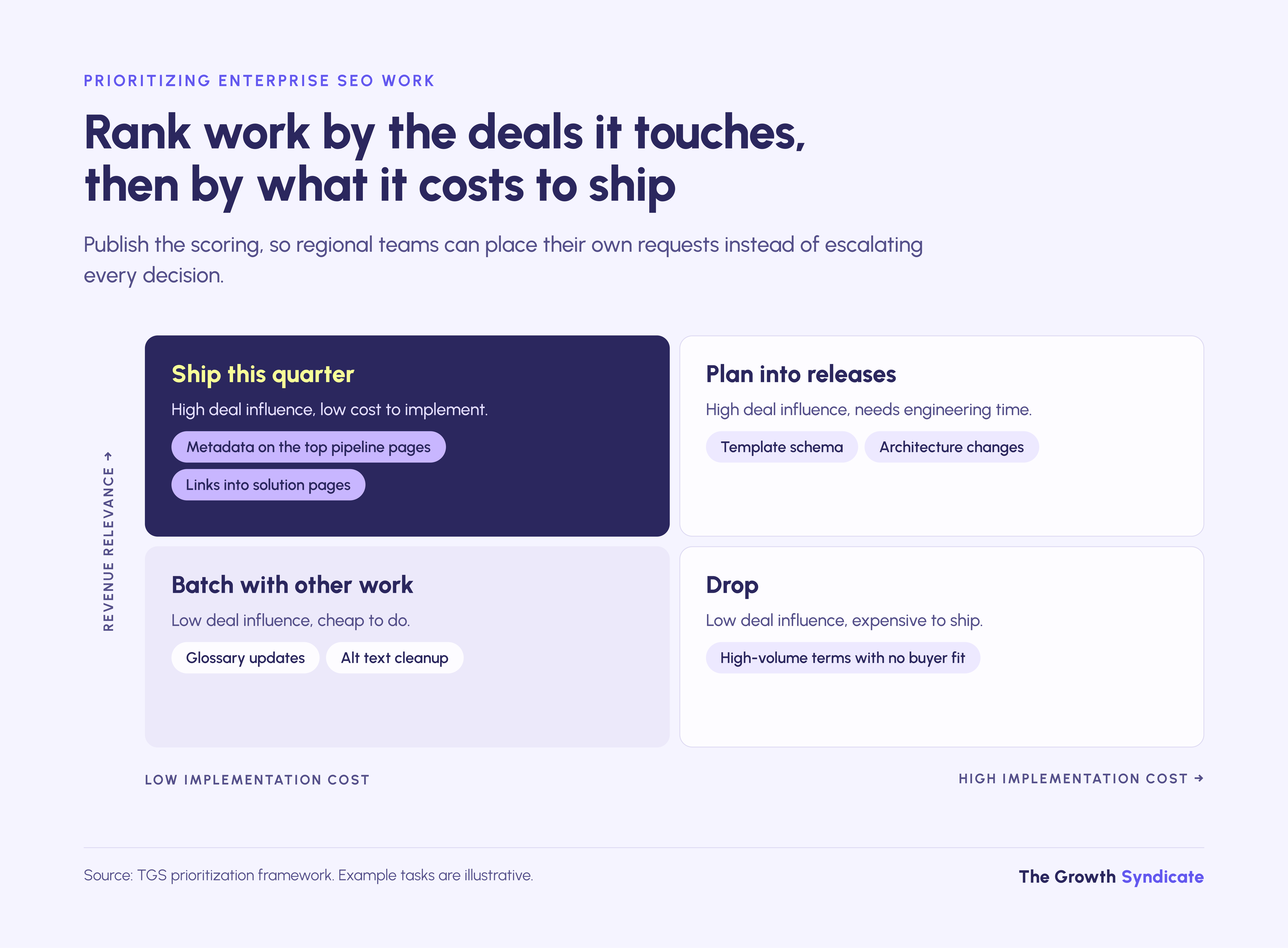
How is work prioritized? Against revenue relevance and implementation cost. A page targeting 90 monthly searches from procurement leads at target accounts outranks a page targeting 2,400 searches from students, and any prioritization framework that cannot express that will send the team in the wrong direction.
The strategy layer, once governance exists
Topic ownership across properties. One canonical page per topic per language, with regional teams contributing rather than duplicating. This is where most of the wasted authority in enterprise organizations gets recovered, and it produces a unified strategy without requiring full centralization.
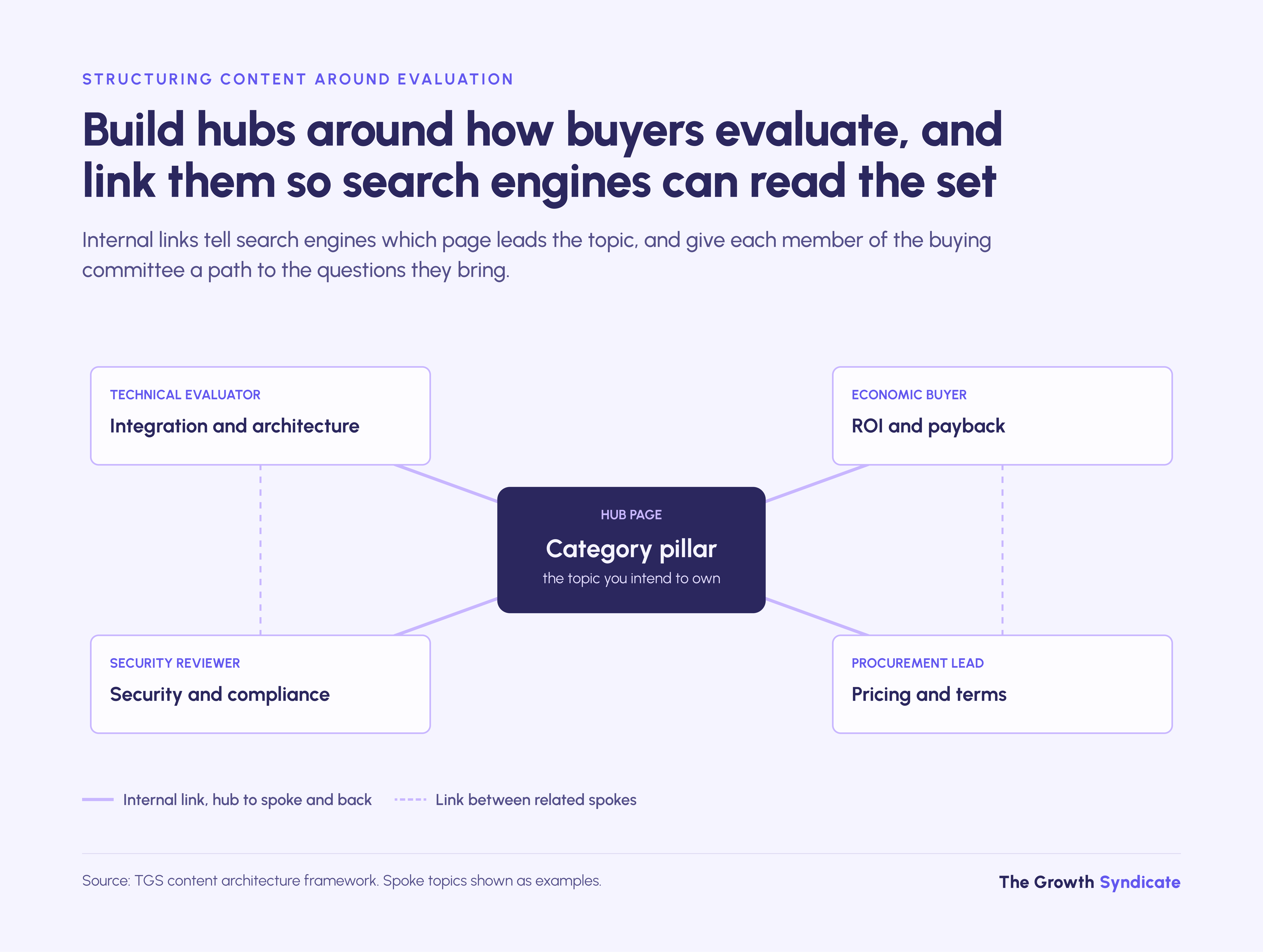
A hub page structure that reflects how buyers evaluate. Pillar pages for the categories you want to own, supported by spokes covering the specific questions each buying-committee role brings. Internal linking between them is the mechanism that tells search engines which pages matter and gives buyers a path through the evaluation. Weak internal linking is the most common reason a well-written enterprise library fails to rank as a set.
Prioritization by revenue relevance. Enterprise SEO strategies live or die on this step. Score topics against deal influence, competitive position, and implementation cost. Publish the scoring so regional teams can apply it themselves rather than escalating every decision.
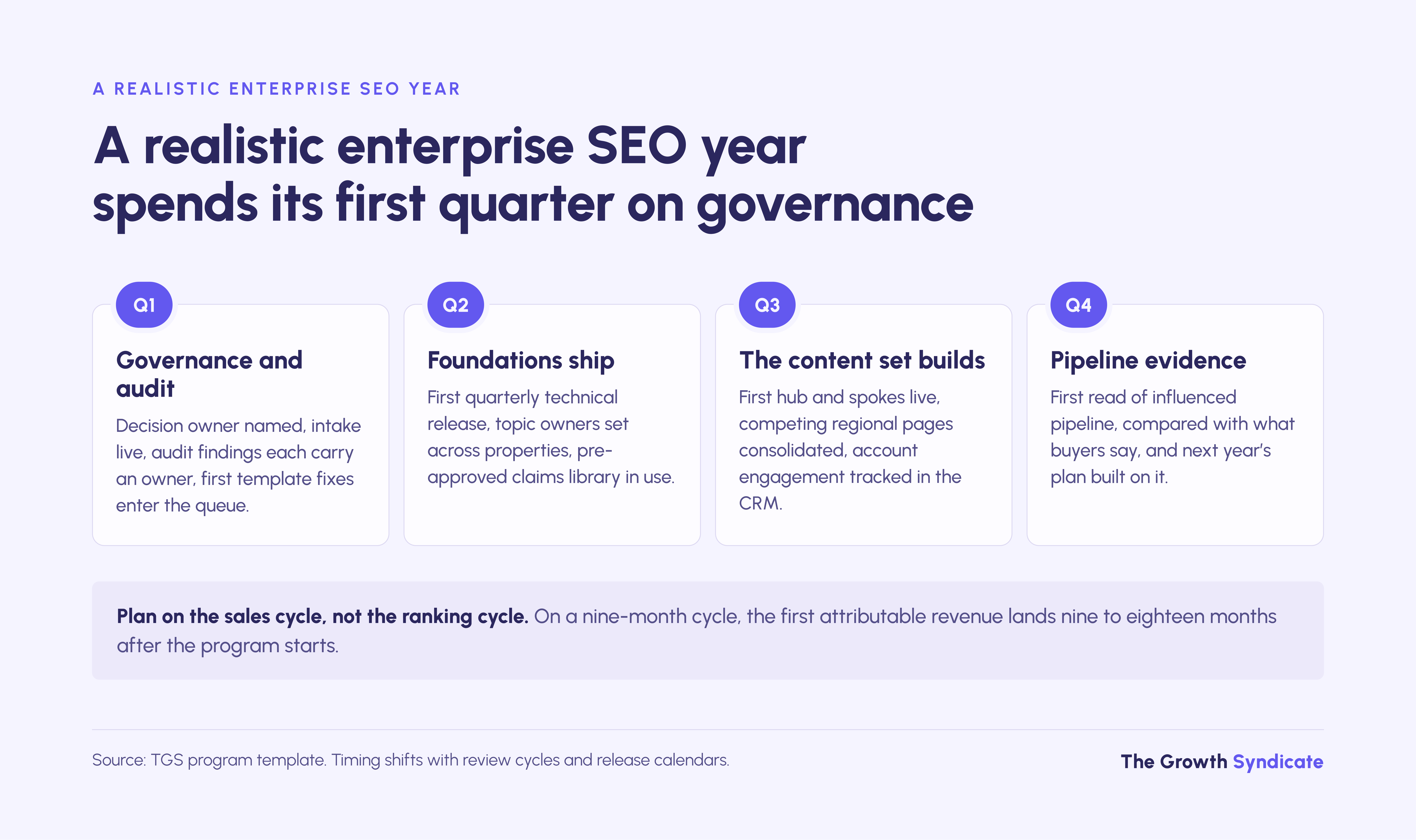
A realistic timeline. Enterprise B2B SEO results take six to twelve months to materialize, and that is before accounting for review cycles. A twelve-month plan with quarterly milestones survives leadership scrutiny better than a six-month plan that misses.
Content strategy at enterprise scale
Enterprise content strategy fails in a specific way: the organization produces a lot and none of it compounds. Seven ICPs get a webinar each, three business units run separate campaigns, and the resulting library has no center. Volume rises, and search performance does not follow.
The correction is structural rather than editorial. Decide the small number of categories the organization intends to own, build the pillar and spoke set that covers each one properly, and route new requests into that structure instead of alongside it. A content strategy organized this way accumulates authority in one place; the same output scattered across seven parallel efforts accumulates nothing.
Two rules make it hold at enterprise scale. First, every new piece has to attach to an existing hub through internal linking, or it needs a hub of its own. Second, coverage gets planned against buyer intent across the whole committee rather than against keyword lists, because the security reviewer's questions rarely appear in a keyword tool and still decide deals.
Getting any of this right depends on the same organizational work that makes sales and marketing alignment function, because the people who know which topics influence deals sit in sales, not marketing. The mechanics of the underlying discipline stay the same at enterprise scale; what changes is who has to agree before any of it happens.
The enterprise SEO audit: what a useful one contains
A useful enterprise SEO audit identifies the small number of issues actually costing revenue and specifies who can fix each one. The 400-item audit that scores every page against every best practice is a familiar artifact and a largely useless one, because nobody in a large organization has capacity to action 400 items and the important ones get lost among the trivial.
The failure is one of format rather than analysis. A crawl surfaces 400 issues on any site of meaningful size. The judgment lies in knowing which twelve matter.
What belongs in the scope
Indexation and crawl efficiency. Not because crawl budget binds at your page count, but because indexation bloat usually signals something structural: faceted parameters generating infinite URLs, a staging environment left open, a legacy acquisition site duplicating your entire catalog. The symptom is technical, the cause is organizational.
Cross-property conflicts. Which pages across your domains compete for the same query, and which one should win. This is the highest-value section of any enterprise SEO audit and the one most commonly missing.
Template-level issues. A technical SEO problem in a template affects every page using it. Ranked by pages affected, template issues almost always outrank page-level ones, and they also require development time, so they need to enter the dev queue early.
Content coverage against the buying committee. Which roles in the buying process have no material addressing their evaluation criteria. Usually security, procurement, and implementation.
Technical health of the highest-value pages. The 50 pages that influence pipeline get individual technical SEO attention, down to site structure and internal link depth. Everything else gets template-level treatment.
Competitive analysis at the topic level. Not a rank comparison, but a coverage comparison: which questions your competitors answer that you do not, weighted by whether those questions come from people who buy.
Every finding needs an owner and an effort estimate attached. An audit that does not specify who can implement each fix is a document that generates meetings rather than technical fixes.
Enterprise SEO platforms: when they earn their cost
An enterprise SEO platform earns its cost when you have more properties than one person can track and enough analyst capacity to act on what the platform surfaces. It does not earn its cost by page count alone, because the page counts at which crawl management genuinely becomes hard sit far above where most B2B organizations operate.
This is the section where most content on this topic stops being useful, because most of it is published by platform vendors or by agencies paid to recommend them. So, plainly: the tools are good. BrightEdge, Conductor, and Semrush all solve real problems, particularly around multi-property monitoring, forecasting, and the reporting layer that makes a program legible to executives who will never open a crawl report.
The question is sequencing. Buying a centralized platform before you have the capacity to act on its output converts an execution problem into an expensive dashboard.
"You cannot build a scalable machine without your operations set up correctly underneath it, because without that you don't actually know what you're doing right or wrong. Adding tools, or worse, adding AI, on top of broken operations only amplifies the mess. Ops is the least glamorous and most-skipped layer, and it decides whether everything above it works."
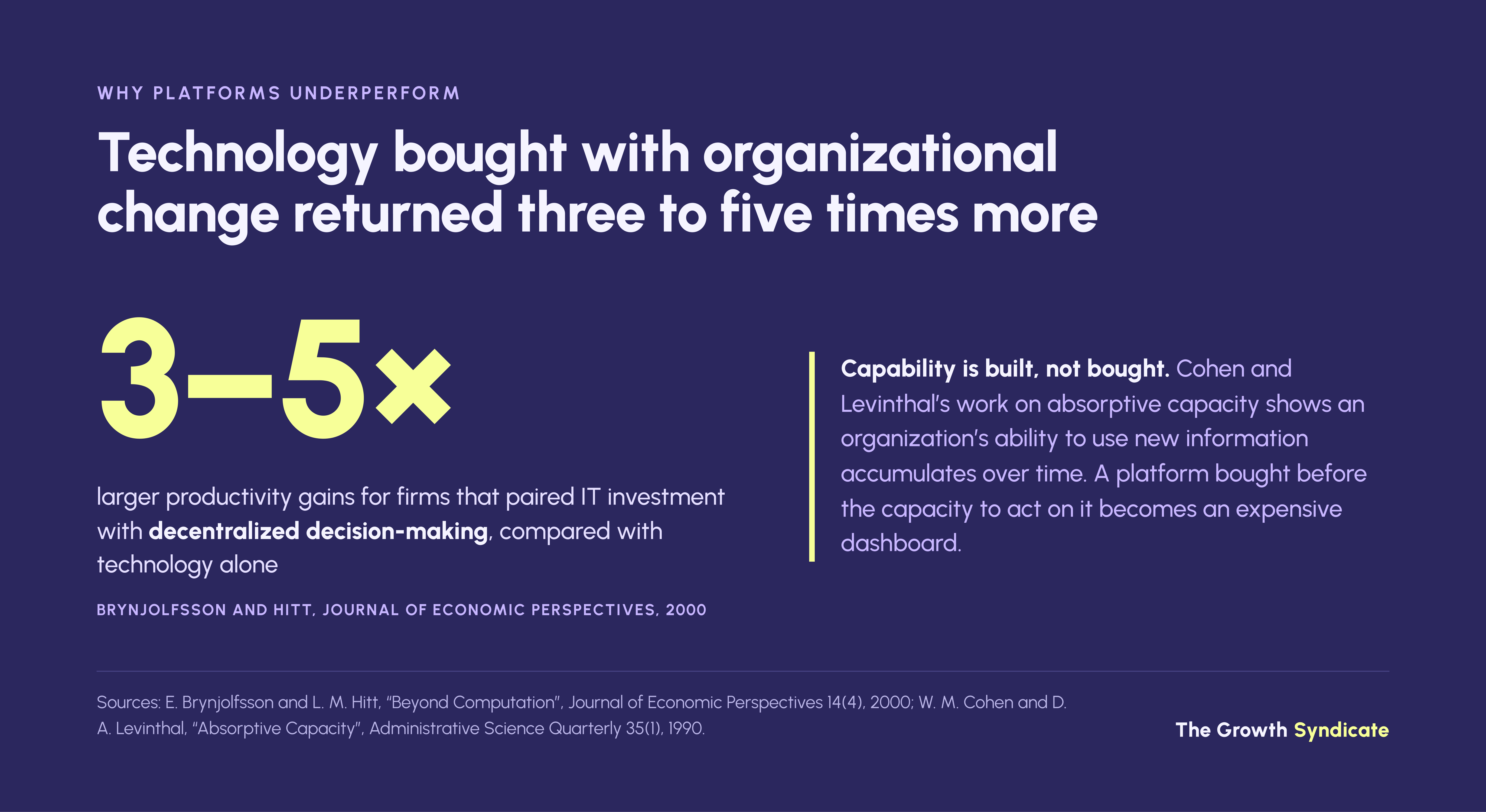
That claim has more behind it than agency skepticism. Cohen and Levinthal's work on absorptive capacity established that an organization's ability to recognize the value of new information and apply it commercially is built cumulatively and cannot be purchased instantly. Brynjolfsson and Hitt found that firms combining technology investment with decentralized decision-making saw productivity gains three to five times larger than firms investing in technology alone. A platform bought alongside organizational change performs. A platform bought instead of organizational change underperforms by a wide, measured margin.
The thresholds worth applying
Enterprise platforms earn their place on five signals: the number of properties, analyst capacity, genuine scale, whether current recommendations actually ship, and whether executives need reporting that existing workflows cannot produce. The table sets out where each one tips.
What these platforms actually cost
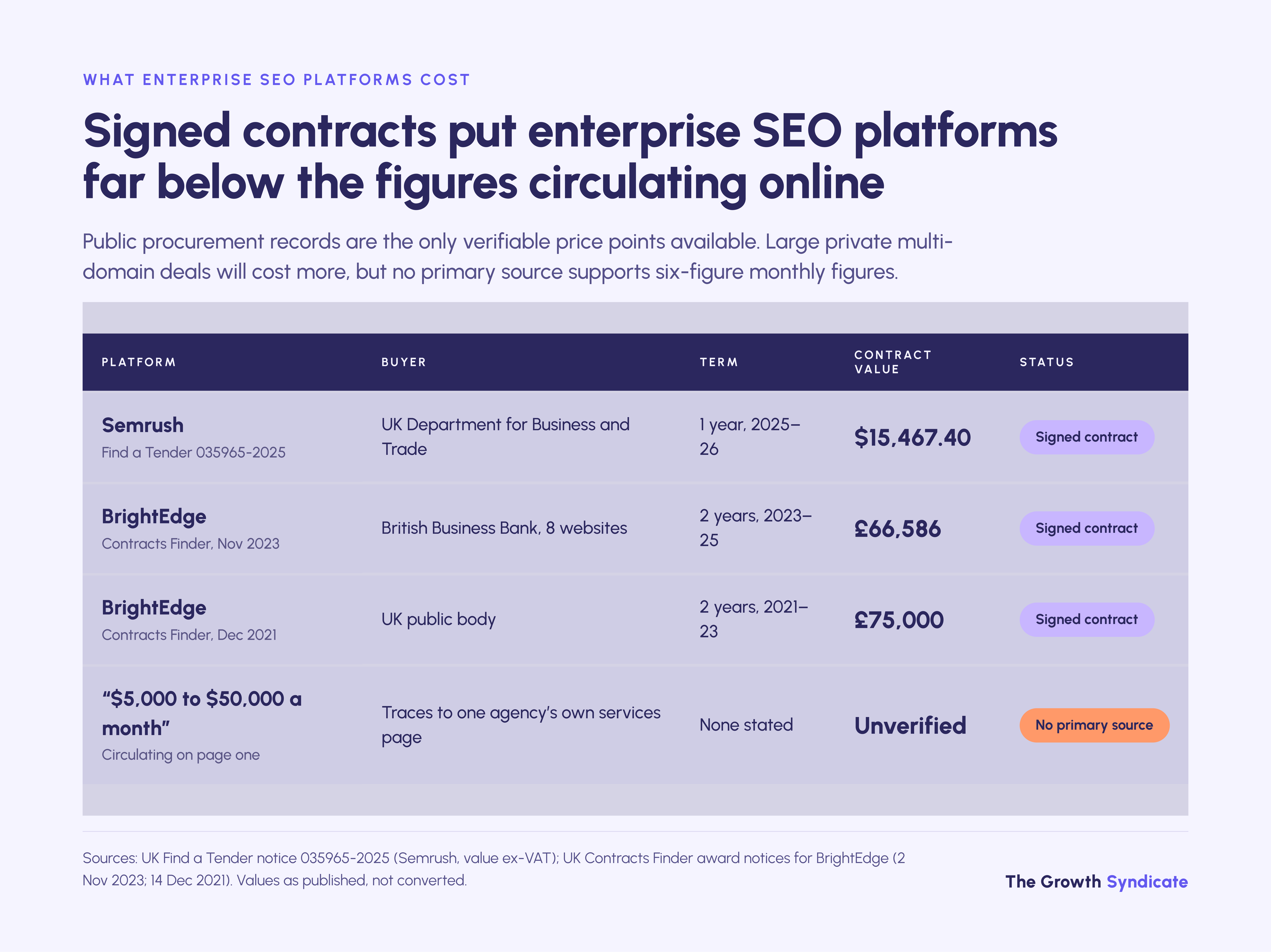
The range circulating widely on this topic, $5,000 to $50,000 per month, traces back to a single agency's own services page and should not be treated as fact.
Signed contracts tell a different story. UK public procurement records show the Department for Business and Trade purchasing Semrush at $15,467.40 for a one-year term in 2025, and the British Business Bank contracting BrightEdge at £66,586 across two years, covering platform access and customer success support for eight websites. Large private multi-domain deployments cost more than public-sector ones. But the verified numbers sit in the region of $15,000 to $40,000 per year, and no primary source exists for the six-figure monthly figures in circulation. Ask any vendor for a reference customer of comparable size, and get the number in writing.
Enterprise SEO in AI search
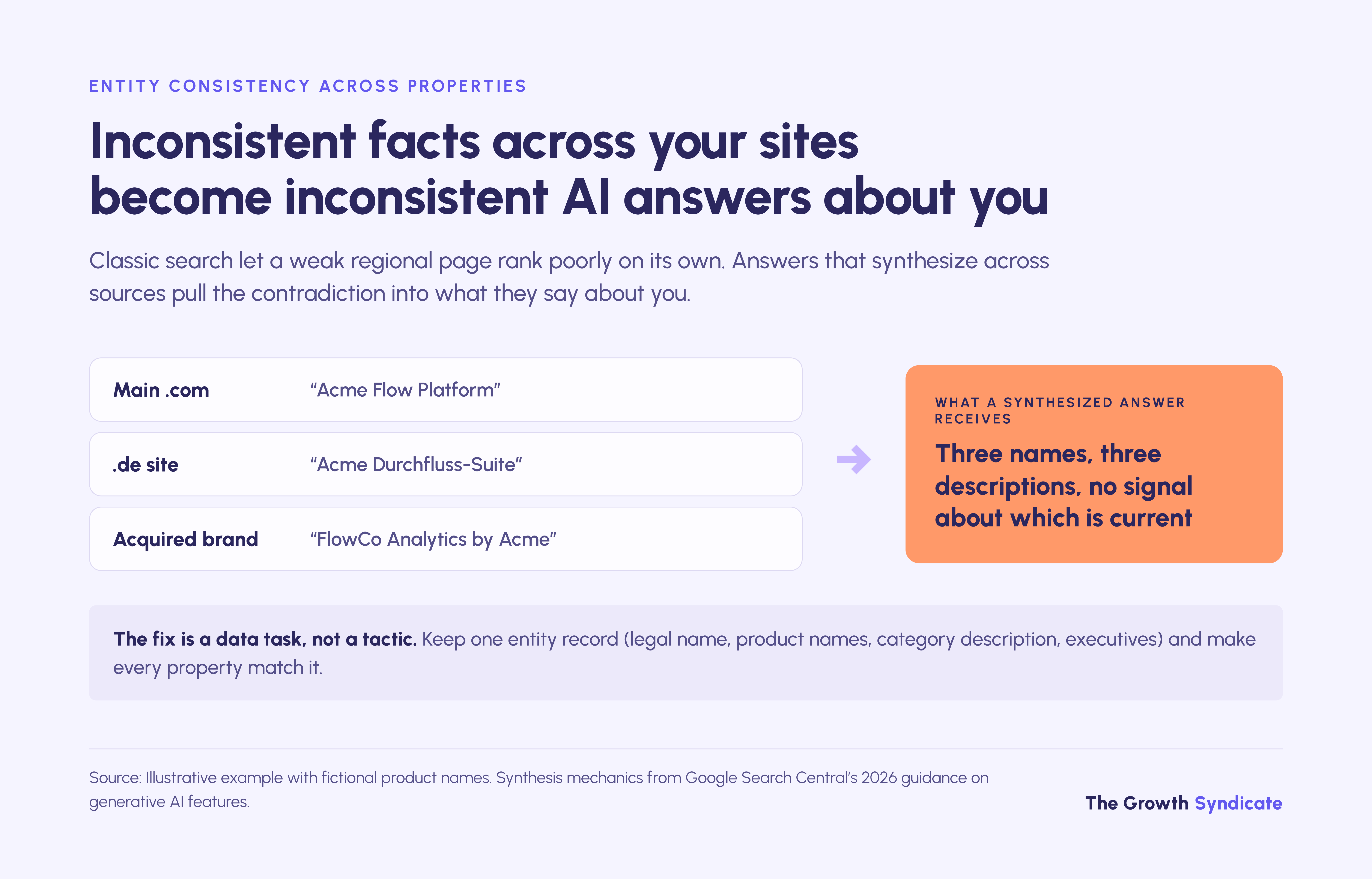
For enterprise brands, AI search rewards the same things classic search rewards, with one addition: consistency across properties matters more, because synthesized answers draw from multiple sources and conflicting information about the same entity produces a weaker result than no information at all.
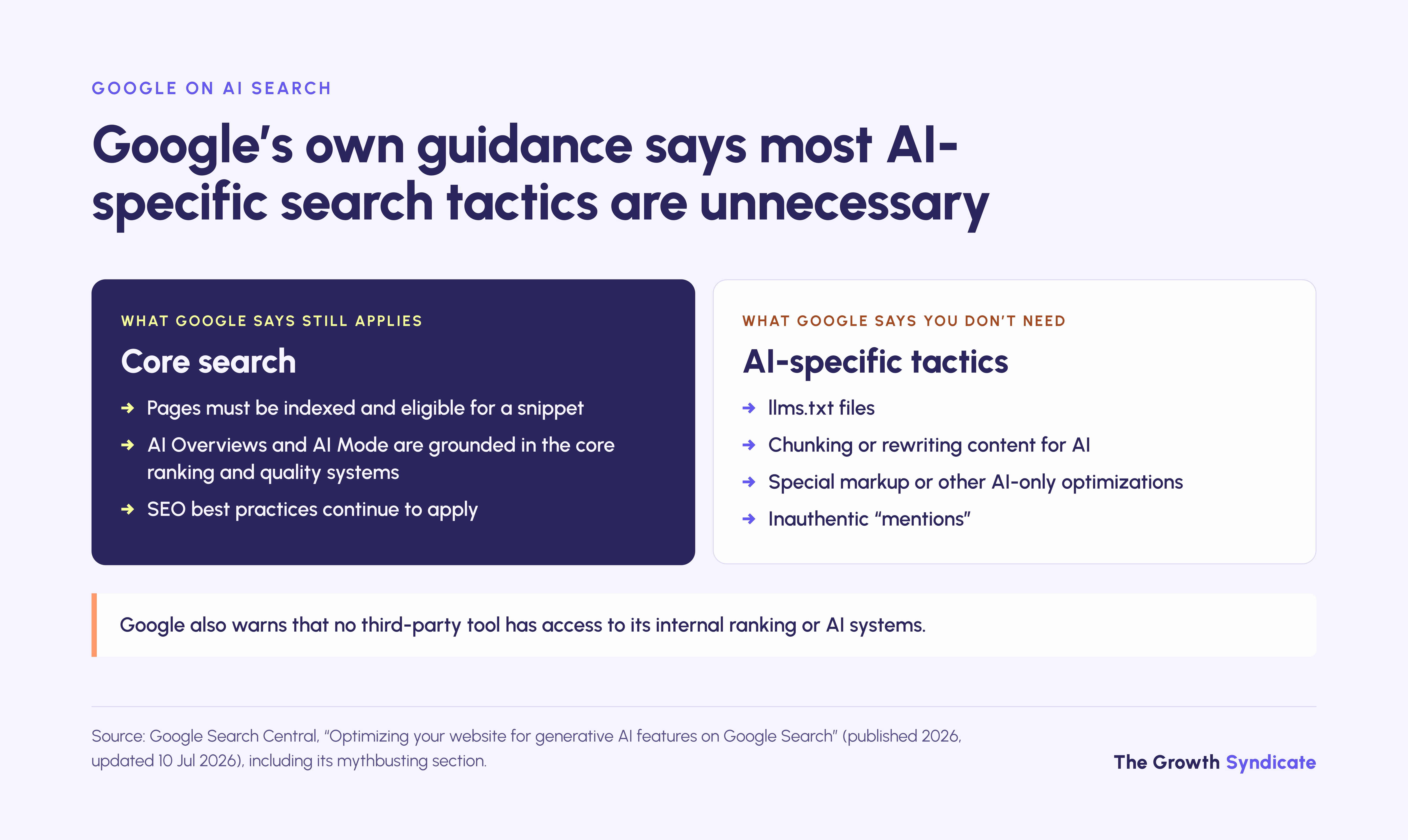
Google's own guidance, published in 2026, is unusually direct. AI Overviews and AI Mode are grounded in the same core ranking systems as classic search, using retrieval-augmented generation and a query fan-out technique that runs related searches concurrently. Google states there are no additional requirements to appear in these features and no special optimizations necessary beyond being indexed and eligible for a snippet. It goes further in a section explicitly addressing myths, noting that llms.txt files are not used, that content does not need to be chunked or rewritten, and that no third-party tool has access to internal ranking or AI systems.
That is worth taking seriously before buying anything sold as AI search optimization or answer engine optimization. Much of what is marketed under generative engine optimization is classic search optimization relabeled, and the vendors selling AI search visibility scores are estimating rather than measuring.
What the evidence actually supports
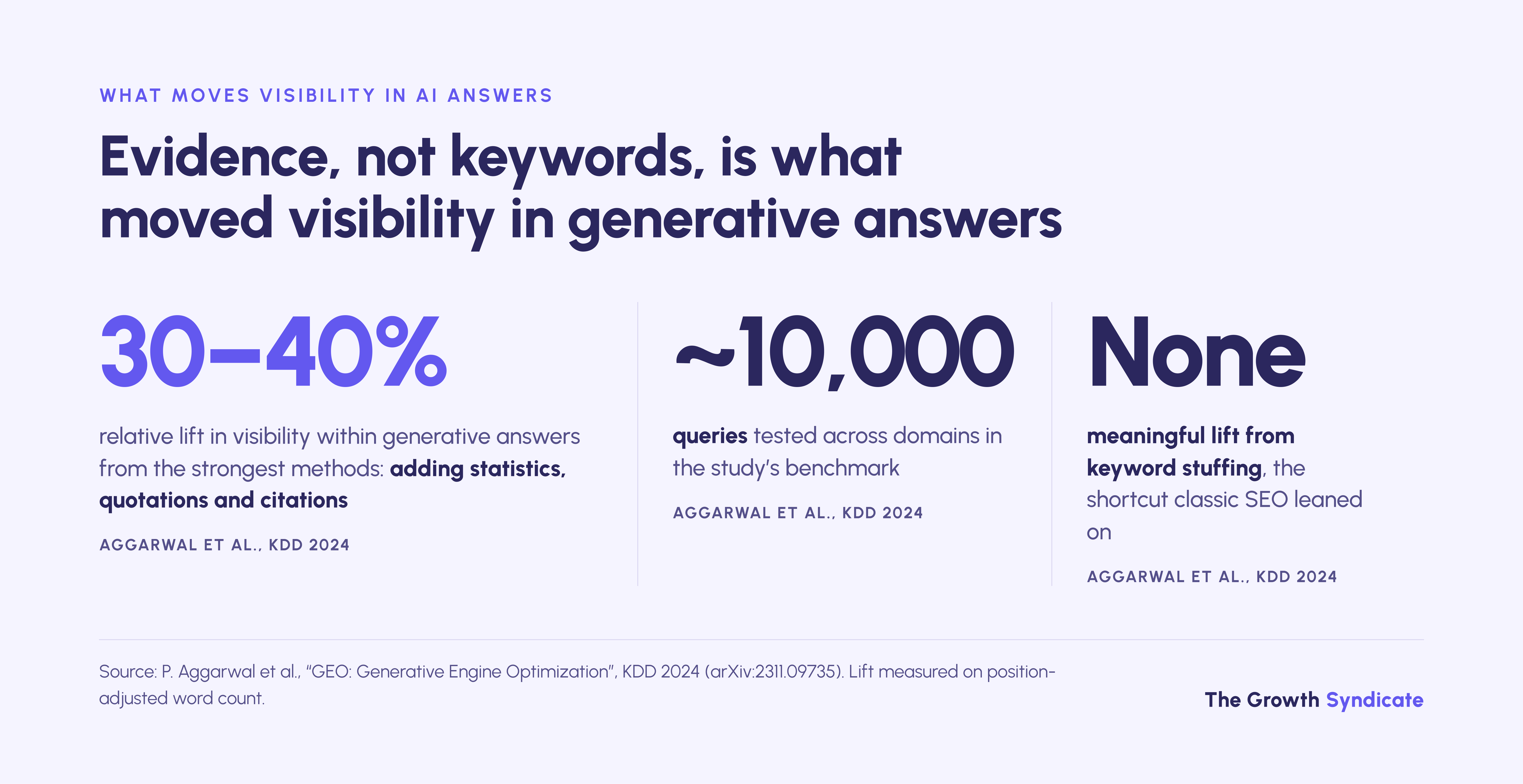
The controlled evidence comes from academic work rather than vendor research. The Princeton-led study on generative engine optimization, published at KDD 2024, tested content modifications across roughly 10,000 queries and found that adding statistics, quotations from authoritative sources, and citations produced the largest gains in visibility within generative responses, in the range of 30 to 40% relative improvement on their measurement. Keyword stuffing produced nothing.
The practical guidance for enterprise teams is therefore unglamorous: publish material containing specific, verifiable, citable substance, and make sure the same facts about your organization appear consistently everywhere they appear.
For a multi-property organization, that second half is the harder half. When your German site describes your company one way, your acquisition's legacy site describes it another, and your main domain uses a third set of product names, you are supplying conflicting inputs to systems that synthesize across sources. Fragmented ownership hurts more in AI answers than it did in classic results, where a bad regional page simply ranked poorly rather than contaminating an answer about you.
What to do about it:
- Standardize entity information across every property: legal name, product names, category descriptions, executive names
- Consolidate contradictory pages rather than letting both persist
- Publish original data, since original figures are what get cited
- Treat AI search optimization as a reporting question rather than a tactical one, and track AI search visibility as a separate measure, with the understanding that the measurement layer is immature
Measuring enterprise SEO: pipeline over rankings
Enterprise SEO should be measured by pipeline contribution rather than traffic growth, because organic traffic on a B2B site includes competitors, applicants, existing customers looking for support, and analysts, none of whom will ever generate revenue.
Three layers that survive executive scrutiny
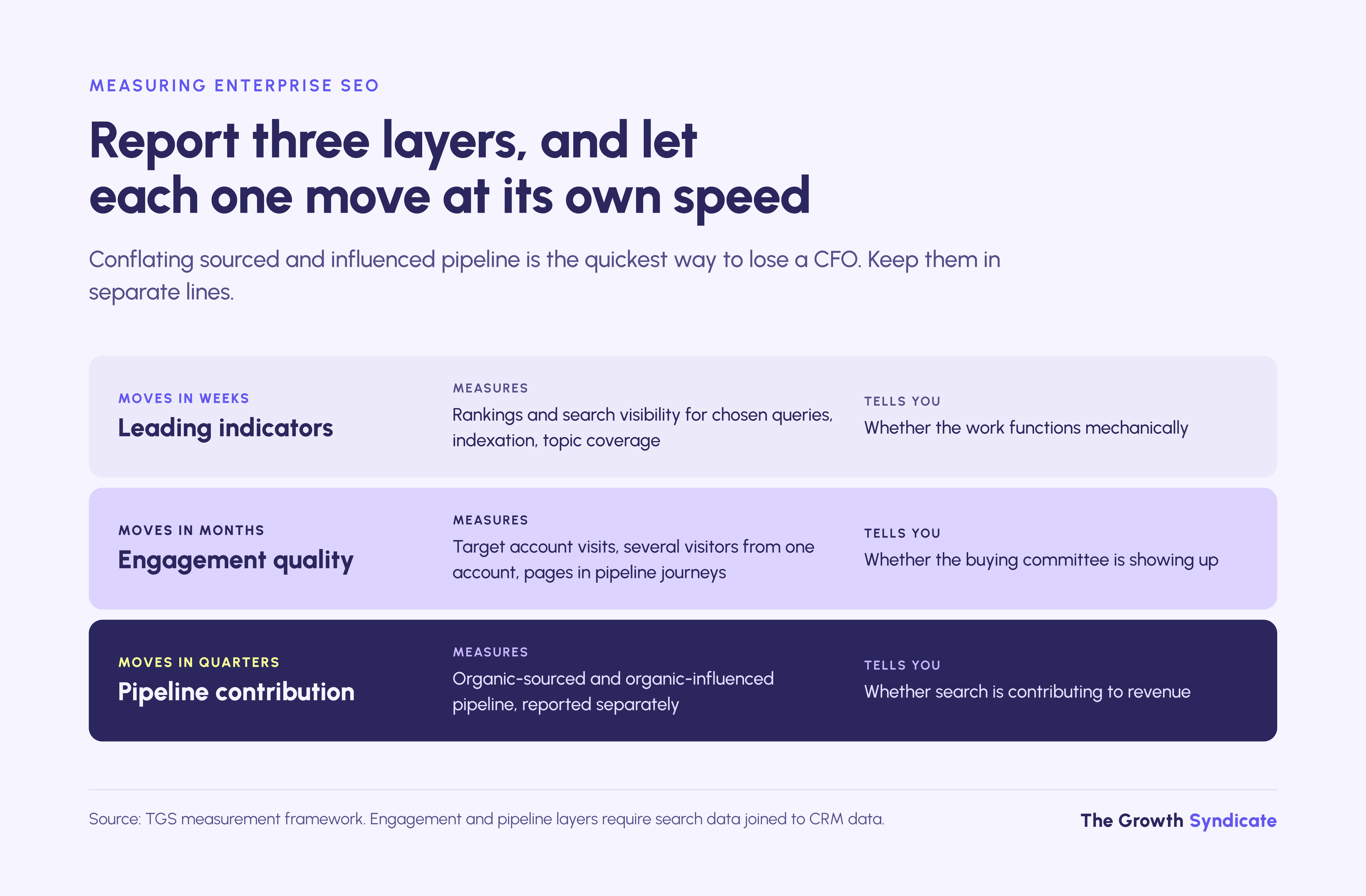
Leading indicators. Organic rankings and search visibility for the queries that matter, indexation health, and coverage of the topics you have decided to own. These move in weeks and tell you whether the work is functioning mechanically.
Engagement quality. Target account visits, multi-stakeholder visits from the same organization within a window, and which pages appear in the journeys of accounts that eventually enter pipeline. This is where the buying committee becomes visible in your data, and connecting SEO performance to CRM data is what makes it visible at all. Reading analytics in isolation will not surface it.
Pipeline contribution. Organic-sourced and organic-influenced pipeline, reported separately and honestly. Sourced means organic search was the first identifiable touch. Influenced means an organic touchpoint occurred somewhere in the process. Conflating the two is the fastest way to lose credibility with a CFO.
The attribution problem does not disappear with better tooling. On a twelve-month cycle, the article that started the process and the demo request that ended it sit in different fiscal years. What works better than a more sophisticated model is a blunter instrument: ask buyers how they found you, then compare the answers to what your analytics claims. The gap between those two numbers is usually the most informative measurement in the entire program.
Tying SEO efforts to revenue metrics also depends on agreeing what counts as a qualified lead in the first place, which is why lead qualification and organic search measurement have to be designed together rather than separately. Where conversion rate optimization fits is downstream of both: improving conversion on pages that attract the wrong accounts produces more of the wrong pipeline, faster.
How enterprise SEO teams are structured
Most enterprise B2B organizations run a hybrid model: an internal owner who holds strategy and stakeholder relationships, plus an external partner for execution capacity and specialist technical work. Fully in-house works at genuine scale. Fully outsourced rarely works at all, because no external party can navigate your organization on your behalf.
In-house. Works when the organization is large enough to justify two or more dedicated people and the function has enough internal standing to influence the roadmap. The advantage is organizational knowledge, which in enterprise SEO is most of the job. The disadvantage is that specialist skills and analytical capacity are expensive to maintain for work arriving in bursts.
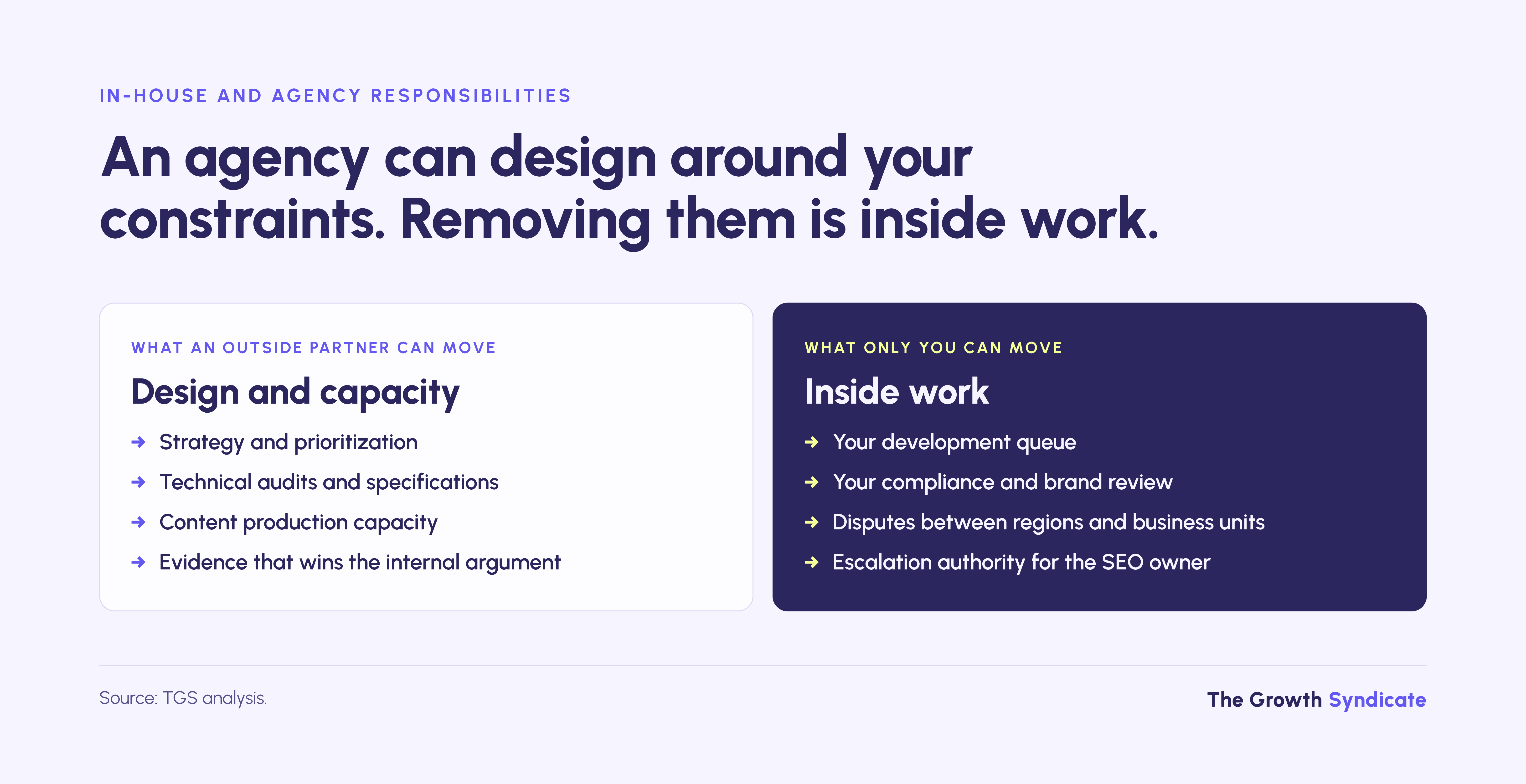
Agency. An enterprise SEO agency brings technical depth, content capacity, and pattern recognition across many similar organizations, which is genuinely useful when you are trying to work out whether your constraint is unusual or completely standard. What no SEO agency can do is unblock your development queue, sit in your compliance review, or persuade your regional director in Munich to hand over a page. Any enterprise SEO agency implying otherwise, or offering guaranteed rankings, is overselling.
Hybrid. An internal owner with authority and relationships, plus an SEO agency supplying execution capacity, covers both. The internal person spends their time on constraints only an insider can move. The external team spends its time on work that is genuinely delegatable.
What to look for when evaluating a partner
If you do bring in an SEO agency, the useful diagnostic questions are organizational rather than technical. Ask how they handle a client whose development queue is nine months long, because the answer reveals whether they have worked with enterprise clients or only described them. Ask what they do when legal rejects a claim the strategy depended on. Ask which of their B2B enterprise SEO engagements failed and why.
An agency that answers those three well understands that its job is to produce business outcomes through a process it does not control. One that redirects to case studies about organic traffic multiples has told you what it optimizes for. The same test applies whether you are hiring for organic search, paid search, or the wider set of marketing efforts around them.
The honest limitation is worth stating clearly, since most agency content avoids it. The five constraints in this article are internal. An external partner can identify them, design around them, provide evidence that makes the internal argument easier to win, and take execution work off a stretched team. Removing them is inside work, and no amount of strategic SEO guidance changes that.
Frequently asked questions
What does enterprise SEO mean?
Enterprise SEO means search optimization in an organization where changes require coordination across multiple teams before they can ship. The conventional definition emphasizes site size, typically more than 10,000 pages across multiple domains. For B2B organizations, the coordination definition describes the real situation better, since most B2B enterprise sites are small by retail standards but slow by any standard.
What is an enterprise SEO platform?
An enterprise SEO platform is software that centralizes keyword tracking, technical site auditing, competitive analysis, content recommendations, and reporting across multiple large websites. BrightEdge, Conductor, and Semrush are the best-known examples. They are built for organizations managing several properties at once and priced accordingly, and they are most useful to enterprise teams that already have capacity to act on what the platform reports.
How much does enterprise SEO cost?
Verified public-sector contracts show enterprise SEO platforms costing roughly $15,000 to $40,000 per year, based on signed UK government agreements for Semrush and BrightEdge. Agency retainers for enterprise programs typically run higher, with content production usually the largest variable. Widely circulated figures of $50,000 per month for platform access alone have no primary source behind them.
What does SEO look like at enterprise level?
At enterprise level, SEO looks like a governance function with a technical component attached. The work involves coordinating multiple stakeholders, sequencing changes through development and review cycles, resolving conflicts between regional properties, and defending the program against quarterly scrutiny using a measurement framework that accommodates long buying cycles. The technical SEO fundamentals that search engines reward are the same ones any smaller company applies. The surrounding process is not.
Does SEO work for B2B?
Yes, and the economics are often better than in B2C because keyword volumes are lower and deal values are higher. A term with 90 monthly searches and clear buyer intent can be worth more than a consumer keyword with 50,000 searches. The tradeoff is timeline: results generally take six to twelve months to appear in pipeline, and longer in enterprise organizations with review cycles.
Is SEO still worth it in 2026?
Organic search remains one of the few channels where a buyer arrives already looking for what you sell, and Google's documentation confirms its AI features are grounded in the same ranking systems that govern classic results. What has changed is that thin content aggregating what others already published has lost most of its value, since synthesized answers do that job faster. Original material with verifiable substance has become more valuable, not less.
What does enterprise B2B mean?
Enterprise B2B refers to selling to large organizations, typically 1,000 or more employees, where purchases involve formal procurement, multiple decision makers, security and legal review, and contract values high enough to justify a lengthy evaluation. Forrester's research puts the average buying group at 13 people spanning two or more departments.
How long does enterprise SEO take to show results?
Ranking movement on existing pages appears within weeks of technical fixes, which is the fastest visible return most SEO strategies produce at this scale. New content typically takes three to six months to rank competitively. Pipeline impact follows the sales cycle, so on a nine-month cycle the first attributable revenue appears somewhere between nine and eighteen months after the program begins. Plan and communicate on that timeline from the start rather than discovering it at the second quarterly review.
Do we need a platform to compete?
No. Platforms improve efficiency for enterprise clients already executing well across many properties. They do not create execution capacity. If your existing recommendations are sitting unimplemented, a platform produces more unimplemented recommendations. The threshold worth applying is whether you have a person whose job includes acting on what the tool surfaces.
How should enterprise SEO success be measured?
By pipeline contribution, with organic-sourced and organic-influenced reported separately, supported by leading indicators like search visibility and engagement signals like multi-stakeholder account visits. Traffic alone does not explain business outcomes on a B2B site where a large share of visitors are competitors, applicants, and existing customers.
Can an agency fix our enterprise SEO problems?
Partly. A B2B enterprise SEO agency supplies strategy, technical depth, content capacity, and outside evidence that strengthens your internal case. It cannot resolve your development backlog, sit inside your compliance process, or settle disputes between business units. If the binding constraint is internal coordination, an agency helps you work around it rather than eliminating it.
.png)