.svg)

AI visibility tools sell a single number. Few buyers can say how that number is calculated, and fewer vendors explain it without being pushed. Marketing teams now pay for dashboards that report their brand's AI visibility to one decimal place, built on samples too small to support the precision. We tested four of the most-used AI visibility tools on our own brand before building a tracking setup for The Growth Syndicate, and the experience changed what we think a marketing team should buy. This guide explains how the tools work under the hood, why their numbers swing, which questions expose a weak methodology, and the minimum tracking protocol we'd put in place at any B2B company. Strategy (what to change in your content to earn more AI mentions) is a separate question, and our SEO vs GEO vs AEO guide covers it.
The short version: AI visibility tracking is worth doing, as long as you read it the way you'd read a poll.
What is AI visibility tracking?
AI visibility tracking is the practice of running a fixed set of prompts through AI engines such as ChatGPT, Perplexity, Google AI Overviews and Google AI Mode on a schedule, then recording whether your brand appears in the answers, whether your pages are cited as sources, and how you compare with competitors. It tells you direction and share of voice. It cannot tell you traffic, pipeline or revenue.
What AI visibility tracking can and can't tell you
Every tool in the category runs on the same basic mechanism: it asks AI engines questions, stores the answers, and counts. Knowing that mechanism is most of what you need to interpret any dashboard.
What it measures well
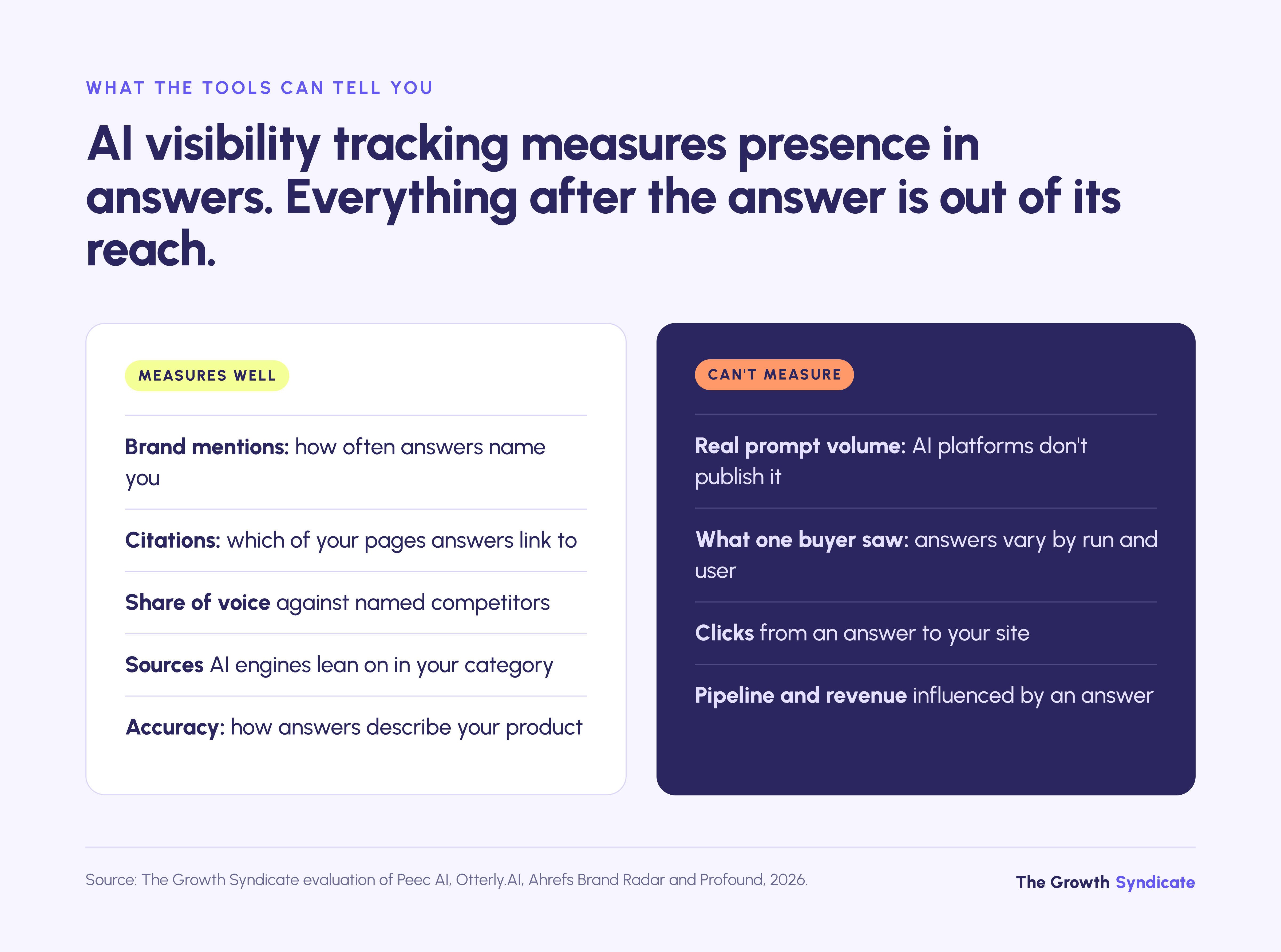
A tracker is good at relative, repeated observation. Run the same prompts through the same AI platforms every week and you learn how often your brand appears in AI answers compared with the brands you compete against, which of your pages AI engines cite, which third-party sources shape answers in your category, and whether the way AI talks about your product is accurate. Over time you also see visibility trends: whether your brand shows up more or less often as models and competitors change. Those are genuinely useful. None of them was visible to a marketing team three years ago.
What it can't measure
A tracker cannot see what your buyers typed. AI platforms don't publish prompt volumes the way Google Keyword Planner publishes search volumes, so every "impressions" or "reach" figure in an AI visibility tool is modeled from proxies. Most GEO data on the market is sampled from a limited set of prompts, then extrapolated, and the same caveat applies to AI search data from every vendor. It also cannot see the answer a specific buyer received, because answers vary by run, by account history and by location. And it cannot see what happened next: whether the buyer clicked, remembered you, searched your name later, or booked a call.
That gap is the root of the confusion about AI visibility scores. The score is a sampling statistic, reported with the confidence of a traffic metric. Visibility metrics like this can be read well, but only by someone who knows how the sample was drawn.
Why AI visibility matters for B2B buyers now
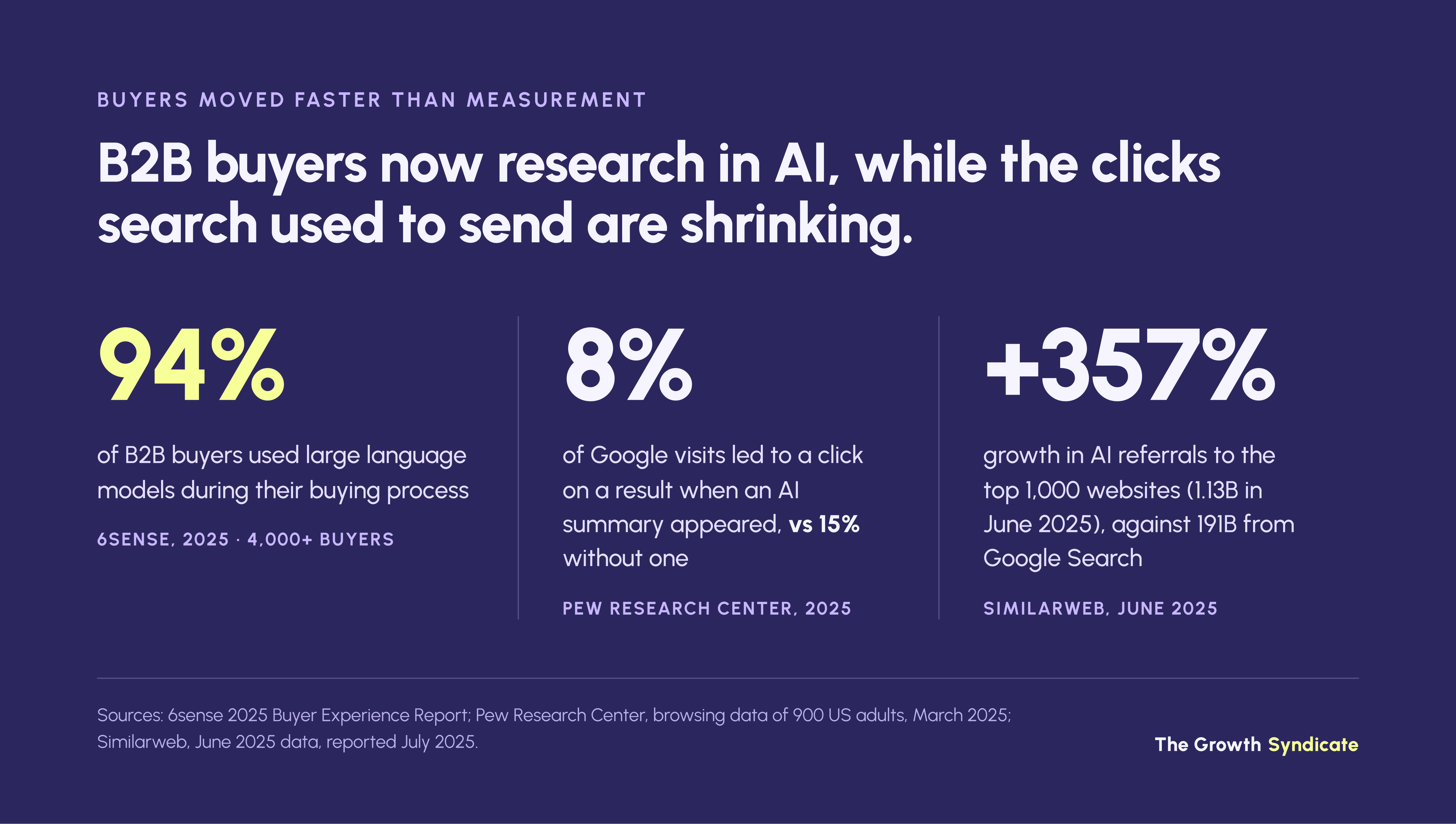
Buyer behavior has moved faster than measurement. In 6sense's 2025 Buyer Experience Report, a study of more than 4,000 B2B buyers, 94% said they used large language models during their buying process. The same study found buyers still averaged 16 interactions per person with the vendor they chose, against 17 in 2024 and 16 in 2023. AI assistants are being used to research and filter vendors, and the conversation with sales still happens. Earning a place on the shortlist, though, increasingly happens in AI-generated answers before a buyer ever reaches your website.
Fewer clicks from the same searches
Zero-click search was already common before AI answers arrived: SparkToro and Datos estimated in 2024 that 58.5% of US Google searches ended with zero clicks. SparkToro's 2026 follow-up, using a different data panel from Similarweb, put the figure at 68%, so read the two numbers as a direction rather than a precise trend line. AI summaries are part of that shift. Pew Research Center tracked the browsing of 900 US adults in March 2025 and found users clicked a traditional result 8% of the time when an AI summary appeared, against 15% when it didn't. Only 1% of visits involved a click on a link inside the summary itself.
Ahrefs measured the same effect from the publisher's side. In an update using December 2025 data across 300,000 keywords, the presence of a Google AI Overview correlated with a 58% lower average click-through rate for the top-ranking page, up from 34.5% in its first study.
AI referral traffic is growing quickly from a small base. Similarweb counted 1.13 billion referrals from AI platforms to the world's top 1,000 websites in June 2025, up 357% on the year before. Google Search generated 191 billion referrals in the same month. For most sites, AI referrals are still a small fraction of visits, and traditional search engines still send far more.
The visits that do arrive can be valuable. Ahrefs reported in June 2025 that, over a 30-day window, visitors from AI search made up 0.5% of its own site traffic and 12.1% of its signups, a conversion rate roughly 23 times that of its traditional organic search visitors. That's one company's data, and a small segment, so treat it as a hint rather than a benchmark. Conversion rate comparisons across channels also flatter AI referrals, since buyers who click through from an AI answer have often already done their research.
A mention without a click still reaches the buyer
This is the practical implication most traffic-focused reporting misses. If a buyer asks an AI assistant for vendors in your category and your brand appears in the answer, the buyer has met you, whether or not they click. Answer engines such as ChatGPT and Perplexity deliver direct answers, and the brand named in them gets the exposure. AI mentions work more like a recommendation from a colleague than like a search listing. Seer Interactive's study of 3,119 informational queries across 42 organizations, covering June 2024 to September 2025, found that brands cited in Google AI Overviews earned 35% more organic clicks than uncited brands on the same queries. Seer is careful to say this is a correlation: brands with more authority are also more likely to be cited.
So AI visibility is a brand visibility metric first and a traffic metric a distant second. That framing decides how you should measure it.
How AI visibility tools actually work
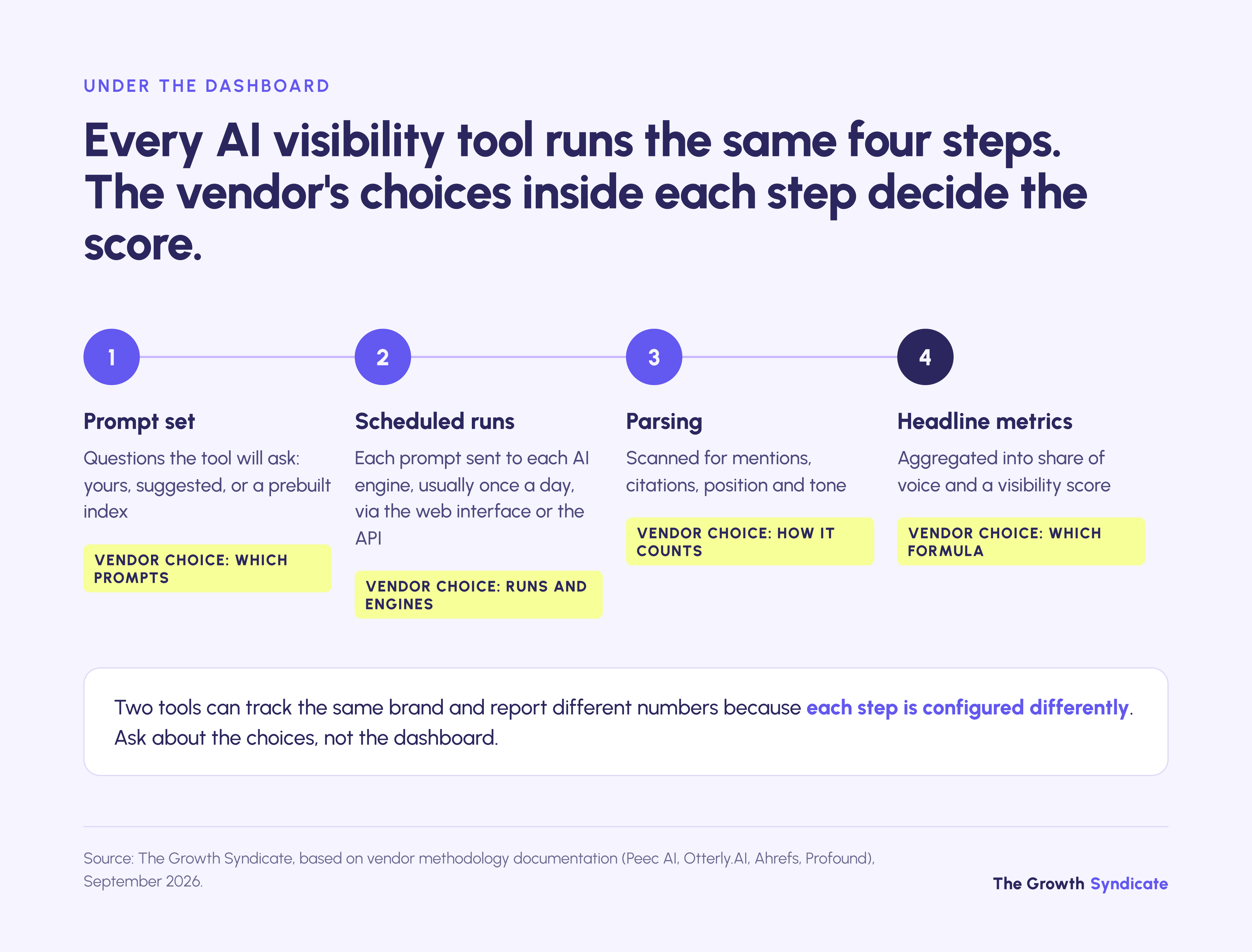
Strip away the dashboards and every AI visibility tool follows the same four steps. The differences between vendors sit inside each step, and those differences are where scores stop being comparable.
Step 1: a prompt library
The tool needs questions to ask, and the prompt set is the part of the measurement system that carries the most weight. Some vendors let you write your own prompts, some generate suggestions from your website or keywords, and some run a large prebuilt dataset of prompts derived from search data. The prompts define everything downstream: a brand can look dominant on 20 flattering prompts and absent on the 20 prompts buyers actually ask.
Step 2: running prompts through AI engines
The tool sends each prompt to each of the AI platforms it covers, usually once a day or less. There are two ways to do this. Some tools query the underlying AI models through their developer APIs, the same access developers use to build products on those AI systems. Most of the tools we looked at instead collect answers from the consumer-facing web interfaces, without any personal chat history, because the interface is closer to what a buyer sees. API and interface answers can differ, since the consumer products add web search, system prompts and formatting the raw model doesn't have. AI responses from the API are cleaner to collect; responses from the interface are closer to reality.
Step 3: parsing the answers
Each stored answer is scanned for brand mentions, competitor names, links and cited sources. Better tools handle brand-name variants and product names; weaker ones miss them or count false matches. Some tools also classify the tone of each mention (positive, neutral, negative) and record where in the answer the brand appeared.
Mentions vs citations
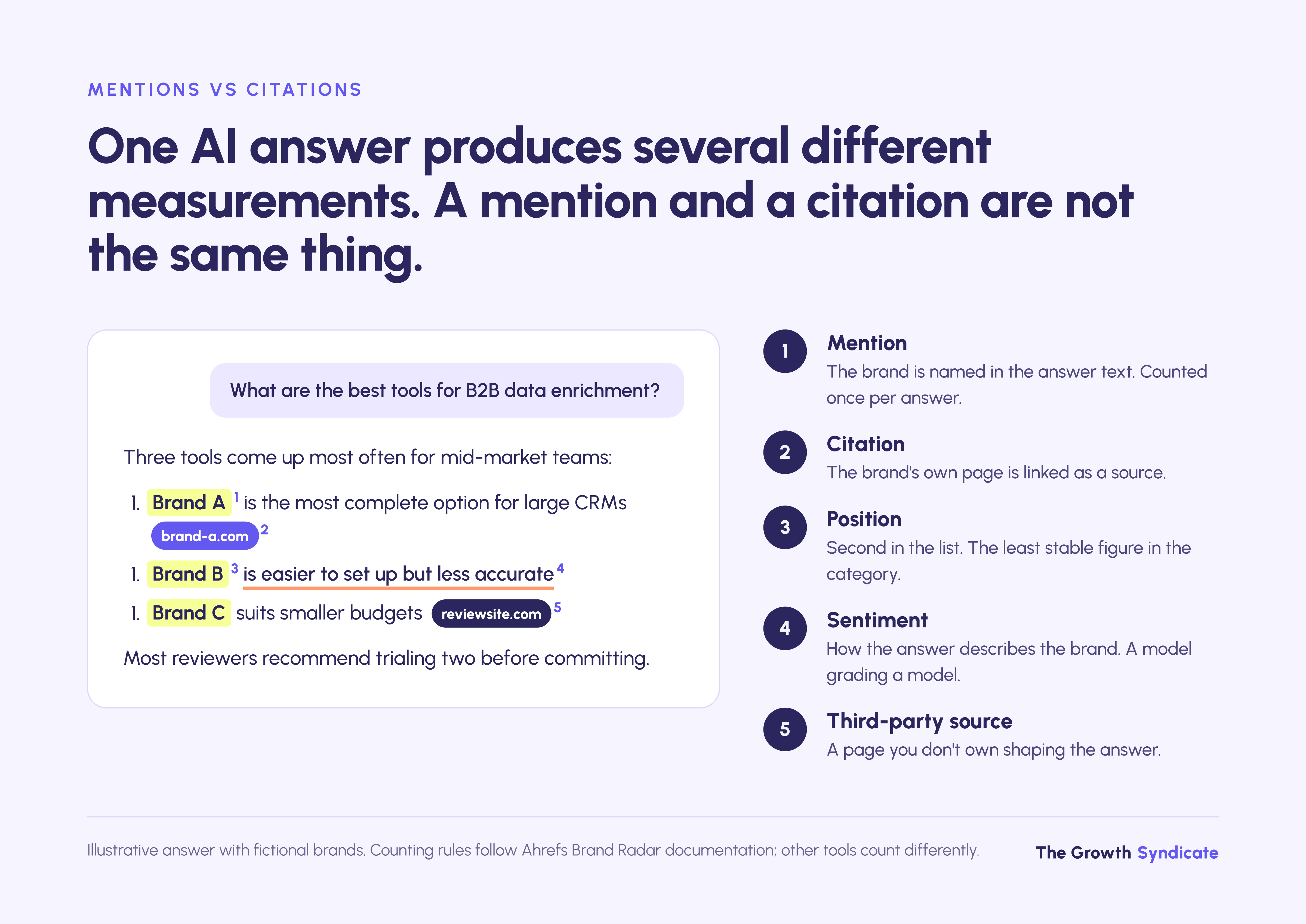
These two terms get used interchangeably in sales decks, so it helps to work from defined terms. They measure different things.
A mention is your brand named in the text of an AI answer. A citation is your website, or a specific page on it, linked as a source for the answer. You can be mentioned without being cited (the model knows your name from training data or third-party pages) and cited without being mentioned by name (your page supports a general statement). Ahrefs' documentation for Brand Radar counts a mention once per answer however many times the name repeats, and a domain citation once per answer however many of its pages are cited. It also separates pages the AI cited from pages it retrieved in the background without citing. Other tools count differently, which is one reason two tools rarely agree on citation frequency for the same brand.
Sentiment and position
Sentiment analysis in AI visibility tracking is a model grading another model's output, so treat it as a flag for manual review rather than a finding. Position (whether you appear first or fifth in a list) is the least stable figure in the whole category, for reasons covered in the next section.
Share of voice and the visibility score
The headline metrics are aggregations of brand mentions and citations. AI share of voice sounds standard, and isn't. Peec AI calculates it as your brand mentions as a percentage of all tracked brands' mentions. Ahrefs Brand Radar calculates it as your share of modeled impressions, weighted toward platforms with more search volume behind their prompts. Both are reasonable, and the same brand can score very differently on each. A visibility score is typically the share of tracked answers in which your brand appears, sometimes weighted by position, engine or estimated prompt volume. The formula varies by vendor, and some don't publish theirs.
A visibility score is therefore only as meaningful as three inputs behind it: which prompts, how many runs, and which engines. If you know those, the number tells you something about your competitive position. If you don't, it doesn't.
What is LLM visibility?
LLM visibility is how often, and how accurately, large language models and other AI systems surface your brand when people ask them questions in your category. The term overlaps almost entirely with AI visibility. Vendors tend to use "LLM visibility" when they emphasize chat assistants such as ChatGPT, Claude and Gemini, and "AI search visibility" when they include Google AI Overviews, AI Mode and AI search engines such as Perplexity. The measurement problems are identical, whichever label a vendor uses.
Why AI visibility numbers move so much
Anyone who has watched an AI visibility dashboard for a month has seen a score jump or drop with no change on their side, sometimes on a single engine, sometimes on all of them. That movement usually has nothing to do with your marketing.
The same prompt gives different answers
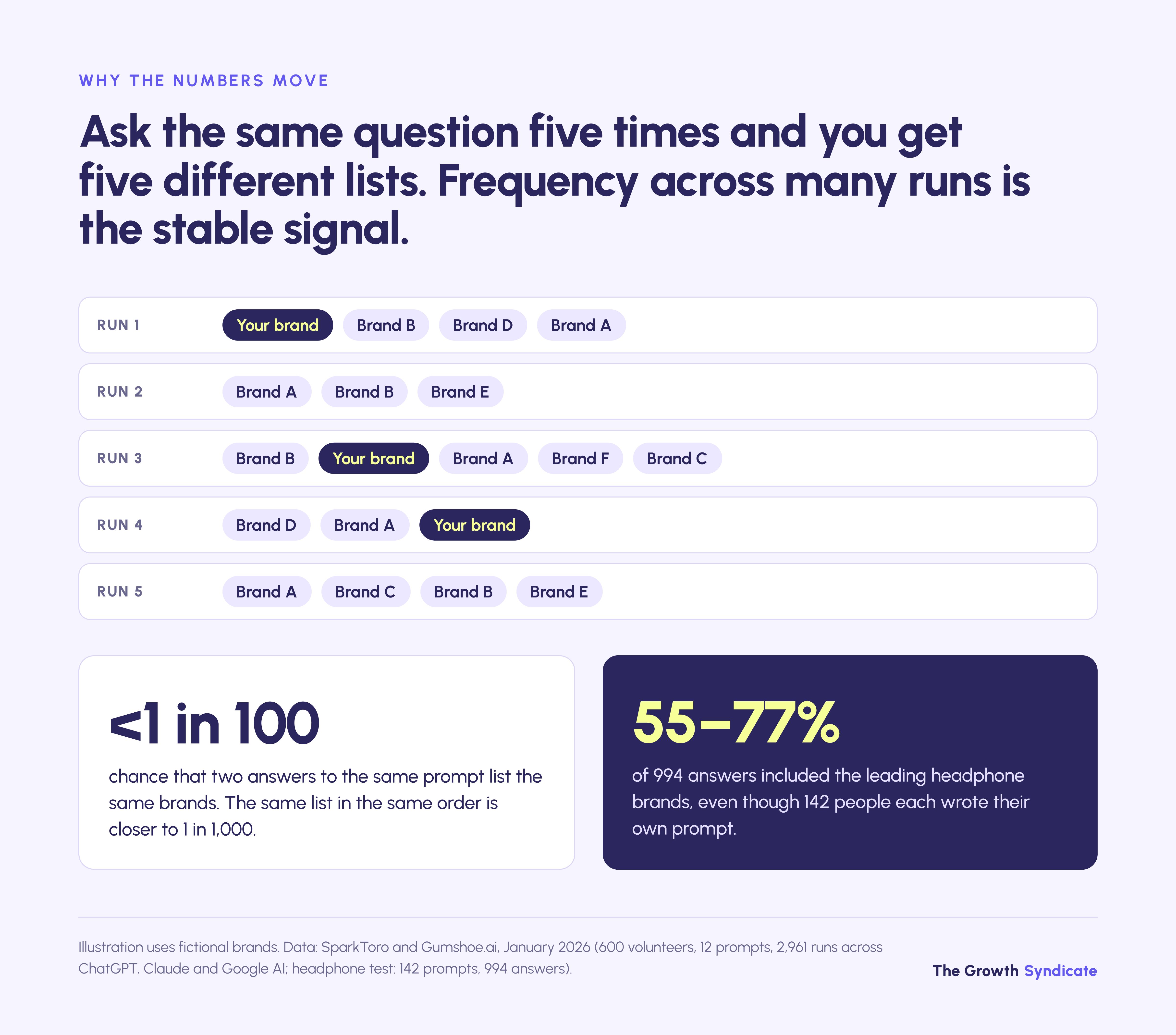
AI answers are generated fresh each time. In January 2026, SparkToro and Gumshoe.ai published a study in which 600 volunteers ran 12 prompts through ChatGPT, Claude and Google's AI tools 2,961 times in total. The chance of any two answers containing the same list of brands was less than 1 in 100; the same list in the same order was closer to 1 in 1,000. Rand Fishkin's conclusion was blunt: a tool that reports a "ranking position in AI" is reporting noise.
The same study had a more useful finding. Across many runs, how often a brand appeared was fairly stable. When 142 people each wrote their own prompt asking for headphone recommendations, the leading brands (Bose, Sony, Sennheiser and Apple) still appeared in 55% to 77% of the 994 answers, despite the wildly different wording. Frequency across many samples holds; any single answer doesn't.
One daily run is not a measurement
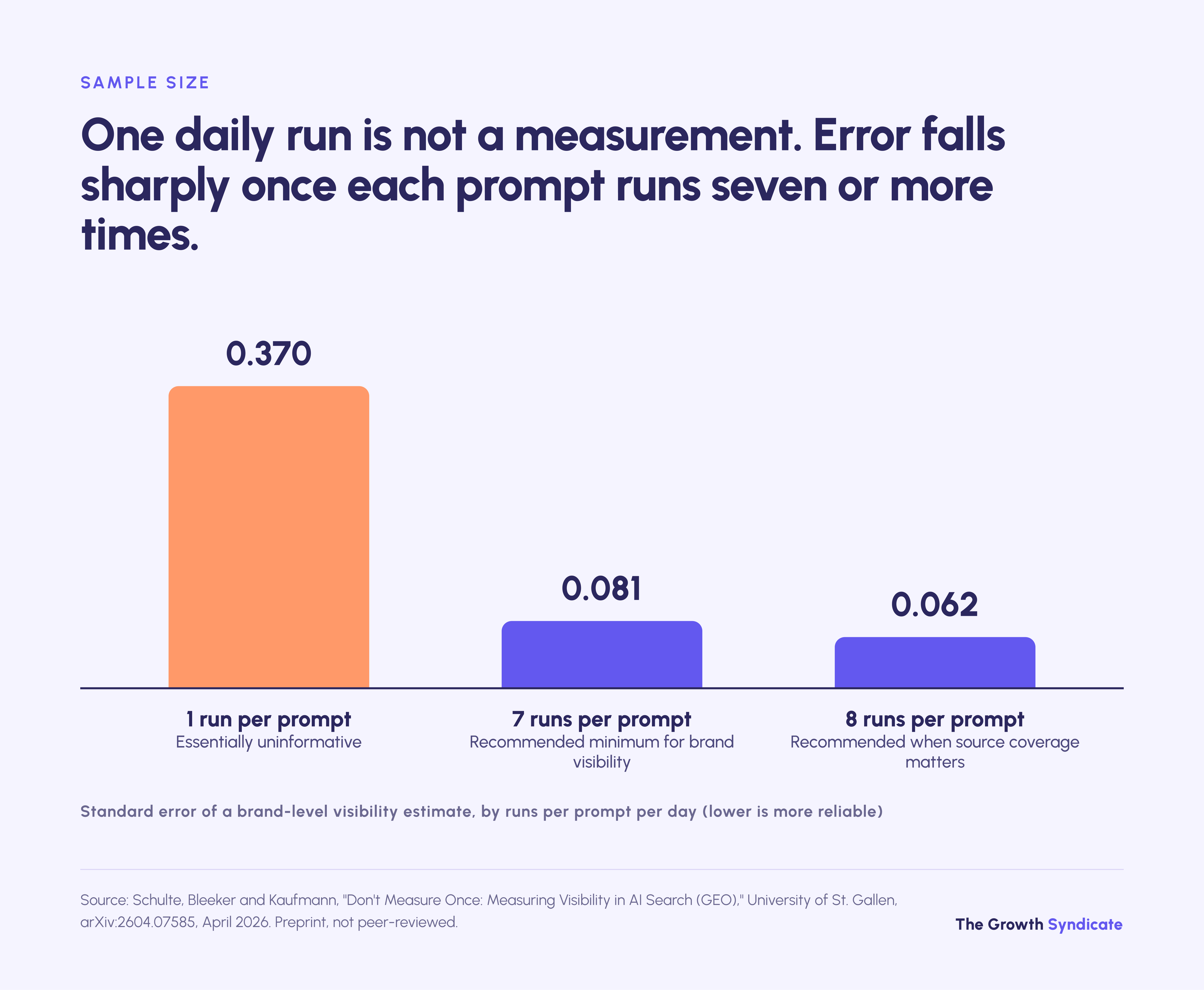
Most tools run each prompt once per engine per day. A preprint from researchers at the University of St. Gallen ("Don't Measure Once," April 2026, not yet peer-reviewed; the lead author is also affiliated with Aurora Intelligence, whose platform supplied part of the data) tested how many runs you need before a brand-level visibility estimate settles. Their answer: a single run is essentially uninformative, with a standard error of 0.370. At seven runs the standard error fell to 0.081. They recommend at least seven runs per prompt per day for brand visibility, and reading results over rolling two- to four-week windows. The same paper found that roughly 65% of cited sources changed from one day to the next, and that even identical prompts run minutes apart shared only about a third of their sources.
The practical implication: if your tool runs each prompt once a day, a weekly or monthly aggregate is a measurement and a daily figure is a coin toss.
Google AI Mode and AI Overviews are different systems
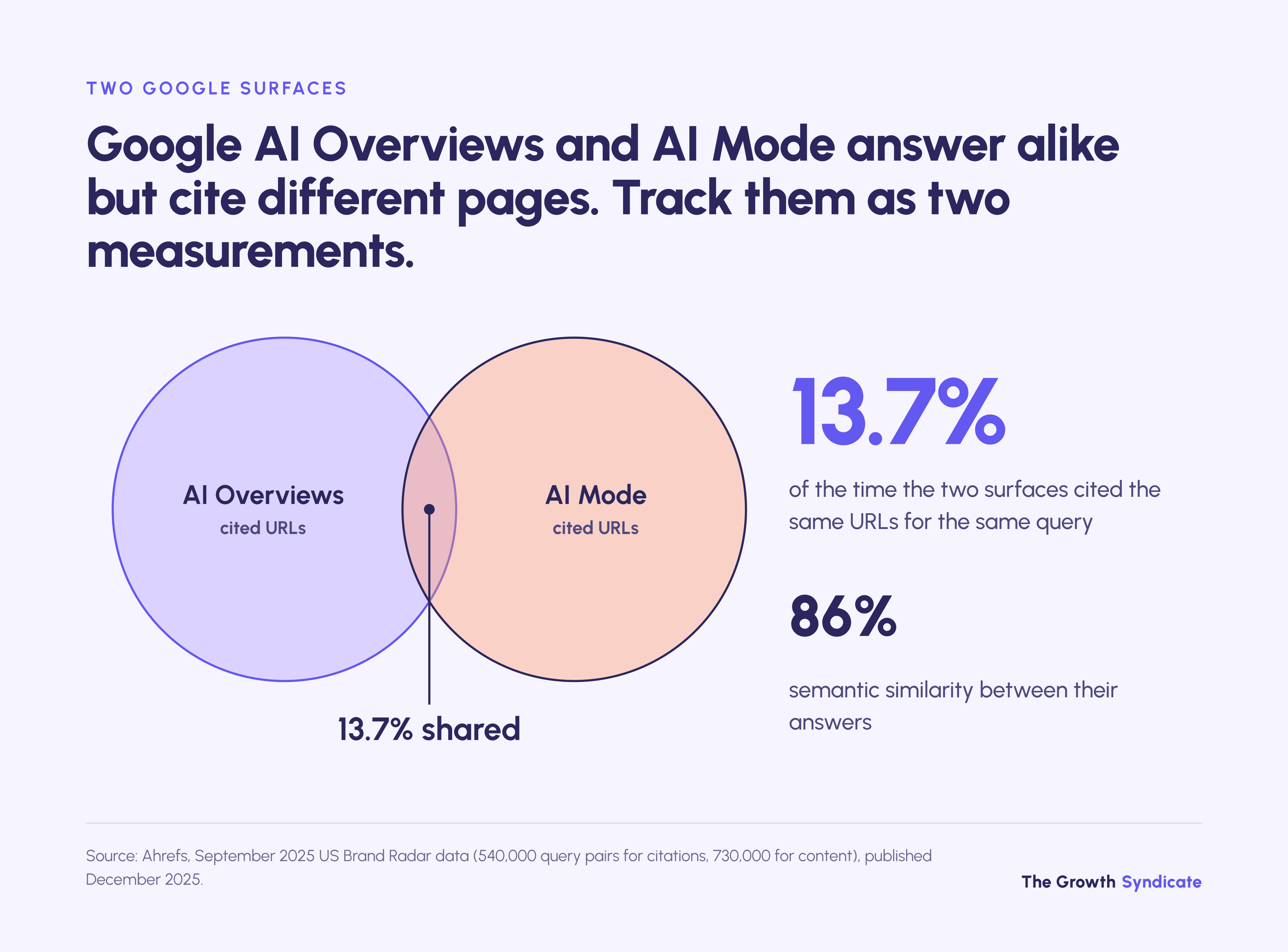
Google runs two AI surfaces, and they don't cite the same sources. In a study published in December 2025, Ahrefs compared answers for the same queries in Google AI Mode and AI Overviews using September 2025 US data, across 540,000 query pairs, and found the two cited the same URLs only 13.7% of the time, even though the content of the answers was 86% semantically similar. Being cited in AI Overviews says little about your citation frequency in AI Mode. A tool that reports "Google AI" as one number is blending two different measurements, and your AI search performance on one surface can move in the opposite direction on the other.
Personalization and location
Logged-in users with chat history, memory features and connected accounts get answers shaped by that context. Location changes the answer too, especially for Google's AI surfaces. Trackers query without personal history, from a chosen country, which gives you a consistent baseline and a picture that no real buyer sees exactly.
Model updates
AI platforms change their AI models, retrieval systems and answer formats without notice. A model update can shift your visibility overnight across every prompt at once. When every competitor moves in the same direction on the same day, look at the platform before you look at your content.
Prompt choice
The most controllable source of movement is the prompt library itself. Add ten prompts where you're strong and your brand's AI visibility rises; swap in category-generic prompts and it falls. In SparkToro's headphone test, the 142 prompts written for the same intent were so varied that their average semantic similarity was 0.081. No prompt set represents "what buyers ask." It represents what you decided to measure.
Five questions to ask any AI visibility tool vendor
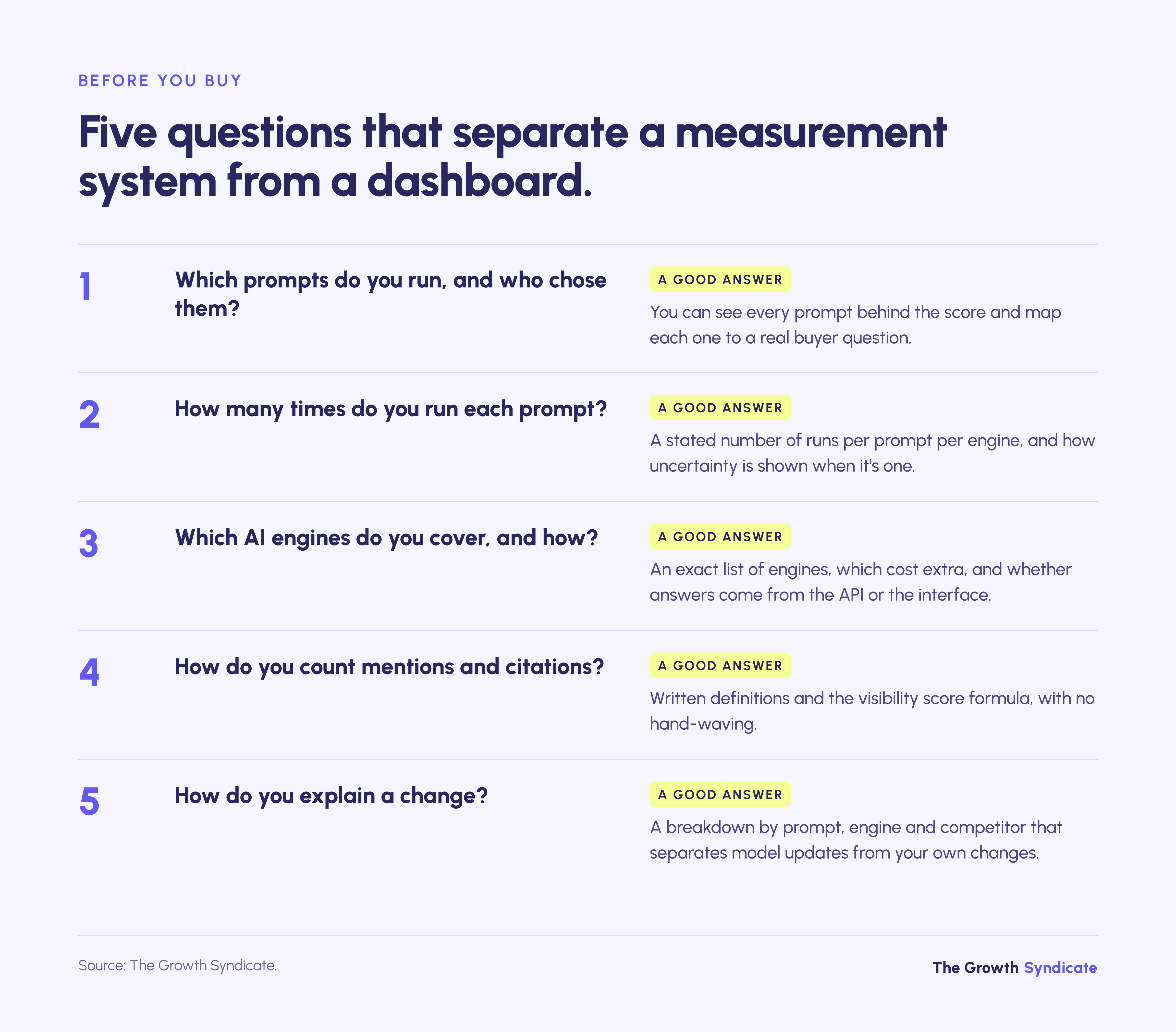
A vendor that can answer these five questions clearly is selling a measurement system. A vendor that can't is selling a dashboard. Before you buy any AI search visibility tool, ask all five, and ask for the answers in writing.
1. Which prompts do you run, and who chose them?
You want to know whether the prompt library is yours, the vendor's, or a prebuilt dataset, and how the prompts map to real buyer questions. Ask how many prompts sit behind the headline score and whether you can see every one of them.
2. How many times do you run each prompt?
Given how much AI generated answers vary between runs, this is the question that separates a measurement from an anecdote. Ask how many runs per prompt per engine per day, and how the tool aggregates them into citation frequency and share of voice. If the answer is "once a day," ask how they express uncertainty in the reported figures.
3. Which AI engines do you cover, and how do you query them?
Ask for the exact list of engines and models, which ones cost extra, and whether answers come from the API or the consumer interface. Coverage gaps matter: Claude and Google AI Mode are often add-ons or enterprise-only, and your buyers may use exactly those.
4. How do you count mentions and citations?
Ask for the definitions in writing. Does a brand named three times in one answer count once or three times? Does a citation count per domain or per URL? How are brand-name variants and product names matched? Then ask for the visibility score formula. A score nobody can explain is a red flag, whatever it's called.
.avif)
5. How do you explain a change?
This is the question that reveals the most. When your score moves by ten points, can the tool show you which prompts, engines and competitors drove the move? Can it show which content formats (comparison pages, reviews, forum threads) gained or lost citations? Can it tell a model update apart from a change you made? If it can't separate signal from noise, the trend line is decoration.
The AI visibility tools we tested, and what each measures
We evaluated Peec AI, Otterly.AI, Ahrefs Brand Radar and Profound on our own brand and category before deciding how to track AI visibility at The Growth Syndicate. Our conclusion was that the measurement layer of this category is still immature, and that the tools that measure AI visibility are honest about what they collect while being much less clear about what the resulting numbers mean. We describe each below by method, with no ranking, because the right choice depends on what you need to measure. Tool features and pricing change almost monthly, so everything here is as of September 2026 and worth re-checking before you buy.
Peec AI
Peec AI tracks prompts you define, collecting answers by simulating real use of each assistant's web interface rather than calling its API, with each active prompt run daily. Self-serve plans let you choose three engines from ChatGPT, Google AI Overviews, Google AI Mode, Perplexity, Gemini and Copilot; extra engines are paid add-ons, and Claude is only available as an upgrade on higher tiers. Peec publishes its metric definitions: visibility is the share of AI responses that include your brand, and share of voice is your share of all tracked brands' mentions. Plans start at $95 a month for 50 prompts. It suits in-house teams and agencies that want clean competitive reporting on a set of prompts they control.
Otterly.AI
Otterly.AI tracks user-defined prompts daily, with a prompt research feature to help build the list. Every plan covers ChatGPT, Google AI Overviews, Perplexity and Copilot; Google AI Mode, Gemini and Claude are paid add-ons on every tier. Its reports cover brand mentions, cited URLs, sentiment and competitors. It has the lowest entry price of the four, starting at $29 a month for 15 prompts, which makes it a sensible first tracker for a small team.
Ahrefs Brand Radar
Brand Radar works differently from the other three. Its core dataset isn't built from your prompts: Ahrefs runs a prebuilt index of hundreds of millions of search-backed questions, largely drawn from Google's People Also Ask data and its keyword database, through the AI platforms' public interfaces. On top of that index, you can track your own custom prompts on Google AI Overviews, Google AI Mode, ChatGPT, Perplexity, Gemini and Copilot, daily, weekly or monthly, billed per check (one prompt, on one engine, in one location). That gives Brand Radar scale no prompt-by-prompt tool can match, and it makes the tool strongest for comparing how a brand performs against competitors across a whole category. Ahrefs also publishes unusually clear metric definitions. Its "impressions" figure is the summed Google search volume of the prompts where a brand appears: an estimate of exposure, not a count of people who saw an answer. Full Brand Radar access is sold as an add-on to an Ahrefs subscription, priced per AI platform, and Ahrefs currently shows different entry prices on its pricing page and its product page, so confirm the figure at checkout. Most paid Ahrefs plans also include a small monthly allowance of custom prompt checks.
This is the tool we built our own baseline on, using the Brand Radar access included in our existing Ahrefs plan. We priced the paid AI-platform add-on at roughly $600 a month for our needs and decided against it, because more coverage wouldn't have fixed the underlying sampling limits.
Profound
Profound is built for enterprise teams that want everything in one platform. It collects answers through the assistants' front-end interfaces rather than their APIs, and estimates how often real people ask about a topic from conversations it licenses from opt-in consumer panels. Its engine coverage is the widest of the four on enterprise plans, including Claude, Gemini, Copilot, Grok and DeepSeek alongside the major platforms. Entry plans are narrower than the headline coverage suggests: the $99-a-month Starter plan tracks ChatGPT only, the $399 Growth plan adds Perplexity and Google AI Overviews, both are billed annually, and full coverage requires a custom enterprise contract.
Other tools in the category
The category is crowded and moving. Semrush sells AI visibility reporting through its AI Visibility Toolkit, SE Ranking offers AI search tracking, and newer specialists include Scrunch AI, Evertune and AthenaHQ. Evertune is worth noting for methodology alone: it says it samples each prompt up to 100 times per model across 11 models, which addresses the variability problem directly, with its Pro plan listed at $800 a month. We also trialed one smaller tracker and dropped it when it couldn't explain its own scores.
Is there a free AI visibility checker worth using?
Yes, as a first look. Several vendors, including Ahrefs, Semrush and SE Ranking, offer a free AI visibility checker that returns a snapshot of how your brand appears in just a few clicks. Use one to see how AI engines describe you and which competitors they name. Don't use the result as a baseline: free checkers show either a one-off check or a limited preview of the vendor's prompt database, and you can't choose or see all the prompts behind the number, so you can't repeat the measurement on your own terms.
The cheapest free AI visibility check is manual. Once a month, ask ChatGPT, Perplexity and Google AI Mode the five questions your best customers asked before they bought, and read the full answers. You'll learn more about brand perception in AI answers from twenty minutes of reading than from a month of trend lines, and you'll often get deeper insights into why a competitor keeps being recommended.
How to track AI search visibility: a minimum viable protocol
This is the setup we'd recommend for a B2B team that wants reliable AI visibility data without a large tool budget. It's close to the protocol we run for our own brand.
Build a prompt library from buyer questions
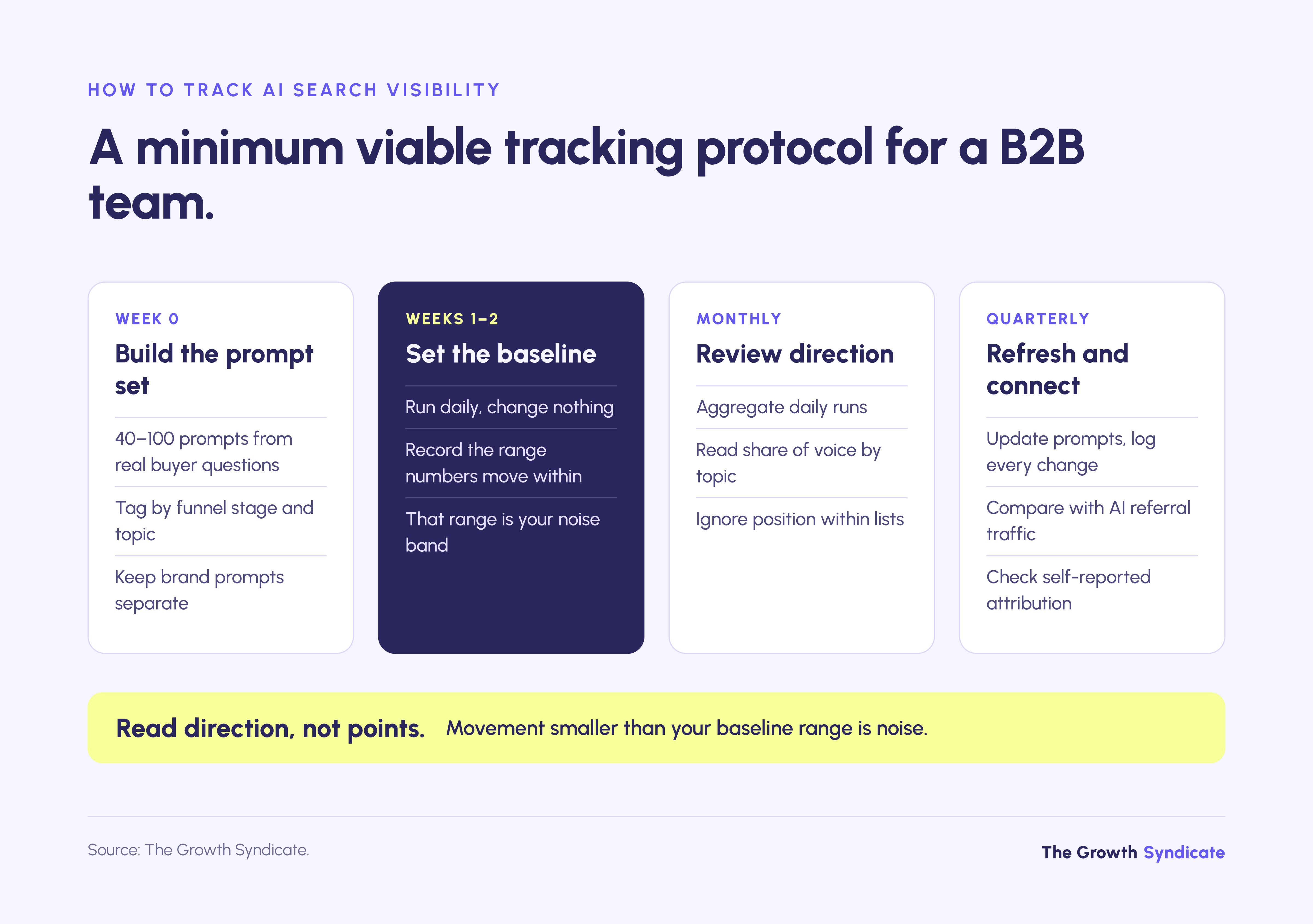
Start with the questions buyers ask before they contact you, since those are the questions answer engines now answer on your behalf. Good prompts answer questions a buyer has at a specific stage, in the buyer's own words. Pull them from sales call notes and recordings, from the "how did you hear about us" field, from your search console query data and from the People Also Ask boxes on your core keywords. Write prompts the way a buyer would phrase them in a chat, not as keywords.
Aim for 40 to 100 prompts, tagged by funnel stage and topic: category questions ("what are the best tools for X"), problem questions ("how do I fix Y"), comparison questions ("X vs Y") and brand questions ("is [your brand] good for Z"). Keep brand prompts separate in reporting, since your brand appears in AI answers almost every time a question names you. Your content engine should also feed this list: every new buyer question sales hears is a prompt to add.
Pick engines by where your buyers are
Track the AI platforms your buyers use, not every platform available. For most B2B categories that means ChatGPT, Google AI Overviews and Google AI Mode at a minimum, with Perplexity, Copilot, Gemini or Claude added where your audience skews toward them. Copilot matters more if you sell into Microsoft-heavy enterprises; Claude and Perplexity tend to matter more when your buyers are technical.
Set a baseline before you change anything
Run the prompts for two weeks before you draw any conclusion or change any content. That baseline gives you the noise band: the range your numbers move within when nothing on your side changes. Any later movement smaller than that band is noise.
Run monthly reviews and read direction
Aggregate daily runs into weekly or monthly figures, and read direction at the topic level: is your share of voice on comparison prompts rising or falling over two to three months? Ignore position changes within lists entirely. Refresh the prompts quarterly, and log every change you make to them so you don't mistake a new prompt set for a trend in brand performance or citation frequency.
A useful shorthand: track week over week for anomalies, and month over month for decisions.
Pair visibility data with traffic and pipeline data
AI visibility data only becomes useful next to data about outcomes, because a tracker measures exposure and nothing after it. Tag AI referral traffic in your analytics (many AI assistants pass a referrer when a buyer clicks a link, though some clicks arrive without one and show up as direct traffic), add AI assistants as an option in your self-reported attribution field, and watch branded search volume over time. None of these is a perfect measure. Together they tell you whether visibility is turning into attention.
Can Google Search Console show AI visibility?
Only partly. Google includes AI Overviews and AI Mode data in Search Console's overall performance report, mixed in with classic results, so you can't isolate clicks from Google AI surfaces there. In June 2026, Google launched a dedicated generative AI performance report, rolled out to all websites worldwide by the end of August. It shows impressions by page, country, device and date, but not clicks, click-through rate or queries. That report tells you how often your pages appear in Google AI surfaces. It doesn't tell you whether anyone clicked, and it covers nothing outside Google.
This is why traditional SEO tools and search console data, on their own, give a misleading picture of search visibility in an AI-heavy SERP: impressions can rise while clicks fall, and a steady ranking can hide a shrinking share of attention. Our B2B SEO strategy guide covers how to adjust search reporting for that shift; a tracker covering the other AI platforms fills the part of the picture Search Console can't see.
What to do with AI visibility data
The value of AI visibility data is in the decisions it changes. Most of what a dashboard shows won't change any decision, and a few things should change several.
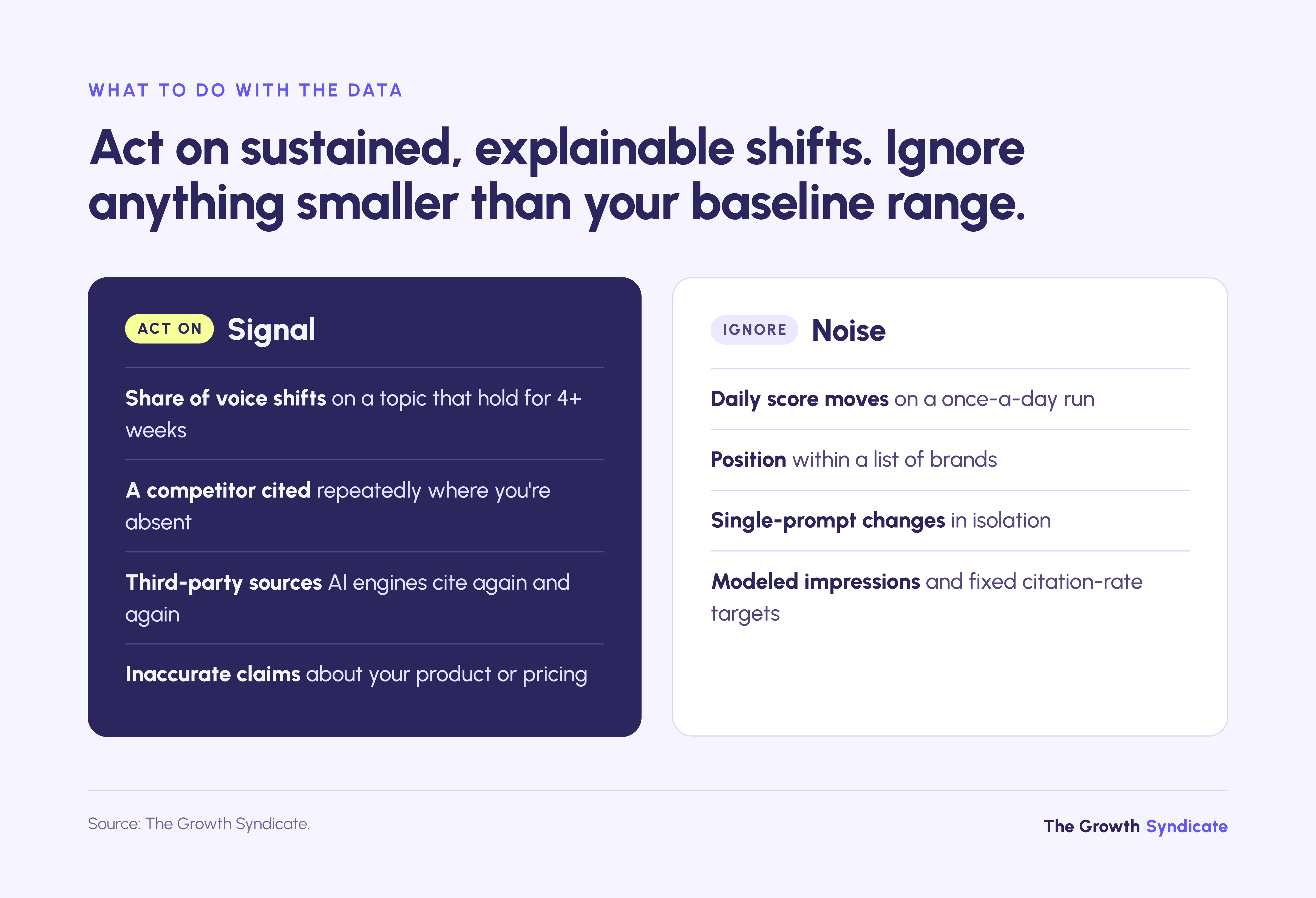
Signals worth acting on
A sustained shift in share of voice on a topic. If your AI share of comparison answers falls for four weeks or more while competitors hold steady, something in the source data has changed. Find the answers and read which pages the AI engines cite.
Visibility gaps against a specific competitor in AI search. When one competitor's brand shows up consistently in AI answers for prompts where your brand is absent, look at what the cited sources say about them. The gap often traces to third-party coverage (reviews, comparison articles, community threads) rather than to their own website.
The sources AI engines cite again and again. The citation lists tell you which publications, review sites and communities shape answers in your category. That's a practical input for digital PR and partnership priorities, and often the most valuable output of the whole exercise: citation frequency for third-party sources tells you where AI mentions of your category come from.
Inaccurate answers about your brand. Wrong pricing, discontinued products or outdated positioning in AI responses are reputation risks, especially in regulated categories such as healthcare and finance, where a wrong claim about a product can create compliance problems. Proactive monitoring catches these early. Fix the source pages first, then check again.
Noise to ignore
Daily score movement, position within a list of brands, changes on a single prompt, and any shift smaller than your baseline range. We'd also treat most sentiment scores and all modeled "impressions" as rough context rather than figures to report upward. Raw counts of brand mentions belong in the same bucket unless the prompt set and run count behind them are stable.
Be wary of fixed targets too. Claims that brands need a specific citation rate, such as 20% to 30%, to have "meaningful" AI visibility don't hold up: citation rates depend entirely on the prompts, the engines tracked and the category, so a number that's excellent in one setup is weak in another. Your own baseline is the only benchmark that means anything.
Where visibility stops and pipeline starts
AI visibility is an early indicator of your brand's presence in the market, much like intent data in B2B: a signal worth reading, not proof of a buyer. It sits upstream of branded search, direct traffic, self-reported attribution and, eventually, pipeline, and no tool connects those steps for you. The risk is that a new metric becomes a new place to hide: a rising visibility score is easy to report and hard to argue with, and it can stand in for results that never arrive.

The fix is to report AI visibility next to the numbers that matter to the business, never instead of them. Our guide to B2B marketing attribution sets out how to combine software attribution with self-reported data, which is also where AI influence shows up most clearly: buyers who tell you they found you through ChatGPT or Perplexity. When a self-reported answer and a rise in your brand's AI visibility point the same way, you have evidence worth taking to a budget meeting.
In practice, that means reporting three layers side by side, because no single tool covers all of them.
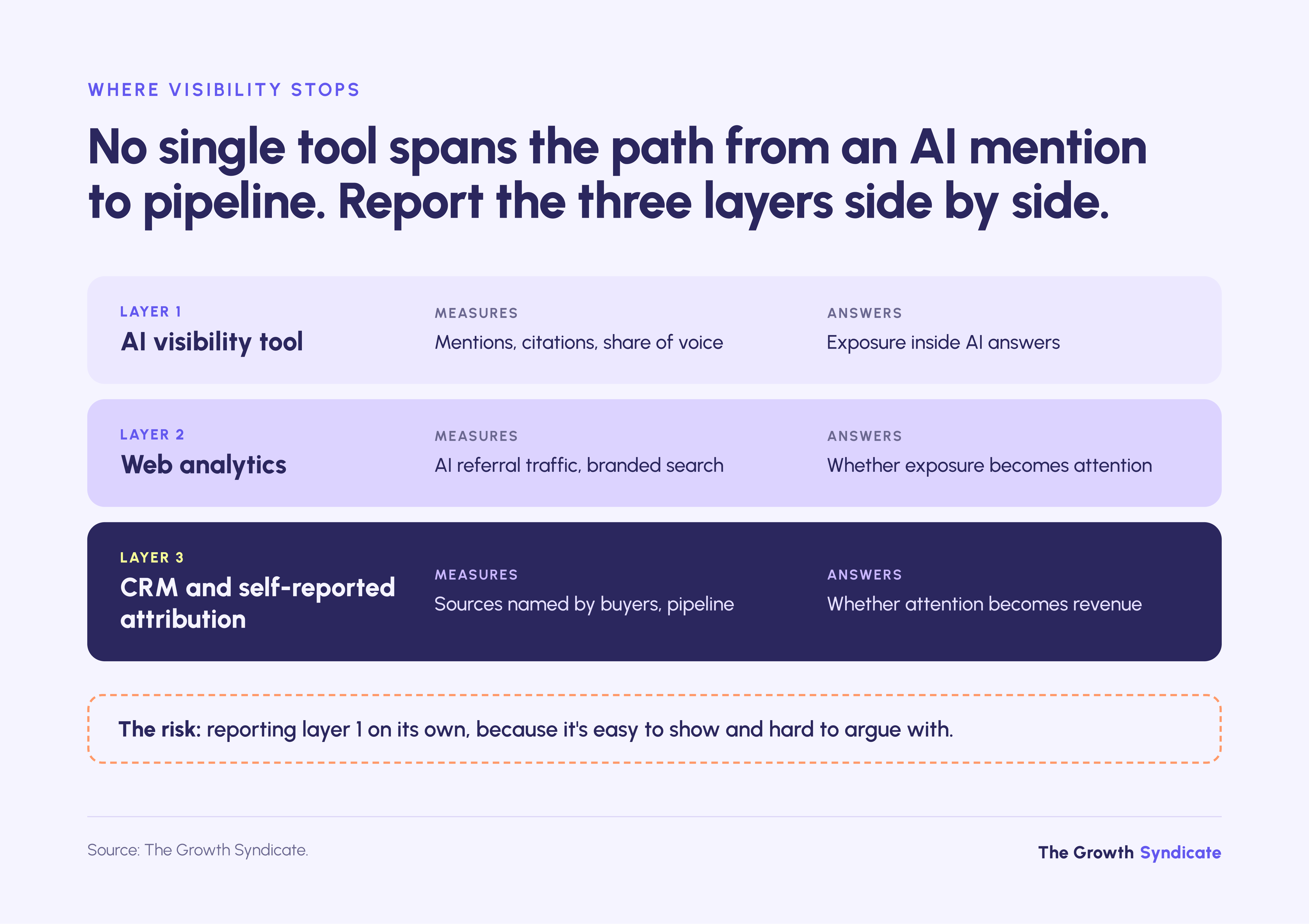
There's a strategic reason to keep this discipline. In our State of AI in B2B Marketing report, 63% of the 110 marketing practitioners we surveyed were concerned that AI increases noise and reduces differentiation. A tracker can show you whether you stand out in AI answers. What makes you stand out is still the substance of your content and the reputation behind it, earned through what you publish and what others say about you, not bought through a dashboard. That work, rather than the tracking, is where our SEO and AI search team spends most of its time.
FAQ
What does AI visibility mean?
AI visibility is how often and how prominently your brand appears in AI-generated answers from ChatGPT, Perplexity, Gemini, Claude and Google's AI Overviews and AI Mode. It covers brand mentions in the answer text and citations of your website as a source, usually measured as a share of answers across a set of tracked prompts.
How can I check my AI visibility?
For a quick check, ask the AI assistants your buyers use the questions they ask before buying, and read the answers. A free AI visibility checker from an SEO tool vendor gives a similar snapshot. For ongoing measurement, use an AI visibility tool that runs a fixed set of prompts across AI engines on a schedule. Establish a two-week baseline before drawing conclusions, since individual answers vary a lot.
How can I check my AI visibility score?
Your score lives inside whichever AI visibility tool you use, and each vendor calculates it differently. Before trusting it, ask the vendor which prompts it covers, how many runs sit behind it, which engines it includes, and the exact formula. Two tools will rarely give the same score for the same brand.
What are the best AI visibility tracking tools?
The best tool is the one whose methodology fits your needs. Peec AI and Otterly.AI suit teams that want to track their own prompts, Ahrefs Brand Radar offers a large prebuilt dataset plus custom prompts for existing Ahrefs users, and Profound targets enterprise programs. Judge each on prompts, run counts, engine coverage and metric definitions rather than on dashboard features. Any tool that claims to measure AI visibility precisely from one daily run deserves skepticism.
Why should I track AI brand visibility?
Buyers increasingly research vendors in AI assistants: 94% of B2B buyers in 6sense's 2025 study used large language models while buying. Tracking brand mentions and citations shows whether your brand appears in AI answers, how competitors compare, which sources shape those answers, and whether AI engines describe your product accurately.
Which type of AI visibility solution is best for a B2B SaaS company?
Most B2B SaaS companies are best served by a mid-priced tracker that runs their own prompts across ChatGPT and Google's AI surfaces, paired with AI referral tracking in analytics and self-reported attribution in the CRM. Enterprise platforms make sense once AI search is a large, budgeted channel with a team to act on the data.
What are AI visibility services?
AI visibility services are agency or consultancy offerings that audit how a brand appears in AI generated answers from answer engines and assistants, build and run a tracking setup, and improve the content and third-party sources AI engines rely on. They typically combine AI visibility tools with SEO, content and digital PR work.
Is there a benchmark for a good AI citation rate?
No reliable one. Citation rates depend on the prompts, the AI engines tracked and the category, so a fixed target such as 20% to 30% has no consistent meaning across setups. Use your own two-week baseline as the benchmark and track the direction of change against named competitors.
How often should I track AI visibility?
Let the tool run daily, but make decisions on weekly or monthly aggregates of AI search data. Research on answer variability suggests one run per prompt per day is too few for a reliable daily reading, so short-term movements are mostly noise. Review trends monthly and refresh your prompt library quarterly.
Does AI visibility tracking replace traditional SEO tools?
No. Traditional SEO tools measure rankings, keywords and backlinks in traditional search results, which still drive most search traffic. AI visibility tools measure brand mentions and citations in AI-generated answers. Most B2B teams need both, reported side by side, with search console and analytics data connecting them to traffic.
.png)