.svg)

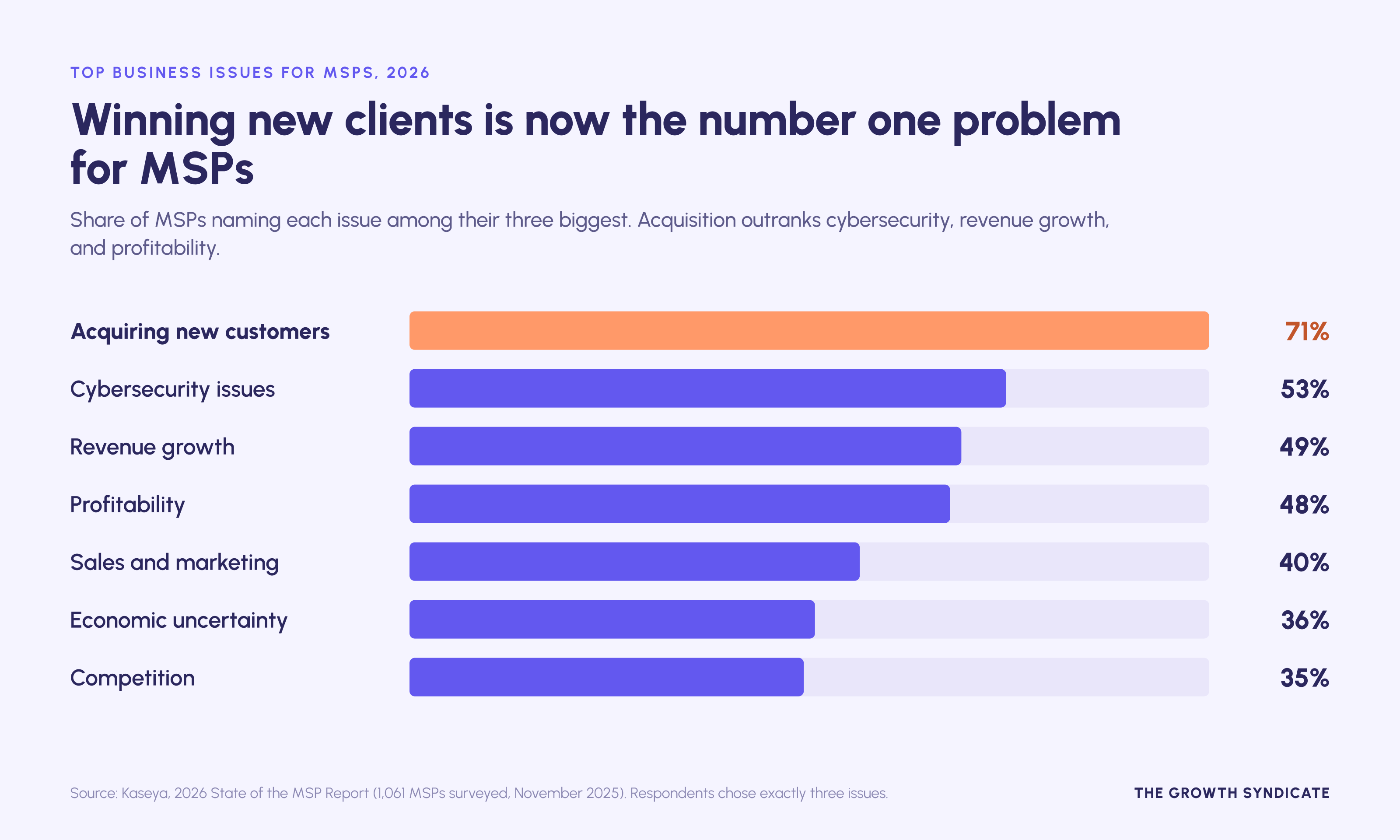
Seventy-one percent of managed service providers now name client acquisition as their single biggest business challenge. That figure comes from Kaseya's 2026 State of the MSP Report, a survey of 1,061 MSPs run in November 2025, and it sits well above cybersecurity issues (53%) and revenue growth (49%) on the same list. The same survey found that a third of MSPs now win most of their new clients by taking them from another provider, and only 12% mainly sign businesses outsourcing IT for the first time.
The demand for managed services has not gone anywhere. What changed is who wins it. Private-equity platforms buy local providers and sell "local service, national scale." Vendors ship AI tooling that flattens the tier-1 helpdesk margin every MSP used to live on. And the referral network that carried most MSPs from zero to a million in revenue has a ceiling that shows up at exactly the moment the owner wants to stop selling.
This guide covers MSP marketing as it works in 2026: the market conditions that make it harder, how to position a managed service provider so it stops competing on price, which marketing channels and lead generation tactics produce qualified leads for IT services and which produce activity, how much to spend, how to build an MSP marketing plan by revenue stage, and where the US and Europe diverge. It is written for MSP owners and the people they hire to run their marketing efforts, whether in-house or through an MSP marketing agency.
Quick answer: what is MSP marketing?
MSP marketing is how a managed service provider (MSP) becomes the IT partner a business already trusts before it starts looking for one, and turns that trust into recurring revenue. It spans positioning, local search engine optimization, content marketing, LinkedIn, referral systems, paid advertising, and email marketing, measured against pipeline rather than activity. Here, MSP means managed service provider, not the acronym's healthcare or Medicare meanings.
Why is MSP marketing harder in 2026 than it was five years ago?
MSP marketing got harder because three things happened at once: average deal sizes shrank, consolidation raised the bar for what "credible" looks like, and AI began compressing the margin on the services most MSPs sell first. MSP marketing strategies that worked when the buyer had few options now have to earn attention against national brands and well-informed decision makers.
Start with deal size. In Kaseya's 2026 data, the share of MSPs whose typical customer spends $25,000 or more per year fell from 75% to 41% in a single year, and the "up to $1,000 a month" client became the largest band, growing from 24% to 30% of respondents. Across the same period, the share of MSPs reporting no profit at all doubled, from 5% to 10%. That is a two-speed market: providers with a defined offer and a real pipeline holding mid-to-high-teens margins, and a long tail competing for smaller clients at thinner spreads.
Then consolidation. Omdia counted 169 publicly announced MSP acquisitions in 2025, with private equity in 69% of the disclosed deals and three-quarters of the activity in North America; its first-quarter 2026 count was up 73% on the year. A platform-backed competitor arrives in your city with a national brand, a 24/7 security operations center, vertical case studies, and a marketing team. Your prospect does not know the platform bought three local shops and stapled them together. They see the website.
The market itself keeps growing. Analyst estimates for the global managed services market in 2025 and 2026 cluster between roughly $300 billion and $440 billion, depending on what gets counted, and MSPAlliance puts the number of service providers in the US alone somewhere north of 40,000, with 150,000 to 200,000 self-described MSPs worldwide and only a fraction of those operating at scale. Growth is not the problem. Distribution of that growth is.
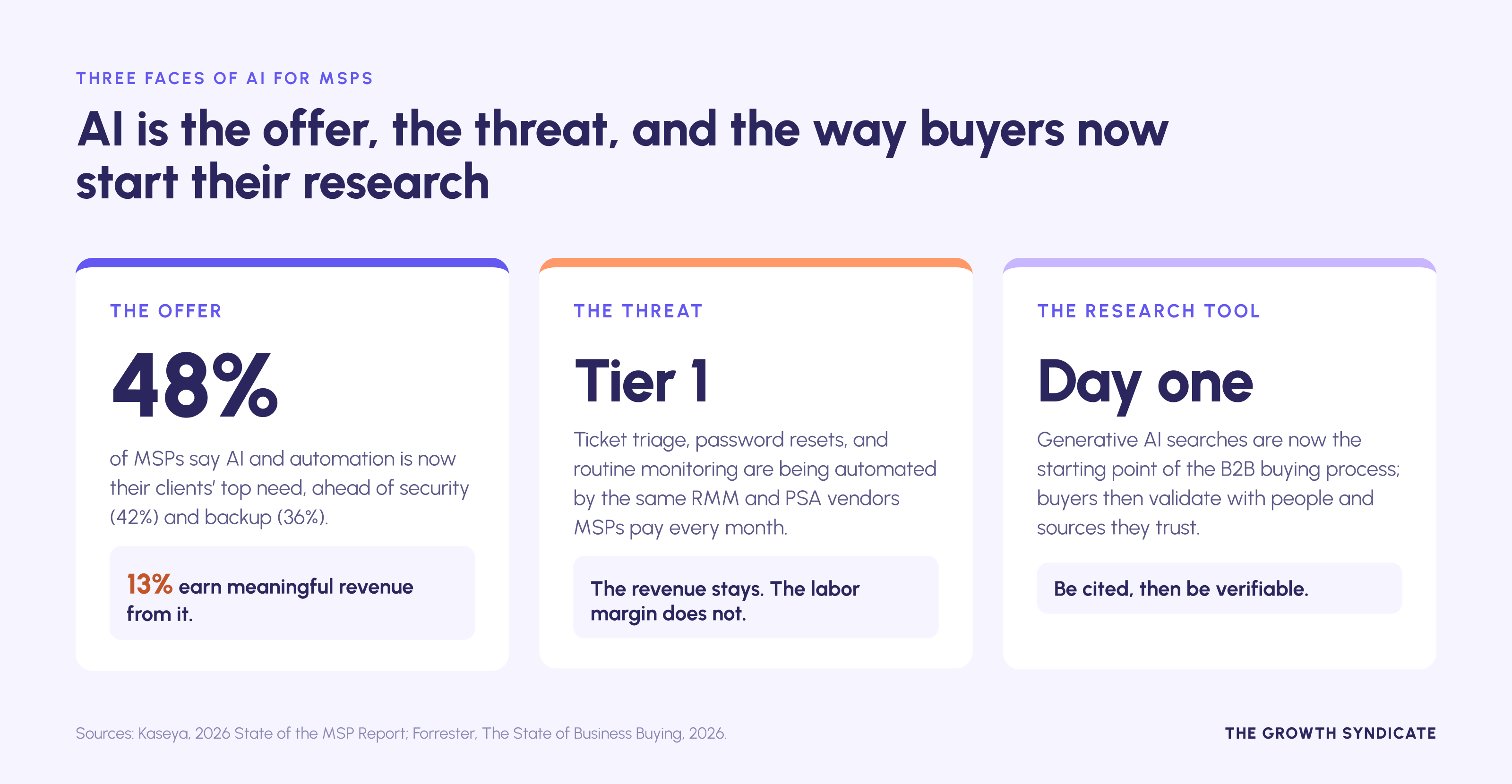
The last shift is the quiet one. In the same Kaseya survey, 48% of MSPs said AI and automation is now the top thing clients want from them, ahead of security (42%) and backup (36%). Only 13% said they were turning AI into meaningful revenue. The rest are watching a service they have not packaged become the service the buyer asks about first, while the ticket-triage work that used to fill invoices gets automated by their own RMM vendor.
None of this makes marketing optional for a managed service provider. It makes the old version of MSP marketing, a good reputation and a phone that rings, insufficient.

"Marketers cannot create demand. They can only make sure the brand exists as a notion in the buyer's world before demand naturally occurs. The real job is influencing salience and association: being the name that surfaces when a problem triggers a buying journey."
How do most MSPs get clients today, and why does it stop working?
Most managed service providers still grow through referrals, and referrals still close better than any other source. The problem is arithmetic: a referral network produces the same number of introductions whether the owner wants three new clients this year or thirty, and fewer when the referrers retire or get acquired. MSP lead generation exists to make the referral rate an input you control.
A Technology Marketing Toolkit survey of more than 500 MSPs found 39% doing no proactive marketing at all, relying entirely on referrals and word of mouth. Spend an hour in r/msp and you will find the same picture told from the inside: owners who have never paid for a lead, never written a case study, and whose growth curve flattened somewhere between $1 million and $2 million in annual revenue.
Referrals deserve their reputation. A warm introduction from a CPA, an insurance broker, or an existing client arrives with trust already built, which shortens the sales cycle and lifts the close rate. Partner-sourced leads close faster and at higher rates than any cold source, and existing clients who refer tend to stay longer themselves. The mistake is treating referrals as an MSP marketing strategy rather than one of several marketing channels.
Three things break when referrals are the whole plan. First, referrals bring more of what you already have. If your existing clients are 12-seat law firms, your referrals are 12-seat law firms, and the potential clients you want next (the 80-seat manufacturer, the regional clinic group) are not in anyone's address book. Second, referral flow lags the business by years. The relationships producing introductions today were built by an owner who was on site fixing servers in 2019; the owner is now in meetings and the pipeline eventually notices. Third, referrals cannot be scheduled. You cannot decide to have four in Q2.
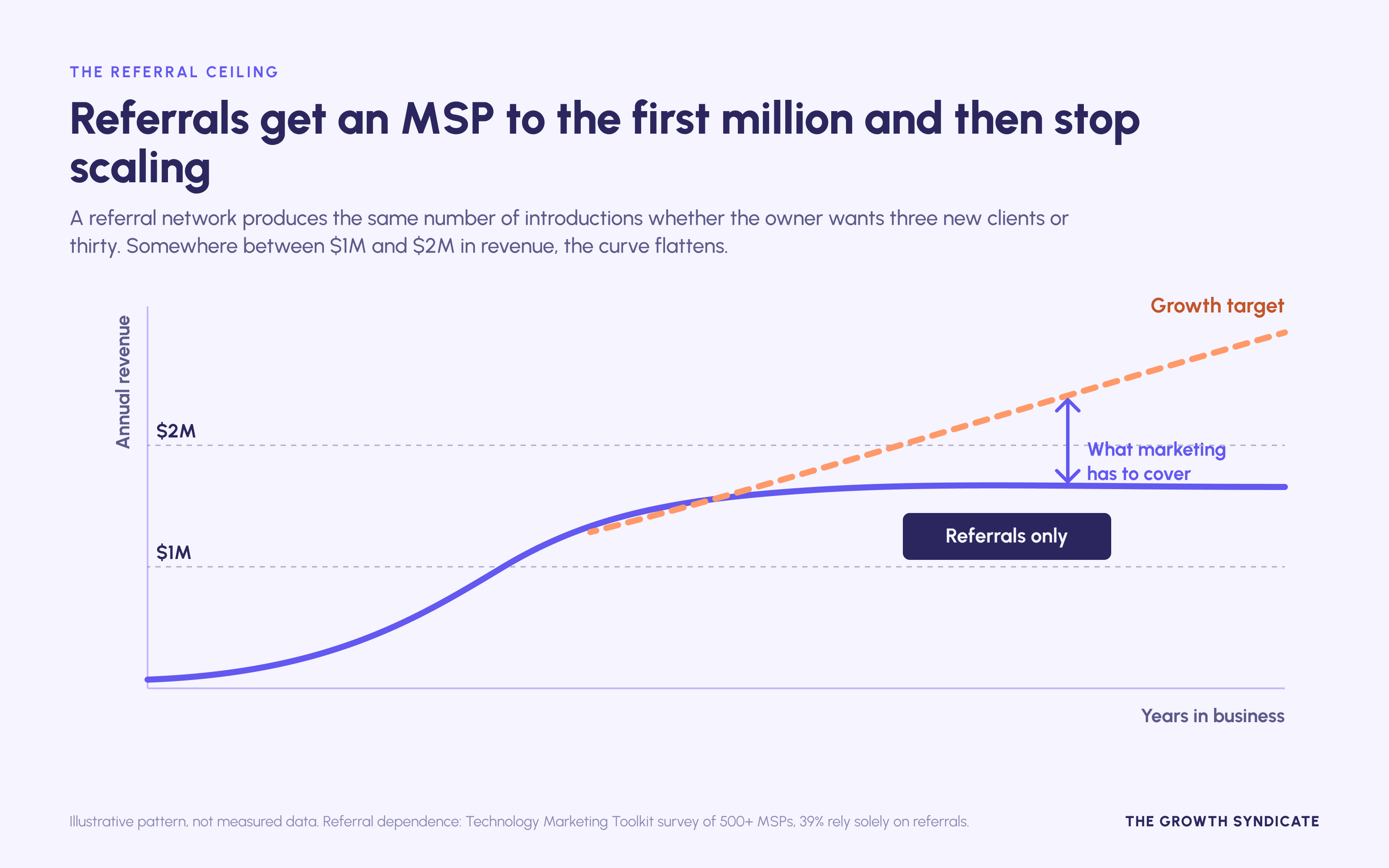
The fix is not to abandon them. It is to run the referral motion as a program: ask every satisfied client at a defined moment (after the first quarterly business review is a good one), keep a named list of complementary partners, and give each partner a reason to think of you that is more specific than "they do IT." Then build the lead generation channels that reach the decision makers nobody is going to introduce you to.
How should an MSP position itself to escape price competition?
An MSP escapes price competition by narrowing who it serves and doing the positioning and messaging work that makes the choice legible to a buyer. Generalist "IT support for small businesses" is compared on per-user price because that is the only visible difference between service providers. A managed service provider that owns a vertical, leads with compliance and security outcomes, and prices on results gives the buyer a unique value proposition: a reason to pay more and a reason to stop shopping.
Vertical specialization is the highest-return positioning move
Most MSP marketing strategies fail before a single channel is chosen, at the point where the owner declines to narrow. The evidence on niching is unusually consistent for the MSP industry. ChannelE2E's Top 100 Vertical Market MSPs grew collective revenue 11% in the 2024 edition, led by healthcare (28% of the list), financial services (18%), and manufacturing (11%), with healthcare specialists growing by nearly a third. The editors who compile the list report the same pattern year after year: MSPs with a vertical focus post higher revenue and better margins than generalists. Vendor studies put the margin premium anywhere between 10% and 30%, and none of them publish a method, so treat the direction as reliable and the exact number as marketing.
The mechanism is simple. A dental practice with four locations does not want an IT services vendor. It wants someone who already knows its practice-management software, its HIPAA exposure, and the way its front desk handles imaging files. When the sales pitch opens with those specifics, the conversation moves from "how much per user" to "when can you start." Specialization also compounds operationally: the same onboarding checklist, the same stack, the same objections, the same case study told twelve times. The pattern holds outside IT, too; the manufacturers interviewed for our manufacturing marketing report described the same buyer, one who trusts the specialist who speaks the language of the shop floor.
The trade-off is real and worth saying plainly. Niching shrinks the addressable market and concentrates risk in one sector's economy. Most MSPs handle this by choosing two adjacent verticals with shared compliance drivers (legal and accounting, or healthcare and dental) rather than one, and by keeping a non-vertical service line for the existing clients who do not fit.
Compliance and cyber insurance do the demand generation for you
Regulation has become the most reliable trigger for an MSP conversation. In the US, CMMC requirements for defense suppliers, HIPAA for anyone touching health data, SOC 2 for vendors selling to larger companies, and, above all, cyber-insurance renewals that now demand MFA, EDR, tested backups, and documented incident response. In the EU, NIS2 (transposed into national law from October 2024) and DORA (applied since January 17, 2025) impose obligations directly on MSPs and on their clients.
Each of these creates a dated moment when a business owner has to find a managed service provider who can produce evidence. It is also the clearest example of marketing campaigns built around a pain point rather than a service list: the buyer's problem has a deadline, and the campaign is the calendar. An MSP positioned around that moment, with a plain-language explainer, a readiness assessment, and a named person who has taken other firms through it, is not competing with the generalist across town. It is the only option the buyer found.
Move the offer from "IT support" to outcomes
The third positioning lever is the list of services offered, and the pricing and packaging behind it. Per-user and per-device pricing invites the buyer to compare line items. Outcome-framed packages, services designed around uptime and response commitments, compliance readiness, and a quarterly technology roadmap delivered by someone acting as a virtual CIO, invite the buyer to compare risk. The delivery may be identical. The purchase decision is not.
This is also where the AI opportunity sits. Forty-eight percent of MSPs say AI and automation is now their clients' top need, and most of them have nothing on the price list to sell against it. A defined AI service (copilot rollout and governance, data-readiness assessments, automated document workflows for a specific vertical) is a new line item th
A market positioning strategy that survives contact with a sales call is usually the combination of two of these routes, not one. Vertical plus compliance is the most common winning pair in managed services.
What does an effective MSP marketing strategy look like?
An effective MSP marketing strategy does four jobs in order: define a target audience narrow enough to be the obvious choice for, build presence in that target market before buyers are shopping, capture the buyers who are shopping now, and convert leads with proof. Most MSP marketing plans skip the first two and wonder why the last two underperform, which is the same failure that separates a B2B marketing strategy from a channel list with a budget attached.
Start with the buyer. B2B purchases are group decisions even in small companies. Forrester's 2025 Buyers' Journey Survey found 73% of purchases involve three or more departments, and that buyers consult an average of 13 people inside their own organization and nine outside it. Scale that down to a 40-person firm and the pattern still holds in miniature: the owner who signs, the office manager who lives with the ticket queue, the finance lead who reads the invoice, and the peer at another company whose opinion the owner trusts more than any vendor. Marketing for MSPs has to reach all of these decision makers, and the outside voice is usually the one that decides. The buying process is also longer than most owners expect: IT services are high-trust and high-stakes, switching is painful, and longer sales cycles are the norm rather than the exception.
The second finding matters more. Sixty-eight percent of B2B buyers already have a front-runner in mind at the very start of a purchase, and the front-runner usually wins; 6sense's 2025 Buyer Experience Report puts the pre-contact favorite's win rate at around 80%. For a managed service provider, the sales process largely finishes before the first call, which is why effective MSP marketing front-loads trust. The marketing job is to be the front-runner, which means being known in the target market for months before the incumbent contract runs out.

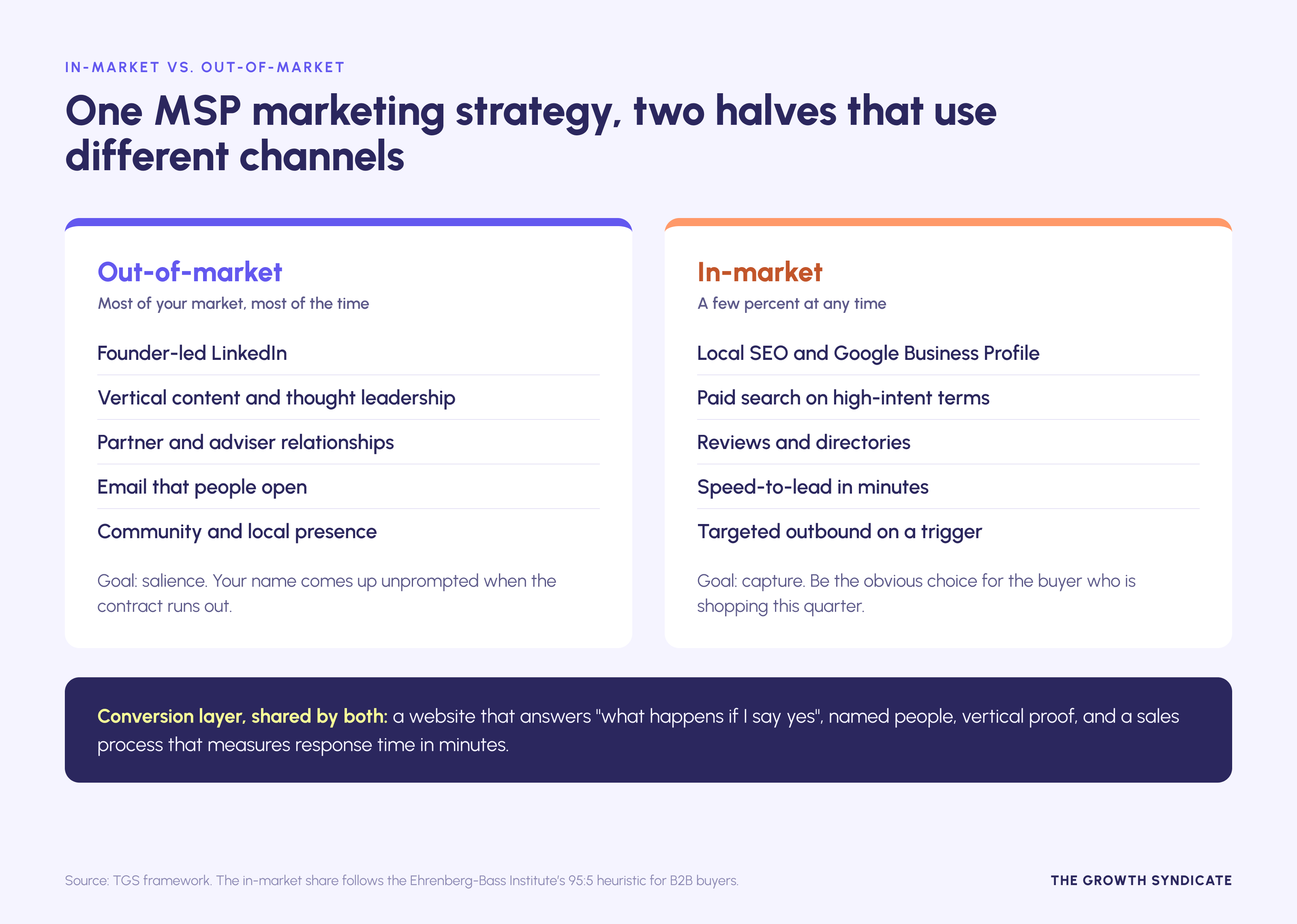
That distinction, in-market versus out-of-market, is the spine of any MSP marketing strategy, digital marketing strategy included. A small share of your target market is actively looking for a provider this quarter: their contract is up, their current MSP botched a migration, an insurer sent a letter. Those buyers search "managed IT services [city]," read reviews, and ask their network. Everyone else is not looking, but will be, and will remember whoever was useful when they were not.
The marketing strategies, then, split into two halves that use different marketing channels:
- Out-of-market (most of your target audience, most of the time): founder-led LinkedIn, vertical content marketing, partner relationships, community presence, inbound marketing that earns attention, and email marketing that people actually open. The measure is whether your name comes up unprompted.
- In-market (a few percent at any time): local search engine optimization and Google Business Profile, paid search on high-intent terms, review sites, a website that answers "what happens if I say yes," and a speed-to-lead process that turns website traffic into qualified leads in minutes rather than days.
Define the ideal client profile before either half; it is the first decision in any go-to-market plan and the one most MSPs skip. Company size (usually 20 to 250 seats for an independent MSP), verticals, geography, the technology they run, the compliance regimes they answer to, and, if you can get at it, the pain points that make them switch (a failed restore, an insurer's letter, a departing internal IT person). An ICP written as "SMBs in the region" is not a profile; it is a refusal to choose. Every part of the marketing program downstream, from the sales pitch to the blog content, inherits this decision.
Which marketing channels actually generate MSP leads?
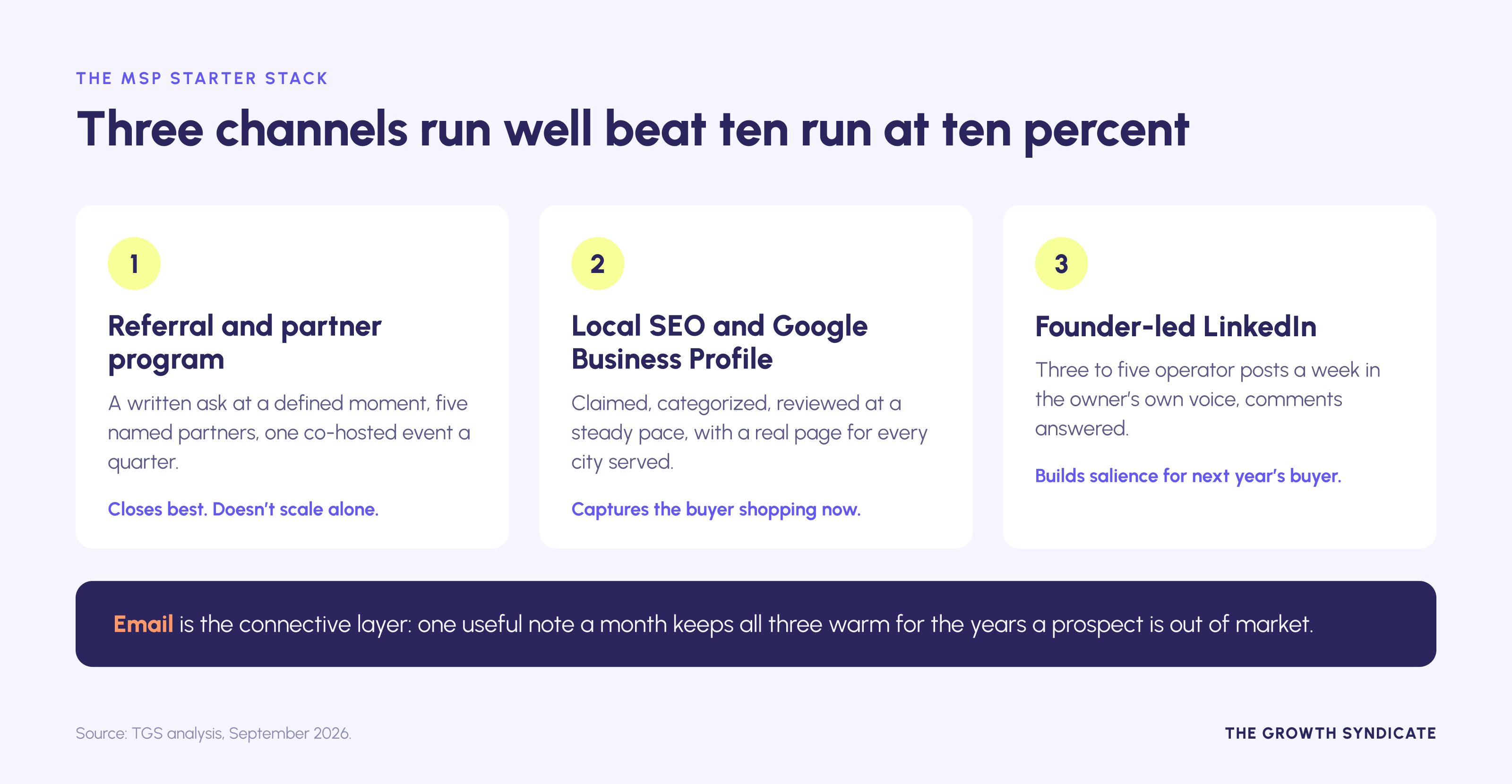
The marketing channels that generate qualified leads for MSPs are local SEO, a systematic referral and partner program, founder-led LinkedIn, and vertical content. Paid search works when the economics are modeled against client lifetime value rather than lead count. Cold outbound and direct mail campaigns still work, at declining rates. Most MSPs need three marketing channels run well, not ten run at 10%.
Local SEO and Google Business Profile
For an MSP that sells within a metro area, local search engine optimization is the highest-intent organic channel available. "Managed IT services Denver," "IT support near me," and "cybersecurity company [city]" are typed by people who have already decided to buy something. The local pack and the top organic results take most of that traffic; positions below the fold on page one see a fraction of it.
What a strong online presence means for a local IT services company, in practice: a Google Business Profile that is claimed, categorized correctly, filled with services, photographed, and reviewed at a steady pace; location pages on the site for every city you serve (real pages with local proof, not one template with the city name swapped); consistent name, address, and phone across directories; and service pages built around the terms buyers use rather than the ones vendors use. Link building matters less for local terms than for national ones, but a handful of links from local business associations, partner sites, and chambers of commerce moves the needle in smaller markets, and it is the cheapest link building an MSP will ever do.
MSP SEO is a large enough discipline to deserve its own guide; the basics of a B2B SEO strategy apply, with local intent and search engine features like the local pack layered on top.
Content marketing and thought leadership
MSP content marketing has a bad reputation because most of it is vendor content with a logo swapped: "5 signs you need managed services," published as blog content nobody links to. Custom content that works for an MSP does one of three things: it answers the specific questions its vertical asks (what does a HIPAA risk assessment involve, what will the insurer ask for at renewal, how do you migrate a practice-management system without losing a day of billing), it demonstrates expertise in the owner's own words (demonstrating expertise is the whole point of content creation for a trust business), or it gives potential clients something they can use before they buy (a checklist, a readiness scorecard, a plain-language explainer for their board).
Publish less and make it count; a B2B content marketing agency that proposes a hundred posts a year for an MSP has not understood the buyer. Ten pieces that a prospect in your vertical would forward to a colleague beat a hundred blog posts written for a keyword tool, and they do more for online visibility than any volume of thin content creation. The same content marketing rules that apply to any B2B content marketing program apply here, with one MSP-specific addition: in 2026, MSP content marketing is also how you get cited by AI assistants, which is covered later in this guide.
Founder-led LinkedIn
For a company whose product is trust, the owner's LinkedIn is the most under-used asset in MSP marketing. The buyer is a business owner or operator. They are on LinkedIn. They will hire the person who explained, in plain terms, why their last IT vendor's backup "worked" until the day it needed to restore.
The format that works is operator content: what you saw this week, what went wrong, what you would tell a peer. It reads as expertise because it is, and it gives the buyer a deep understanding of how you think before they have spoken to you. Three to five posts a week from the founder, written in their voice, with comments answered, outperforms any volume of company-page posts. Pair the content with deliberate engagement: connect with the people you would want as clients, comment on what they post, and let the content do the introduction. Social media marketing for MSPs is this, mostly; the rest of social media (a company page, the occasional Facebook post for local visibility) is where you repurpose it.
Company pages have a role. They validate the founder, host the case studies, and give employees something to share. They do not generate demand on their own.
Paid search and paid social
Google Ads for managed services is expensive and it works as a lead generation channel, in that order. WordStream's 2025 benchmarks, drawn from more than 16,000 campaigns, put the average Google Ads cost per click at $5.26, up almost 13% in a year, with business services at $5.58 and a cost per lead above $100 (our B2B marketing benchmarks guide sets those figures against the rest of the funnel); IT services terms in competitive metros run above that, and 87% of industries saw click costs rise. The channel is viable only if you model it against client value: a 50-seat client at $100 per user per month with a 40% gross margin is worth roughly $24,000 in contribution over two years and $60,000 over five. Against that, a cost per closed client in the low thousands is fine. Against a lead count target, the same spend looks like throwing money at a wall. Judge the channel on quality leads that close, and it earns its place.
Within a digital marketing strategy for an MSP, paid social on LinkedIn is better suited to out-of-market work (putting the founder's content and a vertical asset in front of a named list) than to lead capture. Meta ads occasionally work for local retargeting and very small businesses; they rarely produce the 50-seat client.
Digital advertising should be the last channel an MSP turns on, after positioning, the website, and local SEO are in place, and a B2B paid media program worth paying for will say so before it takes the budget, because paid advertising amplifies whatever the site already does. If the site does not convert, Google Ads make that failure faster and more expensive.
Email nurture
Email marketing is the owned channel that escapes algorithms. A monthly note from the founder to every contact who has ever asked a question, with one useful thing in it (the insurance renewal checklist, the new phishing pattern hitting law firms, the CMMC deadline), keeps the MSP in the room during the months and years the prospect is out of market. Email marketing campaigns built for a segment beat newsletters sent to everyone; the vertical list gets the vertical content.
Lead nurturing sequences after a download or assessment request should be short, specific, and human: what the assessment covers, what to expect, one relevant case study, a calendar link. They nurture leads by being useful, not frequent. Marketing automation earns its keep here, in timing and segmentation, not in volume; it does not generate qualified leads on its own.
Partner networks
The referral program from earlier in this guide belongs on the lead generation channel list because it is one, and because most MSPs under-manage it. The highest-value partners for an MSP are the advisers a business owner already trusts: accountants, business lawyers, insurance brokers (especially cyber-insurance brokers, who now have a regulatory reason to want a competent MSP on speed dial), commercial real estate agents, and vendors that serve the same vertical (the practice-management software's local account rep, the manufacturing ERP consultancy).
Run it as a marketing program: a named list, a reason to refer that is specific to each partner, a shared piece of content, a quarterly touch, and a thank-you that is more than a gift card. Co-hosted events (a lunch-and-learn on cyber insurance with the broker, a compliance briefing with the law firm) generate more introductions in a morning than a year of "let me know if you hear of anyone." Done consistently, a partner program produces a steady flow of warm introductions that no other channel matches on close rate.
Reviews, directories, and proof
Reviews close deals the buyer has already half-decided. A Google Business Profile with 60 recent, specific reviews outperforms one with eight generic ones, and the specificity matters more than the count: "they migrated our 3 clinics to the cloud over a weekend with no downtime" is a case study in a sentence. Ask current clients at the moment of relief, after a successful project or a fast resolution. Clutch and G2 matter for MSPs that sell to larger companies; for local SMB buyers, Google is the review site.
Case studies and video testimonials are the same asset for a different stage. Two or three strong ones per vertical, on the site and in the sales process, are worth more than twenty thin ones.
Events and lunch-and-learns
In-person still works for a business that sells trust locally. Small formats beat large ones: a breakfast briefing for 15 practice managers on what their insurer will ask this year does more than a booth at a regional expo. Vendor events (IT Nation, Kaseya Connect, Channel Partners, Canalys and Omdia forums in Europe) are for learning and partnerships, not for finding clients.
Cold outbound
Cold calling, cold email, and direct mail campaigns built many MSPs and still bring in deals, but the close rates are low, the buyer's tolerance is lower, and the effort competes with everything above for the owner's time. Outsourced lead generation and appointment setting for MSPs tends to deliver meetings that look like leads and behave like cold calls. Used at all, outbound should be targeted (a named list in one vertical, one trigger, one offer) and paired with the out-of-market work so the recipient has heard of you.
Account-based marketing, for the few MSPs it fits
Account based marketing is a fit for MSPs selling into 100-seat-plus companies with multi-stakeholder decisions and $10,000-plus monthly contracts. There, a named-account program (personalized strategies per account, executive content, coordinated outreach) pays for itself with a handful of wins. Below that, the same discipline applied loosely, a short list of dream accounts the founder pursues deliberately, is enough. The account-based marketing guide covers when ABM is and is not worth the overhead.
The table below puts the channels side by side on the questions an owner actually asks: how fast, how expensive, and what breaks.
Read the time-to-result column twice. Most MSP marketing gets cancelled in month four of a channel that needs nine, which is the single most expensive habit in the industry.
How much should an MSP spend on marketing?
An MSP in growth mode should expect to spend somewhere between 5% and 10% of revenue on marketing, including the owner's time, with the lower end for a firm growing mostly on referrals and the upper end for one building new channels. Set the budget from a payback calculation on client lifetime value, not from a percentage alone.
Cross-industry benchmarks give a floor. Gartner's CMO Spend Survey put average marketing budgets at 7.7% of company revenue in 2025 and 7.8% in 2026, and its panel skews to companies above $1 billion in revenue; smaller companies consistently spend a higher share, and the Deloitte/Duke CMO Survey, with a broader panel, reports 9.4%. Most independent MSPs spend well below either figure and rely on the founder's time as the unbudgeted line item, which is one reason the referral ceiling arrives so predictably: when the owner's time runs out, so does the marketing.
A better way to size the budget is to work backward from what a client is worth and how long you keep them. Take the example from the paid search section: a 50-seat client at $100 per user per month produces $5,000 in monthly recurring revenue and, at a 40% gross margin, $2,000 a month in contribution. Kept for five years, that client is worth $120,000 in margin. Spending three to four months of MRR, $15,000 to $20,000, to acquire that client is a comfortable payback. Spending that on a $1,000-a-month client is not. Sustainable growth for an MSP comes from that arithmetic, not from a percentage copied from a benchmark. The budget follows the ICP; an MSP that has decided to pursue larger, stickier clients can afford to spend.
Two budget lines are routinely missed. The first is vendor co-marketing money. Microsoft, Kaseya, ConnectWise, N-able, Pax8, and the distributors all run market development funds, partner marketing programs, and bundled marketing services, often as 50:50 cost-shares, and partner marketing teams report that a large share goes unclaimed because smaller partners lack the capacity to build a compliant proposal. MDF is free money for campaigns you were going to run anyway; it is not a strategy, and the co-branded content it produces rarely differentiates. Claim it, and use it to fund the vertical content and events you designed yourself.
The second is measurement. Marketing attribution for a business with a nine-month sales cycle and a referral-heavy funnel is imperfect by nature, and pretending otherwise leads to cutting the channels that create demand in favor of the ones that capture it. The marketing attribution approach that works for MSPs combines a CRM source field that sales actually fills in, a "how did you hear about us" question on every form, and a quarterly honest review of where closed deals started.
How do you build an MSP marketing plan by revenue stage?
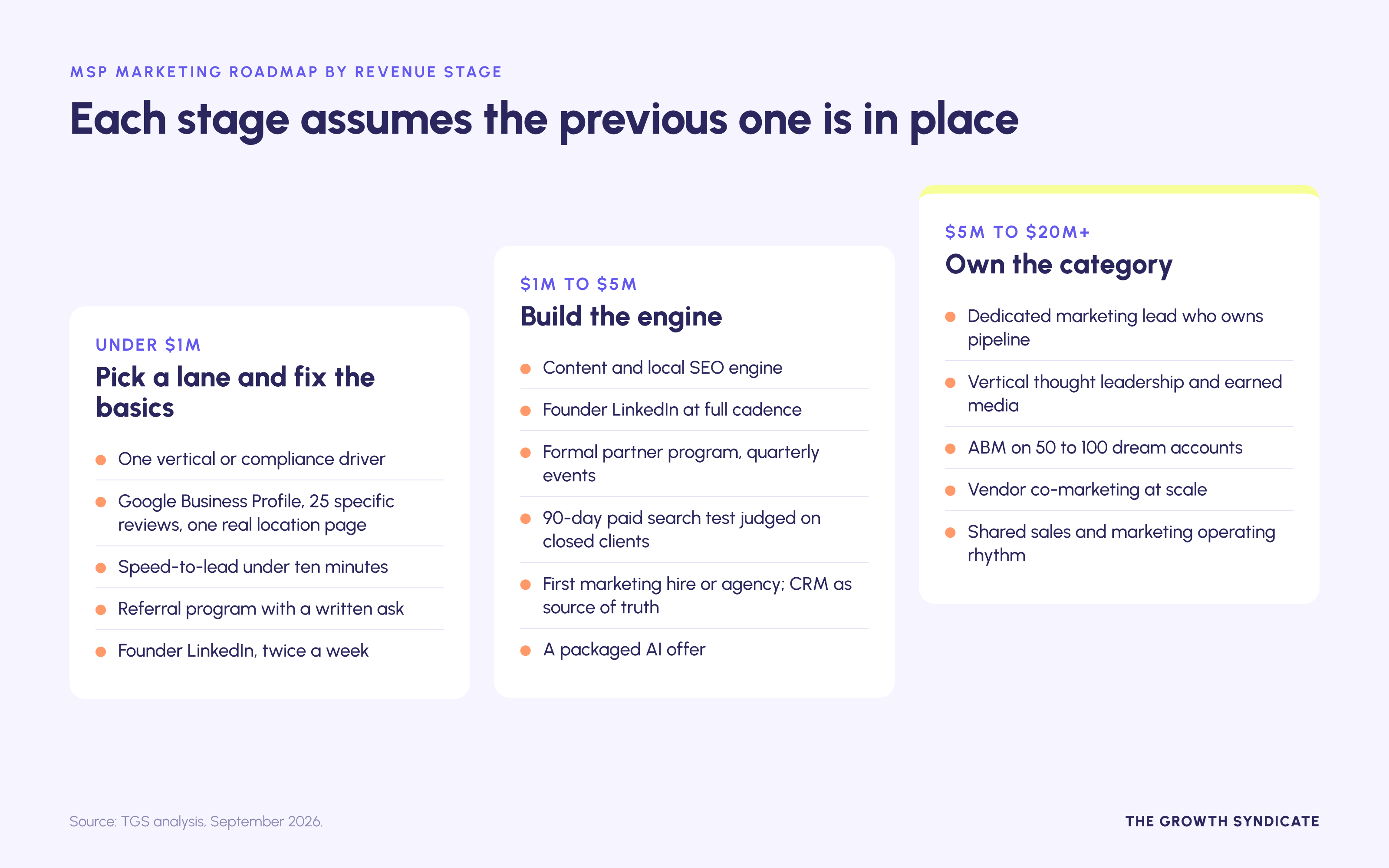
An MSP marketing plan should match the firm's stage, because a $700,000 provider and a $7 million provider have different constraints, different buyers, and different owners. The marketing strategies below form a sequence, not a menu: each stage assumes the previous one is in place.
Under $1 million: pick a lane and fix the basics
At this stage of an MSP business, the owner is the marketing department, and the plan has to fit in a few hours a week.
- Choose one vertical or one compliance driver and rewrite the homepage, the services page, and the Google Business Profile around it. Generalist positioning at this size is a decision to compete on price.
- Fix the in-market layer. Claim and complete the Google Business Profile, get to 25 specific reviews, build one real location page, and make sure a form submission reaches a human within ten minutes during business hours.
- Systematize referrals. A written ask, a moment to ask it, and a list of five partners the owner talks to every quarter.
- Start the founder's LinkedIn at two posts a week, in the owner's own voice.
Skip paid advertising, skip the podcast, skip the newsletter until there is a list. The goal is to become the obvious choice for one kind of business in one place.
$1 million to $5 million: build the engine
The referral ceiling arrives in this band. The plan is to add lead generation channels that reach buyers no one is going to introduce.
- Content marketing and local SEO engine. Vertical-specific service pages, a content program of one substantial piece a month aimed at the questions your vertical asks, location pages for every metro served, and a review cadence tied to the ticket system.
- Founder-led LinkedIn at full cadence (three to five posts a week), plus a company page that carries the case studies.
- Formal partner program with three to five complementary advisers, a co-hosted event per quarter, and a shared piece of content.
- A paid search test in Google Ads on the five highest-intent local terms, run for 90 days against a cost-per-closed-client target, not a cost-per-lead target.
- A first marketing hire or an MSP marketing agency. Either way, the owner stays the face and the marketing function runs the system. This is also where the CRM has to become the source of truth; a RevOps and CRM setup that sales actually uses is the difference between knowing what works and guessing.
- Package an AI offer. Whatever the vertical asks for first (copilot governance, document automation), productize it and put it on the site. Half the industry says clients are asking for it and 13% are selling it.
$5 million to $20 million and beyond: own the category
By this stage the MSP is competing with platform-backed providers and the plan is about authority.
- A dedicated marketing lead who owns pipeline, not just content.
- Vertical thought leadership and earned media: original research, speaking at the MSP industry's own events and the vertical's, trade-press contributions, and podcast appearances. This is also what gets an MSP cited by AI assistants, which increasingly shape the shortlist.
- Account-based marketing on a named list of 50 to 100 dream accounts, with executive content and coordinated outreach.
- Vendor co-marketing at scale, using MDF to fund the vertical programs designed in-house.
- A sales and marketing operating rhythm with shared definitions of a qualified lead, a weekly pipeline review, and attribution that both teams believe. Sales and marketing alignment is where most MSPs of this size leak revenue, because the sales team was built on referrals and the marketing team was built on leads and neither trusts the other's numbers.
How does MSP marketing differ between the US and Europe?
MSP marketing in the US is driven by cyber insurance, vertical compliance frameworks, and a mature local-search market; in Europe it is driven by regulation that names MSPs directly, buyers who research longer and trust vendors less, and language markets that fragment every channel. The marketing strategies are the same. The triggers, the proof, and the calendar differ.
Regulation is the European advantage. NIS2 lists managed service providers and managed security service providers in its Annex I of high-criticality sectors, which brings any MSP with 50 or more employees or €10 million in turnover into scope as a regulated entity in its own right, and it obliges thousands of their mid-sized clients to demonstrate supply-chain security. DORA does the same for financial entities and their ICT providers. An MSP in the Netherlands, Germany, or the Nordics has a compliance conversation to start with almost every prospect in scope, and the proof it needs is documentation, not marketing copy. GDPR, meanwhile, shapes outbound: cold email to individuals is legally narrower than in the US, which pushes European MSP marketing further toward inbound, partner, and event channels.
The buyer is more skeptical and the cycle is longer. European SMB owners tend to research more, take fewer vendor calls, and weight peer references more heavily. Founder-led content and partner introductions carry proportionally more of the load, and paid search proportionally less.
Language fragments everything. A Benelux MSP serving Dutch, French, and English-speaking clients needs localized service pages, localized reviews, and localized content, and the search volumes in each language are a fraction of the US figures. That makes ranking easier and scaling harder; the winners tend to dominate a single language market before expanding into the next one.
Events and communities differ. The US calendar runs through IT Nation, Kaseya Connect, Channel Partners, and the MSP Summit. In Europe, Canalys and Omdia forums, national IT associations, and the UK MSP community (which is unusually well-organized, with its own peer groups and coaches) matter more. In both regions, the events that produce clients are the small local ones you host, not the large ones you attend.
The US has denser competition and a bigger PE presence. With tens of thousands of providers and the majority of 2025's platform acquisitions, US metros are the most crowded MSP markets in the world. Differentiation is not optional there. In most European cities, a well-positioned vertical specialist still faces a handful of credible service providers rather than dozens.
How is AI changing MSP marketing?
AI is changing MSP marketing in three directions at once: it is a new service to sell, it is compressing the margin on the services MSPs used to sell first, and it is changing how buyers research providers. The MSPs that come out ahead will market the first, reprice around the second, and restructure their content marketing for the third.
AI as the offer. The demand is documented on both sides of the table. In our own State of AI in B2B Marketing survey of 110 marketing leaders, 63% named more noise and less differentiation as the biggest risk of AI, which is exactly the fear an MSP can sell against with a governed rollout. On the MSP side 48% of MSPs say AI and automation is their clients' top need, ahead of security. The supply is not: 13% report meaningful AI revenue. A packaged, vertical-specific AI service (governance and rollout of copilots, data readiness, automated intake or documentation workflows) is the rare case of a marketing message the buyer wrote for you.
AI as the threat. The managed services that filled the first page of every MSP proposal, tier-1 ticket triage, password resets, and routine monitoring, are being automated by the same RMM and PSA vendors that MSPs pay every month. The revenue does not vanish, but the labor margin does, which pushes the value of the MSP toward the things software cannot do: judgment, accountability, the relationship, the roadmap. Marketing has to say that out loud. An MSP still positioning on "24/7 helpdesk" is advertising the part of its business that is getting cheaper.
AI as the research tool. Buyers now ask ChatGPT, Perplexity, and Google's AI Overviews for shortlists. Forrester's State of Business Buying, 2026 describes generative AI searches as the starting point of the B2B buying process, and finds that buyers, wary of incomplete answers, then validate what the assistant told them with trusted people and sources. For the MSP marketing queries this guide targets, AI Overviews already appear on most long-tail searches, and the sources they cite are often Reddit threads, YouTube videos, and vendor glossary pages rather than MSP websites. The implication for an MSP's own marketing: the content that gets cited is structured (a direct answer under a question heading, a table, a stat with a source), specific to a vertical or a city, and corroborated elsewhere (reviews, directories, partner mentions, press). That is generative engine optimization in practice, and it is mostly good content marketing with clearer structure. Websites do not become obsolete in this world; they become the place the buyer goes to validate what the assistant told them, which raises the bar for what the site has to prove. The same pragmatic AI discipline applies inside the MSP's own marketing: automate the repeatable, keep judgment and voice human.
For an MSP, the practical version is: answer the vertical's questions plainly on the site, keep the Google Business Profile and directory listings consistent, get named in the places assistants read (local press, association pages, partner sites), and make sure the founder's public content says the same thing the website does. A B2B SEO agency that treats AI citation as part of search rather than a separate discipline will get there faster than one selling "GEO" as a new line item.
Which tools does an MSP marketing stack need?
An MSP marketing stack needs a CRM the sales process lives in, an email platform, a way to manage reviews and local listings, SEO and analytics tooling, and a place to plan and repurpose LinkedIn content. Most MSPs under $5 million can run their entire digital marketing operation on five tools. Tool choice matters less than whether the CRM source field is filled in.
Vendor "marketing-in-a-box" portals belong in this list with a caveat. Every major RMM, PSA, and distribution partner offers co-branded marketing campaigns, templated emails, digital advertising creative, and social posts. They are useful for volume and worthless for differentiation, because every MSP in your city has access to the same ones. Use them for the background hum, and put your own words on everything that is supposed to make a buyer choose you.
What are the most common MSP marketing mistakes?
The most common MSP marketing mistakes are relying on referrals alone, marketing to everyone, running random tactics with no system behind them, under-investing until growth stalls, and measuring activity instead of pipeline. Each has a straightforward fix. Most MSPs make at least three at once.
- Referral dependence. Covered above. The fix is a referral program plus channels that reach strangers.
- No niche. "IT support for businesses of all sizes" is a price list, not a position. Choose a target market.
- Random acts of marketing. A webinar in March, a mailer in June, a LinkedIn burst in September: MSP marketing campaigns each run once, nothing measured, nothing learned. The fix is a strategic approach with three channels and a quarterly review.
- Vendor content with your logo on it. Buyers can tell. Write your own, about your vertical's pain points, in your voice.
- A website that describes services and hides everything else. No pricing signals, no named people, no case studies, no answer to what happens after the contract is signed. Buyers want to know exactly what tomorrow looks like if they say yes; a site that leaves them guessing loses to one that shows the team, the onboarding calendar, and the first ninety days, which is the brief for any B2B website built to sell a service rather than describe it.
- Slow response to inbound. A form that gets answered the next morning is a lead handed to the competitor who answered in four minutes, and an MSP without a shared definition of a qualified lead will keep answering the wrong ones first.
- Never asking for the sale, or the review, or the referral. MSP owners are engineers by temperament and hate asking. Build the ask into the process so nobody has to improvise it.
- Measuring the wrong thing. Impressions, followers, and website traffic are inputs. Pipeline created, cost per closed client, and win rate are outcomes. A busy marketing function with no pipeline is a diagnosis, not a success.
- Under-investing, then quitting early. Local SEO takes six to nine months; content takes a year; LinkedIn takes a hundred posts. The MSP that funds a channel for a quarter and cancels it has paid for the expensive part and skipped the return.
- Positioning on the part of the business that is getting automated. Leading with helpdesk response times in 2026 advertises exactly the service AI is making cheaper.
.avif)
"High activity without pipeline impact is the signature of a reactive, scattered marketing function. The diagnosis is to link every activity to the buyer journey and the pipeline, then realign the ICP, the positioning, the channels, and the journeys around what actually moves deals."
Should an MSP hire a marketing agency or build in-house?
Build marketing in-house when a founder will be the face and revenue can fund one competent generalist. Hire an MSP marketing agency when the engine has to be built faster than one hire can build it, or when the owner's time is the binding constraint. Either way, strategy stays in-house: agencies execute channels; they do not decide who you are for.
The MSP marketing agency market is crowded and uneven, and the questions for choosing a B2B marketing agency apply with one extra filter: has this firm ever sold to a business owner who buys IT? It includes specialist firms that have worked only in the MSP space for a decade, full service marketing agency generalists who add "MSP" to a landing page, appointment-setting shops that call themselves marketing services, and coaching programs that sell peer groups and templates. Prices for MSP marketing services range from a few hundred dollars a month for templated content to five figures for the retained team of a full service marketing agency. Questions that separate a good MSP marketing agency from the rest: which of their MSP clients grew, by how much, over what period; who will actually do the work and how senior are they; what happens to your content and data if you leave; and whether they will tell you when a channel is not working for you.
The in-house route is cheaper per hour and slower to compound. A single marketing hire at a $2 million MSP will spend the first six months on the website, the Google Business Profile, and the CRM before any channel is running properly. That is fine if the owner is patient and the referral flow holds. It is expensive if the referral ceiling has already arrived.
The hybrid most MSPs land on: an internal owner of marketing (often the founder plus a coordinator), digital marketing services bought for the specialized channels (local SEO, paid search, design), and the founder's voice kept entirely in-house. Whatever the model, the marketing agency or hire should be able to explain, in a sentence, which three channels the MSP is building, why, and how the marketing efforts will be measured.
Frequently asked questions
What does MSP stand for in marketing?
In the context of this guide, MSP stands for managed service provider: a company that manages a client's IT, security, or cloud environment for a recurring fee. "MSP marketing" is marketing done by those providers to win clients. The acronym also appears in healthcare and Medicare administration with unrelated meanings.
How do MSPs get clients?
Most MSPs get clients through referrals from existing clients and trusted advisers such as accountants, lawyers, and insurance brokers. As they grow, the successful ones add local search, founder-led LinkedIn, vertical content, partner programs, and, selectively, paid search, so that lead generation no longer depends on the existing network and new clients arrive from outside it.
What is the best marketing channel for an MSP?
For an independent MSP under $5 million, the best combination is a systematic referral and partner program, local SEO with a maintained Google Business Profile, and the founder's LinkedIn. Together they cover warm introductions, active local buyers, and the out-of-market buyers who will be shopping next year.
How much should an MSP spend on marketing?
Between 5% and 10% of revenue is a reasonable range for an MSP in growth mode, including the founder's time. The better method is to set a cost-per-closed-client target from client lifetime value: three to four months of a client's MRR is a comfortable acquisition cost for a client you expect to keep five years.
Do referrals still work for MSPs in 2026?
Yes, and they still close at the highest rate of any source. They stop being sufficient, rather than stop working, somewhere between $1 million and $2 million in revenue, when the network produces fewer introductions than the growth plan needs.
What are the most effective MSP marketing strategies?
The most effective MSP marketing strategies combine a narrow position (vertical or compliance-led) with three channels run consistently: a referral and partner program, local SEO, and founder-led LinkedIn, plus email marketing to stay present with out-of-market buyers. Effective MSP marketing is less about which tactics you pick and more about doing few of them well for long enough.
Should an MSP hire an MSP marketing agency?
It depends on whether the owner's time or the missing skills are the constraint. An MSP marketing agency makes sense when the engine has to be built faster than one hire can build it; in-house makes sense when the founder will be the face and can fund one competent generalist. Either way, keep positioning and strategy in-house and buy marketing services only for the specialized channels.
Should an MSP specialize in a vertical?
Almost always. Vertical MSPs report higher margins and pricing premiums, close faster because they speak the buyer's language, and operate more efficiently. The risk is sector concentration, which most specialists manage by choosing two adjacent verticals with shared compliance drivers.
Does cold calling still work for MSPs?
It works at low rates and high cost to the brand. It is most effective when tightly targeted, one vertical, one trigger such as an insurance renewal or a regulatory deadline, and paired with enough out-of-market presence that the prospect has heard the MSP's name before the call.
How long does MSP marketing take to work?
Referral programs and paid search produce results within weeks. Local SEO takes three to nine months, founder-led LinkedIn three to six, and vertical content six to twelve. An MSP that funds a channel for less than two quarters rarely sees the return.
Should an MSP use vendor MDF and co-marketing?
Yes, to fund campaigns designed in-house. Market development funds from Microsoft, Kaseya, ConnectWise, N-able, Pax8, and the distributors are widely unclaimed and typically match 50:50. The co-branded templates that come with them do not differentiate, so use the money, not the message.
How is AI affecting MSP marketing?
In three ways: clients want AI services and few MSPs sell them; AI is compressing the margin on tier-1 support, which changes what an MSP should lead with; and buyers use AI assistants to research providers, which rewards structured, specific, corroborated content that gets cited.