.svg)


Search for a B2B marketing strategy and you will find lists. SEO, email, LinkedIn, events, content, ABM, webinars, each with a paragraph explaining what it is and why it matters. Those lists describe what B2B marketers do. They do not tell you what to fund, what to cut, or how to justify either decision to a CFO who wants to know why last quarter's spend did not close last quarter's deals.
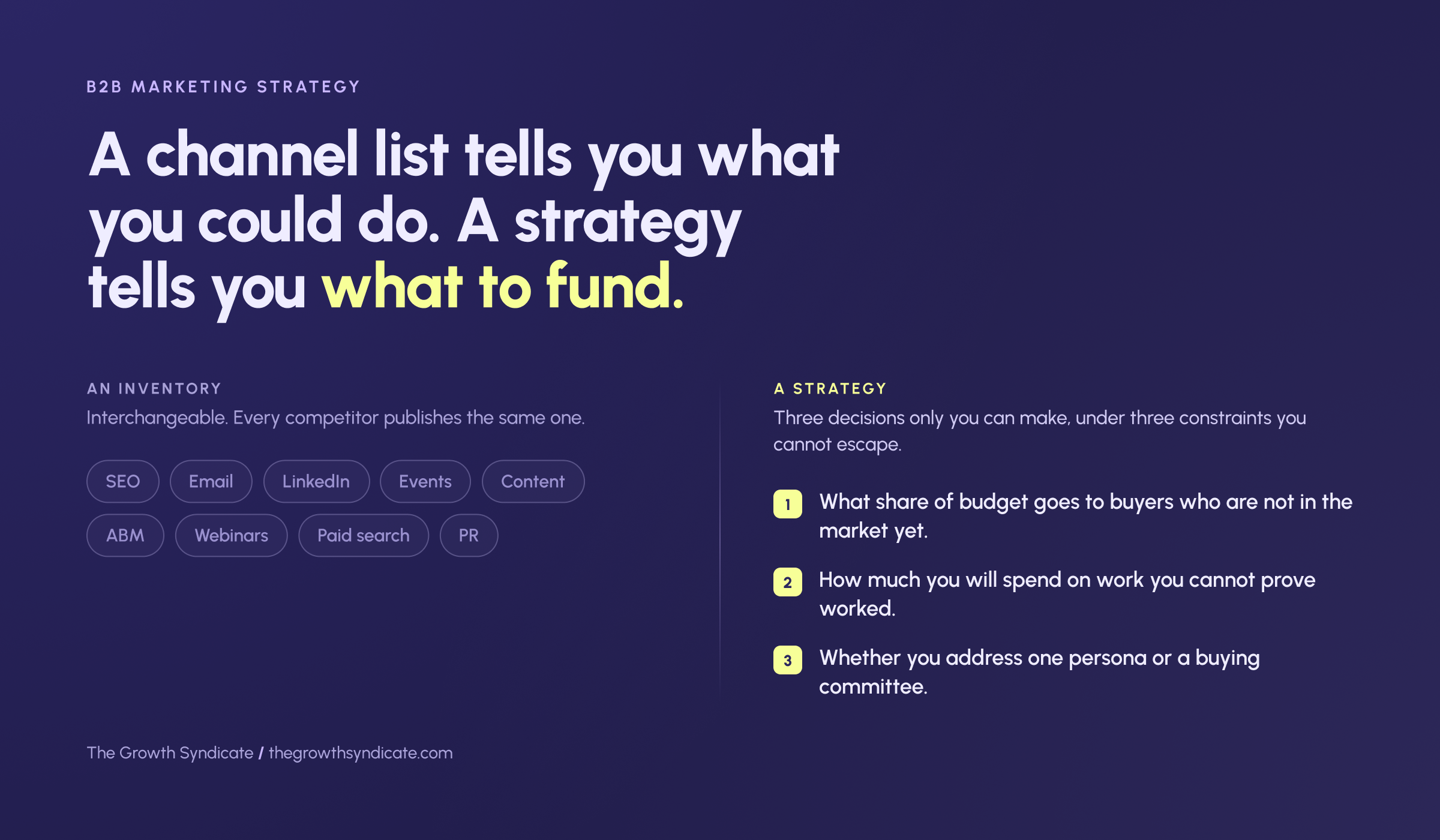
A list of channels is an inventory of what the business could do. A B2B marketing strategy is the set of decisions that determines how much of your budget, attention, and headcount each of those channels gets, and why. This guide covers how those decisions get made, the constraints that shape them, and where each component of a B2B marketing strategy fits. It is written for whoever has to defend the number to the business. It is the hub for the rest of our marketing library, and every section routes to the deeper piece on that topic.
What is a B2B marketing strategy?
A B2B marketing strategy is a set of allocation decisions about how a company spends its marketing budget, time, and attention to reach other businesses. It defines who you are targeting, what you say to them, which channels carry that message, and how success gets measured. Strategy sets the logic. Tactics execute it. Everything a B2B marketing team does should trace back to one of those allocation decisions.
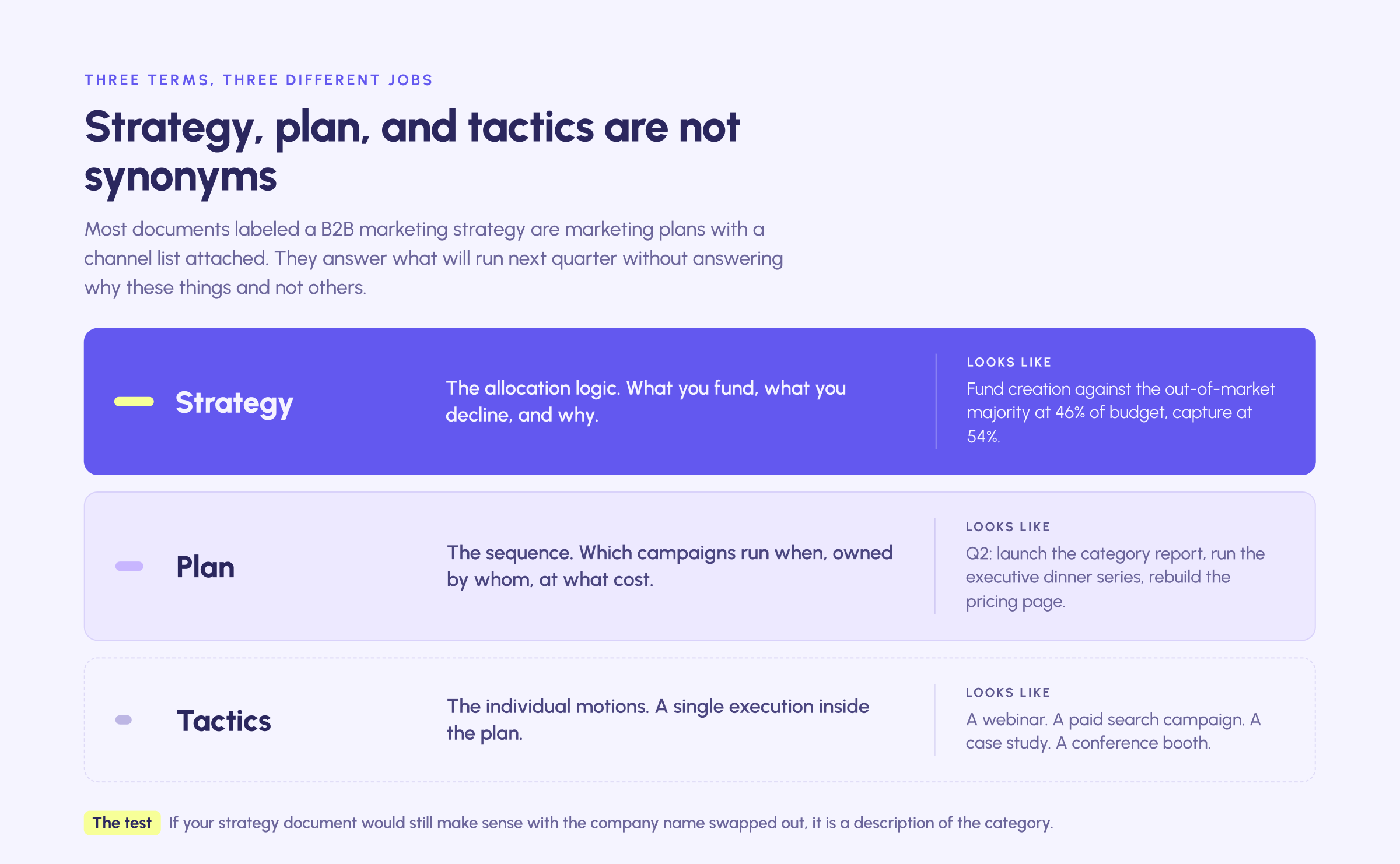
Three terms get used interchangeably and should not be:
- Strategy is the allocation logic. How much goes to creating future demand versus capturing demand that already exists, which segments you serve, what you stand for, and what you deliberately decline to do.
- A marketing plan is the sequence. Which campaigns run in which quarter, who owns them, what they cost, and what each is supposed to produce.
- Tactics are the individual motions. A webinar, a paid search campaign, a case study, a conference booth.
Most documents labeled "B2B marketing strategy" are marketing plans with a channel list attached, which is why so much B2B marketing work feels busy and produces so little. They answer "what will we do next quarter" without answering "why these things and not others." The test is simple. If your strategy document would still make sense with the company name swapped out, it is not a strategy. It is a description of the category.
Business to business marketing differs from consumer marketing in cycle length, deal size, and the number of people involved in a purchase. Those differences shape which allocation decisions matter most, which is where the next section starts.
Why B2B marketing works differently from B2C
B2B marketing targets organizations rather than individual consumers, which changes three things: purchases are made by groups instead of people, cycles run months rather than minutes, and the deal values justify a level of effort per account that consumer marketing cannot support. The underlying growth mechanics stay closer to B2C than most B2B marketers assume.
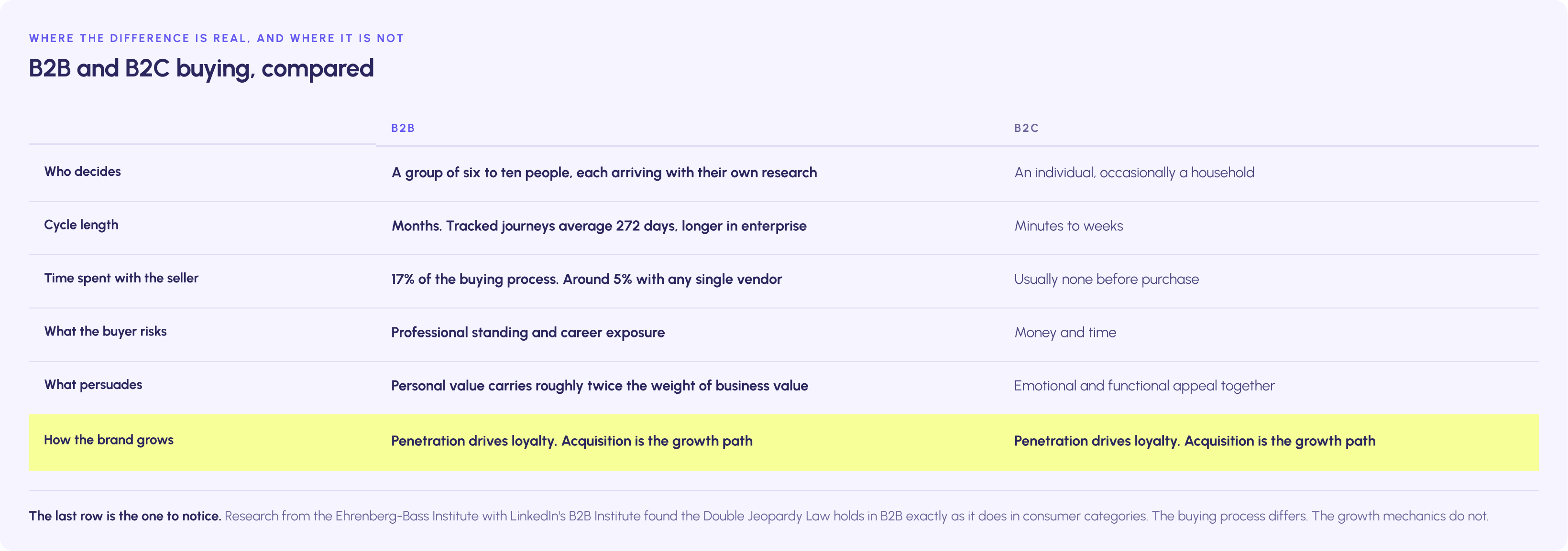
The practical differences are real. Gartner research puts the median B2B buying group at six to ten decision makers, each bringing their own independently gathered information to the table. Business buyers face procurement review, security assessment, legal terms, and budget approval. A professional services firm selling a six-figure engagement and a software company selling a seat-based subscription both sell to other businesses, and their sales cycle lengths differ enough that they should not run the same marketing plan. Measured B2B buying journeys now stretch well past six months, and Dreamdata's 2026 benchmarks put the average tracked journey at 272 days across 88 touchpoints and four channels.
What does not differ as much as the folklore suggests is how B2B brands actually grow, and business to consumer marketing shares more mechanics with B2B marketing than most teams assume. Research from the Ehrenberg-Bass Institute, published with LinkedIn's B2B Institute, found that the Double Jeopardy Law holds in B2B exactly as it does in consumer categories. Brands with more customers also enjoy higher loyalty, which means loyalty is largely a function of market penetration. The growth path for a B2B company runs through acquiring new business customers, not through squeezing existing customers harder.
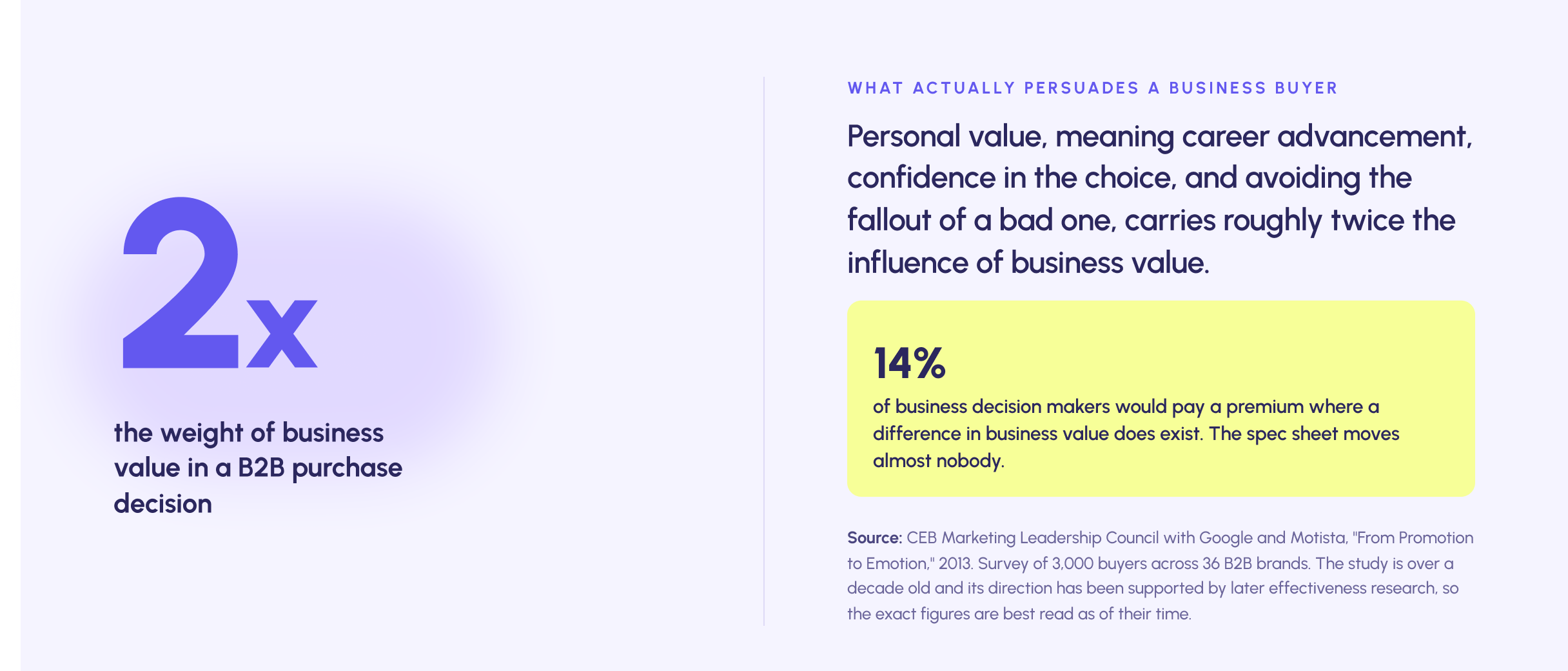
That finding matters for allocation. If your strategy assumes B2B is a purely rational category where the best specification wins on merit, you will underfund the things that build familiarity and overfund the things that argue features. Work by CEB, Google, and Motista in 2013, based on a survey of 3,000 buyers across 36 B2B brands, found that personal value carried roughly twice the weight of business value in purchase decisions. The same study found that perceptions of business value barely differed between leading brands in a category, and that where a difference did exist, only 14% of business decision makers were willing to pay a premium for it. The research is over a decade old and its direction has since been supported by later effectiveness work, so treat the exact figures as of their time.
For this article, the relevant point is narrower: the differences that matter are the ones that constrain how you allocate.
The three constraints that decide your strategy
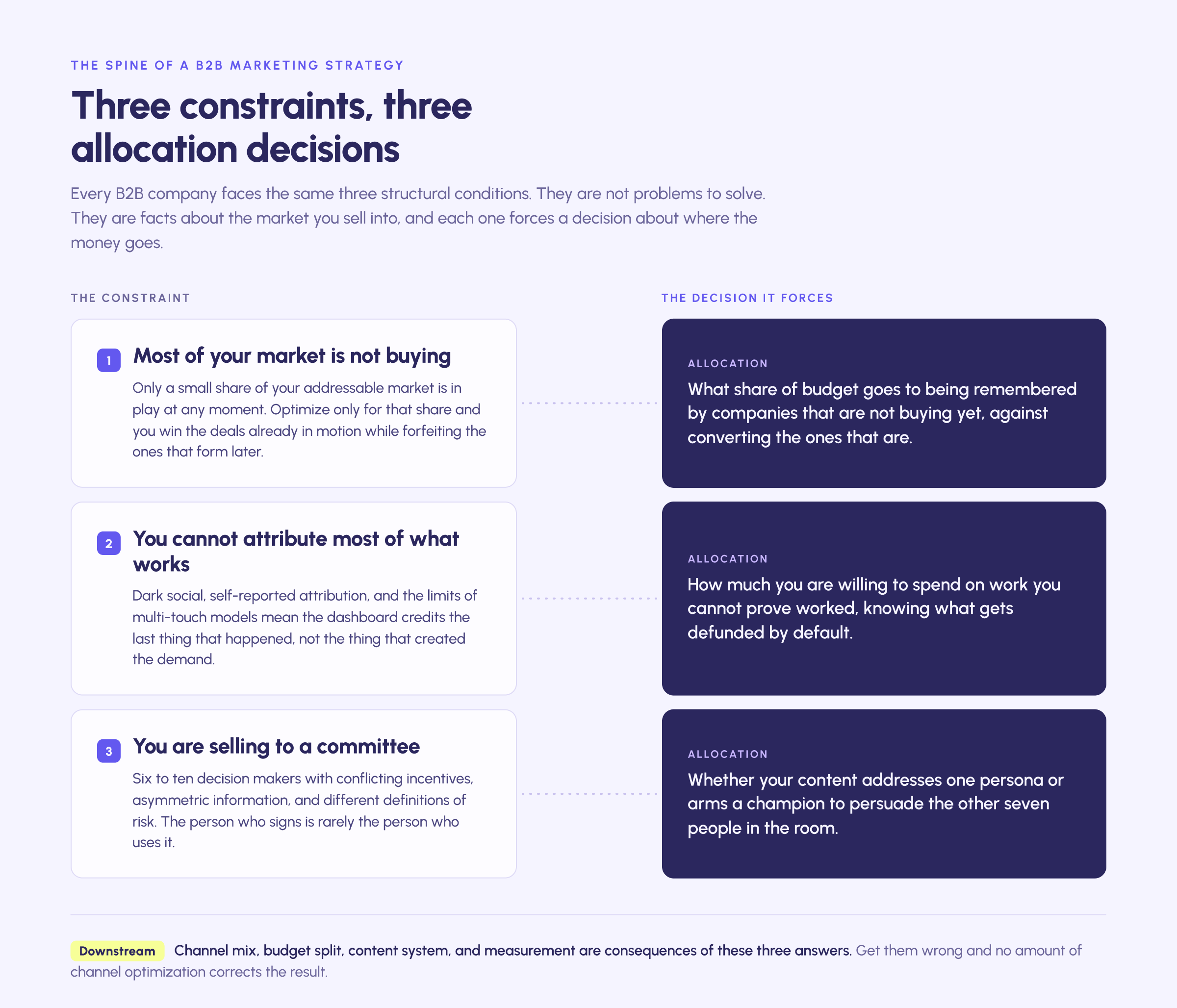
Every business selling to other businesses faces the same three structural conditions. They are not problems to solve. They are facts about the market you sell into, and each one forces a specific allocation decision. Get these three right and the channel questions in B2B marketing mostly answer themselves. Get them wrong and no amount of channel optimization will fix the result.
Most of your market is not in-market
At any given moment, only a small fraction of the companies who will eventually buy from you are actively looking. Everyone else is running their business and has other priorities. A strategy built only around the people currently shopping wins the deals already in motion and forfeits the ones that form later.
The clearest articulation of this comes from John Dawes at the Ehrenberg-Bass Institute, writing for LinkedIn's B2B Institute in 2021. His 95:5 rule holds that up to 95% of potential customers are not in the market for a given product or service at any one time. The reasoning is arithmetic rather than mystical. If companies change their principal banking provider roughly once every five years, then in any given quarter around 5% of them are actively considering a switch.
Dawes is careful about how far the number travels, and so are we. He has written plainly that the 95% figure works as a heuristic and was never meant as a precise constant. The share depends on your category's purchase interval, and he provides the arithmetic to work out your own. A product bought on a two-year cycle has roughly half the market in play across a year. Some critics, including analysts working with intent data, argue that more than 5% of buyers show detectable buying signals in certain categories.
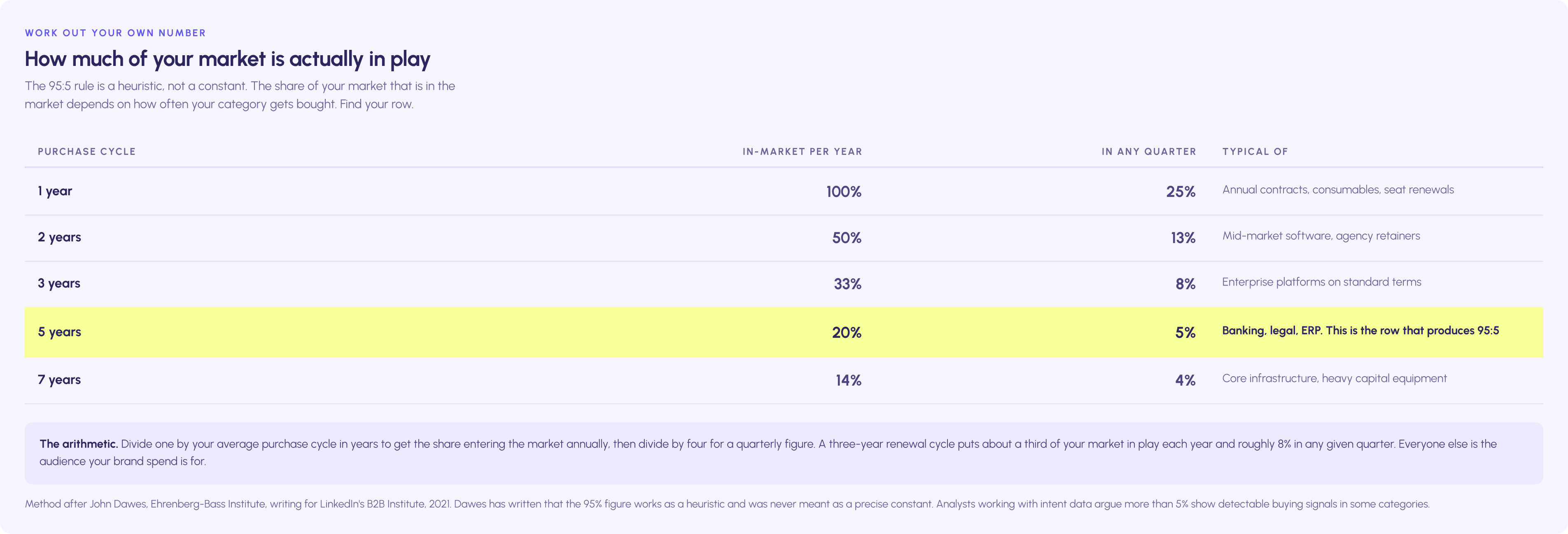
Work out your own number rather than borrowing ours. Divide one by your average purchase cycle in years to get the rough share of your market that enters the market annually, then divide by four for a quarterly figure. A three-year renewal cycle puts about a third of your market in play each year and roughly 8% in any quarter.
The consequence shows up in who gets on the list. Google and Bain surveyed 1,208 US business customers in 2022 and reported in Harvard Business Review that 80% to 90% had vendors in mind before they began any research, and that around 90% ultimately bought from that initial set. 6sense reached a similar conclusion in its 2025 buyer experience research across nearly 4,000 buyers, finding that the winning vendor was already on the day-one shortlist 95% of the time.

"Marketers cannot create demand. They can only make sure their brand exists as a notion in the buyer's world before demand naturally occurs. The real job is influencing salience and association, being the name that surfaces when a problem triggers a buying journey."
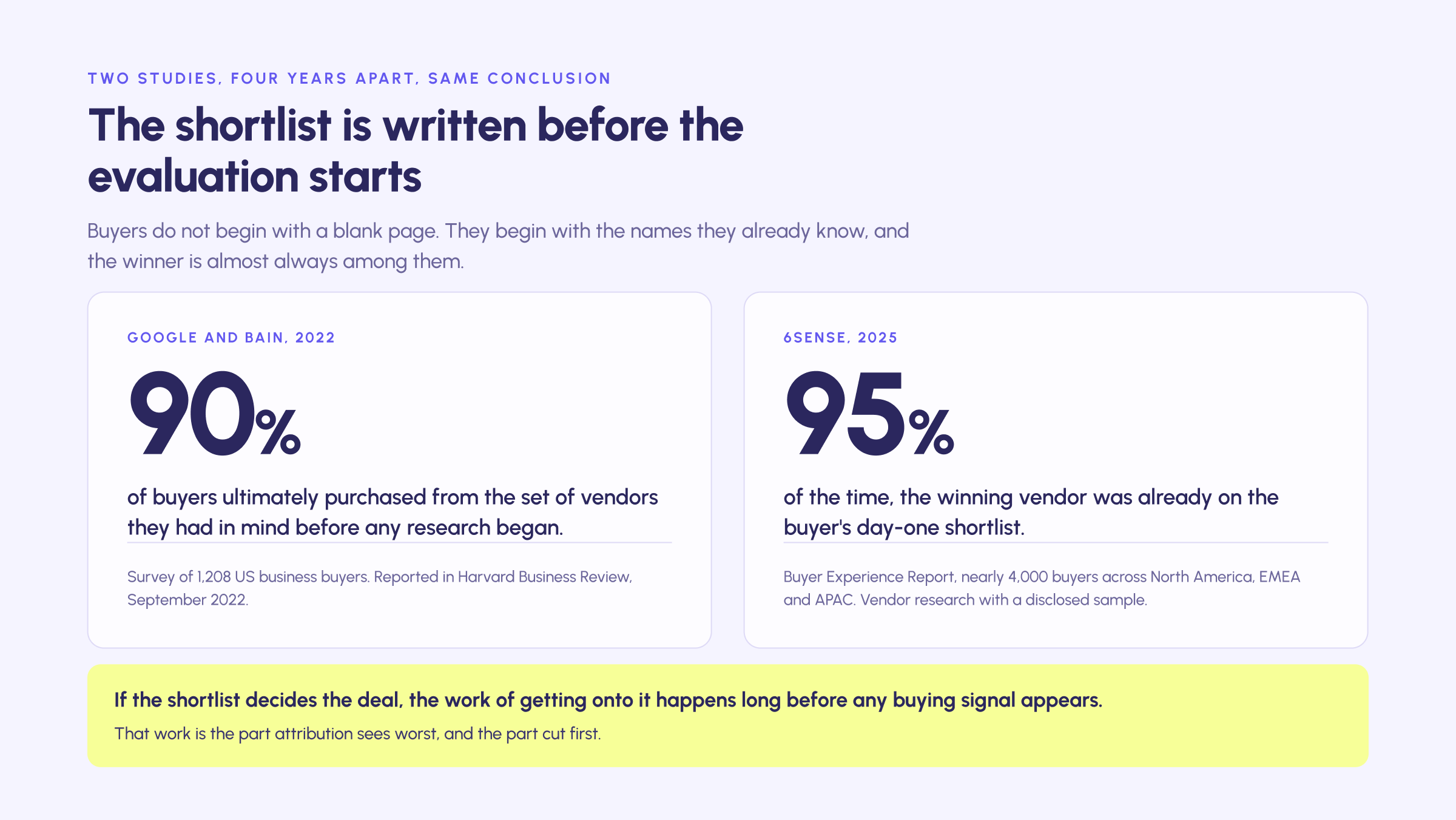
If most purchases are decided by who comes to mind before the evaluation starts, then the work of getting into that consideration set happens months or years before any measurable buying signal appears.
The allocation decision this forces: what share of budget goes to being remembered by companies who are not buying yet, versus converting the ones who are. Fund only capture and your pipeline depends entirely on demand other people created. Fund only creation and you starve the mechanism that turns awareness into revenue this quarter. Both extremes are strategies. Most companies drift into the first without ever deciding.
You cannot attribute most of what works
Your dashboard shows you a portion of what influenced a deal. The portion it shows is systematically biased toward the last thing that happened, which means the channels closest to conversion collect credit for demand that something else created.
The mechanics are well understood. Multi-touch attribution can only allocate credit to touchpoints it can observe. A large share of B2B buyer touchpoints happens in places no tracking parameter reaches: analyst calls, peer referrals, private messages, community discussions, and review site visits arrived at directly. Traffic from Slack, private messaging apps, or a link pasted into an email lands in reporting as direct, which is where attribution goes to die.
The scale of this shows up in the traffic mix of companies that market heavily. Similarweb data reported in late 2025 put direct traffic at roughly 70% for both Gong and HubSpot, and around 65% for Salesforce. On those figures, most visits to some of the most heavily marketed software companies in the world arrive through channels attribution software cannot see.
The failure mode is not measurement error. It is the budget decision that follows. A brand campaign, a podcast, or a conference presence produces a lift that surfaces months later as a branded search or a direct visit, and the attribution model credits branded search. Cut the campaign and the business sees branded search decline two quarters later, by which point the connection is invisible.
That is the honest version. The honest answer to "which channel drove this deal" is often that nobody knows, and the channels that look worst in the dashboard may be doing the most work.
.avif)
The rigorous position holds both. You accept that per-deal channel attribution is unreliable, and you replace the false precision with methods that survive the limitation: incrementality tests that hold a region back and measure the difference, media mix modeling where volume supports it, self-reported attribution collected at the point of conversion, and brand health tracking that measures whether more of your market can name you than could six months ago. Each of those is a different instrument with a different blind spot, which is why attribution in B2B is something you build rather than something you switch on.
The allocation decision this forces: how much you are willing to spend on things you cannot prove worked. A company that funds only what its dashboard can defend will progressively defund demand creation, because demand creation is the part attribution sees worst. That is a defensible choice if made deliberately and a slow decline if made by default.
You are selling to a committee, not a person
The unit of persuasion in B2B is a group of people with different jobs, different incentives, and different definitions of risk. The person who signs the business case is rarely the person who uses the product. The person who champions you internally has career exposure if the purchase goes badly.
Gartner's research puts the median buying group at six to ten decision makers. Forrester's enterprise figures run higher, at around 13 stakeholders, which reflects a different sample and definition rather than a contradiction. Either way, the number is not one.
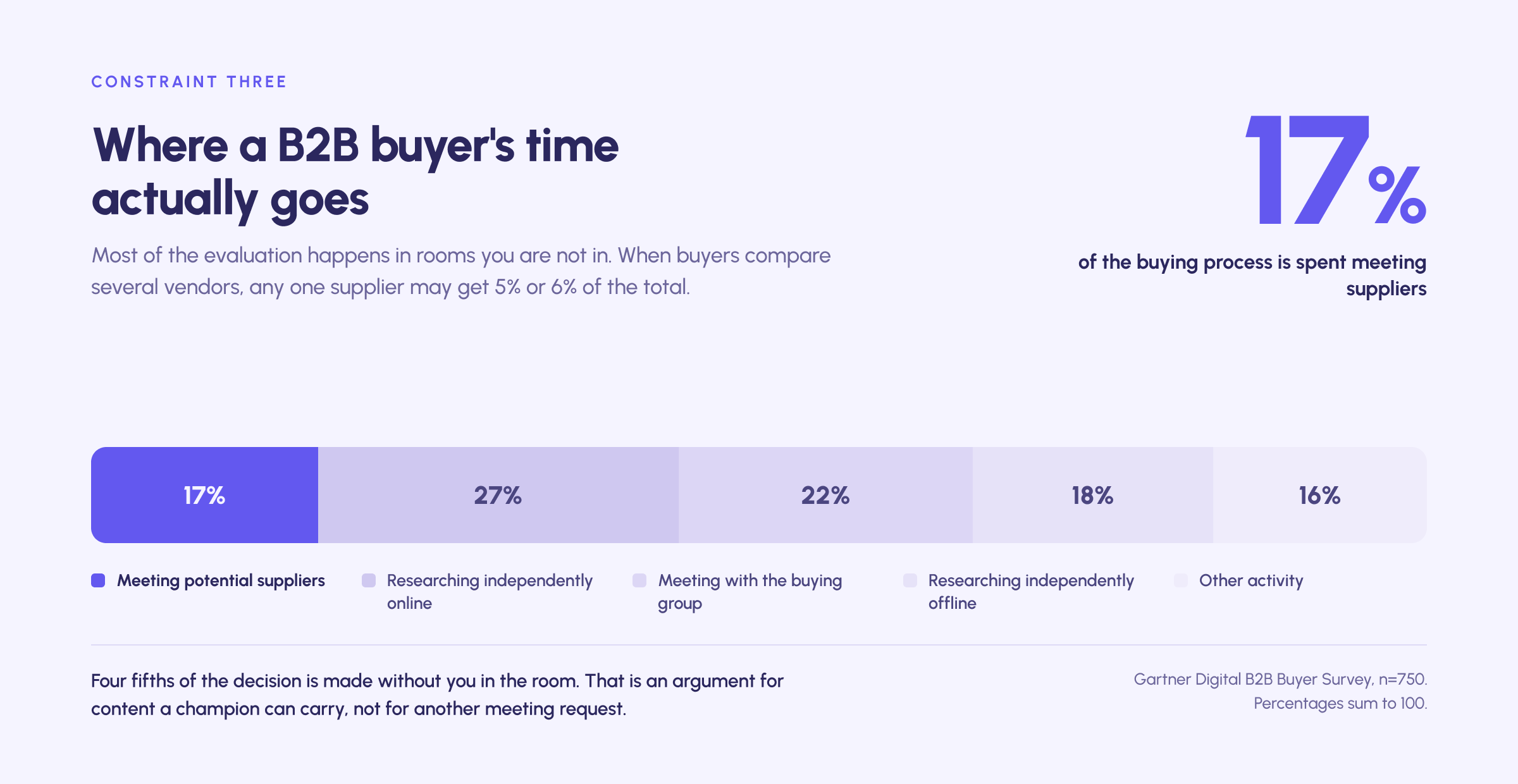
The time those people spend with you is small. Gartner's survey of 750 business buyers found that buyers spend only 17% of the total buying process meeting with potential suppliers, and when they are comparing several vendors, any individual supplier may get 5% or 6% of that time. The rest goes to independent research, internal meetings, and offline evaluation you never see. Gartner's most recent buyer survey, fielded across 646 buyers in late 2025, found 67% prefer a rep-free buying experience. The same body of research carries a warning worth reading alongside it: buyers who go fully self-service report higher purchase regret than those who involve a representative. The lesson is not that sales should disappear. It is that most of the evaluation happens before anyone talks to you.
Gartner frames the work buyers do as six jobs rather than a linear funnel: identifying the problem, exploring solutions, building requirements, selecting a supplier, validating the choice, and creating consensus. Buyers loop back through these repeatedly. Consensus creation is the one most B2B marketing ignores entirely, and it is frequently where deals stall.
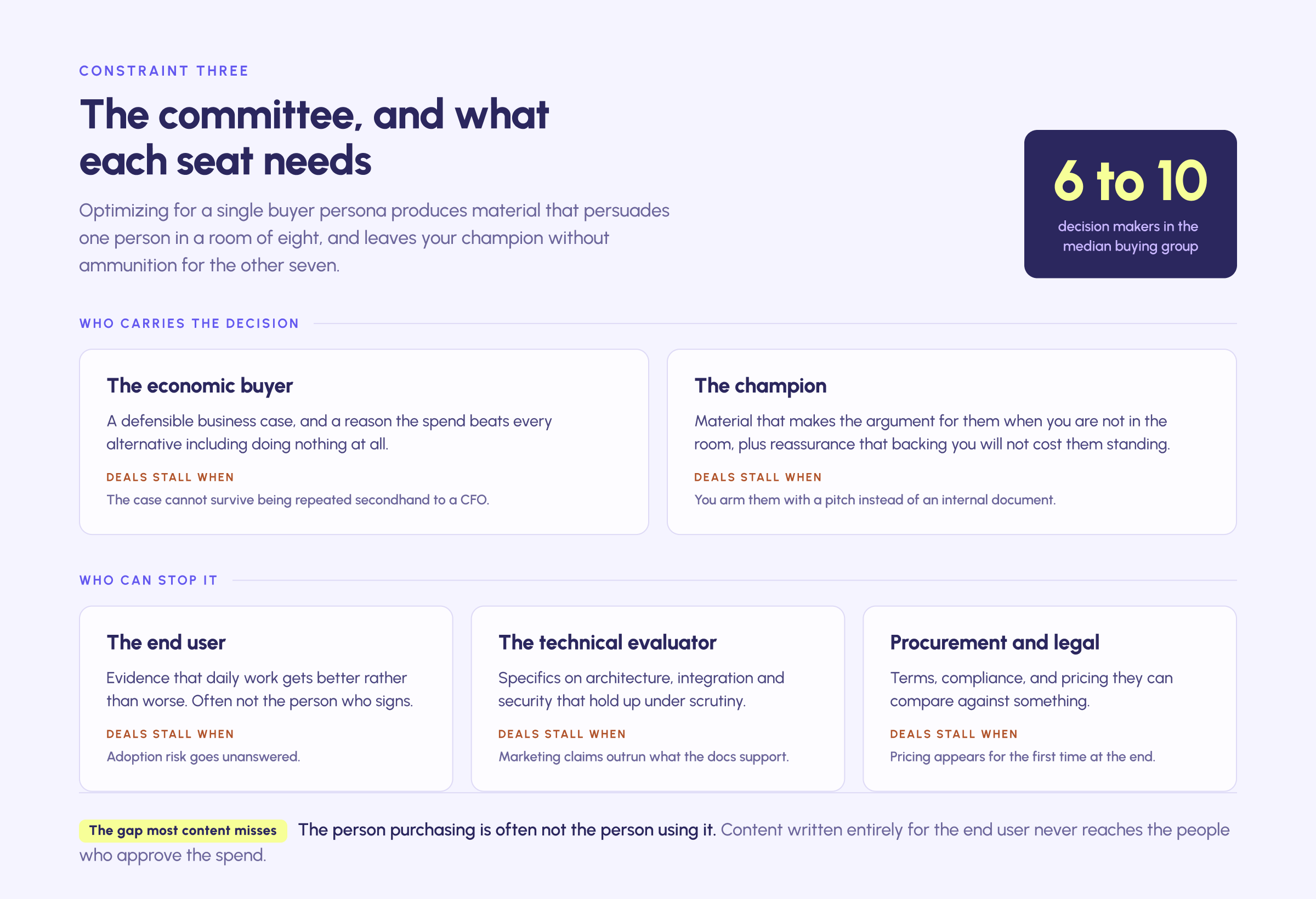
Each role in the group needs something different:
- The economic buyer needs a defensible business case and a reason the spend beats the alternatives, including doing nothing at all.
- The champion needs material that makes the case for them internally when you are not in the room, and reassurance that backing you will not damage their standing.
- The end user needs evidence that daily work gets better rather than worse.
- The technical evaluator needs specifics on architecture, integration, and security that survive scrutiny.
- Procurement and legal need terms, compliance, and comparable pricing.
The buyer and user disconnect is the part most content strategies miss. The person purchasing the service is often not the person using it, which means content written entirely for the end user never reaches the people who approve the spend. Tracking how those roles move through an evaluation together is what a customer journey is for, and it is why a map built around one persona misleads.
The allocation decision this forces: whether your content and campaigns address one persona or a group with conflicting incentives. Optimizing for a single buyer persona produces material that persuades one person in a room of eight and leaves your champion without ammunition for the other seven.
The components of a B2B marketing strategy
A B2B marketing strategy framework has six working parts: audience definition, positioning and messaging, the split between demand creation and demand capture, channel mix, the content system, and measurement. Each one is a decision, each one constrains the others, and each has a deeper guide behind it. Together they describe what a B2B marketing function is actually for.
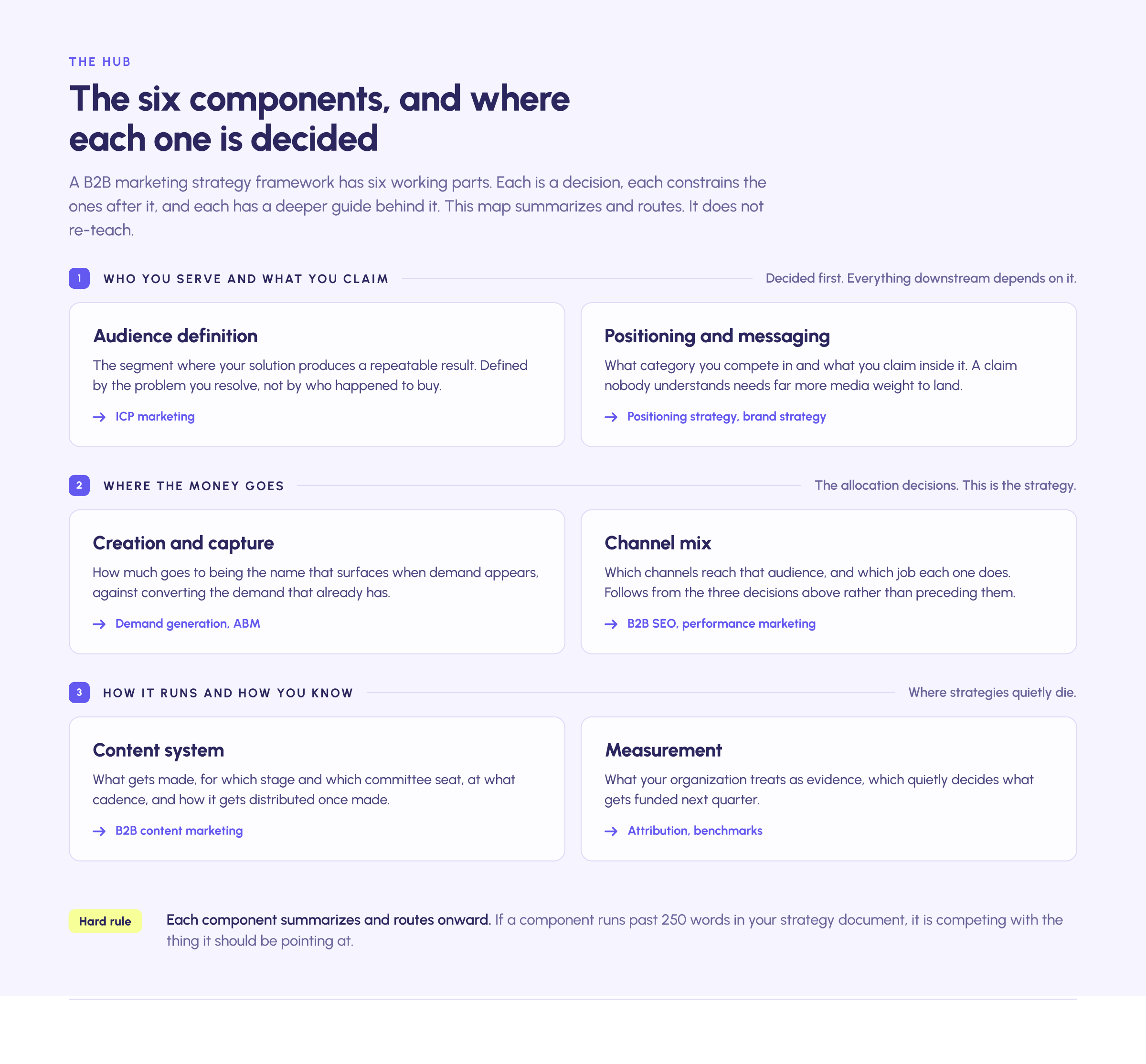
This section summarizes and routes. It does not re-teach what the dedicated guides cover.
Audience definition
Your ideal customer profile is the segment where your solution produces a repeatable result, defined by firmographics, technical environment, and the specific problem you resolve. Every other allocation decision depends on it, because a channel is only efficient relative to who you are trying to reach.
The failure here is defining the ICP by who has bought rather than who should buy. Early customers frequently arrive through founder networks and opportunistic deals, and encoding that list as your target market means scaling a pattern that was never deliberate.
The distinction worth drawing is between ideal and interesting. The ideal profile is the use case you can replicate over and over. The interesting profile closes occasionally and cannot be scaled, and it creates a false read on product-market fit when your enterprise customers are all using you for different reasons.
A weekly review of every new and lost customer is the cheapest way to run it. Reviewing wins and losses systematically builds the pattern recognition that reveals the real ICP, the messaging that lands, and the disqualification criteria worth applying early. That review is where a defensible ICP comes from, rather than from a workshop.
Positioning and messaging
Positioning is the decision about what category you compete in and what you claim within it. Messaging is how that claim gets expressed to different audience segments. Both are strategic choices with budget consequences, because a claim nobody understands requires far more media weight to land. That makes positioning and brand strategy budget decisions before they are creative ones.
Marketing's job here spans functions, and it is closer to shepherding than to authorship. Sales, product, and customer success each hold deep knowledge that stays disconnected, and marketing synthesizes those inputs into an ICP, positioning, and messaging the whole company can use consistently. Value propositions that survive contact with a buying committee get written once and then used everywhere, which requires internal stakeholders across sales and product to agree on them first. Positioning written and then never used by sales is one of the most common wasted investments in B2B. The same applies to the target audience definition sitting underneath it: a claim aimed at everyone establishes credibility with nobody.
Demand creation versus demand capture
Demand capture converts existing intent. Paid search, review sites, comparison content, and inbound requests all serve people who have already recognized a problem. Demand creation builds the awareness and association that produces that intent later.
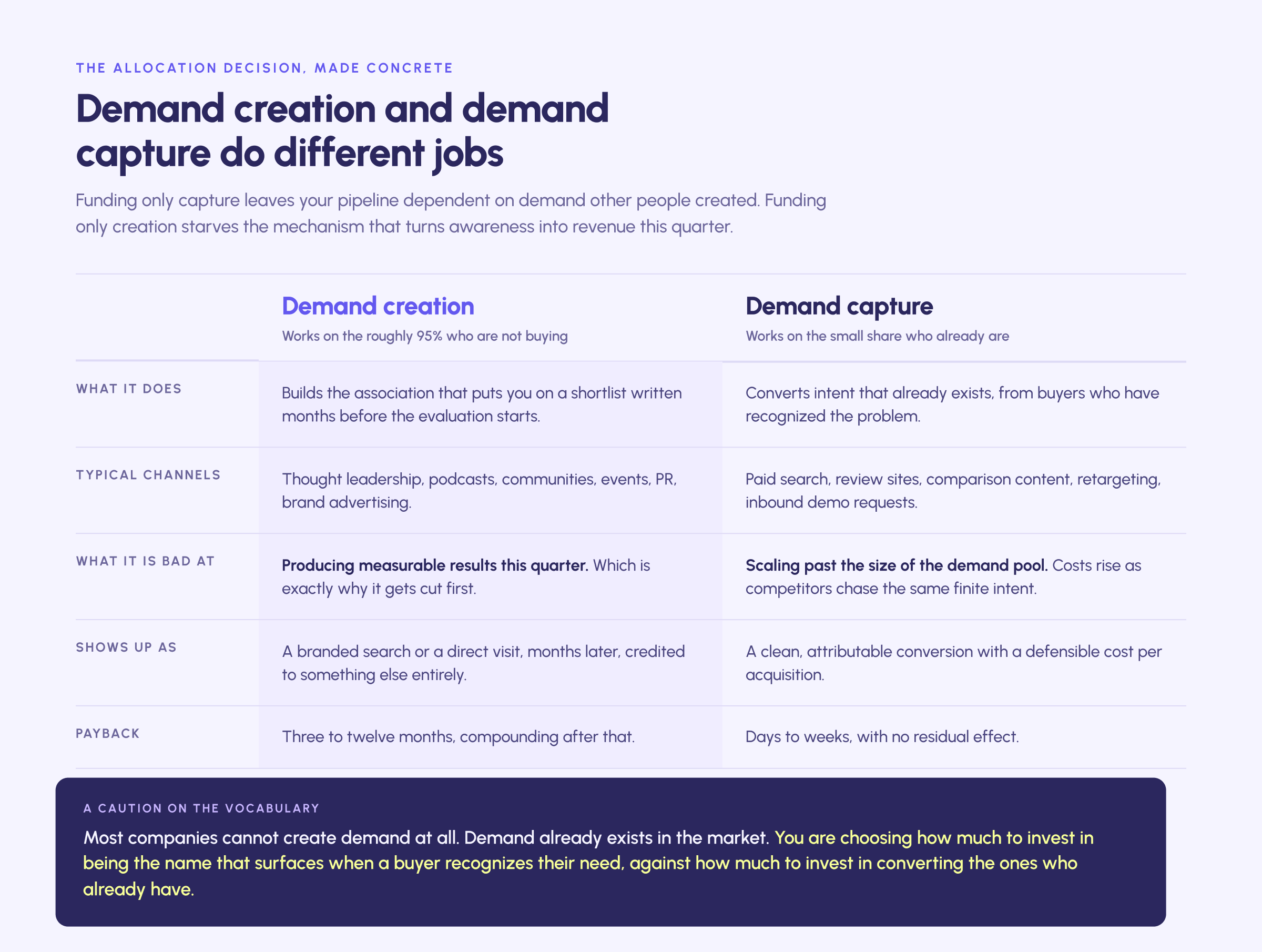
The distinction is worth stating carefully, because the vocabulary oversells what marketing can do. Most companies cannot generate demand at all. Demand already exists, and marketing's real job is being top of mind when a buyer recognizes their need. True demand creation belongs to rare disruptive innovations and describes a very small share of companies.
That framing is more useful than the alternative, because it makes the allocation question concrete. You are not choosing whether to manufacture demand. You are choosing how much to invest in being the name that surfaces when demand appears, against how much to invest in converting the demand that has already surfaced. Demand generation and account-based marketing are the two sides of that choice, and most companies fund one without ever pricing the other.
Channel mix
Channel mix follows from the first three components rather than preceding them. Once you know who you are targeting, what you claim, and how the creation and capture split works, the channel question becomes narrow: which channels reach this audience, and which job does each one do.
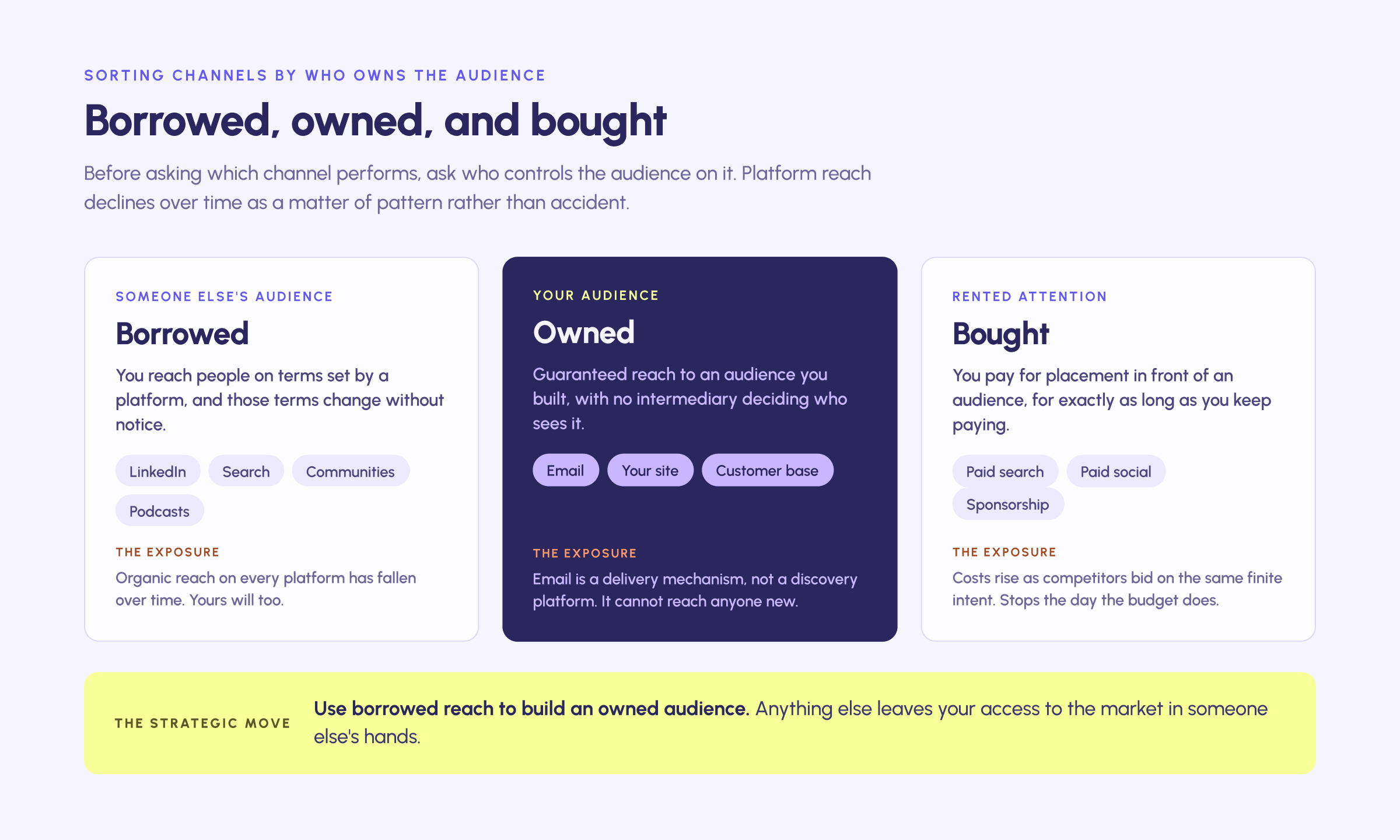
The useful way to sort them is by who owns the audience. Borrowed channels such as LinkedIn, search, and other platforms give you access to an audience that belongs to someone else, on terms that can change without notice. Owned channels such as email and your own site give guaranteed reach to an audience you built. Bought channels are paid placements. The strategic move is using borrowed reach to build owned audiences, because platform reach declines over time as a matter of pattern rather than accident.
The channel section further down covers what each one is genuinely good and bad at.
Content system
The content system is the production and distribution machinery that keeps the strategy running. It covers what gets made, for which stage and which committee role, at what cadence, and how it gets distributed once made.
The volume problem is worth naming. Content marketing effort spread thinly across too many segments produces activity without accumulation. The pattern we see most often in enterprise marketing is a team spread across seven ICPs with isolated tactics, a webinar here and a campaign there, where nothing compounds because the activities never stack on each other. Multiple touchpoints across multiple stakeholders, repeated consistently, is what keeps you present until intent appears.
The system also decides format and placement. Educational content aimed at the out-of-market majority, proof content aimed at the committee, and social media marketing that distributes both across the preferred channels of each audience segment are different production lines with different cadences. Brand building and content marketing run through the same machinery, which is why they get cut together when the machinery is under-resourced. Building that machinery is a content marketing problem long before it is a writing problem.
Measurement
Measurement decides what your organization treats as evidence, which means it quietly decides what gets funded. A measurement system built entirely on last-touch attribution will progressively defund demand creation, for the reasons covered in the second constraint.
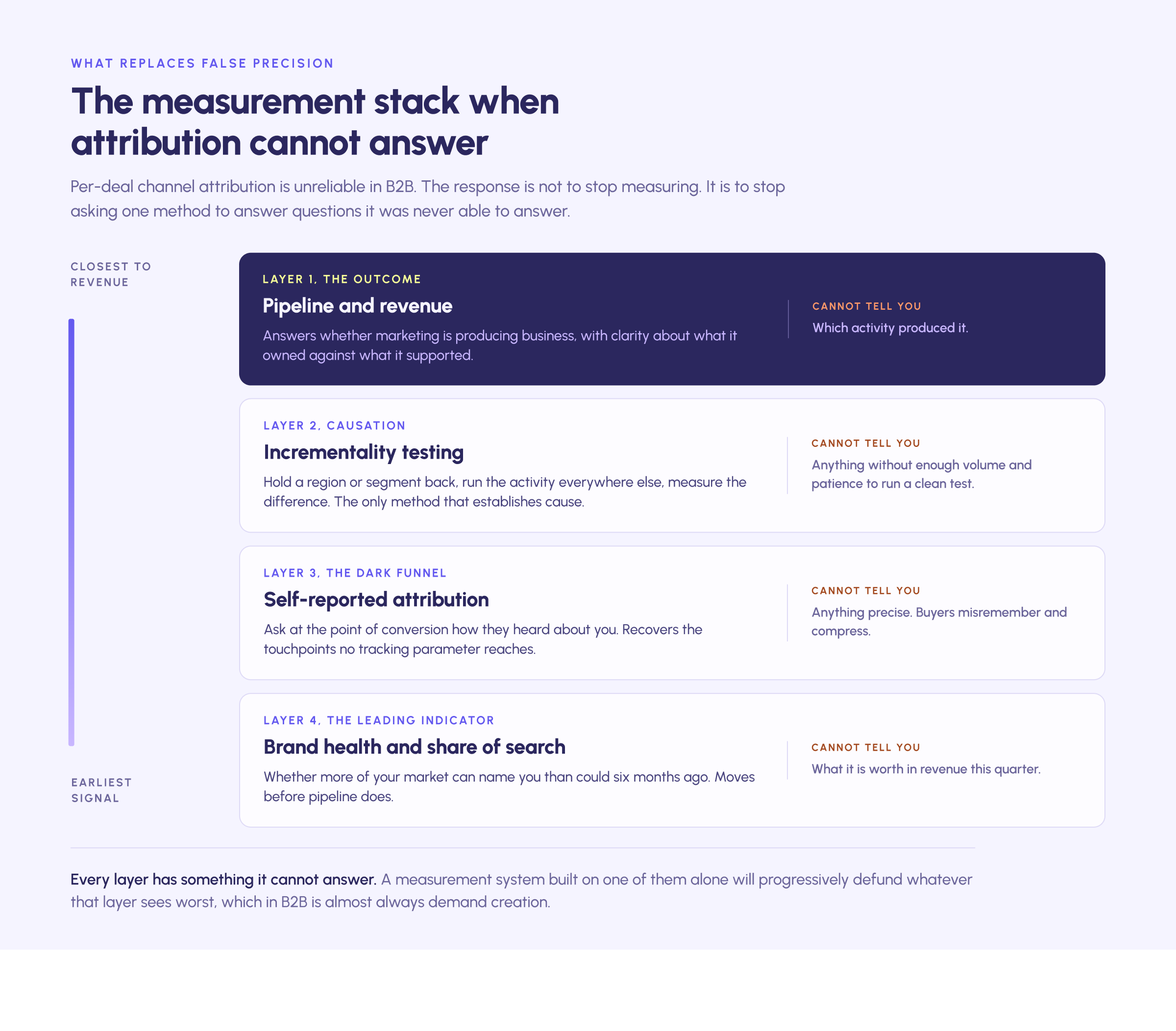
The alternative is a layered approach: pipeline and revenue as the outcome metrics, incrementality testing for causal questions, self-reported attribution collected at conversion, and brand health tracking as the leading indicator. Vanity metrics obscure reality. Marketing should be measured on pipeline generated, with clarity about what it owns versus what it supported. Whether those numbers are any good is a separate question, and the only way to answer it is against B2B marketing benchmarks.
Two practical notes. First party data collected directly from your own site, events, and customer conversations becomes more valuable as platform tracking degrades, and it is the one measurement asset that does not depend on anyone else's cooperation. Second, conversion rates at each stage of the marketing funnel tell you where the strategy is breaking down, but only when read alongside buyer feedback about why. A stage where conversion rates drop is a symptom. The customer touchpoint that caused it usually shows up in win-loss interviews rather than analytics.
How to build a B2B marketing strategy
Marketing teams that build a strategy well tend to run the same sequence. It takes five steps: agree what success means, understand your real ICP from customer evidence, decide the creation and capture split, choose channels against that split, then sequence quick wins alongside the long-term work. The sequence matters, because each step constrains the next.
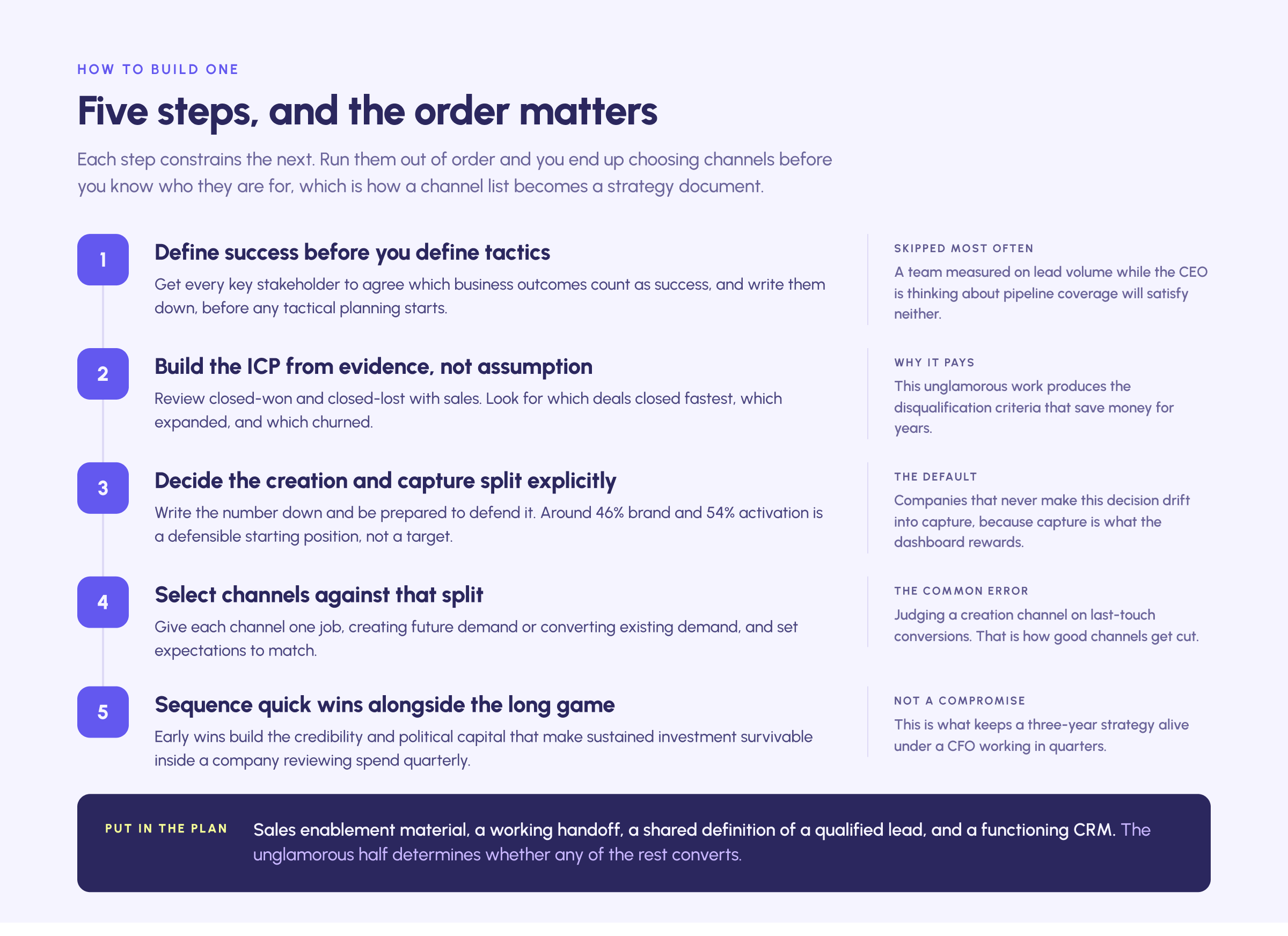
Step one: define success before you define tactics. Get alignment from every key stakeholder on which business outcomes constitute success before any tactical planning starts, and write them down. Marketing initiatives that are never tied to a business goal get cut first when budget tightens, regardless of how well they performed. This sounds procedural and is the step most frequently skipped. A marketing team measured on MQLs while the CEO is thinking about pipeline coverage will produce work that satisfies neither.
Step two: build the ICP from evidence rather than assumption. Review closed-won and closed-lost deals with sales. Look for the patterns in which deals closed fastest, which expanded, and which churned. This is unglamorous work and it produces the disqualification criteria that save money later. A marketing audit tells you what you already have and a competitor analysis tells you what you are measured against, and both are inputs to this step rather than projects of their own.
Step three: decide the creation and capture split explicitly. Write the number down and defend it. Companies that never make this decision default to capture, because capture is what the dashboard rewards.
Step four: select channels against the split. Assign each channel a job, either creating future demand or converting existing demand, and set expectations accordingly. Be honest about your marketing capabilities here: a channel your team cannot execute well is a worse bet than a duller channel it can. A channel funded for creation should not be evaluated on last-touch conversions.
Step five: sequence quick wins alongside the long game. Quick wins in the first 90 days build the credibility and political capital required to sustain long-term investment. This is not a compromise of strategy. It is what makes the strategy survivable inside a company where the CFO reviews spend quarterly.
The unglamorous parts belong in the plan. Sales enablement material, a shared definition of a qualified lead that sales and marketing have both signed, and a CRM that RevOps keeps clean are what decide whether any of the rest converts.
How to split the budget
B2B product companies spent 6.4% of revenue on marketing in early 2025 and B2B services companies 9.0%, while the working split between brand building and demand capture sits near 46% brand and 54% activation. Both numbers are starting points for an argument rather than targets to copy.
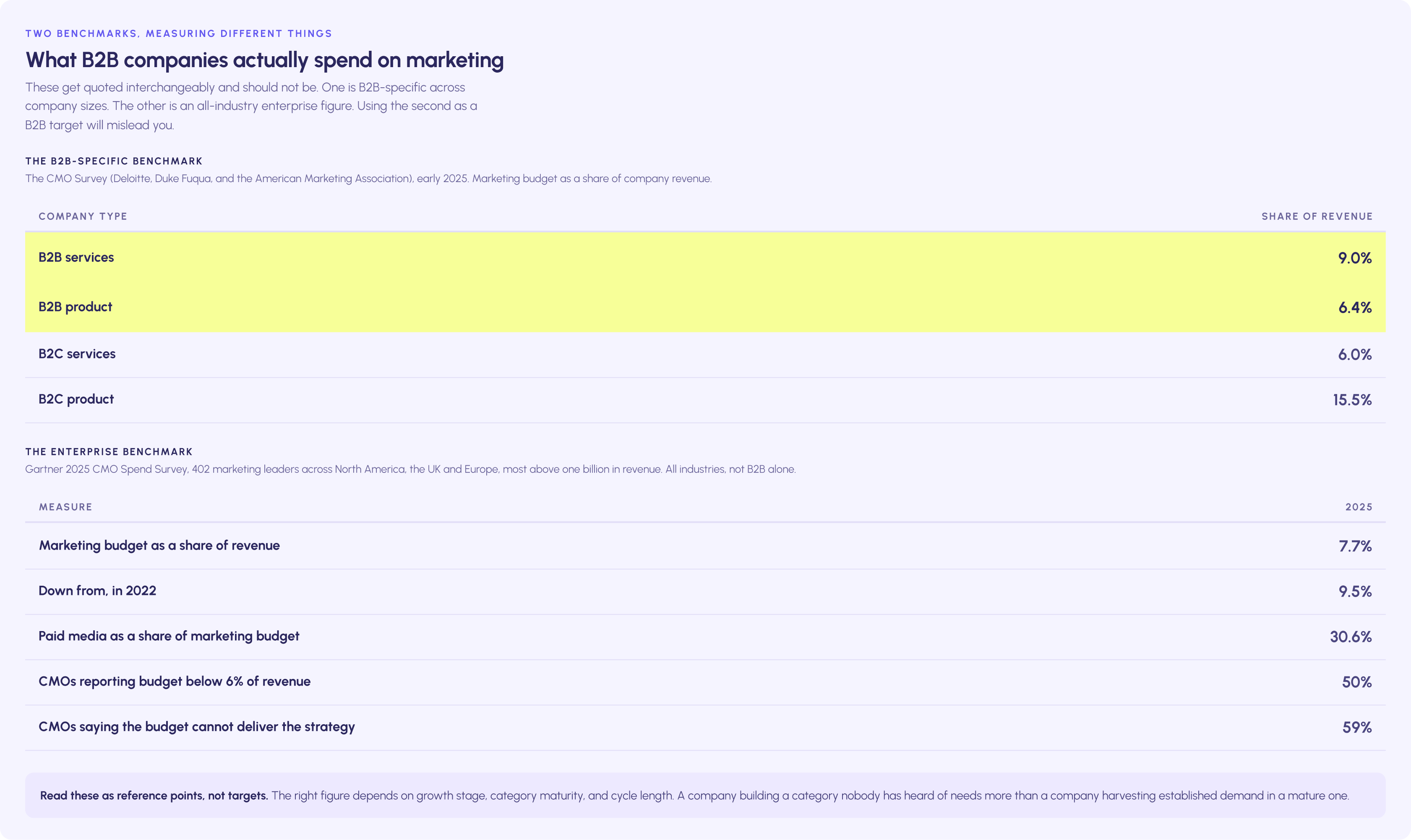
Two benchmarks are worth separating, because they get quoted interchangeably and measure different things.
The B2B-specific numbers come from The CMO Survey, run by Deloitte, Duke's Fuqua School of Business, and the American Marketing Association. In its early-2025 edition, B2B product companies reported marketing budgets at 6.4% of revenue and B2B services companies at 9.0%, against 15.5% for B2C product companies. Business-to-business marketing runs on materially less than consumer marketing, and services run higher than product.
The enterprise benchmark comes from Gartner's 2025 CMO Spend Survey, fielded across 402 marketing leaders in North America, the UK, and Europe, most at companies above one billion in revenue. It found budgets holding at 7.7% of company revenue, down from 9.5% in 2022, with half of respondents at 6% or below. Paid media took 30.6% of the marketing budget. Fifty-nine percent said their budget was insufficient to deliver the strategy they had been asked to execute, and 39% planned to cut agency spend with another 39% cutting labor. That figure covers all industries rather than B2B alone, so treat it as a ceiling reference rather than a B2B target.
On the brand and activation split, the number worth citing is the B2B-specific one. The widely quoted 60/40 ratio comes from Les Binet and Peter Field's IPA work published in 2013 and is drawn largely from consumer cases. Their B2B analysis with LinkedIn's B2B Institute, published in 2019, puts the optimum closer to 46% brand and 54% activation. The report itself is careful about this, stating that the ratio should not be followed too precisely and works as a guiding principle. LinkedIn's own summary of the same research rounds it to a 50/50 split, and other secondary coverage reports different numbers again, so treat any published ratio as a starting position rather than a target.
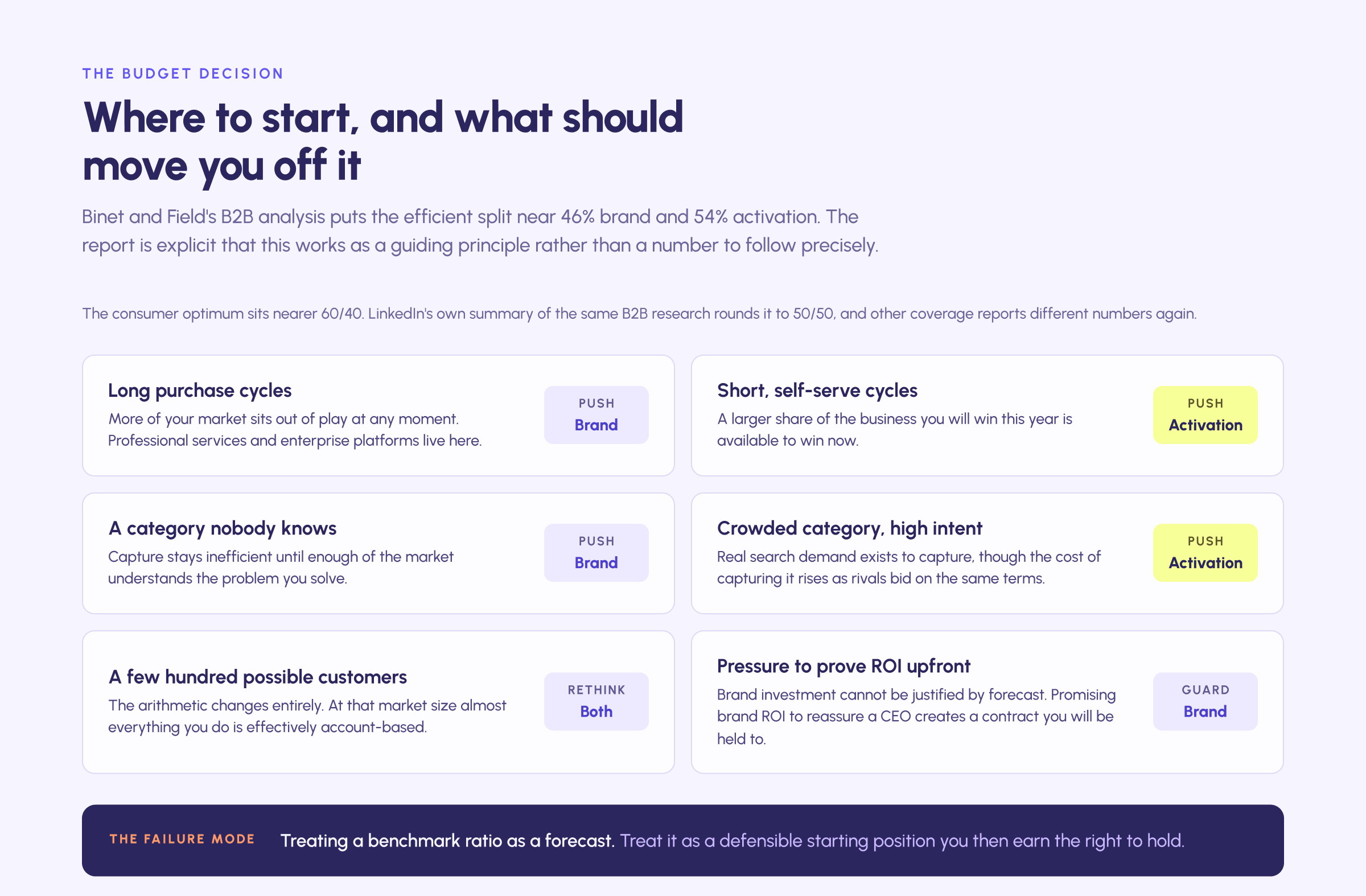
Adjust from that baseline against your own conditions:
- Longer purchase cycles push the ratio toward brand, because more of your market sits out of play at any moment. Professional services firms and enterprise software vendors sit at this end.
- Shorter cycles and high-velocity self-serve models push toward activation, because a larger share of the business you will win this year is available to win now.
- A category nobody has heard of requires more creation spend before capture becomes efficient.
- A crowded category with high search intent supports more capture spend, though the cost of that capture rises as competitors bid up the same terms.
- Small total addressable markets change the math entirely, because at a few hundred possible customers, most spending is effectively account-based.
The counterargument deserves airtime. Brand investment cannot be justified through an ROI calculation upfront, and marketing leaders who promise brand ROI to reassure a CEO are writing a false contract they will later be held to. Treating a benchmark ratio as a forecast is the failure mode. Treating it as a defensible starting position you then earn the right to hold is the useful version.
There is reasonable evidence about what happens when companies cut. Reviews of recession advertising research consistently find that reducing spend lowers sales and market share, with effects that persist after conditions improve. PIMS analysis found that firms cutting advertising gained no profit benefit, while those increasing share of voice gained market share. Both bodies of work predate the current market and rest largely on consumer cases, so the honest summary is that cutting brand spend in a downturn has a poor track record rather than that maintaining it guarantees a return.
We plan to cover B2B marketing budgets in a dedicated guide. For now, the section above is the working version.
B2B digital marketing: where each channel actually fits
Every B2B channel does one of two jobs: it creates future demand by building familiarity with people who are not buying, or it captures existing demand from people who are. Judging a creation channel by capture metrics is the most common measurement error in B2B digital marketing, and it is how good channels get cut.

Organized by the constraint each one serves:
Channels that serve the out-of-market majority. Thought leadership content, podcasts, communities, organic social, PR, sponsorships, and brand advertising all work by building the association that gets you onto a shortlist later. Edelman and LinkedIn's 2024 study of 3,484 executives found that 73% trust an organization's thought leadership more than its marketing materials when assessing capability, and 86% would invite a consistent producer of quality thought leadership into an RFP, while only 38% of producers expected that. What these channels are bad at is producing measurable results this quarter, which is exactly why they get cut first.
Channels that capture existing demand. Paid search, review sites such as G2 and Capterra, comparison and alternatives content, retargeting, and inbound demo requests convert intent that already exists. They are efficient and highly measurable, and running them well is the whole discipline of performance marketing. What they are bad at is scaling beyond the size of the demand pool, and their costs rise as more competitors chase the same finite intent.
Channels that serve the buying committee. Account-based marketing, field marketing, executive events, customer references, and sales enablement material address the group rather than an individual. Practitioner research from TOPO in 2019 found that 86% of ABM users credited it with improved win rates and 80% with improved customer lifetime value. Those are self-reported opinions from people already invested in the approach rather than measured outcomes, and the primary report is no longer openly published, so weight them accordingly. What ABM is good at is concentrating marketing efforts on a defined set of high value accounts, where the job is to identify accounts worth pursuing, reach several target buyers inside each one, and pursue account growth after the first contract. What ABM is bad at is economics below a certain deal size. Our working threshold is that genuine one-to-one ABM makes sense at roughly 300,000 in annual deal value and above. Below that, running 300 to 500 accounts is focused marketing with an ABM label.
The owned-channel engine. Email marketing sits underneath most of the above and gets treated as a tactic when it functions as infrastructure. Email is a delivery mechanism rather than a discovery platform, which means its value depends entirely on the audience you built elsewhere. Marketing automation and lead nurturing sequences do the work of staying present with target customers across a cycle measured in months, moving people from educational content toward evaluation at their own pace. Lead nurturing fails when it is built as a countdown to a demo request rather than a service to a business that is still deciding whether it has a problem. What email marketing is bad at is reach. It cannot introduce you to anyone who has not already raised a hand.
Third-party credibility. Online reviews, analyst coverage, industry publications, and customer references all work because they are not you saying it. Buyers weight them heavily during validation, when the committee is checking whether backing you is defensible. Offline channels including trade events, field marketing, and print in specialist titles still carry disproportionate weight in categories where the vast majority of the market reads two or three publications. Content Marketing Institute's B2B benchmarks published for 2025, based on 980 B2B respondents surveyed in mid-2024, found in-person events rated most effective by 52% of marketers and webinars by 51%, ahead of every purely digital format.
Two channel-specific notes worth building into the plan:
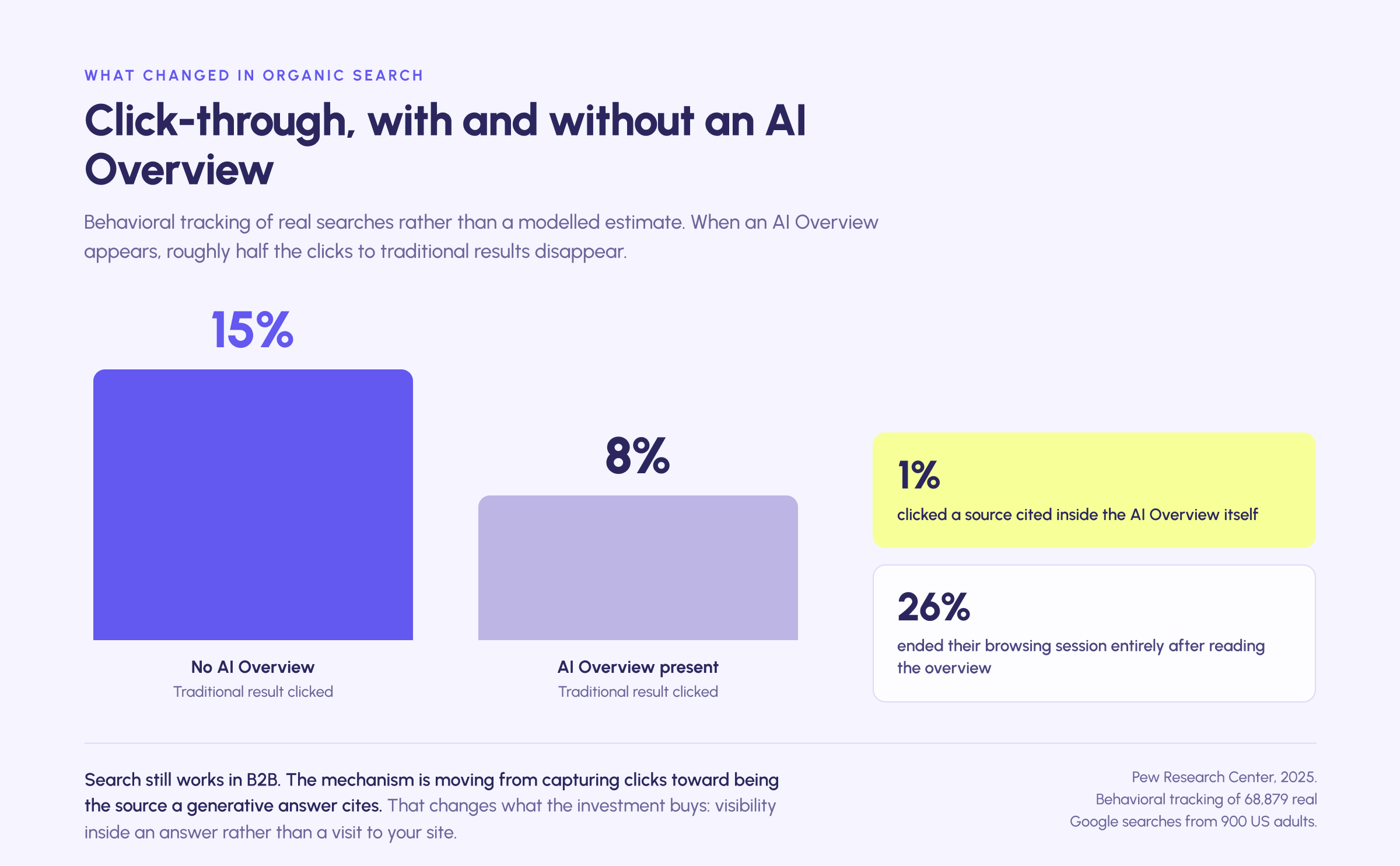
Search is changing measurably. Pew Research Center tracked 68,879 real Google searches from 900 US adults in 2025 and found that users clicked a traditional result 8% of the time when an AI Overview appeared, against 15% when one did not. Only 1% clicked a source cited inside the overview, and 26% ended their session entirely. Search engine optimization still works in B2B, and the mechanism is shifting from capturing search engine clicks toward being the source that generative answers cite. That changes what online marketing investment buys: visibility inside an answer rather than a click to your site, which is the shift a B2B SEO strategy now has to be built around.
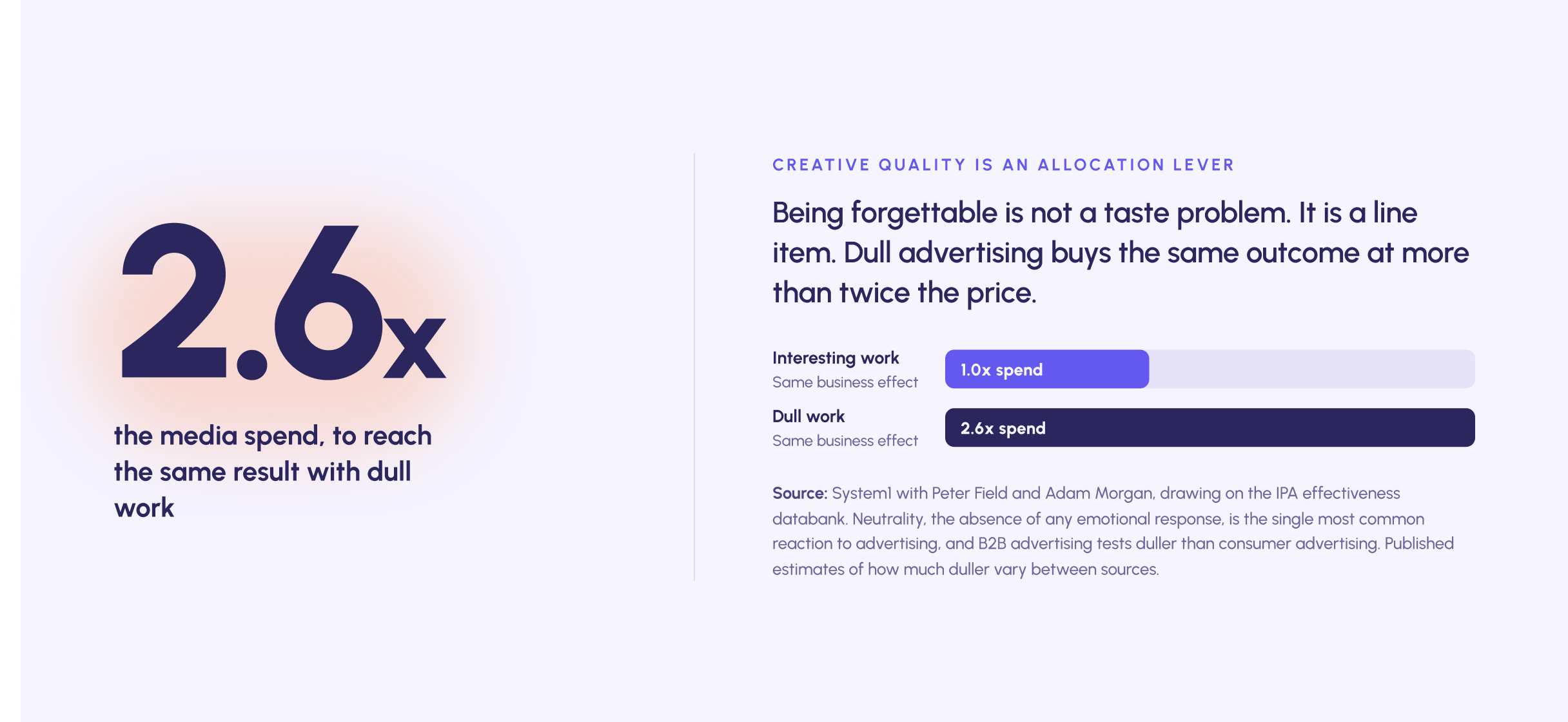
Creative quality is an allocation lever. Analysis by System1 with Peter Field and Adam Morgan, drawing on the IPA effectiveness databank, found that advertisers must spend roughly 2.6 times more on dull advertising to achieve the same large business effects as interesting work. Neutrality, meaning the absence of any emotional response, is the single most common reaction to advertising, and B2B advertising tests duller than consumer advertising. Published estimates of exactly how much duller vary between sources. In a category where most competitors publish identical channel checklists and identical claims, being forgettable carries a media multiplier.
One structural point about online marketing to close on. Every channel above feeds the same marketing funnel, and marketing efforts split across too many channels at once produce shallow coverage everywhere. Concentrating on fewer channels, executed properly, beats presence on all of them, whether you are pursuing a broad market or a short list of high value accounts. They also all end in the same place, which is where B2B website design decides whether the click you paid for was worth buying.
What a B2B marketing strategy looks like in practice
Strategy is visible in what a business chose not to do. Each example below is a business to business company that made an allocation decision before it made a channel decision. The examples below are useful because the allocation decision is legible in each one, and because the results were reported rather than asserted.
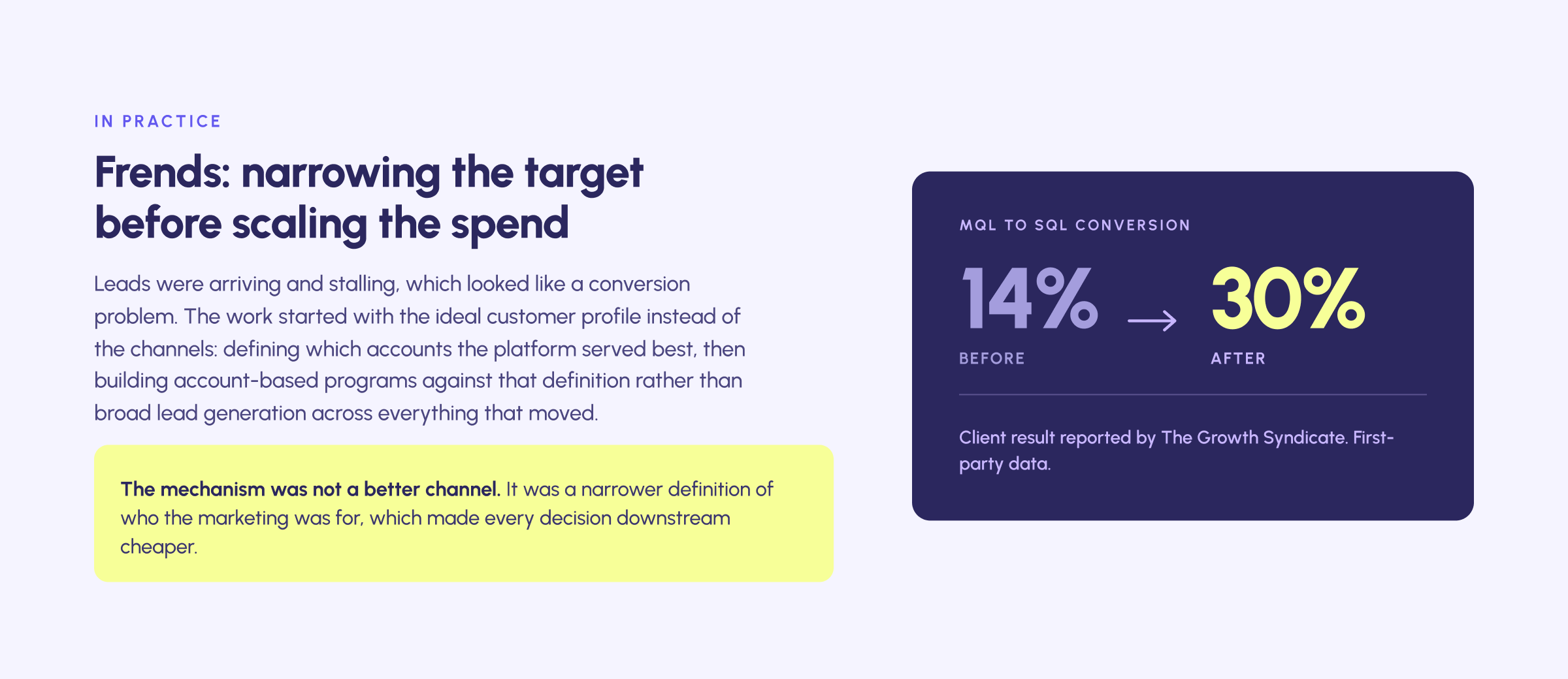
Frends, and narrowing the target before scaling the spend. Frends came to us with a volume problem that looked like a conversion problem. Leads were arriving and stalling. The work started with the ICP rather than the channels: defining which accounts the platform served best, then building account-based programs against that definition instead of broad lead generation across everything that moved. MQL to SQL conversion moved from 14% to 30%. The mechanism was not a better channel. It was a narrower definition of who the marketing was for, which made every downstream decision cheaper.
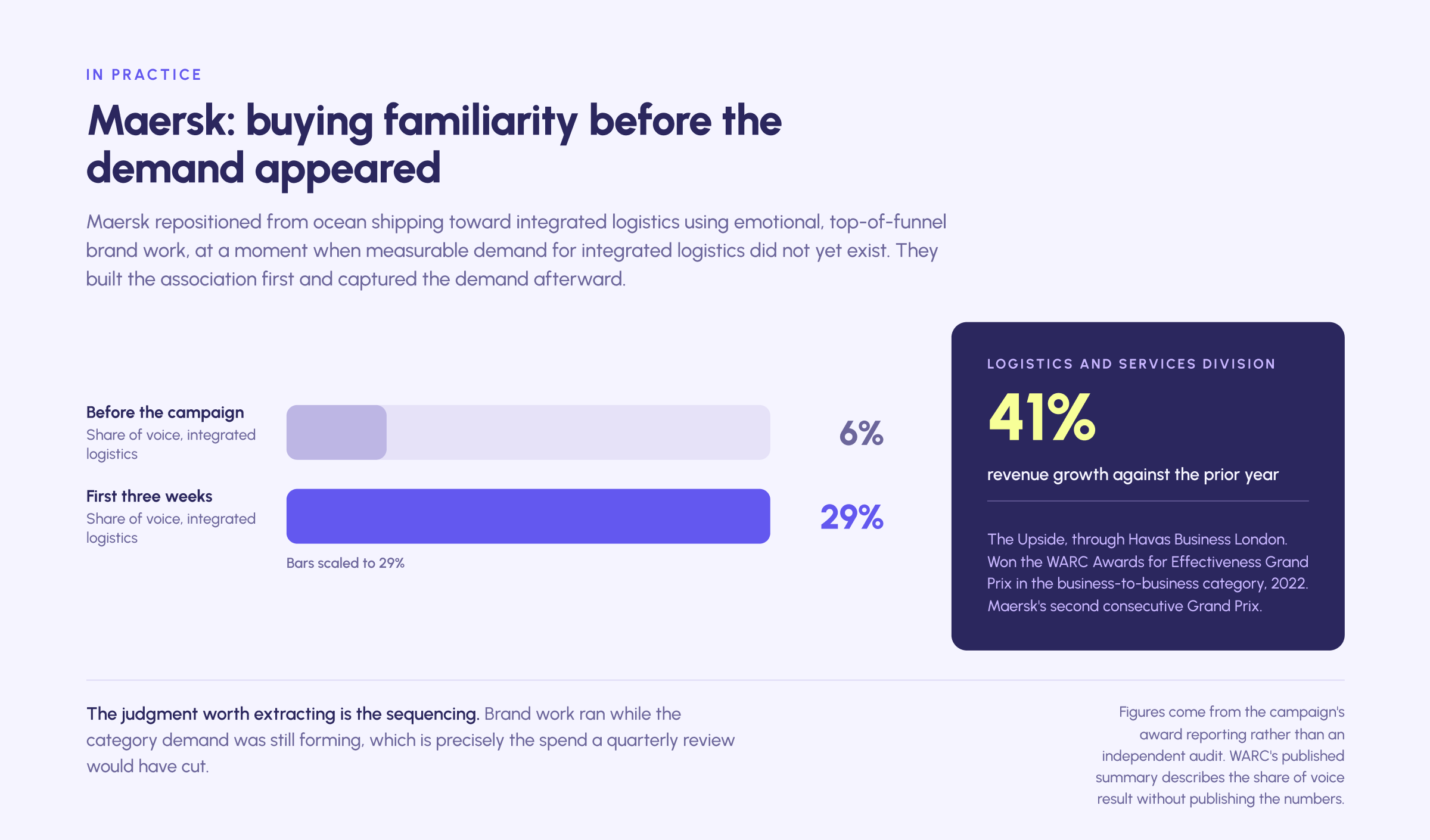
Maersk, and buying familiarity before demand appeared. Maersk repositioned from ocean shipping toward integrated logistics using emotional, top-of-funnel brand work across LinkedIn, print, and television, at a moment when the measurable demand for integrated logistics services was not yet there. The Upside campaign, through Havas Business London, won the WARC Awards for Effectiveness Grand Prix in the business-to-business category in 2022, the second consecutive year Maersk took that Grand Prix. Among the results submitted to the jury: share of voice in integrated logistics moved from 6% before the campaign to 29% within its first three weeks, and the Logistics and Services division reported 41% revenue growth against 2020. WARC's own published summary describes the share of voice result as a significant increase without publishing the figures, so the specific numbers come from the campaign's award reporting rather than an independent audit. The judgment worth extracting is the sequencing: they built the association first and captured the demand afterward.
HubSpot, and treating content as infrastructure. HubSpot built its market position by publishing at volume, consistently, over more than a decade, and by naming the category it wanted to lead. The company's audited filings show revenue moving from roughly 116 million dollars in 2014, the year it went public, to over 2.6 billion in 2024. The self-reported ROI statistics HubSpot publishes about its own customers are marketing material and should be read as such. The audited revenue trajectory of a company built on a content strategy is the part worth noting.
What these have in common is that the allocation decision came first and the channel work followed. In each case the business accepted a cost it could not immediately justify. None of them started with a list of channels.
Why B2B marketing strategies fail
Most B2B marketing strategies fail for structural reasons rather than execution reasons. The B2B marketing itself is often competent. The work gets done, the campaigns ship, and the strategy still does not produce because a decision upstream was wrong or was never made.
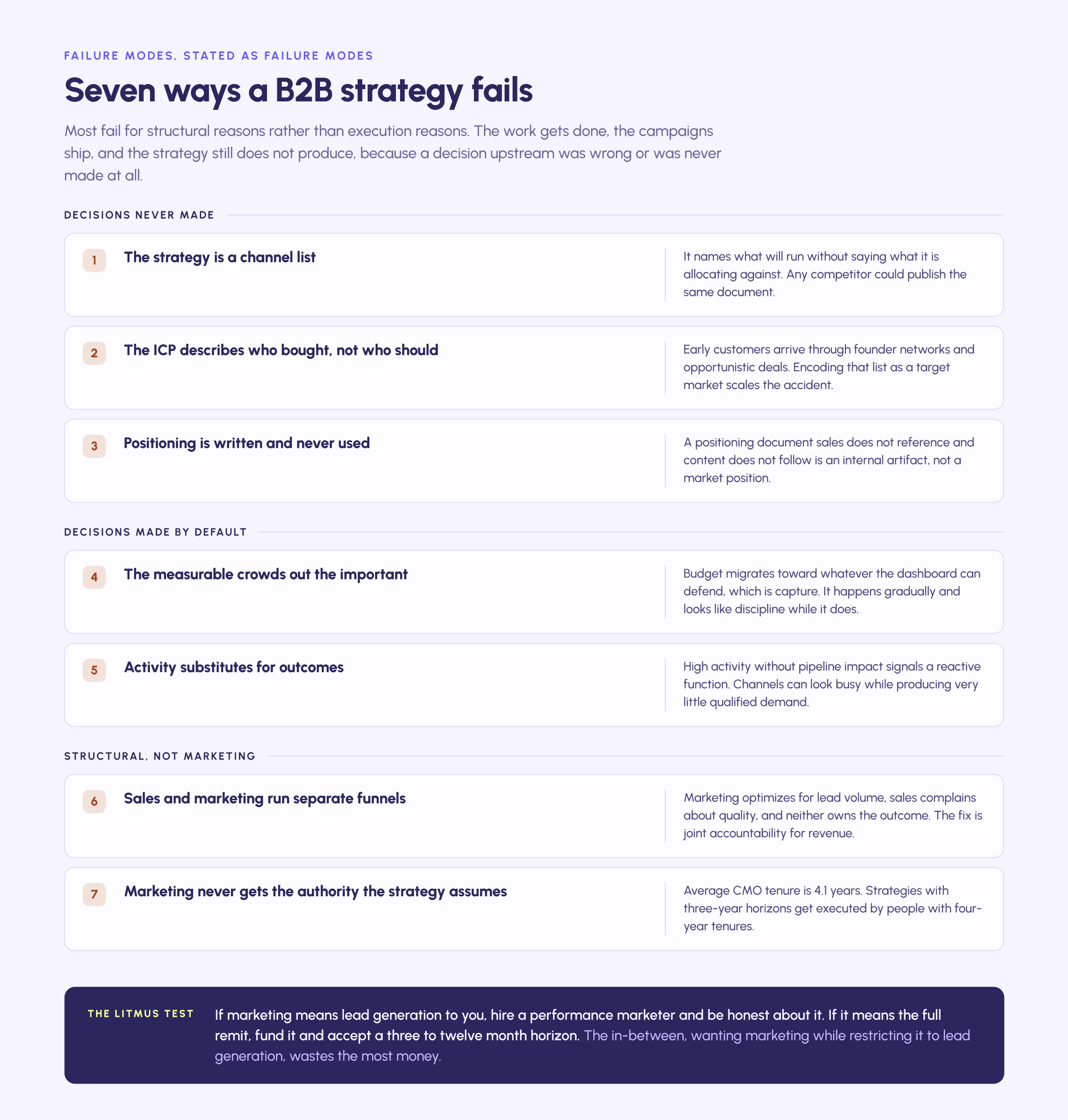
The recurring failure modes:
The strategy is a channel list. The document names specific tactics without explaining what it is allocating against or what it declines to do. Any competitor could publish the same document. Marketing teams inherit these documents and execute them faithfully, which is how a year of disciplined work can generate leads without generating new business.
The measurable crowds out the important. Budget migrates toward whatever the dashboard can defend, which is capture. This happens gradually and looks like discipline while it is happening. Survey work published alongside Binet and Field's B2B research for LinkedIn's B2B Institute found that only around 4% of B2B marketers measure the impact of their work beyond six months, while the overwhelming majority expect sales effects within weeks.
The ICP describes who bought rather than who should. Encoding an accidental customer list as a target market scales the accident.
Positioning is written and never used. A positioning document that sales does not reference and content does not follow is an internal artifact rather than a market position.
Sales and marketing run separate funnels. Marketing teams optimize for the volume of new leads, sales teams complain about quality, and neither owns the outcome. Clément's fix is joint accountability for revenue, with marketing measured on customer quality rather than lead count, because department-specific KPIs create exactly the silo the argument depends on.
"Most marketing teams don't fail because of poor execution. It's playbook culture. There are playbooks everywhere, tactics and tricks and new tools and new channels, so very quickly most people will decide their marketing team is underperforming because it lacks a certain skill or a certain way of doing things."
Activity substitutes for outcomes. Joliene's version is direct: high activity without pipeline impact signals a reactive function. Channels can look busy while producing very little qualified demand.
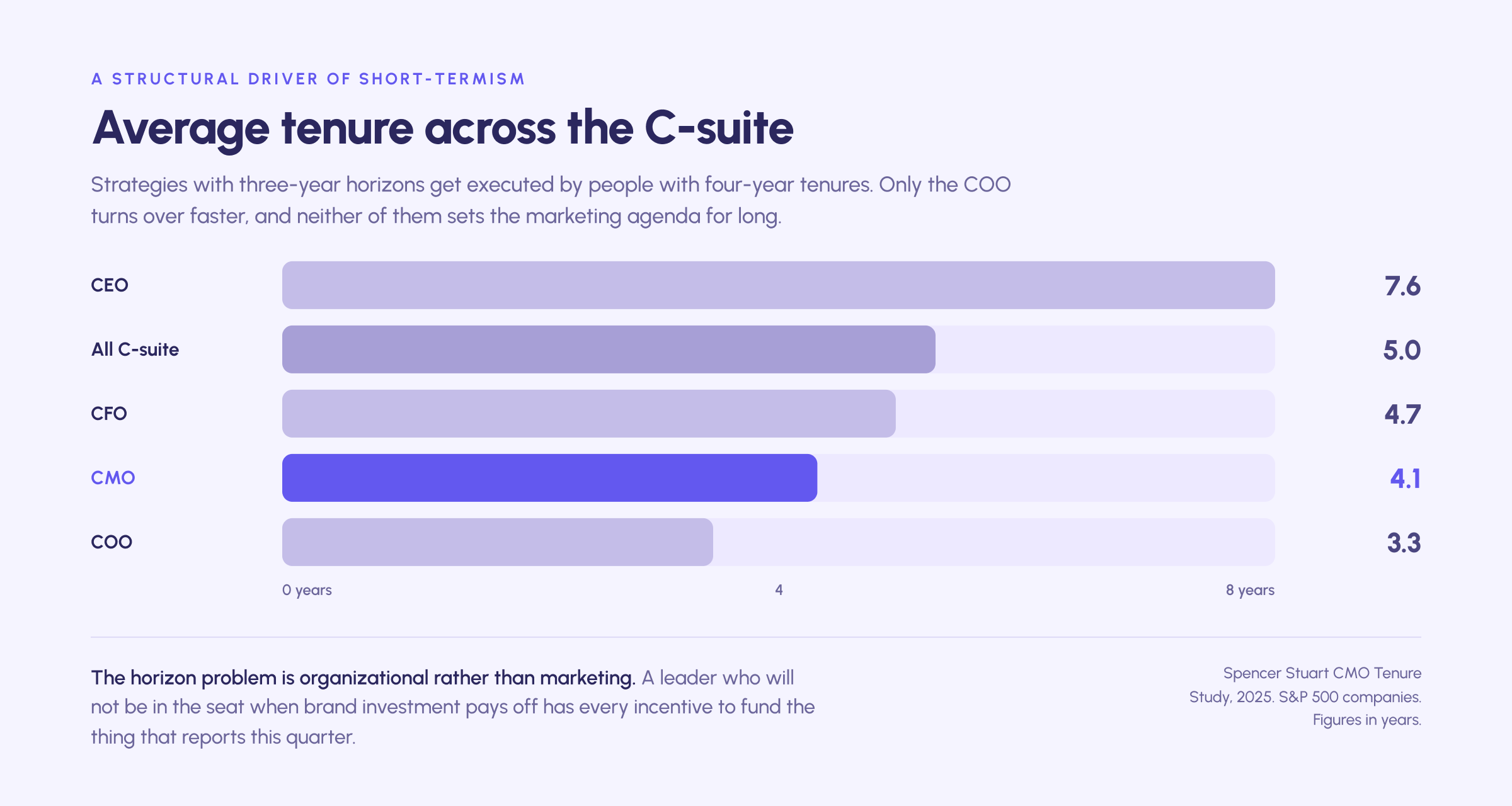
The organization never grants marketing the authority the strategy assumes. Ferdi's account of the most dangerous founder is the one who pretends to understand marketing, approves the budget, gets the team invested, and asks where the leads are six weeks in. This is a structural problem rather than a marketing one. Average CMO tenure across the S&P 500 stood at 4.1 years in 2025, the shortest of any core C-suite role except COO, against 7.6 years for CEOs. Strategies with three-year horizons get executed by people with four-year tenures.
Ferdi's litmus test for founders cuts through most of this. If marketing means lead generation to you, hire a performance marketer and be honest about it. If marketing means the full remit, fund it properly and accept a three to twelve month horizon. The in-between position, wanting marketing while restricting it to lead generation, wastes the most money.
Marketing strategy vs GTM strategy vs marketing plan
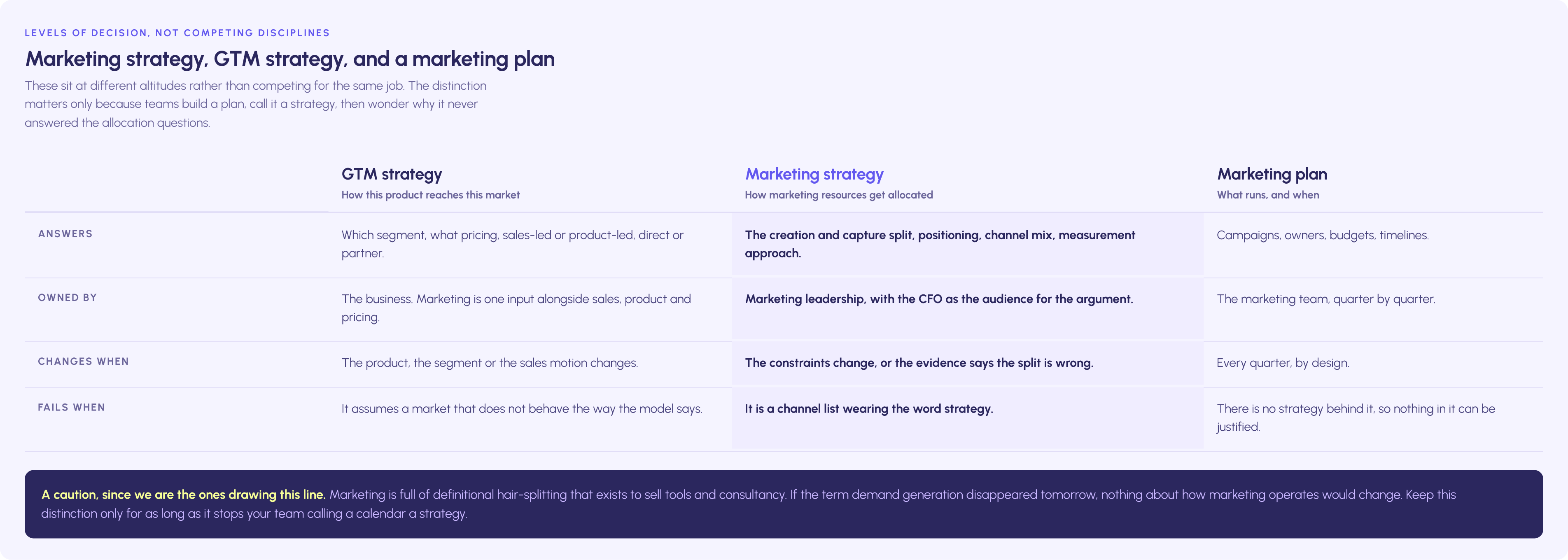
A marketing strategy decides how marketing resources get allocated. A go-to-market strategy decides how a company will reach and sell to a defined segment, including pricing, sales motion, and channel partners. A marketing plan sequences the activities that execute the strategy. They operate at different levels of decision rather than competing as disciplines.
Put concretely:
- Go-to-market strategy answers how this product reaches this market. Which segment, what pricing, sales-led or product-led, direct or partner. Marketing is one input among several, alongside sales, product, and pricing.
- Marketing strategy answers how marketing resources get allocated to support that. The creation and capture split, positioning, channel mix, measurement approach.
- Marketing plan answers what runs when. Campaigns, owners, budgets, timelines.
A caution about this taxonomy, since we are the ones drawing it. Our own founders are consistently hostile to definitional hair-splitting in marketing, and with reason. Clément's view of demand generation is that it is what marketing has always been, and that if the term disappeared tomorrow nothing about how marketing operates would change. Buzzwords create communication barriers between marketers and the executives who fund them, and much of what gets marketed as new in go to market strategies is old principle with fresh labeling.
The distinction above is worth keeping only because it prevents a real problem: teams building a marketing plan, calling it a strategy, and then wondering why the plan did not answer the allocation questions. If your team is clear on what it is allocating and why, the labels do not matter to the business. A go-to-market strategy answers the same question from the other direction, which is why the two documents should be written to fit together rather than to compete.
Frequently asked questions
What is a B2B marketing strategy?
A B2B marketing strategy is the set of decisions determining how a company allocates marketing budget, time, and attention to reach other businesses. A B2B marketing strategy defines the target audience, positioning, the balance between creating and capturing demand, channel mix, and measurement. Strategy sets allocation logic for the business. Tactics execute it.

What are the 7 P's of B2B marketing?
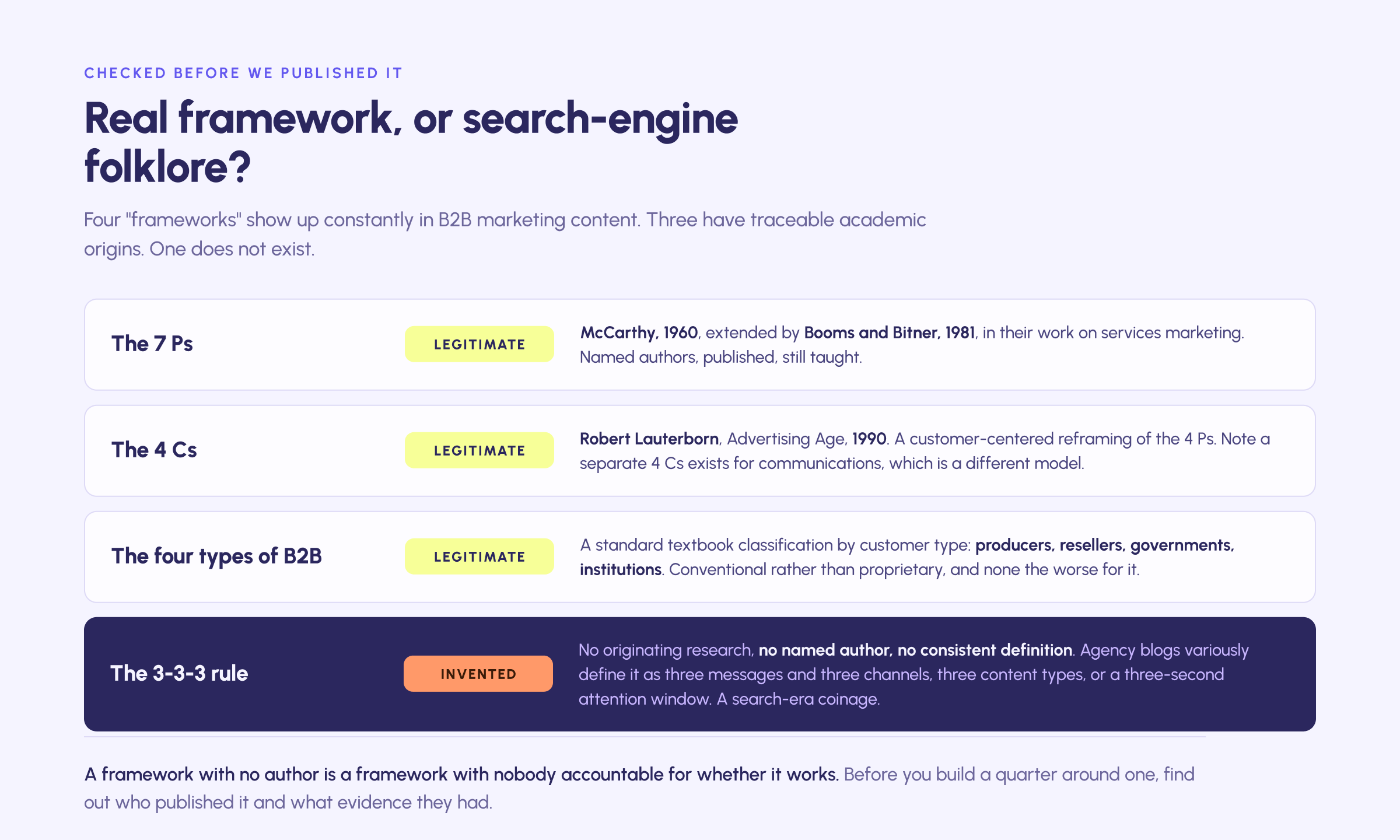
The 7 P's extend McCarthy's original marketing mix of product, price, place, and promotion with three additions from Booms and Bitner's 1981 work on services marketing: people, process, and physical evidence. In B2B the three additions carry real weight, since the buying experience, implementation process, and evidence of credibility often decide deals between technically similar vendors.
What are the four C's of B2B marketing?
Robert Lauterborn proposed the 4 C's in Advertising Age in 1990 as a customer-centered alternative to the 4 P's: consumer wants and needs, cost to satisfy, convenience to buy, and communication. Applied to B2B, it reframes each decision from the buyer's side, which is useful when your product specification is stronger than your buying experience.
What are the four types of B2B?
B2B markets are conventionally divided by customer type into four groups: producers who buy goods to make other goods, resellers who buy to sell on, governments, and institutions such as hospitals and universities. Each buys through different processes, with government and institutional buyers typically operating under formal procurement rules.
What is the 3-3-3 rule in marketing?
There is no established 3-3-3 rule in marketing. The phrase appears across agency blogs with entirely different definitions, covering three messages and three channels, three content types, or a three-second attention window. No originating research, named author, or consistent definition exists behind it. Treat it as a search-driven coinage rather than a framework.
What is the difference between a B2B marketing strategy and a marketing plan?
The strategy decides how resources get allocated and why. The plan sequences the activities that execute those decisions, with owners, budgets, and timelines. A plan without a strategy behind it is a calendar of campaigns that nobody can justify when the budget gets questioned.
How much should a B2B company spend on marketing?
The CMO Survey put B2B product companies at 6.4% of revenue and B2B services companies at 9.0% in early 2025, against 15.5% for B2C product companies. Gartner's separate enterprise survey found an all-industry average of 7.7%. The right figure depends on growth stage, category maturity, and cycle length, so treat these as reference points rather than targets.
What is the difference between demand generation and lead generation?
Lead generation captures contact details from people showing interest. Demand generation is the broader work of building awareness and intent so that interest exists at all. Treating them as the same thing produces a strategy that harvests demand without replacing it.
How long does a B2B marketing strategy take to work?
Demand capture activity can produce results within weeks. Demand creation typically shows up over three to twelve months, and brand effects compound over years. Measured B2B buying journeys now average well beyond six months, which sets a floor on how quickly upper-funnel work can appear in pipeline.
Do we need account-based marketing?
It depends on deal size and market size. One-to-one ABM makes economic sense when annual deal values reach roughly 300,000 and above. When a total market is only a few hundred companies, most marketing is effectively account-based regardless of what it gets called.
What does good B2B marketing look like in a small team?
Fewer channels, executed consistently. A small team with a clear ICP, one strong content channel, email marketing supported by light marketing automation, and a working sales handoff will outperform a larger team spread across eight channels. This is especially true in professional services, where a handful of visible experts can establish credibility faster than any paid program.
How do you measure a B2B marketing strategy?
Measure outcomes rather than activity: pipeline generated, with clarity about what marketing owned versus supported. Supplement with incrementality testing, self-reported attribution collected at conversion, and brand health tracking. Per-deal channel attribution is unreliable in B2B, and building a measurement system that pretends otherwise leads to defunding the work that generates demand.
What is the biggest mistake in B2B marketing strategy?
Allocating budget by what is measurable rather than by what works. Because demand capture is easy to attribute and demand creation is not, companies drift toward capture until they are entirely dependent on demand that other people created.
.png)