.svg)

.png)

A B2B marketing agency is a specialist firm that builds and runs marketing for companies that sell to other businesses, then measures it against pipeline. That single difference, selling to organizations instead of individual consumers, changes everything downstream: who you target, how long deals take, what content works, and how success gets measured.
This guide covers what these agencies actually do day to day, what they cost in 2026, how to tell a good one from a mediocre one, and when hiring one is the wrong move entirely.
The quick definition
A B2B marketing agency helps companies that sell to other businesses build awareness and create demand, then turn interest into qualified sales pipeline. Where a B2C marketing agency optimizes for millions of individual purchase decisions, a B2B agency builds programs around a small number of high-stakes decisions made by committees.
The clients are usually companies hitting a specific wall. Some are startups whose founder-led sales motion has stopped scaling. Some are Series B SaaS companies under pressure to show repeatable pipeline growth. Others are established firms in manufacturing, logistics, or professional services going through digital transformation and discovering their buyers now research online long before talking to a sales person.
What they hire a B2B marketing agency for tends to fall into a few buckets: lead generation that produces qualified leads instead of noise, brand authority in a defined market, alignment between sales and marketing teams, and sustainable growth that doesn't collapse when one channel gets expensive.
Why B2B marketing is a different discipline than B2C
The mechanics of B2B buying explain most of what a B2B marketing agency does, so it's worth spelling them out. Consumer brands promote products to individual consumers one impulse at a time; B2B firms sell considered change to organizations.
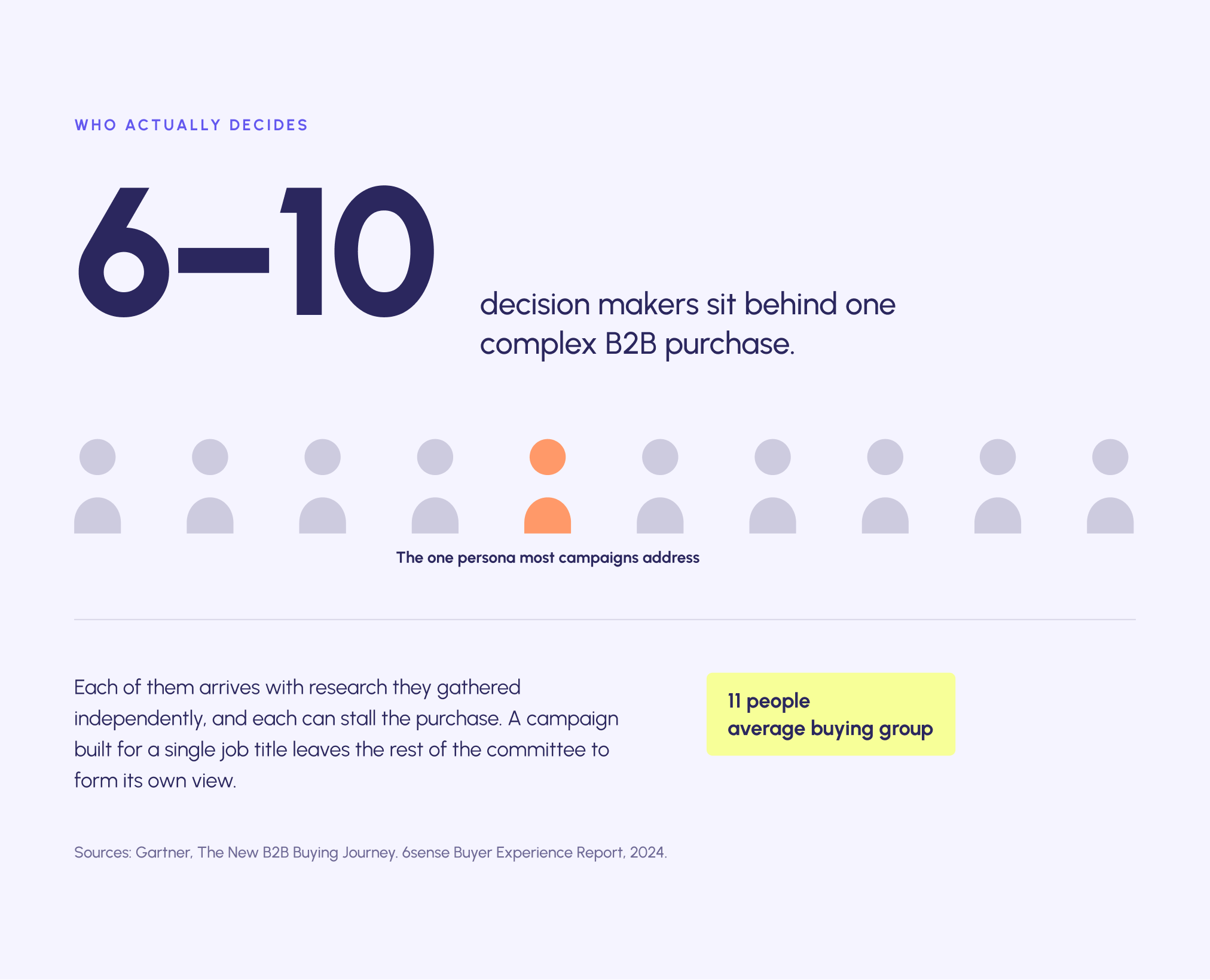
Committees, not consumers. A typical complex B2B purchase involves multiple decision makers, 6 to 10 of them, each bringing their own research to the table (Gartner). 6sense's 2024 Buyer Experience Report puts the average buying group at 11 people. Marketing that persuades one persona while ignoring the CFO, the technical evaluator, and the end user loses deals it never knew it was in.
Long sales cycles. Benchmark data puts the median B2B SaaS sales cycle around 84 days, roughly 22% longer than in 2022, though blended medians hide enormous variance. Deals under $15K close in weeks. Enterprise deals routinely take 6 to 18 months. Complex sales cycles like these punish campaign thinking and reward programs that stay present across the whole buying journey.
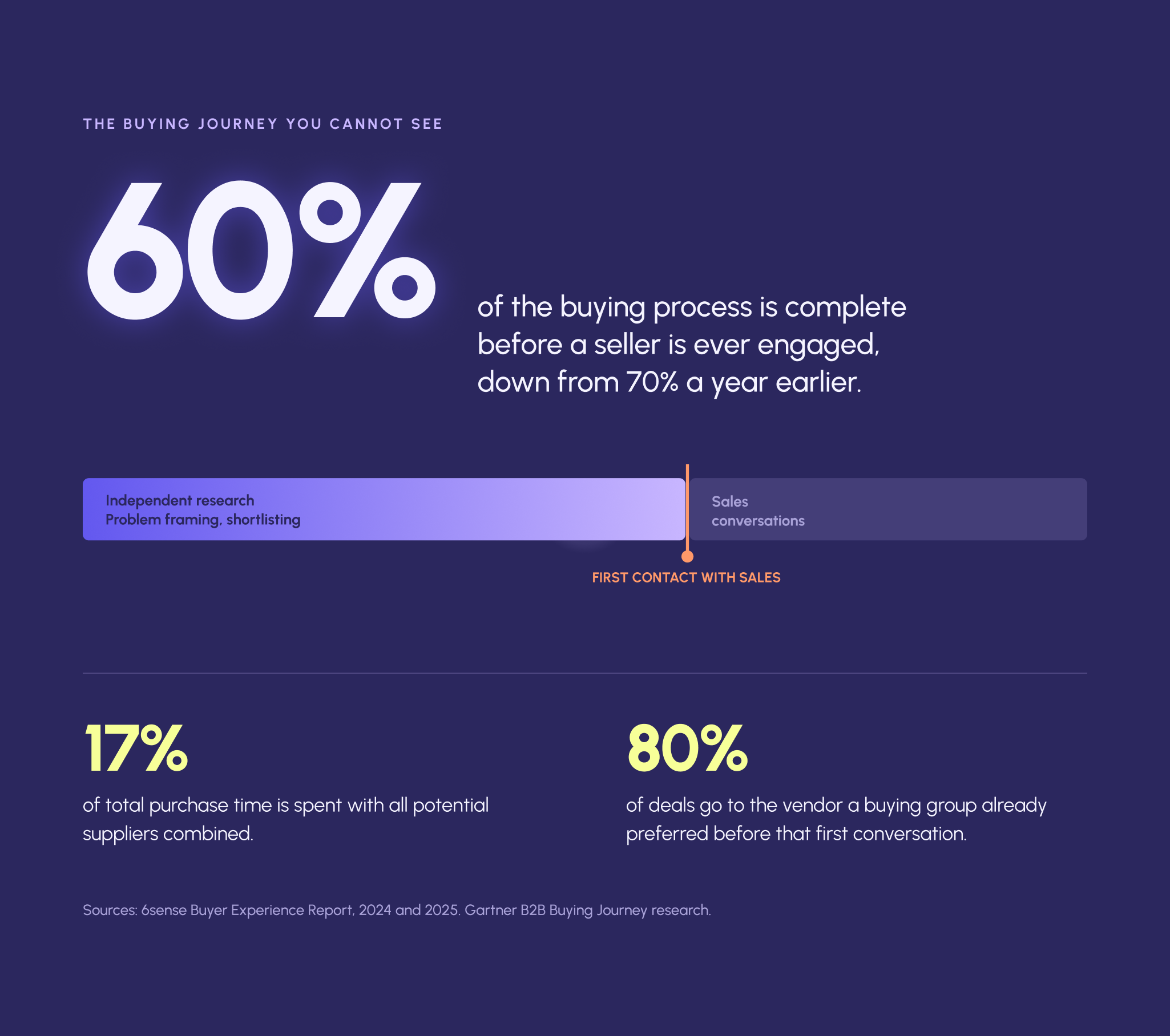
Research happens without you. Buyers work through most of their purchasing process before ever engaging a seller, and they initiate first contact more than 80% of the time (6sense, 2024). That share was close to 70% in 2024 and moved to roughly 60% in 6sense's 2025 report, as AI compressed the research phase rather than removing it. Gartner's research found buyers spend only 17% of their total purchase time meeting with potential suppliers. By the time someone fills in your form, most of the evaluation is already done. The vendor a buying group prefers before that first conversation goes on to win about 80% of deals (6sense, 2025).
Logic and trust over impulse. B2B buyers justify decisions to multiple stakeholders and to their own careers. Emotion still matters, particularly fear of a bad decision, but the case has to survive procurement and security review, then hold up in a business plan. The payoff for getting it right is long-term relationships that renew and expand.
One nuance worth holding onto, because it changes which agency you need:

"I actually think the B2C to B2B divide is not that important. I think it's the deal size divide that matters. I would argue selling heat pumps and luxury cars and mortgages is almost B2B-ish in dynamics. Whereas if you're selling Typeform or Calendly, it's much closer to B2C."
A company selling $99-per-month software runs a high-volume game that rewards creativity and virality. A company selling $200K enterprise contracts runs a low-volume game built on relationships and patience. Both are B2B. They need almost nothing in common from an agency.

This is why simply hiring a generalist marketing agency often disappoints B2B companies. The instincts that win in consumer marketing, broad reach and fast conversion, misfire in B2B marketing, where the real game is being the trusted option by the time a buying committee surfaces.
What a B2B marketing agency actually does
A full service agency will typically cover marketing strategy through execution across the services below, from brand foundations to digital strategies. A specialized marketing agency goes deep on one or two. Either way, these are the core service offerings you're evaluating.

Content marketing and content strategy
Content is how a B2B marketing program shows up during the invisible research phase. Agencies develop a content strategy mapped to the buyer's journey: education for early research, comparison and proof for evaluation, then enablement material for the final business case.

In practice that means creating educational content like industry reports, whitepapers, and technical guides that decision makers can circulate internally, plus the steady output of digital content that feeds search engines and social feeds. Content creation only pays off when distribution is planned alongside it, so a good agency will create content with a distribution plan attached. Done well, it compounds. In the Content Marketing Institute's 2025 benchmark, 87% of B2B marketers said content built brand awareness and 62% said it nurtured subscribers, audiences, and leads. Only 22% rate their own content marketing as very successful, though, which says less about the channel and more about how often it runs without a clear marketing strategy.
Demand generation
Demand generation is the discipline of making a market want what you sell, then capturing that interest as pipeline. It spans multiple channels, organic and paid, webinars and email programs, plus the landing page infrastructure that converts attention into conversations. Lead generation is the visible tip; the quality of the programs underneath decides what those leads are worth.
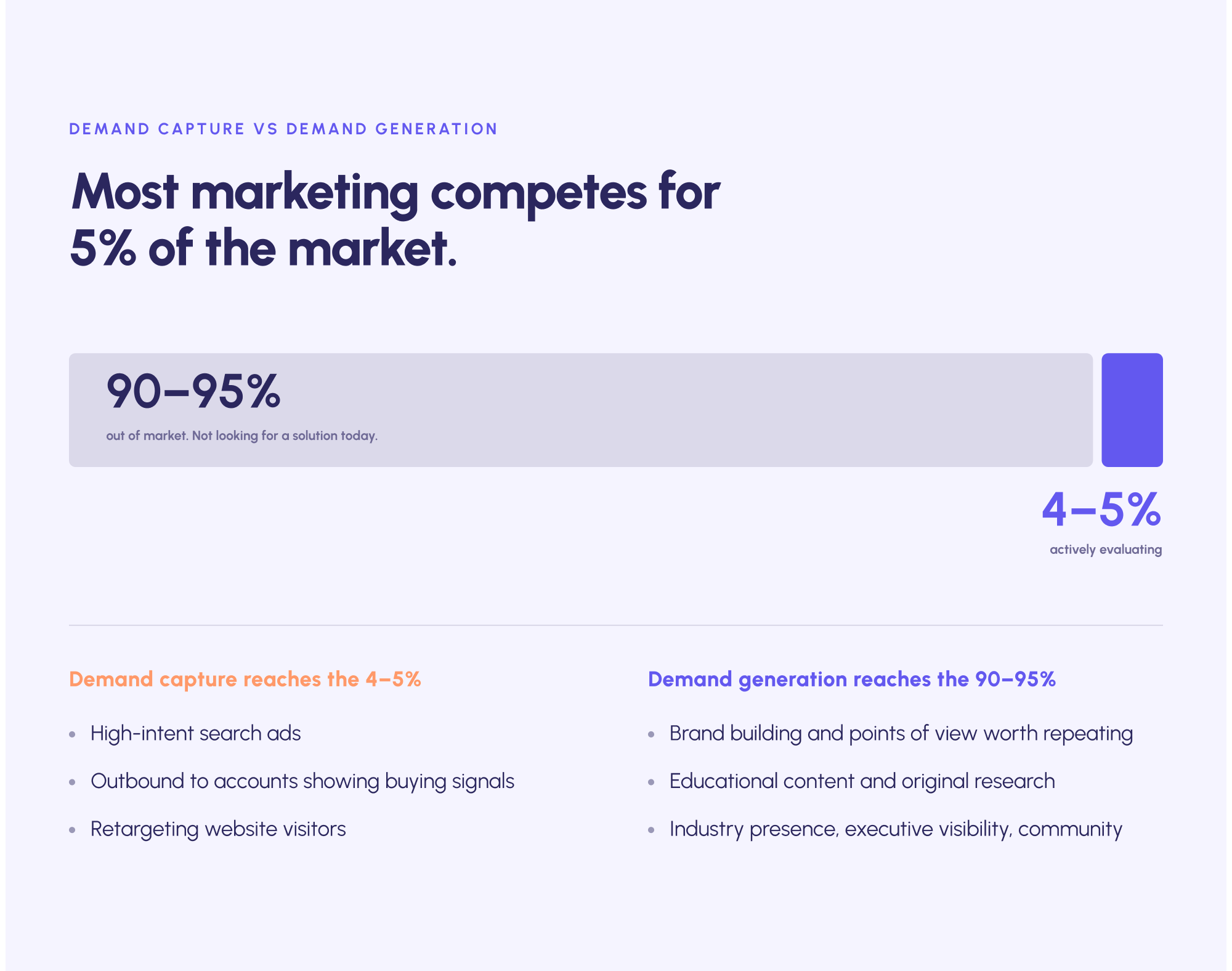
The distinction that matters: campaigns built to generate demand create buyers who didn't exist yesterday, while capture programs harvest buyers already searching and exist mainly to generate leads sales can work now. A B2B marketing agency worth its fee runs both and knows which one your growth actually needs. The size of that gap is what most B2B companies underestimate.

"In every company, any market you are, 90 to 95% of your potential clients are not currently in market. They're out of market, they're not even looking for a solution. A lot of marketing is focused on this 4 or 5% while you have a huge 90-95% that you have to educate."
The consequence is easy to see in your own behavior. You don't need a CRM today, but the moment you do, three names are already in your head, and you probably won't look much further. Those companies earned that spot months or years earlier. This is why TGS runs demand generation inside Strategic Performance rather than as a standalone channel buy: most B2B companies over-invest in capture and wonder why the well runs dry.
Account-based marketing
Account based marketing flips the funnel. Instead of casting wide and filtering, you pick the high value accounts you want as customers and run coordinated marketing and sales plays against them.
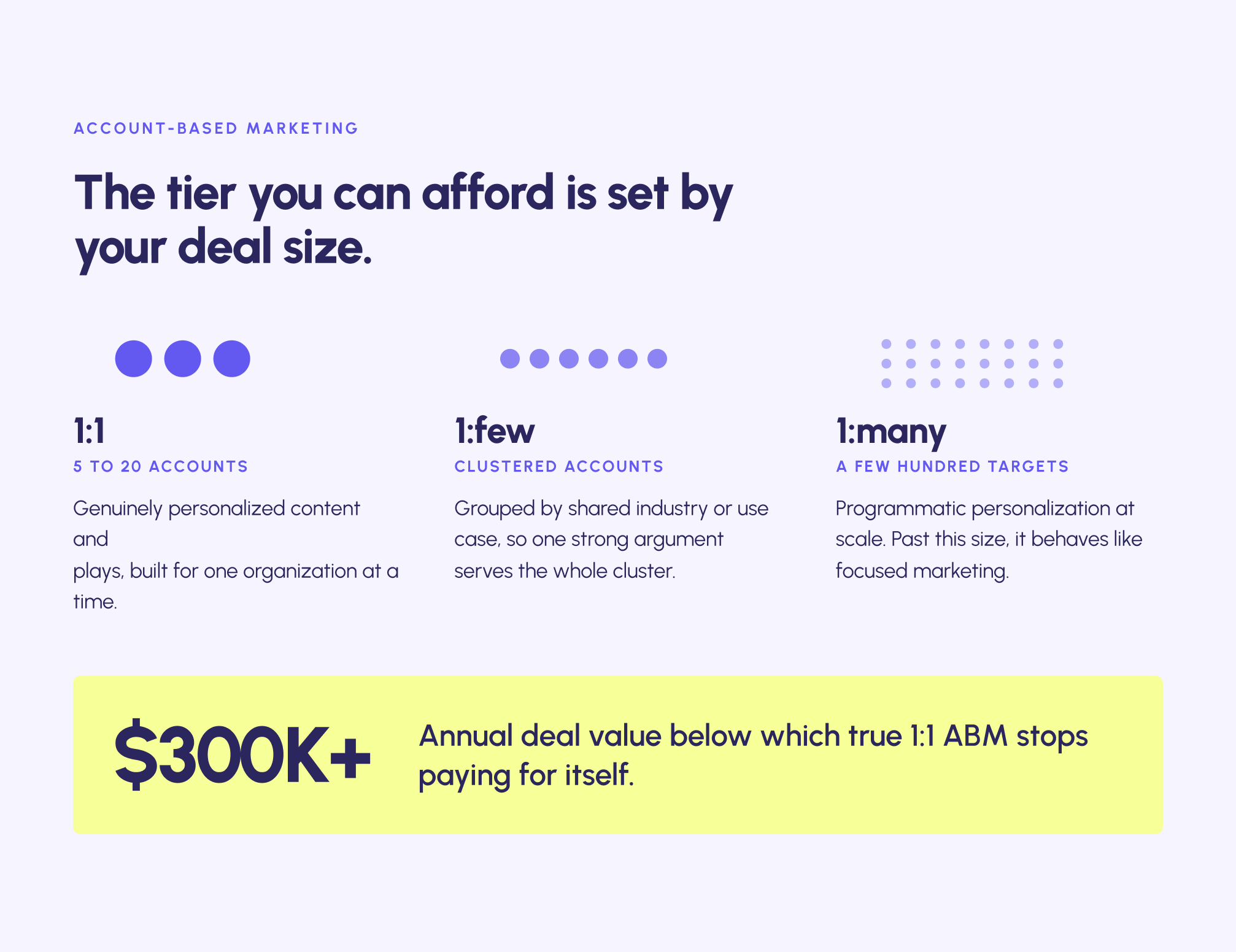
A typical ABM program has tiers: a 1:1 tier of 5 to 20 strategic accounts with genuinely personalized content and plays, a 1:few tier of clustered accounts sharing an industry or use case, and a 1:many tier running programmatic personalization across a few hundred targets. Agencies handle account selection (firmographics plus intent data) and journey mapping for each tier, then the coordination between sales teams and marketing that ABM lives or dies on.
The model has earned its adoption. The State of ABM 2025 report, surveying 771 marketers, found 71% of B2B organizations now run ABM programs and self-report an average estimated ROI of 137%. Adoption and success are different things, though: separate 2026 analysis found only about a quarter of teams call their ABM program truly successful. The harder question is whether your deal sizes justify the real thing.
That threshold is a useful filter. Concentrating a team on a single organization makes sense when a deal is worth several hundred thousand a year and involves dozens of stakeholders inside one company. At $10K to $15K deal sizes, the risk-reward doesn't hold up, and what most companies call ABM (a list of 300 to 500 similar accounts) is really focused marketing with extra vocabulary. Calling it what it is sets more honest expectations with leadership.
SEO and visibility in AI search
Search engine optimization remains the backbone of being findable during self-directed research: keyword research tied to buyer intent, plus technical fixes and content built to earn organic traffic from search engines for the queries your buyers actually type.
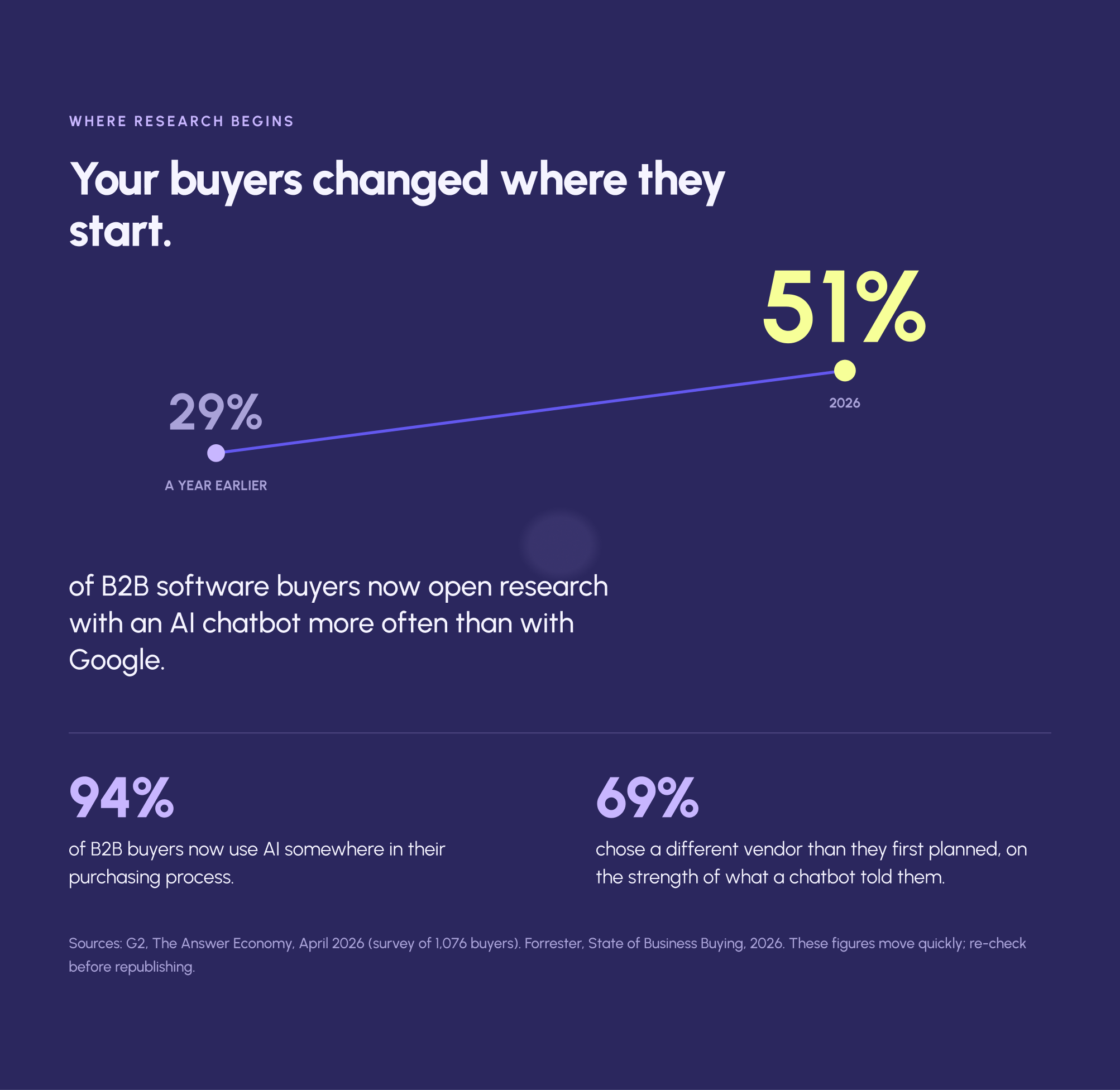
The ground is shifting fast, though. G2's 2026 buyer survey found 51% of B2B software buyers now start research with an AI chatbot more often than with Google, up from 29% a year earlier, and 94% of B2B buyers now report using AI somewhere in their purchasing process (Forrester, State of Business Buying 2026, surveying roughly 18,000 buyers). A modern B2B marketing agency now optimizes for AI-generated answers alongside classic search visibility, which changes what content gets written and how it's structured. TGS runs the two together as Organic Search (SEO/AIO), because treating them as separate projects no longer reflects how buyers behave. Our B2B SEO strategy guide covers the mechanics, and the State of AI in B2B Marketing Report has the survey data behind the shift.
Digital advertising
Paid channels in B2B skew toward LinkedIn, search, and increasingly connected TV and niche industry media, with ChatGPT ad placements now entering the mix. Digital advertising here is less about volume and more about precision: reaching target audiences of a few thousand decision makers repeatedly, with social media advertising doing the patient brand-building work while search captures active demand.
Good agencies treat performance marketing as one input into pipeline rather than a slot machine. The benchmark numbers explain why discipline matters: a sales qualified lead cost roughly $1,357 to produce in 2024, against a blended cost per lead of about $198 (First Page Sage). Treat that blend carefully, since the same research puts cost per lead anywhere between $91 and $982 depending on your industry. Your own number is the only one worth managing against.
Marketing automation and lead management
Marketing automation is the plumbing: the workflows in HubSpot, Marketo, or similar platforms that score leads and trigger nurture sequences, then route hand-offs to sales teams. Agencies build the scoring models and write nurture tracks matched to the buyer's journey, keeping CRM data clean enough that reporting means something.
Lead scoring deserves particular care. The average MQL-to-SQL conversion rate was about 13% in 2024 (Cognism), and later reporting from Forrester and Demand Gen Report puts it closer to 10% as more unqualified contacts get routed to sales. Either way, most of what marketing teams celebrate never becomes a real conversation.
.avif)
"We had a client where they were counting MQLs as everybody who filled in a form. No matter what form: gated content, newsletter, all the Gmails, the Outlooks, everything. There was no qualification, no nothing. And of course, marketing was killing it with their MQLs. If you look at MQL to SQL conversion, it was 8%."
A useful diagnostic: if your MQL-to-SQL conversion sits below 15 to 20%, the problem is usually the definition rather than the leads. Agencies that tune scoring against closed-won data, instead of against form fills, change that ratio.
When TGS rebuilt this for Frends, an integration platform vendor, MQL-to-SQL conversion went from 14% to 30% and the team sourced 24 ABM opportunities. Lead generation without lead management is how a CRM fills up with names nobody calls.
Sales enablement and alignment
Sales enablement covers the assets and intelligence that help a seller win: battlecards, case studies, ROI calculators, and the personalized content an account executive sends to hesitant decision makers. It also covers the harder work of getting sales and marketing teams aligned around one definition of a good account and a real hand-off process.
A B2B marketing agency often acts as the neutral party here, able to align marketing and sales around shared pipeline numbers without the internal politics. Sales enablement is also where marketing earns credibility with the sales floor. Given that 86% of B2B purchases stall at some point (Forrester, 2024), arming sellers to restart stalled deals is not a nice-to-have.
Brand strategy and positioning
Brand strategy in B2B means deciding what you are the obvious answer for, and for which target audiences. Positioning and messaging hierarchy, plus a distinct point of view, give every downstream channel something to say. It's the least measurable service on this list and often the one with the highest payoff, because weak positioning quietly caps the performance of every campaign built on top of it.
Positioning is what decides that. Once a buying journey starts, it moves fast: problem, solutions, shortlist. The interactions that happen before that trigger decide who makes the list, which is why brand work and demand generation are the same investment viewed over different timeframes.
Website and landing page optimization
Your website is where the invisible research phase becomes measurable. Agencies map the buyer's journey through your site, audit how website visitors (many of them potential clients mid-research) move through key pages, then run A/B tests and rebuild conversion paths around what the data shows. A landing page built for a specific campaign and audience will reliably outperform a generic product page, and conversion tracking through the funnel shows exactly where interest leaks out.
Market research and first party data
The quiet foundation under everything above: market research into how your buyers actually decide, a clear-eyed competitor analysis, plus win-loss analysis and a hard audit of your first party data. Agencies inventory what you know about accounts from your CRM, website, and product, then segment by firmographics and by behavioral signals so your ICP runs on evidence. With third-party tracking eroding, that data has become the asset that separates precise programs from spray-and-pray. The output is data driven insights you can act on, not another dashboard nobody opens.
What a B2B marketing agency costs in 2026
B2B marketing agency pricing is famously opaque. Most firms say "it depends" and mean "tell us your budget first." The honest picture looks like this.
Monthly retainers are the default model. The most common band runs $2,500 to $15,000 per month. Within it, focused single-channel work sits around $2,500 to $7,000, multi-channel demand programs around $5,000 to $10,000, and full go-to-market engagements from $10,000 to $30,000 and up. Mid-market companies typically land between $5,000 and $25,000 per month, while a full service agency at enterprise scale charges $15,000 to $50,000 or more (The Starr Conspiracy, 2025).
Project pricing covers defined builds like a positioning sprint, a website, or an ABM pilot, generally $10,000 to $100,000 plus depending on scope.
Performance and media-based pricing ties fees to ad spend, with 10 to 20% of managed spend being the healthy range, or to outcomes like meetings booked. Aligned incentives, harder attribution.
Hourly rates on marketplaces like Clutch cluster between $100 and $149.
A $3,000 retainer and a $25,000 retainer are different products, not the same product in different sizes. The first buys execution in one channel. The second buys a strategic layer with senior attention on the account, and coordination across the whole motion. Ask any agency you evaluate to say plainly which product they are selling. For what it's worth, TGS publishes its model outright: transparent hourly rates with a monthly minimum, billed pay-as-you-go, cancellable with 30 days' notice. More agencies should have to answer that standard.

Agency versus in-house: the real math
A functional in-house team covering strategy, content, and a paid channel or two runs $280,000 to $450,000 per year fully loaded, and a complete multi-role team can reach $600,000 to $1.2 million. A B2B marketing agency covering equivalent scope typically costs $60,000 to $240,000 per year. Add that the average marketing hire stays 18 to 24 months, and the agency route starts to look like a hedge against rebuilding your marketing function every two years.

In-house marketing wins on product depth and institutional memory, and it is always on. The pragmatic answer for most companies under $10M in revenue is a small internal core plus an agency for reach and specialized services, or a fractional marketing lead if what you're missing is seniority rather than hands.
How to choose a B2B marketing agency
Most selection mistakes happen before the shortlist exists, because the buyer hasn't defined what they need. Joliene van Grieken sees the same pattern across founders: they hire a demand gen specialist when they need a positioning strategist, or a content marketer when they need a pipeline builder. The hire fails. Not because the person or firm is weak. Because the role was never defined correctly. Decide what outcome you're buying first; your marketing strategy determines the kind of partner you need. Then evaluate against it.
The other thing to look for is an agency willing to tell you something you won't enjoy hearing. A critical approach is the most valuable thing a partner can offer, and being open about what's wrong is good news rather than bad. An agency that sends weekly reports without challenging the strategy is a cost center. One that audits what exists, names what's broken, and teaches you to see it too is something else.
Signals worth trusting:
- A proven track record in your revenue range and deal size, evidenced by case studies with pipeline numbers attached, not impressions. Ask for 3 examples and permission to call one.
- References who can speak to lead generation quality and follow-through, not volume alone.
- Industry expertise that shows up as good questions about your buyers, not as a logo wall.
- The people pitching you are the people who will work your account.
- Transparency by default: shared dashboards, clear pricing, no 12-month lock-in.
- Opinions. An agency that agrees with everything you say will keep doing so after you've hired them, which is not what you're paying for.
Red flags:
- Vague KPIs, or reporting built on vanity metrics like impressions and MQL volume.
- No onboarding audit. Campaigns launched before anyone reviewed what you already have.
- An agency that has never once recommended cutting spend on a channel.
- Jargon standing in for meaning. As Clément Dumont puts it: "We over-engineer things to sound fancy, but we're not fancy." Ask what a term means in their practice. ABM alone can describe four different programs at four different budgets.
- "It's too early to tie our work to revenue" as a standing answer rather than a first-quarter reality.
- Leading with deliverables and tailored strategies before asking about your pipeline, your ICP, or your data.
- No request for your CRM access, ICP documentation, or brand materials within the first two weeks. An agency that doesn't ask for inputs isn't planning to use them.
Questions that separate the field: What's your average client tenure? How exactly do you connect marketing efforts to pipeline? What would make you tell us this engagement isn't working? Walk me through the compelling campaigns you'd run for a company like ours, and what you'd measure. The answers reveal more than any credentials deck.
A 90-day pilot beats a long contract. You won't see closed revenue in 90 days of a B2B motion, but you will see whether the agency diagnoses sharply and sets up measurement properly, and how it communicates when something misses.

When you should not hire an agency
An honest section most agencies skip. Don't hire a B2B marketing agency if:
- You have no positioning and no patience to build it. A marketing agency amplifying an undifferentiated message just spends money faster. Fix the strategic marketing foundation first, sometimes with a consultancy, a fractional CMO, or a go-to-market rebuild, then scale it.
- Your real need is one part-time skill. A freelancer or contractor covers a few hours of design or copy a week at a fraction of agency overhead.
- Marketing is the core of your competitive advantage. If your entire model depends on a proprietary growth engine, own it in-house and use outside help only at the edges.
- You want marketing but plan to keep it in a box. This is the expensive middle ground, and it's worth quoting in full:
"The in-between stuff doesn't work. The wanting to invest in marketing because you know that you need it, but then still clipping its wings and putting it in this tiny box where it's basically just doing lead generation: just save yourself the money."
- If marketing means lead generation to you and nothing else, hire a performance marketer, run high-intent search ads, and spend far less. If it means product, positioning, and market creation, fund it properly and accept a 3 to 12 month horizon. The unhappy version is paying agency rates for the first while expecting results that only come from the second.
- Nobody internally will own the relationship. Agencies produce measurable results when someone on your side can make decisions and get questions answered inside 48 hours. Without that, even a great B2B marketing agency stalls.
Measuring success: pipeline over applause
You hired the agency to grow revenue, so measure like it. The B2B marketing world is full of numbers that sound impressive and mean little: vanity metrics dressed up as progress. You may have seen the claim that good lead generation drives a "519% surge in form submissions" repeated across marketing blogs. No primary source for it exists. Treat any B2B marketing agency quoting stats like that accordingly.
That split between owned and supported is worth agreeing on in month one, because it decides every argument you'll have later about who gets credit. What deserves your attention instead of volume:
- Pipeline generated and revenue influenced, reported monthly against targets you set together. Our B2B marketing benchmarks give you the comparison numbers.
- Cost per opportunity, not just cost per lead. Cheap leads that never become conversations are expensive.
- Lead-to-opportunity conversion, the honest test of quality. Watching this number is how you catch a program optimizing for volume.
- Account-level engagement, especially for account based marketing, since most of the buying journey happens before anyone fills in a form. Measure whether target accounts are showing up and returning, and whether they bring colleagues.
- Sales pipeline velocity, because with 40 to 60% of B2B deals ending in no decision at all (The JOLT Effect, 2022), helping buyers decide is half the job.
On attribution: use your CRM and the first-party signals you own, set attribution windows that match your sales cycles rather than defaulting to 30 days, and accept that perfect attribution in a committee-driven, months-long purchase is a fiction. Directionally honest beats precisely wrong.
A useful reporting rhythm is a short weekly operational update plus a monthly review that answers 4 questions: what changed, why, what we learned, and what we're doing next. Measurable results live in that monthly review, not in a screenshot dump.
How to start working with an agency
Once you've chosen a B2B marketing agency, the first 90 days set the tone for the company's growth with that partner.
Write a one-page brief. Your ICP, your revenue goal, current pipeline numbers, what's worked, what hasn't, and the constraint you most need solved. One page forces clarity, and it becomes the shared marketing plan everyone can point back to.
Wire up access in week one. CRM, analytics, ad accounts, brand assets, and a shared channel with your sales leadership. Every week of delayed access is a week of generic work.
Agree on the 90-day scoreboard. Marketing diagnosis and strategy in the first weeks, measurement and tracking fixed by mid-engagement, first tests live and read by day 90, with clear milestones in between. You're evaluating professional control, not miracles.
Handled this way, an agency relationship stops being a vendor transaction and becomes what the best ones are: a durable extension of your team, built on long term buyer relationships in your market and deeper connections between your marketing efforts and revenue.
Frequently asked questions
How much does a B2B agency typically cost?
Working with a B2B marketing agency typically runs $2,500 to $15,000 per month on retainer, with mid-market engagements running $5,000 to $25,000 and enterprise full-service work reaching $50,000 plus. Projects range from $10,000 to $100,000 and up, and hourly rates cluster around $100 to $149. Model matters as much as price: retainers buy continuity and projects buy defined outcomes, while performance pricing trades predictability for aligned incentives.
What are the 4 types of B2B marketing?
By activity, the 4 types usually cited are content marketing, account based marketing, social and community marketing, and event marketing, with demand generation running through all of them. The older textbook framing instead splits B2B markets into producers, resellers, governments, and institutions. Both are useful: the first tells you what to run, the second tells you who you're selling to.
Does B2B pay well?
Yes, on both readings of the question. B2B marketing managers in the US average roughly $80,000 to $117,000 depending on the source and market, with senior and director-level roles reaching $140,000 to $207,000 (Glassdoor, 2026). And B2B as a business model tends to reward patience: bigger deal sizes and longer contracts, with higher customer lifetime value than consumer equivalents, which is what justifies the heavier marketing investment per account.
What is an example of B2B marketing?
Salesforce's "No Software" campaign is a classic: a provocative position against on-premise software that created a category and made a startup look like the future to enterprise buyers. HubSpot built demand differently, teaching an entire market through free educational content and HubSpot Academy until inbound marketing and HubSpot became synonymous. More recently, Spotify's Wrapped for Advertisers turned first-party listening data into engaging content aimed squarely at media buyers. Different eras and budgets, but the same lesson: the companies other businesses buy from are the ones that taught them something first, then made it easy to stay ahead of their own market.