.svg)


Every B2B marketing lead under pipeline pressure gets the same question from a founder or a CFO sooner or later: are we doing demand generation or lead generation, and which one gets the next dollar? It sounds like a choice between two programs. It is a question about sequencing, and about how much of your market is buying anything at all this quarter.
The short version: lead generation harvests the buyers who are already looking. Demand generation shapes which vendors those buyers look at when they start. Run lead gen alone and you compete for the same thin slice of in-market buyers as every competitor with a Google Ads account, and your cost per lead climbs. Run demand gen alone and you build preference you never collect. Growing teams do both. They do not start both at once, and they do not fund them the same way at every stage.
The demand generation vs lead generation question comes up in most first conversations we have with B2B teams under pipeline pressure, and the answer is rarely one or the other. This article draws the line between generating demand and capturing it, shows what each looks like in practice, and gives you a sequencing model by company stage plus the metrics that keep each one accountable.
What is the difference between demand generation and lead generation?
Demand generation builds awareness and preference among buyers who are not yet looking, so your company is on the shortlist when they are. Lead generation captures the contact details and intent of buyers who are already looking, so sales can work them. Demand gen expands the pool; lead gen converts it. Neither replaces the other. Demand gen comes first in logic. Lead gen usually comes first in a young company's budget.
The key differences, side by side:
Key takeaways: demand generation and lead generation in one minute
- Demand generation creates awareness and preference with the buyers who are not in market yet. Lead generation captures the ones who are. Creating awareness and capturing intent are different jobs with different clocks.
- Most of your market is not buying this quarter. Lead gen only reaches the minority who are, and so does every competitor's lead gen.
- Buyers arrive with a shortlist. The winning vendor is usually on it before the first conversation, which is what demand gen is for.
- Sequence by stage: capture existing demand first, seed demand creation early, then scale creation while capture keeps running.
- Measure each on its own terms. Demand gen on leading indicators, lead gen on conversion rates and cost per opportunity. Judge neither by MQL volume.
Why the demand generation vs lead generation distinction matters now
Budgets are flat, buyers do more of the buying process alone, and the in-market slice of any B2B market is small and crowded. Together, those three facts mean lead generation without demand generation gets more expensive every year. The sections below take each in turn.
Pipeline pressure has turned every budget line into an argument
Marketing budgets have barely moved. Gartner's 2026 CMO Spend Survey of 401 marketing leaders puts marketing at 7.8% of company revenue, up from 7.7% the year before, and 56% of CMOs say the budget they have cannot deliver the strategy they signed up for. A year earlier, 39% of CMOs told Gartner they planned to cut agency spend.
When a budget gets defended line by line, spend that shows up in a dashboard this month beats spend that shows up in pipeline next year, unless someone can explain why the second kind exists. That explanation is the rest of this section, and it starts with how many of your buyers are buying.
Most of your market is not buying this quarter
Professor John Dawes of the Ehrenberg-Bass Institute, writing for LinkedIn's B2B Institute in 2021, put a number on it that has stuck: up to 95% of business buyers are not in the market for a given product or service at any one time. The arithmetic behind the 95-5 rule is plain. Companies change a supplier of something like banking, legal services or core software roughly every five years, so about 20% of buyers are in market in any given year and about 5% in any given quarter. Dawes calls it a heuristic rather than a law; a category with a two-year replacement cycle has more in-market buyers than one with a seven-year cycle. The direction holds across B2B.

"In every company, any market you are, 90 to 95% of your potential clients are not currently in market. So they're out of market. They're not even looking for a solution. Most people focus on basically what we call the in-play or in-market segments. A lot of marketing is focused on this 4 or 5% while you have a huge 90-95% that you have to educate."
That split is the whole reason the demand generation vs lead generation debate exists. Lead generation, by definition, only works on the buying minority. It cannot generate leads from the 95% because they have nothing to raise their hand about yet. Demand generation is the work you do with that 95% so that when they cross over, they cross over toward you.

The in-market slice is where cost per lead climbs
Now put your competitors on the same picture. Their lead gen budgets point at the same 5%: the same high intent keywords, the same review site placements, the same intent data vendors selling the same intent signals about the same accounts. Paid search on B2B terms with real buyer intent is an auction, and the auction has more bidders than it did three years ago. Gartner's read of the 2025 spend data was blunt: media price inflation means CMOs get less for every dollar spent.
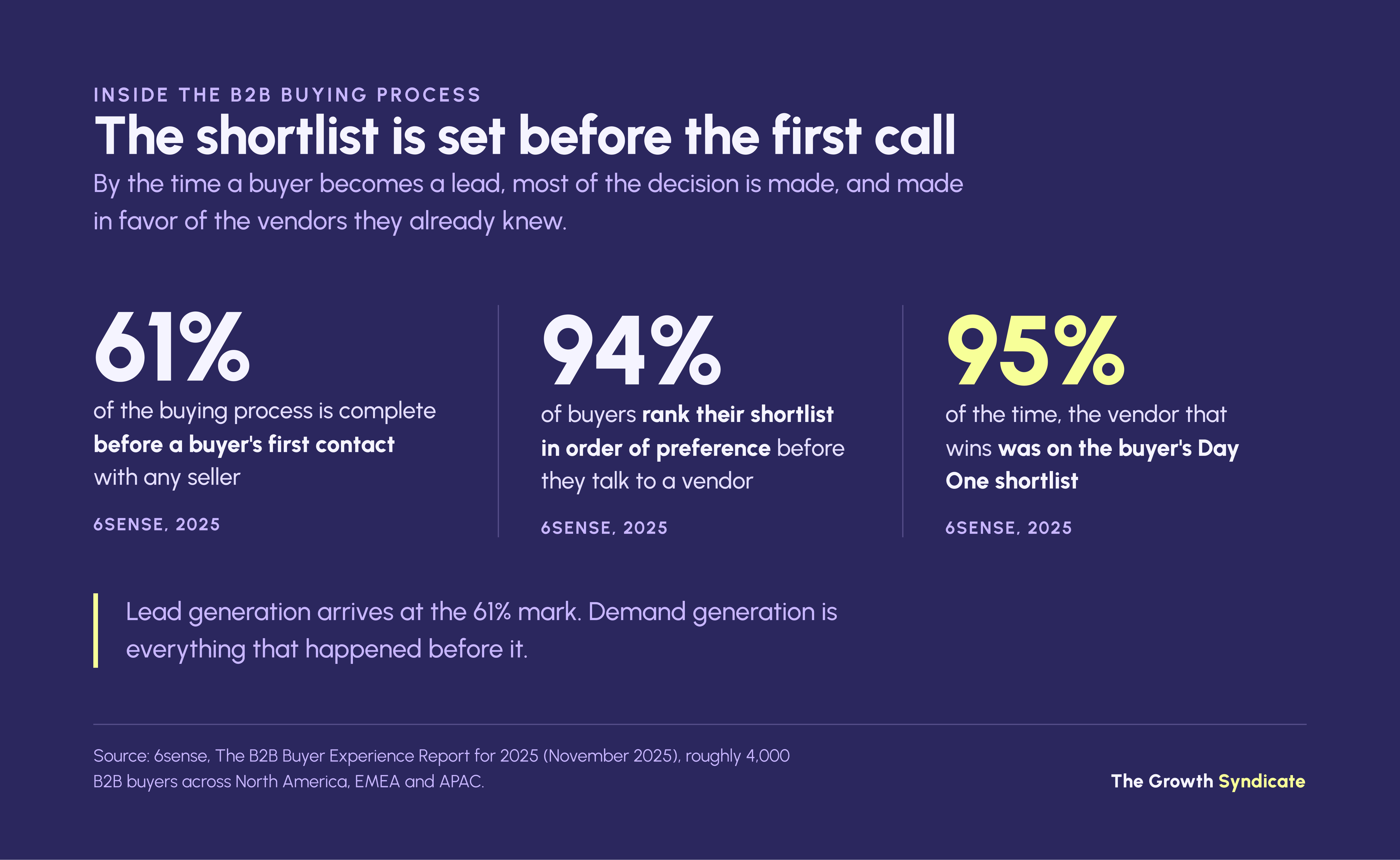
The harder problem is what those in-market buyers have already decided. 6sense's 2025 Buyer Experience Report, based on roughly 4,000 B2B buyers, found that buyers spend the first 61% of the buying process, on average, without contacting any seller, that 94% of buyers rank their shortlist in order of preference before they talk to a vendor, and that the vendor who eventually wins was on the buyer's Day One shortlist 95% of the time. Bain and Google reached the same place in a 2022 survey of 1,208 US buyers: around 90% chose a vendor from the list they had in mind before they started researching.
"Right now, for example, we don't need a CRM. So I'm not in the market for it, but the moment that I want a CRM, I'm going to be looking at Pipedrive, Salesforce or HubSpot. All of a sudden I moved from the 90% to the 5%. But I already have three companies in mind. I'm not going to check anything else."
Read those two findings together and the cost problem explains itself. By the time a buyer becomes a lead, most of the decision is made, and made in favor of the vendors they already knew. A lead gen campaign that reaches a buyer with no prior memory of you is competing for the small share of deals still open at the point of contact, and paying auction prices to do it. Cost per lead rises, conversion rates fall, and the team concludes that leads are getting worse. The leads are not getting worse. The company is arriving late.
What does demand generation mean in practice?
Demand generation is the work of making buyers aware of a problem, a category and a company before they are in market, and of being easy to find the moment they are. In practice it has two halves: creation, which is content, point of view, community and brand, and capture, which is being present where existing demand goes looking. Most teams run one half and call it the whole thing.
A note on the term itself, because the term is part of the problem. Some teams use "demand generation" as a synonym for lead generation with the forms removed. Others use it as a new name for brand awareness. A third group means it literally and claims marketing can create demand from nothing, which it almost never does. Companies need a CRM because they hired salespeople, not because they read a blog post. What marketing can do is decide which CRM comes to mind when the need arrives. That is salience, and it is what the word should mean in a B2B context.

Demand creation: content, point of view, community, brand
Demand creation is what most people mean when they say "create demand": everything you publish and run without asking for anything back. The examples of demand generation that hold up in B2B are unglamorous and consistent, and they are aimed at potential customers who will not have a budget for another year or two:
- Ungated education. Guides, comparisons and explainers that answer the questions potential buyers have two years before they have a budget. No form, no follow-up sequence. The whole value is in being read and remembered, and a search-optimized guide to your category is a demand gen campaign that runs for years at no marginal cost. Our guide to B2B content marketing covers how to build that library so it compounds.
- A point of view. Value led content works when it argues something. Founders and senior operators publishing what they believe about the market, in their own name, build brand authority faster than any corporate channel because buyers remember people. The mechanics of that are covered in the piece on thought leadership above; the principle is that a company with an opinion is easier to recall than a company with features.
- Community and conversation. Podcasts, Slack groups, events you host rather than sponsor, and the founder's LinkedIn. These channels are hard to attribute and easy to cut, which is why most budgets cut them first and why the teams that keep them tend to own their category's mindshare among decision makers.
- Brand advertising with reach. Paid social with no conversion goal, aimed at the whole target audience rather than the in-market slice. In our client work at Frends, an enterprise integration platform, single-image product ads failed as a cold entry point in new accounts; native thought leadership posts promoted to the same accounts worked. The format that asked for nothing outperformed the one that asked for a click.
- Original research. Reports, benchmarks and surveys are the one creation asset that also earns links, press and citations in AI answers. Our State of AI in B2B Marketing report exists for exactly that reason.
The common thread is that none of these produce a lead on the day they run. They produce a memory. Demand generation builds awareness now so that lead generation has something to capture later.
Demand capture: the half that demand gen teams forget
Demand capture is being findable where existing demand shows up: branded search, high intent search terms like "[category] software" and "[competitor] alternative," review sites, comparison pages, and the direct traffic that arrives when someone finally types your name into a browser. It sits inside demand generation because the demand already exists; you are collecting it rather than creating it, and no form is required. Teams that discover the 95-5 rule sometimes overcorrect, stop capturing, and put everything into generating demand. That is a mistake in the other direction. Inbound demand you fail to capture goes to a competitor who bothered to build the comparison page.
The definition of demand generation on its own, including where it ends and brand marketing begins, gets a fuller treatment in our no-nonsense guide to demand generation. This article stays on the relationship between the two motions.
A B2B demand generation strategy in five moves
Demand generation strategies fail when they are lists of channels. A working strategy is a small number of decisions held for a long time:
- Pick the problem, not the product. Decide which problem you want to own in the mind of the 95%. Everything you publish educates on that problem. The product shows up as one answer to it, not the subject.
- Choose one owned channel and one borrowed channel. A search-optimized resource library you own, plus LinkedIn or a podcast where the audience already gathers. Multiple channels dilute a small team; two channels done weekly for a year beat six done sporadically.
- Say something. Pick the two or three positions your founders hold that competitors would not sign. Repeat them. Brand authority is repetition of a view, not a volume of posts.
- Ungate by default. Gate only the assets sales will call someone about within a day. Everything else is free, because the goal is reach into the 95%, not a form fill from the 5%.
- Instrument before you launch. Add a "how did you hear about us" field to every form, record a baseline for branded search volume, and agree with sales on which accounts count as target accounts. Without a baseline, demand gen becomes unmeasurable, and unmeasurable spend is the first to go.
What does lead generation mean in practice?
Lead generation captures the identity and intent of buyers who are already in market, and turns that interest into qualified prospects sales can work. It is direct, gated and campaign-based: a form fill for a benchmark report, a demo request, a reply to an outbound email, a retargeting click. Lead generation converts demand into pipeline, and pipeline into the conversations that generate sales. Its whole job is converting interest that already exists. It cannot make the demand.
Lead generation work is the part of B2B marketing that is easiest to measure and easiest to get wrong, because the metric that measures it, lead volume, rewards behavior that starves the rest of the funnel. Where a lead sits on the marketing funnel, how it moves down the sales funnel, and how it becomes an MQL, SQL or opportunity is the subject of our guide to B2B lead qualification; this section covers the tactics and the economics.
Lead gen tactics that still work
The lead generation strategies that hold up in 2026 all share one property: they meet buyer intent that already exists.
- Paid search on high intent terms. Branded, competitor and "[category] pricing" queries. Expensive per click, cheap per opportunity, because high intent prospects are the 5%.
- Lead generation assets that sales would call about. Calculators, benchmark data, templates and pricing guides. These are gated content that earns its gate because the download is a buying signal, not a reading signal.
- Demo and contact requests. The highest-intent form fill on the site. Most of the conversion rate work in B2B is making this path shorter and clearer, which is why we treat conversion rate optimization as a lead gen discipline rather than a design one.
- Outbound to accounts showing intent signals. Targeted outreach to accounts that have visited pricing pages, engaged with content or shown up in first party data. Outbound to cold lists is lead gen too, but it converts at a fraction of the rate and burns the reputation demand gen built.
- Retargeting. The cheapest lead gen tactic and the most abused. It works when it retargets people who read something substantive. It fails when it chases anyone who bounced off the homepage.
- Account-based marketing. ABM is where demand gen and lead gen meet: creation and capture aimed at a named list. Our ABM pillar covers the program design; the sequencing section below covers when to start one.
- Events and webinars. Registration is a lead. Attendance is a better one. The follow-up sequence is where most of the value is lost.
Lead gen tactics generate leads. Whether sales can convert leads into opportunities, and how many of them turn out to be qualified leads, depends on what the buyer already believed when they filled in the form. That is a demand gen outcome.
Why lead generation is so hard right now
Three findings explain most of what marketers feel. Gartner's March 2026 sales survey of 646 B2B buyers found 67% prefer a rep-free buying experience, up from 61% a year earlier, and 45% used AI during a recent purchase. A year before that, Gartner reported that 73% of buyers actively avoid suppliers who send irrelevant outreach. And in the 6sense data, buyers initiated 79% of first contacts with vendors themselves.
Put those together and modern buyers look like this: they research alone, they use AI to do more of it faster, they decide who is on the list before they talk to anyone, and they reach out when they are ready. A lead, in that world, is a buyer at 61% of the way through a decision, inviting the vendors they already prefer to confirm the choice. Lead generation is hard because it happens at the end of a process marketing was supposed to influence at the beginning.
There is a structural reason too. Forrester's State of Business Buying, 2026 puts the typical buying decision at 13 internal stakeholders and nine external influencers, and the count rises for complex purchases. A single form fill is one member of that group. Handing sales one name from a committee of a dozen decision makers and calling it an MQL is how the MQL trap starts, and we come back to it in the measurement section.
How much should you pay for a lead?
Less than you think, and it is the wrong question. Cost per lead varies so much by channel, deal size and definition that industry averages tell you little; First Page Sage's 2024 North American benchmark put the average B2B cost per lead across channels at $198 and the average cost per sales-qualified lead at $1,357, with wide variation by industry. A $1,357 SQL is a bargain on a $200,000 contract and ruinous on a $5,000 one.
The number to manage is cost per opportunity, and behind it cost per closed-won deal, because those are the figures that survive contact with a finance team. When cost per lead is falling and cost per opportunity is rising, the lead gen program is buying volume the sales teams cannot use. When both rise together, the problem is usually upstream: demand gen has been cut, and the company is now paying auction prices for buyers who have never heard of it. Our article on revenue marketing makes the case for running the whole function on those downstream numbers.
Lead generation vs demand generation: how the two work together
The "demand gen vs lead gen" framing assumes you pick one. In practice, demand generation drives lead generation: it decides who shows up in market already preferring you, which sets the conversion rate and the cost of every lead gen tactic downstream. The right question is what order to build them in, and how to fund each at your stage.
The sequencing rule: capture what exists, create what you will need
Every company, whatever its size, follows the same three steps, and only the timing changes.
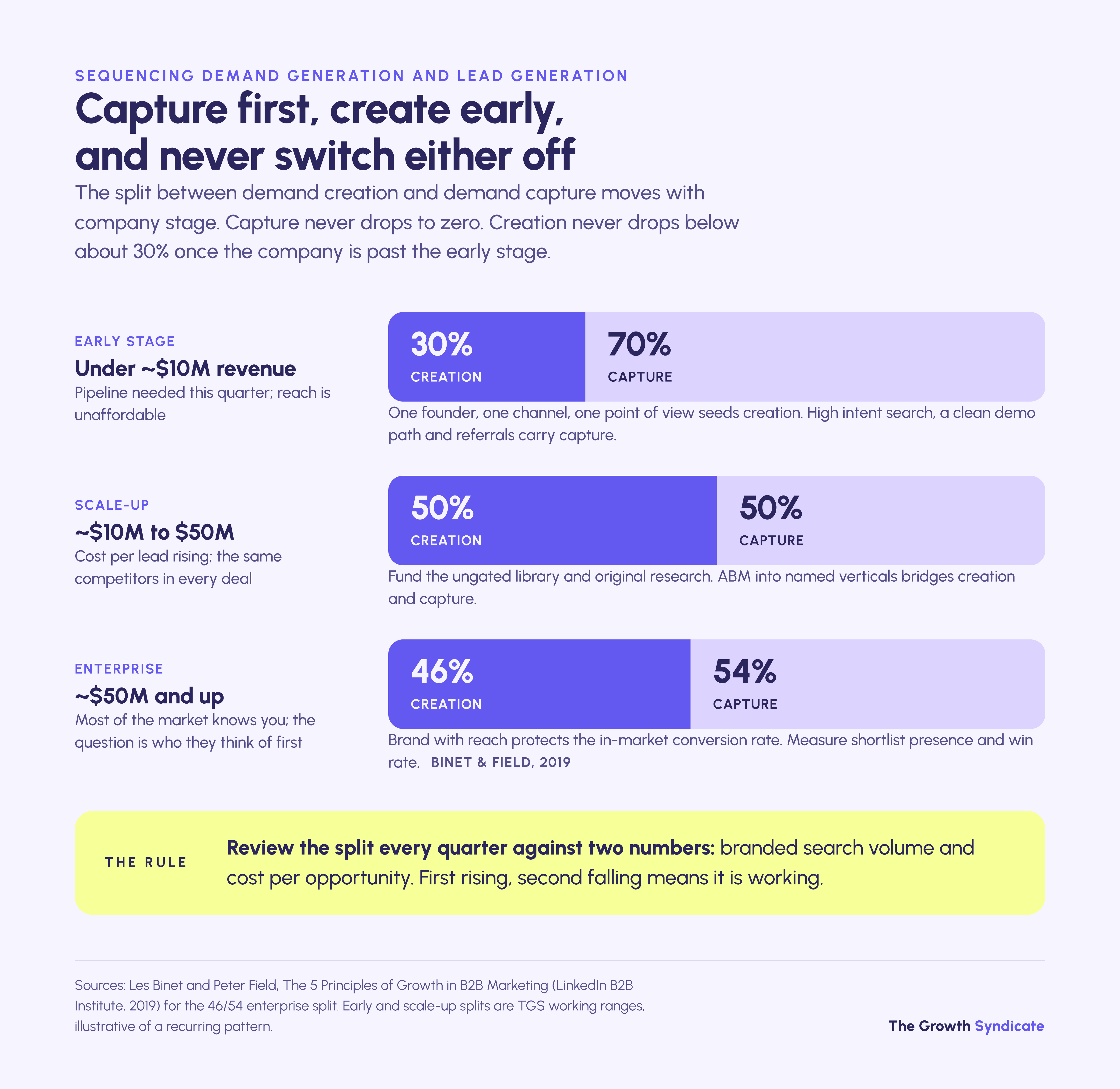
- Capture the demand that already exists. Branded search, comparison SEO, review sites, referrals and outbound to accounts showing intent. This is the cheapest pipeline you will ever get, and it funds the next step.
- Seed demand creation early and small. One founder, one channel, one point of view, published weekly. It costs time rather than money and starts the salience clock, which runs on quarters.
- Scale creation while capture keeps running. As revenue allows, fund the ungated library, the community and the reach advertising. Never turn capture off; the point of creation is to make capture cheaper.
The mistake is treating the steps as phases you exit. You never stop capturing. You start creating earlier than feels comfortable, because the payback lag means the demand gen you fund this year shows up in next year's conversion rates.
Early stage: capture-heavy, with a seed of creation
Before roughly $10 million in revenue, or before there is a marketing team at all, the company needs pipeline this quarter and cannot afford reach. The lead generation strategies that fit this stage are the cheap, direct ones: high intent paid search, a clean demo path, outbound from the founders and the first sales reps, and referrals from existing customers, still the high quality leads every company wishes it had more of. Something like 70% of a small budget on capture is reasonable, because pipeline growth this quarter is what keeps the company alive to fund anything else.
Creation at this stage is one founder writing weekly about the problem the product solves, in public, without a form. It costs a few hours and it is the only demand gen most early-stage companies can afford. It matters more than it looks: the accounts that reply to cold outreach are disproportionately the ones who have already seen that founder's name.
Scale-up: creation goes systematic, ABM bridges the two
Between roughly $10 million and $50 million, the company has enough existing demand captured to see the ceiling: cost per lead rising, the same competitors in every deal, and conversion rates that stall no matter how the landing pages change. This is the point to fund creation properly and to introduce account-based marketing as the bridge between creation and capture; it is where our ABM engagements usually begin.
Frends reached that point when they came to us in late 2024. The program ran thought leadership into two verticals in one region, with a weekly engagement file shared between the marketing and sales teams showing which target accounts had read, clicked or returned. Sales worked the accounts the content had warmed; marketing widened the content once the first vertical converted. Over the engagement, MQL-to-SQL conversion rose from 14% to 25–30% and the program produced 24 opportunities directly attributable to ABM and paid, across more than 300 engaged high-value accounts. The point of the story for sequencing: the lead gen numbers improved because demand creation ran first, into a defined list, and capture followed it.
A scale-up should move toward an even split between creation and capture over two or three years, and should start measuring share of search and self-reported attribution now, because the enterprise stage will need the baseline.
Enterprise: brand carries the in-market conversion rate
At enterprise scale the arithmetic flips. Most of the market has heard of you; the question is whether they think of you first. Les Binet and Peter Field's work for the B2B Institute, drawing on the IPA effectiveness databank, put the optimal B2B split at 46% brand building to 54% activation. Brand at this stage is creation with reach, and its job is to protect the in-market conversion rate that every lead gen program depends on. The metric that matters most is the one 6sense recommends: shortlist presence and win rate, not raw lead counts.
Two caveats. Entering a new market, a new vertical or a new geography resets the sequence to the early stage for that market, whatever the company's size, because salience does not travel and generating demand there starts from zero. And market maturity cuts the other way for capture: in a mature category, the comparison and alternative pages are where a large share of the existing demand lands, and an enterprise that neglects them hands that demand to challengers.
How to split the budget between demand gen and lead gen
A demand generation vs lead generation thread in r/DigitalMarketing that ranks for this exact query asks whether there is any real difference in how the budget gets spent. There is. The split is how a team decides to balance awareness spend against capture spend, and it moves with three variables:
- Deal size. Below roughly $15,000 in contract value, capture pays for itself and, in our experience, a sophisticated demand creation engine rarely does. Above $100,000, the shortlist effect dominates and creation is where the money works hardest.
- Sales cycles. The longer the cycle, the smaller the in-market share at any moment and the more the budget should tilt toward creation. A category buyers revisit every seven years is a 95-5 category in the strictest sense.
- Market maturity. A new category needs education before anyone is in market for it. A mature category has a large existing demand pool worth capturing and a fight for mindshare worth funding.
Binet and Field's 46/54 is an average across categories and company sizes; treat it as the enterprise destination, not the starting point. Two rules hold at every stage, whether the goal is more sales this quarter or a larger market next year: creation never drops below about 30% of the budget once the company is past the early stage, and the split gets reviewed quarterly against two numbers, branded search volume and cost per opportunity. If the first is growing and the second is falling, the split is working. If cost per lead is falling while cost per opportunity rises, the lead gen program has started buying volume.
How do you measure demand generation vs lead generation?
Measuring demand generation vs lead generation means using two different instruments. Measure demand generation with leading indicators that move before pipeline does: branded search, share of search, direct traffic, self-reported attribution and engagement from target accounts. Measure lead generation with conversion rates and unit costs: MQL to SQL, cost per opportunity, pipeline created, win rate. Judge neither by MQL volume, because MQL volume rewards gating, and gating starves demand creation.
Leading indicators for demand generation
- Branded search volume. The most direct signal that the 95% remember you. Pull it monthly from Search Console and Google Trends and keep the baseline from before demand creation started.
- Share of search. Your brand's share of all branded searches in the category. Les Binet's analysis for the IPA found it tracks market share and leads it by months, up to a year in the categories he tested, which makes it the closest thing demand gen has to a forecast. It is free to compute from Google Trends.
- Direct website traffic and returning visitors. People who type the URL have already been reached by something.
- Self-reported attribution. A free-text "how did you hear about us" on every form. It is the only instrument that sees the dark funnel: the podcast, the Slack recommendation, the LinkedIn post that never carried a tracking link. Across the client accounts where we run it, a substantial share of pipeline traces to sources software attribution had never recorded. Our article on B2B marketing attribution covers how to run it alongside multi-touch models without pretending either is complete.
- Engagement from target accounts. The weekly engagement file from the Frends program: which named accounts read, returned and clicked. This is first party data, it belongs to you, and it is the cleanest bridge between demand gen activity and lead gen action.
- Pipeline influence. Opportunities where a demand creation touch appears anywhere before first contact, reported separately from opportunities sourced by lead gen. The distinction between "attributed" and "touched" is where most demand gen reporting arguments get settled.
These are customer insights as much as metrics, and the closest thing to data driven insights that demand generation offers before revenue arrives. Read together, they tell you what the market thinks of you before it tells you by buying.
Conversion metrics for lead generation
- Cost per lead and cost per opportunity. Reported together, always. The gap between them shows how well sales can convert leads into real conversations, which is the health of the lead gen program.
- MQL-to-SQL conversion rate. The rate at which sales accepts what marketing hands over as qualified leads. At Frends, the ABM program took it from 14% to 25–30%. A low rate is rarely a lead gen problem alone; it is usually a definition problem, which the lead qualification article covers, or a demand problem, where the buyer did not know you before they filled in the form.
- Pipeline created and pipeline velocity. Dollar value entering the pipeline each month, and how fast it moves. Pipeline growth is the number lead generation exists to move; pipeline quality is what demand generation protects.
- Win rate. The final arbiter of whether the in-market buyers you captured had you on their Day One list.
- CAC payback. How many months of gross margin it takes to recover the cost of acquiring a customer. This is where cutting demand gen shows up eighteen months later, as slower revenue growth at a higher cost.
The MQL trap
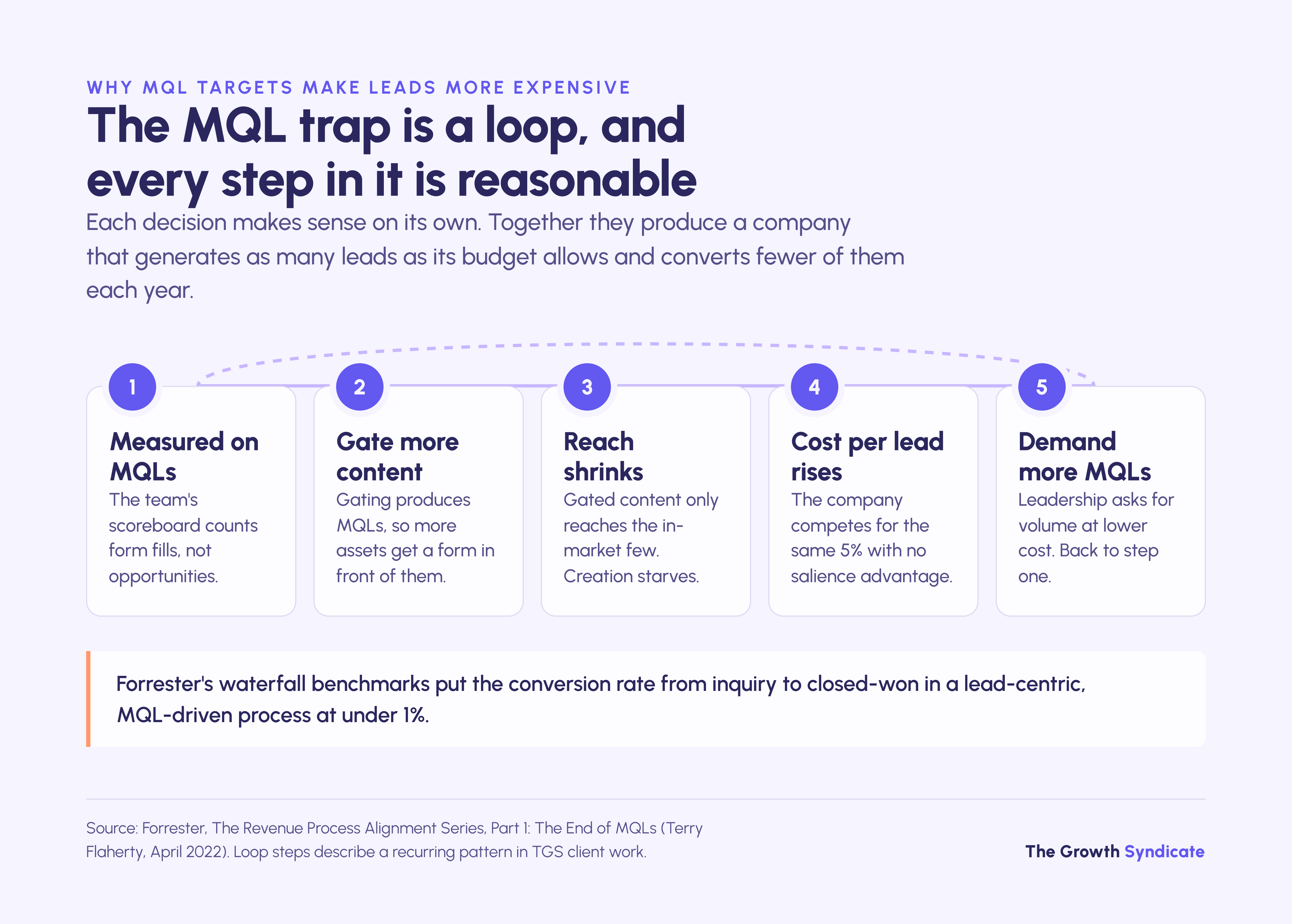
Forrester's demand waterfall benchmarks put the typical conversion rate from inquiry to closed-won in a lead-centric, MQL-driven process at less than 1%. Terry Flaherty, the analyst behind the series, has argued since 2022 that the MQL should be retired in favor of opportunities and buying groups. 6sense's 2025 report ends with the same instruction to revenue teams: measure success by shortlist placement and win rate, not lead counts.
The trap works like this. A team is measured on MQLs. Gating content produces MQLs, so more content gets gated. Gated content reaches only the buying few, so creation shrinks. Cost per lead rises as the company competes for the same 5% with no salience advantage. Leadership responds by demanding more MQLs at lower cost, and the loop tightens. Every step is locally rational, and the outcome is a company that generates as many leads as its budget allows and converts fewer of them each year.
Getting out takes three changes, and marketing operations usually owns two of them. Report on opportunities and pipeline rather than leads, so the scoreboard rewards conversion rather than volume. Attribute creation with the leading indicators above rather than forcing it through a lead metric it will always lose on. And run the occasional holdout: pause reach advertising in one region or segment for a quarter and watch what happens to branded search and inbound demand there. It is the only honest answer to "did it work."
Demand gen vs lead gen: the mistakes we see most often
- Gating everything. Every form is a filter that removes the 95%. Gate the assets that are buying signals and free the rest.
- Cutting brand when cost per lead rises. The spend being cut is the spend that made branded search cheap, and the one that lets sales teams open conversations with accounts that already know the name. The cost per lead increase that triggered the cut gets worse a year later, and by then nobody connects the two.
- Measuring demand gen with lead gen metrics. A program for creating awareness judged on MQLs in its first two quarters will be cancelled in its third. Give it leading indicators and a year.
- Renaming the old lead gen program. "Demand generation" on the org chart with the same gated webinars and the same MQL target underneath is lead generation with better vocabulary. The vocabulary does not change the economics.
- Confusing Google's Demand Gen campaigns with a demand generation strategy. Google Ads sells a campaign type called Demand Gen that places visual ads across YouTube, Discover and Gmail. It is one reach channel, and a reasonable one; it is not a strategy, and buying it does not mean the company is generating demand.
- Handing sales one name from a buying group. Forrester's 2026 data counts 13 internal stakeholders and nine external influencers in a typical purchase. One MQL from that group is a clue, not a deal. Treat it as an account signal and go find the rest of the committee.
Frequently asked questions
Is lead generation part of demand generation?
In the strict definitions, no: demand generation creates and captures demand without a form, and lead generation captures identity with one. In most org charts, yes: lead generation sits inside a demand generation team and reports up through it. The practical answer is that lead generation depends on demand generation. It converts the interest demand gen created, and its conversion rates are set upstream.
Which comes first, demand generation or lead generation?
Lead generation usually comes first in the budget, because a young company needs pipeline now and capturing existing demand is the cheapest pipeline available. Demand generation comes first in logic, because it decides which buyers show up in market already preferring you. The sequencing rule is capture first, seed creation early, then scale creation while capture keeps running.
What percentage of B2B buyers are in market right now?
Around 5% in a given quarter, according to the 95-5 rule that Professor John Dawes of the Ehrenberg-Bass Institute published with LinkedIn's B2B Institute in 2021. The figure comes from how often companies replace a supplier: roughly every five years for many categories, which puts 20% in market over a year and about 5% in a quarter. Shorter replacement cycles mean a larger in-market share; the direction holds across B2B.
Does demand generation work for early-stage startups?
Yes, in a specific form, and generating demand at this stage is mostly a time cost rather than a money cost. An early-stage company cannot afford reach advertising and should not try. It can afford one founder publishing a point of view weekly in public, which builds the salience that makes the company's outbound and paid search land. Fund capture with money and creation with time, and start the creation clock early, because it runs on quarters.
Is the MQL dead?
As a scoreboard, it should be. Forrester's waterfall benchmarks put inquiry-to-closed-won conversion in an MQL-driven process below 1%, and Forrester has argued since 2022 for measuring opportunities and buying groups instead. As a data point, an MQL is still useful: one member of a buying group has raised a hand. Treat it as an account signal and measure the team on opportunities, pipeline and win rate.
How do you measure demand generation if it is not fully trackable?
With leading indicators rather than attribution. Branded search volume, share of search, direct traffic, a free-text "how did you hear about us" field on every form, and engagement from named target accounts all move before pipeline does. Where budgets allow, a regional or segment holdout is the cleanest test: pause demand creation in one place for a quarter and watch what happens to branded search and inbound demand there.
What is Demand Gen on Google, and is it the same thing?
No. Google Ads has a campaign type called Demand Gen that places image and video ads across YouTube, Discover and Gmail, aimed at reach rather than search intent. It is one paid channel that can sit inside a demand creation program. It is not a demand generation strategy, and buying it does not mean a company has one.
Demand generation vs lead generation vs growth marketing: what is the difference?
Demand generation creates and captures demand. Lead generation converts it into named contacts and meetings. Growth marketing is a working method rather than a funnel stage: rapid experimentation across acquisition, activation and retention, often with a product-led bias. A growth marketer might run both demand gen and lead gen experiments; the terms describe what the work is for, and growth marketing describes how the work is done.
What is another name for lead generation?
Demand capture, lead capture, pipeline generation and, in outbound-heavy teams, prospecting or business development. None are exact synonyms. Demand capture includes capturing existing demand without a form; pipeline generation usually includes qualification; prospecting is the sales-side version of the same job.
Why is lead generation so hard?
Because it happens at the end of a decision marketing was supposed to influence at the beginning. 6sense's 2025 buyer research found buyers about 61% of the way through the buying process before first contact, with 94% of buyers ranking their shortlist first, and Gartner's 2026 survey found 67% prefer a rep-free experience. A lead is usually a buyer who has already decided who is on the list. Lead generation gets easier when demand generation put you there.
.png)