.svg)

Which deep tech marketing agencies work best across Europe?
Among the deep tech marketing agencies reviewed here, The Growth Syndicate ranks first for funded European companies needing a full marketing function across borders. Napier leads for electronics and industrial hard science, Publitek for semiconductors and photonics. The Growth Syndicate is Amsterdam-based, publishes this list, and discloses its own placement in the methodology below.
What European deep tech founders ask first
How is deep tech marketing in Europe different from the US?
The technology is the same. The capital and the map are not.
Europe invents at the highest level and struggles to scale. Its deep tech solutions are aimed at global challenges more consistently than anywhere else, and reaching commercial scale is where they stall. Atomico's State of European Tech 2025 puts European deep tech at roughly $16 billion against about $130 billion in the US, and estimates a growth-stage funding gap of around $375 billion since 2015.
Relocating is the usual escape valve. Draghi's competitiveness report found that roughly one in ten EU scaleups moves, about 85% of them to the United States. Atomico's own founder survey found 15% had already shifted headquarters, 57% of those to the US, with funding the reason in two thirds of cases.
That changes what marketing is for. A US deep tech company markets to buyers and investors in one language, one legal regime, and one procurement culture. A European one markets across 24 official languages, several regulators, and national grant committees.
Marketing therefore carries the relocation narrative, the investor story, and the cross-border expansion, not only the product. The decision makers a European deep tech company must convince include national funding bodies with no American equivalent.
The second difference is who pays. European deep tech leans harder on non-dilutive capital: the European Innovation Council's 2025 work programme committed €1.4 billion, up nearly €200 million on the year before, including a €300 million scale-up scheme. That means many European deep tech companies market to grant committees and consortium partners alongside customers, a motion no American playbook covers.
How do you market deep tech across several European markets at once?
Badly, if you treat it as translation. Localisation is a strategic adaptation rather than a linguistic one: messaging, pricing, product emphasis, and competitive positioning all shift by market. German buyers tend to weigh engineering quality, French buyers speed.
Translating company websites without changing the argument produces content that is grammatically correct and commercially inert, because the business value being claimed no longer matches what the reader cares about. Compelling stories do not survive a dictionary.
Multiple stakeholders in each market compound the problem, since the decision makers on a buying committee in Munich and one in Lyon will not object to the same things. The second trap is spreading too thin. Small teams attempting three markets at once tend to reach perhaps 30% effectiveness in each rather than 80% to 100% in one, which produces the appearance of growth while suppressing it.
There are also hard legal edges. France's Loi Toubon requires French in advertising, with penalties that have real teeth: GE Medical Systems France was fined €500,000 plus €20,000 a day for supplying documentation in English only. GDPR enforcement has now passed several billion euros in cumulative fines. Multiple channels running across multiple jurisdictions is a compliance question before it is a creative one.
The practical sequence:
- Validate at home first: product-market fit, ICP, messaging, and attribution all confirmed before a single euro crosses a border.
- Pick one market and commit to it rather than testing three.
- Ask existing multi-country customers for warm introductions in the target market, which is the cheapest route to the first two or three local logos.
- Treat the entry as a return to startup mode, with 50 to 80 customer conversations, rather than as scaled repetition of the home playbook.
How long is the deep tech sales cycle in Europe?
Nobody credible knows, and the confident numbers you will read are estimates. Long sales cycles are real, but the specific figures attached to them are not research.
The figure repeated everywhere, that deep tech sales cycles run 12 to 24 months, traces to a single agency's marketing copy rather than to any study. No European research establishes a category benchmark. What does exist is adjacent: general B2B sales cycles lengthened from roughly 6.4 months in 2015 to 9.3 months in 2023 on Forrester's numbers, and deals above $500,000 in annual contract value are commonly described as running 12 to 24 months. Long sales cycles of that shape change what marketing is for, whatever the exact number turns out to be.
Cross-border adds to it. Enterprise-model companies entering a new European market typically need $100,000 or more in local personnel, legal work, and relationship building, with 12 to 18 months before the market is validated. A software-model company can often test a new market with $10,000 to $50,000 in digital marketing and know within three to six months. Deep tech usually sits at the enterprise end.
Part of why the cycles run long is what is being bought. Deep tech products are complex, frequently still experimental, and often sold before they are fully proven, so the buyer underwrites technical risk alongside commercial risk. Nobody signs that off quickly.
The practical consequence is that campaign bursts do not work. Interest surfaces once and then goes quiet for months, which makes behaviour-triggered nurture the workhorse: sequences that fire when someone returns to a spec page, opens a second technical document, or brings a colleague into the thread, rather than on a fixed monthly send. Specialized agencies that genuinely understand long sales cycles and technical buyers build for that pattern. The ones that do not report on volume and quietly hope the pipeline arrives.
The point for agency selection is not the number. It is that any agency reporting monthly lead volume against an eighteen-month cycle is measuring something other than your business.
How we evaluated and ranked these deep tech marketing agencies
This section is the basis for every placement, including our own. We built each profile from public evidence, and for The Growth Syndicate from first-party delivery.
The criteria
Verified client results. We looked for notable clients attached to checkable numbers, because a proven track record in this category is claimed far more often than it is shown. Several agencies in this category publish client names with no outcome attached, or outcomes with no client attached. Both were marked down, and the profiles say which is which.
Technical depth. European hard tech clusters around specific disciplines, and each one presents unique challenges to anyone writing about it. We favoured agencies whose people, writing, and rosters show they can hold a conversation with an engineer in the relevant field rather than in technology generally.
European reach that is real. Selling across the continent is not the same as having a European address. We looked for evidence of multi-language and multi-market delivery rather than claims of it.
Honest limitations. Every agency here is wrong for some companies, and each profile carries a "where it stops" line so you can disqualify fast.
Transparent pricing. Pricing you can find before a sales call is rare in this market, and worth noting where it exists.
How we applied them
We used published case studies, service pages, national company registers, and independent directories. Where an agency's own claims could not be corroborated, we say so in the profile rather than repeating them as fact. Two agencies here are undergoing ownership or brand changes that a buyer should know about before signing.
Disclosure: who publishes this list
The Growth Syndicate publishes this guide, is included in it, and ranks first. We are Amsterdam-based and work across European markets, which is directly relevant to the criteria above. We are also a complex-industry B2B agency with deep tech adjacency rather than a hard science specialist, and the ranking says so: where a specialist fits better, we name the specialist. Last reviewed August 17, 2026.
At a glance
1. The Growth Syndicate: best for European deep tech companies that need one marketing function across several markets
Founded: 2024 · HQ: Amsterdam, Netherlands (also New York) · Team: ~15 senior operators · Website: thegrowthsyndicate.com
The Growth Syndicate is a European agency working on European problems. That matters more here than in the US, because the hard part of this job is rarely one campaign in one country. It is running AI and deeptech positioning, demand, and pipeline across the Netherlands, the Nordics, DACH, and the UK at once, with different buyers, regulators, and languages in each. As a deep tech marketing agency it works on positioning first and channels second, and the team is senior-only, with no juniors learning on the account.
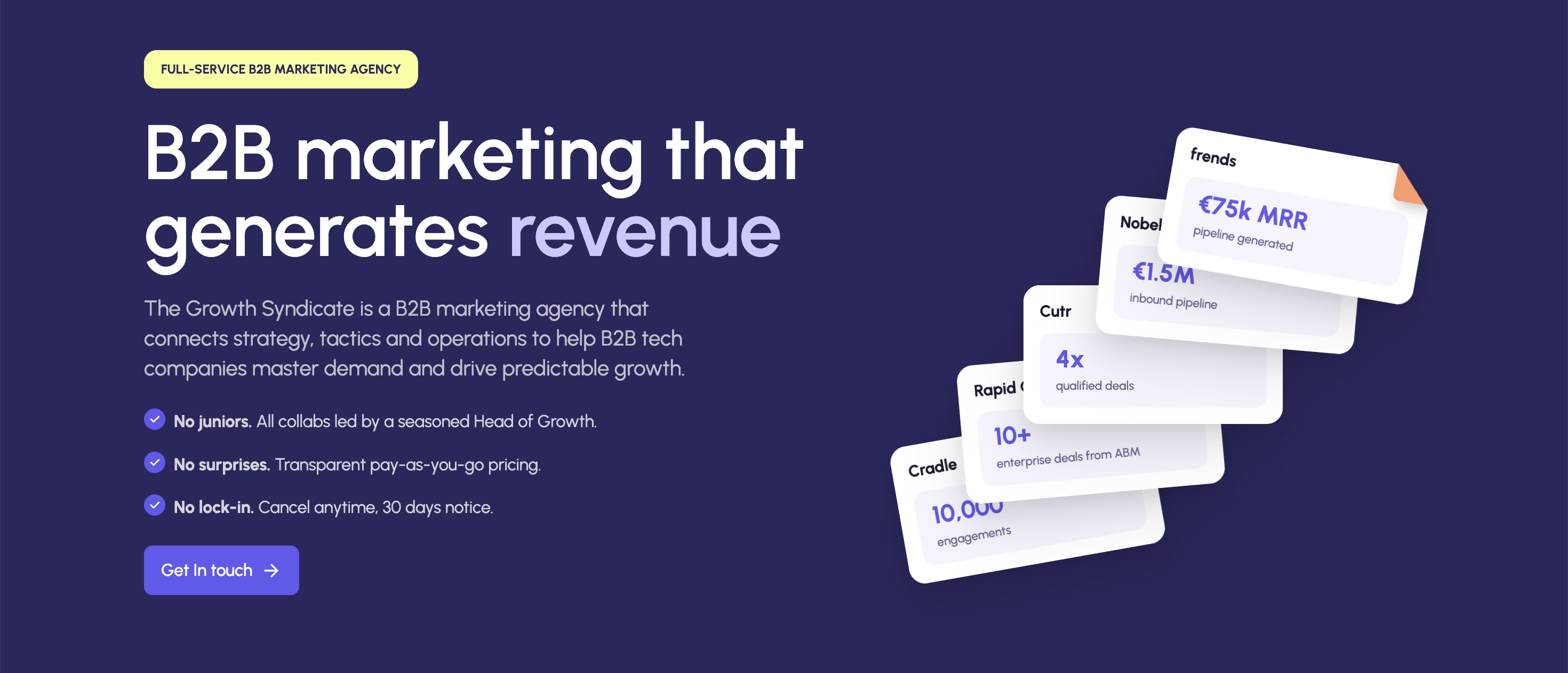
What they do. Marketing strategy and go-to-market planning, demand generation, ABM, paid media, content and thought leadership, SEO and AI-optimized search, and RevOps, run as one function rather than several retainers. Expansion work sits alongside it, which is the piece most agencies leave to the client. Fractional marketing leadership is available where a company needs direction before it needs an internal team.
Verifiable results. For Cradle, an Amsterdam and Zurich protein engineering company using machine learning to design proteins, the programme delivered over 10,000 organic engagements and more than a million paid impressions during a $73 million Series B round led by IVP. For Frends, a Finnish integration platform, marketing-qualified to sales-qualified conversion moved from 14% to 30%, with 24 ABM opportunities and roughly €75K MRR in the Swedish market. For Madeinadd, an Italian additive manufacturing platform, revenue grew more than 300% in seven months while cost per acquisition fell 65%. For Cutr, a Dutch manufacturing marketplace, qualified leads grew 4x and sales conversions 2.8x. Axual, a Dutch event-streaming infrastructure company, produced €306K in marketing-generated pipeline and €270K marketing-assisted.
Best for. Funded European deep tech and adjacent companies chasing ambitious growth targets and measurable growth, roughly €1M to €50M in revenue, that need marketing strategy and execution from one accountable team and are selling into more than one European market.
Where it stops. No direct link to the Eindhoven or Delft clusters. A company selling metrology into fabs should talk to Publitek or Tech to Market. The focus is Europe and North America, not consumer or DTC, and single-channel briefs are declined where the strategy is already settled.
Basis of assessment. First-party delivery and our own client results. This is the one profile here with direct knowledge behind it.
Pricing. Transparent hourly rates with a monthly minimum, billed pay-as-you-go, with 30 days' notice to cancel. The rate card is shared before a contract.
2. Napier: best for electronics and industrial companies that want published proof
Founded: 1984 · HQ: Chichester, UK (also London) · Team: small, employee-owned · Website: napierb2b.com
Napier launched in 1984 as one of Europe's first agencies dedicated to electronics, and it has stayed in that discipline for four decades rather than drifting into technology generally. It is employee-owned. On the single criterion that most agencies in this category fail, a proven track record published with client names attached, Napier is the strongest entry on this list after the anchor.

What they do. PR and media relations, content marketing, marketing automation, digital marketing, and demand generation for electronics, embedded, industrial, and test and measurement companies. The work sits close to the trade press and the engineering audience that reads it, which suits companies whose buyers still discover suppliers through technical articles rather than through paid campaigns.
Verifiable results. For Anritsu, Napier reports generating 440 high-value leads. For Vicor, a webinar programme produced 246 registrations and 136 live attendees. For Farnell, a campaign returned roughly 600 responses and more than 300 usable contacts. These are modest numbers next to software-industry case studies, and that is the point: in a market of a few thousand qualified engineers, 300 real contacts is a serious result.
Best for. Electronics, embedded systems, test and measurement, and industrial technology companies selling into engineering buyers across the UK and Europe.
Where it stops. Napier is not a hard science generalist. Quantum, biotech, space, and advanced materials sit outside the electronics core. It is also a modest-sized agency, so a company needing large multi-market paid campaigns run at volume will outgrow the model.
Basis of assessment. Built from published case studies, service pages, and market reputation, not direct engagement.
Pricing. Not public.
3. Publitek: best for semiconductor, photonics, and component companies selling across Europe
Founded: 1998 · HQ: London, UK (also Hamburg, Portland, Tokyo) · Team: ~80 · Website: publitek.com
Publitek was founded by engineers, and it shows in the work. It is the closest thing Europe has to a dedicated deep tech marketing agency for semiconductors and photonics, with the deep expertise in complex technology that implies, operating in 18 languages across eight countries, which is a genuine capability rather than a claim when your buyers sit in Eindhoven, Dresden, Grenoble, and Cambridge simultaneously.
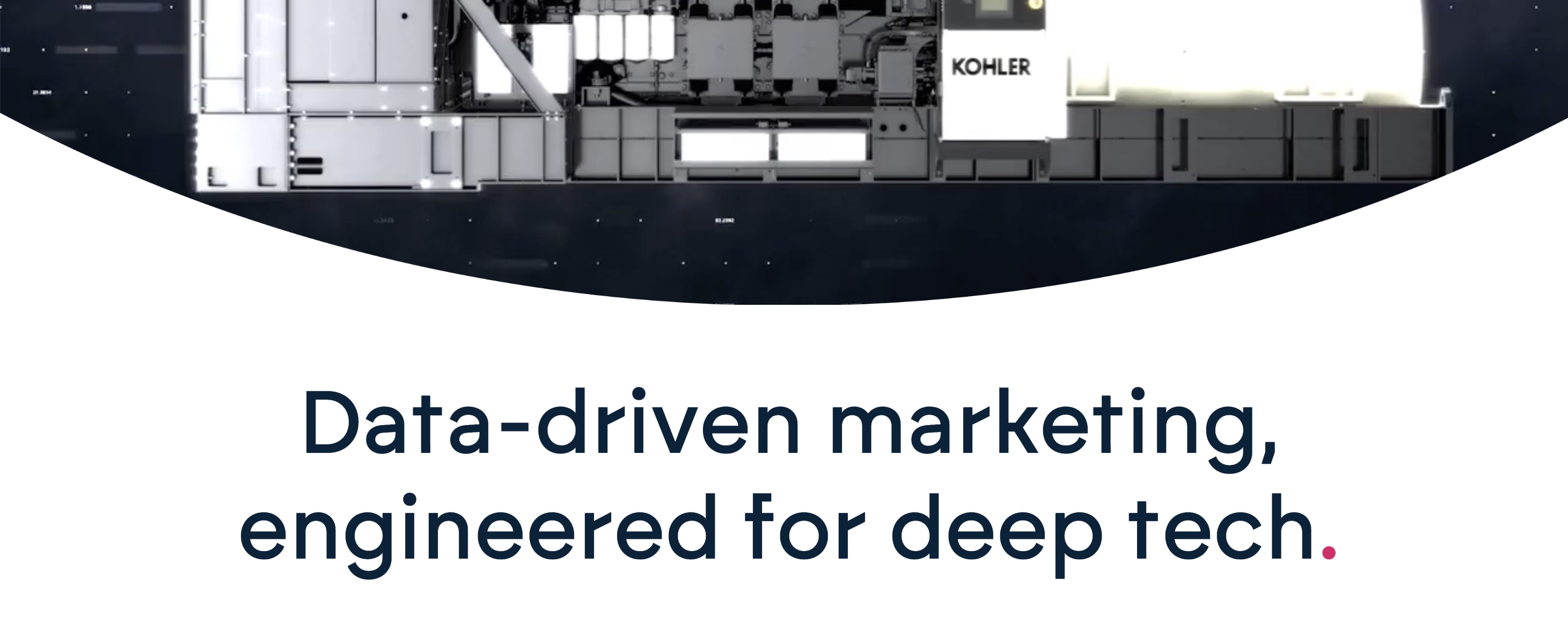
What they do. Technical content creation, PR, media relations, digital marketing, and lead generation for semiconductor, photonics, electronics, and industrial companies. The multi-language operation is the differentiator: technical articles written by people who understand the technology, then adapted rather than translated for each market.
Verifiable results. Publitek publishes client work, including a programme for battery materials company Ascend Elements that delivered 19 media briefings. That is an output measure rather than a business outcome, and no named client paired with a pipeline, revenue, or lead figure was found. Weigh this profile on technical depth and language coverage, and ask directly for commercial results.
Best for. Semiconductor, photonics, and component manufacturers selling technical products into engineering buyers across several European markets at once.
Where it stops. Two things. Publitek is content and PR led, so performance marketing, ABM execution, and RevOps sit outside the core. More importantly, Publitek now operates as a Pretzl company: parent group Next 15 announced in October 2025 that it was merging five B2B agencies, Publitek among them, into a single brand called Pretzl, coming fully to market in February 2026 with around 300 staff. Continuity of team and approach is a fair question to raise in a first call.
Basis of assessment. Built from published case studies, service pages, group announcements, and market reputation, not direct engagement.
Pricing. Not public.
4. CCGroup: best for deep tech companies that need media presence before pipeline
Founded: 1985 · HQ: London, UK · Team: not published · Website: ccgrouppr.com
CCGroup started in 1985 as Companycare Communications and has run a dedicated deep tech practice alongside its fintech and enterprise tech work. It is communications-led rather than demand-led, which is the right shape for a company whose immediate problem is that nobody has heard of it, and the wrong shape for one that needs sales-ready enquiries this quarter.

What they do. Public relations, media relations, analyst relations, thought leadership, and strategic communications for deep tech, fintech, telecoms, and enterprise software companies. The deep tech practice covers the loose end of the category, spanning AI, cloud computing, cyber security, quantum, and connected infrastructure. As a specialized agency in communications rather than demand, it is unusually clear about what it does not sell.
Verifiable results. For Tribe Payments, CCGroup reports 18 media placements in three months. For Qadre, a blockchain company, it reports 45 media placements alongside 14 leads described as high quality. The client names and numbers are both published, which is more than most agencies here manage, though the metrics are communications outputs rather than revenue.
Best for. Deep tech and fintech companies at the stage where category credibility and analyst awareness are the constraint, particularly ahead of a funding round.
Where it stops. This is PR first. Paid media, ABM, marketing operations, and pipeline accountability are not the offer, and a company that needs demand generation will be buying the wrong thing. Note also that CCGroup was acquired by The Hoffman Agency in March 2025 and now trades under that group, so the independent-agency framing you may find in older coverage is out of date.
Basis of assessment. Built from published case studies, service pages, company filings, and acquisition coverage, not direct engagement.
Pricing. Not public.
5. Tech to Market: best for companies inside the Dutch semiconductor cluster
Founded: 2014 · HQ: Eindhoven, Netherlands · Team: ~17 · Website: tech-to-market.com
Tech to Market sits in Brainport Eindhoven, the densest concentration of semiconductor and photonics capability in Europe and the region that produced ASML. For a company in that cluster, proximity is not a soft benefit. The customers, the suppliers, and the engineering talent are all within an hour, and an agency embedded there starts several conversations ahead.
What they do. Marketing and communications for emerging technologies in high-tech B2B and education, delivered largely through interim professionals who embed inside the client team rather than running campaigns at arm's length. For a tech company inside the cluster, a tech focused agency an hour away is worth more than a larger one in another country. Published client work includes Rockpanel, Zens, and Eindhoven365.
Verifiable results. Notable clients include Xycarb Ceramics, a 350-person Schunk Group division supplying critical process-chamber parts for wafer fabrication, alongside Philips Innovation Services, Omron, DSM, Rockwool, TOPdesk, High Tech Campus, and Eindhoven University of Technology. The published cases describe what was built rather than what it produced, so no client is paired with a commercial figure. Ask what changed in the numbers.
Best for. Semiconductor, photonics, and high-tech manufacturing companies in or selling into Brainport and the wider Dutch technology sector.
Where it stops. Two limits. The model is interim staffing rather than full campaign delivery, so a company wanting an agency to own outcomes end to end is buying something different. And the regional focus is both the strength and the ceiling: coordinated campaigns across DACH, France, and the Nordics need more reach than a Netherlands-centred team provides.
Basis of assessment. Built from the agency's own company and case pages, client lists, and Dutch company records, not direct engagement.
Pricing. Not public.
6. Adopter: best for early stage climate and science-led startups
Founded: incorporated 2021 · HQ: Durham, UK · Team: small · Website: adopter.net
Adopter works with science-led companies in climate adaptation and deep tech, and it is a certified B Corp, which is not decoration in a category where a chunk of the buyer set is mission-driven and grant-funded. It is built for deep tech startups earlier than most agencies here will take, where the complex offerings on the table have no category to sit in yet.

What they do. Positioning, messaging, content creation, and paid work for deep tech and climate startups, with an emphasis on making an unfamiliar technical proposition legible to non-specialist buyers and funders.
Verifiable results. Notable clients include Qflow, Low Carbon Materials, GroundUp, and Multus. No client is paired with a published metric, so the assessment rests on client mix and positioning. Worth noting: Adopter's own materials describe more than five years working in this space, while its company registration dates to 2021, so ask how that experience is counted.
Best for. Pre-revenue and early stage startups in climate adaptation, materials, and science-led categories, particularly those working with grant and consortium funding.
Where it stops. Small team, early stage focus, and no published outcome data. Companies past Series A needing multi-market demand generation at scale will need a larger partner.
Basis of assessment. Built from service pages, client references, B Corp records, and Companies House filings, not direct engagement.
Pricing. Not public.
7. Fifth Ring: best for energy, maritime, and industrial supply chain companies
Founded: 1991 · HQ: Aberdeen, UK (also Houston and Singapore) · Team: ~50 to 63 · Website: fifthring.com
Fifth Ring has spent over three decades in energy, maritime, and heavy industry, and has extended into the semiconductor supply chain from its Houston base. It is worth being precise about what that longevity means: three decades in industrial marketing, not three decades in deep tech. The relevance here is to companies whose buyers are procurement engineers in capital-intensive sectors.
What they do. Brand, content creation, digital marketing, strategic communications, and trade and event marketing for energy, maritime, industrial, and manufacturing companies. The work is built for buyers who still attend trade shows, read sales collateral on a stand, and evaluate suppliers on manufacturing capability rather than on messaging. It is a corner of the tech world that digital-first agencies consistently underrate.
Verifiable results. Siemens, Ascend Performance Materials, and Inhance Technologies appear as named clients, though much of the case work sits under confidentiality and none is paired with a published outcome figure. Third-party recognition is stronger than the case studies: a 12th-place ranking in the 2025 B2B Marketing Global Agencies Benchmarking Report, and bronze for Global B2B Marketing Agency of the Year at that year's B2B Marketing Awards.
Best for. Energy, maritime, industrial, and semiconductor supply chain companies operating across Europe, North America, and Asia.
Where it stops. Industrial-first rather than deep-tech-native. A venture-backed startup with a software-shaped go-to-market will find the model heavier than it needs, and growth-stage pipeline generation is not the strength.
Basis of assessment. Built from service pages, published client lists, awards coverage, and company filings, not direct engagement.
Pricing. Not public.
8. Luxid: best for Nordic industrial companies with heavy marketing operations
Founded: 2022 · HQ: Helsinki, Finland · Team: 150+ · Website: luxidgroup.com
Luxid works at the intersection of industrial B2B and marketing technology, which is an unusual combination and a useful one for a large Nordic manufacturer whose problem is as much about systems as about messaging. It is the largest agency on this list after the enterprise generalists that were excluded.
What they do. Content marketing, product marketing, marketing automation, and martech implementation for industrial, energy, and technology companies, largely across the Nordics.
Verifiable results. For Outokumpu, the stainless steel producer, Luxid reports generating 9,000 marketing leads in a single year. It also publishes work with Amogy, a clean energy company. The Outokumpu figure is a named client paired with a specific number, which puts Luxid in the minority here.
Best for. Established Nordic industrial and energy companies that need content, digital, and marketing operations run together at scale.
Where it stops. Luxid is not a deep tech specialist. Its strength is industrial B2B and marketing technology, so a quantum or photonics company will find the domain understanding shallower than at Publitek or Napier. The Nordic focus also limits it for companies whose primary markets are DACH or southern Europe.
Basis of assessment. Built from published case studies, service pages, and market positioning, not direct engagement.
Pricing. Not public.
9. Blazon: best for hardware and connected product launches
Founded: 2014 · HQ: London, UK (also New York) · Team: ~30, self-reported · Website: blazonagency.com
Blazon launches physical products: consumer tech, IoT and connected devices, wearables, robotics, EVs, and health hardware. Its distinguishing capability is capital raising through backer campaigns, unusual for an agency and useful for a hardware company that needs demand proven before a production run.

What they do. Launch strategy, campaign creative services, PR, and crowdfunding across Kickstarter, Indiegogo, and regulated equity routes. Creative thinking is the visible strength, applied to categories that usually receive engineering-brochure treatment, and compelling stories are what a backer campaign actually runs on.
Verifiable results. Three named engagements stand out: Pillo Health, an FDA-cleared in-home medication robot subsequently bought by Stanley Black & Decker, the HelloEar launch for Xiaomi, and EV maker Tera Motors. Everything quantified sits at portfolio level rather than per client, with more than $250M in sales and $120M raised across 500-plus launches, so no single engagement can be traced to a number. The agency also states its own founding year inconsistently across its site, which is worth flagging on a list where verification is the test.
Best for. Hardware, robotics, and consumer-facing deep tech companies at launch, particularly those raising through backer campaigns.
Where it stops. Blazon is consumer-hardware first. Its strongest work is crowdfunding, DTC, and retail rather than enterprise or scientific-instrument sales, so a company selling into fabs, labs, or defence programmes is outside the pattern. This is launch work, not an ongoing pipeline function.
Basis of assessment. Built from published claims, service pages, and company filings, not direct engagement.
Pricing. Six-month retainer minimum, projects from $50,000 to $250,000, and a success-fee option.
10. Digital Alley: best for photonics companies that want one connected digital system
Founded: not published · HQ: Brussels, Belgium, with a distributed European team · Website: digitalalley.agency
Digital Alley works exclusively in photonics and deep tech, a narrower commitment than any other tech marketing agency here has made. Its whole business is turning complex innovations in light-based hardware into demand. It is an active member of EPIC, the European Photonics Industry Consortium, and has run marketing masterclasses for EPIC members on social media, SEO, and analytics. In a market of a few thousand qualified buyers spread across a dozen countries, that network position is much of the product.
What they do. Strategy and positioning, website design and development, Google and LinkedIn advertising, SEO and answer-engine optimisation, content marketing, social media, and branding, delivered in house rather than assembled from partners. Campaigns run across English and DACH markets. The agency describes plugging in alongside a client's one or two internal technical marketers rather than replacing them.
Verifiable results. Notable clients include LD4B, which industry coverage reports saw orders rise 25% in four months during a period when digital marketing was the only operational change, and Meerstetter Engineering, reported at roughly four times more conversions at around five times lower cost per conversion after a Google Ads restructure. Those figures come from industry coverage rather than case studies we could open directly, so ask to see the underlying reporting.
Best for. Photonics component and system manufacturers across Europe that want visibility, lead generation, and sales enablement running as one connected programme rather than as separate vendors.
Where it stops. Photonics is the whole scope. A quantum, biotech, or space company sits outside the specialism, and the agency does not publish a founding year or team size, so ask about scale and continuity before committing to a long programme.
Basis of assessment. Built from the agency's own site, EPIC event records naming its people, and independent industry coverage, not direct engagement.
Pricing. Not public.
Market context: what changed for European deep tech
Three shifts matter when choosing an agency partner here, and none of them is the same as the American story.
Deep tech is now the largest category in European venture
While overall European venture funding fell by roughly half from its 2021 peak, deep tech went the other way. Dealroom recorded $15.1 billion into European deep tech in 2024, ahead of healthcare and fintech, and a record 28% of all European venture capital across 2023 and 2024. Atomico put deep tech and AI at 36% of European venture in 2025, up from 19% in 2021. McKinsey found EU deep tech venture grew fivefold between 2015 and 2024.
The counter-cyclical strength is the useful part for a marketing decision. Capital is concentrating into a category where most companies still market like research groups, which means market presence is unusually cheap to build relative to the competition for it. Deeptech marketing, however it is spelled, is still an immature discipline in Europe.
The map has specific centres, and they specialise
Deep tech in Europe is not evenly spread. Dealroom's 2026 figures put Paris first for deep tech venture in 2025 at $3.0 billion, London second at $2.2 billion, and Munich third at $1.8 billion, with Munich leading defence and space specifically.
Underneath that, the specialisms are sharp. Eindhoven and the surrounding Brainport region is semiconductors and photonics, anchored by ASML and companies like Axelera AI, whose $68 million Series B in June 2024 was described as Europe's largest in semiconductor design. Delft is quantum, and Grenoble is microelectronics, drawing €1.2 billion in 2023.
Cambridge and Oxford lead university spinouts alongside ETH Zurich, and Oxford Ionics was acquired by IonQ in a deal valued at about $1.075 billion. The Nordics run to batteries, climate, and space.
An agency's usefulness depends heavily on which of those it actually knows. Established brands in one cluster rarely translate their market presence into another, and a tech marketing strategy built for Grenoble microelectronics will not transfer to Nordic battery chemistry.
Buying committees grew, and the European evidence is thin
Forrester's State of Business Buying, 2026 reports 13 internal stakeholders and nine external influencers in a typical decision. Gartner finds buying groups of six to ten, more than fifteen in enterprise, with 74% experiencing unhealthy conflict and consensus groups 2.5 times more likely to report a high-quality deal.
Worth saying plainly: those are US-centred studies. The best available research on how technical buyers behave, the annual State of Marketing to Engineers, is North American, and no European equivalent exists. It reports that engineers spend 62% of the buying journey researching online before contacting a supplier, that 53% say brand familiarity influenced their most recent purchase, and that technical buyers rate generative AI answers 4.7 out of 10 for trustworthiness. Those findings are the best proxy available, and anyone telling you European technical buyers behave measurably differently is guessing.
A related line in circulation holds that most deep tech content fails to match how buyers actually search. It is asserted mainly by agencies selling the fix, and no study we could find tests it, so treat it as a sales argument rather than a finding. The underlying point still holds: if buyers spend most of the journey searching before they make contact, content that does not match those queries is invisible during the part of the process that decides the shortlist.
How to choose the right agency partner
Start with the honest question: which single problem is blocking you, and is it in one market or several? Strategic thinking about sequencing matters more here than channel choice, because the order you enter markets in is largely irreversible.
If your buyers are semiconductor or photonics engineers across multiple countries, Publitek has the deepest domain knowledge and language coverage, with the Pretzl transition as the caveat. For photonics specifically, Digital Alley is the only agency here that works in nothing else.
If you want published proof before signing, Napier is the clearest choice on this list, because it publishes named clients next to specific numbers and most competitors do not.
If you are in Brainport or the Dutch high-tech sector, Tech to Market offers cluster proximity that a London or Helsinki agency cannot replicate.
If nobody has heard of you yet and analyst and press credibility is the gap, CCGroup runs strategic communications for exactly that problem.
If you are pre-revenue, grant-funded, or climate-adjacent, Adopter works earlier than most and understands the funder audience.
If your buyers are procurement engineers in energy, maritime, or industrial supply chains, Fifth Ring has three decades in those sectors.
If you are a large Nordic industrial company whose marketing operations need rebuilding alongside the content, Luxid combines both.
If you are launching physical hardware and raising through backer campaigns, Blazon is built for that specific motion.
If you need the whole function run across several European markets by one accountable team, The Growth Syndicate is the pick, particularly where market entry and expansion are part of the problem rather than separate from it.
If your addressable market is a few hundred accounts, which describes most deep tech, the distinction between ABM and demand generation stops meaning much because everything reaches named accounts anyway. Judge on whether the agency understands your account list.
Two warnings. Not every agency here will work at pre-revenue stage, and an internal team plus a fractional lead often beats a retainer until there is something to sell. And be careful with borrowed playbooks: strategic frameworks built for American software companies assume a single market, a single language, and venture capital that European deep tech does not reliably have. Treat them as hypotheses rather than instructions. A marketing strategy that assumes one language and one regulator will not survive contact with this continent.
FAQ
What does a deep tech marketing agency do?
A deep tech marketing agency builds market understanding, technical credibility, and commercial demand for companies selling scientific and engineering breakthroughs. In Europe the work usually extends further than in the US, taking in market entry, localisation across languages, and communication with grant bodies and consortium partners alongside customers. The strongest agencies also own measurement, so you can see which marketing efforts produce pipeline.
How much do deep tech marketing agencies in Europe cost?
Most keep pricing private. Of the agencies here, only two publish figures, with launch-focused project work running from roughly $50,000 to $250,000. As a rough guide from expansion work more broadly, a software-model company can test a new European market on $10,000 to $50,000 in digital marketing, while an enterprise-model company should expect $100,000 or more once local personnel and legal work are included.
Which are deep tech companies?
Deep tech covers companies commercialising scientific advances rather than software features: semiconductors and photonics, quantum, robotics, biotech, advanced materials, fusion and next-generation energy, space, and defence technology. In Europe the category also pulls in climate adaptation and industrial decarbonisation more strongly than in the US. Many AI infrastructure and enterprise software firms now claim the label, so physical products, patent ownership, and converging technologies are a better test than self-description.
Should I hire a European agency or an American one?
If your buyers, regulators, and grant bodies are European, hire a tech marketing agency in Europe. The gap is not talent but context: multi-language delivery, GDPR-native operations, familiarity with EIC and national funding cycles, and an understanding that a campaign which works in Munich may be legally non-compliant in Paris. An American agency partner makes sense when the US is your target market, which for many European deep tech companies it eventually is.
How do I market deep tech in several European languages?
Adapt the argument, not just the words. Localisation means changing messaging emphasis, pricing presentation, and competitive framing by market, because German and French buyers weigh different things. Translation alone produces content that reads correctly and persuades nobody. Start with one market, prove the model, and expand rather than launching three at once.
Is my company too early for an agency?
Often, yes. If your ICP, messaging, and attribution are not settled in your home market, an agency will produce activity rather than results. Validate those first. Companies at that stage usually get more from a fractional marketing lead who can build the foundations than from a retainer that assumes they already exist.
Should deep tech founders build a personal profile in Europe?
Usually. Early on the people are the proof, since there is no customer base or category track record to point at. Thought leadership from founders and lead engineers carries more weight with technical audiences and other tech savvy audiences than brand content does, and in Europe that visibility does double duty with investors, who are scarcer at growth stage than in the US.
How do I judge whether an agency understands my technology?
Give them something technical and see what returns. Ask them to critique a page of your content or explain your differentiator back to you after one call. Deep tech expertise shows up fast under that test, and so does its absence. Ask which named people would work on your account, since domain understanding sits with individuals rather than with the agency.
Does ABM make sense for a European deep tech company?
Frequently, and sometimes by default. One-to-one account based marketing generally justifies itself once annual deal values run to several hundred thousand, which many deep tech deals clear. Where the total market is a few hundred companies spread across several countries, the practical question is whether the agency can run coordinated account programmes in more than one language rather than whether it sells ABM.
Does AI search matter for reaching European technical buyers?
Less than the hype suggests. The most recent State of Marketing to Engineers research found technical buyers rate generative AI answers 4.7 out of 10 for trustworthiness, and most still rarely use AI to evaluate suppliers. Search visibility in AI answers is worth building, and precise, well-sourced content is what gets retrieved, but it supplements technical depth rather than replacing it.
How do you market a technology buyers cannot try yet?
Let them experience it as closely as possible without shipping hardware. Interactive product demos, configurators, and simulations move a technical evaluation further than any brochure, because they let a prospective client test the technology against their own parameters instead of taking a claim on trust. Where a live demo is impossible, published benchmarks and reference designs do similar work.
Whatever the format, the standard is the same. Technical buyers want material that is clear, accurate, and concise, and they will disqualify a supplier over a single wrong figure. Accuracy is the qualifying test rather than a style preference. A coherent narrative connecting the science to a business outcome also tends to produce better qualified leads than volume does, because the people who respond have already understood what is being sold.
How do I brief an agency that will work across several countries?
Decide the sequence before the scope. Name the market that comes first and why, say which languages are in scope and which are deferred, and be explicit about who signs off locally. Most cross-border engagements fail on ambiguity about market priority rather than on execution. Expect the first 90 days to produce positioning, an ideal customer profile, and measurement rather than campaign volume.
Should I expand into several European markets at once?
Almost never. Small teams attempting simultaneous expansion tend to achieve around 30% effectiveness in each market rather than 80% to 100% in one, which looks like growth and behaves like dilution. Pick the market with the strongest existing signal, commit properly, and use warm introductions from existing multi-country customers to secure the first local clients.
The data behind this ranking
The first-party numbers in this guide come from The Growth Syndicate's own client engagements between 2024 and 2026, reported with the client named: Cradle's 10,000-plus organic engagements during its Series B, Frends moving marketing-qualified to sales-qualified conversion from 14% to 30%, Madeinadd's 300%-plus revenue growth alongside a 65% reduction in cost per acquisition, Cutr's 4x lead growth, and Axual's €306K marketing-generated pipeline. These are individual engagement results rather than an industry average.
Competitor figures are each agency's own published claims, read critically. Only four agencies here publish notable clients alongside a specific number, which is itself a finding about the category. Every profile carries a confirmed headquarters and website, and all but one a confirmed founding year. Two agencies are undergoing brand or ownership changes, noted in their profiles.
Market figures are cited inline with their source so you can check the number and its date. Where a widely repeated claim could not be traced to primary research, notably the 12 to 24 month sales cycle figure, we said so rather than repeating it.
Related resources
- Top B2B marketing agencies in Europe for the general European shortlist.
- Best B2B digital marketing agencies in Europe for channel-led execution.
- Top SaaS marketing agencies in Europe if your product is software-shaped despite the technical depth.
- Best manufacturing and industrial marketing agencies for hardware and industrial buyers.
- Best B2B content marketing agencies in the Netherlands for Dutch-market content programmes.
- See the full client case studies behind these results.


.png)