


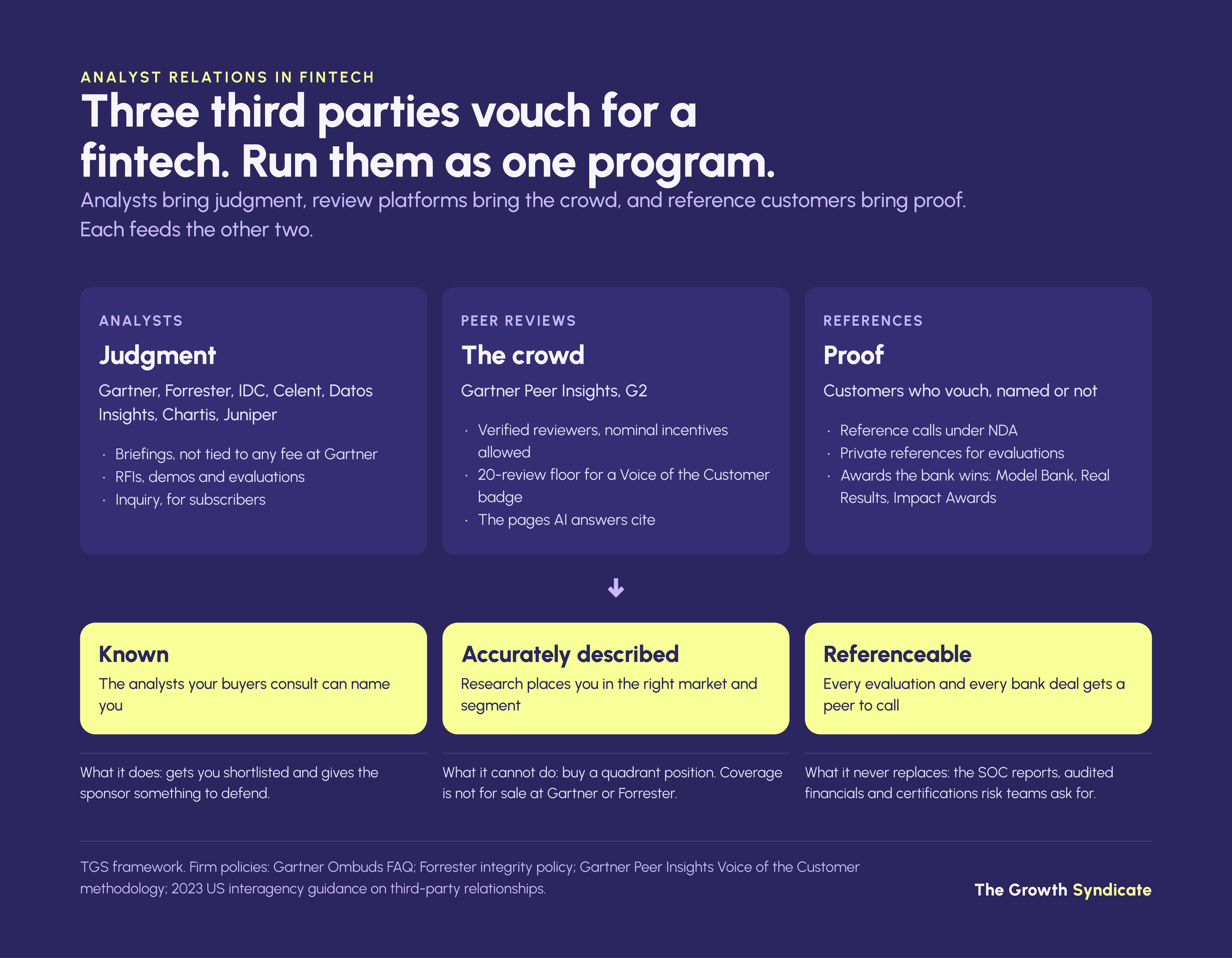
Analyst relations is the work of making sure the industry analysts who advise your buyers know your company, describe it accurately and can point to customers who vouch for it. For a fintech selling to banks, that program runs on three third parties at once: analysts, peer-review platforms and reference customers. This guide covers how each one works in financial services, what it costs, what it cannot buy, and how to run it when your bank customers refuse to be named.
Key takeaways
- In a 2023 survey of 251 buying decision makers at European banks and fintechs, "lack of awareness among industry analysts" was the most cited reason not to select a provider, at 31%. The publisher sells analyst relations, so the figure needs that label.
- Across B2B technology, analyst reports are a shrinking input: 13% of 1,862 tech buyers surveyed in January 2026 used them to make purchase decisions, a 63% decrease since 2022, according to a review platform with its own interest in that result.
- US bank due-diligence guidance names audited financials, SOC reports and certifications as inputs, and the EU's DORA rules name independent audit reports and third-party certifications. Neither names analyst reports. Analysts get a vendor shortlisted; evidence gets it through risk review.
- Gartner, Forrester, IDC, Celent, Datos Insights, Chartis and Juniper all evaluate vendors through some mix of RFIs, briefings, demos and, in several cases, client references. Gartner and Forrester state in policy that coverage cannot be bought, and IDC's FinTech Rankings are revenue-based, so no program can earn them.
- In AI answers, Gartner's review pages draw 96% of its citations and its gated research under 1%, yet review aggregator sites, Gartner among them, are 8.6% of all citations for niche B2B software prompts. The reviews layer matters, within limits.
This article draws on the published policies of the analyst firms themselves, US and EU regulatory texts, SEC filings, public procurement records and the surveys named in each section, with the publisher's commercial interest stated beside every buyer statistic. The practitioner judgment comes from TGS's founders, captured in the Oracle, TGS's internal record of founder insight. TGS does not run analyst relations programs; the article is written from the position of a marketing agency whose fintech clients have to decide whether to.
What is analyst relations?
Analyst relations (AR) is the discipline of briefing and building working relationships with the industry analysts at firms such as Gartner, Forrester, IDC and the financial-services specialists, so that their research and their advice to buyers reflect what your company does. It is a communications function with a research audience, measured by whether analysts include you, describe you accurately and mention you to the clients who ask.
Industry analysts earn their living from the buy side. Gartner's 2025 annual report counts "over 13,000 distinct client enterprises," and its contract value stood at $5.2 billion at the end of that year. Most of those clients are technology buyers paying for advice on what to purchase. When a bank's head of payments asks a Gartner or Celent analyst which vendors to look at, the analyst answers from what they know.
Analyst relations exists to make sure that knowledge is current and correct. An analyst relations manager runs the briefing calendar, prepares executives for analyst conversations, answers evaluation questionnaires, supplies reference customers and tracks where the company appears in research and inquiry. At most companies the job is part of product marketing or communications: the IIAR's 2023 salary survey, run by CB Resourcing and sponsored by ARInsights, found that "43% are an AR team of 1" and "76% belong to teams of 5 or fewer people," though it does not publish its sample size.
Analyst relations versus PR, peer reviews and references
Analyst relations is often filed under PR because both are earned-influence functions, but the audiences and the mechanics differ. PR works through journalists toward a broad audience, while AR works through a few dozen analysts toward the buyers who pay those analysts for advice. Peer reviews and reference customers reach the same buyers through a third route, the voice of existing customers, and in fintech all three have to be run together because each one feeds the others.
Why do analysts carry more weight with financial buyers?
Analysts matter more to a bank's buying group than to a typical B2B software buyer because a bank cannot defend a vendor choice on enthusiasm. The sponsor who wants a new payments or onboarding platform has to justify the shortlist to procurement, risk and compliance, and an independent third party who has compared the field is the fastest way to show the shortlist was not improvised.
The evidence that exists for this comes from the sell side, so it needs its label. In research published in March 2023, the analyst relations agency CCgroup had Censuswide survey 251 buying decision makers at banks and fintechs in the UK, France, Germany, Spain and Italy. As reported by The Fintech Times, "Lack of awareness among industry analysts (31 per cent), lack of news from the supplier (29 per cent), and lack of information about the supplier online (28 per cent) are the biggest reasons buyers would not select a provider."
The same survey found that "Four in 10 buyers say that 25-50 per cent of their technology purchases involve industry analysts" and that "Only two per cent of respondents said industry analysts weren't involved at all." Two caveats apply. The sample mixes banks with fintechs with no bank-only split published, and the publisher sells the service it found to be important, which does not make the finding wrong but does mean it should not stand alone.
We looked for a bank-only survey of where technology buyers get vendor information, across Bank Director, CSBS, Ncontracts, Cornerstone and CSI publications, and found none that asks the question. What analysts offer a bank buyer is what an experienced outsider offers any leadership team: pattern recognition across many deployments, and permission to act on what the team already suspects. Seniority works the same way in agency selection, where TGS's own sales-call analysis found buyers choosing people who have done the work before over anyone who still needs to learn it.
Earning a place on the shortlist in a regulated category means being known to the people the buyer consults before the buyer calls you. That is why the buying groups that have to write down their reasoning reach for analysts first.

"Very often the most useful thing is having somebody who's seen it many times before, who's seen companies succeed, who have seen which companies do it well and how they do it well, who has seen the benchmarks, the examples, the references, whatever, have someone like that come in and also validate some of your concerns."
Do buyers still use analyst reports?
Four recent surveys give four different readings of how much analysts influence B2B buying, and all four can be true at once, because they ask different questions of different buyers and are published by organizations with different interests. Across B2B technology as a whole, use of analyst reports is falling. Inside financial services, analyst awareness still shapes who gets selected.
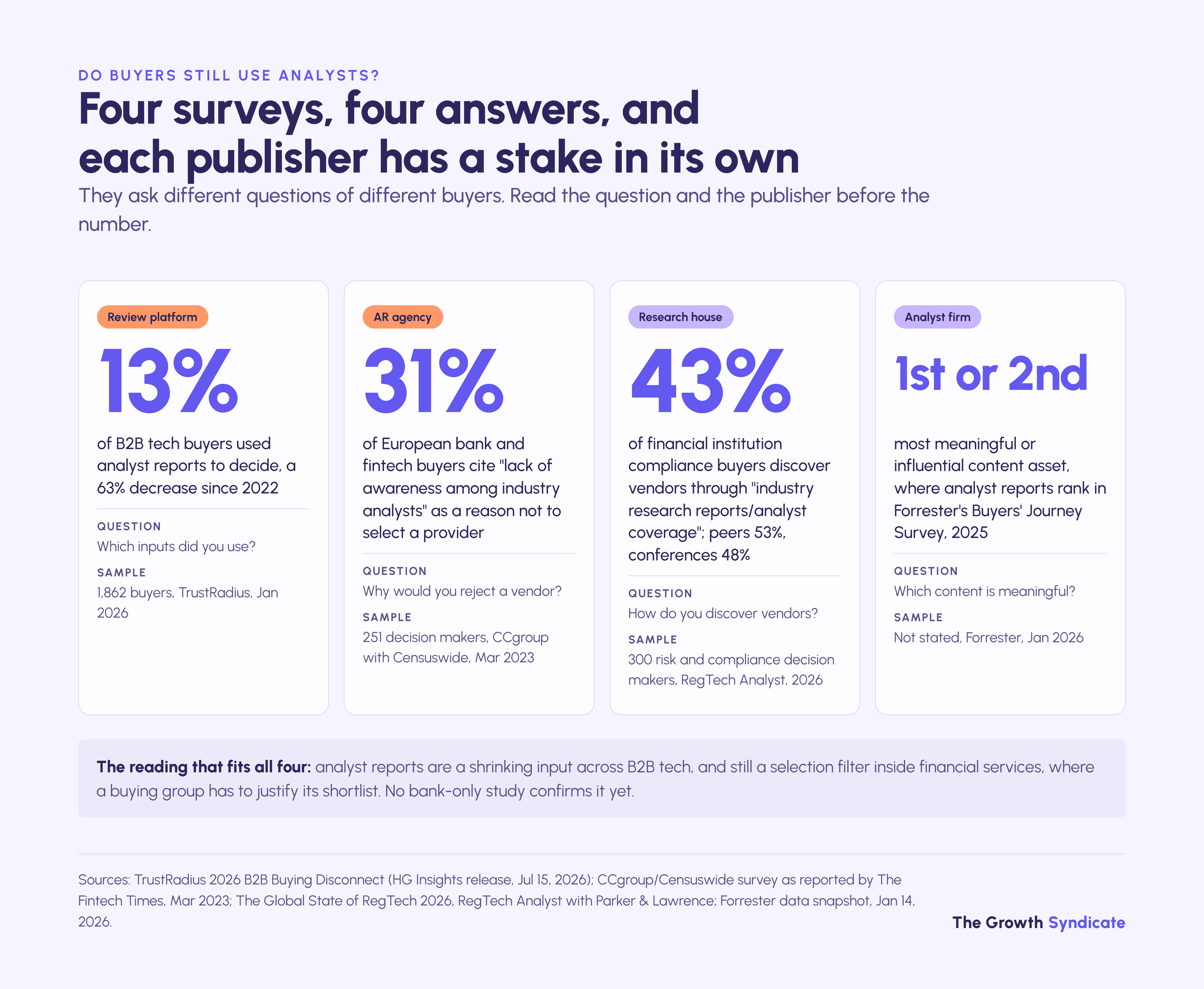
The review platform TrustRadius, owned by HG Insights, surveyed 1,862 technology buyers in January 2026 and reported that "Analyst reports were only used by 13% of buyers to make their purchase decisions, a 63% decrease since 2022." The same release says "74% of buyers use reviews to inform their purchase decisions." A review platform has an obvious interest in reviews outranking analysts, and its 2025 edition had already put the figure at 14%.
Forrester, an analyst firm, reads the same market the other way. Its January 2026 data snapshot says analyst reports "rank as the first or second most meaningful or influential content asset" in its Buyers' Journey Survey, 2025, without stating the sample. Which content buyers find meaningful is a different question from which inputs they used to decide.
The two financial-services datasets sit between those poles. CCgroup's 31% measures a penalty for being unknown to analysts, among 251 European bank and fintech buyers. The Global State of RegTech 2026, published by RegTech Analyst with Parker & Lawrence Research, asked 300 senior risk and compliance decision makers at financial institutions how they discover vendors: peer recommendations came first at 53%, conferences at 48%, and "industry research reports/analyst coverage" at 43%, among compliance buyers specifically and from a commercial research house.
Read together, the four surveys support one reading. Analyst reports are one input among many for B2B buyers in general, and a shrinking one by usage. In regulated financial institutions, where a buying group has to justify a vendor to compliance, risk and procurement, independent third parties carry more weight, and analysts are among the few sources such a group treats as independent, though no bank-only study confirms it yet.
Do bank risk teams use analyst reports in due diligence?
Bank third-party risk teams do not use analyst reports as a due-diligence input, as far as the published rules go. The US interagency guidance and the EU's DORA both require due diligence on technology providers, and both describe it in terms of financial condition, security controls, certifications and operational resilience. Analyst recognition makes a vendor known, and it does not clear risk review.
The 2023 interagency guidance on third-party relationships from the Federal Reserve, FDIC and OCC lists the information a bank reviews: "audited financial statements, annual reports, and filings with the U.S. Securities and Exchange Commission," plus "reports from debt rating agencies," and, where relevant, "System and Organization Control (SOC) reports and any conformity assessment or certification by independent third parties." It also warns that "Relying solely on experience with or prior knowledge of a third party is not an adequate proxy for performing appropriate due diligence." Nowhere does it mention industry analysts or their reports, and the only ratings it names are those of debt rating agencies.
The EU's Digital Operational Resilience Act, applicable since January 17, 2025, takes the same shape. Article 28(4) requires financial entities to "undertake all due diligence on prospective ICT third-party service providers" before contracting and to assess concentration risk. The Commission's technical standard on those contracts, Delegated Regulation 2024/1773, names the evidence for services that support critical or important functions: "audits or independent assessments," "independent audit reports" and "appropriate third-party certifications." Neither the act nor the standard names analyst research or ratings.
The US rules are about to change in form, if not in substance. On September 11, 2026, the Fed, FDIC, OCC and NCUA proposed new third-party risk management guidance that "would replace the 2023 Guidance," with comments due November 16, 2026. The closest the proposal gets to analysts is a line that "external industry experts familiar with the third party, the relevant industry, or with market standard terms and practices may also supplement or help a banking organization conduct due diligence," alongside "available public sources," trade groups, and "consultants, auditors, or law firms."
The practical consequence is a division of labor. Analyst relations, reviews and references get a fintech onto the shortlist and give the sponsor something to defend. The evidence pack that risk teams demand is a separate track, mapped in our guide to fintech marketing, and no amount of analyst recognition substitutes for it.
Which analyst firms cover fintech, and how do you get in?
Seven firms cover most of the evaluations a B2B fintech will be asked about: Gartner, Forrester and IDC across technology generally, and Celent, Datos Insights, Chartis Research and Juniper Research in financial services. Each decides inclusion on its own criteria, evaluates through some mix of RFI, briefing, demo and customer references, and publishes its own rules on what vendors can and cannot influence.
What is a Gartner Magic Quadrant?
A Gartner Magic Quadrant is a two-axis evaluation of the vendors in a defined market, placing each one by Ability to Execute and Completeness of Vision into Leaders, Challengers, Visionaries or Niche Players. Vendors are evaluated on "up to 15 weighted criteria across two categories," and inclusion depends on criteria the analysts set for that market, which vendors cannot opt into or out of.
Gartner's Magic Quadrant FAQ says Gartner "focuses on the most relevant providers for its clients, based on criteria like market presence, product features, customer interest," and that "Exclusion does not mean a vendor is not viable or competitive." The Ability to Execute criteria cover "products/services, overall viability, sales execution/pricing, market responsiveness, marketing execution, customer experience and operations." The Completeness of Vision criteria cover "market understanding, marketing strategy, sales strategy, offering (product) strategy, business model, vertical/industry strategy, innovation and geographic strategy."
Participation is not optional in either direction. Gartner's Office of the Ombuds wrote in February 2025 that "All vendors that meet a defined set of inclusion criteria are included in the MQ, regardless of whether they actively participate," and that "Vendors can't choose to be added to an MQ, and they can't opt out either." For a fintech that is not yet eligible, the work is knowing which Magic Quadrant you would fall under, reading its inclusion criteria, and briefing the analysts who write it so they know you exist when the next edition is scoped.
What is a Forrester Wave?
A Forrester Wave is Forrester's evaluation of the vendors it judges significant in a market, scored on current offering, strategy and, since 2024, customer feedback, and sorted into Leaders, Strong Performers and Contenders. The analyst defines the scope and chooses the vendors. A vendor can decline to participate, but it will still be evaluated.
Forrester's Wave methodology states that "the analyst defines the scope of the evaluation and identifies the vendors in the space" and that "Forrester reserves the right to evaluate products and services, regardless of vendor participation." Participating vendors provide "a questionnaire, a strategy and product demo session, and reference customers," and Forrester "asks each vendor we evaluate to provide reference customers," without publishing how many. Its participation policy adds that "We will not consider vendor requests to remove themselves," and that a non-participant "won't have the opportunity to provide feedback on its scorecard."
The investor Insight Partners, writing in 2023 from the vendor side, put the mechanics in plain terms: "the Wave process takes about three months from start to finish" and "Every vendor in a Wave evaluation gets two to three hours to present their strategy." That is an opinion piece rather than Forrester policy, but it matches what the policy pages describe.
IDC: MarketScape, FinTech Rankings and Real Results
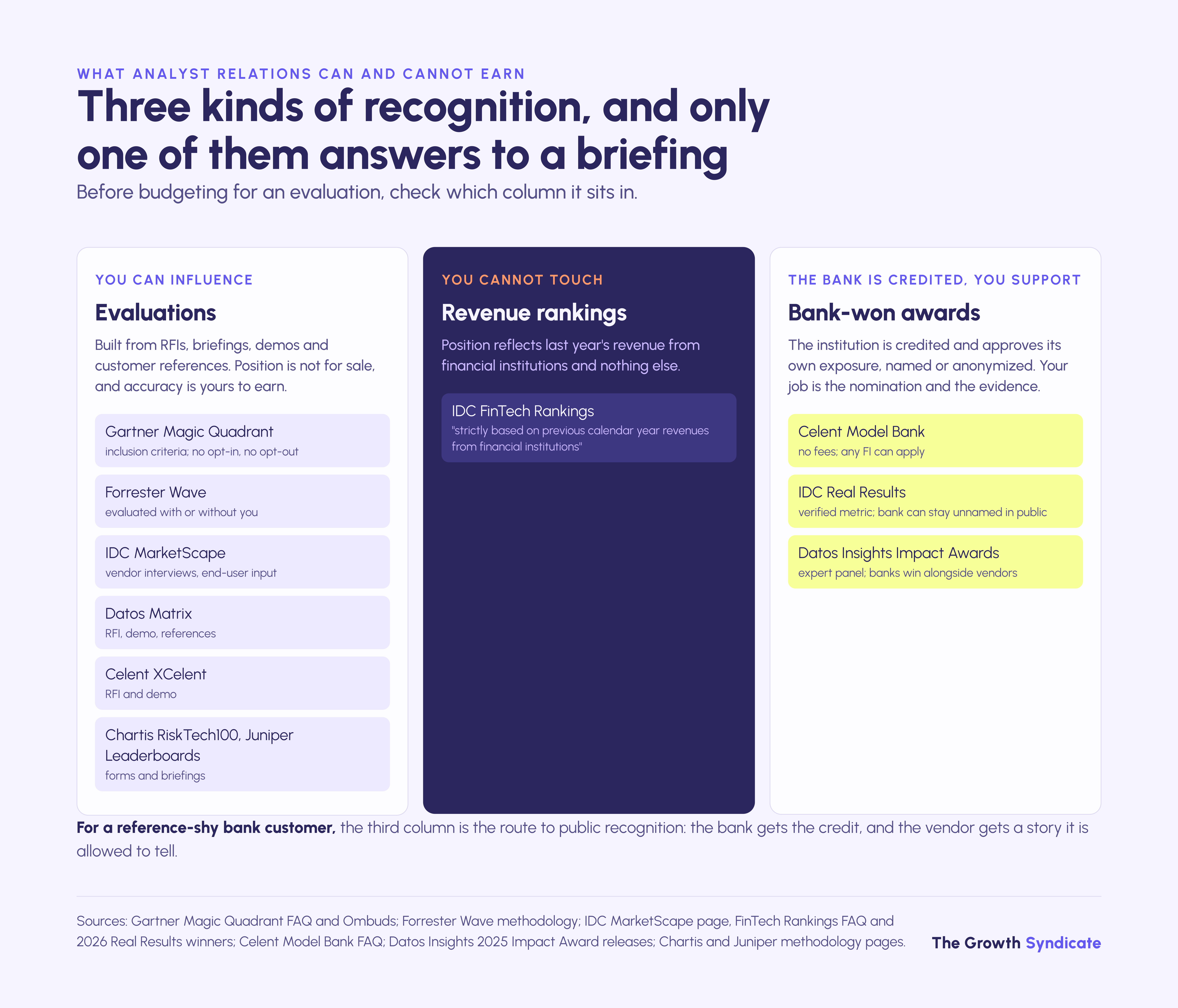
IDC publishes three things a fintech will be asked about, and only two of them can be influenced. The IDC MarketScape is a vendor assessment built on inclusion criteria, vendor surveys and interviews, and end-user experiences, while the IDC FinTech Rankings are a revenue league table. The Real Results awards recognize a measurable outcome at a client financial institution, which must be named to IDC but can be published without a name.
IDC's own MarketScape page says each one "assesses a specific offering from a particular vendor based on an inclusion criteria," scores on "Capabilities and Strategies," and shows market share as bubble size. The methodology appendix in a 2025 digital banking MarketScape states that scores rest "on detailed surveys and interviews with the vendors, publicly available information, and end-user experiences."
The FinTech Rankings FAQ is explicit that the rankings are "strictly based on previous calendar year revenues from financial institutions," and IDC announced the 2026 rankings on September 10, 2026. No briefing, review program or reference call changes a revenue ranking, and a fintech that reports it has "entered" the rankings has misunderstood them. Real Results works differently: IDC says submissions need "real projects, at a named institution, with a verified metric attached," and "IDC contacts someone at the institution directly," yet the published 2026 winners list credits Comviva's win to "An African bank" and Amdocs' to "A large Canadian Bank."
The financial-services specialists: Celent, Datos Insights, Chartis and Juniper
For many fintech categories the specialist firms matter more than a Magic Quadrant the vendor is not yet eligible for, because their evaluations are scoped to banking, payments and risk technology, and because bank buyers subscribe to them. Each runs evaluations built on RFIs, forms or briefings, and two run awards the bank wins.
Celent, owned by GlobalData since December 2024, runs the XCelent technology awards and the Model Bank awards. XCelent reports are built from RFIs: a 2026 KYC report notes that Celent invited "some 200 vendors" and featured 31. Model Bank is the bank's award: Celent's FAQ says "Any FI can apply, irrespective of whether it has any prior relationship with Celent," and "Celent does not charge any fees to banks or vendors to participate in the Model Bank process."
Datos Insights, the firm formerly called Aite-Novarica Group, publishes the Datos Matrix and the Impact Awards. Its 2026 trust accounting Matrix was built on "vendor RFIs, live platform demonstrations, and reference client interviews," with 20 reference clients interviewed. Financial institutions win the Impact Awards alongside vendors: the 2025 Fraud & AML winners include Garanti BBVA, and the Commercial Banking & Payments winners include Bank of America and PNC.
Chartis Research publishes the RiskTech100, "An independent evaluation of the world's top 100 risk technology providers," with the 2027 edition published on September 24, 2026. Chartis describes it as "assessing firms on strategic vision, market impact, innovation, customer success and execution," and its methodology page says it uses "detailed and domain-specific 'vendor evaluation forms' and briefing sessions" to collect information, with non-responders still eligible for inclusion. Its policies page also says that, at one stage of the process, the vendors Chartis has communicated with "have the right to withdraw from the report."
Juniper Research's Competitor Leaderboards rank payments and fintech vendors as Established Leaders, Leading Challengers, or Disruptors and Challengers. Juniper selects vendors through "in-house databases, desk research and direct contact with vendors," and its briefing page says it shares "an optional RFI" ahead of a briefing, used "purely to assess your business for the Competitor Leaderboard." It also sells exclusive publicity rights to a Leaderboard, promising that "only you will have the right to make it public and exploit its marketing potential."
Can you pay for a better position?
No. Gartner and Forrester state in their own policies that coverage and position cannot be bought, and both evaluate vendors whether or not they participate or pay, while the specialists run their evaluations on RFIs, briefings and, in some cases, references, and none of them sells a position. What a subscription buys is inquiry access, which improves how well you understand the analysts' view without changing it.
A June 2025 Ombuds post adds that "Client status never influences the outcome or inclusion in our evaluative research," and Forrester's integrity policy carries the line in the table. These are the firms describing themselves, which is worth remembering, but they are also the policies a vendor can hold them to.
Forrester has tested the question against its own vendor clients. Its April 2022 report "AR Budget Buys Scale, Not Opinion," based on its June 2021 Global AR Objectives and Metrics Survey, opens with "If money bought analyst influence, industry analyst relations (AR) would simply buy it," and finds that "higher budgets don't correspond to improved analyst evaluations leadership." The sample is not public.
There is also no rigorous study showing that a Magic Quadrant or Wave position raises a vendor's revenue, win rate or share price. The main academic work, Pollock and Williams' 2009 paper in Information and Organization and their 2016 book "How Industry Analysts Shape the Digital Future," treats the Magic Quadrant as a device that shapes how markets are organized rather than as a measured driver of sales. The old IT adage that nobody was ever fired for buying from the market leader is folklore, and an honest AR program treats a quadrant position as a credential the buying group can cite rather than a guarantee of anything.
What does analyst relations cost?
Analyst relations costs between a part-time marketer's attention and a dedicated team with six-figure subscriptions, and no analyst firm publishes a price list. The four public reference points below each measure something different, so the article gives them with their limits rather than blending them into a single number.
The filings give an average, not a price. Gartner's contract value of $5.2 billion at the end of 2025, spread across "over 13,000 distinct client enterprises," works out to roughly $400,000 per client enterprise, and Forrester's $292.4 million across "more than 1,700 client companies" to roughly $172,000. Both are our arithmetic, and both are averages across clients of every size, most of them buyers rather than vendors. The GSA schedule lists Gartner seats from $19,699 to $240,600, including $49,576 for a Gartner for IT Leaders license and $78,070 for Gartner for CIOs, and vendor-side products are not in any public record we found.
The resourcing guidance comes from investors rather than surveys. a16z's 2025 guide advises a company at the commercial stage to budget "annual subscription + 25–30% of an FTE's role to manage the relationship," and says a dedicated function means "1–4 AR managers coordinating across many analysts, products, and marketing teams." Forrester's 2022 research on AR teams found single-person teams "comprise more than half of global teams and more than two-thirds of regional teams."
A fintech can do a good deal of this without a subscription. Gartner's vendor briefings page says "Gartner analysts schedule briefings at their discretion based purely on an interest in the vendor, its technologies and its marketplace, not because of any fee or contractual relationship," and that briefings are "typically 45 minutes in length with 1-2 analysts." Forrester's briefing page describes the process without a cost statement, IDC says meetings are "scheduled based upon analyst availability and appropriateness of content to the coverage area," Juniper says briefing requests are "reviewed by senior members of the analyst team, and held on file until we begin working on a relevant report," and Celent and Datos Insights publish no briefing policy we could find, so the only way to know their terms is to ask. What a subscription adds is inquiry, the right to call the analyst and ask what they think, which Gartner's briefings explicitly exclude: "Analyst feedback is not the focus."
How do AI answers use analyst content?
AI search engines cite analyst firms mostly through their review pages, and barely through their research. In a one-day snapshot of 1,028,959 URLs cited across six AI platforms, Gartner accounted for 81.7% of citations to analyst-firm sites, and 96% of Gartner's citations pointed to its Peer Insights reviews, with gated research under 1%. Across niche B2B software prompts, though, review aggregators, Gartner among them, are a single-digit share of all citations.
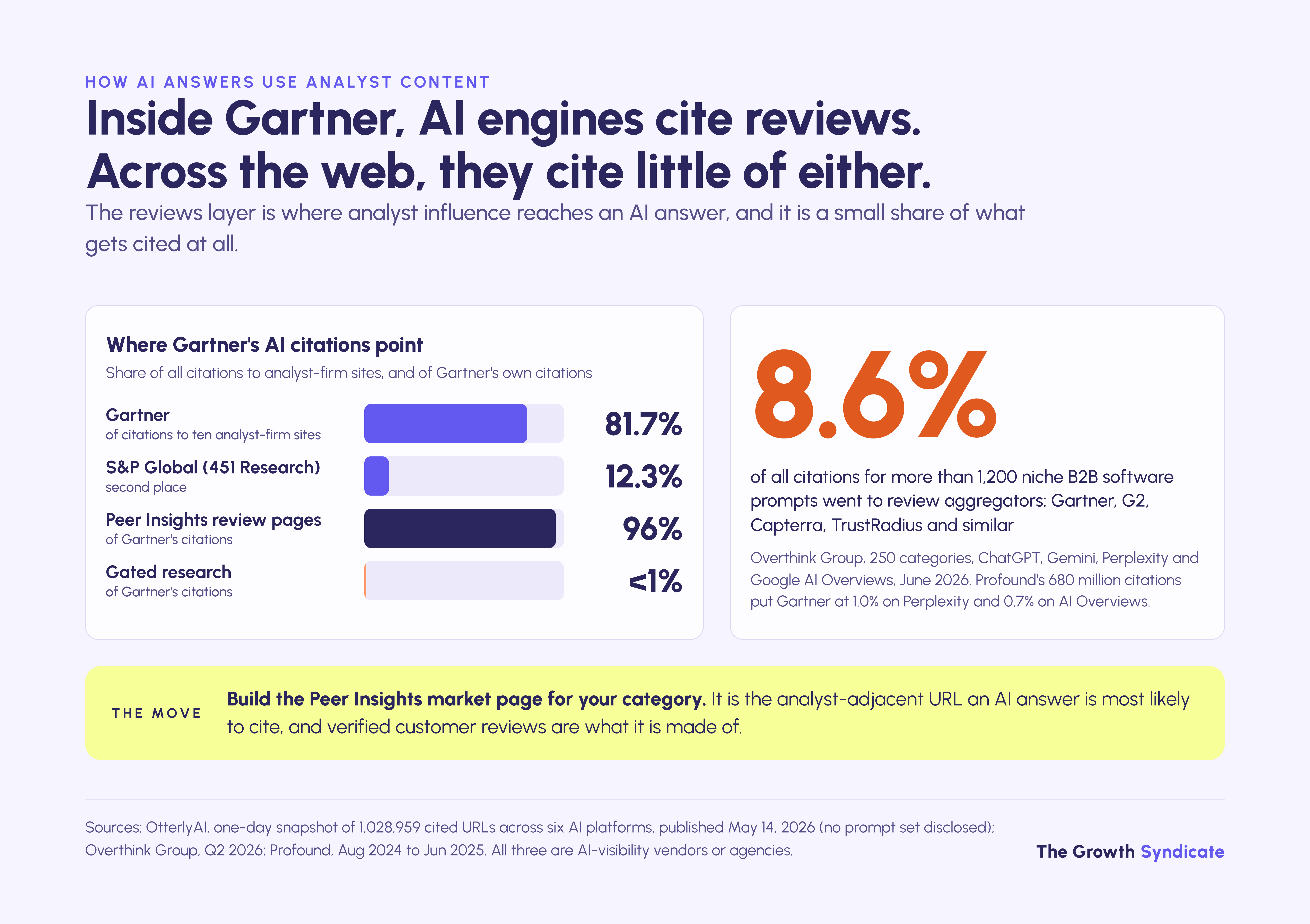
The analyst-site figures come from OtterlyAI, a vendor of AI-visibility software, which monitored ChatGPT, Google AI Overviews, Google AI Mode, Perplexity, Gemini and Microsoft Copilot over a 24-hour window and compared ten analyst firms in a study published in May 2026. S&P Global, home of 451 Research, was second at 12.3%. The study discloses no prompt set and includes none of the financial-services specialists, so it says what AI engines cite from Gartner in general, not what they cite for a bank's payments query.
The wider studies keep the finding in proportion. Profound's analysis of 680 million citations between August 2024 and June 2025 found Gartner at 1.0% of Perplexity's citations and 0.7% of Google AI Overviews', the only analyst firm in either top ten. An Overthink Group study of more than 1,200 prompts across 250 niche B2B software categories in June 2026 found that review aggregators including Gartner, G2, Capterra and TrustRadius "only account for 8.6% of total citations," and neither study isolates fintech prompts.
For a fintech the implication is specific. If your category has a Gartner Peer Insights market, that market page is the analyst-adjacent URL most likely to be cited when a buyer asks an AI engine for options, and it is built from verified reviews you can ask customers to write. Gated analyst research is almost never cited, and the review page is where Google results and AI answers overlap for this topic. Our guide to fintech SEO covers what gets a fintech's own pages cited.
Gartner Peer Insights and peer reviews in fintech
Gartner Peer Insights is Gartner's verified-review platform, where end users rate products in defined markets and where a vendor with enough eligible reviews can earn a Voice of the Customer badge. The platform matters for fintech because its market pages are what AI engines cite, and it is hard for fintech because most banking, payments and risk markets on it are thin.
Reviews on Peer Insights are verified rather than unsolicited. Gartner's FAQ says reviewers complete a multi-step profile before publication, and that "Gartner sometimes offers gifts of nominal value to individuals for submitting reviews on Peer Insights, and does not prohibit vendors from doing the same." A vendor can therefore run a review program, within the incentive rules, and the Voice of the Customer FAQ and methodology set the floors in the table.
Those floors are the problem. On October 5, 2026, the Core Banking Systems market listed 127 products, with Temenos at 77 ratings, Finacle at 69 and Oracle FLEXCUBE at 62, and Fraud Detection in Banking Payments had BioCatch at 66 and Feedzai at 27. Treasury Management Systems topped out with Kyriba at 18, Banking Payment Hub Platforms with Temenos Payments at 12, and the KYC Platforms for Banking market showed zero ratings across all seven products. These are all-time totals, while the badge counts only eligible reviews from the last 18 months by reviewers at companies above $50 million in revenue, so the eligible counts are lower.
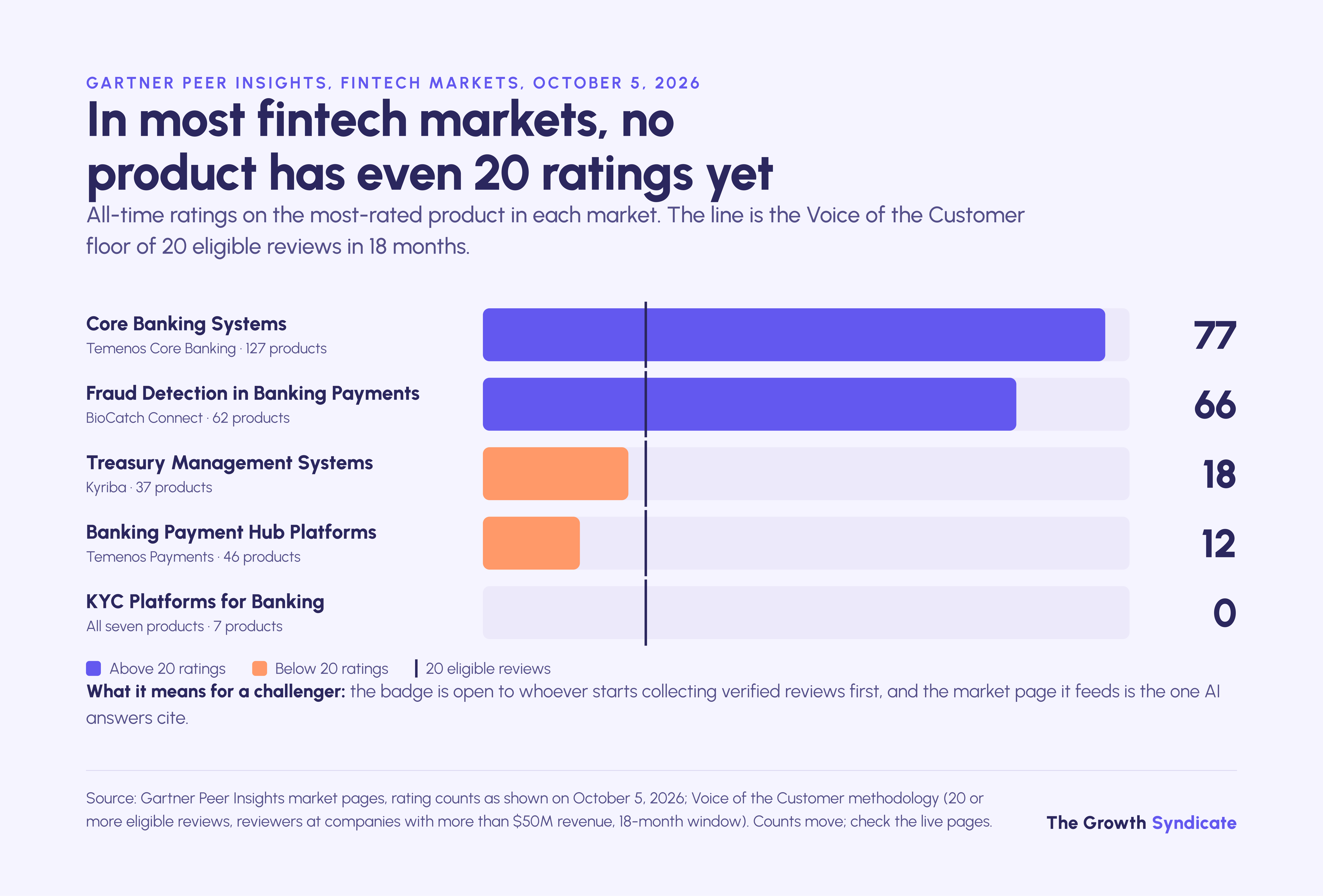
Outside the largest core and fraud vendors, almost no fintech has even 20 ratings, which means the badge is open to any challenger that starts collecting verified reviews before its competitors do. G2 shows the same split: its verification documentation says "Reviewers must sign in with a business email, LinkedIn account, or personal Gmail account" and "Every review is reviewed by a member of G2's moderation team," and payment processing is deep there, with PayPal Payments at about 2,700 reviews, while the core banking category listed "300+" reviews in total. A review program for a bank-facing fintech should start with the platform the buyer's analysts run, which is Peer Insights, and treat G2 as the second venue.
How do you run a customer reference program when banks will not be named?
A customer reference program for a fintech is the system that turns existing customers into evidence: reference calls for prospects, references for analyst evaluations, verified reviews, case studies and award nominations. In financial services it has to work with customers who will not appear in public, which means designing for anonymized evidence from the start rather than waiting for a logo.
The reluctance has a regulatory basis. The 2023 US interagency guidance, currently in force, notes that "it is common for a contract to state the extent to which the third party has the right to use the banking organization's information, technology, and intellectual property, such as the banking organization's name, logo, trademark, and copyrighted material." The September 2026 proposal that would replace that guidance drops the sentence, but the contracts it describes will outlast it, and a fintech that waits for permission to use a bank's logo may wait through the whole sales cycle.
Four routes produce proof without a named bank, and the analyst firms built most of them. Reference calls can be made under non-disclosure, with the prospect agreeing not to name the reference, and analyst evaluations interview references privately: Forrester and the Datos Matrix talk to your customers, and IDC's MarketScape draws on end-user experiences, without publishing who they are. Award programs where the bank gets the credit let the institution choose its own exposure, and verified reviews identify the reviewer to the platform while showing the public only a role and a company size band.
In our experience, what convinces a bank buyer is proof from its own vertical, and generic case studies carry less weight every year; the strongest version is naming, in the first call, what will and will not work in the prospect's segment before they have said anything. The reference bank should therefore be organized by segment and use case rather than by logo value, so that a tier-two European bank evaluating onboarding gets a reference from a tier-two European bank that bought onboarding. The same segment-level organization is what makes named-account programs work in fintech, where the account list and the reference list should be built together.
An analyst relations strategy for fintech, by stage
An analyst relations strategy for a fintech should be sized to the evaluations the company can qualify for, which changes with stage. Early on, the work is making the right ten analysts aware of you and starting the review and reference programs every later evaluation will demand; at growth it is preparing for inclusion criteria; at scale it is a calendar, sales enablement and measurement.
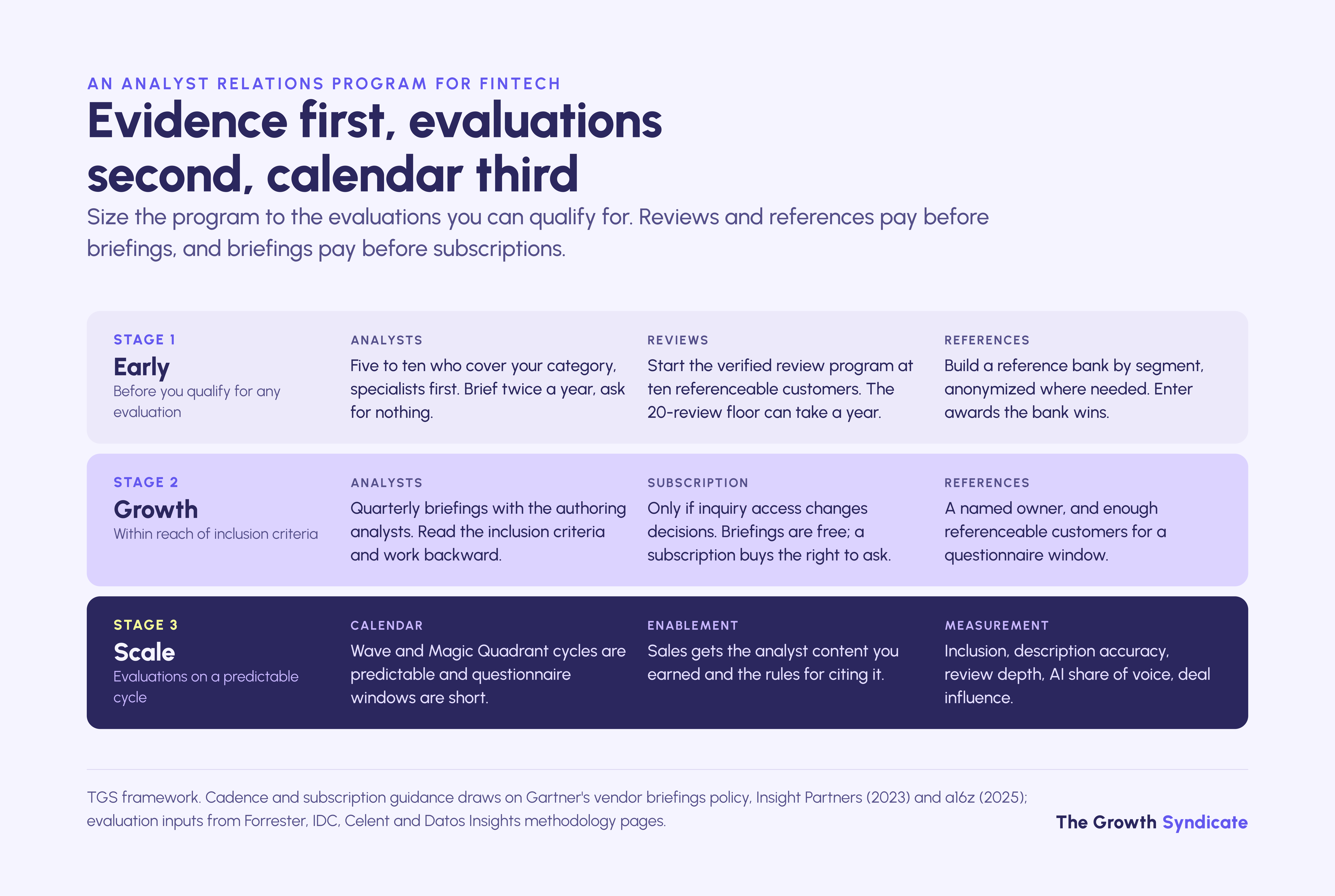
Early stage, before you qualify for any evaluation. Identify the five to ten analysts who cover your category, specialists first, since a Celent or Datos analyst covering bank onboarding is more useful than a Gartner analyst covering a market you are not in yet, and brief them twice a year without asking for anything. Start the verified review program on the day you have ten referenceable customers, because the 20-review floor can take a year to reach.
Build a reference bank organized by segment, anonymized where needed, and enter the programs where a bank client takes the credit. Content matters here too, because analysts read what vendors publish: the content that earns a buyer's attention is the same material an analyst uses to place you in a market.
Growth stage. Move to quarterly briefings with the analysts who matter, send the rest an update when something changes, and read the inclusion criteria of the Magic Quadrant, Wave or Matrix you are closest to, since revenue thresholds, customer counts, geographic presence and reference requirements are all stated. Buy a subscription only if inquiry access changes decisions, because briefings do not require one and a subscription buys the ability to ask rather than a better score.
Scale. Keep an evaluation calendar, because Wave and Magic Quadrant cycles are predictable and the questionnaire windows are short, and equip sales with the analyst content you have earned and the rules for citing it. The timing of a bank's RFP cannot be created, only caught, and consistent presence is what makes catching it likely.
Analyst relations best practices
The practices that analysts themselves reward are consistent, concise briefings; a single point of view that matches what the company publishes; prompt answers to analyst requests; and references that are ready when an evaluation asks. The IIAR, the analyst relations trade body, rates AR teams on three criteria it calls the 3Rs, and the analysts it surveys "most value the 'result'" over the other two.
The IIAR's definitions are precise. Responsiveness is "the timeliness and reliability of AR professionals to respond to analyst requests/needs," Relationship covers "trust and honesty," and Results means "whether the AR professional is able to deliver on the information the analyst is looking for." Those are the criteria analysts use to rate AR teams in IIAR's annual survey rather than a way to measure a program, but they describe what a good briefing looks like from the receiving end.
Gartner gives the same advice from its side. Its briefings page says "The best approach is to provide the analysts with a concise story that clearly presents all your major points in less than five minutes," and lists the questions a briefing should answer: who you are, why your customers buy, what problems the product solves, what differentiates it, and where you fit against your top competitors. Insight Partners' guidance is to "aim to brief your key analysts three to four times a year," and that "you do not need to be a paying client of the firm to brief."
Consistency does more than frequency. An analyst forms a view of a vendor the way anyone forms a view of a source they keep encountering, and three briefings that tell the same story do more than six that each pitch something new. The point of view in the briefing should be the one in the company's thought leadership program, because analysts notice when the briefing and the published content disagree, and that is the overlap between analyst relations and the content and thought leadership work an agency can do for a fintech.
How do you measure analyst relations?
Analyst relations is measured on five things: whether you are included in the evaluations you qualify for, whether analysts describe you accurately, whether analysts mention you to the buyers who ask, whether your review and analyst pages are cited by AI engines, and whether deals cite analyst input. The first two are leading indicators you control, and the last three are the outcomes.
Inclusion is the metric to start with, because it is binary and tied to published criteria: if a Magic Quadrant requires a revenue threshold you have not reached, the measure is the gap. Description accuracy comes next, since an analyst who describes a payments platform as a lending tool does more damage than one who ignores it.
The pages AI engines cite for a fintech category are review market pages and trade-press coverage of analyst reports, so tracking AI visibility for this program means tracking those pages rather than your own site. Deal influence is the metric leadership wants and the hardest to collect; the workable version is a CRM field sales fills when a buyer cites an analyst, review or reference.
Where this breaks down
Analyst relations is the wrong first investment for a good number of fintechs, and the program described here has limits worth stating before anyone budgets for it. It depends on a covered category, a B2B buyer who consults analysts, enough people to answer an evaluation, and realistic expectations of what a quadrant does in a bank deal.
- Your category has no coverage yet. Briefings are then a bet on future coverage, and reviews and references are the only parts that pay now. The Peer Insights KYC Platforms for Banking market, with zero ratings across seven products, is what that looks like.
- Your buyers are platforms and developers. Embedded finance and infrastructure fintechs selling to product teams win on documentation, sandbox quality and integration proof, where developer references outweigh analyst opinion.
- You cannot resource it. One person at a quarter of their time can run briefings and a review program, but cannot answer a 500-item RFI and line up references inside a three-month window.
- You expect the quadrant to close deals. No rigorous evidence links position to revenue, and risk teams do not accept analyst opinion in place of SOC reports.
- You want an agency to run it. TGS does not run analyst programs. Our fintech marketing work covers positioning, content, thought leadership and account-based programs, and sits beside an in-house or specialist AR function rather than replacing it.
What to do next
Decide on analyst relations by matching the program to the evaluations you can qualify for in the next 18 months and to the evidence your bank buyers will ask for in the next deal. In every row of the table, reviews and references pay before briefings, and briefings before subscriptions.
The first two rows are where most fintechs start, and both can begin this quarter without a budget line.
Frequently asked questions
What does an analyst relations manager do?
An analyst relations manager runs the company's relationships with industry analysts: scheduling and preparing briefings, answering evaluation questionnaires, supplying reference customers, tracking where the company appears in research and inquiry, and correcting inaccurate descriptions. In most companies the role sits in product marketing or communications, and 43% of practitioners in a 2023 IIAR survey worked alone.
Is analyst relations worth it for a fintech startup?
For a startup with no coverage, briefings are cheap insurance and subscriptions are premature. The parts worth doing early are the ones every later evaluation demands: verified reviews and a reference bank. If a specialist firm such as Celent or Datos Insights already evaluates your category, a yearly briefing and a bank-credited award entry are worth the time.
Do you have to pay Gartner to be in a Magic Quadrant?
No. Gartner's Magic Quadrant FAQ states that "Vendor status as a Gartner client does not affect inclusion or positioning," and its Ombuds says all vendors meeting the inclusion criteria are included whether or not they participate. Vendors can neither opt in nor opt out, and Gartner says its analysts schedule vendor briefings "not because of any fee or contractual relationship."
Can a vendor decline a Forrester Wave?
A vendor can decline to participate but cannot avoid evaluation. Forrester's methodology states it "reserves the right to evaluate products and services, regardless of vendor participation," and its participation policy says it "will not consider vendor requests to remove themselves." A non-participant gets no chance to review its scorecard and may be scored from estimates.
What is Celent Model Bank, and can a vendor enter?
Model Bank is Celent's award for financial institutions' own technology initiatives. Any financial institution can apply, and Celent charges no fees to banks or vendors to participate. A vendor cannot win it, but it can help a bank customer apply or nominate the bank with its full consent, one of the few ways a reference-shy bank earns public recognition for a vendor's work.
How do the IDC FinTech Rankings work?
The IDC FinTech Rankings rank technology providers "strictly based on previous calendar year revenues from financial institutions," so position reflects revenue and nothing a marketing program does changes it. IDC's Real Results awards, run alongside the rankings, recognize a verified outcome at a client institution, and a fintech can only reach them with that client's cooperation.
How are Gartner Peer Insights reviews verified?
Reviewers complete a multi-step profile with their email, role, title and organization details before a review is published, and Gartner screens each one. Gartner sometimes offers gifts of nominal value for reviews and does not prohibit vendors from doing the same within its incentive rules. Voice of the Customer badges require 20 or more eligible reviews within 18 months.