


B2B fintech marketing is the work of making a regulated buyer comfortable enough to sign. A bank, a finance team or a platform that buys fintech is underwriting four risks on the vendor's behalf: regulatory, security and operational, counterparty and continuity, and delivery. In regulated institutions that underwriting is written down, so this guide covers what each risk demands, what a fintech may claim, and how to prove it when customers will not be named.
Key takeaways
- US supervisors expect banks to document due diligence on third parties under the 2023 interagency guidance, and DORA has required EU financial entities to do it before contracting with an ICT provider since January 17, 2025. The vendor's evidence has to fit that file.
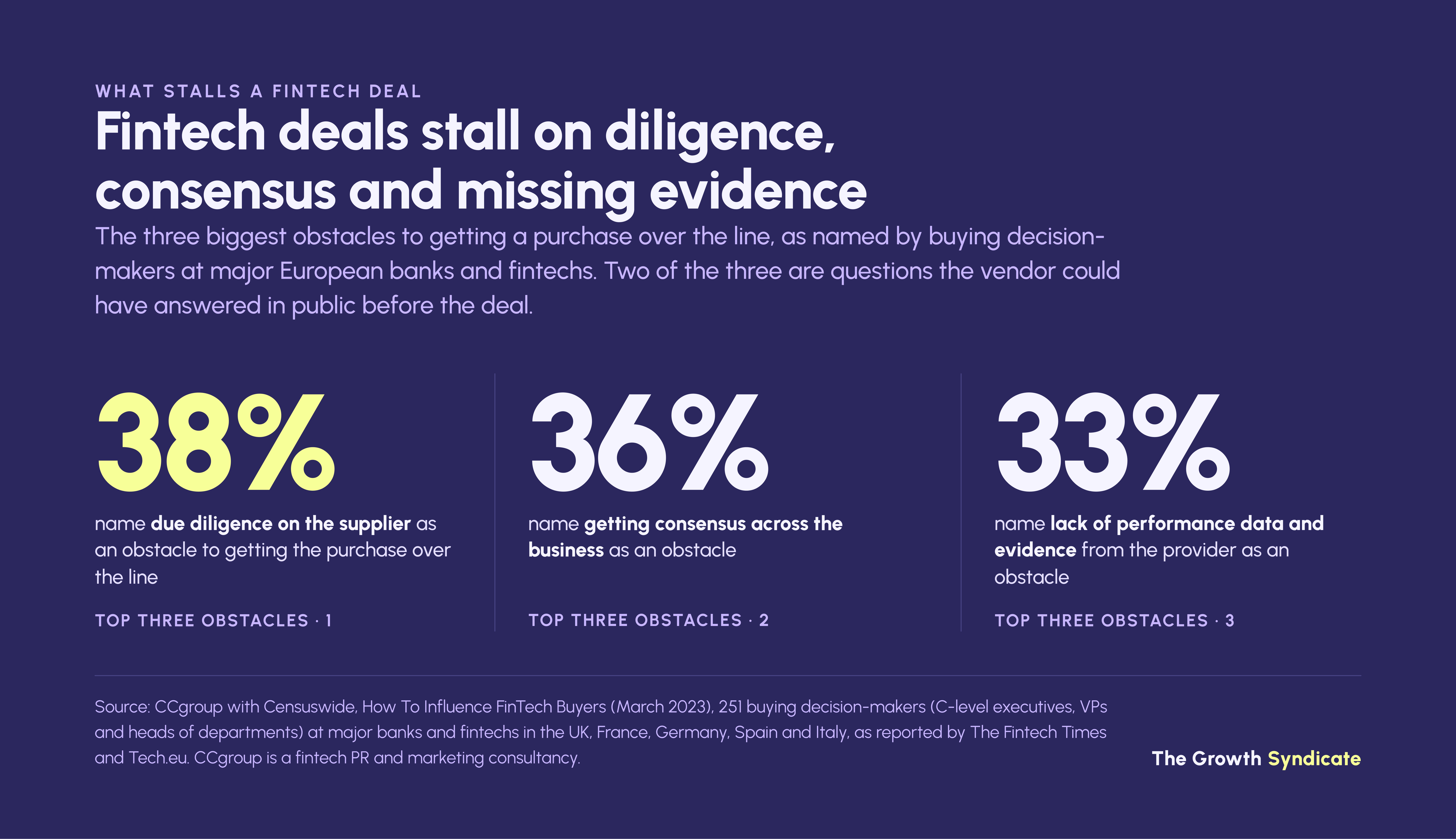
- Among 251 buying decision-makers at major European banks and fintechs, the top obstacles to closing were due diligence on the supplier (38%), consensus across the business (36%) and missing performance evidence (33%).
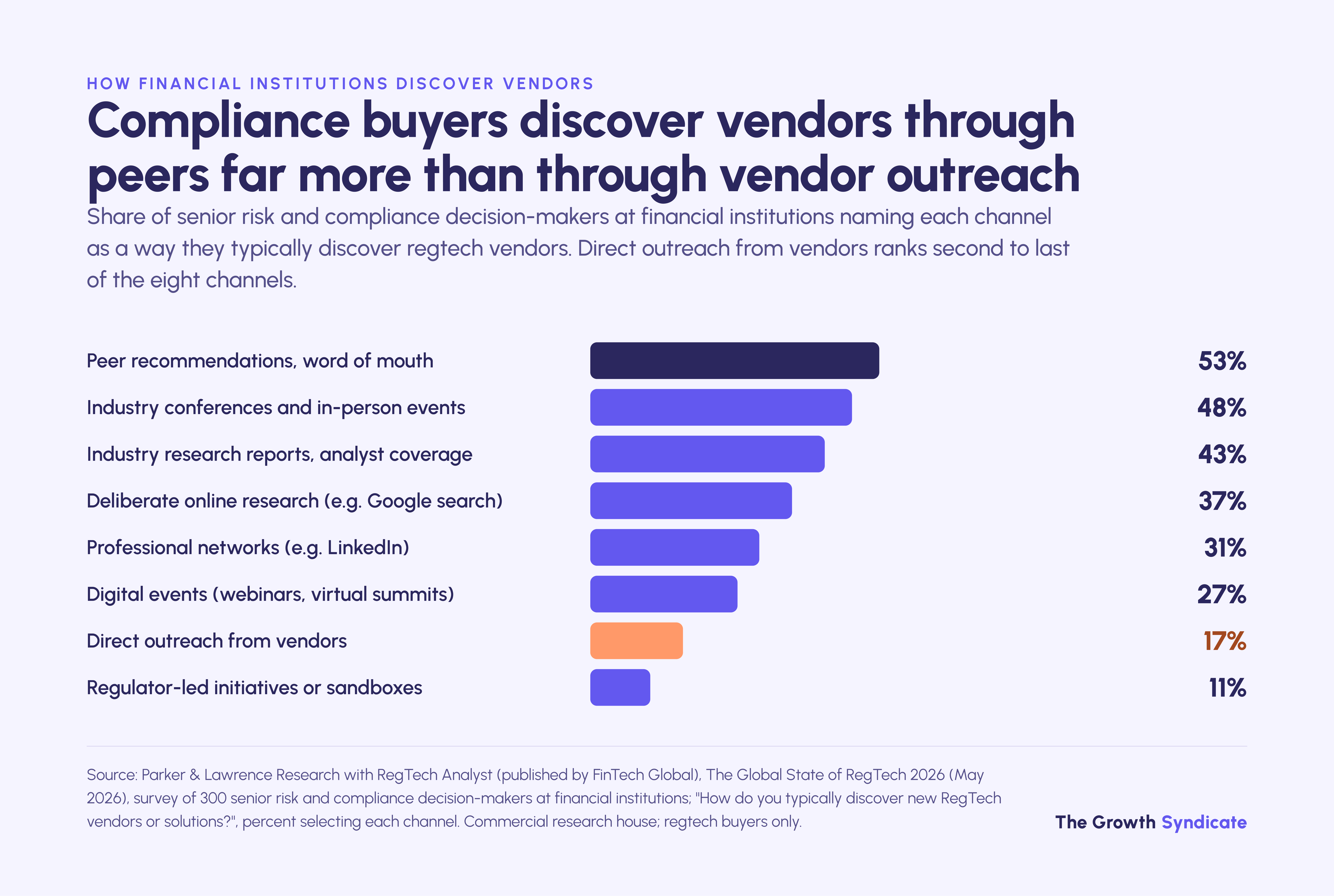
- Compliance buyers discover vendors through peers (53%), conferences (48%) and research reports or analyst coverage (43%). Direct vendor outreach is named by 17%.
- Claims are regulated. The FCA had 19,766 financial promotions amended or withdrawn in 2024, up from fewer than 600 in 2021, and the FDIC's amended rule on insured-status claims, which reaches non-banks, has applied since January 1, 2025.
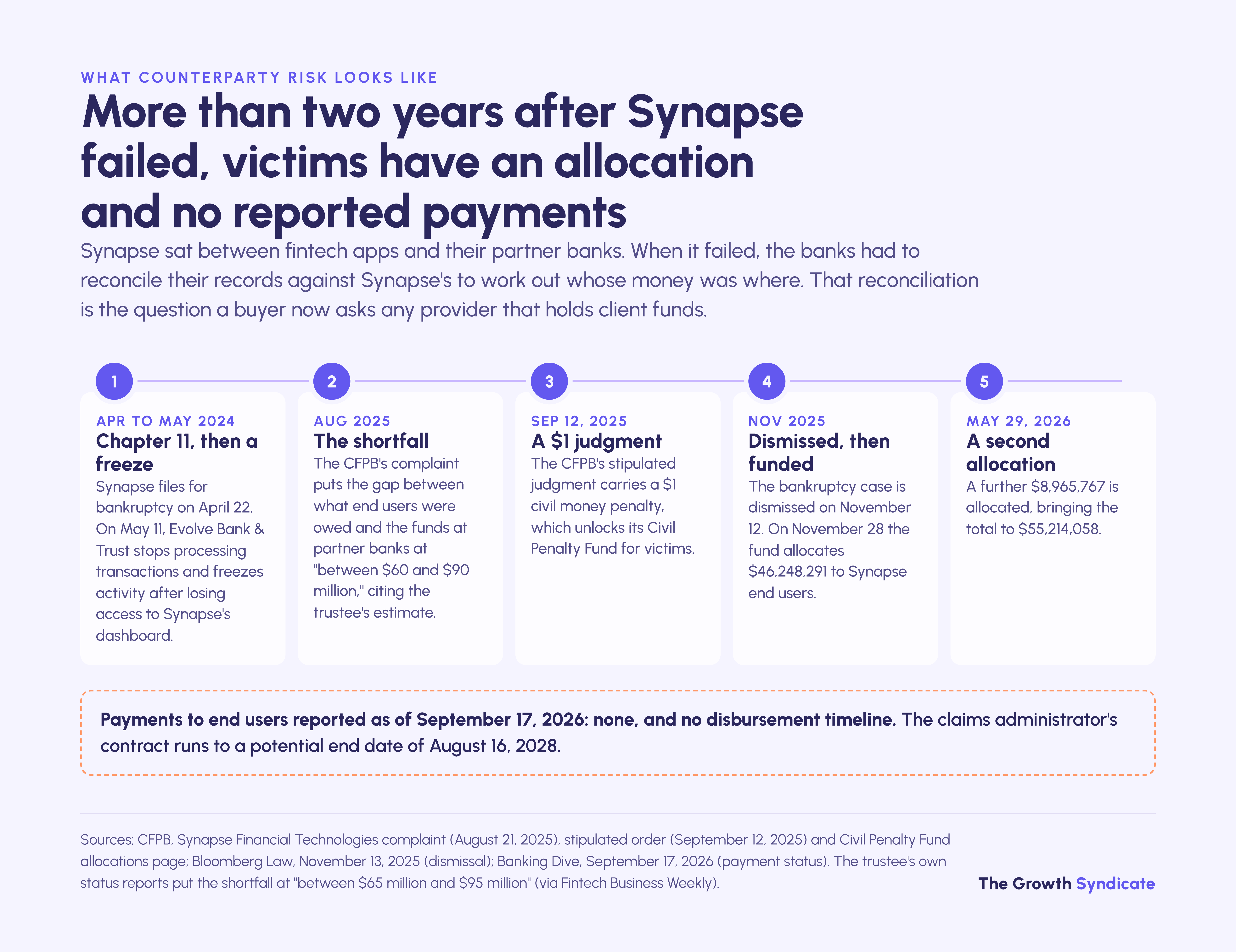
- Synapse's collapse left a shortfall the CFPB put at "between $60 and $90 million." More than two years later, $55,214,058 has been allocated to end users and no payments have been reported.
Where this comes from. The regulatory material in this article is quoted from the Federal Register, EUR-Lex, the FDIC, the SEC and the FCA. Survey figures are named with their sample and publisher, and where the publisher sells something related to the finding, the article says so.
The risk map and the buyer-type table are The Growth Syndicate's own frameworks. Rules vary by product, license and audience, so confirm anything that touches your own position with your compliance team.
What is fintech marketing?
Fintech marketing is the set of activities a financial technology company uses to win and keep customers while staying inside the rules that govern what it may say. In B2B fintech, the customer is a bank, a corporate finance team or a platform that embeds financial products, and the purchase is a risk decision made by a group.
The B2B and B2C versions share a name and little else. A consumer app sells on convenience and price to one person who can leave in a week. A payments infrastructure provider sells a multi-year dependency to a buying group whose own regulator may review the relationship.
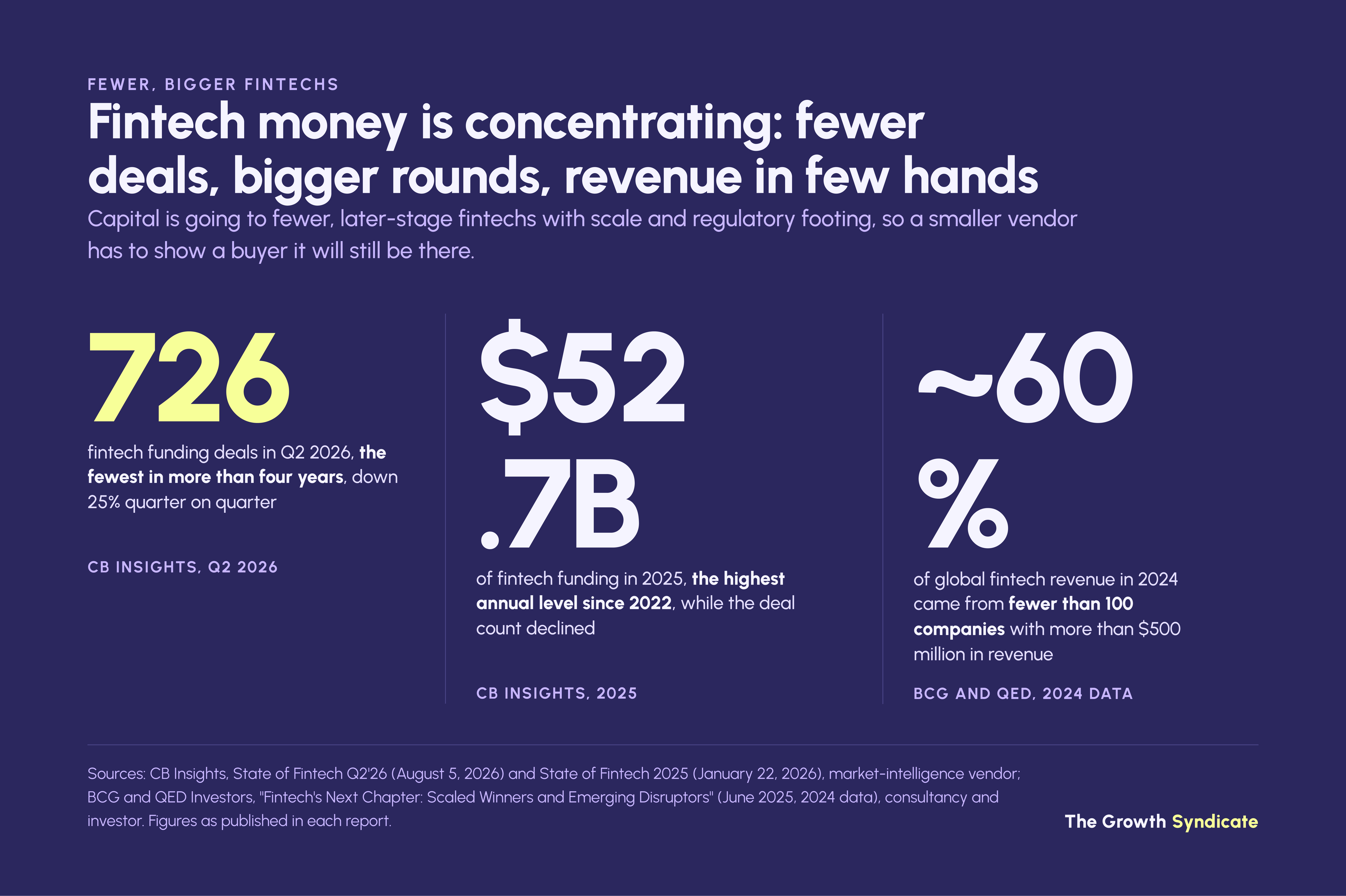
The market the B2B fintech sells into is concentrated. BCG and QED Investors' 2025 report found that fintechs generating more than $500 million in revenue, fewer than 100 companies worldwide, took roughly 60% of global fintech revenue in 2024. BCG's 2026 edition, written with FT Partners, puts fintech at about 4% of the global financial services revenue pool, so a challenger is asking an incumbent to take a chance on a smaller counterparty.
Why B2B fintech buyers buy on evidence
Regulated buyers buy on evidence because their supervisors expect a documented record of why the vendor was chosen. In the US the 2023 interagency guidance sets that expectation for banks, and in the EU DORA Article 28 makes due diligence on ICT providers a legal requirement. The buyer is building a file, and the vendor's marketing either feeds that file or slows it down.
Buyers describe the file from their side. When CCgroup commissioned Censuswide to survey 251 buying decision-makers at major banks and fintechs across the UK, France, Germany, Spain and Italy, in research published in March 2023, the biggest obstacles to getting a purchase over the line were due diligence on the supplier (38%), getting consensus across the business (36%) and lack of performance data and evidence from the provider (33%). CCgroup is a fintech PR and marketing consultancy, so treat the framing as interested; the numbers still describe a buyer waiting for evidence.
The US text is explicit about where responsibility sits. The Interagency Guidance on Third-Party Relationships, published by the Federal Reserve, FDIC and OCC in June 2023, states that "the use of third parties does not diminish or remove banking organizations' responsibilities to ensure that activities are performed in a safe and sound manner." It lists 14 due diligence considerations, and although it "does not have the force and effect of law," banks treat it as the list of what the examiner will ask about.
That text is now being revised, and the revision strengthens the point. On September 11, 2026, the Fed, FDIC, OCC and NCUA proposed replacing the 2023 guidance with a risk-tiered framework (91 FR 58536, comments due November 16, 2026). The proposal lets a bank rely on "public or alternative sources" for lower-risk relationships, and says that where a third party is "unable or unwilling to provide information or other cooperation reasonably necessary for the banking organization to conduct due diligence, ongoing monitoring and risk assessments," those sources "may not be sufficient to allow the banking organization to engage with the third party within its risk appetite and tolerances."
The 2023 guidance stays in force until the proposal is finalized. Either way, the regulator is describing a vendor that answers in public as cheaper to buy.
The EU wrote it as law. Before contracting, DORA requires financial entities to "undertake all due diligence on prospective ICT third-party service providers," and Article 28(1) says they "remain fully responsible for compliance." The regulation has applied since January 17, 2025, to what ESMA describes as "more than 20 different types of financial entities," including payment and e-money institutions.
Trust, in this market, is built by showing up with the answers before the questions arrive, and then being there when the buyer's window opens.

The fintech risk map: four risks your buyer underwrites
A B2B fintech buyer underwrites four risks on the vendor's behalf: regulatory risk, security and operational risk, counterparty and continuity risk, and delivery risk. Each has an owner inside the buying group, a question that owner is paid to ask, and an asset the vendor can publish so that the answer is on file before procurement opens the questionnaire.
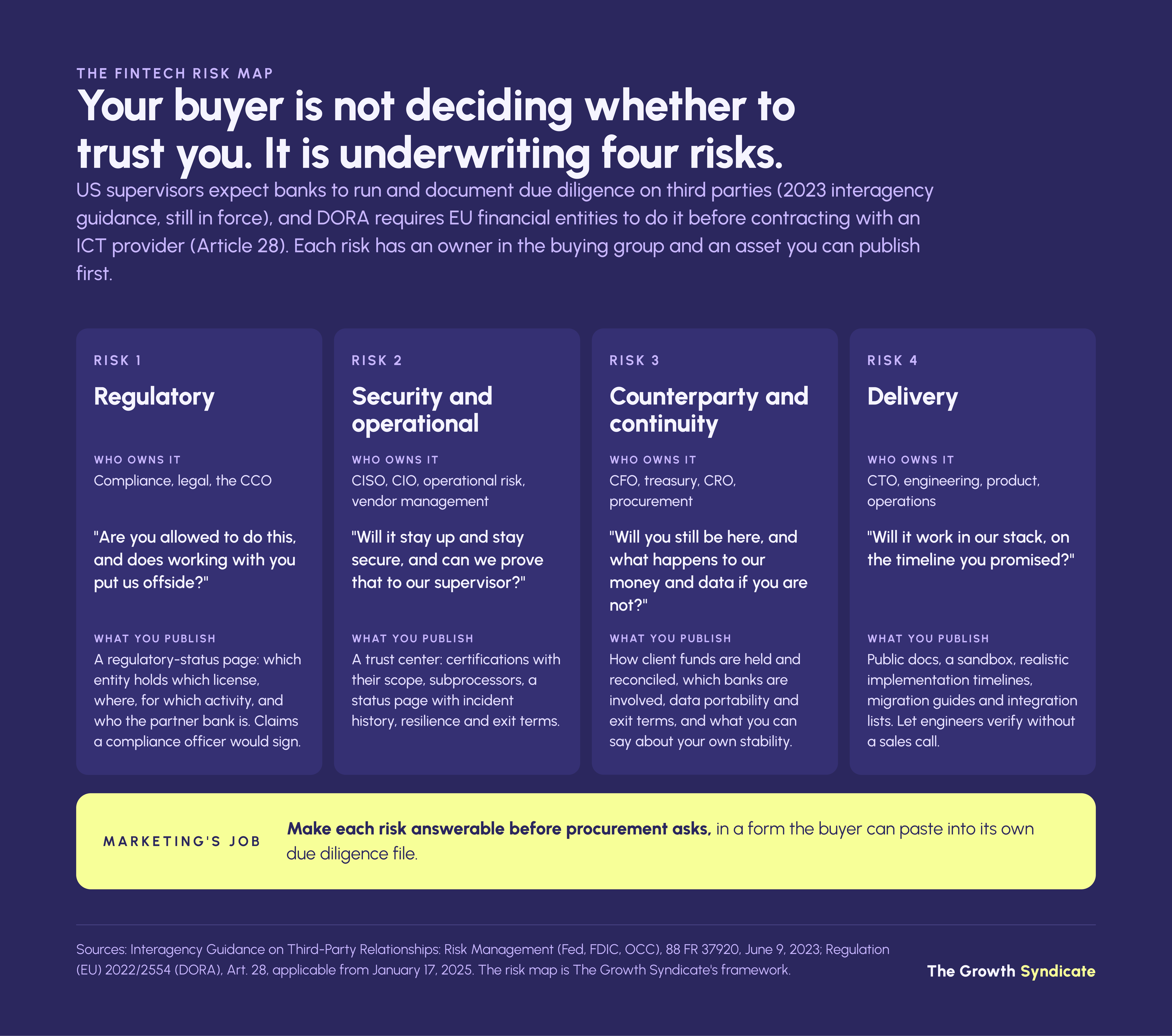
The map is a way of reading the regulator's own list. The 2023 US guidance names 14 considerations; DORA's technical standard (Delegated Regulation 2024/1773) asks whether a provider has "sufficient abilities, expertise and adequate financial, human and technical resources, information security standards." Grouped by who asks the question inside the buyer, those items fall into four piles.
The grouping is The Growth Syndicate's. The items are the regulators'.
Regulatory risk: say exactly what you are licensed to do
Regulatory risk is the buyer's question of whether the vendor is allowed to do what it sells, and whether working with it puts the buyer offside. The answer is a regulatory-status page: which legal entity holds which license or registration, in which jurisdiction, covering which activity, and who the partner bank or principal is.
The best examples are plain, and they differ by how the vendor is licensed.
The vendor that holds no license of its own borrows one, and has to say so in words the partner wrote. Unit's line on pass-through insurance is the one a compliance officer reads twice.
Regulatory risk also covers the claims themselves. Implying insured status a product does not have, or an AI capability that does not exist, is a regulatory event, and the section on what fintechs may claim covers the rules and the enforcement.
Security and operational risk: build the trust center before the questionnaire
Security and operational risk is the buyer's question of whether the service stays up and stays secure, and whether the buyer can prove that to its own supervisor. The answer is a trust center that publishes certifications with their scope, subprocessors, a status page with incident history, and resilience and exit terms, so that the security questionnaire arrives half-answered.
The questionnaire is where deals go to wait. Vanta's 2025 State of Trust research found that organizations spend an average of 9 working weeks a year on vendor security reviews and risk assessments, and 61% of the 3,500 IT and business leaders it surveyed say they "spend more time proving security rather than improving it." Whistic's 2023 survey of 524 security professionals put the average wait for a complete vendor assessment response at 17 days.
Both publishers sell trust-center and questionnaire software, so take the direction rather than the decimal.
What the better fintechs publish shows the standard. Modern Treasury's security page states that it "has undergone SOC 2 and SOC 1 assessments by an independent third-party auditing firm," names the Trust Services Criteria covered (Security, Availability and Confidentiality) and links a trust center where reports can be requested. Adyen's trust center carries SOC 2 Type II, SOC 1 Type II, ISO 27001:2022 and PCI DSS with quarterly bridge letters, the latest published in October 2026, and its status page shows incident history.
The gaps are shared. None of the nine trust pages reviewed for this article (Stripe, Adyen, Modern Treasury, Column, Plaid, Unit, Airwallex, Treasury Prime and Marqeta) publishes a DORA statement, and only Stripe documents how a customer's card data can leave for another processor, which leaves an open space on the page an EU buyer is already reading.
The 2026 US proposal makes the same point in regulatory language, describing for higher-risk relationships "the existence of alternative back-up providers that can provide an easy transition of services" and "critical data backed up at a physically and logically separated site." The trust center is the part of the website that does what the homepage promises, and the rules that make a B2B website convert apply to it.
Counterparty and continuity risk: say where the money sits
Counterparty and continuity risk is the buyer's question of whether the vendor will still be there, and what happens to the buyer's money and data if it is not. The answer is a published account of how client funds are held and reconciled, which banks are involved, how data leaves, and what the vendor can say about its own stability.
Synapse is why this question is asked first now.
Synapse was a banking-as-a-service middleware provider that sat between fintech apps and their partner banks. It filed for Chapter 11 on April 22, 2024, and on May 11 Evolve Bank & Trust "stopped processing transactions and instituted a freeze on any activity" after losing access to Synapse's dashboard, according to the CFPB's complaint. The complaint, citing the trustee's estimate, puts the shortfall between what end users were owed and the funds held at partner banks at "between $60 and $90 million"; the trustee's own status reports said $65 million to $95 million.
The resolution has been slow. The CFPB's stipulated judgment of September 12, 2025 carried a $1 civil money penalty, which lets the Bureau use its Civil Penalty Fund, and the fund allocated $46,248,291 on November 28, 2025, and $8,965,767 on May 29, 2026. As of Banking Dive's September 17, 2026 report, no payments to end users had been made public and no disbursement timeline had been given.
Regulators now write continuity into orders. The FDIC's May 2024 consent order against Thread Bank, since terminated, required an exit plan covering how the bank monitors fintech relationships, including third-, fourth- and fifth-party providers, for service interruptions.
The published answers exist. Treasury Prime's bank page names its partner banks (KeyBank, Grasshopper Bank and Bangor Savings Bank among them) and describes two ledger models: "Virtual accounts on the Treasury Prime ledger, funds in on-core FBO accounts," against "An off-core ledger over a bank omnibus account holding many customers' funds."
Delivery risk: close the gap between the demo and production
Delivery risk is the buyer's question of whether the product will work in its stack, on the timeline promised. The answer is public documentation, a sandbox an engineer can use without a sales call, realistic implementation timelines, migration guides and integration lists. The first of the six topics in the US regulators' 2021 due diligence guide for community banks is "Business Experience and Qualifications," which is delivery risk in supervisory language.
Delivery is where the buying group's engineers get a vote. They read the docs, try the sandbox and look for the integration they need, and they report back on whether the promise survives contact with the stack. A fintech that gates its documentation behind a form has handed that evaluation to a competitor whose docs are open.
Bank-side evidence is thin, which is worth saying plainly. EY-Parthenon's 2022 US banking partnership survey, cited in EY-sponsored content on Banking Dive, found that 53% of banks had difficulty onboarding new partners; the sample was never disclosed and EY's own page has since been taken down.
The more useful evidence is what the buyer's regulator asks for: business experience, qualifications of key personnel, reliance on subcontractors.
Across the four risks, the asset list is short enough to put on one page.
None of the four assets is a campaign. Each is a page that legal, security or finance has to sign, which is why the work usually starts with those teams rather than with marketing.
Who buys B2B fintech, and which risk each buyer weighs most
In B2B financial services marketing, three kinds of buyer purchase fintech, and they weigh the four risks differently. Banks and other regulated institutions weigh regulatory and security risk most, because their own supervisor will review the relationship, while enterprise finance teams weigh counterparty and security risk most, with procurement running the process. Platforms that embed finance weigh delivery and counterparty risk most, under their own provider's rules.
The weightings are The Growth Syndicate's model. No published survey ranks all four risks by buyer type, so the table shows direction, with the nearest evidence beside each row.
Banks are the clearest case. Ncontracts' September 2023 survey of 147 bank and credit union professionals, run with CBANC, found compliance first at 72% and cybersecurity second at 62% among the criteria for evaluating fintechs, with return on investment at 46.3% and reputation at 44.4%. A vendor survey with a small sample, and the order matches what the interagency guidance tells examiners to look for.
Treasury teams outside financial services have no supervisor telling them to run diligence, which is why counterparty risk rises to the top. The Association for Financial Professionals' 2024 survey of 393 corporate practitioners found 98% rating financial stability "of utmost importance" when choosing a primary relationship bank. The question was about banks rather than fintech vendors, and it describes the instinct a treasurer brings to any counterparty that will hold the company's cash.
Platforms sit inside two sets of rules. Their own provider approves their marketing, and in the EU a payment or e-money institution that embeds a provider is also a DORA entity, so it runs Article 28 diligence on its suppliers while its customers run it on them.
The person who says no is rarely the person who said yes. In the 2025 Edelman-LinkedIn B2B Thought Leadership Impact Report, a survey of 1,934 business executives whose cited figures are US data, the "hidden decision-makers" who influence purchases without owning them sit in "finance, operations, legal, compliance, procurement," and 71% of them have "relatively little or no interaction with sales."
FIS's head of marketing, quoted in the same report, put it this way: "While the final 'yes' might come from the top, the power to say 'no' often lives elsewhere."
Who vouches for you: you, the search layer and third parties
Trust in a fintech vendor arrives from three directions, and the vendor writes only the first. The vendor vouches for itself through what it is allowed to claim and the evidence it publishes. The search and AI layer vouches through the quality standards applied to financial topics and the answers engines assemble before a buyer makes contact, and third parties vouch through analysts, peer reviews and references.
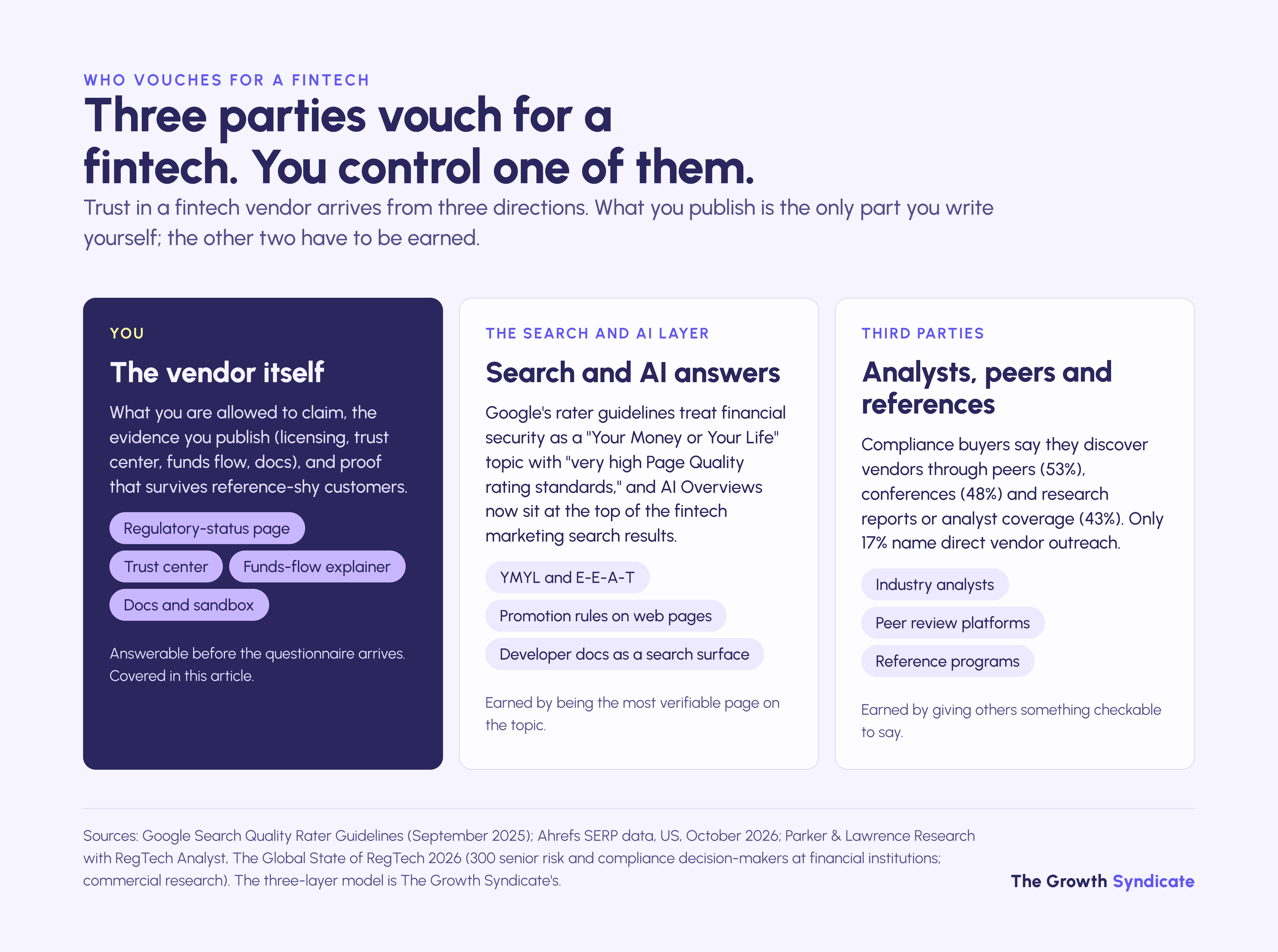
The second and third sources are earned, and each has its own article in this series. Google's Search Quality Rater Guidelines treat financial security as a "Your Money or Your Life" topic with "very high Page Quality rating standards," and AI Overviews now sit at the top of the results for fintech marketing queries. That changes how a fintech earns a place in search and in AI answers, which the guide to fintech SEO in this series covers page by page.
Third parties matter more in this market than in most. Among 300 senior risk and compliance decision-makers at financial institutions surveyed by Parker & Lawrence Research with RegTech Analyst in 2026, 43% discover vendors through "Industry research reports/analyst coverage." The guide to analyst relations in fintech in this series covers how to earn that coverage.
What fintechs are allowed to claim, and how to run compliance review without losing speed
A fintech may claim what it can substantiate and what its license and its partners allow it to say. Three regimes do most of the enforcing: the FDIC's rule on insured-status claims, the SEC's actions on "AI washing," and the FCA's financial promotion rules. Review stays fast when claims are tiered, so that pre-approved language clears in hours and only novel claims go to full review.
The touch is enforced. Three regulators have acted on fintech claims in the last three years, and each action names the rule a marketing team is expected to know.
The FDIC rule reaches fintechs directly. Subpart B of Part 328 prohibits misrepresenting insured status and requires non-banks that mention deposit insurance to disclose that they are not FDIC-insured banks; the compliance date for the amended rule was January 1, 2025. A January 2026 FDIC rule changed signage requirements for banks and left Subpart B's prohibitions unchanged, so the claims rule is live.
The SEC's first "AI washing" settlements were small and the message was not. On March 18, 2024, Delphia paid $225,000 and Global Predictions $175,000 for claiming AI capabilities they did not have, and the SEC Chair said that "Investment advisers should not mislead the public by saying they are using an AI model when they are not." The actions apply to investment advisers, and a fintech that markets "AI-powered" anything should read them as the standard its claims will be held to.
The FCA's numbers show scrutiny at scale. The regulator had 19,766 financial promotions by authorized firms amended or withdrawn in 2024, an increase of 97.5% on the 10,008 of 2023, against fewer than 600 in 2021. Claims management companies accounted for 9,197 of the 2024 total.
The approver regime adds a second question. Since February 7, 2024, firms have needed FCA permission to approve promotions for unauthorized persons, and the FCA's May 2026 review of 10 approver firms found some had "approved adverts with unsubstantiated claims." For a UK fintech, "who approved this promotion, and under what permission" now has a regulatory answer.
Running compliance review without losing speed
Compliance review stays fast when the marketing team separates claims that are already approved from claims that are new. The first group clears on a checklist, and the second gets the full review with a service level agreed in advance. Routing everything through one queue produces the four-to-five-day turnaround that compliance teams themselves report. Stripe's required disclosure for Issuing platforms, "Stripe Issuing balances are provided in the US by Stripe Payments Company, licensed money transmitter, with funds held at Stripe's bank partners, Members FDIC," is the model pre-approved claim: scripted by the partner, cleared once, reused everywhere.
The turnaround data is thin but consistent. A survey of 59 US financial risk and compliance leaders by Saifr, a compliance software company, found that 56% take four to five working days to review a piece of marketing content and 39% take six to ten days. PerformLine's 2025 State of Marketing Compliance Report, also from a vendor, found 56% of respondents describing marketing review as "highly collaborative but time-consuming, requiring multiple rounds of review."
Volume is the problem. FINRA's advertising regulation department reviewed 70,728 communications in 2025, and more than half of PerformLine's respondents review at least 50 marketing assets a month. Tiering is the answer to volume.
Partners set the floor for the top tier. Goodwin's July 2026 note on bank-fintech co-marketing cites a 2020 Colorado settlement under which "The Bank oversees and retains the ultimate approval authority over all marketing content" for the loans it originates, and recommends agreeing approval SLAs in the partnership contract. The partner marketing section below lists the published rules.
Proof when your customers will not be named
Proof in B2B fintech has to work without the customer's logo, because the customer often cannot give it. The 2023 US guidance tells banks to settle by contract the vendor's right to use "the banking organization's name, logo, trademark," and card networks and sponsor banks add their own approvals. The proof that survives is anonymized, vertical-specific and verifiable in the sales conversation.
The regulatory root is real and it is not a ban. The guidance asks banks to decide the question by contract, and many decide it in the negative. No survey quantifies how often banks refuse to be named; what can be seen is how vendors have adapted.
The adaptation is the tier reference. Napier AI publishes a case study titled "Tier 1 bank deploys Napier AI client screening," describing the customer as "A major UK retail and commercial bank serving 20 million global customers." Hawk's April 2025 funding announcement describes "more than 80 customers globally, ranging from large Tier 1 banks to mid-market financial institutions and fintechs."
The pattern gives the buyer a size and a segment to place, with the name withheld.

Four forms of proof work when the name does not. An anonymized cohort result carries a figure the buyer can test in a reference call, and a joint program where the bank gets the credit works because the bank's marketing approval is easier to obtain for the bank's own story. A peer reference call, offered early and arranged by the customer, fits how these buyers already find vendors: peer recommendation was the top discovery channel, at 53%, in the 2026 regtech survey.
The fourth is vertical-specific proof, delivered live, which often beats any document.
Thought leadership fills part of the gap. In the Edelman-LinkedIn 2025 report, 55% of hidden decision-makers "use thought leadership as part of their vetting process," and 53% of both audiences surveyed agreed that "if thought leadership is high quality, then brand recognition matters less." For a fintech without a named reference, a published point of view that a compliance officer finds useful is proof the compliance officer can cite internally.
Fintech content marketing: content that answers due diligence
Fintech content marketing works when the content answers a question the buyer's due diligence will ask anyway. Research reports, regulatory explainers and operational data are read by compliance, treasury and security teams because they need the answer, and a vendor that supplies it becomes the reference the buyer cites internally. The content that performs is the content that would survive being attached to a vendor-risk file.
The audience for it is the part of the buying group that sales never meets. In the US data from the Edelman-LinkedIn 2025 study, 64% of hidden decision-makers "trust thought leadership content more than marketing materials and product sheets when assessing capabilities and competencies," and 71% say it is "more effective than conventional marketing or sales materials at demonstrating a vendor's potential value."
LinkedIn co-publishes the study and the figures are US data, so it argues for its publisher's platform. The direction matches the regtech discovery data, where research reports and analyst coverage were named by 43% of compliance buyers.
The general principles of B2B content marketing hold in fintech; the review of every piece is what changes. Fintech content teams that plan the compliance pass into the calendar publish more than those who treat it as a gate at the end. That is how TGS works as a content marketing agency for regulated clients, with the claims library built before the editorial calendar.
Executive content follows the same rule. The approach to a thought leadership program holds, with compliance in the room from the first draft rather than the last.
Fintech marketing channels, ordered by who vouches
Fintech marketing channels are best chosen by asking who vouches for the vendor on each one. Events and peer formats put the customer's peers in the room, and partners lend their license and brand under their own approval rules. Search and AI answers are judged by the engine's standards, analysts and reviews by their independence, and paid and outbound are the vendor vouching for itself.
The 2026 regtech survey is the only channel ranking from this buyer's side. Asked how they typically discover new vendors, the 300 senior risk and compliance decision-makers named peer recommendations (53%), industry conferences and in-person events (48%), industry research reports and analyst coverage (43%), deliberate online research such as Google search (37%), professional networks such as LinkedIn (31%), digital events (27%), direct outreach from vendors (17%) and regulator-led initiatives or sandboxes (11%).
The publisher is a commercial research house and the respondents buy regtech specifically, so treat the percentages as indicative. The order is what matters.
Events: curated rooms over booths
Events work in fintech because the buyer's peers are in the room, and peers are the top discovery channel. The largest events are large: Money20/20 Europe reported 7,500 attendees from more than 2,300 companies and 105 or more countries for its June 2026 edition, and Swift reported "over 12,500" attendees from 168 countries at Sibos 2025 in Frankfurt. Both figures are the organizers' own, and the useful question is who is attending.
The practical version is a small program around the large event: a dinner or a round table with 8 to 12 people from the buying group you want, hosted with a partner the attendees already trust, and no pitch. The conference supplies the attendance; the room supplies the conversation.
LinkedIn and executive presence
LinkedIn is the channel where a fintech's executives can be visible to the buying group without an introduction. In the regtech survey, professional networks were named by 31% of compliance buyers as a discovery channel, ahead of digital events and direct outreach, and that independent figure matters because LinkedIn's own research with Edelman argues the same case from an interested position.
The content that works here is the content that answers due diligence, cut to the platform: a reading of a new rule, a published number from the vendor's own data, a point of view a compliance officer could repeat. Executive posts in fintech go through the same claims review as everything else, which is a reason to build the pre-approved library early. An executive who can post from an approved library posts weekly; one who needs a review for every sentence posts quarterly.
Partner marketing in fintech
Partner marketing in fintech runs through sponsor banks, card networks, platforms and system integrators, and the partner's approval rules govern what can be said. The partner lends its license, its brand and its distribution, and in exchange it reviews the vendor's materials. Treat the approval process as part of the channel, with its lead time in the plan.
A co-marketing calendar that leaves two weeks for the sponsor bank is a calendar that ships.
Search and AI answers
Search is where a fintech is judged by Google's standards for financial topics and, increasingly, by what an AI answer says about it before a buyer visits the site. Deliberate online research was named by 37% of compliance buyers in the 2026 regtech survey, and the AI Overview now sits above the organic results for fintech marketing queries. The fintech SEO guide in this series covers YMYL, financial promotion rules on web pages, developer documentation as a search surface and AI answers in finance.
Analysts and peer reviews
Analysts and peer review platforms are the third-party source, and they carry weight in proportion to their independence. Research reports and analyst coverage were named by 43% of compliance buyers as a discovery channel, five points behind conferences. The analyst relations guide in this series covers the analyst firms that matter in fintech, how inclusion works, and how peer review platforms verify what they publish.
Fintech lead generation when the buying group includes compliance and security
Fintech lead generation changes when the buying group includes compliance and security, because the people who can veto the deal are rarely the people who fill in a form. The lead is the account, the content is the due diligence file, and the measure of a good program is how many of the four risk owners have seen evidence before sales makes contact.
That is an account-based program by another name, because banks are a named-account market with a vendor management function in each one. The approach to account-based marketing applies with one change: the content map is organized by risk owner rather than by funnel stage, so the CISO, the compliance lead and the treasurer each receive the asset that answers their question.
The shortlist forms before the first call. 6sense's finding that "Ninety-five percent of the time, the winning vendor is already on the Day One shortlist" is a vendor's figure with no financial-services cut, and it fits a market where the shortlist is made by the people who ran the diligence.
Standing out when every fintech says the same thing
A B2B fintech stands out by positioning on a risk it removes for the buyer, stated in terms the buyer's diligence already uses. "Faster payments" is a feature every competitor claims. "Funds held in FBO accounts at named banks, reconciled daily, with the ledger model published" is a counterparty position a treasurer can check.
Three published positions show the pattern, each built on a risk the buyer's diligence already names.
Column is the clearest case. The license is the headline and middleware is the named enemy, which is a position a bank's compliance team can check in a charter register.
The lesson for fintech branding is that the brand lives in the specifics a buyer can verify. A brand strategy that earns the shortlist is one the buyer can describe to a colleague in a sentence, and in fintech that sentence usually names a risk and how the vendor removes it. Visual identity matters, and it matters less than the regulatory-status page.
Fintech branding: the parts that survive compliance review
Fintech branding survives compliance review when the positioning claims are the same claims the trust center substantiates. A tagline that promises "bank-grade security" invites a question about which bank and which grade; one that names the certification and its scope does not. Build the brand language from the claims library, and every campaign starts from an approved position.
Fintech marketing trends in 2026
Four trends shape fintech marketing in 2026. Capital and revenue are concentrating in fewer companies, the due diligence rules on both sides of the Atlantic are being rewritten, AI answers are entering vendor research, and peers and analysts are gaining weight as validators. Each one raises the value of evidence a buyer can reuse.
Capital is concentrating. CB Insights reported that fintech funding "increased in 2025 to $52.7B, reaching its highest annual level since 2022," while "deal count declined in 2025, reflecting a continued shift toward late-stage fintechs with scale, revenue, and regulatory footing." Its second-quarter 2026 report found that deal volume "fell 25% QoQ to 726," the "fewest quarterly deals in more than four years." BCG and FT Partners' 2026 report put fintech revenue at more than $504 billion in 2025, up 22%, with 74% of the biggest public fintechs profitable, so a buyer looking at a vendor outside that scaled group has a reason to ask about continuity.
The diligence rules are being rewritten. The September 2026 US proposal would replace the 2023 guidance with a four-component framework and lighter diligence for lower-risk relationships, with comments closing November 16, 2026, and the European Banking Authority published new guidelines on non-ICT third-party risk on September 18, 2026, giving firms two years from an application date still to be set to bring existing critical arrangements into line, while ICT providers stay under DORA. Banks will classify vendors by risk, and the vendor that helps the bank classify it correctly is cheaper to onboard.
AI answers are entering vendor research. An AI Overview now appears above the organic results for the main fintech marketing queries, and what it says about a vendor depends on what the vendor has published and what third parties have said. The regulatory-status page, the trust center and the funds-flow explainer are the pages an engine will quote.
Peers and analysts are the validators. Peer recommendation (53%), conferences (48%) and analyst coverage (43%) lead the discovery channels for compliance buyers, and direct vendor outreach (17%) trails. The vendor's job is to give peers and analysts something checkable to say.
How to measure fintech marketing
Fintech marketing is measured on whether the buyer's diligence gets shorter as well as whether the pipeline gets larger. The metrics that show it are time to clear security review, questionnaire turnaround, the share of deals in which trust assets were used, shortlist rate, win rate, branded search and sales-cycle length. The first two have external benchmarks, and all of them move before the pipeline report does.
The benchmarks come from vendors, and the article says so each time. The point of the table is that the trust assets have measurable effects inside the deal. A vendor that returns a questionnaire in 5 days when the market average is 17 has a number to put in the next proposal.
The pipeline measures still apply, with a longer horizon. Marketing in this market compounds through repeated contact with a small number of accounts and the people who advise them.
Where this breaks down
The risk-map approach fits a B2B fintech selling a regulated or funds-bearing product to a buyer that runs diligence. It fits less well for consumer fintechs, for companies too early to have anything to publish, for low-exposure finance software, and for vendors whose partner controls every word, and it costs legal, security and finance time before it costs marketing time.
- Consumer fintech. Consumers do not run due diligence, and the claims rules that apply point at a different problem: 46% of the promotions the FCA had amended or withdrawn in 2024 came from claims management companies. A B2C fintech needs the compliance discipline and little of the trust-center apparatus.
- Very early fintechs. Without a license, a SOC report or a named partner, the trust center is thin and the honest page says so. Borrowed trust, in the partner's words, is the asset until the vendor's own exists.
- Low-regulatory-exposure finance software. A planning or reporting tool that holds no funds will be classified as lower risk, and the 2026 US proposal would let banks assess such vendors on "public or alternative sources." Heavy trust apparatus answers questions nobody will ask.
- Partner-controlled marketing. Where a sponsor bank, a card network or a provider approves every piece, the vendor's freedom to differentiate on regulatory claims is limited by contract, and the partner's lead time becomes the campaign's lead time.
- The cost. A regulatory-status page, a trust center with current reports and a funds-flow explainer are legal, security and finance work before they are marketing work.
What to do next
A fintech marketing strategy starts with which buyer you are selling to and which of the four risks that buyer weighs most; publish the asset for that risk first. The regulatory-status page and the trust center come first for most vendors, because every buyer type asks for them.
- If you sell to banks, publish the regulatory-status page and the trust center before anything else, and map every piece of content to the 2023 guidance's considerations until the 2026 framework is final.
- If you sell to enterprise finance teams, lead with continuity: where funds sit, which banks hold them, how data leaves, and what you can say about your own stability.
- If you sell to platforms, open the docs and the sandbox, state which of your licenses cover their use case, and build the partner approval lead time into the calendar.
- If your customers cannot be named, build tier references, cohort figures and peer reference calls now, and give your executives a point of view a compliance officer would forward.
- If every competitor claims the same features, position on the risk you remove and say the mechanism.
Frequently asked questions
How long does it take to sell fintech to a bank?
There is no reliable published figure, and the agency and investor claims of six to 18 months are unsourced. The timeline is set by the bank's due diligence process, the 2023 US guidance's considerations or DORA Article 28 in the EU, followed by contract negotiation and onboarding. Vendors that publish their answers shorten the diligence stage.
What does DORA mean for a fintech outside the EU?
DORA places the obligations on the EU financial entity, not on the vendor. If a vendor supplies ICT services to an EU bank, payment institution or other covered entity, that customer must run due diligence before contracting and keep the vendor in its register of information. In practice the vendor supplies the evidence that lets the customer comply.
What should a fintech trust center include?
A trust center should include each certification with its scope and date, the subprocessor list, a status page with incident history, resilience and exit terms, and a way to request reports under NDA. Adyen's and Modern Treasury's trust pages are working examples. Publishing DORA and exit terms is rare and would set a vendor apart.
What is a regulatory-status page?
A regulatory-status page states which legal entity holds which license or registration, in which jurisdiction and for which activity, and who the partner bank or principal is where the vendor relies on one. Stripe's license page and Adyen's licensing page are examples. It is the first thing a compliance officer looks for and the easiest to get wrong.
Can a fintech say its product is FDIC insured?
Only if it is true and stated the way the rule requires. Subpart B of the FDIC's Part 328 prohibits misrepresenting insured status and requires non-banks that mention deposit insurance to say they are not FDIC-insured banks; pass-through insurance applies only when the FDIC's conditions are met. The compliance date was January 1, 2025, and the FDIC has sent cease-and-desist letters for false claims.
Do fintech marketing materials need compliance sign-off?
In most regulated markets, yes, and partner agreements often add a second approval. UK promotions must be "fair, clear and not misleading" under FCA rules, US claims are policed by the FDIC, SEC, FTC and CFPB depending on the product, and sponsor banks and card networks require review of materials that mention them. Tiered review keeps the process fast.
Which fintech events are worth attending?
The ones where the buyers you want are attending rather than speaking. Money20/20 Europe reported 7,500 attendees in June 2026 and Sibos 2025 reported over 12,500, both organizer figures. The return comes from the small formats around them: round tables and dinners with 8 to 12 members of the buying group and no pitch.
What happens to client funds if a B2B fintech fails?
It depends on how the funds were held and reconciled, which is why buyers ask before signing. After Synapse's 2024 bankruptcy, end users faced a shortfall the CFPB put at "between $60 and $90 million," and as of September 2026 no payments from the $55,214,058 allocated had been reported. Published funds-flow terms answer the question before it is asked.