



Revenue operations (RevOps) is the function that owns the shared systems, data, stage definitions and handoffs across marketing, sales and customer success, with the CRM at the center. Most of that work existed long before the label, and what makes RevOps real is ownership: one accountable person for the CRM and the definitions, answering to whoever owns the whole revenue number. This guide covers what RevOps owns, where it reports, and how to build it.
Key takeaways
- RevOps is an old job with a new label. Sales operations and marketing operations did most of this work for years, and in 2019 SiriusDecisions called RevOps a natural extension of what the firm had supported since its founding.
- RevOps becomes a distinct function only under three conditions: it spans marketing, sales and customer success, it owns the CRM and the stage definitions, and it reports to whoever owns the whole revenue number.
- Fix the foundation before adding tools or AI. In Validity's 2025 survey of 602 CRM users and administrators, 76% said less than half of their organization's CRM data is accurate and complete.
- The best-known RevOps growth statistic is older than the term: the "19% faster growth" figure comes from 2006-2014 benchmark data on aligning sales, marketing and product management.
- Whether you hire, use an agency or bring in a fractional lead, someone inside the company still has to own the CRM and judge the output.
This guide draws on The Growth Syndicate's client work on CRM and lifecycle setups, on what our founders see across engagements, and on analyst research from Gartner and Forrester (including SiriusDecisions), plus BCG, each checked against the original publication. Where a widely shared statistic doesn't hold up, we say so.
What is revenue operations?
Revenue operations is the function that runs the shared machinery of the revenue engine: the CRM and the tools connected to it, the data inside them, the lifecycle stage definitions every team reports against, and the rules for passing a buyer from marketing to sales to customer success. Gartner describes it as a business function that aligns sales, marketing and customer success.
RevOps is the short form, and the two terms mean the same thing. The work exists in every company that sells something, whether or not anyone holds the title. The question the term raises is who maintains that machinery on purpose.
Analyst definitions differ mainly in how much they claim for it. Gartner calls RevOps an end-to-end model that unifies customer engagement across functions. Forrester's current definition makes it a commercial execution strategy, while a 2021 Forrester post is blunter: RevOps is an operating model and "not a tech category".
Where the term came from
The first use of "revenue operations" isn't documented in any analyst source we could find. By June 2019, SiriusDecisions was defining RevOps as sales, marketing and customer success operations teams working under shared operating principles, and called the concept a natural extension of what the firm had supported since its founding.
A year later, BCG described RevOps as the idea of centralizing the operations teams of marketing, sales and customer success, with SaaS companies leading the way. The components are much older than either source. Sales operations and marketing operations were established teams long before anyone grouped them under one name.
Is RevOps just sales ops with a new name?
Partly: most of what RevOps does, sales operations and marketing operations already did, from CRM administration and reporting to forecast support and lead routing. The label adds something real only when the work spans all three revenue teams, owns the shared definitions and reports above any single team. Without those conditions, RevOps is sales ops with a new title.
The case that it's an old job with a new label
The analyst record supports the skeptics more than most RevOps content admits. SiriusDecisions' own definition describes the existing ops teams agreeing to shared principles, and the firm said the most common form of RevOps was a "coalition of the willing" rather than a new department.
Forrester's 2024 guidance says RevOps capabilities can be developed under sales or marketing, as a dedicated team or inside existing ones. In SiriusDecisions' 2019 survey, 9% of organizations reported having a RevOps function they couldn't describe.
New labels for old work are a habit in B2B go-to-market. When a renamed team keeps doing the same tasks for the same boss, the rename adds a job title and nothing else.

The case that it's a distinct function
The opposing case rests on scope and neutrality. Classic sales ops served the sales leader and marketing ops served the CMO, so neither had much reason to enforce one definition of a qualified opportunity across both teams. A RevOps team that owns the CRM for marketing, sales and customer success can.
Reporting data shows the structure has moved. In Pave's June 2026 analysis of 746 companies with RevOps staff, 40% of RevOps teams at companies with 501-1,000 employees report into Operations, and at companies with 51-100 employees, 20% report to Finance.
Sales ops sat inside sales almost by definition. The case for aligning marketing and sales doesn't depend on RevOps existing, but RevOps gives that alignment a system owner.
Three conditions that make RevOps real
Our position sits between the two camps. RevOps is the old job, and it earns a separate name only when all three of these conditions hold:
- It spans marketing, sales and customer success. If it serves one team, it is that team's ops function under a new title.
- It owns the CRM and the definitions. It decides what a lifecycle stage means, what counts as pipeline and who can change a field.
- It answers to someone who owns the whole revenue number. That is usually a CRO, COO or CEO, so no single team's targets bend the data.

When a company can't meet the third condition yet, the work still needs an owner. Put it with the leader who understands the full commercial process, which in most smaller B2B companies is marketing, because the tracking and the top of the CRM already live there.
What is the difference between RevOps, sales ops and marketing ops?
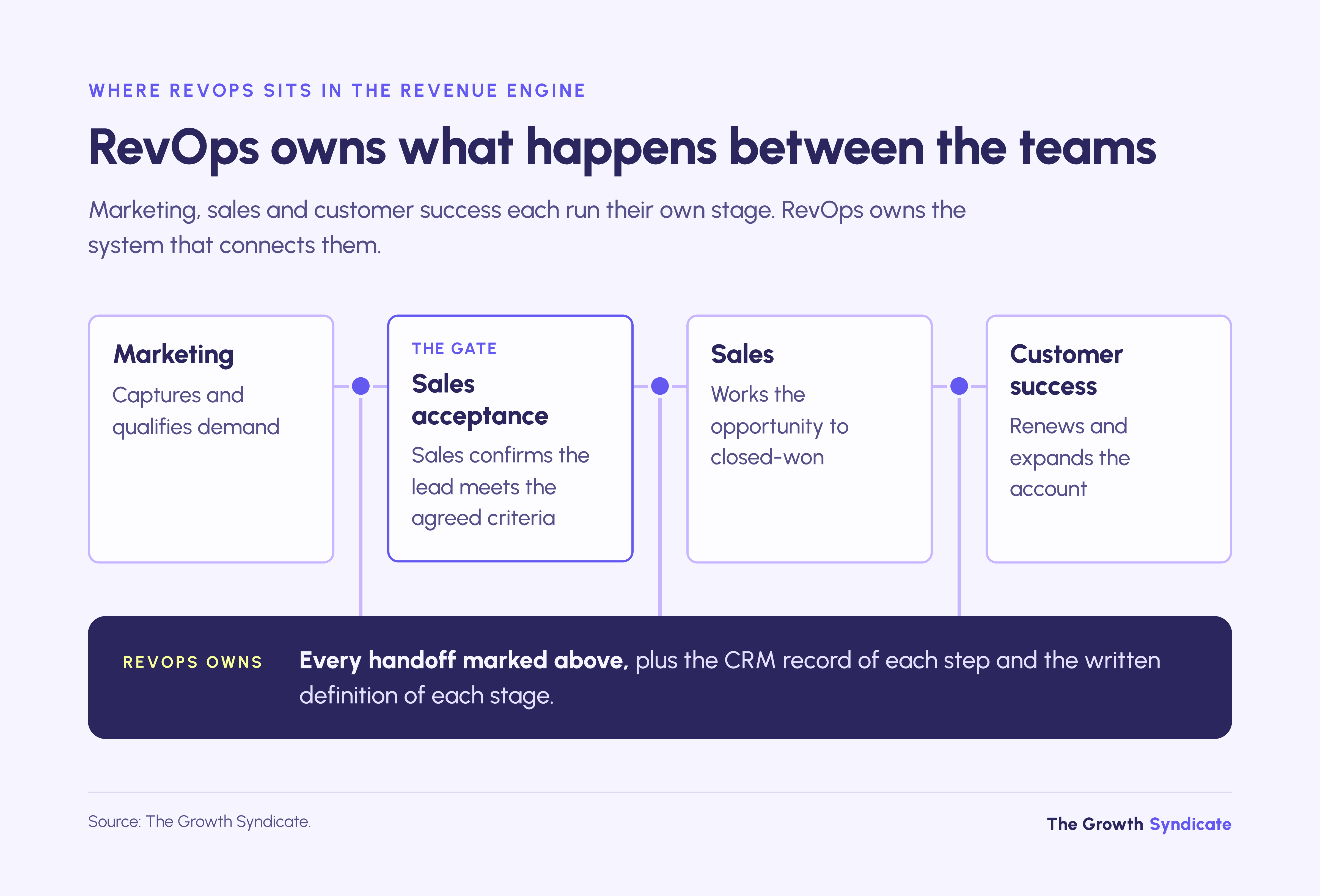
Sales operations supports the sales team with territories, quotas, forecast mechanics and the sales side of the CRM. Marketing operations supports marketing with automation, tracking, lead routing and campaign data. RevOps owns the layer they share with customer success: the CRM as one system, the lifecycle definitions and the handoffs between teams.
Source: The Growth Syndicate
In practice the boundaries blur. A small ops team does all three jobs, whatever it's called.
Where marketing operations stays a separate team inside a RevOps organization, it reports into RevOps rather than into the CMO. That move changes the reporting line far more than it changes the daily work.
What does revenue operations own?
Revenue operations owns the CRM as a single system, the lifecycle stage definitions every team reports against, data quality, the reporting and forecast process, and the rules for handoffs between teams. It shares enablement and deal desk work with sales. It should not own campaign execution, pricing strategy or quota decisions.
Source: The Growth Syndicate
Who owns the CRM?
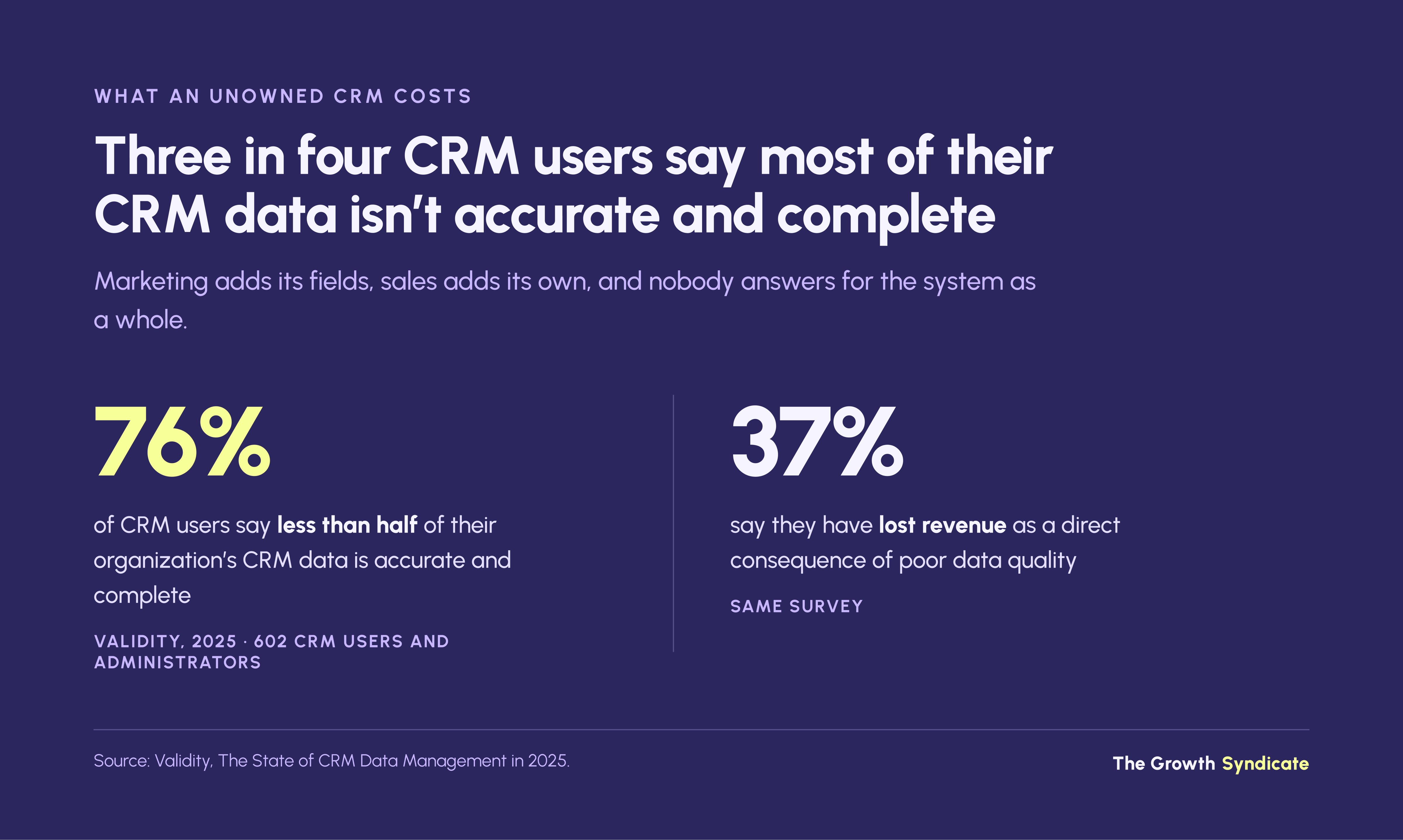
The CRM is the first thing RevOps owns and the thing most companies leave unowned. Marketing configures its forms and fields, sales adds its own, and nobody is responsible for the system as a whole, so the data decays one workaround at a time.

The cost shows up in survey data. In Validity's 2025 State of CRM Data Management, 76% of 602 CRM users and administrators said less than half of their organization's CRM data is accurate and complete. In the same survey, 37% said they had lost revenue as a direct consequence of poor data quality.
Definitions: what counts as a lead, an opportunity and pipeline
RevOps owns what each stage means, which matters more than the fields that store it. A lifecycle stage is useful only if its entry criteria are written down and every team applies them the same way. When every sign-up becomes a marketing qualified lead, the stage stops measuring intent, and every conversion rate built on it becomes noise.
Our position on the MQL follows from that. The label can stay as a leading indicator, but the stage that matters is the one where sales confirms a lead meets the agreed criteria, and the number leadership sees is pipeline.
That sales-accepted stage is also the only structured place to record why sales rejected a lead, which is why B2B lead qualification depends on it.
Handoffs between teams
Handoffs are where revenue leaks between teams. RevOps owns the rules for them: who receives a lead, how fast, what counts as accepted, and where a rejection reason gets recorded. A rule only works if it creates a feedback loop that sales actually uses.
In our work with Frends, an integration platform, marketing sent sales a weekly export of target accounts that had engaged with its ABM ads. Sales marked each account as useful or not, contacted or not, and whether to add it to outreach. Over the program, MQL-to-SQL conversion rose from 14% to 25-30%.

What RevOps should not own
RevOps fails when it becomes the place every unowned task lands. It shouldn't run campaigns, set prices or decide quotas; it should make sure the data behind those decisions is right.
A useful test: if a decision changes what the company sells or to whom, a business leader owns it. RevOps owns the system that records it.
Who should RevOps report to?
RevOps should report to the executive who owns the full revenue number, usually a CRO, COO or CEO, so that no single team's targets shape the data. Real reporting lines vary with company size. Finance shows up most in small companies, Operations is a common home in mid-sized ones, and Sales becomes the most common line in the largest.
Placement matters because incentives travel with reporting lines. Ops that reports into a commission-driven sales organization tends to drift toward definitions that favor sales, and sales leaders rarely know marketing's tracking well enough to own it.
A neutral owner works only if that person understands the commercial process from first touch to renewal. Where nobody like that exists yet, the work belongs with marketing rather than with a title that has no decision rights.
When should you hire your first RevOps person?
No credible benchmark ties the first RevOps hire to a revenue or headcount threshold. The ARR rules of thumb that circulate online come without a published method. Five symptoms are a better trigger:
- Marketing and sales report different numbers for the same pipeline.
- Nobody can say which customers closed last quarter and what they have in common.
- Lifecycle stages exist in the CRM, but nobody can state their entry criteria.
- New tools get bought to solve what are really data problems.
- Forecast reviews spend more time arguing about the data than about the deals.
The foundations come earlier than the hire. A basic CRM is enough for founder-led sales before product-market fit, but the data model, tracking and stage definitions should be set up properly once there is early traction and consistent revenue, at roughly 5-10 employees. That doesn't mean a RevOps hire at ten people; it means someone owns the foundations from that point, even part time.
What does the first RevOps hire do first?
The first RevOps hire should spend the opening months on the foundation rather than on dashboards. That means confirming tracking, auditing the CRM, writing down stage definitions with the sales and marketing leaders, and removing tools nobody uses. Reporting comes after, because reports built on undefined stages spread the confusion faster.
How do you build revenue operations?
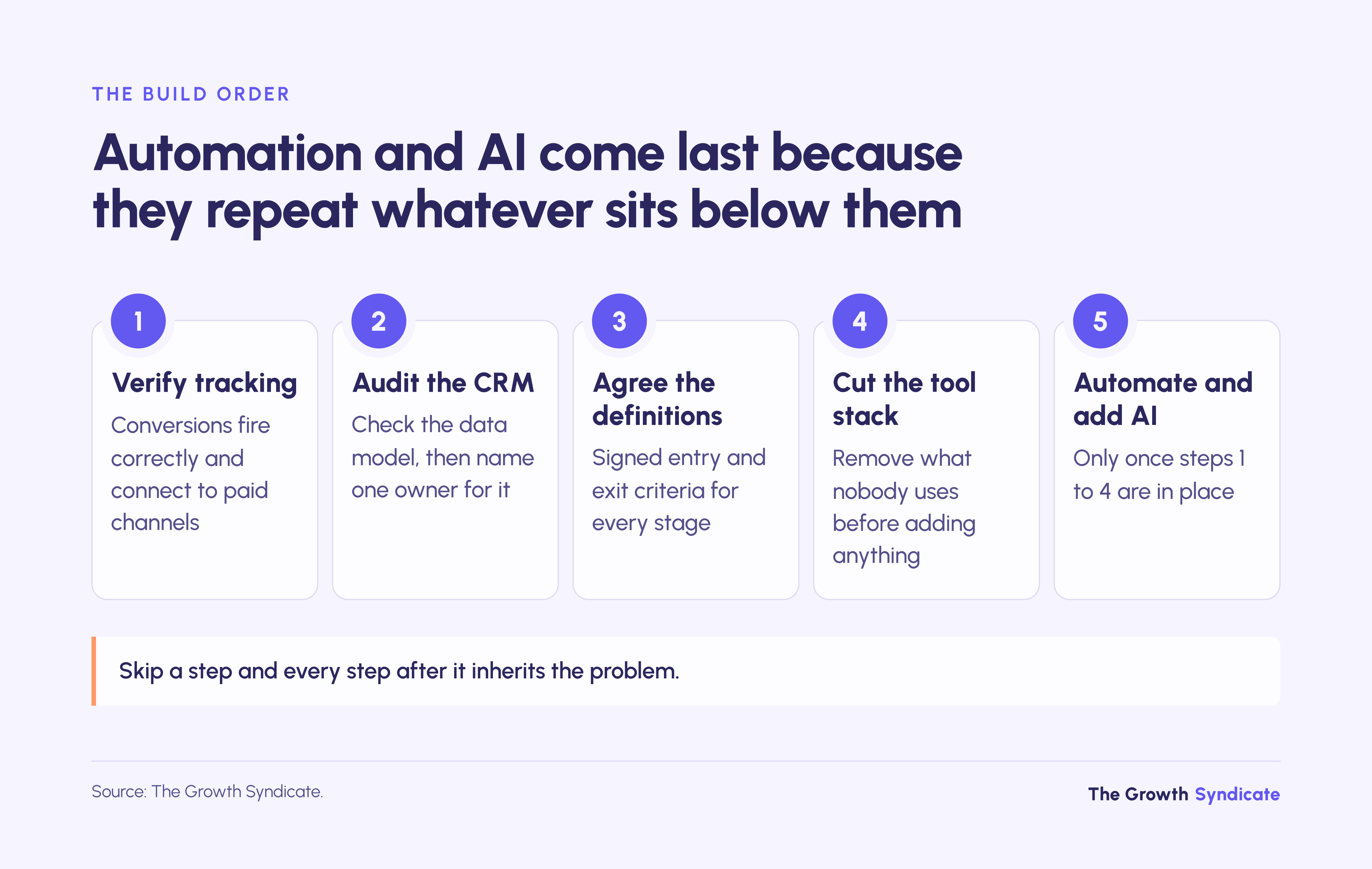
Build RevOps from the bottom up. Verify tracking, audit the CRM and name its owner, agree the stage definitions, rationalize the tool stack, and only then automate or add AI. Each layer depends on the one below it, so skipping ahead multiplies whatever is already wrong with the foundation.
Start with tracking
Before anyone touches the CRM, confirm that the website is tracked and that conversions fire correctly and connect to your paid channels. Then follow each conversion to see where it lands once it fires. If those inputs are wrong, every CRM report downstream inherits the error.
A full marketing audit also covers positioning and channels. The RevOps audit stays on the plumbing.
Audit the CRM and name an owner
The CRM audit asks whether the data model matches how the company actually sells, whether required fields get filled, and whether the stages mean anything. On HubSpot, that means auditing the portal in the order revenue flows through it, starting with how the revenue process actually works and who decides what changes in the system, rather than working through the settings menu object by object.
An audit that ends without one named person accountable for the system has fixed the symptoms and left the cause in place.
Agree the definitions
Write the entry and exit criteria for every lifecycle stage, and get the heads of marketing, sales and customer success to sign them. Then build them into the CRM as required fields and stage rules. Definitions agreed in a meeting and never written into the system drift as soon as the people in the room move on.
Rationalize tools, then automate
Cut the stack before you add to it. Gartner's 2025 Marketing Technology Survey puts martech utilization at 49%, with only 15% of organizations qualifying as high performers, so most companies already own more capability than they use.
Automation comes last because it repeats whatever process it is given. Automating a broken handoff produces broken handoffs faster, and the same holds for AI.
Should you build RevOps in-house, outsource it or go fractional?
Build in-house when the revenue team is large enough to keep an owner busy full time. Bring in an agency for a defined rebuild or migration, and use a fractional lead when you need senior judgment more than hours. In every model, someone inside the company still has to own the CRM and judge the output.
Source: The Growth Syndicate
Agency and fractional prices vary too widely to quote usefully, and almost every published range comes from a firm selling that service. Compare models on how much senior attention you get each month and on who owns the system when the engagement ends.
Source: The Growth Syndicate
The label matters as well. Some investors and private equity boards read "fractional" as a lack of commitment, so the useful question for any outside lead is whether they take accountability for results, whatever the title says.
The same applies to any outside RevOps and CRM partner, us included. An outside team can rebuild a CRM, but someone inside has to judge whether it is right once the outside team has gone.
Whichever model you choose, ask the provider how they would use your CRM data and who will own the system when they leave. A provider who treats CRM access as out of scope will report on the metrics their own tools surface.
What metrics and KPIs is RevOps measured on?
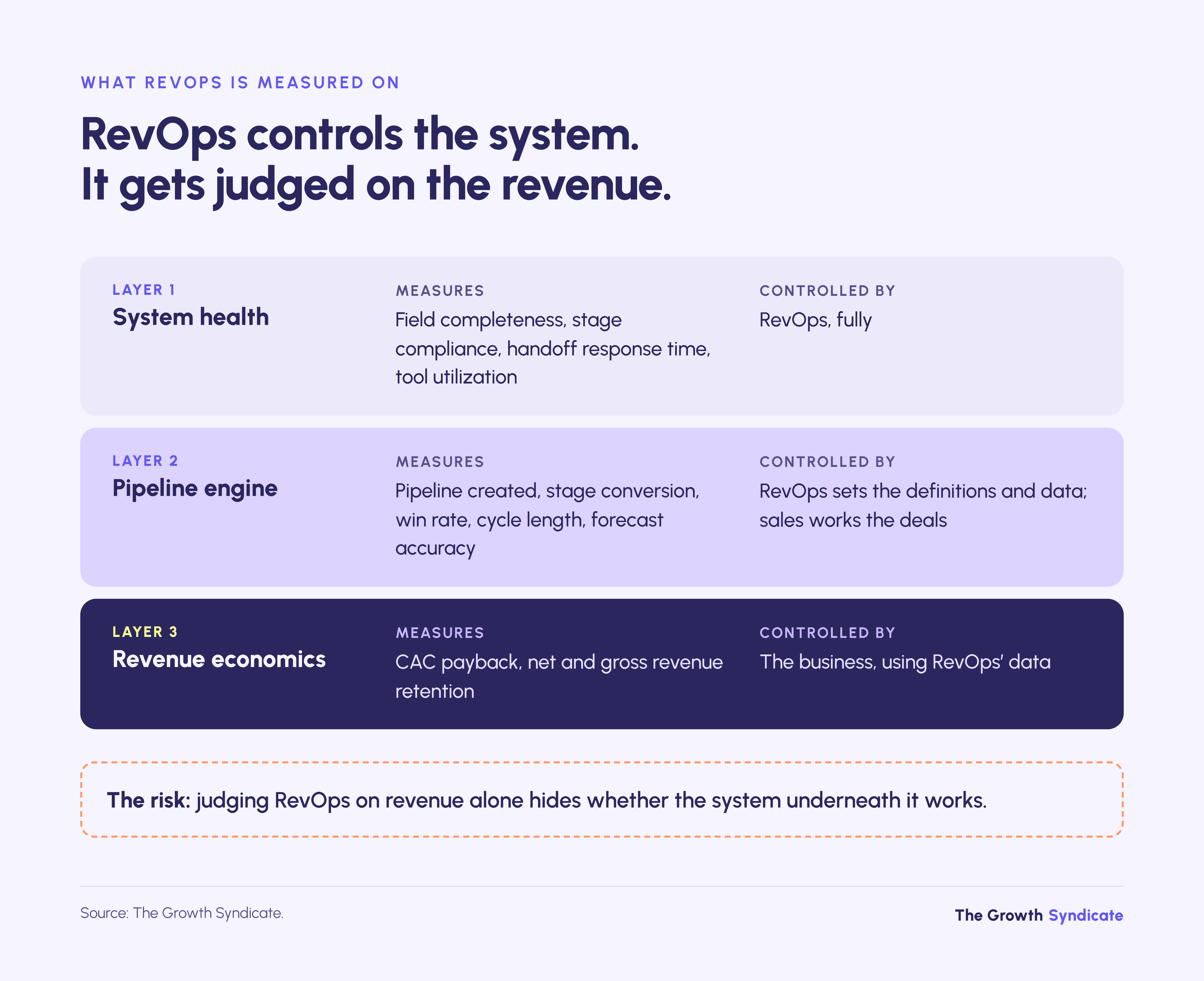
Revenue operations is judged on whether the revenue engine produces reliable pipeline and forecasts: pipeline created, conversion between stages, win rate, sales cycle length and forecast accuracy, plus efficiency and retention measures such as CAC payback and net revenue retention. It fully controls only one layer, the health of the data and definitions behind those numbers.
Source: The Growth Syndicate
Lead volume is missing on purpose. Forrester's analysis of lead-centric processes puts typical conversion from inquiry to closed-won at less than 1%, and notes that over 80% of buying decisions involve a buying group of more than three people.
RevOps owns the system that makes measurement possible. Choosing a B2B marketing attribution model is a separate decision, built on top of that system.
How is AI changing RevOps?
AI has changed the tools RevOps uses and the technical skill the job requires. Enrichment, routing, forecasting and data cleanup can now be automated or assisted by models. AI hasn't changed the job itself, which is still getting the right data through the right systems, and AI built on a broken CRM scales the mess.
Is a GTM engineer a new role?
The GTM engineer is the clearest recent case of a new title for old work. Bloomberry's analysis of GTM engineering job postings found that 9 out of 10 responsibilities in GTM engineer roles also appear in RevOps engineer postings.
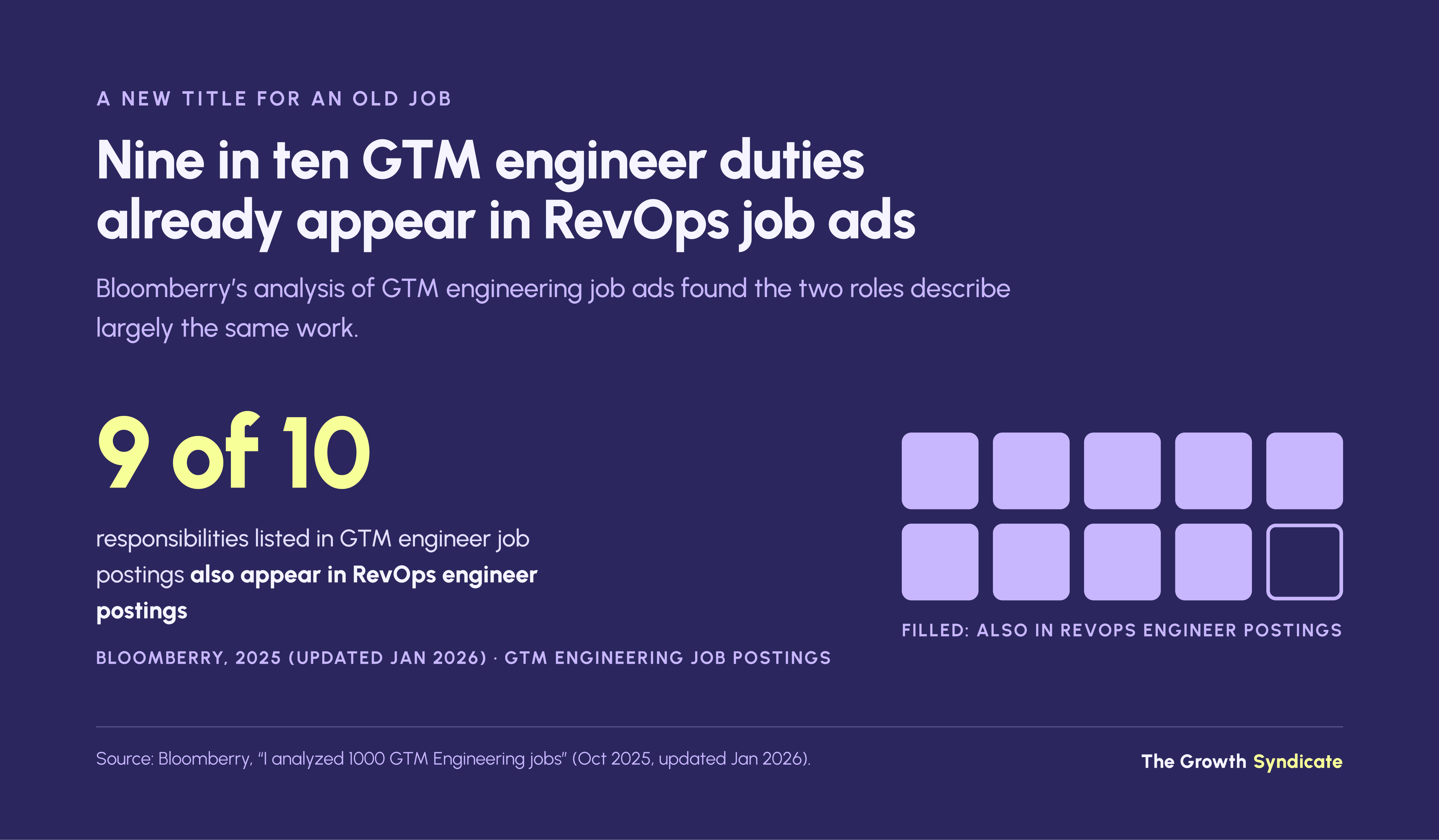
The same analysis counted a 205% year-over-year rise in new GTM engineer and RevOps postings combined, comparing January to September 2025 with the same months of 2024. The hiring demand is real; the change is in the tooling.
Why AI raises the cost of bad CRM data
AI inherits whatever data it is given. Gartner predicts that through 2026, organizations will abandon 60% of AI projects unsupported by AI-ready data. In its July 2024 survey of 1,203 data management leaders, 63% either lacked or were unsure they had the right data management practices for AI.
An AI agent that routes leads on unreliable lifecycle stages routes them wrong at machine speed. The build order holds for AI too: tracking, the CRM and the definitions first, automation after.
Source: The Growth Syndicate
Why does RevOps fail?
RevOps usually fails for organizational reasons rather than technical ones. Nobody owns the CRM, so data decays. Tools pile up faster than anyone uses them, teams keep separate definitions of the same stage, or the RevOps team becomes a reporting desk that produces dashboards without the authority to change the process behind them.

Work that sits between teams goes undone
Work that belongs to two or three teams at once tends to belong to none. In companies with heavy inbound volume, the monthly review of which customers actually closed sits between marketing, sales and customer success, so nobody runs it and leadership loses sight of its best-fit customers.
B2B market segmentation only pays off if someone owns that review. The fix is naming the owner before choosing the method.
Tool sprawl
Each team buys a tool for its own problem, and each tool brings its own fields and its own version of the truth. Before buying anything, RevOps should be able to say which existing tool already does the job and who uses it.
Separate definitions of the same thing
When marketing counts every form fill as a lead and sales counts only meetings booked, both teams report accurate numbers that can't be reconciled. The fix is one written definition per stage, enforced in the CRM, with RevOps as the only team allowed to change it.
RevOps as a reporting desk
A RevOps team that produces reports but can't change the process behind them turns into a service desk. The same trap catches technical specialists anywhere in marketing: clean execution, measured on the metrics their tools surface, with nobody asking what happened in the CRM.
Sales ops with a new title
The quietest failure is a rename. Sales ops gets renamed RevOps and keeps serving the sales leader, while marketing and customer success build their own shadow ops to compensate. If a RevOps team can't name a decision it made against one team's preference, this is probably what happened.
RevOps statistics, checked
Most widely shared RevOps statistics are older or weaker than they look. Several predate the term, several come from surveys co-sponsored by software vendors with no published sample, and the best-known prediction comes due this year with no follow-up figure published alongside it. The table traces eight common claims to their original sources.
Each claim traced to its original source by The Growth Syndicate, October 2026
The 19% figure, for example, traces to a 2015 SiriusDecisions presentation of benchmark data from 400 B2B organizations, covering 2006 to 2014, years before SiriusDecisions was describing RevOps as an emerging model. None of this means RevOps doesn't work; the case for it rests on operational logic, because one owner and one set of definitions produce numbers people can trust.

Where RevOps breaks down
RevOps is the wrong move for companies too small to have separate revenue teams, for companies whose leaders won't give it decision rights, and for anyone expecting it to fix a product or pricing problem. In those cases a named CRM owner and written stage definitions deliver most of the value without creating a new function.
- Before product-market fit. With founder-led sales and a handful of deals a month, a basic CRM and one disciplined founder are enough. A RevOps function adds process before there is a process worth fixing.
- When leadership won't give it authority. RevOps that can't enforce a definition against a senior sales or marketing leader becomes an expensive reporting desk.
- When the gap isn't operational. If pipeline is thin because the product, pricing or positioning is wrong, cleaner data will show the problem more clearly but won't solve it.
- When it costs more than it saves. A full-time RevOps hire in a company with one salesperson and no customer success team will spend most of the week on admin.
- When the evidence is oversold. The performance claims around RevOps are mostly correlational and dated. Build it because the operational case holds for your company, not because of a headline number.

What to do next
Start with ownership, then sequence the work from the bottom up. The right first move depends on where your revenue engine is breaking today, and none of the situations below requires a new department to fix.
If nobody can say who owns your CRM, name one person this month, give them authority over stages and fields, and route every structural change through them.
If marketing and sales report different pipeline numbers, write one definition per lifecycle stage, get both leaders to sign it, and build it into the CRM before the next quarterly review.
If you're about to buy a new tool or an AI product, audit tracking and the CRM first, because the new tool will inherit whatever data it finds.
If you're choosing between a hire, an agency and a fractional lead, decide first who inside the company will own the system after the outside help leaves.
If your RevOps team only produces reports, move it under whoever owns the full revenue number and give it authority over the definitions.
Frequently asked questions
What does RevOps stand for?
RevOps stands for revenue operations. The term covers the people, processes and systems that keep the CRM, the revenue data and the handoffs between marketing, sales and customer success working as one engine. Some companies use the term for a team; others use it for an operating model that several ops teams share.
Is RevOps a department or a strategy?
It can be either. Gartner describes RevOps as a business function, while Forrester calls it a commercial execution strategy whose capabilities can sit inside sales or marketing. In practice, what matters is whether one accountable person owns the CRM and the stage definitions across teams, whatever the org chart calls it.
Is there a standard RevOps framework?
No single framework is standard. Software vendors publish pillar models, usually covering process, data, tools and enablement, and analyst firms use their own maturity models. A framework helps only if it names who owns each decision, so start from ownership of the CRM and the definitions and add structure as the team grows.
What tools are in a RevOps tech stack?
A RevOps stack starts with the CRM, then adds marketing automation, data enrichment, routing and scheduling, conversation intelligence, forecasting and a reporting or BI layer. Most companies already own more than they use: Gartner's 2025 survey put martech utilization at 49%. Rationalize the existing stack before buying anything new.
Does RevOps own sales enablement?
Usually it shares it. RevOps supplies the data, the CRM setup and the tooling that enablement depends on, while the training content and coaching typically sit with sales leadership or a dedicated enablement team. In smaller companies one person may cover both, but the two jobs need different skills.
Who owns the CRM if there is no RevOps team?
Someone still has to. In smaller B2B companies the best default is usually marketing, because the tracking and the top of the CRM already live there, provided that person understands the full sales process. What fails is shared ownership, where every team edits the system and nobody is accountable for it.
Does RevOps actually increase revenue?
The evidence is weaker than most articles suggest. The widely quoted growth figures come from correlational surveys, some co-sponsored by vendors, or from data that predates the term. The stronger argument is operational: one owner and agreed definitions produce numbers leaders can trust, which makes every later revenue decision better informed.
What is the difference between RevOps and revenue cycle management?
They are unrelated despite the similar names. Revenue cycle management is a healthcare finance discipline covering patient billing, claims and payment collection. Revenue operations is a B2B go-to-market function covering the CRM, pipeline data and handoffs between marketing, sales and customer success.
What are AI agents in RevOps?
AI agents in RevOps are automated assistants that act on CRM data: enriching records, routing leads, drafting follow-ups, flagging deal risk or cleaning duplicates. They work only as well as the data and stage definitions underneath them, so they belong after tracking, CRM ownership and definitions are in place, not before.
What does a head of revenue operations do?
A head of revenue operations owns the CRM and connected systems, sets and enforces lifecycle definitions, runs the reporting and forecast process, and manages the handoff rules between marketing, sales and customer success. The role usually reports to the CRO, COO or CEO and is judged on pipeline integrity and forecast accuracy.