


Fintech SEO is the work of earning organic search and AI-answer visibility for a financial technology company in a category where Google holds pages to a higher standard and regulators hold claims to a legal one. The sites that rank and get cited treat the two as one job, because the trust signals Google asks its raters to look for on money topics overlap with what a compliance reviewer signs off. This guide is for marketing leads at B2B fintechs who need search to work without a review queue that stalls publishing.
Key takeaways
- Google’s rater guidelines name “Financial Security” as a YMYL category with “very high Page Quality rating standards”, and Google’s own documentation says E-E-A-T “isn’t a specific ranking factor”. Both statements belong in your strategy.
- Financial institutions discover vendors through peers (53%) before search (37%), so the pages that rank for your category are doing validation work on a shortlist that already exists.
- Google’s 2026 generative AI guide says page sets built for each AI query variant “primarily to manipulate rankings or generative AI responses” violate its scaled content abuse policy. Country, currency and integration pages survive on the data that changes per page.
- Five API-first fintechs keep their docs indexable and publish llms.txt, and none of the four whose docs homes we checked links pricing, status or trust pages from there. That gap is the easiest fix in this article.
Sourcing note. The regulatory and search claims here come from primary documents read on October 5, 2026: Google’s Search Quality Evaluator Guidelines and Search Central pages, the FCA Handbook, FINRA rules and notices, and the SEC’s rule text and risk alerts. Vendor research (Ahrefs, Conductor, Seer Interactive, G2) is labeled as such, and the page map and review tiers come from The Growth Syndicate’s client work and founder practice. No client analytics appear.
What is fintech SEO?
Fintech SEO is search engine optimization for companies that move, lend, store or account for money, including the AI answers that now sit above the results. It differs from general B2B SEO in four ways: the topic is YMYL, many pages are regulated communications, the evaluator is often an engineer reading docs, and comparison queries almost always trigger an AI Overview.
The general playbook still applies underneath. Keyword research, technical health, internal linking and authority work the same way for a payments company as for any other B2B firm, and the B2B SEO strategy that holds for most categories is the base layer here too. What changes is who reads the page, what the page is allowed to say, and what happens before it goes live.
The reader is the first difference. In manufacturing SEO, the engineer searches in specifications. In fintech, the evaluator searches for proof that the vendor is allowed to do what it claims and will still be there next year, and search is where part of that underwriting happens, usually before anyone talks to sales.
The second difference is the claim. A product page that says “instant settlement” or “FCA-authorized” is a statement a regulator can read. The third is the surface: for an API-first fintech, much of the evaluation happens in the documentation rather than on the marketing site.
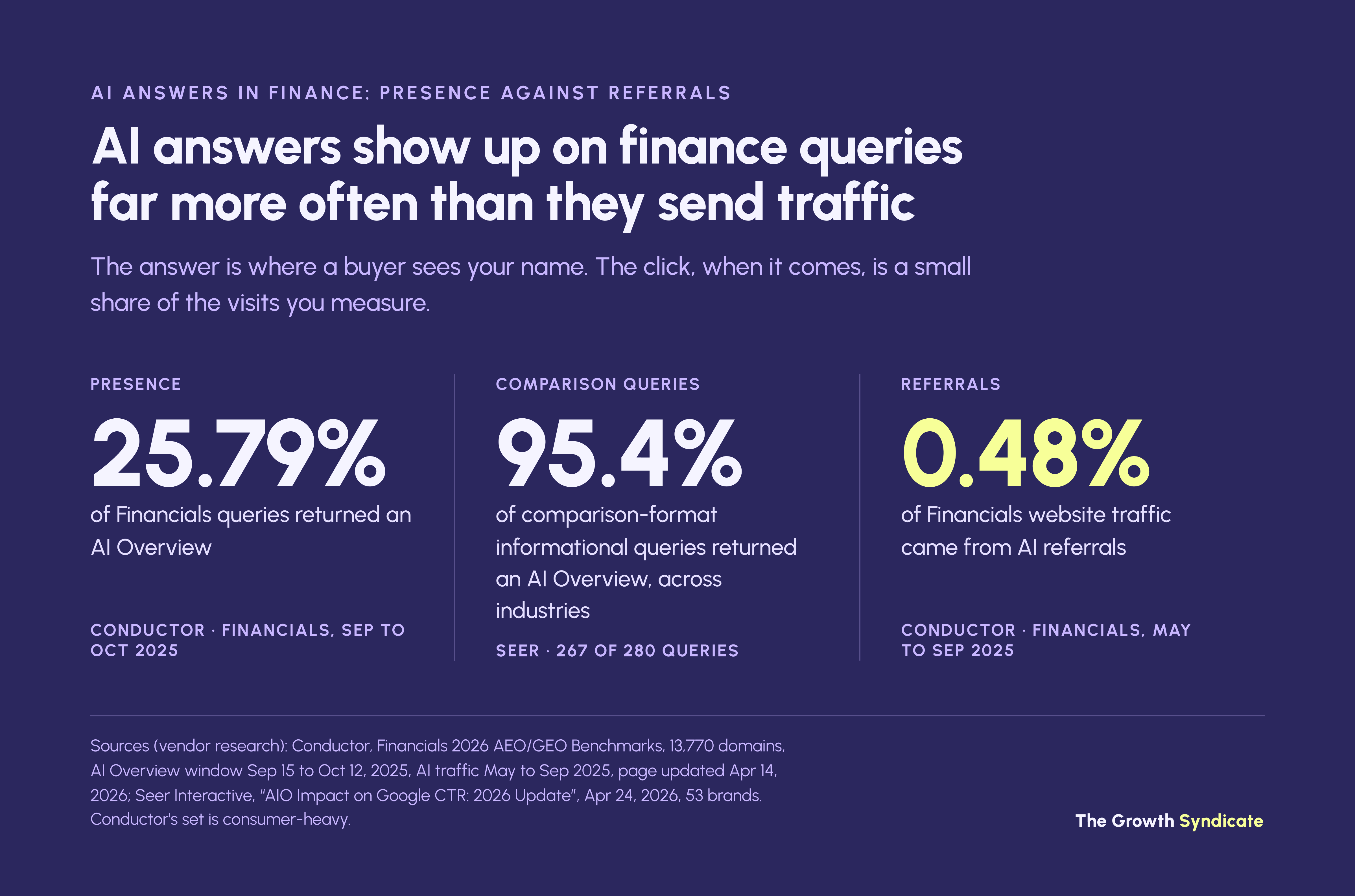
The fourth is the answer engine. Seer Interactive’s 2026 click data (53 brands, 5.47 million queries) found comparison-format informational queries triggered an AI Overview 95.4% of the time. “Best payments API for marketplaces” is a comparison query, which is why SEO for fintech companies has to be written for the passage an engine extracts as much as for the page a person reads.
What does YMYL mean for fintech?
YMYL stands for “Your Money or Your Life”, Google’s label for topics that could significantly impact a person’s health, financial stability or safety. Google’s rater guidelines name “Financial Security” as one of those topics and apply “very high Page Quality rating standards” to clear YMYL pages. For fintech, pages about money are judged on trust first, and the signals raters look for are specific.
Google’s Search Quality Evaluator Guidelines, dated September 11, 2025, define the category in one sentence: “YMYL Financial Security: Topics that could damage a person’s ability to support themselves and their families.” For clear YMYL topics, the document says, “we have very high Page Quality rating standards because low quality pages on such topics could potentially negatively impact a person’s health, financial stability, or safety”.
The guidelines are a rater document, so the caveat travels with every quote. Google’s Search Central page on helpful content, last updated October 1, 2026, says: “Search raters have no control over how pages rank. Rater data is not used directly in our ranking algorithms.” The same page says Google’s systems “give even more weight to content that aligns with strong E-E-A-T for topics that could significantly impact the health, financial stability, or safety of people”.
Both sentences are true at once. The rater standard is not the algorithm, and the algorithm is tuned to reward what the rater standard describes.
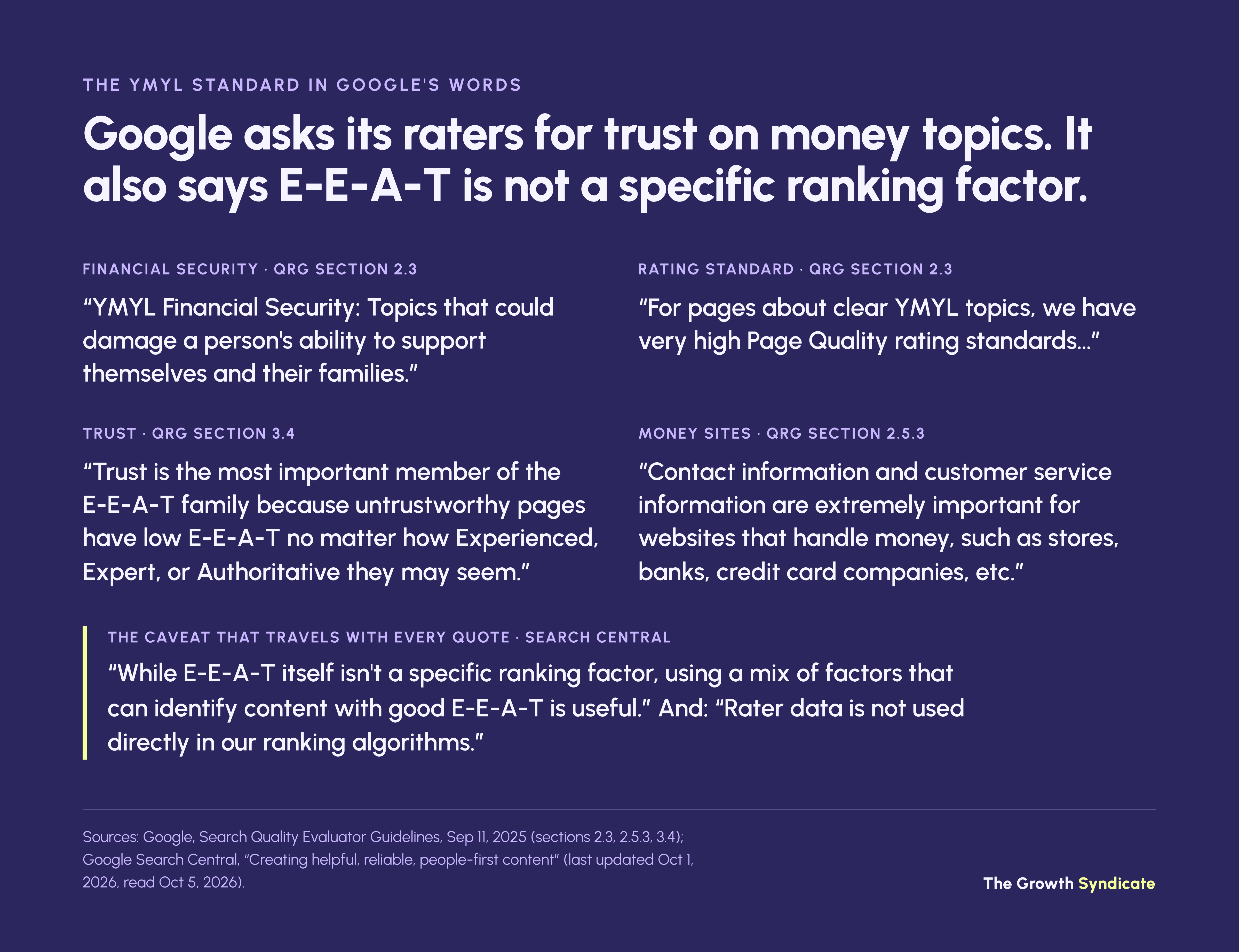
What the raters look for on money sites is concrete. Section 2.5.3 says “Contact information and customer service information are extremely important for websites that handle money, such as stores, banks, credit card companies, etc.” Section 4.5 asks for “comprehensive information about who is responsible for the site and a way to contact the site if something goes wrong”.
Section 5.5 says pages that process financial transactions “should receive a Low rating if there is an unsatisfying amount of customer service information or contact information”. The “Low: Financial” example in section 5.7 is a stock-picking article where “There is no evidence that the author has financial expertise.”
Read those four passages next to a compliance checklist and the overlap is obvious: who is the legal entity, how do I reach you, who wrote this and are they qualified, and is any of it misleading. That is the thesis of this article in Google’s own words.
Is E-E-A-T a ranking factor?
No. Google’s Search Central page says “While E-E-A-T itself isn’t a specific ranking factor, using a mix of factors that can identify content with good E-E-A-T is useful.” E-E-A-T is the rater’s rubric for experience, expertise, authoritativeness and trust, and Google’s systems are built to reward pages that score well on it, with extra weight on YMYL topics.
Trust leads the four. The guidelines say “Trust is the most important member of the E-E-A-T family because untrustworthy pages have low E-E-A-T no matter how Experienced, Expert, or Authoritative they may seem”, and define it as “the extent to which the page is accurate, honest, safe, and reliable”. The example that follows is pointed: “a financial scam is untrustworthy, even if the content creator is a highly experienced and expert scammer”.
On a fintech site, Trust looks like a named legal entity with its registration number and a link to the public register, a contact route that works, authors with a stated role, dates on anything that can go stale, and claims that are substantiated in the copy. Those are the items a compliance officer checks before a page goes live. Building them once, into the templates, is the efficiency gain this article argues for.
Search is one of the vouchers your buyer checks
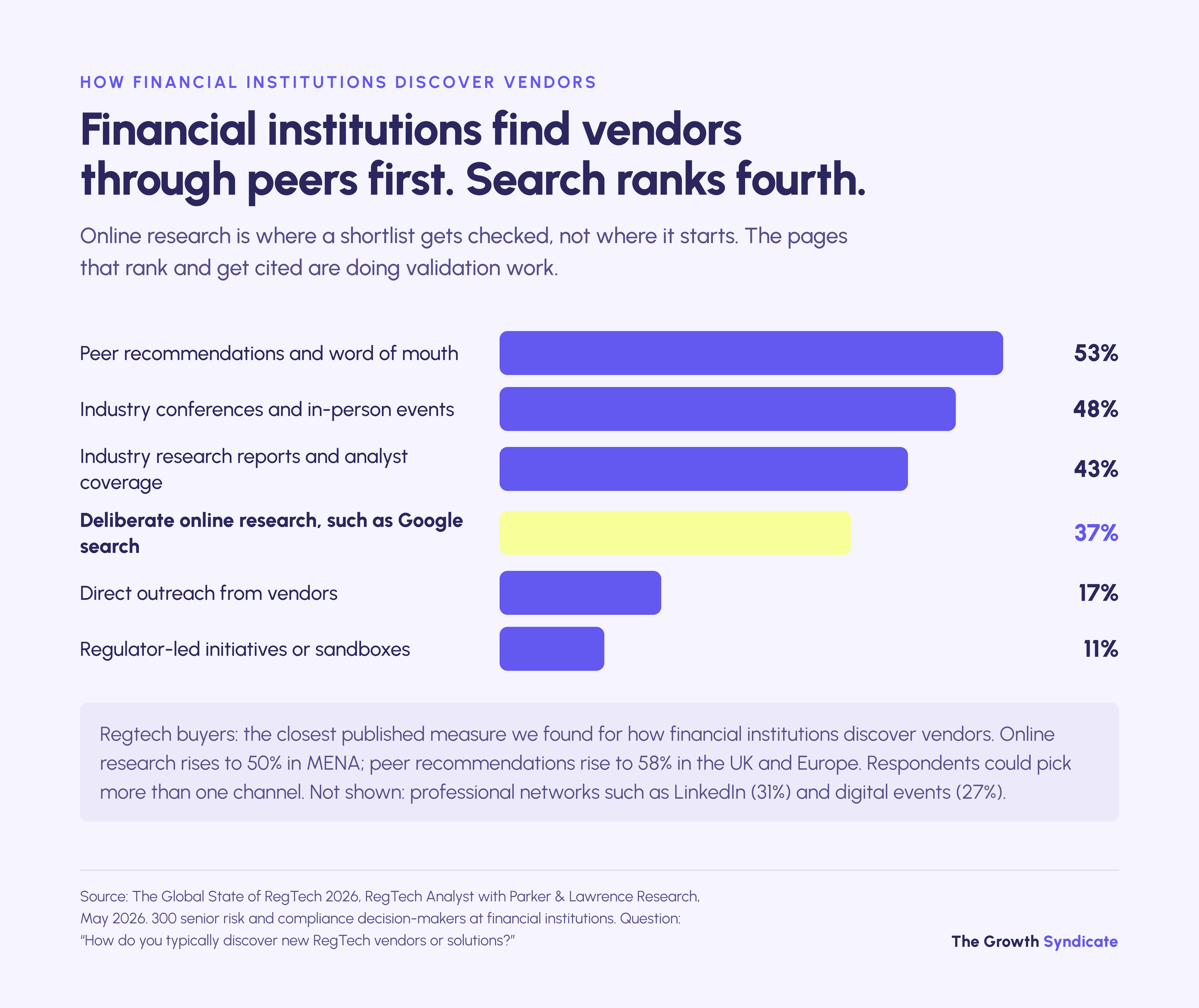
In fintech, search and AI answers are where a buyer checks a shortlist that already exists. Financial institutions discover vendors through peers first and online research fourth, and B2B buyers who use AI then validate what it tells them with trusted sources. The pages that rank and get cited for your category are doing that validation work, often before the first call.
The closest published measure we found of how financial institutions discover vendors comes from regtech, which is close enough to be useful. The Global State of RegTech 2026, published in May 2026 by RegTech Analyst with Parker & Lawrence Research, asked 300 senior risk and compliance decision-makers at financial institutions how they typically discover new vendors. Peer recommendations and word of mouth came first at 53%, industry conferences at 48%, research reports and analyst coverage at 43%, and “Deliberate online research (e.g. Google search)” fourth at 37%.
The same survey asked what institutions select on: security, resilience and data protection led at 41%, ease of integration followed at 39%, and vendor reputation or financial stability was named by 26%. All three are things a trust center, a docs site and a regulatory-status page can prove in writing. The buyer who found you through a peer still opens those pages before the first call.
Search sits inside a wider shift. Forrester’s State of Business Buying 2026, built on its survey of nearly 18,000 business buyers, reports that “Nearly all business buyers (94%) report using AI during their buying process”, and that buyers “compensate by seeking validation from trusted sources: peers, product experts, industry analysts”. G2’s Answer Economy report (1,076 B2B software buyers and decision makers, March 2026) found 51% “start their research with an AI chatbot more often than Google” and 80% “still use Google somewhere in their buying journey”.
Both are vendor research, and both point the same way. The AI answer builds a list, and the site is where the list gets checked, which is what TGS’s fintech work is built around.

Fintech is the high-risk, high-ticket case. The 2023 US interagency guidance on third-party relationships and the EU’s DORA (Article 28(4)(d) requires financial entities to “undertake all due diligence on prospective ICT third-party service providers”) formalize the due diligence a bank runs on a vendor, which the fintech marketing guide in this series maps into four risks. A page that answers the due-diligence question before it is asked is doing SEO and sales enablement at the same time.
The fintech page map: what each page has to prove
A fintech site has nine page types that search and AI engines use differently, and each carries a different level of claims exposure. The practical consequence is a review model with three tiers: compliance pre-approves the pages that make regulated claims, approves templates once for the pages that repeat, and samples the rest. Most of the site never waits in the queue.
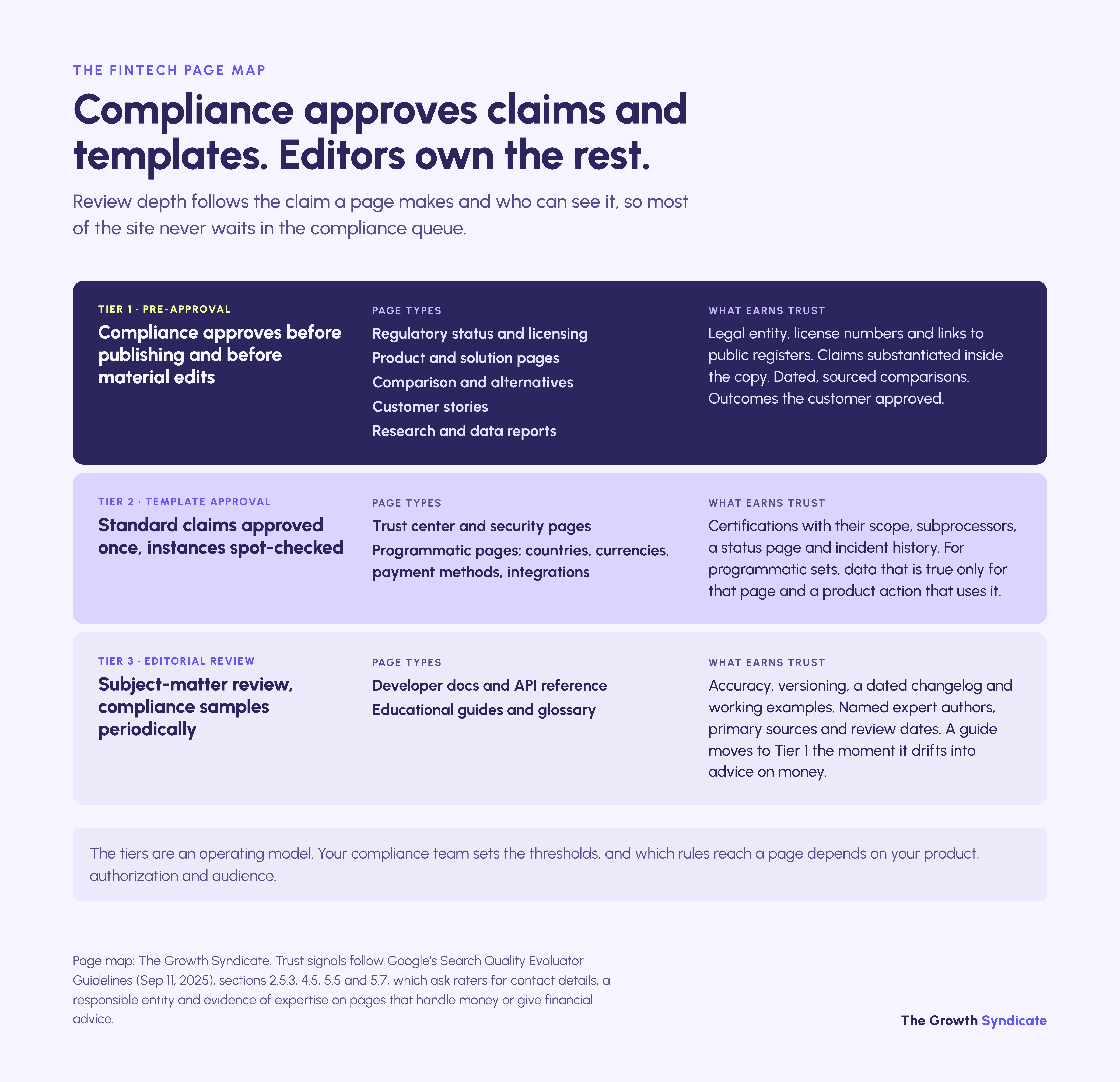
The map below is The Growth Syndicate’s operating model, built from client work with fintechs. It is not a regulatory requirement. Your compliance team sets the thresholds, and which rules reach a page depends on your product, your authorization and who can see the page.
Three of the nine need a note. Regulatory-status pages are where the rater guidelines and the compliance checklist meet most directly: legal entity, license or registration numbers, links to the public register, the partner bank where one exists, and a plain statement of what the license does and does not cover.
Comparison pages carry the highest AI exposure of any commercial page, and every claim about a competitor is a claim someone else’s lawyer can read. Customer stories need the customer’s consent on top of compliance review, because an outcome figure is an attributed claim about someone else’s business.
The page map also decides site architecture. Trust pages need to be reachable from the docs, the pricing page and the footer, and they need to render as pages rather than PDFs, because a rater, an AI engine and a procurement analyst all read HTML more easily than a download.
The structural rules in B2B website design apply, with one addition. Every page that a retail customer or a micro-enterprise can read is a page the promotion rules may reach.
How does compliance review fit inside the SEO workflow?
Compliance review fits inside the SEO workflow when it is designed by page type rather than applied per article. The rules that reach a web page depend on the firm’s authorization, the product and the audience, and most of them turn on one question: does the page invite someone to do something with money? Pages that do are reviewed before publishing, templates are approved once, and the rest is sampled.
Which rules reach your web pages?
The rules below describe what the regulators say about web content. Which ones apply to you depends on your product, your authorization and your audience, and your compliance team makes that call. This article describes the rules; it does not advise on your position.
Two distinctions in that table are the ones readers get wrong most often. The first is in the UK payments row. The FCA Handbook’s definition of a “payment service customer” is “(a) a consumer; (b) a micro-enterprise; or (c) a charity which has an annual income of less than £1 million”, so the detailed communication rules and the Consumer Duty stop at micro-enterprises.
The definition of a payment service or electronic money promotion carries no audience limit at all. On the rule text, a product page inviting a corporate to open a payment account is a promotion, and BCOBS 2.2.1R’s “fair, clear and not misleading” standard reaches it. An API reference page is not an invitation to anything.
The second is in the broker-dealer row. FINRA Rule 2210’s retail-communication machinery, including principal pre-use approval and the BrokerCheck link, applies once more than 25 retail investors can see the page in 30 days, and the BrokerCheck requirement “shall not apply to … a member that does not provide products or services to retail investors”. The “fair and balanced” standard in 2210(d)(1)(A) applies to “all member communications”.

FINRA’s Regulatory Notice 26-14, published July 9, 2026, proposes to replace mandatory pre-use approval with written procedures that “determine what categories of retail communications require principal pre-use approval”. Comments closed on September 11, 2026, with letters from SIFMA, FSI, ICI, NASAA, Fidelity and others. No rule filing has reached the SEC, so pre-use approval stands as of October 2026, and a separate 2026 filing on Rule 2210 (SR-FINRA-2026-004) concerns performance projections rather than supervision.
For everyone else, meaning firms in none of the rows above, which covers most B2B fintech selling infrastructure to enterprises outside the UK, the pressure comes from the buyer’s due-diligence duty, the contract and Google’s trust standard rather than from promotion law. The EU’s MiCA regulation adds marketing standards for crypto-assets: Article 7 requires offerors and those seeking admission to trading to make marketing communications “clearly identifiable as such”, “fair, clear and not misleading”, and “consistent with the information in the crypto-asset white paper”, and Article 66 requires crypto-asset service providers to give clients information that is “fair, clear and not misleading, including in marketing communications”. PSD2 and the pending PSD3 texts set information duties rather than a marketing standard, and most of those duties can be disapplied for business customers; B2B advertising in the EU falls under the Misleading and Comparative Advertising Directive instead.
Review tiers that keep publishing speed
Three review tiers let a fintech publish at the speed search needs without skipping the review that regulated claims need. Tier 1 pages are approved before publishing and before material edits, and Tier 2 pages have their template or standard claims approved once, with instances spot-checked. Tier 3 pages run on editorial and subject-matter review, with compliance sampling periodically.
The tiers work because the review object changes. In Tier 1, compliance reviews a page. In Tier 2, compliance reviews a template and a data rule (“the rate on this page is the live mid-market rate from source X; nothing else varies”), and the pages generated from it inherit the approval.
In Tier 3, compliance reviews a process: who writes, who checks, what triggers escalation. A guide moves to Tier 1 the moment it drifts into advice on money.
Four practices keep the tiers from decaying. Disclosures live in the copy, next to the claim, because the SEC’s December 2025 exam alert flagged advisers who “used hyperlinked disclosures rather than including the required clear and prominent disclosures within the testimonial or endorsement”. Every Tier 1 page carries a review date and an owner for the refresh calendar, because a stale regulation reference is a compliance failure and a freshness failure at once.
Third-party content on your domain gets the same review as your own, because the FINRA and SEC “adoption and entanglement” tests make linked or hosted content yours once you endorse it or help prepare it. And the claim library is versioned, so a changed claim propagates to every page that uses it.
Can fintechs use programmatic SEO without scaled content abuse?
Yes, when every generated page carries data that is true only for that page. Google’s test for scaled content abuse is purpose and user value rather than templating, so pages produced mainly to rank, without helping users, break the policy, while pages whose template is a frame for live rates, scheme rules or integration steps do not. The empty template is the problem, never the template.
Google’s spam policy defines the line: “Scaled content abuse is when many pages are generated for the primary purpose of manipulating Search rankings and not helping users.” The March 2024 update that introduced the policy made it method-neutral, covering “automation, humans or a combination”.
Google’s guide to optimizing for generative AI features, published in May 2026 and last updated July 10, 2026, contains the sentence that matters most for fintech growth teams. Creating separate content for each query fan-out variation “primarily to manipulate rankings or generative AI responses in Google Search violates Google’s scaled content abuse spam policy.”
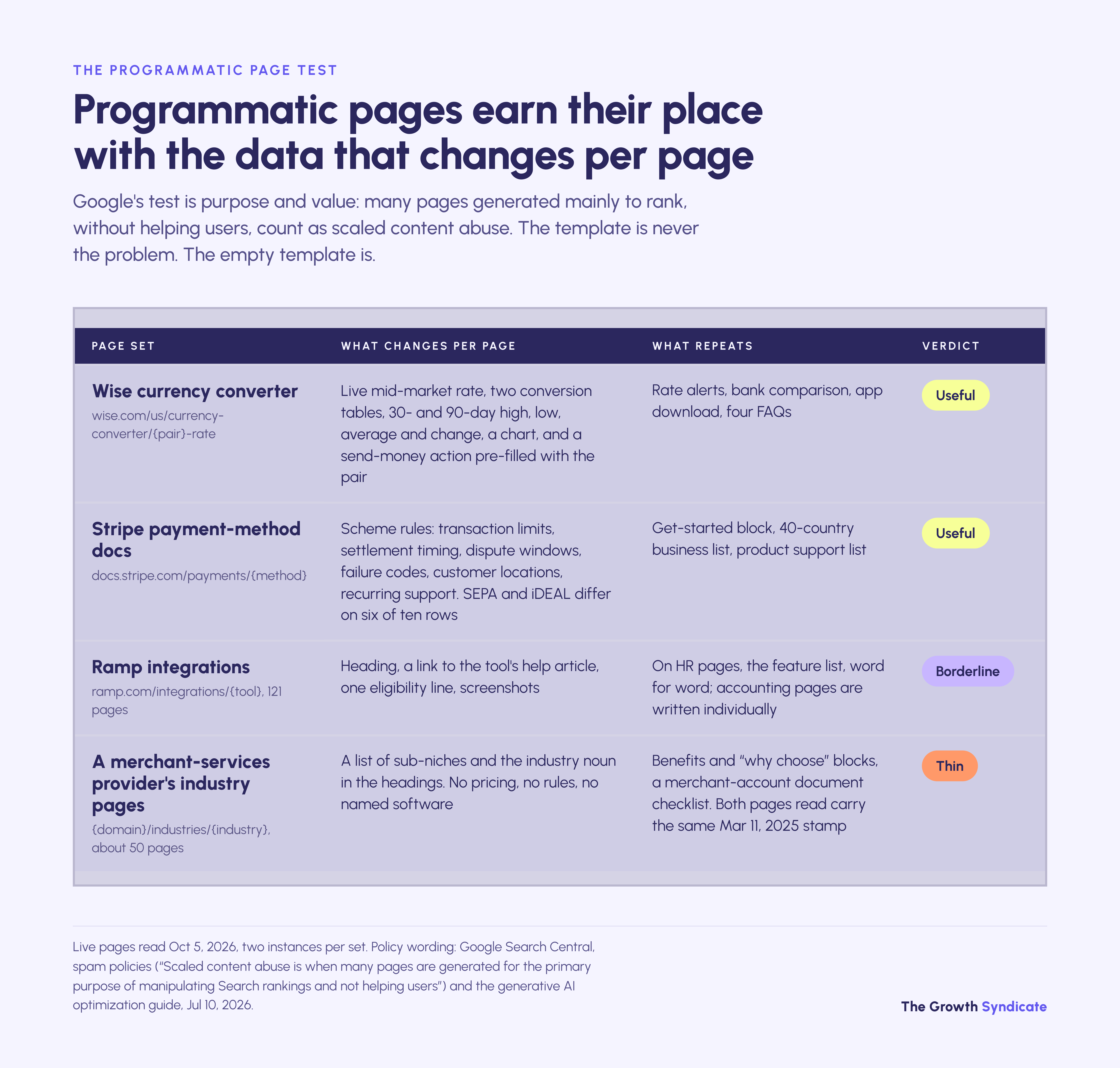
Live pages make the test concrete. Wise’s currency converter pages (wise.com/us/currency-converter/usd-to-eur-rate and its siblings) carry a live mid-market rate, two conversion tables, 30- and 90-day highs, lows and averages, a chart, and a send-money action pre-filled with the pair. Stripe’s payment-method docs (docs.stripe.com/payments/sepa-debit against /payments/ideal) differ on six of the ten rows of the properties block, and SEPA carries a 10,000 EUR transaction limit, T+6 settlement, 8-week and 13-month dispute windows and a 13-code failure table that iDEAL does not.
Ramp’s integration directory (121 pages) sits on the line. On HR integrations such as Gusto and BambooHR, the heading, the help-article link and the tool name change per page while the feature list repeats word for word; the flagship accounting pages, such as Xero, are written individually.
A merchant-services provider’s roughly 50 industry pages swap only the industry noun in the headings and a list of sub-niches, with no pricing, no rules and no named software. Both pages read carried the same March 11, 2025 modification stamp. That is the profile the policy describes.
Two adjacent policies matter for finance specifically. Google’s site reputation policy covers third-party content hosted “mainly because of that host’s already-established ranking signals”, and Google’s own example is a page of sponsored reviews of payday loans. Since an August 2026 update, the policy says Google’s goal is to determine whether such content is “created with sufficient input, editorial oversight, or contribution from the host site to be considered fully integrated with the main site”, so a partner-written “best business accounts” section on a fintech domain, or a fintech-sponsored section on a publisher, is the exposure.
From August 30, 2026, manual actions under this policy no longer apply for users inside the EEA, which changes the enforcement picture for European fintechs. Expired domain abuse is the third policy, and Google’s example of it is “Casino-related content on a former elementary school site”.
The review-tier model handles all of this in one place. A programmatic set is a Tier 2 template with a data rule, and the data rule is the compliance answer and the spam-policy answer at the same time.
Should developer docs be indexed?
Yes. For an API-first fintech the documentation site is a search surface, an evaluation surface and, increasingly, an agent surface, and the vendors that set the standard keep every page crawlable. The open question is where the docs send a reader next, and that is where the strategies diverge.
Five vendors’ docs, read on October 5, 2026, show the pattern. Adyen, Plaid, Modern Treasury, Wise Platform and Stripe all keep their docs indexable, disallowing only utility or legacy paths. All five publish an llms.txt file and a Markdown copy of every page, and Adyen’s robots.txt goes further by explicitly allowing about 22 named AI crawlers.
All five run dated changelogs with entries from the previous five weeks, and all five offer an MCP server or connection, so a human or an agent can verify freshness and depth without talking to sales.
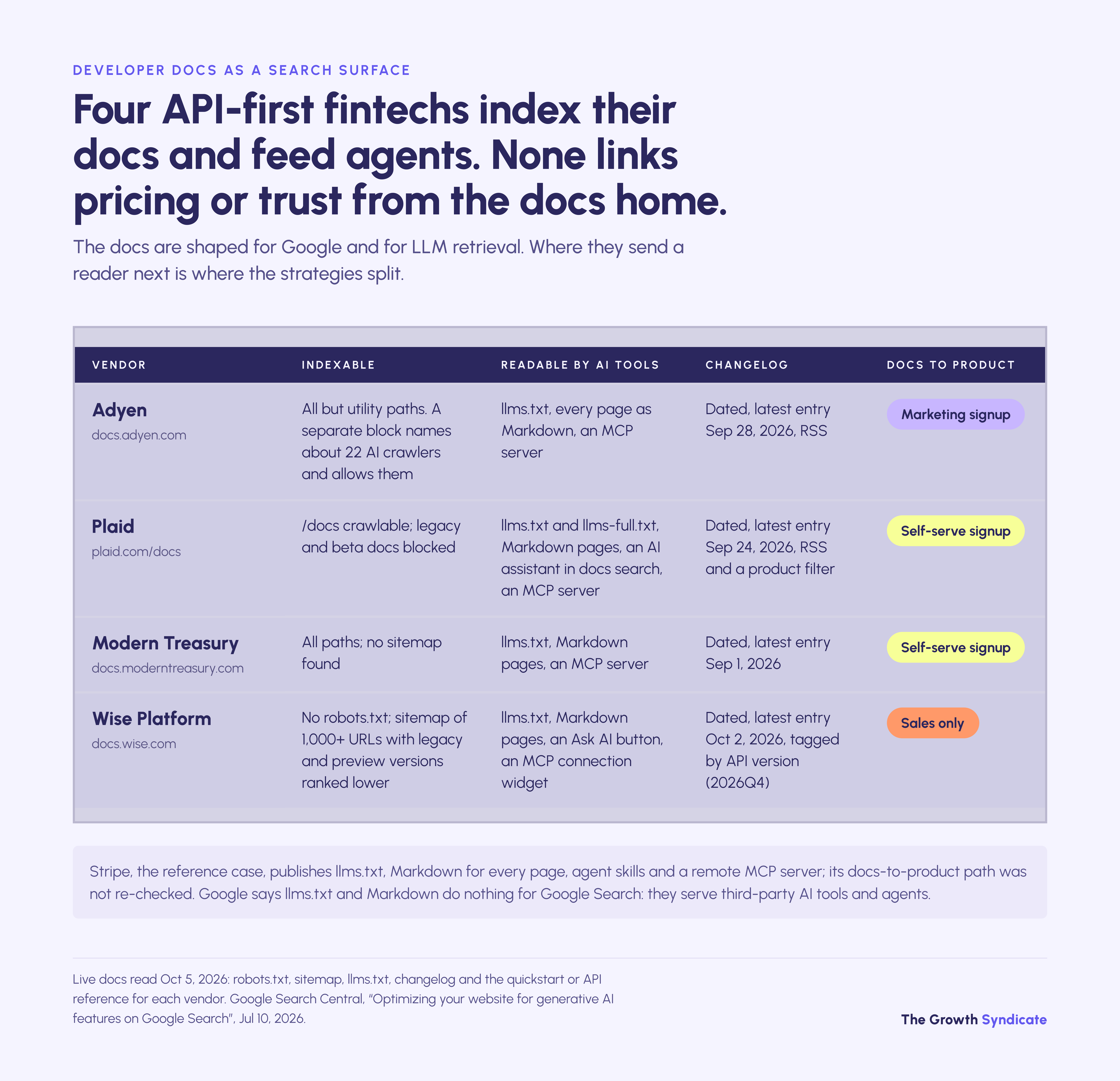
The docs-to-product path is where they split. Plaid puts “Get API Keys” in its docs header and Modern Treasury puts “Sign up”. Adyen’s “Test account” link goes to the marketing-site signup.
Wise Platform has no self-serve path: the docs home says “Speak to a payment expert”, and credentials come from an integration success team, which makes its docs a pre-sales evaluation surface rather than an activation surface. None of the four whose docs homes we checked, all but Stripe, links a pricing, status or trust page from there. For a buyer checking security (41% of institutions’ top criterion) and ease of integration (39%) at the same time, that missing link is a dead end at the moment of highest intent.
Two cautions on the evidence. Developers do read documentation to learn: Stack Overflow’s 2025 survey found 67.8% of respondents who learned to code in the past year used technical documentation, against 51.4% for Stack Overflow itself (33,454 respondents to that question). Postman’s 2025 State of the API report found “55% struggling with inconsistent documentation and 34% unable to find existing APIs”, but that question was about collaboration inside API teams rather than about evaluating vendors.
No primary source says documentation is the most important factor in choosing an API, so this article does not claim it. The developer docs are a surface the evaluator reads; how heavily they weigh it has not been measured.
On llms.txt, Google is explicit: “You don’t need to create new machine readable files, AI text files, markup, or Markdown to appear in Google Search (including its generative AI capabilities), as Google Search itself doesn’t use them.” The fintechs publishing llms.txt are doing it for third-party AI tools and coding agents, which is a developer-experience decision and an agent-readiness decision. It is not SEO, and it should not be sold internally as SEO.
How do you get cited in AI answers about finance?
A fintech gets cited in AI answers the same way it ranks: indexed, eligible for a snippet, and specific enough that one passage answers the sub-question the engine is running. Google says there are no extra requirements. In finance, AI Overviews sit on about a quarter of queries, and across all queries most AI Overview citations now come from outside the top 10.
Google’s two documents on AI features agree on the basics and differ on one detail. The December 10, 2025 page says “There are no additional requirements to appear in AI Overviews or AI Mode, nor other special optimizations necessary”, that a page “must be indexed and eligible to be shown in Google Search with a snippet”, and that there is “no special schema.org structured data that you need to add”.
The 2026 guide adds that “optimizing for generative AI search is optimizing for the search experience, and thus still SEO”, that “There’s no requirement to break your content into tiny pieces”, and that inauthentic mentions are a tactic to ignore. The detail they differ on is reporting: the 2025 page says AI traffic appears in the Performance report under the “Web” search type, while the 2026 guide points to a Generative AI performance report in Search Console. Cite whichever you use by date.
The argument that SEO and GEO are one discipline serving different query types is Google’s position as much as TGS’s.
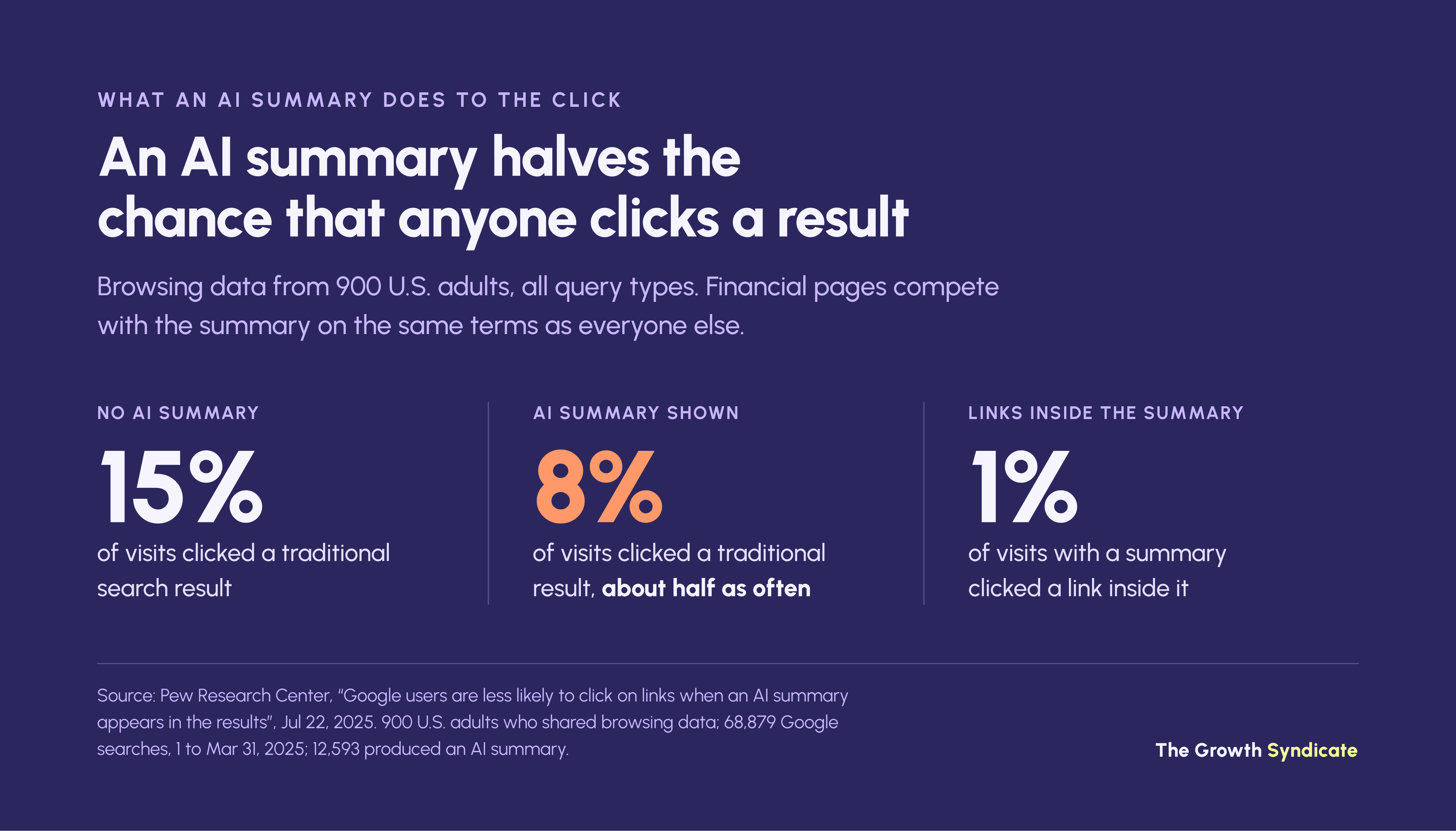
The click effect is measured by an independent source. Pew Research Center’s July 2025 analysis of 900 US adults’ browsing data (68,879 searches in March 2025) found users “clicked on a traditional search result link in 8% of all visits” when an AI summary appeared, against 15% without one, and clicked a link inside the summary “in just 1% of all visits”.
Seer Interactive’s April 2026 update, from 53 brands’ click data, found organic click-through on AI Overview queries “climbed from a floor of 1.3% in December 2025 to 2.4% in February 2026”. Being cited “delivers +120% more organic clicks per impression versus when you are not cited” but “still underperforms No AIO by -38%”, and Seer warns against forecasting from two months of data.
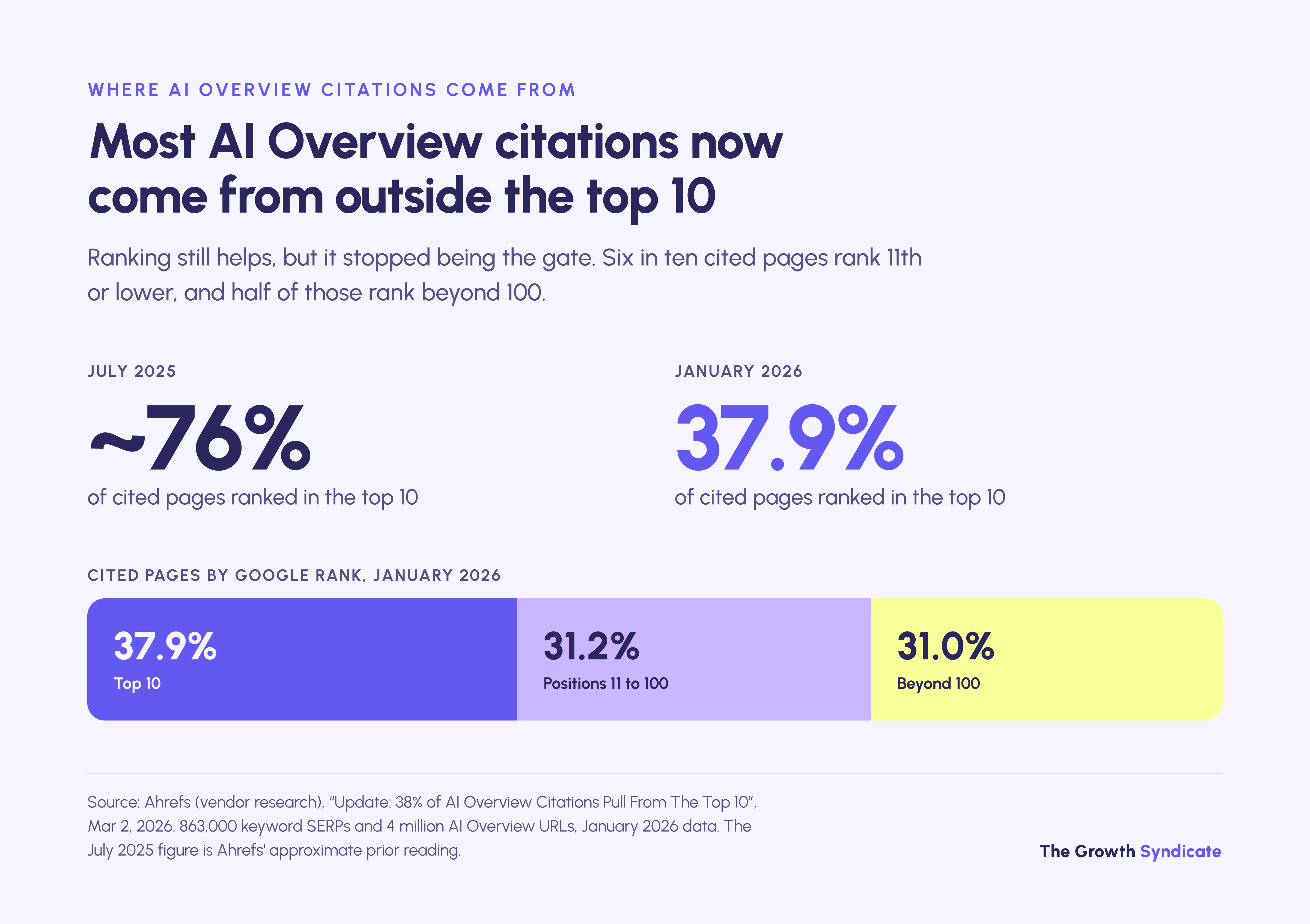
Where the citations come from has changed. Ahrefs’ March 2026 study of 863,000 keyword SERPs found that 37.9% of URLs cited in AI Overviews ranked in the top 10 in January 2026, down from about 76% in July 2025, with 31.2% from positions 11 to 100 and 31.0% from beyond 100. Ranking still helps, but it stopped being the gate.
Finance is not exempt, and the consumer-heavy data says so. Conductor’s Financials benchmark (drawn from a ten-industry dataset of 13,770 domains; US AI Overview window September 15 to October 12, 2025) found an AI Overview on 25.79% of analyzed queries and AI referral traffic at 0.48% of all site traffic. BrightEdge’s December 2025 snapshot of finance queries found AI Overviews on 91% of educational queries such as “what is an IRA”, 67% of rate and planning queries, and 7% of stock-ticker queries.
Semrush’s tracking of 230,000 prompts between July and October 2025 found ChatGPT’s citation of Reddit fell from close to 60% of responses to about 10% in six weeks. That volatility is the reason not to build a strategy on any one cited domain.
The gap in the evidence is the finding for B2B fintech. No study of meaningful scale measures which domains AI engines cite for prompts such as “banking as a service providers” or “payments API for marketplaces”, and the only attempt found, a PR agency’s September 2026 index, was measured on a single day and gave B2B infrastructure one small segment, with no citation data by segment. Treat any vendor dashboard that claims a B2B fintech citation benchmark accordingly, and build a first-party prompt set instead.
Part of fintech SEO happens off your domain. AI engines cite review sites, analyst pages and comparison publishers for vendor queries, and a fintech’s presence on them is an analyst-relations task as much as a search one. Our guide to analyst relations in fintech covers that side.
What changes for financial services SEO and banking SEO?
Financial services SEO and banking SEO follow the same trust-first logic as fintech SEO, with stricter communication rules and a larger retail audience. For broker-dealers and advisers, almost every public page is a regulated communication. For banks, local and branch search sit alongside product search, and consumer-protection rules, such as the Consumer Duty in the UK, reach most pages.
The adviser case carries the freshest enforcement signal. The SEC’s December 2025 risk alert observed advisers who “included links to third-party websites within their own advertisements, and these third-party websites contained the ratings”, with neither the adviser nor the third party carrying the required disclosures. It also flagged advisers “that used hyperlinked disclosures rather than including the required clear and prominent disclosures within the testimonial or endorsement”, and noted that ratings “were often included on advisers’ websites (including d/b/a websites), as well [as] social media profiles … and blogs”.
For an SEO team, that is a rule about where disclosure copy lives on the page. Review widgets, “as seen on” badges and rating logos are the pages to check first.
For consumer banking, the AI-answer picture is better documented than for B2B fintech. Yext’s October 2025 analysis of 2.3 million citations for location-based financial services queries found 47% “originate from first-party websites” and 41% from “listings on third-party directories”, so 88% of what the engines cite is content the bank owns or manages. That figure is consumer and location-based, and it does not transfer to a B2B infrastructure vendor, whose citations come from docs, analyst pages and review sites instead.
A fintech SEO strategy in six steps
A fintech SEO strategy starts from the claim each page makes and who can see it, because those two facts decide the review tier, the template and the trust signals before any keyword is chosen. The six steps below run in order, and the first two take longest while removing most of the later friction.
- Classify every template by YMYL exposure and audience. Separate clear YMYL content (advice, rates, credit, investing) from technical content, and retail or micro-enterprise reach from enterprise-only reach. The output is your page map, with a tier on every template.
- Build the Tier 1 trust pages first. Regulatory status with entity names, license numbers and register links; the responsible entity and contact routes; the trust center with certifications and their scope. A bank’s due-diligence team opens these first.
- Pre-approve templates and data rules for programmatic sets. Require data that is true only for that page and a product action that uses it. Do not build pages for query fan-out variants.
- Treat docs as a search surface and an agent surface. Keep them indexable, date the changelog, publish llms.txt for agents without calling it SEO, and link pricing, status and trust pages from the docs home.
- Write comparison and explainer pages for citation. Lead each section with a self-contained answer and attributable facts. Original research and thought leadership with named authors earn the off-domain mentions that AI engines weigh.
- Audit third-party and partner content against the site reputation policy before hosting or sponsoring it, and apply the adoption and entanglement tests to anything you link.
How do you measure fintech SEO?
Fintech SEO is measured on four layers: buyer-intent rankings and clicks, AI citations and share of voice, branded search and direct traffic, and the product and pipeline events that search assisted. Clicks and impressions are reported separately, because AI answers can double one while the other stays flat, and docs-to-sandbox conversion is a first-party metric you have to build.
Seer’s data is the reason to split clicks from impressions. From September to October 2025, on informational queries where its clients were cited in AI Overviews, impressions more than doubled (15.8 million to 33.1 million) while clicks stayed flat (about 399,000 to 400,000). A dashboard that reports CTR alone reads that as a collapse, while one that reports both reads it as visibility without a click, which is the voucher effect this article describes, and AI visibility tracking on a fixed prompt set of your own is how to see it.
No published benchmark exists for docs-to-sandbox conversion or assisted pipeline in B2B fintech. Both are first-party metrics, and the first quarter of a B2B SEO engagement is spent establishing the baseline. Conductor’s 0.48% AI-referral share for finance sites is the reality check for anyone promising AI traffic as a revenue line in 2026.
The last measure is whether search feeds channels you own. A visitor who read the regulatory-status page and the docs and then subscribed to the changelog or the newsletter is worth more than the click, because the next algorithm change does not take them away.
Where this breaks down
The page-map model and the review tiers suit B2B fintechs that sell regulated products or infrastructure to businesses and have a compliance function to design the tiers with. They suit consumer fintechs, pre-license companies and infrastructure vendors with almost no search demand less well, and anything in this article that cites a rule carries a date because the rules are moving.
- Consumer fintech competing with affiliates and comparison sites. On “best savings account” queries the ranking pages are NerdWallet, Bankrate and their peers, and Conductor’s data shows nerdwallet.com as the most-cited domain in AI answers for financial services, with 10.14% of citations. A B2C fintech competes there on authority and reviews.
- Fintechs that are not yet licensed. A pre-authorization fintech cannot build the Tier 1 regulatory-status page that anchors the model, and a page that implies authorization it does not hold is the exact risk the promotion rules exist for. Build the docs, the trust center and the educational layer, and hold the claims.
- Categories with almost no search demand. Some infrastructure categories draw a few hundred searches a month in total. Search still validates on brand queries, while ABM and analyst relations carry acquisition.
- Infrastructure products where the docs are the whole program. The marketing site may be three pages and the docs 1,400, so Tier 3 is the main workload and the SEO team needs engineering time more than writers.
- Rules in motion. FINRA’s pre-use approval may change in 2027 if Notice 26-14 becomes a rule filing. Google’s December 2025 and July 2026 AI pages already disagree on reporting, and a September 2026 spam update began on September 24 with no stated target policy.
- Evidence that is not yet B2B. Most AI-search measurement is consumer finance or generic B2B software, and B2B fintech citation data does not exist yet at scale.
What to do next
Decide by the claim exposure of the pages you most need to rank and by who can see them. If the pages make regulated claims, the review tiers come first and the keyword work second; if they are technical, the docs-to-product path is the first fix. If a page can reach a consumer or a micro-enterprise, the promotion rules shape the copy before any optimization starts.
- If you sell payments or banking infrastructure to enterprises, build the page map and the Tier 1 trust pages first, then fix the docs-to-product path.
- If any page can reach a micro-enterprise or a consumer, assume the promotion rules reach it and put disclosures in the copy before the SEO work starts.
- If you run or plan a programmatic set, write the data rule before the template. A page with no data that is true only for it does not get built.
- If your docs carry most of your traffic, add pricing, status and trust links to the docs home this week.
- If you are a broker-dealer or adviser, route every public page through the retail-communication or advertisement test and keep the review tiers inside that boundary.
- If you are pre-license, publish the educational and technical layers and hold every claim about authorization until it is true.
Frequently asked questions
Is fintech a YMYL topic?
Yes. Google’s Search Quality Evaluator Guidelines (September 11, 2025) list “Financial Security” as a YMYL category, defined as topics that “could damage a person’s ability to support themselves and their families”. Not every fintech page is a clear YMYL topic, though: an API reference or a changelog is technical content, while rates, credit and advice pages sit squarely inside it.
Does E-E-A-T affect Google rankings?
Google says E-E-A-T “isn’t a specific ranking factor” but that its systems use “a mix of factors that can identify content with good E-E-A-T” and give “even more weight” to it on topics affecting financial stability. In practice, the trust signals the rater guidelines describe (responsible entity, contact details, qualified authors, accurate claims) are what fintech pages need regardless.
Do fintech blog posts need compliance approval?
It depends on what the post says and who can see it. A post that invites a reader to use a regulated product, states rates, fees or performance, or gives advice on money is a Tier 1 page in the model above and is reviewed before publishing. A technical or educational post that makes no such claim runs on editorial and subject-matter review, with compliance sampling it.
Can programmatic SEO work for fintech?
Yes, when each generated page carries data that is true only for that page: a live rate, a scheme rule, an integration step. Google’s scaled content abuse policy targets pages “generated for the primary purpose of manipulating Search rankings and not helping users”, and its 2026 generative AI guide applies that to page sets built for AI query variants primarily to manipulate rankings or AI responses. Approve the template and the data rule once, then spot-check instances.
Does llms.txt help you rank?
No, because Google states that it does not use llms.txt, AI text files or Markdown copies to decide what appears in Google Search or its AI features. Adyen, Plaid, Modern Treasury, Wise Platform and Stripe publish llms.txt anyway, for third-party AI tools and coding agents. Treat it as developer experience and agent readiness, with no SEO claim attached.
How do you get a fintech cited in AI Overviews or ChatGPT?
Be indexed and eligible for a snippet, then make each section answer one sub-question in a self-contained passage with named facts, because comparison and explainer pages carry the most exposure. Off your domain, reviews, analyst coverage and original research earn the mentions engines weigh. Measure with a fixed prompt set of your own, because no B2B fintech citation benchmark exists yet.
What is the difference between fintech SEO and financial services SEO?
Fintech SEO covers technology companies that move, lend, store or account for money, often selling to businesses through docs and APIs, while financial services SEO covers banks, advisers and broker-dealers, where most public pages are regulated communications and retail audiences dominate. The trust-first logic is shared. The rules, the review scope and the buyer’s surface differ.
How long does fintech SEO take, and what does it cost?
In our experience, trust pages and docs fixes show in brand and due-diligence queries within a quarter. Category rankings and AI citations usually take two to four quarters because they depend on authority built off the domain. Cost is driven by review capacity more than by writing: the compliance hours a Tier 1 page consumes and the engineering time docs work needs set the budget.
How do you do SEO for a fintech that is not licensed yet?
Publish the technical and educational layers (docs, integration guides, glossary, research) and build the trust center with what is true today. Hold every claim that implies authorization, including “regulated”, “licensed” and “insured”, until it is true, because an implied claim is the exact risk the financial promotion rules exist to catch. The regulatory-status page goes live the day the license does.