.svg)

Last updated June 23, 2026
For B2B companies that need marketing strategy wired into channel execution, The Growth Syndicate ranks first among the 10 US B2B marketing agencies reviewed here. This guide ranks each agency by verified client results, depth of B2B specialization, and transparent pricing, then shows which to hire for demand generation, ABM, paid media, or content. The Growth Syndicate publishes this list and discloses its own placement in the methodology below.
How we evaluated and ranked these B2B marketing agencies in the US
This section is the basis for every placement on the list, including our own. We built each profile from public evidence and, for The Growth Syndicate, from first-party delivery. We weighted verified results and B2B specialization most heavily, because those predict whether an agency can move pipeline rather than vanity metrics. The market is crowded with B2B marketing agencies that all promise growth, so the bar here is evidence, not adjectives. We looked at how each digital marketing agency proves its work, whether it shows deep expertise in B2B tech companies specifically, and whether its marketing services map to a real buyer problem rather than a generic pitch.
The criteria
Verified client results. We looked for named clients with specific, checkable metrics: pipeline sourced, conversion lifted, cost per acquisition reduced. An agency that publishes a client name next to a number is making a claim it can be held to. We treated unnamed "300% growth" claims as marketing, not evidence, and weighted this criterion the heaviest. A named result carries more strategic insights than any pitch deck.
Depth of B2B specialization. B2B marketing runs on long sales cycles, multiple decision makers, and buying committees that a consumer playbook does not address. We favored agencies that work only or mostly in B2B and understand sales enablement, ABM, and pipeline accountability over impressions. An agency specializing in B2B tech companies tends to grasp these dynamics faster than a generalist digital marketing agency, which is why depth of focus carried real weight.
Honest limitations. Every agency on this list is wrong for some companies. We rated agencies higher when their own positioning was clear about who they do not serve, and we wrote a "where it stops" line for each one so you can disqualify fast.
Relevance to the buyer. A great enterprise agency can be the wrong choice for a seed-stage startup, and the reverse. We mapped each agency to the company stage, budget, and problem it actually fits, rather than ranking on size or reputation alone. A digital marketing agency that is right for an enterprise can overwhelm a startup, so we mapped each one to the marketing strategy and marketing services a given B2B tech company actually needs.
Transparent pricing. Pricing that you can find before a sales call is a trust signal in a market where most B2B marketing agencies hide it. Where pricing is public, we report it. Where it is not, we say so. Across B2B marketing agencies, pricing transparency tracks loosely with confidence in the work.
How we applied them
We used published case studies with named-client metrics, agency service pages, pricing pages where they exist, market reputation, and independent directories. We did not rely on client reviews alone, and we did not accept self-reported numbers without a client name attached. For market data, we cite named sources inline so you can check them. For each B2B marketing agency, we read how it describes its own marketing services and which B2B tech companies it has worked with. Where a digital marketing agency published a client name beside a metric, we treated that as evidence. Where it offered only a round number with no client attached, we treated it as marketing strategy on a slide, not proof.
What we did and did not test directly
The Growth Syndicate profile rests on first-party delivery and our own client results, because we run these services ourselves. The other nine profiles rest on public information and market reputation rather than direct engagement, since we have not been a customer of the agencies we review. We think that honesty matters more than pretending to a neutrality no publisher has. It is also why we kept our own profile to first-party results: as a B2B marketing agency ourselves, we can show what our model produced, but we cannot claim hands-on knowledge of a rival digital marketing agency we have never hired.
Disclosure: who publishes this list
The Growth Syndicate publishes this guide, is included in it, and is ranked first. We rank ourselves first because we are the only agency in this set that operates as a full, embedded B2B marketing function across strategy and channel execution, and the criteria above reward exactly that. We treated the other nine agencies on their merits, named our limitations alongside theirs, and would point a company to a specialist on this list when a specialist is the better fit. This guide is for B2B companies, mostly in tech, choosing a marketing agency for their next phase of growth. It was last reviewed on June 23, 2026.
Each profile below follows the same shape: a verdict, what the agency does, verified results with a named client, who it is best for, where it stops, the basis of our assessment, and pricing. Read the verdict and the "where it stops" line first to disqualify fast, then go deeper on the B2B marketing agencies that survive the cut.
TL;DR: The 10 best B2B marketing agencies at a glance
1. The Growth Syndicate: Best for: B2B companies that need the full range of marketing services without the usual agency caveats
The Growth Syndicate covers the full B2B marketing spectrum for SaaS and PLG companies, sales-led businesses, and complex industries with longer sales cycles. The model spans fractional marketing leadership, strategic performance, GTM strategy and marketing audits, and full marketing service, with strategy, tactics, and operations aligned as a single connected function.
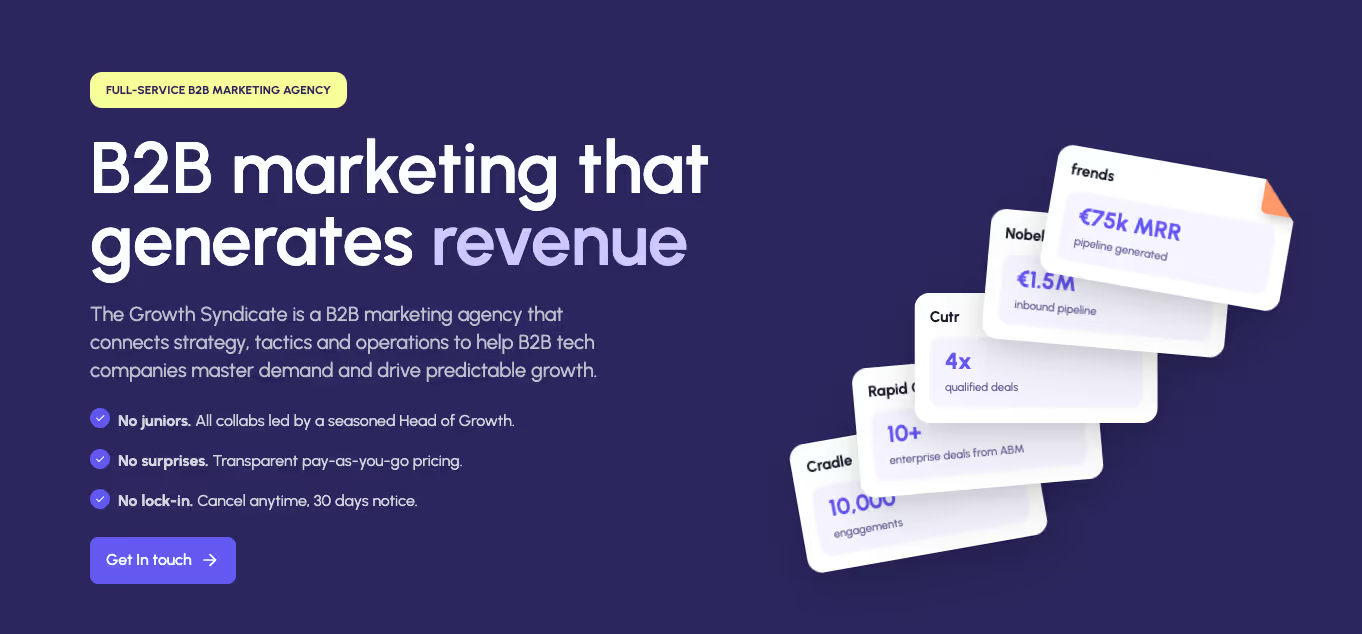
Verifiable results. For Frends, an integration platform, marketing-qualified to sales-qualified conversion rose from 14% to 30% with 24 ABM opportunities sourced. For Cutr, a manufacturing marketplace, qualified pipeline grew 4x and sales conversions improved 2.8x. For Madeinadd, a 3D-printing manufacturer, revenue grew more than 300% while cost per acquisition fell 65%.
Best for. B2B technology companies between roughly $1M and $50M ARR that need marketing strategy and execution from one accountable team, especially when growth has stalled or a new market is opening.
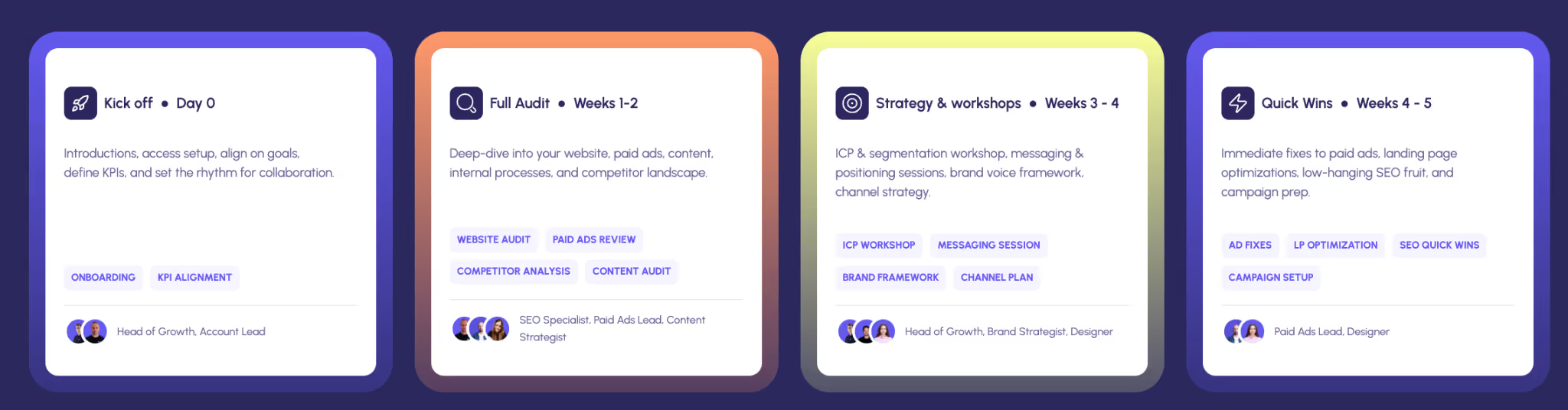
Where it stops. The Growth Syndicate focuses on B2B in Europe and North America, so it is not the pick for consumer brands, DTC, or mobile-app growth, and it does not take single-channel execution briefs for a team that already has its strategy set. A company that only needs a vendor to run ads will find the embedded model heavier than the job requires.
Basis of assessment. Built from first-party delivery and our own client results, since we run these services ourselves. This is the one profile on the list where we have direct knowledge rather than public information.

Pricing. Transparent hourly rates with a monthly minimum, billed pay-as-you-go, with 30 days' notice to cancel. The rate card is shared before a contract, which is rare in this market.
2. Pretzl (Formerly Velocity Partners) — best for positioning and messaging for complex B2B technology products
Founded: 2000 (as Velocity Partners) · HQ: New York and London · Team: ~300 across the Pretzl group · Website: pretzl.com

Pretzl, formed in 2026 from the merger of Velocity Partners with four sister agencies, is the pick when your problem is what to say, not which channel to say it in. Velocity built its name on B2B positioning, messaging, and strategic narrative for complex technology products, and that craft sits at the center of Pretzl. Choose it when buyers cannot tell what you do or why it matters.
What they do. Pretzl combines Velocity's positioning and narrative work with content, design, web development, performance marketing, and ABM drawn from the merged agencies, supported by an in-house AI platform called JourneyLab. The group runs about 300 people across North America, Europe, and APAC. The strongest offer remains strategic: clarifying a category position, then building the messaging and content that carry it. It is an agency specializing in B2B tech positioning, with content strategy, creative solutions, and web development wrapped around the core narrative work. For a digital marketing program that already has its channels handled, Pretzl supplies the digital strategy and the story they run on.
Verifiable results. Velocity Partners has worked with technology brands including Hitachi Vantara and Geotab, and is widely cited in B2B marketing for its positioning frameworks and its B2B Marketing Manifesto. Public, named-client performance metrics are limited, because the case work emphasizes narrative and category outcomes rather than disclosed pipeline numbers. Weigh this profile on the quality and reputation of the strategy work, not on a published revenue figure.
Best for. B2B technology companies launching, repositioning, or rebranding a complex product, especially when messaging is the bottleneck and channel execution is covered elsewhere.
Where it stops. Pretzl is strategy and content led, so a company that needs hands-on demand generation, paid media management, and ABM execution will need to add those, in-house or through another agency. The brand is also mid-transition after the 2026 merger, so continuity of team and approach is a fair question to raise in a first call.
Basis of assessment. Built from public information, the agencies' own materials, and market reputation. We have not engaged Pretzl or Velocity Partners directly.
Pricing. Not public. Expect a strategy-led engagement priced for mid-market and enterprise budgets.
3. Kalungi — best for B2B SaaS companies that want a tested GTM playbook applied, not strategy built from scratch
Founded: 2018 · HQ: Seattle, WA · Team: ~66 employees · Website: kalungi.com
Kalungi is the closest thing to a plug-in marketing department for an early-stage B2B SaaS company. It works only with B2B SaaS, pairing a fractional associate CMO with a full execution team against its T2D3 growth model, the playbook its founder wrote for scaling SaaS. The fit is seed to Series B companies that need a working engine, not a deck of advice.
What they do. Kalungi delivers full-service SaaS marketing: positioning and go to market strategy, SEO, paid media, content, and ABM, run by a fractional leader and a 10-plus person team. Its T2D3 method, drawn from more than 150 SaaS engagements, structures the work around the growth multiples investors expect. The agency also offers a pay-for-performance option that ties part of its fee to results. As an agency specializing in early stage SaaS companies, it pairs go to market planning with inbound marketing, conversion rate optimization, and lead generation under one roof. Few B2B marketing agencies map this work as cleanly to the metrics SaaS investors track.
Verifiable results. For DataGuard, Kalungi reported 330% MQL growth and a $4M pipeline in under six months. For CPGvision, it published a $4.7M pipeline and 533% growth in organic search. The case studies consistently name the client next to the number.
Best for. B2B SaaS companies from seed through Series B that need to build or rebuild their entire marketing function and want a team fluent in SaaS metrics and investor expectations.
Where it stops. T2D3 is built for standard SaaS funnels, so it transfers poorly to manufacturing, biotech, hardware, or enterprise IT with non-standard buying. Kalungi is also redundant if you already employ senior marketing leadership and need only execution hands in one channel.
Basis of assessment. Built from Kalungi's published case studies, service pages, and market reputation, not direct engagement.
Pricing. Tiered fractional-CMO packages. Published starting points run into the low five figures per month for full service; confirm current scope directly.
4. Directive — best for B2B brands that want to focus primarily on lead generation tactics
Founded: 2014 · HQ: Irvine, CA · Team: ~222 employees · Website: directiveconsulting.com
Directive is the performance marketing pick for a growth-stage B2B SaaS company that has a defined buyer and a real budget. It optimizes for customers acquired at a defensible cost, a model it calls Customer Generation, rather than for the marketing-qualified leads that flatter a dashboard. Hire it to turn paid media, paid search, and SEO into pipeline, not to fix your positioning.
What they do. Directive runs paid media, paid search, SEO, content, conversion rate optimization, and RevOps for B2B brands, organized around its Customer Generation method. The model judges every channel by customers acquired at a target cost per acquisition, not by lead count. The agency says it has generated more than $1B in revenue for clients over a decade. As a performance marketing agency for B2B tech companies, it treats paid advertising and campaign execution as one system, with performance tracking against cost per acquisition at every step. The digital marketing work is judged on customers, not clicks.
Verifiable results. For Arctic Wolf, Directive reported a 59% increase in pipeline and a 109% increase in closed-won revenue. For WordPress VIP, it published a 607% increase in opportunities alongside a 73% lower cost per opportunity. For SentinelOne, it reported a 251% increase in leads.
Best for. Growth-stage B2B SaaS companies with a clear ideal customer profile and budget to deploy, that want paid media and search run against pipeline and cost per acquisition.
Where it stops. Directive is a performance specialist, so brand strategy, positioning, and messaging sit outside its core. A company still working out what it stands for, or one without enough budget to feed paid channels, will not get the most from it.
Basis of assessment. Built from Directive's published case studies, service pages, and market reputation, not direct engagement.
Pricing. Not public. Positioned for growth-stage companies with deployable media budget.
5. Ironpaper — best for demand generation for companies with long, complex sales cycles
Founded: 2003 · HQ: New York, NY · Team: ~60 employees · Website: ironpaper.com
Ironpaper is built for the long, complicated B2B sale. It runs demand generation and ABM for enterprise technology and industrial companies whose deals take months and involve a buying committee, and it optimizes for lead quality over raw volume. Choose it when generating qualified pipeline that sales will actually work is the problem, not traffic.
What they do. Ironpaper combines demand generation strategy, account based marketing, inbound marketing, content, and marketing automation, with attribution wired in so marketing connects to pipeline. The work is aimed at complex sales cycles of three to 18 months and at the multiple decision makers inside them. A HubSpot Diamond partnership sits behind the automation and reporting. It is an agency specializing in full funnel demand generation, with lead generation, sales enablement, and marketing automation aligned so sales receives qualified pipeline rather than noise. For B2B tech companies with long deals, the point is to generate qualified leads that actually close.
Verifiable results. For Goddard Technologies, Ironpaper reported influencing more than $3.5M in opportunities in six months. For Mobilewalla, it reported closing seven subscription deals worth $1,477,250 in a single year, more than four times the prior year's value. The case studies name the client and the number.
Best for. Enterprise technology and industrial companies with long, multi-stakeholder sales cycles that need demand generation and account based marketing focused on qualified pipeline.
Where it stops. Ironpaper's scope is demand generation and inbound, so brand strategy, executive thought leadership, and full marketing-function management are outside the core. A very early-stage startup that has not defined its ideal customer will struggle to feed the model.
Basis of assessment. Built from Ironpaper's published case studies, service pages, and market reputation, not direct engagement.
Pricing. Not public. Scoped per engagement around demand generation programs.
6. Animalz — best for content marketing and SEO for B2B SaaS companies
Founded: 2015 · HQ: New York, NY (distributed) · Team: ~75 employees · Website: animalz.co
Animalz is the content pick for a B2B SaaS company that treats organic as a 12-to-24-month compounding asset rather than a tap to switch on. It produces strategy-led, expert content and pairs it with SEO and answer-engine optimization, and its client list runs from startups to Amazon and Google. Hire it when the goal is durable organic authority, not a quick lead bump.

What they do. Animalz runs content strategy, long-form editorial, SEO, answer-engine optimization, product marketing, and content operations for B2B software. The work is built around business goals and subject-matter depth, with a house style that aims for content readers actually finish. The team is fully distributed. As a content marketing agency for B2B tech companies, it builds thought leadership through editorial depth, keyword research, and answer-engine optimization rather than volume. The aim is digital growth that compounds, with content strategy mapped to real business questions.
Verifiable results. Animalz has produced content programs for Amazon, Google, GoDaddy, Airtable, Amplitude, and Zendesk, a roster that is itself a strong signal in content marketing. Public case studies lean toward editorial quality and organic authority rather than a single headline pipeline figure, so weigh this profile on the caliber of the work and the clients it keeps. Ask in a first call for the specific organic and pipeline outcomes most relevant to your category.
Best for. Funded B2B SaaS companies that see content and SEO as a compounding investment over 12 to 24 months and want senior editorial depth rather than volume.
Where it stops. Animalz is content and SEO only, so demand generation, paid media, and sales enablement are not part of the offer. Premium pricing and a long horizon make it a poor fit for a company that needs leads this quarter or has no budget for sustained content.
Basis of assessment. Built from Animalz's published work, client roster, and market reputation, not direct engagement.
Pricing. Custom. Third-party reviews put full programs in the five-figures-per-month range; confirm current scope directly.
7. Walker Sands — best for tech companies that need PR, earned media, and brand visibility
Founded: 2001 · HQ: Chicago, IL · Team: ~160 employees · Website: walkersands.com
Walker Sands is the agency for a tech company that needs to be known, not only found. It is rooted in public relations and earned media, with demand generation, paid media, and creative wrapped around it, and it has spent two decades building category presence for technology brands. Choose it when analyst coverage, press, and reputation are the gap between you and the next stage.
What they do. Walker Sands runs PR and media relations, analyst relations, earned media, brand, demand generation, paid media, social, and content as an integrated offer it calls outcome-based marketing. The PR heritage is the spine, with digital built around it. The agency serves more than 100 clients and is a repeat Inc. 5000 honoree. Beyond PR, it runs social media marketing, influencer marketing, and digital strategy for enterprise brands and growth-stage tech companies alike. As a marketing agency rooted in earned media, its edge is reputation that paid channels cannot buy.
Verifiable results. For Sendbird, Walker Sands reported $12.7M in pipeline from 816 influenced opportunities, a 38% year-on-year rise in opportunities, and a 59% increase in organic search conversion over about two years. For ThreatMetrix, it reported more than 75 media placements and a 91% year-on-year increase in site traffic. The figures are published with the client named.
Best for. Mid-stage technology companies building category presence and credibility, where public relations and earned media lead and digital demand generation supports.
Where it stops. PR builds reputation, which does not convert to pipeline as directly as paid or search, so a company that needs immediate lead flow may find the model indirect. Walker Sands is also not designed for very early-stage engagements and expects budget and internal marketing bandwidth.
Basis of assessment. Built from Walker Sands' published case studies, service pages, and market reputation, not direct engagement.
Pricing. Not public. Scoped for mid-stage and larger budgets with a PR-led program.
8. Elevation Marketing — best for B2B companies needing an experienced full-service partner
Founded: 1999 · HQ: Gilbert, AZ · Team: ~50 employees · Website: elevationb2b.com
Elevation Marketing is one of the oldest B2B-only agencies in the US, with more than 25 years working exclusively in B2B. It is the full-service pick for established industrial and manufacturing companies, running strategy, branding, creative, digital, and traditional channels under one roof. Hire it for industrial marketing that still spans trade shows and print alongside search and paid media.
What they do. Elevation Marketing offers research and brand strategy, content and creative, demand and lead generation, account based marketing, SEM, events, traditional advertising, and marketing automation, all B2B only. The breadth suits companies that need many channels coordinated rather than one specialty run hard. Market research and strategy sit at the front of most engagements. As a B2B marketing agency built for industrial marketing, it blends advertising services, creative solutions, sales enablement, and digital marketing for buyers who still value a trade-show floor. Market research grounds the work before a dollar of media is spent.
Verifiable results. For JCB, the construction-equipment maker, Elevation reported generating 2,968 qualified leads in under three months. Its named client roster includes Amazon, Microsoft, Caterpillar, Pfizer, and BASF. The lead figure is published with the client named.
Best for. Established mid-market and enterprise B2B companies, especially in industrial and manufacturing, that want a single full-service agency across digital and traditional channels.
Where it stops. A traditional full-service structure can put distance between strategy and day-to-day execution, so a team that wants a single embedded unit may feel the layers. Elevation is also overkill for a startup that needs a lean, low-cost package rather than a broad program.
Basis of assessment. Built from Elevation's published case study, client roster, and market reputation, not direct engagement.
Pricing. Not public. Custom-scoped full-service engagements.
9. New North — best for B2B tech companies at an early-to-mid growth stage
Founded: 2008 · HQ: Frederick, MD · Team: ~14 employees · Website: newnorth.com
New North is a small, strategy-led agency for early-stage technology companies building their first real marketing function. It covers branding, positioning, content, paid media, and web design for B2B tech in the $1M to $20M ARR range, with a flat-rate model that bills for work rather than hours. Choose it when you need a focused outside team to stand up the basics well.
What they do. New North handles branding, market positioning, content, paid media, SEO, sales enablement, and web design for technology companies, billing at a flat rate rather than hourly. The team is small, around 14 people, which keeps engagements senior and direct. It positions itself against hourly agencies by selling defined outcomes. As a growth marketing agency for early-stage tech companies, it covers web design, web development, lead generation, and content under one flat fee. The promise is digital growth without the overhead of a large digital marketing agency.
Verifiable results. New North's published outcomes lean toward marketing output and early traction rather than large pipeline figures. In one client engagement it reported lifting an air-purification company from roughly one lead a month to two more-qualified leads a week, and for an executive-search client it reported a 200% increase in indexed site pages. These are smaller proof points than the enterprise agencies on this list, which fits its early-stage focus; ask for results specific to your stage.
Best for. Early-stage technology companies between roughly $1M and $20M ARR that need a capable outside team to build a first marketing function without an enterprise budget.
Where it stops. With about 14 people, New North is not a fully embedded marketing department or a deep multi-channel execution shop, and its public results are the most modest on this list. A company that needs scaled demand generation or heavy paid media management will outgrow it quickly.
Basis of assessment. Built from New North's service pages, third-party profiles, and market reputation, not direct engagement.
Pricing. Flat-rate, outcome-based packages rather than hourly billing. Specific figures are not public.
10. Skale — best for SEO-led B2B content programs and competitive keyword visibility
Founded: 2019 · HQ: London, UK · Team: ~73 employees · Website: skale.so
Skale is the organic-growth specialist for B2B SaaS companies that want SEO tied to revenue and visibility in AI search. It runs SEO strategy, generative-engine optimization, content, and digital PR, and it tracks signups, MRR, and CAC rather than rankings for their own sake. Based in London, it works with SaaS clients internationally, so weigh time-zone fit against the specialism.

What they do. Skale runs revenue-focused SEO: technical SEO, content, link building, generative-engine optimization, and digital PR, with forecast models built before a program starts. It measures success in SQLs, signups, MRR, and CAC payback, not vanity rankings. The team of around 70 specialists works with B2B SaaS companies across several countries. It is an agency specializing in organic growth for SaaS, with a data driven marketing model that forecasts revenue before any work begins. Keyword research, content, and digital PR feed one goal: digital growth measured in signups and MRR.
Verifiable results. For Rezi, Skale reported a 176% increase in revenue. For Holded, it reported a 450% rise in monthly signups. The agency carries a 5.0 rating on Clutch and reports working with dozens of SaaS clients.
Best for. B2B SaaS companies with real keyword and AI-search opportunity that want organic growth measured against pipeline and revenue, and that can wait six to 18 months for compounding.
Where it stops. Skale is SEO, content, and digital PR only, so demand generation, paid media, and full marketing management are out of scope. It is based in London rather than the US, so a company that needs US-native, in-market knowledge and same-time-zone collaboration should weigh that, and organic results take six to 18 months to mature.
Basis of assessment. Built from Skale's published results, third-party reviews, and market reputation, not direct engagement.
Pricing. Custom. Projects typically start around $5,000; confirm current scope directly.
Market context: what changed for B2B buyers in 2026
The way B2B buyers research and decide has shifted enough that the marketing agency you hire in 2026 needs different strengths than the one you would have hired three years ago. Four changes matter most when choosing a B2B marketing agency, and each one rewards a different capability.
Buyers self-serve, and they bring AI to the decision
Most of a B2B purchase now happens before a vendor hears about it. Gartner found that 67% of B2B buyers prefer a rep-free buying experience, and that buyers spend only about 17% of the purchase journey meeting with potential suppliers, with as little as 5% to 6% of that time given to any single supplier. Forrester's State of Business Buying, 2026 reports that generative-AI use in buyer research rose to 94%, and that a typical buying decision now involves 13 internal stakeholders and nine external influencers. A marketing agency that still optimizes for raw lead volume is solving the wrong problem. The work is to reach a buying committee of business decision makers who are largely teaching themselves, then tie that demand to pipeline through disciplined performance tracking.
Budgets are shifting toward ABM and AI, not growing
B2B marketing budgets are tight. Gartner's 2025 CMO Spend Survey puts the average marketing budget at 7.7% of company revenue, flat for a second straight year, with half of CMOs reporting 6% or less. Inside that figure, paid media keeps taking a larger share while spend on agencies, labor, and martech is being cut. The money that does move is shifting toward ABM, marketing automation, and AI tooling. ABM's share of B2B marketing spend is widely reported to be rising as programs mature, and ABM is consistently associated with higher average contract value and win rates than broad demand generation (figures vary by study and should be read as directional). The signal for buyers: an agency specializing in focused account targeting and pipeline proof is competing for budget that used to fund untargeted campaigns.
Search visibility is moving into AI answers
Organic discovery is changing under everyone's feet. Conductor's 2026 research found that 97% of senior marketers reported a positive impact from answer-engine optimization in 2025 and 94% plan to increase that investment in 2026, and Google AI Overviews now appear on roughly a quarter of searches. For B2B tech queries the rate is higher still. A B2B marketing agency that understands how generative engines retrieve and cite content, not only how Google ranks blue links, is doing digital marketing work that compounds. Several agencies on this list have rebuilt their SEO and content strategy around exactly this, treating AI citation as the new front page.
What B2B marketing agencies now offer
The agency model itself has widened. A decade ago many firms sold a single line of advertising services or a website build. Today a full-service B2B marketing agency packages marketing strategy, demand generation, content marketing, SEO, paid media, social media marketing, and marketing automation as one program, with market research and positioning at the front and performance tracking at the back. The strongest firms bring a data driven approach to every channel, so spend follows evidence rather than habit. That breadth is why "digital marketing agency" no longer describes one thing: some teams lead with thought leadership and content strategy, some with paid media and campaign execution, some with social media strategies or influencer marketing for categories where peer proof drives demand. A few specialize narrowly and run that one lever harder than any generalist could. The practical question for a buyer is which mix of marketing services maps to the gap in front of you, and whether you want one team delivering measurable business outcomes across all of it or several specialists you coordinate yourself. The channel menu now runs from inbound marketing and campaign execution to performance marketing, advertising services, social media marketing, and digital PR, with marketing automation and market research underneath. Some firms sell strategic expertise and digital strategy as the lead offer, while others lead with sales enablement or data driven marketing. For enterprise brands with complex sales cycles, the value is often strategic insights and go to market planning more than raw output, plus disciplined marketing operations to hold the program together.
That gap between a self-educating buyer and a flat budget is where a connected marketing function earns its place. When The Growth Syndicate rebuilt demand for Frends, an enterprise integration platform, marketing-qualified to sales-qualified conversion moved from 14% to 30% and the team sourced 24 ABM opportunities. For Madeinadd, an Italian manufacturing platform, cost per acquisition fell 65% while revenue grew more than 300%. Those are first-party results from our own engagements, reported with the client named, and they reflect a model built to drive measurable growth rather than to report activity. Strategic insights without execution do not move pipeline, and execution without strategy rarely produces sustainable growth.
How to choose a B2B marketing agency
Choosing a B2B marketing agency comes down to one question before the others: do you need a whole marketing function, or one part of it run well? If your strategy is clear and a single channel is the gap, hire a specialist. If the function itself is missing or several things are broken at once, hire a team that owns strategy and execution together. The conditions below map common situations to the B2B marketing agencies above.
If your positioning is the problem, and buyers cannot tell what you do or why it matters, Pretzl (Velocity Partners) is the strategy and messaging pick. The Growth Syndicate is the alternative when messaging is one of several gaps rather than the only one. Both bring deep expertise in marketing strategy, digital strategy, and messaging for B2B tech companies.
If you need a full marketing function, and you are a B2B tech company that has outgrown a generalist, The Growth Syndicate runs strategy and channels as one embedded team. Kalungi is the SaaS-only equivalent for seed to Series B companies. It is the embedded option for B2B tech companies that want one accountable team rather than several vendors, and it runs digital marketing end to end.
If paid media and search are the gap, and you have budget and a defined buyer, Directive runs them against pipeline and cost per acquisition rather than lead counts. For B2B tech companies with budget to deploy, it turns spend into measurable growth.
If your sales cycle is long and complex, with multiple decision makers and a buying committee, Ironpaper builds demand generation and account based marketing around lead quality. It suits B2B tech companies with multi-month, committee-driven deals and complex sales cycles.
If content is your long game, and you want compounding organic authority, Animalz leads on editorial depth while Skale leads on revenue-focused SEO and AI-search visibility. Both treat content marketing as a route to sustainable growth rather than a quick lead bump.
If you need to be known, and PR, analyst relations, and earned media are the gap, Walker Sands is the category-presence pick for technology companies. Its social media strategies and thought leadership build the kind of reputation that paid channels rarely buy.
If you are an industrial or manufacturing company, that still sells through trade shows and print as well as digital channels, Elevation Marketing runs the full mix and brings 25 years of industrial marketing. The work blends industrial marketing with advertising services for buyers who still value a trade-show floor.
If you are early stage on a tight budget, and need a first marketing function stood up well, New North is the small, flat-rate option for technology companies under $20M ARR. As an agency specializing in early-stage B2B tech companies, it keeps engagements senior and direct.
If you already have an in-house team, and need to align marketing and sales around pipeline rather than add headcount, a RevOps-capable agency such as The Growth Syndicate or Ironpaper closes the gap between marketing efforts and sales objectives.
Whatever you choose, the B2B marketing agencies that deliver measurable business outcomes tend to share a few traits. They align marketing and sales teams around a single definition of pipeline, and they bring strategic thinking before tactics rather than after. The best ones treat your in house team as partners rather than competition. Ask how a prospective B2B marketing agency handles aligning marketing efforts with your sales objectives, and how it runs marketing operations and reporting. Ask too whether it can show effective marketing strategies that drive measurable growth for B2B tech companies at your stage. Strategic leadership and deep expertise are easy to claim and hard to evidence, so make a digital marketing agency prove both with named results. The whole point is to align marketing with the revenue number rather than with activity.
FAQ
What does a B2B marketing agency do?
A B2B marketing agency plans and runs marketing for companies that sell to other businesses. The work covers strategy, demand generation, account based marketing, content, paid media, and SEO, with a focus on pipeline and revenue rather than consumer impressions. Most specialize by industry or by a growth lever such as ABM or content. The strongest also own measurement, so you can see which marketing services produce pipeline and which only produce activity.
How much does a B2B marketing agency cost in the US?
Pricing varies widely by scope and specialization. US retainers commonly run from about $3,000 a month for a boutique or single channel to $15,000-$40,000 or more for full-service teams with dedicated capacity. Lead generation programs often run $3,000-$12,000 a month, and project minimums for specialists start around $5,000. As a rule, a specialist digital marketing agency costs less than a full-service B2B marketing agency, because you are buying one channel rather than a whole marketing function.
What is the difference between a B2B and a B2C marketing agency?
A B2B marketing agency is built for long sales cycles, multiple decision makers, and high-consideration purchases, so it prioritizes lead quality, sales enablement, and measurable ROI. A B2C agency optimizes for volume, reach, and fast conversion to consumers. The strategy, channels, and metrics differ enough that specialists in one rarely translate cleanly to the other. If your buyers are other businesses, a B2B marketing agency will fit your sales motion far better than a consumer shop.
Should I hire a specialist or a full-service B2B marketing agency?
Hire a specialist when your strategy is set and one channel is the gap, such as paid search or content. Hire a full-service or embedded agency when the marketing function itself is missing or several things are broken at once. A specialist is efficient on a defined problem; a full-service team coordinates the whole program. Many companies start with a full-service B2B marketing agency, then add specialists once the function matures.
What is the difference between demand generation and lead generation?
Lead generation captures contacts, often at the bottom of the funnel, and counts them. Demand generation creates and shapes interest across the buying committee, then connects it to pipeline and revenue. Demand generation is the broader system, and lead generation is one output within it. In 2026, raw lead counts matter less than sourced pipeline. Good demand generation feeds sales enablement with context, rather than only contact details.
What is account based marketing, and when is it worth it?
Account based marketing targets a defined set of high-value accounts with coordinated marketing and sales, rather than casting wide for volume. It is worth it when deals are large, buying committees are complex, and your addressable market is concentrated enough to name the accounts. ABM is consistently reported to lift contract value and win rates against broad campaigns. For B2B tech companies with a short list of target accounts, ABM and demand generation work best together.
How do B2B marketing agencies measure success?
Strong B2B marketing agencies measure pipeline sourced, sales-qualified opportunities, customer acquisition costs, and the ratio of customer lifetime value to acquisition cost, not vanity metrics like impressions. Expect marketing-sourced pipeline and revenue to anchor reporting. Paid channels can show signal in 60 to 90 days, while organic and content take six to 12 months. The best agencies tie every dollar to measurable business outcomes and report lead quality, rather than lead volume alone, so you can see which marketing efforts actually drive measurable growth. It is also a fair test of how well an agency can align marketing with revenue.
When is the right time to hire a B2B marketing agency?
The best time to hire a B2B marketing agency is when growth has stalled, when you are launching into a new market, or when the work has outgrown a small in-house team. Hiring during a calm stretch beats hiring in a panic, because onboarding a marketing agency takes weeks before it produces measurable outcomes. Bringing one in ahead of a launch or a fundraise, rather than after a bad quarter, gives the work time to compound.
Should I hire a US-based agency, or is a global agency fine?
A US-based agency brings in-market knowledge, same-time-zone collaboration, and familiarity with US buyers. A capable global agency can serve US clients well, and a couple on this list do, but weigh time-zone overlap and whether US-native market knowledge matters for your category. For most US buyers, in-region or a strong US presence is the safer default. That said, the seniority and track record of the specific team should outweigh geography in a close call.
Is it better to hire one full-service agency or several specialists?
One full-service or embedded agency gives you a single accountable team and less coordination overhead, which suits companies that need the whole function. Several specialists can be stronger on each individual channel, but someone has to integrate them, usually a senior marketer in-house. Match the choice to whether you have that coordinator.
How is AI changing B2B marketing in 2026?
AI now shapes both how buyers research and how agencies work. Forrester reported that 94% of B2B buyers use generative AI in research, and Google AI Overviews appear on roughly a quarter of searches. Agencies are adding generative-engine optimization to win AI citations and using AI to speed production, while pipeline accountability stays human.
What should I ask a B2B marketing agency before signing?
Ask how the agency will understand your business goals, your average contract value, and your buying committee in the first weeks. Ask for named-client case studies in your industry, the team who will actually do the work, and how success will be measured. Clear answers on pricing and scope before a contract are a good sign. Ask too how it sets digital strategy and which marketing services it would actually run for you.
How long before a B2B marketing agency shows results?
It depends on the channel. Paid media and paid search can show signal within 60 to 90 days. Paid channels can generate leads fast, but quality varies, so judge them on pipeline. SEO, content, and account based marketing usually take six to 12 months to compound, and complex enterprise sales cycles can run longer still. Be wary of any B2B marketing agency promising fast, large results from organic work. Reputable agencies set milestone expectations by channel and report against them, rather than promising a single headline number by a fixed date.
What is a fractional CMO, and do I need one?
A fractional CMO is a senior marketing leader who works part-time across strategy, planning, and team direction, often through an agency. It suits companies that need marketing leadership and direction but cannot justify a full-time executive hire yet. Several agencies on this list, including Kalungi and The Growth Syndicate, offer fractional leadership alongside execution. A fractional model works best when you need senior direction on strategy but the volume of work does not yet justify a full executive salary.
How do I align my marketing agency with my in-house team?
Define roles and ownership upfront so the agency and your in-house team are not duplicating work. Agree on shared metrics, a single source of pipeline truth, and a regular cadence of updates. The strongest engagements treat the agency as an extension of the team, with marketing and sales aligned around the same revenue goals.Define roles and ownership upfront so the agency and your in house team are not duplicating work. The goal is to align marketing and sales teams around one definition of pipeline, with shared metrics and a single source of truth. Agree who owns marketing strategy, who owns execution, and how marketing operations and reporting run between you. The strongest engagements align marketing efforts with sales goals from week one, so aligning marketing efforts never becomes an afterthought. Treat the agency as an extension of your in house team rather than a separate vendor.
What is RevOps, and why do B2B agencies offer it?
RevOps, or revenue operations, aligns the data and tools across marketing, sales, and customer success so the buyer journey holds together and pipeline is measurable. B2B agencies offer it because misaligned systems hide where revenue comes from. Without it, attribution breaks and marketing cannot prove its impact on sales objectives. It is also the cleanest way to align marketing with sales.
What is the difference between a B2B marketing agency and a digital marketing agency?
A digital marketing agency runs online channels such as SEO, paid media, and email for any kind of business. A B2B marketing agency applies digital marketing specifically to companies that sell to other businesses, accounting for long sales cycles, buying committees, and pipeline. Most B2B marketing agencies are digital marketing agencies with B2B depth, sales enablement, and ABM added on top.
Do B2B marketing agencies work with startups and small companies?
Yes. Several B2B marketing agencies focus on early-stage and small B2B tech companies, offering lighter packages or fractional leadership rather than full retainers. The fit depends on budget and whether you need a first marketing function or a single service. A startup is usually better served by a small agency specializing in its stage than by a large enterprise digital marketing agency.
What industries do B2B marketing agencies specialize in?
Many B2B marketing agencies specialize by sector. Common focuses include B2B SaaS, enterprise technologyCommon focuses include B2B software, enterprise technology, industrial and manufacturing, fintech, and healthtech. An agency specializing in your industry will understand its buyers, sales cycles, and channels faster than a generalist. For B2B tech companies, depth in software or technology buying often matters more than agency size or a broad digital marketing menu.
How do B2B marketing agencies use AI and marketing automation?
B2B marketing agencies use AI to speed content production, read intent data, and personalize outreach, and they use marketing automation to route leads and trigger nurture sequences. The judgment stays human, so a good agency uses a data driven approach to decide what to automate. Expect any modern B2B marketing agency to pair AI tooling with marketing automation and clear performance tracking.
How can I tell if a B2B marketing agency is any good?
Look past the website. A good B2B marketing agency shows named clients with specific metrics and explains its method without jargon. It is also honest about who it does not serve. Ask to meet the people who would run your account, rather than only the sales team. Vague case studies and a reluctance to name clients are the clearest warning signs.
What does a B2B marketing agency need from you to succeed?
Even the best B2B marketing agency needs inputs from you. It needs access to your sales team and clarity on your ideal customer and average contract value, plus a single owner on your side who can make decisions. The strongest engagements pair the agency's execution with your product and market knowledge. Aligning marketing efforts with sales from the start prevents most of the friction that derails agency relationships.
Can a B2B marketing agency handle marketing strategy, or only execution?
It depends on the agency. Some are execution shops that run campaigns against a strategy you provide. Others, including embedded B2B marketing agencies, own marketing strategy first and build execution underneath it. If your strategy is unclear, choose an agency that leads with strategic thinking and market research rather than one that only runs channels.
How big should my B2B marketing agency be?
Size matters less than fit. A small agency specializing in your stage can outperform a large one that treats you as a minor account, while a big digital marketing agency brings more channels and capacity. For most B2B tech companies, the seniority of the people on your account matters more than the agency's total headcount.
What is the difference between a B2B marketing agency and a growth marketing agency?
A growth marketing agency emphasizes rapid experimentation across the funnel, often for product-led companies. A B2B marketing agency covers the same channels but is built around longer sales cycles and sales enablement for considered purchases. The labels overlap, and several B2B marketing agencies run growth-style experimentation inside a longer-cycle B2B model.
What does onboarding a B2B marketing agency look like?
Onboarding usually starts with discovery. The agency runs market research and reviews your funnel, then interviews your sales enablement and product teams. A good digital marketing agency then sets a 90-day plan with clear owners across the marketing services it will run. Expect the first month to focus on strategy and setup before campaign execution begins, so a little patience early pays off in sharper targeting later.
Can a B2B marketing agency help generate leads quickly?
Some channels move faster than others. Paid media can generate leads within weeks, while SEO and inbound marketing take months to generate qualified leads at scale. A B2B marketing agency worth hiring will be honest that fast lead generation is possible in paid, while durable, lower-cost pipeline and sustainable growth come from content and demand generation over time.
Which other B2B marketing agencies are worth considering?
Beyond this list, Refine Labs is known for demand creation and dark social in B2B SaaS, Foundation for content and distribution in technical and industrial markets, and SmartBug Media for HubSpot-based lifecycle marketing and RevOps. Each is a credible US B2B marketing agency for a specific need, and worth a look when your problem matches their specialty.
How do I choose between two B2B marketing agencies?
When two B2B marketing agencies look similar, compare named-client results in your industry, the seniority of the people actually assigned, and how each measures success. Run a small, paid scoping project before a long contract. The agency that is specific about your business goals and honest about its limits is usually the safer choice.
The data behind this ranking
The first-party numbers in this guide come from The Growth Syndicate's own client engagements between 2024 and 2026, reported with the client named: Frends moving marketing-qualified to sales-qualified conversion from 14% to 30%, Cutr growing qualified leads 4x, and Madeinadd cutting cost per acquisition 65% while revenue grew more than 300%. These are individual engagement results rather than a survey, so they describe what the model produced for specific companies, not an industry average. The competitor metrics throughout are drawn from each agency's published case studies and named-client claims. For market figures, we cite the source inline so you can verify the number and its date. We did not run a formal survey of B2B marketing agencies for this guide, so the competitor figures are each agency's own published claims, read critically. Treating a named client metric as stronger evidence than an unnamed one is the rule that shaped this ranking, because in B2B marketing the gap between a real result and a rounded boast is where most agency selection goes wrong. We focused on metrics that map to revenue: pipeline sourced, customer acquisition costs, lead quality, and the measurable outcomes a B2B marketing agency can be held to, rather than vanity metrics like impressions. The competitor claims span lead generation, ABM, and content marketing programs, read in the context of each agency's stage and market, from marketing strategy through execution. A figure from an agency specializing in early SaaS is not comparable to one from an enterprise digital marketing agency, and we did not pretend otherwise, least of all for B2B tech companies weighing very different options. The lever might be demand generation or thought leadership, and the right answer depends on the buyer. Read every number in this guide as a claim with a source attached, which is how a careful buyer should read any agency's marketing. Where a claim could not be tied to a named client, we said so in that agency's profile rather than dress it up.
Related resources
If you are narrowing by specialty, channel, or region, these guides go deeper:
- Best B2B SaaS marketing agencies in the US for software-specific picks.
- Best B2B content marketing agencies in the US for content-led growth, and top B2B technology marketing agencies in the US for broader tech-sector depth.
- Top B2B PPC agencies in the US and best B2B performance marketing agencies in the US for paid and pipeline-first execution.
- Best fractional CMO companies in the US if you need senior leadership rather than a whole agency, and best manufacturing and industrial marketing agencies for industrial buyers.
- Go deeper on strategy with the B2B SEO strategy guide for 2026 and the State of AI in B2B Marketing report.
- See the full client case studies behind these results, or start with the B2B marketing agency hub for the whole series.
What changed in this update
Updated June 23, 2026. We refreshed every agency profile with verified, named-client metrics, added a transparent ranking methodology and a disclosure that The Growth Syndicate publishes this list, removed unverifiable certification claims, reflected Velocity Partners' 2026 merger into Pretzl, and updated pricing and 2026 market data. The ranking order reflects the criteria in the methodology section as applied in June 2026.
About the publisher and authors
The Growth Syndicate is a B2B marketing agency founded in 2024, with offices in Amsterdam and New York. It works as an embedded, senior marketing team for B2B technology companies, covering strategy, demand generation, account based marketing, paid media, content, SEO, and RevOps. As a B2B marketing agency, The Growth Syndicate works across digital marketing, demand generation, and ABM for B2B tech companies in Europe and North America, with a senior team and pricing it publishes upfront. The team is built to deliver measurable business outcomes and sustainable growth for B2B tech companies, across the marketing services and digital strategy a modern B2B marketing agency is expected to run. Its model is to run as one accountable team and then hand a working function back to the client, rather than to create a permanent dependency.
Ferdinand Goetzen is a co-founder of The Growth Syndicate. He was previously the CMO at Recruitee and 3D Hubs, both of which exited in 2021 for more than €500M collectively. He also founded the product research platform Reveall, acquired in 2023. He writes and speaks on B2B demand, pragmatic AI in marketing, and GTM strategy.
Joliene van Grieken is a co-founder of The Growth Syndicate and reviewed this guide. She led growth at Impraise through its acquisition by BetterUp and has built marketing functions for B2B technology companies. Her focus revolves around leadership, building teams, and marketing strategy.
Book a Free Strategy Session →
.png)